LITERATURE.ToC (continued 2)
Reading edition
To account for his frequent use of dialogue, and his dramatic effects of narrative, we must remember the tribunal to which the work of Herodotus was subjected. Every author, unconsciously to himself, consults the tastes of those he addresses. No small coteries of scholars, no scrupulous and critical inquirers, made the ordeal Herodotus underwent. His chronicles were not dissertations to be coldly pondered over, and skeptically conned; they were read aloud at solemn festivals to listening thousands: they were to arrest the curiosity—to amuse the impatience—to stir the wonder of a lively and motley crowd. Thus the historian imbibed naturally the spirit of the tale-teller, as he was driven to embellish his history with the romantic legend—the awful superstition—the gossipy anecdote—which yet characterize the stories of the popular and oral fictionist in the bazaars of the Mussulman, or on the sea-sands of Sicily. Still it has been rightly said, that a judicious reader is not easily led astray by Herodotus in important particulars. His descriptions of localities, of manners and of customs, are singularly correct; and travelers can yet trace the vestiges of his fidelity.
Few enlightened tourists are there who can visit Egypt, Greece, and the regions of the East, without being struck by the accuracy, with the industry, with the patience of Herodotus. To record all the facts substantiated by travelers, illustrated by artists, and amplified by learned research, would be almost impossible; so abundant, so rich, has this golden mine been found, that the more its native treasures are explored, the more valuable do they appear. The oasis of Siwah, visited by Browne, Hornemann, Edmonstone, and Minutuoli; the engravings of the latter, demonstrating the co-identity of the god Ammon and the god of Thebes; the Egyptian mode of weaving, confirmed by the drawings of Wilkinson and Minutuoli; the fountain of the sun, visited by Belzoni; one of the stelæ or pillars of Sesostris, seen by Herodotus in Syria, and recognized on the road to Beyrout with the hieroglyphic of Remeses still legible; the kneading of dough, drawn from a sculpture in Thebes, by Wilkinson; the dress of the lower classes, by the same author; the prodigies of Egyptian architecture at Edfou; Caillaud's discovery of Meroe in the depths of Æthiopia; these, and a host of brilliant evidences, center their once divergent rays in one flood of light upon the temple of genius reared by Herodotus, and display the goddess of Truth enshrined within.
The following are the main subjects of his nine books, which were named after the nine muses:—
Book I. Clio.—Transfer of the Lydian Kingdom from Gyges to Crœsus—minority of Cyrus—his overthrow of the Lydian power—rising greatness of Athens and Lacedæmon.
Book II. Euterpe.—Dissertation on Egypt—Egyptian customs, and the regal succession of that Empire.
Book III. Thalia.—Achievements of Cambyses—his total subjugation of Egypt—election of Darius Hystaspes to the Persian throne, then vacant by the assassination of Smerdis, the impostor.
Book IV. Melpomene.—Full narrative of the calamitous expeditions of the Persians against the Scythians in the reign of Darius Hystaspes.
Book V. Terpsichore.—The political progress of Lacedæmon, Athens and Corinth—view of their relative resources during the time of Darius—expulsion of Hippias from Athens.
Book VI. Erate.—Origin of the Kings of Lacedæmon—causes of Darius' hostility to Greece—first Persian invasion of Hellas—battle of Marathon.
Book VII. Polyhymnia.—Preparations and grand expedition of Xerxes into Greece—battle at Thermopylæ.
Book VIII. Urania.—Further progress of the Persian arms—Athens captured and burned—defeat of the Persians at the sea-fight of Salamis.
Book IX. Calliope.—Defeat of the Persians at Platæa—defeat at the promontory of Mycale, and their complete retreat within their own territories.
THE CROCODILE. (By Herodotus.)
The following are the peculiarities of the crocodile: During the winter months they eat nothing; they are four-footed, and live indifferently on land or in the water. The female lays and hatches her eggs ashore, passing the greater portion of the day on dry land, but at night retiring to the river, the water of which is warmer than the night-air and the dew. Of all known animals this is the one which from the smallest size grows to be the greatest, for the egg of the crocodile is but little bigger than that of the goose, and the young crocodile is in proportion to the egg, yet when it is full grown, the animal measures frequently seventeen cubits, and even more. It has the eyes of a pig, teeth large and tusk-like, of a size proportioned to its frame; unlike any other animal, it is without a tongue; it can not move its under-jaw, and in this respect, too, it is singular, being the only animal in the world which moves the upper-jaw but not the under. It has strong claws and a scaly skin, impenetrable upon the back. In the water it is blind, but on land it is very keen of sight. As it lives chiefly in the river, it has the inside of its mouth constantly covered with leeches, hence it happens that, while all the other birds and beasts avoid it, with the trochilus it lives at peace, since it owes much to that bird, for the crocodile, when he leaves the water and comes out upon the land, is in the habit of lying with his mouth wide open, facing the western breeze; at such times the trochilus goes into his mouth and devours the leeches. This benefits the crocodile, who is pleased, and takes care not to hurt the trochilus.
The crocodile is esteemed sacred by some of the Egyptians, by others he is treated as an enemy. Those who live near Thebes, and those who dwell around Lake Mœris, regard them with especial veneration. In each of these places they keep one crocodile in particular, who is taught to be tame and tractable. They adorn his ears with ear-rings of molten stone or gold, and put bracelets on his fore-paws, giving him daily a set portion of bread, with a certain number of victims; and, after having thus treated him with the greatest possible attention while alive, they embalm him when he dies and bury him in a sacred repository. The people of Elephantine, on the other hand, are so far from considering these animals as sacred that they even eat their flesh.
The modes of catching the crocodile are many and various. I shall only describe the one which seems to me most worthy of mention. They bait a hook with a chine of pork and let the meat be carried out into the middle of the stream, while the hunter upon the bank holds a living pig, which he belabors. The crocodile hears its cries and, making for the sound, encounters the pork, which he instantly swallows down. The men on the shore haul, and when they have got him to land, the first thing the hunter does is to plaster his eyes with mud. This once accomplished, the animal is dispatched with ease, otherwise he gives great trouble.
ARTABANUS DISSUADES XERXES. (By Herodotus.)
The other Persians were silent, for all feared to raise their voice against the plan proposed to them. But Artabanus, the son of Hystaspes, and uncle of Xerxes, trusting to his relationship, was bold to speak: "O King," he said, "it is impossible, if no more than one opinion is uttered, to make choice of the best; a man is forced then to follow whatever advice may have been given him, but if opposite speeches are delivered, then choice can be exercised. In like manner pure gold is not recognized by itself, but when we test it along with baser ore, we perceive which is the better. I counseled thy father, Darius, who was my own brother, not to attack the Scyths, a race of people who had no town in their own land. He thought, however, to subdue those wandering tribes, and would not listen to me, but marched an army against them, and ere he returned home lost many of his bravest warriors. Thou art about, O King, to attack a people far superior to the Scyths, a people distinguished above others both by land and sea. 'Tis fit, therefore, that I should tell thee what danger thou incurrest hereby. Thou sayest that thou wilt bridge the Hellespont, and lead thy troops through Europe against Greece.
"Now, suppose some disaster befall thee by land or sea, or by both. It may be even so, for the men are reputed valiant. Indeed one may measure their prowess from what they have already done; for when Datis and Artaphernes led their huge army against Attica, the Athenians singly defeated them. But grant they are not successful on both elements. Still, if they man their ships, and, defeating us by sea, sail to the Hellespont, and there destroy our bridge—that, sire, were a fearful hazard. And here 'tis not by my own mother wit alone that I conjecture what will happen, but I remember how narrowly we escaped disaster once, when thy father, after throwing bridges over the Thracian Bosphorus and the Ister, marched against the Scythians, and they tried every sort of prayer to induce the Ionians, who had charge of the bridge over the Ister, to break the passage. On that day, if Histiæus, the King of Miletus, had sided with the other princes, and not set himself to oppose their views, the empire of the Persians would have come to naught. Surely a dreadful thing is this even to hear said, that the King's fortunes depended wholly on one man.
"Think, then, no more of incurring so great a danger when no need presses, but follow the advice I tender. Break up this meeting, and when thou hast well considered the matter with thyself, and settled what thou wilt do, declare to us thy resolve. I know not of aught in the world that so profits a man as taking good counsel with himself; for even if things fall out against one's hopes, still one has counseled well, though fortune has made the counsel of no effect: whereas, if a man counsels ill and luck follows, he has gotten a windfall, but his counsel is none the less silly. Seest thou how God with His lightning smites alway the bigger animals, and will not suffer them to wax insolent, while those of lesser bulk chafe Him not? How likewise His bolts fall ever on the highest houses and the tallest trees? So plainly does He love to bring down everything that exalts itself. Thus oft-times a mighty host is discomfitted by a few men, when God in His jealousy sends fear or storm from heaven, and they perish in a way unworthy of them. For God allows no one to have high thoughts but Himself. Again, hurry always brings about disasters, from which huge sufferings are wont to arise; but in delay lie many advantages, not apparent (it may be) at first sight, but such as in the course of time are seen of all. Such, then, is my counsel to thee, O King.
"And thou, Mardonius, son of Gobryas, forbear to speak foolishly concerning the Greeks, who are men that ought not to be lightly esteemed by us. For while thou revilest the Greeks, thou dost encourage the King to lead his own troops against them; and this, as it seems to me, is what thou art specially striving to accomplish. Heaven send thou succeed not to thy wish! For slander is of all evils the most terrible. In it two men do wrong, and one man has wrong done to him. The slanderer does wrong, forasmuch as he abuses a man behind his back; and the hearer, forasmuch as he believes what he has not searched into thoroughly. The man slandered in his absence suffers wrong at the hands of both; for one brings against him a false charge, and the other thinks him an evil-doer. If, however, it must needs be that we go to war with this people, at least allow the King to abide at home in Persia. Then let thee and me both stake our children on the issue, and do thou choose out thy men, and taking with thee whatever number of troops thou likest, lead forth our armies to battle. If things go well for the King, as thou sayest they will, let me and my children be put to death; but if they fall out as I prophesy, let thy children suffer, and thou, too, if thou shalt come back alive. But shouldst thou refuse this wager, and still resolve to march an army against Greece, sure I am that some of those whom thou leavest behind thee will one day receive the sad tidings that Mardonius has brought a great disaster upon the Persian people, and lies a prey to dogs and birds somewhere in the land of the Athenians, or else in that of the Lacedæmonians; unless, indeed, thou shalt have perished sooner by the way, experiencing in thy own person the might of those men on whom thou wouldst fain induce the King to make war."
SOCRATES.
Socrates was born at Athens about the middle or latter part of April, 469 B.C. He commanded more admiration and reverence than any other individual of ancient or modern times. By his ability and purity he emerged from a barbaric sophistry into the purest form of religion that was ever invented by man, it was nearer like that of Christ than was ever reached by mortal before. The object of his entire philosophy was the attainment of correct ideas concerning moral and religious obligations.
Although Socrates was the son of a sculptor of limited means, he was educated according to the manner of the times. Music and poetry and gymnastic exercises formed the principal part of the education of an Athenian youth, and in these Socrates was instructed.
Through the influence of Crito, a wealthy Athenian who subsequently became an intimate friend and disciple of our philosopher, he was induced to rise into a higher sphere. He then began the study of physics, mathematics, astronomy, natural philosophy, etc.
Socrates, however, was unable to obtain any satisfactory knowledge from the philosophers and teachers of his time. Dissatisfied with the pretended wisdom of the Cosmologists and Sophists he entirely abandoned all speculative subjects and devoted his entire attention to human affairs, and his earnestness as a social reformer brought upon him increasing odium from the "Conservatives" of the day, as well as from that still larger class whose feelings of malice and revenge towards those who expose their follies and their vices, their wicked private customs and public institutions, can never be appeased but with the death of their victim. Accordingly, prejudice, unpopularity and hate finally prevailed, and two charges were brought against him, one of not believing in the national deities and the other of corrupting the youth. That he did not believe in the idols that most of his contemporaries worshiped, is true; but that he corrupted the youth was as absurd as false, for all his teachings tended ever to purify them, and lead them in the paths of virtue and truth. He defended himself, and his defense is a perfect whole, neither more nor less than what it ought to have been. Proudly conscious of his innocence, he sought not to move the pity of his judges, for he cared not for acquittal, and "exhibited that union of humility and high-mindedness which is observable in none, perhaps, with the exception of St. Paul." His speech availed not, and he was condemned to drink the hemlock. He continued in prison thirty days before the sentence was executed, and to this interval we are indebted for that sublime conversation on the immortality of the soul which Plato has embodied in his Phædo.
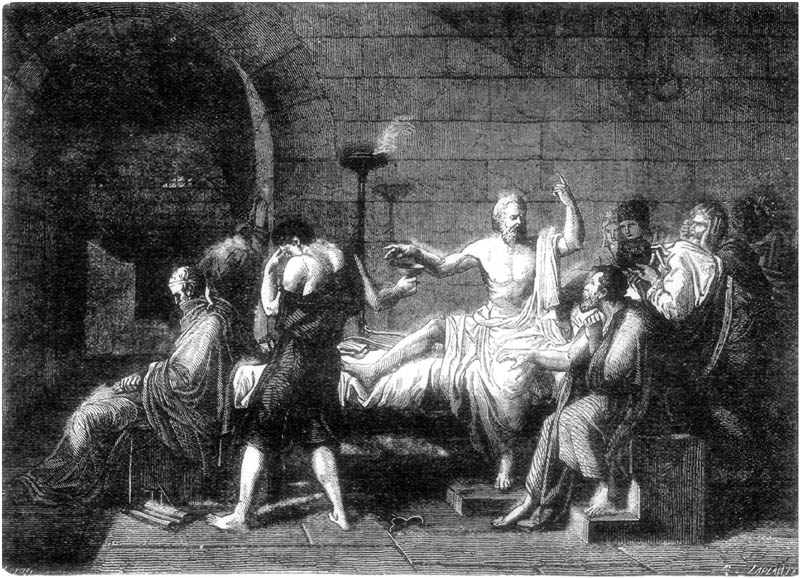
SOCRATES DRINKING THE POISON (From ancient Wall Painting.)ToList
At length the fatal day arrived, when he had reached his full three score years and ten. Refusing all means of escape to which his friends continually and importunely urged him, he took the poisoned cup from the hands of the boy who brought it to him in his prison-chamber, drank it off calmly amid the tears and sobs of surrounding friends, walked about till the draught had begun to take effect upon his system, and then laid himself down upon his bed, and soon breathed his last. Such was the life and such the death of this great man. It has been felt as the greatest of all human examples, not only by his own countrymen, but by the whole civilized world.
SOCRATES AND ARISTODEMUS. (By Socrates.)
We will now relate the manner in which Socrates discoursed with Aristodemus, surnamed the Little, concerning the Deity. For, observing that he neither prayed nor sacrificed to the gods nor yet consulted any oracle, but, on the contrary, ridiculed and laughed at those who did, he said to him:
"Tell me, Aristodemus, is there any man whom you admire on account of his merit?"
Aristodemus having answered, "Many."—"Name some of them, I pray you."
"I admire," said Aristodemus, "Homer for his epic poetry, Melanippides for his dithyrambics, Sophocles for tragedy, Polycletes for statuary, and Xeuxis for painting."
"But which seems to you most worthy of admiration, Aristodemus—the artist who forms images void of motion and intelligence, or one who hath the skill to produce animals that are endued, not only with activity, but understanding."
"The latter, there can be no doubt," replied Aristodemus, "provided the production was not the effect of chance, but of wisdom and contrivance."
"But since there are many things, some of which we can easily see the use of, while we can not say of others to what purpose they were produced, which of these, Aristodemus, do you suppose the work of wisdom?"
"It should seem the most reasonable to affirm it of those whose fitness and utility is so evidently apparent."
"But it is evidently apparent, that He, who at the beginning made man, endued him with senses because they were good for him; eyes, wherewith to behold whatever was visible; and ears, to hear whatever was to be heard. For say, Aristodemus, to what purpose should odors be prepared, if the sense of smelling had been denied? Or why the distinctions of bitter and sweet, of savory and unsavory, unless a palate had been likewise given, conveniently placed, to arbitrate between them, and declare the difference? Is not that Providence, Aristodemus, in a most eminent manner conspicuous, which, because the eye of man is so delicate in its contexture, hath therefore prepared eyelids like doors, whereby to secure it; which extend of themselves whenever it is needful, and again close when sleep approaches? Are not these eyelids provided, as it were, with a fence on the edge of them, to keep off the wind and guard the eye? Even the eyebrow itself is not without office, but, as a penthouse, is prepared to turn off the sweat, which, falling from the forehead, might enter and annoy that no less tender than astonishing part of us! Is it not to be admired that the ears should take in sounds of every sort, and yet are not too much filled by them? That the fore-teeth of the animal should be formed in such a manner as evidently best suited for the cutting of its food, and those on the side for grinding it in pieces? That the mouth, through which this food is conveyed, should be placed so near the nose and the eyes, as to prevent the passing, unnoticed, whatever is unfit for nourishment; while Nature, on the contrary, hath set at a distance, and concealed from the senses, all that might disgust them? And canst thou still doubt, Aristodemus! whether a disposition of parts like this should be the work of chance, or of wisdom and contrivance?"
"I have no longer any doubt," replied Aristodemus; "and, indeed, the more I consider it, the more evident it appears to me, that man must be the masterpiece of some great Artificer, carrying along with it infinite marks of love and favor of Him who hath thus formed it."
"And what thinkest thou, Aristodemus, of that desire in the individual which leads to the continuance of the species? Of that tenderness and affection in the female towards her young, so necessary for its preservation? Of that unremitted love of life, and dread of dissolution, which take such strong possession of us from the moment we begin to be?"
"I think of them," answered Aristodemus, "as so many regular operations of the same great and wise Artist, deliberately determining to preserve what He hath once made."
"But, farther (unless thou desirest to ask me questions), seeing, Aristodemus, thou thyself art conscious of reason and intelligence, supposest thou there is no intelligence elsewhere? Thou knowest thy body to be a small part of that wide-extended earth which thou everywhere beholdest; the moisture contained in it, thou also knowest to be a small portion of that mighty mass of waters whereof seas themselves are but a part, while the rest of the elements contribute, out of their abundance, to thy formation. It is the soul, then, alone, that intellectual part of us, which is come to thee by some lucky chance, from I know not where. If so be, there is indeed no intelligence elsewhere; and we must be forced to confess, that this stupendous universe, with all the various bodies contained therein—equally amazing, whether we consider their magnitude or number, whatever their use, whatever their order—all have been produced, not by intelligence, but chance!"
"It is with difficulty that I can suppose otherwise," returned Aristodemus, "for I behold none of those gods, whom you speak of as making and governing all things, whereas I see the artists when at their work here among us."
"Neither yet seest thou thy soul, Aristodemus, which, however, most assuredly governs thy body: although it may well seem, by thy manner of talking, that it is chance, and not reason, which governs thee."
"I do not despise the gods," said Aristodemus; "on the contrary, I conceive so highly of their excellence, as to suppose they stand in no need of either me or of my services."
"Thou mistakest the matter, Aristodemus; the greater magnificence they have shown in their care of thee, so much the more honor and service thou owest them."
"Be assured," said Aristodemus, "if I once could be persuaded the gods took care of man, I should want no monitor to remind me of my duty."
"And canst thou doubt, Aristodemus, if the gods take care of man? Hath not the glorious privilege of walking upright been alone bestowed on him, whereby he may, with the better advantage, survey what is around him, contemplate, with more ease, those splendid objects which are above, and avoid the numerous ills and inconveniences which would otherwise befall him? Other animals, indeed, they have provided with feet, by which they may remove from one place to another; but to man they have also given hands, with which he can form many things for his use, and make himself happier than creatures of any other kind. A tongue hath been bestowed on every other animal, but what animal, except man, hath the power of forming words with it, whereby to explain his thoughts, and make them intelligible to others? And to show that the gods have had regard to his very pleasures, they have not limited them, like those of other animals, to times and seasons, but man is left to indulge in them whenever not hurtful to him.
"But it is not with respect to the body alone that the gods have shown themselves thus bountiful to man! Their most excellent gift is that soul they have infused into him, which so far surpasses what is elsewhere to be found. For, by what animal, except man, is even the existence of those gods discovered, who have produced, and still uphold, in such regular order, this beautiful and stupendous frame of the universe? What other species of creatures are to be found that can serve, that can adore them? What other animal is able, like man, to provide against the assaults of heat and cold, of thirst and hunger? That can lay up remedies for the time of sickness and improve the strength nature hath given by a well-proportioned exercise? That can receive, like him, information and instruction, or so happily keep in memory what he hath seen, and heard, and learnt? These things being so, who seeth not that man is, as it were, a god in the midst of this visible creation; so far doth he surpass, whether in the endowments of soul or body, all animals whatsoever that have been produced therein! For, if the body of the ox had been joined to the mind of man, the acuteness of the latter would have stood him in small stead, while unable to execute the well-designed plan; nor would the human form have been of more use to the brute, so long as it remained destitute of understanding! But in thee, Aristodemus, hath been joined to a wonderful soul, a body no less wonderful, and sayest thou, after this, 'the gods take no thought for me!' What wouldst thou, then, more to convince thee of their care?"
"I would they should send, and inform me," said Aristodemus, "what things I ought or ought not to do in like manner as thou sayest they frequently do to thee."
"And what then, Aristodemus! Supposest thou, that when the gods give out some oracle to all the Athenians, they mean it not for thee? If, by their prodigies, they declare aloud to all Greece—to all mankind—the things which shall befall them, are they dumb to thee alone? And art thou the only person whom they have placed beyond their care? Believest thou they would have wrought into the mind of man a persuasion of their being able to make him happy or miserable, if so be they had no such power? or would not even man himself, long ere this, have seen through the gross delusion? How is it, Aristodemus, thou rememberest, or remarkest not, that the kingdoms and commonwealths most renowned as well for their wisdom as antiquity, are those whose piety and devotion hath been the most observable? And why thinkest thou that the providence of God may not easily extend itself throughout the whole universe? As, therefore, among men, we make best trial of the affection and gratitude of our neighbor, by showing him kindness, and discover his wisdom, by consulting him in our distress; do thou, in like manner, behave towards the gods, and, if thou wouldst experience what their wisdom, and what their love, render thyself deserving the communication of some of those divine secrets which may not be perpetrated by man, and are imparted to those alone who consult, who adore, who obey the Deity. Then shalt thou, my Aristodemus, understand there is a Being whose eye pierceth throughout all nature, and whose ear is open to every sound; extended to all places; extending through all time, and whose bounty and care can know no other bounds than those fixed by his own creation!"
By this discourse, and others of the like nature, Socrates taught his friends that they were not only to forbear whatever was impious, unjust, or unbecoming before men; but even, when alone, they ought to have a regard to their actions; since the gods have their eyes continually upon us, and none of our designs can be concealed from them.
EURIPIDES.
Euripides flourished about 450 B.C.; was born 480 B.C. He spent his youth in the highest mental and physical training. He was a native of Athens, and enjoyed the most glorious days of her annals, being brought in direct connection with Æschylus and Sophocles, and in his older days was a pupil of Socrates.
In comparing Euripides and the other two masters in Grecian tragedy, it may be said that he ranks first in tragic representation and effect; Sophocles first in dramatic symmetry and ornament; Æschylus first in poetic vigor and grandeur. Æschylus was the most sublime; Sophocles the most beautiful; Euripides the most pathetic. The first displays the lofty intellect; the second exercises the cultivated taste; the third indulges the feeling heart. Each, as it were, shows a fine piece of sculpture. In Æschylus, it is a naked hero, with all the strength, boldness, and dignity of olden time. In Sophocles and Euripides, it may be perhaps the same hero; but with the former, he has put on the flowing robes, the elegant address, and the soft urbanity of a polished age; with the latter, he is yielding to some melancholy emotion, ever heedless of his posture or gait, and casting his unvalued drapery negligently about him. They have been compared by an illustration from another art: "The sublime and daring Æschylus resembles some strong and impregnable castle situated on a rock, whose martial grandeur awes the beholder—its battlements defended by heroes, and its gates proudly hung with trophies." Sophocles appears with splendid dignity, like some imperial palace of richest architecture; the symmetry of the parts and the chaste magnificence of the whole delight the eye and command the approbation of the judgment. The pathetic and moral Euripides has the solemnity of a Gothic temple, whose storied windows admit a dim religious light, enough to show its high embowed roof, and the monuments of the dead which rise in every part, impressing our minds with pity and terror as emblems of the uncertain and short duration of human greatness, and with an awful sense of our own mortality.
ARISTOPHANES.
Very little is known about the life of Aristophanes. He was born about 444 B.C., and devoted himself to comic poetry. He wrote fifty-four plays, of which eleven are extant.
The comedies of Aristophanes are universally regarded as the standard of Attic writing in its greatest purity. His genius was vast, versatile, and original, and his knowledge of human nature surpassed by Homer and Shakspeare alone.
The noble tone of morals, the elevated taste, the sound political wisdom, the boldness and acuteness of the satire, the grand object, which is seen throughout, of correcting the follies of the day, and improving the condition of his country—all these are features in Aristophanes, which, however disguised, as they intentionally are, by coarseness and buffoonery, entitle him to the highest respect from every reader of antiquity. He condescended, indeed, to play the part of jester to the Athenian tyrant. But his jests were the vehicles for telling to them the soundest truths. They were never without a far higher aim than to raise a momentary laugh. He was no farce writer, but a deep philosophical politician; grieved and ashamed at the condition of his country, and through the stage, the favorite amusement of Athenians, aiding to carry on the one great common work, which Plato proposed in his dialogues, and in which all the better and nobler spirits of the time seem to have concurred as by a confederacy—the reformation of an atrocious democracy. There is as much system in the comedies of Aristophanes as in the dialogues of Plato. Every part of a vitiated public mind is exposed in its turn. Its demagogues in the Knights, its courts of justice in the Wasps, its foreign policy in the Acharnians, its tyranny over the allies in the Birds, the state of female society in the Sysistrate and the Ecclesiazusæ, and its corrupt poetical taste in the Frogs. No one play is without its definite object; and the state of national education, as the greatest cause of all, is laid open in the Clouds. Whatever light is thrown, by that admirable play, upon the character of Socrates, and the position which he occupies in the Platonic Dialogues—a point, it may be remarked, on which the greatest mistakes are daily made—it is chiefly valuable as exhibiting, in a short but very complete analysis, and by a number of fine Rembrandt-like strokes, not any of which must be overlooked, all the features of that frightful school of sophistry, which at that time was engaged systematically in corrupting the Athenian youth, and against which the whole battery of Plato was pointedly directed.
PLATO.
Plato was born in the year 429 B.C., and died when he was eighty-two years old, on his birthday. He was a pupil of Socrates, the first and purest of moral philosophers. By the rare union of a brilliant imagination with a fondness for severe mathematical studies and profound metaphysical investigations; by extensive foreign travel; by familiar intercourse with the most enlightened men of his time, particularly Socrates, whose instructive conversations he attended for eight years, as well as by the correspondence which he maintained with the Pythagoreans of Magna Græcia, this great philosopher came to surpass all others in the vastness and profoundness of his views, and in the correctness and eloquence with which he expressed them; while his pure moral character entitled him to take his place by the side of Socrates. Socrates once said, "For what higher reward could a teacher ask than to have such pupils as Xenophon and Plato?"
The object of Plato was evidently the noble one of placing before man a high intellectual, and consequently, by implication, a high moral standard as the end and object of his aspirations; to encourage his efforts after the true, the pure, the beautiful, and the virtuous, knowing that the character would be purified in the endeavor, and that the consciousness of the progress made, step by step, would be of itself a reward. The object of science was, as he taught, the true, the eternal, the immutable, that which is; in one alone could these attributes be found united—that is God. Man's duty, then, according to the Platonic system is to know God and His attributes, and to aim at being under the practical influence of this knowledge. This the Christian is taught, but much more simply and plainly, to know God, and Jesus Christ whom He hath sent, and to propose to himself a perfect standard, to be perfect even as his Father in heaven is perfect, and to look forward, by that help which Plato had no warrant to look for, to attain the perfect measure of the fulness of Christ. Although Plato believed and taught that man ought to strive after and devote himself to the contemplation of the One, the Eternal, the Infinite, he was humbly conscious that no one could attain to the perfection of such knowledge; that it is too wonderful and excellent for human powers. Man's incapacity for apprehending this knowledge he attributed to the soul, during his present state of existence, being cramped and confined by its earthly tabernacle.
Plato defined virtue to be the imitation of God, or the free effort of man to attain to a resemblance to his original, or, in other terms, a unison and harmony of all our principles and actions according to reason, whence results the highest degree of happiness. Evil is opposed to this harmony as a disease of the soul. Virtue is one, indeed, but compounded of four elements—wisdom, courage, temperance, and justice. In his practical philosophy he blended a rigid principle of moral obligation with a spirit of gentleness and humanity; and education he described as a liberal cultivation and moral discipline of the mind. Politics he defined to be the application, on a great scale, of the laws of morality; for a society, being composed of individuals, is under similar moral obligations, and the end of politics to be liberty and concord. Beauty he considered to be the sensible representation of moral and physical perfection; consequently it is one with truth and goodness, and inspires love, which leads to virtue.
Would that many so-called Christian legislators and Christian people would go to this "heathen" philosopher and learn of him—learn that to do right is always and ever the highest safety, the highest expediency, the highest "conservatism," the highest good!
How beautifully Akenside expresses this:—
"Thus was beauty sent from heaven, The lovely ministress of truth and good, In this dark world: for truth and good are one, And beauty dwells in them, and they in her, With like participation. Wherefore, then, O sons of earth! would ye dissolve the tie? O wherefore, with a rash, impetuous aim, Seek ye those flowery joys with which the hand Of lavish fancy paints each flattering scene Where beauty seems to dwell, nor once inquire Where is the sanction of eternal truth, Or where the seal of undeceitful good, To save your search from folly! wanting these, Lo! beauty withers in your void embrace, And with the glittering of an idiot's toy Did fancy mock your vows."
THE PERFECT BEAUTY. (By Plato.)
"He who aspires to love rightly, ought from his earliest youth to seek an intercourse with beautiful forms, and first to make a single form the object of his love, and therein to generate intellectual excellencies. He ought, then, to consider that beauty in whatever form it resides is the brother of that beauty which subsists in another form; and if he ought to pursue that which is beautiful in form, it would be absurd to imagine that beauty is not one and the same thing in all forms, and would therefore remit much of his ardent preference towards one, through his perception of the multitude of claims upon his love. In addition, he would consider the beauty which is in souls more excellent than that which is in form. So that one endowed with an admirable soul, even though the flower of the form were withered, would suffice him as the object of his love and care, and the companion with whom he might seek and produce such conclusions as tend to the improvement of youth; so that it might be led to observe the beauty and the conformity which there is in the observation of its duties and the laws, and to esteem little the mere beauty of the outward form. He would then conduct his pupil to science, so that he might look upon the loveliness of wisdom; and that contemplating thus the universal beauty, no longer would he unworthily and meanly enslave himself to the attractions of one form in love, nor one subject of discipline or science, but would turn towards the wide ocean of intellectual beauty, and from the sight of the lovely and majestic forms which it contains, would abundantly bring forth his conceptions in philosophy; until, strengthened and confirmed, he should at length steadily contemplate one science which is the science of this universal beauty.
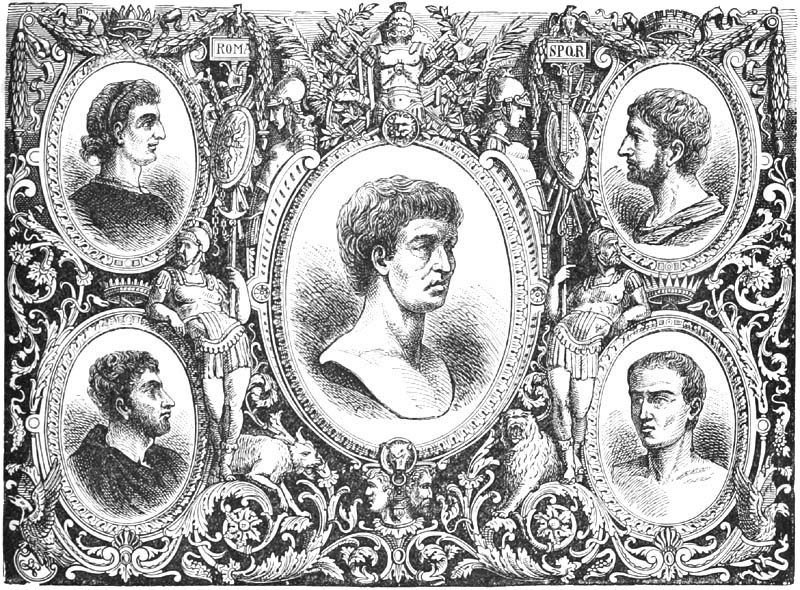
FROM ANCIENT SCULPTURING.ToList
"Attempt, I entreat you, to mark what I say with as keen an observation as you can. He who has been disciplined to this point in love, by contemplating beautiful objects gradually, and in their order, now arriving at the end of all that concerns love, on a sudden beholds a beauty wonderful in its nature. This is it, O Socrates, for the sake of which all the former labors were endured. It is eternal, unproduced, indestructible; neither subject to increase nor decay; not, like other things, partly beautiful and partly deformed; not at one time beautiful and at another time not; not beautiful in relation to one thing and deformed in relation to another; not here beautiful and there deformed; not beautiful in the estimation of one person and deformed in that of another; nor can this supreme beauty be figured to the imagination like a beautiful face, or beautiful hands, or any portion of the body, nor like any discourse, nor any science. Nor does it subsist in any other that lives or is, either in earth, or in heaven, or in any other place; but it is eternally uniform and consistent, and monoeidic with itself. All other things are beautiful through a participation of it, with this condition, that although they are subject to production and decay, it never becomes more or less, or endures any change. When any one, ascending from a correct system of love, begins to contemplate this supreme beauty, he already touches the consummation of his labor. For such as discipline themselves upon this system, or are conducted by another beginning to ascend through these transitory objects which are beautiful, towards that which is beauty itself, proceeding as on steps from the love of one form to that of two, and from that of two, to that of all forms which are beautiful; and from beautiful forms to beautiful habits and institutions, and from institutions to beautiful doctrines; until, from the meditation of many doctrines, they arrive at that which is nothing else than the doctrine of the supreme beauty itself, in the knowledge and contemplation of which at length they repose.
"Such a life as this, my dear Socrates," exclaimed the stranger Prophetess, "spent in the contemplation of the beautiful, is the life for men to live; which, if you chance ever to experience, you will esteem far beyond gold and rich garments, and even those lovely persons whom you and many others now gaze on with astonishment, and are prepared neither to eat nor drink so that you may behold and live forever with these objects of your love! What, then, shall we imagine to be the aspect of the supreme beauty itself, simple, pure, uncontaminated with the intermixture of human flesh and colors, and all other idle and unreal shapes attendant on mortality; the divine, the original, the supreme, the monoeidic beautiful itself? What must be the life of him who dwells with and gazes on that which it becomes us all to seek? Think you not that to him alone is accorded the prerogative of bringing forth, not images and shadows of virtue, for he is in contact not with a shadow but with reality; with virtue itself, in the production and nourishment of which he becomes dear to the gods, and if such a privilege is conceded to any human being, himself immortal?"—From the Banquet, translated by the poet Shelley.
THE LAST HOURS OF SOCRATES. (By Plato.)
"When the dead arrive at the place to which their demon leads them severally, first of all they are judged, as well those who have lived well and piously, as those who have not. And those who appear to have passed a middle kind of life, proceeding to Acheron, and embarking in the vessels they have, on these arrive at the lake, and there dwell, and when they are purified, and have suffered punishment for the iniquities they may have committed, they are set free, and each receives the reward of his good deeds, according to his deserts; but those who appear to be incurable, through the magnitude of their offences, either from having committed many and great sacrileges, or many unjust and lawless murders, or other similar crimes, these a suitable destiny hurls into Tartarus, whence they never come forth. But those who appear to have been guilty of curable, yet great offences, such as those who through anger have committed any violence against father or mother, and have lived the remainder of their life in a state of penitence, or they who have become homicides in a similar manner, these must fall into Tartarus, but after they have fallen, and have been there for a year, the wave casts them forth, the homicides into Cocytus, but the parricides and matricides into Pyriphlegethon; but when, being borne along, they arrive at the Acherusian lake, there they cry out to and invoke, some those whom they slew, others those whom they injured, and invoking them, they entreat and implore them to suffer them to go out into the lake, and to receive them, and if they persuade them, they go out, and are freed from their sufferings, but if not, they are borne back to Tartarus, and thence again into the rivers, and they do not cease from suffering this until they have persuaded those whom they have injured; for this sentence was imposed upon them by the judges. But those who are found to have lived an eminently holy life, these are they, who, being freed and set at large from these regions in the earth, as from prison, arrive at the pure abode above, and dwell on the upper parts of the earth. And among these, they who have sufficiently purified themselves by philosophy shall live without bodies, throughout all future time, and shall arrive at habitations yet more beautiful than these, which it is neither easy to describe, nor at present is there sufficient time for the purpose.
"But for the sake of these things which we have described, we should use every endeavor, Simmias, so as to acquire virtue and wisdom in this life; for the reward is noble, and the hope great.
"To affirm positively, indeed, that these things are exactly as I have described them, does not become a man of sense; that however either this, or something of the kind, takes place with respect to our souls and their habitations—since our soul is certainly immortal—this appears to me most fitting to be believed, and worthy the hazard for one who trusts in its reality; for the hazard is noble, and it is right to allure ourselves with such things, as with enchantments; for which reason I have prolonged my story to such a length. On account of these things, then, a man ought to be confident about his soul, who during this life has disregarded all the pleasures and ornaments of the body as foreign from his nature, and who, having thought that they do more harm than good, has zealously applied himself to the acquirement of knowledge, and who having adorned his soul not with a foreign but its own proper ornament, temperance, justice, fortitude, freedom, and truth, thus waits for his passage to Hades, as one who is ready to depart whenever destiny shall summon him. You then," he continued, "Simmias and Cebes, and the rest, will each of you depart at some future time; but now destiny summons me, as a tragic writer would say, and it is nearly time for me to betake myself to the bath; for it appears to me to be better to drink the poison after I have bathed myself, and not to trouble the women with washing my dead body."
When he had thus spoken, Crito said, "So be it, Socrates; but what commands have you to give to these or to me, either respecting your children, or any other matter, in attending to which we can most oblige you?"
"What I always say, Crito," he replied, "nothing new; that by taking care of yourselves you will oblige both me and mine and yourselves, whatever you do, though you should not now promise it; but if you neglect yourselves, and will not live as it were in the footprints of what has been now and formerly said, even though you should promise much at present, and that earnestly, you will do no good at all."
"We will endeavor then so to do," he said; "but how shall we bury you?"
"Just as you please," he said, "if only you can catch me, and I do not escape from you." And at the same time smiling gently, and looking round on us, he said, "I can not persuade Crito, my friends, that I am that Socrates who is now conversing with you, and who methodizes each part of the discourse; but he thinks that I am he whom he will shortly behold dead, and asks how he should bury me. But that which I some time since argued at length, that when I have drunk the poison I shall no longer remain with you, but shall depart to some happy state of the blessed, this I seem to have urged to him in vain, though I meant at the same time to console both you and myself. Be ye, then, my sureties to Crito," he said, "in an obligation contrary to that which he made to the judges; for he undertook that I should remain; but do you be sureties that, when I die, I shall not remain, but shall depart, that Crito may more easily bear it, and when he sees my body either burned or buried, may not be afflicted for me, as if I suffered some dreadful thing, nor say at my interment that Socrates is laid out, or is carried out, or is buried. For be well assured," he said, "most excellent Crito, that to speak improperly is not only culpable as to the thing itself, but likewise occasions some injury to our souls. You must have a good courage, then, and say that you bury my body, and bury it in such a manner as is pleasing to you, and as you think is most agreeable to our laws."
When he had said this, he rose, and went into a chamber to bathe, and Crito followed him, but he directed us to wait for him. We waited, therefore, conversing among ourselves about what had been said, and considering it again, and sometimes speaking about our calamity, how severe it would be to us, sincerely thinking that, like those who are deprived of a father, we should pass the rest of our lives as orphans. When he had bathed, and his children were brought to him, for he had two little sons and one grown up, and the women belonging to his family were come, having conversed with them in the presence of Crito, and giving them such injunctions as he wished, he directed the women and children to go away, and then returned to us. And it was now near sunset; for he spent a considerable time within. But when he came from bathing he sat down, and did not speak much afterwards. Then the officer of the Eleven came in, and, standing near him, said, "Socrates, I shall not have to find that fault with you that I do with others, that they are angry with me, and curse me, when, by order of the archons, I bid them drink the poison. But you, on all other occasions during the time you have been here, I have found to be the most noble, meek, and excellent man of all that ever came into this place; and, therefore, I am now well convinced that you will not be angry with me, for you know who are to blame, but with them. Now, then, for you know what I came to announce to you, farewell, and endeavor to bear what is inevitable as easily as possible." And at the same time, bursting into tears he turned away and withdrew.
And Socrates, looking after him, said, "And thou, too, farewell; we will do as you direct." At the same time turning to us, he said, "How courteous this man is; during the whole time I have been here he has visited me, and conversed with me sometimes, and proved the worthiest of men; and now how generously he weeps for me. But come, Crito, let us obey him, and let some one bring the poison, if it is ready pounded, but if not, let the man pound it."
Then Crito said, "But I think, Socrates, that the sun is still on the mountains, and has not yet set. Besides, I know that others have drank the poison very late, after it had been announced to them, and have supped and drank freely. Do not hasten, then, for there is yet time."
Upon this Socrates replied, "These men whom you mention, Crito, do these things with good reason, for they think they shall gain by so doing, and I, too, with good reason shall not do so; for I think I shall gain nothing by drinking a little later, except to become ridiculous to myself, in being so fond of life, and sparing of it when none any longer remains. Go, then," he said, "obey, and do not resist."
Crito having heard this, nodded to the boy that stood near. And the boy having gone out, and stayed for some time, came, bringing with him the man that was to administer the poison, who brought it ready pounded in a cup. And Socrates, on seeing the man, said, "Well, my good friend, as you are skilled in these matters, what must I do?"
"Nothing else," he replied, "than, when you have drank it, walk about until there is a heaviness in your legs, then lie down: thus it will do its purpose." And at the same time he held out the cup to Socrates. And he having received it very cheerfully, neither trembling, nor changing at all in color or countenance, but, as he was wont, looking steadfastly at the man, said, "What say you of this potion, with respect to making a libation to any one, is it lawful or not?"
"We only pound so much, Socrates," he said, "as we think sufficient to drink."
"I understand you," he said, "but it is certainly both lawful and right to pray to the gods that my departure hence thither may be happy; which therefore I pray, and so may it be." And as he said this he drank it off readily and calmly. Thus far, most of us were with difficulty able to restrain ourselves from weeping; but when we saw him drinking, and having finished the draught, we could do so no longer; but in spite of myself the tears came in full torrent, so that, covering my face, I wept for myself, for I did not weep for him, but for my own fortune, in being deprived of such a friend. But Crito, even before me, when he could not restrain his tears, had risen up. But Apollodorus even before this had not ceased weeping, and then bursting into an agony of grief, weeping and lamenting, he pierced the heart of every one present, except Socrates himself. But he said, "What are you doing, my admirable friends? I indeed for this reason chiefly, sent away the women, that they might not commit any folly of this kind. For I have heard that it is right to die with good omens. Be quiet, therefore, and bear up."
When we heard this we were ashamed, and restrained our tears. But he, having walked about, when he said that his legs were growing heavy, laid down on his back; for the man so directed him. And at the same time he who gave him the poison, taking hold of him, after a short interval examined his feet and legs; and then having pressed his foot hard, he asked if he felt it; he said that he did not. And after this he pressed his thighs; and thus going higher, he showed us that he was growing cold and stiff. Then Socrates touched himself, and said that when the poison reached his heart he should then depart. But now the parts around the lower belly were almost cold; when, uncovering himself, for he had been covered over, he said, and they were his last words, "Crito, we owe a cock to Æsculapius; pay it, therefore, and do not neglect it."
"It shall be done," said Crito, "but consider whether you have any thing else to say."
To this question he gave no reply, but shortly after he gave a convulsive movement, and the man covered him, and his eyes were fixed, and Crito, perceiving it, closed his mouth and eyes.
This, Echecrates, was the end of our friend, a man, as we may say, the best of all of his time that we have known, and, moreover, the most wise and just.
DEMOSTHENES.
Demosthenes was born 382 B.C. and died 322 B.C., at the age of sixty. His father died when he was but seven years old and left his son a large estate, which was squandered by his guardians.
Demosthenes, most happily, was forced to depend upon the resources of his own intellect, and determined to devote his life to oratory. He chose Isæus for his master, and though having a weakly constitution, and an impediment in his speech, yet by steady, persevering effort, and daily practice, he brought himself to address without embarrassment, and with complete success, the assembled multitudes of the Athenian people. His first attempts at oratory were made to vindicate his own claims, and recover the property which his guardians had appropriated to themselves. In this he proved entirely successful. After this, he displayed his ability as an orator on several public occasions, and succeeded by the power of his eloquence in preventing the Athenians from engaging in a war with Persia.
But most of the oratorical efforts of Demosthenes were directed to rouse the Athenians from indolence, and to arm them against the insidious designs and ambitious schemes of Philip, who, in the year 358 B.C., began the attack upon the northern maritime allies of Athens.
In modern times, Lord Chatham's speech on American affairs, delivered in the House of Lords, November 18, 1877; Edmund Burke's, on the "Nabob of Arcot's Debts," delivered in the House of Commons, February 28, 1785; Fisher Ames', on the "British Treaty," delivered in our House of Representatives, April 28, 1796; Daniel Webster's, on the "Public Lands," delivered in the United States Senate, 1830, and Charles Sumner's, on the infamous "Fugitive Slave Bill," delivered in the Senate in 1852, will, for effective, brilliant, and logical eloquence, rank side by side with the masterly efforts of Demosthenes.
PHILIP AND THE ATHENIANS. (Oration of Demosthenes.)
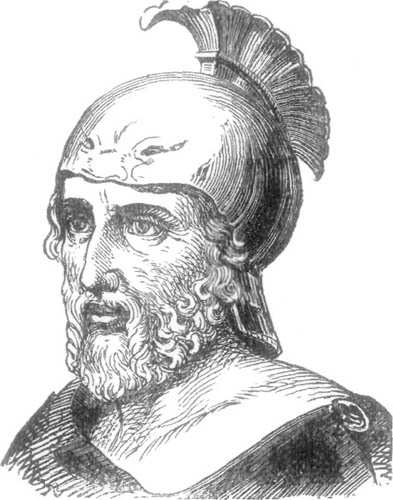
KING PHILIP (of Macedon).ToList
If any one of you, Athenians, think that Philip is hard to struggle with, considering both the magnitude of the power already to his hand and the fact that all the strong places are lost to our state—he thinks rightly enough. But let him take this into account: that we ourselves, Athenians, once held Pydna, and Potidæa, and Methone, and all that country—as it were in our own home-circle; and many of the states now under his sway were beginning to be self-ruled and free, and preferred to hold friendly relations with us rather than with him. Now, then, if Philip had harbored at that time the idea that it was hard to struggle with the Athenians when they had such strongholds in his country, while he was destitute of allies—he would have effected none of those things which he has accomplished, nor would he have ever acquired so great power. But he at least knew this well enough, Athenians—that all these strongholds are prizes of war open to each contestant, and that naturally the possessions of the absent fall to those who are on the spot, and the opportunities of the careless are seized by those willing to work and to risk. It has been so in his case, for, possessed by such sentiments, he has thoroughly subdued and now holds all places; some, as one might hold them in his grasp by custom of war; others, by having made them allies and friends. No wonder; for all are ready to give their heartfelt adherence to those whom they see prepared and ready to do what necessity demands.
In like manner, if you, also, Athenians, are now ready to adopt the same principle (since, alas! you were not before), and each one of you, throwing away all dissimulation, is ready to show himself useful to the state, as far as its necessity and his power extend; if each is ready to do—the rich to contribute, those of serviceable age to take the field; in a word, if you choose to be your own masters, and each individual ceases to do nothing, hoping that his neighbor will do all for him—you will both regain your possessions (with heaven's permission) and recover your opportunities recklessly squandered; you will take vengeance on HIM.
Do not suppose his present happy fortune immutable—immortal, like a god's; on the other hand, some hate him, others fear him, Athenians, and envy him, and that, too, in the number of those who seem on intimate terms with him; for all those passions that rage in other men, we may assume to be hidden in the bosoms of those also that surround him. Now, however, all these passions have crouched before him, having no escape on account of your laziness and indifference, which, I repeat, you ought immediately to abandon. For you see the state of things, Athenians, to what a pitch of arrogance he has come—this man who gives you no choice to act or to remain quiet, but brags about and talks words of overwhelming insolence, as they tell us. He is not such a character as to rest with the possessions which he has conquered, but is always compassing something else, and at every point hedging us, dallying and supine, in narrower and narrower circles. When, then, Athenians, when will you do what you ought? As soon as something happens? As soon, great Jove! as necessity compels you? Why, what does necessity compel you to think now of your deeds? In my opinion, the most urgent necessity to freemen is the disgrace attendant upon their public policy.
Or do you prefer—tell me, do you prefer to wander about here and there, asking in the market-place, "What news? what news?" What can be newer than that a Macedonian should crush Athenians in war and lord it over all Greece? "Is Philip dead?" "No, by Jove, but he's sick." What difference is it to you? what difference? For if anything should happen to him, you would quickly raise up another Philip, if you manage your public affairs as you now do. For not so much to his own strength as to your laziness does he owe his present aggrandizement.
Yet even if anything should happen to him, and fortune begin to favor us (for she has always cared for us more kindly than we for ourselves); you know that by being nearer to them you could assert your power over all these disordered possessions, and could dictate what terms you might choose; but as you now act, if some chance should give you Amphipolis, you could not take it, so lacking are you in your preparations and zeal.
MEASURES TO RESIST PHILIP. (Oration of Demosthenes.)
Let any one now come forward and tell me by whose contrivance but ours Philip has grown strong. Well, sir, this looks bad, but things at home are better. What proof can be adduced? The parapets that are whitewashed? The roads that are repaired? fountains and fooleries? Look at the men of whose statesmanship these are the fruits. They have risen from beggary to opulence, or from obscurity to honor; some have made their private houses more splendid than the public buildings, and in proportion as the state has declined, their fortunes have been exalted.
What has produced these results? How is it that all went prosperously then, and now goes wrong? Because anciently the people, having the courage to be soldiers, controlled the statesmen, and disposed of all emoluments; any of the rest was happy to receive from the people his share of honor, office, or advantage. Now, contrariwise, the statesmen dispose of emoluments; through them everything is done; you, the people, enervated, stripped of treasure and allies, are become as underlings and hangers-on, happy if these persons dole you out show-money or send you paltry beeves; and, the unmanliest part of all, you are grateful for receiving your own. They, cooping you in the city, lead you to your pleasures, and make you tame and submissive to their hands. It is impossible, I say, to have a high and noble spirit, while you are engaged in petty and mean employments; whatever be the pursuits of men, their characters must be similar. By Ceres, I should not wonder if I, for mentioning these things, suffered more from your resentment than the men who have brought them to pass. For even liberty of speech you allow not on all subjects; I marvel indeed you have allowed it here.
Would you but even now, renouncing these practices, perform military service and act worthily of yourselves; would you employ these domestic superfluities as a means to gain advantage abroad; perhaps, Athenians, perhaps you might gain some solid and important advantage, and be rid of these perquisites, which are like the diet ordered by physicians for the sick. As that neither imparts strength, nor suffers the patient to die, so your allowances are not enough to be of substantial benefit, nor yet permit you to reject them and turn to something else. Thus do they increase the general apathy. What? I shall be asked, mean you stipendiary service? Yes, and forthwith the same arrangement for all, Athenians, that each, taking his dividend from the public, may be what the state requires. Is peace to be had? You are better at home, under no compulsion to act dishonorably from indigence. Is there such an emergency as the present? Better to be a soldier, as you ought, in your country's cause, maintained by those very allowances. Is any one of you beyond the military age? What he now irregularly takes without doing service, let him take by just regulation, superintending and transacting needful business. Thus, without derogating from or adding to our political system, only removing some irregularity, I bring it into order, establishing a uniform rule for receiving money, for serving in war, for sitting on juries, for doing what each, according to his age, can do, and what occasion requires. I never advise we should give to idlers the wages of the diligent, or sit at leisure, passive and helpless, to hear that such a one's mercenaries are victorious, as we now do. Not that I blame any one who does you a service; I only call upon you, Athenians, to perform upon your own account those duties for which you honor strangers, and not to surrender that post of dignity which, won through many glorious dangers, your ancestors have bequeathed.
I have said nearly all that I think necessary. I trust you will adopt that course which is best for the country and yourselves.
FORMER ATHENIANS DESCRIBED. (By Demosthenes.)
I ask you, Athenians, to see how it was in the time of your ancestors; for by domestic (not foreign) examples you may learn your lesson of duty. Themistocles who commanded in the sea-fight at Salamis, and Miltiades who led at Marathon, and many others, who performed services unlike the generals of the present day—assuredly they were not set up in brass nor overvalued by our forefathers, who honored them, but only as persons on a level with themselves. Your forefathers, O my countrymen, surrendered not their part to any of those glories. There is no man who will attribute the victory of Salamis to Themistocles, but to the Athenians; nor the battle of Marathon to Miltiades, but to the republic. But now people say that Timotheus took Corcyra, and Iphicrates cut off the Spartan division, and Chabrias won the naval victory at Naxos; for you seem to resign the merit of these actions, by the extravagance of the honors which you have bestowed on their account upon each of the commanders.
So wisely did the Athenians of that day confer political rewards; so improperly do you. But how the rewards of foreigners? To Menon the Pharsalian, who gave twelve talents in money for the war at Eion by Amphipolis, and assisted them with two hundred horsemen of his own retainers, the Athenians then voted not the freedom of their city, but only granted immunity from imposts. And in earlier times to Perdiccas, who reigned in Macedonia during the invasion of the Barbarian—when he had destroyed the Persians who retreated from Platæa after their defeat, and completed the disaster of the King—they voted not the freedom of their city, but only granted immunity from imposts; doubtless esteeming their country to be of high value, honor, and dignity, surpassing all possible obligation. But now, ye men of Athens, ye adopt the vilest of mankind, menials and the sons of menials, to be your citizens, receiving a price as for any other salable commodity. And you have fallen into such a practice, not because your natures are inferior to your ancestors, but because they were in a condition to think highly of themselves, while from you, men of Athens, this power is taken away. It can never be, methinks, that your spirit is generous and noble, while you are engaged in petty and mean employments; no more than you can be abject and mean-spirited, while your actions are honorable and glorious. Whatever be the pursuits of men their sentiments must necessarily be similar.
Mark what a summary view may be taken of the deeds performed by your ancestors and by you. Possibly from such comparison you may rise superior to yourselves. They for a period of five and forty years took the lead of the Greeks by general consent, and carried up more than ten thousand talents into the citadel; and many glorious trophies they erected for victories by land and sea, wherein even yet we take a pride. And remember, they erected these, not merely that we may survey them with admiration, but, also, that we may emulate the virtues of the dedicators. Such was their conduct; but for ours—fallen as we have on a solitude manifest to you all—look if it bears any resemblance. Have not more than fifteen hundred talents been lavished ineffectually on the distressed people of Greece? Have not all private fortunes, the revenues of the state, the contributions from our allies, been squandered? Have not the allies, whom we gained in the war, been lost recently in the peace? But forsooth, in these respects only was it better anciently than now, in other respects worse. Very far from that! Let us examine what instances you please. The edifices which they left, the ornaments of the city in temples, harbors, and the like, were so magnificent and beautiful, that room is not left for any succeeding generation to surpass them; yonder gateway, the Parthenon, docks, porticos, and others structures, which they adorned the city withal and bequeathed to us. The private houses of the men in power were so modest and in accordance with the name of the constitution, that if any one knows the style of house which Themistocles occupied, or Cimon, or Aristides, or Miltiades, and the illustrious of that day, he perceives it to be no grander than that of the neighbors. But now, ye men of Athens—as regards public measures—our government is content to furnish roads, fountains, whitewashing, and trumpery; not that I blame the authors of these works; far otherwise; I blame you, if you suppose that such measures are all you have to execute. As regards individual conduct—your men in office have (some of them) made their private houses, not only more ostentatious than the multitude, but more splendid than the public buildings; others are farming land which they have purchased of such an extent as once they never hoped for in a dream.
The cause of this difference is, that formerly the people were lords and masters of all; any individual citizen was glad to receive from them his share of honor, office, or profit. Now, on the contrary, these persons are the disposers of emoluments; everything is done by their agency; the people are treated as underlings and dependents, and you are happy to take what these men allow you for your portion.
ORATION ON THE CROWN. (By Demosthenes.)
Let me begin, men of Athens, by imploring, of all the Heavenly Powers, that the same kindly sentiments which I have, throughout my public life, cherished towards this country and each one of you, may now by you be shown towards me in the present contest! In two respects my adversary plainly has the advantage of me. First, we have not the same interests at stake; it is by no means the same thing for me to forfeit your esteem, and for Æschines, an unprovoked volunteer, to fail in his impeachment. My other disadvantage is, the natural proneness of men to lend a pleased attention to invective and accusation, but to give little heed to him whose theme is his own vindication. To my adversary, therefore, falls the part which ministers to your gratification, while to me there is only left that which, I may almost say, is distasteful to all. And yet, if I do not speak of myself and my own conduct, I shall appear defenseless against his charges, and without proof that my honors were well earned. This, therefore, I must do; but it shall be with moderation. And bear in mind that the blame of my dwelling on personal topics must justly rest upon him who has instituted this personal impeachment.
At least, my judges, you will admit that this question concerns me as much as Ctesiphon, and justifies on my part an equal anxiety. To be stripped of any possession, and more especially by an enemy, is grievous to bear, but to be robbed of your confidence and esteem—of all possessions the most precious—is indeed intolerable. Such, then, being my stake in this cause, I conjure you all to give ear to my defense against these charges, with that impartiality which the laws enjoin—those laws first given by Solon, and which he fixed, not only by engraving them on brazen tables, but by the sanction of the oaths you take when sitting in judgment; because he perceived that, the accuser being armed with the advantage of speaking first, the accused can have no chance of resisting his charges, unless you, his judges, keeping the oath sworn before Heaven, shall receive with favor the defense which comes last, and, lending an equal ear to both parties, shall thus make up your minds upon the whole of the case.
CICERO.
Cicero, taken all in all, for his eloquence, for his learning, for his true patriotism, for the profound and ennobling views he has left us in his critical, oratorical and philosophical writings, as well as for his purity in all the domestic relations of life, in the midst of almost universal profligacy, stands forth upon the page of history as one of the very brightest names the ancients have left us. He was probably distinguished most as an orator, in which character he is most generally known, though as a general scholar and statesman he was almost without a peer. He was born on the third of January, 106 B.C. His father was a member of the Equestrian order, and lived in easy circumstances near Arpinum, but afterwards removed to Rome for the purpose of educating his sons, Marcus and Quintus. The very best teachers were procured for them. Almost immediately after his schooling he was promoted, and rose from one station of honor and distinction to another.
It may be doubted whether any individual ever rose to power by more virtuous and truly honorable conduct, and the integrity of his public life was only equaled by the purity of his private morals. But as his history is taught to our school boys and his orations read in their original language, we will not lengthen our remarks. The following are his works. They are numerous and diversified, but may be arranged under five separate heads: 1. Philosophical Works. 2. Speeches. 3. Correspondence. 4. Poems. 5. Historical and Miscellaneous Works. The following are the most important:
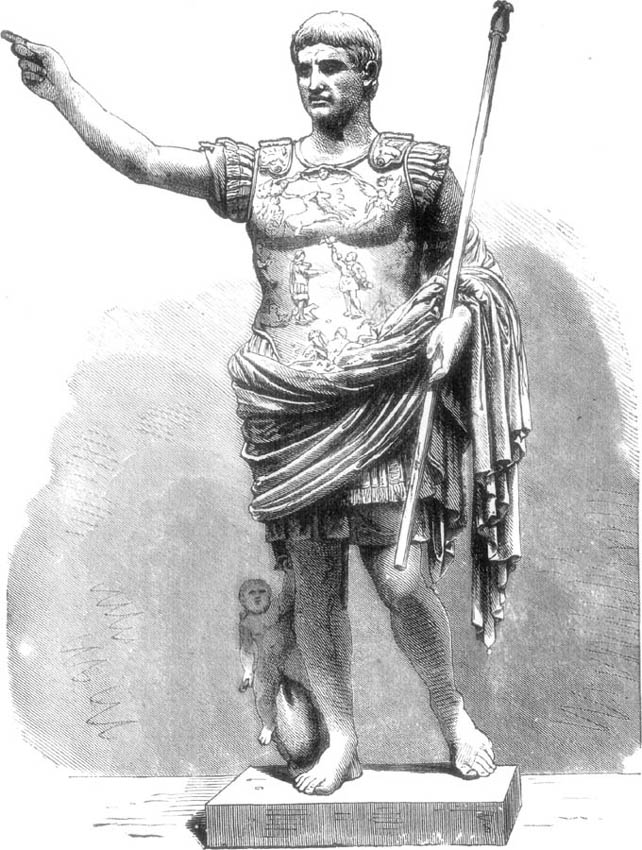
AUGUSTUS CÆSAR. (Found at Pompeii.)ToList
First, his Philosophical Works, 1. De Inventione Rhetorica, "On the Rhetorical Art;" intended to exhibit, in a compendious form, all that are most valuable in the works of the Grecian rhetoricians. 2. De Partitione Oratorio Dialogus, "A Dialogue on the several Divisions of Rhetoric," a sort of catechism of rhetoric. 3. De Oratore, "On the True Orator," a systematic work on the art of oratory. This is one of his most brilliant efforts, and so accurately finished in its minute parts, that it may be regarded as a masterpiece of skill in all that relates to the graces of style and composition. 4. Brutus: de claris Oratoribus. This is in the form of a dialogue, and contains a complete critical history of Roman eloquence. 5. Orator, "The Orator," addressed to Marcus Brutus, giving his views as to what constitutes a perfect orator. 6. De Republica, "On the Republic," in six books, designed to show the best form of government and the duty of the citizen; but a considerable portion of this is lost. 7. De Officiis; a treatise on moral obligations, viewed not so much with reference to a metaphysical investigation of the basis on which they rest, as to the practical business of the world, and the intercourse of social and political life. This is one of his most precious legacies. 8. De Finibus Bonorum et Malorum, "On the Ends of Good and Evil," a series of dialogues dedicated to M. Brutus, in which the opinions of the Grecian schools, especially of the Epicureans, the Stoics, and the Peripatetics, on the Supreme Good, the Summum Bonum, that is, the finis, "the end."
INVECTIVE AGAINST CATILINE. (By Cicero.)
How long, O Catiline, wilt thou abuse our patience? How long shalt thou baffle justice in thy mad career? To what extreme wilt thou carry thy audacity? Art thou nothing daunted by the nightly watch, posted to secure the Palatium? Nothing, by the city guards! Nothing, by the rally of all good citizens? Nothing, by the assembling of the senate in this fortified place? Nothing, by the averted looks of all here present? Seest thou not that all thy plots are exposed?—that thy wretched conspiracy is laid bare to every man's knowledge, here in the senate?—that we are well aware of thy proceedings of last night; of the night before; the place, of meeting, the company convoked, the measures concerted? Alas, the times! Alas, the public morals! The senate understands all this. The Consul sees it. Yet the traitor lives! Lives? Ay, truly, and confronts us here in council; takes part in our deliberations; and, with his measuring eye, marks out each man of us for slaughter! And we, all this while, strenuous that we are, think we have amply discharged our duty to the state, if we but shun this madman's sword and fury!
Long since, O Catiline, ought the Consul to have ordered thee to execution, and brought upon thy own head the ruin thou hast been meditating against others! There was that virtue once in Rome, that a wicked citizen was held more execrable than the deadliest foe. We have a law still, Catiline, for thee. Think not that we are powerless because forbearing. We have a decree—though it rests among our archives like a sword in its scabbard—a decree by which thy life would be made to pay the forfeit of thy crimes. And, should I order thee to be instantly seized and put to death, I make just doubt whether all good men would not think it done rather too late, than any man too cruelly. But, for good reasons, I will yet defer the blow, long since deserved. Then will I doom thee, when no man is found so lost, so wicked, nay, so like thyself, but shall confess that it was justly dealt. While there is one man that dares defend thee, live! But thou shalt live so beset, so surrounded, so scrutinized, by the vigilant guards that I have placed around thee, that thou shalt not stir a foot against the Republic without my knowledge. There shall be eyes to detect thy slightest movement, and ears to catch thy wariest whisper, of which thou shalt not dream. The darkness of night shall not cover thy treason—the walls of privacy shall not stifle its voice. Baffled on all sides, thy most secret counsels clear as noon-day, what canst thou now have in view? Proceed, plot, conspire, as thou wilt; there is nothing you can contrive, nothing you can propose, nothing you can attempt which I shall not know, hear, and promptly understand. Thou shalt soon be made aware that I am even more active in providing for the preservation of the state than thou in plotting its destruction!—First Oration.
EXPULSION OF CATILINE FROM ROME. (By Cicero.)
At length, Romans, we are rid of Catiline! We have driven him forth, drunk with fury, breathing mischief, threatening to revisit us with fire and sword. He is gone; he is fled; he has escaped; he has broken away. No longer, within the very walls of the city, shall he plot her ruin. We have forced him from secret plots into open rebellion. The bad citizen is now the avowed traitor. His flight is the confession of his treason! Would that his attendants had not been so few! Be speedy, ye companions of his dissolute pleasures; be speedy, and you may overtake him before night, on the Aurelian road. Let him not languish, deprived of your society. Haste to join the congenial crew that compose his army; his army, I say—for who doubts that the army under Manlius expect Catiline for their leader? And such an army! Outcasts from honor, and fugitives from debt; gamblers and felons; miscreants, whose dreams are of rapine, murder, and conflagration!
Against these gallant troops of your adversary, prepare, O Romans, your garrisons and armies; and first to that maimed and battered gladiator oppose your consuls and generals; next, against that miserable, outcast horde, lead forth the strength and flower of all Italy! On the one side, chastity contends; on the other wantonness; here purity, there pollution; here integrity, there treachery; here piety, there profaneness; here constancy, there rage; here honesty, there baseness; here continence, there lust; in short, equity, temperance, fortitude, prudence, struggle with iniquity, luxury, cowardice, rashness; every virtue with every vice; and, lastly, the contest lies between well-grounded hope and absolute despair. In such a conflict, were even human aid to fail, would not the immortal gods empower such conspicuous virtue to triumph over such complicated vice?—Second Oration.
THE TYRANT PRÆTOR DENOUNCED. (By Cicero.)
An opinion has long prevailed, fathers, that, in public prosecutions, men of wealth, however clearly convicted, are always safe. This opinion, so injurious to your order, so detrimental to the state, is now in your power to refute. A man is on trial before you who is rich, and who hopes his riches will compass his acquittal, but whose life and actions are sufficient condemnation in the eyes of all candid men. I speak of Caius Verres, who, if he now receive not the sentence his crimes deserve, it shall not be through the lack of a criminal or of a prosecutor, but through the failure of the ministers of justice to do their duty. Passing over the shameful irregularities of his youth, what does the quæstorship of Verres exhibit but one continued scene of villainies? The public treasure squandered, a Consul stripped and betrayed, an army deserted and reduced to want, a province robbed, the civil and religious rights of a people trampled on! But his praætorship in Sicily has crowned his career of wickedness, and completed the lasting monument of his infamy. His decisions have violated all law, all precedent, all right. His extortions from the industrious poor have been beyond computation. Our most faithful allies have been treated as enemies. Roman citizens have, like slaves, been put to death with tortures. Men the most worthy have been condemned and banished without a hearing, while the most atrocious criminals have, with money, purchased exemption from the punishment due to their guilt.
I ask now, Verres, what have you to advance against these charges? Art thou not the tyrant prætor, who, at no greater distance than Sicily, within sight of the Italian coast, dared to put to an infamous death, on the cross, that ill-fated and innocent citizen, Publius Gavius Cosanus? And what was his offense? He had declared his intention of appealing to the justice of his country against your brutal persecutions! For this, when about to embark for home, he was seized, brought before you, charged with being a spy, scourged and tortured. In vain did he exclaim: "I am a Roman citizen! I have served under Lucius Pretius, who is now at Panormus, and who will attest my innocence!" Deaf to all remonstrance, remorseless, thirsting for innocent blood, you ordered the savage punishment to be inflicted! While the sacred words, "I am a Roman citizen," were on his lips—words which, in the remotest regions, are a passport to protection—you ordered him to death, to a death upon the cross!
O liberty! O sound once delightful to every Roman ear! O sacred privilege of Roman citizenship! once sacred—now trampled on! Is it come to this? Shall an inferior magistrate—a governor, who holds his whole power of the Roman people—in a Roman province, within sight of Italy, bind, scourge, torture, and put to an infamous death, a Roman citizen? Shall neither the cries of innocence expiring in agony, the tears of pitying spectators, the majesty of the Roman commonwealth, nor the fear of the justice of this country, restrain the merciless monster, who, in the confidence of his riches, strikes at the very root of liberty, and sets mankind at defiance? And shall this man escape? Fathers, it must not be! It must not be, unless you would undermine the very foundations of social safety, strangle justice, and call down anarchy, massacre and ruin on the commonwealth.—Oration against Verres.
ADVANTAGES OF AGE. (By Cicero.)
Indeed, old age is so far from being necessarily a state of languor and inactivity, that it generally continues to exert itself in that sort of occupation which was the favorite object of its pursuit in more vigorous years. I will add, that instances might be produced of men who, in this period of life, have successfully applied themselves even to the acquisition of some art of science to which they were before entirely strangers. Thus Solon in one of his poems, written when he was advanced in years, glories that "he learned something every day he lived." And old as I myself am, it is but lately that I acquired a knowledge of the Greek language; to which I applied with the more zeal and diligence, as I had long entertained an earnest desire of becoming acquainted with the writings and characters of those excellent men, to whose examples I have occasionally appealed in the course of our present conversation. Thus, Socrates, too, in his old age, learned to play upon the lyre, an art which the ancients did not deem unworthy of their application. If I have not followed the philosopher's example in this instance (which, indeed, I very much regret), I have spared, however, no pains to make myself master of the Greek language and learning.
Inestimable, too, are the advantages of old age, if we contemplate it in another point of view; if we consider it as delivering us from the tyranny of lust and ambition; from the angry and contentious passions; from every inordinate and irrational desire; in a word, as teaching us to retire within ourselves, and look for happiness in our own bosoms. If to these moral benefits naturally resulting from length of days be added that sweet food of the mind which is gathered in the fields of science, I know not any season of life that is passed more agreeably than the learned leisure of a virtuous old age.
IMMORTALITY OF THE SOUL. (By Cicero.)
And now, among the different sentiments of the philosophers concerning the consequences of our final dissolution, may I not venture to declare my own? and the rather, as the nearer death advances towards me, the more clearly I seem to discern its real nature.
I am well convinced, then, that my dear departed friends, your two illustrious fathers, are so far from having ceased to live, that the state they now enjoy can alone with propriety be called life. The soul, during her confinement within this prison of the body, is doomed by fate to undergo a severe penance; for her native seat is in heaven, and it is with reluctance that she is forced down from those celestial mansions into these lower regions, where all is foreign and repugnant to her divine nature. But the gods, I am persuaded, have thus widely disseminated immortal spirits, and clothed them with human bodies, that there might be a race of intelligent creatures, not only to have dominion over this, our earth, but to contemplate the host of heaven, and imitate in their moral conduct the same beautiful order and uniformity so conspicuous in those splendid orbs. This opinion I am induced to embrace, not only as agreeable to the best deductions of reason, but in just deference, also, to the authority of the noblest and most distinguished philosophers. And I am further confirmed in my belief of the soul's immortality by the discourse which Socrates—whom the oracle of Apollo pronounced to be the wisest of men—held upon this subject just before his death. In a word, when I consider the faculties with which the human mind is endued; its amazing celerity; its wonderful power in recollecting past events, and sagacity in discerning future; together with its numberless discoveries in the several arts and sciences, I feel a conscious conviction that this active, comprehensive principle can not possibly be of a mortal nature. And as this unceasing activity of the soul derives its energy from its own intrinsic and essential powers, without receiving it from any foreign or external impulse, it necessarily follows (as it is absurd to suppose the soul would desert itself) that this activity must continue forever. But farther; as the soul is evidently a simple, uncompounded substance, without any dissimilar parts or heterogeneous mixture, it can not, therefore, be divided; consequently, it can not perish. I might add, that the facility and expedition with which youth are taught to acquire numberless very difficult arts, is a strong presumption that the soul possessed a considerable portion of knowledge before it entered into the human form, and that what seems to be received from instruction is, in fact, no other than a reminiscence or recollection of its former ideas. This, at least, is the opinion of Plato.
JULIUS CAESAR.
Julius Cæsar was born on the 12th of July, 100 B.C. As to his intellectual character, Cæsar was gifted by nature with the most varied talents, and was distinguished by an extraordinary genius, and by attainments in very diversified pursuits. He was, at one and the same time, a general, a statesman, a lawgiver, a jurist, an orator, a poet, an historian, a philologer, a mathematician, and an architect. He seemed equally fitted to excel in all, and has given proofs that he would surpass most men in any subject to which he should devote the energies of his great mind; and Middleton says he was the only man in Rome capable of rivaling Cicero as an orator. During his whole busy life he found time for literary pursuits, and always took pleasure in the society and conversation of men of learning.
Cæsar wrote many works on different subjects, but they are now all lost but his "Commentaries." These relate the history of the first seven years of the Gallic War in seven books, and the Civil War down to the commencement of the Alexandrine in three books. The purity of his Latin, and the clearness and beauty of his style have rendered his "Commentaries" a most popular and desirable text book for students of the Latin language.
A most important change was introduced by him in the reformation of the calendar, which was not only of vast importance to his country and to the civilized world, but its benefits have extended to the present day. What consummate folly, then, to say nothing of the wickedness, was displayed by the conspirators who put him to death; for instead of the wise, the noble, the magnanimous, they exalted to supreme power one of the basest men in all Rome—Augustus, who, as one of the second Triumvirate, consented to the murder of his intimate and noble friend, Cicero.
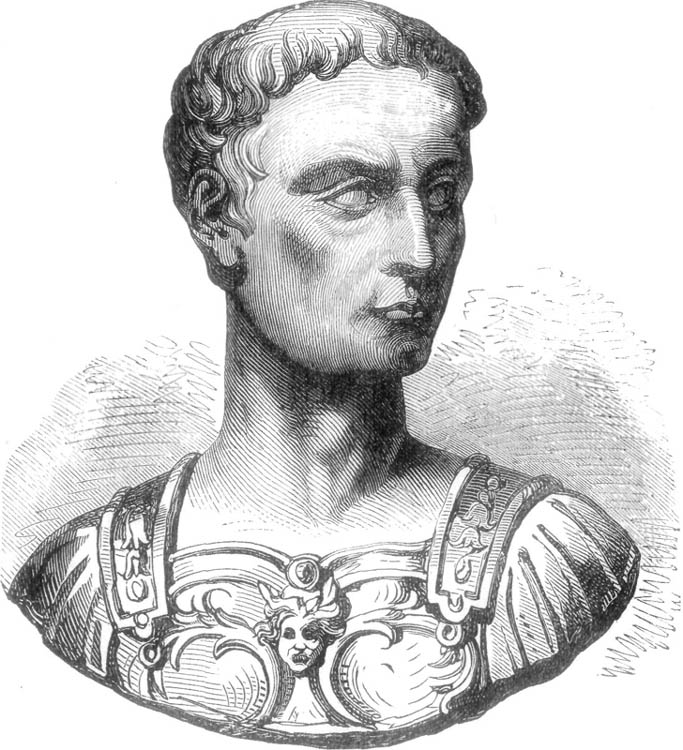
JULIUS CÆSAR. (From an Ancient Sculpturing.)ToList
THE GERMANS. (By Julius Cæsar.)
The Germans differ much from these usages, for they have neither Druids to preside over sacred offices, nor do they pay great regard to sacrifices. They rank in the number of the gods those alone whom they behold, and by whose instrumentality they are obviously benefited, namely, the sun, fire, and the moon; they have not heard of the other deities even by report. Their whole life is occupied in hunting and in the pursuits of the military art; from childhood they devote themselves to fatigue and hardships. Those who have remained chaste for the longest time receive the greatest commendation among their people; they think that by this the growth is promoted, by this the physical powers are increased and the sinews are strengthened.
They do not pay much attention to agriculture, and a large portion of their food consists in milk, cheese, and flesh; nor has any one a fixed quantity of land or his own individual limits; but the magistrates and the leading men each year apportion to the tribes and families, who have united together, as much land as, and in the place which, they think proper, and the year after compel them to remove elsewhere. For this enactment they advance many reasons—lest seduced by long-continued custom, they may exchange their ardor in the waging of war for agriculture; lest they may be anxious to acquire extensive estates, and the more powerful drive the weaker from their possessions; lest they construct their houses with too great a desire to avoid cold and heat; lest the desire of wealth spring up, from which cause divisions and discords arise; and that they may keep the common people in a contented state of mind, when each sees his own means placed on an equality with those of the most powerful.
It is the greatest glory to the several states to have as wide deserts as possible around them, their frontiers having been laid waste. They consider this the real evidence of their prowess, that their neighbors shall be driven out of their lands and abandon them, and that no one dare settle near them; at the same time they think that they shall be on that account the more secure, because they have removed the apprehension of a sudden incursion. When a state either repels war waged against it, or wages it against another, magistrates are chosen to preside over that war with such authority that they have power of life and death. In peace there is no common magistrate, but the chiefs of provinces and cantons administer justice and determine controversies among their own people. Robberies which are committed beyond the boundaries of each state bear no infamy, and they avow that these are committed for the purpose of disciplining their youth and of preventing sloth. And when any of their chiefs has said in an assembly "that he will be their leader, let those who are willing to follow give in their names," they who approve of both the enterprise and the man arise and promise their assistance and are applauded by the people; such of them as have not followed him are accounted in the number of deserters and traitors, and confidence in all matters is afterwards refused them. To injure guests they regard as impious; they defend from wrong those who have come to them for any purpose whatever, and esteem them inviolable; to them the houses of all are open and maintenance is freely supplied.