AMUSEMENTS.ToC (continued 2)
Reading edition
The vases were very numerous, and varied in shape, size, and materials; being of hard stone, alabaster, glass, ivory, bone, porcelain, bronze, brass, silver, or gold; and those of the poorer classes were of glazed pottery, or common earthenware. Many of their ornamental vases, as well as those in ordinary use, were of the most elegant shape, which would do honor to the Greeks, the Egyptians frequently displaying in these objects of private luxe the taste of a highly refined people; and so strong a resemblance did they bear to the productions of the best epochs of ancient Greece, both in their shape and in the fancy devices upon them, that some might even suppose them borrowed from Greek patterns. But they were purely Egyptian, and had been universally adopted in the valley of the Nile, long before the graceful forms we admire were known in Greece; a fact invariably acknowledged by those who are acquainted with the remote age of Egyptian monuments, and of the paintings that represent them.
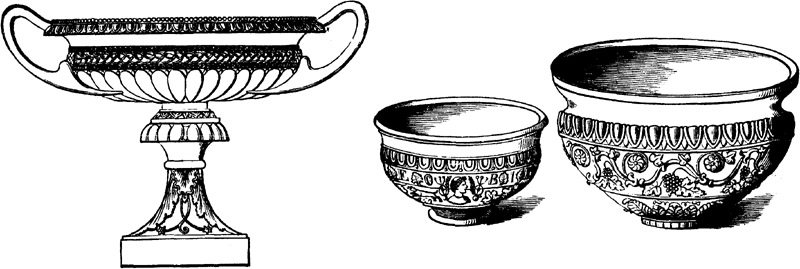
EGYPTIAN VASES.ToList
For some of the most elegant date in the early age of the third Thothmes, who lived between 3,300 and 3,400 years before our time; and we not only admire their forms, but the richness of the materials of which they were made, their color, as well as the hieroglyphics, showing them to have been of gold and silver, or of this last, inlaid with the more precious metal.
Those of bronze, alabaster, glass, porcelain, and even of ordinary pottery, were also deserving of admiration, from the beauty of their shapes, the designs which ornamented them, and the superior quality of the material; and gold and silver cups were often beautifully engraved, and studded with precious stones. Among these we readily distinguish the green emerald, the purple amethyst, and other gems; and when an animal's head adorned their handles, the eyes were frequently composed of them, except when enamel, or some colored composition, was employed as a substitute.
While the guests were entertained with music and the dance dinner was prepared; but as it consisted of a considerable number of dishes, and the meat was killed for the occasion, as at the present day in Eastern and tropical climates, some time elapsed before it was put upon table. An ox, kid, wild goat, gazelle or an oryx, and a quantity of geese, ducks, teal, quails and other birds, were generally selected; but mutton was excluded from a Theban table. Plutarch even states that "no Egyptians would eat the flesh of sheep, except the Lycopolites," who did so out of compliment to the wolves they venerated; and Strabo confines the sacrifice of them to the Nome of Nitriotis. But though sheep were not killed for the altar or the table, they abounded in Egypt and even at Thebes; and large flocks were kept for their wool, particularly in the neighborhood of Memphis. Sometimes a flock consisted of more than 2,000; and in a tomb below the Pyramids, dating upwards of 4,000 years ago, 974 rams are brought to be registered by his scribes, as part of the stock of the deceased; implying an equal number of ewes, independent of lambs.
A considerable quantity of meat was served up at those repasts, to which strangers were invited, as among people of the East at the present day; whose azooma, or feast, prides itself in the quantity and variety of dishes, in the unsparing profusion of viands, and, whenever wine is permitted, in the freedom of the bowl. An endless succession of vegetables was also required on all occasions; and, when dining in private, dishes composed chiefly of them were in greater request than joints, even at the tables of the rich, and consequently the Israelites, who, by their long residence there, had acquired similar habits, regretted them equally with the meat and fish of Egypt.
Their mode of dining was very similar to that now adopted in Cairo and throughout the East; each person sitting round a table, and dipping his bread into a dish placed in the centre, removed on a sign made by the host, and succeeded by others, whose rotation depends on established rule, and whose number is predetermined according to the size of the party, or the quality of the guests.
Among the lower orders, vegetables constituted a very great part of their ordinary food, and they gladly availed themselves of the variety and abundance of esculent roots growing spontaneously, in the lands irrigated by the rising Nile, as soon as its waters had subsided; some of which were eaten in a crude state, and others roasted in the ashes, boiled or stewed: their chief aliment, and that of their children, consisting of milk and cheese, roots, leguminous, cucurbitaceous and other plants, and the ordinary fruits of the country. Herodotus describes the food of the workmen who built the Pyramids, to have been the "raphanus, onions and garlic;" the first of which, now called figl, is like a turnip-radish in flavor; but he has omitted one more vegetable, lentils, which were always, as at the present day, the chief article of their diet; and which Strabo very properly adds to the number.
The nummulite rock, in the vicinity of those monuments, frequently presents a conglomerate of testacea imbedded in it, which, in some positions, resemble small seeds; and Strabo imagines they were the petrified residue of the lentils brought there by the workmen, from their having been the ordinary food of the laboring classes, and of all the lower orders of Egyptians.
Much attention was bestowed on the culture of this useful pulse, and certain varieties became remarkable for their excellence, the lentils of Pelusium being esteemed both in Egypt and in foreign countries.
That dinner was served up at mid-day, may be inferred from the invitation given by Joseph to his brethren; but it is probable that, like the Romans, they also ate supper in the evening, as is still the custom in the East. The table was much the same as that of the present day in Egypt: a small stool, supporting a round tray, on which the dishes are placed; but it differed from this in having its circular summit fixed on a pillar, or leg, which was often in the form of a man, generally a captive, who supported the slab upon his head; the whole being of stone, or some hard wood. On this the dishes were placed, together with loaves of bread, some of which were not unlike those of the present day in Egypt, flat and round as our crumpets. Others had the form of rolls or cakes, sprinkled with seeds.
It was not generally covered with any linen, but, like the Greek table, was washed with a sponge, or napkin, after the dishes were removed, and polished by the servants, when the company had retired; though an instance sometimes occurs of a napkin spread on it, at least on those which bore offerings in honor of the dead.
One or two guests generally sat at a table, though from the mention of persons seated in rows according to rank, it has been supposed the tables were occasionally of a long shape, as may have been the case when the brethren of Joseph "sat before him, the first born according to his birth-right, and the youngest according to his youth," Joseph eating alone at another table where "they set on for him by himself." But even if round, they might still sit according to rank; one place being always the post of honor, even at the present day, at the round table of Egypt.
In the houses of the rich, bread was made of wheat; the poorer classes being contented with bakes of barley, or of doora (holcus sorghum), which last is still so commonly used by them; for Herodotus is as wrong in saying that they thought it "the greatest disgrace to live on wheat and barley," as that "no one drank out of any but bronze (or brazen) cups." The drinking cups of the Egyptians not only varied in their materials, but also in their forms. Some were plain and unornamented; others, though of small dimensions, were made after the models of larger vases; many were like our own cups without handles; and others may come under the denomination of beakers, and saucers. Of these the former were frequently made of alabaster, with a round base, so that they could not stand when filled, and were held in the hand, or, when empty, were turned downwards upon their rim: and the saucers, which were of glazed pottery, had sometimes lotus blossoms, or fish, represented on their concave surface.
The tables, as at a Roman repast, were occasionally brought in, and removed, with the dishes on them; sometimes each joint was served up separately, and the fruit, deposited in a plate or trencher, succeeded the meat at the close of the dinner; but in less fashionable circles, particularly of the olden time, fruit was brought in baskets, which stood beside the table. The dishes consisted of fish; meat boiled, roasted, and dressed in various ways; game, poultry, and a profusion of vegetables and fruit, particularly figs and grapes, during the season; and a soup, or "pottage of lentils," as with the modern Egyptians, was not an unusual dish.
Of figs and grapes they were particularly fond, which is shown by their constant introduction, even among the choice offerings presented to the gods; and figs of the sycamore must have been highly esteemed, since they were selected as the heavenly fruit, given by the goddess Netpe to those who were judged worthy of admission to the regions of eternal happiness. Fresh dates during the season, and in a dried state at other periods of the year, were also brought to table, as well as a preserve of the fruit, made into a cake of the same form as the tamarinds now brought from the interior of Africa, and sold in the Cairo market.
The guests sat on the ground, or on stools and chairs, and, having neither knives and forks, nor any substitute for them answering to the chop-sticks of the Chinese, they ate with their fingers, like the modern Asiatics, and invariably with the right hand; nor did the Jews and Etruscans, though they had forks for other purposes, use any at table.
Spoons were introduced when required for soup, or other liquids; and, perhaps, even a knife was employed on some occasions, to facilitate the carving of a large joint, which is sometimes done in the East at the present day.
The Egyptians washed after, as well as before, dinner; an invariable custom throughout the East, as among the Greeks, Romans, Hebrews, and others; and Herodotus speaks of a golden basin, belonging to Amasis, which was used by the King, and "the guests who were in the habit of eating at his table."
An absorbent seems also to have been adopted for scouring the hands; and a powder of ground lupins, the doqaq of modern Egypt, is no doubt an old invention, handed down to the present inhabitants.
Soap was not unknown to the ancients, and a small quantity has been found at Pompeii. Pliny, who mentions it as an invention of the Gauls, says it was made of fat and ashes; and Aretæus, the physician of Cappadocia, tells us that the Greeks borrowed their knowledge of its medicinal properties from the Romans. But there is no evidence of soap having been used by the Egyptians; and if by accident they discovered something of the kind, while engaged with mixtures of natron or potash, and other ingredients, it is probable that it was only an absorbent, without oil or grease, and on a par with steatite, or the argillaceous earths, with which, no doubt, they were long acquainted.
The Egyptians, a scrupulously religious people, were never remiss in expressing their gratitude for the blessings they enjoyed, and in returning thanks to the gods for that peculiar protection they were thought to extend to them and to their country, above all the nations of the earth.
They, therefore, never sat down to meals without saying grace; and Josephus says that when the seventy-two elders were invited by Ptolemy Philadelphus to sup at the palace, Nicanor requested Eleazer to say grace for his countrymen, instead of those Egyptians to whom that duty was committed on other occasions.
It was also a custom of the Egyptians, during or after their repasts, to introduce a wooden image of Osiris, from one foot and a half to three feet in height, in the form of a human mummy, standing erect, or lying on a bier, and to show it to each of the guests, warning him of his mortality, and the transitory nature of human pleasures. He was reminded that some day he would be like that figure; that men ought "to love one another, and avoid those evils which tend to make them consider life too long, when in reality it is too short;" and while enjoying the blessings of this world, to bear in mind that their existence was precarious, and that death, which all ought to be prepared to meet, must eventually close their earthly career.
Thus, while the guests were permitted, and even encouraged, to indulge in conviviality, the pleasures of the table, and the mirth so congenial to their lively disposition, they were exhorted to put a certain degree of restraint upon their conduct; and though this sentiment was perverted by other people, and used as an incentive to present excesses, it was perfectly consistent with the ideas of the Egyptians to be reminded that this life was only a lodging, or "inn" on their way, and that their existence here was the preparation for a future state.
"The ungodly," too, of Solomon's time, thus expressed themselves: "Our life is short and tedious, and in the death of a man there is no remedy; neither was there any man known to have returned from the grave. For we are born at all adventure, and we shall be hereafter as though we had never been, ... come on, therefore, let us enjoy the good things that are present, ... let us fill ourselves with costly wine and ointments; and let no flower of the spring pass by us; let us crown ourselves with rosebuds, before they be withered; let none of us go without his part of our voluptuousness; let us leave tokens of our joyfulness in every place."
But even if the Egyptians, like other men, neglected a good warning, the original object of it was praiseworthy; and Plutarch expressly states that it was intended to convey a moral lesson. The idea of death had nothing revolting to them; and so little did the Egyptians object to have it brought before them, that they even introduced the mummy of a deceased relative at their parties, and placed it at table, as one of the guests; a fact which is recorded by Lucian, in his "Essay on Grief," and of which he declares himself to have been an eye-witness.
After dinner, music and singing were resumed; hired men and women displayed feats of agility; swinging each other round by the hand; throwing up and catching the ball; or flinging themselves round backwards head-over-heels, in imitation of a wheel; which was usually a performance of women. They also stood on each other's backs, and made a somersault from that position; and a necklace, or other reward, was given to the most successful tumbler.
Egyptian Music and Entertainments.
Though impossible for us now to form any notion of the character or style of Egyptian music, we may be allowed to conjecture that it was studied on scientific principles; and, whatever defects existed in the skill of ordinary performers, who gained their livelihood by playing in public, or for the entertainment of a private party, music was looked upon as an important science, and diligently studied by the priests themselves. According to Diodorus it was not customary to make music part of their education, being deemed useless and even injurious, as tending to render the minds of men effeminate; but this remark can only apply to the custom of studying it as an amusement. Plato, who was well acquainted with the usages of the Egyptians, says that they considered music of the greatest consequence, from its beneficial effects upon the mind of youth; and according to Strabo, the children of the Egyptians were taught letters, the songs appointed by law, and a certain kind of music, established by government.
That the Egyptians were particularly fond of music is abundantly proved by the paintings in their tombs of the earliest times; and we even find they introduced figures performing on the favorite instruments of the country, among the devices with which they adorned fancy boxes or trinkets. The skill of the Egyptians in the use of musical instruments is also noticed by Athenæus, who says that both the Greeks and barbarians were taught by refugees from Egypt, and that the Alexandrians were the most scientific and skillful players on pipes and other instruments.
It is sufficiently evident, from the sculptures of the ancient Egyptians, that their hired musicians were acquainted with the triple symphony: the harmony of instruments; of voices; and of voices and instruments. Their band was variously composed, consisting either of two harps, with the single pipe and flute; of the harp and double pipe, frequently with the addition of the guitar; of a fourteen-stringed harp, a guitar, lyre, double pipe, and tambourine; of two harps, sometimes of different sizes, one of seven, the other of four, strings; of two harps of eight chords, and a seven-stringed lyre; of the guitar and the square or oblong tambourine; of the lyre, harp, guitar, double pipe, and a sort of harp with four strings, which was held upon the shoulder; of the harp, guitar, double pipe, lyre, and square tambourine; of the harp, two guitars, and the double pipe; of the harp, two flutes, and a guitar; of two harps and a flute; of a seventeen-stringed lyre, the double pipe, and a harp of fourteen chords; of the harp and two guitars; or of two seven-stringed harps and an instrument held in the hand, not unlike an eastern fan, to which were probably attached small bells, or pieces of metal that emitted a jingling sound when shaken, like the crescent-crowned bells of our modern bands. There were many other combinations of these various instruments; and in the Bacchic festival of Ptolemy Philadelphus, described by Athenæus, more than 600 musicians were employed in the chorus, among whom were 300 performers on the cithara.
Sometimes the harp was played alone, or as an accompaniment to the voice; and a band of seven or more choristers frequently sang to it a favorite air, beating time with their hands between each stanza. They also sang to other instruments, as the lyre, guitar or double pipe; or to several of them played together, as the flute and one or more harps; or to these last with a lyre or a guitar. It was not unusual for one man or one woman to perform a solo; and a chorus of many persons occasionally sang at a private assembly without any instrument, two or three beating time at intervals with the hand. Sometimes the band of choristers consisted of more than twenty persons, only two of whom responded by clapping their hands; and in one instance we have seen a female represented holding what was perhaps another kind of jingling instrument.
The custom of beating time by clapping the hands between the stanzas is still usual in Egypt.
On some occasions women beat the tambourine and darabooka drum, without the addition of any other instrument; dancing or singing to the sound; and bearing palm branches or green twigs in their hands, they proceeded to the tomb of a deceased friend, accompanied by this species of music. The same custom may still be traced in the Friday visit to the cemetery, and in some other funeral ceremonies among the Moslem peasants of modern Egypt.
If it was not customary for the higher classes of Egyptians to learn music for the purpose of playing in society, and if few amateur performers could be found among persons of rank, still some general knowledge of the art must have been acquired by a people so alive to its charms; and the attention paid to it by the priests regulated the taste, and prevented the introduction of a vitiated style.
Those who played at the houses of the rich, as well as the ambulant musicians of the streets, were of the lower classes, and made this employment the means of obtaining their livelihood; and in many instances both the minstrels and the choristers were blind.
It was not so necessary an accomplishment for the higher classes of Egyptians as of the Greeks, who, as Cicero says, "considered the arts of singing and playing upon musical instruments a very principal part of learning; whence it is related of Epaminondas, who, in my judgment, was the first of all the Greeks, that he played very well upon the flute. And, some time before, Themistocles, upon refusing the harp at an entertainment, passed for an uninstructed and ill-bred person. Hence, Greece became celebrated for skillful musicians; and as all persons there learned music, those who attained to no proficiency in it were thought uneducated and unaccomplished."
Cornelius Nepos also states that Epaminondas "played the harp and flute, and perfectly understood the art of dancing, with other liberal sciences," which, "though trivial things in the opinion of the Romans, were reckoned highly commendable in Greece."
The Israelites also delighted in music and the dance; and persons of rank deemed them a necessary part of their education. Like the Egyptians with whom they had so long resided, the Jews carefully distinguished sacred from profane music. They introduced it at public and private rejoicings, at funerals, and in religious services; but the character of the airs, like the words of their songs, varied according to the occasion; and they had canticles of mirth, of praise, of thanksgiving, and of lamentation. Some were epithalamia, or songs composed to celebrate marriages; others to commemorate a victory, or the accession of a prince; to return thanks to the Deity, or to celebrate his praises; to lament a general calamity, or a private affliction; and others, again, were peculiar to their festive meetings. On these occasions they introduced the harp, lute, tabret, and various instruments, together with songs and dancing, and the guests were entertained nearly in the same manner as at an Egyptian feast. In the temple, and in the religious ceremonies, the Jews had female as well as male performers, who were generally daughters of the Levites, as the Pallaces of Thebes were either of the royal family, or the daughters of priests; and these musicians were attached exclusively to the service of religion.
David was not only remarkable for his taste and skill in music, but took a delight in introducing it on every occasion. "And seeing that the Levites were numerous, and no longer employed as formerly in carrying the boards, veils, and vessels of the tabernacle, its abode being fixed at Jerusalem, he appointed a great part of them to sing and play on instruments, at the religious festivals."
Solomon, again, at the dedication of the temple, employed "120 priests, to sound with trumpets;" and Josephus pretends that no less than 200,000 musicians were present at that ceremony, besides the same number of singers, who were Levites.
When hired to attend at a private entertainment, the musicians either stood in the centre, or at one side, of the festive chamber, and some sat cross-legged on the ground, like the Turks and other Eastern people of the present day. They were usually accompanied on these occasions by dancers, either men or women, sometimes both; whose art consisted in assuming all the graceful or ludicrous gestures, which could obtain the applause, or tend to the amusement, of the assembled guests. For music and dancing were considered as essential at their entertainments, as among the Greeks; but it is by no means certain that these diversions counteracted the effect of wine, as Plutarch imagines; a sprightly air is more likely to have invited another glass; and sobriety at a feast was not one of the objects of the lively Egyptians.
They indulged freely in whatever tended to increase their enjoyment, and wine flowed freely at their entertainments.
Private individuals were under no particular restrictions with regard to its use, and it was not forbidden to women. In this they differed widely from the Romans; for in early times no female at Rome enjoyed the privilege, and it was unlawful for women, or, indeed, for young men below the age of thirty, to drink wine, except at sacrifices.
Even at a later time the Romans considered it disgraceful for a woman to drink wine; and they sometimes saluted a female relation, whom they suspected, in order to discover if she had secretly indulged in its use. It was afterwards allowed them on the plea of health.
That Egyptian women were not forbidden the use of wine, is evident from the frescoes which represent their feasts; and the painters, in illustrating this fact, have sometimes sacrificed their gallantry to a love of caricature. Some call the servants to support them as they sit, others with difficulty prevent themselves from falling on those behind them; a basin is brought too late by a reluctant servant, and the faded flower, which is ready to drop from their heated hands, is intended to be characteristic of their own sensations.
That the consumption of wine in Egypt was very great is evident from the sculptures, and from the accounts of ancient authors, some of whom have censured the Egyptians for their excesses; and so much did the quantity used exceed that made in the country, that, in the time of Herodotus, twice every year a large importation was received from Phœnicia and Greece.
Notwithstanding all the injunctions or exhortations of the priests in favor of temperance, the Egyptians of both sexes appear from the sculptures to have committed occasional excesses, and men were sometimes unable to walk from a feast, and were carried home by servants. These scenes, however, do not appear to refer to members of the higher, but of the lower, classes, some of whom indulged in extravagant buffoonery, dancing in a ludicrous manner, or standing on their heads, and frequently in amusements which terminated in a fight.
At the tables of the rich, stimulants were sometimes introduced, to excite the palate before drinking, and Athenæus mentions cabbages as one of the vegetables used by the Egyptians for this purpose.
Besides beer, the Egyptians had what Pliny calls factitious, or artificial, wine, extracted from various fruits, as figs, myxas, pomegranates, as well as herbs, some of which were selected for their medicinal properties. The Greeks and Latins comprehended every kind of beverage made by the process of fermentation under the same general name, and beer was designated as barley-wine; but, by the use of the name zythos, they show that the Egyptians distinguished it by its own peculiar appellation. Palm-wine was also made in Egypt, and used in the process of embalming.
The palm-wine now made in Egypt and the Oases is simply from an incision in the heart of the tree, immediately below the base of the upper branches, and a jar is attached to the part to catch the juice which exudes from it. But a palm thus tapped is rendered perfectly useless as a fruit-bearing tree, and generally dies in consequence; and it is reasonable to suppose that so great a sacrifice is seldom made except when date-trees are to be felled, or when they grow in great abundance.
The modern name of this beverage in Egypt is lowbgeh; in flavor it resembles a very new light wine, and may be drunk in great quantity when taken from the tree; but, as soon as the fermentation has commenced, its intoxicating qualities have a powerful and speedy effect.
Among the various fruit-trees cultivated by the ancient Egyptians, palms, of course, held the first rank, as well from their abundance as from their great utility. The fruit constituted a principal part of their food, both in the month of August, when it was gathered fresh from the trees, and at other seasons of the year, when it was used in a preserved state.
They had two different modes of keeping the dates; one was by the simple process of drying them, the other was by making them into a conserve, like the agweh of the present day; and of this, which was eaten either cooked or as a simple sweetmeat, there have been found some cakes, as well as the dried dates, in the sepulchres of Thebes.
Pliny makes a just remark respecting the localities where the palm prospers, and the constant irrigation it requires; and though every one in the East knows the tree will not grow except where water is abundant, we still read of "palm-trees of the desert," as if it delighted in an arid district. Wherever it is found it is a sure indication of water; and if it may be said to flourish in a sandy soil, this is only in situations where its roots can obtain a certain quantity of moisture. The numerous purposes for which its branches and other parts might be applied rendered the cultivation of this valuable and productive tree a matter of primary importance, for no portion of it is without its peculiar use.
The trunk serves for beams, either entire, or split in half; of the gereet, or branches, are made wicker baskets, bedsteads, coops, and ceilings of rooms, answering every purpose for which laths or any thin woodwork are required; the leaves are converted into mats, brooms, and baskets; of the fibrous tegument as the base of the branches, strong ropes and mats are made, and even the thick ends of the gereet are beaten flat and formed into brooms.
Besides the lowbgeh of the tree, brandy, wine, and vinegar are made from the fruit; and the quantity of saccharine matter in the dates might be used in default of sugar or honey.
In Upper Egypt another tree called the Dom, or Theban palm, was also much cultivated, and its wood, more solid and compact than the date-tree, is found to answer as well for rafts, and other purposes connected with water, as for beams and rafters.
Games and Sports of the Egyptians.
The game of morra was common in ancient as well as modern Italy, and was played by two persons, who each simultaneously threw out the fingers of one hand, while one party guessed the sum of both. They were said in Latin, "micare digitis," and this game, still so common among the lower order of Indians, existed in Egypt, about four thousand years ago, in the reigns of the Osirtasens.
The same, or even a greater, antiquity may be claimed for the game of draughts, or, as it has been called, chess. As in the two former, the players sat on the ground, or on chairs, and the pieces, or men, being ranged in line at either end of the tables, moved on a chequered board, as in our own chess.
The pieces were all of the same size and form, though they varied on different boards, some being small, others large with round summits: some were surmounted by human heads; and many were of a lighter and neater shape, like small nine-pins, probably the most fashionable kind, since they were used in the palace of king Remeses. These last seem to have been about one inch and a half high, standing on a circular base of half an inch in diameter; but some are only one inch and a quarter in height, and little more than half an inch broad at the lower end. Others have been found, of ivory, one inch and six eighths high, and one and an eighth in diameter, with a small knob at the top, exactly like those represented at Beni Hassan, and the tombs near the Pyramids.
They were about equal in size upon the same board, one set black, the other white or red; or one with round, the other with flat heads, standing on opposite sides; and each player, raising it with the finger and thumb, advanced his piece towards those of his opponent; but though we are unable to say if this was done in a direct or a diagonal line, there is reason to believe they could not take backwards as in the Polish game of chess, the men being mixed together on the board.
It was an amusement common in the houses of the lower classes, as in the mansions of the rich; and king Remeses is himself portrayed on the walls of his palace at Thebes, engaged in the game of chess with the ladies of his household.
The modern Egyptians have a game of chess, very similar, in the appearance of the men, to that of their ancestors, which they call dameh, and play much in the same manner as our own.
Analogous to the game of odd and even was one, in which two of the players held a number of shells, or dice, in their closed hands, over a third person who knelt between them, with his face towards the ground, and who was obliged to guess the combined number ere he could be released from this position.
Another game consisted in endeavoring to snatch from each other a small hoop, by means of hooked rods, probably of metal; and the success of a player seems to have depended on extricating his own from an adversary's rod, and then snatching up the hoop, before he had time to stop it.
There were also two games, of which the boards, with the men, are in the possession of Dr. Abbott. One is eleven inches long by three and a half, and has ten spaces or squares in three rows; the other twelve squares at the upper end (or four squares in three rows) and a long line of eight squares below, forming an approach to the upper part, like the arrangement of German tactics. The men in the drawer of the board are of two shapes, one set ten, the other nine in number.
Other games are represented in the paintings, but not in a manner to render them intelligible; and many, which were doubtless common in Egypt, are omitted both in the tombs, and in the writings of ancient authors.
The dice discovered at Thebes and other places, may not be of a Pharaonic period, but, from the simplicity of their form, we may suppose them similar to those of the earliest age, in which, too, the conventional number of six sides had probably always been adopted. They were marked with small circles, representing units, generally with a dot in the centre; and were of bone or ivory, varying slightly in size.
Plutarch shows that dice were a very early invention in Egypt, and acknowledged to be so by the Egyptians themselves, since they were introduced into one of their oldest mythological fables; Mercury being represented playing at dice with the Moon, previous to the birth of Osiris, and winning from her the five days of the epact, which were added to complete the 365 days of the year.
It is probable that several games of chance were known to the Egyptians, besides dice and morra, and, as with the Romans, that many a doubtful mind sought relief in the promise of success, by having recourse to fortuitous combinations of various kinds; and the custom of drawing, or casting lots, was common, at least as early as the period of the Hebrew Exodus.
The games and amusements of children were such as tended to promote health by the exercise of the body, and to divert the mind by laughable entertainments. Throwing and catching the ball, running, leaping, and similar feats, were encouraged, as soon as their age enabled them to indulge in them; and a young child was amused with painted dolls, whose hands and legs, moving on pins, were made to assume various positions by means of strings. Some of these were of rude form, without legs, or with an imperfect representation of a single arm on one side. Some had numerous beads, in imitation of hair, hanging from the doubtful place of the head; others exhibited a nearer approach to the form of a man; and some, made with considerable attention to proportion, were small models of the human figure. They were colored according to fancy; and the most shapeless had usually the most gaudy appearance, being intended to catch the eye of an infant. Sometimes a man was figured washing, or kneading dough, who was made to work by pulling a string; and a typhonian monster, or a crocodile, amused a child by its grimaces, or the motion of its opening mouth. In the toy of the crocodile, we have sufficient evidence that the notion of this animal "not moving its lower jaw, and being the only creature which brings the upper one down to the lower," is erroneous. Like other animals, it moves the lower jaw only; but when seizing its prey, it throws up its head, which gives an appearance of motion in the upper jaw, and has led to the mistake.
The game of ball was of course generally played out of doors. It was not confined to children, nor to one sex, though the mere amusement of throwing and catching it appears to have been considered more particularly adapted to women. They had different modes of playing. Sometimes a person unsuccessful in catching the ball was obliged to suffer another to ride on her back, who continued to enjoy this post until she also missed it; the ball being thrown by an opposite player, mounted in the same manner, and placed at a certain distance, according to the space previously agreed upon; and, from the beast-of-burden office of the person who had failed, the same name was probably applied to her as to those in the Greek game, "who were called asses, and were obliged to submit to the commands of the victor."
Sometimes they caught three or more balls in succession, the hands occasionally crossed over the breast; they also threw it up to a height and caught it, like our "sky-ball;" and the game described by Homer to have been played by Halius and Laodamus, in the presence of Alcinous, was known to them; in which one party threw the ball as high as he could, and the other, leaping up, caught it on its fall, before his feet again touched the ground.
When mounted on the backs of the losing party, the Egyptian women sat sidewise. Their dress consisted merely of a short petticoat, without a body, the loose upper robe being laid aside on these occasions; it was bound at the waist with a girdle, supported by a strap over the shoulder, and was nearly the same as the undress garb of mourners, worn during the funeral lamentation on the death of a friend.
The balls were made of leather or skin, sewed with string, crosswise, in the same manner as our own, and stuffed with bran, or husks of corn; and those which have been found at Thebes are about three inches in diameter. Others were made of string, or of the stalks of rushes, platted together so as to form a circular mass, and covered, like the former, with leather. They appear also to have had a smaller kind of ball probably of the same materials, and covered, like many of our own, with slips of leather of a rhomboidal shape, sewed together longitudinally, and meeting in a common point at both ends, each alternate slip being of a different color; but these have only been met with in pottery.
In one of their performances of strength and dexterity, two men stood together side by side, and, placing one arm forward and the other behind them, held the hands of two women, who reclined backwards, in opposite directions, with their whole weight pressed against each other's feet, and in this position were whirled round; the hands of the men who held them being occasionally crossed, in order more effectually to guarantee the steadiness of the centre, on which they turned.
Sometimes two men, seated back to back on the ground, at a given signal tried who should rise first from that position, without touching the ground with the hand. And in this, too, there was probably the trial who should first make good his seat upon the ground, from a standing position.
Another game consisted in throwing a knife, or pointed weapon, into a block of wood, in which each player was required to strike his adversary's, or more probably to fix his own in the centre, or at the circumference, of a ring painted on the wood; and his success depended on being able to ring his weapon most frequently, or approach most closely to the line.
Conjuring appears also to have been known to them, at least thimble-rig, or the game of cups, under which a ball was put, while the opposite party guessed under which of four it was concealed.
The Egyptian grandees frequently admitted dwarfs, and deformed persons, into their household; originally, perhaps, from a humane motive, or from some superstitious regard for men who bore the external character of one of their principal gods, Pthah-Sokari-Osiris, the misshapen Deity of Memphis; but, whatever may have given rise to the custom, it is a singular fact, that already as early as the age of Osirtasen, or about 4,000 years ago, the same fancy of attaching these persons to their suite existed among the Egyptians, as at Rome, and even in modern Europe, till a late period.
The games of the lower orders, and of those who sought to invigorate the body by active exercises, consisted of feats of agility and strength. Wrestling was a favorite amusement; and the paintings at Beni Hassan present all the varied attitudes and modes of attack and defence of which it is susceptible. And, in order to enable the spectator more readily to perceive the position of the limbs of each combatant, the artist has availed himself of a dark and light color, and even ventured to introduce alternately a black and red figure. The subject covers a whole wall.
It is probable that, like the Greeks, they anointed the body with oil, when preparing for these exercises, and they were entirely naked, with the exception of a girdle, apparently of leathern thongs.
The two combatants generally approached each other, holding their arms in an inclined position before the body; and each endeavored to seize his adversary in the manner best suited to his mode of attack. It was allowable to take hold of any part of the body, the head, neck, or legs; and the struggle was frequently continued on the ground, after one or both had fallen; a mode of wrestling common also to the Greeks.
They also fought with the single stick, the hand being apparently protected by a basket, or guard projecting over the knuckles; and on the left arm they wore a straight piece of wood, bound on with straps, serving as a shield to ward off their adversary's blow. They do not, however, appear to have used the cestus, nor to have known the art of boxing; though in one group, at Beni Hassan, the combatants appear to strike each other. Nor is there an instance, in any of these contests, of the Greek sign of acknowledging defeat, which was by holding up a finger in token of submission; and it was probably done by the Egyptians with a word. It is also doubtful if throwing the discus, or quoit, was an Egyptian game; but there appears to be one instance of it, in a king's tomb of the 19th dynasty.
One of their feats of strength, or dexterity, was lifting weights; and bags full of sand were raised with one hand from the ground and carried with a straight arm over the head, and held in that position.
Mock fights were also an amusement, particularly among those of the military class, who were trained to the fatigues of war, by these manly recreations. One party attacked a temporary fort, and brought up the battering ram, under cover of the testudo; another defended the walls and endeavored to repel the enemy; others, in two parties of equal numbers, engaged in single stick, or the more usual neboot, a pole wielded with both hands; and the pugnacious spirit of the people is frequently alluded to in the scenes portrayed by their artists.
The use of the neboot seems to have been as common among the ancient, as among the modern, Egyptians; and the quarrels of villages were often decided or increased, as at present, by this efficient weapon.
Crews of boats are also represented attacking each other with the earnestness of real strife. Some are desperately wounded, and, being felled by their more skillful opponents, are thrown headlong into the water; and the truth of Herodotus' assertion, that the heads of the Egyptians were harder than those of other people, seems fully justified by the scenes described by their own draughtsmen.
It is fortunate that their successors have inherited this peculiarity, in order to bear the violence of the Turks, and their own combats.
Many singular encounters with sticks are mentioned by ancient authors; among which may be noticed one at Papremis, the city of Mars, described by Herodotus. When the votaries of the deity presented themselves at the gates of the temple, their entrance was obstructed by an opposing party; and all being armed with sticks, they commenced a rude combat, which ended, not merely in the infliction of a few severe wounds, but even, as the historian affirms, in the death of many persons on either side.
Bull-fights were also among their sports; which were sometimes exhibited in the dromos, or avenue, leading to the temples, as at Memphis before the temple of Vulcan; and prizes were awarded to the owner of the victorious combatant. Great care was taken in training them for this purpose; Strabo says as much as is usually bestowed on horses; and herdsmen were not loth to allow, or encourage, an occasional fight for the love of the exciting and popular amusement.
They did not, however, condemn culprits, or captives taken in war, to fight with wild beasts, for the amusement of an unfeeling assembly; nor did they compel gladiators to kill each other, and gratify a depraved taste by exhibitions revolting to humanity. Their great delight was in amusements of a lively character, as music, dancing, buffoonery, and feats of agility; and those who excelled in gymnastic exercises were rewarded with prizes of various kinds; which in the country towns consisted, among other things, of cattle, dresses, and skins, as in the games celebrated in Chemmis.
The lively amusements of the Egyptians show that they had not the gloomy character so often attributed to them; and it is satisfactory to have these evidences by which to judge of it, in default of their physiognomy, so unbecomingly altered by death, bitumen, and bandages.
The intellectual capabilities, however, of individuals may yet be subject to the decision of the phrenologist; and if they have escaped the ordeal of the supposed spontaneous rotation of a pendulum under a glass bell, their handwriting is still open to the criticisms of the wise, who discover by it the most minute secrets of character; and some of the old scribes may even now be amenable to this kind of scrutiny. But they are fortunately out of reach of the surprise, that some in modern days exhibit, at the exact likeness of themselves, believed to be presented to them from their own handwriting by a few clever generalities; forgetting that the sick man, in each malady he reads of in a book of medicine, discovers his own symptoms, and fancies they correspond with his own particular case. For though a certain neatness, or precision, carelessness, or other habit, may be discovered by handwriting, to describe from it all the minutiæ of character is only feeding the love of the marvelous, so much on the increase in these days, when a reaction of credulity bids fair to make nothing too extravagant for our modern gobe-mouches.
Among the various pastimes of the Egyptians, none was more popular than the chase; and the wealthy aristocracy omitted nothing that could promote their favorite amusement. They hunted the numerous wild animals in the desert; they had them caught with nets, to be turned out on some future day; and some very keen sportsmen took long journeys to spots noted for abundance of game.
When a grand chase or hunt took place in the domain of some grandee, or in the extensive tracts of the desert, a retinue of huntsmen, beaters and others in his service, attended to manage the hounds, to carry the game baskets and hunting poles, to set the nets, and to make other preparations for a good day's sport. Some took a fresh supply of arrows, a spare bow, and various requisites for remedying accidents; some were merely beaters, others were to assist in securing the large animals caught by the lasso, others had to mark or turn the game, and some carried a stock of provisions for the chasseur and his friends. These last were borne upon the usual wooden yoke, across the shoulders, and consisted of a skin of water, and jars of good wine placed in wicker baskets, with bread, meats, and other eatables.
Sometimes a portion of the desert of considerable extent, was enclosed by nets, into which the animals were driven by beaters; and the place chosen for fixing them was, if possible, across narrow valleys, or torrent beds, lying between some rocky hills. Here a sportsman on horseback, or in a chariot, could waylay them, or get within reach with a bow; for many animals, particularly gazelles, when closely pressed by dogs, fear to take a steep ascent, and are easily overtaken, or shot as they double back.
The spots thus enclosed were usually in the vicinity of the water brooks, to which they were in the habit of repairing in the morning and evening; and having awaited the time when they went to drink, and ascertained it by their recent tracks on the accustomed path, the hunters disposed the nets, occupied proper positions for observing them unseen, and gradually closed in upon them.
Such are the scenes partially portrayed in the Egyptian paintings, where long nets are represented surrounding the space they hunted in; and the hyænas, jackals, and various wild beasts unconnected with the sport, are intended to show that they have been accidentally enclosed within the same line of nets with the antelopes and other animals.
In the same way Æneas and Dido repaired to a wood at break of day, after the attendants had surrounded it with a temporary fence, to enclose the game.
The long net was furnished with several ropes, and was supported on forked poles, varying in length, to correspond with the inequalities of the ground, and was so contrived as to enclose any space, by crossing hills, valleys or streams, and encircling woods, or whatever might present itself; smaller nets for stopping gaps were also used; and a circular snare, set round with wooden or metal nails, and attached by a rope to a log of wood, which was used for catching deer, resembled one still made by the Arabs.
The dresses of the attendants and huntsmen were generally of a suppressed color, "lest they should be seen at a distance by the animals," tight fitting, and reaching only a short way down the thigh; and the horses of the chariots were divested of the feathers and showy ornaments used on other occasions.
Besides the portions of the open desert and the valleys, which were enclosed for hunting, the parks and covers on their own domains in the valley of the Nile, though of comparatively limited dimensions, offered ample space and opportunity for indulging in the chase; and a quantity of game was kept there, principally the wild goat, oryx, and gazelle.
They had also fish-ponds, and spacious poultry-yards, set apart for keeping geese and other wild fowl, which they fattened for the table.
It was the duty of the huntsmen, or the gamekeepers, to superintend the preserves; and at proper periods of the year wild fawns were obtained, to increase the herds of gazelles and other animals, which always formed part of the stock of a wealthy Egyptian.
The Egyptians frequently coursed with dogs in the open plains, the chasseur following in his chariot, and the huntsmen on foot. Sometimes he only drove to cover in his car, and having alighted, shared in the toil of searching for the game, his attendants keeping the dogs in slips, ready to start them as soon as it appeared. The more usual custom when the dogs threw off in a level plain of great extent, was for him to remain in his chariot, and, urging his horses to their full speed, endeavor to turn or intercept them as they doubled, discharging a well-directed arrow whenever they came within its range.
The dogs were taken to the ground by persons expressly employed for that purpose, and for all the duties connected with the kennel; and were either started one by one or in pairs, in the narrow valleys or open plains; and when coursing on foot, the chasseur and his attendant huntsmen, acquainted with the direction and sinuosities of the torrent beds, shortened the road as they followed across the intervening hills, and sought a favorable opportunity for using the bow; or enjoyed the course in the level space before them.
Having pursued on foot, and arrived at the spot where the dogs had caught their prey, the huntsman, if alone, took up the game, tied its legs together, and hanging it over his shoulders, once more led by his hand the coupled dogs, precisely in the same manner as the Arabs do at the present day. But this was generally the office of persons who carried the cages and baskets on the usual wooden yoke, and who took charge of the game as soon as it was caught; the supply of these substitutes for our game cart being in proportion to the proposed range of the chase, and the number of head they expected to kill.
Sometimes an ibex, oryx, or wild ox, being closely pressed by the hounds, faced round and kept them at bay, with its formidable horns, and the spear of the huntsman as he came up, was required to decide the success of the chase.
It frequently happened, when the chasseur had many attendants and the district to be hunted was extensive, that they divided into parties, each taking one or more dogs, and starting them on whatever animal broke cover; sometimes they went without hounds, merely having a small dog for searching the bushes, or laid in wait for the larger and more formidable animals, and attacked them with the lance.
The noose, or lasso, was also employed to catch the wild ox, the antelope and other animals; but this could only be thrown by lying in ambush for the purpose, and was principally adopted when they wished to secure them alive.
Besides the bow, the hounds and the noose, they hunted with lions, which were trained expressly for the chase, like the cheeta, or hunting leopard of India, being brought up from cubs in a tame state; and many Egyptian monarchs were accompanied in battle by a favorite lion. But there is no instance of hawking.
The bow used for the chase was very similar to that employed in war; the arrows were generally the same, with metal heads, though some were only tipped with stone. The mode of drawing the bow was also the same; and if the chasseurs sometimes pulled the string only to the breast, the more usual method was to raise it, and bring the arrow to the ear; and occasionally, one or more spare arrows were held in the hand, to give greater facility in discharging them with rapidity on the antelopes and oxen.
The animals they chiefly hunted were the gazelle, wild goat or ibex, the oryx, wild ox, stag, kebsh or wild sheep, hare and porcupine; of all of which the meat was highly esteemed among the delicacies of the table; the fox, jackal, wolf, hyæna, and leopard, and others, being chased as an amusement, for the sake of their skins, or as enemies of the farm-yard. For though the fact of the hyæna being sometimes bought with the ibex and gazelle might seem to justify the belief that it was also eaten, there is no instance of its being slaughtered for the table. The ostrich held out a great temptation to the hunter from the value of its plumes. These were in great request among the Egyptians for ornamental purposes; they were also the sacred symbol of truth; and the members of the court on grand occasions decked themselves with the feathers of the ostrich. The labor endured during the chase of this swift-footed bird was amply repaid; even its eggs were required for some ornamental or for some religious use (as with the modern Copts); and, with the plumes, formed part of the tribute imposed by the Egyptians on the conquered countries where it abounded. Lion hunting was a favorite amusement of the kings, and the deserts of Ethiopia always afforded good sport, abounding as they did with lions; their success on those occasions was a triumph they often recorded; and Amunoph III. boasted having brought down in one battue no less than one hundred and two head, either with the bow or spear. For the chase of elephants they went still further south; and, in after times, the Ptolemies had hunting places in Abyssinia.

FOOTNOTES:
