DOMESTIC UTENSILS.ToC (continued 2)
Reading edition
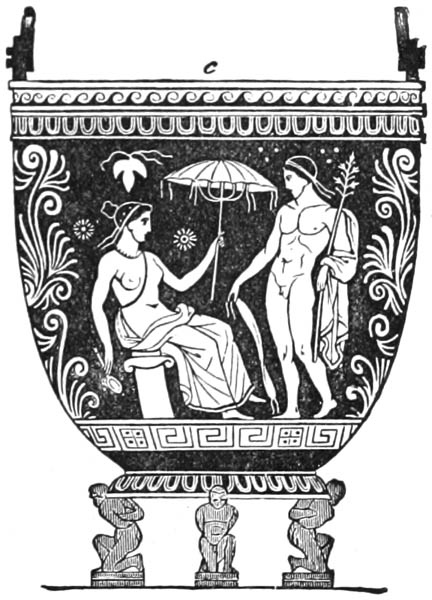
In Greece, the graves are generally small, being designed for single corpses, which accounts for the comparatively small size of the vases discovered in that country. At Athens the earlier graves are sunk deepest in the soil, and those at Corinth, especially such as contain the early Corinthian vases, are found by boring to a depth of several feet beneath the surface.
The early tombs of Civita Vecchia, and Cære, or Cervetri, in Italy, are tunneled in the earth; and those at Vulci, and in the Etruscan territory, from which the finest and largest vases have been extracted, are chambers hewn in the rocks. In southern Italy, especially in Campania, the common tombs are constructed of rude stones or tiles, and are exactly of sufficient size to contain a corpse and five or six vases; a small one is placed near the head, and the others between the legs of the body, or they are ranged on each side, frequently on the left side alone.
The number and beauty of the vases vary, probably, according to the rank and fortune of the owner of the tomb. The tombs of the first class are larger, and have been built with large cut stones, and rarely connected with cement; the walls inside are coated with stucco, and adorned with paintings; these tombs resemble a small chamber; the corpse is laid out in the middle, the vases are placed round it, frequently some others are hung up to the walls on nails of bronze. The number of vases is always greater in these tombs; they are also of a more elegant form.
Several other articles are sometimes found in the tombs, such as gold and silver fibulæ, swords, spears, armor, and several ornaments. The objects buried with the corpse generally bespeak the tastes and occupation of the deceased. Warriors are found with their armor, women with ornaments for the toilet, priests with their sacerdotal ornaments, as in the tomb at Cervetri. When the vases are taken out of the excavations, they are covered with a coating of whitish earth, something like tartar, and of a calcareous nature; it disappears on the application of aqua fortis. This operation ought to be done with great caution; for though the aqua fortis does not injure the black varnish, it might destroy some of the other colors.
2000 YEARS OLD.ToList
Some of these vases are as well preserved as if they had just been issued from the hands of the potter; others have been greatly injured by the earthy salts with which they have come in contact; many are found broken—these have been put together and restored with great skill. But this work of restoration, especially if the artist adds any details which are not visible on the original, might alter or metamorphose a subject, and the archæologist ought to set little value on these modern additions, in the study of a painted vase.
Several collections have been formed of these vases. The British Museum contains the finest collections, purchased by government from Sir William Hamilton and others. The Museum at Naples, and the Gregorian Museum in the Vatican, also contain many beautiful specimens from Magna Græcia and Etruria. The British Museum has about 2,600 vases of all kinds. The Museum at Naples contains about 2,100, and the Gregorian Museum at Rome about 1,000. Several amateurs have also formed collections in England, France, and Italy. We may mention those of Roger, Hope, Sir Harry Englefield, in England; those of the Duc de Blacas, the Comte Pourtales, in France; and that of the Marquis Campana, in Rome. The total number of vases in public and private collections probably amounts to 15,000 of all kinds. Some of these collections have been published, such as the first collection of Sir William Hamilton, explained by d'Hancarville; the second by Tischbein. Several works have also been published, giving detailed accounts of painted vases in general.
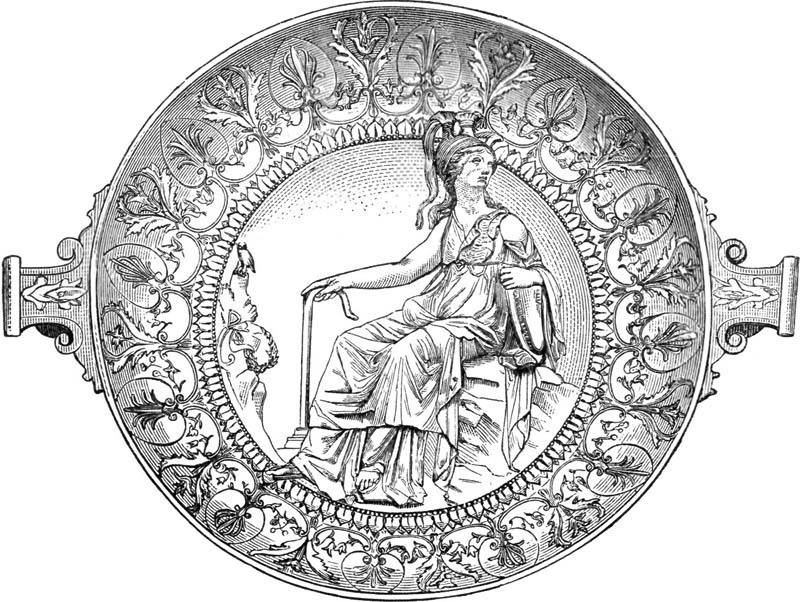
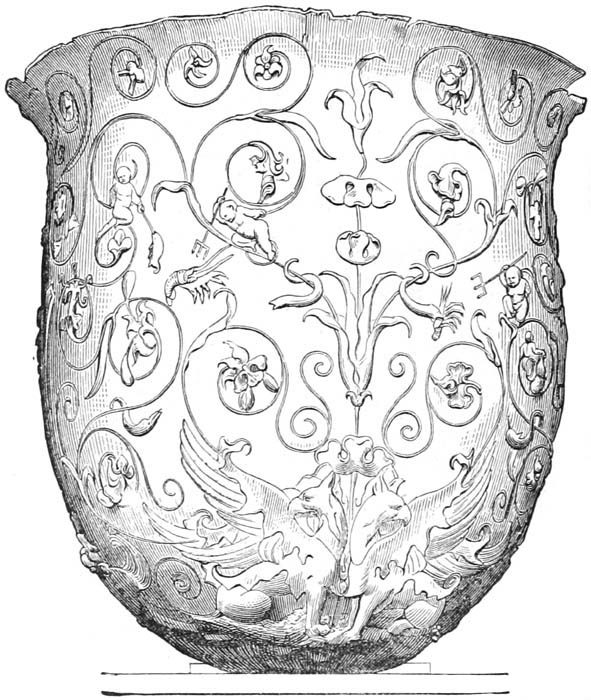
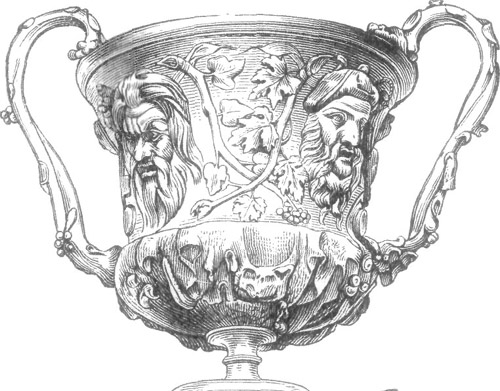
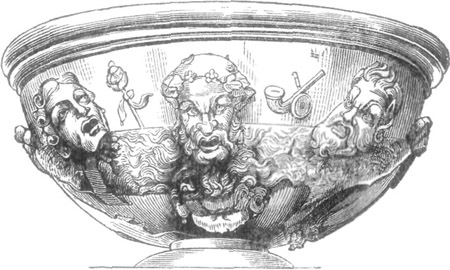
We have mentioned before the luxurious custom, common amongst the Romans after the conquest of Greece and Asia, of having their utensils of the table, and even of the kitchen, made of solid silver. Valuable plate was of common occurrence in the houses of the rich. According to Pliny, common soldiers had the handles of their swords and their belts studded with silver; the baths of women were covered with the same valuable material, which was even used for the common implements of kitchen and scullery. Large manufactories of silver utensils were started, in which each part of the work was assigned to a special artificer; here the orders of the silver-merchants were executed. Amongst the special workmen of these manufactories were the modelers, founders, turners or polishers, chiselers, the workmen who attached the bas-reliefs to the surface of the vessel, and the gilders. Many valuable vessels have been recovered in the present century; others (for instance, several hundred silver vessels found near the old Falerii) have tracelessly disappeared. Amongst the discoveries which happily have escaped the hands of the melter, we mention the treasure of more than one hundred silver vessels, weighing together about 50 pounds, found by Berney in Normandy (1830). According to their inscriptions, these vessels belonged to the treasury of a temple of Mercury; they are at present in the late imperial library at Paris. In the south of Russia the excavations carried on in 1831, 1862, and 1863, amongst the graves of the kings of the Bosphoric empire, have yielded an astonishing number of gold and silver vessels and ornaments belonging to the third century of our era. At Pompeii fourteen silver vases were discovered in 1835; at Cære (1836) a number of silver vases (now in the Museo Gregoriano) were found in a grave. One of the most interesting discoveries was made near Hildesheim, 7th October, 1868, consisting of seventy-four eating and drinking vessels, mostly well preserved; not to speak of numerous fragments which seem to prove that only part of the original treasure has been recovered; the weight of all the vessels (now in the Antiquarium of the Royal Museum, Berlin) amounts to 107,144 lbs., some over 53 tons, of silver. The style and technical finish of the vases prove them to have been manufactured in Rome; the form of the letters of the inscriptions found on twenty-four vessels indicates the first half of the first century after Christ. The surfaces of many of them are covered with alto-relievos of beaten silver—a circumstance which traces back their origin to imperial times, distinguishing them, at the same time, from the bas-relief ornamentations of the acme of Greek art. The gilding of the draperies and weapons, and the silver color of the naked parts, in imitation, as it were, of the gold-and-ivory statues of Greek art, also indicate Roman workmanship. The annexed cuts show some of the finest pieces of this treasure. The composition of the figures on the surface of the vase in cut on page 340 shows true artistic genius; naked children are balancing themselves on water-plants growing in winding curves from a pair of griffins; some of the children attack crabs and eels with harpoons, while others drag the killed animals from the water. The graceful groups on the drinking-vessels in the above cuts are mostly taken from the Bacchic cycle of myths.
FOUND AT HILDESHEIM.ToList
FOUND AT HILDESHEIM. (Of the first century)ToList
VASE OF THE FIRST CENTURY.ToList
VASE OF THE FIRST CENTURY.ToList
Besides vessels of precious metals and stones, those of glass were in favorite use among the Romans. The manufactory of glass, originating in Sidon, had reached its climax of perfection, both with regard to color and form, in Alexandria about the time of the Ptolemies. Many of these Alexandrine glasses have been preserved to us, and their beauty fully explains their superiority in the opinion of the ancients to those manufactured in Italy. Here also, after the discovery of excellent sand at Cumæ and Linternum, glass works had been established. Most of our museums possess some specimens of antique glass manufacture, in the shape of balsam or medicine bottles of white or colored glass. We also possess goblets and drinking-bottles of various shapes and sizes, made of white or common green glass; they generally taper toward the bottom, and frequently show grooves or raised points on their outer surfaces, so as to prevent the glass from slipping from the hand; urns, oinochoai, and dishes of various sizes made of glass, are of frequent occurrence. Some of these are dark blue or green, others party-colored with stripes winding round them in zigzag or in spiral lines, reminding one of mosaic patterns. Pieces of glittering glass, being most likely fragments of so-called allassontes versicolores (not to be mistaken for originally white glass which has been discolored by exposure to the weather), are not unfrequently found. We propose to name in the following pages a few of the more important specimens of antique glass-fabrication. One of the first amongst these is the vessel known as the Barberini or Portland Vase, which was found in the sixteenth century in the sarcophagus of the so-called tomb of Severus Alexander and of his mother Julia Mammæa. It was kept in the Barberini Palace for several centuries, till it was purchased by the Duke of Portland, after whose death it was placed in the British Museum. After having been broken by the hand of a barbarian, it has fortunately been restored satisfactorily. Many reproductions of this vase in china and terra-cotta have made it known in wide circles. The mythological bas-reliefs have not as yet been sufficiently explained. Similar glass vases with bas-relief ornamentation occur occasionally either whole or in fragments.