RELIGION OR MYTHOLOGY.ToC (continued 4)
Reading edition
So the years went; and one day, as they were playing about by the side of the river, there came into the field a beautiful white bull. He was quite white all over—as white as the whitest snow; there was not a single spot or speck on any part of his body. And he came and lay down on the green grass, and remained still and quiet. So they went nearer and nearer to the bull, and the bull did not move, but looked at them with his large eyes as if he wished to ask them to come and play with him, and at last they came to the place where the bull was. Then Kadmos thought that he would be very brave, so he put out his hand, and began to pat the bull on his side, and the bull only made a soft sound to show how glad he was. Then Europa put out her hand, and stroked him on the face, and laid hold of his white horn, and the bull rubbed his face gently against her dress.
So by and by Kadmos thought that it would be pleasant to have a ride on the back of the bull, and he got on, and the bull rose up from the ground, and went slowly round the field with Kadmos on his back, and just for a minute or two Kadmos felt frightened, but when he saw how well and safely the bull carried him, he was not afraid any more. So they played with the bull until the sun sank down behind the hills, and then they hastened home.
When they reached the house, they ran quickly to Telephassa, and said to her, "Only think, we have been playing in the field with a beautiful white bull." And Telephassa was glad that they had been so happy, but she would not have been so glad if she had known what the bull was going to do.
Now, the next day while Europa was on its back, the bull began to trot quickly away, but Kadmos thought he was only trotting away for fun. So he ran after him, and cried out to make him stop. But the faster that Kadmos ran, the bull ran faster still, and then Kadmos saw that the bull was running away with his sister, Europa. Away the bull flew, all along the bank of the river, and up the steep hill and down into the valley on the other side, and then he scoured along the plain beneath. And Kadmos watched his white body, which shone like silver as he dashed through the small bushes and the long waving grass and the creeping plants which were trailing about all over the ground, till at last the white body of the bull looked only like a little speck, and then Kadmos could see it no more.
Very wretched was Kadmos when his sister was taken away from him in this strange way. His eyes were full of tears so that he could scarcely see, but still he kept on looking and looking in the way the bull had gone, and hoping that he would bring his sister back by and by. But the sun sank lower and lower in the sky, and then Kadmos saw him go down behind the hills, and he knew now that the bull would not come again, and then he began to weep bitterly. He hardly dared to go home and tell Telephassa what had happened, and yet he knew that he ought to tell her. So he went home slowly and sadly, and Telephassa saw him coming alone, and she began to be afraid that something had happened to Europa, and when she came up to him Kadmos could scarcely speak. At last he said, "The bull has run away with Europa." Then Telephassa asked him where he had gone, and Kadmos said that he did not know. But Telephassa said, "Which way did he go?" and then Kadmos told her that the bull had run away towards the land of the West, where the sun goes down into his golden cup. Then Telephassa said that they, too, must get up early in the morning and go towards the land of the West, and see if they could find Europa again.
That night they hardly slept at all, and their cheeks were pale and wet with their tears. And before the sun rose, and while the stars still glimmered in the pale light of the morning, they got up and went on their journey to look for Europa. Far away they went, along the valleys and over the hills, across the rivers and through the woods, and they asked every one whom they met if they had seen a white bull with a girl upon its back. But no one had seen anything of the kind, and many people thought that Kadmos and Telephassa were silly to ask such a question, for they said, "Girls do not ride on the backs of bulls; you can not be telling the truth." So they went on and on, asking every one, but hearing nothing about her; and as they journeyed, sometimes they saw the great mountains rising up high into the sky, with their tops covered with snow, and shining like gold in the light of the setting sun; sometimes they rested on the bank of a great broad river, where the large white leaves lay floating and sleeping on the water, and where the palm trees waved their long branches above their heads. Sometimes they came to a water-fall, where the water sparkled brightly as it rushed over the great stones. And whenever they came to these beautiful places, Kadmos would say to Telephassa, "How we should have enjoyed staying here if Europa were with us; but we do not care to stay here now, we must go on looking for her everywhere." So they went on and on till they came to the sea, and they wondered how they could get across it, for it was a great deal wider than any river which they had seen. At last they found a place where the sea was narrow, and here a boatman took them across in his boat, just where little Helle had been drowned when she fell off the back of the ram that was carrying her and her brother away to Kolchis. So Telephassa and Kadmos crossed over Hellespontos, which means the Sea of Helle, and they went on and on, over mountains and hills and rocks, and wild gloomy places, till they came to the sunny plains of Thessaly. And still they asked every one about Europa, but they found no one who had seen her. And Kadmos saw that his mother was getting weak and thin, and that she could not walk now as far and as quickly as she had done when they had set out from home to look for his sister. So he asked her to rest for a little while. But Telephassa said, "We must go on, Kadmos, for if we do, perhaps we may still find Europa." So they went on, until at last Telephassa felt that she could not go any further. And she said to Kadmos, "I am very tired, and I do not think I shall be able to walk any more with you; I must lie down and go to sleep here, and perhaps, Kadmos, I may not wake again. But if I die while I am asleep, then you must go on by yourself and look for Europa, for I am quite sure that you will find her some day, although I shall not be with you. And when you see your sister, tell her how I longed to find her again, and how much I loved her always. And now, my child, I must go to sleep, and if I do not wake up any more, then I trust that we shall all see each other again one day, in a land which is brighter and happier than even the land in which we used to live before your sister was taken away from us."
So when she had said this, Telephassa fell asleep, just as the daylight was going away from the sky, and when the bright round moon rose up slowly from behind the dark hill. All night long Kadmos watched by her side, and when the morning came, he saw that Telephassa had died while she was asleep. Her face was quite still, and Kadmos knew by the happy smile which was on it, that she had gone to the bright land to which good people go when they are dead. Kadmos was very sorry to be parted from his mother, but he was not sorry that now she could not feel tired or sorrowful any more. So Kadmos placed his mother's body in the ground, and very soon all kinds of flowers grew up upon her grave.
But Kadmos had gone on to look for his sister, Europa, and presently he met a shepherd who was leading his flock of sheep. He was very beautiful to look at. His face shone as bright almost as the sun. He had a golden harp, and a golden bow, and arrows in a golden quiver, and his name was Phœbus Apollo. And Kadmos went up to him and said, "Have you seen my sister, Europa? a white bull ran away with her on his back. Can you tell me where I can find her?" And Phœbus Apollo said, "I have seen your sister, Europa, but I can not tell you yet where she is, you must go on a great way further still, till you come to a town which is called Delphi, under a great mountain named Parnassos, and there perhaps you may be able to find out something about her. But when you have seen her you must not stay there, because I wish you to build a city, and become a King, and be wise and strong and good. You and Europa must follow a beautiful cow that I shall send, till it lies down upon the ground to rest, and the place where the cow shall lie down shall be the place where I wish you to build the city."
So Kadmos went on and on till he came to the town of Delphi, which lay beneath the great mountain, called Parnassos. And there he saw a beautiful temple with white marble pillars, which shone brightly in the light of the early morning. And Kadmos went into the temple, and there he saw his dear sister, Europa. And Kadmos said, "Europa, is it you, indeed? How glad I am to find you." Then Europa told Kadmos how the bull had brought her and left her there a long time ago, and how sorry she had been that she could not tell Telephassa where she was. Then she said to Kadmos, "How pale and thin and weak you look; tell me how it is you are come alone, and when shall I see our dear mother?" Then his eyes became full of tears, and Kadmos said, "We shall never see our mother again in this world. She has gone to the happy land where good people go when they are dead. She was so tired with seeking after you that at last she could not come any further, and she lay down and fell asleep, and never waked up again. But she said that when I saw you I must tell you how she longed to see you, and how she hoped that we should all live together one day in the land to which she has gone before us. And now, Europa, we must not stay here, for I met a shepherd whose name is Phœbus Apollo. He had a golden harp and a golden bow, and his face shone like the sun, and he told me that we must follow a beautiful cow which he would send, and build a city in that place where the cow shall lie down to rest."
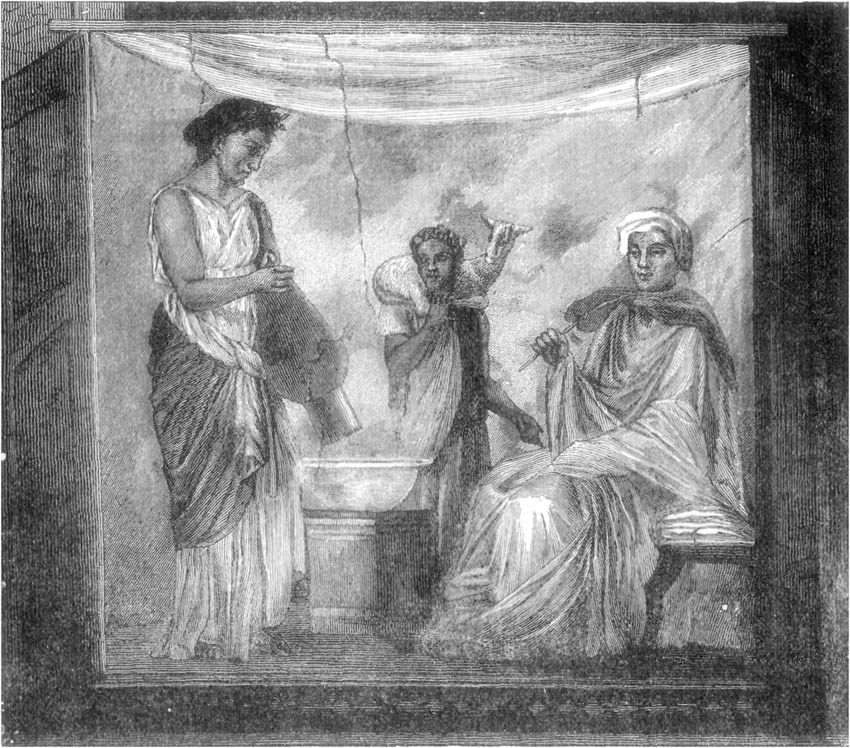
ANCIENT SACRIFICE. (From Wall Painting of Pompeii.)ToList
So Europa left Delphi with her brother, Kadmos, and when they had gone a little way, they saw a cow lying down on the grass. But when they came near, the cow got up, and began to walk in front of them, and then they knew that this was the cow which Phœbus Apollo had sent. So they followed the cow, and it went on and on, a long way, and at last it lay down to rest on a large plain, and Kadmos knew then that this was the place where he must build the city. And there he built a great many houses, and the city was called Thebes. And Kadmos became the King of Thebes, and his sister, Europa, lived there with him. He was a wise and good King, and ruled his people justly and kindly. And by and by Kadmos and Europa both fell asleep and died, and then they saw their mother, Telephassa, in the happy land to which good people go when they are dead, and were never parted from her any more.
BELLEROPHON.
The minstrels sang of the beauty and the great deeds of Bellerophon through all the lands of Argos. His arm was strong in the battle, his feet were swift in the chase, and his heart was pure as the pure heart of Artemis and Athene. None that were poor and weak and wretched feared the might of Bellerophon. To them the sight of his beautiful form brought only joy and gladness, but the proud and boastful, the slanderer and the robber, dreaded the glance of his keen eye. But the hand of Zeus lay heavy upon Bellerophon. He dwelt in the halls of King Prœtos, and served him even as Herakles served the mean and crafty Eurystheus. For many long years Bellerophon knew that he must obey the bidding of a man weaker than himself, but his soul failed him not, and he went forth to his long toil with a heart strong as the sun when he rises in his strength, and pure as the heart of a little child.
But Anteia, the wife of King Prœtos, saw day by day the beauty of Bellerophon, and she would not turn away her eye from his fair face. Every day he seemed to her to be more and more like to the bright heroes who feast with the gods in the halls of high Olympos, and her heart became filled with love, and she sought to beguile Bellerophon by her enticing words. But he hearkened not to her evil prayer, and heeded not her tears and sighs; so her love was turned to wrath, and she vowed a vow that Bellerophon should suffer a sore vengeance, because he would not hear her prayer. Then, in her rage, she went to King Prœtos, and said, "Bellerophon, thy slave, hath sought to do me wrong, and to lead me astray by his crafty words. Long time he strove with me to win my love, but I would not hearken to him. Therefore, let thine hand lie more heavy upon him than in time past, for the evil that he hath done, and slay him before my face." Then was Prœtos also full of anger, but he feared to slay Bellerophon, lest he should bring on himself the wrath of Zeus, his father. So he took a tablet of wood, and on it he drew grievous signs of toil and war, of battles and death, and gave it to Bellerophon to carry to the far-off Lykian land, where the father of Anteia was King, and as he bade him farewell, he said, "Show this tablet to the King of Lykia, and he will recompense thee for all thy good deeds which thou hast done for me, and for the people of Argos."
So Bellerophon went forth on his long wandering, and dreamed not of the evil that was to befall him by the wicked craft of Anteia. On and on he journeyed towards the rising of the sun, till he came to the country of the Lykians. Then he went to the house of the King, who welcomed him with rich banquets, and feasted him for nine days, and on the tenth day he sought to know wherefore Bellerophon had come to the Lykian land. Then Bellerophon took the tablet of Prœtos and gave it to the King, who saw on it grievous signs of toil and woe, of battles and death. Presently the King spake, and said, "There are great things which remain for thee to do, Bellerophon, but when thy toil is over, high honor awaits thee here and in the homes of the bright heroes." So the King sent him forth to slay the terrible Chimæra, which had the face of a lion with a goat's body and a dragon's tail. Then Bellerophon journeyed yet further towards the rising of the sun, till he came to the pastures where the winged horse, Pegasos, the child of Gorgo, with the snaky hair, was feeding, and he knew that if he could tame the steed he should then be able to conquer the fierce Chimæra.
Long time he sought to seize on Pegasos, but the horse snorted wildly and tore up the ground in his fury, till Bellerophon sank wearied on the earth and a deep sleep weighed down his eyelids. Then, as he slept, Pallas Athene came and stood by his side, and cheered him with her brave words, and gave him a philtre which should tame the wild Pegasos. When Bellerophon awoke, the philtre was in his hand, and he knew now that he should accomplish the task which the Lykian King had given him to do. So, by the help of Athene, he mounted the winged Pegasos and smote the Chimæra, and struck off his head, and with it he went back, and told the King of all that had befallen him. But the King was filled with rage, for he thought not to see the face of Bellerophon again, and he charged him to go forth and do battle with the mighty Solymi and the fair Amazons. Then Bellerophon went forth again, for he dreamed not of guile and falsehood, and he dreaded neither man nor beast that might meet him in open battle. Long time he fought with the Solymi and the Amazons, until all his enemies shrank from the stroke of his mighty arm, and sought for mercy. Glad of heart, Bellerophon departed to carry his spoils to the home of the Lykian King, but as he drew nigh to it and was passing through a narrow dell where the thick brushwood covered the ground, fifty of the mightiest Lykians rushed upon him with fierce shoutings, and sought to slay him. At the first, Bellerophon withheld his hands, and said, "Lykian friends, I have feasted in the halls of your King, and eaten of his bread; surely ye are not come hither to slay me." But they shouted the more fiercely, and they hurled spears at Bellerophon; so he stretched forth his hand in the greatness of his strength, and did battle for his life until all the Lykians lay dead before him.
Weary in body and sad of heart, Bellerophon entered the hall where the King was feasting with his chieftains. And the King knew that Bellerophon could not have come thither unless he had first slain all the warriors whom he had sent forth to lie in wait for him. But he dissembled his wrath, and said, "Welcome, Bellerophon, bravest and mightiest of the sons of men. Thy toils are done, and the time of rest is come for thee. Thou shalt wed my daughter, and share with me my kingly power."
Then the minstrels praised the deeds of Bellerophon, and there was feasting for many days when he wedded the daughter of the King. But not yet was his doom accomplished; and once again the dark cloud gathered around him, laden with woe and suffering. Far away from his Lykian home, the wrath of Zeus drove him to the western land where the sun goes down into the sea. His heart was brave and guileless still, as in the days of his early youth, but the strength of his arm was weakened, and the light of his eye was now dim. Sometimes the might was given back to his limbs, and his face shone with its ancient beauty; and then, again, he wandered on in sadness and sorrow, as a man wanders in a strange path through the dark hours of night, when the moon is down. And so it was that when Bellerophon reached the western sea, he fell asleep and died, and the last sight which he saw before his eyes were closed was the red glare of the dying sun, as he broke through the barred clouds and plunged beneath the sea.
ALTHAIA AND THE BURNING BRAND.
There was feasting in the halls of Oineus, the chieftain of Kalydon, in the Ætolian land, and all prayed for wealth and glory for the chief, and for his wife, Althaia, and for the child who had on that day been born to them. And Oineus besought the King of gods and men with rich offerings, that his son, Meleagros, might win a name greater than his own, that he might grow up stout of heart and strong of arm, and that in time to come men might say, "Meleagros wrought mighty works and did good deeds to the people of the land."
But the mighty Moirai, whose word even Zeus himself may not turn aside, had fixed the doom of Meleagros. The child lay sleeping in his mother's arms, and Althaia prayed that her son might grow up brave and gentle, and be to her a comforter in the time of age and the hour of death. Suddenly, as she yet spake, the Moirai stood before her. There was no love or pity in their cold, grey eyes, and they looked down with stern, unchanging faces on the mother and her child, and one of them said, "The brand burns on the hearth, when it is burnt wholly, thy child shall die." But love is swifter than thought, and the mother snatched the burning brand from the fire, and quenched its flame in water, and she placed it in a secret place where no hand but her own might reach it.
So the child grew, brave of heart and sturdy of limb, and ever ready to hunt the wild beasts or to go against the cities of men. Many great deeds he did in the far-off Kolchian land, when the chieftains sailed with Athamas and Ino to take away the golden fleece from King Aietes. But there were greater things for him to do when he came again to Kalydon, for his father, Oineus, had roused the wrath of the mighty Artemis. There was rich banqueting in his great hall when his harvest was ingathered, and Zeus and all the other gods feasted on the fat burnt-offerings, but no gift was set apart for the virgin child of Leto. Soon she requited the wrong to Oineus, and a savage boar was seen in the land, which tore up the fruit-trees, and destroyed the seed in the ground, and trampled on the green corn as it came up. None dared to approach it, for its mighty tusks tore everything that crossed its path. Long time the chieftains took counsel what they should do, until Meleagros said, "I will go forth; who will follow me?" Then from Kalydon and from the cities and lands round about came mighty chieftains and brave youths, even as they had hastened to the ship, Argo, when they sought to win the golden fleece from Kolchis. With them came the Kouretes, who live in Pleuron, and among them were seen Kastor and Polydeukes, the twin brethren, and Theseus, with his comrade, Peirithoos, and Iason and Admetos. But more beautiful than all was Atalante, the daughter of Schoineus, a stranger from the Arcadian land. Much the chieftains sought to keep her from the chase, for the maiden's arm was strong, and her feet swift, and her aim sure, and they liked not that she should come from a far country to share their glory or take away their name. But Meleagros loved the fair and brave maiden, and said, "If she go not to the chase, neither will I go with you." So they suffered her, and the chase began. At first the boar fled, trampling down those whom he chanced to meet, and rending them with his tusks, but at last he stood fiercely at bay, and fought furiously, and many of the hunters fell, until at length the spear of Atalante pierced his side, and then Meleagros slew him.
Then was there great gladness as they dragged the body of the boar to Kalydon, and made ready to divide the spoil. But the anger of Artemis was not yet soothed, and she roused a strife between the men of Pleuron and the men of Kalydon. For Meleagros sought to have the head, and the Kouretes of Pleuron cared not to take the hide only for their portion. So the strife grew hot between them, until Meleagros slew the chieftain of the Kouretes, who was the brother of Althaia, his mother. Then he seized the head of the boar, and bare it to Atalante, and said, "Take, maiden, the spoils are rightly thine. From thy spear came the first wound which smote down the boar; and well hast thou earned the prize for the fleetness of thy foot and the sureness of thy aim."
So Atalante took the spoils and carried them to her home in the Arcadian land, but the men of Pleuron were full of wrath, and they made war on the men of Kalydon. Many times they fought, but in every battle the strong arm of Meleagros and his stout heart won the victory for the men of his own city, and the Kouretes began to grow faint in spirit, so that they quailed before the spear and sword of Meleagros. But presently Meleagros was seen no more with his people, and his voice was no longer heard cheering them on to the battle. No more would he take lance in hand or lift up his shield for the strife, but he tarried in his own house by the side of the beautiful Kleopatra, whom Idas, her father, gave to him to be his wife.
For the heart of his mother was filled with grief and rage when she heard the story of the deadly strife, and that Meleagros, her child, had slain her brother. In heavy wrath and sorrow she sat down upon the earth, and she cast the dust from the ground into the air, and with wild words called on Hades, the unseen King, and Persephone, who shares his dark throne: "Lord of the lands beneath the earth, stretch forth thy hand against Meleagros, my child. He has quenched the love of a mother in my brother's blood, and I will that he should die." And even as she prayed, the awful Erinys, who wanders through the air, heard her words and swore to accomplish the doom. But Meleagros was yet more wrathful when he knew that his mother had laid her curse upon him, and therefore he would not go forth out of his chamber to the aid of his people in the war.
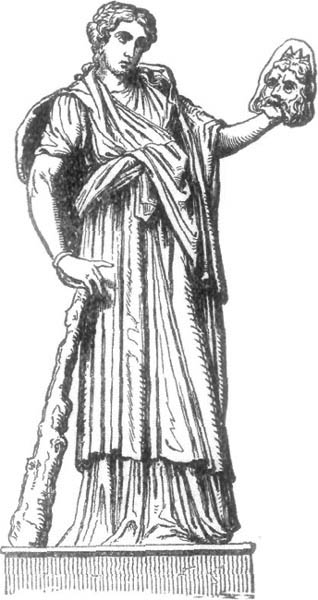
MELPOMENE. (Muse of Tragedy.)ToList
So the Kouretes grew more and more mighty, and their warriors came up against the City of Kalydon, and would no longer suffer the people to come without the walls. And everywhere there was faintness of heart and grief of spirit, for the enemy had wasted their fields and slain the bravest of the men, and little store remained to them of food. Day by day Oineus besought his son, and the great men of the city fell at the knees of Meleagros and prayed him to come out to their help, but he would not hearken. Still he tarried in his chamber with his wife, Kleopatra, by his side, and heeded not the hunger and the wailings of the people. Fiercer and fiercer waxed the roar of war; the loosened stones rolled from the tottering wall, and the battered gates were scarce able to keep out the enemy. Then Kleopatra fell at her husband's knee, and she took him by the hand, and called him gently by his name, and said, "O Meleagros, if thou wilt think of thy wrath, think also of the evils which war brings with it—how when a city is taken, the men are slain, and the mother with her child, the old and the young are borne away into slavery. If the men of Pleuron win the day, thy mother may repent her of the curse which she has laid upon thee; but thou wilt see thy children slain and me a slave."
Then Meleagros started from his couch and seized his spear and shield. He spake no word, but hastened to the walls, and soon the Kouretes fell back before the spear which never missed its mark. Then he gathered the warriors of his city, and bade them open the gates, and went forth against the enemy. Long and dreadful was the battle, but at length the Kouretes turned and fled, and the danger passed away from the men of Kalydon.
But the Moirai still remembered the doom of the burning brand, and the unpitying Erinys had not forgotten the curse of Althaia, and they moved the men of Kalydon to withhold the prize of his good deeds from the chieftain, Meleagros. "He came not forth," they said, "save at the prayer of his wife. He hearkened not when we besought him, he heeded not our misery and tears; why should we give him that which he did not win from any love for us?" So his people were angry with Meleagros, and his spirit grew yet more bitter within him. Once again he lay within his chamber, and his spear and shield hung idle on the wall, and it pleased him more to listen the whole day long to the soft words of Kleopatra than to be doing brave and good deeds for the people of his land.
Then the heart of his mother, Althaia, was more and more turned away from him, so that she said in bitterness of spirit, "What good shall his life now do to me?" and she brought forth the half-burnt brand from its secret place, and cast it on the hearth. Suddenly it burst into a flame, and suddenly the strength of Meleagros began to fail as he lay in the arms of Kleopatra. "My life is wasting within me," he said; "clasp me closer in thine arms; let others lay a curse upon me, so only I die rejoicing in thy love." Weaker and weaker grew his failing breath, but still he looked with loving eyes on the face of Kleopatra, and his spirit went forth with a sigh of gladness, as the last spark of the brand flickered out upon the hearth.
Then was there grief and sorrow in the house of Oineus and through all the City of Kalydon, but they wept and mourned in vain. They thought now of his good deeds, his wise counsels, and his mighty arm, but in vain they bewailed the death of their chieftain in the glory of his age. Yet deeper and more bitter was the sorrow of Althaia, for the love of a mother came back to her heart when the Moirai had accomplished the doom of her child. And yet more bitterly sorrowed his wife, Kleopatra, and yearned for the love which had been torn away from her. There was no more joy within the halls of Oineus, for the Erinys had done their task well. Soon Althaia followed her child to the unknown land, and Kleopatra went forth with joy to meet Meleagros in the dark kingdom of Hades and Persephone.
IAMOS.
On the banks of Alpheios, Evadne watched over her new-born babe, till she fled away because she feared the wrath of Aipytos, who ruled in Phaisana. The tears streamed down her cheeks as she prayed to Phœbus Apollo, who dwells at Delphi, and said, "Lord of the bright day, look on thy child, and guard him when he lies forsaken, for I may no longer tarry near him."
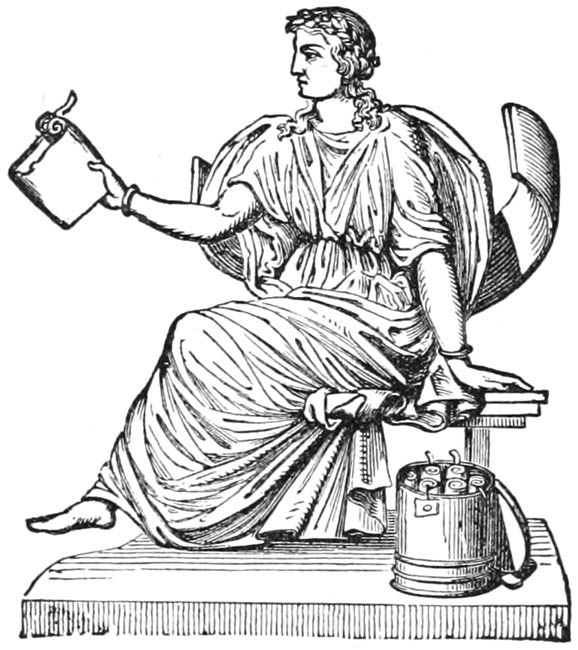
CLIO (Muse of History).ToList
So Evadne fled away, and Phœbus sent two serpents, who fed the babe with honey as he lay amid the flowers which clustered round him. And ever more and more through all the land went forth the saying of Phœbus, that the child of Evadne should grow up mighty in wisdom and in the power of telling the things that should happen in the time to come. Then Aipytos asked of all who dwelt in his house to tell him where he might find the son of Evadne. But they knew not where the child lay, for the serpents had hidden him far away in the thicket, where the wild flowers sheltered him from wind and heat. Long time they searched amid the tall reeds which clothe the banks of Alpheios, until at last they found the babe lying in a bed of violets. So Aipytos took the child and called his name Iamos, and he grew up brave and wise of heart, pondering well the signs of coming grief and joy, and the tokens of hidden things which he saw in the heaven above him or the wide earth beneath. He spake but little to the youths and maidens who dwelt in the house of Aipytos, but he wandered on the bare hills or by the stream side, musing on many things. And so it came to pass that one night, when the stars glimmered softly in the sky, Iamos plunged beneath the waters of Alpheios, and prayed to Phœbus who dwells at Delphi, and to Poseidon, the lord of the broad sea; and he besought them to open his eyes, that he might reveal to the sons of men the things which of themselves they could not see. Then they led him away to the high rocks which look down on the plain of Pisa, and they said, "Look yonder, child of Evadne, where the white stream of Alpheios winds its way gently to the sea. Here, in the days which are to come, Herakles, the son of the mighty Zeus, shall gather together the sons of Helen, and give them in the solemn games the mightiest of all bonds; hither shall they come to know the will of Zeus, and here shall it be thy work and the work of thy children to read to them the signs which of themselves they can not understand." Then Phœbus Apollo touched his ears, and straightway the voices of the birds spake to him clearly of the things which were to come and he heard their words as a man listens to the speech of his friend. So Iamos prospered exceedingly, for the men of all the Argive land sought aid from his wisdom, and laid rich gifts at his feet. And he taught his children after him to speak the truth and to deal justly, so that none envied their great wealth, and all men spake well of the wise children of Iamos.