TOMBS AND CATACOMBS.ToC (continued 2)
Reading edition
In classifying the Roman inscriptions, M. de Rossi has adopted the following divisions. The first comprises those inscriptions only which contain some express note of time, and are therefore susceptible of exact chronological arrangement. The second comprises the select inscriptions, viz.: first, sacred and historical ones, and next those which, either by testimony, by forms, or by symbols, illustrate the doctrines, the worship, or the morals of the Christians. The third, the purely topographical, assigns each inscription its proper place among the ancient localities of Rome. This comprises also inscriptions of unknown or uncertain locality, as well as inscriptions of spurious origin or doubtful authenticity.
In considering the chronological arrangements of Christian inscriptions, it is important to keep in view that in the earlier centuries the Christians kept note of time either by the years of the bishop, or by some of the civil forms which prevailed in the various countries in which they resided. In Rome the common date was that of the consular year. The common use of the Christian era as a note of time began, as is well known, later than the sixth century, at which M. de Rossi's series terminates. In M. de Rossi's collection one inscription bears date from the year A.D. 107, and another from 111. Of the period from the year 204, in which the next inscription with a date occurs, till the peace of the church in 312, twenty-eight dated inscriptions have been found; after the peace of the church the number of dated inscriptions increases rapidly. Between the accession of Constantine and the close of the fourth century, his collection contains 450 dated inscriptions, and the fifth century presents about the same number; but in the sixth, the number again declines, that century producing little more than 200.
In those cases where no note of time is marked, M. de Rossi has availed himself of other chronological indications and tests, founded on the language, on the style, on the names, and on the material execution of the inscription, in determining the date. Out of the 11,000 extant Roman inscriptions anterior to the seventh century, M. de Rossi finds chronological evidence of the date of no fewer than 1374.
There are also varieties in inflection, such as "spiritu sancta" for "spiritu sancto," "pauperorum," for "pauperum," "vocitus" for "vocatus," "requiescent" for "requiescunt," etc.
There are also new or unusual terms, or new familiar words in new or unusual meanings, such as "pausavit, rested, bisomus, trisomus, quadrisomus," holding two, three, four bodies; compar and conpar (husband and wife); fecit for egit, passed; "percepit," received, scil. baptism, as also "consecutus est," in the same sense, etc.
Sometimes Latin is written in Greek characters and sometimes Greek in Latin.
The age is expressed by "vixit," or "vixit in sæculo," "annos" (or "annis") "menses," "dies" (or "diebus") ——, with the number of hours sometimes stated. Sometimes "qui fuit" stands for "vixit;" sometimes neither is expressed, and we have the form in the genitive, "sal. annorum," etc.
Frequently the time passed in married life is mentioned, and we find such phrases as "vixit mecum, duravit mecum, vixit in conjugio, fecit mecum, fecit in conjugio, fecit cum compare," with a precise statement of the number of years, etc., and often with some expression marking the happiness of the couple's married life.
The epithets applied to the deceased indicate strong affection, and the eulogies are sometimes extravagant.
The occupation or position in life is stated, with the proper titles, in many dated Christian epitaphs. But they are all, it is supposed, later than the time of Constantine.
The same designations of the place of burial and of the tomb are found in both Christian and Pagan epitaphs.
Acclamations or expressions of good wishes or prayers to or for the deceased frequently occur in the inscriptions.
The letters also of these inscriptions are usually very irregular. They are from half an inch to four inches in height, colored in the incision with a pigment resembling Venetian red. The sense, too, of the inscriptions is not always very obvious. An extreme simplicity of language and sentiment is the prevailing characteristic of the earlier inscriptions. But, on the other hand, exaggerated examples of the opposite style are occasionally met with.
Another peculiarity in these Christian inscriptions is the disuse of the three names usually assumed by the Romans. M. de Rossi has given twenty inscriptions with the names complete, prior to Constantine. Of these, no fewer than seventeen have prænomina, whereas after Constantine prænomina may be said entirely to disappear.
The year is usually indicated by the names of the consuls. The abbreviation COS for "consulibus" was in use up to the middle of the third century, when COSS, CONS, and CONSS began to be adopted; COS is very seldom found during the fourth century, and almost never in the fifth or sixth; COSS fell into disuse about the first quarter of the fifth century, and after that CONS was used; in the time of Diocletian with S for one consul and SS for two. At the same time CC. SS. CS were introduced, but they were very rarely used in the fifth, and there is scarcely an example of them in the sixth. From about the middle of the fourth century CONS began to be placed before instead of after the names, and this usage became the prevalent custom in the fifth and sixth.
At the date of the discovery of the Roman catacombs, the whole body of known Christian inscriptions collected from all parts of Italy fell far short of a thousand in number. Of these, too, not a single one was of subterranean origin, and not dated earlier than A.D. 553. At present the Christian inscriptions of Rome on catacombs alone, and anterior to the sixth century, considerably exceed 11,000. They have been carefully removed from the cemeteries, and are now systematically arranged by M. de Rossi, on the walls of the Christian museum, recently formed by order of Pius IX., in the Lateran Palace. A large number of these inscriptions are also inserted in the walls of the Galleria Lapidaria in the Vatican.
EARLY INSCRIPTIONS.
VG. VESPASIANO III COS IAN A.D. 71.
This fragment has been received as a part of a Christian epitaph by Reggi, Marini and de Rossi. It is the most ancient of all such as bear dates.
SERVILIA. ANNORVM. XIII PIS. ET BOL. COSS.
Servilia, aged thirteen, died in the consulate of Piso and Bolanus. A.D. 111.
TEMPORE. ADRIANI. IMPERATORIS. MARVIS. ADOLESCENS DVX. MILITVM QVI SATIS. VIXIT DVM VITAM PRO CHO CVM. SANGVINE CONSVNSIT. IN. PACE. TANDEM QUIEVIT. BENE MERENTES CVM. LACRIMIS. ET. METV. POSVERVNT. I.D. VI.
"In the time of the Emperor Adrian, Marius, a young military officer who had lived long enough, when with blood he gave up his life for Christ. At length he rested in peace. The well-deserving set up this with tears and in fear, on the 6th before the ides." A.D. 130.
ALEXANDER MORTVVS NON EST SED VIVIT SVPER ASTRA ET CORPVS IN HOC TVMVLO QVIESCIT VITAM EXPLEVIT SVS ANTONINO IMPo QVIVBI MVLTVM BENE FITII ANTEVENIRE PRAEVIDERET PROGRATIA ODIVM REDDIDIT GENVA ENIM FLECTENS VERO DEO SACRIFICATVRVS AD SVPPLICIA DVCITVRO TEMPORA INFAVSTA QVIBVS INTER SACRA ET VOTA NE IN CAVERNIS QVIDEM SALVARI POSSIMVS QVID MISERIVS VITA SED QVID MISERIVS IN MORTE CVM AB AMICIS ET PARENTIBVS SEPELIRI NEQVEANT TANDEM IN COELO CORVSCANT PARVM VIXIT QVI VIXIT IV. X. TEM.
"In Christ. Alexander is not dead, but lives beyond the stars, and his body rests in this tomb. He lived under the Emperor Antoninus, who, foreseeing that great benefit would result from his services, returned evil for good. For, while on his knees, and about to sacrifice to the true God, he was led away to execution. O, sad times! in which sacred rites and prayers, even in caverns, afford no protection to us. What can be more wretched than such a life? and what than such a death? when they could not be buried by their friends and relations. At length they sparkle in heaven. He has scarcely lived who has lived in Christian times." A.D. 160.
From the Cemetery of St. Callisto.
AVRELIA DULCISSIMA FILIA QVAE DE. SAECVLO RECESSIT VIXIT ANN. XV. M. IIII. SEVERO ET QVINTIN COSS.
"Aurelia; our sweetest daughter, who departed from the world. She lived fifteen years and four months. Severus and Quintinus being consuls." A.D. 325.
Consule Claudio et Paterno, nonis Novembribus, die Veneris, luna XXIV, Leuces filiæ Severæ carissimæ posuit et spiritui sancto tuo. Mortua annorum LV et mensium XI dierum X.
"In the consulship of Claudius and Paternus, on the nones of November, on Friday, the 24th day of the moon, Leuce erected (this memorial) to her very dear daughter, and to thy holy spirit. She (died at the age) of fifty-five years, and eleven months, (and) ten days." A.D. 269.
D. M. P. LIBERIO VICXIT ANN N. V MENSES N. III DIES N. VIII R. ANICIO FAVSTO ET VIRIO GALLO COSS
"Publius Liberio lived five years, three months, and eight days. He retired (from this world) in the consulship of Anicius Faustus and Virius Gallus." A.D. 298.
B.M. CVBICVLVM. AVRELIAE. MARTINAE. CASTISSIMAE ADQVE. PVDI. CISSIMAE FEMINAE QVE FECIT. IN. COIVGIO. ANN. XXIII. D. XIIII. BENE MERENTI. QVE VIXIT. ANN. XL. M. XI. D. XIII. DEPOSITIO EIS DIE. III. NONAS. OCT. NEPOTIANO. ET FACVNDO. CONNS. IN PACE
"To the well-deserving.
The chamber of Aurelia Martina, my wife, most chaste and modest, who lived in wedlock twenty-three years and fourteen days. To the well-deserving one, who lived forty years, eleven months, and thirteen days. Her burial was on the third nones of October. Nepotianus and Facundus being consuls." In peace. A.D. 336.
Galleria Lapidaria. Vatican.
Another in Greek characters:
"Here lies Euterpe, the companion of the Muses, having lived simply and piously, and irreproachably for fifteen years, twenty-two days, and three months. She died on the fifth day before the calends of December, in consulship of our lords, for the tenth time, and for the third time (i.e., in the Consulship of Constantine, for the tenth time, and Julian for the third time)." A.D. 360.
ROMANO. NEOFITO BENEMERENTI QVI VI XIT. ANNOS. VIII. DXV. REQVIESCIT IN PACE DN FL. GRATIANO. AVG. II. ET. PETRONIO PROBO. CS.
"To Romanus, the neophyte, the well-deserving, who lived eight years, fifteen days. He rests in the peace of the Lord. Flavius and Gratianus and Petronius Probus being consuls."
HIC QVIESCIT ANCILLA DEI QVE DE SVA OMNIO POSSIDIT DOMVM ISTA QVEM AMICE DEFLEN SOLACIVMQ REQVIRVNT. PRO HVNC VNVM ORA SVBOLEM QVEM SVPERIS. TITEM REQVISTI ETERNA REQVIEM FELICITA. S. CAVSA MANBIS IIIIX. KALENDAS OTOBRIS CVCVRBITINVS ET ABVMDANTIVS HIC SIMVL QVIESCIT DD. NN. GRATIANO V. ET TEODOSIO. AAGG.
Hic quiescit ancilla Dei, quæ de suis omnibus possidet domum istam, quam amicæ deflent solaciumque requirunt. Pro hac una ora subole, quam superstitem reliquisti. Æterna in requie felicitatis causa manebis, XIV. kalendis Octobris, Cucurbitinus et Abumdantius hic simul quiescunti. DDNN Gratiano v et Theodosio Augustis (Consulibus).
"Here rests a handmaid of God, who out of all her riches now possesses but this one house, whom her friends bewail, and seek in vain for consolation. Oh pray for this one remaining daughter, whom thou hast left behind! Thou wilt remain in the eternal repose of happiness. On the 14 of the Calends of October. Curcurbitinus and Abumdantius rest here together. In the consulship of our Lords Gratian (V.) and Theodosius Emperors." A.D. 380.
HIC POSITA EST ANIMA DVLCES INNOCA SAPIENS ET PVLCHRA NOMINE QUIRIACE QVE VIXIT. ANNOS. III. M III. DVIII. DP IN PACE IIII. ID IAN. CONSS. DN. TEVDOSIO. AVG. II ET MEROBAVDE. VC. III
Hic posita est anima dulces (dulcis) innoca (innocua), sapiens et pulchra, nomine Quiriace, quæ vixit annos III., menses III., dies VIII. Deposita in pace, IV. Idus Januarias, Consulibus Domino nostro Teudosio (Theodoric) Augusto II. et Merobaude Vire Clarissimo III.
"Here has been laid a sweet spirit, guileless, wise and beautiful, by name Quiriace, who lived three years, three months, and eight days. Buried in peace, in the fourth day before the Ides of January, in the consulship of our Lord Theodorius Augustus, for the second time, and Merobaudes, a most distinguished man, for the third time." A.D. 388.
PERPETVAM SEDEM NVTRITOR POSSIDES IPSE HIC MERITVS FINEM MAGNIS DEFVNCTE PERICLIS HIC REQVIEM FELIX SVMIS COGENTIBVS ANNIS HIC POSITVS PAPAS ANTIMIOO VIXIT ANNIS LXX DEPOSITVS DOMINO NOSTRO ARCADIO II ET FL. RVFINO VVCCSS NONAS NOBEMB.
"You, our nursing father, occupy a perpetual seat, being dead, and deserving an end of your great dangers. Here happy, you find rest, bowed down with years. Here lies the tutor, Antimio, who lived seventy years. Buried on the nones of November; our Lords Arcadius for the second time, and Flavius Rufinus being consuls." A.D. 392.
Galleria Lapidaria.
HIC REQVIESCET IN SOMNO PACIS MALA QVI VIXIT ANNOS XXXVIII. M. V. DV. ACCEPTA APVT DE IV. IDVS IVNIAS AETIO CONL.
Hic requiescet (requiescit) in somno pacis, Mala qui (quæ) vixit annos XXXVIII. menses V. dies V. Accepta aput (apud) De(um) IV idus Junias. Aetio Consule.
"Here rests in the sleep of peace Mala, who lived thirty-eight years, five months, five days. Received before God, on the fourth day before the Ides of June, in the consulship of Aetius." A.D. 432.
LEVIVAE CONIVNX PETRONIA FORMA PVDORIS HIS MEA DEPONENS SEDISVS OSSA LOCO PARCITE VOS LACRIMIS DVLCES CVM CONIVGE NATAE VIVENTEMQVE DEO CREDITE FLERE NEFAS DP IN PACE III NON OCTOBRIS FESTO VC. CONSS.
"Petronia, a priest's wife, the type of modesty. In this place I lay my bones; spare your tears, dear husband and daughters, and believe that it is forbidden to weep for one who lives in God. Buried in peace on the 3d nones of October, in the consulate of Festus." A.D. 472.
IN PACE AVRELIO. FELICI QVI BIXIT CVM COIVCE ANNOS X. VIII DVLCIS. IN COIVGIO BONE MEMORIE BIXIT. ANNOS. L. V RAPTVS ETERNE DOMVS. XII KAL. IENVARIAS.
"In peace To Aurelius Felix, who lived with his wife eighteen years in sweetest wedlock. Of good memory. He lived fifty-five years. Snatched away eternally on the twelfth kalend of January."
IRENE IN PACE. ARETVSA IN DEO
"Irene sleeps in peace." "Aretusa sleeps in God."
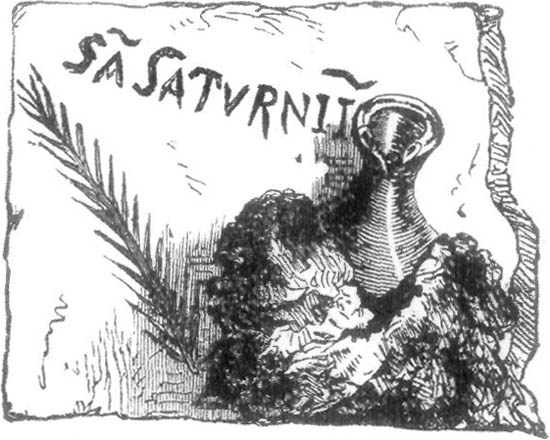
"Valeria sleeps in peace."ToList
ZOTICVS HIC AD DORMIEN DVM.
"Zoticus laid here to sleep."
DOMITIANUS ANIMA SIMPLEX DORMIT IN PACE.
"Domitianus, a simple soul, sleeps in peace."
NICEFORVS ANIMA DVLCIS IN REFRIGERIO.
"Nicephorus, a sweet soul, in a place of refreshment."
PRIMITIVS IN PACE QVI POST MVLTAS. ANGVSTIAS FORTISSIMVS MARTYR ET. VIXIT. ANNOS P.M. XXXVIII CONIVG. SVO PERDVLCISSIMO BENEMERENTI FECIT.
"Primitius in peace: a most valiant martyr after many torments. Aged 38. His wife raised this to her dearest well-deserving husband."
LANNVS XPI. MARTIR HIC REQVIESCIT. SVB DIOCLIZIANO PASSVS.
"Lannus, a martyr of Christ, rests here. He suffered under Diocletian."
NABIRA IN PACE ANIMA DVLCIS QVI BIXIT ANNOS XVI. M. V ANIMA MELEIEA TITVLV FACTV A PARENTES
"Navira in peace; a sweet soul who lived sixteen years and five months; a soul sweet as honey: this epitaph was made by her parents."
SEVERO FILIO DVL CISSIMO LAVRENTIVS PATER BENEMERENTI QVI BI XIT ANN. IIII. ME. VIII. DIES V. ACCERSITVS AB ANGELIS VII. IDVS. IANVA.
"Laurence to his sweetest son Severus, borne away by angels on the 7th ides of January."
MACVS PVER INNOCENS ESSE IAMINTER INNOCENTIS COEPISTI. QVAM STAVILES TIVI HAEC VITA EST QVAM TELETVM EXCIP ET MATER ECLESIAE DEOC MVNDO REVERTENTEM COMPREMATVR PECTORVM GEMITVS STRVATVR FLETVS OCVLORVM.
"Macus (or Marcus) an innocent boy. You have already begun to be among the innocent ones. How enduring is such a life to you! How gladly will your mother, the church of God, receive you, returning to this world! Let us restrain our sighs and cease from weeping."
Galleria Lapidaria.
PAX HIC MIHI SEMPER DOLOR ERIT IN AEVO ET TVVM BENERABILEM BVLTVM LICEAT VIDERE SOPORE CONIVNX ALBANAQVE MIHI SEMPER CASTA PVDICA RELICTVM ME TVO GREMIO QVEROR. QYOD MIHI SANCTVM TE DEDERAT DIVINITVS AVTOR RELICTIS TVIS IACES IN PACE SOPORE MERITA RESVRGIS TEMPORALIS TIBI DATA REQVETIO QVE VIXIT ANNIS XLV. MENV. DIES XIII DEPOSITA IN PACE FECIT PLACVS MARITVS
Peace. "This grief will always weigh upon me: may it be granted me to behold in sleep your revered countenance. My wife, Albana, always chaste and modest, I grieve, deprived of your support, for our Divine Author gave you to me as a sacred (boon). You, well-deserving one, having left your (relations), lie in peace—in sleep—you will arise—a temporary rest is granted you. She lived forty-five years, five months, and thirteen days. Buried in peace. Placus, her husband, made this."
Galleria Lapidaria.
CHURCH OF S. SEBASTIAN "IN CATACUMBIS."
I. Inscription of Pope Damasus in Honor of S. Eutychius, the Martyr, in twelve verses (on the left hand on entering the church). These inscriptions are very numerous in the catacombs, and all of this beautiful calligraphy, and usually in Latin verse, not without elegance of style, though the construction of the sentences is sometimes not clear. Damasus restored all the catacombs, after they had been damaged during the persecution under Julian the Apostate.
EVTYCHIVS. MARTYR. CRVDELIA. IVSSA. TYRANNI CARNIFICVMQ. VIAS. PARITER. TVNC. MILLE. NOCENDI VINCERE. QVOD. POTVIT. MONSTRAVIT. GLORIA. CHRISTV CARCERIS. INLVVIEM. SEQVITVR. NOVA. POENA. PER. ARTVS TESTARVM. FRAGMENTA. PARANT. NE. SOMNVS. ADIRET BISSENI. TRANSIERE. DIES. ALIMENTA. NEGANTVR MITTITVR. IN. BARATHRUM. SANCTVS. LAVAT. OMNIA. SANGVIS VVLNERA. QVAE. INTVLERAT. MORTIS. METVENDA. TOTESTAS NOCTE. SOPORIFERA. TVRBANT. INSOMNIA. MENTEM OSTENDIT. LATEBRA. INSONTIS. QVAE. MEMBRA. TENERET QVAERITVR. INVENTVS. COLITVR. FOVET. OMNIA. PRESTANS EXPRESSIT. DAMASVS. MERITVM. VENERARE. SEPVLCHQVM F
"That Eutychius, the Martyr, was able to overcome the cruel orders of the tyrant, and equally at that time the executioners' thousand ways of torment, the glory of Christ shewed. A new punishment follows the filth of the prison. They provide breaking of tiles on his limbs, to prevent sleep approaching. Twice six days passed, food is refused. The saint is thrown into a pit, blood bedews all the wounds which the dread power of death had caused. In night, which usually brings sleep, sleeplessness troubles his mind. The place of concealment which held the limbs of the innocent, manifested them(?). He is sought for, being found he is reverenced, he benefits all things. Damasus shewed forth his exceeding merit; venerate his tomb."
2. Another Inscription in the same Catacomb Church (over a door on the right-hand side, looking towards the altar).
VISITET. HIC. PIA. MENS. SCTORVM. BVSTA. FREQVENTER IN. CRISTO. QVORVM. GLORIA. PERPES. ERIT
HIC. EST. CEMETERIV̄. BEATI. CHALIXTI. PAPE. ET. MARTIRIS INCLITI. QVICV̄QVE. ILLVD. CŌTRICTVS. ET. CŌFESSVS. INGRESSVS FVERIT. PLENAM. REMISSION̄E. OMNIV̄. PEC̄TORV̄. SVORV̄. OBTINEBIT PER. MERITA. GLORIOSA. CENTV̄. SEPTVAGINTA. QVATVOR. MILIV̄ SC̄TORV̄. MARTIRV̄. QVORV̄. IBI. CORPORA. IN. PACE. SEPVLTA. SV̄T̄ VNA. CV̄. QVADRAGINTA. SEX. PONTIFICIBVS. BEATIS. QVI. OMNES EX MAGNA. TRIBVLATIONE. VENERV̄T. ET. VT. HEREDES. IN. DOMO DOMINI. FIERĒT. MORTIS. SVPPLICIVM. PRO. CRISTI. NOMINE PERTVLERVNT
"Here let the pious mind often visit the tombs of the saints, Whose glory will be everlasting in Christ."
"Here is the cemetery of the blessed Calixtus, renowned Pope and Martyr. Whoever shall have entered it contrite and after confession, shall obtain full remission of all his sins, through the glorious merits of 174,000 martyr saints, whose bodies are buried here in peace, together with forty-six blessed pontiffs, who all came out of great tribulation, and suffered the punishment of death for Christ's name, that they might become heirs in the Lord's house."
PAINTINGS.
If the tombs of the early martyrs, before "the peace of the church," were commonly decorated with paintings at all, which is not probable, it is almost certain that some of those paintings have been renewed at various subsequent periods. The best monuments of the first three centuries are the tomb stones with inscriptions and small simple emblems incised upon them.
It is difficult to decide by the art of drawing only between the end of the third and the beginning of the fourth century. But this art was in the height of perfection in the first century, in the second it was still very good, in the third it had begun to decline, but not so rapidly as to justify the assumption that the very bad drawings in the catacombs belong to that period, with the exception of those already mentioned as not Christian. The drawing of the figures in the mosaic pictures in the vault of S. Constantia, which are of the first half of the fourth century, are decidedly better than any of the Scriptural subjects in the catacombs. The mosaic pictures of the fifth century on the sides of the nave of S. Maria Maggiore, published by Ciampini, are much more like them.
S. Paulinus, bishop of Nola, writing in the fifth century, says that he had painted a catacomb, for the pilgrims, and gives his reasons for doing so. He thought good to enliven the whole temple of S. Felix, in order that these colored representations might arrest the attention of the rustics, and prevent their drinking too much at the feasts. The temple here evidently means the tomb or crypt in which the commemorative feasts were held, and were represented by paintings. His expressions imply that such paintings were not then a received custom.
That the painted vaults in the catacombs were used for feasts on various occasions in the same manner as the painted chambers in the Pagan tombs, is evident from the manner in which several writers of the fourth and fifth centuries mention them; in addition to the letters of Paulinus of Nola and S. Augustine, and the hymns of Prudentius, there is also a remarkable passage in a sermon of Theodoret on the Martyrs (written about A.D. 450):
"Our Lord God leads His own even after death into the temples for your Gods, and renders them vain and empty; but to these [Martyrs] He renders the honors previously paid to them. For your daily food and your sacred and other feasts of Peter, Paul, and Thomas, and Sergius and Marcellinus, and Leontius, and Antoninus, and Mauricius, and other martyrs, the solemnities are performed; and in place of the old base pomp and obscene words and acts, their modest festivities are celebrated, not with drunkenness and obscene and ludicrous exhibitions, but with hearing divine songs and holy sermons, and prayers and praises adorned with tears. When, therefore, you would dilate on the honor of the martyrs, what use is there in sifting them? Fly, my friends, the error of demons, and under their guidance seize upon the road that leads to God, and welcome their presence with holy songs, as the way is to eternal life."
Bosio enumerates six cubicula or family burial-chapels in the cemetery or catacomb of Priscilla, and thirteen arched tombs with paintings. These pictures, of which he gives engravings, were far more perfect in his time than they are now. His engravings are good for the period when they were executed; but it was a time when all drawing was bad, slovenly, and incorrect, so that the general idea only of the picture is all we can expect. The costume and ornaments do not indicate any very early period of art, but rather a time when it had declined considerably. Costume in Rome, as in the East generally, was far more stationary and less subject to changes than in the West, and these may be as early as the fourth or fifth century, but can hardly be earlier. Several of the martyrs buried in the Via Salaria suffered in the tenth persecution under Diocletian, called the great persecution, about the year 300: the decorations of their tombs, therefore, can not be earlier than the fourth century, and many of them have been restored or renewed at subsequent times. John I., A.D. 523, is recorded to have renewed the cemetery of Priscilla, and this probably means that he renewed the paintings in the style of his own time, as the greater part of the paintings now remaining are of the character of that period.
On comparing the costumes of the figures in this catacomb with those in the illuminations of the celebrated manuscript of Terence, usually attributed to the seventh or eighth century, and which can hardly be earlier than the fifth, we see at once that the long flowing robe was the ordinary costume of the period, and that the narrow scarf of black ribbon hanging over the shoulders, with the ends reaching nearly to the ground, was the usual badge of a servant. This seems to have been adopted as part of the costume of a Christian going to pray to God, whether in a church or chapel or any other place, emblematical of the yoke of Christ, as Durandus says. The surplice and stole of the priest of the Anglican Church is a more close copy of this ancient costume than any now worn in the Roman church. The rich cope, cape, or cloak was the dress of the Roman senator and of the Pagan priests; it was probably adopted by the Bishop of Rome when he assumed the title and office of Pontifex Maximus, and after a time the custom was followed by other bishops and priests of his communion.
GLASS VASES.
A valuable work on the ancient glass vases found in the catacombs was published by F. Buonarotti in Florence, nearly simultaneously with the work of Boldetti on the catacombs, and of Fabretti on the inscriptions found in them. This is the foundation of all the subsequent works on the subject; the figures are badly drawn and engraved, according to the fashion of the period, but many of the later works are not much better. The subjects are generally the same as in the paintings on the walls: the Good Shepherd, more numerous than any other; Adam and Eve, Moses striking the Rock, Noah and the Ark, the raising of Lazarus, Peter and Paul, generally busts—these are very numerous. Both the style of drawing and the character of the inscriptions indicate late dates and frequent copying from the same type. In one are three figures, S. Peter, S. Paul, with S. Laurence seated between them. S. Agnes occurs frequently, always drawn as in the usual type of the eighth century. Other busts are evidently portraits of persons interred. In some are the father, mother and child;—one has the name of Cerontius; another of two busts, Cericia and Sottacus;—another is a family group, father, mother and four children; the name is partly broken off ....N ... BVSVISTRIS. P. Z. remains.—Abraham with a drawn sword in his hand, and Isaac with his eyes bound, kneeling at his feet, with the ram. A tall female figure with the hands uplifted in prayer; the inscription is PETRVS PAVLVS ANE possibly for Agnes. Another similar subject consists of two figures seated facing each other; over the left hand figure the name Cristvs, over the right hand one ISTEFANVS. Several of the subjects are distinctly Pagan; others are evidently from the Jews' catacomb, as two lions guarding the ark, and under them two of the seven-branched candlesticks, with leaves and vases and palm-branch.
S. CALIXTUS.
This is one of the earliest of the catacombs; it is mentioned at a very early period as a burying-place, then in use, not as being then just made. Michele de Rossi, in the course of his investigations in this catacomb, found a brick staircase and some brick loculi, evidently an alteration of and addition to the original catacombs, and the stamps on these bricks were those of Marcus Aurelius, A.D. 161-180. This staircase is in the lower part of the catacomb, made for the purpose of enlarging it, and seems to show that the ground had been used as a cemetery in the first century. The original part was probably made before there were any Christians to be buried. Although the staircase is later, and the bricks used again, they were probably found on the spot.
Calixtus is said to have been entrusted with the government of the clergy, and set over the cemetery by Zephyrinus his predecessor, before he became bishop or pope. This expression, over the cemetery, seems to prove that the whole of the catacombs were considered as one cemetery, and that he had the general superintendence of the burial of the Christians.
This is the catacomb usually exhibited to strangers and now used for pilgrimages; its present state is very uninteresting to the archæologist. The upper part of it nearest to the entrance has been so much restored that it has lost all archæological importance. This portion of the catacomb is illuminated on certain occasions, and is employed to excite the devotion of the faithful. A low mass is said at an altar fitted up in the cemetery chapel of S. Cæcilia, on the anniversary of her martyrdom, and this part of the catacomb on that occasion is illuminated with candles.
The other parts are in the usual state, stripped of nearly every inscription, and the graves empty. The earliest inscription from this catacomb, of ascertained date, is of A.D. 268 or 279; it is dated by the names of the consuls, which would apply to either of these two dates. One important inscription of Bishop Damasus is preserved, and is valuable in many ways; it shows that the cemetery chapel, in which it was found, was made in his time, and the slab of marble on which it is engraved has a Pagan inscription on the back of it, evidently proving that it was used merely as a slab of marble, without reference to that inscription. It shows for what purpose some of the Pagan inscriptions found in the catacombs may have been brought there. Two small and very curious tombstones, consisting of mosaic pictures said to have been taken from this catacomb, are now preserved in the sacristy of the church of S. Maria in Trastevere. They were for some centuries in the nave, built into one of the piers; but during the restorations made in 1868-76, they were removed and built into the wall of the sacristy. One represents a landscape, with building in the style of the third century, and a harbor or a lake with a vessel, and fishermen dragging in a great net, evidently intended for the miraculous draught of fishes. This is an extremely curious mosaic picture, the probable date of which is the beginning of the fourth century. The other small mosaic represents birds of various kinds, and is much earlier than the view of the harbor, perhaps as early as the first century. Possibly the birds were intended to be symbolical of the souls of the faithful. These are engraved by Ciampini in his work on Mosaics. Some of the original paintings [Bosio gives, on eight plates, engravings of a number of vases and lamps found in this catacomb, several views of cubicula, and upwards of seventy paintings. The same subjects have been repeated by Perret and Signor de Rossi.] remain in the lower part of this catacomb that have not been restored, and these are of the usual subjects: Daniel and the two lions, Moses striking the rock, the raising of Lazarus, etc.
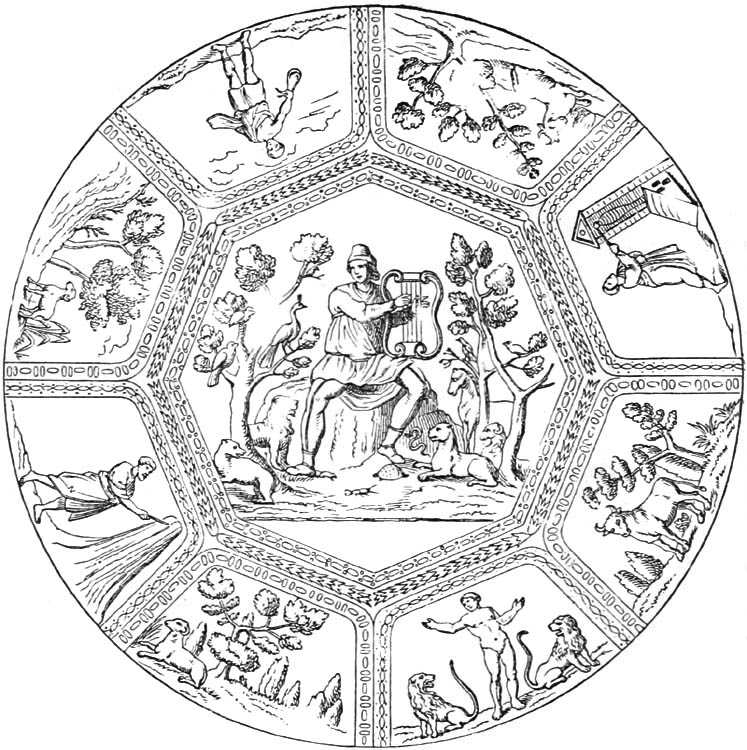
PAINTED CEILING.ToList
THE LAST SUPPER.
S. CALIXTUS.
This painting has more the appearance of being really intended for the Last Supper than most of the paintings of this class. The central figure has a certain dignity about it. Upon the round plates on the table are fishes, and the eight baskets are full of bread. It may be a Christian painting of a bad period, and intended to commemorate some of our Lord's miracles. The principal lines on the edges of the dresses have been renewed. This painting is under an arco-solium in the chapel of the Sacraments, the burial-place of the Bishops of Rome in the third century. All the paintings in that part of this great catacomb that is usually open to the public, and in which masses are said on certain occasions, have long been said by well-informed persons to have been restored within the last twenty years, but this is now denied by the Roman Catholic authorities.
An engraving of this painting is given by Bosio in the sixth arco-solium of this catacomb, p. 523; he calls it Christ and the Apostles. It is also given by Perret in the modern French style, vol. i. p. 28; and by Dr. Northcote in plate xiii., much embellished by color and improved by the skill of modern artists.
S. PONTIANUS.
The Baptistery, with the Baptism of Christ painted on the wall, over the arch. He is represented standing in the River Jordan up to His waist in water, in which fishes are swimming, and at which a hart is drinking; the Holy Dove is over His head. S. John Baptist is standing on the bank, and pouring water on His head, or perhaps only holding out his hand to touch it. On the opposite side is another figure in a white dress, hiding his face. All the three figures have the nimbus.
AN AGAPE.
An Agape, or love-feast, is a common subject of the paintings in the catacombs, and sometimes seems to be evidently a representation of the family gatherings that were held on the anniversaries in these tombs, in the same manner as they were in the painted tombs in the Via Latina or the Via Appia. These paintings are often supposed to be the Last Supper, and sometimes may be so, but the one before us can hardly be intended for Christ and his Apostles.
CHRIST AND THE CHURCH.
These two figures, one on either side of a small table, on which are two dishes, one with a fish upon it and the other with bread, are supposed to represent our Lord after the Resurrection, and the Christian Church in the form of a woman, with the hands uplifted in the Oriental attitude of prayer, such as is usually called in the catacombs an Orante. This explanation is of course conjectural only, but seems not improbable. The painting is so much damaged that it is difficult to tell to what period it belongs. A part of this great catacomb is as early as the second century. In this passage stravit may mean covering the walls with slabs of porphyry also, as well as the floor. It is evident that in several instances the word platonia is applied by Anastasius to a chapel lined with marble plates for inscriptions, as at S. Sebastian's.
CHAMBER OF A CATACOMB. (With head of Christ, etc., of the first century.)ToList
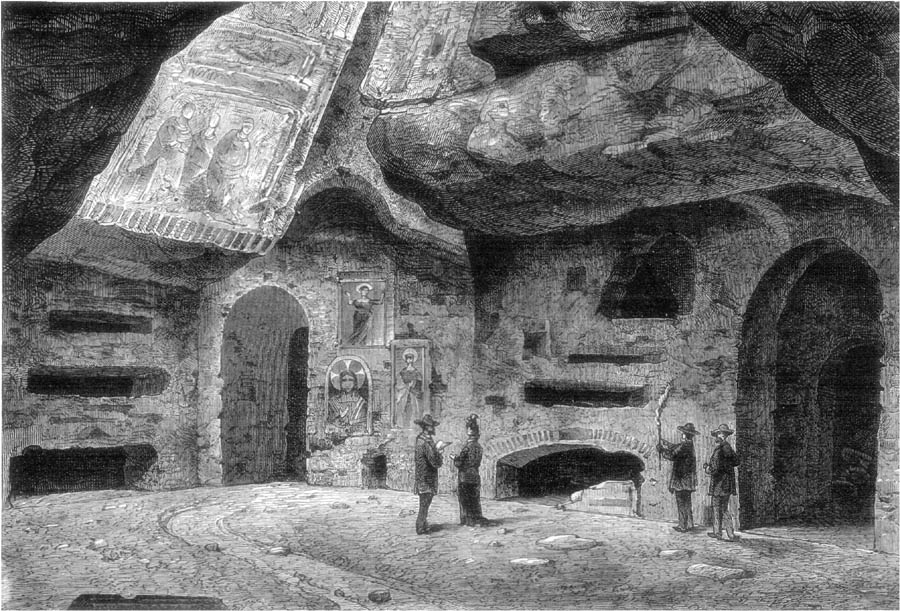
HEAD OF CHRIST IN AN AUREOLE.—MARY, MOTHER OF CHRIST, AND MARY MAGDALENE.—ST. MARK, ST. PAUL AND ST. PETER.
This cemetery or catacomb is on the western side of the Tiber, about half a mile beyond the Porta Portuensis, on the road to Porto, but on the hill above, and on a higher level than the road in what is now a vineyard. The soil in which this catacomb is made is quite different from the others; instead of the granular tufa, or volcanic sand, which is the soil generally used for them near the Via Appia and the Via Ardeatina, this is an alluvial soil formed by the action of water on the bank of the Tiber. Whether from this cause, or from some others that have not been explained, the paintings in this catacomb are far more perfect than those in any other; they are the most celebrated and the most popular, and those that have been more often engraved and published than any others.
The picture of the head of Christ is a very fine one, in an aureole or circular nimbus, with the cross on it, called also a cruciform nimbus. This head has been many times engraved and published, and it is amusing to compare those commonly sold in the shops of Rome with the original as shown in the photograph. These will illustrate the manner in which the clever modern artists have improved upon the originals; it is difficult to understand that they are intended for the same picture.
The figures of the three saints, St. Paul, St. Peter, and St. Mark, are painted on the ceiling, while Mary, the Mother of Christ, and Mary Magdalene are over and on the left side of the head of Christ.