RELIGION OR MYTHOLOGY.ToC
Reading edition
RELIGION OR MYTHOLOGY.ToC
Mythology is from the word myth, meaning fable, it is therefore a system of fabulous opinions and doctrines respecting the deities which the heathen nations have supposed to preside over the world or to influence its affairs.
They had twelve gods, Jupiter, Neptune, Pluto, Mercury, Mars, Vulcan, Apollo, Diana, Minerva, Juno, Ceres and Vesta. Besides these there were other lesser gods, Bacchus, Isis, Hebe, the Muses and the Fates, etc.; also Sleep, Dreams and Death; and there were still others who had free will and intelligence, and having mixed forms, such as the Pegasus, or winged horse, the Centaur, half man and half horse, Hydra, etc.
The Greek theory of the origin of things was that the beginning was chaos laden with the seed of all nature, then came the Earth and the Heavens, or Uranus; these two were married and from this union came a numerous and powerful brood. First were the six Titans, all males, and then the six females, and the Cyclops, three in number; these latter were of gigantic size, having but one eye, and that in the center of the forehead. They represented Thunder, Lightning and Fire, or the rapid flame.
The Titans made war upon their father and wounded him, and from the drops of blood which flowed from the wound and fell upon the earth sprang the Furies, whose names signified "Unceasing," "Envier," and "Blood-Avenger;" and the Giants and melian Nymphs, and from the blood drops which fell into the sea sprang Venus, the goddess of love and beauty.
The youngest and bravest son, Saturn, who wounded and dethroned his father, was, by the consent of his brethren, permitted to reign with an understanding that his male children should all be destroyed. But his wife, Rhea, hid from him three of her sons, Jupiter, Neptune and Pluto, who, waging a ten-year war against their father, finally dethroned him and divided the kingdom among themselves. The oldest, Jupiter, had the heavens, and reigned over all gods, Neptune over the sea, and Pluto the lower regions.
Jupiter then built his courts on Mount Olympos, reigned supreme god over heaven and earth; he was called the father of man and gods, and is placed at the head of the entire creation.
He is generally represented as majestic in appearance, seated on a throne with a sceptre in one hand and thunderbolts in the other. Jupiter had a number of wives; he also married his sister Juno, who was the queen goddess. Besides Jupiter, Juno, Neptune and Pluto the other eight gods were the children of Jupiter.
Neptune was second to Jupiter in power. He is represented as carrying a trident or three-tined fork, with which he strikes the earth and shakes it; he is therefore often called the "earth-shaker." He is usually represented like Jupiter, of a serene and majestic aspect, seated in a chariot made of shells and drawn by dolphins and sea-horses, while the Tritons and the Nymphs gambol about him.
Pluto is represented as the grim, stern ruler over hell. He is also called Hades and Orcus. He has a throne of sulphur, from beneath which flows the Rivers Lethe, or "Oblivion," Phlegethon, Cocytus and Acheron. In one hand he holds his fork and in the other the keys of hell, and beside him is the dog with three heads. He is described as being well qualified for his position, being inexorable and deaf to supplications, and an object of aversion and hatred to both gods and men. From his realms there is no return, and all mankind, sooner or later, are sure to be gathered into his kingdom.
As none of the goddesses would marry the stern and gloomy god, he seized Proserpine, the daughter of Ceres, while she was gathering flowers, and opened the earth and carried her through into his dominion.
Mercury was the messenger and ambassador of the gods. He was represented by wings on his hat, and sandals, and usually carrying a wand, or staff, with two serpents twined around it. He himself was a god of eloquence and the patron of orators, merchants, thieves, robbers, travelers and shepherds.
Mars was the god of war. Sorrow and fear accompanied him, disorder and discord in tattered garments go before him and anger and clamor follow. He is of huge size and gigantic strength, and his voice was louder than those of ten thousand mortals.
Vulcan was the forger, and is generally represented at an anvil in a short tunic, with a hammer in his right hand. He was lame when he was born, and his mother, Juno, was so shocked that she flung him headlong from the Mt. Olympos.
Apollo was the god of archery, prophecy and music, and is usually seen with a harp in his hand and of beautiful figure.
Diana was the goddess of chase, and appears with a bow in her hand and a quiver of arrows at her back, and on her side is a hound. She devoted herself to perpetual celibacy, and her chief joy was to speed like a Dorian maid over the hills, followed by a train of nymphs in pursuit of the flying game.
Minerva is the goddess of wisdom and skill, and the teacher in warfare. She has a serious and thoughtful countenance, a spear in one hand and a shield in the other, while a helmet covers her head. She is said to have sprung from the brains of Jupiter.
Juno, the wife of Jupiter, was haughty, jealous and inexorable; a goddess of dignified and matronly air, often found with a peacock at her feet.
Ceres is the goddess of grain and harvest. She is represented riding on a chariot drawn by dragons, and distributing grain to the different regions of the earth. She holds in one hand corn and wheat, in the other a lighted torch, and wears on her head a garland of wheat heads.
After Pluto stole her daughter, Proserpine, she searched for her throughout the whole world.
Vesta, the goddess of the household and domestic hearths, is represented in a long-flowing robe, with a veil on her head, a lamp in one hand, and a spear or javelin in the other. In her temple at Rome, the sacred fire was guarded by six priestesses, called the Vestal Virgins.
Among the lesser gods there were many, but the most common was Bacchus, who was the god of lust, wine, and the patron of drunkenness and debauchery. He is represented as an effeminate young man, with long flowing hair. In one hand he holds a goblet, in the other a bunch of grapes and a short dagger.
The Muses were goddesses who presided over music and poetry, and all the liberal arts and sciences. They were nine in number.
The Graces were three in number, and personified Splendor, Joy and Pleasure. They were three beautiful sisters, standing with their arms entwined.
The Fates were also three goddesses, who presided over the destiny of mortals. The first was the staff of life, the second spun the cord, and the third cut it off.
This is a brief outline of the origin and nature of the gods and goddesses: and the legends are numerous, and some of them are of exceeding interest and beauty, while others shock and disgust us by the gross impossibilities and hideous deformities which they reveal. We have concluded to give a direct translation of them from the Greek, so that the reader may have them in the pure original form, and thereby have not only the beauty and interest retained, but at the same time an idea of the style of the ancient writings; only a few stories have been modified to bring them nearer to the level of the rest. We will, however, be obliged to use the Greek names instead of the Latin in this translation, as it is from the Greek, and will therefore give the names translated below:
Greek. Latin.
Zeus, Jupiter.
Here, Juno.
Poseidon, Neptune.
Plouton, Pluto.
Demeter, Ceres.
Apollo, Apolo.
Artemis, Diana.
Hephaistos, Vulcan.
Athene, Minerva.
Ares, Mars.
Aphrodite, Venus.
Hermes, Mercury.
Hestia, Vesta.
The most of the Greek people appear to have believed that their divinities were real persons, but their philosophers explained the legends concerning them as allegorical representations of general physical and moral truths. The Greeks, therefore, instead of favoring nature, worshiped the powers of nature personified.
THE DELPHIAN APOLLO.
From land to land the lady Leto wandered in fear and sorrow, for no city or country would give her a home where she might abide in peace. From Crete to Athens, from Athens to Ægina, from Ægina to the heights of Pelion and Athos, through all the islands of the wide Ægæan Sea, Skyros and Imbros and Lemnos, and Chios the fairest of all, she passed, seeking a home. But in vain she prayed each land to receive her, until she came to the Island of Delos, and promised to raise it to great glory if only there she might rest in peace. And she lifted up her voice and said, "Listen to me, O island of the dark sea. If thou wilt grant me a home, all nations shall come unto thee, and great wealth shall flow in upon thee; for here shall Phœbus Apollo, the lord of light and life, be born, and men shall come hither to know his will and win his favor." Then answered Delos, and said, "Lady, thou promisest great things; but they say that the power of Phœbus Apollo will be such as nothing on the wide earth may withstand; and mine is but a poor and stony soil, where there is little to please the eye of those who look upon me. Wherefore I fear that he will despise my hard and barren land, and go to some other country where he will build a more glorious temple, and grant richer gifts to the people who come to worship him." But Leto swore by the dark water of Styx, and the wide heaven above, and the broad earth around her, that in Delos should be the shrine of Phœbus, and that there should the rich offerings burn on his altar the whole year round.
So Leto rested in the Island of Delos, and there was Phœbus Apollo born. And there was joy among the undying gods who dwell in Olympos, and the earth laughed beneath the smile of heaven. Then was his temple built in Delos, and men came to it from all lands to learn his will and offer rich sacrifices on his altar.
THE PYTHIAN APOLLO.
Long time Apollo abode in Delos; and every year all the children of Ion were gathered to the feast which was held before his temple. But at length it came to pass that Apollo went through many lands, journeying towards Pytho. With harp in hand he drew nigh to the gates of Olympos, where Zeus and the gods dwell in their glory; and straightway all rejoiced for the sweetness of his harping. The Muses sang the undying gifts of the gods, and the griefs and woes of mortal men who can not flee from old age and death. The bright Horai joined hands together with Hebe and Harmonia; and Ares stood by the side of Aphrodite with Hermes the slayer of Argos, gazing on the face of Phœbus Apollo, which glistened as with the light of the new-risen sun. Then from Olympos he went down into the Pierian land, to Iolkos and the Lelantian plain; but it pleased him not there to build himself a home. Thence he wandered on to Mykalessos, and, traversing the grassy plains of Teumessos, came to the sacred Thebes; but neither would he dwell there, for no man had yet come hither, neither was there road nor path, but only wild forests in all the land.
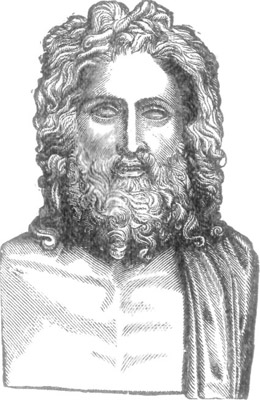
JUPITER. (Zeus)ToList
Further and further he roamed, across the stream of Kephisos and beyond Okalea and Haliartos, until he came to Telphusa. There he thought to build himself a temple, for the land was rich and fair, so he said, "Beautiful Telphusa, here would I rest in thy happy vale, and here shall men come to ask my will and seek for aid in the hour of fear; and great glory shall come to thee while I abide in thy land." But Telphusa was moved with anger as she saw Phœbus marking out the place for his shrine and laying its foundations; and she spake craftily to him, and said, "Listen to me, Phœbus Apollo. Thou seekest here to have a home, but here thou canst never rest in peace; for my broad plain will tempt men to the strife of battle, and the tramp of war-horses shall vex the stillness of thy holy temple. Nay, even in the time of peace, the lowing cattle shall come in crowds to my fountain, and the tumult will grieve thine heart. But go thou to Krisa, and make for thyself a home in the hidden clefts of Parnassos, and thither shall men hasten with their gifts from the utmost bounds of the earth." So Apollo believed her words, and he went on through the land of the Phlegyes until he came to Krisa. There he laid the foundations of his shrine in the deep cleft of Parnassos; and Trophonios and Agamedes, the children of Erginos, raised the wall. There also he found the mighty dragon who nursed Typhaon, the child of Here, and he smote him, and said, "Rot there upon the ground, and vex not more the children of men. The clays of thy life are ended, neither can Typhoeus himself aid thee now, nor Chimæra of the evil name. But the earth and the burning sun shall consume and scorch thy body." So the dragon died, and his body rotted on the ground; wherefore the name of the place is called Pytho, and they worship Phœbus Apollo as the great Pythian king.
But Phœbus knew now that Telphusa had deceived him, because she said nothing of the great dragon of Krisa, or of the roughness of the land. So he hastened back in his anger and said, "Thou hast beguiled me, Telphusa, with thy crafty words; but no more shall thy fountain send forth its sweet water, and the glory shall be mine alone." Then Apollo hurled great crags down and choked the stream near the beautiful fountain, and the glory departed from Telphusa.
Then he thought within himself what men he should choose to be his priests at Pytho; and far away, as he stood on the high hill, he saw a ship sailing on the wine-faced sea, and the men who were in it were Cretans, sailing from the land of King Minos to barter their goods with the men of Pylos. So Phœbus leaped into the sea, and changed his form to the form of a dolphin, and hastened to meet the ship. None knew whence the great fish came which smote the side of their vessel with its mighty fins; but all marveled at the sight, as the dolphin guided the ship through the dark waters, and they sat trembling with fear, as they sped on without a sail by the force of the strong south wind. From the headland of Malea and the land of the Lakonians they passed to Helos and to Tænaron where Helios dwells, in whom the sons of men take delight, and where his cattle feed in the rich pastures. There the sailors would have ended their wanderings; but they sought in vain to land, for the ship would not obey its helm. Onward it went along the coast of the Island of Pelops, for the mighty dolphin guided it. So from Arene and Arguphea it came to the sandy Pylos, by Chalkis and Dyme to the land of the Epeians, to Pheræ and to Ithaka. There the men saw spread out before them the waters which wash the shores of Krisa; and the strong west wind came with its fierce breath, and drove them off to the east and towards the sunrising until they came to Krisa.
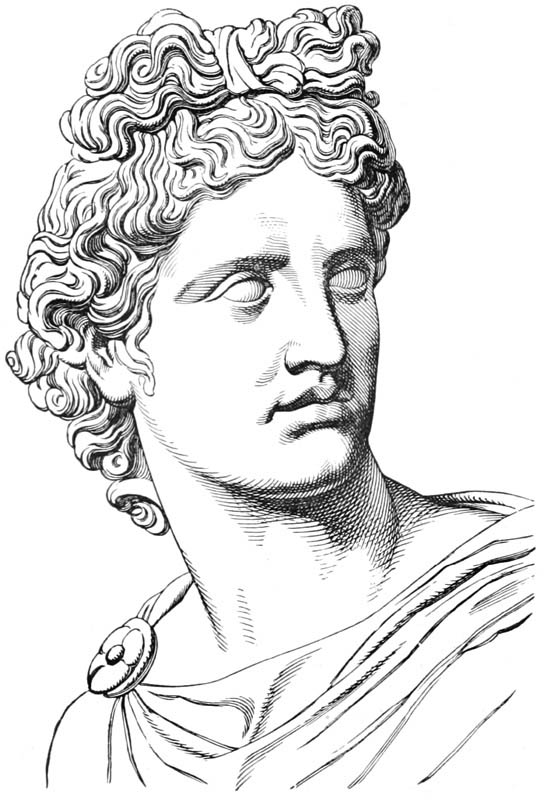
APOLLO. (From an ancient Sculpture.)ToList
Then Phœbus Apollo came forth from the sea, like a star, and the brightness of his glory reached up to the high heaven. Into his shrine he hastened, and on the altar he kindled the undying fire, and his bright arrows were hurled abroad, till all Krisa was filled with the blaze of his lightnings, so that fear came upon all, and the cries of the women rose shrill on the sultry air. Then, swift as a thought of the heart, he hastened back to the ship; but his form was now the form of a man in his beauty, and his golden locks flowed over his broad shoulders. From the shore he called out to the men in the Cretan ship, and said "Who are ye, strangers? and do ye come as thieves and robbers, bringing terror and sorrow whithersoever ye may go? Why stay ye thus, tarrying in your ships, and seek not to come out on the land? Surely ye must know that all who sail on the wide sea rejoice when their ship comes to the shore, that they may come forth and feast with the people of the land?" So spake Phœbus Apollo; and the leader of the Cretans took courage and said, "Stranger, sure I am that thou art no mortal man, but one of the bright heroes or the undying gods. Wherefore tell us now the name of this land and of the people who dwell in it. Hither we never sought to come, for we were sailing from the land of Minos to barter our wares at Pylos; but some one of the gods hath brought us hither against our will."
Then spake the mighty Apollo, and said to them, "O, strangers, who have dwelt in Knossos of the Cretan land, think not to return to your ancient home, to your wives or to your children. Here ye must guard and keep my shrine, and ye shall be honored of all the children of men. For I am the son of Zeus, and my name is Phœbus Apollo. It was I who brought you hither across the wide sea, not in guile or anger, but that in all time to come ye may have great power and glory, that ye may learn the counsel of the undying gods and make known their will to men. Hasten then to do my bidding; let down your sails, and bring your ship to the shore. Then bring out your goods, and build an altar on the beach, and kindle a fire, and offer white barley as an offering; and because I led you hither under the form of a dolphin, so worship me as the Delphian god. Then eat bread and drink wine, as much as your soul may lust after; and after that come with me to the holy place, where ye shall guard my temple."
So they obeyed the words of Phœbus; and when they had offered the white barley, and feasted richly on the sea-shore, they arose to go, and Apollo led them on their way. His harp was in his hand, and he made sweet music, such as no mortal ear had heard before; and they raised the chant Io Pæan, for a new power was breathed into their hearts, as they went along. They thought not now of toil or sorrow; but with feet unwearied they went up the hill until they reached the clefts of Parnassos, where Phœbus would have them dwell.
Then out spake the leader of the Cretans, and said, boldly, "O king, thou hast brought us far away from our homes to a strange land; whence are we to get food here? No harvest will grow on these bare rocks, no meadows are spread out before our eyes. The whole land is bare and desolate." But the son of Zeus smiled and said, "O foolish men, and easy to be cast down, if ye had your wish ye would gain nothing but care and toil. But listen to me and ponder well my words. Stretch forth your hands and slay each day the rich offerings, for they shall come to you without stint and sparing, seeing that the sons of men shall hasten hither from all lands, to learn my will and ask for aid in the hour of fear. Only guard ye my temple well, and keep your hands clean and your hearts pure; for if ye deal rightly no man shall take away your glory; but if ye speak lies and do iniquity, if ye hurt the people who come to my altar, and make them to go astray, then shall other men rise up in your place, and ye yourselves shall be thrust out forever, because ye would not obey my words."
NIOBE AND LETO.
In the little Island of Delos there lived a long time ago a lady who was called Niobe. She had many sons and many daughters, and she was very proud of them, for she thought that in all the Island of Delos, and even in all the world, there were no children so beautiful as her own. And as they walked, and leaped, and ran among the hills and valleys of that rocky island, all the people looked at them, and said, "Surely there are no other children like the children of the lady Niobe." And Niobe was so pleased at hearing this, that she began to boast to every one how strong and beautiful her sons and daughters were.
Now in this Island of Delos there lived also the lady named Leto. She had only two children, and their names were Artemis and Phœbus Apollo; but they were very strong and fair, indeed. And whenever the lady Niobe saw them, she tried to think that her own children were still more beautiful, although she could hardly help feeling that she had never seen any so glorious as Artemis and Apollo. So one day the lady Leto and the lady Niobe were together, and their children were playing before them; and Phœbus Apollo played on his golden harp, and then he shot from his golden bow the arrows which never missed their mark. But Niobe never thought of Apollo's bow, and the arrows which he had in his quiver; and she began to boast to the lady Leto of the beauty of her children, and said, "See, Leto; look at my seven sons and my seven daughters, and see how strong and fair they are. Apollo and Artemis are beautiful, I know, but my children are fairer still; and you have only two children while I have seven sons and seven daughters." So Niobe went on boasting, and never thought whether she should make Leto angry. But Leto said nothing until Niobe and her children were gone, and then she called Apollo, and said to him, "I do not love the lady Niobe. She is always boasting that her sons and daughters are more beautiful than you and your sister; and I wish you to show her that no one else is so strong as my children, or so beautiful." Then Phœbus Apollo was angry, and a dark frown came upon his fair young face, and his eyes were like the flaming fire. But he said nothing, and he took his golden bow in his hand, and put his quiver with his terrible arrows across his shoulder, and went away to the hills where he knew that the lady Niobe and her children were. And when he saw them he went and stood on a bare high rock, and stretched the string of his golden bow, and took an arrow from his quiver. Then he held out the bow, and drew the string to his breast, until the point of the arrow touched the bow; and then he let the arrow fly. Straight to its mark it went, and one of the lady Niobe's sons fell dead. Then another arrow flew swiftly from the bow, and another, and another, and another, till all the sons and all the daughters of Niobe lay dead on the hillside. Then Apollo called out to Niobe, and said, "Go and boast now of your beautiful children!"
It had all passed so quickly that Niobe scarcely knew whether it was not a dream. She could not believe that her children were really gone—all her sons and all her daughters, whom she had just now seen so happy and strong around her. But there they lay, still and cold, upon the ground. Their eyes were closed as if they were asleep, and their faces had still a happy smile, which made them look more beautiful than ever. And Niobe went to them all one by one, and touched their cold hands, and kissed their pale cheeks; and then she knew that the arrows of Phœbus Apollo had killed them. Then she sat down on a stone which was close to them, and the tears flowed from her eyes, and they streamed down her face, as she sat there as still as her children who lay dead before her. She never raised her head to look at the blue sky—she never moved hand or foot, but she sat weeping on the cold rock until she became as cold as the rock itself. And still her tears flowed on, and still her body grew colder and colder, until her heart beat no more, and the lady Niobe was dead. But there she still seemed to sit and weep, for her great grief had turned her into a stone; and all the people, whenever they came near that place, said, "See, there sits the lady Niobe, who was turned into stone, when Phœbus Apollo killed all her children because she boasted that no one was so beautiful as they were." And long after, when the stone was grown old and covered with moss, the people still thought they could see the form of the lady Niobe; for the stone, which did not look much like the form of a woman when they came near to it, seemed at a distance just as though Niobe still sat there, weeping for her beautiful children whom Phœbus Apollo slew.
DAPHNE.
In the vale of Tempe, where the stream of Peneios flows beneath the heights of Olympos towards the sea, the beautiful Daphne passed the days of her happy childhood. Fresh as the earliest morning, she climbed the crags to greet the first rays of the rising sun; and when he had driven his fiery horses over the sky, she watched his chariot sink behind the western mountains. Over hill and dale she roamed, free and light as the breeze of spring. Other maidens round her spoke each of her love, but Daphne cared not to listen to the voice of man, though many a one sought her to be his wife.
One day as she stood on the slopes of Ossa in the glow of early morning, she saw before her a glorious form. The light of the new-risen sun fell on his face with a golden splendor, and she knew that it was Phœbus Apollo. Hastily he ran towards her, and said, "I have found thee, Child of the Morning. Others thou hast cast aside, but from me thou canst not escape. I have sought thee long, and now will I make thee mine." But the heart of Daphne was bold and strong; and her cheek flushed and her eye sparkled with anger, as she said, "I know neither love nor bondage. I live free among the streams and hills; and to none will I yield my freedom." Then the face of Apollo grew dark with anger, and he drew near to seize the maiden; but swift as the wind she fled away. Over hill and dale, over crag and river, the feet of Daphne fell lightly as falling leaves in autumn; but nearer yet came Phœbus Apollo, till at last the strength of the maiden began to fail. Then she stretched out her hands, and cried for help to the lady Demeter; but she came not to her aid. Her head was dizzy, and her limbs trembled in utter feebleness as she drew near the broad river which gladdens the plains of Thessaly, till she almost felt the breath of Phœbus, and her robe was almost in his grasp. Then, with a wild cry, she said, "Father Peneios, receive thy child," and she rushed into the stream, whose waters closed gently over her.
She was gone; Apollo mourned for his madness in chasing thus the free maiden. And he said, "I have punished myself by my folly; the light of the morning is taken out of the day. I must go on alone till my journey shall draw towards its end." Then he spake the word, and a laurel came up on the bank where Daphne had plunged into the stream; and the green bush with its thick clustering leaves keeps her name forever.
KYRENE.
Among the valleys and hills of Thessaly, Kyrene, the fair-armed daughter of Hypseus, wandered free as the deer upon the mountain side. Of all the maidens of the land, there was none to vie her in beauty; neither was there any that could be matched with her for strength of arm and speed of foot. She touched not the loom or the spindle; she cared not for banquets with those who revel under houses. Her feasts were spread on the green grass, beneath the branching tree; and with her spear and dagger she went fearless among the beasts of the field, or sought them out in their dens.
One day she was roaming along the winding banks of Peneios, when a lion sprang from a thicket across her path. Neither spear nor dagger was in her hand, but the heart of Kyrene knew no fear, and she grappled with him until the beast sank wearied at her feet. She had conquered, but not unseen, for Phœbus Apollo had watched the maiden as she battled with the angry lion; and straightway he called the wise centaur Cheiron, who had taught him in the days of his youth. "Come forth," he said, "from thy dark cave, and teach me once again, for I have a question to ask thee. Look at yonder maiden, and the beast which lies beaten at her feet; and tell me (for thou art wise) whence she comes, and what name she bears. Who is she, that thus she wanders in these lonely valleys without fear and without hurt? Tell me if she may be wooed and won." Then Cheiron looked steadfastly at the face of Phœbus, and a smile passed over his countenance as he answered, "There are hidden keys to unlock the prison-house of love; but why askest thou me of the maiden's name and race—thou who knowest the end of all things, and all the paths along which the sons of men are journeying? Thou hast counted the leaves which burst forth in the spring-time, and the grains of sand which the wind tosses on the river bank, or by the sea shore. But if I must needs match thee in suitable wisdom, then listen to my words. The maiden is wooed and won already; and thou art going to bear her as thy bride over the dark sea, and place her in golden halls on the far-off Libyan land. There she shall have a home rich in every fruit that may grow up from the earth; and there shall thy son Aristaios be born, on whose lips the bright Horai shall shed nectar and ambrosia, so that he may not come under the doom of mortal men."
Then Phœbus Apollo smiled as he answered, "Of a truth, Cheiron, thou deservest thy fame, for there are none to match with thee for wisdom; and now I go with Kyrene to the land which shall be called by her name, and where, in time to come, her children shall build great and mighty cities, and their name shall be spread abroad throughout all the earth for strength and wisdom."
So the maiden Kyrene came to the Libyan land, and there Aristaios, her child, was born. And Hermes carried the babe to the bright Horai, who granted him an endless life; and he dwelt in the broad Libyan plains, tending his flocks, and bringing forth rich harvests from the earth. For him the bees wrought their sweetest honey; for him the sheep gave their softest wool; for him the cornfields waved with their fullest grain. No blight touched the grapes which his hand had tended; no sickness vexed the herds which fed in his pastures. And they who dwelt in the land said, "Strife and war bring no such gifts as these to the sons of men; therefore let us live in peace."
HERMES.
Early in the morning, long ago, in a cave of the great Kyllenian hill, lay the new-born Hermes, the son of Zeus and Maia. The cradle-clothes were scarcely stirred by his soft breathing, while he slept as peacefully as the children of mortal mothers. But the sun had not driven his fiery chariot half over the heaven, when the babe arose from his sacred cradle and stepped forth from the dark cavern. Before the threshold a tortoise fed lazily on the grass; and when the child saw it he laughed merrily. "Ah! this is luck, indeed," he said; "whence hast thou come, pretty creature, with thy bright speckled shell? Thou art mine now, and I must take thee into my cave. It is better to be under shelter than out of doors; and though there may be some use in thee while thou livest, it will comfort thee to think that thou wilt sing sweetly when thou art dead." So the child Hermes took up his treasure in both arms, and carried it into the cavern. There he took an iron probe, and pierced out the life of the tortoise; and quick as thought, he drilled holes in its shell, and fixed in them reed-canes. Then across the shell he fastened a piece of ox-hide, and with seven sheep-gut cords he finished the making of his lyre. Presently he struck it with the bow, and a wave of sweet music swelled out upon the air. Like the merry songs of youths and maidens, as they sport in village feasts, rose the song of the child Hermes; and his eyes laughed slyly as he sang of the loves of Zeus and Maia, and how he himself was born of the mighty race of the gods. Still he sang on, telling of all that he saw around him in the home of the nymph, his mother, but all the while, as he sang, his mind was pondering on other things; and when the song was ended, he went forth from the cave, like a thief in the night, on his wily errand.
The sun was hastening down the slope of heaven, with his chariot and horses to the slow-rolling stream of Ocean, as Hermes came to the shadowy hills of Pieria, where the cattle of the gods fed in their large pastures. There he took fifty from the herd, and made ready to drive them to the Kyllenian hill. But before him lay vast plains of sand; and, therefore, lest the track of the cattle should tell the tale of his thieving, he drove the beasts round about by crooked paths, until it seemed as though they had gone to the place from whence he had stolen them. He had taken good care that his own footsteps should not betray him, for with branches of tamarisk and myrtle, well twisted with their leaves, he hastily made sandals, and sped away from Pieria. One man alone saw him, a very old man, who was working in his vineyard on the sunny plain of Onchestos. To him Hermes went quickly, and said, "Old man, thou wilt have plenty of wine when these roots come all into bearing trim. Meanwhile keep a wise head on thy crumpled shoulders, and take heed not to remember more than may be convenient."
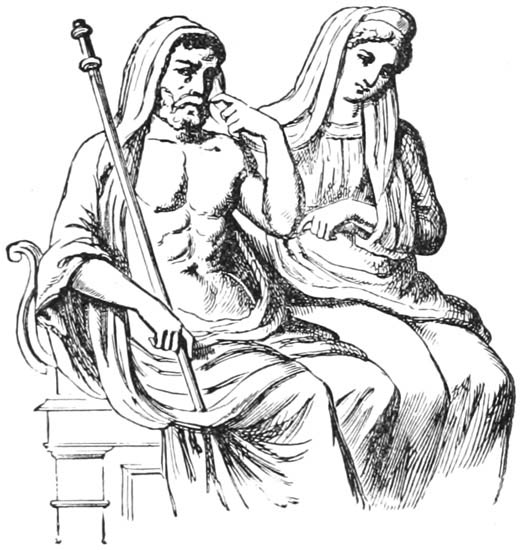
PLUTO AND HIS WIFE.ToList
Onwards, over dark hills, and through sounding dells, and across flowery plains, hastened the child Hermes, driving his flock before him. The night waxed and waned, and the moon had climbed to her watchtower in the heaven, when, in the flush of early morning, Hermes reached the banks of the great Alpheian stream. Then he turned his herd to feed on the grassy plain, while he gathered logs of wood, and, rubbing two sticks together, kindled the first flame that burned upon the earth where dwell the sons of men. The smoke went up to the heaven, and the flame crackled fiercely beneath it, as Hermes brought forth two of the herd, and, tumbling them on their back, pierced out the life of both. Their hides he placed on the hard rock; their flesh he cut up into twelve portions; and so Hermes hath the right of ordering all sacrifices which the children of men offer to the undying gods. But he ate not of the flesh or fat, although hunger sorely pressed him; and he burnt the bones in the fire, and tossed his tamarisk sandals into the swift stream of Alpheios. Then he quenched the fire, and with all his might trampled down the ashes, until the pale moon rose up again in the sky. So he sped on his way to Kyllene. Neither god nor man saw him as he went, nor did the dogs bark. Early in the morning he reached his mother's cave, and darted through the keyhole of the door, softly as a summer breeze. Without a sound his little feet paced the stony floor, till he reached his cradle and lay down, playing like a babe among the clothes with his left hand, while the right held the tortoise-lyre hidden underneath them.
But, wily as he was, he could not cheat his mother. To his cradle she came, and said, "Whither hast thou wandered in the dark night? Crafty rogue, mischief will be thy ruin. The son of Leto will soon be here, and bear thee away bound in chains not easily shaken off. Out of my sight, little wretch, born to worry the blessed gods and plague the race of men!" "Mother," said Hermes, gently, "why talk thus to me, as though I were like mortal babes, a poor cowering thing, to cry for a little scolding? I know thy interest and mine: why should we stay here in this wretched cave, with never a gift nor a feast to cheer our hearts? I shall not stay. It is pleasanter to banquet with the gods than to dwell in a cavern in draughts of whistling wind. I shall try my luck against Apollo, for I mean to be his peer; and if he will not suffer me, and if Zeus, my father, take not up my cause, I will see what I can do for myself, by going to the shrine of Pytho and stealing thence the tripods and caldrons, the iron vessels and glittering robes. If I may not have honor in Olympos, I can at least be the prince of thieves."
Meanwhile, as they talked together, Eos rose up from the deep ocean stream, and her tender light flushed across the sky, while Apollo hastened to Onchestos and the holy grove of Poseidon. There the old man was at work in his vineyard, and to him Phœbus went quickly, and said, "Friend hedger, I am come from Pieria looking for my cows. Fifty of them have been driven away, and the bull has been left behind with the four dogs who guarded them. Tell me, old man, hast thou seen any one with these cows, on the road?" But the old man said that it would be a hard matter to tell of all that he might chance to see. "Many travelers journey on this road, some with evil thoughts, some with good; I can not well remember all. This only I know, that yesterday, from the rising of the sun to its setting, I was digging in my vineyard, and I think, but I am not sure, that I saw a child with a herd of cattle. A babe he was, and he held a staff in his hand, and, as he went, he wandered strangely from the path on either side."
Then Phœbus stayed not to hear more, for now he knew of a surety that the new-born son of Zeus had done him the mischief. Wrapped in a purple mist, he hastened to beautiful Pylos, and came on the track of the cattle. "O Zeus!" he cried, "this is indeed a marvel. I see the footprints of cattle, but they are marked as though the cattle were going to the asphodel meadow, not away from it. Of man or woman, of wolf, bear, or lion, I spy not a single trace. Only here and there I behold the footprints of some strange monster, who has left his mark at random on either side of the road." So on he sped to the woody heights of Kyllene, and stood on the doorstep of Maia's cave. Straightway the child Hermes nestled under the cradle-clothes in fear, like a new-born babe asleep. But, seeing through all his craft, Phœbus looked steadily through all the cave and opened three secret places full of the food and drink of the gods, and full also of gold and silver and raiment; but not a cow was in any of them. At last he fixed his eyes sternly on the child, and said, "Wily babe, where are my cows? If thou wilt not tell me, there will be strife between us; and then I will hurl thee down to the gloomy Tartaros, to the land of darkness, whence neither thy father nor thy mother can bring thee back, and where thy kingdom shall be only over the ghosts of men." "Ah!" said Hermes, "these are dreadful words, indeed; but why dost thou chide me thus, or come here to look for cows? I have not seen or heard of them, nor has any one told me of them. I can not tell where they are, or get the reward, if any were promised, for discovering them. This is no work of mine; what do I care for but for sleeping and sucking, and playing with my cradle-clothes, and being washed in warm water? My friend, it will be much better that no one should hear of such a silly quarrel. The undying gods would laugh at the very thought of a little babe leaving its cradle to run after cows. I was born but yesterday. My feet are soft, and the ground is hard. But if it be any comfort to thee, I will swear by my father's head (and that is a very great oath) that I have not done this deed, nor seen any one else steal your cows, and that I do not know what cows are."
As he spoke he looked stealthily from one side to the other, while his eyes winked slyly, and he made a long soft whistling sound, as if the words of Phœbus had amused him mightily. "Well, friend," said Apollo, with a smile, "thou wilt break into many a house, I see, and thy followers after thee; and thy fancy for beef will set many a herdsman grieving. But come down from the cradle, or this sleep will be thy last. Only this honor can I promise thee, to be called the prince of thieves forever." So without more ado Phœbus caught up the babe in his arms; but Hermes gave so mighty a sneeze that he quickly let him fall, and Phœbus said to him, gravely, "This is the sign that I shall find my cows; show me, then, the way." In great fear Hermes started up and pulled the cradle-clothes over his ears, as he said, "Cruel god, what dost thou seek to do with me? Why worry me thus about cows? I would there were not a cow in all the earth. I stole them not, nor have I seen any one steal the cows, whatever things cows may be. I know nothing but their name. But come; Zeus must decide the quarrel between us."
Thus each with his own purpose spake to the other, and their minds grew all the darker, for Phœbus sought only to know where his cows might be, while Hermes strove only to cheat him. So they went quickly and sulkily on, the babe first, and Phœbus following after him, till they came to the heights of Olympos and the home of the mighty Zeus. There Zeus sat on the throne of judgment, and all the undying gods stood around him. Before them in the midst stood Phœbus and the child Hermes, and Zeus said, "Thou hast brought a fine booty after thy hunt to-day, Phœbus—a child of a day old. A fine matter is this to put before the gods."
"My father," said Apollo, quickly, "I have a tale to tell which will show that I am not the only plunderer. After a weary search I found this babe in the cave of Kyllene; and a thief he is such as I have never seen whether among gods or men. Yester eve he stole my cattle from the meadow, and drove them straight towards Pylos to the shore of the sounding sea. The tracks left were such that gods and men might well marvel at them. The footprints of the cows on the sand were as though they were going to my meadows, and not away from them; his own footmarks beggar all words, as if he had gone neither on his feet nor on his hands, and as if the oak tops had suddenly taken to walking. So was it on the sandy soil; and after this was passed, there remained no marks at all. But an old man saw him driving them on the road to Pylos. There he shut up the cattle at his leisure, and, going to his mother's cave, lay down in his cradle like a spark in a mass of cinders, which an eagle could scarcely spy out. When I taxed him with the theft he boldly denied it, and told me that he had not seen the cows or heard naught of them, and could not get the reward if one were offered for restoring them."
So the words of Phœbus were ended, and the child Hermes made obeisance to Zeus, the lord of all the gods, and said, "Father Zeus, I shall tell thee the truth, for I am a very truthful being, and I know not how to tell a lie. This morning, when the sun was but newly risen, Phœbus came to my mother's cave, looking for cows. He brought no witnesses; but urged me by force to confess; he threatened to hurl me into the abyss of Tartaros. Yet he has all the strength of early manhood, while I, as he knows, was born but yesterday, and am not in the least like a cattle-reiver. Believe me (by thy love for me, thy child) that I have not brought these cows home, or passed beyond my mother's threshold. This is strict truth. Nay, by Helios and the other gods, I swear that I love thee and have respect for Phœbus. Thou knowest that I am guiltless, and, if thou wilt, I will also swear it. But, spite of all his strength, I will avenge myself some day on Phœbus for his unkindness; and then help thou the weaker."
So spake Hermes, winking his eyes and holding the clothes to his shoulders; and Zeus laughed aloud at the wiliness of the babe, and bade Phœbus and the child be friends. Then he bowed his head and charged Hermes to show the spot where he had hidden the cattle, and the child obeyed, for none may despise that sign and live. To Pylos they hastened and to the broad stream of Alpheios, and from the fold Hermes drove forth the cattle. But as he stood apart, Apollo beheld the hides flung on the rock, and he asked Hermes, "How wast thou able, cunning rogue, to flay two cows, thou a child but one day old? I fear thy might in time to come, and I can not let thee live." Again he seized the child, and bound him fast with willow bands; but the child tore them from his body like flax, so that Phœbus marveled greatly. In vain Hermes sought a place wherein to hide himself, and great fear came upon him till he thought of his tortoise-lyre. With his bow he touched the strings, and the wave of song swelled out upon the air more full and sweet than ever. He sang of the undying gods and the dark earth, how it was made at the first, and how to each of the gods his own appointed portion was given, till the heart of Apollo was filled with a mighty longing, and he spake to Hermes, and said, "Cattle-reiver, wily rogue, thy song is worth fifty head of cattle. We will settle our strife by and by. Meanwhile, tell me, was this wondrous gift of song born with thee, or hast thou it as a gift from any god or mortal man? Never on Olympos, from those who can not die, have I heard such strains as these. They who hear thee may have what they will, be it mirth, or love, or sleep. Great is thy power, and great shall be thy renown, and by my cornel staff I swear that I will not stand in the way of thy honor or deceive thee in anywise."
Then said Hermes, "I grudge thee not my skill, son of Leto, for I seek but thy friendship. Yet thy gifts from Zeus are great. Thou knowest his mind, thou canst declare his will, and reveal what is stored up in time to come for undying gods or mortal men. This knowledge I fain would have. But my power of song shall this day be thine. Take my lyre, the soother of the wearied, the sweet companion in hours of sorrow or of feasting. To those who come skilled in its language, it can discourse sweetly of all things, and drive away all thoughts that annoy and cares that vex the soul. To those who touch it, not knowing how to draw forth its speech, it will babble strange nonsense, and rave with uncertain moanings. But thy knowledge is born with thee, and so my lyre is thine. Wherefore now let us feed the herds together, and with our care they shall thrive and multiply. There is no more cause for anger."
So saying the babe held out the lyre, and Phœbus Apollo took it. In his turn he gave to the child Hermes a glittering scourge, with charge over his flocks and herds. Then, touching the chords of the lyre, he filled the air with sweet music, and they both took their way to Olympos, and Zeus was glad at heart to see that the wrath of Apollo had passed away. But Phœbus dreaded yet the wiles of Hermes, and said, "I fear me much, child of Maia, that in time to come thou mayest steal both my harp and my bow, and take away my honor among men. Come now, and swear to me by the dark water of Styx that thou wilt never do me wrong." Then Hermes bowed his head, and swore never to steal anything from Apollo, and never to lay hands on his holy shrine; and Phœbus swore that of all the undying gods there should be none so dear to him as Hermes. "And of this love," he said, "I will give thee a pledge. My golden rod shall guard thee, and teach thee all that Zeus may say to me for the well or ill-doing of gods or men. But the higher knowledge for which thou didst pray may not be thine; for that is hidden in the mind of Zeus, and I have sworn a great oath that none shall learn it from me. But the man who comes to me with true signs, I will never deceive; and he who puts trust in false omens and then comes to inquire at my shrine, shall be answered according to his folly, but his offering shall go into my treasure-house. Yet further, son of Maia, in the clefts of Parnassos far away dwell the winged Thriai, who taught me long ago the secret things of times to come. Go thou, then, to the three sisters, and thus shalt thou test them. If they have eaten of the honeycomb before they speak, they will answer thee truly; but if they lack the sweet food of the gods, they will seek to lead astray those who come to them. These I give thee for thy counselors; only follow them warily; and have thou dominion over all flocks and herds, and over all living things that feed on the wide earth; and be thou the guide to lead the souls of mortal men to the dark kingdom of Hades."
So was the love of Apollo for Hermes made sure; and Hermes hath his place amongst all the deathless gods and dying men. Nevertheless, the sons of men have from him no great gain, for all night long he vexes them with his treacherous wiles.
THE SORROW OF DEMETER.
In the fields of Enna, in the happy Island of Sicily, the beautiful Persephone was playing with the girls who lived there with her. She was the daughter of the lady Demeter, and every one loved them both, for Demeter was good and kind to all, and no one could be more gentle and merry than Persephone. She and her companions were gathering flowers from the field, to make crowns for their long flowing hair. They had picked many roses and lilies and hyacinths, which grew in clusters around them, when Persephone thought she saw a splendid flower far off; and away she ran, as fast as she could, to get it. It was a beautiful narcissus, with a hundred heads springing from one stem; and the perfume which came from its flowers gladdened the broad heaven above, and the earth and sea around it. Eagerly Persephone stretched out her hand to take this splendid prize, when the earth opened, and a chariot stood before her, drawn by four coal-black horses; and in the chariot there was a man with a dark and solemn face, which looked as though he could never smile, and as though he had never been happy. In a moment he got out of his chariot, seized Persephone round the waist, and put her on the seat by his side. Then he touched the horses with his whip, and they drew the chariot down into the great gulf, and the earth closed over them again.
Presently the girls who had been playing with Persephone came up to the place where the beautiful narcissus was growing; but they could not see her anywhere. And they said, "Here is the very flower which she ran to pick, and there is no place here where she can be hiding." Still for a long time they searched through the fields of Enna; and when the evening was come they went home to tell the lady Demeter that they could not tell what had become of Persephone.
Very terrible was the sorrow of Demeter when she was told that her child was lost. She put a dark robe on her shoulders, and took a flaming torch in her hand, and went over land and sea to look for Persephone. But no one could tell her where she was gone. When ten days were passed she met Hekate, and asked her about her child; but Hekate said, "I heard her voice, as she cried out when some one seized her; but I did not see it with my eyes, and so I know not where she is gone." Then she went to Helios, and said to him, "O Helios, tell me about my child. Thou seest everything on the earth, sitting in the bright sun." Then Helios said to Demeter, "I pity thee for thy great sorrow, and I will tell thee the truth. It is Hades who has taken away Persephone to be his wife in the dark and gloomy land which lies beneath the earth."
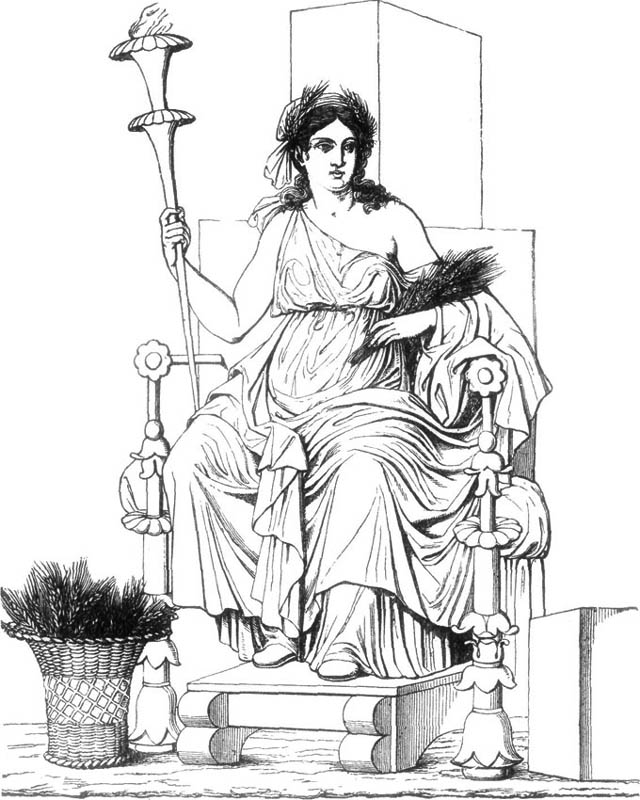
CERES. (or Demeter, from Pompeii Wall Painting)ToList
Then the rage of Demeter was more terrible than her sorrow had been; and she would not stay in the palace of Zeus, on the great Thessalian hill, because it was Zeus who had allowed Hades to take away Persephone. So she went down from Olympos, and wandered on a long way until she came to Eleusis, just as the sun was going down into his golden cup behind the dark blue hills. There Demeter sat down close to a fountain, where the water bubbled out from the green turf and fell into a clear basin, over which some dark olive trees spread their branches. Just then the daughters of Keleos, the king of Eleusis, came to the fountain with pitchers on their heads to draw water; and when they saw Demeter, they knew from her face that she must have some great grief; and they spoke kindly to her, and asked if they could do anything to help her. Then she told them how she had lost and was searching for her child; and they said, "Come home and live with us; and our father and mother will give you everything that you can want, and do all that they can to soothe your sorrow." So Demeter went down to the house of Keleos, and she stayed there for a whole year. And all this time, although the daughters of Keleos were very gentle and kind to her, she went on mourning and weeping for Persephone. She never laughed or smiled, and scarcely ever did she speak to any one, because of her great grief. And even the earth, and the things which grow on the earth, mourned for the sorrow which had come upon Demeter. There was no fruit upon the trees, no corn came up in the fields, and no flowers blossomed in the gardens. And Zeus looked down from his high Thessalian hill, and saw that everything must die unless he could soothe the grief and anger of Demeter. So he sent Hermes down to Hades, the dark and stern king, to bid him send Persephone to see her mother, Demeter. But before Hades let her go he gave her a pomegranate to eat, because he did not wish her to stay away from him always, and he knew that she must come back if she tasted but one of his pomegranate seeds. Then the great chariot was brought before the door of the palace, and Hermes touched with his whip the coal-black horses, and away they went as swiftly as the wind, until they came close to Eleusis. Then Hermes left Persephone, and the coal-black horses drew the chariot away again to the dark home of King Hades.
The sun was sinking down in the sky when Hermes left Persephone, and as she came near to the fountain she saw some one sitting near it in a long black robe, and she knew that it must be her mother who still wept and mourned for her child. And as Demeter heard the rustling of her dress, she lifted up her face, and Persephone stood before her.
Then the joy of Demeter was greater, as she clasped her daughter to her breast, than her grief and her sorrow had been. Again and again she held Persephone in her arms, and asked her about all that had happened to her. And she said, "Now that you are come back to me, I shall never let you go away again; Hades shall not have my child to live with him in his dreary kingdom," But Persephone said, "It may not be so, my mother; I can not stay with you always; for before Hermes brought me away to see you, Hades gave me a pomegranate, and I have eaten some of the seeds; and after tasting the seed I must go back to him again when six months have passed by. And, indeed, I am not afraid to go, for although Hades never smiles or laughs, and everything in his palace is dark and gloomy, still he is very kind to me, and I think that he feels almost happy since I have been his wife. But do not be sorry, my mother, for he has promised to let me come up and stay with you for six months in every year, and the other six months I must spend with him in the land which lies beneath the earth."
So Demeter was comforted for her daughter Persephone, and the earth and all the things that grew in it felt that her anger and sorrow had passed away. Once more the trees bore their fruits, the flowers spread out their sweet blossoms in the garden, and the golden corn waved like the sea under the soft summer breeze. So the six months passed happily away, and then Hermes came with his coal-black horses to take Persephone to the dark land. And she said to her mother, "Do not weep much; the gloomy king whose wife I am is so kind to me that I can not be really unhappy, and in six months more he will let me come to you again." But still, whenever the time came round for Persephone to go back to Hades, Demeter thought of the happy days when her child was a merry girl playing with her companions and gathering the bright flowers in the beautiful plains of Enna.
THE SLEEP OF ENDYMION.
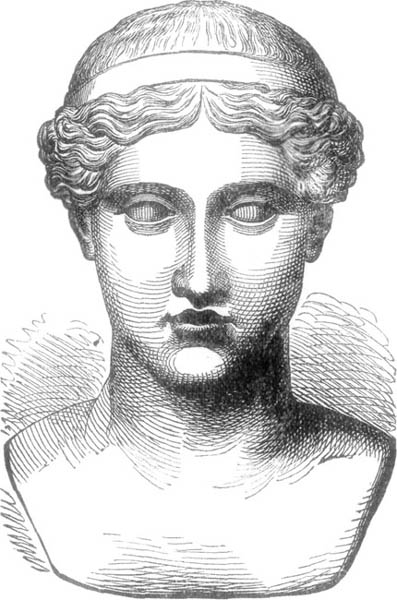
JUNO (or Here).ToList
One beautiful evening, when the sun was sinking down in the West, Selene was wandering on the banks of the River Meander; and she thought that of all the places which she had ever seen there was none more lovely than the quiet valley through which that gentle river was flowing. On her right hand rose a hill, whose sides were covered with trees and flowers, where the vine clambered over the elm, and the purple grapes shone out from amongst the dark leaves. Then Selene asked some people who were passing by to tell her the name of the hill, and they told her that it was called the hill of Latmos. On she went, under the tall trees, whose branches waved over her in the clear evening light, till at last she reached the top, and looked down on the valley which lay beneath her. Then Selene was indeed astonished, for she had never seen anything so beautiful before, even in a dream. She had fancied that nothing could be more lovely than the vale of the Meander, and now she saw something far more beautiful than the rocks and stones and clear bright water of that winding river. It was a small valley, at the bottom of which a lake shone like silver in the light of the setting sun. All around it beautiful trees covered the sloping banks; and their long branches drooped down over the water. Not a breath of wind was stirring the dark leaves—not a bird was flying in the air. Only the large green dragon-fly floated lazily on the lake, while the swan lay half asleep on the silvery waters. On one side, in the loveliest corner of the valley, there was a marble temple, whose pillars shone like the white snow; and, leading down to the lake, there were steps of marble, over which the palm trees spread their branches, and everywhere were clusters of all beautiful flowers, amongst which mosses, and ferns, and the green ivy were tangled. There was the white narcissus and the purple tulip—the dark hyacinth and the soft red rose. But more beautiful than all the trees and flowers, a man lay sleeping on the marble steps of the temple. It was Endymion, who lived in this quiet valley, where the storms never came, and where the dark rain-clouds never covered the sides of the mountain. There he lay in the still evening hour; and at first Selene thought that it could scarcely be a living man whom she saw, for he lay as still as if he were made of marble himself. And as she looked upon him, Selene drew in her breath for wonder; and she went gently down the valley till she came to the steps where Endymion lay asleep. Presently the sun sank behind the hill, and the rich glow of the evening made the silvery lake gleam like gold; and Endymion awoke and saw Selene standing near him. Then Selene said, "I am wandering over the earth; and I may not stay here. Come away, and I will show you larger lakes and more glorious valleys than these." But Endymion said, "Lady, I can not go. There may be lakes which are larger, and valleys more splendid than this, but I love this still and quiet place, where the storms never come, and the sky is never black with clouds. You must not ask me to leave the cool shade of these sleeping trees, and the myrtles and roses which twine under the tall elms, and these waters, where the swans rest in the hot hours of the day and the dragon-fly spreads his green and golden wings to the sun."
Many times did Selene ask him, but Endymion would not leave his pleasant home; and at last she said, "I can stay no more, but if you will not come with me, then you shall sleep on these marble steps and never wake up again." So Selene left him, and presently a deep sleep came over Endymion, and his hands dropped down by his side, and he lay without moving on the steps of the temple, while the evening breeze began to stir gently the broad leaves of the palm trees, and the lilies which bowed their heads over the calm water. There he lay all through the still and happy night; and there he lay when the sun rose up from the sea, and mounted up with its fiery horses into the sky. There was a charm now on this beautiful valley, which made the breeze more gentle and the lake more still than ever. The green dragon-flies came floating lazily in the air near Endymion, but he never opened his eyes; and the swans looked up from the lake, to see if he was coming to feed them; but he stirred not in his deep and dreamless sleep. There he lay day and night, for weeks, and months, and years; and many times, when the sun went down into the sea, Selene came and stood on the Latmian hill, and watched Endymion as he lay asleep on the marble steps beneath the drooping palm trees; and she said, "I have punished him because he would not leave his home; and Endymion sleeps forever in the land of Latmos."
PHAETHON.
In the golden house which Hephaistos had wrought for him with his wondrous skill, Helios saw nothing fairer than his son Phaethon; and he said to his mother, Klymene, that no mortal child might be matched with him for beauty. And Phaethon heard the words, and his heart was filled with an evil pride. So he stood before the throne of Helios, and said, "O father, who dwellest in the dazzling light, they say that I am thy child; but how shall I know it while I live in thy house without name and glory? Give me a token, that men may know me to be thy son." Then Helios bade him speak, and swear to grant his prayer; and Phaethon said, "I will guide thy chariot for one day through the high heaven; bid the Horai make ready the horses for me, when Eos spreads her quivering light in the sky." But the heart of Helios was filled with fear, and he besought his son with many tears to call back his words. "O Phaethon, bright child of Klymene, for all thy beauty thou art mortal still; and the horses of Helios obey no earthly master." But Phaethon harkened not to his words, and hastened away to the dwelling of the Horai, who guard the fiery horses. "Make ready for me," he said, "the chariot of Helios, for this day I go through the high heaven in the stead of my father."
The fair-haired Eos spread her faint light in the pale sky, and Lampetie was driving the cattle of Helios to their bright pastures, when the Horai brought forth his horses and harnessed them to the fiery chariot. With eager hand Phaethon seized the reins, and the horses sped upon their way up the heights of the blue heaven, until the heart of Phaethon was full of fear and the reins quivered in his grasp. Wildly and more madly sped the steeds, till at last they hurried from the track which led to the Hesperian land. Down from their path they plunged, and drew near to the broad plains of earth. Fiercer and fiercer flashed the scorching flames; the trees bowed down their withered heads; the green grass shriveled on the hillsides; the rivers vanished from their slimy beds, and the black vapors rose with smoke and fire from the hidden depths of the mighty hills. Then in every land the sons of men lay dying on the scorched and gaping ground. They looked up to the yellow sky, but the clouds came not; they sought the rivers and fountains, but no water glistened on their seething beds; and young and old, all lay down in madness of heart to sleep the sleep of death.
So sped the horses of Helios on their fiery wanderings, and Zeus looked down from his Thessalian hill and saw that all living things on the earth must die unless Phaethon should be smitten down from his father's chariot. Then the mighty thunders woke in the hot sky which mourned for the clouds that were dead; and the streams of lightning rushed forth upon Phaethon, and bore him from the blazing heaven far down beneath the waters of the green sea.
But his sisters wept sore for the death of the bright Phaethon, and the daughters of Hesperos built his tomb on the sea-shore, that all men might remember the name of the son of Helios and say, "Phaethon fell from his father's chariot, but he lost not his glory, for his heart was set upon great things."
BRIAREOS.
There was strife in the halls of Olympos, for Zeus had conquered the ancient gods, and sat on the throne of his father Kronos. In his hand he held the thunderbolts; the lightning slumbered at his feet, and around him all the gods trembled for the greatness of his power. For he laid hard tasks on all, and spoke hard words, and he thought to rule harshly over the gods who dwell on the earth and in the broad sea. All the day long Hermes toiled on weary errands to do his will; for Zeus sought to crush all alike, and remembered not the time when he, too, was weak and powerless.
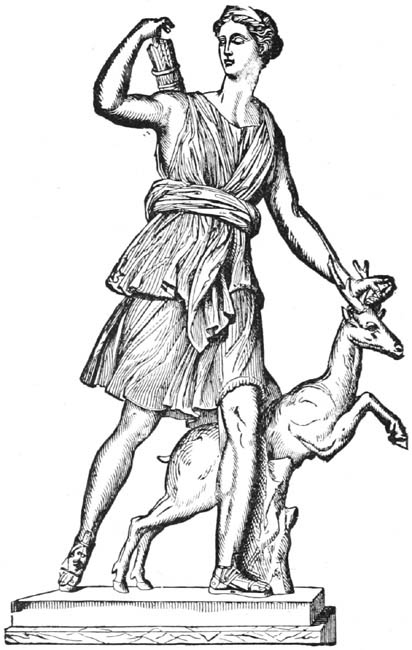
DIANA (or Artemis).ToList
Then were there secret whisperings, as the gods of earth and sea took counsel together; and Poseidon, the lord of the dark waters, spoke in fierce anger, and said, "Hearken to me, Here and Athene, and let us rise up against Zeus, and teach him that he has not power over all. See how he bears himself in his new majesty—how he thinks not of the aid which we gave him in the war with his father Kronos—how he has smitten down even the mightiest of his friends. For Prometheus, who gave fire to mortal men and saved them from biting cold and gnawing hunger, lies chained on the crags of Caucasus; and if he shrink not to bind the Titan, see that he smite not thee also in his wrath, O lady Here." And Athene said, "The wisdom of Zeus is departed from him, and all his deeds are done now in craft and falsehood; let us bind him fast, lest all the heaven and earth be filled with strife and war." So they vowed a vow that they would no more bear the tyranny of Zeus; and Hephaistos forged strong chains at their bidding to cast around him when sleep lay heavy on his eyelids.
But Thetis heard the words of Poseidon and Athene, as she sat beneath the waters in her coral cave, and she rose up like a white mist from the sea, and knelt before the throne of Zeus. Then she clasped her arms round his knees, and said, "O Zeus, the gods tremble at thy might, but they love not thy hard words, and they say that thy wisdom hath departed from thee, and that thou doest all things in craft and falsehood. Hearken to me, O Zeus, for Hephaistos hath forged the chain and the lady Here, and Poseidon, the lord of the sea, and the pure Athene have vowed a vow to bind thee fast when sleep lies heavy on thine eyes. Let me therefore go, that I may bring Briareos to aid thee with his hundred hands, and when he sits by thy side, then shalt thou need no more to fear the wrath of Here and Poseidon. And when the peril is past, then, O Zeus, remember that thou must rule gently and justly, for that power shall not stand which fights with truth and love; and forget not those who aid thee, nor reward them as thou hast rewarded Prometheus on the crags of Caucasus, for it may be that, in time to come, I may ask a boon from thee for Achilleus, my child, who dwells now in the house of his father, Peleus; and when that hour shall come, then call to mind how in time past I saved thee from the chains of Hephaistos."
Then Zeus spoke gently, and said, "Hasten, Thetis, and bring hither the mighty Briareos, that he may guard me with his hundred hands, and fear not for the words that thou hast spoken, for Zeus will not cast aside good counsel, and the gods shall hate me no more for hard and unkindly words."
So from the depths of the inmost earth Thetis summoned Briareos to the aid of Zeus, and presently his giant form was seen in the hall of Olympos; and the gods trembled as he sat down by the side of Zeus, exulting in the greatness of his strength. And Zeus spoke, and said, "Hearken to me, O lady Here, and Poseidon, and Athene. I know your counsels, and how ye purposed to bind me for my evil deeds; but fear not. Only do my bidding in time to come, and ye shall no more have cause to say that Zeus is a hard and cruel master."
DIONYSOS.
In the dark land beneath the earth, where wander the ghosts of men, lay Semele, the daughter of Kadmos, while her child Dionysos grew up full of strength and beauty on the flowery plain of Orchomenos. But the wrath of the lady Here still burned alike against the mother and the child. No pity felt she for the helpless maiden whom the fiery lightning of Zeus had slain; and so in the prison-house of Hades Semele mourned for the love which she had lost, waiting till her child should lead her forth to the banquet of the gods. But for him the wiles of Here boded long toil and grievous peril. On the land and on the sea strange things befel him; but from all dangers his own strong arm and the love of Zeus, his father, rescued him. Thus throughout the land men spake of his beauty and his strength, and said that he was worthy to be the child of the maiden who had dared to look on the majesty of Zeus. At length the days of his youth were ended, and a great yearning filled his heart to wander through the earth and behold the cities and the ways of men. So from Orchomenos Dionysos journeyed to the sea-shore, and he stood on a jutting rock to gaze on the tumbling waters. The glad music of the waves fell upon his ear and filled his soul with a wild joy. His dark locks streamed gloriously over his shoulders, and his purple robe rustled in the soft summer breeze. Before him on the blue waters the ships danced merrily in the sparkling sunlight, as they hastened from shore to shore on the errands of war and peace. Presently a ship drew near to the beach. Her white sail was lowered hastily to the deck, and five of her crew leaped out and plunged through the sea-foam to the shore, near the rock on which stood Dionysos. "Come with us," they said, with rough voices, as they seized him in their brawny arms; "it is not every day that Tyrrhenian mariners fall in with youths like thee." With rude jests they dragged him into the ship, and there made ready to bind him. "A brave youth and fair he is," they said; "we shall not lack bidders when we put forth our goods for sale." So round his limbs they fastened stout withy bands, but they fell from off him as withered leaves fall from off trees in autumn, and a careless smile played on his face as he sat down and looked calmly on the robbers who stood before him. Then on a sudden the voice of the helmsman was heard, as he shouted, "Fools, what do ye? The wrath of Zeus is hurrying you to your doom. This youth is not of mortal race; and who can tell which of the undying gods has put on this beautiful form? Send him straightway from the ship in peace, if ye fear not a deadly storm as we cross the open sea." Loud laughed the crew, as their chief answered, jeeringly, "Look out for the breeze, wise helmsman, and draw up the sail to the wind. That is more thy task than to busy thyself with our doings. Fear not for the boy. The withy bands were but weak; it is no great marvel that he shook them off. He shall go with us, and before we reach Egypt or Cyprus or the land of the Hyperboreans, doubtless he will tell us his name and the name of his father and mother. Fear not, we have found a godsend."
So the sail was drawn up to the mast, and it swelled proudly before the breeze as the ship dashed through the crested waves. And still the sun shone brightly down on the water, and the soft white clouds floated lazily in the heavens, as the mighty Dionysos began to show signs and wonders before the robbers who had seized him. Over the deck ran a stream of purple wine, and a fragrance as of a heavenly banquet filled the air. Over mast and sailyard clambered the clustering vine, and dark masses of grapes hung from the branches. The ivy twined in tangled masses round the tackling, and bright garlands shone, like jeweled crowns, on every oar-pin. Then a great terror fell on all, as they cried to the old helmsman, "Quick, turn the ship to the shore; there is no hope for us here." But there followed a mightier wonder still. A loud roar broke upon the air, and a tawny lion stood before them, with a grim and grizzly bear by his side. Cowering like pitiful slaves, the Tyrrhenians crowded to the stern, and crouched round the good helmsman. Then the lion sprang and seized the chief, and the men leaped in their agony over the ship's side. But the power of Dionysos followed them still; and a change came over their bodies as they heard a voice, which said, "In the form of dolphins shall ye wander through the sea for many generations. No rest shall ye have by night or by day, while ye fly from the ravenous sharks that shall chase you through the seas."
But before the old helmsman again stood Dionysos, the young and fair, in all the glory of undying beauty. Again his dark locks flowed gently over his shoulders, and the purple robe rustled softly in the breeze. "Fear not," he said, "good friend and true, because thou hast aided one who is sprung from the deathless race of the gods. I am Dionysos, the child of Zeus, the lord of the wine-cup and the revel. Thou hast stood by me in the hour of peril; wherefore my power shall shield thee from the violence of evil men and soothe thee in a green old age, till thine eyes close in the sleep of death and thou goest forth to dwell among brave heroes and good men in the asphodel meadows of Elysium."
Then at the bidding of Dionysos, the north wind came and wafted the ship to the land of Egypt, where Proteus was King. And so began the long wanderings of the son of Semele, through the regions of the Ethiopians and the Indians, towards the rising of the sun. Whithersoever he went, the women of the land gathered round him with wild cries and songs, and he showed them of his secret things, punishing grievously all who set at naught the laws which he ordained. So, at his word, Lykurgos, the Edonian chieftain, was slain by his people, and none dared any more to speak against Dionysos, until he came back to the city where Semele, his mother, had been smitten by the lightnings of Zeus.
PENTHEUS.
For many years Dionysos wandered far away from the land of his birth; and wherever he went he taught the people of the country to worship him as a god, and showed them strange rites. Far away he roamed, to the regions where the Ganges rolls his mighty stream into the Indian Sea, and where the Nile brings every year rich gifts from the southern mountains. And in all the lands to which he came he made the women gather round him and honor him with wild cries and screams and marvelous customs such as they had never known before. As he went onwards the face of the land was changed. The women grouped themselves in companies far away from the sight of men, and, high up on the barren hills or down in the narrow valleys, with wild movements and fierce shoutings, paid honor to Dionysos, the lord of the wine-cup and the feast. At length, through the Thracian highlands and the soft plains of Thessaly, Dionysos came back to Thebes, where he had been born amid the roar of the thunder and the blaze of the fiery lightning. Kadmos, the King, who had built the city, was now old and weak, and he had made Pentheus, the child of his daughter Agave, King in his stead. So Pentheus sought to rule the people well, as his father Kadmos had done, and to train them in the old laws, that they might be quiet in the days of peace, and orderly and brave in war.
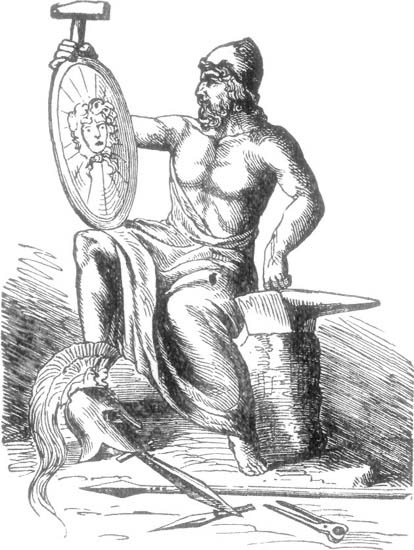
VULCAN (or Hephaistos).ToList
Thus it came to pass that when Dionysos came near to Thebes, and commanded all the people to receive the new rites, which he sought to teach them, it grieved Pentheus at the heart; and when he saw how the women seemed smitten with madness, and that they wandered away in groups to desert places, where they lurked for many days and nights, far from the sight of men, he mourned for the evils which his kinsman, Dionysos, was bringing upon the land. So King Pentheus made a law that none should follow these new customs, and that the women should stay quietly doing their own work in their homes. But when they heard this, they were all full of fury, for Dionysos had deceived them by his treacherous words, and even Kadmos himself, in his weakness and old age, had been led astray by them. In crowds they thronged around the house of Pentheus, raising loud shouts in honor of Dionysos, and besought him to follow the new way, but he would not hearken to them.
Thus it was for many days; and when all the city was shaken by the madness of the new worship, Pentheus thought that he would see with his own eyes the strange rites by which the women, in their lurking-places, did honor to Dionysos. So he went secretly to some hidden dells, whither he knew that the women had gone; but Dionysos saw him and laid his hands upon him, and straightway the mind of King Pentheus himself was darkened, and the madness of the worshipers was upon him, also. Then in his folly he climbed a tall pine-tree, to see what the women did in their revelry; but on a sudden one of them saw him, and they shrieked wildly and rooted up the tree in their fury. With one accord they seized Pentheus and tore him in pieces; and his own mother, Agave, was among the first to lay hands on her son. So Dionysos, the wine god, triumphed; and this was the way in which the new worship was set up in the Hellenic land.
ASKLEPIOS.
On the shores of the Lake Boibeis, the golden-haired Apollo saw and loved Koronis, the beautiful daughter of Phlegyas. Many a time they wandered beneath the branching elms while the dew-drops glistened like jewels on the leaves, or sat beneath the ivy bowers as the light of evening faded from the sky and the blue veil of mist fell upon the sleeping hills. But at length the day came when Apollo must journey to the western land, and as he held Koronis in his arms, his voice fell softly and sadly on her ear. "I go," he said, "to a land that is very far off, but surely I will return. More precious to me than aught else on the wide earth is thy love, Koronis. Let not its flower fade, but keep it fresh and pure as now, till I come to thee again. The dancing Horai trip quickly by, Koronis, and when they bring the day on which I may clasp thee in mine arms once more, it may be that I shall find thee watching proudly over the child of our love."
He was gone, and for Koronis it seemed as though the sun had ceased to shine in the heaven. For many a day she cared not to wander by the winding shore in the light of early morning, or to rest in the myrtle bowers as the flush of evening faded from the sky. Her thoughts went back to the days that were passed, when Apollo, the golden-haired, made her glad with the music of his voice. But at length a stranger came to the Boibean land, and dwelt in the house of Phlegyas, and the spell of his glorious beauty fell upon Koronis, and dimmed the love which she had borne for Apollo, who was far away. Again for her the sun shone brightly in the heaven, and the birds filled the air with a joyous music, but the tale went swiftly through the land, and Apollo heard the evil tidings as he journeyed back with his sister, Artemis, to the house of Phlegyas. A look of sorrow that may not be told passed over his fair face; but Artemis stretched forth her hand towards the flashing sun and swore that the maiden should rue her fickleness. Soon, on the shore of the Lake Boibeis, Koronis lay smitten by the spear which may never miss its mark, and her child, Asklepios, lay a helpless babe by her side. Then the voice of Apollo was heard saying, "Slay not the child with the mother, he is born to do great things, but bear him to the wise centaur, Cheiron, and bid him train the boy in all his wisdom, and teach him to do brave deeds, that men may praise his name in the generations that shall be hereafter."
So in the deep glens of Pelion the child, Asklepios, grew up to manhood under the teaching of Cheiron, the wise and good. In all the land there was none that might vie with him in strength of body; but the people marveled yet more at his wisdom, which passed the wisdom of the sons of men, for he had learned the power of every herb and leaf to stay the pangs of sickness and bring back health to the wasted form. Day by day the fame of his doings was spread abroad more widely through the land, so that all who were sick hastened to Asklepios and besought his help. But soon there went forth a rumor that the strength of death had been conquered by him, and that Athene, the mighty daughter of Zeus, had taught Asklepios how to bring back the dead from the dark kingdom of Hades. Then, as the number of those whom he brought from the gloomy Stygian land increased more and more, Hades went in hot anger to Olympos, and spoke bitter words against the son of Koronis, so that the heart of Zeus was stirred with a great fear lest the children of men should be delivered from death and defy the power of the gods. Then Zeus bowed his head, and the lightnings flashed from heaven, and Asklepios was smitten down by the scathing thunderbolt.
Mighty and terrible was the grief that stirred the soul of the golden-haired Apollo when his son was slain. The sun shone dimly from the heaven; the birds were silent in the darkened groves; the trees bowed down their heads in sorrow, and the hearts of all the sons of men fainted within them, because the healer of their pains and sickness lived no more upon the earth. But the wrath of Apollo was mightier than his grief, and he smote the giant Cyclopes, who shaped the fiery lightnings far down in the depths of the burning mountain. Then the anger of Zeus was kindled against his own child, the golden-haired Apollo, and he spake the word that he should be banished from the home of the gods to the dark Stygian land. But the lady Leto fell at his knees and besought him for her child, and the doom was given that a whole year long he should serve as a bondsman in the house of Admetos, who ruled in Pherai.
IXION.
Fair as the blushing clouds which float in early morning across the blue heaven, the beautiful Dia gladdened the hearts of all who dwelt in the house of her father Hesioneus. There was no guile in her soft clear eye, for the light of Eos was not more pure than the light of the maiden's countenance. There was no craft in her smile, for on her rested the love and the wisdom of Athene. Many a chieftain sought to win her for his bride; but her heart beat with love only for Ixion the beautiful and mighty, who came to the halls of Hesioneus with horses which can not grow old or die. The golden hair flashed a glory from his head dazzling as the rays which stream from Helios when he drives his chariot up the heights of heaven, and his flowing robe glistened as he moved like the vesture which the sun-god gave to the wise maiden Medeia, who dwelt in Kolchis.
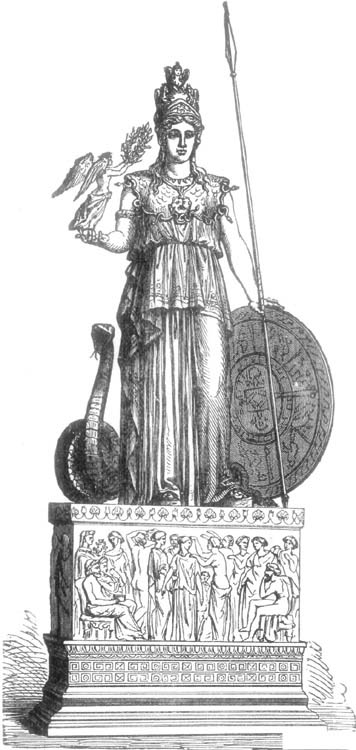
MINERVA, OR PALLAS ATHENE. (Found in Pompeii.)ToList
Long time Ixion abode in the house of Hesioneus, for Hesioneus was loth to part with his child. But at the last Ixion sware to give for her a ransom precious as the golden fruits which Helios wins from the teeming earth. So the word was spoken, and Dia the fair became the wife of the son of Amythaon, and the undying horses bare her away in his gleaming chariot. Many a day and month and year the fiery steeds of Helios sped on their burning path, and sank down hot and wearied in the western sea; but no gifts came from Ixion, and Hesioneus waited in vain for the wealth which had tempted him to barter away his child. Messenger after messenger went and came, and always the tidings were that Ixion had better things to do than to waste his wealth on the mean and greedy. "Tell him," he said, "that every day I journey across the wide earth, gladdening the hearts of the children of men, and that his child has now a more glorious home than that of the mighty gods who dwell on the high Olympos. What would he have more?" Then day by day Hesioneus held converse with himself, and his people heard the words which came sadly from his lips. "What would I more?" he said; "I would have the love of my child. I let her depart, when not the wealth of Phœbus himself could recompense me for her loss. I bartered her for gifts, and Ixion withholds the wealth which he sware to give. Yet were all the riches of his treasure-house lying now before me, one loving glance from the eyes of Dia would be more than worth them all."
But when his messengers went yet again to plead with Ixion, and their words were all spoken in vain, Hesioneus resolved to deal craftily, and he sent his servants by night and stole the undying horses which bare his gleaming chariot. Then the heart of Ixion was humbled within him, for he said, "My people look for me daily throughout the wide earth. If they see not my face their souls will faint with fear; they will not care to sow their fields, and the golden harvests of Demeter will wave no more in the summer breeze." So there came messengers from Ixion, who said, "If thou wouldst have the wealth which thou seekest, come to the house of Ixion, and the gifts shall be thine, and thine eyes shall once more look upon thy child." In haste Hesioneus went forth from his home, like a dark and lonely cloud stealing across the broad heaven. All night long he sped upon his way, and, as the light of Eos flushed the eastern sky he saw afar off the form of a fair woman who beckoned to him with her long white arms. Then the heart of the old man revived, and he said, "It is Dia, my child. It is enough if I can but hear her voice and clasp her in mine arms and die." But his limbs trembled for joy, and he waited until presently his daughter came and stood beside him. On her face there rested a softer beauty than in former days, and the sound of her voice was more tender and loving, as she said, "My father, Zeus has made clear to me many dark things, for he has given me power to search out the secret treasures of the earth, and to learn from the wise beings who lurk in its hidden places the things that shall be hereafter. And now I see that thy life is well-nigh done, if thou seekest to look upon the treasures of Ixion, for no man may gaze upon them and live. Go back, then, to thy home if thou wouldst not die. I would that I might come with thee, but so it may not be. Each day I must welcome Ixion when his fiery horses come back from their long journey, and every morning I must harness them to his gleaming chariot before he speeds upon his way. Yet thou hast seen my face and thou knowest that I love thee now even as in the days of my childhood." But the old greed filled again the heart of Hesioneus, and he said, "The faith of Ixion is pledged. If he withhold still the treasures which he sware to give, he shall never more see the deathless horses. I will go myself into his treasure-house, and see whether in very truth he has the wealth of which he makes such proud boasting." Then Dia clasped her arms once again around her father, and she kissed his face, and said, sadly, "Farewell, then, my father; I go to my home, for even the eyes of Dia may not gaze on the secret treasures of Ixion." So Dia left him, and when the old man turned to look on her departing form it faded from his sight as the clouds melt away before the sun at noon-day. Yet, once again he toiled on his way, until before his glorious home he saw Ixion, radiant as Phœbus Apollo in his beauty; but there was anger in his kindling eye, for he was wroth for the theft of his undying horses. Then the voice of Ixion smote the ear of Hesioneus, harsh as the flapping of the wings of Erinys when she wanders through the air. "So thou wilt see my secret treasures. Take heed that thy sight be strong." But Hesioneus spake in haste, and said, "Thy faith is pledged, not only to let me see them, but to bestow them on me as my own, for therefore didst thou win Dia my child to be thy wife." Then Ixion opened the door of his treasure-house and thrust in Hesioneus, and the everlasting fire devoured him.