LITERATURE.ToC (continued 3)
Reading edition
BATTLE OF PHARSALIA. (By Julius Cæsar.)
There was so much space left between the two lines as sufficed for the onset of the hostile armies; but Pompey had ordered his soldiers to await Cæsar's attack, and not to advance from their position, or suffer their line to be put into disorder. And he is said to have done this by the advice of Caius Triarius, that the impetuosity of the charge of Cæsar's soldiers might be checked, and their line broken, and that Pompey's troops, remaining in their ranks, might attack them while in disorder; and he thought that the javelins would fall with less force if the soldiers were kept in their ground, than if they met them in their course; at the same time he trusted that Cæsar's soldiers, after running over double the usual ground, would become weary and exhausted by the fatigue. But to me Pompey seems to have acted without sufficient reason; for there is a certain impetuosity of spirit and an alacrity implanted by nature in the hearts of all men, which is inflamed by a desire to meet the foe. This a general should endeavor not to repress, but to increase; nor was it a vain institution of our ancestors that the trumpets should sound on all sides, and a general shout be raised; by which they imagined that the enemy were struck with terror, and their own army inspired with courage.
But our men, when the signal was given, rushed forward with their javelins ready to be launched, but perceiving that Pompey's men did not run to meet their charge, having acquired experience by custom, and being practiced in former battles, they of their own accord repressed their speed, and halted almost midway, that they might not come up with the enemy when their strength was exhausted, and after a short respite they again renewed their course, and threw their javelins, and instantly drew their swords, as Cæsar had ordered them. Nor did Pompey's men fail in this crisis, for they received our javelins, stood our charge, and maintained their ranks; and having launched their javelins, had recourse to their swords. At the same time Pompey's horse, according to their orders, rushed out at once from his left wing, and his whole host of archers poured after them. Our cavalry did not withstand their charge, but gave ground a little, upon which Pompey's horse pressed them more vigorously, and began to file off in troops, and flank our army. When Cæsar perceived this, he gave the signal to his fourth line, which he had formed of the six cohorts. They instantly rushed forward and charged Pompey's horse with such fury that not a man of them stood; but all wheeling about, not only quitted their post, but galloped forward to seek a refuge in the highest mountains. By their retreat the archers and slingers, being left destitute and defenseless, were all cut to pieces. The cohorts, pursuing their success, wheeled about upon Pompey's left wing, whilst his infantry still continued to make battle, and attacked them in the rear.
At the same time Cæsar ordered his third line to advance, which till then had not been engaged, but had kept their post. Thus, new and fresh troops having come to the assistance of the fatigued, and others having made an attack on their rear, Pompey's men were not able to maintain their ground, but all fled, nor was Cæsar deceived in his opinion that the victory, as he had declared in his speech to his soldiers, must have its beginning from those six cohorts, which he had placed as a fourth line to oppose the horse. For by them the cavalry were routed; by them the archers and slingers were cut to pieces; by them the left wing of Pompey's army was surrounded, and obliged to be the first to flee. But when Pompey saw his cavalry routed, and that part of his army on which he reposed his greatest hopes thrown into confusion, despairing of the rest, he quitted the field, and retreated straightway on horseback to his camp, and calling to the centurions, whom he had placed to guard the prætorian gate, with a loud voice, that the soldiers might hear: "Secure the camp," says he; "defend it with diligence, if any danger should threaten it; I will visit the other gates, and encourage the guards of the camp." Having thus said, he retired into his tent in utter despair, yet anxiously waiting the issue.
Cæsar having forced the Pompeians to flee into their entrenchment, and thinking that he ought not to allow them any respite to recover from their fright, exhorted his soldiers to take advantage of fortune's kindness, and to attack the camp. Though they were fatigued by the intense heat, for the battle had continued till mid-day, yet, being prepared to undergo any labor, they cheerfully obeyed his command. The camp was bravely defended by the cohorts which had been left to guard it, but with much more spirit by the Thracians and foreign auxiliaries. For the soldiers who had fled for refuge to it from the field of battle, affrighted and exhausted by fatigue, having thrown away their arms and military standards, had their thoughts more engaged on their further escape than on the defense of the camp. Nor could the troops who were posted on the battlements long withstand the immense number of our darts, but fainting under their wounds, quitted the place, and under the conduct of their centurions and tribunes, fled, without stopping, to the high mountains which joined the camp.
In Pompey's camp you might see arbors in which tables were laid; a large quantity of plate set out; the floors of the tents covered with fresh sods; the tents of Lucius Lentulus and others shaded with ivy; and many other things which were proofs of excessive luxury, and a confidence of victory; so that it might readily be inferred, that they had no apprehensions of the issue of the day, as they indulged themselves in unnecessary pleasures, and yet upbraided with luxury Cæsar's army, distressed and suffering troops, who had always been in want of common necessaries. Pompey, as soon as our men had forced the trenches, mounting his horse, and stripping off his general's habit, went hastily out of the back gate of the camp, and galloped with all speed to Larissa. Nor did he stop there, but with the same dispatch, collecting a few of his flying troops, and halting neither day nor night, he arrived at the sea-side, attended by only thirty horses, and went on board a victualing barque, often complaining, as we have been told, that he had been so deceived in his expectation, that he was almost persuaded that he had been betrayed by those from whom he had expected victory, as they began the flight.
VIRGIL.
Virgil was born October 15, 70 B.C., and died 19 B.C. His father was an opulent farmer, and gave his son a liberal Greek and Latin education. His principal works were the Georgica and the Æneid. The Georgica (Georgics), or "Agricultural Poems," is a didactic poem in four books, dedicated to Mæcenas. In the first book he treats of the cultivation of the soil; in the second, of fruit trees; in the third, of horses and other cattle, and in the fourth, of bees. It gives us the most finished specimen of the Latin hexameter which we have. It is acknowledged by scholars to stand at the head of all Virgil's works, and is certainly the most elaborate and extraordinary instance of power in embellishing a most barren subject which human genius has ever afforded. The commonest precepts of farming are delivered with an elegance which could scarcely be attained by a poet who should endeavor to clothe in verse the sublimest maxims of philosophy.
At what time Virgil projected the Æneid is uncertain, but from a very early age he appears to have had a strong desire of composing an epic poem which would be an enduring monument of his fame. And he has succeeded, for this poem is ranked as one of the great epics of the world. It is divided into twelve books, and originates from an old Roman tradition that Æneas and his company of Trojans settled in Italy, and founded the Roman nation.
PRAISE OF RURAL LIFE. (By Virgil.)
Thrice happy swains! whom genuine pleasures bless, If they but knew and felt their happiness! From wars and discord far, and public strife, [812] Earth with salubrious fruits supports their life; Tho' high-arch'd domes, tho' marble halls they want, And columns cased in gold and elephant, In awful ranks where brazen statues stand, The polish'd works of Grecia's skillful hand; Nor dazzling palace view, whose portals proud Each morning vomit out the cringing crowd; Nor wear the tissu'd garment's cumb'rous pride, Nor seek soft wool in Syrian purple dy'd, Nor with fantastic luxury defile The native sweetness of the liquid oil; Yet calm content, secure from guilty cares, Yet home-felt pleasure, peace, and rest, are theirs; Leisure and ease, in groves, and cooling vales, Grottoes, and bubbling brooks, and darksome dales; The lowing oxen, and the bleating sheep, And under branching trees delicious sleep! There forests, lawns, and haunts of beasts abound, There youth is temperate, and laborious found; There altars and the righteous gods are fear'd, And aged sires by duteous sons rever'd. There Justice linger'd ere she fled mankind, And left some traces of her reign behind! Georgics II. Warton.
EMPLOYMENTS OF THE BEE. (By Virgil.)
If all things with great we may compare, Such are the bees, and such their busy care: Studious of honey, each in his degree, The youthful swain, the grave, experienced bee; That in the field; this in affairs of state, Employed at home, abides within the gate, To fortify the combs, to build the wall, To prop the ruins, lest the fabric fall: [813] But late at night, with weary pinions come The laboring youth, and heavy laden home. Plains, meads, and orchards, all the day he plies, The gleans of yellow thyme distend his thighs: [814] He spoils the saffron flowers, he sips the blues Of violets, wilding blooms, and willow dews. Their toil is common, common is their sleep; They shake their wings when morn begins to peep; Rush through the city gates without delay, Nor ends their work but with declining day: Then, having spent the last remains of light, They give their bodies due repose at night; When hollow murmurs of their evening bells Dismiss the sleepy swains, and toll them to their cells. Georgics IV. Dryden.
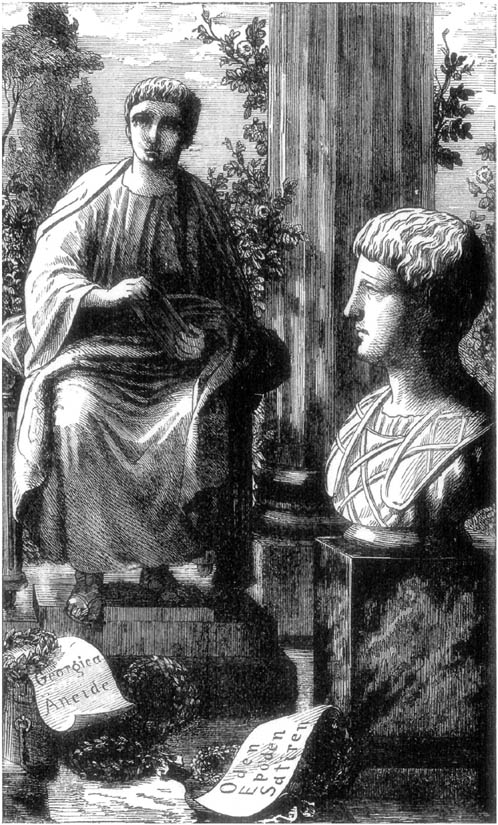
VIRGIL AND HORACE.ToList
PUNISHMENTS IN HELL. (By Virgil.)
Now to the left, Æneas darts his eyes, Where lofty walls with tripple ramparts rise. There rolls swift Phlegethon, with thund'ring sound, His broken rocks, and whirls his surges round. On mighty columns rais'd, sublime are hung The massy gates, impenetrably strong. In vain would men, in vain would gods essay, To hew the beams of adamant away. Here rose an iron tow'r; before the gate, By night and day, a wakeful fury sate, The pale Tisiphone; a robe she wore, With all the pomp of horror, dy'd in gore. Here the loud scourge and louder voice of pain, The crashing fetter, and the ratt'ling chain. Strike the great hero with the frightful sound, The hoarse, rough, mingled din, that thunders round: Oh! whence that peal of groans? what pains are those? What crimes could merit such stupendous woes? Thus she—brave guardian of the Trojan state, None that are pure must pass that dreadful gate. When plac'd by Hecat o'er Avernus' woods, [815] I learnt the secrets of those dire abodes, With all the tortures of the vengeful gods. Here Rhadamanthus holds his awful reign, Hears and condemns the trembling impious train. Those hidden crimes the wretch till death supprest, With mingled joy and horror in his breast, The stern dread judge commands him to display, And lays the guilty secrets bare to-day; Her lash Tisiphone that moment shakes; The ghost she scourges with a thousand snakes; Then to her aid, with many a thund'ring yell, Calls her dire sisters from the gulfs of hell. Near by the mighty Tityus I beheld, Earth's mighty giant son, stretch'd o'er the infernal field; He cover'd nine large acres as he lay, While with fierce screams a vulture tore away His liver for her food, and scoop'd the smoking prey; Plunged deep her bloody beak, nor plung'd in vain, For still the fruitful fibres spring again, Swell, and renew th' enormous monster's pain, She dwells forever in his roomy breast, Nor gives the roaring fiend a moment's rest; But still th' immortal prey supplies th' immortal feast. Need I the Lapiths' horrid pains relate, Ixion's torments, or Perithous' fate? On high a tottering rocky fragment spreads, Projects in air, and trembles o'er their heads. Stretch'd on the couch, they see with longing eyes In regal pomp successive banquets rise, While lucid columns, glorious to behold, Support th' imperial canopies of gold. The queen of furies, a tremendous guest, Sits by their side, and guards the tempting feast, Which if they touch, her dreadful torch she rears, Flames in their eyes, and thunders in their ears They that on earth had low pursuits in view, Their brethren hated, or their parents slew, And, still more numerous, those who swelled their store, But ne'er reliev'd their kindred or the poor; [816] Or in a cause unrighteous fought and bled; Or perish'd in the foul adulterous bed; Or broke the ties of faith with base deceit; Imprison'd deep their destin'd torments wait. But what their torments, seek not thou to know, Or the dire sentence of their endless wo. Some roll a stone, rebounding down the hill, Some hang suspended on the whirling wheel; There Theseus groans in pain that ne'er expire, Chain'd down forever in a chair of fire. There Phlegyas feels unutterable wo, And roars incessant thro' the shades below; Be just, ye mortals! by these torments aw'd, These dreadful torments, not to scorn a god. This wretch his country to a tyrant sold, And barter'd glorious liberty for gold. Laws for a bribe he past, but past in vain, For those same laws a bribe repeal'd again. To some enormous crimes they all aspir'd; All feel the torments that those crimes requir'd! Had I a hundred mouths, a hundred tongues, A voice of brass, and adamantine lungs, Not half the mighty scene could I disclose, Repeat their crimes, or count their dreadful woes! Æneid VI. Pitt.
HORACE.
Horace was born 65 B.C. and died 8 B.C. His father gave him a good education. About the age of seventeen he lost his father, and afterwards his property was confiscated. He had to write for bread—Paupertas impulit audax ut versus facerem—and in so doing gained much reputation, and sufficient means to purchase the place of scribe in the Quæstor's office. He now made his acquaintance with Virgil and Varius, and by them was introduced to that munificent patron of scholars, Mæcenas, who gave to our poet a place next to his heart, while he, in return, is never weary of acknowledging how much he owes to his illustrious friend.
The following happy remarks on the Roman Satirists are by Professor Sanborn, formerly Professor of Latin in Dartmouth College, and now in the University of St. Louis: "The principal Roman Satirists were Horace, Juvenal and Persius. Horace is merry; Persius serious; Juvenal indignant. Thus, wit, philosophy and lofty scorn mark their respective pages. The satire of Horace was playful and good natured. His arrows were always dipped in oil. He was a fine specimen of an accomplished gentleman. His sentiments were evidently modified by his associates. He was an Epicurean and a stoic by turns. He commended and ridiculed both sects. He practiced economy and praised liberality. He lived temperate, and sang the praises of festivity. He was the favorite of the court and paid for its patronage in compliments and panegyrics, unsurpassed in delicacy of sentiment and beauty of expression. Horace is every man's companion. He has a word of advice and admonition for all. His criticisms constitute most approved canons of the rhetorician; his sage reflections adorn the page of the moralist; his humor and wit give point and force to the satirist, and his graver maxims are not despised by the Christian philosopher. Juvenal is fierce and denunciatory. His characteristics are energy, force, and indignation; his weapons are irony, wit and sarcasm; he is a decided character, and you must yield and submit, or resist. His denunciations of vice are startling. He hated the Greeks, the aristocracy and woman with intense hatred. No author has written with such terrible bitterness of the sex. Unlike other satirists, he never relents. His arrow is ever on the string, and whatever wears the guise of woman is his game. The most celebrated of the modern imitators of Horace and Juvenal are Swift and Pope."
The Odes, Satires and Epistles are his chief productions.
TO LICINIUS. (By Horace.)
Receive, dear friend, the truths I teach So shalt thou live beyond the reach Of adverse Fortune's power; Not always tempt the distant deep, Nor always timorously creep Along the treacherous shore. He that holds fast the golden mean, And lives contentedly between The little and the great, Feels not the wants that pinch the poor, Nor plagues that haunt the rich man's door, Embittering all his state. The tallest pines feel most the power Of wintry blasts; the loftiest tower Comes heaviest to the ground; The bolts that spare the mountain's side, His cloud-capt eminence divide, And spread the ruin round. The well-inform'd philosopher Rejoices with an wholesome fear, And hopes, in spite of pain; If Winter bellow from the north, Soon the sweet Spring comes dancing forth, And Nature laughs again. What if thine heaven be overcast? [819] The dark appearance will not last; Expect a brighter sky; The god that strings the silver bow, Awakes sometimes the Muses, too, And lays his arrows by. If hindrances obstruct thy way, Thy magnanimity display, And let thy strength be seen; But oh! if Fortune fill thy sail With more than a propitious gale, Take half thy canvas in. Cowper.
TO PYRRHA. (By Horace.)
What youth, O Pyrrha! blooming fair, With rose-twined wreath and perfumed hair, Woos thee beneath yon grotto's shade, Urgent in prayer and amorous glance? For whom dost thou thy tresses braid, Simple in thine elegance? Alas! full soon shall he deplore Thy broken faith, thy altered mien: Like one astonished at the roar Of breakers on a leeward shore, Whom gentle airs and skies serene Had tempted on the treacherous deep, So he thy perfidy shall weep Who now enjoys thee fair and kind, But dreams not of the shifting wind. Thrice wretched they, deluded and betrayed, Who trust thy glittering smile and Siren tongue! I have escaped the shipwreck, and have hung In Neptune's fane my dripping vest displayed [820] With votive tablet on his altar laid, Thanking the sea-god for his timely aid. Lord Ravensworth.
SENECA.
Seneca was born 7 B.C. and died 65 A.D. His writings were of a philosophical nature. His character was much doubted. His great misfortune was to have known Nero, who ordered him to be put to death, to which he merely replied that he who had murdered his brother and his mother could not be expected to spare his teacher. He had been absent from Rome some time, and when he returned to visit his mother in the country, he was spied, and Nero sent a squad of armed men to the house to ask him to choose the manner of his death. His fame rests on his numerous writings, which, with all their faults, have great merits. His principal works, which are of a philosophical character, are essays "On Anger," "On Consolation," "On Providence," "On Tranquillity of Mind," "On the Firmness of the Wise Man," "On Clemency," "On the Brevity of Human Life," "On a Happy Life," etc., together with "Epistles of Lucilius," one hundred and twenty-four in number. Besides these, there are extant ten tragedies attributed to him, entitled, Hercules Furens, Thyestes, Thebais or Phœnissæ, Hippolytus or Phædra, Œdipus, Troades or Hecuba, Medea, Agamemnon, Hercules Œtæus and Octavia. These were never intended for the stage, but were designed for reading or recitation, after the Roman fashion. They contain many striking passages, and have some merits as poems.
HAPPINESS FOUNDED ON WISDOM. (By Seneca.)
Taking it for granted that human happiness is founded upon wisdom and virtue, we shall treat of these two points in order as they lie, and first of wisdom; not in the latitude of its various operations, but only as it has a regard to good life and the happiness of mankind.
Wisdom is a right understanding; a faculty of discerning good from evil; what is to be chosen, and what rejected; a judgment grounded upon the value of things, and not the common opinion of them; an equality of force and strength of resolution. It sets a watch over our words and deeds, it takes us up with the contemplation of the works of nature, and makes us invincible by either good or evil fortune. It is large and spacious, and requires a great deal of room to work in; it ransacks heaven and earth; it has for its object things past and to come, transitory and eternal. It examines all the circumstances of time; "what it is, when it began, and how long it will continue;" and so for the mind; "whence it came; what it is; when it begins; how long it lasts; whether or no it passes from one form to another, or serves only one, and wanders when it leaves us; where it abides in the state of separation, and what the action of it; what use it makes of its liberty; whether or no it retains the memory of things past, and comes to the knowledge of itself." It is the habit of a perfect mind and the perfection of humanity, raised as high as nature can carry it. It differs from philosophy, as avarice and money; the one desires, and the other is desired; the one is the effect and the reward of the other. To be wise is the use of wisdom, as seeing is the use of eyes and well-speaking the use of eloquence. He that is perfectly wise is perfectly happy; nay, the very beginning of wisdom makes life easy to us. Neither is it enough to know this, unless we print it in our minds by daily meditation, and so bring a good will to a good habit. And we must practice what we preach, for philosophy is not a subject for popular ostentation, nor does it rest in words, but in things. It is not an entertainment taken up for delight, or to give a taste to leisure, but it fashions the mind, governs our actions, tells us what we are to do, and what not. It sits at the helm, and guides us through all hazards; nay, we can not be safe without it, for every hour gives us occasion to make use of it. It informs us in all the duties of life, piety to our parents, faith to our friends, charity to the miserable, judgment in counsel; it gives us peace, by fearing nothing, and riches, by coveting nothing.
There is no condition of life that excludes a wise man from discharging his duty. If his fortune be good, he tempers it; if bad, he masters it; if he has an estate, he will exercise his virtue in plenty, if none, in poverty; if he can not do it in his country, he will do it in banishment; if he has no command, he will do the office of a common soldier. Some people have the skill of reclaiming the fiercest of beasts: they will make a lion embrace his keeper, a tiger kiss him, and an elephant kneel to him. This is the case of a wise man in the extremest difficulties; let them be never so terrible in themselves, when they come to him once, they are perfectly tame. They that ascribe the invention of tillage, architecture, navigation, etc., to wise men, may perchance be in the right, that they were invented by wise men; but they were not invented by wise men, as wise men; for wisdom does not teach our fingers, but our minds: fiddling and dancing, arms and fortifications, were the works of luxury and discord; but wisdom instructs us in the way of nature, and in the arts of unity and concord; not in the instruments, but in the government of life; nor to make us live only, but to live happily. She teaches us what things are good, what evil, and what only appear so; and to distinguish betwixt true greatness and tumor. She clears our minds of dross and vanity; she raises up our thoughts to heaven, and carries them down to hell; she discourses on the nature of the soul, the powers and faculties of it; the first principles of things; the order of providence: she exalts us from things corporeal to things incorporeal; and retrieves the truth of all: she searches nature, gives laws to life; and tells us, "that it is not enough to know God unless we obey Him." She looks upon all accidents as acts of providence; sets a true value upon things; delivers us from false opinions, and condemns all pleasures that are attended with repentance. She allows nothing to be good that will not be so forever; no man to be happy but he that needs no other happiness than what he has within himself; no man to be great or powerful, that is not master of himself;—and this is the felicity of human life; a felicity that can neither be corrupted nor extinguished.
AGAINST RASH JUDGMENT. (By Seneca.)
EUCLID.ToList
It is good for every man to fortify himself on his weak side; and if he loves his peace, he must not be inquisitive and harken to tale-bearers; for the man that is over-curious to hear and see everything, multiplies troubles to himself; for a man does not feel what he does not know. He that is listening after private discourse, and what people say of him, shall never be at peace. How many things that are innocent in themselves, are made injurious yet by misconstruction? Wherefore some things we are to pause upon, others to laugh at, and others again to pardon. Or if we can not avoid the sense of indignities, let us, however, shun the open profession of it; which may be easily done, as appears by many examples of those who have suppressed their anger, under the awe of a greater fear. It is a good caution not to believe anything until you are very certain of it; for many probable things prove false, and a short time will make evidence of the undoubted truth. We are prone to believe many things which we are unwilling to hear, and so we conclude, and take up a prejudice before we can judge. Never condemn a friend unheard; or without letting him know his accuser, or his crime. It is a common thing to say, "Do not tell that you had it from me; for if you do, I will deny it; and never tell you anything again." By which means friends are set together by the ears, and the informer slips his neck out of the collar. Admit no stories, upon these terms; for it is an unjust thing to believe in private, and be angry openly. He that delivers himself up to guess and conjecture, runs a great hazard; for there can be no suspicion without some probable grounds; so that without much candor and simplicity, and making the best of everything, there is no living in society with mankind. Some things that offend us we have by report; others we see or hear. In the first case, let us not be too credulous; some people frame stories that may deceive us; others only tell us what they hear, and are deceived themselves; some make it their sport to do ill offices; others do them only to receive thanks; there are some that would part the dearest friends in the world; others love to do mischief, and stand off aloof to see what comes of it. If it be a small matter, I would have witnesses; but if it be a greater, I would have it upon oath, and allow time to the accused, and counsel, too, and hear it over and over again.
THE EQUALITY OF MAN. (By Seneca.)
It is not well done to be still murmuring against nature and fortune, as if it were their unkindness that makes you inconsiderable, when it is only by your own weakness that you make yourself so; for it is virtue, not pedigree, that renders a man either valuable or happy. Philosophy does not either reject or choose any man for his quality. Socrates was no patrician, Cleanthes but an under-gardener; neither did Plato dignify philosophy by his birth, but by his goodness. All these worthy men are our progenitors, if we will but do ourselves the honor to become their disciples. The original of all mankind was the same, and it is only a clear conscience that makes any man noble, for that derives even from heaven itself. It is the saying of a great man, that if we could trace our descents we should find all slaves to come from princes and all princes from slaves. But fortune has turned all things topsy-turvy, in a long story of revolutions. It is most certain that our beginning had nothing before it, and our ancestors were some of them splendid, others sordid, as it happened. We have lost the memorials of our extraction; and, in truth, it matters not whence we come, but whither we go. Nor is it any more to our honor the glory of our predecessors, than it is to their shame the wickedness of their posterity. We are all of us composed of the same elements; why should we, then, value ourselves upon our nobility of blood, as if we were not all of us equal, if we could but recover our evidence? But when we can carry it no farther, the herald provides us some hero to supply the place of an illustrious original, and there is the rise of arms and families. For a man to spend his life in pursuit of a title, that serves only when he dies, to furnish out an epitaph, is below a wise man's business.
ALL THINGS ORDERED BY GOD. (By Seneca.)
Every man knows without telling, that this wonderful fabric of the universe is not without a Governor, and that a constant order can not be the work of chance, for the parts would then fall foul one upon another. The motions of the stars, and their influences, are acted by the command of an eternal decree. It is by the dictate of an Almighty Power, that the heavy body of the earth hangs in balance. Whence come the revolutions of the seasons and the flux of the rivers? the wonderful virtue of the smallest seeds? as an oak to arise from an acorn. To say nothing of those things that seem to be most irregular and uncertain; as clouds, rain, thunder, the eruptions of fire out of mountains, earthquakes, and those tumultuary motions in the lower region of the air, which have their ordinate causes, and so have those things, too, which appear to us more admirable because less frequent; as scalding fountains and new islands started out of the sea; or what shall we say of the ebbing and flowing out of the ocean, the constant times and measures of the tides, according to the changes of the moon that influences most bodies; but this needs not, for it is not that we doubt of providence, but complain of it. And it were a good office to reconcile mankind to the gods, who are undoubtedly best to the best. It is against nature that good should hurt good. A good man is not only the friend of God, but the very image, the disciple, and the imitator of Him, and a true child of his heavenly Father. He is true to himself, and acts with constancy and resolution.
PLUTARCH.
Plutarch was born A.D. 90, in Chæronea, a city of Bœotia. To him we are indebted for so many of the lives of the philosophers, poets, orators and generals of antiquity. No book has been more generally sought after or read with greater avidity than "Plutarch's Lives." However ancient, either Greek or Latin, none has received such a universal popularity. But the character of Plutarch himself, not less than his method of writing biography, explains his universal popularity, and gives its special charm and value to his book. He was a man of large and generous nature, of strong feeling, of refined tastes, of quick perceptions. His mind had been cultivated in the acquisition of the best learning of his times, and was disciplined by the study of books as well as of men. He deserves the title of philosopher; but his philosophy was of a practical rather than a speculative character—though he was versed in the wisest doctrines of the great masters of ancient thought, and in some of his moral works shows himself their not unworthy follower. Above all, he was a man of cheerful and genial temper. A lover of justice and of liberty, his sympathies are always on the side of what is right, noble and honorable.
He was educated at Delphi and improved himself by the advantages of foreign travel. On his return he was employed by his country on an embassy to Rome, where he opened a school for youth, employing all his leisure time at that capital of the world and chief seat of erudition in acquiring those vast stores of learning which he afterwards read for the delight and instruction of mankind. "It must be borne in mind," he says, "that my design is not to write histories, but lives. And the most glorious exploits do not always furnish us with the clearest discoveries of virtue or vice in men; sometimes a matter of less moment, an expression or a jest, informs us better of their characters and inclinations than the most famous sieges, the greatest armaments, or the bloodiest battles whatsoever. Therefore, as portrait-painters are more exact in the lines and features of the face, in which the character is seen, than in the other parts of the body, so I must be allowed to give my more particular attention to the marks and indications of the souls of men; and, while I endeavor by these to portray their lives, may be free to leave more weighty matters and great battles to be treated by others."
THE HORRIBLE PROSCRIPTIONS OF SYLLA. (By Plutarch.)
Sylla being thus wholly bent upon slaughter, and filling the city with executions without number or limit, many wholly uninterested persons falling a sacrifice to private enmity, through his permission and indulgence to his friends, Caius Metellus, one of the younger men, made bold in the senate to ask him what end there was of these evils, and at what point he might be expected to stop? "We do not ask you," said he, "to pardon any whom you have resolved to destroy, but to free from doubt those whom you are pleased to save." Sylla answering, that he knew not as yet whom to spare, "Why, then," said he, "tell us whom you will punish." This Sylla said he would do. These last words, some authors say, were spoken not by Metellus, but by Afidus, one of Sylla's fawning companions. Immediately upon this, without communicating with any of the magistrates, Sylla proscribed eighty persons, and notwithstanding the general indignation, after one day's respite he posted two hundred and twenty more, and on the third, again, as many. In an address to the people on this occasion, he told them he had put up as many names as he could think of; those that had escaped his memory he would publish at a future time. He issued an edict likewise, making death the punishment of humanity, proscribing any who should dare to receive and cherish a proscribed person, without exception to brother, son, or parents. And to him who should slay any one proscribed person, he ordained two talents reward, even were it a slave who had killed his master, or a son his father. And what was thought most unjust of all, he caused the attainder to pass upon their sons, and son's sons, and made open sale of all their property. Nor did the proscription prevail only at Rome, but throughout all the cities of Italy the effusion of blood was such, that neither sanctuary of the gods, nor hearth of hospitality, nor ancestral home escaped. Men were butchered in the embraces of their wives, children in the arms of their mothers. Those who perished through public animosity, or private enmity, were nothing in comparison of the numbers of those who suffered for their riches. Even the murderers began to say, that "his fine house killed this man, a garden that, a third, his hot baths." Quintus Aurelius, a quiet, peaceable man, and one who thought all his part in the common calamity consisted in condoling with the misfortunes of others, coming into the forum to read the list, and finding himself among the proscribed, cried out, "Woe is me, my Alban farm has informed against me." He had not gone far, before he was dispatched by a ruffian, sent on that errand.
DEMOSTHENES AND CICERO COMPARED. (By Plutarch.)
Omitting an exact comparison of the respective faculties in speaking of Demosthenes and Cicero, yet this much seems fit to be said; that Demosthenes, to make himself a master in rhetoric, applied all the faculties he had, natural or acquired, wholly that way; that he far surpassed in force and strength of eloquence all his cotemporaries in political and judicial speaking, in grandeur and majesty all the panegyrical orators, and in accuracy and science all the logicians and rhetoricans of his day; that Cicero was highly educated, and by his diligent study became a most accomplished general scholar in all these branches, having left behind him numerous philosophical treatises of his own on Academic principles; as, indeed, even in his written speeches, both political and judicial, we see him continually trying to show his learning by the way. And one may discover the different temper of each of them in their speeches. For Demosthenes' oratory was without all embellishment and jesting, wholly composed for real effect and seriousness; not smelling of the lamp, as Pytheas scoffingly said, but of the temperance, thoughtfulness, austerity, and grave earnestness of his temper. Whereas Cicero's love for mockery often ran him into scurrility; and in his love of laughing away serious arguments in judicial cases by jests and facetious remarks, with a view to the advantage of his clients, he paid too little regard to what was decent. Indeed, Cicero was by natural temper very much disposed to mirth and pleasantry, and always appeared with a smiling and serene countenance. But Demosthenes had constant care and thoughtfulness in his look, and a serious anxiety, which he seldom, if ever, set aside, and, therefore, was accounted by his enemies, as he himself confessed, morose and ill-mannered.
ALEXANDER SEVERUS.ToList
Also, it is very evident, out of their several writings, that Demosthenes never touched upon his own praises but decently and without offense when there was need of it, and for some weightier end; but, upon other occasions, modestly and sparingly. But Cicero's immeasurable boasting of himself in his orations argues him guilty of an uncontrollable appetite for distinction, his cry being evermore that arms should give place to the gown, and the soldier's laurel to the tongue. And at last we find him extolling not only his deeds and actions, but his orations, also, as well those that were only spoken, as those that were published. * *
The power of persuading and governing the people did, indeed, equally belong to both, so that those who had armies and camps at command stood in need of their assistance. But what are thought and commonly said most to demonstrate and try the tempers of men, namely, authority and place, by moving every passion, and discovering every frailty, these are things which Demosthenes never received; nor was he ever in a position to give such proof of himself, having never obtained any eminent office, nor led any of those armies into the field against Philip which he raised by his eloquence. Cicero, on the other hand, was sent quæstor into Sicily, and proconsul into Cilicia and Cappadocia, at a time when avarice was at the height, and the commanders and governors who were employed abroad, as though they thought it a mean thing to steal, set themselves to seize by open force; so that it seemed no heinous matter to take bribes, but he that did it most moderately was in good esteem. And yet he, at this time, gave the most abundant proofs alike of his contempt of riches and of his humanity and good nature. And at Rome, when he was created consul in name, but indeed received sovereign and dictatorial authority against Catiline and his conspirators, he attested the truth of Plato's prediction, that then the miseries of states would be at an end, when by a happy fortune supreme power, wisdom and justice should be united in one. * *
Finally, Cicero's death excites our pity; for an old man to be miserably carried up and down by his servants, flying and hiding himself from that death which was, in the course of nature, so near at hand, and yet at last to be murdered. Demosthenes, though he seemed at first a little to supplicate, yet, by his preparing and keeping the poison by him, demands our admiration; and still more admirable was his using it. When the temple of the god no longer afforded him a sanctuary, he took refuge, as it were, at a mightier altar, freeing himself from arms and soldiers, and laughing to scorn the cruelty of Antipater.
[This seems to have been Plutarch's views of suicide, and, in fact, the spirit of the age in which he lived. From the standpoint of the philosophy of our day, suicide manifests nothing but a weakness and very generally insanity.]

Engraved & Printed by Illman Brothers.
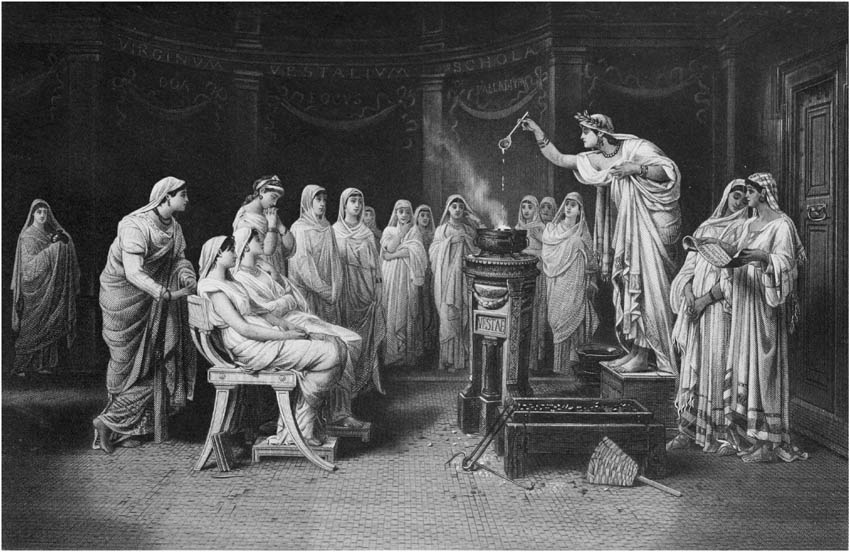
SCHOOL OF THE VESTAL VIRGINSToList
(WALL-PAINTING POMPEII)
FOR THE MUSEUM OF ANTIQUITY