Chapter IV · Caves, Kitchen-Middings, Lake Stations, “Terremares,” Crannoges, Burghs, “Nurhags,” “Talayoti,” and “Truddhi.”
N. D'Anvers translation
The earliest races of men lived in a climate less rigorous than ours, on the shores of wide rivers, in the midst of fertile districts, where fishing and the chase easily supplied all their needs. These races were numerous and prolific, and we find traces of them all over Western Europe, from Norfolk to the middle of Spain. What were the homes of these men and their families? Did they crouch in dens, as Tacitus says the German tribes did in his day? In his “Ancient Wiltshire,” Sir R. Coalt Hoare says that the earliest human habitations were holes dug in the earth and covered over with the branches of trees. Near Joigny there still remain some circular holes in the ground, about fifty feet in diameter by sixteen to twenty deep, known in the country under the name of buvards. The trunk of a tree was fixed at the bottom and rose above the ground, and the branches plastered with clay formed the roof. The floor of these buvards consists of a greasy black earth mixed with bones, cinders, charcoal, and worked flints. Amongst the last named, polished hatchets predominate, which proves that these refuges were inhabited in Neolithic times, but there is nothing to prevent our supposing that they were also occupied in the Palæolithic period. Ameghino gives a still more striking example of an earth-dwelling. Near Mercedes, about twenty leagues from Buenos Ayres, he picked up numerous human bones, together with arrow-heads, chisels, flint knives, bone stilettos and polishers, and bones of animals scratched and cut by man. Later, Ameghino discovered the actual dwelling of this primeval man, and his strange home was beneath the carapace of a gigantic armadillo, the now extinct glyptodon seen in Fig. 48.
Figure 48.
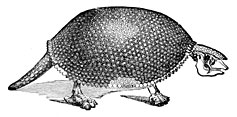
The glyptodon.
Figure 49.

Mylodon robustus.
Our ancestors must constantly have disputed the possession of their caves of refuge with animals, but there is often a certain distinction between those chiefly occupied by man and the mere dens of wild beasts. The latter are generally more difficult of access, and are only to be entered by long, low, narrow, dark passages. Those permanently inhabited by man are wide, not very deep, and they are well lighted. That at Montgaudier, for instance, has an arched entrance some forty-five feet wide by eighteen high. The cave-men had already learnt to appreciate the advantages of air and light.
The caves are often of considerable height; that of Massat is some 560 feet high, that of Lherm is 655, that of Bouicheta nearly 755, that of Loubens 820, and that of Santhenay is, as much as 1,344 feet high. Those of Eyziès, Moustier, and Aurignac are also very lofty. As the valleys were hollowed out by the rushing torrents of the Quaternary floods, men sought a home near the waters which were indispensable to their existence, and came to dwell on the shores of rivers. The most ancient of the inhabited caves, therefore, are those on the highest levels, but the difference in the nature of the country and the varying force of geological action have led to so many exceptions, that all we can say with any certainty is that the caves were inhabited at different epochs. That of Montgaudier, for instance, was filled with an accumulation of ooze about forty feet thick. Weapons and tools lay one above the other from the bottom to the top, and it is easy to distinguish the succession of hearths by the blackened earth, cinders, charcoal, and crushed bones lying about them.
In the Placard Cave eight different deposits bear witness to the presence of man; and these are separated by others bare of traces of human occupation. The lowest deposit, which is some twenty-five feet below the present level of the soil, contains worked flints of the Moustérien type, above which, but separated by an accumulation of débris which has fallen from the roof, comes a layer in which was found a number of arrow-heads of the shape of laurel leaves. The fauna of both these levels includes the reindeer, the horse, and the aurochs. As we go up we find, above another layer of débris, the Solutréen type of tools and weapons represented by bone implements and numerous arrow-heads, this time stalked and notched. The four following levels correspond with those belonging to what is known as the Madeleine type, and the arrow-heads are decorated with geometrical designs. The traces of human occupation at different times, doubtless separated by long intervals, are therefore very clearly defined. The Fontabert Cave, in Dauphiné, contained, at a depth of about six feet, traces of fire and roughly worked flints, and about three feet below the surface lay the skeleton of a man, who had perhaps been overtaken by a fall of earth, still holding in his hand a polished dipper of fine workmanship. Yet a third and evidently more recent period is characterized by a jade crescent. We might easily multiply instances of a similar kind, but that we wish to avoid so much repetition.
We soon begin to find evidence of the progress made by man, and though in Neolithic times he still continued to occupy caves he learned to adapt them better to his needs. The rock shelters of the Petit-Morin valley, so well explored by M. de Baye, are the best examples we can give.
These caves are hollowed out of a very thick belt of cretaceous limestone. They date from different epochs, and each presents special characteristics which can easily be recognized. Some were used as burial-places, others as habitations. In the former the entrance is of irregular shape, the walls are roughly cut, and the work is of the most elementary description. The sepulchral eaves were simply closed by a large stone rolled into place and covered with rubbish, the better to hide the entrance. The shelters used to live in show much more careful work, and are divided into two unequal parts by a wall cut in the living rock. To get into the second partition one has to go down steps, cut in the limestone, and these steps are worn with long usage. The entrance was cut out of a massive piece of rock, left thick on purpose, and on either side of the opening the edges still show the rabbet which was to receive the door. Two small holes on the right and left were probably used to fix a bar across the front to strengthen the entrance. A good many of these eaves are provided with an opening for ventilation, and some skilful contrivances were resorted to for keeping out water. Inside we find different floors, shelves, and crockets cut in the chalk, and on the floors M. de Baye picked up shells, ornaments, and flints, which were lying just where their owners had left them. Very different is all this from the Vezère caves, and everything proves an undeniable improvement in the conditions of life.
The most interesting of all the objects found in these caves are, however, the carvings; but few date from Neolithic times, and some archæologists have argued from their absence in favor of the displacement everywhere of old races by the incursion of new-corners. Some of these carvings represent hafted hatchets, the flint being painted black to make the raised design stand out better. Others represent human figures. In the Coizard Cave, for instance, was found a roughly outlined representation of a woman with a prominent nose, eyes indicated by black dots, highly developed breasts, but no lower limbs. A necklace adorns her throat, and a pendant hanging from this necklace is colored yellow. On the passage leading to the door is engraved another figure which was originally more accurately drawn than the others, but is not in such good preservation. In the Courjonnet Cave we see a woman with a bird’s bead; she was probably one of the lares penates, the protectors of the domestic hearth. We meet with this same goddess at Santorin, and at Troy, and on the shores of the Vistula, which is a very interesting ethnological fact.
The objects found in the sepulchral caves are important, and included a number of arrow-heads with transverse cutting edges. There is no doubt about their use; they have been picked up in black earth, in contact with human bones, the decomposition of the soft parts of which caused them to fall out of the mortal wound they had inflicted. With these arrow-heads were found flint knives, large sloped scrapers, polishers, and bone stilettos, the femora of a ruminant with a pig’s tooth fixed on to each end, hoes made of stag horn, beads and pendants made of bone, shell, schist, quartz, and aragonite, with the teeth of bears, boars, wolves, and foxes, all pierced with holes. Some of the shell anti schist beads were spread upon the surface of the skull, and perhaps formed a net or résille, such as that already referred to as found at Baoussé-Roussé.
Whilst the men of the Petit-Morin valley hollowed out caves, or enlarged those made by nature, others took refuge in buts made of dried clay and interlaced branches, or in tents of the skins of the animals they had slain, and, though these fragile dwellings have disappeared, leaving no trace, there yet remain indelible evidences of the presence of many successive generations. Everywhere throughout the world we find heaps of rubbish, consisting chiefly of the shells of mollusca and crustacea, broken bones, flakes of flint, and fragments of stone and bone implements, covering vast areas and often rising to a considerable height.
Not until our own day did these rubbish heaps attract attention, and it was reserved to our own generation, so interested in all that relates to the past, to recognize their true significance. Steenstrup noticed, in the north of Europe, that these mounds consisted nearly entirely of the shells of edible species, such as the oyster, mussel, and littorina littorea; that they were all those of adult specimens, but not all subject to similar conditions of existence or native to the same waters. The kitchen-middings, or heaps of kitchen refuse—such was the name given to these shell-mounds—could not have been the natural deposits left by the waves after storms, for in that case they would have been mixed with quantities of sand and pebbles. The conclusion is inevitable, that man alone could have piled up these accumulations, which were the refuse flung away day by day after his meals. The excavation of the kitchen-middings confirmed in a remarkable manner the opinion of Steenstrup, and everywhere a number of important objects were discovered. In several places the old hearths were brought to light. They consisted of flat stones, on which were piles of cinders, with fragments of wood and charcoal. It was now finally proved that these mounds occupied the site of ancient settlements, the inhabitants of which rarely left the coast, and fed chiefly on the mollusca which abounded in the waters of the North Sea.
These primeval races, however savage they may have been, were not wanting in intelligence. The earliest inhabitants of Russia placed their dwellings near rivers above the highest flood-level known to or foreseen by them. The Scandinavians were most precise in the orientation of their homes, and M. de Quatrefages points out that the kitchen-midding of Sœlager is set against a hill in the best position for protecting those who lived near it from the north winds, which are so trying in these districts on account of their violence. At Havelse, says Sir John Lubbock, the settlement was on rather higher ground, and, though close to the shore, was quite beyond the reach of the waves. The English visitors had an excavation made whilst they were present, and in two or three hours they obtained about a hundred fragments of bone, many rude flakes, sling stones, and fragments of flint, together with some rough axes of the ordinary shell-mound type. The excavations at Meilgaard a little later by the same explorers were even more fruitful in results.
Amongst the birds found, we may mention the large penguin, now extinct, the moor-fowl, which fed entirely on pine buds, and several species of clucks and geese; whilst amongst the fish were the herring, the cod, the dab, and the eel. The numerous relics of chelonia prove the existence of numbers of the turtle tribe in the North Sea.
A great variety of objects, most of them of a coarse type, have been found beneath the kitchen-middings; metals are however completely absent, and it is probable that they were quite unknown to the Scandinavians for several centuries after their arrival in the country.
It is easy to quote similar facts in other countries. In 1877, Count Ouvarof mentioned, at the Archæological Congress at Kazan, some kitchen-middings near the Oka, a little river flowing into the Volga near Nijni-Novgorod. In excavating some bougrys, or little mounds of sand overlooking the valley, he discovered amongst the layers of alluvium, successive deposits of cinders and fragments of charcoal, which appear to have been the remains of a fire. A little lower down in another deposit were fragments of pottery, stone weapons and implements, and an immense number of shells. Judging from these relics of their daily life, this numerous population must have fed exclusively on fish and mollusca, for excavations brought to light but few mammal bones. The mollusca were all of species that only live in salt water. From this we know that the waves washed the shores near this bougry, and that a milder climate probably prevailed in these regions, making life more supportable.
Similar deposits are by no means rare in France. M. du Chatellier mentions one in Brittany, which he estimates as 325 cubic feet in size. From it be has taken spear- and arrow-heads, knives and scrapers, some highly finished, others but roughly cut and often with scarcely any shape at all. The population was evidently ichthyophagous, to judge by the vast accumulations of shells of scallops, oysters, limpets, pectens, and other mollusca. The few animal bones are those of the stag, the bear, and certain wading birds.
At Canche, near Étaples, has been evade out a series of mounds forming a semicircle some eight hundred and fifty feet in extent. These mounds are made up of successive layers of shells and charcoal, the relics of successive occupations. Lastly we must mention a kitchen-midding situated at the mouth of the Somme, which is eight hundred and twenty feet long by about one hundred wide. It consists principally of shells of adult species, with which are mixed fragments of coarse black pottery and numerous goat and sheep bones, the latter bearing witness to a more recent date than that of the kitchen-middings of Scandinavia or of Germany.
Throughout Europe similar facts are coming to light. Evans mentions heaps of shells on the coasts of England. Chantre speaks of others near Lake Gotchai in the Caucasus, and Nordenskiöld of others at Cape North, to which he wishes to restore its true name of Jokaipi. He sass these mounds are exactly like those of Denmark.
It is, however, chiefly in America that these heaps attract attention, for there huge shell-mounds stretch along the coast in Newfoundland, Nova Scotia, Massachusetts, Louisiana, California, and Nicaragua. We meet with them again near the Orinoco and the Mississippi, in the Aleutian Islands, and in the Guianas, in Brazil and in Patagonia, on the coasts of the Pacific as on those of the Atlantic. Owing to the darker color of the vegetation growing on them, the shell-heaps of Tierra del Fuego are seen from afar by the navigator. For a long time the true character of these mounds was not known, and they were attributed to natural causes, such as the emergence of the ancient coast-line from the sea, and it was not until lately that it was discovered that they were the work of men.
Whether man did or did not live in the basin of the Delaware at the most remote times of which we have any knowledge, we meet with traces of his occupation in the same latitude at more recent periods. At Long-Nick-Branch is a shell-mound that extends for half a mile, and in California there is a yet larger kitchen-midding. It measures a mile in length by half a mile in width, and, as in similar accumulations, excavations have yielded thousands of stone hammers and bone implements (Fig. 24).
The shell-mounds of which we have so far been speaking are all near the sea, but there is yet another consisting entirely of marine shells fifty miles beyond Mobile. This fact seems to point to a considerable change in the level of the ground since the time of man’s first occupancy, for he is not likely to have taken all the trouble involved in carrying the mollusca necessary for his daily food so far, when he might so easily have settled down near the shore.
I cannot close this account of the kitchen-middings, without calling attention to two very interesting facts. The importance of these mounds bears witness alike to the number of the inhabitants who dwelt near them, and the long duration of their sojourn. Worsaae sets back the initial date of the most ancient of the shell-mounds of the New World more than three thousand years. This is however a delicate question, on which in the present state of our knowledge it is difficult to hazard a serious opinion. It is easier to come to a conclusion on other points: the close resemblance, for instance, between the kitchen-middings of America and those of Europe. In both continents we find the early inhabitants fed almost entirely on fish; their weapons, tools, and pottery were almost identical in character; and in both cases the characteristic animals of Quaternary times had disappeared, and the use of metals still remained unknown. Are these remarkable coincidences the result of chance, or must we not rather suppose that people of the same origin occupied at the same epoch both sides of the Atlantic?
The man of the kitchen-middings evidently had a fixed abode. Long since, the tent, the temporary shelter of the nomad, had given place to the but. We have already said what this but may have been like, but the most certain data we have as to human habitations at this still but little known epoch, are those supplied by the Lake Stations of Switzerland, and it is to our own generation that we are indebted for the first discoveries relating to them.
The memory of these Lake Stations bad completely passed away, and it was only the long drought which desolated Switzerland in 1853 and 1854, and the extraordinary sinking of Lake Zurich, revealing the piles still standing, that attracted the attention of archæologists. In the space still enclosed by these piles lay scattered pell-mell stones, bones, burnt cinders of ancient hearths, pestles, hammers, pottery, hatchets of various shapes, implements of many kinds, with innumerable objects of daily use. These relics prove that some of the ancient inhabitants of Switzerland had dwelt on the lake where they were found, in a refuge to which they had probably retired to escape from the attacks of their fellow-men or wild beasts. Though they bad succeeded in getting away from these enemies, they were to fall victims to a yet more formidable adversary, and the half-burnt piles have preserved to our own day the traces of a conflagration that destroyed the Lake dwelling so laboriously constructed.
The discovery of these piles excited general interest, an interest that was redoubled when similar discoveries revealed that all the lakes of Switzerland were dotted with stations that had been built long centuries before in the midst of the waters. Twenty such stations were made out on Lake Bienne, twenty-four on the Lake of Geneva, thirty on Lake Constance, forty-nine on that of Neuchâtel, and others, though not so many, on Lakes Sempach, Morat, Mooseedorf, and Pfeffikon. In fact more than two hundred Lake Stations are now known in Switzerland; and how many more may have completely disappeared?
There is really nothing to surprise us in the fact of buildings rising from the midst of waters. They are known in historic times; Herodotus relates that the inhabitants of pile dwellings on Lake Prasias successfully repelled the attacks of the Persians commanded by Megabasus. Alonzo de Ojeda, the companion of Amerigo Vespucci, speaks of a village consisting of twenty large houses built on piles in the midst of a lake, to which he gave the name of Venezuela in honor of Venice, his native town. We meet with pile dwellings in our own day in the Celebes, in New Guinea, in Java, at Mindanao, and in the Caroline Islands. Sir Richard Burton saw pile dwellings at Dahomey, Captain Cameron on the lakes of Central Africa, and the Bishop of Labuan tells us that the houses of the Dayaks are built on lofty platforms on the shores of rivers. The accounts of historians and travellers help us to understand alike the anode of construction of the Lake Stations and the kind of life led by their inhabitants.
The distance from the shore of the most ancient of the Lake dwellings varies from 131 to 298 feet. Gradually men began to take greater and greater precautions against danger, and the most recent stations are 656 to 984 feet from the banks of the lake. The piles of the Stone age are from eleven to twelve inches in diameter; those of the later epochs are smaller. They are pointed at the ends, and hardened by fire. When the piles had been driven into the bottom of the lake, a platform was laid on them solid enough to bear the weight of the buts. This platform was made of beams laid down horizontally, and bound together by interlaced branches. Two modes of construction can easily be distinguished. In one the platforms were upheld by numerous piles, ten yards long, firmly driven into the mud. This is how the Pfahlbauten, Palafittes, or pile dwellings situated in shallow waters were generally put together. In other cases it seemed easier to raise the soil round the piles, than to drive them into the hard rock which formed the bed of the lake. Care was then taken to consolidate them, and keep them in position with blocks of stone, clay, and tiers of piles. Keller gives to these latter the name of Packwerbauten, and other German archæologists call them Steinbergen.
The mean depth of the waters in those parts of the lakes formerly occupied by the pile dwellings is from thirteen to sixteen feet, and we can still make out the piles when the water is calm and clear. Worn though they may be, their tops still emerge at a height varying from one to three feet above the mud at the bottom of the lake. Their number was originally considerable, and it is estimated that there were forty thousand at Wangen, and a hundred thousand at Robenhausen. The area occupied by the stations varies considerably; according to Troyon, that at Wangen was seven hundred paces long by one hundred and twenty broad. Baron von Mayenfisch explored seventeen sites in the Lake of Constance, the area of which varies from three to four acres. At Inkwyl is a little artificial island about forty-eight feet in diameter. The Lake dwelling of Morges, which was still inhabited in the Bronze age, covers an area of twelve hundred feet long by a mean width of one hundred and fifty. It is, however, useless to enumerate the various calculations that have been made, as they are founded on nothing but more or less probable guesswork.
Excavations show that the buts that rose from the platforms were made of wattle and hurdle-work. In different places calcined and agglutinated fragments have been picked up, and pieces of clay which had served as facing. The house to which they had belonged had been destroyed by fire, and the clay, hardened in the flames, had resisted the disintegrating action of the water. On one side this clay is smooth, and on the other it still retains the marks of the interlaced branches, which had helped to form the inner walls. Some of these marks are so clear and regular that Troyon, noticing the way they curve, was able to assert that the buts were circular, and that they varied in diameter from ten to fifteen feet.
A recent discovery at Schussenreid (Wurtemberg) gives completeness to our knowledge of the Swiss Lake dwellings. In the midst of a peat-bog rises a but known as a Knüppelbau, which is supposed to date from the Stone age. It is of rectangular form, and is divided into two compartments communicating with each other by a foot-bridge consisting of three beams laid side by side. The floors of this but are made of rounded wood, and the walls of piles split in half. Excavations have brought to light several floors, one above the other, and divided by thick layers of clay. The rising of the level of the peat doubtless compelled the Lake Dweller to add by degrees to the height of his house.
Though the importance and number of the discoveries made in Switzerland render it the classic land of Lake Stations, it is not the only country in which they have been found. They have been made out in the Lago Maggiore and in the lakes of Varèse, Peschiera, and Garda in Lombardy; in Lake Salpi in the Capitanata, and in other parts of Italy. Judging from the objects recovered from these stations, they belonged partly to the Stone and partly to the Bronze age.
The pile dwelling of Lagozza is one of the most interesting known to us. It forms a long square, facing due east, and covers an area of two thousand six hundred yards, now completely overgrown with peat six and a half feet thick. Amongst the posts still standing can be made out a number of half-burnt planks, which are probably the remains of the platform. One of the posts was still covered with bark, and it was easy to recognize the silver birch (Betula alba). Other posts consisted of the trunks of resinous trees, such as the Pinus picea, the Pinus sylvestris, and the larch, which now only grow in the lofty Alpine valleys. Amongst the industrial objects found in the Lagozza pile dwelling were polished stone hatchets, hammers, polishers of hard stone, knife-blades, flint scrapers, and seven or eight arrows with transverse cutting edges, a form rare in Italy.
What chiefly distinguishes the Lagozza pile dwelling, however, is the absence of the bones, teeth, or horns of animals, and also of fish-hooks, harpoons, or nets, so that we must conclude that the inhabitants did not hunt or fish, that they did not breed domestic animals, and were probably vegetarians. The researches of Professor Sordelli confirm this hypothesis; from amongst the objects taken from the peat he recognized two kinds of corn (Triticum vulgare antiquorum and Triticum vulagere hibernum), six-rowed barley (Hordeum hexastichum), mosses, ferns, flax, the Indian poppy (Papaver somniferum), acorns, and an immense number of nuts and apples.
The acorns are those of the common oak, and their cups and outer rind had been removed, so that they had evidently been prepared to serve as food for, man; the apples were small and coriaceous, resembling the modern crab-apple; the Indian poppy cannot have grown without cultivation; but this was perhaps but an example of the same species already recognized in the Lake dwellings of Switzerland. It is difficult to say whether it was used for food or whether oil was extracted from it.
We have already spoken of the discoveries made in Austria and Hungary. Count Wurmbrand has described the difficulties with which explorers had to contend. The lakes have in many cases become inaccessible swamps, and in others, the waters having been artificially dimmed to regulate their overflow, the sites of the pile dwellings are so far below the level of the lakes that any excavations are impossible. Long and arduous researches have, however, been rewarded with some success, and the numerous objects recovered bear witness, as in Switzerland, to the gradual progress made by the successive generations who occupied these pile dwellings.
Figure 50.
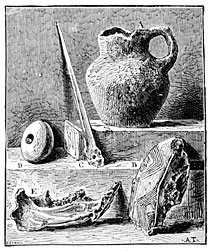
Objects discovered in the peat-bogs of Laybach. A. Earthenware vase. B. Fragment of ornamented pottery. C. Bone needle. D. Earthenware weight for fishing-net. E. Fragment of jawbone.
Figure 51.

Small terra-cotta figures, found in the Laybach pile dwellings.
The mode of construction of the Lake Stations of the marshes of Pomerania is very different from that employed in Switzerland or in Austria. The foundations rest on horizontal beams, kept in place either by great blocks of rock or by piles driven in vertically. In many cases notches had evidently been made, the better to place the cross-beams; whilst in others forked branches had been selected, so that a second branch could be fitted into the fork. Primeval man soon learnt to appreciate the solidity of such a combination. Do these stations, however, really date from prehistoric times? Virchow, returning to his first opinion, now thinks that the pile dwellings of Germany belong to the same epoch as the intrenchments known as Burgwallen, when metals and even iron were already in general use. They were inhabited until the thirteenth century, and it is easy to trace in them, as in those of Switzerland, the signs of the successive occupations, the dwellings having evidently been abandoned and restored later by fresh comers.
Figure 52.
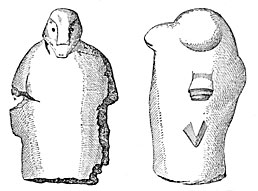
Small terra-cotta figures, from the Laybach pile dwellings.
At the meeting of the British Association at Newcastle in 1863, Lord Lovaine described a Lake Station in the south of Scotland, and Sir J. Lubbock mentions one in the north of England. Others are known at Holderness (Yorkshire), at Thetford, on Barton Mere, near Bury St. Edmunds; but judging from the description of them they are not of earlier date than the Bronze age.
Other stations are more ancient. A few years ago a number of piles were found a little above Kew, beneath a layer of alluvium, and embedded in the gravel which formed the ancient bed of the Thames. All around these piles were scattered the bones of animals, of which those of the Bos longifrons were the most remarkable. The long bones had been split to get out the marrow, an evident proof of the intelligent action of man. In London two similar examples were found on the site of the present Mansion House, and beneath the ancient walls of the city. They are supposed to date from times earlier, not only than the cutting out of the present course of the Thames, but before that invasion of the sea which preceded the formation of the Thames valley, now the home of more than four million men and women.
The Lake Stations of France are less important than those of the neighboring countries. It is supposed that Vatan, a little town of Berry, was built on the site of a Lake city. It is situated in the midst of a dried-up marsh, and at different points piles have been removed which were driven deep into the mud. We also hear of pile dwellings in the Jura Mountains, in the Pyrenean valleys of Haute-Garonne, Ariège, and Aude, as well as in those of the Eastern Pyrenees. In the department of Landes, which on one side joins the plateau of Lannemezan, and on the other the lofty plains of Béarn, are many marshy depressions, where have been found numbers of piles, with charred wood and fragments of pottery.
Discoveries no less curious have been made in the Bourget Lake, but the dwellings rising from its surface date from a comparatively recent epoch. The numerous fragments of pottery found prove that terra-cotta ware had attained to a beauty of form and color unknown to primitive times. Indeed some of the vases actually bear the name of the Roman potter who made them. We must also assign to an epoch later than the Stone age the buildings, remains of which have beet found in the peat-bogs of Saint-Dos near Salies (Basses-Pyrénées). At a depth of about thirty-two inches has been found a regular floor formed of trunks of trees resting on piles and bound together in a primitive fashion with the filaments of roots. These piles bear a number of deep clean-cut notches, such as could only have been made with an iron implement. In other parts of France there are Lake Stations, which were occupied until the time of the Carlovingians. To this time belong the pile dwellings of Lake Paladru (Isère), which were abandoned, so far as we can tell, by their owners when they were swamped by the rising of the water.
The remains of the stag and of the ox are more numerous than those of any other animal, and it is easy to see that every clay the importance of a pastoral life became more clearly recognized. In the most ancient Lake Stations, those of Mooseedorf, Wangen, and Meilen, for instance, the stag predominates; in those of the western lakes, which are comparatively more recent, relics of the ox are more numerous. In the Lake village of Nidau, which dates from the Bronze age, a greatly increased number of bones of domestic animals have been found, whilst those of wild creatures become rarer and rarer. The progress of domestication is evident, and it is no less certain that the lapse of centuries must have been required for the formation of the herds which evidently existed in certain localities. It is possible that these animals may have first entered Europe in the wake of foreign invaders, and before being reduced to servitude, they may have roamed about in a wild state, and even have been contemporaries with species now extinct. However that may be, there can be no doubt on one point, they could not domesticate themselves; one race of creatures after another must have fallen under the subjection of man, who gradually became the master of all the animals that are still about us.
We do not meet in the pile dwellings with the common mouse, the rat, or the cat, and the horse is very rare. It is the same with the kitchen-middings and the caves occupied in Neolithic times. The disappearance of the horse, so numerous in earlier epochs, is general, and this would be inexplicable if history did not solve the mystery. The Bible, which gives us such complete details of the pastoral life of the Hebrews, speaks for the first time of the horse after the exodus from Egypt of the children of Israel, and in Egypt itself the horse is not represented in any monument of earlier date than the Seventeenth Dynasty. It is the same in America, animals of the equine race, that were so numerous in early geological times, had long since disappeared on the arrival of the Spaniards, and the horses they brought with them inspired the Mexicans and Peruvians with unutterable terror.
The so-called terremares of Italy date from the same period as the Danish kitchen-middings and the Swiss pile dwellings. They are met with chiefly in Lombardy and in the ancient duchies of Parma and Piacenza, and consist of low mounds rising from thirteen to sixteen feet above the surface of the soil. In some cases a number of terremares, close to one another, form regular villages covering an area of from five to six miles square. Excavations of the terremare have brought to light rows of piles from seven to ten feet long, connected by transverse beams, forming a regular floor, from which rose buts built in a similar way to those of the Swiss pile dwellings, of interlaced branches or of clay and straw, for no trace has been made out of the use of bricks or of stones. The refuse of the kitchen and rubbish of all kinds rapidly accumulated round about these buts, and formed the first nucleus of the mound, which soon grew to a considerable height as one occupant of the house succeeded another. When the refuse became too much of a nuisance, the owner of the but set up fresh piles at a greater height on the same site, laid down another platform, and built anew but. In some places three such platforms have been found one above another.
As in the Lake Stations, excavations of the terremares have brought to light numerous bones of domestic animals; but those of wild creatures, such as bears, stags, roedeer, and boars, are even rarer than in Switzerland. The inhabitants evidently had other resources than hunting at their command, and though the processes they employed were but elementary, they cultivated corn, beans, vines, and various fruits. Though iron was still unknown, some bronze objects have been found in certain terremares, but these were only roughly melted pieces of metal, showing no traces of having been either hammered or soldered. Amongst the pottery found in the terremares, we must mention a number of small objects not unlike acorns in form, pierced lengthwise, and decorated with incised lines, some straight, others curved. Italian archæologists call them fusaïoles, and Swiss savants, who have found a great many in the lakes of their native country, give them the name of pesons de fuseau. Both these names connect them with the process of spinning; but their number renders this hypothesis inadmissible, and when we give an account of the excavations carried on at Hissarlik, under Dr. Schliemann, we shall be able to determine their character (see Chapter VII.).
With these flints were hand-made vases with handles, the clay unmixed with sand or quartz and ornamented with lines, grooves, and raised knobs. These vases differ greatly from those found in the terremares; are they then, as has been said, of earlier (late? It is impossible to come to any decision on the point.
Before closing our account of prehistoric buildings surrounded by water, we must say a few words on crannoges though there is the greatest difference of opinion as to their date.
To add to the difficulties of dealing with the subject of crannoges, they were successively occupied for many centuries. They are mentioned in the most ancient Irish legends, and even in the sixteenth century they served as refuges for the kings of the country in the constant rebellions that took place. The objects taken from the lakes belong to very different epochs, and it is impossible to say anything positive as to the time of their construction.
It is probable that Lake dwellings were also used in Asia and in Africa from prehistoric times. History tells us that the inhabitants of Phasis, the Mingrelians of the present day, lived in reed huts on the water, and that they went from one islet to another in canoes hollowed out of the trunks of oak-trees. A bas-relief from the palace of Sennacherib, preserved in the British Museum, represents warriors fighting on artificial islands made of large reeds. But here w e enter the domain of history, and we must return to Neolithic times, and speak of the habitations built of more durable materials and the ruins of which are still standing.
It is impossible to say with any certainty to what period the most ancient of these structures belong. It is probable that man early learned to pile up stones, binding them together at first with clay, and then with some stronger cements. The burghs of Scotland, the nurhags of the island of Sardinia, the talayoti of the Balearic Isles, the castellieri of Istria, are all ancient witnesses of the modes of building employed in the most remote ages.
The regularity of the building of this burgh, and the architectural knowledge it implies, prevent our ascribing it either to the Stone or even to the Bronze age; but we find in Scotland itself more ancient examples, if we may so express ourselves, of domestic architecture. These examples are subterranean dwellings, made of rough-hewn stones of considerable size, laid down in regular courses, to which the names of earth-houses, Picts’ houses, and weems have been given. The walls converge towards the centre, leaving an opening at the top, which was covered in with large flat stones. These dwellings are certainly of earlier date than the burghs, and the discovery of a Picts’ house actually beneath the ruins of a burgh enables us to speak with certainty on this point.
In Ireland similar proofs have been found of the great antiquity of roan. More than one hundred towers have been found in that country, all built of large stones, and varying in height from seventy to one hundred and thirty feet, with a diameter of from eight to fifteen feet. The most diverse origins have been attributed to these towers, from prehistoric times to the centuries immediately preceding the Christian era; from the time of the Druids to that of the Friars. According to the point of view of different archæologists, they have been called temples of the sun, hermitages, phallic monuments, or signal towers.
We meet with a similar problem in considering the nurhags, as in considering the burghs. They have been justly called a page of history, written all over the surface of Sardinia by an unknown people. Count Albert de la Marmora counted three thousand of them a few years ago, and more recent explorers tell us that this number is greatly exceeded. Like the burghs, which they strangely resemble, the nurhags are conical towers with very thick walls made of huge stones, some Hewn, others in their natural state, arranged in regular courses without mortar. On entering one of them we find ourselves in a vaulted room, which looks exactly like one half of an egg in shape. In the upper stories are two, and sometimes three rooms, one above the other, to which access is gained by steps cut in the walls. The whole structure is crowned by a terrace (Fig. 53). We must add that the entrance to the nurhag is through an opening on a level with the ground, and so low that one can only go in by crawling on the stomach.
Many conjectures have been made as to the use of these towers. Were they temples in which to worship, or trophies of victory? Their number is against either of these hypotheses. Were they then habitations or towers of observation? Not the former certainly, for no one could live between walls sixteen or twenty-two feet thick, shut out from air and light. Some travellers think they were tombs, but excavations have brought to light no bones or sepulchral relics. We can compare them to nothing but the Towers of Silence, on which the Parsees expose their dead to the birds of heaven, which are ever ready rapidly to acquit themselves of their melancholy functions.
Figure 53.
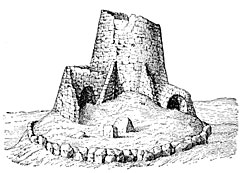
Nurhag at Santa Barbara (Sardinia).
The origin of the nurhags is as uncertain as their use. Diodorus Siculus considered them very ancient, and one fact has come to light in our day which enables us to arrive at a somewhat more exact decision. The island of Sardinia was taken by the Romans from the Carthaginians in 238 B.C., and an aqueduct, the ruins of which can still be seen, was built by the conquerors on the foundations of an ancient nurhag, so that the latter must belong to an earlier (late than the third century before our era. Fergusson, who speaks with authority on everything relating to the monuments of the Stone age, assigns the nurhags to the mystic times of the Trojan War. In all probability they were built by an invading people. La Marmora thinks these invaders were the Libyans; M. de Rougemont, in his history of the Bronze age, says that the curved vault is the characteristic feature of Pelasgian architecture, which is often confounded with that of the Phœnicians. Although any final conclusion would be premature, we ourselves think that the builders of the nurhags belonged to the great stream of emigration from the East, the course of which is marked by megalithic monuments in so many parts of the world. In some instances, nurhags were surrounded by cromlechs, of which most of the stones have now been thrown down. Some of these stones bore prominences resembling the breasts of a woman.
The accumulations of earth and rubbish about the nurhags are, some of them, from six to ten feet high. In the lower deposits have been found coarse pottery, with no attempt at ornamentation, fragments of flint, and obsidian hatchets of black basalt, or porphyry of the Palæolithic type, arrow-head, flint knives, stones used in slings, and numerous shells; whilst in the upper deposits were picked up black pottery and fragments of bronze belonging to the transition period between the Stone and Metal ages.
All over the island of Sardinia, side by side with the nurhags, rise tombs to which have been given the name of Sepolture dei Giganti. They are from thirty-two to thirty-nine feet long by a nearly equal width, and are built, some of huge slabs of stone, some of stones of smaller size. They are in every case surmounted by a pediment, formed of a single block, and often covered with sculptures dating from different epochs. These sepulchres are certainly of later date than the nurhags, and in them have been found numerous implements of bronze, but none of stone.
Figure 54.
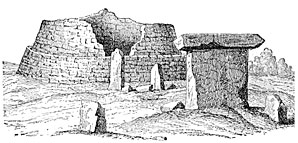
“Talayoti” at Trepuco (Minorca).
The talayoti, of which one hundred and fifty are still standing in the island of Minorca, are circular or elliptical truncated cones, built of huge unhewn stones, laid one on the other without cement (Fig. 54). The most remarkable of all of them, that at Torello, near Mahon, is thirty-three feet high. In many cases there are two stone, one placed upright, the other across it, in front of the talayoti. The meaning of these biliths is unknown.
Yet another series of cyclopean monuments are known under the name of nanetas, and are not unlike overturned boats. Seven such nanetas are still to be seen in the Balearic Isles. The one which is best preserved consists of large unhewn stones of rectangular shape, enclosing an inner chamber about six feet in width. The roof having fallen in, its height cannot be exactly determined; we only know that the lateral walls are some forty-five feet high.
In Algeria also have been preserved some towers built of stones without cement. Some of them are square (basina) and surmounted by a small dolmen, others are round (chouchet) and closed at the top by a large slab of stone, as in the nurhags we have just described.
The castellieri of Istria, which the Slavonian peasants call starigrad, are as yet but little known. Doubtless an examination of them will bring out their resemblance to the nurhags and talayoti. They are, however, more than mere towers, forming regular enceintes between walls formed of two facings of dry stones, the space between which is filled in with smaller stones. There are fifteen of these castellieri in the district of Albona, a little town on the southeast of Trieste. They were at first attributed to the Roman epoch, but later researches relegate them rather to prehistoric times, and the discovery near them of numerous stone implements rather tends to support this latter opinion, but it must not be considered conclusive.
A vast period of time, countless centuries, indeed, have passed away since the close of the Paleolithic epoch. The burghs, nurhags, and castellieri show the progress of civilization, and at the same time prove that this progress extended throughout Europe, and that at a time not so very far removed from our own. The close resemblance between buildings of different dates enables us to speak with certainty of the connection between the races which succeeded each other in Europe. The importance of these conclusions is very great, and will be brought out still more in our study of megalithic monuments.