Chapter VII · Camps, Fortifications, Vitrified Forts; Santorin; The Towns upon the Hill of Hissarlik.
N. D'Anvers translation
Combativeness, to use the language of phrenology, is one of the most lively instincts of humanity. The Bible tells us of the struggle between the sons of Adam, and shows us might making right ever since the days of primeval man. History is but one long account of wars and conquests, victories or defeats, and progress is chiefly marked in inventions which made battles more sanguinary and added to the number of victims slaughtered. At the very dawn of humanity man learned to make weapons; very soon, however, weapons ceased to appear sufficient. The first fortification was doubtless the cave, which its owner strengthened by closing the entrance with blocks of stone and piles of broken rock, or by digging deep trenches about it.
These primitive enclosures, says Bertrand in his “Archéologie Celtiquc et Gauloise,” may have been very much more numerous than is supposed, if we include amongst them, as it appears we ought, many ruins long thought to date from the Roman era.
There is no doubt as to the purpose served by the camps, but we are not prepared to speak as positively as does Bertrand as to their origin, and the difficulty of deciding is very greatly increased on account of these camps having been successively occupied at different epochs by different peoples. Bearing in mind this reservation, we will now sum up to the best of our ability all that is so far known about the most important remains hitherto examined.
There were originally a good many hearths about the camp, and it was near to one of them that the spoon was found, figured in an earlier chapter of this book (Fig. 25). With it were picked up polished fibrolite, basalt, chloromelanite, serpentine, and diorite hatchets; evidently made in the neighborhood, as is proved beyond a doubt by the numerous chips and partly worked pieces lying about, as well as the discovery of no less than thirty polishers, many of them showing signs of long service. Bone implements of all kinds and whistles made of the phalanges of oxen are also constantly found. Even if the presence of these objects does not enable us to come to any final conclusion, they are at least most useful and interesting in enabling us to put together little by little a picture of the life of the most ancient inhabitants of France.
De Quatrefages has accurately made out a series of works extending along the left bank of the Nive, as far as Itsassou, and of which the Pas-de-Roland marks the extreme limit. A merely superficial examination is enough to show that these defences existed only on the side to which access would otherwise have been easy, while the height overlooking the river on the other side, which is impregnable by nature, has been left untouched. Here too we find the name Cæsar’s Camp given to the relics, a fact of common occurrence all over France, where the great captain was long held in honor. Quatrefages is, however, of opinion that the works are neither Roman, Gallic nor Celtic, and he even arrives by a process of elimination at the conclusion that they were erected by the Iberians, who preceded the Aryans, and have left so deep an impress on all the countries they successively occupied. We do not feel able to accept entirely this hypothesis; but no suggestion of the eminent professor must be overlooked by those who earnestly seek with unbiassed minds to ascertain the truth.
Figure 84.
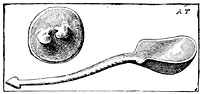
Prehistoric spoon and button found in a lake station at Sutz (Switzerland).
Great Britain is intersected by lines of fortifications of unknown origin, but certainly of extreme antiquity. We may mention Dane’s Dyke, Wandyke, the Devil’s Dyke at Newmarket, and Offa’s Dyke, running from the Bristol Channel to the Dee, and dividing England from Wales. Ancient camps and intrenchments, Sir John Lubbock tells us, crown the greater number of the hills of England. General Pitt-Rivers explored several of these camps in the county of Sussex. Many extend over considerable areas, and all contain numerous worked flints and other relics of prehistoric industry. These relics are met with in great numbers at the base of the intrenchments, so that we may justly conclude that they date from the same epoch.
The walls of the subterranean galleries of Cissbury bore not only cup-shaped ornaments, strive, and curved or broken lines, recalling those on the megalithic monuments of Scotland and Ireland; but Park Harrison has made out some regular runes, or written characters, of which a reproduction was shown at the Paris Exhibition in 1878. This last fact is the more curious, as Sayce discovered in a passage giving access to a cave near Syracuse some characters somewhat similar in form, to which he assigns a proto-Phœnician origin. We may add that certain characters made out at Cissbury, differing but little from the modern letter b or the figure 6, are also found in the most ancient Palmyrian, Copt, and Syrian alphabets. Were this fact completely established, still more, if it were corroborated by other analogous facts, we should in it have a very valuable indication of the relations of England with the most ancient known navigators.
Figure 85.
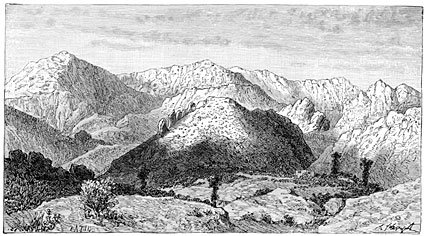
General view of the station of Fuente-Alamo.
The valla include important works. One of them cuts across Valachie parallel with the Danube and loses itself in Southern Russia. Another crosses the north of Moldavia and Bessarabia, following a direction convergent with the former. These valla, although they are known in the country in which they occur as Fossés de Trajan, are certainly of earlier date than the Roman occupation, and in fact Roman roads cut across the intrenchments or fosses which have been levelled or covered over to make way for them. Excavations of the large tumuli are not yet sufficiently advanced for us to hazard an opinion about them. The smaller ones, however, are seldom of Roman origin. The funeral vases of calcareous stone which they contain bear witness clearly enough to their destination, and also to the rite with which they were connected.
The cetati de pamentu are regular earthen fortifications set up within short distances of each other on all the heights overlooking the torrential rivers of Roumania. These intrenchments, generally of round or oval form, are protected by deep fosses, parapets, and palisades. Masses of cinders and burnt earth bear unmistakable evidence to the cause of their destruction. All about, excavations have brought to light coarse pottery, grindstones for crushing grain, stores of millet which had been damaged by the flames, and a few primitively constructed bronze idols. When the vanquished Roumanians were driven from their intrenchments, they had evidently learned to use bronze, but were still, as we have already remarked, unacquainted with iron, as no object in that material has been found, nor does anything bear any trace of rust.
Thus, throughout Europe, man, in the presence of the many dangers surrounding him, endeavored in the very earliest times to protect by similar means his family, his flocks, and his wealth. In America we are able to quote facts of even more importance. The vast territory comprised between the Alleghanies and the Rocky Mountains, between the great lakes of Canada and the Gulf of Mexico, is intersected with truly colossal fortifications, almost all of them made entirely of earth. The ancient Americans knew how to protect every height and every delta formed by the junction of two rivers with redoubts, walls, parapets, fosses, and circumvallations. Not without astonishment we make out a regular system of fortresses connected with each other by deep trenches and secret passages, some of them hewn out beneath the beds of rivers, observatories on the heights, and concentric walls, some actually strengthened with casemates protecting the entrances. All these works were constructed by the so-called Mound-Builders, of whose ancestors or of whose descendants absolutely nothing is known.
All the strongholds of the Mound-Builders rise near abundant watercourses, and the best proof that can be given of the intelligence which guided their constructors in their choice of sites, is the fact of the number of flourishing cities such as Newark, Portsmouth, Cincinnati, Saint Louis, Frankfort, and New-Madrid, etc., which were built upon the ruins of various earthworks.
It would take us too long merely to enumerate all the ancient fortifications still existing in North America. Moreover they all resemble each other so much that the description of a few of them is really all that is needed to prove their importance.
Forest trees have grown up on these abandoned ruins, succeeding other vegetable growths; the huge girth of the decaying trunks proving their longevity. Man, impelled by motives we cannot fathom, had abandoned the districts where everything bears witness to his power and intelligence, and the vigorous vegetation of nature once more has it all its own way.
Figure 86.
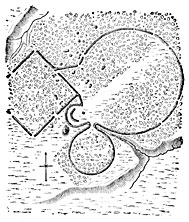
Group at Liberty (Ohio).
Figure 87.

Trenches at Juigalpa (Nicaragua).
We must not omit to name an extraordinary system of intrenchments at Juigalpa, in Nicaragua, which so far as I know is quite unique. This is a series of trenches extending for several miles (Fig. 87), varying in width from nine and a half to thirteen feet; at equal distances are oval reservoirs, the longest axis of which measures as much as seventy-eight feet. In each reservoir are two or four mounds, probably serving as watch-towers. We know nothing either of the people who erected these singular structures or of the enemy from whom they formed a protection. Nor can anything be guessed as to the way in which the defence was conducted. All is involved in obscurity, and at every turn we are compelled to repeat that prehistoric studies are weighted with uncertainty, long and arduous study being necessary to bring ever so little order into the chaos in which everything connected with them is involved.
We must cursorily refer to some other fortifications which really scarcely belong to our subject, though certain archæologists claim for them a prehistoric origin. We refer to the vitrified forts, which are strange structures in which stones, such as granite and gneiss, quartzite and basalt, have been subjected to a heat so intense as to produce vitrification.
Craig Phœdrick is now covered with a luxuriant vegetation of broom, furze, and fern, with groves of firs and larches, amongst which the explorer makes his way with difficulty to the fortifications, or rather to the piles of massive blocks to which that name has been given. These blocks form an acropolis of oval form, the upper part of which is a flat terrace encircling a central basin some six and a half to nine and a half feet deep, which may be compared to the craters of the extinct volcanoes of Auvergne. The sides of the mound are strewn with cyclopean blocks of vitrified granite, which evidently originally formed part of the fortifications. It is on the eastern side, overlooking the valley of the Ness, that the buildings are of the greatest importance; two terraces can be made out, the lower projecting beyond the upper, forming a double series of almost perpendicular fortifications, constructed of vitrified blocks cemented together with thin layers of mortar, spread without any attempt at regularity. The blocks form, with the mortar, a conglomerate so compact that when struck with a hammer they break without separating. Examination of fragments under the microscope prove that they have gone through important mineralogical transformations, under the influence of what must have been an extremely high temperature. The heat must have been indeed intense which could cause mica to disappear entirely, and feldspar to melt almost completely.
The ancient fortress of Ribandelle, of circular form, rises above the Creuse, opposite Châteauvieux. It was successively occupied by the Celts, the Romans, and the Visigoths, but we are unable to fix the date of its erection or the name of the people who built it. There remain but a few ruins at the present day, but we can make out in them the same mode of construction as that followed at Châteauvieux. The walls are faced with unhewn stones, the outer side of which still retains a natural appearance, while the inner is corroded and disintegrated. In the wall itself, separated from the facings by beds of peat mould, are great blocks of vitrified granite. The traces of the action of fire are specially noticeable in the upper part of the walls, so that they were evidently finished when the fusion took place.
The site of the furnace in these forts is difficult to determine. It was evidently not situated under any of the blocks, for the earthworks on which they rest retain no traces of the action of fire. Nor was it situated at the side, for the outer facings have retained alike their original form and consistency. Nor can the furnace have been lit on the blocks, as heat exercises its action by radiating in every direction. We are therefore forced to the conclusion that the fire was spread with the aid of spaces left in the inside of the construction at various points, for the vitrified mass is divided into blocks, about nine and three fourths feet long, at very short distances from each other.
These few examples will be enough to give some idea of the strange vitrified forts. Many of them retain traces of Roman. occupation. The Guéret Museum possesses a fragment from the Ribandelle walls in which a Roman tile is completely imbedded; and M. Thuot picked up other tiles in a similar condition amongst the ruins. This is a very decided proof that the vitrification took place after the arrival of the conquerors of Gaul. The weapons and tools discovered would appear to confirm this idea, and to suggest similar explanations of vitrification elsewhere. If so, we shall have to admit that vitrified forts date from the earliest centuries of the Christian era, and are not prehistoric at all. We have, however, noticed them here on account of the grave doubts in the matter, and because they furnish a striking and valuable illustration of the relations existing from the most remote tunes between widely separated races, and maintained until the present time. In no other way can we account for the practice of the extremely difficult and complicated operation of the vitrification of bard rocks in districts so far apart as Norway and Scotland, Germany and the midlands of France.
The more we think of the difficulties vitrification presents, the greater is our astonishment. How was the fusion achieved of elements so refractory alike in their structure and in the resistance offered by accumulated masses of material? By what processes was heat brought up to the 1300 degrees necessary for the fusion of granite? The incineration and fusion of the materials of which the vitrified forts are made, especially the granite ones of La Creuse and the Côtes du Nord, bear witness, says Daubrée, to a surprising skill and knowledge of the management of fire in those who burned them, but these qualities were manifested also in extremely ancient metallurgical operations. It is quite impossible to suppose the vitrification to have been the result of a conflagration. No fire, whether accidental or the work of an incendiary, could be powerful enough to produce such results. The use of petroleum in the most terrible conflagrations of our own time—those of the Commune in 1871, for instance—did calcine and disintegrate stone, but I know of no case of vitrification.
Whatever explanation we may accept, however, the processes employed certainly bear witness to a much more advanced state of civilization than was acquired in the earliest ages of humanity. We have been led by the great interest and mystery of the subject to dwell longer on it than we intended, and we must hasten to return to prehistoric times with a determination not to transgress again.
Fortifications are a proof of combined action leading to a common end; they imply social organization, chiefs to command, workmen to obey. A recent discovery enables us to form a very accurate picture of prehistoric men gathered together not only for purposes of defence, but in a society already rich, industrious, and, if we may so speak, learning to cultivate the arts of peace.
The removal of the pouzzolana, so called after the volcanic ashes of Pozzuoli in Italy for the works on the Isthmus of Suez, necessitated important excavations, and the cuttings revealed the existence of dwellings which had been bidden away from the light of day for many centuries. The masses of rubbish hiding these prehistoric ruins were some sixty-five feet high, and consisted chiefly of volcanic ashes piled up, for some accidental reason, in comparatively modern times. Beneath the pouzzolana a thin layer of humus contains fragments of pottery of Hellenic origin; which marks the close of the historic period, and covers over the mass of pumiceous tufa vomited out by the volcano. It was in this tufa, which is eight feet thick, that the first signs of buildings were discovered. Further excavation brought to light two houses with doors, windows, and bearing walls. In one of these houses there were five different rooms. Other discoveries rapidly succeeded each other, alike in the island of Therasia and at Acrotiri, the principal island, which has given its name to the group. The plan of these houses is an irregular parallelogram, the angles of which are rounded and the sides more or less curved. This arrangement differs greatly from that adopted in Greece as well as from that in use at Therasia after the time of the volcanic eruptions. The houses too are quite different in their mode of construction. The walls consist of great blocks of lava placed one above the other, without any trace of cement or of lime, and are merely kept in place by a reddish earth mixed with chopped straw or marine algae. Large branches of olive or cypress trees, still with the bark on, are imbedded in the masonry. These pieces of wood, the size of which varies considerably, were probably added to give the necessary solidity to the walls in the numerous earthquakes, the disastrous effects of which were only too well known to the ancient inhabitants of Santorin. It is curious and interesting to note the use of the same expedient among the inhabitants of the islands of the Archipelago who are still exposed to the same danger. The doors and windows are clumsily arched, and the roof seems to have been a low vault. It was made of stones and coated with clay and supported by the trunks of olive trees, the charred remains of which lay upon the floors of the crushed homes. These trunks show no sign of having been touched with metal tools; not a metal nail or clamp has been found, and we cannot but conclude that the remains belong to the age when stone alone was employed.
The inside walls were not glazed or decorated in any way, except in one instance, that of a house at Acrotiri, from which the rubbish has been cleared away, revealing on the walls a layer of lime on which was some colored ornamentation which still retained an extraordinary brilliancy when it was discovered.
In all the houses and in every room of each were found beneath the tufa burying them masses of lava and volcanic scoriae, forming a most eloquent witness of the cause of their destruction. Near one of the houses of Therasia is a little cylindrical structure, about three feet high; which cannot have been a well, as it rests directly on impermeable lava, and was certainly not a cistern, as it is too small for that. May it, as some think, have been an altar? We cannot tell, and though the religious sentiment was probably no more absent among these primitive races than it is among the barbarous peoples of our own day, it does not do to express an opinion in the absence of positive proof.
Successive excavations have yielded a number of objects which throw a new light upon the manners and customs of the inhabitants. Terra-cotta vases are more numerous than anything else (Fig. 88), and among them preponderate large yellow vessels capable of holding about one hundred quarts. Most of them have a clumsy brim, and a rough attempt has been made at ornamentation by the potter with his fingers on the damp clay. Other vases of finer clay, colored red or yellow, are covered with ornaments and graceful arabesques; the garlands of fruit and flowers are often of remarkably beautiful workmanship. Cups with well-shaped rounded handles, made of some kind of red ferruginous earth, others of gray material, were picked up in all the houses. These various vessels were used for many different purposes; some to cook food, the marks of the hearth being still on them, whilst others retained some of the chopped straw with which the domestic animals had evidently been fed. The most curious of all are those which are supposed to represent a woman; the front part projecting and surmounted by a narrow neck bent backwards, with two brown prominences supposed to stand for breasts, and dots round the upper part representing a necklace, while ear-rings are indicated by elliptical bands of different colors. We shall have to refer again to these curious vases when we speak of the discoveries made at Troy; we need only add now that the pottery found at Santorin differs completely, alike in form and ornamentation, from the Greek, Phœnician, and Etruscan specimens, of which the museums of Europe contain so many. They are evidently therefore not of foreign origin, but of native manufacture. The absence of clay in the island of Santorin has thrown some doubt on this, however, but the researches of M. Fouqué have revealed the former existence of a large valley, at the base of the principal cone, which valley ran down to the sea-shore near the island of Aspronisi; and in which probably was found the clay which the potters of the district soon learned to turn to account.
Figure 88.
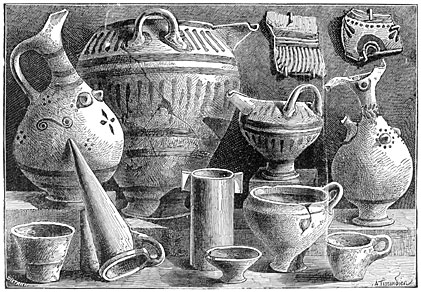
Vases found at Santorin.
With these vases were found some troughs for holding crushed grain, and lava discs very much like those still in use among the weavers of the Archipelago to stretch the woof of their tissues; skilfully graduated lava weights, the correlation of which is very evident, as they weigh 8, 24, and 96 ounces; a flint arrow-head and a saw of the same material with regular teeth; together with a great variety of other objects, including many obsidian arrows and knives, reminding us in their shape of those characteristic of the Stone age in North Europe.
Two rings of gold beaten very thin, and a little copper saw with no trace of any alloy, are, so far, the only metal objects found in the excavations. The origin of the former, moreover, is very uncertain, and there has been much discussion as to where the rings came from. In spite, however, of all the gaps in the evidence about them, there remains no doubt that the inhabitants of Santorin were farther advanced in civilization than the Lake dwellers of Switzerland, the builders of the terremare of Italy, or the Iberians of the south of Spain, who were very probably their contemporaries; and we cannot refrain from expressing our admiration of the wonderful progress made by the inhabitants of the little group of volcanic islands under notice.
Before the catastrophe which overwhelmed them, Santorin was covered with comfortable and solidly built houses. Men knew how to till the ground, and gathered in crops of cereals, among which barley was the most abundant, then millet, lentils, peas, coriander, and anise; they had learned to domesticate animals, as is proved beyond a doubt by the number of bones of sheep and goats; they kept dogs to guard their flocks, and horses to aid in agricultural work; they knew how to weave stuffs, to grind grain, to extract the oil from olives, and even to make cheese, if we may give that name to the pasty white stuff found at the bottom of a vase by Dr. Nomicos. They were acquainted with the arch, and they used durable and brilliant colors. The copper saw is an example of the first efforts of the natives at metallurgy; the gold and obsidian which were foreign to the island bear witness to commercial relations with people at a distance. They loved art, as proved by the shape of their vases and the ornamentation on many of them, which is really often worthy of the best days of Greece. All around we see signs appearing as it were suddenly of a civilization, the origin and tendencies of which are alike still unknown.
But one human skeleton has so far been found in Santorin, and that is of an inhabitant who had evidently been overtaken in his flight and crushed beneath the burning scoriæ from the volcano. This man was of medium height, and is supposed to have been between forty and forty-eight years old. The bones of the pelvis are firmly consolidated, and the teeth are worn with mastication.
Let us endeavor to guess at the period when the people of Santorin lived. De Longpérier tells us that vases similar to those left by them are represented on the tomb of Rekmara amongst the presents offered to Thothmes III., who lived in the eighth century B.C., but if so the people of Santorin appear to have borrowed nothing in their intercourse with Egypt. The first invasion of Greece by the Phœnicians is supposed to have been in the fifteenth century B.C., but the buildings, the pottery, and the various implements of Therasia and Acrotiri differ essentially from those of the Phœnicians, who, moreover, from the earliest times, used metals. Must we not therefore conclude that the catastrophe which overwhelmed Santorin took place before the fifteenth century B.C.? Conjectures as to the date of the fatal eruption, however plausible, are of no use in anything relating to the origin of the people, or the time of their first occupation of the island. On these points all is still hopeless confusion, and we must wait for further discoveries before we can hope to come to any conclusions in the matter.
We have gone back to the very earliest days of man upon the earth; we have shown that he was the contemporary of the mammoth and the rhinoceros, of the cave-lion and the cave-bear; we have seen him crouching in the deep recesses of his cave and fighting the battle of life with no weapon but a few scarcely sharpened flints, leading an existence infinitely more wretched than the animals about him. Not without emotion have we watched our remote ancestors in their ceaseless struggle for existence; not without emotion have we seen them gradually growing in intelligence and energy, and attaining by slow degrees to a certain amount of civilization. Santorin is a striking and brilliant proof of their progress, and we shall appreciate this progress yet more when we have examined the ruins piled up on the hill of Hissarlik. There we shall close this portion of our work, for from the time when the buildings of which these remains were the relics met their doom, the use of metals, copper, bronze, gold, silver, and iron became general. History began to be written, and it is her task to tell us of the migrations of races, the early efforts of historic, races, the foundation of empires. In a word, the prehistoric age was over; that of self-conscious portraiture was now to begin.
A few years ago I was on the ancient Hellespont and my fellow-travellers, grouped about the deck of our vessel, were trying to make out on the receding coast of Asia the sites of Troy and of the tumuli which were then still supposed to have been the tombs of Achilles, Patrokles, and Hector, but which are now, thanks to the able researches of Dr. Schliemann, known to belong to a comparatively modern epoch. The streams, bearing the ever memorable names of Simoïs and Scamander, were also eagerly pointed out by the watchers, recalling the words of Lamartine:
Le nautonnier voguant sur les flots du Bosphore Des yeux cherchait encore Le palais de Priam et les tours d’Ilium.
Great indeed is the privilege of genius, immortalizing all that it touches; for it must be pointed out that Troy was never an important town, and the war in which it disappeared was in reality but one of the incessant struggles between the petty princes of Greece and Asia.
When I visited the East, scholars were not at all agreed as to the site of the town which was so long besieged by the Greeks; and certain sceptical spirits even went so far as to deny that there ever was such a person as Homer at all, or that if there were, he wrote the epic poem which has borne his name so long. Tradition, however, was pretty constant in pointing to the hill of Hissarlik as the site on which Troy was built. Strabo was quite an exception in relegating the town to the lower end of the bay; where the miserable little village of Akshi-koi now stands. In 1788 a new idea was started; Lechevalier in his account of his journey in Troas claims to have recognized the site of Troy at Bunarbashi. At that time erudition was not very profound, and Lechevalier’s site was accepted; indeed it was long maintained, and quite recently it has been defended by Perrot. But the nineteenth century is more exacting; the most plausible hypotheses are not enough without facts to support them, and excavations at Akshi-koi and at Bunarbashi show that there never was a town on either of these sites.
There remain but a few relics of the buildings erected by the first inhabitants of the bill of Hissarlik, which relics consist of great blocks of irregular size, with remains of bearing walls composed of small stones cemented together with clay and faced with a glaze which has withstood the wear and tear of centuries.
Other ruins are evidently remains of the royal residence. The homes of the people were clustered on the sides and at the foot of the hill. After the destruction of the town by the Greeks, the Acropolis formed one vast mass of ruins, from which bits of walls stood out here and there as mute witnesses of the catastrophe. The thin layer of black earth covering the ruins seems to point to the speedy rebuilding of the town. The houses of the third settlement are very irregularly grouped, and consisted mostly of one story only, containing a number of very small rooms. Some of the walls are of bricks with glazed facings, others of very small stones cemented together with clay. In one house of rather larger size than the others was found some cement made of cinders, mixed with fragments of charcoal, broken bones, and the remains of shells and pottery. On the northwest the new colonists erected walls in place of those which had fallen down, but they were of very inferior masonry, coarse bricks baked on the spot, in the way customary among the Trojans, having formed the material.
The destruction of the third town was more complete than that of Troy. The walls of the houses can still be made out rising to a certain height, and it was upon them as foundations that the fourth colony set up their abodes. These dwellings are smaller still, with flat roofs formed of beams on which was laid a coating of rushes and clay. Every generation appears to have been poorer than the last, alike in material wealth and in fertility of resource.
The fifth colony spread northwards and eastwards. Their homes were built very much in the same style as those of their predecessors. The resemblance does not end there, and Dr. Schliemann notes that among the ruins of the three towns, which successively rose from the site of Troy, are found similar strange-looking idols, hatchets in jade, porphyry, diorite, and bronze, goblets with two handles, clumsy stone hammers, trachyte grindstones, and fusaïoles or perforated whorls bearing symbolic signs of a similar form. Evidently the men who succeeded each other after the great siege of Troy on the now celebrated hill of Hissarlik belonged to the same race, perhaps even to the same tribe. There are, however, certain notable differences which must not be passed over. The later pottery is not of such fine clay or so well moulded as the earlier specimens, nor are the stone hammers, which appear to have been the chief implements used, of such good workmanship. The piles of shells left to accumulate about the houses of the fourth and fifth towns can only be compared to the kitchen-middings so often referred to, and there is no doubt that those who left such heaps of rubbish about their dwellings could not have been so civilized as were the celebrated Trojans.
Beneath the ruins of the Greek town, which strictly speaking belongs to history, Schliemann found a quantity of pottery of curious shapes and very different to anything he had previously discovered. He ascribes them to a Lydian colony which dwelt for a short time upon the hill. This pottery resembles that known as proto-Etruscan, of which so many specimens have been found in Italy. Probably the makers of both were contemporaries.
The number of objects picked up at different stages of the excavations was very considerable. Dr. Schliemann neglected absolutely nothing that appeared to him at all worthy of his collection, which now belongs to the Royal Museum of Berlin and contains some twenty thousand objects, including weapons and implements, some of stone, others of bronze, and thousands of vases and fusaïoles, gazing upon which we see rise before our eyes a picture of a civilization unknown before but through the Iliad and a few meagre historical allusions.
Before we note in detail the most remarkable of the objects in Dr. Schliemann’s collection, we must add that recent researches have also brought to light the remains of a little temple dedicated to Pallas Athene and referred to in history, as well as those of a large Doric temple erected by Lysimachus, and of a magnificent theatre capable of holding six thousand spectators, and which probably dates from the end of the Roman Republic. The human bones picked lip among the ruins of the different towns play be attributed to the practice, already general, of cremation. Virchow has examined the skull of a woman found at Troy, which is of a pronounced brachycephalic type (82.5). The crania from the third town, on the other hand, are dolichocephalic, the mean cranial capacity being sixty-seven. If we could reason with any certainty from cranial capacity, this would appear to point to a different race, but it would not do to come to any positive conclusion with only one Trojan cranium to judge by.
Figure 89.
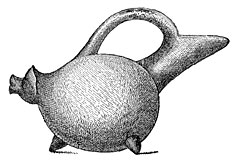
Vase ending in the snout of an animal. Found on the hill of Hissarlik at a depth of 45½ feet.
Figure 90.
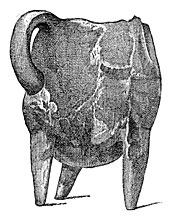
Funeral vase containing human ashes. Found at a depth of 50 feet.
Excavations have brought to light more than six hundred celts or knives, generally of smaller size than those found in Denmark or France. Rock of many kinds, including serpentine, schist, felsite, jadeite, diorite, and nephrite, were used; and saws of flint or chalcedony, some toothed on one side only, others on both, are of frequent occurrence. They were fixed into handles of wood or horn, and kept in place with some agglutinative substance, such as pitch, several of them still retaining traces of this primitive glue. We must also mention awls, pins of bone and ivory, and ossicles or knuckle bones, in every stage of manufacture, confirming the accounts of Greek historians, who tell us of the great antiquity of the game played with them. The Dardanians used wooden and bone implements and weapons almost exclusively. It is impossible to say whether they were acquainted with the use of metals, but we might assert that they were if we could quite certainly attribute to them a certain mould of mica schist, found at a depth of 45½ feet, which bad been used in the process of casting spits and pins, which are supposed to be of more ancient date than the fibulæ.
Figure 91.
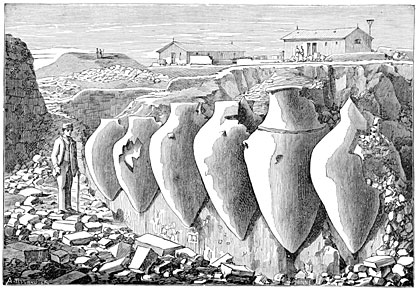
Large terra-cotta vases found at Troy.
Figure 92.
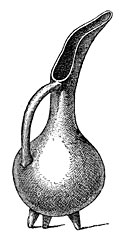
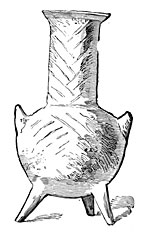
Earthenware pitcher found at a depth of 19½ feet.
Figure 93.
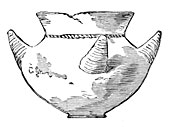
Vase found beneath the ruins of Troy.
The most valuable objects of the collection come from the deposits representing the town of Troy; they are all twisted, broken, and charred, bearing witness to the fierceness of the flames in which the town perished. These discoveries reveal to us the daily life of the people of Troy. Judging from the number of boars’ tusks found, hunting must have been a favorite pastime with them. The bones of oxen, sheep, and goats, of smaller species than those of the present day, have also been found. Horses and dogs were rare, and cats unknown. The domestic poultry of the present day was also wanting, no remains of birds having been found except a few bones of the wild swan and the wild goose. Fish and mollusca, as proved by the immense numbers of bones and shells, formed an important part of the diet of the Trojans. They also fed largely on cereals, which they cultivated with success; and wheat, the grains of which were very small, was known to them. The preservation of these vegetable relics was due to carbonization.
Figure 94.
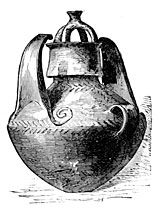
Terra-cotta vase found with the treasure of Priam.
Figure 95.
Vase found beneath the ruins of Troy.
Figure 96.
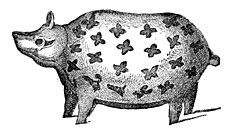
Earthenware pig found at a depth of 13 feet.
Figure 97.
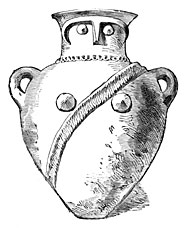
Vase surmounted by an owl’s head. Found beneath the ruins of Troy.
Figure 98.
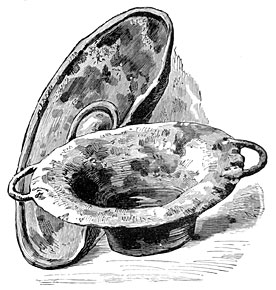
Copper vases found at Troy.
Figure 99.
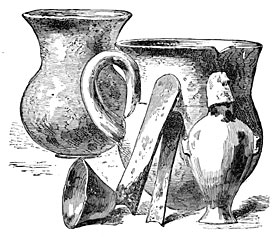
Vases of gold and electrum, with two ingots, found beneath the ruins of Troy.
Figure 100.
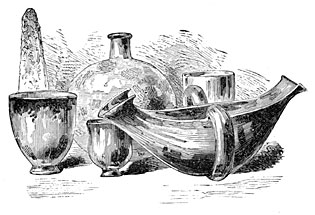
Gold and silver objects from the treasure of Priam.
Figure 101.
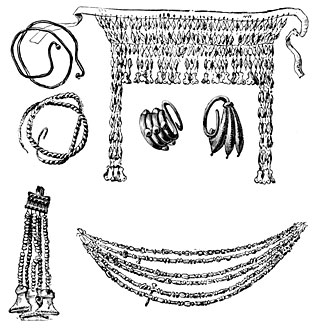
Gold ear-rings, head-dress, and necklace of golden beads from the treasure of Priam.
I will not add more to what I have already said about the towns which succeeded each other on the ruins of Troy, and of which the successive stages of rubbish on the hill of Hissarlik are the only witnesses left. The flames spared none who settled on that doomed spot, and new arrivals disappeared as rapidly as they came. The Ilium of the Greeks and Romans alone enjoyed any prosperity, but it too was in its turn swept away; and at the present day a few wandering shepherds and their flocks are the sole dwellers upon the hill immortalized by Homer.
Before concluding this chapter I must refer once more to a, fact of considerable interest. In that part of the deposits of Hissarlik which represents Troy, Dr. Schliemann picked up the perforated whorls to which the name of fusaïoles has been given (Fig. 102), and of which we spoke in our account of the Lake Dwellings of Switzerland. These fusaïoles are generally of common clay mixed with bits of mica, quartz, or silica, though some few have been found at Mykenæ and Tiryns of steatite. The clay whorls before being baked were plunged into a bath of a very fine clay of gray, yellow, or black color, and then carefully polished. They nearly all bear ornaments of very primitive execution, such as stars, the sun, flowers, or animals, and more rarely representations of the human figure.
Figure 102.
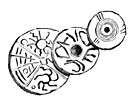
Terra-cotta fusaïoles.
Figure 103.
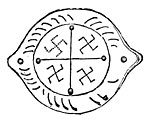
Cover of a vase with the symbol of the swastika. Found at Troy.
Figure 104.
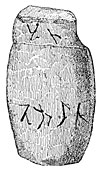
Stone hammer from New Jersey bearing an undeciphered inscription.
Moreover, if we cross the Atlantic we find the same symbol engraved on the temples of Yucatan, the origin of which is unknown, on a hatchet found at Pemberton, in New Jersey (Fig. 104), on vases from a Peruvian sepulchre near Lima, and on vessels from the pueblos of New Mexico. Dr. Hamy, in his “American Decades,” represents it on a flattened gourd belonging to the Wolpi Indians, and the sacred tambours of the Esquimaux of the present day bear the same symbol, which was probably transmitted to them by their ancestors. The universality of this one sign amongst the Hindoos, Persians, Hittites, Pelasgians, Celts, and Germanic races, the Chinese, Japanese, and the primitive inhabitants of America is infinitely strange, and seems to prove the identity of races so different to each other, alike in appearance and in customs, and is a very important factor in dealing with the great problem of the origin of the human species.
We have now passed in review the chief of the works left behind him by man from the earliest (lays of his existence to the dawn of historic times. We must still show prehistoric man in the presence of death, the universal destroyer, and learn from the evidence of the tombs of the remote past how our ancestors met the common doom.