Chapter V · Megalithic Monuments.
N. D'Anvers translation
Megalithic monuments are perhaps the most interesting of all the witnesses of the remote past, into the history of which we are now inquiring, and of which so little is known. From the shores of the Atlantic to the Ural Mountains, from the frontiers of Russia to the Pacific Ocean, from the steppes of Siberia to the plains of Hindustan, we see rising before us monuments of the same characteristic form, built in the same manner. This is a very important fact in the history of humanity, and of which it is difficult to exaggerate the importance.
What is the age of all these monuments? Were they all erected by one race, which has thus carried on its traditions front one generation to another? Were they the temples of the gods of this race, or the tombs of their ancestors? Did the people who set them up come from the East, or did they come from the North, on their way to the warmer regions of the South? These and many other questions are eagerly discussed, but in the present state of our knowledge not one of them call be answered in a perfectly satisfactory manner. Scire ignorare magna scientia, said an ancient philosopher, and this is a truth which we must often repeat when we are dealing with prehistoric times.
Figure 55.
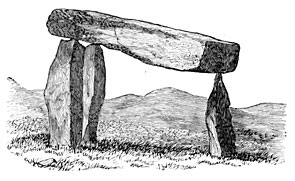
Dolmen of Castle Wellan (Ireland).
Figure 56.
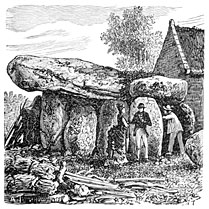
The large dolmen of Coreoro, near Plouharnel.
Figure 57.
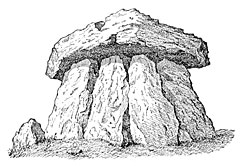
Dolmen of Arrayolos (Portugal).
The dolmen type of monument is a rectangle of u hewn upright stones covered over with a slab laid across them; this slab being the largest block of stone that could be found in the neighborhood or obtained by the builders.
Dolmens are generally found either on the top of a natural or an artificial mound, in the middle of a plain, or on the banks of a watercourse. We must mention, amongst others, those in Persia, which are some 7,000 feet high and from twenty-one to twenty-six feet long by six wide; that near Mykenæ, that of Aumède-Bas, excavated by Dr. Prunières; that of New Grange, in Ireland, surmounted by a cromlech of stones of considerable size, many of them brought from a distance; that of Hellstone, near Dorchester, consisting of nine upright stones supporting a table more than twenty-seven and a half feet in circumference, seven feet wide and two and a half thick. The dolmens near Saturnia, one of the most ancient Etruscan towns, include a quadrangular room, sunk some feet into the earth, and having walls made of blocks of stone and a roof of a couple of large slabs, sloped slightly to let the rain run off. We give illustrations of the dolmens of Castle Wellan in Ireland (Fig. 55), of Coreoro near Plouharnel (Morbihan) (Fig. 56), of Arrayolos in Portugal (Fig. 57), and Acora in Peru (Fig. 58), which will enable the reader to judge of the different modes of construction employed in building these megalithic monuments.
Figure 58.
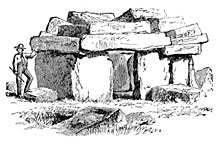
Megalithic sepulchre at Acora (Peru).
In some cases the dolmen, which alone is visible from without, is placed upon a mound, covering a hidden sepulchral chamber, whilst in others the crypt is replaced by a simple stone cist, generally of rectangular shape. We may mention in this connection the dolmen of Bekour-Noz at St. Pierre Quiberon, which is remarkable for its great size, and rises from the midst of a cemetery in which a great many coffins have been found. The bones they contained were unfortunately dispersed at the time of their discovery.
Cromlechs are circles of upright stones often surrounding dolmens or tumuli. Sometimes they form single circles, and at others two, three, or even seven separate enclosures. They are common in Algeria, Sweden, and Denmark, and in the last-named country two kinds are distinguished: the langdyssers, which form an ellipse, and the rundyssers which form a perfect circle. In other countries cromlechs are slot so numerous; there are but few in France, of which we may name those of Kergoman (Morbihan), Lestridion in Plomeur, and Landaondec in Crozon (Finistère). The last-named, known its le temple des faux dieux, is closed by a double row of small menhirs. In Italy, the only cromlechs known are those of Sesto-Calende and those of the plateau of Mallevalle near Ticino. One of the latter still retains in their original position fifty-nine huge granite blocks, forming a circular enceinte, a semicircle, and an entrance avenue. A few leagues from the ancient Tyre can still be seen a circle of upright stones. Ouseley describes another at Darab, in Persia; a missionary speaks of three large circles at Khabb, in Arabia, which circles he compares with those at Stonehenge; and Dr. Barth tells us of a cromlech between Mourzouk and Ghât.
It was in Great Britain, however, that cromlechs appear to have reached their highest development. That of Salkeld in Cumberland includes sixty-seven menhirs; that near Loch Stemster in Caithness, thirty-three, whilst in Westmoreland, Long Meg and her daughters are still the objects of superstitious reverence. The remains at Avebury are among the most remarkable prehistoric monuments still extant, and evidently originally formed part of a most important group. This group had an outer rampart of earth, with a ditch on the inner side, within which was a circle of upright stones, probably numbering as many as one hundred. Within this circle were two others of smaller size, each in its turn enclosing yet another circle of upright stones. In the middle of one of these inner circles, that on the north, was a dolmen, whilst that on the south enclosed in the centre but a single upright menhir. The stones used in constructing these various groups were all such as are still to be found on the Wiltshire downs. From the southeastern portion of the extensive earthen rampart, a stone avenue extended for a considerable distance in a perfectly straight line, and is still known as Kennet’s Avenue, on account of its leading to the village of Kennet. The remains on Hakpen Hill and on Silbury Hill are all supposed to have been originally connected with those at Avebury. The remains at Hakpen consist of relics of two circles, one about 140 feet in diameter, the other not more than forty. About eighty yards from the inner circle was found a double row of skeletons, all with the feet pointing towards the centre. Silbury Hill is itself an artificial conical mound, the largest in England, 170 feet high, on which were originally no less than 650 upright stones, of which only twenty are still standing, surrounded by a trench. In the centre of the circle of stones a single menhir of great height still remains with three others sloped so as to form a kind of crypt.
The megalithic monuments of Stonehenge, which are probably better known than any others in the world, are perhaps also the most curious. The group is supposed to have originally consisted of an outer stone concentric circle some one hundred feet in diameter, formed by thirty piers of solid masonry, of which about twenty can still be made out, some few standing, others lying broken upon the ground. This outer circle enclosed a second of similar shape but lesser diameter, within which again were taro elliptic circles, the outer consisting of ten or twelve sandstone blocks some twenty-two feet high, standing in pairs, each pair united by a slab laid horizontally across, so as to form a trilithon. The inner ellipse was formed by nineteen upright masses of granite, within which was the famous slab of blue marble, by many supposed to have been an altar. The pillars and lintels of the outer portico, and those of the trilithons, are fitted together with the greatest skill, with tenons and mortices, a remarkable exception to the general rule with megalithic monuments. Everywhere in the neighborhood of Stonehenge, as far as the eye can reach, are tumuli, all nearly equidistant from the principal group of monuments, a fact which has led many archæologists, including Henry Martin, to look upon. Stonehenge as a temple surrounded by a necropolis. Excavations at Stonehenge have yielded a few human bones which have escaped the flames, with some stone and bronze weapons.
In some cases menhirs mark the site of a tomb, and sometimes, as is the case with the obelisks of Egypt, they commemorate some happy event. A standing stone in Scotland preserves the memory of the battle of Largs, which took place in the thirteenth century, and a piously preserved legend tells how the menhir of Aberlemmo was set up in honor of a victory over the Danes in the tenth century.
Figure 59.
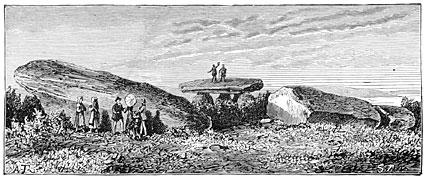
The great broken menhir of Locmariaker, with Cæsar’s table.
The covered avenues are often built beneath masses of earth, and the inner rooms became regular hypogea, These hypogea, or subterranean chambers, are very common near Paris, and we may mention amongst many others those of Meudon, Argenteuil, Conflans-Sainte-Honorine, Marly, Chamant, La Justice, and Compans. The tombs of Denmark, the Gang Graben of Nilsson, show an arrangement somewhat similar, a vast subterranean chamber being reached by a passage ending in a small stone cist. The tumulus of Dissignac, near Saint-Nazaire (Fig. 60), shows this strange arrangement of two galleries running parallel with each other at a distance of about eighteen feet. The walls and ceilings are made of slab, anti the interstices are filled in with flints. These galleries are some thirty feet long, and their height insensibly increases from about three to nine feet.
Figure 60.
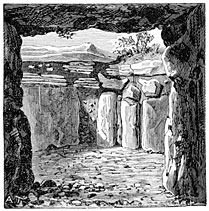
Covered avenue of Dissignac (Loire-Inférieur); view of the chamber at the end of the north gallery.
Figure 61.
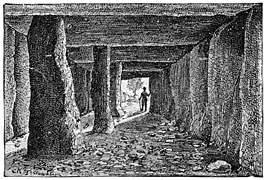
Covered avenue near Antequera.
At Gavr’innis, the length of the passage leading to the crypt exceeds forty-two feet (Fig. 62), and the Long Barrow of West Kennet is more than seventy-three feet long by a width in some parts exceeding thirty-two feet. In the Long Barrows of Littleton, Nempnitt, and Uley, the crypt is reached by an avenue, the entrance of which is closed by a trilithon, and a similar arrangement is met with in many megalithic monuments of Scania. The sepulchral chambers of oval shape, such as that met with in the island of Moen, were surmounted by a tumulus some 100 yds. in circumference; twelve unhewn stones formed the walls, and five large blocks the roof. In removing the earth from the Moen tomb, the bones of several human individuals were found; and a skeleton, doubtless that of the chief, lay stretched out in the middle of the chamber, whilst the bones of the others had evidently been ranged against the walls either in a sitting or crouching position. With the bones were found a flint hatchet, which appeared never to have been used, a number of balls of amber, and several vases of different shapes.
Figure 62.
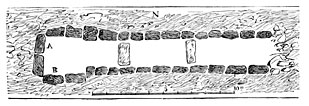
Ground plan of the Gavr’innis monument.
The megalithic monuments of Mecklenburg are supposed to date from Neolithic times, and are constructed in two very different ways. The Hünengräber, formed of huge blocks of granite set up at right angles to each other, resemble the covered avenues of France and elsewhere; in the so-called Riesenbetten, or giant’s beds, on the contrary, the sepulchral chamber is merely sunk in the ground.
We must also mention the so-called Grotte des Fées, or fairy grotto, forming part of so many of the megalithic monuments of Provence. This fairy grotto includes an open-air gallery cut in the mountain limestone and roofed in with huge flat stones. This gallery leads to a sepulchral chamber not less than seventy-nine feet long.
We have now specified the chief forms and modes of arrangement of megalithic monuments, and must add that they are often found in juxtaposition. At Mané-Lud, for instance, on a rocky platform which had been artificially smoothed, and which is some 246 feet long by 162 in area, we find at the eastern extremity an avenue of upright stones, on the west a dolmen, and in the centre a crypt surmounted by a conical pile of stones. Between the cone and the avenue the ground is covered with an artificial paving of small stones cemented together, and known in France as a nappe pierreuse, and amongst the stones forming this paving were found quantities of charcoal and bones of animals. The megalith was completely buried beneath a mound of earth, or rather of dried mud, the amount of which was estimated at more than 37,986 cubic feet. At Lestridiou (Finistère), a cromlech forms the starting-point of an alignment formed of seven rows of small menhirs, the mean height of which above the ground does not exceed three feet; and these alignments lead up to two covered avenues and a central dolmen. In other cases, in England and the land of Moab for instance, alignments simply lead to cromlechs; whilst in some few cases, as at Stennis (Fig. 63), the menhirs are scattered about a plain in great numbers, with nothing either in their form or their position, or in the traditions relating to them, to throw the slightest light on their origin.
Figure 63.
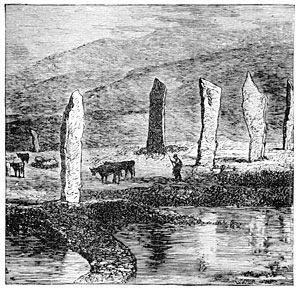
Monoliths at Stennis, in the Orkney, Islands.
One of the most important monuments that have come down to us is that of Carnac. The alignments of Menec, Kermario, and Kerlescant include 1,771 menhirs, of which 675 are still standing. The alignments of Erdeven, which succeed those of Carnac, extend for a length of more than a mile and a half. They originally included 1,030 menhirs, of which 288 are still extant.
The archæologists of Brittany, carried away perhaps by their patriotic enthusiasm, claim that when these monuments were intact they included two thousand menhirs. What is really certain, however, is that a definite plan was evidently followed, the distances between the alignments tallying exactly; the menhirs being set up in straight parallel lines gradually decreasing in size towards the east. Excavations near them have brought to light fragments of charcoal, masses of cinders, chips of silicate of flint, with numerous fragments of pottery, and tools made of quartzite, granite, schist, and diorite, similar to those met with under all the other megaliths of Morbihan. This is yet another proof, if such were needed, that they were all the work of the same race and all probably date from the same period.
Algeria presents a vast field for research, and it is easy to find dolmens and cromlechs, such as that shown in Fig. 64, which are sepulchres with a central dolmen surrounded by a double or triple enceinte of monoliths driven into the ground. These monuments, much as they differ in form and arrangement, are undoubtedly the work of one strong and powerful race that dominated the whole of the north of Africa; and are represented in historic times by the Berbers, and at the present clay by the Kabyles.
Figure 64.
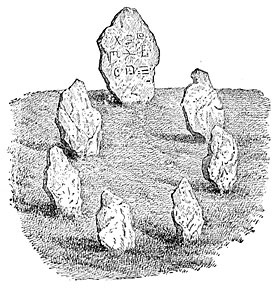
Cromlech near Bône (Algeria).
In Algeria, we also meet with quadrangular pyramids called djedas, which measure as much as ninety feet on each face, but do not rise more than three feet above the ground. The (lead were buried beneath them in a crouching position. We know nothing either of the origin of these djedas or of the date to which they belong.
Figure 65.
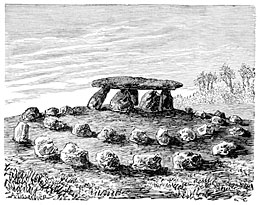
Dolmen at Pallicondah, near Madras (India).
This is, of course, but a very rapid survey of the megalithic monuments of our globe. They are most of them either tombs intended to hold the bodies of the dead, or memorials set up in their honor. New facts are constantly coming to light in this connection, and we may add to what we have already said, that beneath the tumulus of Mugen, as in the Cabeco d’Aruda ( Portugal), there are numerous skeletons; sixty-two repose in the sepulchral chamber of Monastier (Lozère); the dolmen known as the Mas de l’Aveugle (Gard) covers a circular cavity in which fifteen corpses had been placed; that of La Mouline (Charente) also enclosed a number of skeletons, all in a crouching position, whilst above them were placed two clumsy vases, a pious offering to the unknown dead. The prehistoric cemetery of Maupas contains several crypts of irregular form, built of rubble stone, and surmounted by a huge stone which had become corroded by age. In these crypts, too, the dead were piled up on each other, and the relics found with them justify us in assigning them to the Neolithic age. Beneath the dolmens of Port-Blanc (Morbihan) were two upper layers of dead, stretched out horizontally and separated by flat stones. In the Isle de Thinie (Morbihan) excavations have brought to light twenty-seven stone cists or coffins of different sizes, all intended to be used for burial. Beneath the menhirs of Finistère, cinders and stones charred by fire bear eloquent witness to the cremation of the dead. “Whenever a dolmen has been opened in Finistère,” says Dr. Floquet, “cinders or bones have been picked up; why, then, should we not admit that all dolmens are tombs?” This is really a conclusion to which we are almost compelled to come, and the names handed down by popular tradition are, if need be, yet another proof of the same thing. One dolmen at Locmariaker, for instance, is known as le tombeau du vieillard, a covered avenue at Saint Gildas is le champ du tombeau, and farther on a pathway leading to a ruined megalith is known as the chemin du tombeau. The Abbé Harvard speaks of a remarkable monolith known as la pierre du champ dolent, and another champ dolent is met with near Rheims, whilst a group of monuments near Tréhontereuc is called the jardin des tombes, and the upright stones of Auvergne are known by the characteristic name of the plourouses.
Whether we examine the megaliths of Germany or of Poland, the mounds of Ohio or of Kentucky, of Missouri or of Arkansas, it is ever the same thing; excavations bring to light striking proofs of their destination, and everywhere we are led to the same conclusions.
Archæologists would certainly appear to have been justified in hoping that the tombs thus scattered about all over the world would yield such useful information as to lead to some final conclusions. Unfortunately, however, this has not been the case. Often all trace of burial has disappeared in successive displacements, and more often still, the home of the dead has been violated in the hope, which turned out to be imaginary, of finding treasures; whilst in other cases the earliest inhabitants of the tombs have been removed to make way for their successors, who in their turn were soon afterwards expelled. Victory and defeat were not over with life, but were met with yet again in the grave.
Figure 66.
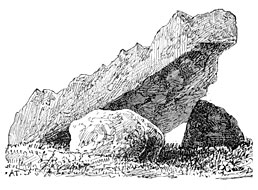
Dolmen at Maintenon, with a table about 19½ feet long.
It has been well pointed out by Fergusson, in his “Rude Stone Monuments,” that the megalithic architecture of the remote past is a thing altogether apart; its special form indicating now the tendencies of a race or group of races of mankind, now the particular degree of civilization attained by a race at a certain period of its development. A cursory view of these monuments as a whole would lead us to class them all together as masses of rough, scarcely hewn stones piled up without cement, and almost always without ornamentation. In studying them one by one, however, we find, in spite of their undeniable family likeness, if we may use such a term, that it is quite easy to snake out certain differences, the result of the peculiar genius of the race by whom they were erected, or of the nature of the materials the builders had at their disposal. To take a case in point: Cromlechs are most numerous in England, and dolmens in France, and in both these countries we meet with a form of dolmen (Fig. 66) such as is rarely set up in other districts; one of the extremities of the table resting on the ground, and the other opt two supporting stones. In Scandinavia the supports are erratic blocks, in India fragments of the rocks in the neighborhood, in Algeria and the south of France buildings in courses are often met with; in Brittany the monuments of Mané-er-H’roek and Mané-Lud are paved with large stones. The ground from which rises the dolmen of Caranda, near Fère in Tardenois (Aisne), is covered with slabs, and the opening is closed with a flat stone resting on two lintels. We cannot speak of Caranda without referring to the discoveries and magnificent publications of M. F. Moreau, thanks to whom the daily life of the Gauls, Gallo-Romans, and Merovingians is brought vividly before us. To return, however to our monuments: As we have seen, the crypt was in many cases divided into two or more sepulchral chambers by walls made of stones. We find this arrangement at Gavr’innis, at Gamat (Lot), at Alt-Sammit in Mecklenburg, in Wayland Smith’s cave in Berkshire, and in a great many monuments in Scandinavia. M. du Chatellier speaks of several megalithic monuments in Finistère, including a central dolmen and several lateral chambers. The chambered graves at Park Cwn in Wales, and at Uley in Gloucestershire, contain side chambers, those of the former with a covered passage between them, whilst in the latter the side chambers are grouped round a central apartment. At New Grange, in Ireland, a passage more than ninety-two feet long leads to a double chamber of cruciform shape, with a roof of converging stones. Yet another fine example of a similar kind is that of Maeshow in the Orkney Islands. The tomb of Vauréal (Seine-et-Oise) contains three crypts of different sizes. The long barrow of Moustoir-Carnac contained four separate chambers, the western one of which is a dolmen of the kind known as Grottes des Fées, and is supposed to be much older than the rest of the group. A central circular chamber, with walls of upright stones, has a roof in which an attempt has been made to form a kind of dome, the stones of which project and overlap each other, marking, clumsy as is the construction, a considerable advance on anything previously accomplished, and adding considerably to the solidity of the monument.
Stone as well as wood can be much more easily cut in one direction than in any other. Men early learnt to recognize this peculiarity, and to take advantage of it in attacking rock. With their stone hammers they struck in straight lines, always aiming at the same points, and then, probably with the help of a fierce file, they succeeded in breaking off fragments. They also employed wedges of wood, which they drove into natural or artificial fissures, pouring water on to this wedge again and again. The wood became swollen with the damp, and in course of time a block of stone would be detached. Neither time nor sinewy arms were wanting, and Fergusson has remarked that any one who has seen the ease with which Chinese coolies transport the largest monoliths for considerable distances, will not look upon the difficulties of transport as insurmountable. A more serious difficulty would be the placing of the table of the dolmen on the supports, which are often raised to a great height above the ground. It is supposed that earth was piled up against the jambs so as to form an inclined plane, up which the table was slid into place with levers and rollers of the most primitive form, such as were in use in the most remote antiquity. Sometimes the way in which these stones are balanced is perfectly marvellous. The Martine stone, near Livernon (Lot), for instance, is the shape of a boat, and the slightest touch is enough to make it rock on its two supports. That of Castle Wellan (Fig. 55) rests on three stones pointed at the top, and some of the trilithons of India are of even more remarkable construction.
Although, as a general rule, megalithic monuments are without ornamentation, there are a good many exceptions in the case of dolmens made of very hard granite, on which numerous carvings and engravings have been made. It is, however, impossible to decipher any but a very few of these signs, whether circles, disks, dots, tooth or leaf mouldings, spirals, serpentine lines, lozenges, or strip.
Figure 67.
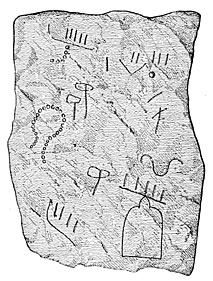
Part of the Mané-Lud dolmen.
The monument of the Isle of Gavr’innis, of which we have already spoken, is the most remarkable of any for the richness of its decoration. It includes a gallery, consisting of forty-nine blocks of granite and two of quartz, leading to a spacious apartment. These blocks were brought from a distance, and the fact that the little arm of the sea separating the island from the mainland was crossed, proves that the men who built the monument owned boats strong enough to carry heavy loads. Excavations carried on in 1884 brought to light a pavement consisting of ten large slabs of granite, and beneath this pavement was found a kind of crypt at least three feet deep, the lower part of the lateral menhirs forming the walls. We must add, however, that Dr. de Closmadeuc, and his opinion should carry weight, thinks that when the Gavr’innis monument was erected the island was connected with the mainland. Three of the supports, forming the walls of the crypt, and all those of the gallery are covered with chevrons or zig-zag ornaments, circles, lozenges, and scrolls of which Fig. 68 will give some idea, and which Mérimée compares to the tatooing of the inhabitants of New Zealand. Megalithic monuments of Ireland and certain stones in Northumberland are ornamented in a manner resembling the Gavr’innis engraving, similar designs being produced by similar means, and although the engravings of Morbihan are generally more clearly cut and distinct, Ave note in all alike the same absence of regularity, the same roughness of execution, the same strange types, the same disorder in the arrangement of the signs, and the same care to preserve the surface of the block in its natural condition.
Figure 68.
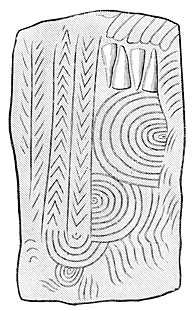
Sculptures on the menhirs of the covered avenue of Gavr’innis.
There has been a good deal of discussion about the orientation of megalithic monuments, and the truth on that point once ascertained, some light might be thrown on the aim of the builders. It is evident, however, that there never was any general system of orientation. The dolmens of Morbihan, it is true, nearly all face the east, doubtless in homage to the sun rising in its splendor; but this is not the case in Finistère, and the dolmens of Kervinion and Kervardel, for instance, are set due north and south. Leaving Brittany, we are told by the Rev. W. Lukis that the position of the megalithic monuments of England varies considerably: most of the dolmens of Berry, Poitou, Aveyron, and the island of Bornholm, face west; and those of Algeria are set southwest, and northeast, so that it is really impossible to come to any final conclusion.
Some of the megalithic monuments already noticed have a peculiarity to which we must refer here on account of its importance. One of the supports, in nearly every case that which closes the entrance, is pierced with a circular opening. Sometimes, however, the opening is elliptical or square.
Figure 69.
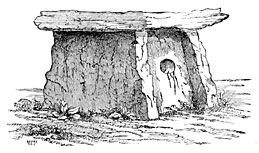
Dolmen with opening (India).
We meet with dolmens thus distinguished in India (Fig. 69), in Sweden, in Algeria, in France, and in Palestine, where they are often associated with sepulchral niches hewn out of the rock and also pierced with an opening corresponding with that of the entrance. In Alemtejo (Spain), square openings occur. West of Karleby in Sweden, is a sepulchral chamber about twenty-nine feet long, made of slabs set upright, all those facing south being pierced with a nearly circular opening; and on the shores of the Black Sea dolmens made of four upright stones surmounted by a slab, have, in every case, one of the uprights pierced with an artificial opening about six inches in diameter. These dolmens are said by the country people to have been set up by a race of giants who built them as shelters for a dwarf people on whom they had compassion.
Figure 70.
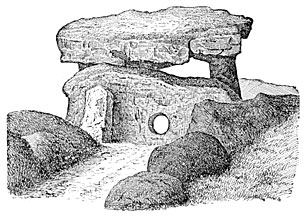
Dolmen near Trie (Oise).
In France, dolmens with openings are so numerous that it is difficult to make a selection. That known as La Justice, near Beaumont-sur-Oise, consists of a small vestibule and a very long mortuary chamber, separated by a slab pierced with a round opening. We must also mention the megalithic monument of Villers-Saint-Sépulchre at Trie (Oise) (Fig. 70), that of Grand-Mont, with many of those of Morbihan, of which that of Kerlescant has an oval opening; the covered avenue of Conflans-Sainte-Honorine, originally erected at the confluence of the Seine and Oise, and now set up exactly as it was found at Saint Germain, has an oval opening, and presents the exceptional feature, of which I know no other instance, of having a stone for closing the opening if necessary; the covered avenue of Bellehaye in Normandy, reproduced with precision at the Paris Exhibition of 1889, which was closed by a transverse stone with an opening some inches in diameter.
Of English examples we may mention the dolmens of Rodmarten and Avening; Mérimée quotes several megalithic monuments in Wiltshire; and Sir J. Simpson, the well-known and oft-described Kit’s Cotty House, which is nothing more than a dolmen with an opening. Holed Stones, as they are called, are numerous in Cornwall, the size of the opening varying considerably; that at Men-an-Tol, for instance, is more than a foot in diameter, whilst others are but a few inches long. At Orry’s Grave, in the Isle of Man, two large stones are so placed as to leave a circular space between them, which was evidently intended to serve the same purpose, or at least was in accordance with the same superstition, as were similar characteristics elsewhere. Setting aside the interminable legends connected with dolmens having openings, there is no doubt that this peculiarity of structure, which we meet with in India as in Scandinavia, in the Caucasus as in France, shows that the builders of all of them were impelled by a similar idea. These openings are too small to allow of the introduction of other corpses, or to afford to the living a refuge in the home of the dead; they could but have served for the passing in of food, of which a supply was so often left for the departed; or yet another interpretation is possible: they may have been left for the soul or the spirit to leave its earthly prison and take flight for those happy regions in which all races more or less believe, and to which belief these openings may be witnessed to the present day. M. Cartailhac, however, hazards yet another explanation, and suggests that the megalithic monuments were intended for the interment of whole families, and that the bodies were not introduced into the tombs until all the flesh was gone, when the skeletons might have been slipped through the openings left for that purpose. The repeated disturbances of the remains in the graves have unfortunately often entirely dispersed all the human bones.
It was in Brittany that the art of erecting dolmens reached its fullest development, and it is there that the relics found in the tombs are of the most important character. Nowhere do we find weapons more carefully preserved, more delicately finished ornaments of a more remarkable kind. The Museum of Vannes, where most of the valuable objects found in the excavations are preserved, possesses quartzite, fibrolite, diorite, and even nephrite and jadeite hatchets, some of which materials are not native to Europe; as well as amber beads and a necklace of calaïte, that precious stone described by Pliny, and which long remained unknown after his time.
Hatchets or celts are more numerous than any other objects found beneath dolmens of Brittany. A report, read by M. R. Galles to the Société Polymathique of Morbihan, enumerates the objects found with the dead beneath the dolmen of Saint-Michel. This report is a regular inventory, in which figure eleven jade celts of great elegance of form and varying from about three and a half to sixteen inches, two larger celts of coarse workmanship both broken, twenty-six small fibrolite celts with sharp edges, nine pendants, more than one hundred jasper beads which had been part of a necklace, and lastly an ivory ring. Other megalithic monuments were not less rich in relics. Thirty hatchets were picked up at Tumiac; more than a hundred, nearly all of tremolite, at Mané-er-H’roek; which were remarkable for their regularity of form, their polish, and the variety of their colors. They seldom bear any traces of having been used, and in many cases they appear to have been intentionally broken, probably in conformity with some funereal rite. Finistère, though not so rich as Morbihan, furnished an important contingent. The excavations of the Kerhué-Bras tumulus brought to light a sepulchral chamber which contained thirty-three arrow-beads. Beneath other dolmens were picked up a number of little plaques of slate, all pierced with holes; one of these pieces of slate, which was oblong in form, bore on it a representation of a sun with rays surrounded by ornaments not easy to make out. The Breton megalithic monuments also contained numerous fragments of pottery, some of which had formed part of vases without stands, such as those found at Santorin and at Troy.
In other parts of France, similar discoveries have been made; shells often brought from distant shores, glass beads, amber bowls, hatchets and celts made of stone foreign to the country. Dr. Prunières presented to the French Association, when it met at Bordeaux, a collection of weapons and ornaments which came from the megalithic monuments of Lozère. M. Cartailhac described at the Prehistoric Congress of Copenhagen the dolmen of Grailhe (Gard). A skeleton was found beneath it crouching in a corner; whilst round about it lay a knife, a flint arrow-head, a vase of coarse pottery, and in the earth forming the tumulus were picked up twenty arrow-heads, a hatchet of chloromelanite, with numerous beads and fragments of pottery. Were these offerings to the dead, or to the infernal deities, given to them in the hope of propitiating them in favor of the deceased? Beneath the megalith of Saint Jean d’Alcas were found beads of blue glass and of enamel which Dr. Prunières, having compared with those in the Campana collection in the Louvre, thinks are of Phœnician origin. The tumuli of the Pyrenees have yielded calaïte beads of the shape of small cylinders pierced with holes; and the dolmen of Breton (Tarn-et-Garonne) eight hundred and thirty-two necklace beads, some of the shape of a heart. Beneath the Vauréal dolmen were found five skulls in a row, and near one of them, that of a woman, lay a necklace made of round bits of bone and slate, on which hung a little jadeite hatchet as an amulet. These human relics were also accompanied by a fibrolite celt, numerous little worked flints, and some fragments of pottery. This arrangement of skulls in a tomb is very rare, and the only thing I can compare it to is the row of five horses’ heads placed at the end of the entrance gallery of Mané-Lud.
At Alt-Sammit (Mecklenburg), were round stone hatchets, flint knives, fragments of pottery covered with strive and ornaments; at Tenarlo (Holland), urns and amber beads. At Ancress in the island of Jersey, we find a regular necropolis dating from Neolithic times, and one hundred vases or urns of different forms were collected. In the Long Barrow of West Kennet, too, were found numerous fragments of pottery, and with these fragments boars’ tusks longer than those of the boar of the present clay, the bones of sheep, goats, roedeer, pigs, and of a large species of ox, all of which are probably relics of a funeral feast. At a little distance from West Kennet the Rev. Doyen Merewether found several flint implements. Here too, then, as elsewhere, the home of the living was side by side with the resting-place of the (lead.
Beneath the dolmens of West Gothland have been found polished stone weapons and tools associated with the bones of domestic animals, in many cases bearing traces of the work of the hand of man. At Olleria, in the kingdom of Valencia, at Xeres de la Frontera, we find diorite hatchets, and in Algeria vases filled with the shells of land mollusca. In every clime we meet with tokens of the respect in which the dead were held.
This respect is really very remarkable. The builders of the dolmens did not hesitate to sacrifice their most precious objects, their richest ornaments, their hatchets and precious stones brought from a distance by their tribe in their long migrations. No one would dream of robbing the sacred collection. Our own contemporaries, however civilized we may flatter ourselves by considering them, would not prove themselves as disinterested.
Hatchets, pottery, and personal ornaments of stone bone, etc., are not the only artificial objects found beneath the megalithic monuments. Metals, too, have been discovered, and M. Piette in one of his excavations, came across a plate formed of very thin layers of gold leaf welded together by hammering; and in several parts of the south of France have been found olives made of gold and pierced lengthwise. The dolmen of Carnouet in Brittany, insignificant as it appears and containing but one small sepulchral chamber with no gallery of access or lateral crypts, beneath a tumulus about thirteen feet high by some eighty-five in diameter, and which was left untouched until our own day, actually contained a golden necklace weighing over seven ounces; in the crypt of the Castellet monument was found a golden plaque and a golden bead; whilst the Ors dolmen in the isle of Oleron concealed a nugget which had been rolled into the shape of a bead probably after having been beaten thin with a hammer. At Plouharnel, two golden amulets were found beneath a triple dolmen, and M. du Chatellier, in excavating beneath a megalithic monument in Finistère, found a magnificent chain of gold. A somewhat similar chain was taken from the Leys dolmen near Inverness, and in 1842 Lord Albert Cunningham picked up at New Grange (Ireland) two necklaces, a brooch, and a ring, all of gold.
More than a hundred megalithic monuments of France have been found to contain bronze, and this number would be more than doubled if we counted the finds in tombs not connected with megaliths, such as those of Aveyron and Lozère, where a few bits of bronze were found mixed with numerous stone objects. One fifth of the weapons, especially the swords and daggers found beneath the dolmens, are of bronze. At Kerhué in Finistère, a number of bronze swords were arranged in a circle round a little heap of cinders and black earth, relics, probably, of the cremation of the dead, in honor of whom the tumulus had been erected.
Beneath the dolmens of Roknia (Algeria) were found thirteen bronze ornaments, and two in silver gilt of very superior workmanship, and under those of the Caucasus were picked up blue-glass beads, arrow-heads, and bronze rings; but M. Chantre, who is an authority in the matter, thinks these objects date from interments subsequent to the erection of the dolmens.
Iron was much more rarely used than bronze in the greater part of Europe. It was not even known in Scandinavia before the Christian era. In Germany, Pannonia, and Noricum its use dates from the sixth or seventh century B.C. Beneath the mounds of Central America we find but a few fragments of meteoric iron, the rarity of which made them extremely valuable; on the other hand iron was known to the Hellenes as long ago as the fourteenth century B.C., and it had been employed in Egypt for many centuries prior to that time. The most ancient sepulchres of Malabar contain iron tridents, and Genesius dates their use from before the deluge. It is therefore surprising to find that some races remained for an illimitable time ignorant of the way to procure a metal of such great utility.
Iron was not used in Brittany until towards the close of the period during which megalithic monuments were erected. Stone, bronze, and iron were found together in the Nignol tomb at Carnac, which dates from the time when cremation was already practised. We find the same association of different materials in the Rocher dolmen.
In the British Isles, especially in Scotland and in Ireland, bronze and iron objects are more numerous than in France. At Aspatria, near St. Bees in Cumberland, a cist was discovered containing the skeleton of a man measuring seven feet from the crown of the head to the feet. Near the giant lay numerous valuable objects, including an iron sword inlaid with silver, a gold buckle, the fragments of a shield and of a battle-axe, and the iron bit of a snaffle bridle. The great cairn of Dowth, in Ireland, contained iron knives and rings mixed with bone needles, copper pins, and glass and amber beads, all showing rapid progress in the industrial arts. The remarkable cairns near Lough Crew (Ireland), which were untouched and indeed unknown to archæologists until 1863, were found to contain, amongst many other interesting objects, numerous human bones, fragments of pottery, shells of marine mollusca, 4,884 bone implements, and seven pieces of iron very much oxidized. The tumuli of the Grand Duchy of Posen and those of Prussia cover kistvaens containing funeral vases, weapons, and silver and gold ornaments.
We are altogether in the dark as to the date or the use of the various objects found in these tombs, and the coins bearing dates which are often associated with them, do not seem to help us much, belonging as they doubtless do to a much later period than the erection of the monuments. We may, however, mention that near the surface of the mound of Mané-er-H’roek eleven medals of Roman emperors from Tiberius to Trajan were found; whilst under the tumulus of Rosmeur, on the Penmarch Point (Finistère), were various Roman coins; at Bergous in Locmariaker, at Mané-Rutual, and at other places in Brittany, coins of the earliest Christian emperors; at Uley, in Gloucestershire, some coins of the time of the sons of Constantine; at Mining-Low (Derbyshire), beneath a kistvaen surrounded by a cromlech, some medals of Valentinianus; at Galley-Low, with a magnificent gold necklace set with garnets, a coin of Honorius, but as these last were found at the outer edge of the mound there are doubts as to the time of their deposition; these doubts were, however, to some extent set at rest by the finding of a coin of Geta beneath the monument itself. We might multiply instances of similar finds, but I will only mention one more, the discovery under some Scotch barrows of silver necklaces and coins of the Caliphs of Bagdad, bearing date from 88 887 to 945 A.D.
This last discovery confirms what I have already said, that the introduction of the coins was of much later date than the erection of the monument. Another fact adds weight to this decision. The most ancient Gallic coins date from about three centuries before our era, and the earliest British from a century earlier than that. How is it that excavations have brought to light no specimens of either? The Romans successively occupied all the countries of which we have just spoken; the tombs themselves bear witness to their conquests; and it is to the violation of the tombs, the displacements, and secondary interments that we owe the introduction of coins, pottery, and bricks that undoubtedly date from the Roman period, and were probably placed beside their dead by the Roman legionaries.
Whatever may be the difficulties, however, we are already able to come to certain definite conclusions. We cannot connect the megalithic monuments with any one of the ancient religions known. They were certainly not set up in honor of Odin or of Osiris, of Astarte or of Athene, the Phoenician or the Egyptian, the Greek or the Roman gods; their erection seems to have had but one end in view, to do honor to the dead. Beneath none of them do we find the remains either of the cave-bear or of the reindeer, still less of the mammoth or of the rhinoceros; whereas we do constantly meet with the bones of animals characteristic of Neolithic times. It is therefore to that period that we must attribute the more ancient of these mysterious monuments. And the setting up of such memorials continued throughout the intermediate time between the Stone and Bronze ages, and through the Bronze and Iron periods. It was, indeed, still practised now and then in the earlier centuries of the Christian era. More than that, such monuments are even now occasionally erected. The Khassias of India make cromlechs of large, flat unhewn stones, some six to seven feet high, and the Angami-Nagas of the extreme north of British India set up extensive alignments of menhirs, similar to those of France. Inscriptions in the old Irish cipher writing, known as ogham, prove that megalithic monuments were erected in Ireland after the time of St. Patrick; and, as we have already remarked, some of the Breton menhirs are surrounded by crosses. In India, too, we find the symbol of the Christian faith, and in 1867, were discovered on the shores of the Godavery between Hyderabad and Nagpore, a few dolmens made of four upright stones surmounted by one or two slabs of sandstone, and encircling a cross which is said to date from the same age as the dolmens themselves. We must add, however, that the most competent archæologists are of opinion that this form of the cross was not introduced into India until about the sixth or seventh century of our era. Probably the erection of megalithic monuments was not discontinued in England or in France until towards the eighth or ninth century after Christ; and the menhirs set up later in Scotland and in Scandinavia prove how fondly the people of those countries clung to ancient traditions. These rude stone monuments were handed down from one race to another, from invaders to invaded, from conquered to conquerors.
We must not, however, omit to mention one serious objection. Roman historians, exact as is their description of Gaul, Britannia, and Germania, are silent as to stone monuments. Tacitus does not refer to Stonehenge or to Avebury. Cæsar was present at the naval battle between his own fleet and that of the Veneti, in the Gulf of Morbihan, and if the megalithic monuments of Carnac were then there, would they not have arrested the attention of the great captain? This silence is the more inexplicable as one of the earliest geographers mentions the stone of Iapygia; Ptolemy speaks of a similar stone on the shores of the ocean; Strabo, of a group of dolmens near Cape Cuneus; Quintus Curtius, of an important alignment in Bactriana; Pliny, who mentions a leaning pillar in Asia Minor, says nothing of the megalithic monuments of Gaul, which he crossed several times. Moreover, Ausonius, Sidonius, Appollinaris, and Fortunatus, who are so eager to glorify their own land, maintain a similar silence with regard to these structures. Sulpicius, Severus, and Gregory of Tours, old chroniclers of French history, also pass them over without a word. More than that, Madame de Sévigné, who was stopping at Auray in 1689, and visited its environs, writes to her daughter of all she has seen and done, without alluding to the alignments of Carnac, or of Erdeven, which were, of course, much more complete in her day than in ours. In fact, they are mentioned for the first time by Sauvagère, in his “Recueil des Antiquites de la Gaule,” in which he attributes them to the Romans. We may therefore, perhaps, conclude that these decayed and clumsy-looking monuments were despised for generations, no one realizing their importance or caring to penetrate their secrets.
If need were, we have yet other proofs of their extreme antiquity. In excavating an alignment in the district occupied by the Kermario group, a Roman encampment was discovered. The enceinte is represented by a long wall about six feet thick, and propped up against this wall were found a number of flat stones blackened with smoke, on which the legionaries doubtless cooked their food. In some instances these hearths were made on an overturned menhir, and other menhirs, which had belonged to the alignment, were fitted into the walls. A Roman road passes near Avebury, and, contrary to their general custom, the haughty conquerors had turned aside to avoid the tumulus. These are decisive proofs that in France and England at least the megalithic monuments were erected before the advent of the Romans.
We may add that the distances between what we may call megalithic zones is considerable. We meet, for instance, with dolmens in Circassia and in the Crimea, but there are no others nearer than the Baltic. There are none in the districts peopled by the Belgæ, from the Drenthe to the borders of Normandy, nor are there any in the valleys of the Rhine or of the Scheldt. There are but a few in Italy or in Greece, where Pelasgic buildings were early erected, and bore witness to a more advanced civilization. We meet with them again, however, in Palestine, but we must traverse many miles before we find other examples at Peshawur and in the valley of Cabul. It is difficult to overrate the importance of these facts, or to explain these gaps. Are they, however, so complete as has been supposed? The few travellers who have crossed Afghanistan and Daghestan have seen tumuli which may have served as points of union between the monuments of India and those of the Caucasus. The megalithic monuments of Palestine and of Arabia may yet be found to be linked with those of Algeria, by examples in the little known regions between the Nile and the Regency of Tripoli. If our ignorance forbids us to assert anything on this point, it equally forbids our denying anything with any confidence. We may also add one general remark: the countries where megalithic monuments are found, abound in granite, in sandstone, and in flint, whilst other districts have only very friable limestones; and, their monuments, if they were ever erected, would have been more easily destroyed, the very ruins disappearing and leaving no trace.
It has been said, moreover, that the mode of construction of the dolmens, and we hate ourselves made the same remark, is far from being the same everywhere. The dolmens of Brittany have sepulchral chambers with long passages leading to them; those of the neighborhood of Paris have wide covered avenues with a very short entrance lobby. In the south of France we see nothing but rectangular compartments formed of four or five colossal stones. All this is true enough; but if we examine our old cathedrals of comparatively modern date, the common origin of which is never disputed, we note differences no less remarkable. On the other hand it is urged that if megalithic monuments were all erected by one race, the objects they contain would certainly resemble each other to a great extent. But even this is not the case. The hatchets so numerous in the west of France are rare in the south; those from the Algerian monuments are always of coarse workmanship, whilst those of Denmark are highly finished. We might multiply instances, but as a matter of fact do we not see the same kind of thing in the present day, in spite of our railways and other modes of rapid communication, and the perpetual intermarrying of modern peoples? Compare the ornaments of Normandy with those of the Basque provinces, those of Brittany with those of Burgundy, and surely the differences between them will be found to be as great as we note in the weapons and ornaments of the builders of the megalithic monuments.
To sum up: according to the opinion of many eminent savants, numerous races have been in the habit of raising megalithic monuments, the form of which varies ad infinitum according to the genius or the circumstances of each race, and according to the nature of the soil or of the material at the disposal of the builders. All, however, belong to one general type, and bear witness to one general influence, which extended throughout the whole world at a certain epoch. M. Cazalis de Fondouce, from whom I borrow these last observations, would probably find it as difficult to say how a general influence was extended to races of which he denies the common parentage, and the relations and contemporaneity he can but guess at, as I myself should—granting the contrary hypothesis—to explain how a people could wander about the world in incessant migrations without modifying its own habits or communicating to others its rites and its mode of erecting monuments.
We cannot, however, fail to recognize the evidence of facts. We can understand how men were everywhere impelled to raise mounds above the bodies of their ancestors, to perpetuate their memory or to enclose their mortal remains between flat stones to save them from being crushed by the weight of earth above them. We may even, by straining a point, admit the idea that a large cist developed into a dolmen, but when in districts separated by enormous distances we see monuments with the wall pierced with a circular opening or combining an interior crypt with an external mound and dolmen, it is impossible to look upon these close resemblances as the result of an accidental coincidence, and equally impossible to fail to conclude that the men whose funeral rites were remarkable for such close similarity belonged to the same race.