Chapter I · The Stone Age: its Duration and its Place in Time.
N. D'Anvers translation
The nineteenth century, now nearing its close, has made an indelible impression upon the history of the world, and never were greater things accomplished with more marvellous rapidity. Every branch of science, without exception, has shared in this progress, and to it the daily accumulating information respecting different parts of the globe has greatly contributed. Regions, previously completely closed, have been, so to speak, simultaneously opened by the energy of explorers, who, like Livingstone, Stanley, and Nordenskiöld, have won immortal renown. In Africa, the Soudan, and the equatorial regions, where the sources of the Nile lie hidden; in Asia, the interior of Arabia, and the Hindoo Koosh or Pamir mountains, have been visited and explored. In America whole districts but yesterday inaccessible are now intersected by railways, whilst in the other hemisphere Australia and the islands of Polynesia have been colonized; new societies have rapidly sprung into being, and even the unmelting ice of the polar regions no longer checks the advance of the intrepid explorer. And all this is but a small portion of the work on which the present generation may justly pride itself.
Distant wars too have contributed in no small measure to the progress of science. To the victorious march of the French army we owe the discovery of new facts relative to the ancient history of Algeria; it was the advance of the English and Russian forces that revealed the secret of the mysterious lands in the heart of Asia, whence many scholars believe the European races to have first issued, and of this ever open book the French expedition to Tonquin may be considered at present one of the last pages.
Geographical knowledge does much to promote the progress of the kindred sciences. The work of Champollion, so brilliantly supplemented by the Vicomte de Rougé and Mariette Bey, has led to the accurate classification of the monuments of Egypt. The deciphering of the cuneiform inscriptions has given us the dates of the palaces of Nineveh and Babylon; the interpretation by savants of other inscriptions has made known to us those Hittites whose formidable power at one time extended as far as the Mediterranean, but whose name had until quite recently fallen into complete oblivion. The rock-hewn temples and the yet more strange dagobas of India now belong to science. Like the sacred monuments of Burmah and Cambodia they have been brought down to comparatively recent dates; and though the palaces of Yucatan and Peru still maintain their reserve, we are able to fix their dates approximately, and to show that long before their construction North America was inhabited by races, one of which, known as the Mound Builders, left behind them gigantic earthworks of many kinds, whilst another, known as the Cliff Dwellers, built for themselves houses on the face of all but inaccessible rocks.
Comparative philology has enabled us to trace back the genealogies of races, to determine their origin, and to follow their migrations. Burnouf has brought to light the ancient Zend language, Sir Henry Rawlinson and Oppert have by their magnificent works opened up new methods of research, Max Müller and Pictet in their turn by availing themselves of the most diverse materials have done much to make known to us the Aryan race, the great educator, if I may so speak, of modern nations.
To one great fact do all the most ancient epochs of history bear witness: one and all, they prove the existence in a yet more remote past of an already advanced civilization such as could only have been gradually attained to after long and arduous groping. Who were the inaugurators of this civilization? Who ware the earliest inhabitants of the earth? To what biological conditions were they subject? What were the physical and climatic conditions of the globe when they lived? By what flora and fauna were they surrounded? But science pushes her inquiry yet further. She desires to know the origin of tire human race, when, how, and why men first appeared upon the earth; for from whatever point of view he is considered, man must of necessity have had a beginning.
Let us work our way back through past centuries and study our remote ancestors on their first arrival upon earth; let us watch their early struggles for existence! We will deal with facts alone; we will accept no theories, and we must, alas, often fail to come to any conclusion, for the present state of prehistoric knowledge rarely admits of certainty. We must ever be ready to modify theories by the study of facts, and never forget that, in a science so little advanced, theories must of necessity be provisional and variable.
Truly strange is the starting-point of prehistoric science. It is with the aid of a few scarcely even rough-hewn flints, a few bones that it is difficult to classify, and a few rude stone monuments that we have to build up, it must be for our readers to say with what success, a past long prior to any written history, which has left no trace in the memory of man, and during which our globe would appeal to have been subject to conditions wholly unlike those of the present day.
A subject so calculated to fire the imagination has of course not been neglected by the poets. Claudian’s verses are well known:
Pyrenæisque sub antris Ignea flumineæ legere ceraunia nymphæ.
Marbodius, Bishop of Rennes, in the eleventh century, sang of the thunder-stones in some Latin verses which have come down to us, and an old poet of the sixteenth century in his turn exclaimed, on seeing the strange bones around him
Le roc de Tarascon hébergea quelquefois Les géants qui couroyent les montagnes de Foix, Dont tant d’os successifs rendent le témoignage.
With these stones, in fact, were found numerous bones of great size, which had belonged to unknown creatures. Latin authors speak of similar bones found in Asia Minor, which they took to be those of giants of an extinct race. This belief was long maintained; in 1547 and again in 1667 fossil remains were found in the cave of San Ciro near Palermo; and Italian savants decided that they had belonged to men eighteen feet high. Guicciadunus speaks of the bones of huge elephants carefully preserved in the Hôtel de Ville at Antwerp as the bones of a giant named Donon, who lived 1300 years before the Christian era.
Prejudices were not, however, always so obstinate. For more than three centuries stones worked by the hand of man have been preserved in the Museum of the Vatican, and as long ago as the time of Clement VIII. his doctor, Mercati, declared these stones to have been the weapons of antediluvians who had been still ignorant of the use of metals.
During the early portion of the eighteenth century a pointed black flint, evidently the head of a spear, was found in London with the tooth of an elephant. It was described in the newspapers of the day, and placed in the British Museum.
In 1723 Antoine de Jussieu said, at a meeting of the Académie des Sciences, that these worked stones had been made where they were found, or brought from distant countries. He supported his arguments by an excellent example of the way in which savage races still polish stones, by rubbing them continuously together.
Figure 1.
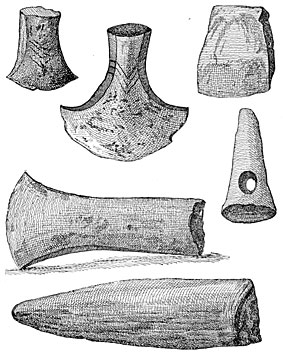
Stone weapons described by Mahudel in 1734.
In 1835, M. Joly, by his excavations in the Nabrigas cave, established the contemporaneity of man with the cave bear, and a little later M. Pomel announced his belief that plan had witnessed the last eruptions of the volcanoes of Auvergne.
In spite of these discoveries, and the eager discussions to which they led, the question of the antiquity of man and of his presence amongst the great Quaternary animals made but little progress, and it was reserved to a Frenchman, M. Boucher de Perthes, to compel the scientific world to accept the truth.
This conclusion, which now appears so simple, was not accepted without difficulty. Boucher de Perthes defended his discoveries in books, in pamphlets, and in letters addressed to learned societies. He had the courage of his convictions, and the perseverance which insures success. For twenty years he contended patiently against the indifference of some, and the contempt of others. Everywhere the proofs he brought forward were rejected, without his being allowed the honor of a discussion or even of a hearing. The earliest converts to De Perthes’ conclusions met with similar attacks and with similar indifference. There is nothing to surprise us in this; it is human nature not to take readily to anything new, or to entertain ideas opposed to old established traditions. The most distinguished men find it difficult to break with the prejudices of their education and the yet more firmly established prejudices of the systems they have themselves built up. The words of the great French fabulist will never cease to be true:
Man is ice to truth; But fire to lies.
It was against powerful adversaries such as this that the modest savant of Abbeville had to maintain his opinion. “No one,” he says, “cared to verify the facts of the case, merely giving as a reason, that these facts were impossible.” Weight was added to his complaint by the refusal in England about the same blue to print a communication from the Society of Natural History of Torquay, which announced the discovery of flints worked by the hand of man, associated, as were those of the Somme, with the bones of extinct animals. The fact appeared altogether too incredible!
Fear no more the lightning flash Nor the all dreaded thunder-stone.
Figure 2.
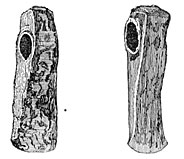
Copper hatchets found in Hungary, and now in the National Museum of Budapest.
Figure 3.
Copper beads, from Connett’s Mound, Ohio (natural size).
It is impossible to fix the duration of the Stone age. It began with man, it lasted for countless centuries, and we find it still prevailing amongst certain races who set their faces against all progress. The scenes sculptured upon Egyptian monuments dating from the ancient Empire represent the employment of stone weapons, and their use was continued throughout the time of the Lagidæ and even into that of the Roman domination. A few years ago, on the shores of the Nile, I saw some of the common people shave their heads with stone razors, and the Bedouins of Gournah using spears headed with pointed flints. The Ethiopians in the suite of Xerxes had none but stone weapons, and yet their civilization was several centuries older than that of the Persians. The excavations on the site of Alesia yielded many stone weapons, the glorious relics of the soldiers of Vercingetorix. At Mount Beuvray, on the site of Bibracte, flint hatchets and weapons have been discovered associated with Gallic coins. At Rome, M. de Rossi collected similar objects mixed with the Æs rude. Flint hatchets are mentioned in the life of St. Éloy, written by St. Owen, and the Merovingian tombs have yielded hundreds of small cut flints, the last offerings to the dead. William of Poitiers tells us that the English used stone weapons at the battle of Hastings in 1066, and the Scots led by Wallace did the same as late as 1288. Not until many centuries after the beginning of the Christian era did the Sarmatians know the use of metals; and in the fourteenth century we find a race, probably of African origin, making their hatchets, knives, and arrows of stone, and tipping their javelins with horn. The Japanese, moreover, used stone weapons and implements until the ninth and even the tenth century A.D.
Excavations in every department of France have yielded thousands of worked flints, and there are few more interesting studies than an examination of the mural map in the Saint Germain Museum on which are marked with scrupulous exactitude the dwelling-places of our most remote ancestors, and the megalithic monuments which are the indestructible memorials of our forefathers.
In the Crimea were picked up a number of small flints cut into the shape of a crescent exactly like those found in the Indies and in Tunis, and the Anthropological Society of Moscow has introduced us to a Stone age the memory of which is preserved in the tumuli of Russia. On the shores of Lake Lagoda have been found some implements of argillaceous schist, in Carelia and in Finland tools made of slate and schist, often adorned with clumsy figures of men or of animals. The rigor of the climate did not check the development of the human race; in the most remote times Lapland, Nordland, the most northerly districts of Scandinavia, and even the bitterly cold Iceland, were peopled. The Exhibition of Paris, 1878, contained some stone weapons found on the shores of the White Sea.
On several parts of the coast of Denmark we meet with mounds of an elliptical shape and about nine feet high, with a hollow in the centre, marking the site of a prehistoric dwelling. It was not until about 1850 that the true nature of these mounds was determined. Excavations in them have brought to light knives, hatchets, all manner of stone, horn, and bone implements, fragments of pottery, charred wood, with the bones of mammals and birds, the skeletons of fishes, the shells of oysters and cockles buried beneath the ashes of ancient hearths. To these accumulations the characteristic name of Kitchenmiddings, or kitchen refuse, has been given.
Several caves have recently been examined in Poland, one of which, situated near Cracow, appears to belong to Palæolithic times. Count Zawiska has already given an account of his interesting discoveries to the Prehistoric Congress at Stockholm. In the Wirzchow cave he identified seven different hearths, and took out of the accumulations of cinders various amulets, clumsy representations of fish cut in ivory, split bones, bears’, wolves’, and elks’ teeth pierced with a hole for threading, and more than four thousand stone objects of a similar type to those found in Russia, Scandinavia, and Germany. We meet with similar traces of successive habitation in a cave near Ojcow; the valuable contents of which included some beautiful flint tools, some awls, bone spatulæ, and some gold ornaments, mixed, in the lower of the hearths, with the bones of extinct animals, and in the upper, with those of species still living.
The discoveries made in the Atter See and in the Salzburg lakes with those in the Moravian caves prove what had previously been very stoutly denied, the existence in those districts of ancient races at a very remote date.
The most ancient inhabitants of Hungary, however, cannot be traced further back than to Neolithic times. In that country have been found, with polished stone implements, thousands of objects made of stag-horn, or bone, almost all without exception finely finished off. The discovery of copper tools and ornaments of a peculiar form in the Danubian provinces, bears witness to a distinct civilization in those districts, and confirms what we have just said about a Copper age.
From the Lake Stations of Austria and Hungary, we pass naturally to those of Switzerland. We shall have to introduce to our readers whole villages built in the midst of the waters, and a people long completely forgotten. In many of these stations, none but stone implements have been found, and on the half-burnt piles on which the huts had been set up, it is still easy to make out the notches cut with flint hatchets.
We meet with similar pile dwellings, as these structures are called, in France, Italy, Germany, Ireland, and England, for from the earliest times man was constantly engaged in sanguinary contests with his fellowmen, and sought in the midst of the waters a refuge from the ever present dangers surrounding him.
The discoveries made in Belgium must be ranked amongst the most important in Europe, and we shall often have occasion to refer to them. Holland, on the other hand, having much of it been under the sea for so long, yields nothing to our researches but a few arrow-heads, hatchets, and knives made of quartz or diorite, and all of them of the coarsest workmanship.
No less fruitful in results to prehistoric science are the researches made in the south of Europe. The congress that met at Bologna, in 1871, showed us that in the Transalpine provinces man was witness of those physical phenomena which gave to Italy its present configuration; and the exhibition in connection with the congress enabled us to get a good idea of the primitive industry which has left relics behind it in every district of the peninsula.
It will be well to mention also the excavations made on the slopes of Mount Hymettus, and in the ever-famous plains of Marathon. Finlay has brought together in Greece a very interesting collection of stone weapons and implements which he picked up in great numbers at the base of the Acropolis of Athens. All these discoveries prove the existence of man at a time about which but yesterday nothing was known, and to which it is difficult as yet to give a name, this existence being proved by the most irrefragable of evidence, the work of his own hands.
Although the proofs of there having been a Stone age in Western Europe are absolutely convincing, it is difficult to feel equally sure with regard to the portions of the globe where so many districts are closed to the explorer. Everywhere, however, where excavations have been made, they have yielded the most remarkable results. M. de Ujfalvy has brought diorite and serpentine hatchets and wedges from the south of Siberia, and Count Ouvaroff tells us of a Quaternary deposit, the only one known at present at Irkutsk, in Eastern Siberia, containing cut flints. Near Tobolsk, Poliaskoff found some beautifully worked stones. Other archæologists tell us of having found, in the east of the Ural Mountains and on the shores of the Joswa, hammers, hatchets, pestles, nuclei the shape of polygonal prisms, and round or long pieces of flint, all pierced with a central hole, which are supposed to have been spindle whorls. Lastly, Klementz tells us that the lofty valleys of the Yenesei and its tributaries were inhabited in the most remote times by races who developed a special civilization.
At the other extremity of the great Asiatic continent, a deposit of cinders found at the entrance of a cave near the Nahr el Kelb yielded some flint knives or scrapers, and more recently a prehistoric station has been made out at Hanoweh, a little village of Lebanon, east of Tyre. The flints are of primitive shapes, not unlike the most ancient forms found in France. They were discovered in a mass of débris of all kinds, forming a very hard conglomerate. Some teeth, which had belonged to animals of the bovidæ, cervidæ, and equidæ groups, were got out with considerable difficulty, but the bones in the conglomerate were too touch broken up to be identified. Worked flints and arrow- or spear-heads were also found in considerable quantities in various parts of the table-land of Sinai, and at the openings of the caves in which the ancient inhabitants took refuge. It was with stone tools that these people worked the mines riddling the sides of the mountains, and it is still easy to make out traces of their operations.
We have already alluded to Japan; for a long time the barbarian Aïnos, the earliest inhabitants of the country, were acquainted with nothing but stone. Flint arrows were presented to the Emperor Wu-Wang eleven hundred years before our era; the annals of one of the ancient dynasties speak of flint weapons, and an encyclopædia published in the reign of the Emperor Kang-Hi speaks of rock hatchets, some black and some green, and all alike dating from the most remote antiquity.
In Algeria have been preserved some most interesting relics of prehistoric times. If I am not mistaken, Worsaae was the first to note the worked stones in the French possessions in Africa. They have been picked up in great numbers, especially near the watercourses at which the ancient inhabitants of the country slaked their thirst, as do their descendants at the present day. The exploration of the Sahara daily yields unexpected discoveries; and already fifteen different stations formerly inhabited by man have been made out. In those remote days a large river flowed near Wargla, which was then an important centre, and a number of tools picked up bear witness to the former presence of an active and industrious population. At one place the flint implements, arrow-heads, knives, and scrapers are all of a very primitive type, and were found sorted into piles. This was evidently a dépôt, probably forming the reserve stock of the tribe. Wargla or perhaps Golea at one time appears to have been the extreme limit of the Stone age in Algeria, but quite recently traces of primitive man have been discovered amongst the Tuaregs. These relics are hatchets made of black rock, and arrow-heads not unlike those which the Arabs attribute to the Djinn; but as we approach the south we find the flints picked up more clumsily and unskilfully cut—a proof that they were the work of a more barbarous people with less practical skill. It is the megalithic monuments of Algeria, of which we shall speak more in detail presently, that are the most worthy of attention. As in India, we meet with them in thousands, and in certain parts of the continent they extend for considerable distances. They consist of long, square, circular, or oval enclosures—dolmens similar to those of Western Europe,—and almost always surrounded by circles of upright stones. The silence of historians respecting them need not make us doubt their extreme antiquity, for did it not take a very long time to induce the scientific men of our day to turn their attention to Algeria at all?
In the Cave of Hercules, in Morocco, which Pomponius Mela spoke of as of great antiquity in his day, have been found a great many worked flints, such as knives and arrow-heads. We shall refer later to the important monument of Mzora and the menhirs surrounding it, the builders of which certainly belonged to a race that lived much nearer our own day than did the inhabitants of the Cave of Hercules.
In the torrid regions between the Vaal and the Zambezi rivers, we find traces of a race of a civilization different from that of the savages conquered by the English. At Natal the gradual progress of these unknown people can be traced step by step. To the earliest period of all belong nothing but roughly hewn flints, and no traces of pottery have been found; then follow flint arrow-heads of more distinct form, and here and there fragments of sun-dried pottery. Of more recent date still are polished stone weapons and more finely moulded pottery; whilst to the latest date of all belong weapons of considerable variety of form, better adapted to the needs of man, and with these weapons were found huge stone mortars which had been used for crushing grain, and bear witness to the use of vegetable diet.
We also meet with important ruins in the Transvaal. Some walls are still standing which are thirty feet high and ten thick, forming imperishable memorials of the past. They are built of huge blocks of granite piled up without cement. We know nothing of those who erected them; their name and history are alike effaced from the memory of man, and we know nothing either of their ancestors or of their descendants.
Figure 4.
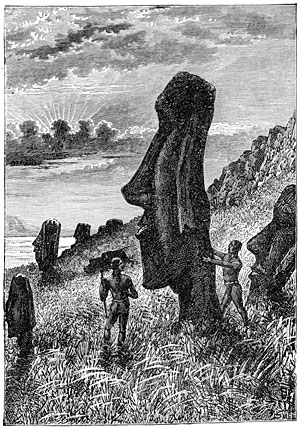
Stone statues on Easter Island.
On a rock at the entrance to the port of Sydney a kangaroo is sculptured. In Easter Island (Rapa-Nui) La Pérouse discovered a number of coarsely executed bust statues (Fig. 4). There are altogether some four hundred of them, forming groups in different parts of the island. The excavations conducted by Pinart in 1887 have proved these figures to be sepulchral monuments. He managed to make a considerable collection of crania and human bones. Round about the crater of the Rana-Raraku volcano, forty of these figures have been counted, all of a similar type, all cut in one piece of solid trachyte rock. In another place are eighty busts with longer noses and thicker lips, forming a group by themselves. The largest of them is some thirty-nine feet high. On the sides of the volcano, scattered about amongst the statues, have been picked up a considerable number of knives, scrapers, and pointed pieces of obsidian, which were probably tools thrown away by the sculptors of the figures.
Figure 5.
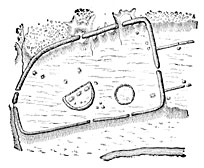
Fort Hill, Ohio.
Figure 6.
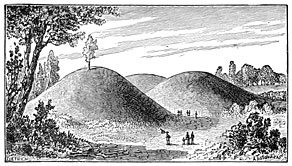
Group of sepulchral mounds.
In other parts of America prehistoric races have left behind them huge earthworks, lofty masses which were probably fortifications (Fig. 5), temples, and sepulchral monuments (Fig. 6). These earthworks extend throughout North America from the Alleghany Mountains to the Atlantic, from the great lakes of Canada to the Gulf of Mexico. The name of the people who erected them is lost, and we must be content with that of Mound Builders, which commemorate their vast undertakings.
Figure 7.
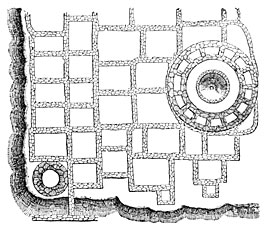
Ground plan of a pueblo of the Mac-Elmo Valley.
Figure 8.
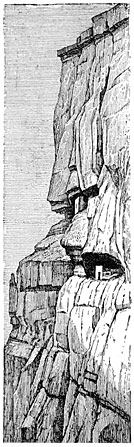
Cliff-house on the Rio Mancos.
Figure 9.
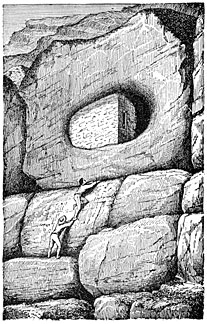
House in a rock of the Montezuma Cañon.
Such are the facts with which we have to deal. In the following chapters we shall consider more at length the problems they present, but already we are led to one important conclusion: in every part of the globe, in every latitude, in every climate, worked flints, whether but roughly chipped or elaborately polished, present analogies which must strike the most superficial observer. “We find them,” remarks an American author, “in the tumuli of Siberia, in the tombs of Egypt, in the soil of Greece, beneath the rude monuments of Scandinavia; but whether they come front Europe or Asia, from Africa or America, they are so much alike in form, in material, and in workmanship, that they might easily be taken for the work of the same men.”
The same observation applies to megalithic monuments. Everywhere we find these primitive structures assuming similar forms. It is difficult enough to believe that the wants of man alone, such as the craving for food, the need of clothing, and the necessity of defending himself, have led in every case to the same ideas and the same amount of progress. Even if this be proved by the worked flints, we cannot accept a similar conclusion with regard to the megalithic monuments, which imply reflection and a thought of the future far beyond the material needs of daily life. Is it not more reasonable to regard a similitude so striking as a proof of the unity of our race?
One final conclusion is no less interesting. These absolutely countless flints, these monuments of imposing size, these stones of immense weight often brought from afar, these marvellous mounds and tumuli, bear witness to the presence of a population which was already considerable at the time of which we are endeavoring to make out the traces. A long series of centuries must have been needed for a people to increase to such an extent as to have spread over entire continents. And time was not wanting. Whatever antiquity may be attributed to the human race, whatever the initial date to which its first appearance may be relegated, this antiquity is but slight, this date is but modern, if we compare it with the truly incalculable ages of which geology reveals the existence. At every turn we are arrested by the immensity of time, the immensity of space, and yet our knowledge is still confined to the mere outer rind of the earth, and science cannot as yet even guess at the secrets hidden beneath that rind.
In concluding these introductory remarks, we must add that very great difficulties await those who devote themselves to prehistoric studies—difficulties such as noise but those who have attempted to conquer them can realize. The rare traces of prehistoric man must be sought amongst the effects of the cataclysms that have devastated the earth, and the ruins piled up in the course of ages. We must show mall wrestling with the ever-recurrent difficulties of his hard life, and gradually developing in accordance with a law which appears to be immutable. Such is the aim of this work, and it is with gratitude that we assert at the beginning that the pianta uomo, the human plant, as Alfieri calls our race, was endowed by the Creator from the first with a very vigorous vitality, to enable it to contend with the dangers besetting its steps in the early days of its existence, and with a truly marvellous spirit, to be able to make so humble a beginning the starting-point for a destiny so glorious.