Chapter VI · Industry, Commerce, and Social Organization; Fights, Wounds and Trepanation.
N. D'Anvers translation
When we consider the discoveries connected with the Stone age as a whole, we are struck with the immense numbers of weapons of every kind and of every variety of form found in different regions of the globe. The Roman domination extended over a great part of the Old World, and it lasted for many centuries. Everywhere this people, illustrious amongst the nations, has left tokens of its power and of its industry. Roman weapons, jewelry, and coins occupy considerable spaces in our museums; but numerous as are these relics of the Romans, they are far inferior in number to the objects dating from prehistoric times, and flints worked by the hand of man have been picked up by thousands in the last few years, forming incontestable witnesses of the rapid growth of a large population.
One important point remains obscure. Schmerling has excavated fifty caves in Belgium, and only found human relics in two or three of them; and of six hundred explored by Lund in Brazil, only six contained human bones. Similar results were obtained in the excavations of the mounds of North America, as well as in the caves of France. M. Hamy, in a book published a few years ago, only mentions twelve finds of human bones, which could, without any doubt, be dated from Palæolithic times. True, this number has been added to by recent discoveries, but it is still quite insignificant. It is the same thing with the kitchen-middings and the Lake settlements. This paucity of actual human remains forms a gap in the evidence relating to prehistoric man, which disturbances and displacements do not sufficiently account for, and to which we shall refer again when speaking of prehistoric tombs.
Worked flints are generally found in numbers in one place, probably formerly a station or centre of human habitation. Men were beginning to form themselves into societies, and the dwellings, first of the family and then of the tribe, rapidly gathered together near some river rich in fish, or some forest stocked with game affording plenty of food easily obtained. The caves also afford proofs of the number of men who inhabited them. In one alone, near Cracow, Ossowski discovered 876 bone implements, more than 3,000 flint objects, and thousands of fragments of pottery. From the Veyrier cave, near Mount Salève, were taken nearly 1,000 stone implements; from those of Petit Morin, 2,000 arrow-heads; from that of Côttes, on the banks of the Gartampe, more than 264 pounds’ weight of flints, some of the Moustérien and others of the Madeleine type, mixed with the bones of the rhinoceros, and of several large beasts of prey of indeterminate species. The Abbé Ducrost picked up 4,000 flints in one dwelling alone at Solutré, where the soil is calcareous and flint is not native, so that it must have been brought from a distance. More than 8,000 different objects were taken from the fine Neolithic station of Ors in the isle of Oleron; 12,000 chips of stone, bearing marks of human workmanship, were picked up in the Thayngen Cave, and more than 80,000 in the different caves of Belgium. The shelter of Chaleux alone yielded 30,000 pieces of stone, at every stage of workmanship, from the waste of the manufactory to the highly finished implement. Other explorers have been no less fortunate. The Marquis of Wavrin found in the environs of Grez no less than 60,000 worked stones belonging to no less than thirty different types, chiefly arrow-heads, some triangular, others almond-shaped, others again cutting transversely, some with and some without feathers, some stalked, others not; in a word, arrows of every known type. Nothing but an actual visit to the Royal Museum of Brussels can give any idea of the importance of the discoveries made in Belgium.
The environs of Paris are, however, no less rich. As early as Palæolithic times the valleys of the Seine and its tributaries were evidently inhabited by a numerous population. M. Rivière mentions a station near Clamart, where, in a limited space, he picked up more than 900 flints, some worked, others mere chips, many of which bad been subjected to heat. A sand-pit of Levallois-Perret yielded 4,000 stone objects, and on the plateau of Champigny, full of such terrible memories for the people of France, were found nearly 1,200 flints, knives, polished hatchets, lance heads and scrapers, mixed with numerous fragments of hand-made pottery without ornamentation.
Are yet other examples needed? At. de Mortillet estimates at more than 25,000 the number of specimens found on the plateau of Saint Acheul, the scene of the earliest discoveries that revealed the existence of man in Quaternary times; and the station of Concise, on Lake Neuchâtel, which is one of the most ancient in Switzerland, yielded a yet more considerable number. Many have, however, been lost or destroyed; the ballast of the railway skirting the lake contains thousands of worked stones and of pieces of the waste left in making them, all of which were taken from the bed of the lake. It must not be forgotten that it is only of late years that the importance of these relics of the past has been recognized and that any one has dreamt of preserving or of studying them.
The excavation of a gravel pit at Dundrum (County Down, Ireland) yielded 1,100 flint implements, and M. Belluci himself picked up in the province of Pérouse more than 17,000 pieces, chiefly spear-, lance-, or arrow-heads, belonging to six different types. The Broholm Museum contains 72,409 weapons and implements, all found in Denmark.
In America, Dr. Abbott has sent to the Peabody Museum more than 20,000 stones, which were collected by him at Trenton, on the banks of the Delaware, and quite recently I was told that in sinking a well in Illinois the workmen came upon a deposit of more than 1,000 worked flints, all of oval form. Every one knows the importance of the recent discoveries at Washington, and we might multiply examples ad infinitum, for everywhere explorers come upon undoubted traces of the active work and intelligence of comparatively dense populations, all of whom had attained to about the same degree of development.
These numerous deposits often mark the, site of regular workshops, tokens of the earliest attempt at social organization. In no other way can we explain the piles of flints in every stage of workmanship lying beside the lumps from which they were detached. One of the most celebrated of these workshops is that of Grand-Pressigny, chief town of the canton of the department of Indre-et-Loire, which is admirably situated between two picturesque rivers, the Claise and the Creuse.
The flint implements of Grand-Pressigny, of which specimens can be seen in all the museums of Europe, are some sixteen inches long, of light color, pointed at one end and square at the other. One face is rough, the other chipped into three oblong pieces, whilst the sides are roughly hewn into saw-like teeth. If we examine these flints closely we can easily make out the exact point, the eye, as workmen call it, where the stone was struck. At Charbonnière, on the banks of the Saône, to quote other examples, in a radius of less than a mile, were found weapons, tools, and nuclei, which may be compared with those of Grand-Pressigny. In some places the collections of flints still remaining look as if they had been used for road-making. In some cases hatchets, knives, and scrapers seem to have been buried in pits. Were these the reserve stores of the tribe, or the so-called caches of the merchants?
It is difficult merely to name the different workshops or manufactories discovered in the last few years. We must, however, endeavor to mention the most important, for these workshops, we must repeat, are an important proof of the existence of a society of organized working communities. We meet with them on the shores of the bay of Kiel, in the island of Anholt, in the midst of the Kattegat, and on the borders of the Petchoura, and of the Soula, among the Samoieds. Virchow discovered an arrow-head manufactory on the shores of Lake Burtneek, and in 1884 the Moscow Society of Natural Sciences made known the existence of important workshops near the Vetluga River, in the province of Kostroma, so that we know that in remote prehistoric times men lived and fought in a rigorous climate in districts but sparsely populated in our own day.
There is nothing to surprise us in all these facts. Recently near the Yenesei River, in the heart of Siberia, were found bronze daggers, hatchets and bridle bits (Fig. 71), all bearing witness in the beauty of their workmanship to a more advanced state of civilization than the Lake Dwellings or megalithic monuments farther south. Many of them are ornamented with figures of animals, so that at an epoch less remote, it is true, than the one we have been considering, but still far removed from our own, we find that there was an intelligent race, with artistic tastes, living in a country now so intensely cold as to be uninhabitable to all but a few miserable nomad Tartars.
At Spiennes, near Mons, a field was discovered, known as the camp des cayaux, strewn with flints, some uncut, others hewn, together with knives and hatchets innumerable. There were also centres of manufacture at Hoxne and Brandon, in England, at Bellaria in Bologna, and at Rome on the Tiburtine Way. At Ponte-Molle, where worked flints were discovered for the first time in Italy a few years ago, a workshop was found, remarkable for the great number of stags’ antlers, from which the middle part had been removed, doubtless to be used as handles for tools. M. de Rossi, who gives us these details, thinks that this station was inhabited in the Paleolithic period. In the settlement of Concise have been found not only stone implements, but a great many articles made of bone, so that this place was evidently an important manufacturing centre. Knives, stilettos, and arrow heads were turned out here, and in the hands of skilful workmen the tusks of the boars, which abounded at this time in Switzerland, were converted into excellent chisels.
Figure 71.
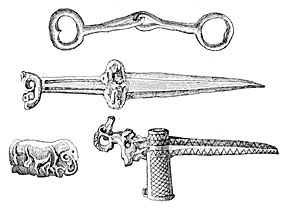
Bronze objects found at Krasnojarsk (Siberia).
To name the districts where tools were manufactured in prehistoric times in France would be to give a list of all the departments. In the commune of Saint-Julien du Saut we find a large manufactory where every division of the Stone age is fully represented, from the time of the simply chipped hatchet to that of the polished implement of rare perfection. Everything bears witness to the prolonged residence of man in a neighborhood which offered the attraction of vast deposits of chalk with bands of flint that supplied alike weapons and tools. Amongst others, we must name the so-called atelier de la Treiche, near Toul, which extends for an area of about a hundred acres, that of Bonaruc, near Dax; surrounded by waste lands covered with a scanty vegetation; that of Rochebertier (Charente), which probably dates from the Madeleine period; and that of Ecorche-Bœuf, near Périgueux. The Abbé Cochet tells us of an atelier in the Aulne valley, and Maurice Sand of another near La Châtre, where we meet with the most ancient traces of man in Berry. In the fields, near an alignment not far from Autun, were picked up numbers of hatchets of bard rock, barbed arrows, flakes of flint worked into scrapers or chisels, whilst near them were the very polishers on which they had been pointed.
We have just spoken of polishers, and we said some time ago that it was by prolonged rubbing that the remarkable weapons of Neolithic times were produced. We must add now that a whole series of the polishers used are to be seen on the right bank of the Loing, near Nemours; one of which is a regular table (Fig. 72), on which can be made out no less than fifty grooves and twenty-five cup-like depressions.
Figure 72.
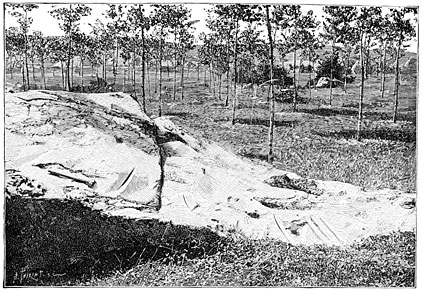
Prehistoric polisher, near the ford of Beaumoulin, Nemours.
One would have expected to find the ground near these polishers covered with flakes of flint and pieces of tools of all kinds, but nothing of the kind has been discovered; a fact which leads its to suppose that the workmen only came down into the valley to finish off their weapons by polishing them.
At the period we are considering all the continents were peopled, and we must repeat, for it is the most important point of our present study, that the civilization attained to by the inhabitants was everywhere almost identical. Thus we find centres of manufacture similar to those of Europe at the foot of the mountains of Tunis and of Algeria. In one of the latter, at Hassi al Rhatmaia, the knives were piled up in one place, the scrapers in another, and the arrow-heads in a third. In this disposition M. Rabourdin thinks he sees a sign of the division of labor, one of the most important features of modern progress. M. Arcelin mentions a similar deposit on the summit of the Jebel Kalabshee, near Esneh in Egypt, and a few years ago another was found in Palestine, near the ancient Berytus, containing great numbers of hatchets, saws, scrapers, and all the implements characteristic of the Stone age; whilst amongst them lay the blocks from which they had been cut. Asia Minor was evidently an important manufacturing centre during the Stone age, and, as a matter of course, it must have had a considerable population; and even in America discoveries of similar extent have been made. At Kinosha, in Wisconsin, Lapham made out a manufactory of flint and quartzite arrow-heads, which dates from prehistoric times, and quite recently a yet more important centre of industry has been discovered at St. Andrew (Winnipeg).
They made out eight shafts in the face of a layer of limestone some eighty-one feet long, and at every turn of their excavations they came to fresh shafts. These shafts opened out towards the top like funnels, and the), were not more than three feet three inches below the surface, the flint having been struck at that depth (Fig. 73). These shafts were, in many cases, continued by galleries, as seen in our illustration (Fig. 74), or by trenches, where the light is, however, more or less shut out by small landslips. It is still easy, in spite of this, to make out the floor of the mine, for it is trodden hard by the feet of the ancient miners. Traces of charcoal, too, reveal the path they took, and we learn at the same time that they used fire to help them in their work.
Figure 73.
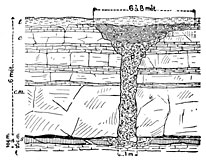
Section of a flint mine; t vegetable earth, c pure limestone, c m Marly limestone, s flint.
Figure 74.
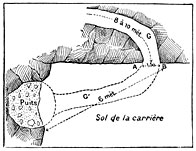
Plan of a gallery, half destroyed in making the excavation which revealed its existence. U gallery still visible; G′ gallery destroyed by the excavation.
In this last example of what has been done in France, we must also add that of the shafts of Nointel (Oise) and those discovered in Maine by M. de Baye, in both of which were found nodules of flint in different stages of preparation, together with some stag-horn picks. In none of these excavations was any metal implement found, or any trace of the use of metal, so that we must conclude that the mines date from Neolithic times.
We have seen how man gradually brought to perfection the tools and weapons which were at first so clumsy. The growth of industry led to the birth of commerce, or, to speak more accurately, to that of barter. From the time of the earliest migrations intercourse was begun, or rather was carried on, between the tribes, as they gradually dispersed, often travelling considerable distances from each other, and fresh proofs of these relations are continually brought to light as we become better acquainted with prehistoric times. The flints worked by the cave-men of Belgium, the fossil shells so numerous at Chaleux, in the Frontal and Nuton caves, at Thayngen on the frontier between Switzerland and Germany, in Italy, in the stations of anterior date to the terremare beds, have been found the shells of the pearl oyster of the Indian Ocean, whilst in the caves of the south of France, such as the Madeleine, that of Cro-Magnon, Bize in Hérault, and Solutré on the banks of the Saône have been picked up the shells of Arctic marine mollusca. The cave-man of Gourdan was decked with shells from the Mediterranean, and the man of Mentone in his turn wore a head-dress made of Atlantic shells. Fossil shells were also much sought after; we have alluded to those from Champagne found in Belgium; others from the shell-marl of Touraine and Anjou had been taken into the caves of Périgord, whilst sea-urchins from the cretaceous strata of the south of France were found in a prehistoric station of Auvergne, and M. Massenat picked up at Laugerie-Basse two specimens of a species not met with anywhere but in the Eocene deposits of the isle of Wight. The Neolithic station of Champigny, near Paris, has yielded some objects from the Alps, and from Belgium, from the Vosges Mountains, and the Puy de Dôme.
Figure 75.
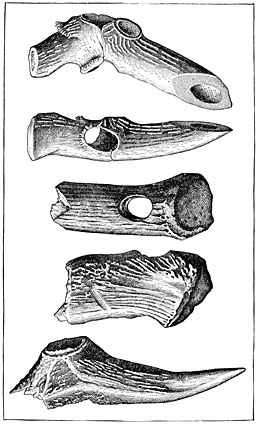
Picks, hammers, and mattocks made of stag-horn.
In the caves of Périgord were also found fragments of hyaline quartz, which must have been brought from the Alps or the Pyrenees. In Brittany and in Marne flints foreign to these granite districts are numerous; and Dr. Prunières tells us that similar discoveries were made under the megalithic monuments of France, and that neither in the eroded limestone districts of Lozère, known locally as les causses, nor under the dolmens of Haute-Vienne, were found any but implements made of rock not native to the country.
Commerce developed rapidly during Neolithic times, and, as far as we can make out from traces left, its course was from the southeast to the northwest. Streams and rivers were followed by merchants as by emigrants, and at an extremely remote date the sea no longer arrested the journeys of men. At a recent meeting of the British Anthropological Institute, Miss Buckland dwelt on the resemblance in the material, shape, and ornamentation of a golden cup found in Cornwall, to other cups found at Mykenæ and at Tarquinii, and maintained that the Cornish cup must have been the work of the same artisans, and have been brought by commerce from what was then the extremity of the known world.
It is not only in Europe that we can trace the relations established between men separated by vast distances, by oceans, and by apparently impassable deserts. The shells of the Atlantic and those of the Pacific, the copper of Lake Superior, the mica of the Alleghanies, and the obsidian of Mexico lie together beneath the tumuli of Ohio, and quite recently Mr. Putnam exhibited to the Society of Antiquaries a collection of jade celts and ornaments, some from Nicaragua, others from Costa Rica, and a hatchet with both edges sharpened from Michigan. No deposit of jade has so far been discovered on the American continent, so that we can only suppose these objects to have been brought from Asia at an unknown date. The marks they retain of having been rubbed up, and the holes made in them to hang them up, show what store was set by them.
Figure 76.
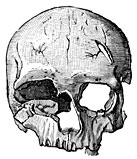
Cranium of a woman, from Cro-Magnon, seen full face.
Figure 77.
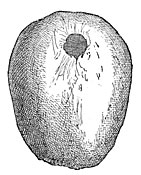
Skull of a woman found at Sordes, showing a severe wound from which she recovered.
Of the nineteen crania found in the Neolithic sepulchre of Vauréal two show traces of old wounds. One of them, that of a woman, has three different scars, two of which were of wounds that had healed, whilst the third in the occiput was a gaping hole, which had evidently caused death.
A sepulchral cave at Nogent-les-Vierges (Oise) contains the skeleton of a man with a wound on the forehead, no less than four and a half inches long by three broad. This man, who was dune young, the sutures being still very apparent, survived this serious wound for some time.
The Gourdan Cave has yielded crania and jaws broken by blunt weapons, whilst on other crania have been made out scratches and stripes which could only have been produced after the hair and skin had been removed. In the caves of the Petit-Morin valley, M. de Baye picked up some human vertebra pierced with flints, the points of which were still imbedded in the bones. In the Villevenard Cave one skull was found containing three arrow-beads with transverse points imbedded in the skull, the bone of which had closed upon them. Another arrow was lodged between the dorsal vertebrae. It is probable that these arrows had remained in the wounds; certainly that is the simplest way to account for their position. About two miles from the caves of which we have been speaking, M. de Baye discovered a sepulchre containing thirty skeletons, all of adult and strongly built individuals. The bodies were laid one above the other, and separated by large flat stones and a thin layer of earth. This sepulchral cave contained seventy-three flint points. As in the case of Villevenard, their position leads us to suppose that these points had been sticking in the flesh of the bodies when they were interred, and had fallen out when decomposition set in. Probably the bodies were those of men who had fallen victims in a bloody conflict that had taken place in the valley. In a cave at the station of Oyes, was found stretched upon a bed of stones a skeleton with a piece of flint, which had been flung with great force, imbedded in the upper part of the humerus. Round about the wound are the marks of many attempts at healing it.
Many of the human bones found in the Vivarais Cave bear traces of having been violently fractured by stone weapons with tapering points. In the Challes Cave (Savoy) lies the skeleton of a woman whose skull was fractured by a flint weapon, but in this case death was evidently immediate, at least if we may judge from the fact that there are no signs of the wound having received any treatment. In the Castellet Cave, a human vertebra contained the weapon which had pierced it, but when the bone was touched the arrow-head broke off. It had, however, been flung with such a sure hand that it had been driven ten inches deep into the bony tissue. Here, too, the absence of any exostosis proves that death quickly followed the wound.
Figure 78.
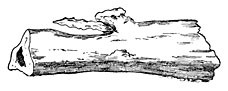
Fragment of human tibia with exostosis enclosing the end of a flint arrow.
In other cases the victims seem to have lived for some time. We have already spoken of wounds in crania that had healed, and we may add that a few years ago a, human bone was presented to the Archæological Society of Bordeaux which still retained a flint arrow-head in the wound it had made. Traces could clearly be made out of the inflammation caused by the presence of the foreign body, and the bony tissue secreted by the periosteum had, so to speak, taken the mould of the arrow (Fig. 78).
In the cave known as the Trou d’Argent (Basses-Alpes) amongst the bones of ruminants and carnivora, fragments of pottery and rubbish of all kinds, was found a piece of humerus (Fig. 79) pierced at the elbow joint and very neatly cut at the lower end, no doubt with the help of some of the implements of hard rock scattered about the cave. The position of this human bone amongst the remains of animals and fragments of a meal, points to its being a relic of a scene of cannibalism; adding yet another proof to what I said at the beginning of this work.
Figure 79.
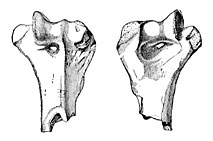
Fragment of human humerus pierced at the elbow joint, found in the Trou d’Argent.
Similar facts are reported front England and Germany. Dr. Wankel mentions an interesting prehistoric deposit at Prerau, near Olmutz, amongst the bones of animals belonging to the most ancient Quaternary fauna, such as the mammoth, the cave-bear, the cave-lion, the glutton, and the arctic fox; and amongst clumsy bone and ivory weapons and ornaments he found a human jaw and a femur covered with strip produced by flint hatchets. In 1801 Mr. Cunnington took several skeletons from a barrow near Heytesbury, the skull of one of which had been broken with a blunt implement; and Sir R. Hoare speaks of a skull from the neighborhood of Stonehenge split open by a blow from one of these formidable weapons. Several crania taken from a long barrow at West Kennet have similar wounds.
In 1884 a human vertebra, with an arrow-head imbedded in it, was picked up on the island of Santa Cruz. The apophysis was broken, and the extent of the fracture shows the great force of the blow. The victim evidently died of the wound, for there is no sign of its having been healed.
I have dwelt upon these deaths and wounds in spite of the inevitable monotony of such a list, not because I wish to bring into prominence the fact that from the earliest times the struggle for existence was fierce and bloody, but because I am anxious to prove that in these remote days an organized and intelligent society had grown up. No one could have survived such wounds as we have described, but for the care and nursing of those around him, such as the other members of his family or of his tribe. The wounded one must have been fed by others for months; nay more, he must have been carried in migrations, and his food and resting-place must have been prepared for him. Moreover, and this is of even yet more importance to our argument, they must have been men able to treat wounds and to set bones.
In 1873 Dr. Prunières, to whom science has reason to be very grateful for his singular discovery, presented to the members of the French Association, in session at Lyons, a human parietal with a rounded piece of bone let into it. This piece of bone was rather larger than a five-franc piece, and the skull into which it had been fixed was found beneath the Lozère dolmen. A large opening, some three inches in diameter, the edges of which were worn smooth, had been made in this skull, and the piece of bone let into it was thicker than the skull itself, as well as different in color, the cranium being dark and the foreign piece of bone pale yellow. It was evident therefore that the two pieces did not belong in life to one person, and that the rounded piece had been cut out of some other skull. The following year Dr. Prunières added fresh details about other rounded pieces of skull that be had discovered let into crania, some of which pieces had evidently been introduced during the life of the patient, who had died under the operation of trepanation, whilst others had been put in after death. Dr. Prunières in every case speaks of rondelles or rounded pieces of skulls, and we prefer to quote him exactly, but as a matter of fact the trepanation was sometimes done with elliptical, triangular, or even pyramidal pieces of bone.
Later no less than sixty fresh examples, corroborating Dr. Prunières’ discoveries, were found in the Baumes-Chaudes caves, and Broca in his turn reported the finding of three crania in the cave of L’Homme Mort, from which great pieces had been taken which had evidently not been lost by accident.
From this time excavations and discoveries made under Dr. Prunières succeeded each other rapidly. In 1887 his collection contained 167 crania or fragments of crania, all perforated, 115 of which were picked up in the caves of Lozère, which are probably of more recent date, beneath the dolmens of the devèzes, as those vast plains given lip to pasturage are called. These dolmens, which were doubtless reserved for the burial of chiefs, often contain many valuable objects. Beneath one, for instance, were found fifteen beautiful darts of variegated flint, four polished boars’ tusks, some schist pendants, some shells cut into the shape of teeth, some bone and stone necklace beads, and, lastly, two small bronze beads. These last-named objects justify us in dating the dolmen from the Bronze epoch, when the use of bronze began to spread over the district, though it was still not generally employed.
Attention once awakened, similar facts began to be announced from many different quarters. In the Neolithic caves of Marne were found skulls with rounded holes in them, pieces of skull such as are shown in Fig. 28, which were probably worn as amulets. M. de Baye has in his fine collection more than twenty examples of trepanation, one of which is shown in Fig. 80. In nearly every case the operation had been performed after death; three examples alone show it to have been done during life, and that the patient certainly survived, for the wound shows very evident signs of having healed, and the edges of the openings no longer bear the marks of the tool of the operator. On one of the three crania there were two wounds near each other, but they were quite separate, and were evidently not treated at the same time.
Figure 80.
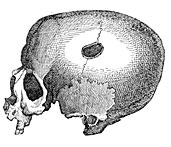
Mesaticephalic skull, with wound which has been trepanned.
On a plain amongst the hills of the right bank of the Seine, above Paris, rises a mound resembling a promontory which is known as the Guérin mound, and consists of a vast deposit of chalk which was excavated long ago. Successive operations have brought to light eight caves, most of which contained a number of human remains, which were unfortunately dispersed without having been scientifically examined. One alone, opened in 1874, contained numerous bones belonging to individuals of every age and of both sexes, with polished flints, fragments of pottery, and implements of stag-horn. Amongst these relics was found the skull of an old man showing a very curious example of trepanation. It was unfortunately broken by the workmen in the very moment of discovery, and could only be very insufficiently examined. Other examples, however, which could be properly authenticated, are not wanting from the banks of the Seine and Marne; two fragments of skull were found in the canton of Moret, one of which had been trepanned during the life of its owner, and the other after death. We must also mention the crania presented to the learned societies at the Sorbonne, one of which came from the plateau of Avrigny, near Mousseaux-lès-Bray (Seine-et-Marne). Side by side with the skeleton lay polished hatchets, scrapers, and arrow-heads, fragments of pottery blackened by smoke, and lastly a solitary bone of an ox, pierced with three holes at regular distances, which had probably been used as a flute. Of nine crania found in this excavation three were pierced, two after death and one during life, the edges of the last named bearing very evident traces of treatment.
A trepanned skull was also discovered in a Neolithic sepulchre near Crécy-sur-Morin, where lay no less than thirty skeletons, remarkable for the strongly defined section of the tibiae, whilst around were strewn hatchets, flint knives, bones, stilettos and picks of siliceous limestone with handles made of pieces of stag-horn. The tomb, built of stones without mortar, contained two contiguous chambers separated by a wall, and covered over by a stone weighing more than 1,200 tons. It seems likely that this huge stone had not been moved—it must have been beyond the strength of the makers of the tomb to lift it,—but that the spaces beneath, in which the dead had been placed, had been merely hollowed out. In the covered Avenue des Mureaux, of which I have already spoken, were picked up several trepanned crania. The tools, scrapers, and piercers, which had probably been used for the operation, lay near the crania.
Goss mentions a discovery in one of the pile-dwellings of Lake Bienne, of a skull with a large hole in it with bevelled edges. There is no trace of this wound having healed, and the patient had evidently died soon after the operation.
The Prague Museum possesses two crania found at Bilin in Bohemia; one, of a pronounced dolichocephalic type, has near the middle of the right parietal an opening measuring one and a half by two and a third inches; the cicatrization is complete, and trepanation was evidently performed long before death. The other is mesaticephalic, and bears a round opening about one and a half inches in diameter. Dr. Wankel, to whom we owe these details, is well known through other discoveries; his excavations in the Bytchiskala Cave brought to light the skeleton of a young girl of ten or twelve years old, who bad undergone the operation of trepanation. The wound, which was on the right side of the forehead, was half healed. The child still wore the ornaments she had been fond of in life—bronze bracelets and a necklace of large glass beads.
In the north of Europe similar discoveries have been made. At Borreby, in Denmark, a skull was found from which large pieces had been taken; and another from beneath a dolmen at Noes, in the island of Falster, had a hole in it no less than two and a quarter by one and three quarter inches in size. In the one case the holes were parts of a wound to which the victim had succumbed; in the other the edges were too regular to have been caused by traumatism. A Russian skull, a cast of which has recently been presented to the Italian Anthropological Society, bears traces of two trepanations; one performed during life, the other after death. The former had evidently been caused neither by illness nor by a wound.
General Faidherbe discovered at Roknia, in Algeria, two trepanned skulls, dating from a remote antiquity, in one of which the wound is half an inch in diameter, and shows no sign of cicatrization; and travellers speak of evident traces of similar operations on skulls dating from the time of the Aïnos, the ancestors or predecessors of the Japanese at the present day; and if we cross the Atlantic, we shall meet with instances of trepanations executed in a similar manner, and probably for similar reasons.
We give an illustration (Fig. 81) of a trepanned skull found in a cemetery in the Yucay valley. A square piece has been cut out by making four regular incisions. The bone shows traces of an ancient inflammation, and many eminent surgeons, including Nélaton and Broca, have not hesitated to attribute the opening, large as it is (seven by six inches), to a surgical operation. If the incisions are carefully examined it is easy to see that they were made with the help of a pointed instrument, such as a clumsily made drill, for instance. Each incision must have taken a long time to make, and we note with ever increasing astonishment that the ancient Peruvians were not acquainted with the use of iron or steel, and that the hardest metal they employed was bronze.
Figure 81.
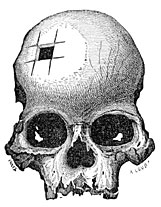
Trepanned Peruvian skull.
A few years ago a sepulchre was opened at Chaclacayo, at the foot of Mount Chosica, not far from Lima. In this tomb lay three mummies, of a man, a woman, and a child. Near them lay a human skull, having about the middle of the forehead an opening, measuring some two and a half by two inches. It is of polygonal form, and eight different incisions can easily be made out, which appear to have been made with some notched stone implement. On raising a strip of skin, still adhering to the skull, there was seen on the front part of the sagittal suture a very small perforation, the result either of a wound or of an operation which bad taken place during life. It has been suggested that the piece of bone taken from the skull had been used to make a lance or arrow-head, which was superstitiously supposed by the owner to ensure his victory. This is, however, a mere suggestion, of which no proof can be given.
In other party of America discoveries have been made of trepanned skulls, supposed to date from even more remote times than those we have just been considering. A few years ago Professor Putnam found, in the State of Ohio, some old wells idled with cinders and rubbish of all kinds. From one of them, which was deeper than the others, he took several crania, some of which bore evident traces of trepanation. From a mound near Dallas (Illinois) were taken more than one hundred skeletons, all of adults, placed side by side in a crouching attitude. Every one of them had a round opening on the left temple, and in some of these wounds the flint implement which had produced them was still imbedded. It is very evident that we have here tokens of some funereal rite, the meaning of which is uncertain, though it was evidently practised also in districts very remote from Illinois. To mention yet other examples, the excavation of a tumulus of irregular form near Devil’s River (Michigan) has brought to light five skeletons buried u right, whilst a sixth lay in the centre of the tumulus, which was evidently, if w e may so express it, the place of honor. On each of the six crania a perforation had been made after death.
But to resume our narrative. The trepanations reported from North America are generally posthumous, and we can prove nothing as to their origin. Were they marks of honor made in some religious rite? Were they openings to allow the spirit of the departed to revisit the body it had abandoned? or, to suggest a far more worldly and revolting motive, were they merely holes through which to pick out the brains of the dead. A missionary, in a letter dated from Fort Pitt (Canada) in 1880, describes the mode of scalping practised by the Redskins, and says that they often take a round piece of skull as well as the scalp. May not this be a case of atavism, or the transmission of a custom from one generation to another, for the origin of which we must go back to the most remote ages? In the present state of our knowledge, insufficient as it is, this explanation is the most plausible.
Of one thing, however, we may be quite certain. The cranial perforations so much like one another reported from districts so remote and different in character, cannot be accidental. It is impossible to attribute to chance the occurrence of injuries of exactly the same size in crania of totally different origins. Setting aside the Entre-Roches skull, the antiquity of which does not seem to us sufficiently established, we find this custom maintained throughout the period characterized by the use of polished stone weapons and implements, the erection of megalithic monuments, and the domestication of animals. It was practised by the men of the cave of L’Homme Mort at the beginning of the Neolithic period, and was still in use at Moret when metals began to be known. The discoveries of Dr. Wankel, the excavations of the tumulus of Guisseny, prove that trepanation was continued throughout the Bronze age, whilst the Jeuilly and Limet tombs show that it was not discontinued even in Merovingian times.
Figure 82.
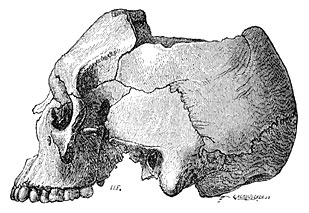
Skull from the Bougon dolmen (Deux-Sèvres), seen in profile.
In nearly every case the subjects operated on were young, and long survived the operation. The knowledge of this fact was from the first a very useful guide in the study of the subject of trepanation, and eagerly pursued researches constantly confirm it. One skull, for instance, from the cave of L’Homme Mort (Fig. 83), had a large opening produced partly by an old operation and partly by two posthumous trepanations. The subject had been trepanned in childhood or early youth. There could be no doubt on that point; cicatrization had been complete, the bony tissue having returned to its original condition. Then after death, at an adult age, the relations or friends of the deceased had cut out further round portions of the skull as near as possible to the old wound, probably with a view to keeping these pieces as amulets.
Figure 83.
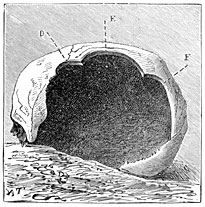
Trepanned prehistoric skull.
This was to Broca a flash of illuminating light, and according to him was in some cases a religious rite, a ceremony of initiation, perhaps even a custom inculcated by an established religion. The child who had been subjected to it and had survived—as probably most of the victims did survive,—attained to a certain position and celebrity in his life, and after his death the fragments of his skull, especially those portions near the old wound, became treasured relics, and were in the end buried with their fortunate possessor on his death.
However the operation may have been performed, it is not one of great danger to the patient or of great difficulty to the operator. Experiments on animals with Quaternary flint implements have always been successful, and have had no tragic results, which is the best proof we can possibly give.
The only instance we know in the present day of trepanation practised as a religious rite, is met with among the Kabyles, who are established at the foot of Mount Aurès on the south of the Atlas. The operation is performed among them by the thébibe, one of their priests, by the aid of a simple gimlet which he turns rapidly round between his fingers. Among the Kabyles are men who have submitted to an operation of this kind several times.
We have now passed in review the weapons of prehistoric peoples, the wounds they caused, and the modes of healing them known to our ancestors; we have still to study the modes of defence resorted to by them in face of the many dangers by which they were surrounded; but the importance of this subject is such as to deserve separate consideration.