Chapter II · Food, Cannibalism, Mammals Fish, Hunting, and Fishing.
N. D'Anvers translation
Whilst he evidently preferred to hunt and eat the larger mammals, man when pressed by hunger did not despise the small rodents, which were, of course, more easily captured. Amongst piles of the bones of horses and stags have been found the remains of martens, hedgehogs, and mice; and from the Thayngen Cave have been taken the bones of more than five hundred bares. In Belgium the water-rat seems to have been considered a dainty, and in the Chaleux Cave alone were found more than twenty pounds’ weight of the bones of this creature, nearly all bearing traces of having been subjected to the action of fire.
The skulls of the mammals bad been opened, and the bones split. Brains and marrow probably figured at feasts as the greatest delicacies. Travellers, whose tales are a help to us in building up a picture of the remote past of our race, relate that the Laplanders, as soon as an animal is killed, break open its skull and devour the brain whilst it is still warm and bleeding. This was probably also the custom amongst prehistoric cave-men.
It is generally admitted that we can tell whether the fracture of long bones was intentional by the way in which they were broken. This fact, which is true alike with the bones of men and of animals, is the most important proof we have of the cannibalism of the men of the Stone age. To the examples already given, we can easily add others culled from France. In the Pyrenees and in the caves of Lourdes and Gourdan, for instance, human bones have been found mixed with the cinders and ashes of the hearth, and still bearing the marks of the implements with which they were broken.
In Kent’s Hole, the celebrated cave in Devonshire, amongst many objects dating from the Stone age, were found some human bones bearing traces of having been gnawed by man. The eminent anthropologist, Owen, came to a similar conclusion—that cannibalism had been practised—after examining the jaw-bone of a child found in Scotland; and so did the Rev. F. Porter, after the excavations near Scarborough, where several skeletons were found under a tumulus, which had apparently been thrown where they were discovered by accident.
From the ancient tombs of Georgia have been taken human bones that have been boiled or charred, which were doubtless those of the victims eaten by the assistants in the fêtes which have ever accompanied funeral rites.
Nothing could exceed the barbarity of the Mexican sacrifices, the numbers of the victims, and the refinements of torture to which they were subjected. Prisoners, who had often been fattened for months previously, perished by thousands on the altars. The palpitating flesh was distributed amongst the assistants, and a horrible custom compelled the priests to clothe themselves in the still bleeding skins of the unfortunate wretches, and to wear them until they rotted to pieces.
Without going back to an antiquity so remote, in how many different regions of Africa and America, and in how many islands of Polynesia have not our sailors and missionaries reported the practice of cannibalism in our own day? It is difficult, therefore, not to believe, although the fact cannot perhaps be very distinctly proved, that the first inhabitants of Europe degraded as were the conditions of their existence, did eat human flesh and acquire a depraved taste for it; impelled thereto not only by the pangs of hunger, but also by a revolting superstition.
Delegorgue speaks of one lake peopled by more than one hundred hippopotami, and of a region less than three miles in diameter containing six hundred elephants. Livingstone tells us that he saw troops of more than four thousand antelopes pass at a time, and that these animals showed absolutely no fear. We may give a yet more curious instance. Captain Gordon Cumming, crossing the plains stretching away on the north of the Cape, saw troops of gazelles and antelopes, compelled by a long drought to migrate in search of the water indispensable to them, and be describes with enthusiasm one of these migrations, telling us that the plain was literally covered with animals, the hurrying herds defiling before him in an endless stream. On the evening of the same day, a yet more numerous herd passed by in the same direction, the numbers of which were absolutely incalculable, but which, according to Cumming, must have exceeded several hundred thousand.
Animals of the cervine and equine groups were, if possible, yet more numerous. M. Piette estimates the number of reindeer whose bones he has picked up in the Gourdan Cave as over. 3,000, and the number of cervidæ found at Hohlefels is positively incalculable.
At first man obtained by force, often aided by strategy, the animals he coveted. He bad not yet learnt to tame them and reduce them to servitude. Neither the reindeer nor the horse was as yet domesticated, and neither in the caves nor in the various deposits elsewhere has a complete skeleton been found, but only—a very significant fact—the bones on which had been the greater amount of flesh. The absence of any remains of the dog, so indispensable an animal in the keeping of flocks, is yet another proof that domestication was still unpractised.
It was with most miserable weapons, such as a few stones, scarcely even rough-hewn, and a few flint arrows, that the cave-man did not hesitate to attack the most formidable animals, and with such apparently inadequate means he succeeded in wounding and even killing them. The French Museum possesses mammoth and rhinoceros bones bearing fine scratches produced by the weapons which had been used to despatch the animals. The metacarpus of a large beast of prey, found at Eyziès, retains marks no less clear, and the skull of a bear front Nabrigas has in it a large wound which must have been made by a missile of some kind.
Nor were those already mentioned the only animals on which man made war. We shall speak presently of the contests with each other, which began amongst men in the very earliest days of humanity. Human bones, perforated by arrows and broken by stone hatchets, bear ineffaceable traces to this day of homicidal struggles.
In many places fresh-water and marine fish were utilized as food by man. In the numerous caves of the Vezère, in those of Madeleine, Eyziès, and Bruniquel, excavations have brought to light the vertebræ and other bones of fishes, amongst which predominate chiefly those of the jack, the carp, the bream, the drub, the trout, and the tench—in a word, all the fish which still people our rivers and lakes. In the Lake Stations of Switzerland, fish of all kinds are no less abundant. At Gardeole, amongst the bones of mammals have been found the shells of mollusca, and remains of the turtle and of goldfish. Fish was not, however, caught by all these primitive people, not even by all those who lived by the sea. In researches carefully carried on for years in the Maritime-Alps, M. Rivière found neither fishing-tackle nor fish-lines.
Whilst the cave-men of the south of France seem not to have utilized any but fresh-water fish, the Scandinavians, at a date probably less remote however, did not hesitate to brave the ocean. The kitchen-middings contain numerous remains of fish, amongst which those of the mackerel, the dab, and the herring are the most numerous. There, too, we meet with relics of the cod, which never approaches the coast, and must always be sought by the fisherman in the open sea.
Although we are in a position to assert that men were able to catch fish during every prehistoric period, if not in every locality, we can speak less positively of their mode of doing so. The earliest fishing-tackle was doubtless of the most primitive description: the bone of some animal, a fragment of hard wood, or even a fish-bone pointed at each end and pierced with a hole, served their purpose (Fig. 10). The Exhibition of Fishing-Tackle held at Berlin in 1880 contained several such implements, some of wood, others of bone. Others have also been found in the Madeleine Cave, and in different stations of the ancient inhabitants of Switzerland. It is interesting to note their resemblance to those still in use amongst the Esquimaux.
Figure 10.
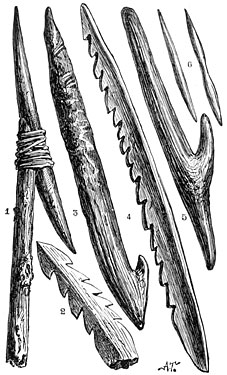
1. Fragments of arrows made of reindeer horn from the Martinet Cave (Lot-et-Garonne).—2. Point of spear or harpoon in stag-horn (one third natural size).—3. and 4. Bone weapons from Denmark.—5. Harpoon of stag-horn from St. Aubin.—6. Bone fish-hook; pointed at each end, from Wangen.
Prehistoric mail also turned to account the teeth of animals. We may quote in this connection the molars of a bear from which the enamel and the crown have been removed, and the thickness of which has been lessened by rubbing (Fig. 11). The small flints picked up in great numbers in the department of the Gironde also date from a remote antiquity; they are sixteen millimetres long by four wide, and though we cannot assert it as a fact, they are supposed to have been used for catching fish.
Figure 11.
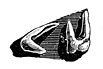
Bears’ teeth converted into fish-hooks.
Figure 12.
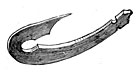
Fish-hook made out of a boar’s tusk.
In America, stone fish-hooks are rare. The most ancient are of bone, and resemble those now in use. They have been picked up in Dakota, and in the cinderheaps of Madisonville (Ohio), in Indiana, in Arkansas, on the shores of Lake Erie, and in a kitchen-midding of Long Island. The greater number of them are polished, and some of them have near the top a hole by which they could be fastened to a line or cord. The fish-hooks of California are remarkable for their rounded forms and sharply curved points; the top was covered with a thick layer of asphalt to which the line was probably fastened. They are numerous in all the islands of the Pacific coast. In that of Santa Cruz Schumacker excavated a tomb which must have been that of a fish-hook manufacturer, for care had been taken to place near the deceased, not only the implements of his craft, but also a number of fish-hooks in various stages of advancement. The Californians used the shells of the Mytilus Californicus and Haliotis to make fish-hooks, and these were even more curved than those made of bone. The shape seems but little suited for fishing, but even in our own day the natives of the Samoa Islands use similar tackle with great success. The Indians of the northwest coast make fish-hooks of epicea wood, and those of Arizona utilize for the same purpose the long spikes of the cactus. It is very probable that European as well as American races knew how to use wood in the same manner. During the lapse of centuries, however, these fragile objects have been reduced to dust, and we are unable to make any further conjectures on the subject.
Other fishing implements were also used by our prehistoric ancestors. At Laugerie-Basse a rough drawing shows us a man striking with a harpoon a fish that is trying to escape. These harpoons were generally made of reindeer horn (Figs. 10 and 13). Some had but one barb, others several. One of the largest was found in the Madeleine Cave; it is eight inches long, and has three barbs on one side and five on the other. Most of these weapons have a notch in the handle, with the help of which they could be firmly fastened to a spear or lance. Different fashions prevailed in different localities, and sinews, leather thongs, roughly plaited cords, creepers, and resinous substances were often pressed into the service.
Figure 13.
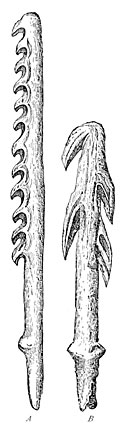
A, a large barbed arrow from one side of the Plantade shelter (Tarn-et-Garonne). B, lower part of a barbed harpoon from the Plantade deposit.
Herodotus tells that the Pœni (Carthaginians) plunged baskets into the water and drew them up full of fish. It is probable that the Lake Dwellers of Helvetia employed a similar process, but these ancient Swiss were already more advanced than that. They knew how to cultivate hemp, to spin it, and to make nets of it; the remains of some of these nets have often of late years been taken from the beds of the lakes.
It is almost impossible to class with any certainty the numerous Lake Stations of Switzerland. Some few certainly date from the Stone age, others from the transition period, between it and that of the early use of metals, or even from the Bronze age. As therefore they have been occupied at different times by different people, some of them having even been still in use in the time of the Romans, it is most difficult to fix with any precision the date to which belong the various objects mixed together beneath the deep waters of the lakes. We can only say that the nets differ very much in the size of the meshes, and the thickness of the rope used. Those found at Robenhausen are very like those in use in France at the present day. There has, in fact, been no advance in the art of making fishing-tackle since the remote days of the Lake Dwellers.
We are ignorant of the mode of manufacture of prehistoric nets. Did the Lake Dwellers, as some archæologists are disposed to think, use a loom? Did they use shuttles and rollers such as are employed by the Esquimaux and Californians of the present day? It is impossible to say, but it is supposed that the bears’ teeth sharpened to a point, found in some stations, were used to tighten the meshes. These meshes were generally square, and each one was finished of with a knot of the same size at each intersection.
The lead weights so indispensable to fishermen of the present day for sinking the nets, were represented in prehistoric times by stones. These stones, which are drilled or notched, are found in all the Lake Stations. The fragments of pottery pierced with a hole found at Schussenried, a Lake Station of the Stone age on the Feder-See (Wurtemburg), were probably used for the same purpose. In some of the Swiss Lake Stations have also been found pieces of wood and cork, pierced with one or more holes, which had certainly served as floats.
Numerous stone implements of the most primitive forms, often of rock not native to the country, have been found in some of the islands of Greece, as well as in Corsica, Sardinia, Elba, and Sicily. These discoveries bear witness to the presence of man in these islands at a very remote antiquity, though no other traces of the existence of prehistoric human beings have as yet been found there. These men can only have reached the islands by way of the sea. Boats were the only means of communication between the Lake Dwellers of Switzerland and the mainland, and, as we have seen, the ancient Scandinavians hunted fish on the deep ocean. We must therefore admit that attempts at navigation were made in the very earliest days of humanity. Alan, impelled by necessity, or perhaps only by curiosity, was not afraid to launch his bark, first upon the rivers, and later upon the more formidable waves of the sea
The Latin poet is right, and we cannot but admire those who were the first to brave the terrors of the deep and the horrors of the tempest; for they were gifted alike with the intelligence which conceives, the courage that dares, and the strength that achieves.
Figure 14.
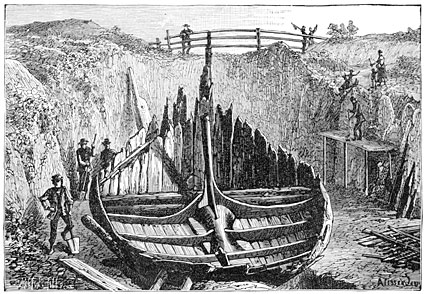
Ancient Scandinavian boat found beneath a tumulus at Gogstadten.
Inlaying the foundations of the bridge of Les Invalides, Paris, a boat was taken out of the mud which had lain there for many centuries. Like most of those already mentioned, it had been made out of a single trunk roughly squared. Everywhere, we must repeat once again, man’s original ideas were the same; everywhere the tree floating on the top of the water excited his curiosity, and became the starting-point for one of his most important discoveries. Traces of similar attempts at navigation are met with in other parts of France; a canoe was found in the Loire near Saint Mars, and the Dijon Museum possesses another from the same river, the latter some sixteen feet long, and traces have been made out of what are supposed to have been seats, but may have been mere contrivances for strengthening the boat. A canoe taken last year from the bed of the Cher is of the shape of a trough closed at the end by pieces of wood fixed by means of vertical grooves. The prow had been shaped in the first instance in the trunk itself, and it was probably owing to an accident, a collision perhaps, that it had had to be mended in this way (Fig. 15).
Figure 15.
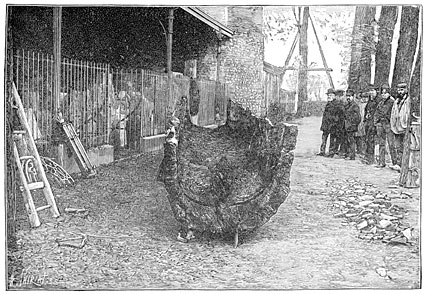
Ancient boat discovered in the bed of the Cher.
The Lake Dwellers of Switzerland owned boats from the time of their first settlement in their water homes. One of them found at Robenhausen is more than ten feet long, and is very shallow, varying from six to eight inches. Like most of those already mentioned, it was hollowed out of the trunk of a tree, bulging out towards the centre, and rounded at the ends. So far none but stone tools have been found at the station of Robenhausen, so that we must presume that it was with such tools that the boat was made. The lakes of Bienne and. Geneva, and the stations of Morges and Estavayer have also yielded boats which are doubtless less ancient than those of which I have just spoken. In nearly all of them the prow is curiously pointed. One of them from the Lake of Neuchâtel, large enough to bold twelve people, has a beak at the stern and a rounded prow; but there is no sign of any contrivance for keeping the oars in place.
Lastly, a boat bas been found in Switzerland some 3,900 feet above the valley of the Rhine, but no one can say how it came to be at such a height.
Figure 16.
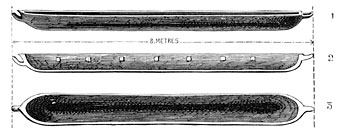
A lake pirogue found in the Lake of Neuchâtel. 1. As seen from the outside. 2 and 3. Longitudinal and transverse sections.
Professor Gastaldi speaks of a wooden anchor taken from a peat-bog near Arona, beneath which was a pile dwelling. He dates it from the tinge when the use of bronze was already beginning to spread in the north of Italy. A stone of peculiar shape found at Niddau is, they say, an Ankerstein (anchor stone). This name is also given by Friedel to a good-sized round lump of sandstone with a deep groove near the middle. Lastly, Kerviler, in crossing a basin of the Bay of Penhouet, near Saint-Nazaire, found several stones which had evidently been used to keep boats at anchor, and with the aid of which we can get an idea of the methods employed by ancient navigators (Fig. 17).
Figure 17.
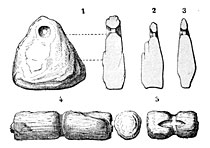
Stones used as anchors, found in the Bay of Penhouet. 1, 2, 3, stones weighing about 160 pounds each. 4 and 5, lighter stones, probably used for canoes.
Such are the only details we have on the important subject of prehistoric anchors, but we may add that ancient fishermen probably ventured but a short distance from the land, and would not need anchors, as they could easily carry their light boats on shore.
We leave now passed in review the conditions of the life of our remote ancestors, noting the animals that were their contemporaries, and the fish that peopled the watercourses near which they lived. We have studied the earliest efforts at navigation, made in the pursuit of fish, and we must now go back to examine the weapons, tools, and ornaments of these ancient peoples, and trace in those objects the dawn of art. This will be the aim of our next chapter.