Chapter III · Weapons, Tools, Pottery; Origin of the Use of Fire, Clothing, Ornaments; Early Artistic Efforts.
N. D'Anvers translation
Man alone amongst the countless creatures around him knew anything of the past, and he alone was able to predict the future. Even apes, however great the intelligence that may be attributed to them, have remained very much what they were from the first. In vain has one generation succeeded another; they still obey the dictates of their brutal instincts, as their ancestors did before them; and if apes continue to propagate their species thousands of years hence they will remain what we see them to be now. Dogs, too, will remain dogs, elephants will continue to be elephants; beavers will make their dams exactly like those of the present day, wasps will never learn to make honey as bees do, and bees will never be able, like ants, to bring up plant-lice to be their servants, or to enslave other families. Their instincts are incapable of progress, and in their earliest efforts they reach the limit assigned to them by the Eternal Wisdom. To man alone has it been given to understand what has been done by his predecessors, to walk more firmly in the path along which they groped, to pronounce clearly the words they stammered. Without a doubt we descend from the men who lived in the midst of primeval forests, or amongst stagnant marshes, dwelling in caves, for the possession of which they often bad to fight with the wild beasts around them. These men, however, knew that one result achieved would lead to another, if similar means were used; they saw that a pointed stone would inflict a deeper wound than a blunt one on the animal they hunted, and therefore they learnt to sharpen stones artificially; the skins of beasts, flung over their shoulders, protected them from cold, and they learned to make garments; seeds sprouted around them, and they learned to plant them; they noticed the effect of heat upon metals, and tried to mix them; wild animals wandered around them, and they learned to reduce them to slavery. Every bit of knowledge won, and every progress made, became the starting-point for fresh acquisitions, fresh advances, which thenceforth remained forever the common heritage of the human race.
It was thus that experience early taught our remote ancestors that rock chips more easily under the blows of a hammer when fresh from the quarry; and everywhere men learnt to choose the stone best suited to their purpose. For hatchets, wedges, and hammers, they used jade and kindred substances, such as fibrolite, diorite, and basalt, which were at the same time extremely durable, and very impervious to blows. For spear- and arrow-heads, knives, saws, and all instruments requiring sharp points and cutting edges, they employed quartz, jaspar, agate, and obsidian, according to the situation of the worker; all these materials, though extremely hard, being easily split into thin sharp flakes. The blocks of stone were very methodically cut up; they were, in fact, to use a very appropriate expression of M. Dupont’s, scaled (écaillês). We give drawings of a few of these implements (Figs. 18, 19, and 20), which illustrate the earliest efforts of lean, efforts which may be looked upon as the starting-point of all those industries which in the course of centuries have developed results which it is impossible to contemplate without astonishment.
Figure 18.
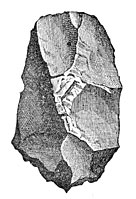
Scraper from the Delaware Valley.
Figure 19.
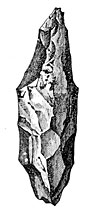
Implement from the Delaware Valley.
Figure 20.
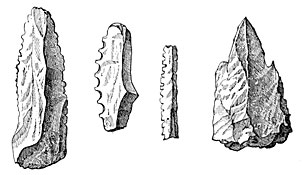
Worked flints from the Lafaye and Plantade shelters (Tarn-et-Garonne).
Sometimes these Chelléen tools (the French call them coups de poing) have retained at the base a projection to enable the user to grasp them better; these certainly never had handles, but it will not do to draw any general conclusions froth that fact; and an examination of the collection of M. d’Acy, the most complete we have of relics of the Chelléen period, proves on the contrary that certain tools could not have been used unless they had been fixed into handles.
In the following epoch, to which has been given the name of Moustérien, from the Moustier Cave (Dordogne), we already meet with more varied forms, including scrapers, saws, knife-blades, and spear- or arrow-heads, with the special characteristic of being cut on one side only. These implements are found not only in the alluvium as are the Chelléen coups de poing, but also in the cave or rock-shelter deposits. Amongst the mammalian remains with which they are associated are those of the mammoth, the Rhinoceros tichorhinus, the elk, the horse, the aurochs, the cave-lion, the cave-hyena, and the cave-bear, remarkable for the constancy of their characteristics. The Elephas antiquus and the Rhinoceros Merckii that belonged to the preceding period have now completely passed away, and the reindeer, now appearing for the first time, are still far from numerous.
Lastly to the Madeleine period, so named after the Madeleine Cave (Dordogne), and considered one of the most important of the cave epochs, belong tools and weapons of all manner of shapes and materials, including bone, born, and reindeer antlers; from this time also date barbed arrows and harpoons, batons of office, telling of social organization; the engravings and carvings on which bear witness to the development of artistic feeling. On the other hand, the flint arrow-heads and knife-blades are not so finely cut; we see that man had learned to use other materials than stone. The reindeer is the most characteristic animal form of the Madeleine period.
It is impossible to enumerate the number of polished hatchets which have been found; their number is simply incalculable. Of all of them, however, those of Scandinavia are the most remarkable for delicacy of workmanship. With the fine hatchets of Brittany, may be compared the blades found at Volgu, and preserved in the Museum of Copenhagen, and those in pink, gray, and brown flint, from the Sordes Cave in the south of France; but we cannot fix the date of the production of any of them. One of the great difficulties of prehistoric research, a difficulty not to be got over in the present state of our knowledge, is to distinguish with any certainty the periods into which an attempt has been made to divide the life-story of man from his first appearance upon earth.
Rounded stones of granite or sandstone seem however to have been weapons peculiar to the Neolithic period. Dr. Pommerol recently spoke at the Anthropological Society of Paris, of two such rounded stones picked up in the Puy-de-Dôme. Similar stones have been discovered at Viry-Noureuil, and M. Massénat has one in his collection from Chez-Pourré. Are not these rounded stones of a similar character to the bolas flung by the ancient Gauls, and still in use amongst the inhabitants of the pampas of South America?
As we have already remarked, plan from the earliest times must often have held in his hands the stones which served him as weapons or as tools. The marks of hammering on the smooth surfaces, the rounded projections and the grooves worked in these stones, were evidently made to prevent the hand or the thumb from slipping. Soon, however, reflection led man to understand the increase of force he would gain by the addition to the stone of a handle of wood or horn, stag or reindeer antler. This addition of a handle was simple enough: the workman merely bound it to the hatchet with fibrous roots, leather thongs, or ligaments taken from the gut of the animals slain in the chase (Fig. 21). At first sight we are astonished at the results obtained with such wretched materials, but it is impossible to dispute them, for we have seen the same thing done in our own day.
Figure 21.
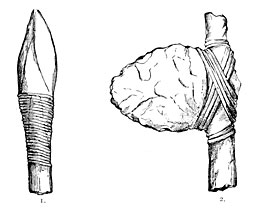
1. Stone javelin-head with handle. 2. Stone hatchet with handle.
Though flint was the material par excellence of Quaternary times for weapons and tools, it could not long suffice for the ever-growing needs of man. Our museums contain a complete series of bone or stag-horn implements such as darts, arrow-heads, barbed arrows, harpoons, fibulæ, and finely cut needles often pierced with eyes (Fig. 22). The invention of barbs is worthy of special notice; the series of points made the blow much more dangerous, as the projectile remained in the flesh of a wounded animal which was not able to get it out. But this was not the only object of the barbs. Arranged symmetrically on either side of the arrow they kept it afloat in the air like the wings of a bird, which may perhaps have suggested their use and increased the effect and precision of the shot.
Figure 22.
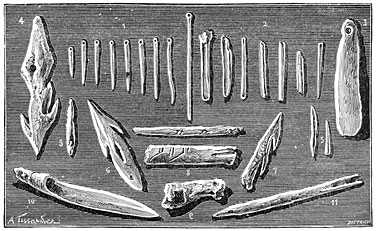
1. Fine needles. 2. Coarse needles. 3. Amulet. 4 and 6. Ornaments. 5. Cut flint. 7. Fragment of a harpoon. 8. Fragments of a reindeer antler with signs or drawings. 9. Whistle. 10. One end of a bow (?). 11. Arrow-head. (From the Vache, Massat, and Lourdes caves.)
Figure 23.

Amulet made of the penien bone of a bear, and found in the Marsoulas Cave.
There is no doubt that it is the caves of the south of France which have yielded the most interesting objects; needles with drilled eyes, and barbed arrows have been picked up in considerable numbers at Eyziès, Laugerie-Basse, at Bruniquel, Massat, and in the Madeleine Cave. Dr. Garrigou mentions some rein deer or roebuck antlers found in Ariège caves, which had been made into regular stilettos. In the deposits at Lafaye were fouled stilettos or bodkins, varying in length from two to six inches; needles measuring from nineteen to one hundred and five millimetres and provided with eyes; at Marsoulas were found an amulet made of the penien bone of a bear (Fig. 23), some pendants, and some pointed pieces of bone which astonish us by the delicacy of their workmanship, and the drawings with which they were adorned.
Figure 24.
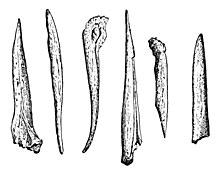
Various stone and bone objects from California.
At Paviland, Dr. Buckland discovered a wolf bone cut to a point. Kent’s Hole yielded a number of needles resembling those of the Madeleine Cave; at Aggtelek (Hungary) were found some bones of the cave-bear pointed to serve as daggers, cut into scrapers or pierced to serve as amulets or ornaments. In Belgium, objects very similar to these have been found made of reindeer antler and dating from the most remote times. The antlers moulted by the reindeer in the spring were in especial request.
Excavations in the sepulchral mounds near San Francisco (California) have yielded thousands of bone implements (Fig. 24). Others similar to them have been found in the layers of cinders at Madisonville (Ohio) and beneath the numerous kitchen-middings of the coasts of the Atlantic and Pacific.
Some objects, which are supposed to date from Neolithic times, bear witness to an altogether unexpected degree of civilization. In the heart of Germany, in the peat-bogs of Laybach and Wörbzig on the banks of the Saale, have been found earthenware spoons of the shape of modern spatulæ; at Geraffin on Lake Bienne, a finely shaped spoon made of the wood of a yew tree; and at Lagozza, another in shining black earthenware. Lartet had already brought to light a bone implement covered with ornaments in relief which he ascribed to the Palæolithic period, and which he imagined had been used for extracting marrow; and another archaeologist tells of objects in reindeer antler found in the Gourdan Cave, which he thinks were used for a similar purpose. In the Saint-Germain Museum are preserved the remains of spoons from the bed of the Seine, and in the collections of England are fragments of bone taken from beneath the West-Kennet dolmen, which were all probably employed for extracting marrow. But the most important discovery of all, which leaves no doubt on the subject, is that made by M. Perrault at the Chassey Camp, near Chalon-sur-Saône, beneath a hearth dating from Neolithic times. He collected fourteen earthenware spoons; one of them of a round shape and remarkable for its size, was unfortunately broken (Fig. 25). It is of brown earthenware with a rather rough surface mixed with bits of flint, and is so much worn that it had evidently been in use a long time. Lastly two spoons, also of earthenware, have recently been found near Dondas (Lot-et-Garonne). The use of spoons, which certainly marked considerable progress, must therefore have spread rapidly.
Figure 25.
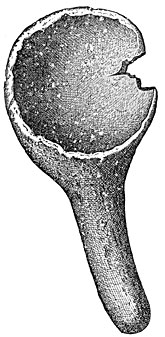
Dipper found in the excavations at the Chassey Camp.
Long previously, however, pottery of a great variety of form bore witness to tire plastic skill of man. Every where we find vessels of coarse material mixed with grains of sand or mica to give more consistency to the paste which was baked in the fire, and had often no further ornamentation than the marks of the fingers of the potter. Does this pottery date from Palæolithic times, or were the earthenware vessels later additions at the time of those disturbances of deposits which are the despair of archæologists? A few examples may enable us better to answer this question.
Fraas tells us that fragments of pottery have been found in all the caves of Germany in which excavations have been made. He quotes that of Hohlefels, where he himself picked up such fragments amongst the bones of the mastodon, the mammoth, the rhinoceros, and the cave-lion, when the remains of these animals were for the first time found in Germany. In 1872, the making of the railway from Nuremberg to Ratisbon brought to light a cave of considerable depth. In its lower deposits were found nothing but the bones of hyenas, bears, and lions, of which the cave had been the resort for centuries. Among the most ancient deposits, relics of a similar kind were found in abundance, but now mixed with numerous fragments of pottery, worked flints, and fish bones, including those of the carp and the pike, with the bones of mammals, amongst which predominated those of the rhinoceros, most of them intentionally split open. At Argecilla, twenty leagues from Madrid, Vilanova discovered a regular workshop, in which were knives and flint arrow-heads, together with some very primitive pottery made of clay that had evidently been brought from a distance, as there is none in the district in which the pottery was found, In an upper deposit Vilanova collected more than two hundred implements made of diorite, a rock frequently used in Spain, some very remarkable celts of serpentine dating from the Neolithic period, and numerous fragments of very delicate pottery. Not far off he discovered another workshop, containing some very fine hatchets perfectly polished, and some keramic ware tastily ornamented. The progress made is as marked in the weapons and tools as in the pottery.
Figure 26.
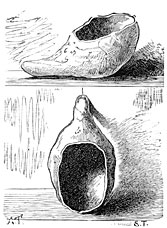
Pottery of a so far unclassified type found in the Argent Cave (France).
The baking of pottery is a proof that the use of fire was known in the most remote times. The existence in various places of masses of cinders, fragments of charred wood, and half-calcined bones, proves it yet more decidedly. At Solutré, at Louverné (Mayenne), at Saint-Florent (Corsica), to give but a few examples, we find large slabs of half-calcined stone, laid flat and covered with heaps of cinders and all sorts of rubbish. These slabs formed the family hearth, where man prepared his food, with the help of the fire he had learnt to ignite and to keep burning.
Without pausing to consider the somewhat puerile theories of Vitruvius, or the myths which testify to the importance attached to fire by primeval man, we are at liberty to suppose that a conflagration caused by lightning or by the spontaneous combustion of vegetable materials in a state of fermentation, or other similar phenomena, made known to man the power of fire, and the use it might be to him. The accidental striking together of two flints produced a spark; observation taught men to obtain a similar result by the same process; a great step in advance was made, and the future of humanity was assured. M. Dupont picked up in the Chaleux Cave a kidney-shaped piece of iron pyrites, hollowed out in a peculiar manner, which had evidently been used to obtain the precious spark. The Christy collection contains a granite pebble with a hole the shape of a cup, which had evidently been used to obtain fire, by rubbing round in it a stick of very dry wood. The two methods employed at the present day were therefore already in use. Lumholz tells us that the Australians of Herbert River get fire by rubbing two pieces of wood together. The Indians of the northwest of Colorado, the Yapais of the Caroline Islands, and the Mincopies of the Andaman Isles, with many other races, know no other process. We must, however, still maintain a certain reserve in dealing with the fire-obtaining implements of so imperfect a nature, and belonging to times so remote as those called prehistoric.
During bad seasons, or in the bitter cold of winter, primeval man contented himself with flinging over his shoulders the skins of the animals he had killed. He prepared these skins with flint scrapers, and sewed them together with bone needles. In hot weather man probably roamed about stark naked. Shame is not a natural instinct; education alone develops it. Writing in 1617, Fynes Morison speaks of having seen at Cork young girls quite naked, engaged in crushing corn with a stone. The Tchoutchi women, says Nordenskiöld, wear no clothes when in their tents, however great the cold. In tropical countries men, women, and children, all completely nude, went to meet the travellers who landed on their shores. Count Ursel, in a recent journey in Bolivia, in going through a little town, saw “near the public fountain some young girls already growing up making their ablutions and playing about in the garb of the earthly paradise.” Travellers who visited Japan a few years ago reported that the inhabitants, without distinction of age or sex, came out of the water in a state of complete nudity, presenting a strange spectacle to European eyes. The sight of what is actually going on amongst comparatively civilized people in our own day enables us to understand better what must have been the state of things when the whole world was in a state of barbarism.
It was not until much later, in the times to which the name of Neolithic has been given, that men made stuffs, and replaced the skins of animals by lighter and more flexible garments. The inhabitants of the Lake Stations of Switzerland and of Italy cultivated hemp. At Wangen and at Robenhausen have been found shreds of coarsely woven cloth, and at Lagozza fragments of yet more primitive material. On some of these pieces it is supposed that traces of fringe and attempts at ornamentation have been made out. Even in the Périgord caves Lartet noticed some long slim needles which could not have been used for sewing skins; and he concluded that they were intended for more delicate work, perhaps even for embroidery. A new art, and one which we certainly should not have expected to find is now met with for the first time.
Red chalk was not the only substance employed. At Chatelperron, were picked up fragments of manganese; at Cueva de Rocca, near Valentia, pieces of cinnabar; in the Placard Cave, bits of black lead; and in the different stations in the Pyrenees, especially in that of Aurensan, ochre has been found which was doubtless used for the same purpose. At Solutré, ochre, manganese, and graphite were found; the last named had been scraped with a flint, and the scratches made by it are still distinctly visible. From a Westphalian cave, Schaafhausen took some dark yellow ochre; at Castern (Staffordshire), a bit of this same calcareous substance, worn with long service, was picked tip; in Cantire (Argyleshire), a piece of red hematite, which had evidently been brought from Westmoreland or Lancashire; and lastly, in Kent’s Hole was found some peroxide of manganese.
All these fragments of ochre or manganese, red chalk or black lead, were reduced to powder with the help of pebbles, artificially hollowed out. Everywhere we meet with these primitive mortars, and side by side with them other pebbles in their native condition, which had evidently been used for crushing the coloring matter.
A recent discovery tends to confirm the hypothesis that these colors were used for the decoration of the human body. A curious engraving on a bone represents the head and arm of a man, and on the lower part of the forearm it is easy to make out a four-sided design which evidently indicated tatooing.
In every country, and in every climate, we find men as well as women manifesting a taste for ornament. The progress of civilization has greatly increased this taste, but it existed as a natural instinct in the very earliest days of humanity, and the contemporary of the mammoth and the cave-bear, the cave-man cowering in his miserable den, sought for ornaments with which to deck himself. In the caves near the stations occupied by primeval men we find little bits of fossil coral, beads of hardened clay, the teeth of bears, wolves, and foxes, boars’ tusks, and the jawbones of small mammals, fish-bones, and belemnites pierced with holes, and intended to be used as amulets or ornaments to be worn round the neck. At Lafaye, we find the incisors of small rodents serving the same purpose. The dweller in the Sordes Cave owned a precious necklace made of forty bears’ and three lions’ teeth. The teeth found often have on them ornamental lines, which doubtless indicated the rank or celebrated the deeds of the chief. The Abbé Bourgeois describes some stags’ teeth found at Villehonneur (Charente), two of which bore scratches which may have had some signification. At Cro-Magnon were picked up some ivory plaques pierced with three holes; at Kent’s bole were found some oval disks measuring five by three inches, which in the delicacy of their workmanship presented a curious contrast to the other objects taken from the same cave. In the Belgian caves here picked up some thin slices of jet and some ivory plaques, and in those of the south of France fragments of steatite, cut into rectangular and lozenge shapes, whilst in the Thayngen Cave was found a pendant of lignite (Fig. 27). Men were not content with natural products; fashion demanded new forms and fresh materials.
Figure 27.
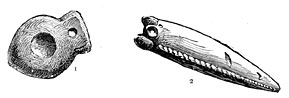
1. Lignite pendant. 2. Bone pendant (Thayngen Cave).
But what most attracted the attention of the ancient inhabitants of France were bright-colored shells. The caves of Roquemaure have yielded nearly a thousand disks and beads made of cockle-shells; at Cro-Magnon more than three hundred shells were picked up which formed a collar or necklace, which was not however so valuable as that of the man of Sordes. M. de Maret discovered at Placard numerous shells; some belonging to ocean species still extant, and others fossils of forms now extinct. Many of them are foreign to the country in which they were found. From the most remote times therefore the inhabitants of the present department of Charente fished in the Gulf of Gascony, crossed Aquitania, visited the shell marl deposits of Anjou and Touraine, and penetrated as far as the present Paris basin. The finding of the Cyprina Islandica in one of the French caves proves that the prehistoric men of France even went as far away as the north of England. This is by no means an isolated fact; numerous shells from the department of Champagne had been taken to tire shores of the Lesse and the Meuse. At Solutré have been found belemnites, ammonites, and Miocene shells, which were certainly never native to that district, with pieces of rock-crystal from the Alps, and beads made of a jadeite of unknown origin.
The most interesting discoveries, however, were those made in the caves of Baoussé-Roussé, of which we have so often spoken. M. Rivière picked up the skeletons of two children, some thousand shells (Nassa neritea) artificially pierced, which had been used to deck their garments: Near an adult were other shells forming a necklace, a bracelet, an amulet, and a garter worn on the left leg; whilst on the head was a regular résille or net, not unlike that of the Spanish national costume, which net was made of small nerita shells and kept in place by bone pins.
We must also mention amongst favorite ornaments beads made of jet and of very fine ochreous clay dried in the sun, of calcareous crystalline rock, and of grayish schist, and in other places of beads of amber or of hyaline quartz, the brightness of which attracted the attention. At the station of Menieux (Charente) with flints of a type to which it is usual to give the names of Moustérien or Solutréen, excavations have yielded numerous carefully polished balls of calx, varying in diameter from one to two inches. If there had been any doubts as to their use, those doubts would have been removed by the discovery at Laugerie-Basse of a fragment of the shoulder-blade of a reindeer on which was engraved the figure of a woman wearing round her neck a necklace of clumsy round balls. Other yet stranger ornaments have been found, for which what we have said about the cannibalism of early man should have prepared the reader. Our ancestors of the Stone age adorned themselves with necklaces of human teeth, and two skeletons have been dug out wearing round their necks this token of their victories. M. de Baye possesses in his collection some round pieces of skull pierced with holes (Fig. 28), and at the meeting of the American Association in 1886, at Ann Arbor (Michigan) were presented some ornaments made of human bones from a mound in Ohio.
In taking from the gangue in which it was imbedded a skull from the megalithic monument of Vauréal, Pruner Bey noticed a fragment of a human shoulder blade pierced with an incision in which was fixed a little rounded piece of bone. This style of ornament seems to have remained in use for many centuries, for M. Nicaise has lately discovered at Moulin d’Oyes (Marne) a necklace made of calx balls, shells, and pendants cut out of the scales of unio shells. On this necklace hung a round piece of human cranium, and in the Gallic cemetery at Varille, the exterior lamina of a human lumbar vertebra was fastened to a necklace made of coral beads.
Figure 28.
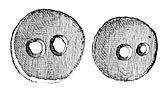
Round pieces of skull pierced with holes (Al. de Baye’s collection).
We are also acquainted with facts of another order, which may be mentioned in this connection. The men of Marjevols drank out of human crania; the Grenoble Museum owns a drinking-vessel of this kind; others have been discovered at Billancourt, at Chavannes, at the Chassey Camp, and at Sutz, Æfelé, and Loci-as in Switzerland, as well as at Brookville in the State of Indiana. Dr. Prunières possesses half a human radius, probably that of a female, carefully polished and converted into a stiletto (Fig. 29). Dr. Garrigou has an arrow-head made of a human bone, Pellegrino a fibula converted into a polisher found in the lower beds of the celebrated Castione terremare near Parma. At the meeting of the Prehistoric Congress in Paris in 1869, Pereira da Costa mentioned a femora converted into a sceptre or staff of office, and to conclude this melancholy list, Longpérier mentions a human bone pierced with regular openings, which, by a strange irony of death, served as a flute to delight the ears of the living. .
Figure 29.
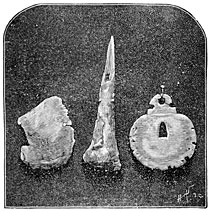
Part of a rounded piece of a human parietal-Stiletto made of the end of a human radius—Disk made of the burr of a stag’s antler.
One of the earliest necessities of human nature must have been companionship; for help was absolutely necessary to enable man to cope with the dangers surrounding him. Tribes, formed at first of members of the same family, must have existed from the very dawn of humanity. The reindeer phalanges, pierced to serve as whistles (Fig. 30), found at Eyziès, Schussenreid, Laugerie-Basse, Bruniquel, in the Chaffaud Cave and the Belgian shelters, in a peat-marsh of Scania, in the island of Palmaria, and in many other places, were doubtless used to summon men to war or to the chase. In the Cottes Cave were found some reindeer and aurochs’ shanks, which may naturally be supposed to have served the same purpose. The curious objects preserved in the Christy collections must also have been used in war or in the chase. They bear, in addition to the mark of their owner, notches of different shapes commemorating his exploits in battle or in hunting. At Solutré, MM. Ducrost and Arcelin noticed fragments of elephants’ tusks, calcareous plaques, and some sandstone disks from the Trias, with notches and equidistant lines evidently having a similar purpose.
Figure 30.
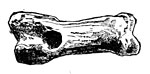
Whistle from the Massenat Collection.
From whistles to regular musical instruments the transition is simple. Without describing that mentioned by M. de Longpérier, which we cannot confidently assert to be of great antiquity, M. Piette, in one of his numerous excavations, discovered a primitive flute made of two bird bones which, when put together and blown into, produced modulations similar to those of the pipes used by the people of Oceania; the monotonous music of which is alluded to by Cook. Some time afterwards M. Piette noticed similar bones in the Rochebertier collection. So far we know of no other discovery of a similar kind.
The curious objects known under the name of staves of office would, if it were needed, afford yet another proof that the men of the Stone age lived in societies, possessed an organization, and acknowledged a chief. The staves of office consist of large pieces of reindeer or stag antler, artistically worked and presenting a pretty uniform appearance. Their surface is decorated with carvings and engravings representing animals, plants, and hunting scenes. They are thicker than they are wide, and the care often taken to reduce the thickness is a proof that an attempt was made to combine elegance and lightness with solidity (Figs. 31, 32, 33, 34, and 35). Nearly all of them are pierced at one end with large holes, of which the number varies. Some of these holes were later additions. May we perhaps see in them the signs of a priesthood, in which successive ranks were attained, and in which every new achievement was rewarded with a new distinction? This is difficult to prove, but these staves could not have been used as weapons or as tools; the care taken to cover them with ornaments, with the long time required for this decoration, shows the value their owners attached to them. The impossibility of any other hypothesis is the best proof we have of their use.
Figure 31.
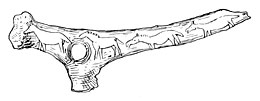
Staff of office.
Amongst the marvellous objects collected by Dr. Schliemann at Hissarlik, were two fragments of reindeer antler pierced with holes presenting a singular resemblance to those we have been describing. We may also compare with them the pogomagan, the badge of office of Indian chiefs on the Mackenzie River, the Tartar kemous, the sticks on which the Australians mark by conventional signs any event of importance to themselves or their tribe, and the similar objects from Persia, Assam, the Celebes, and New Zealand. But why seek examples so far away? Is not the memory of these ancient insignia preserved in our own day, and may they not have been the original forms of the sceptres of our kings and the croziers of our bishops?
Figure 32.
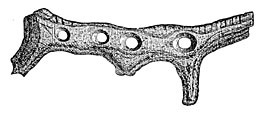
Staff of office made of stag-horn pierced with four holes.
Figure 33.
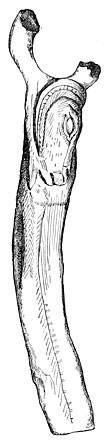
Staff of office found at Lafaye.
Figure 34.
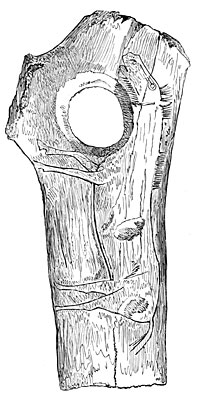
Staff of office in reindeer antler, with a horse engraved on it, found at Thayngen.
With this staff of office were picked up some pieces of ivory covered with geometrical designs, engraved with some sharp implement, stilettos, bone needles, knives, flint scrapers, and, stranger still, the remains of the cave-lion, the cave-hyena, and the Rhinoceros tichorhinus, all contemporaries of the most ancient Quaternary fauna.
Figure 35.
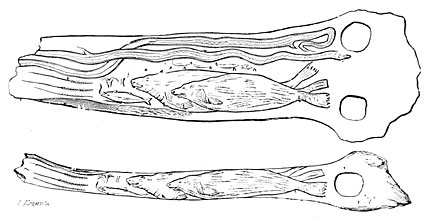
Staff of office found at Montgaudier.
Figure 36.
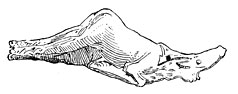
Carved dagger-hilt (Laugerie-Basse).
Figure 37.
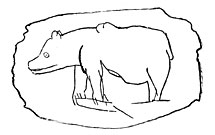
The great cave-bear, drawn on a pebble found in the Massat Cave (Garrigou collection).
In the Lortet Cave was found the bone of a stag on which could be made out a representation of fish and reindeer, whilst at Sordes was discovered a bear’s tooth with a seal engraved upon it (Fig. 39), at Marsoulas a piece of rib on which is depicted an animal said to be a musk-ox (Fig. 40), and at Feyjat (Dordogne) a bird’s bone bearing on it a drawing of three horses moving rapidly along. I am obliged to pass over many other most interesting examples, but I must not omit to mention the magnificent examples which form part of the Peccadeau collection at Lisle. Cartailhac mentions some chamois, an ox, and an elephant; some engraved on the bones of deer and others on fragments of ivory, or on reindeer antlers. The art of the cave-men was now at its zenith.
Figure 38.
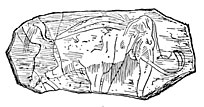
Mammoth, or elephant, from the Lena Cave.
Figure 39.
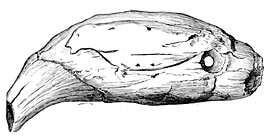
Seal engraved on a bear’s tooth found at Sordes.
But for one exception to which I shall refer again, it is curious to note that we only find these engravings and carvings, which so justly excite our astonishment in a district of limited extent, bounded on the north by the Charente, on the south by the Pyrenees and extending on the east no farther than the department of the Ariège. It is a pleasant thought that in the midst of their struggle for existence, and when they had to contend with gigantic pachyderms and formidable beasts of prey, our most remote ancestors, the contemporaries of the mammoth and the lion, already developed those artistic tendencies which are the glory of their descendants.
Figure 40.
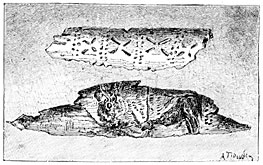
Fragment of a bone with regular designs. Fragment of rib on which is engraved a musk-ox, found in the Marsoulas Cave.
Figure 41.
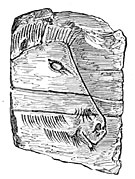
Head of a horse from the Thayngen Cave.
Figure 42.
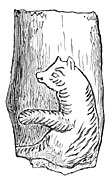
Bear engraved on a bone from the Thayngen Cave.
Figure 43.
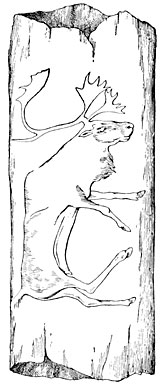
Reindeer grazing, from the Thayngen Cave.
The representation of the human figure is extremely rare. I have already mentioned the young man trying to strike an aurochs which is running away from him; and the woman wearing a necklace. The former (Fig. 45), found at Laugerie, is engraved on a piece of reindeer antler about twenty-five centimetres long. The aurochs with its head down and quantities of bristling hair, widely open nostrils, arched and uplifted tail, presents the appearance of a terrified animal endeavoring to escape the danger threatening it. The man is naked, and has a round head, his hair is stiff and seems to stand up on the top of his skull; on the chin a short beard can clearly be made out; the face expresses the delight and excitement of the chase. The neck is long, the arm short, and the spine of unusual length. In the other example of the representation of the human figure, that of the woman wearing a necklace, drawn on a piece of a shoulder-blade of a reindeer, she is seen lying by a stag, and would seem to be in an advanced state of pregnancy. The piece of bone however is broken, and the head of the woman is lost, which of course greatly lessens the value of the relic.
Figure 44.
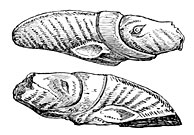
Head of Ovibos moschatus engraved on wood, found in the Thayngen Cave.
Figure 45.
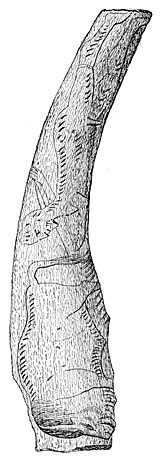
Young man chasing the aurochs, from Laugerie.
Figure 46.
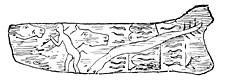
Fragment of a staff of office, from the Madeleine Cave.
Figure 47.
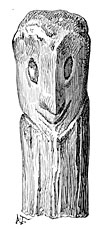
Human face carved on a reindeer antler, found in the Rochebertier Cave (Charente).
We must not close this account of the art efforts of the men of the Stone age without mentioning the remarkable discovery by M. Siette, of flints covered with lines and geometrical designs colored with red chalk. These are the very earliest examples of the art of painting which have hitherto come to our knowledge. They bear witness to a remarkable progress made by our remote ancestors of the valleys of the Pyrenees.
We cannot more appropriately close this chapter than by quoting the magnificent verse of Lucretius, which brings before us, better than could a long description, the condition of these men, and the humble starting-point from which humanity has advanced to achieve its immortal destiny: