Chapter VIII · Tombs.
N. D'Anvers translation
The true history of man will be found in his tombs, says Thucydides; and as a matter of fact the sepulchre has ever occupied much of the thoughts of man, the result of a religious sentiment, a conviction that all does not end with the life which so quickly passes by.
From the very earliest times we meet with tokens of the hopes and fears connected with a future existence; but, as I have already stated, the human bones that can with certainty be said to date from Palæolithic times are very rare. We know but very few facts justifying us in asserting that the contemporary of the mammoth and of the cave bear had already learnt to respect the remains of what had once been a man like himself. One of these few facts deserves, I think, to be noticed with some detail.
At the same level and in that immediately above it were picked up the remains of the mammoth, the Rhinoceros tichorhinus, the cave bear, and the large cave hyena, the reindeer, and numerous other mammals belonging to the Quaternary fauna. Everything points to the conclusion that the man and woman whose remains have so opportunely come to light were contemporary with these animals, and that their bodies were placed after death in the cave in which they were found.
Belgium has furnished numerous examples of sepulchral caves, of a date, however, less ancient than that we have been considering. Recent excavations in the Chauvaux Cave revealed two skeletons leaning against the walls in a crouching position, the legs tucked under the body. In the Gendron Cave M. Dupont discovered seventeen skeletons lying in a low, narrow passage, stretched out at full length with the feet toward the wall, and arranged in twos and threes, one above the other. In the middle of all these dead was the skeleton of one man placed upright, as if to watch over the other bodies.
The Duruthy Cave at Sordes opens near the point of junction of the waters of the Pan and Oloron, whence their united waters flow into the Adour. At the northern extremity of this cave is a natural niche in which lay more than thirty skeletons, some of men, some of women, and some of children, mixed together in the greatest confusion. Worked flints, bone stilettos, and ornaments lay around, all of the forms characteristic of Palæolithic times.
At the present day certain tribes of North America expose their dead on the tops of trees, and before burying the bones, when stripped of their flesh, cover them with a coating of a bright red color. In the island of Espiritu Santo many human bones have also been picked up painted with an oxide of argillaceous iron. These customs, strange as they may appear, were evidently practised in honor of ancestors; atavism is as clearly shown in customs and traditions as in physical structure.
The dead were often buried seated or bent forward, and it is interesting to note the same custom beneath the mounds of America and the tumuli of Europe. It is touching to see how in death men wished to recall their life on earth; the cradle was, so to speak, reproduced in the tomb, and man lay on the bosom of earth, the common mother of humanity, like the child on the bosom of his own mother. Perhaps, too, the seated position was meant to indicate that man, who had never known rest during his hard struggle for existence, had found it at last in his new life. The men of the rough and barbarous times of the remote past were unable to conceive the idea of a future different to the present, or of a life which was not in every respect the same as that on earth had been.
The funeral rites of which we have spoken necessarily imply burial; man did not abandon to wild beasts or birds of prey the bodies of those who had once been like himself. At Aurignac, at Bruniquel, and in the Frontal Cave, the cave man bad taken the precaution of closing with the largest stones he could find the entrances to the last resting-places of those belonging to him. The caves of L’Homme Mort, and of Petit-Morin which date from Neolithic times, retain traces of similar blocking up. There were five entrances to the cave of Garenne de Verneuil (Marne) in which was a regular ossuary; the floor was paved and the roof kept up with eleven upright stones. The objects in the tomb with the dead were a clumsy earthenware vase, a few flint knives, and some shell necklace beads.
The sides of the almost inaccessible mountains of Peru are pierced, at a height of several hundred feet, with numerous caves which have nearly all been artificially enlarged. It was in them that the Peruvians placed their dead, and the people of the country still call them Tantama Marca or abodes of desolation. The entrances were concealed with extreme care, but this care did not save the tombs from violation; the greed for the treasures supposed to be concealed in the tombs was too great for respect to the unknown dead to hold curiosity in check.
We have said so much in preceding chapters on monuments erected in memory of the dead, that but little remains to be added here. Doubtless there are many distinctions to be noted at different times and in different countries, but everywhere the aim remains the same, and the means used for attaining that end are radically the same all the world over. Take for example the Aymaras, the most ancient race of Bolivia and Callao; they laid their dead sometimes beneath megalithic monuments (Fig. 58, p. 178) resembling the dolmens of Europe, sometimes beneath towers or chulpas, which are however probably of more recent date.
Figure 105.
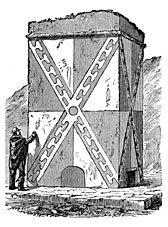
Chulpa near Palca.
Chulpas, generally of square or rectangular form, consist of a mass of unhewn stones faced outside with blocks of trachyte or basalt, painted red, yellow, or white. A very low door, always facing east, as if in honor of the rising sun, gives access to a cist in which the dead was laid. The chulpa of our illustration (Fig. 105) is situated near the village of Palca; it rises from an excavation four feet deep; its height is about sixteen feet, and the cornice consists of ichu, a coarse grass which grows in abundance on the mountains, and which after being firmly compressed was cut with the help of sharp instruments. The human bones, which were mixed together in the greatest confusion, made a heap in the sepulchral chamber more than a foot high.
The mounds of Ohio also cover over sepulchral chambers of a peculiar construction, being often formed of round pieces of wood, five to seven feet long by five to six inches in diameter; near the bodies were placed a few ornaments, chiefly copper ear-rings, shell beads, and large flint knives. Most of the skeletons lay on the bare earth; but one exception is mentioned in which the ground was paved with mussel shells. A remarkable discovery has quite recently been made at Floyd (Iowa), the account of which in Nature for January 1, 1891, we will give in the words of Clement Webster: “In making a thorough exploration of the larger mound … the remains of five human bodies were found, the bones even those of the fingers, toes, etc., being, for the most part in a good state of preservation. First, a saucer or bowl-shaped excavation has been made, extending down three and three-quarter feet below the surface of the ground around the mound, and the bottom of this macadamized with gravel and fragments of limestone. In the centre of this floor five bodies were placed in a sitting posture with the feet drawn under them, and apparently facing the north. First above the bodies was a thin layer of earth and ashes, among which were found two or three small pieces of fine-grained charcoal. Nearly all the remaining four feet of earth had been changed to a red color by the long-continued action of fire.” Mr. Webster goes on to describe the various skeletons and says of one of them, that of a woman: “The bones in their detail of structure indicated a person of low grade, the evidence of unusual muscular development being strongly marked. The skull of this personage was a wonder to behold, it equalling if not rivalling in some respects and in inferiority of grade, the famous Neanderthal skull. The forehead, if forehead it could be called, is very low, lower and more animal-like than in the Neanderthal specimen…. The question has been raised how was it that these five bodies were all buried here at the same time, their bodies being still in the flesh.” … Webster adds that the probability is that all but one of them had been sacrificed at the death of that one, who had most likely been a chief.
Figure 106.
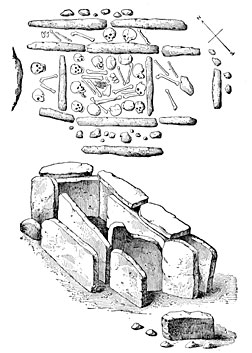
Dolmen at Auvernier near the Lake of Neuchâtel.
Figure 107.
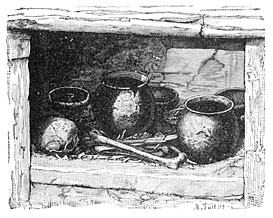
A stone chest used as a sepulchre.
Figure 108.
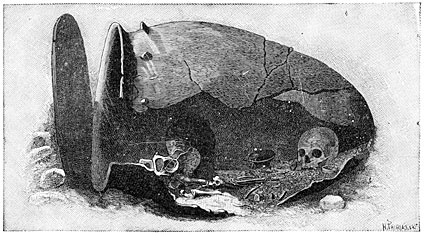
Example of burial in a jar.
The ancient Caledonians sewed up their dead in the skins of oxen before burying them. The Egyptians also embalmed the ibis, the ox, the cat, the crocodile, and other animals deified by them, and the bodies of these creatures were then placed in vast subterranean chambers, where they have been discovered in the present day in great numbers. The Guanches of Teneriffe, the last representatives of the Iberians, and probably the most ancient race of Europe, took out the intestines of the corpse, dried the body in the air, painted it with a thick varnish, and finally wrapped it in the skin of a goat. This last custom was evidently a relic of the original idea of embalming, with a view to rendering the mummy as nearly as possible indestructible and, to use a happy expression of Michelet, to compel death to endure (forcer la mort de durer). Our own contemporaries are thus able to look upon the very features of those who preceded them on the earth some forty centuries ago; and but yesterday photography reproduced in every detail what was once Ramses the Great, one of the most glorious kings of history.
Figure 109.
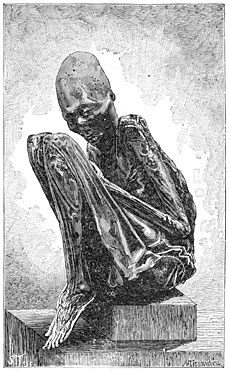
Aymara mummy.
The facts enumerated above prove that burial was long practised, though it is impossible to say when it first cattle into use. About the time of the beginning of the Bronze age, or perhaps even earlier, however, a remarkable change took place in the ideas of man, and the dead instead of being buried intact were consumed by fire on the funeral pile.
What can have been the origin of this custom? What race first practised it? It has long been supposed by many archæologists that it was the Aryans from the lofty Hindoo Koosh Mountains who first introduced into Europe a civilization more advanced than that which had hitherto obtained there, and taught the people to cremate instead of bury their dead. This theory was accepted for a considerable time without question, but of late years a new school, headed by Penka, has arisen who claim that the reformers came not from the East but from the North. The Marquis de Saporta had indeed before suggested that the primitive races who were the contemporaries of the mammoth and the rhinoceros came originally from the polar regions, where the remains of a luxuriant vegetation prove that climatic conditions prevailed in remote times of a very different character to those of the present day. The lignites of Iceland are made up of tulip, plantain, and nut-trees, even the vine sometimes occurring. In the ferruginous sandstones, associated with the carboniferous deposits of Spitzberg, the beech, the poplar, the magnolia, the plum tree, the sequoia, and numerous coniferous trees can be made out. The sturdy sailors who dare the regions of perpetual ice come across masses of fossilized wood in Banks, Grinnell, and Francis Joseph’s Lands, at 88° N. Lat. Among this fossil wood Heer made out the cypress, the silver pine, the poplar, the birch, and some dicotyledons with caducous leaves. These were not relics of wood which had drifted where it was found on floating ice, but of an actual local vegetation, as proved by trunks still erect in their original positions, buds, leaves, and flowers in every stage of growth, fruits in every stage of ripening. The very insects that had lived on honey from the flowers or on the leaves themselves could be identified. In those remote days, life, abundant life, similar to that now only found in the temperate countries farther south, flourished in those polar regions, so long supposed to have never been anything but lifeless deserts.
Figure 110.
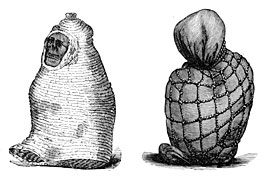
Peruvian mummies.
All this, plausible as it is, does not, however, appear to be conclusive on the point under discussion; and though we may have to abandon the idea of the Aryans having introduced cremation, we are scarcely, I think, in a position to say that races from the North were the first to practise it. I have dwelt more fully on the question of the origin of races and the evidence which language seems to give of a common source in two papers called “Les Premiers Populations de l’Europe,” which appeared in the Correspondent for October 1 and November 25, 1889. Whatever may be the final decision on the much contested points involved in this controversy, one thing is certain that cremation, involving though it does a complete revolution in manners and customs, spread with very great rapidity. We meet with it from Greece to Scotland and Scandinavia, from Etruria to Poland and the south of Russia, in China as in Yucatan and certain parts of Central America.
It is strange indeed to find that incineration was practised from Neolithic times in the wild mountains of Lozère. There can be no doubt on the point, however, and excavations beneath the dolmen of Marconnières strikingly confirm the earlier discoveries of Dr. Prunières. Beneath a layer of broken stones and a very thin pavement, was found a mass of human bones in the greatest confusion; some still retaining their natural color, others blackened and charred by. fire. Among these bones was picked up an arrow of rock foreign to the country, three admirably polished lance-heads, and some finely cut flint-darts. The dolmen contained no metal objects, and there was no trace of metal on any of the bones.
Whatever may have been the cause of the different modes of burial, we meet with them in every country.
In the tombs in which burial was practised, the bodies were laid in the trench without covering, and the remains of anything in the way of slabs or coffins or protecting planks are very rare; in those tombs in which cremation had been the rule, ustion had often been very incomplete, sometimes the head and sometimes the feet having escaped the flames.
Similar facts are noted at Watsch, at San Margarethen, and at Vermo in Styria, at Rovesche in Southern Carniola, and at Rosegg in the valley of the Drave. At Watsch, but ten skeletons were found, among two hundred examples of incineration. In the cremation sepulchres, if we may so call them, the cinerary urn was protected by large slabs; while in those where burial was practised, the bodies were simply confided to the earth as at Hallstadt; but by a singular contrast, the latter tombs contained much more important relics, the objects with the dead being more valuable and of finer workmanship. At Rovesche, the urn was placed in a square chest made of unhewn stones. The buried bodies lay with the head turned toward the east, an urn was placed at their feet, and their shrouds were kept in place by bronze fibulæ, while on the fingers were many rings of the same metal.
Although we meet with the burial of the dead either in a recumbent or a crouching position, everywhere the minor ceremonies connected with death are innumerable; each people, each race, indeed, having its own custom, handed down from one generation to another, and piously preserved intact by each successive family. Feasting was from the earliest times a feature of the funeral ceremonies. An edict of Charlemagne forbids eating and drinking on the tombs of the deceased, and Saint Boniface, the apostle of Germany, complains bitterly that the priests encouraged by their presence these feasts of death. We meet with the same kind of thing among the lower classes at the present day, and the cemeteries of Paris are surrounded with cafés and wine shops, where too often grief is drowned in wine. The custom of holding these feasts really comes down from the earliest inhabitants of Europe, and the savage cave man gorged himself with food upon the tombs of those belonging to him. At Aurignac, in the cave of L’Homme Mort, in the Trou du Frontal, broken bones and fragments of charcoal bear witness to the repast. Similar traces of feasts are met with beneath the dolmens and the tumuli. From the Long Barrows have been taken the skulls and feet of bovidæ, and it is probable that the other parts of the body had been devoured by the assistants, and that the head and feet were placed in the tomb as an offering either to the dead or to the divinities who are supposed to have presided at the death. In the ancient sepulchres of Wiltshire Sir R. Colt Hoare picked up the bones of boars, stags, sheep, horses, and dogs; which he too considered were the remains of funeral feasts.
The facts we have been noticing prove that early man cherished hopes of immortality. All was not ended for him with death; a new life commences beyond the tomb, marked—for his ideas could go no farther—by joys similar to those he had known on earth, and events such as had occurred during his life. What else could be the meaning of the weapons, the tools of his craft, the vases filled with food placed near the defunct, the ornaments and colors intended for his adornment, the wives, slaves, and horses flung into the same tomb or consumed upon the same pile? It is pleasing to find this supreme hope among our remote ancestors; and clumsily as it was expressed, it implies a belief in a being superior to man, a protecting divinity according to some, but according to some few others a malignant and tyrannical spirit. The proofs so far to hand are not enough to justify us in seriously asserting that ancestors were worshipped by prehistoric man. But the subject is too important for us to refrain from putting before the reader such indications of this worship as have been collected, and which are necessarily connected with the moral and material condition of our remote ancestors.
The radius of a mammoth was discovered at Chaleux, occupying a place of honor on a large sandstone slab near the hearth. The Chaleux Cave dates from the Reindeer period; at which time the mammoth had long since been extinct in Belgium, so that there can be no doubt that the cave man had taken this bone from the alluvial deposits of the preceding epoch, and this huge relic of an unknown creature had been the object of his veneration, a lar or protective divinity of his home. A somewhat similar fact was discovered at Laugerie-Basse and, by a strange coincidence, certain tribes of North America of the present clay preserve the bone of a mastodon or of a cetacean in their buts as a protection to their homes.
From Paleolithic times men were in the habit of cutting celts or hatchets in chalk, bitumen, and other fragile substances, which were certainly of no practical use. Thousands of similar objects in harder rock, but showing no sign of wear or tear, have also been found, and there is little doubt that they all alike served as amulets. This superstitious respect for certain objects lasted for many centuries, and was handed down from one generation to another. The tombs of the Bronze and Iron ages are often found to contain flint hatchets, some of them broken intentionally, a proof, as I have already said, that they were connected with funeral rites of the nature of which we are ignorant.
We find hatchets engraved on the megalithic monuments of Brittany, on the walls of the caves of Marne, and we meet with them again on the other side of the Atlantic, evidently bearing the same signification, implying respect for them as means of protection. De Longpérier has published a description of a Chaldean cylinder, on which was represented a priest presenting his offering to a hatchet lying on a throne, and a ring was picked up at Mykenæ, on the stone of which was engraved a double-bladed celt. We find the same idea in many different mythologies. The word Nouter (God) is translated in Egyptian hieroglyphics by a sign resembling a celt, and the hatchet of Odin is engraved on the rocks of Kivrik. On a number of Gallo-Roman cippi, we find a hatchet beneath which we read the words, Dis Manibus, and lower down the dedication, Sub Ascia dedicavit. At all times and everywhere the hatchet appears as the emblem of force, and is the object of the respect of the people. The tradition of its value and importance is handed down from ancestors to descendants throughout many generations.
Figure 111.
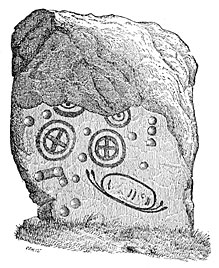
Erratic block from Scania, covered with carvings.
May we give a religious interpretation to the basins and cups hollowed out on rocks and erratic blocks and on the so-called Roches Moutonnées, with other monuments that have endured for many centuries (Figs. 111 and 112)? Or must we attribute them merely to passing caprice? Their number and importance we think forbid the latter idea. We find such blocks in Switzerland, in England, France, Italy, Portugal, and on the frozen shores of the Baltic. They are no less numerous in India, and they figure in the curious pictographs of the two Americas. There is no doubt that we have here a common idea, and one it is impossible not to recognize. How. else can we account for the similarity of arrangement in the cup-shaped sculptures from the tumuli of Schleswig-Holstein and those on the Indian rocks of Kamaou, or between those of Algeria and of England?
Figure 112.
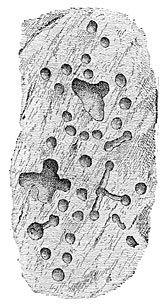
Engraved rock from Massibert (Lozère).
In Brittany and in Scotland these cup-like sculptures are found on rocks and menhirs, on the walls of sepulchral chambers, on stones forming the sides of kistvæns, accompanied in many instances with radiated circles, which do not, however, help us to understand them better. In Scandinavia they are known as Elfen Stenavs, or elf stones, and the inhabitants come and place offerings on them for the Little People. According to a touching tradition, these little people are souls awaiting the time of their being clothed once more in human flesh. In Belgium these strangely decorated stones are attributed to the Nutons, dwarfs who are very helpful to mortals. In every country there is some legend sacred to the sculptured stones.
Such are the only facts we have been able to collect respecting the religious feeling of prehistoric races. They are not sufficient to authorize any final conclusion on the subject. At every turn we are compelled to admit our helplessness. But yesterday this past without a limit was absolutely unknown to us, and to-day we are but beginning to be able to obtain a glimpse into its secrets. We have been the laborers of the first hour, it will be for those who come after us to complete the task we have been able but to begin. May a genuine love of truth be to them, as we may justly claim it has been to us, the only guide.