BIOGRAPHICAL (continued 8)
Reading edition
It was in 1887 that Martin Hansen crossed the broad Atlantic to the United States and about three years later he made his way to Walla Walla county, Washington, where he was employed for wages for five years. He saved carefully and systematically until his industry and economy had brought him sufficient capital to enable him, in 1895, to engage in farming on his own account. He then rented land and again he practiced economy and industry until in 1897 he had a capital sufficient to enable him to purchase his present home farm of one hundred and fifty-nine acres. Upon that place he has since resided and has made many valuable improvements thereon, among others drilling in 1912 two artesian wells which flow one thousand gallons of water per minute, greatly enhancing the value of the farm. Its splendid appearance is indicative of the care and labor which he has bestowed upon it. He arrived in Walla Walla without capital and today he is one of the substantial farmers of this section of the state, and what means more, the result achieved is due to his industry, his perseverance and his determination alone. He has never been afraid of hard work and he early recognized the eternal principle that industry wins.
Mr. Hansen is a republican in his political views, having supported the party since becoming a naturalized American citizen. He has served for a number of years on the school board and is one of the influential men of his community, his opinions carrying weight regarding public affairs. His life record should serve to inspire and encourage others, showing what may be accomplished when energy points out the way.
JAMES H. SCHNECKLOTH.
James H. Schneckloth, the well-known and popular postmaster of Pomeroy, was born on the 25th of October, 1868, in Scott county, Iowa, a son of Henry and Margaretha (Kuhl) Schneckloth, who were natives of Germany and on coming to America in early life settled in Scott county, Iowa, where the father engaged in farming for some years. In 1881 he brought his family to Washington and located on a farm near Pomeroy, where he still resides. His wife died in 1914. To them were born eight children and seven of them survive.
James H. Schneckloth began his education in the public schools of his native county, where the first thirteen years of his life were passed in much the usual manner of farmer boys in the middle west. He then accompanied his parents on their removal to Washington and here grew to manhood. On starting out in life for himself he engaged in the stock business and is still interested in that enterprise. As time passed he prospered in his undertakings and is today the owner of a fine stock ranch of one thousand acres.
In 1912 Mr. Schneckloth was united in marriage to Miss Rose Dougherty, and to them has been born a daughter, Janet M. They are members of the Episcopal church, and Mr. Schneckloth is also identified with the Knights of Pythias and the Foresters. By his ballot he supports the men and measures of the democratic party and he has taken a very active and influential part in public affairs. In 1904 he was elected county treasurer and acceptably filled that office until 1913. In February of the following year he was appointed postmaster of Pomeroy and is now serving in that capacity with credit to himself and to the entire satisfaction of all concerned. He is a self-made man, whose success in life is due to his own unaided efforts, and he is regarded as one of the leading citizens of the town.
JOSEPH WEIMER.
Joseph Weimer is a resident farmer of Garfield county, his home being on section 20, township 12 north, range 41 east. Ever loyal to his adopted country, he has made himself a creditable position as a leading agriculturist of Garfield county and as a citizen of genuine worth. He was born in Germany, June 3, 1861, and is a son of Casper and Lizzie (Braun) Weimer, who came to the United States in 1886. After arriving on the shores of the new world they made their way direct to the west with Washington as their destination and established their home in Garfield county, where the father filed on a homestead claim five miles northwest of Pomeroy. With characteristic energy he began the development and improvement of that property and devoted his attention to its further cultivation until the time of his death.
Joseph Weimer, whose name introduces this review, acquired his education in the common schools of his native country and in 1884 he set sail for the United States, landing in Philadelphia, Pennsylvania. Crossing the continent without tarrying for any length of time in the east, he at length reached the Pacific coast and spent six months in California. He then came northward into Washington and made his final settlement. He took up a homestead in Garfield county on which he resided for seven years, at the end of which time he bought land and removed to his present home farm on section 20, township 12 north, range 41 east. Upon that place he has since resided. He is one of the self-made men of this state. He came to the northwest in very limited financial circumstances and today he owns three hundred and twenty acres of valuable wheat land in Garfield county. His plate is improved with substantial buildings, with well kept fences and good farm machinery and everything about his place indicates his careful supervision and his practical and progressive methods. The fields give promise of abundant harvests in the autumn and the work of the farm has been carried on in a most modern and effective way.
In 1891 Mr. Weimer was united in marriage to Miss Matilda Andress, a native of Chippewa Falls, Wisconsin, and they have become the parents of four children: Edward Joseph, Frank Henry, Fred and Tillie, all of whom are still under the parental roof. Mr. Weimer and his family are communicants of the Catholic church.
In his adopted land Mr. Weimer has found the opportunities which he sought and in their utilization has won a substantial measure of success. He has worked diligently and persistently along lines that have led to gratifying results and is now one of the enterprising farmers of Garfield county.
JOHN H. HARER.
John H. Harer is a resident farmer of Walla Walla county, owning and cultivating one hundred and thirty acres of land on section 4, township 6 north, range 35 east. He was born in Lane county, Oregon, on the 25th of February, 1859, his parents being David and Sarah (Standifer) Harer. The father was a native of Arkansas, while the mother was born in Tennessee. They were married in the former state and there resided until 1852, when they determined to try their fortune upon the Pacific coast and removed to Oregon. They settled in Lane county and in 1865 left that locality to become residents of Walla Walla county, Washington, the father having previously made several trips into this part of the country prior to the removal. He secured a homestead claim at Webfoot and later he bought and removed to the farm where Valley Chapel is now located. He kept adding to his original purchase from time to time as his financial resources increased until he was the owner of more than a section of land. Upon that property he died, passing away June 14, 1883. His widow long survived him and departed this life in 1907. During her last nine years she made her home with her son John.
John H. Harer is numbered among the honored pioneer settlers of the northwest, having resided in this section of the country for almost six decades. He acquired a district school education and also attended the public schools of Walla Walla. On reaching manhood he became engaged in the cattle business, with which he was identified for several years, and in 1889 he purchased from the other heirs their interest in the Harer estate and thus came into possession of his present home farm, upon which he has since carried on general agricultural pursuits. The farm originally comprised one hundred and sixty acres of rich and productive land, but he has recently sold thirty acres of the tract. He has brought his fields under a high state of cultivation and everything about his place indicates his careful supervision, progressive methods and indefatigable energy.
In 1882 Mr. Harer was united in marriage to Miss Eva Waterman, a native of Walla Walla county. Her father was Samuel Waterman, who crossed the plains from Iowa to California in 1860 and in the spring of 1861 arrived in Walla Walla county, taking up his abode in the vicinity of Valley Chapel. He was thus closely identified with the early development and progress of this section of the state until his death, which occurred in January, 1878. His widow survives and is now living with a daughter in Spokane, Washington. To Mr. and Mrs. Harer have been born three children, two of whom survive, namely: Inez, who is the wife of E. S. Gibson, of North Yakima, Washington; and Bertha, the wife of R. L. Ridley, who operates the farm of his father-in-law. Mrs. Harer is a member of the Christian church and is a lady of many admirable characteristics.
Mr. Harer gives his political allegiance to the democratic party. He has never sought or desired political office but for several years he served as school director and proved a stalwart champion of the cause of education. Both he and his wife are actuated by a spirit of progress and enterprise in all that they undertake and their interest centers deeply in those affairs which promise to upbuild and develop further the section of the country in which they live.
WILLIAM F. CLUSTER.
William F. Cluster, deceased, was one of the honored and highly esteemed citizens of Pomeroy. His birth occurred in Indiana on the 8th of February, 1831, and his parents were Daniel and Margaret (Tumlin) Cluster, natives of Kentucky and Ohio respectively. About 1861 they removed to Missouri, where both died. In their family were eleven children, all of whom have passed away with the exception of one sister, residing in Missouri.
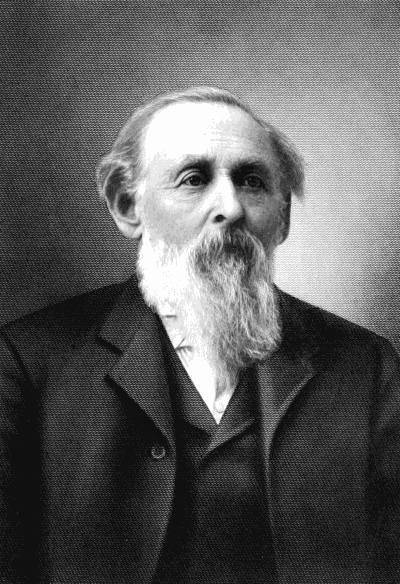
WILLIAM F. CLUSTER
In the state of his nativity William F. Cluster was reared and educated and on leaving the parental roof at the age of twenty-three years went to Missouri. He crossed the plains to Oregon in 1862 and spent the remainder of his life on the Pacific coast. In 1868 he married Mrs. Mary E. French, a native of Ohio, who only a short time previously had come to the northwest and had located in Oregon, where they continued to make their home until 1871. It was in that year that Mr. and Mrs. Cluster removed to old Walla Walla county, Washington, and took up a claim seven miles from Pomeroy, on which they built a log cabin, this being the family home for four years. They remained on the farm until 1882, when they took up their abode in Pomeroy and here Mrs. Cluster still lives. She continues in possession of the old homestead, which comprises two hundred acres of finely improved land, and owns a forty-acre tract which adjoins the city of Pomeroy. She has six residences in this city and derives a substantial income from all these properties.
The children born to Mr. and Mrs. Cluster are as follows: Viola E., the wife of C. E. Gray; Florence M., the wife of E. M. Pomeroy; Carrie E., deceased; and E. C., a resident of Pomeroy.
After a useful and well spent life, Mr. Cluster passed away on the 14th of June, 1915, leaving his immediate family as well as many friends to mourn his death. His remains were interred in the Pomeroy cemetery. Mrs. Cluster takes an active part in the work of the Presbyterian church, to which she belongs and is a most estimable lady who has a wide circle of friends and acquaintances in the city and throughout the surrounding country.
W. H. GILLIS.
The family of W. H. Gillis, residing in Dayton, pays fitting tribute to his memory in preserving the record of his life in this history of southeastern Washington. He was born in Montgomery county, North Carolina, and was reared and educated in his native state. In 1867 he was united in marriage to Miss Lucy A. Crump, of Stanly county, North Carolina, a daughter of Stephen and Eliza (Kendall) Crump, both of whom were natives of the Old North state, where they lived and died. They were the parents of five children, all of whom survive. Mrs. Gillis was reared and educated in North Carolina, pursuing her studies in the common schools and afterward in the Greenville and Doranport colleges of that state. To Mr. and Mrs. Gillis were born three children: Lillian, who has departed this life; John A.; and Minnie, who is the wife of J. F. Hall. The death of Mr. Gillis occurred March 2, 1906. He had been a soldier of the Civil war, serving for four years, and was brave and loyal to the cause which he espoused. He never faltered in the performance of any duty that devolved upon him and made an excellent record as a soldier. To his family he was a devoted husband and father and found his greatest happiness in promoting the welfare of his wife and children. In business affairs he was progressive and reliable and his sterling worth was acknowledged in many relations.
On the 16th of June, 1907, Mrs. Gillis became the wife of A. H. Richardson, who died five years later. Mrs. Richardson is the owner of a valuable farm property of five hundred and twenty acres pleasantly and conveniently situated about five miles east of Dayton. Upon this place many modern improvements have been made. The buildings are substantial and commodious, the fences are well kept and everything about the place indicates the progressive spirit of the owner. Mrs. Richardson rents her farm and therefrom derives a gratifying annual income. She also owns one of the finest residences of Dayton and is most comfortably situated in life. She is a member of the Christian church and takes an active interest in promoting the church work. Her social position is indicated by the fact that the hospitality of the best homes of Dayton is freely accorded her.
WILLIAM GAYLORD COLEMAN.
William Gaylord Coleman, a well known member of the Walla Walla bar, was born October 7, 1884, in the city where he still resides. His father, Dan J. Coleman, a native of Bowling Green, Kentucky, became a pioneer farmer of the Eureka Flat district and spent his last days in Walla Walla. The mother, who bore the maiden name of Mattie C. Roberts, was a daughter of E. G. Roberts and was born in an emigrant wagon somewhere along the Platte river while the family were crossing the plains. Her first marriage was with J. W. Cookerly and she later wedded Dan J. Coleman. The family ever has been closely associated with the pioneer development of Washington.
Reared in his native city, William Gaylord Coleman, after mastering the preliminary branches of learning, decided upon the practice of law as a life work and with that end in view entered the University of Michigan at Ann Arbor and was there graduated in June, 1909, "with honors" and with the LL. B. degree. He returned to the northwest, opening an office in Walla Walla, and has since engaged in practice here. In a profession where advancement depends entirely upon individual merit and ability he has made steady progress and public opinion names him as one of the able lawyers of the Walla Walla bar.
On the 5th of September, 1911, in Walla Walla, Mr. Coleman was married to Miss Margaret S. Steel, a daughter of T. S. and Annie J. Steel. They hold membership in the Presbyterian church and Mr. Coleman is a past grand of the Odd Fellows lodge. A lifelong resident of Walla Walla, he has a wide acquaintance and his sterling worth as a man, as a lawyer and a citizen is indicated by the high regard entertained for him by his fellow citizens.
JOHN MARTIN.
John Martin, living retired in Walla Walla after many years devoted to agricultural pursuits, was born in Ireland, January 1, 1842, a son of John and Ann Martin, who spent their entire lives on the Emerald isle. The educational opportunities accorded John Martin were those common to the boys of his time, he attending the national schools, and he remained in Ireland until he was twenty-five years old, when, in 1867, he emigrated to the United States. He first resided in New York state, where he secured employment in a brickyard at Haverstraw, and subsequently went to Baltimore, Maryland, but finding it too hot to suit him there, he went to Chicago, where he was employed by the Armour Packing Company, during the winters for several years, but in summer followed his work of brick burning and helped to manufacture the brick used in the construction of the United States customs house in Chicago. After remaining in the metropolis of the middle west for eight years he came to Walla Walla, Washington, in 1882 and settled on a farm on Dry creek. He operated that place until 1905, when he retired and removed to Walla Walla, where he purchased land and built his home on Grove street, where he has since lived. He is still prominently connected with agricultural affairs, however, as he owns fourteen hundred acres of fine wheat land, all of which is well improved. He gives his personal supervision to the management of his farm although he leaves the actual work of its operation to others. All that he has he has made since coming to Walla Walla county and it is but natural that he should be enthusiastic concerning conditions here.
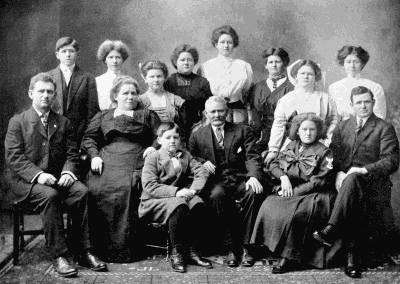
JOHN MARTIN AND FAMILY
In 1875, in Chicago, Mr. Martin was united in marriage to Miss Sarah McAvaney, a native of Illinois, and they have become the parents of fourteen children, of whom two are deceased, the others being: James, who is now chief of police of Walla Walla; John P., who is farming in Spring valley; Mary, the wife of Joe Martin, who although of the same name is not a relative; Elizabeth, the wife of Albert Schiller; Margaret, the wife of Roy Davies; and Katherine, Agnes, Grace, Theresa, George, Lillian and William, all at home.
Mr. Martin supports the republican party and has served acceptably as member of the school board. He is a communicant of the Catholic church, and his life has been guided by high moral standards. His residence is attractive and up-to-date and he is enjoying all the comforts of his life as the result of his well directed labors and wise investments. Mr. Martin is strong and vigorous for his years but to enjoy the balmy air of the south he spends his winters in Los Angeles, California.
C. F. ACTOR.
C. F. Actor, a grain dealer and warehouse man of Starbuck, was born in Dixie, Washington, on the 27th of October, 1868, a son of H. C. Actor, one of the veterans of the early Indian wars and one of the well known men of the pioneer period of Walla Walla county. He died August 30, 1917, near Dixie and extended mention of him appears elsewhere in this work.
C. F. Actor was reared under the parental roof and acquired his education in the public schools of Dixie. He also attended the Empire Business College of Walla Walla and thus became well qualified for life's practical and responsible duties. In early manhood he worked for a time in Colfax and was variously employed, after which he returned to Walla Walla county and for some time was engaged in farming. In 1902 he removed to Starbuck and entered the grain trade, managing the Alto warehouse for the Alto Warehouse Company for a year. On the expiration of that period he became the representative of the Balfour-Guthrie Company, with which he continued for four years as grain buyer. In 1907 he engaged in the grain business on his own account and since that time has operated independently and successfully, being today one of the well known grain merchants of Columbia county, controlling a business of large volume that brings to him a good financial return.
In 1900 Mr. Actor was married to Miss Lucy May Buroker, daughter of Martin B. Buroker, of Waitsburg, and they have become the parents of five children, four sons and a daughter, namely: Charles M., Alfred A., Grace, Lester E. and Fred F.
In his political views Mr. Actor has ever been an earnest republican since attaining adult age. In January, 1917, he was appointed to fill a vacancy on the board of county commissioners and is now serving in that capacity, in which connection he is making an excellent record, carefully safe-guarding the interests of the county, yet never blocking public progress by useless retrenchment. He belongs to Tucannon Lodge, No. 106, F. & A. M., of Starbuck, and also to Starbuck Lodge, No. 158, I. O. O. F. In 1916 he was representative to the grand lodge of Odd Fellows. He is also identified with Dayton Lodge, No. 3, K. P. In banking circles he is known as a director of the Bank of Starbuck and he ranks with the leading and representative business men and citizens of the town, his aid and influence being always given on the side of progress and improvement. He at all times displays a public-spirited devotion to the general good and has wisely conducted his private business affairs, which have brought to him substantial and merited success.
M. W. SWEGLE.
A successful career has been that of M. W. Swegle, who now follows farming on section 32, township 7 north, range 35 east, in Walla Walla county. He has lived in this county since 1888 and is concentrating his efforts and attention upon the development and improvement of a farm of five hundred and fourteen acres. This is a memorable locality in the history of the state for it is the site of the Whitman massacre—the identical spot on which the atrocities committed by the red men culminated in the murder of the noble Reverend Whitman and his family, those venerable pioneers, who were doing such inestimable work in claiming this region for the purposes of Christian civilization, laying the cornerstone of the foundation for the moral and materially visible development of the entire region.
Mr. Swegle is a western man by birth, training and preference and exemplifies in his life the spirit of enterprise and progress which has been the dominant factor in the upbuilding of the west, leading to its wonderful development. He was born in Salem, Oregon, June 28, 1861, a son of Charles and Lucinda (Robinson) Swegle. The father was a native of New Jersey, while the mother's birth occurred in Ohio. They were married in Illinois, to which state they had removed with their respective parents, and in 1848 they crossed the plains with ox teams to Oregon, settling first in Clackamas county, although soon afterward they removed to Marion county, taking up their abode near Salem. There the father resided until 1880, when he came with his family to Walla Walla county, Washington, and purchased nine hundred acres of land, a part of which is included within the boundaries of the present home place of M. W. Swegle. In the residence where his son now resides the father passed away on the 7th of May, 1888, and in his death the community mourned the loss of an honored pioneer settler and most respected citizen—one who in every relation of life commanded the goodwill and confidence of those with whom he came in contact. His widow survived him for several years and passed away in November, 1895.
M. W. Swegle was reared upon the old home farm and acquired a common school education. From the time he attained his majority he began farming on his own account and in 1888 he established his home in Walla Walla county. Soon afterward he purchased a section of land, some of which he has since sold, while a portion thereof he deeded to his wife. The present farm, held conjointly by Mr. Swegle and his wife's heirs, comprises five hundred and fourteen acres. This land he has brought to a very high state of cultivation, carrying on farm work along the most progressive lines. He is at all times practical in what he undertakes and the results are therefore substantial and most desirable. He has placed good improvements upon his farm and its neat and attractive appearance indicates his intelligently directed activity.
On the 2d of July, 1890, Mr. Swegle was united in marriage to Miss Libby Brooks, also a native of Oregon, although at the time of her marriage she was living in Walla Walla county. She was a daughter of John Brooks, who came to this county from that of Yamhill in Oregon. He is still living and at the present time is a resident of Portland, Oregon, the beautiful city of roses. To Mr. and Mrs. Swegle were born eight children, seven of whom survive, namely: Floyd and Jesse, who are operating the home farm; May; Alice; Frank; Florence; and Irene. All the children are yet at home. The wife and mother passed away February 19, 1916, her death being the occasion of deep and widespread regret among her many friends. All who knew her sympathized and grieved with the family, to whose welfare and interest she was always most devoted.
Mr. Swegle votes with the democratic party. He has never been an aspirant for office, preferring to give his time to and concentrate his energies upon his own affairs, upon the interests of his home, upon his business and upon those things which help to further the welfare of the community. For thirty years he has been a resident of Walla Walla county and has witnessed many favorable changes during this period, having by his own labors in no small measure contributed to agricultural development.
S. V. DAVIN.
One of the energetic and progressive business men of Walla Walla is S. V. Davin, president and manager of the Washington Weeder Works. He is a native of France, born September 20, 1861, and is a son of Joseph E. and Nomie (Escalle) Davin, who came with their family to America in 1873 and located in California, where the parents continued to make their home until death. Of their thirteen children only two are living, these being Joseph and S. V., of this review.
S. V. Davin was twelve years of age on the emigration of the family to the United States and in the schools of California he completed his education, which was begun in his native land. He remained in the Golden state until 1888, when he came to Walla Walla and spent three years on a ranch in this locality. During the following ten years he engaged in business in the city and was also interested in farming and stock raising, owning sixty-three hundred acres of land in Franklin county, Washington, stocked with sheep, and is president of the Davin-Mitchell sheep and cattle ranch, the company owning one thousand acres of land. Mr. Davin also owns one hundred and ninety-four acres of land west of the garrison, which is worth eight hundred dollars per acre and has two hundred and twenty-five acres at Lowden, Walla Walla county, upon which he keeps both cattle and sheep and has twenty-five cows for dairy purposes. Since 1910, however, Mr. Davin has given his attention largely to the business of the Washington Weeder Works, which is in a flourishing condition, manufacturing a double-disc weeder, which was awarded the gold medal at the Lewis & Clark Exposition as the best weed killer and cultivator exhibited. Besides the property already mentioned Mr. Davin owns a business building, also the Ritz Hotel and three residences in Walla Walla.
In 1893 he was united in marriage to Miss Ardella Haight, who died in 1901, leaving no children, and in 1903 he again married. To this union were born two sons, Jackson Joseph and Virgil Edward Marion. The family attend the Methodist Episcopal church and Mr. Davin is an active member of the Independent Order of Odd Fellows, the Eagles, the Moose and the Red Men. In politics he is a republican but has never cared for office. He gives his undivided attention to his extensive business interests, is prompt, energetic and progressive and carries to successful completion what he sets out to accomplish.
HON. JOHN F. ROCKHILL.
Hon. John F. Rockhill owns and operates a farm of five hundred acres of land in Columbia county, upon which he has resided for almost a quarter of a century, having taken up his abode upon that place in 1893. He was born in Marshall county, Iowa, April 29, 1855, a son of Anthony and Rosetta (Robbins) Rockhill, the former a native of Ohio, while the latter was born in the state of New York. They lived for some time in Iowa, but at length determined to try their fortunes upon the Pacific coast and in 1864 crossed the plains, establishing their home in Grande Ronde valley, Oregon. In 1865, however, they removed to the vicinity of Portland and in 1868 they came to Washington, settling in Walla Walla county, where the father rented a farm for two years. In 1870 he removed to a farm near Dayton and upon that place continued to reside until his demise. His widow also spent her last days upon that farm. They had a family of nine children, of whom six are yet living.
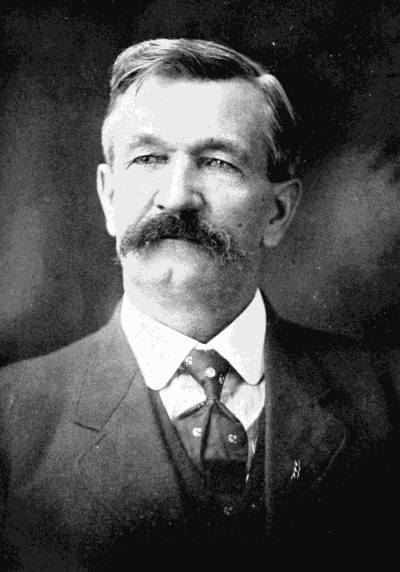
HON. JOHN F. ROCKHILL
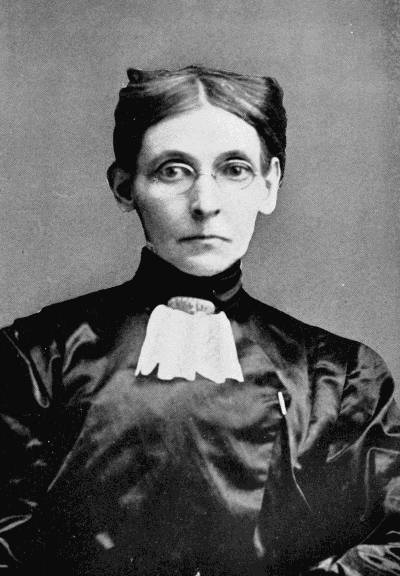
MRS. JOHN F. ROCKHILL
Hon. John F. Rockhill of this family was a little lad of nine years when he left his native state in company with his parents and came to the northwest. From the age of thirteen years he has lived in Washington and in the public schools of this section of the state he completed his education. He afterward took up land and engaged in farming, bringing to his duties broad practical experience which had come to him through assisting his father in the development and cultivation of the old home property. In 1885 John F. Rockhill removed to Whitman county, where he resided for eight years, but in 1893 he returned to Columbia county and purchased his present farm, upon which he is now living. He owns five hundred acres of excellent wheat land and in connection with the production of that cereal he is also successfully engaged in raising stock. In a word, his business affairs are capably managed and whatever he undertakes he carries forward to successful completion. He is likewise a stockholder in the warehouse at Turner and at Dayton and is regarded as a prominent figure in the business circles of his section of the state.
In 1877 Mr. Rockhill was united in marriage to Miss Mabel L. Taylor, a native of Iowa, and to them have been born eight children: Don M. a resident of Columbia county; Daisy, now the wife of C. I. Fleming, of Oregon; Hazel, deceased; Luella, who is a graduate of a normal school and is now engaged in teaching; Nora, who has departed this life; Cora, who was graduated from the high school and is now the wife of Edgar Hilbert, of Columbia county; John, who is engaged in farming with his father; and Mabel L., who is also a graduate of the high school and is the wife of Glenn Cecil.
Mrs. Rockhill is a consistent member of the Methodist Episcopal church and is a lady of many excellent qualities. Mr. Rockhill belongs to Dayton Lodge, No. 136, I. O. O. F. His political allegiance is given to the republican party and in 1915 he was called upon to represent his district in the state legislature, of which he proved an able member, carefully considering the vital and significant problems which came up for settlement and throwing the weight of his influence where he felt that the public good could best be conserved or promoted. For several years he has served on the school board and the cause of education finds in him a stalwart champion. He is a self-made man whose business advancement is attributable entirely to his own well directed efforts. Not only has he progressed in a financial way but has also come to be recognized as one of the prominent and influential citizens of Columbia county, where for almost a half century he has made his home, therefore witnessing the greater part of the growth and development of this section of the state. Great indeed have been the changes which have occurred during this period and Mr. Rockhill is numbered among the worthy pioneer settlers.
W. E. SPROUT.
W. E. Sprout is regarded as among the foremost business men of Starbuck, where he is engaged in general merchandising and he also is president of the Bank of Starbuck. He was born in Grundy county, Missouri, on the 31st of January, 1861, a son of Francis M. and Sarah (Winters) Sprout, the former a native of Indiana, while the latter was born in Ohio. They were married in Grundy county, Missouri, to which place they had removed in boyhood and girlhood with their respective parents. Following their marriage the father turned his attention to farming in Grundy county, but at the time of the Civil war he put aside all business and personal considerations to espouse the cause of his country, serving for a year and a half in the Civil war. He was wounded in the battle of Shiloh, losing his right arm. His first wife had died when their son, W. E. Sprout, was an infant of but four months and three years later the father married Miss Sophia Newland. He continued his residence in Missouri until 1888, when he removed to Hutchinson, Kansas, where he was engaged in farming until the death of his second wife in the year 1905. Since that date he has lived retired in Hutchinson, where he still makes his home, being now in the eightieth year of his age.
W. E. Sprout acquired but a limited education, his opportunities being such as the district schools afforded. When not busy with his textbooks he worked in the fields and thus early received the training which well qualified him to begin farming on his own account when he attained his majority. He carried on general agricultural pursuits in Grundy county for three years and in 1884 he came west to Washington, settling in Dayton, where he spent two years as a farm hand, working for wages. In 1886 he invested in land, becoming owner of a farm on the Tucanon, a half mile outside the city limits of the town site of Starbuck. Upon that place he engaged in general farming and stock raising, which business claimed his time and attention until the year 1892, when Starbuck was made a railroad division point and Mr. Sprout then established a butchering business in the village. This was largely done in order to find a profitable market for his cattle. Eight years later, in 1900, he bought out the mercantile business of A. L. O'Neil of Starbuck and has since been prominently identified with the commercial interests of the town. For eight years he carried on the business independently and then, in 1908, organized the Sprout & Barnhart Mercantile Company, which was incorporated with Mr. Sprout as the president and W. H. Barnhart as the secretary and manager of the company. In 1907 Mr. Sprout was also the dominant factor in the organization of the Bank of Starbuck, of which he became president and has since served in that connection. He is thus actively identified with the financial interests of the county and has made the Bank of Starbuck one of the strong and thoroughly reliable moneyed institutions of this section of the state.
In 1890 Mr. Sprout was united in marriage to Miss Minnie Wooten, a native of Columbia county, Washington, and a daughter of W. S. Wooten, who came to this state from Missouri about 1878 and still makes his home in Dayton. Mr. and Mrs. Sprout became the parents of one child, who has passed away, and the wife and mother died in January, 1906. Two years later, in April, 1908, Mr. Sprout was again married, his second union being with Miss Ida Hukill, a native of Walla Walla and a daughter of Allen Hukill, who was one of the early pioneers of Columbia county, taking up a homestead in this section of the state shortly after his arrival in Washington, when the entire region was largely an undeveloped section. To the second marriage of Mr. Sprout has been born one child, Allen M.
In his political views Mr. Sprout is a republican and served as the first mayor after the city of Starbuck was incorporated. He also served for a number of years as a member of the town council and ever exercised his official prerogatives in support of well defined plans and measures for the general good. He likewise served on the school board and the cause of education has ever found in him a stalwart champion. Fraternally he is connected with Tucannon Lodge, No. 106, F. & A. M., of Starbuck, and also with Starbuck Lodge, No. 158, I. O. O. F. He has recently disposed of his landed possessions but Mrs. Sprout still owns her homestead which she entered prior to her marriage. Mr. Sprout belongs to the Methodist Episcopal church and its teachings have been the guiding force in his life, making him a man among men, honored and respected by reason of his sterling worth, his patriotic loyalty in citizenship, his integrity and progressiveness in business and his faithfulness in friendship. In his public offices he has displayed the same spirit of enterprise and recognition of opportunity that has marked his business career, and Starbuck has profited much by his labors.
LESTER LEE ROBISON.
Lester Lee Robison, one of the foremost agriculturists and most extensive sheep growers of Walla Walla county, has in his own name three thousand acres of wheat land and seventy-five hundred acres of grazing land. His home is on section 34, township 8 north, range 35 east. His birth occurred in Dayton, Columbia county, Washington, on the 13th of April, 1884, his parents being Andrew M. and Theodosia (Fall) Robison, the former born in Austin, Texas, March 16, 1854, and the latter in Sidney, Iowa, on the 7th of September, 1857. It was in the year 1872 that the mother came to Washington with her parents, the family home being established near Dayton in Columbia county. Andrew M. Robison made his way to this state in the winter of 1876-7, when a young man of twenty-two years, and after his arrival he secured a contract with the Northern Pacific Railroad Company in construction work. Later he bought stock throughout this section, furnishing meat for the railroad construction gangs, which numbered about seven thousand Chinamen. Subsequently Mr. Robison took up his abode near Dayton and engaged in farming and in the stock business, being recognized for a number of years as one of the extensive stock buyers of this section of the state. In the fall of 1897 he removed to Walla Walla county, locating on Dry creek, four and one-half miles northwest of Walla Walla, where he acquired extensive farm lands, owning at the time of his death some twenty-eight hundred acres. He was widely recognized as one of the influential and leading citizens of southeastern Washington and was a prominent representative of the Masonic fraternity. His demise occurred on the 21st of October, 1907, but his widow survives, making her home in Walla Walla, where she has an extensive circle of friends.
Lester L. Robison acquired his education in the city schools of Walla Walla and also attended the State Agricultural College at Pullman, Washington. After putting aside his textbooks he worked with his father until 1907, when he started out independently as an agriculturist, taking charge of his father's large holdings, which he has managed with marked success to the present time. The property in his own name embraces three thousand acres of wheat land and also some seventy-five hundred acres of grazing land. Moreover, he has been heavily interested in the stock business for a number of years and is one of the foremost sheep growers of Walla Walla county.
On the 11th of September, 1907, Mr. Robison was united in marriage to Miss Elsie Riffle, of Walla Walla, her father being Elihu G. Riffle, who was one of the earliest pioneers of this county. Mr. and Mrs. Robison have a daughter, Laura Lee. Politically Mr. Robison is a democrat and fraternally is identified with the following Masonic organizations: Blue Mountain Lodge, No. 13, F. & A. M.; Walla Walla Chapter, No. 1, R. A. M.; the Knight Templar Commandery; Oriental Consistory, A. & A. S. R.; and El Katif Temple, A. A. O. N. M. S. He also belongs to Walla Walla Lodge, No. 287, B. P. O. E. A young man of enterprise, ambition and ability, he has ably carried forward the work of his honored father and his career bids fair to be one of continued achievement.
JAMES G. WOODEND.
James G. Woodend was one of the prominent farmers of southeastern Washington for many years and won a substantial measure of success by reason of the careful manner in which he developed his fields and managed his business affairs. He was a native of England and came to America when a young man of twenty-seven years. He did not tarry on the Atlantic coast but made his away across the country and took up his abode in Columbia county, Washington, at Starbuck. Here he occupied the position of section foreman for nineteen years and on the expiration of that period turned his attention to agricultural pursuits, purchasing a farm which he at once began to further develop and improve. Year after year he carefully tilled the soil and his plowing and planting, with the careful cultivation of his fields, brought to him substantial harvests which sold at a good figure. He was thus busily and successfully engaged in general farming up to the time of his death. In the intervening years he had added to his holdings as opportunity offered until he had become the owner of sixteen hundred acres of land which is still in possession of his widow, the greater part being wheat land. He was regarded as one of the most prominent men in the valley and his life work indicates what can be accomplished in the way of wheat production in this section of the state. Moreover, his history shows clearly what can be attained by honorable purpose and indefatigable energy.
In 1886 Mr. Woodend was united in marriage to Miss Margaret Bellingham, a native of England, who came to America in the same year. To them were born six children: Isabel, the wife of F. F. Kent; Anna M., who is living in Spokane; Robert G., who follows farming; Thomas S., at home; Marguerite V., the wife of A. J. Burke; and Mildred A., who is a student in the high school at Spokane.
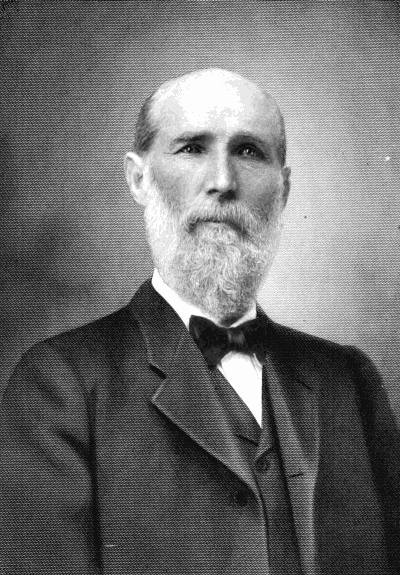
JAMES G. WOODEND
The death of the husband and father occurred on September 21, 1915, and his remains were interred in the Starbuck cemetery. He left a widow and six children to mourn his loss, his demise being also a matter of deep regret to his many friends who sincerely esteemed him. He possessed many sterling traits of character, was thoroughly reliable in business, was public spirited in citizenship, held friendship inviolable and was devoted to the welfare and happiness of his wife and children. Mrs. Woodend still owns and manages her farm property and in fact has added to the sixteen hundred acres left by her husband, making an additional purchase of six hundred and twenty acres, also in Columbia county, so that she now owns over two thousand two hundred acres of valuable land in this section of the state.
M. B. WINCHELL.
M. B. Winchell, who is engaged in general merchandising in Touchet, Walla Walla county, ranks with the foremost business men of this section of the state. A spirit of progress and enterprise actuates him in all that he undertakes and his course has been characterized by a determined purpose. He has ever recognized the fact that when one avenue of success seems closed there can always be marked out another path that will lead to the desired goal. Alert and energetic and thoroughly reliable, his position among the business men of Walla Walla county is indeed enviable. A native son of Washington, he was born at Lyons Ferry on the 28th of March, 1888, his parents being Hezekiah and Alice L. (Palmer) Winchell. The father was a native of Michigan and the mother of the state of New York. They were married, however, in Minnesota, where the father was identified with timber interests for a number of years. In 1883 he brought his family to the west, settling in Walla Walla county, Washington, at which time he filed on a homestead near Lyons Ferry but resided thereon only long enough to prove up on the property. He then took up his abode in Waitsburg and for twenty-two years the family lived in or near that town. The father was engaged in farming during this time. He died in 1905, at the comparatively early age of fifty-six years. The sons in the family continued to make their home with their mother, her death occurring on the 5th of June, 1917. Mr. and Mrs. Winchell were worthy pioneer people of this section of the state and contributed much to its development and progress.
M. B. Winchell pursued his education in the graded schools of Waitsburg and also in the Waitsburg Academy, while subsequently he spent three terms in the Waitsburg high school, which he attended in the winter seasons. In fact his attendance at school was by no means continuous, but he utilized every opportunity to promote his education by entering school whenever he could. His father met with financial reverses and thus Mr. Winchell of this review was obliged early to start out in the business world and provide for his own support. He also earned the money that enabled him to continue his education. After finishing his course of study in the graded schools he devoted two years to work before he entered the academy and there was also a period of two years between his academic course and his high school course. In the meantime, however, he was learning many valuable lessons through experience. He was employed during the summer months and he made every spare hour count. He continued farm work and subsequently turned his attention to the grain business, becoming manager of an elevator when a youth of but seventeen years. This elevator was located at Alto, and he subsequently managed elevators at other points for the same company, a fact which is indicative of his capability and of his faithfulness. It is recognized that the best way to learn to do a thing is to do it. Habit brings accuracy and power grows through the exercise of effort. Labor does not tire—it gives resisting force; and all of these facts Mr. Winchell demonstrated in his life. He studied every task that came to his hand and from each new experience learned valuable lessons which have proven of worth to him in later years. He learned to correctly judge men and read character, while at the same time he was acquainting himself with commercial methods. While engaged in the grain trade he bought and shipped grain on tonnage during the winter months and attended school when there was no grain to ship. In other words he improved every opportunity to promote his knowledge as well as to advance his material interests. In 1914 he entered the employ of the Allen Grocery Company in Waitsburg and there laid the foundation for his mercantile success. In 1916 he took up his abode at Touchet and became one of the dominant factors in the organization of the Quality Stores Company, having stores at Touchet, Lowden and Waitsburg. He became the manager of the establishment at Touchet, which at the last inventory showed a stock of over thirty-one thousand dollars value, while annually he does a business of from seventy-five to eighty-five thousand dollars. This is a splendid establishment to be under the care of a young man who had to fight his own way, make his own way through school unaided and at all times rely upon his own resources. In the parlance of the present day, he is a live wire, or in other words he has the dynamic force which makes things move. An opportunity is to him a call to action and the call is never neglected.
On the 22d of September, 1912, Mr. Winchell was united in marriage to Miss Alberta Williams, of Walla Walla, by whom he has two children, Zilpha Alice and Ruth Emily. Mr. Winchell maintains an independent course in regard to politics, voting for men and measures rather than for party. Fraternally he is connected with Delta Lodge, No. 75, K. P., of Waitsburg, and also with the Ancient Order of United Workmen, while both he and his wife hold membership in the Community church of Touchet. He is interested in all that pertains to the material, political, social, mental and moral progress of the community. In a word his aid and influence are given on the side of advancement and improvement, and with him each day must mark off a full-faithed attempt to grow more and to know more.
WILLIAM C. WOODWARD.
William C. Woodward, a resident farmer of Columbia county, Washington, was born February 13, 1862, within the boundaries of the county where he still resides and which has been his home throughout the intervening period. He is a son of Albert and Oral Woodward, of whom mention is made in connection with the sketch of his sister, Mrs. Mary Nichols, on another page of this work. He spent his youthful days under the parental roof and divided his time between the acquirement of an education and work in the fields. His early training under his father's direction acquainted him with the best methods of tilling the soil and caring for the crops, so that valuable experience aided him when, on attaining his majority, he started out in the business world for himself. He began farming and has since been identified with general agricultural pursuits, owning valuable property which he has brought under a high state of cultivation, so that year after year his fields return to him good harvests that bring him a substantial income.
In 1891 Mr. Woodward was united in marriage to Miss Nora Davis, a native of Oregon and a daughter of Daniel and Isabella (Laughlin) Davis. Mr. and Mrs. Woodward have become the parents of six children: Albert D., S. M., O. H., L. S., H. L. and Sarah Alice. The parents are members of the Christian Science church and in his political views Mr. Woodward is a republican. He has served as county commissioner for two terms and has made an excellent record in his devotion to the public welfare. He has also been a member of the school board and the cause of education finds in him a stalwart champion. He has many sterling traits of character, is thoroughly reliable as well as enterprising in the conduct of his farming interests, is progressive in citizenship and loyal in friendship. In fact, he is most faithful to every cause which he espouses, does not hesitate to express his honest convictions and his position upon any important question is never an equivocal one. A resident of what is now Columbia county for fifty-five years, he has been a witness of practically its entire growth and development and is justly numbered among its worthy and honored pioneer settlers.
JOHN ROBERTSON.
John Robertson, who follows farming on section 25, township 11 north, range 41 east, in Garfield county, was born in Prince Edward Island, Canada, on the 30th of November, 1866, but since 1882 has been a resident of Washington and through all the intervening years has been identified with its agricultural development. His parents, John and Mary (Steel) Robertson, were also natives of Prince Edward Island and were of Scotch parentage. In 1873 they removed with their family to California, settling in the Livermore valley, where the father's death occurred four years later, and in the fall of 1882, Mrs. Robertson with her four sons and one daughter came by team to Washington, where they proceeded to make a home for themselves. There was a strong family bond between the brothers, mother and sister and they held all of their interests jointly for many years, the brothers cooperating in their farming enterprises, and as a consequence all of them prospered. The mother is still living and makes her home with her son John, whose filial love and devotion repay her for the care which she gave to him in his youth.
John Robertson pursued a district school education in California, to which state he was taken by his parents when a lad of but seven years. He was a youth of sixteen when the family home was established in Garfield county, Washington, and here in connection with his three older brothers he began farming. Early in the '90s he homesteaded eighty acres which adjoins his present home farm, but he continued to engage in business in connection with his brothers until 1902, since which time he has followed farming independently. As the years have passed on he has prospered in his undertakings by reason of his close application and indefatigable energy and, making judicious investment in real estate, is now the owner of five hundred and sixty-five acres of excellent farm land and is regarded as one of the prominent agriculturists of his section of the state.
J. M. CRAWFORD.
A notable example of successful personal achievement is the history of J. M. Crawford, president and general manager of the Tum-a-lum Lumber Company of Walla Walla. Since making his initial step in the business world his career has been marked by an orderly progression that has brought him forward step by step until he now occupies a most prominent position in the commercial and manufacturing circles of the northwest. He was born in Smithfield, Ohio, June 3, 1865, and is a son of Dr. J. B. Crawford, who was engaged in the practice of medicine in Gillespie, Illinois, for many years. In 1910 he came to Walla Walla and here passed away in 1915 at the age of eighty-eight years.
J. M. Crawford spent his early life in the states of Illinois, Nebraska and Kansas. At the age of twenty-two years he was employed by the Badger Lumber Company of Kansas City and remained with them from 1887 to 1890, acting as line yard manager for western Kansas at a salary of fifty dollars per month, but he found his work very congenial. In 1889 he was married in western Kansas to Miss Martha Cox and they began their domestic life in a humble way, their first home being made in a lumber shed of the company, and here their oldest son was born. On starting in business for himself Mr. Crawford purchased a stock of lumber from the Paddock Lumber Company of Raywood, Illinois, and thus he laid the foundation for his present successful business.
In 1904 Mr. Crawford came to Walla Walla and formed the Whitehouse-Crawford Company by purchasing the control of a company from its original owners and later bought out those still interested in the business, so that today it is an entirely new corporation. In 1908 his brother, Joseph F. Crawford, came to Walla Walla and is now general manager of the company. They own a plant devoted to the manufacture of interior trimmings, showcases, bank and store fixtures, in addition to which they deal extensively in lumber, this being one of the most important industries of Walla Walla. The plant covers a block and a half on North Second street and forty men are employed throughout the year in the manufacture of a product which finds a ready sale on the market.
It was in 1906 that Mr. Crawford started the Tum-a-lum Lumber Company with five lumberyards, but which has since grown until it now has forty-five lumberyards in eastern Washington and central Oregon and is capitalized for five hundred thousand dollars. Of this company Mr. Crawford is the president and general manager. His business interests have thus assumed very extensive proportions and his activities constitute an important element in the material growth and commercial development of the northwest. Moreover, Mr. Crawford has been most active in advancing the welfare and upbuilding of his city by inducing many others to locate here. He has prevailed on many of his old friends to come from the east and make their homes in Walla Walla and five different Crawford families have located here.
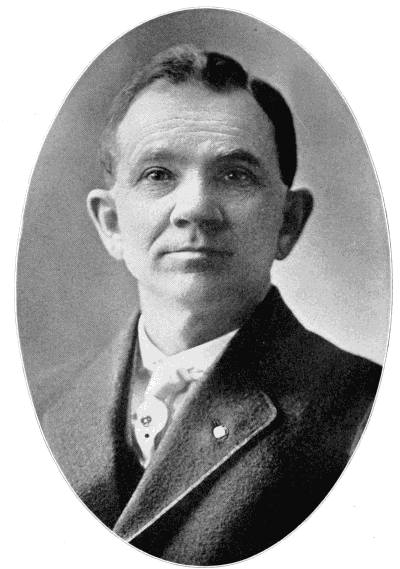
J. M. CRAWFORD
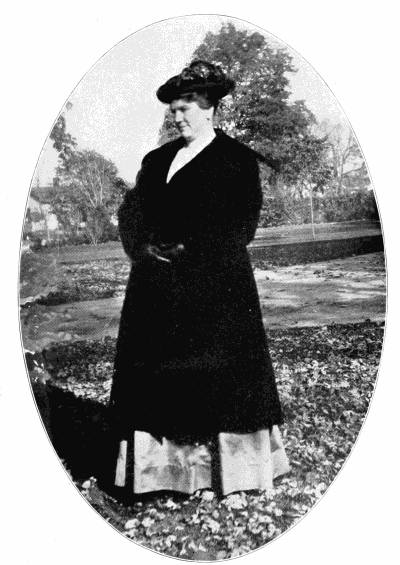
MRS. J. M. CRAWFORD
To Mr. and Mrs. Crawford have been horn three children. Harold E. is a graduate of Whitman College and the Boston School of Technology. He now has charge of the engineering department of the Tum-a-lum Lumber Company, which constructs elevators, furnishes plans for houses and promotes good buildings, the plans and work being given patrons free of charge. C. Howard is treasurer of the Tum-a-lum Lumber Company and office man. He attended the Walla Walla high school until the age of seventeen, when he entered the office of the company and has steadily advanced, being a young man of practical experience and pronounced ability. Both sons are progressive and able to fill positions calling for skill and effectiveness. Susan M., the only daughter, was at one time a student at the University of Washington but is now attending Whitman College.
Mr. Crawford is a Knight Templar Mason and a member of the Mystic Shrine. He has taken a marked interest in the Walla Walla Commercial Club and served on its board of directors for some years and as its president for one year. Both he and his wife hold membership in the Presbyterian church and Mr. Crawford was on the building committee when the present house of worship was erected. He is a self-made man, able, forceful and successful, and can well be numbered among the builders of Walla Walla. Alert and enterprising, he seems to lose sight of no opportunity that will advance his legitimate business interests or will promote the welfare and upbuilding of the community at large. His keen sagacity has been an important element in public progress and Walla Walla honors him as one of her most valued and representative men.
GRANT LOW.
Grant Low, a resident farmer of Columbia county, living on section 3, township 10 north, range 40 east, is numbered among the native sons of North Carolina, his birth having occurred within the borders of the Old North state December 25, 1870. His parents were Samuel and Dillie (Proctor) Low, who were also natives of North Carolina, where they spent their entire lives, the father there conducting a plantation.
Grant Low was reared upon the old home farm until his sixteenth year, and acquired but a limited common school education. His parents died when he was a youth of ten years and he was placed with a guardian, for whom he worked for his board and clothes. He did not like the treatment he received, however, and at the age of sixteen he ran away from his foster parents and went to Missouri, where he was employed as a farm hand for three years. In July, 1889, he made his way westward to Dayton, Washington, where he arrived with a cash capital of but five dollars. His financial condition rendered it imperative that he secure immediate employment and soon afterward he began working for wages at farm labor, spending three years in that way. He next purchased a place of one hundred and sixty acres on credit. He did not have a cent with which to make an initial payment but he possessed courage and determination and was not afraid to work. Moreover, he recognized the eternal principle that industry wins. He began farming for himself and within the next five years was able to clear his place of all indebtedness. From that time forward he has steadily added to his holdings until he now has twelve hundred and forty acres in his home farm and he owns altogether forty-four hundred acres near Starbuck, in Columbia county, of which eighteen hundred acres is valuable farm land. He operates altogether three thousand acres of his own land and six hundred acres belonging to the Dwelly estate, which he farms under lease. He is one of the leading agriculturists of southeastern Washington, his business affairs having been most carefully managed and his investments most judiciously made. He employs progressive methods in the care and cultivation of his land and he has added many improvements to his farm, which is today valuable and which constitutes one of the attractive features in the landscape.
On December 3, 1891, Mr. Low was united in marriage to Miss Oral Monnett, of Covello, Columbia county, Washington, a daughter of Wallace Monnett and a sister of A. A. Monnett, one of the prominent business men of Dayton. Mr. and Mrs. Low became the parents of five children, four of whom survive, namely: Nellie, Josie, Alberta and Donald. All are at home.
Mr. Low gives his political allegiance to the republican party and is a stanch advocate of its principles but does not seek nor desire office as a reward for party fealty. He has always preferred to concentrate his efforts and attention upon his business affairs and, working steadily and persistently, he has gained a comfortable competence, being numbered among the leading and progressive agriculturists of Columbia county.
ANGUS McKAY.
Angus McKay, a well known and enterprising farmer of Walla Walla county, was born in Canada on the 13th of January, 1836, and is a son of Angus and Margaret (Campbell) McKay, both of Highland Scotch birth. In 1832 they crossed the Atlantic and settled in Canada, where they continued to make their home until called from this life. To them were born eight children but Angus is the only one of the number now living.
Mr. McKay grew to manhood in Canada with the usual advantages of a boy of that period, attending school as he found opportunity. He subsequently served three years apprenticeship in a general merchandise store and remained in the Dominion in various capacities until in 1861 he left Canada and came to Walla Walla, Washington, where he engaged in the confectionery and tobacco business for five years. His former experience stood him in good stead and that he was successful along business lines is evident from the fact that at the end of that period he was enabled to secure a homestead of three hundred and twenty acres on Russell creek and he has since given his time and attention to farming with good results, becoming one of the well-to-do men of his community.
In 1866 Mr. McKay married Mrs. Mary A. Winship, a native of Ohio, who crossed the plains with her parents in 1852 in a covered wagon drawn by ox teams and settled in Oregon. To this union have been born seven children, of whom three are living, namely: March, residing and assisting on the ranch; Angus, living in Prossor; and Bessie, the wife of Oscar M. Shelton.
Mr. and Mrs. McKay are living on the ranch which has been their home for over half a century and besides this property they own a residence in the city of Walla Walla. Fraternally Mr. McKay is a member of the Masonic order and being a strong temperance man he organized the first Good Templars lodge in this region in 1866. In politics he is a republican and for fifty years he has efficiently served as justice of the peace, his rulings being fair and impartial. He has also filled the office of assessor for several years and no trust reposed in him has ever been betrayed in the slightest degree. His honorable principles have won him many friends and all who know him hold him in the highest esteem.
JOHN W. FOLEY.
The life record of John W. Foley spells success. He has succeeded in whatever he has undertaken by reason of close application, determined purpose and indefatigable energy. Early in life, when little more than a youth, he started out upon a mercantile career in Adam, Oregon, and the prosperity which attended that venture gave him his start for bigger things. He was likewise successful in the live stock business and later in farming operations, which he has carried on extensively, being regarded today as one of the foremost representatives of agricultural interests in Garfield county, his home being on section 3, township 12 north, range 41 east. He was born in the Willamette valley of Oregon on the 1st of November, 1866, and is a son of Francis and Hannah (Reese) Foley. The father is a native of Ohio and the mother of Kansas and in early life they crossed the plains, becoming residents of Oregon. They now make their home in California.
Liberal educational advantages were accorded John W. Foley. After mastering the branches of learning taught in the public schools he became a student in the Willamette University of Salem, Oregon, and subsequently attended the Portland University, thus becoming well qualified for life's practical and responsible duties. In young manhood he turned his attention to the hardware business, establishing a store in Adam, Oregon, where he remained for two years. The venture proved profitable and he sold out at a good advance. He then went to Rock Lake in Whitman county, Washington, and for seven years was engaged in the cattle business. Again success attended his undertaking and on the expiration of that period he removed to Walla Walla, where he was engaged in the hardware and implement business for two years. He also devoted a part of his attention to farming when in Walla Walla county and in March, 1916, he took up his abode upon his present home farm in Meadow Gulch, Garfield county, where he owns sixteen hundred acres of rich and valuable land that responds readily to the care and cultivation which he bestows upon it. In business affairs he displays sound judgment and discriminates readily between the essential and the non-essential, discarding the latter and utilizing the former to the best possible advantage.
In 1893 Mr. Foley was united in marriage to Miss Edith Babcock, a daughter of W. A. Babcock, one of the early pioneer settlers of Whitman county who is now deceased. Mr. and Mrs. Foley have three children: Harold F., Eva and Wayne C. Mr. Foley gives his political allegiance to the republican party and is a stanch advocate of its principles but he has no desire for public office. He and his wife are consistent members of the Methodist church, contributing generously to its support and doing their part in its work. They are interested in all that pertains to the welfare and upbuilding of the community in which they reside and have been active factors in advancing its material, social and moral progress. They are widely and favorably known and the hospitality of the best homes of their locality is accorded them.
ANDREW J. ABEL.
Among the well known residents of Columbia county is Andrew J. Abel, a retired farmer. He was born in Indiana, October 28, 1838, a son of Andrew and Sarah Abel, both of whom were Hoosiers by birth. They grew to mature years and were married in Indiana but in 1840 removed with their family to Iowa, whence, in 1864, they set out by wagon for the far west. They at length reached Old Walla Walla county, Washington, and took up their residence on a farm near Dayton. Their first home in this section was a log cabin with a slab floor and a clapboard roof. Subsequently good buildings were erected upon the place, and the parents resided there until their death.
Andrew J. Abel, who is one of two living children of a family of ten, received the greater part of his education in Iowa and there grew to manhood. Upon removing to Washington with the other members of the family in 1864 he took a preemption claim in Paddock Hollow, and there he maintained his home for six years. At the end of that time he sold this place and took up as a homestead the farm on which he still lives. This comprises two hundred and forty acres, is in a high state of cultivation and is well improved. During his active life he gave the closest attention to the management of his affairs and as the years passed his resources increased. He is now in good financial circumstances and is living practically retired.
Mr. Abel married Miss Sarah A. Brodhead, and they have had eleven children, of whom eight survive, namely: Andrew J., Jr.; Maria J., the wife of James Woodward; Sarah E., who married William Newby; Cora A., now Mrs. Charles Ingram; Adele, the wife of Seymour Litter; Maud, the wife of Sterling Litter; Chester, a resident of Columbia county; and Tressie, who married Lenn Collins, now of Missouri.
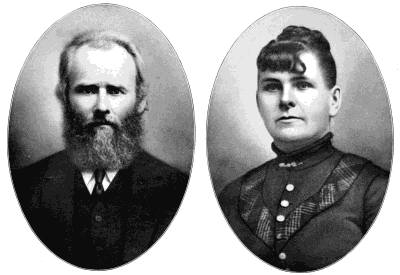
MR. AND MRS. ANDREW J. ABEL
Mr. Abel gives his political allegiance to the democratic party but has not served in any office with the exception of that of member of the school board. His wife belongs to the Christian church and he also casts his influence on the side of right and justice. For more than five decades he has been an interested witness of the progress that has been made in Old Walla Walla county, and his reminiscences of the early days are of much interest to the younger generation who are growing up amid conditions vastly different from those that their parents found here.
SMITH OWENS GWINN.
Smith Owens Gwinn is successfully engaged in farming on section 20, township 11 north, range 40 east, in Columbia county. He was born in Putnam county, Missouri, February 17, 1855, his parents being William and Nancy (Triplett) Gwinn, both of whom were natives of Kentucky, where they were reared and married. Soon afterward they removed to Putnam county, Missouri, where they resided until 1864, when they heard and heeded the call of the west. The stories which reached them concerning the opportunities on the Pacific coast led them to the determination to try their fortune in Washington. With ox teams and wagons they traveled across the plains, being six months on the journey, and at length they established their home in Walla Walla county, six miles east of Walla Walla, where the father purchased one hundred and sixty acres of land, for which he paid eighteen hundred dollars. Today the same property is worth forty thousand dollars. He lived upon that farm for a number of years and then sold the property, after which he took up his abode in the city of Walla Walla, spending his remaining days in the enjoyment of well earned rest. He had acquired a comfortable competence sufficient to meet all of his needs and also sufficient to supply him with the comforts of life. He passed away in 1897, while his widow survived for about twelve years, her death occurring in 1909. In his political views Mr. Gwinn was a democrat, giving stalwart allegiance to the party. He served as county assessor of Walla Walla county before it was divided, occupying that position for three or four years. He was widely known throughout the county, ranking as a representative business man and progressive citizen, and as a pioneer he contributed much to the early development of his section of the state. He and his wife were consistent and faithful members of the Methodist Episcopal church and were people of the highest respectability, enjoying the goodwill and confidence of all with whom they were associated. They left the impress of their individuality for good upon the material, political and moral development of the community.
Smith O. Gwinn was a lad of but nine years at the time of the removal of the family to Washington, so that he pursued his education largely in the schools of this district. He attended the Maxson school on Russell creek and on reaching his majority he began farming on his own account, renting land for that purpose. He raised two crops in Walla Walla county and in the fall of 1877 removed to Columbia county, where he homesteaded eighty acres. He failed, however, to get water on his land and therefore sold his right, after which he purchased another eighty acres with water on it. About 1880 he disposed of that farm and invested in his present home place of one hundred and sixty acres. In 1895 he leased this farm to Charlie Thronson and removed to Dayton, where he turned his attention to the livery business, with which he was identified for four years. Later he was engaged in various lines of business and retained his residence in Dayton until 1904, when he removed to Portland, where he resided for two years. He then went to Spokane, where the following year was passed, after which he returned to Portland, Oregon, where he again lived for three years. Once more he took up his abode in Spokane, where he remained until July, 1917, when he returned to the old home farm in Columbia county. Upon this place he has recently erected one of the most commodious and beautiful country homes in southeastern Washington and he has added many other modern improvements which add to the value and attractive appearance of the place. He also owns four hundred and eighty acres of land which constitutes one of the valuable wheat ranches of Columbia county. His business affairs are carefully managed and his unfaltering energy has carried him steadily forward to the goal of success.
Mr. Gwinn votes with the democratic party, of which he has been a stalwart champion since attaining his majority. He belongs to Touchet Lodge, I. O. O. F., and is one of the well known citizens of Columbia county who has gained a gratifying measure of success owing to his close application and indefatigable energy. His efforts have been a contributing factor in bringing about the splendid results that have been achieved in making southeastern Washington a notable agricultural belt, especially adapted to wheat raising.
W. H. YOUNGER.
W. H. Younger, who superintends the operation of the Prescott mills as agent for the Portland Flouring Mills Company, the largest concern of the kind in the northwest, was born in Stockton, California, on the 29th of January, 1889, a son of Thomas W. and Nannie (Welch) Younger. For a period of forty-three years the father was connected with the Southern Pacific Railroad Company as superintendent of motive power but has recently retired and now makes his home at Forest Grove, Oregon.
In the acquirement of his education W. H. Younger attended the public schools of Portland and also the Portland Academy. When a youth of sixteen years he entered the employ of the Portland Flouring Mills Company, securing a position as office boy in their Portland offices. With this important enterprise he has been connected continuously to the present time, becoming thoroughly familiar with every phase of the milling business, and that his services have been recognized as of value is indicated by his steady promotion. In 1909 he was made bookkeeper under E. H. Leonard, agent of the Prescott mills, serving in that capacity for four years or until the 1st of April, 1913, when he was appointed agent of the mills at Dayton, Washington. He had charge of the mills there for four years and on the 1st of May, 1917, was transferred to Prescott as agent at this point, in which connection he is making an excellent and most commendable record.
On the 28th of June, 1910, Mr. Younger was united in marriage to Miss Jessie Grace Anderson, of Portland, Oregon. Mr. Younger gives his political allegiance to the republican party and is deeply interested in matters of civic concern, having served as president of the Dayton Commercial Club and as a member of the Dayton Board of Trade. Fraternally he is identified with Dayton Lodge, F. & A. M., and he is also a charter member of Whetstone Lodge, No. 157, K. P., in which he has passed through all the chairs. His wife belongs to Trinity Episcopal church of Portland and both enjoy an enviable position in the social circles of Prescott, where they now make their home.
WILEY L. ARNOLD.
Wiley L. Arnold, a representative and successful agriculturist of Walla Walla county, resides on section 26, township 8 north, range 37 east, where he operates a well improved farm of forty-five acres, and he is also the owner of another valuable farm of one hundred and eighteen acres four miles distant from the aforementioned place. His birth occurred in Tennessee on the 8th of September, 1866, his parents being John and Anna Arnold, who spent their entire lives in that state. They had two sons, the brother of our subject being Grant, who is still a resident of Tennessee.
Wiley L. Arnold spent the period of his minority in his native state and in 1887, when a young man of twenty-one years, made his may to Spokane, Washington. Soon afterward, however, he removed to Vancouver, Washington, where he also spent but a short time and then went to Grants Pass, Oregon, there remaining during a winter season. Subsequently he came to Walla Walla county, Washington, and here worked on a ranch for three and one-half years. On the expiration of that period he returned to Grants Pass, Oregon, but two years later again made his way to Walla Walla county and purchased the farm on which he now resides and to the cultivation of which he has devoted his attention continuously to the present time. It is a highly improved property, comprising forty-five acres on section 26, township 8 north, range 37 east, near Dixie. Mr. Arnold also owns another farm of one hundred and eighteen acres nearby and in the conduct of his agricultural interests has met with gratifying and well deserved success, being energetic, enterprising and progressive. He is also a stockholder in the warehouse at Sapellel.
In 1893 Mr. Arnold was united in marriage to Miss Carrie Perry, a native of California and a daughter of Thomas and Sarah (Shinn) Perry, the former born in Canada and the latter in Michigan. They made the trip to California in 1849 and after a number of years' residence in that state took up their abode in Grants Pass, Oregon, where they spent the remainder of their lives. They became the parents of twelve children, eight of whom survive. To Mr. and Mrs. Arnold have been born six children, as follows: Veora I., who is the wife of George W. Bruce; Marion Harvey; Zeffie A.; Sarah F.; Ivan W.; and one who died in infancy.
Mr. Arnold gives his political allegiance to the republican party and has ably served as school director here. Fraternally he is identified with the Independent Order of Odd Fellows, belonging to Lodge No. 117, and his wife is a consistent member of the Christian church. They are widely and favorably known in Walla Walla county and Mr. Arnold enjoys an enviable reputation as a self-made man whose success is the merited reward of his unremitting industry and sound business judgment.
JOHN HOFFMANN.
John Hoffmann is one of the honored pioneer settlers of Walla Walla and of the Inland Empire. There is no phase of the frontier development with which he is not familiar, for he came here when the work of progress seemed scarcely begun. In the years which have since elapsed he has not only witnessed remarkable changes that have brought this county to a foremost place in the way of improvement and development but he has also taken a most active part in bringing about this result by reason of his extensive interests and activities as an agriculturist.
Mr. Hoffmann was born in Germany, March 28, 1852, and remained in that country until he reached the age of sixteen years, when his father sent him to the new world in order that he might escape Bismarck's compulsory military service law, which had been established at the close of the Franco-Prussian war. He remained for a period in New York and in the eastern part of the country but in 1878 reached Walla Walla, being then a young man of twenty-six years. He began life as a farm hand, and something of the intense activity and enterprise which has ever characterized him is indicated in the fact that he came to be the possessor of eight thousand acres of the finest land in the wheat belt of Washington, having six thousand and eighty acres in one body, which was but bunch grass land when taken by Mr. Hoffmann. It is now well improved with fine buildings, supplied with best modern improvements, including electric light and baths. Water is secured at a depth of nine hundred and forty-five feet, Mr. Hoffmann being the first to drill a deep well in this locality. His fine place certainly indicates what energy, good judgment and determination can do. At the time of his arrival, however, little land had been brought under the plow and the city of Walla Walla was scarcely more than a trading and military post. The wide fields were covered with sagebrush or bunchgrass and there were no railroads. Mr. Hoffmann brought with him a heavy team and with this he at once began work, hauling freight from Wallula to Spokane and into the Coeur d'Alenes. It often required two or three months to make such trips, for the horses had to be fed on grass, as there was little grain for that purpose. With the completion of the Northern Pacific Railroad, Mr. Hoffmann recognized the fact that freighting would no longer be profitable and therefore looked about him for some other means of support. He was unable to secure a homestead because he could not remain upon it, necessity forcing him to provide for his support in other ways. He therefore used his preemption right and occupied one hundred and sixty acres of land on what is now Eureka Flats. He used his team in work for others and as opportunity offered rented adjoining land. It was about 1880 that he threshed his first wheat crop from a tract of seventy-five acres, selling the crop at about forty-four cents per bushel after hauling it eighteen miles to Prescott. In his third year he harvested half a section of wheat but as yet had no farm machinery. When sowing and threshing time came, Mr. Hoffmann with his eight horses continued to work for others and in this way paid for putting in and gathering his crops for several years. In the meantime he was most carefully saving his earnings in order to equip a farm, and whenever opportunity offered he also added to his holdings, becoming the owner of four thousand four hundred acres on the Eureka Flats. There he introduced punctuality and regulations as stringent as those of a factory. He began work after three o'clock in the morning to round up the horses and ended the day's work at dark or later. He secured modern steam machinery and with his working system he did more work than if he had forced his employes to continue their labor from daylight until dark. There was no loss of time and each move was made to count for the utmost. He kept in touch with every phase of progressive farming and in fact was a recognized leader in introducing improved methods. He studied agriculture from the practical and from the scientific standpoints and, in fact, he recognized that these two things are one. The results achieved were marvelous and as his financial resources increased he continued making investments. From time to time he purchased cheap land. He bought six sections of railroad land along the Snake river to be used as horse pasturage until rapidly moving settlement required it. For this he paid only seventy-five cents per acre and after a few years he sold it at a net profit of five dollars per acre, thus realizing a handsome sum on his investment. He made other similar purchases of land, which in time he turned into ready money, continuing to realize a fair profit. His holdings at one time embraced over twelve thousand acres. He continued to occupy his farm until 1893, when he removed his family to Walla Walla, and in 1903 he retired from the active management of his farming property. He helped to organize and is a director of Walla Walla's Farmers Agency.
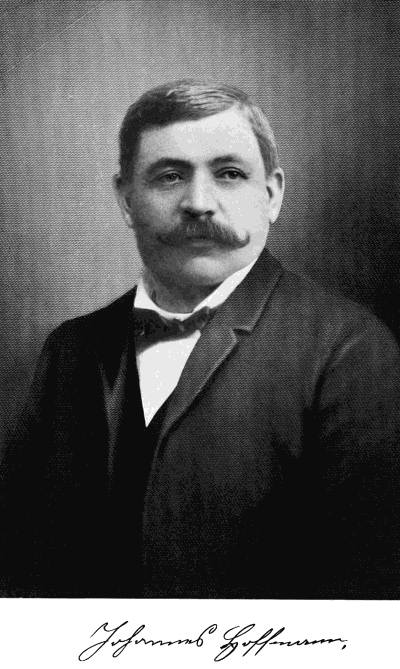
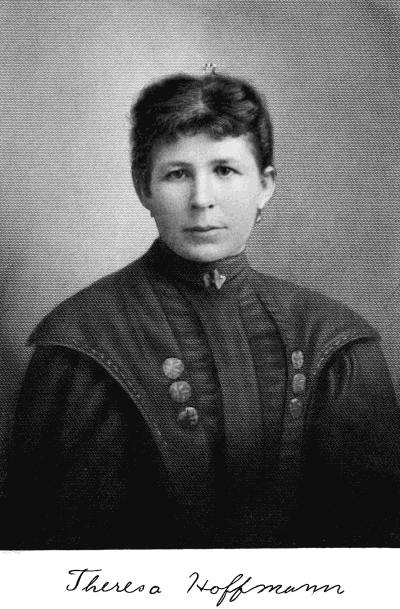
On April 25, 1881, Mr. Hoffmann was united in marriage to Miss Theresa Kirchner, a native of Minnesota, who came to Washington with her parents when she was a child of but four years. Mr. and Mrs. Hoffmann have become the parents of ten children, seven of whom are yet living: John Edward, an agriculturist of Columbia county, Washington; Bessie D., who is the wife of Ben Grote, of Walla Walla; Anna, who gave her hand in marriage to George Retzer, a druggist residing in Walla Walla; Valline, who is pursuing a course in mechanical engineering in the University of Washington at Seattle; Philip, a senior in the high school; John William, who is an eighth grade pupil; and Corleen, who is a freshman in the high school.
In politics Mr. Hoffmann has long been a stalwart republican and gives unfaltering allegiance to the principles of the party, yet without desire for office. He belongs to the Commercial Club and through that agency works for the upbuilding and development of the city in which he makes his home. He is well known in fraternal circles, holding membership in Blue Mountain Lodge, No. 13, A. F. & A. M.; Walla Walla Chapter, No. 1, R. A. M.; Columbia Commandery, K. T.; Oriental Consistory, No. 2, A. & A. S. R.; and El Katif Temple, A. A. O. N. M. S. For from thirty to forty years he has belonged to the order. He and his wife are also members of the Order of the Eastern Star and they are widely and prominently known socially, having a circle of friends almost coextensive with the circle of their acquaintance. The life record of Mr. Hoffmann is indeed a notable one and there is no resident of Walla Walla who has more truly earned the proud American title of a self-made man. Being early released from the military rule of Germany, he found in the opportunities of the new world the chances for advancement if the individual possesses industry and determination. These qualities are his in large measure and step by step he has progressed until he has long since occupied a place among the men of affluence in Washington. For almost forty years he has been a witness of the changes which have here occurred and is today one of the honored pioneer settlers of Walla Walla county, his memory forming a connecting link between the primitive past and the progressive present.
U. F. CORKRUM.
No student of history can carry his investigations far into the annals of Walla Walla county without learning of the close connection of the Corkrum family with the development of the agricultural interests of this section of the state. U. F. Corkrum is numbered among the progressive and enterprising wheat growers of Walla Walla county, where he was born on the 1st of June, 1866. His father, Francis M. Corkrum, was a native of Kentucky, and in early life went to Illinois, where he was united in marriage to Miss Mary Killabrew, who was a native of that state. They were residents of Illinois until 1865, when they crossed the plains with ox teams to Washington. On their arrival the father took up a homestead on Dry creek, about six miles northeast of Walla Walla, where he resided until about 1895. He then removed to the city, where the last twelve years of his life were passed, his death occurring in 1907. He was one of the first men in this county to take up wheat growing, demonstrating the possibilities for the successful production of that crop in this section of the state. He became one of the most extensive wheat growers of eastern Washington and acquired twelve hundred acres of land, mostly devoted to wheat raising. His widow survived him for a brief period, passing away in 1910.
U. F. Corkrum was educated in the Union school on Dry creek, with one term at Whitman College. The winter seasons were devoted to his school work, while the summer months were spent in farm labor. As early as his nineteenth year he began farming on his own account and on attaining his majority he made his first purchase of land, becoming owner of a farm of two hundred and forty acres on Dry creek. To this he added at intervals as his financial resources increased until 1893, at which time he had ten hundred and thirty-five acres, but the widespread financial panic of that year caused him to lose all that he had and to start in business life anew. That he met discouragement bravely and undertook his task with stout heart is indicated in the fact that he now owns six hundred and forty acres of rich and valuable wheat land and recently sold another tract of one hundred and sixty acres. He is now residing in Walla Walla in order to give his children the advantages of the city, but he is still one of the active wheat growers of the county and his business affairs are systematically managed, while the results that are attained are most desirable.
In 1897 Mr. Corkrum was united in marriage to Miss Kathryn Williams, of Brecknockshire, Wales, who emigrated to the United States in 1894, and came to Washington two years later. They now have four children, namely: Franklin Carl, Frederick Victor and Ralph Edward, all of whom are students in the Walla Walla high school; and Bertie Stanford, who is attending the graded school.
In politics Mr. Corkrum is a democrat but is without ambition for public office. He and his wife are members of the Methodist Episcopal church, to the teachings of which they consistently adhere, and their influence is always on the side of right, progress and improvement. They are honored among those whose financial liberality made possible the fine new church built in 1917. Their cooperation can ever be counted upon to advance and support movements for the benefit of the individual and of the community at large and they advocate the highest standards of citizenship. Mr. Corkrum's example is well worthy of emulation. Many a man of less resolute spirit would have become utterly discouraged by failure, but in his career difficulties and obstacles have seemed but to serve as an impetus for renewed effort, calling forth his latent powers. Recognizing that perseverance and industry are essential features to success, he has ever cultivated those qualities and has gained a most creditable position in business circles.
CLINTON H. CUMMINGS.
Clinton H. Cummings is a well known agriculturist residing on section 4, township 6 north, range 35 east, Walla Walla county, there owning eighty acres of land in the richest part of the valley. His birth occurred in Lewisburg, Union county, Pennsylvania, on the 13th of August, 1855, his parents being Andrew and Catherine (Boney) Cummings, who spent their entire lives in the Keystone state. The father worked at the cabinet maker's trade in early life, but after the period of the Civil war embarked in the furniture business and was identified therewith in later years.
Clinton H. Cummings acquired a limited education in the district schools and subsequently secured a position as clerk in a mercantile establishment, while for a year and a half he was in the employ of the Pittsburgh & Lake Erie Railroad Company. In 1883 he heard and heeded the call of the west and made his way to the Pacific coast country, reaching Seattle on the 28th of April of that year. He remained in that city for eight years, being employed in various ways, and in 1891 he came to Walla Walla county, Washington, where he secured a position as manager of a grain warehouse. He was afterward employed in different capacities at Walla Walla until 1896, when he took up a homestead in the Nez Percé reservation and there devoted his attention to general agricultural pursuits for seven years. On the expiration of that period he disposed of the property and returned to Walla Walla, where he established himself in the grocery business, successfully conducting an enterprise of that character for ten years. He then traded his store for his present farm holdings, which embrace eighty acres of the richest land in the valley and to the cultivation of which he has since devoted his attention, meeting with a well deserved and gratifying measure of prosperity in this connection.
In 1889 Mr. Cummings was united in marriage to Miss Frances Belle Kennedy, of Walla Walla. He is a democrat in politics and has served for two terms as a member of the city council of Walla Walla, the fact that he was elected in a strong republican ward being indicative of his personal popularity and the public confidence in his capability. Fraternally he is identified with the Benevolent Protective Order of Elks, belonging to the Walla Walla Lodge, No. 287. His well directed business activities have won him material success and by his upright and honorable life he has gained the warm regard and friendship of many with whom he has been brought in contact.
CHARLES ISECKE.
For almost a third of a century Charles Isecke was a resident of Washington and during that long period made valuable contributions to the work of development and progress in the state. There was no phase of pioneer life in Washington with which he was not thoroughly familiar and at all times he bore his part in the work of development and won a substantial measure of business success. His personal qualities, too, made him very popular and everyone whom he met was his friend.
Mr. Isecke was born in Pommern, western Prussia, May 8, 1842, and had therefore completed the Psalmist's span of three score years and ten when called to his final rest. He acquired his education in the common and normal schools of his native country and after putting aside his textbooks began learning the miller's trade, with which he became thoroughly familiar. He was twenty-four years of age when in 1866 he severed home ties and bade adieu to his native land preparatory to becoming a resident of America. Crossing the Atlantic, he located at Buffalo, New York, and was there employed for a time in carpenter work but afterward turned his attention to railway bridge building. The west, however, attracted him and in 1874 he made his way to California, where for four years he was employed in the car shops at Salida. In the spring of 1878 he arrived in Washington, and after seeking a favorable location decided upon Anatone, where he purchased a small store that had been established only a short time before. Increasing the size of the stock immediately, he continued to carry on the business for eleven years with substantial success and in 1889 sold out to W. J. Clemans. He then removed to Asotin and during the period of his residence in that city was connected with various important industries and business enterprises, becoming president of the Blue Mountain Lumber & Manufacturing Company and also president of the bank of Asotin from its organization until his demise.