BIOGRAPHICAL (continued 2)
Reading edition
William Martin was reared and educated in Missouri, where he resided until 1852, when at the age of nineteen years he came to the Pacific coast country. He outfitted with an ox team and wagon and started upon the long journey to California, attracted by the discovery of gold on the Pacific coast and the business opportunities which it opened up. He was six months in crossing the plains and then concluded to locate in Oregon, but after spending three months in Oregon City went to Thurston county, Washington, where he was employed in a sawmill for three years and a half. On the expiration of that time he took up a claim. Upon that land, which was entirely wild and undeveloped, he built a little log cabin with a clapboard roof and began life there in true pioneer style, experiencing the hardships and privations incident to the settlement of the frontier. Upon that place he lived for several years and his labors wrought a marked change in its appearance, for he broke the sod, tilled the fields and in course of time gathered good harvests. He afterward purchased more land in that locality. The years were fraught not only with much hard labor but with other experiences of pioneer life. In 1855 and 1856 Mr. Martin was engaged in fighting the Indians and became familiar with all of the treacherous methods of Indian warfare. Later he concentrated his efforts upon farming and as the years passed his labors were crowned with a substantial measure of success.
On December 14, 1856, Mr. Martin was united in marriage to Miss Ann E. Yantis, who was born in Missouri in 1840 and by whom he had five children, as follows: John F.; J. A.; Catherine, who is the wife of L. H. Koontz, of Pasco, Washington; William E.; and one who died in infancy.
It was in 1872 that Mr. Martin brought his family to the Walla Walla valley, where he has since lived, covering a period of forty-five years. Here he was engaged in the stock business until 1880 and then removed to Walla Walla and turned his attention to mercantile pursuits. In 1886 he entered a railroad office at Wallula, where he remained for nine years, and at the end of that time located on a ranch on Snake river, living there for three years. The following year was spent in Walla Walla and he next owned and occupied a ranch on Hudson Bay in Oregon for three years. On selling that place he returned to Washington and has lived in Touchet since 1901. He purchased a store in Touchet which he carried on for some time but at length sold that property and retired from active business life, so that he is now enjoying a rest which he has truly earned and richly deserves. He owns seven acres of land in the village of Touchet, upon which he has a comfortable and attractive residence and is now pleasantly situated there.
His has been an active and useful life and one which, by its integrity and honor, has gained for him the respect and confidence of all with whom he has been brought in contact. His political allegiance has always been given to the democratic party and upon that ticket he was elected to represent his district in the general assembly of Washington in 1877. He has served on the school board, has filled the office of justice of the peace and at all times has been most loyal to the trust reposed in him. He and his wife are consistent members of the Christian church and have guided their lives by its teachings, being always careful to conform their actions to high standards. In a word they have ever endeavored to follow the golden rule doing unto others as they would have others do unto them.
RAYMOND RINGOLD REES.
A man who has contributed to the upbuilding of a city in one line of development is considered worthy of honor, but that man who has a part in the promotion of his city's interests in many fields of activity has a still greater claim upon the gratitude of his fellow citizens, and such was the record of Raymond Ringold Rees, pioneer newspaper man, prominent merchant and man of affairs.
He was born in Reily, Ohio, June 17, 1833, and was taken by his parents to Delaware, that state, where he remained until he was twenty-one years old. During his youth he served an apprenticeship to the printer's trade and in 1854 he came west with a brother by way of the Isthmus of Panama, their destination being Portland, Oregon, in the vicinity of which a third brother lived. After a short time Mr. Rees of this review secured work as a typesetter on the Christian Advocate and as he had the distinction of being the only man in Portland who could set book type, he did that work on McCormac's Almanac, the first book published on the Pacific coast. He was also employed as a typesetter on the first issue of the Daily Oregonian, Portland's famous newspaper. With the exception of eighteen months spent with a brother in the Colville mines, he was identified with newspaper publication in Portland until 1861, when he came to Walla Walla, reaching here on the 21st of November.
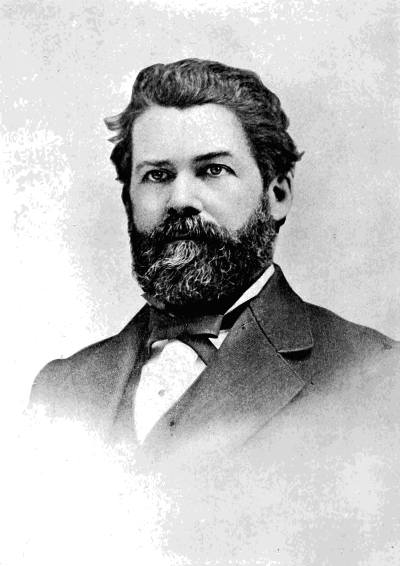
MAJOR RAYMOND R. REES
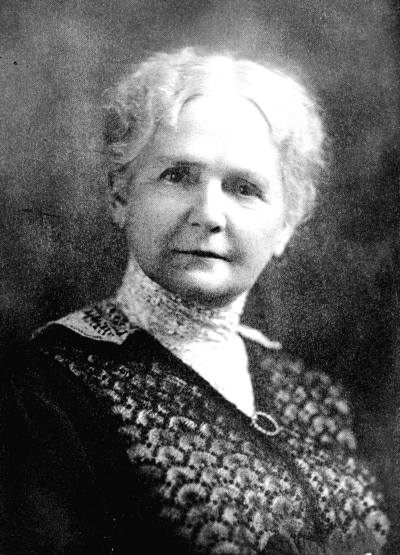
MRS. RAYMOND R. REES
Mr. Rees formed a partnership with Nemiah Northrop and established the first newspaper in this section—the Washington Statesman. The firm sent to Portland for a press, which arrived on schedule time, and the first issue of the new paper appeared on November 27th. The publishers therein made the following announcement to the public: "We send forth this morning with our congratulations the first number of the Washington Statesman, and respectfully solicit the attention of the people of Walla Walla and county to its pages.... That a weekly publication devoted to the various interests of the country, containing all the news which may be gathered from different quarters, is essentially needed in the Walla Walla valley we premise no permanent resident will deny. This admitted, we have no misgivings as to the disposition of the people to come forward and promptly sustain an enterprise so materially calculated to further their interests as a community." In the meantime the firm of Rees & Northrop learned that two brothers named Smith intended starting a democratic paper in Walla Walla and had sent to Portland for a press, which, however, reached The Dalles just as the Columbia river, at that time the only highway, froze over, with the result that it could not be delivered for three months. Mr. Smith desired to become a member of his competing firm and his wish was granted. The first subscriptions did not come in to the new paper as readily as had been expected. Accordingly Mr. Smith made a tour on horseback of Walla Walla county and Umatilla county and succeeded in obtaining two hundred subscriptions at five dollars per year, the circulation list containing the names of practically all the men of the two counties. The Statesman was the first newspaper established in eastern Washington, then known as the "upper country," and was a factor of great importance in the early development of this region. Mr. Rees was one of the owners of that journal until November, 1865, when he sold his interest therein to W. H. Newell, and the following five years were devoted to farming in connection with his father-in-law. In 1870 he returned to Walla Walla and formed a partnership with H. E. Johnson for the conduct of a mercantile business under the style of Johnson & Rees. Two years later W. P. Winans bought into the firm and the name was changed to Johnson, Rees & Winans. With Mr. Johnson's subsequent retirement from the business the firm name became Rees & Winans and so remained until 1887, when the business was sold. In the meantime a two-story building was erected where now stands the Farmers Savings Bank. Plans were subsequently made for the erection of the Rees-Winans building but before construction work was begun Mr. Rees was called by death. His widow, with Mr. Winans, however, carried out the plans already made and the building was erected in due time and was an important addition to the downtown section of Walla Walla. As a merchant Mr. Rees was enterprising, progressive and sound of judgment, managing his affairs carefully and giving much thought to anticipating the demands of his customers. He based his success upon the firm foundation of the best service possible and full return for all money received.
Mr. Rees was married March 12, 1865, to Miss Augusta Ward, the only child of Mr. and Mrs. Michael V. Ward. She was born near Chicago, in De Kalb county, Illinois, in 1843 and in 1853 accompanied her parents to Oregon, the journey being made by ox team. The family settled near Lebanon, in Linn county, but the long wet season proved unhealthful and Mr. Ward developed serious throat trouble. On the advice of a physician he removed to Walla Walla county, bringing with him three hundred head of cattle. That winter, however, there was an unusually heavy snowfall and owing to the unfavorable weather conditions he lost all of his cattle but forty-four. However, the increase in prices enabled him to realize so much from the remaining cattle that his net loss was inconsiderable. He bought the Lewis McMorris ranch a few miles south of Walla Walla and operated that place for some time but at length disposed of it. He then removed to Walla Walla and erected there the most pretentious home in the city at the corner of East and Poplar streets. At the time of the visit of President Hayes and party the president and his wife were entertained at the home of Mr. Ward, as there were no suitable hotel accommodations to be found in the city. Mrs. Hayes insisted in helping with the house work and at her request fried apples were served at breakfast. The democratic spirit manifested by the president and his wife made their visit a genuine pleasure as well as an honor. To Mr. and Mrs. Rees were born three children: Frank W., a well known dentist of Walla Walla; Elma R., the wife of H. H. Turner, cashier of the Baker-Boyer Bank of Walla Walla; and Lora R., the wife of Paul Compton, of Los Angeles, California. Mr. Compton is a son of General Compton, who for years had command of the garrison at Walla Walla.
Mr. Rees was a prominent democrat and for many years took an active part in politics. He represented his district at two different times in the state legislature; for several years served as county treasurer, and his record as an official was highly creditable alike to his ability and his public spirit. He was always called upon with a certainty of response for aid in carrying out projects for the development of Walla Walla city and county and his demise, which occurred July 12, 1889, was recognized as a great loss to his community.
His widow survives and resides in one of the handsomest residences of the city, in which she takes great pride, for it was built in accordance with plans drawn by herself. After the death of her husband she carried on the business of the estate. She is one of the honored pioneer settlers of Walla Walla and her reminiscences of the early days when the present rapidly growing city was a little frontier settlement are much appreciated by the younger generation, who find it hard to realize that conditions have changed so radically within a half century. When she came to this region there were not more than twenty white women in the valley and she is one of the very few of the number now living.
JOHN H. ROMAINE.
John H. Romaine, who has been engaged in farming in Columbia county, was born in Fond du Lac county, Wisconsin, April 15, 1857, a son of Garrit Romaine, a sketch of whom appears elsewhere in this work. Our subject grew to manhood in his native state and there received a good common school education. When twenty years old he accompanied his parents to Washington and not long after his arrival in this state took up a homestead on section 25, township 11 north, range 38 east. He brought his land to a high state of development, and gained recognition as a progressive and capable farmer. He raised both wheat and stock and his annual income reached gratifying proportions. He added to his holdings as the years passed until he owned fourteen hundred acres of fine land but sold out in the fall of 1917 and purchased a ranch of seven hundred and fifty-five acres in Umatilla county, Oregon, nine miles south of Walla Walla, Washington, on which he expects to locate.
In 1882 Mr. Romaine was united in marriage to Miss May McKellips and following her death married Miss Ella Davis, a daughter of Cyrus and Nancy (Holly) Davis, natives respectively of Vermont and Ohio. They removed to Old Walla Walla county and here her father passed away in 1910. Her mother survives and makes her home with Mr. and Mrs. Romaine. The latter have become the parents of four children: Jean M., deceased; one who died in infancy; Garrit; and Jean Henry.
Mr. Romaine gives his political allegiance to the republican party but has never sought office, his farming interests requiring his undivided time and attention. His wife belongs to the Congregational church and takes much interest in its work. During the forty years of his residence in Old Walla Walla county Mr. Romaine has witnessed a remarkable transformation and has kept pace with the development of the county, at all times giving his support to progressive measures.
ZIBA DIMMICK.
For a quarter of a century Ziba Dimmick has been a resident of Walla Walla county and is now numbered among its most prosperous farmers, being extensively and successfully engaged in the growing of wheat. His place is situated on section 27, township 8 north, range 34 east of W. M. He is a western man by birth, by training and by preference, and the spirit of western enterprise finds exemplification in his life. He was born at The Dalles, Oregon, on the 8th of March, 1868, and is a son of H. R. and Ann (Cooper) Dimmick, the former a native of Illinois, while the latter was born in Scotland. It was in the year of 1853 that the father crossed the plains with ox teams, meeting all the hardships and privations of that strenuous trip in the early days. He located first on the Umpqua river in southern Oregon, where he lived with his parents until the spring of 1862, when he and his wife moved to The Dalles. His remaining days were spent in that state, and his widow, who still survives is now a resident of Hood River county, Oregon. In her family were ten children, of whom Ziba is the eldest son and six of the number are now living.
Ziba Dimmick was reared and educated in Oregon, no event of special importance occurring to vary the routine of life for him in the days of his boyhood and youth. At the age of sixteen years he started to work for the Oregon-Washington Railroad & Navigation Company, where he learned the blacksmith's trade, at which he worked until 1892. When a young man of about twenty-four he came to Walla Walla, Washington, and commenced his career as a farmer, working for different men, until 1900, when he invested his savings in the farm upon which he now resides. He today owns seven hundred and twenty acres of rich and productive wheat land and has always made a specialty of raising that crop, for which the soil and climate are particularly adapted. Success has therefore attended his efforts, for in all of his methods he is practical and progressive and through the summer months the broad fields of waving grain give promises of abundant harvest in the autumn. In addition to this property Mr. Dimmick owns one hundred and ten acres of valuable land in Hood River county, Oregon, where he is engaged in raising alfalfa and clover.
In his fraternal relations Mr. Dimmick is a Woodman of the World and an Odd Fellow, politically a republican. His energy and determination have made him what he is today—one of the prosperous farmers of Walla Walla county, and his substantial traits of character have won for him the warm regard of all with whom he has been brought in contact. Walla Walla county gained a substantial citizen when he removed from Oregon to this state, for his labors have contributed much to its agricultural development.
FRANK S. DEMENT.
It was in the quaint and picturesque little city of Oregon City, Oregon, that Frank S. Dement, prominent miller and grain dealer of Walla Walla, was born November 3, 1853, a representative of one of the oldest and most prominent families upon the Pacific coast. His father, W. C. Dement, came to Oregon from Virginia in 1843 in the train with Marcus Whitman. He engaged in merchandising at Oregon City, the little town that was founded above the falls of the Willamette river, and he was one of the four who built the railway around the falls at Oregon City, which was one of the first, if not the first railway on the Pacific coast. With many events which shaped the pioneer development and later progress of that section of the country he was closely associated. He served as captain of volunteers in the Rogue River Indian war in 1856 and there was no phase of frontier development with which he was not thoroughly familiar. He became a resident of Oregon before the city of Portland was established and he lived to witness many remarkable changes as the work of settlement was carried forward. His wife, who bore the maiden name of Olive Johnson, came to Oregon in 1845 and was a daughter of the Rev. Hezekiah Johnson, a Baptist missionary of that state.
Frank S. Dement, spending his boyhood days under the parental roof, acquired his education in the Oregon City Seminary and in early life took up the printing business, learning the trade, after which he engaged in general printing and in publishing of the Oregon City Enterprise. He figured prominently in public affairs in that locality and served as county treasurer of Clackamas county, Oregon, which position he resigned in 1879 and removed to Walla Walla on account of his health. In the following year he organized the Dement Brothers Company and has continuously served as its president. He and his partners purchased the Eureka flour mills of the firm of Welch & Schwabacher Brothers in 1880. These mills had a capacity of one hundred and fifty barrels daily and something of the growth of the business is indicated in the fact that the present capacity is six hundred barrels daily. In a word they have developed one of the most important milling industries of this section of the state and they are also well known as extensive grain dealers. It was Frank S. Dement who in 1882 imported the first bluestem seed wheat from New Zealand to the Pacific northwest and it is today the leading wheat grown in this section of the country. Through this channel and his other business activities he has contributed in marked measure to the material development and consequent prosperity of his section of the state. In the conduct of his business affairs he has amassed a considerable fortune, much of which he has invested in Walla Walla real estate, thus indicating his faith in the future of this district.
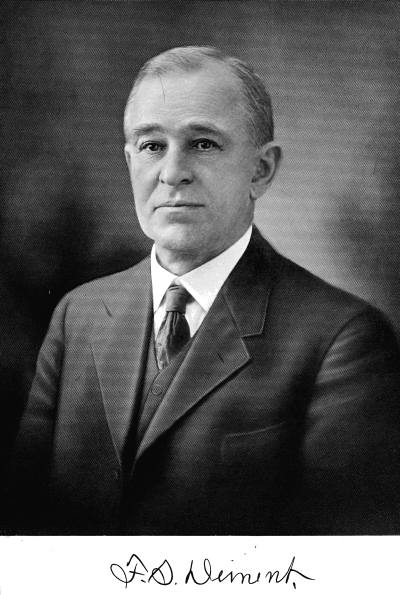
In Oregon City, Oregon, on the 1st of August, 1877, Mr. Dement was married to Miss Frances Miller, a daughter of Captain J. D. Miller, who was a pioneer steamboat operator on the Willamette and Columbia rivers. To Mr. and Mrs. Dement have been born two sons: Charles F., who is county auditor of Walla Walla county; and Frank Bingham, who is now in the National army at Camp Lewis. He was graduated from the Shattuck Military School of Minnesota in 1914 and was a student in Whitman College with the class of 1918.
Frank S. Dement has long been a recognized leader in republican circles in his county and was chairman of the county republican central committee. He has done much to further the interests of his party, believing firmly in its principles and recognizing the duties and obligations as well as the privileges of citizenship; yet he has never sought nor desired office as a reward for party fealty. Fraternally he is connected with the Benevolent Protective Order of Elks and is a prominent Mason, having taken the degrees of both the York and Scottish Rites. He is a member of Oriental Consistory, A. & A. S. R., of Spokane and of El Katif Temple, A. A. O. N. M. S. For the past thirty years he has been a very active and prominent member of the Commercial Club of Walla Walla and is now one of its directors and the treasurer. He stands for progressiveness in all public affairs and his efforts in behalf of general progress and improvement have been practical, far reaching and effective. Men who know him—and he has a wide acquaintance—speak of him in terms of the highest regard both as to his relationship with business affairs and in matters of citizenship.
JOSEPH LEDGERWOOD.
Joseph Ledgerwood, deceased, spent the last years of his life in honorable retirement from business in Pomeroy, enjoying the fruits of his former labor. For many years he had been identified with farming in southeastern Washington and his well directed business affairs brought to him a very substantial competence, enabling him to enjoy all of the comforts and many of the luxuries of life and also to leave his family in very easy financial circumstances. He was born in Clay county, Missouri, July 17, 1836, and was a son of Joseph and Rachael Ledgerwood, who were natives of Tennessee and afterward became pioneer settlers of Clay county, Missouri.
Joseph Ledgerwood acquired his education in the common schools of Clay and Daviess counties of Missouri and on reaching manhood took up the occupation of farming. In 1864, with little money to outfit him for so hazardous and extended a journey, he started across the plains for the Pacific coast country, and while he endured many hardships and privations while en route, he ultimately in safety reached the Umpqua valley, where he made a home for his family and continued to reside until 1877. He then disposed of his property in that region and removed to Garfield county, Washington, settling about nine miles east of Pomeroy. There he prospered and from time to time, as his financial resources increased, he added to his land until at his death he was the owner of about one thousand acres of valuable farm property. In the later years of his life he retired from active farm work and removed to Pomeroy, where he spent his remaining days in the enjoyment of the fruits of his many years of successful labor. For a long period his life had been one of untiring industry and perseverance, during which he was watchful of every opportunity and indication pointing toward success. At all times he based his advancement upon the sure foundation of industry and persistency of purpose.
In 1859 Mr. Ledgerwood was united in marriage to Miss Louise O'Keef, a native of Illinois, who was a faithful helpmate to him and shared with him in all of the hardships and privations of pioneer life, when Oregon and Washington were still frontier states. She still survives her husband and cherishes his memory, for he was most devoted to the welfare and happiness of his family. To Mr. and Mrs. Ledgerwood were born nine children, seven of whom are yet living, as follows: William T.; J. Joseph; John T.; Lou Emma, who is the wife of W. A. DeBow, a grain dealer of Pomeroy; Martha R., who is the widow of James B. Carter and resides in Pomeroy; Rosa, who gave her hand in marriage to Lou Jurgens, of Asotin county, Washington; and Clara B., the wife of Edward Davis, of Okanogan county, Washington.
Mr. Ledgerwood was a very progressive man, public-spirited in all that he did, and his aid and cooperation could ever be counted upon to further public progress. He aided many movements for the general good, and while he was never a politician in the commonly accepted sense of the term and never would consent to hold office, he gave earnest support to the democratic party because of a firm belief in its principles. He belonged to the Masonic fraternity and to the Independent Order of Odd Fellows and was a consistent Christian man, both he and his wife being lifelong members of the Methodist Episcopal church. Mrs. Ledgerwood occupies a handsome home in Pomeroy, surrounded by all the comforts and conveniences which make life worth living.
REME De RUWE.
Among the successful sheep raisers of Columbia county is numbered Reme De Ruwe, who was born in Belgium, September 15, 1882, a son of Peter and Julia De Ruwe, also natives of that country, where their entire lives were passed. To them were born fifteen children. The subject of this review is indebted for his education to the schools of his native land, and remained at home until he was about twenty years old. Then, in 1902, he decided to try his fortune in the United States and located in Walla Walla county, Washington, where he at once turned his attention to raising sheep. He has since continued in that occupation on an extensive scale. He pastures his sheep on a ranch comprising twelve hundred acres of land in Columbia county. The success which he has gained in fifteen years is quite unusual, demonstrating his ability to adapt himself to a new condition, his sound judgment and his enterprise. His ranch is well improved and is a very valuable property.
In 1914 Mr. De Ruwe was united in marriage to Miss Caroline Kregger, and they have a son, Marvin, and have also adopted three children. Mr. De Ruwe casts his ballot in support of the republican party, whose principles accord with his political beliefs. He was reared in the Catholic faith and consistently gives his influence on the side of moral advancement. He has gained many friends since coming to eastern Washington, his salient characteristics being such as never fail to command respect and win regard.
CHARLES L. WHITNEY.
Charles L. Whitney, who is living retired on section 6, township 6 north, range 36 east, Walla Walla county, is now enjoying a period of well merited leisure made possible by his former successful labors as a nurseryman and horticulturist. He was born in Erie county, Pennsylvania, January 26, 1857, of the marriage of William G. and Marcia M. (Pettis) Whitney, the former a native of Onondaga county, New York. They removed to California in 1879; two years before their son Charles L. had made his way to the Pacific coast, and after residing there for one or two years they came to Walla Walla county, Washington. Here the father, in partnership with his son Charles L., bought the farm where the latter still resides. This place was the site of the Sims mill, which was the first mill built in the state and possibly the first in the northwest. The date of its erection was 1858 and there was also a distillery operated within the limits of the farm. In the early days pack trains, numbering one hundred animals were sent to the outlying camps loaded with flour, bacon and whiskey, and the farm is indeed one of the historic places of the state. The father established the Home nursery and the son the North Western nurseries, and both proved successful in that business. The father remained active in the management of his affairs both as a nurseryman and as a farmer until his death in 1912. The mother passed away in 1910.
Charles L. Whitney was reared in Pennsylvania and after attending the common schools became a student in the Edinboro (Penn.) State Normal school and in Austinburg College at Austinburg, Ohio. Later he took up the study of medicine at the Eclectic Medical College at San Francisco, California, but left that institution a year before the completion of his course. It was in 1877 that he removed to California and he was one of the first settlers of the town of Whatcom. He devoted some time to timber cruising and for a number of years he traveled through California, Oregon and Washington, becoming familiar with practically every part of the Pacific coast. In 1880 he came with his parents to Walla Walla county and established the North Western nurseries, which he conducted for years. He was one of the first men to enter that line of business in this section and his success in the growing of fruit trees determined the possibilities of this region in the production of fruit. He also engaged in general farming to some extent and found that likewise profitable. For four years he was county fruit inspector and later was for a similar length of time state fruit inspector and was generally recognized as an authority on everything pertaining to fruit and its production. About 1907 he gave up the nursery business and has since rented his land for gardening, although he still resides upon his farm, which comprises one hundred and-fifty-two acres two miles south of Walla Walla, in the most fertile part of the valley. His home is a handsome country residence, provided with all modern conveniences.
In 1883 Mr. Whitney was united in marriage to Miss Elizabeth McCaslin, who was born in Sharon, Pennsylvania, but was teaching in the schools of Omaha, Nebraska, at the time of her marriage. They have become the parents of five children, of whom four survive, namely: Elizabeth May, the wife of Ned McLean, of Walla Walla; Bertha, who married L. F. Turman, of Willows, California; Charles B., who is first sergeant with the Washington Field Artillery, under Major Weyrauch; and Marguerite, the wife of Fred Houghton, of Attalia, this county.
Mr. Whitney's political views accord with the principles of the republican party and he gives it his stanch support but has never taken a very active part in politics. However, he has always felt the keenest interest in the upbuilding of his county and his influence has been felt in its development along horticultural, agricultural and civic lines. He was a member of the board of commissioners that had charge of the Walla Walla exhibit at the Lewis and Clark Exposition held in Portland in 1905 and took a great deal of pride in the fine showing that the county made. He has a number of fraternal connections, belonging to Blue Mountain Lodge, No. 13, F. & A. M.; Walla Walla Chapter, No. 1, R. A. M.; Walla Walla Commandery, No. 1 K. T.; El Katif Temple, A. A. O. N. M. S., of Spokane; to the Shrine Club at Walla Walla, of which he is president; to Alki Chapter, No. 25, O. E. S., of which he is past patron and of which his wife was the second matron, to Enterprise Lodge, No. 2, I. O. O. F., of which he is past grand; to the Ancient Order of United Workmen; and to Walla Walla Lodge, No. 287, B. P. O. E. His high standing in the Odd Fellows society is further indicated by the fact that he holds the lodge jewel.
EDWARD H. NIXON.
Edward H. Nixon, one of the earliest of Walla Walla's pioneers now living and for many years a dominant factor in civic affairs, was born in Guyandotte, West Virginia, on the 26th of May, 1842. When he was ten years of age his parents removed to Jackson county, Iowa, settling on a farm about eight miles west of Sabula. He was there educated in the district schools and at his mother's knee, she having been educated for a teacher in the Massachusetts schools in early life. Subsequently she went west to teach in the West Virginia schools and it was there that she was married. After mastering the early branches of learning Mr. Nixon continued his studies in the high school at Maquoketa, Iowa, and at the age of twenty years he was elected to the office of constable in his district, but the commissioners refused him a commission because he was not of legal age. He began reading law at Maquoketa, Iowa, and advanced sufficiently to try cases before a justice of the peace.
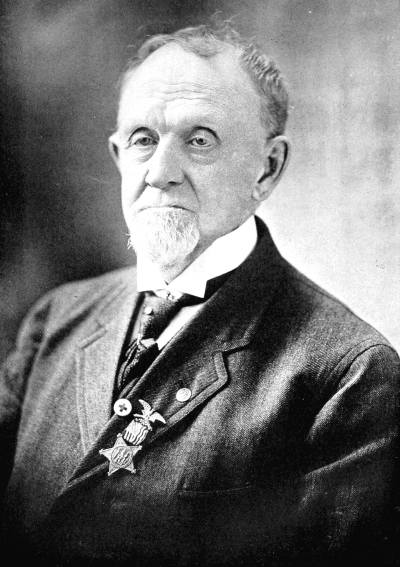
EDWARD H. NIXON
In sentiment he was strongly anti-slavery at the beginning of the Civil war and as his sympathies were with the north, he determined he would not fight for any country that would uphold slavery, but after the Emancipation Proclamation he offered his services to the country and was accepted in December, 1863, being mustered into the service as a member of Company A, Ninth Regiment of the Iowa Veteran Volunteer Infantry, with which he served for one year, five months and eleven days. He then received an honorable discharge, the war having been brought to a close. He had participated in the battles of Snake Creek Gap, Resaca, Dallas and New Hope Church, Ackworth or Big Shanty, and the seven days' siege of Kenesaw Mountain and many skirmishes. He was also in the battle of Atlanta on the 22d of July, 1864, in the battle of Ezra Church and many others, taking part in every engagement in which his regiment participated until the fall of Atlanta. At close of the war he received an honorable discharge and returned to his home with a most creditable military record, having nobly done his part to preserve the Union. He afterward pursued a course in Eastman's Business College at Poughkeepsie, New York, and subsequently he engaged in farming until 1873, when he started for the far west with Walla Walla as his destination. He arrived here on the 16th of March of that year and took up the profession of teaching. He also engaged in farm work and in fact accepted any employment that would yield him an honest dollar.
On the 2d of April, 1876, Mr. Nixon was united in marriage to Miss Kate Stewart, a daughter of Daniel and Margaret Stewart, and to them have been born three children, two daughters and a son: Stella, now the wife of H. L. Wilson, who is state highway contractor and a resident of Walla Walla; Laura, the wife of H. H. Hadley, who is engaged in the automobile business in Dayton, Washington; and Edward S., who is associated with his father in the real estate and insurance business under the firm style of E. H. Nixon & Son.
In 1877, soon after his marriage, Mr. Nixon removed to Whitman county and took up a homestead and tree claim and preempted another one hundred and sixty acres of land. He also rented a section of school land and for eight years or more was extensively and successfully engaged in farming. He laid out the first road ever laid out in Whitman county and was well known as the pioneer settler of that county, instituting much of the progressive work which has brought about its present-day progress and prosperity. In 1885 he returned to Walla Walla, and while he has disposed of his landed interests in Whitman county, he still owns valuable farm property and since 1892 he has conducted a real estate and insurance business, the firm of E. H. Nixon & Son maintaining an office in the Jaycox building. For many years Mr. Nixon was one of the most conspicuous figures in the civic affairs of Walla Walla. He served as road overseer, was also United States deputy postmaster, was justice of the peace two years and was police judge one year. He was also city assessor one term and was a member of the city council and at all times exercised his official prerogatives in support of many well defined plans and measures for the general good. He looked beyond the exigencies of the moment to the opportunities and possibilities of the future and labored not only for the welfare of the passing hour but for future time as well. He was responsible for the establishment of the perpetual care system in the city cemetery and later the same system in the Odd Fellows cemetery, serving as president of the cemetery committee for a number of years. Mr. Nixon has long been a faithful and prominent member of the Grand Army of the Republic, in which he has filled all of the offices in the local post. He has also been honored with the position of assistant adjutant general and assistant quartermaster general of the Department of Washington and Alaska. He has membership in Blue Mountain Lodge, No. 13, A. F. & A. M., and is a member of Washington Lodge, No. 19, I. O. O. F., in which he has filled all of the chairs, including that of noble grand. In 1890 he joined with F. W. Paine and others in forming the Interstate Building Loan & Trust Association, and he is a member of its board of trustees and vice president of the association. In a word his activities are broad and varied. He is a liberal minded man, recognizing the duties and obligations of the individual to his fellowmen and to his country. At all times he has been actuated by a progressive spirit and in business affairs has been stimulated by a laudable ambition. His purposes have been well defined and promptly executed and the course which he has pursued has at all times measured up to the highest standards of manhood. His work has been of great benefit to the community at large as well as a source of individual success, and Walla Walla county honors him as one of her best known pioneers. His religious faith is that of the Unitarian church.
S. S. MORITZ.
S. S. Moritz, who since 1914 has held the office of postmaster of Dayton, was formerly prominently identified with its business interests, first as a merchant and later as a real estate operator. He was born in Victoria, British Columbia, August 28, 1863, a son of Moses and Adeline (Greenenburg) Moritz, natives respectively of Alsace, France, and of Groesenadar, Germany. The mother came to the Pacific coast by way of the Panama route in young womanhood and joined relatives living in San Francisco. The father emigrated to this country in early manhood and after spending some time in the middle west made his way to the California gold fields in 1849. He acquired some valuable mining properties but later lost them through reverses in fortune. He became a naturalized citizen of the United States in San Francisco in 1855 and subsequently went to Portland, Oregon, where he was married, the lady who became his wife having in the meantime removed to that city, where she made her home with relatives. Mr. Moritz engaged in merchandising there until the discovery of gold on the Fraser river in the British possessions. He then removed with his family to Victoria, where they resided for two years, after which they returned to Portland. Later they became residents of Centerville, Idaho, where the father was well known as a general merchant. At length he removed to Boise City with the view of giving his children better educational advantages and remained there until 1873, when he went to Salt Lake City, where he was active in business until 1890. He then retired and spent his last days in the home of his son, S. S. Moritz. He passed away September 23, 1913, when in his eighty-eighth year. He was a man of vigorous constitution and retained the full use of his faculties up to the time of his death. His widow survives.
S. S. Moritz received his education in the schools of Boise City and of Salt Lake City and during vacations received business training which stood him in good stead in his later years. For several years before leaving school the summers were devoted to clerking in various stores in Salt Lake City, chiefly the clothing business, and in the spring of 1885, when a young man of twenty-one years, he came to Dayton, Washington, to accept a position with Duzenbury & Stencil, general merchants. For a year he had charge of their clothing and furnishing department and then engaged in business for himself, establishing a clothing and furnishing store. For eighteen years he conducted that store and became a dominant factor in the commercial life of Dayton, his resourcefulness, energy and keen insight into business conditions causing him to be generally recognized as a leader. In 1904 he sold his store, as he desired to give his undivided attention to his other interests. For a number of years he had been investing heavily in real estate and he it was who laid out the Syndicate Hill subdivision of Dayton, which is now recognized as the finest residence district of the city, and for a decade his entire time was given up to looking after his real estate interests, but in 1914 he became postmaster of Dayton by appointment of President Wilson. During the intervening three years he has held that position and has performed his duties in the same capable manner that he managed his private affairs.
Mr. Moritz was a stanch republican in his political views until 1896, but in that year he became convinced of the wisdom of the policies advocated by William Jennings Bryan and gave his support to the democratic party, with which he has since been identified. He has taken an active part in public affairs and many improvements in Dayton have been brought about largely through his indefatigable work in their behalf. Notable among these is his achievement in securing the paving of the business district in spite of much indifference and determined opposition. His interest in good roads has found further expression in the arterial highway law, a very significant piece of legislation, which is based upon a plan conceived by Mr. Moritz. When it became necessary to change the city charter in conformity with the state regulations he led the movement for a charter that would meet all the needs of Dayton and was largely instrumental in securing such an instrument. He has been one of the most active members in the Dayton Commercial Club since its organization and has had a large part in its effective and farreaching work for the city. Fraternally he belongs to Dayton Lodge, No. 3, K. P. His position as one of the foremost residents of Dayton is secure and his personal friends are many.
T. F. DICE.
T. F. Dice, residing on section 2, township 9 north, range 36 east, Walla Walla county, holds title to a large amount of land but is renting the greater part of it and is thus enjoying comparative leisure. His birth occurred in Pennsylvania, February 15, 1859, a son of William and Susan (Redrick) Dice, who passed their entire lives in the Keystone state. Five of their seven children are still living.
T. F. Dice grew to manhood in Pennsylvania and supplemented the education acquired in the public schools by attendance at Mercersburg college in Mercersburg. On leaving his native state he went to Savannah, Georgia, where he spent three years, and then in 1889 he came to Walla Walla county, Washington, for the benefit of his health and here he purchased a farm on which he resided for three years. He next bought his present home place on section 2, township 9 north, range 36 east, and for many years personally operated the five hundred acres comprised in the farm. At the present time, however, he rents all the land but an eighty acre tract, which is in alfalfa and which he looks after himself.
In 1884 occurred the marriage of Mr. Dice and Miss E. A. Spangenberg. The latter was born in Scranton, Pennsylvania, and is a daughter of Frederick A. and Fanny Anna Spangenberg, both also born in Pennsylvania. The father, who successfully engaged in the practice of law for many years, is now deceased, but the mother survives. Mrs. Dice had exceptional musical training and her talents along that line have been a source of great pleasure to her family and friends. Mr. and Mrs. Dice have four children: William T., who lives in California; Lee R., who is teaching in the University of Montana; Frances E., the wife of the Rev. Robert M. Hood, now a resident of Idaho; and Carl E., a student of Mount Tamalpais Military Academy, San Rafael, California. During the years of his residence in Walla Walla county Mr. Dice has become widely and favorably known, his many excellent qualities gaining for him many warm friends.
W. H. BARNHART.
The field of opportunity finds its boundaries only in the limitations of the individual. When energy and ambition lie dormant the path of advancement seems closed, but to the man who believes that there is a chance for every individual and who is willing to take his chance with others, there always comes a time when he can take the initial step that will lead on to fortune. That Mr. Barnhart recognized the opportune moment is shown in the fact that he is now one of the leading business men of Starbuck, where he is widely known as the vice president and manager of the Sprout & Barnhart Mercantile Company and also as a member of the board of directors of the Bank of Starbuck. Iowa claims him as a native son, his birth having occurred in Wapello county on the 11th of October, 1871, his parents being Henry and Elizabeth (Johnson) Barnhart. The father was a native of Tennessee, while the mother's birth occurred in Ohio, and in Iowa their marriage was solemnized. They had accompanied their respective parents to the last mentioned state in childhood and were there reared. Mr. Barnhart turned his attention to farming and railroading, which he followed in Iowa until 1889, when he removed westward to Oregon and for a number of years was employed by the Oregon & Washington Railroad & Navigation Company in the capacity of engineer. He thus took part in the early development of railway operations in the west. He died in December, 1915, and is survived by his widow, who resides on a ranch near Spokane.
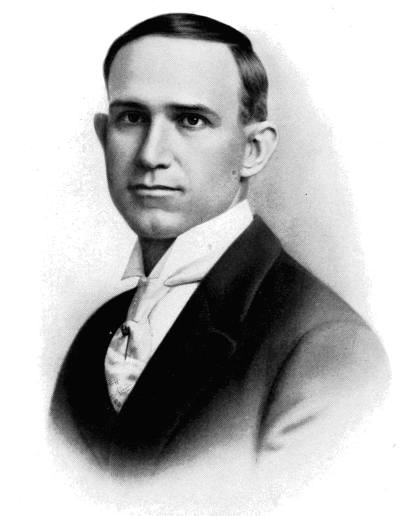
W. H. BARNHART
W. H. Barnhart, spending his youthful days under the parental roof, completed his education in the high school at Albia, Iowa, from which he was graduated with the class of 1889. The following year he came to Oregon and for a number of years successfully engaged in teaching school, imparting readily and clearly to others the knowledge that he had acquired. He also worked in a store at La Grande, Oregon, and subsequently he became a student in Armstrong's Business College at Portland. Later he took up railroading as an employe of the Oregon & Washington Railroad & Navigation Company and was employed by that corporation for thirteen years. During the last seven years of that period he ran an engine and in 1907 he resigned his position with the company and purchased an interest in the mercantile establishment of W. E. Sprout of Starbuck. The following year the company was reorganized and incorporated, with Mr. Barnhart as the vice president and manager of the business, and Mr. Sprout as the president. They have a spacious and well appointed store, carrying an extensive line of goods, and they always maintain the highest standards in the personnel of the house, in the stock carried and in the treatment accorded patrons. Their business has therefore gradually increased as the years have gone on and has become one of the profitable commercial interests of southeastern Washington.
In September, 1901, Mr. Barnhart was united in marriage to Miss Bessie A. Wright, of Starbuck, and they have become parents of two daughters, Grace M. and Blanche L. Mr. Barnhart is a loyal representative of the Masonic fraternity, belonging to Tucanon Lodge, No. 106, F. & A. M., of which he is now worshipful master. He is also identified with the Brotherhood of Locomotive Engineers and has served as chief engineer in the order. In politics he is a stalwart republican and is now mayor of Starbuck. He had previously served for several years as a member of the town council and his fitness for further and more responsible public duties led to his election as chief executive. His wife and two daughters are members of the Episcopal church and Mr. Barnhart is serving on its board of trustees. His aid and influence are always given on the side of progress and improvement as related to the material upbuilding and also the social, intellectual and moral advancement of the community. Those who know him, and he has a wide acquaintance, esteem him as a man of genuine worth who well merits the success that has crowned his efforts since he started out in business life empty-handed.
IRA D. BRUNTON.
Among the native sons of Walla Walla county who have elected to continue residents thereof is Ira D. Brunton, who is engaged in farming on section 30, township 8 north, range 36 east. He was born in that township, May 11, 1876, and is a son of W. H. H. and Sarah A. (Lewis) Brunton, a sketch of whom appears elsewhere in this work. He was reared upon the home farm, and his boyhood and youth were spent in the acquirement of a district school education and in helping his father. He further pursued his studies in Whitman College and at the old Empire Business College at Walla Walla, thus fitting himself for his later life.
After his marriage Mr. Brunton began farming for himself, operating a part of the homestead in partnership with his father, this relation being continued until his father's death, after which Mr. Brunton of this review and his brother Frank managed the entire estate of seven hundred acres for five years. At the end of that time Ira D. Brunton took over the operation of four hundred acres and his brother Garfield became responsible for the cultivation of the remaining three hundred acres. In 1903 our subject purchased one hundred and sixty acres adjoining the home farm and he now operates both places and also four hundred acres of rented land, or nine hundred and sixty acres in all. It is thus evident that his interests are extensive and make heavy demands upon his time and energies, but he is industrious, progressive and systematic in his work and his affairs are kept well in hand.
Mr. Brunton was married October 10, 1897, to Miss Bessie L. Ramseur, a daughter of David W. Ramseur, who removed to Walla Walla county from North Carolina in 1892. To Mr. and Mrs. Brunton have been born five children: Elsie M., the wife of Clyde Garland, of Walla Walla; and Reese R., Lucille B., and Miles and Melvin, twins, all of whom are at home.
Mr. Brunton's political views are in accord with the principles of the democratic party and he supports its candidates at the polls. In 1908 he was his party's nominee for sheriff and polled a large vote. Fraternally he is connected with Mountain Gem Lodge, No. 136, K. P., and his wife is a member of the Methodist Episcopal church. He is held in high esteem as a citizen and as a man, and his success as a farmer entitles him to rank among the leaders in the agricultural development of the county.
JOSEPH CLARK FAIR.
Joseph Clark Fair, an independent grain buyer and one of Dayton's foremost business men and representative citizens, was born in Benton county, Arkansas, February 26, 1874, a son of Joseph A. and Martha Ann (Russell) Fair, the former born in Sullivan county, Tennessee, and the latter in Barry county, Missouri. The parents were taken by their respective parents to Benton county, Arkansas, and there grew to manhood and womanhood. They continued to reside there following their marriage, with the exception of four years spent in Texas, up to the time of the mother's death, which occurred in June, 1899. The father devoted his active life to farming but is now a resident of Centerton, Benton county, Arkansas, where he is living retired. He is a local Methodist minister and was often importuned to join the conference but refused, saying he knew he could make a living farming but did not know whether he could as a minister or not. His parents, Ellis and Nancy Hamilton (Easly) Fair, were representatives of old families of Tennessee. Mr. Fair was killed by Indians at the time of the Civil war. The parents of Mrs. Martha Ann (Russell) Fair were Elijah and Louisa (Bell) Russell, natives respectively of Missouri and Tennessee. Mr. Russell went to the California gold mines in 1849, crossing the plains with ox team, and returned to the east in 1852 by sailing vessel. At the time of the Civil war he was killed by bushwackers.
Joseph Clark Fair was reared at home, and in the acquirement of his education attended the common schools of Arkansas and the Elm Springs Academy, in Washington county, that state. For two terms he engaged in teaching in Benton county, Arkansas, but because of the low salary paid teachers gave up the profession. In 1898 he decided to try his fortune in the far west and located at Condon, Gilliam county, Oregon, where he was connected with lumber interests. He remained there for five years and during the last year helped to build the courthouse. During that time he acquired title to seven hundred and twenty acres of land, which he has since sold at a profit. In 1903 he became a resident of Dayton, Washington, where he has ever since remained, and he is well known throughout Columbia county as a grain-buyer. He is expert in judging wheat and keeps in the closest touch with the grain markets and has been very successful in his business affairs.
Mr. Fair was married in 1908 to Miss Nellie Virginia Gregg, who was born in Washington county, Arkansas, but at the time of her marriage was county superintendent of schools of Columbia county. To them was born one child, who, however, is deceased. Mr. Fair is a stanch democrat in politics and has served with ability as a member of the town council. He is well known in fraternal circles, belonging to Alki Lodge, No. 136, I. O. O. F., of which he is past grand; Franklin Encampment, No. 13, I. O. O. F., of which he is past chief patriarch; Dayton Lodge, No. 26, F. & A. M., of which he is now worshipful master; and Dayton Lodge, No. 3, K. P., of which he is past chancellor. His religious faith is indicated by his membership in the Congregational church, and in his business dealings, as well as in the private relations of life, his conduct measures up to high moral standards. He feels that his decision to come to the west was one of the wisest that he has ever made and he is confident that a greater future is in store for this section.
CHARLES CLAGUE.
Charles Clague, a prosperous farmer residing on section 2, township 9 north, range 36 east, Walla Walla county, was born on the Isle of Man in March, 1860, a son of Richard and Isabella (Quirk) Clague, also natives of that island, where their entire lives were passed. Our subject's education was received in the public schools and he remained in his native country until he attained his majority but in 1881 came to the United States. For six months he worked in a grocery store in Olean, New York, after which he decided to see the west. There for a month he worked in Colorado and then continued his journey, arriving in San Francisco on Christmas day, 1881. He only remained in that city for two days, however, and then came to Walla Walla county, Washington. He took up a homestead two miles south of Prescott and for twenty years lived upon that place, which he operated successfully. He also purchased other land, becoming the owner of seven hundred and eighty acres. In 1902, in partnership with T. F. Dice, he bought five hundred acres of land and later they purchased the old Samuel Erwin home farm, where both have since resided. Mr. Clague has sold his homestead and the land adjoining and has also disposed of the equity of the five hundred acre tract but retains his interest in the farm of eighty acres, where he and Mr. Dice reside. He also is the owner of fifty-two acres of irrigated land near Patterson, Stanislaus county, California. He has gained financial independence and, having disposed of the greater part of his holdings, is now enjoying a period of comparative leisure.
Mr. Clague is a progressive republican in politics and has always been most loyal to the interests of his adopted country. He belongs to the Presbyterian church and in its teachings are found the principles which guide his life. For thirty-six years he has resided in Walla Walla county and has done his part in bringing about the wonderful development that has taken place during that time. He has a wide acquaintance and a large number of warm personal friends.
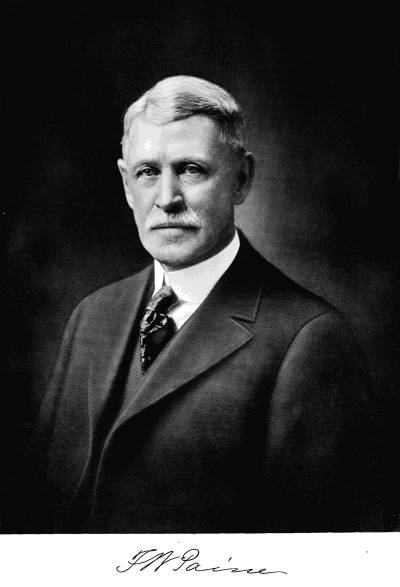
FRANK W. PAINE.
Frank W. Paine is a capitalist of Walla Walla whose name is inseparably interwoven with the history of city and state. Coming to the west in pioneer times, he is familiar with every phase of frontier life and with the processes of development which have brought the state from pioneer conditions to its present stage of progress and prosperity. His individual labors have contributed much to the results achieved, and no account of Walla Walla's development would be complete without extended reference to him.
Mr. Paine was born August 31, 1839, in Mercer, Somerset county, Maine, and has therefore passed the seventy-eighth milestone on life's journey. His father, William Paine, was born in Hingham, Massachusetts, September 5, 1801, and died December 4, 1883, while the mother, who bore the maiden name of Elizabeth Wentworth Pike, was born in Somersworth, New Hampshire, December 29, 1804, and passed away February 14, 1872. Both parents were of English Puritan stock. Among the early representatives of the Paine family were men of title who belonged to the nobility of England, and in New England representatives of the name loyally served their country in the struggle for independence and as statesmen aided in formulating the policy of the commonwealth with which they were connected. In religious faith the parents of Frank W. Paine were Congregationalists. In political faith William Paine was first a whig and afterwards a republican, and by occupation he was a farmer. To him and his wife were born six children, who were reared more in the fear than in the love of God, but for their day they were on the firing line, both in good works and exemplary lives.
Frank W. Paine began his education in a little unpainted schoolhouse of one room, which stood at the forks of the road on Beech Hill, in the town of Mercer, Somerset county, Maine. He at first had the opportunity of attending school for about eight weeks in the summer and ten weeks in the winter season until he was ten or eleven years of age, when he no longer found it possible to continue his studies through the summer but was enabled to attend school through the winter until his eighteenth year. He then began teaching in the country districts through the winter months, while the summer was devoted to farm work. On leaving the schoolroom, however, he did not consider his education complete, for his strong desire for learning has led him to read and study systematically and he always has near him good books on history, literature, science and poetry. Such books have also constituted a part of his continuous reading and thus he has obviated his lack of early training and become a most well informed man. Moreover, in the various positions of public trust which he has filled he has always found it to be of the greatest assistance to resort to the most reliable authorities treating on the matters in hand and in these ways he has been able to accomplish something of what a liberal education might have done for him. He has many times so keenly felt his deficiency in the lack of school and college training that upon an analysis of his educational shortcomings he determined that his most serious lack was a fuller understanding of history, literature and Latin, and he has wherever possible urged young men to prepare along those lines.
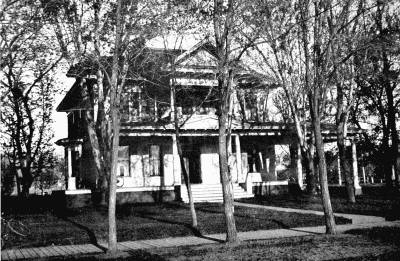
RESIDENCE OF F. W. PAINE
As school teaching and farming seemed to offer small opportunities in Maine, Mr. Paine resolved to go west and chose California as his objective point, arriving in that state in October, 1861, with a letter from the late Judge E. D. Sawyer of San Francisco to an old friend of his at Mokelumne Hill. He was soon on the ground of the "Jumping Frog of Calaveras county" and found the addressee of his letter to be the proprietor of a provision store and his affairs much run down at the heel. Early in the spring of 1862, therefore, Mr. Paine went to Dogtown, in Shasta county, to join two friends who were preparing to go to the newly discovered mines on Salmon river in Idaho. He became the third member of the party, whose route, as contemplated, lay over the Siskiyou mountains to southern Oregon, then to Portland and on by way of Walla Walla, but at Jacksonville they were advised to cross the Cascade mountains down the east side to Klamath lake and on to Walla Walla. After many days of weary walking they arrived in Walla Walla late in June 1862, and there met the returning tide of miners from Salmon river and Florence, which discouraged the three young men from going further in that direction.
Under the stress of necessity Mr. Paine made haste to find employment and after two or three months by precarious work of different kinds he secured a situation in the Baker-Boyer store but was soon detailed to take charge of the Spray warehouse at Wallula under Dr. Baker's direction. In the spring of 1863 a mad rush for the Boise mines carried Mr. Paine along. As a measure of economy he engaged with a mule pack train owned by the firm of Johnson & Stratton, serving as off side packer and learning to "throw the diamond hitch." The wealth which Mr. Paine accumulated in that mining venture consisted mainly in experience. In the fall of 1864 he returned to Walla Walla and at once was reinstated in his former position with the Baker-Boyer firm, there remaining until the spring of 1866, when another attack of mining fever took him to Montana with a stock of clothing made for the California miners' trade, which stock of goods was readily sold at a good profit. After enjoying a few weeks of summer on the summit of the Rockies he returned to the land of his adoption, and to be safeguarded against another "call of the wild," on his return he accepted the proffer of a partnership made by William Stephens, a merchant conducting business at the corner of Main and First streets. The business prospered and at the end of a year Mr. Paine purchased the interest of his partner and admitted his brother John to a partnership, removing the stock to the corner of Second and Main streets, where they conducted a very substantial business. After about two year opportunity enabled Mr. Paine to succeed by purchase to the Baker-Boyer business, then located on the present site of the Baker-Boyer Bank. Miles C. Moore joined him as a partner under the style of Paine Brothers & Moore, which firm soon became widely known for its business enterprise and also for its local political influence. During the existence of the firm they established branches at Waitsburg and at Dayton and built a fine steamboat, The Northwest, to ply in wheat carrying on the Columbia and Snake rivers. The war department, however, leased the steamboat to transport troops and munitions during the war with the hostile Willowas, under the notable Chief Joseph, in 1878. Soon after the boat was taken over by the Oregon Railway & Navigation Company. After nearly ten years of pleasant and profitable partnership Mr. Moore withdrew from the firm. In the meantime they had concentrated their attention upon farm implements and machinery and this business was conducted under the style of Paine Brothers. In 1879 they built the three-story brick building, which was then the finest business block in the northwest outside of Portland. Upon its completion and upon the organization of the First National Bank it took up its home in this building, where it has since continued.
While for many years Mr. Paine figured most prominently in commercial circles, he also became a leader in the public life of the community as well. His first public office was that of councilman, which he filled in 1878 and 1879. He afterward served as city treasurer in 1883 and 1884 and was mayor of Walla Walla through the two succeeding years. All of these offices came to him unsought. During his mayoralty term he signed the ordinance prohibiting stock from running at large in the streets and this executive act lost him his reelection. He recognized, however, the value of such a course to the city and followed the dictates of his judgment and his conscience notwithstanding the contrary advice of his friends who desired his reelection. In 1880 Mr. Paine was elected school director in District No. 34, the western part of the city. In 1882, by act of the legislature, Districts No. 34 and No. 1, the latter the eastern part of the city, were united in one and the two boards of directors acted as one until the next election, when Mr. Paine was elected one of the three directors for the combined district. He was reelected at each succeeding election until 1906 and during his incumbency, covering more than twenty-five years, he was chairman of the board, which from time to time had to meet increasing requirements by the erection of two frame and three brick schoolhouses. To do this the legal maximum levy of five per cent was not exceeded. The educational work done and the standing of the schools was equal to the best in the state.
In 1887 Governor Watson C. Squire, at the request of many of Mr. Paine's friends, appointed him superintendent of the new state penitentiary which had been recently erected at Walla Walla, with orders to establish rules and regulations and to conduct the institution on a similar plan to that of the Oregon state penitentiary. After some hesitation he accepted the appointment, and as the legislature, after providing an appropriation to erect the buildings, had neglected to make any appropriation for its maintenance, it became necessary to secure a citizens' pledge of five thousand dollars on which to draw for incidentals for the ensuing year or until the next legislature should meet. This done, he took six good men as guards with him to Seatco, where the old contract prison built of logs was located and where the convicts divided their time between working in a sash and door factory, working their way out of prison and being worked back by a reward or a bloodhound. Governor Squire met Mr. Paine at that place and after getting a record of the convicts, as a measure of economy for the state, he pardoned sixteen whose terms were nearly completed, leaving ninety-seven to be transferred to Walla Walla, which was accomplished without loss of any member. The next problem was to produce work for the prisoners and Mr. Paine soon succeeded in establishing and operating successfully a brickyard, which proved greatly beneficial to the prisoners. At the close of his term and on the convening of the legislature he reported to the governor, then Governor Semple, giving account of the amount required to cover all indebtedness incurred. The legislature readily made the appropriation, supplemented by a complimentary resolution. Two years later, under a new legislative enactment, Mr. Paine was made chairman of a commission of three members appointed by Governor Elisha P. Ferry, consisting of P. A. Preston, F. M. Lowden and Mr. Paine. With the ready compliance of his colleagues, Mr. Paine proceeded at once to establish a jute mill, having at his personal expense visited and investigated the San Quentin and Oakland jute mills, where he learned of their methods and was advised of their profits, thus becoming convinced of the economy of the measure and of what was of much greater moment, the providing of employment for the inmates of the institution. The establishment of the mill was strenuously opposed by the labor element, as had been the brickyard, but the objection to convict labor has been largely overcome in view of the importance to the health and morals of the inmates of all such institutions. With the advanced views of the day Mr. Paine gladly sees the passing of another most degrading abuse from which this particular institution suffered at times in its earliest history—that of making it a base for political operations of a most scandalous character and its offices a reward for political jobbery.
Another field of activity into which Mr. Paine entered was that of the Building Loan & Trust Association, which he was largely instrumental in organizing in February, 1890. It was called the International Building Loan & Trust Association of Walla Walla and soon built up a prosperous business. It has continuously paid its patrons a good rate of interest, has built many comfortable homes in and around the city and is today one of the leading institutions of the kind in the state. It is strictly mutual, makes money only for the stockholders and the only salary paid is that to its secretary, together with a small fee to its board members for each regular monthly meeting. The business methods are highly commended by the state examiner. Of this association Mr. Paine has been the president since its inception, covering a period of more than twenty-seven years. One of the most greatly appreciated honors that has come to Mr. Paine has been his appointment on the board of overseers of Whitman College and he is further honored in the position of chairman on the college loaning board.
In the late '70s Mr. Paine assisted in organizing the first Board of Trade at Walla Walla. At that early date it was thought to be of questionable value to the business community, so that it was with difficulty that funds could be secured to pay a secretary. In fact the body's activities and even its existence was at times of an intermittent order. In time the Board of Trade became the Chamber of Commerce and eventually the Commercial Club, and it fell to the lot of Captain P. B. Johnson of the Walla Walla Union and to Mr. Paine to keep alive the last named organization, the former acting as secretary and the latter as president. They answered correspondence, mailed descriptive circulars and other literature and in this way induced at least some settlers to come to the valley. All this occurred long before the inception of the present very much alive commercial body.
Mr. Paine not only figured in the business and public activities of the city but also in its social organizations. He became a member of the Inquiry Club on its organization twenty-six years ago, a club which is still in vigorous existence. Its membership has included many of the brightest minds in Walla Walla—men from various professions and callings in life. Whitman College has been largely represented on its roster. The workings of the club certainly have a great charm for its members, for its discussions cover the widest possible range of subjects and any member called upon expresses his views upon the subject under discussion with entire absence of restraint and accepts with good grace whatever he may get in return. Mr. Paine was also connected with an association of gentlemen of literary attainments which was organized in 1877. Among its members were Dr. George M. Sternberg, later surgeon general of the United States army, Judge J. K. Kennedy, Dr. J. E. Bingham, Colonel H. E. Holmes, Ex-Governor M. C. Moore, Colonel W. H. Miller, J. F. Boyer, Major R. R. Rees, F. W. Paine and a number of other prominent citizens. The objects of this association, as expressed in its articles of organization, were to maintain a scientific and useful library, to promote science and to cultivate and improve its members. Mr. Paine is also a member of the Archaeological Association of Walla Walla, which under Professor Anderson maintains a good degree of activity, bringing to the city many able lecturers on arts and sciences. On the list of the members of the Symphony Orchestra is also found the name of Frank W. Paine, who has been its honored president for many years, an association which has done much to cultivate and promote musical taste in Walla Walla.
Most pleasantly situated in his home life, notwithstanding the extent and importance of his business and public and social activities, the interest of Frank W. Paine, yet has ever centered in his home. He married Ida B. Illsley, a daughter of Jonathan H. Illsley, a merchant of Harrison, Maine, the wedding being celebrated in the Presbyterian church on Capitol Hill in Washington, D. C., April 3, 1876. After a brief visit to their old homes in Maine they turned toward Walla Walla, visiting the Centennial at Philadelphia while en route and thence proceeding to San Francisco, to Portland and on to their destination, where they arrived on the 6th of July, being soon domiciled in the home which they yet occupy. Mrs. Paine comes of a family of superior musical and literary talent, finding its highest exponent perhaps in her eldest sister, the late Mrs. Caroline A. Tolman, who possessed unusual literary ability and devoted much time and talent to advocating the emancipation of women, contemporaneous with Elizabeth Cady Stanton, Susan B. Anthony and Abigail Scott Dunniway. They labored to make a place for woman side by side with man. Theirs was scant praise in their day but already the harvest of their labors is being garnered.
To Mr. and Mrs. Paine were born four daughters. Elizabeth, the eldest, passed away at the age of twenty-four years. Josephine became the wife of Timothy A. Paul, a graduate of the University of Virginia and now a resident of Walla Walla, by whom she has three children, two sons and a daughter. Mary became the wife of Ben G. Stone, a real estate and insurance man and farmer of Walla Walla, and they have two sons. Frances is the wife of R. Douglas Ball, who is engaged in the wholesale paper business in Seattle, and they have three children, a daughter and two sons. Mr. and Mrs. Paine are happy in the possession of their three daughters, their generous, manly husbands and their promising children. They stand to them a full measure of reward for any and all sacrifices it may have been their duty and pleasure to make for them and an ample assurance of continued happiness in them, for all of which they duly return thanks to the "giver of every good and perfect gift."
JOHN N. FALL.
John N. Fall was one of the pioneers of Walla Walla county who reaped the reward of his labors, being at the time of his death the owner of large tracts of fine wheat land, the operation of which he supervised, although a resident of Walla Walla. He was born in Indiana, September 13, 1836, a son of Asa and Agnes (Davis) Fall, the former a native of North Carolina. Both parents passed their last years in Walla Walla county.
John N. Fall received the education usually afforded boys in pioneer communities and remained with his parents until he reached mature years. In 1861 he decided to take advantage of the opportunities offered the ambitious young man in the Pacific northwest and crossed the plains with ox teams. He at once settled in Walla Walla county, buying a farm on Mill creek, on which he resided until 1867. He then removed to Walla Walla but continued to operate his farm and, although as the years passed his holdings increased rapidly, he never ceased to exercise direct personal supervision over his agricultural interests. He was at once practical and progressive, being ready to adopt any new method or implement whose value had been reasonably well proven. He gave careful study to the problems of increased production, the conservation of soil fertility and advantageous marketing, and it was recognized that he was an authority on everything pertaining to wheat raising.
Mr. Fall was married in Missouri in 1858 to Miss Sarah E. Williams, a daughter of Benjamin and Mary Williams, both of whom were born in Kentucky, but for a number of years resided in Missouri, whence they finally removed to Iowa, where the father passed away. The mother then came to Walla Walla county, where she spent her last years. To Mr. and Mrs. Fall was born a son, Dr. E. E. Fall, who died in February, 1917, leaving a son, Edmond E.
Mr. Fall supported the democratic party at the polls and manifested the interest of a good citizen in public affairs. Fraternally he belonged to the Independent Order of Odd Fellows and the Ancient Order of United Workmen, and the spirit which characterized his life was that of fraternity and consideration for others. He passed away in 1900 and was laid to rest in Mountain View cemetery. He was a consistent member of the Presbyterian church, to the support of which he contributed generously, and his sterling worth gained him a warm place in the regard of those who were closely associated with him. Mrs. Fall was also a member of that denomination and was likewise keenly interested in its various activities. After the death of her husband she owned and personally managed the operation of two thousand and forty acres of wheat land and two hundred and forty acres on the mountain, a part of which was wheat land and a part pasture. In looking after her extensive interests she manifested an executive ability and keen insight into business that was far above the average and she was recognized as a factor in the development of the county along agricultural lines.
ELMER L. WOODS.
Elmer L. Woods, who resides on section 7, township 9 north, range 27 east, is one of the leading horticulturists of Walla Walla county, his apple orchard comprising almost four thousand trees of the finest varieties. He was born in that township, November 4, 1888, and is a son of Joel and Viola M. (Hull) Woods, a sketch of whom appears elsewhere in this work. He was reared at home and during his boyhood and youth attended the Waitsburg public schools, thus receiving a good education. On reaching man's estate he became associated with his father in the operation of the home farm, and this relation was continued until the father's death. In 1911 forty acres were planted to apple trees, ninety-six to an acre, by Walter & Morris, the administrators of the estate. This orchard of three thousand eight hundred and forty trees is now bearing, and is one of the finest fruit orchards in the county. At the time the estate was settled Mr. Woods of this review acquired title to the orchard, and it yielded about two thousand boxes of apples in 1917. He has given the orchard the most thorough and systematic care and is ever businesslike in solving problems of packing and marketing.
Mr. Woods belongs to Delta Lodge, No. 70, K. P., of Waitsburg and is in hearty sympathy with the ideals of the fraternity upon which that organization is based. He possesses in marked measure the enterprise and self-reliance characteristic of the western man, and he has the utmost confidence in the future of his county and state.
FRANK SINGLETON.
There are few residents of Walla Walla who can claim connection with the city from 1857. The memory of Frank Singleton, however, harks back to the period when this was a frontier fort and the work of progress and civilization had scarcely been begun in all this section of the country. The Indians were more numerous than the white settlers and only here and there had some venturesome spirit penetrated into the western wilderness to plant the seeds of civilization. Frank Singleton, who is now extensively interested in mining and is engaged in the real estate business in Walla Walla, was but six years of age at the time of his arrival in Washington. He was born in San Antonio, Texas, November 7, 1850, and after the removal of the family to the northwest pursued his education in the public and parochial schools of Walla Walla. On reaching manhood he engaged in the live stock business, with which he was prominently identified for many years. At one time he was a heavy holder of farm lands, but in 1916 he sold his farm north of Prescott, comprising six hundred acres, which was the last of his farm possessions. For the past twelve years he has been prominently identified with mining and has large holdings in mining property. For six years he has been engaged in the real estate business in Walla Walla and has negotiated many important realty transfers. In a word, he is a progressive business man, alert and energetic, his activities guided by sound judgment, while his laudable ambition has brought to him gratifying success.
In July, 1907, Mr. Singleton was united in marriage to Mrs. Martha White, who in her maidenhood was Miss Kidwell, a daughter of James Kidwell, who in 1863 cast in his lot with the pioneer settlers of Walla Walla. By her former marriage Mrs. Singleton had two sons; Walter, who is engaged in farming in Walla Walla county; and Vivian, who is a farmer of Franklin county. Mr. and Mrs. Singleton are widely and favorably known in the city and surrounding country, having an extensive circle of friends, while the hospitality of the best homes is freely accorded them. With every phase of pioneer life and of the later development and progress of the county they are familiar, having been interested witnesses of the growth and upbuilding of this section of the state from early pioneer times.
WILLIAM D. PAUL.
William D. Paul was successful as a farmer and his personal qualities were such that he made and retained friends readily. He was recognized as a man of worth and there was much sincere regret when he passed away at his home in Walla Walla. His birth occurred in Walla Walla county, October 21, 1864, and his parents were Thomas and Susan F. (Ellis) Paul, both of whom were born in Iowa. In 1861 they crossed the plains with ox team to Washington, and the father took up a claim in Walla Walla county, on which they resided until called by death.
William D. Paul was reared under the parental roof and in the acquirement of his education attended the pioneer schools. His entire life was devoted to farming and he became in time the owner of three hundred and twenty acres of fertile land, from which he received a gratifying income. He made many improvements upon his place and was careful and systematic in the conduct of the farm work. He also held title to valuable city property and for a number of years resided in Walla Walla.
In 1895 Mr. Paul was married to Miss Kate Loney, a native of Canada and a daughter of Charles and Charlotte (Cole) Loney, who were born in Ireland but emigrated to Canada in young manhood and womanhood. In 1880 they came to Walla Walla, Washington, and here they passed their remaining days. To Mr. and Mrs. Paul were born four children: Thomas N., who is farming in Walla Walla county; Winifred and Ruth, both high school students; and Geneva.
Mr. Paul endorsed the principles of the republican party, and gave his loyal support to its candidates at the polls. His religious faith was the determining principle in his life and he gave freely of his time and means in furthering work of the Baptist church, in which he held the office of deacon and also that of treasurer. He passed away August 24, 1916, and was laid to rest in the Mountain View cemetery. His unswerving integrity and his consistent regard for the rights and feelings of others gave him a place in the warm regard of many, and those who were privileged to know him intimately still cherish his memory. Mrs. Paul owns the family residence in Walla Walla and there makes her home. She rents the farm and personally attends to the management of her affairs and displays in that connection unusual business qualities. She, too, is a faithful and active member of the Baptist church and is a woman of many admirable qualities.
WILLIAM S. CLARK.
William S. Clark, who is living retired in Walla Walla save for the management of his extensive farming interests, has passed his entire life in the northwest and is a son of pioneers who came to "Old Oregon" in 1843, when this region was wild and uninhabited save by Indians and fur traders and when it was still a mooted question whether it was British or American territory. The birth of William S. Clark occurred in Portland, Oregon, April 9, 1857, and his parents were Ransom and Lettice Jane (Millican) Clark. The father was born near St. Johnsbury, Vermont, July 22, 1810, and was descended from a long line of Puritan ancestors. The first one of the family to emigrate to America was Lieutenant William Clark, who became one of the first settlers of Dorchester and Northampton, Massachusetts. Smith College at Northampton is situated upon land that was a part of his homestead.
RANSOM CLARK
Ransom Clark received his education in Vermont and remained there for a considerable period after reaching mature years. At length, however, he manifested the pioneer spirit that had characterized his ancestors and removed to the west, where he believed there were better opportunities. He first located in Wisconsin and then went to St. Louis and later to New Orleans. He was in St. Louis in 1843 at the time Lieutenant Fremont was fitting out his company for his trip to the Pacific coast and although the greater part of his men were French and Canadian frontiersmen, Mr. Clark and about a half dozen other Americans enlisted for the expedition. Mr. Clark remained with the Fremont party until The Dalles were reached and then, with two other Americans, left the command and joined the American emigrants just coming into the country. In the spring of 1844 he took up his residence upon a farm near Lafayette and was successful in adapting himself to the conditions of that frontier locality, growing good crops and also engaging in stock raising. The Oregon Spectator of July 4, 1846, contained the following advertisement: "Ransom Clark, at his home on Yamhill river, offers for sale wheat, oats, corn, white beans, peas and potatoes, also bacon, salt pork, hogs and breeding sows." At the time of the discovery of gold he went to the mines in California, where he spent two years, after which he conducted a hotel in Linn, Oregon, and still later became one of the proprietors of the Columbian Hotel in Portland. In 1855 he went to the Colville country, in which gold had been discovered, and returning by way of Walla Walla, took up a donation claim of six hundred and forty acres just south of the present site of Walla Walla. However, the country had not yet been formally opened for settlement and he was compelled to leave by Nathan Olney, Indian agent. In 1888, however, he learned that the country would soon be opened up and in that spring went to his claim with a full outfit of farming implements, fruit trees, nursery stock, etc. He took with him John Haley to fence and care for his place and, leaving him there, soon returned to Oregon. The following spring he again came to this region, and this time was accompanied by his son, Charles W., whom he left on the place. In May he returned to Portland to make final arrangements for removing to his land, but while there became ill and died on the 24th of May, 1859, at the early age of forty-nine years. He was a member of the famous Lyceum and Debating Society of Oregon City and, as he wrote to a friend, "always advocated those principles which are best calculated to promote the cause of education, to promote the greatest good to the greatest number." He was quite prominent in civic affairs, served as a member of one of the early legislatures and in 1844 was one of three commissioners to view out and survey a road from the Willamette falls to the falls of the Yamhill river. He realized that a great future was in store for this section and was among the men who laid broad and deep the foundation for its future development.
Ransom Clark was married in 1845 to Miss Lettice Jane, the eldest daughter of Elijah and Lucinda (Crisp) Millican. She was born in Canehill, Arkansas, October 3, 1830. In 1843 the family joined the Whitman train and after a journey of weary months reached Oregon. The following year the Millican family settled near the town of Lafayette, Yamhill county, and there in 1845 Lattice J. Millican became the wife of Ransom Clark. Following the death of her husband in 1859, she made the journey to Walla Walla in order to make arrangements for subsequently locating upon the farm which Mr. Clark had taken up and which was known for many years as the Ransom Clark donation claim. She was given a place in the government ambulance from Wallula to Walla Walla and her first night in the latter place was spent in the fort. The following morning she was driven out to her claim and remained there for two weeks. She then returned to Portland, where the birth of her daughter occurred the following summer. In October, 1859, she again came to Walla Walla in company with her family. They were passengers on the first stage from The Dalles to Walla Walla, with John F. Abbott as driver. Later she received a letter from Judge E. D. Shattuck of Portland advising her to sell her claim for two hundred and seventy-five dollars and abandon the idea of developing it. However, she disregarded this advice and continued to reside upon the farm with her children. On the 23d of May, 1861, she married Almos H. Reynolds, a sketch of whom appears elsewhere in this work. She was one of the earliest pioneer women at the head of a ranch in Walla Walla county and the fact that she had been privileged to witness more of the growth of the northwest than others seemed to give her an added interest in everything pertaining to public welfare. She contributed much to the upbuilding of the various institutions of the city and by reason of her force of character and her many liberal and well advised benefactions she was recognized as a most prominent citizen of Walla Walla. The erection of the Young Men's Christian Association building was made possible by a twenty thousand dollar donation from her and after its completion she was one of the chief contributors toward its upkeep. At the rally and jubilee held when the association had raised the forty-five thousand dollars necessary to pay off its debt the speech that she made expressing her great joy in the knowledge that the association was free of all debt will long be remembered by all who heard her. She was also a loyal friend and patron of Whitman College, contributing generously at various times to the support of the institution and paying off a debt of six thousand dollars on the girls' dormitory, which is named in her honor Reynolds Hall. She was a woman of the highest ideals and also had the keenness of intellect and strength of character to realize her ideals and the memory of Lettice J. Reynolds will long be held in honor in Walla Walla.
William S. Clark received his education in the public schools and Whitman Academy, his parents realizing the value of liberal training and giving their children the best advantages possible. After leaving school he went to work in the drug store of Dr. J. H. Day of Walla Walla, and there studied pharmacy. Later he was for two years clerk in a drug store in Portland and then returned to Walla Walla and continued to engage in the drug business here until 1877. He was then employed for some time on the railroad from Walla Walla to Wallula, owned by Dr. Baker. The latter recognized that with the settling up of the country land would rapidly increase in value and advised Mr. Clark to invest his savings in land. Accordingly he began buying farm lands, to the operation of which he gave close personal supervision for many years. He now, however, leaves all the actual work of cultivation to others, confining his attention to the business management of his properties.
On the 6th of June, 1900, Mr. Clark was united in marriage to Miss Ella H. Seelye, a teacher for seventeen years in the Walla Walla public schools. She was born in Minnesota and is a daughter of Stuart Seelye, who had the distinction of building the first lumber, shingle and flour mills in Little Falls, Minnesota. The Seelye family have been prominent in educational circles in the east, Julius Seelye being president of Amherst College and Clark Seelye president of Smith College. To Mr. and Mrs. Clark has been born a daughter, Evelyn.
Mr. and Mrs. Clark are members of the Congregational church and its work profits greatly by their material and moral support. Mr. Clark is a republican in politics and has taken quite a prominent part in public affairs. He was assistant secretary of the constitutional convention of Washington territory which met in 1878 and has never ceased to be an earnest student of the questions and issues of the day. For two years he was president of the Farmers Union of Walla Walla and in 1873 he was a member of the party under the leadership of Major Truax which surveyed the land around Colfax. He also saw military service, serving in the Nez Percé Indian war in 1877 and in the Bannock war in 1878. His record proves that he is in all respects worthy of his ancestors. among whom were numbered soldiers of the Revolutionary war, and he has taken advantage of the privilege which his descent affords of joining the Sons of the American Revolution. The first member of the family in America, Lieutenant William Clark, who came to this country in 1630, also participated in Indian fighting, taking part in a war which occurred in the year of his arrival. Mr. Clark is a member of the different Masonic orders. He feels the greatest loyalty toward his city and state and nothing gives him more pleasure than to cooperate with movements for the public benefit.