BIOGRAPHICAL (continued 13)
Reading edition
J. W. ROGERS.
J. W. Rogers, who for eight years has been successfully and extensively engaged in the automobile business in Walla Walla, was born in Georgia on the 28th day of February, 1879, a son of James and Ellen (Tatum) Rogers, the former a native of Tennessee, while the latter was born in Georgia. About thirty years ago they removed to Kansas, where they are still living.
J. W. Rogers was reared and educated in the Sunflower state, passing through consecutive grades until he became a high school student. He left the middle west in 1907 to become a resident of the Pacific coast country, making his way to Walla Walla, where for two years he was employed in a wholesale grocery house. Since then he has given his attention to the automobile business and now handles the Stutz and Premier cars. He has developed a business of large and extensive proportions. The Stutz car is the champion of the world today and his sales reach a most gratifying annual figure. He also still owns a garage and other property in Dayton, Washington. His business affairs have been wisely and carefully managed and he is actuated by a spirit of enterprise in all that he does. Alert and energetic, he never fails in carrying out his purpose, for he recognizes that when one avenue of opportunity seems closed, he can carve out other paths that will reach the desired goal.
In 1909 Mr. Rogers was united in marriage to Miss Florence Helm, a native of Walla Walla. They are members of the Baptist church and are prominent in the social circles of the city, the hospitality of many of the best homes of Walla Walla being cordially extended them. Mr. Rogers votes with the democratic party and is a staunch advocate of its principles. He belongs to the Commercial Club and is in hearty sympathy with every plan and measure put forth by that organization for the benefit and upbuilding of the city, the extension of its trade relations, or the upholding of its civic standards. For ten years a resident of Walla Walla, he has made himself an enviable position in its business and social circles, and those who know him speak of him in terms of high regard.
EUGENE F. BOURGEOIS.
Eugene F. Bourgeois, one of the prosperous farmers of Walla Walla county, where he has been actively identified with agricultural pursuits during the past four decades, is now the owner of seven hundred acres of valuable land on section 13, Dixie township. His birth occurred in Paris, France, on the 10th of October, 1847, his parents being Franquell and Felicia Bourgeois, who emigrated to the United States in 1852 and took up their abode in Bond county, Illinois, where they spent the remainder of their lives. They had a family of eleven children, three of whom yet survive.
Eugene F. Bourgeois, a little lad of five years when he crossed the Atlantic in company with his parents, was reared and educated in Illinois and remained in that state until thirty years of age. In 1877 he made his way to the Pacific coast country and took up a homestead in Walla Walla county, Washington, which he has since made his place of residence, erecting fine buildings on his property and otherwise improving the same until it is now very valuable. As the years have passed and his financial resources have increased he has extended the boundaries of his farm by purchase until it now comprises seven hundred acres of land, through the cultivation of which he has won a gratifying annual income.
On the 21st of October, 1888, Mr. Bourgeois was united in marriage to Miss Isabel Lang, a daughter of Israel and Allie Ann (Hambough) Lang, both natives of Warren county, Virginia, from which state they removed to Illinois, locating in Pike county in 1867. There they spent the remainder of their lives. By occupation Mr. Lang was a farmer. To Mr. and Mrs. Bourgeois were born four sons, namely: Charles; Frederick; Henry; and William, who is deceased.
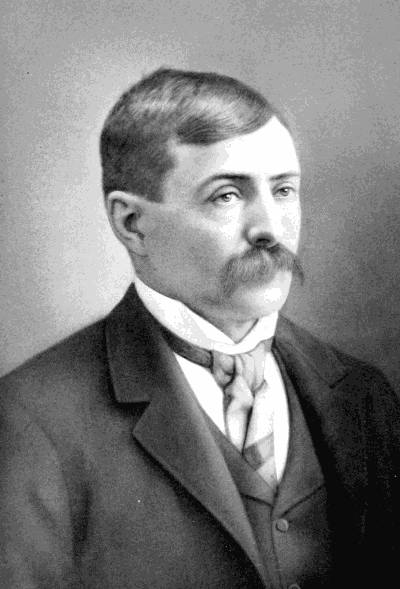
EUGENE F. BOURGEOIS
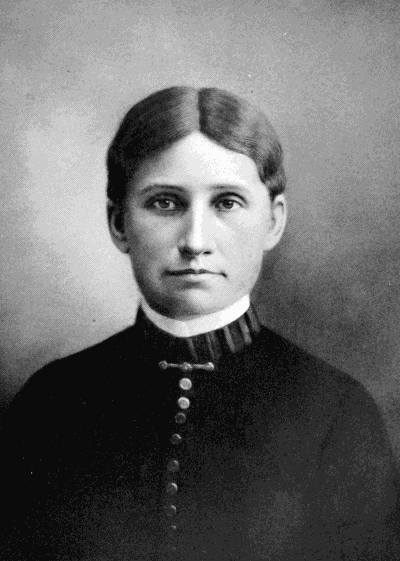
MRS. EUGENE F. BOURGEOIS
Mr. Bourgeois gives political allegiance to the republican party and has furthered the interests of education as a member of the school board. His religious faith is indicated by his membership in the Christian church. He has justly won the proud American title of a self-made man, for he came to this state empty-handed and has worked his way upward to a position among the substantial and representative citizens of his county.
JOHN REITH, M. D.
Well equipped by thorough preparatory training, Dr. John Reith entered upon a successful career as a physician and surgeon and is now prominently known as the superintendent of the Walla Walla Sanitarium, the Seventh Day Adventist institution of this city. He was born in Huron county, Ontario, September 10, 1883, a son of John and Jane (Moir) Reith, the former a native of Ontario, while the latter was born in Ireland. The father has devoted his entire life to agricultural pursuits. He removed to British Columbia in 1892 and now resides in Lacombe, Alberta.
Dr. Reith came to Walla Walla, Washington, in 1900. He had attended the schools of British Columbia, where he had accompanied his parents on their removal during his childhood days. He was therefore reared on the western frontier. Becoming imbued with a desire to enter upon a professional career, he became a student in the Walla Walla College, which he attended for six years, and in 1907 he entered the medical department of the University of Oregon at Portland and there won his professional degree as a member of the class of 1911. He afterward served for a year as interne in the Good Samaritan Hospital of that city and while thus engaged gained the broad and valuable experience which can be secured in no other way as rapidly and as accurately as in hospital practice. In March, 1912, he was made superintendent of the Walla Walla Sanitarium, over which he has since presided. He has held to the highest standards in its management and conduct and has made it largely an ideal institution.
On the 14th of August, 1907, Dr. Reith was married to Miss Grace M. Wood, a native daughter of Walla Walla county, her father having been one of the early pioneers of this section of the state. He arrived about 1856, when the Indians were still numerous throughout Washington and when the work of progress and development was scarcely begun. He brought into Walla Walla county the first harvester ever seen here and he was closely associated with many initial movements which have resulted in the upbuilding and benefit of the county. His wife was a singer of considerable note and she was also the first teacher of music in Whitman College; likewise in St. Paul's and in Walla Walla College. She brought into this county the first organ ever within its borders. To Dr. and Mrs. Reith have been born two children, Margaret Isabel and Mabel Elizabeth.
Dr. and Mrs. Reith are members of the Seventh Day Adventist church and guide their lives according to its teachings. The Doctor is a member of the Washington State Medical Society and the American Medical Association and through his connections with those organizations keeps in close touch with the trend of modern scientific thought, research and investigation. He has developed pronounced ability in the line of his profession, is very careful in the diagnosis of his cases and accurate in his judgment. In his hospital work he has developed a splendid institution, one in which the most thorough care is given to patients, and the success which has attended the work secures to it a continued patronage.
MAJOR PAUL H. WEYRAUCH.
Major Paul H. Weyrauch, for many years connected with the United States regular army, a veteran of the Spanish-American war and now major of the Washington Field Artillery in the United States service, is a valued resident of Walla Walla, where his business connection is that of president of the Blalock Fruit & Produce Company. He was born in Barmen, Germany, April 4, 1873, a son of Ernest and Johanna (Piper) Weyrauch. The father died in Germany in 1886 and in 1889 the mother came with her family to the United States, two of her elder sons having preceded her to this country. With her younger children she settled in the state of New York, where she resided to the time of her death, which occurred in January, 1917.
Major Weyrauch was a youth of sixteen years at the time he accompanied his mother to the new world. He was educated in the public schools and in preparatory schools of his native country, and after crossing the Atlantic he worked for his brothers, who were engaged in silk ribbon manufacturing in the Empire state. After spending two years in that way he went to New York city, where for some time, through the financial panic of 1893, he was employed at whatever he could get to do that would yield an honest living. However, he was possessed of a good education and marked enterprise and subsequently secured a position as shipping clerk and bookkeeper in a silk factory at College Point, Long Island. He continued to act in that capacity until 1895, when he entered the service of his adopted country as a member of the regular army. He was first stationed at College Point and while there saw much of the army engineers stationed at Willets Point, about three miles from College Point. He became impressed with this branch of the service, and with the hope of later securing a commission, he joined the service and was assigned to the First Artillery at Davids Island, New York, there remaining for almost two years. He then went with his command to Key West, Florida. While at Davids Island he had endeavored to be transferred to the hospital corps, where there was greater opportunity for advancement, but his commanding officer did not want to let him go and his transfer did not occur until after he had reached Key West. In May, 1897, however, he became a member of the hospital corps and on the night of the blowing up of the Maine, February 15, 1898, he was sent to Havana, Cuba, with Major Paul Clendemin to assist the Maine survivors, being the first enlisted man to be sent to Cuba after the destruction of the battleship. In April, 1898, he was made hospital steward and served as such at Key West Barracks, Florida, at Fort Jefferson on the island of Dry Tortugas, at Washington Barracks in Washington, D. C., at Fort Monroe, Virginia, at Hilton Head, South Carolina, and at Fort Screven on Tybee Island in Georgia, thus continuing until August, 1899, when he was transferred to the Twenty-eighth United States Volunteer Infantry as hospital steward and served with that regiment in San Francisco, California, and in numerous places in the Philippine Islands. He took part in various engagements in the Orient and in February, 1901, he took the examination for a commission, General Pershing, now commanding the American forces in France, being then president of the examining board. Major Weyrauch was commissioned a second lieutenant of cavalry to date from February 2, 1901, and was assigned to duty with the Fourteenth Cavalry Regiment, with which he served at Fort Huachuca, Arizona, and also in the Philippine Islands, while in December, 1905, he came to Fort Walla Walla with his regiment. While in the Philippines he took part in several campaigns against the Moros under General Leonard Wood.
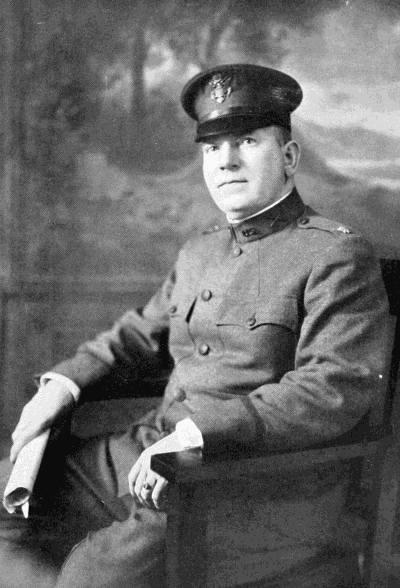
MAJOR PAUL H. WEYRAUCH
Following his return to the United States, Lieutenant Weyrauch was assigned to duty as quartermaster at Boise Barracks in Boise, Idaho, and later was detailed to the Army School of the line at Fort Leavenworth, Kansas. He returned to Fort Walla Walla in the fall of 1906 and was retired from active service on the 1st of March, 1907, at which time he again entered civil life.
On the 11th of February, 1907, Major Weyrauch was united in marriage to Miss Edith Moffatt, a daughter of Mrs. Edith G. Moffatt, widow of Lieutenant William P. Moffatt. The father of Mrs. Edith G. Moffatt was the son of the old pioneer, James P. Goodhue, who was among the first, if not the first, settlers of the Walla Walla valley. To Major and Mrs. Weyrauch have been born two children, Paul Russell and Mary Jane.
Soon after his retirement from the army Major Weyrauch served as assistant engineer of the city of Walla Walla for a short time and on the 11th of April, 1907, he became connected with the Blalock Fruit Company, with which he filled various positions, his first position being that of bookkeeper. He was later assistant secretary, also assistant manager, and in April, 1910, became general manager of the company, in which position he still continues. On the 1st of January, 1916, he organized the Blalock Fruit & Produce Company, of which he is the president. This company is a shipping concern and handles the entire output of the Blalock orchards and also that of adjacent tracts. This organization is also a factor in the marketing of all the fruits and vegetables grown in the valley and the business, under the guidance of Major Weyrauch, has been very profitably conducted from the beginning.
Aside from his connection with interests of a personal character Major Weyrauch has figured prominently in promoting interests that have to do with the material upbuilding and prosperity of the community. In April, 1913, he was elected a member of the board of trustees of the Walla Walla Commercial Club and he served as president of the club from April, 1914, until April, 1916. He was also instrumental in organizing the Fruit Growers' Agency, Incorporated, was elected its first president and has done much to further the interests of the organization, which is composed of growers' and shippers' organizations in the states of Washington, Oregon, Idaho and Montana, and is fostered by the bureau of markets of the Department of Agriculture. He was reelected president in April, 1917, and is still serving in that capacity. He has been a director of the National Apple Show held in Spokane since 1913. Fraternally Major Weyrauch is a prominent Mason, belonging to Walla Walla Lodge, No. 7, F. & A. M.; Walla Walla Chapter, R. A. M.; Walla Walla Commandery, K. T.; Spokane Consistory, A. & A. S. R.; and El Katif Temple, A. A. O. N. M. S., of Spokane. He likewise belongs to Walla Walla Lodge, No. 287, B. P. O. E., and is a member of the Spanish War Veterans, belonging to General Lawton Camp No. 7, of which he is a past commander. His interest in military affairs has never ceased. In February, 1910, he organized Company K of the Second Infantry Regiment of the Washington National Guard and commanded the company until January 1, 1911, when he was appointed quartermaster of the Second Infantry and thus served until July, 1912, when it became necessary to resign owing to his increasing business interests, which were making constantly greater and greater demand upon his time and attention. But there came a day when he felt that military duty was paramount to all else and in July, 1917, he organized the First Battalion of the Washington Field Artillery and on the 9th of July was commissioned major. The battalion was mustered into the federal service September 30, 1917, and on the 9th of October left Walla Walla for Camp Green, North Carolina, where they remained until October 25th. They then proceeded to an Atlantic seaport and sailed for France, December 24th, arriving there safely January 9, 1918. Major Weyrauch has faithfully served his adopted land in military capacities for many years—a splendid example of the loyalty expressed by many men of German birth who recognize their obligations to the country under whose laws they have found protection and by whose privileges and opportunities they have benefited, while in return they render the utmost allegiance and loyalty.
OSCAR E. GRANT.
Oscar E. Grant, who is extensively and successfully engaged in farming in Walla Walla county, near Prescott, was born January 23, 1870, and is a native son of the state of Washington. His parents were Jonathan and Elizabeth Grant, the former a native of Indiana, whence he removed westward and established his home in Walla Walla county, Washington, at a very early day. Here he passed away, while his widow, who was also born in Indiana, is still living.
Oscar E. Grant spent the days of his boyhood and youth in Walla Walla county, as he has the period of his manhood. He was early trained to the active work of the farm upon his father's place and devoted the summer months to the tasks of plowing, planting and harvesting but in the winter seasons attended the public schools. He has never sought to change his occupation but has found in agriculture a vocation thoroughly congenial and one which has proven highly profitable to him. He now owns eight hundred acres of fine wheat land in this section of the state, together with some pasture land. His fields are thoroughly cultivated and his progressive methods produce substantial results.
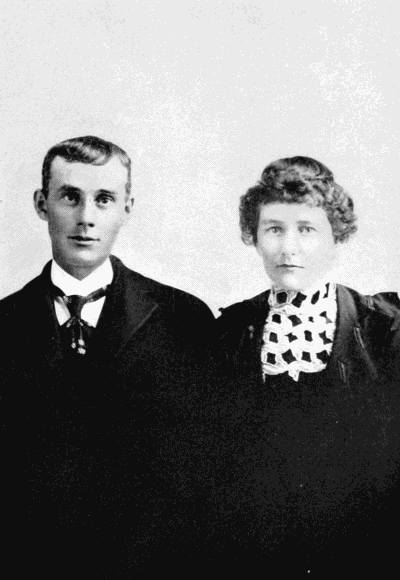
MR. AND MRS. OSCAR E. GRANT
On October 30, 1895, Mr. Grant was united in marriage to Miss Mary E. Pettijohn, whose parents are mentioned elsewhere in this work. To Mr. and Mrs. Grant have been born three children, Mark H., Samuel O. and Elda M., all at home. For forty-eight years or since his birth, Mr. Grant has been a resident of this section of the state, so that he is largely familiar with its history and with the events which figure most prominently in its annals. He has seen its broad lands claimed and cultivated. In the days of his youth there was much open range and stock raising was an important feature of business life in this section. Today all of the land is owned individually and the work of improvement has transformed the tracts largely into productive fields devoted to grain raising. He has borne his part in this result and is today one of the progressive farmers in the vicinity of Prescott.
JAMES M. CORNWELL.
James M. Cornwell, a pioneer of Walla Walla county, was a man of such inherent strength of character that the position of leader was accorded him by his fellows without his seeking prominence. The determination which throughout life was one of his most salient characteristics was never more clearly shown than during the months when he worked his way with wagon teams across the plains to the west and especially when, having left the train, he and his brother walked the distance of three hundred miles from Fort Boise, Idaho, to The Dalles, Oregon, over a country unknown to them, fighting the exhaustion and discouragement of starvation.
His birth occurred in Orleans, Orange county, Indiana, August 7, 1834, and his education was that usually received by farm boys in those early days. His father, Payton Cornwell, who was a native of Kentucky, in 1839 removed with his family from Indiana to Edgar county, Illinois, and there the mother died when our subject was but nine years old. At that time the family was broken up and the eight sons found homes among strangers. In 1852 James M. Cornwell, at the age of seventeen years, with an older brother, Francis M., aged nineteen years, started on foot from Iowa for the Pacific coast with a capital of only five dollars between them. On arriving at a town on the Mississippi river James M. Cornwell worked as a teamster for an emigrant, who in turn was to furnish him with food until they reached St. Joseph, Missouri. In addition to this the brother was permitted to put his little bundle of clothing in the wagon. All that was left of the five dollars was spent for crackers to eat along the journey and at St. Joseph both of the brothers found employment as teamsters with a train bound for Oregon. According to agreement they were to receive their food on the trip but in addition to acting as teamsters were to continue in the service of their employer for one month after reaching the coast. This train was made up of professional men and their families and when they reached Fort Boise, Idaho, late in the season after a six months' journey, they found themselves short of rations. Fearing starvation, the owners of the teams proposed to the teamsters that the latter leave the train and go on ahead and take care of themselves as best they could. Eight of the teamsters, including the two Cornwell brothers, agreed to this plan and left Fort Boise on foot with three days' rations and started for The Dalles, Oregon, three hundred miles distant, which was the nearest point where there was any certainty of obtaining food. It was a desperate chance to take, but it seemed the best under the circumstances and they hoped that somewhere along the way they could find food. As the days passed their scanty store was used up, although they made it last as long as possible and as they came down the west slope of the Blue mountains to Meacham's creek they were almost famished. There they came upon an emigrant camped near the water and found that he, too, had met with misfortune. His family one by one had died and been buried along the trail, his cattle were worn out and could go no farther, and his food supply was exhausted. In order to sustain life he killed one of the almost starved oxen and hospitably fed the party of eight teamsters. After leaving this man the party of eight resumed their journey, one-half of which still lay before them. On reaching Alkali Flats one of the men lay down exhausted and the others went on, for there was no alternative. The only hope of any surviving was to press forward as rapidly as possible. One by one the men gave up and lay down exhausted until only the two brothers were left. These two journeyed hand in hand, each assisting the other as now one and then the other staggered and seemed about to fall. On reaching John Day ford they came across an Indian who had a fish weighing about a pound, for which James gave him a shirt and was glad to make the exchange. From that point on the journey was a nightmare and at length they lost hope and the older brother proposed that they, too, lie down and give up the struggle. Still they staggered on, their weakness causing them to sway as if drunk. Suddenly James saw a light and, renewing their efforts, they at length managed to reach it and there found an emigrant with the surviving members of his party encamped in a nook somewhat sheltered from the wind. However, there was little hope to be obtained here, for the family had been living on corn meal gruel for days and had so little that they could spare none. However, they gave the brothers a quilt and allowed them to sleep on some boxes in the wagon. Even so, the cold of that October night chilled them and James became delirious, but in the morning he was able to again resume the weary way westward. After they had gone some distance they met an Indian with a rotten fish on the banks of the Columbia and James traded a knife for the fish, which the brothers ate in spite of its decayed condition. When they reached the Deschutes river they gave an old pistol as pay for being ferried across the stream and on reaching the other bank, to their great surprise and joy, were overtaken by six of their comrades whom they supposed to be lying dead on the Alkali flats. Somewhat heartened by this reunion, they continued their journey and at length reached The Dalles. James Cornwell was chosen by the party to go to the commissioners stationed there by the people of Oregon for the purpose of relieving destitute emigrants, but on asking for provisions he was told that food was scarce and rations could be given only to widows or orphans of men who had perished on the way across the plains. However, at length he succeeded in getting two pounds of flour, which was made into bread by a kind emigrant woman. Strengthened by this food, they continued their journey westward and at length reached the Willamette valley.
The Cornwell brothers engaged in hunting during the first winter in Oregon and the following summer James farmed land on shares, but it was almost impossible to find a market and the autumn found him with as little money as when he reached Oregon. He then took up a ranch in the timber nine miles southwest of Portland and resided there until 1861. His brother, Francis M., who had accompanied him on their terrible journey to the west, lost his health partly as the result of the hardships endured during those six months and at length settled near our subject and passed away in February, 1858. Mr. Cornwell of this review remained upon his homestead in Oregon until 1861, when he sold that property and went to work in the Oro Fino mines, where he spent the greater part of the summer. During that time he filed on a ranch near Dry creek, six miles north of Walla Walla, Washington, and in the fall he came by wagon with his father-in-law to his claim in Walla Walla county. That winter was the hardest and longest in this part of the state and all his cattle starved to death. Although he was thus compelled to again start with nothing, he was confident that in time he would win success. He brought his family to Washington and during the summer of 1862 operated a farm on shares. As he was dissatisfied with the tract of land which he had taken up he sold it and bought a portion of the T. P. Denny ranch on Dry creek, which, however, he subsequently disposed of. In 1868 he purchased the Kimball farm of one hundred and twenty acres on upper Dry creek, nine miles northeast of Walla Walla, and for a long period there made his home. He harvested good crops and so managed his business affairs that he received a good income from his labors and, recognizing the fact that land would increase in value, he systematically invested his capital in farm property, becoming at length the owner of twelve hundred acres of wheat land and one hundred and sixty acres of timber land.
Mr. Cornwell was married March 16, 1857, to Miss Mary Tucker, who died on the 25th of April, 1858. On the 20th of October, 1859, Mr. Cornwell was united in marriage to Miss Mary A. Stott and they became the parents of the following children: Laura, the wife of C. S. Robinson, of Walla Walla; Oliver T., whose sketch appears elsewhere in this work; Charles E., a resident of Tacoma; Nannie E., the wife of A. M. Cation, of Walla Walla; Arthur G., also of Walla Walla; Minnie E., the wife of Albert Cheney, of Trout Lake, Washington; and Raleigh, who died when about sixteen years of age. The mother of these children passed away in June, 1893, and Mr. Cornwell died in Walla Walla about 1898.
Mr. Cornwell was a staunch advocate of republican principles and served in the territorial legislature as a joint representative from Walla Walla and Whitman counties. His ability won recognition in that body and he was acknowledged to be one of its most valued members. Whether the matter in hand was some question relating to the management of his large farm properties or some problem of government he was always quick to distinguish between the essential and the non-essential factors in a situation and resourceful and sound of judgment in advising a course of action. The same spirit of dogged perseverance that led him as a boy of seventeen to refuse to admit defeat and lie down to die when it seemed humanly impossible to continue further on the way to Oregon was manifest throughout his entire life and that which he undertook was successfully accomplished.
JOHN P. ANDERSON.
John P. Anderson is one of the worthy citizens that Sweden has furnished to the new world and although he came to this country in limited circumstances, he is today one of the well-to-do ranchmen of Walla Walla county, owning a valuable tract of three thousand acres. He was born in Sweden on the 15th of July, 1853, and is a son of Andrew Bengston and Bula Johnson, who spent their entire lives in that country. In their family were seven children, four of whom are still living—one in Sweden and the others in America.
John P. Anderson passed his boyhood and youth in his native land, where he pursued his education in the public schools. Believing that better opportunities were afforded young men on this side of the Atlantic, he came to the United States in 1872 and after spending three years in Illinois proceeded westward to Washington. Locating near Walla Walla, he was in the employ of others for two years and then took up a homestead, where he has since spent the most of his time. As the years have gone by he has steadily prospered in his farming operations and has added to his property until he now owns three thousand acres of land, all improved, and he also has a beautiful home in Walla Walla surrounded by eight acres of ground, on which he raises all kinds of fruit.
In early manhood Mr. Anderson married Miss Anna Gamberg, also a native of Sweden, and to them were born nine children, of whom Arthur and Mabel are deceased. Those living are Victor, who is now on the ranch; Bessie, at home, and Melvin, Carl, Bengt, Otto and Alice, all in school. The wife and mother passed away November 15, 1916, leaving many friends as well as her immediate family to mourn her loss, and her remains were interred in Mountain View cemetery. She was an earnest member of the Christian church, to which Mr. Anderson also belongs, and in politics he is a staunchrepublican but has never been an office seeker. He is one of the self-made men of the community, his success in life being due to his own energy, enterprise and good business ability.
ALONZO L. SANFORD.
Among the citizens of Columbia county who have attained success in their chosen calling and are now able to lay aside all business cares and enjoy the fruits of former labor is Alonzo L. Sanford, who for many years engaged in agricultural pursuits but is spending the sunset of life in ease and retirement. He was born in Clark county, Illinois, on the 2d of November, 1845, and is a son of Peleg and Malinda (Greenleaf) Sanford, natives of New York state, whence they removed to Illinois in 1832. There the father bought a tract of government land at one dollar and a quarter per acre and built thereon a log cabin, in which the family lived for several years. Throughout the remainder of his life he continued to operate his farm and there his death occurred. His widow subsequently came to Walla Walla, Washington, and here she passed away. In their family were five sons, of whom three are still living.
Alonzo L. Sanford spent the first nine years of his life in the state of his nativity and then removed with the family to Iowa, where he was principally reared and educated, pursuing his studies in a little log school house. In 1864, when nineteen years of age, he enlisted in Company D, Tenth Iowa Infantry, for service in the Civil war, and remained at the front until hostilities ceased. He was with General Sherman on his famous march to the sea and participated in the battle of Bentonville. The war having ended he was mustered out at Little Rock, Arkansas, and honorably discharged at Davenport, Iowa, after which he returned home and resumed farming. In 1871 Mr. Sanford removed from Iowa to Washington and took up a claim of one hundred and sixty acres of land northeast of Dayton in Walla Walla county. After living there for four years, he sold his farm and bought another near Covello in what is now Columbia county, where he carried on farming for some years. On disposing of that place he removed to Covello, where he has since lived retired, surrounded by all the comforts and many of the luxuries of life. Besides his nice residence he owns some lots in the village and is one of the well-to-do citizens of the community.
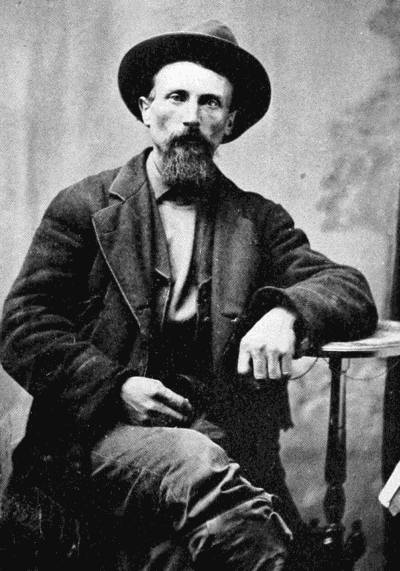
ALONZO L. SANFORD
In 1881 Mr. Sanford married Miss Alice McBride, a native of Iowa, and they have become the parents of seven children, as follows: W. G., now a resident of Dayton, Washington; Bertrand; Christopher; Pearl, the wife of Jesse Carleton; Bryan; Estella, the wife of Robert Smith; and Elton, at home.
Politically Mr. Sanford is a staunch democrat and for two years he acceptably served as assessor of Columbia county. He has also been a member of the school board and as a public-spirited and progressive citizen he has done much to promote the interests of his community. Wherever known he is held in high esteem and he well merits the confidence reposed in him.
WILFORD H. GROSS.
Wilford H. Gross is actively identified with agricultural interests, although making his home in the city of Walla Walla. He possesses the strong and sturdy characteristics that have dominated the west and have constituted the foundation upon which has been built its upbuilding and progress. His entire life has been passed in the Pacific coast country. He was born in Modoc county, California, on the 17th of January, 1874, his parents being Bailey H. and Julia A. (Rice) Gross, the former a native of Illinois, while the latter was born in Ohio. They were married in the year 1862 and soon afterward crossed the plains with ox teams to Nevada, where the father engaged in the dairy business and in freighting near Virginia City. He spent ten years in that way in Nevada, after which he continued his westward journey to California and located in Modoc county, where he conducted a dairy and stock farm. He concentrated his efforts and attention upon that business for a decade and in 1880 removed from California to Walla Walla county, Washington. Here he purchased a quit claim deed to a homestead and to a timber claim situated in township 8, range 36 east, about eleven miles northeast of Walla Walla. In subsequent years, as his financial resources increased, he bought more land from time to time and became the owner of thirteen hundred and twenty acres, which he held at the time of his demise in March, 1915. His life record should serve to inspire and encourage others, showing what may be accomplished when there is a will to dare and to do. He had no assistance but earnest effort promoted his advancement and the sure rewards of labor came to him in the course of years. His political endorsement was given to the republican party.
Wilford H. Gross was educated in the Valley Grove school and in the public schools of Waitsburg, supplemented by a course in the Waitsburg Academy and by a commercial course in the Walla Walla Business College. When about twenty-two years of age he bought one hundred and sixty acres of land and began farming on his own account. He has since been identified with general agricultural pursuits and is now the owner of three hundred and twenty acres in township 8 north, range 36 east, and also one hundred and sixty acres near Eureka. He also cultivates land belonging to his brothers and a sister, thus utilizing in all ten hundred and forty acres. He is numbered among the extensive wheat growers of this section of the state and his business affairs are carefully and successfully conducted. His energy knows no bounds and his indefatigable effort has produced splendid results. He has made a close study of soil and climatic conditions and is thoroughly familiar with the best methods of wheat growing in the northwest, so that he annually produces splendid crops.
On the 21st of October, 1903, Mr. Gross was united in marriage to Miss Grace M. Houghton, of Cowlitz county, Washington, who was a teacher in the old Seeber school at the time of her marriage. They now have three children, namely: Dorothy, Charles and Houghton. Mrs. Gross is a daughter of Henry and Sarah A. (Gardner) Houghton. Her mother located near Woodland, Washington, in 1851 and in 1867 she married Henry Houghton, who followed farming in Clarke county, on the Lewis river, where he still maintains his home. Mrs. Houghton passed away October 9, 1908. The Gardners were among the earliest settlers of Clarke county, crossing the plains and enduring all the hardships of pioneer life.
In politics Mr. Gross maintains an independent course. Fraternally he is connected with the Ancient Order of United Workmen, while the religious faith of himself and his wife is indicated in their membership in the Christian church. About ten years ago they took up their abode in the city of Walla Walla, where they make their home and from that point Mr. Gross has supervised his farming interests, which are wisely and carefully controlled.
JEROME L. KEISER.
Jerome L. Keiser is now practically living retired in Waitsburg, although for many years he was prominently identified with building operations and with mercantile pursuits in the city where he still makes his home. He is a representative of one of the oldest pioneer families of the northwest. He was born in Portland, Oregon, on the 12th of July, 1850, when that beautiful city of roses was a hamlet, containing only a few cabins on the banks of the Willamette. His parents were William M. and Roxcia (Ingalls) Keiser. The father was a native of Rensselaer county, New York, born October 7, 1827, while the mother was a native of Hamilton county, Ohio, the date of her birth being May 22, 1828. They were married in Pittsfield, Pike county, Illinois, on the 4th of April, 1849, and on the 10th of that month they began their journey across the plains with an ox team for the California gold fields. They arrived in Oregon City, Oregon, on the 18th of September, having traveled for thousands of miles across the hot stretches of sandy desert and over the mountain passes. In the same wagon train with them came a married sister and her husband, a married brother and his wife and two single brothers of Mrs. Keiser. It was a wedding trip for Mr. and Mrs. Keiser and also for her brother and wife, but it lacked many of the joyous features and comforts that are supposed to attend wedding trips. From the time they left Missouri they passed only a few forts but did not otherwise see a human habitation until after they had crossed the Cascade mountains, where they approached a settlement and heard the chickens crowing. With thoughts of mother and friends back home Mrs. Keiser sat down and had a good cry. On reaching Oregon City they decided to go into camp and spend a little time there. There had been talk of a city being built on the present site of Portland, which at that time, however, was occupied only by a little store building built of shingles and a few shacks. In fact they thought that Oregon City would be a much more progressive place and occupied a much more favorable location than Portland. However, Mr. Keiser purchased a lot on the site of Portland and built a frame shack. Liking the country, they determined to abandon their California trip and live in Oregon. They resided in Portland until the spring of 1852, by which time the town had expanded to a little village of about two streets situated along the water front. They then went up into Clackamas county, where Mr. Keiser took up a donation claim on which they resided for twenty years and in the meantime although they experienced all the privations and hardships of pioneer life, the work of improving and developing the farm was continued and their land was transformed into rich and productive fields from which they annually gathered good harvests. In 1872, however, they came to Walla Walla county, Washington, and settled in Spring valley, where Mr. Keiser purchased a small farm near a schoolhouse. There he settled down to agricultural life and devoted five years to the development of his farm property, at the end of which time his life's labors were terminated by death. Mrs. Keiser continued to reside upon the farm until 1877, when she removed to Waitsburg, where she has since made her home. She yet owns the old homestead farm, however, comprising two hundred and eighty acres, some of which was purchased by her after her husband's death. In 1851 the first Masonic lodge was organized in Oregon, this being at Portland, where meetings were held in a shack, and Mrs. Keiser, lovingly called Aunt Roxcia by her many friends, was called upon to make the Masonic aprons, as she was a fine seamstress and her brother-in-law, J. B. V. Butler, being one of the prominent members of that organization. She also made some of the wedding clothes for Dr. D. S. Baker, one of the pioneers of this region, whose sketch appears elsewhere in this work. To Mr. and Mrs. Keiser were born six children of whom three are yet living, Jerome L., Millard H. and Frank T., all residents of Waitsburg.
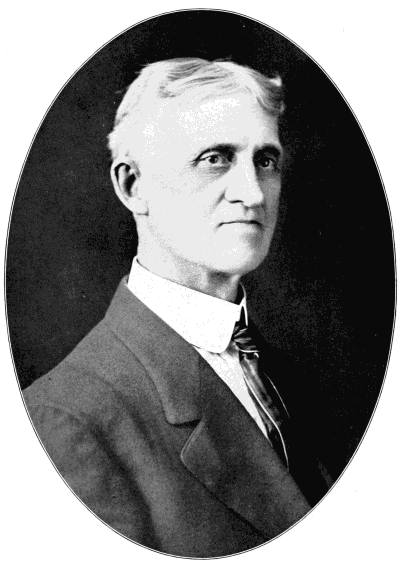
JEROME L. KEISER
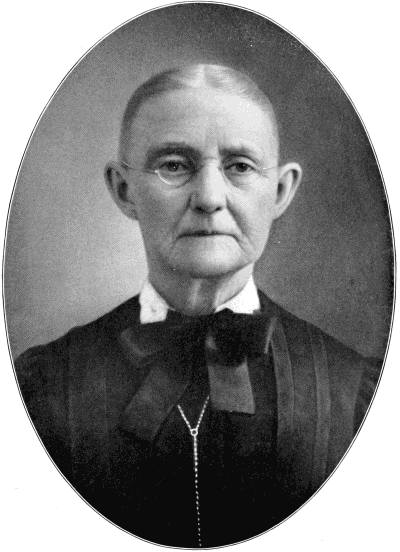
MRS. WILLIAM M. KEISER
Jerome L. Keiser, whose name introduces this review, was reared amid the conditions and environments of pioneer life and has for sixty-seven years been a witness of the growth and development of the northwest. He was educated in the district schools of Clackamas county, Oregon, and in early manhood began learning the carpenter's trade, which he has followed for many years. He was closely identified with that business until 1906, when he established a furniture and undertaking establishment in Waitsburg and was thus connected with the commercial interests of the town for six years. He then disposed of that business and has since worked at his trade when he so desired, although he has practically lived retired. Indolence and idleness, however, are utterly foreign to his nature and at times he cannot resist again taking up the tools and doing some work along the line of trade in which he embarked in early manhood. The success, however, which attended him has obviated the necessity of continued work, for he is now in the possession of a handsome competence that supplies him with all of the comforts and some of the luxuries of life.
In his political views Mr. Keiser is a democrat, having supported the party since attaining his majority. For several years he served on the school board and the cause of education has found in him a stalwart champion. He is a member of Touchet Lodge, No. 5, I. O. O. F., and he has a twenty-five year gold medal, indicating connection with the organization for a quarter of a century. He also belongs to Coppie Encampment, No. 73, I. O. O. F., and he has membership with the United Artisans. He is a member of the board of trustees of the Old Ladies' Home at Walla Walla. His religious faith is indicated by his membership in the Christian church and his belief has actuated him in all of life's relations, making his an honorable course and one which has ever commended him to the confidence, good will and high regard of those with whom he has been associated.
THOMAS DURRY.
In the days when Walla Walla county was famous throughout the west as a stock country Thomas Durry was a leader among the cattle and sheep men of this section. He was born in Williamstown, Glengarry county, Canada, April 20, 1849, a son of John and Isabelle Durry, also natives of the Dominion and descendants of Irish and Scotch ancestry.
Thomas Durry was reared in Williamstown and there received his education, but in 1868 he left home and made his way to California, where he remained for three years. In 1871, in company with his mother and two sisters, Mary and Isabelle, who had joined him in the meantime, he came north to Washington territory, locating in Walla Walla county. He formed a partnership with his brother-in-law, D. McGillivray, and they turned their attention to the stock business, acquiring a ranch near Ritzville. They were there extensively engaged in stock raising for about a quarter of a century and at the end of that time by mutual consent they dissolved their partnership and Mr. Durry continued in business alone until 1903, when he retired from ranching and took up his abode in Walla Walla. He erected a handsome residence at the corner of Birch and Palouse streets and his last days were spent in well earned leisure in the enjoyment of the comforts and luxuries of life. Although during his active career he had extensive herds of cattle, his chief interest was in sheep raising and he was one of the best authorities on everything pertaining to that industry in the northwest. For several years he served as sheep commissioner for the Walla Walla district. On removing to the city he sold his stock ranch, comprising five thousand acres, but retained his extensive holdings in wheat lands, which properties are now owned by his widow.
It was in 1886 that Mr. Durry was united in marriage to Miss Alicia Lane Thomas, a daughter of Mr. and Mrs. George Thomas, of Walla Walla. To this union were born two children, Homer and Marie.
Mr. Durry held membership in the Benevolent Protective Order of Elks and in religious faith was a Roman Catholic. He always rather shunned publicity and his manner was at all times that of the unassuming gentleman, though all who came in contact with him recognized the quiet force of his personality, the keen business insight and ready grasp of the salient points of a situation that enabled him to successfully manage his large interests and the ability to judge men correctly which was such a large factor in his success. He passed away July 7, 1905, and his demise was deeply mourned by his many warm friends. Mrs. Durry is personally looking after her extensive business interests and has proven herself a woman of unusual executive ability and knowledge of business methods and conditions. She also possesses a very attractive personality and is held in the warmest regard by those who know her intimately. In religious faith she is a Catholic.
SHERMAN PETTYJOHN.
Sherman Pettyjohn, a retired farmer of Walla Walla county, has spent his entire life in the county, his birth having here occurred November 10, 1865. He is a son of Jonathan and Hannah (Warner) Pettyjohn, an account of whose lives appears in the sketch of their son, John Pettyjohn.
Sherman Pettyjohn became familiar with all the conditions of pioneer life in his boyhood and youth, as at that time this county was but thinly settled. The district schools afforded him his educational opportunities and he early began assisting his father with the farm work, taking on more and more responsibility as he grew older. On attaining his majority he took up a homestead and at once began the task of developing it. His labors were rewarded by abundant crops, and as the years passed he acquired more and more land, until he now owns eleven hundred and twenty acres, all of which is wheat land and is under a high state of cultivation. The improvements upon his holdings are modern and substantial and the value of his properties reaches a large figure. He raises both wheat and stock and is convinced that such a course is more profitable than confining one's attention to either business exclusively.
In 1892 Mr. Pettyjohn was married to Miss Mabel M. Smith, also a native of Walla Walla county, and a daughter of Sergeant J. C. and Amanda (Sheets) Smith, natives respectively of New Jersey and of Illinois. In 1848 Mr. Smith came west to California by way of Cape Horn and Mrs. Smith crossed the plains by ox team with her family in 1859 and located in Walla Walla county, Washington, where both her parents passed away. To Mr. and Mrs. Pettyjohn have been born two children: Hester S., who is the wife of Howard Holliday, is a graduate of the University of Idaho and for a number of years before her marriage engaged in teaching; and Margaret, a graduate of the Walla Walla high school and now engaged in the study of music at Whitman College.
Mr. Pettyjohn is a stanch republican and has served capably as a member of the school board. He belongs to the Farmers Union, which has as its object the promotion of the interests of agriculturists, and both he and his wife attend the Presbyterian church, whose teachings they follow in their daily lives. They are now living retired in Walla Walla, where they own an attractive residence at No. 530 Division street. In managing his farming interests Mr. Pettyjohn not only gained financial independence for himself but also aided in the agricultural development of the county.
CYRUS T. NELSON.
Cyrus T. Nelson, a resident farmer of Valley Grove, first came to Walla Walla county in 1861. His life experiences cover a long period of mining in Idaho, but since 1888 he has resided continuously at his present place of residence, which is one of the finest farms in the valley. While he ranks with the leading agriculturists of this section of the state, he has also been prominent in public affairs and has been called upon to represent his district in the state legislature. He was born in Ohio, August 9, 1839, his parents being William and Rebecca (Stands) Nelson, both of whom were natives of Pennsylvania. Removing westward, they became residents of Ohio at an early period in the development of that state and there built a log cabin, living in true pioneer style. Later they became residents of Indiana, where both the father and mother passed away. Only two of their ten children are now living.
Cyrus T. Nelson was reared and educated in Ohio and in 1859 started for California. He spent two years as a miner in that state and in 1861 he came to Walla Walla county, Washington, but in the fall of the same year proceeded onward to Idaho, where he engaged in mining until 1888. In that year he returned to Walla Walla county and took up his abode upon his present farm, which he had purchased in 1866. He has developed it into one of the finest farming properties of the valley, having here eight hundred and twenty acres of rich and productive land from which he annually gathers very substantial and gratifying harvests. His agricultural methods are indicative of the latest step along the line of progress in crop production, and in addition to his farm he owns a fine residence at No. 333 Whitman street in Walla Walla.
In 1873 Mr. Nelson was united in marriage to Miss Julia McInroe, who was a native of Wisconsin and by whom he had eight children, as follows: George; Lawrence F.; Cyrus M.; Carrie L., the wife of W. L. Talbert; Laura A., who gave her hand in marriage to L. V. Warner; Ruth, the wife of William C. Retzer; and two who are deceased. All those living are residents of Washington. The wife and mother passed away in 1905 and was laid to rest in Mountview cemetery, her death being the occasion of deep and widespread regret not only to her immediate family but to those many friends who had learned to esteem her highly because of her many sterling traits of character and her kindly spirit.
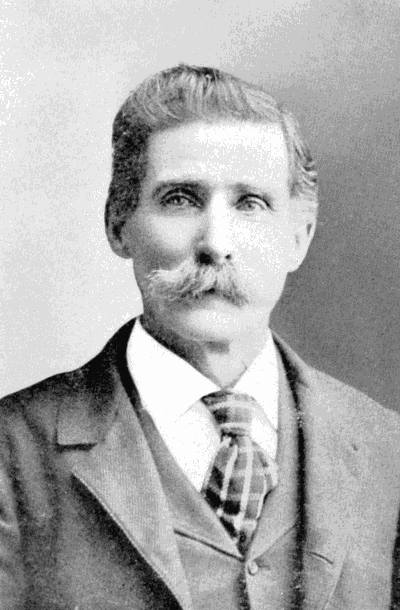
C. T. NELSON
In politics Mr. Nelson has long been an earnest republican, voting with the party since casting his first presidential ballot for Abraham Lincoln. He has served as county commissioner in Idaho and for one term was representative of his district in the Idaho state legislature. His public record, like his private life, is free from blame. His has been a useful, active and honorable career, guided by high principles. He has long been numbered among the honored residents of the northwest, where he has made his home for fifty-six years. There is no phase of the development of the northwest in its mining and agricultural interests with which he is not familiar and his broad experiences have caused him to look at life from a liberal standpoint, with sympathy for the frailties of men and respect for their sterling virtues.
LUTHER J. CAMPBELL.
Luther J. Campbell, superintendent of the Stubblefield Home at Walla Walla, has proved very efficient in that difficult position, displaying the rare combination of executive ability and marked kindness and patience. He was born in Monticello, Piatt county, Illinois, October 9, 1870, a son of George W. and Margaret R. (Gibson) Campbell, the former a native of Salina, Ohio, and the latter of Sangamon county, Illinois. They were married in Sangamon county as the father had located there in young manhood, and there he engaged in farming for many years. His death occurred in August, 1907, but the mother is still living and makes her home with a daughter in Springfield, Illinois.
Luther J. Campbell passed his boyhood and youth under the parental roof and after completing the course offered in the public schools became a student in the Central Normal College. In acquiring an education he displayed unusual persistency of purpose and great energy, for he worked his way through college, completing the four years' course on a capital of one hundred and eighty dollars which he earned. He boarded himself, living chiefly on graham mush sweetened with syrup, and in order to further decrease his expenses he did his own laundry work at night. Most young men would never consider for a moment undergoing such privations, but he realized the benefit of an education and determined to fit himself for something worth while. After his graduation with the class of 1892 with the degree of B. A., he took up the work of teaching and for sixteen years followed that profession. He then turned his attention to the land business and was also for some time advertising manager of the Farm Home. On resigning that position he and L. E. Frost founded the Berkshire World, a stock paper which is now published in Chicago. His residence in the northwest dates from 1910, when he removed to Hermiston, Oregon, where for fifteen months he devoted his time to the study of orchards and irrigation. In 1911 he removed to Walla Walla and during that winter was the principal of Bernie school. In 1911 he was appointed probation officer and served for fifteen months in that capacity and on the 1st of January, 1913, took charge of the Stubblefield Home, which was founded in pursuance of the terms of the will of the late Joseph L. Stubblefield, who left one hundred and fifteen thousand dollars for its establishment and maintenance. The institution is a home for aged and dependent widows and dependent children and since its establishment in 1902 has admirably served its purpose. It is under the direction of three trustees appointed by Mr. Stubblefield, namely C. M. Rader, E. A. Reser and F. M. Stubblefield. Mr. Campbell's knowledge of human nature and administrative skill gained through his years of teaching and in his work as probation officer admirably fit him for the discharge of his duties in the important position of superintendent of the home, and the friction so often found in such institutions is happily lacking.
On the 23d of May, 1893, Mr. Campbell was married to Miss Margaret J. Wallace, of Brazil, Indiana, and they have a daughter, Beryl C., the wife of V. O. McWhorter, who is in the government service at Dubois, Idaho.
Mr. Campbell is a stanch democrat and is commendably interested in public affairs, although not an aspirant for office. He belongs to Columbia Lodge, No. 8, K. P., and both he and his wife are members of the Methodist Episcopal church. In all the communities in which he has resided he has made a highly creditable place for himself, and all who have come in close contact with him hold him in warm regard.
JAMES EMANUEL BERRYMAN.
James Emanuel Berryman, deceased, was well known as an early settler and prosperous farmer of Walla Walla county. His birth occurred in England, May 18, 1834, and he was a son of Richard and Martha Berryman, who were also natives of England. In 1841 they came with their family to America and established their home in Wisconsin, where both passed away. In that state our subject received a limited education and there he remained until 1854. Desiring to seek for gold, he then went to the sea coast and took passage on a ship bound for California by way of the Horn. On the voyage the ship was wrecked and he had the misfortune to lose all of his possessions. For some years he remained in California, following mining, and then went to Australia, but after two years spent in the search for gold in that country he returned to California.
In 1861 Mr. Berryman came to Walla Walla county, Washington, which at that time was unsettled save for the fort, a saloon and a blacksmith shop; but the lure of the mines was still upon him and he went into the mountains of Idaho, making his way first to the Elk City mines and then to Florence, where he was one of the party that discovered the mines there. In 1862 he went back to Wisconsin for a visit and subsequently returned to England, where he was married. Not long afterward, in 1863, he brought his bride to America and located in Wisconsin, working in lead mines. The following year he made his way to Montana, in which state he was engaged in mining for some years. In 1869 he came again to Walla Walla county and this time took up his permanent residence here. He made his home in the city of Walla Walla for ten years and served as a member of the police force. He became the first street commissioner, moved houses, built bridges and did other such work. During this period, however, he again started out in search of gold, spending some time in the Powder River country, at Butte, Montana, and near Florence, Idaho. In 1878 he filed on a homestead and a timber claim in Walla Walla county and also bought railroad land. There were the usual hardships of the pioneer community to contend with, but he knew that such fertile soil and salubrious climate could not fail to attract settlers, and that in time land here would become highly valuable and the country the equal of the older east in all that pertains to civilization. He raised wheat and herds of cattle and horses, and from time to time he gave evidence of his faith in the country by investing in land. His widow now owns fifteen hundred and sixty acres of improved land, a quarter section of which is located on Dry creek. He built the first schoolhouse in his neighborhood and this is still known as the Berryman school.
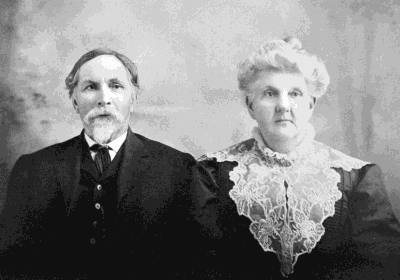
MR. AND MRS. JAMES E. BERRYMAN
Mr. Berryman was married in England, on the 16th of April, 1863, to Miss Mary Berryman, who although of the same name was not a relative. To them were born twelve children: Richard J., who is a property owner of Walla Walla county but lives in Portland, Oregon; Lilly, deceased; Desdemona, the wife of C. Hartman, of Thompson Falls, Montana; Mattie, the wife of William Falkner, of Walla Walla county; George W., Joe and William, all three of whom have passed away; Charles M., Ulrich A. and Paul S., who are operating the ranch; Amyitis; and one son who died in infancy. There are also fifteen grandchildren and five great-grandchildren.
Mr. Berryman was a stanch republican and was quite prominent in politics. He held membership in the First Methodist Episcopal church, to which his widow also belongs, and contributed liberally to its support. He passed away in April, 1911, and was laid to rest in the Mountain View cemetery. He was one of the leading men of his community, honored and respected both for his ability and his uncompromising integrity. Mrs. Berryman still resides in Walla Walla and the family is widely known and highly esteemed throughout the city and county.
HENRY G. MAUZEY, M. D.
For many years Dr. Henry G. Mauzey devoted his time and energies to the practice of medicine and surgery but is now living retired in the suburbs of Walla Walla. He was born in Missouri, June 14, 1848, the son of Judge Stark and Martha Fenning Mauzey, who were natives of Virginia and Indiana, respectively. About the year 1842 they removed to Missouri, and both the father and mother spent their remaining days in that state. They had a family of four children, of whom two are now living.
Dr. Henry G. Mauzey spent the days of his boyhood and youth in the state of Missouri and St. Louis and there acquired his public school education. He began the study of medicine under the direction of Dr. Isaac P. Vaughan, who was a Virginian and a surgeon in the United States army in the Mexican war. Later Henry G. Mauzey entered the McDowell Medical College of St. Louis and after one term became a student at the Bellevue Medical College of New York city and was graduated from that institution with the class of 1870. He obtained a commission in the Cuban army but instead went before the examining board of the United States army and was given a commission as acting assistant surgeon and ordered to the Pacific coast. He arrived in San Francisco in June, 1870, and after a short time was ordered to Fort Vancouver, Washington. He was on duty a short time at army headquarters in the city of Portland and from there was ordered to Alaska as a surgeon traveling with recruits. On February 19, 1873, he arrived in Walla Walla under orders to report and await the coming of the United States troops, who had been fighting Indians in northern California. He opened an office in the city of Walla Walla, where he remained as an active representative of the profession until 1890. In that year he removed to Spokane, where he continued in special work—eye and ear—for twenty-five years. Throughout the intervening years he kept in close touch with the advance thought and work of the profession. Broad reading kept him informed concerning the latest scientific researches and discoveries. In 1909 he again took up his abode in Walla Walla county, where he is now living retired, his home being situated about one and a half miles southeast of the city. In early days and for some years he was associated in practice with Dr. John E. Bingham of this city.
In April, 1875, Dr. Mauzey was united in marriage to Miss Frances I. Abbott, a native of Oregon and a daughter of John F. and Susan (Snyder) Abbott, the former a native of the state of New York and the latter of Ohio. The mother crossed the plains in 1845 with an uncle, the journey being made with ox teams after the primitive manner of travel in those days. She was married in Portland, Oregon, to Mr. Abbott and after a number of years' residence in Oregon, removal was made to Walla Walla, where Mr. Abbott passed away in 1896. Mrs. Abbott is still alive at the notable age of ninety-three years and is enjoying good health. Dr. and Mrs. Mauzey are the parents of two children, of whom one died in infancy. The younger, a daughter, Linda, became the wife of Major Andrew W. Smith, who is an officer in the United States army and now stationed at Camp Meade, Maryland.
Dr. Mauzey has a wide acquaintance in the northwest and all who know him speak of him in terms of high regard. For many years his position was that of family physician in many a household of Walla Walla, and regret was felt on the part of his patients when he determined to retire from practice. He is also numbered among the pioneer settlers in the northwest, his residence in this section of the country covering almost a half century, so that he is largely familiar with its history. When he arrived at Portland in August, 1870, it had a population of ten thousand and the territory of Washington had a population of sixty-five thousand.
WOODSON CUMMINS.
Woodson Cummins, of Touchet, is a retired farmer who was long actively identified with farming interests, but while still owning valuable farm property, is leaving its care and development to others. He is now vice president of the Touchet State Bank and his business record has at all times been such as has won for him the confidence and goodwill of his contemporaries.
A native son of Iowa, Mr. Cummins was born on the 6th of July, 1855, and is a son of Robert and Lucretia (Myers) Cummins, both of whom were natives of Virginia. They were married, however, in Indiana, to which state they had removed with their respective parents in childhood days. Soon after their marriage they left the Hoosier state to become residents of Iowa, and in 1862 they again started upon a westward journey, with Walla Walla county, Washington, as their destination. They crossed the plains with ox teams and a mule team, leaving their Iowa home on the 1st of April and reaching Walla Walla county about the 16th of September. It was a long and arduous trip across the stretches of hot sand and over the mountain passes. There were some dangers to be faced and many hardships to be undergone, but day after day and week after week the journey was continued with resolute spirit and courage until they arrived in Washington. Soon afterward Mr. Cummins took up a homestead about five miles southeast of Walla Walla and in 1869 he removed to the farm which his son Woodson now owns, situated two miles west of Touchet. There he acquired three hundred and twenty acres of land and for several years he was engaged thereon in stock raising, becoming a prominent representative of the livestock business in this section. He also engaged in freighting in the early days, continuing in that business until the building of the railroad. There was no feature of pioneer life with which he was not familiar and his efforts were an important element in promoting the early development and the later progress of this section of the state. He labored diligently and the intelligent direction of his efforts brought good results. He died in the year 1916, having long survived his wife, who passed away in 1875. In fact he was three times married after the death of the mother of Woodson Cummins, and each of his wives preceded him to the grave.
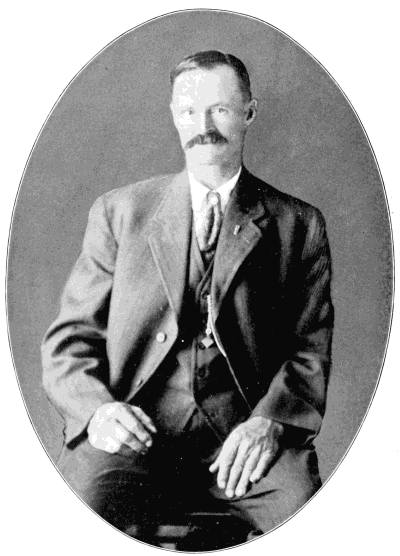
WOODSON CUMMINS
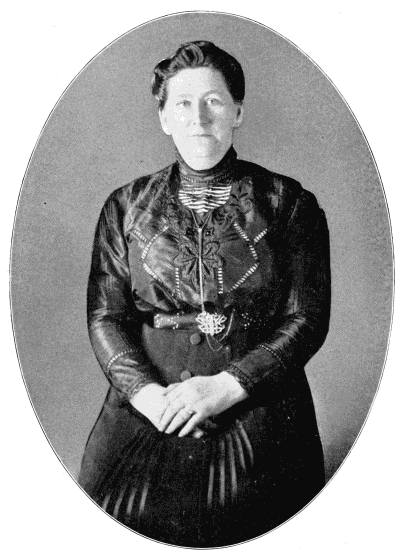
MRS. WOODSON CUMMINS
Woodson Cummins was a little lad of but seven summers when the family came to the northwest. He was reared under the parental roof and acquired his education in the public schools of Touchet. In the spring of 1880 he went to Elgin, Oregon, and for three years was engaged in the livestock business, after which he returned to Walla Walla county. In 1882 he purchased the old home farm and continued to engage in the livestock business. He also cultivated his fields and became recognized as one of the energetic and representative farmers of the community. He took up a homestead claim adjoining his father's old farm and in subsequent years he has purchased other land and now owns six hundred and forty acres. Year by year his farming and livestock interests were carefully conducted and his business affairs grew in volume and importance. He displayed sound judgment in the management of his interests and utilized the most progressive methods in conducting his work. Prosperity therefore came to him and at length, having become the possessor of a very substantial competence, he removed to Touchet about 1908 and a year later gave up active farming, since which time he has lived practically retired. He was, however, one of the organizers of the Touchet State Bank, has been a member of its board of directors from the beginning and also has filled the office of vice president from the organization.
On the 12th of September, 1880, Mr. Cummins was united in marriage to Miss Jemima J. Weaver, of Elgin, Oregon, by whom he has five children, as follows: Clarence E., who is yard manager of the Touchet yards of the Tum-a-Lum Lumber Company; Walter R., who cultivates a farm of his own and also some of his father's land; Hettie, who is the wife of W. E. Burnap, an agriculturist of township 7 north; Leila M., the wife of K. W. Parsons, who is engaged in farming near Lowden, Walla Walla county; and Elmer J., the proprietor of a garage in Touchet. Mr. and Mrs. Cummins also have an adopted daughter, Eva Pearl, now the wife of A. Hanson, residing near Touchet.
In his political views Mr. Cummins has long been a republican, giving stalwart support to the party and doing all in his power to promote its successes, yet never seeking nor desiring office for himself. He holds membership in Trinity Lodge, No. 121, I. O. O. F., and he and his wife are consistent and faithful members of the Primitive Baptist church. His religious faith has guided him in all of his relations and has made his business career one of unquestioned integrity and honor. He has combined high purpose with laudable ambition and his career proves that success and an honored name may be won simultaneously.
JOHN SPREITZER.
Among the retired farmers residing in Walla Walla is numbered John Spreitzer, who was born in Austria in 1860, of the marriage of Stephen and Gertrude Spreitzer, also natives of that country. There the mother passed away and there the father still maintains his home. To them were born nine children, of whom three are deceased.
John Spreitzer was reared at home and in the acquirement of his education attended the public schools of Austria. When twenty-three years of age, or in 1883, he crossed the Atlantic to America, having determined to seek his fortune in this comparatively new country. For six years he lived in Chicago and then went to Colorado, where he spent one year. At the end of that time, in 1890, he came to Walla Walla county, Washington, and for five years operated rented land. He then bought six hundred and forty acres and devoted his time to the cultivation of that tract until 1911, when, feeling that he had accumulated a competence, he retired and removed to Walla Walla, where he purchased an attractive residence on East Chestnut street. The value of his property is enhanced by the fact that there are many fruit trees upon the farm which bear abundantly.
In 1897 occurred the marriage of Mr. Spreitzer and Mrs. Katie Hendricks, a native of Germany. Mr. Spreitzer is a republican in politics but has confined his participation in public affairs to the exercise of his right of franchise. Fraternally he belongs to the Woodmen of the World and has many friends within and without that organization. He came to America empty-handed, but being quick to recognize and take advantage of the opportunities here offered, has by his own efforts gained the prosperity which he now enjoys.
GEORGE A. EVANS.
Among the men who played well their part in the pioneer days of Walla Walla county, when conditions of life were such as to test to the utmost a man's mettle, was numbered George A. Evans, who came to the west by wagon train. He turned his attention to farming, but his last days were passed in well earned leisure. He was born in Portsmouth, Ohio, December 6, 1835, and remained there until he reached mature years. In the meantime he had received but three months of common school education and had acquired habits of industry and of perseverance that were to stand him in good stead in the new northwest. In 1854 he removed to Sidney, Iowa, and two years later, in 1856, he joined a wagon train of forty ox teams and accompanied by his family, his parents and brothers and sisters, made the long journey across the continent to Walla Walla, arriving here in August. At that time the Indians were quite restive and had attacked several wagon trains and massacred a number of the emigrants, but the train with which Mr. Evans journeyed was not molested. For some time he drove a team engaged in freighting in this state and Idaho, principally between Walla Walla, Boise and Silver City, and thus became thoroughly familiar with this section of the northwest and gained a wide acquaintance among the early settlers. His first winter in Walla Walla, that of 1861, was one of the worst ever known in this country and it was a serious problem among the pioneers to make a living. Mr. Evans succeeded in finding employment as a mule herder for the government on what is now known as Eureka Flats. After the coming of the railroad he turned his attention to farming and became the owner of large and valuable holdings. At length, feeling that he was entitled to a period of rest, he retired and removed to Walla Walla, where his death occurred April 2, 1916.
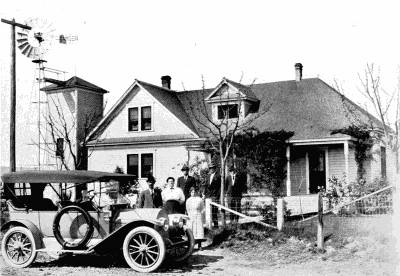
RESIDENCE OF WOODSON CUMMINS
Mr. Evans first married Bethsidia Williams, who died, and in 1886 he married Miss Bessie Bambrick, a native of Nova Scotia, and they became the parents of two children, one of whom survives, Mrs. W. R. McDermott, of San Francisco. Mrs. Bessie Evans passed away September 3, 1905, and on December 18, 1907, Mr. Evans married Miss Anna Bower, who survives him and resides at No. 549 South Division street. She holds membership in the Presbyterian church and is a woman of many admirable qualities.
Mr. Evans was a loyal member of the Masonic fraternity and was laid to his last rest with Masonic honors. For ten years he held membership in St. Paul's Episcopal church and in his daily life he was a consistent Christian, thoroughly upright in all his dealings, kindly in spirit and considerate of others. In his home life he was ever a loving husband and father and his large capacity for friendship gained him the warm regard of all who knew him intimately. He had a keen interest in educational affairs and for sixteen years served as a trustee of St. Paul's school. With his passing Walla Walla lost one of her prominent citizens and his demise was the occasion of widespread regret.
SETH W. HESTER.
Since starting out in life for himself Seth W. Hester has followed agricultural pursuits and is today one of the prosperous farmers of Columbia county, Washington. He has always been a resident of the Pacific northwest, being born in Linn county, Oregon, January 2, 1872, and during his infancy he was brought to Walla Walla county, now Columbia county, by his parents, William M. and Sarah K. (Combs) Hester, who were natives of Kentucky and Iowa respectively. It was in 1852 that his father came to the Pacific coast and after spending four years in California, removed to Oregon in 1856 and in 1872 came to Walla Walla county, Washington, where he settled on a farm. Here he and his wife both died. To them were born nine children and five of the number are now living.
Seth W. Hester passed his boyhood and youth in Walla Walla county and is indebted to its public schools for the early educational advantages he enjoyed. He was only thirteen years of age when his father died and he took charge of the home farm, which he carried on for a few years. Being a wide-awake, up-to-date farmer, he has steadily prospered as the years have gone by and is today the owner of valuable land in Columbia and Garfield counties. He has become interested in other enterprises and is now a stockholder in different businesses in Walla Walla, Garfield and Columbia counties.
In 1893 Mr. Hester was united in marriage to Miss Minnie Loundagin, and they have two daughters: Lucile M., who is a graduate of the Walla Walla high school and is now a student at Mills College, Oakland, California; and La Nor C., now attending high school.
Mr. Hester takes a commendable interest in educational affairs and has efficiently served on the school board. His political support is given to the democratic party and he never withholds his aid from any enterprise which he believes will prove of public benefit.
W. H. RICHARDSON.
W. H. Richardson is now living retired in Dayton, but for many years was actively identified with farming interests and owned and cultivated an excellent tract of land. He was born on St. Joseph's island in Lake Huron, in the province of Ontario, Canada, February 1, 1864, his parents being W. T. and Jane (Holland) Richardson, the former a native of Ontario, Canada, while the latter was born in Ireland. During her girlhood days the mother crossed the Atlantic with her parents, who established their home in Ontario. Soon after their marriage Mr. and Mrs. Richardson took up their abode on St. Joseph's island, where they resided until 1869 and then removed to Minnesota, where they lived for about seven years. In 1876 they came to Washington, taking up their abode upon a farm about six miles west of Dayton, in Columbia county, where the father was actively engaged in general agricultural pursuits until the time of his death, becoming one of the big wheat raisers of the county. At the time of his demise he owned six thousand acres of farm land, the greater part of which was devoted to wheat, and his efforts were resultant in producing splendid crops. He closely studied conditions of soil and climate and his methods were at all times progressive, so that he gathered abundant harvests. He died in 1900, at the age of sixty-six years, while his widow, surviving until 1907, passed away at the age of seventy-two.
W. H. Richardson was educated in the Thorn Hollow public school and in the Huntsville Academy. In early manhood he began farming in cooperation with his father and gradually as their operations extended to a larger scale, W. H. Richardson more and more assumed the burden of managing the business and cultivating the land. Following the death of his father he purchased the entire holdings, which he continued to develop and improve further until 1909, when he disposed of the last of his farm property and has since lived retired. His business affairs were wisely and carefully controlled and he became one of the representative agriculturists and wheat growers of the valley. The industry which he displayed in all of his business undertakings brought to him a very substantial measure of prosperity, so that he is now enabled to enjoy his remaining days in leisure and comfort.
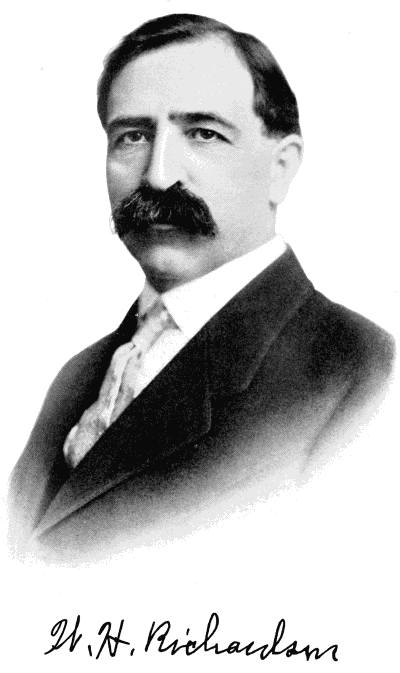
In 1903 Mr. Richardson was united in marriage to Miss Loretta M. Frazer, of Ashland, Illinois, who was principal of the Dayton high school. They became the parents of one son, who died in infancy. In politics Mr. Richardson is a democrat and keeps well informed on the questions and issues of the day, but has never consented to become a candidate for office. Since his retirement from business in 1909 he and his wife have spent much of their time in travel, having visited many European countries, also South America and Japan, thus gaining that broad knowledge and liberal culture which only travel can bring. The life record of Mr. Richardson should serve to inspire and encourage others, showing what may be accomplished through individual effort guided by sound judgment.
ARTHUR G. CORNWELL.
Among those whose extensive farming operations have made Walla Walla county famous as a wheat producing region is Arthur G. Cornwell, who is residing in the city of Walla Walla but is personally directing the operation of about one thousand acres of fine land. He is a native of the county, born April 11, 1869, and is a son of James M. and Mary A. (Stott) Cornwell. He was reared at home and as a boy and youth attended the country schools, thus laying the foundation of his education, and later he was a student at Whitman College. Following his marriage he began farming on his own account and from the beginning proved successful, his early training in agricultural work under his father proving of the greatest value to him. For about ten years he operated rented land and then purchased a farm. His holdings now comprise three hundred and twenty acres of farming land, one hundred and sixty acres of timber and grazing land, and in addition to cultivating his own half section he operates leased land, farming in all about one thousand acres, devoted to the raising of wheat. He keeps his business well in hand and studies carefully the problems of lowering the cost of production, of increasing the yield and of marketing to advantage. He is a stockholder in the Farmers Savings Bank of Walla Walla and in the Farmers Grain Agency and belongs to the Farmers Union, believing thoroughly in the importance of cooperation.
Mr. Cornwell was married on the 15th of July, 1891, to Miss Carrie E. Ingram, who was born in Georgetown, Colorado, a daughter of James H. and Mary J. (Williams) Ingram. In 1847 the family removed to Walla Walla and the father bought a small tract of land on the outskirts of the city of Walla Walla. He planted fruit and devoted the remainder of his life to horticulture. His wife was a writer of ability and after reaching her seventieth year wrote a book of poems. Mr. and Mrs. Cornwell have three children: Artemisia May, who was graduated from Whitman College in 1916 and also in that year completed the course offered in the Whitman Conservatory of Music, receiving the degree of B. M.; Edna Genevieve, who was also a student at Whitman College and is now the wife of Carl Gensel, of Walla Walla; and Elmer Grant, who is now farming on the home ranch. He was married in September, 1917, to Miss Ethel Heath.
Mr. Cornwell is a republican in politics and served for several years as deputy assessor. He and his family belong to the Presbyterian church and for about ten years he has served on its financial board. He is one of the most influential citizens and most successful farmers of Walla Walla county and wherever known is held in the highest esteem.
WILLIAM BOWE.
The life record of William Bowe indicates the opportunities which the northwest offers, for he arrived in this section of the country empty-handed and started out in the business world as a common laborer. Today he is the possessor of a handsome competence and is actively and prominently identified with agricultural and financial interests, owning thirteen hundred acres of land in Walla Walla county. He makes his home in the city of Walla Walla, from which point he directs his farming interests. He was born in Ireland, March 18, 1861, and is a son of John and Katherine Bowe, both of whom were natives of Ireland, where they spent their entire lives, there rearing their family of eight children, of whom six survive.
William Bowe was reared and educated in Ireland and was a young man of twenty-five years when he determined to try his fortune in the new world. Accordingly in 1886 he bade adieu to friends and native land and sailed for the United States. He did not tarry on the Atlantic coast but made his way across the country to Iowa, where he lived for two years. Still he heard the call of the west and in 1888 he came to Walla Walla. He arrived here in very limited financial circumstances and his financial condition rendered it imperative that he find immediate employment. He began work as a farm hand and spent three years in that way. He was ambitious, however, to engage in business on his own account, and at the end of that period rented land which he cultivated for three years. He still continued to save his earnings and after cultivating a rented farm for three years he purchased land, to which he has added from time to time until he is now the owner of about thirteen hundred acres, all of which has been greatly improved. His life throughout his entire residence in the northwest has been devoted to general agricultural pursuits and his large farm presents a most neat and thrifty appearance, indicating his practical methods and careful supervision. He also owns a fine residence in Walla Walla and he is one of the directors of the Farmers Bank of that city.
On the 8th of January, 1896, Mr. Bowe was united in marriage to Miss Elizabeth Davis, a native of Ireland, and they have become the parents of two children, but John C. has passed away. William E. married Miss Alice C. Ennis and in 1917 leased his father's ranch about fourteen miles from Walla Walla, where he now resides. Mr. Bowe of this review was nearly killed in 1909 while riding a young horse. The horse became frightened and fell from a bridge about nine feet with Mr. Bowe under him. He was so severely injured that he was picked up for dead.
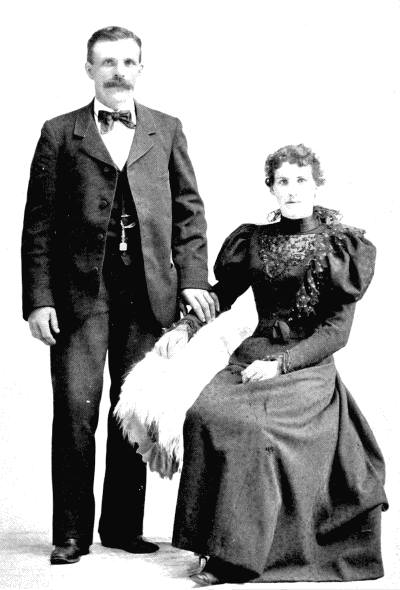
MR. AND MRS. WILLIAM BOWE
Mr. and Mrs. Bowe are communicants of the Catholic church and in politics Mr. Bowe is a democrat, while fraternally he is connected with the Benevolent Protective Order of Elks and also with the Knights of Columbus. His life record should serve to encourage and inspire others, showing what may be accomplished when there is the will to dare and to do. He has never been afraid of hard work, and persistency and diligence have brought to him the measure of prosperity which is now his.
W. H. H. BRUNTON.
W. H. H. Brunton, a pioneer of Walla Walla county, was engaged in farming for many years and won gratifying success in that connection. He was born in Schuyler county, Illinois, January 27, 1841, a son of Cyrus and Martha (Restine) Brunton, who removed with their family to Missouri during the childhood of their son, W. H. H. Brunton. There he was reared and received his education. In 1862 he made the journey across the country to Walla Walla county, Washington, with ox teams and during the following winter resided on the Walla Walla river. The next year he removed to Columbia county and for four years engaged in teaming. In 1866 he was married and then took up a homestead adjoining his father-in-law's farm. He devoted his time and attention to agricultural pursuits until 1899 and then, feeling that he had earned a rest, retired and removed to Walla Walla. From time to time he added to his holdings until he became the owner of almost seven hundred acres of land, which is still in possession of the estate. He passed away September 7, 1901, and his demise was the occasion of deep and widespread regret, for he was a man of sterling worth.
Mr. Brunton was married in 1866 to Miss Sarah A. Lewis, a daughter of Reese Lewis, who removed to Oregon with his family from Wayne county, Iowa, in 1863. After spending two years on the Touchet he took up a homestead claim three miles east of Dixie.
Mr. Brunton was a consistent member of the Methodist Episcopal church, to which Mrs. Brunton also belongs. He was known as a man strictly honest in all his dealings and his uncompromising integrity gained for him the respect of all with whom he came in contact. He had many personal friends and found his greatest pleasure in their companionship and in that of his wife. She resides in a comfortable home at No. 716 Catherine street and is well and favorably known in Walla Walla.
WILLIAM THOMAS DOVELL.
William Thomas Dovell was a native of Walla Walla, his birth occurring September 21, 1869, and his parents were John and Margaret (Ford) Dovell, natives respectively of the Azore islands and Philadelphia, Pennsylvania. In early boyhood the father emigrated to the United States and at an early date became a resident of Walla Walla, where both he and the mother passed away. To them were born four children, of whom two survive.
William Thomas Dovell grew to manhood in Walla Walla and attended the public schools and Whitman College in the acquirement of his education. He prepared for the practice of law under the direction of the firm of Allen & Crowley, and in 1890 he was admitted to the bar. He opened an office and for thirteen years was numbered among the capable attorneys of the city. In 1903, however, he removed to Seattle, where he was active in the practice of his profession until called by death in February, 1916. One of the factors in his success was his habit of careful preparation of his cases, this practice making it difficult for his opponents to gain an advantage over him.
In 1901 Mr. Dovell was united in marriage to Miss Ruth H. Allen, a daughter of the Hon. John B. and M. C. (Bateman) Allen, the former born in Indiana and the latter in Michigan. Mr. and Mrs. Dovell became the parents of four children, Ruth C.; Allen Thomas, deceased; William Thomas, Jr.; and Mary D.
Mr. Dovell was a careful student of public affairs and his views on political issues were in accord with the principles of the republican party. He was chosen attorney for Walla Walla county when but twenty-one years of age and although extremely young to fill such an important position he discharged his duties with marked ability. Fraternally he belonged to the Benevolent Protective Order of Elks, and his attractive social qualities gained him many friends within and without that organization. Those who had been associated with him during his residence in Walla Walla felt deep regret on receiving the news of his death in Seattle. He was buried in that city.
ADOLPH HOLM.
Adolph Holm, deceased, belonged to that class of substantial citizens that Norway furnished to the new world. He was a man of business ability and enterprise and possessed marked skill as a wood worker. Laudable ambition actuated him at every point in his career and an orderly progression brought him to a prominent position among the successful business men of Walla Walla county. Each forward step in his career gave him larger opportunities which he readily recognized and promptly utilized.
Mr. Holm was born in Norway, August 20, 1847, a son of Peter Holm, who was a wood worker and contractor of that country. At the age of nineteen years Adolph Holm bade adieu to friends and native land and sailed for the new world, having heard favorable reports concerning its opportunities, so that he was thus induced to seek a home on this side of the Atlantic. He had previously learned the trade of a wood carver under the direction of his father in Norway and he had also enjoyed liberal educational training. He had attended a Latin school there and was master of four or five languages. Thus well equipped he reached the new world, without capital but possessed of marked intellectual force and ability in the line of his trade. Making his way westward to Chicago, he there worked as a wood carver for a time and was also employed at various points in Michigan. Still later he went to Sioux City, Iowa, where he took up the business of contracting and building.
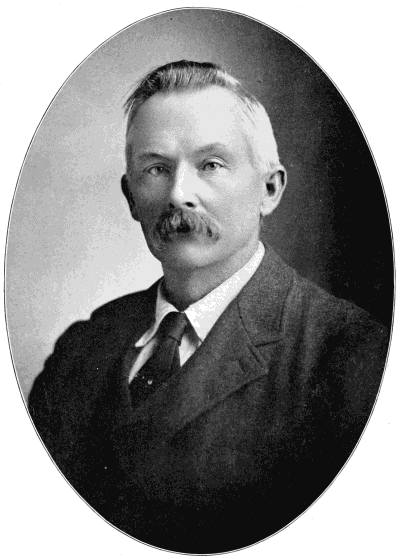
ADOLPH HOLM
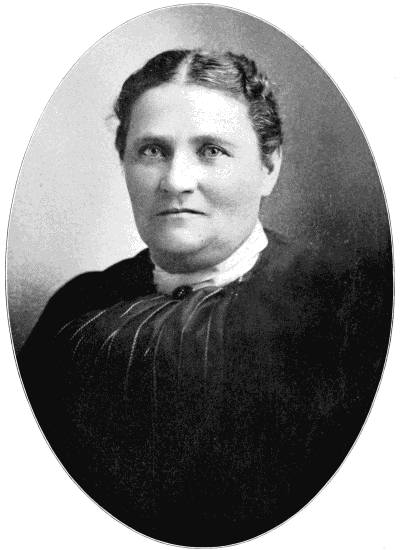
MRS. ADOLPH HOLM
It was while a resident of Sioux City that Mr. Holm was united in marriage, in August, 1870, to Miss Charlotte Peterson, a native of Sweden, who had come to the United States when seventeen years of age. In the year 1872 Mr. Holm came to the west with Oregon as his destination. He located first in Salem and was employed on the building of the state capitol in that city, remaining there for six years. On the expiration of that period he removed to Walla Walla and after two years took up his abode in Asotin county, Washington, where he resided for twenty-one years. During that period he was engaged in farming and in May, 1902, he purchased land and removed to the home farm upon which his widow now resides. There he continued to carry on general agricultural pursuits until his demise, which occurred February 3, 1904. He was a very skilled wood turner and he did much of the interior finishing of the Washington building for the Columbian Exposition held in Chicago in 1893. He proved equally efficient along other lines, both industrial and agricultural. In a word he possessed marked adaptability and accomplished whatever he undertook by reason of his unfaltering diligence and perseverance. His persistency of purpose, his laudable ambition and his splendidly directed efforts constituted an example that is well worthy of emulation.
To Mr. and Mrs. Holm were born eight children, seven of whom still survive, as follows: Anna, at home; Oscar, who is a member of the police force in Seattle; Harry, a resident of Roswell, New Mexico; Edgar, who is engaged in merchandising at Yuma Pine, Oregon; Emma, the wife of Professor W. M. Davis, who is principal of the College Place schools; Maurice, who formerly lived in Boston, Massachusetts but is now with the United States troops somewhere in France; and Roy, who operates the home farm.
Mr. Holm gave his political allegiance to the democratic party, and while he always kept well informed concerning the political conditions and questions of the country, he never had aspiration for office. He belonged to the Independent Order of Odd Fellows for many years and was a loyal representative of that society. He never regretted his determination to come to the new world, for he here found the opportunities which he sought and in their utilization made for himself a most creditable position in business circles. He won success by honorable effort and his record is one which reflects credit upon the land of his birth and the land of his adoption. That his life was well spent is indicated by the fact that those who knew him longest were his stanchest friends, for throughout his entire career he displayed characteristics that were worthy of the highest regard of his fellowmen.