BIOGRAPHICAL (continued 3)
Reading edition
JOHN SINGLETON.
John Singleton was one of the earliest of Walla Walla's pioneers, arriving here in 1857, and to the time of his death he was prominently, actively and helpfully associated with the work of development and progress in this section of the state. He was born in County Cork, Ireland, in 1824, and was educated under private tutors. On the 22d of April, 1847, he was married in Queens county, Ireland, to Miss Frances Jane Gowan and two years later they crossed the Atlantic to the United States, settling in New York, where he at once enlisted for service in the army. He was sent to Texas as quartermaster's clerk under Major Bilger and the command was stationed in the Alamo at San Antonio, Texas, his office being in the very room where Colonel Davy Crockett was killed. He remained in Texas in the service of the government for six years and was then honorably discharged, after which he returned to Washington, D. C. Subsequently he occupied a clerical position for six months in the old arsenal. He then went to Baltimore, Maryland. In 1856 Mr. Singleton again enlisted in the army for service on the Pacific coast, believing that the change of climate would benefit his failing health. He made his way westward by way of the Isthmus of Panama and thence northward to Vancouver, Washington, where he was stationed for ten months. His company afterward took part in the war with the Yakima Indians, having several sharp engagements with them in the Cascade mountains. His command was led by Captain Winder and the Indians by Chief Camiachan. After subduing the red men Captain Winder's command built a fort and remained in the Cascades for about a year, but later was transferred to The Dalles, Oregon, and in the spring of 1857 arrived at Fort Walla Walla, where Mr. Singleton remained in the service until 1861, when he was honorably discharged, his term having expired. While he was still engaged in military duty here the Indians from several tribes joined in hostilities to prevent Captain Mullen opening a military road across the Rocky and Coeur d'Alene mountains to the Columbia river. Mr. Singleton was in Colonel Steptoe's command, which met the allied tribes in the memorable engagement of Steptoe Butte, which was of several days' duration. The whites, being greatly outnumbered, suffered a disastrous defeat and were driven back to the Snake river in great disorder. In this engagement Mr. Singleton had a very narrow escape from death. He became separated from his comrades in the retreat and after wandering around nearly all night came upon a band of friendly Nez Percé Indians, who conducted him to the Clearwater river, ferried him across and directed him to the camp of his company, who had reported to his wife that he had died. Colonel Wright soon came up from The Dalles with a thousand men, and being thus reenforced, the troops began an active campaign against the Indians. In a short time the American army had scattered, captured or killed the entire tribe. Some were hanged in the mountains but the most noted leaders were brought to Walla Walla, where seven of them were hanged in the public square in the rear of the garrison. During his service in Fort Walla Walla, Mr. Singleton did most of the work of keeping the records of the post, in the performance of which duty he was compelled to use an old-fashioned quill pen.
Mrs. Singleton had purchased a squatter's right from Captain Pierce, and on Mr. Singleton's discharge he retired to the homestead, which has been the place of residence of the family continuously since. It is said that the money which Captain Pierce obtained for his squatter's right enabled him to open the Orofino mining district, of which he was the first prospector.
Mr. Singleton died at the old home on December 28, 1893, and there his widow and two daughters still reside. Mrs. Singleton is now in her ninetieth year but for some time past has been an invalid. To Mr. and Mrs. Singleton were born six children: Catherine, who is the widow of Thomas Tierney and resides in San Francisco; Frank E.; William H., who is deceased; Elizabeth and Eudora M., who are at home; and Esther Belle, who gave her hand in marriage to J. W. Brooks, a prominent attorney of Walla Walla.
Not only as one of the Indian fighters of the northwest but also as one of the progressive farmers of Walla Walla county did John Singleton leave the impress of his individuality upon the history of southeastern Washington. His worth as a man and as a citizen was widely acknowledged by all who knew him. There was no phase of pioneer life in this section of the country with which he was not familiar and he rejoiced in all that was accomplished in the way of introducing the evidences of modern civilization. His labors wrought good results and his name should be inscribed high upon the roll of those who have reclaimed this great region, making it a habitable and safe place in which civilization may be still further advanced.
GARRIT ROMAINE.
Garrit Romaine was for many years engaged in farming on a tract of three hundred and twenty acres of excellent land six miles north of Dayton, in Columbia county, and it was recognized that the county had lost a valued citizen when he was called to the home beyond. He was born in New York city, March 7, 1829, a son of Benjamin and Charity (Hopper) Romaine, also natives of the eastern metropolis. Subsequently the family removed to New Jersey, and thence to Fond du Lac county, Wisconsin, where both parents passed away. All their eight children are also now deceased.
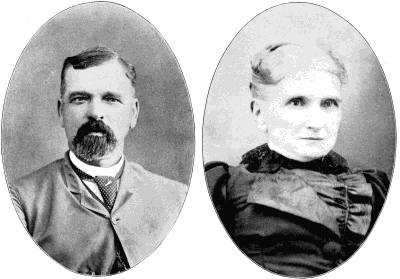
MR. AND MRS. GARRIT ROMAINE
Garrit Romaine was reared at home and obtained his education in the public schools of New York city. When twenty years old he went west to Wisconsin, where he remained for many years, or until 1877, when he removed to California. After remaining there for a short time he took up his residence in Harrisburg, Oregon, but in 1881 removed to Old Walla Walla county, Washington, locating in what is now Columbia county, on a farm six miles from Dayton. He at once began the improvement and development of his place, which he continued to operate until called by death. It comprises three hundred and twenty acres of good wheat land, and his industry and good management were rewarded by large crops, from the sale of which he derived a good income.
Mr. Romaine was married in Wisconsin in 1852, to Miss Martha L. Harbaugh, by whom he had seven children: William B., deceased; John H., a farmer; Jerome W., now a resident of Bellingham, Washington; Franz Sigel, a farmer; Charity, who is the wife of Newton James, and has three children, Louis Homer, on the old farm, Lois, now Mrs. H. L. Gritman of Columbia county, and Frida Ellen, now the wife of A. W. Munford of Ironwood, Michigan; Freeman C., deceased; and Rachel, the wife of Henry James, of Dayton.
Mr. Romaine gave his political allegiance to the republican party, and while not an office seeker was always keenly interested in everything affecting the general welfare. No project looking toward the advancement of his community failed to receive his heartiest support and cooperation, and he was particularly interested in the upbuilding of the local schools. Fraternally he was connected with the Independent Order of Odd Fellows and took an active part in the work of the lodge. He passed away October 23, 1900, and was laid to rest in the Dayton cemetery, leaving to mourn his loss, besides his family, many warm friends. Mrs. Romaine resides with her daughter, Mrs. Newton James, and holds title to the homestead. She belongs to the Christian church and has exemplified its teachings in her daily life.
CHARLES F. KIBLER.
Charles F. Kibler, one of the prominent farmers and stockmen of Walla Walla township, is with his brothers operating forty-four hundred acres of fine land. He is a native son of Walla Walla county and has resided here throughout his entire life. He was born September 24, 1874, of the marriage of Jacob and Louise (Buroker) Kibler, natives respectively of Virginia and Iowa. The father removed to Missouri when a young man and in the early '50s made the long journey overland to California, where he resided for five years. In 1858 he came to Walla Walla, Washington, and for some time worked as a farm hand. He then took up land on Mill creek but for several years gave the greater part of his time and attention to freighting by ox team. Subsequently, when the country became more thickly settled and there was not so much need for freighting supplies from a distant market town, he began the cultivation of his land. His farming operations yielded him a good profit and he acquired additional land, being at the time of his death the owner of fifteen hundred acres. He made excellent improvements upon his place and was one of the substantial men of the county. He passed away in 1908 and is survived by his wife, who has reached the age of sixty-six years. Five of the six children born to their union survive.
Charles F. Kibler passed the days of his boyhood and youth in his native county and attended the district schools in the acquirement of his education. Through working for his father he received thorough training in the best methods of farming and stock raising and on attaining his majority he began farming on his own account. He and his brothers have added to their holdings from time to time and now own forty-four hundred acres of good land finely improved. They have systematized their work and conduct their ranch in the same careful manner that a business man manages his interests. Their progressiveness and good judgment are manifested in the excellent return which they receive from their land and they have never had occasion to regret their choice of an occupation.
Charles F. Kibler was married in 1898 to Miss Marie Clodius, a native of Illinois and a daughter of H. F. and Catherine Clodius, who removed to Walla Walla county in 1881 and are now residents of Waitsburg. Mr. and Mrs. Kibler have a son, Albert F., who was born October 21, 1900, and is still at home.
Mr. Kibler casts his ballot in support of the men and measures of the democratic party but has never sought office as a reward for his loyalty. He is thoroughly imbued with the characteristic western spirit of enterprise and optimism, and any project for the benefit of his county or state receives his heartiest approval and most energetic support.
ALLEN H. REYNOLDS.
Allen H. Reynolds occupies an enviable position in professional and financial circles as a leading lawyer of Walla Walla and as the president of the Farmers Savings Bank. He was born January 24, 1869, in the city where he still makes his home, his parents being Almos H. and Lettice J. (Clark) Reynolds, who are mentioned at length on another page of this work. He has spent his entire life in Walla Walla, acquiring his early education in a private school conducted by the Rev. P. B. Chamberlain. He afterward matriculated in Whitman College and thus laid broad and deep the foundation upon which to build the superstructure of professional learning. When his collegiate course was completed he decided upon the practice of law as a life work and then entered the law department of the Boston University, from which he was graduated with the class of 1893. Soon afterward he returned to his native city, where he opened an office and entered upon the practice of law, becoming associated with W. H. Kirkman. Some time later that partnership was dissolved and he joined his brother under the firm style of Reynolds Brothers, but in the spring of 1900 he entered into partnership with Andrew J. Gillis in a relationship that continued for some time. He is now a partner of Grant S. Bond, with offices at No. 6½ Main street. His success in a professional way affords the best evidence of his capabilities in this line. He is a strong advocate with the jury and concise in his appeals before the court. Much of the success which has attended him in his professional career is undoubtedly due to the fact that he prepares his cases with great thoroughness and must be convinced of the absolute justice of his client's cause. Aside from his activities in the profession of law, Mr. Reynolds is well known in banking circles, having served as vice president of the First National Bank of Walla Walla until November, 1913. At the present time he is president of the Farmers Savings Bank, having succeeded the late W. P. Winans, who had been president for twenty-eight years.
On the 7th of November, 1894, Mr. Reynolds was married to Miss Fanny Kirkman, a daughter of William H. and Isabella Kirkman, well known residents of this city, where Mrs. Reynolds was born. They have become parents of three children: William Allen, born November 19, 1895; Almos, born May 19, 1898; and Ruth Sarah, born February 3, 1901.
Mr. Reynolds is treasurer and one of the trustees of Whitman College and has been the president of the Young Men's Christian Association since its organization. There is no plan or movement for the benefit and upbuilding of the city in which he is not helpfully concerned, standing at all times for progress and improvement in municipal as well as in private affairs.
HENRY OSTERMAN.
Henry Osterman, a member of the firm of Osterman & Siebert, leading architects of Walla Walla, and one whose efforts along professional lines have found expression in the erection of some of the finest buildings not only in this city but elsewhere in the state, was born in Germany, about three miles from Essen, on the 20th of January, 1862, a son of William and Mary (Wusthoff) Osterman, both of whom spent their entire lives in Germany, where the father followed the occupations of farming and milling.
Their son, Henry Osterman, was reared under the parental roof and acquired a college education in Essen, Germany. He served three years in the German army and after reaching his majority took up the study of architecture in Dusseldorf, Germany. In May, 1889, he decided to try his fortune in the new world, hoping here to find excellent professional opportunities. He accordingly came to the United States and on the 15th of June of that year he arrived in Walla Walla, Washington, where he has since made his home and practiced his profession. Having little knowledge of the English language and of building conditions in this country, which he found somewhat different from those in his native land, he did not immediately apply himself to architectural work but became associated with building operations and for a time worked as a carpenter. Shortly afterward, however, he took up contracting and building on his own account and was prominently identified with building operations for eight years. In 1899 he began the practice of his profession, opening an architect's office in the old Baker-Boyer building. He associated with him in this undertaking Victor E. Siebert, who was a former employe of Mr. Osterman and had later gone to the east, where he was graduated from the Boston School of Technology in 1912. The following year he was admitted to a partnership, forming the present firm of Osterman & Siebert. Among the many buildings for which Mr. Osterman has drawn the plans and also superintended the erection are the courthouse, the city hall, the Young Men's Christian Association building, the high school building, the Jefferson, the Green Park and the Sharpstein schools, the city library and practically all the important business and office buildings in the city, together with many of the finer residences. All these stand as monuments to the enterprise, the skill and the professional ability of Mr. Osterman, whose thorough preparatory training and subsequent study and experience have placed him in the front ranks among the architects of the northwest.
In 1902 Mr. Osterman was united in marriage to Miss Geneva Cooney, of Coon Rapids, Iowa, and to this marriage have been born five children, Bernardina, Henrietta, Hugo, Ruth and Betty.
Mr. Osterman gives his political endorsement to the republican party. Fraternally he is connected with Blue Mountain Lodge, No. 13, F. & A. M.; Walla Walla Chapter, No. 1, R. A. M.; Washington Commandery, No. 1, K. T.; the Consistory of Spokane; and El Katif Temple, A. A. O. N. M. S., also of Spokane, while both he and his wife are connected with the Order of the Eastern Star. He is also identified with Trinity Lodge, I. O. O. F., and both he and his wife are consistent members of the Congregational church, guiding their lives according to its teachings. Mr. Osterman has never had occasion to regret his determination to come to the new world, for here he has found the business opportunities which he sought and in their utilization has made steady progress. Not only does he rank with the leading architects of Washington, but is also a prominent figure in financial and commercial circles. He was one of the organizers of the Third National Bank, of which he is now a director, and he is also one of the organizers and a member of the board of directors of the Gardner Company, which owns and controls Walla Walla's largest mercantile establishment. His identification with these interests is the expression of his well directed energy and thrift, his close application and his persistency of purpose, ever guided by a laudable ambition. Step by step he has worked his way upward and his course should serve to inspire others who must start out in life empty-handed. The wise use which he has made of his time, his talents and his opportunities has placed him in the creditable position which he fills today in business and professional circles of Walla Walla.
ALMOS H. REYNOLDS. LETTICE J. REYNOLDS.
Almos H. Reynolds was for many years one of the prominent financiers of the northwest, becoming a factor in the establishment of the first banking business in Walla Walla and figuring for many years as one of the principal stockholders of the First National Bank. He was born in Madrid, St. Lawrence county, New York, October 21, 1808, and in early life learned the millwright's trade. In 1838, when a man of thirty years, he removed westward to Illinois and subsequently became a resident of Iowa, where he remained until 1850. He then crossed the plains to California, attracted by the gold discoveries on the Pacific coast, and in May, 1859, he came to Walla Walla, where he resided until his demise, which occurred thirty years later, or on the 21st of April, 1889. He was prominently identified with milling interests in this section, erecting many mills throughout the territory of Washington, two of them being in the immediate vicinity of Walla Walla. He also built and for several years owned a woolen mill at Dayton. He was associated with Dr. J. H. Day in establishing the first banking business in Walla Walla, opening a private banking institution, which they carried on under the firm style of Reynolds & Day. He was alert and energetic, constantly watchful of opportunities pointing to success. Eventually he became one of the principal stockholders in the First National Bank and was largely instrumental in its organization. Mr. Reynolds was a man of keen insight which enabled him to readily recognize a favorable business situation and his laudable ambition prompted its immediate use. Whatever he undertook he carried forward to successful completion and the integrity of his business methods was above question.
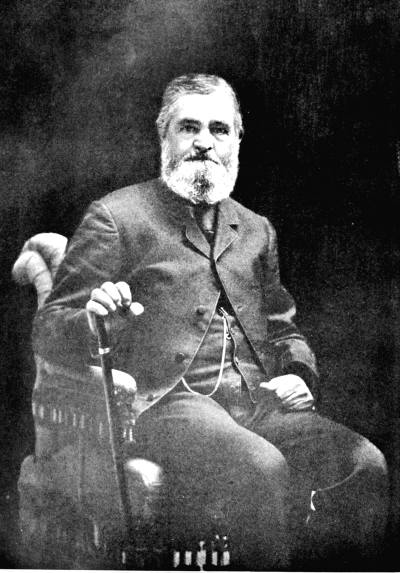
ALMOS H. REYNOLDS
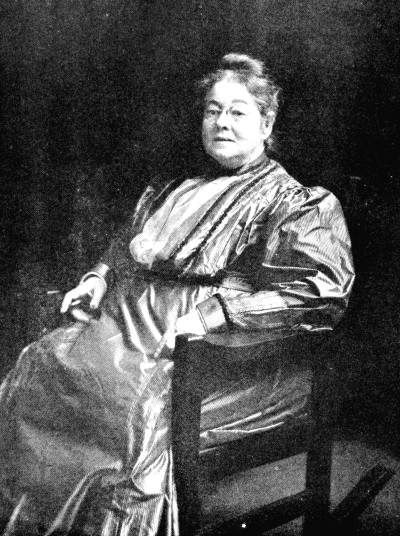
MRS. LETTICE J. REYNOLDS
On the 23d of May, 1861, Mr. Reynolds was united in marriage to Mrs. Lettice J. (Millican) Clark, the widow of Ransom Clark, who first crossed the plains to Oregon with Dr. Whitman in 1843. She was born in Canehill, Arkansas, October 3, 1830, and received her education in her native town. In 1843 the family joined the Whitman train and after a journey of weary months reached Oregon. The following year the Millican family settled near the town of Lafayette, Yamhill county, and there in 1845 Lettice J. Millican became the wife of Ransom Clark. Following the death of her husband in 1859, she made the journey to Walla Walla in order to make arrangements for subsequently taking up her home upon the farm which Mr. Clark had taken up and which was known for many years as the Ransom Clark donation claim. She was given a place in the government wagon from Wallula to Walla Walla and her first night in the latter place was spent in the fort. The following morning she was driven out to her claim and remained there for two weeks. She then returned to Portland and, after the birth of her daughter the following summer, she took up her permanent home on the claim in Walla Walla county. Soon after doing so she received a letter from her Portland lawyer advising her to sell her claim for two hundred and seventy-five dollars and abandon the idea of developing it. However, she disregarded this advice and continued to reside upon the farm with her children. On the 23d of May, 1861, she married Almos H. Reynolds. She was the earliest pioneer woman residing in Walla Walla county and the fact that she had been privileged to witness more of the growth of the northwest than others seemed to give her an added interest in everything pertaining to the public welfare. She contributed much to the upbuilding of the various institutions of the city and by reason of her force of character and her many liberal and well advised benefactions she was recognized as a most prominent citizen of Walla Walla. The erection of the Young Men's Christian Association building was made possible by a twenty thousand dollar donation from her and after its completion she was one of the chief contributors toward its upkeep. At the rally and jubilee held when the association had raised the forty-five thousand dollars necessary to pay off its debt, the speech that she made expressing her great joy in the knowledge that the association was free of all debt will long be remembered by all who heard her. She was also a loyal friend and patron of Whitman College, contributing generously at various times to the support of the institution and paying off a debt of six thousand dollars on the girls' dormitory, which is named in her honor Reynolds Hall. She was a woman of the highest ideals and also had the keenness of intellect and strength of character to realize her ideals, and the memory of Lettice J. Reynolds will long be held in honor in Walla Walla.
To the marriage of Mr. and Mrs. Almos H. Reynolds were born two sons: Harry A., who was born October 14, 1863; and Allen H., who was born January 24, 1869.
JOHN R. GOSE, M. D.
It is believed that few men possess the ability to attain success along both professional and agricultural lines, but Dr. John R. Gose, living on section 33, township 8 north, range 37 east, in Walla Walla county, has made a creditable name in both connections. He was born in Missouri, November 16, 1861, and is a son of John M. and Hannah J. (McQuown) Gose, the former a native of Kentucky, while the latter was born in Virginia. In 1864 they removed westward, settling at Boise, Idaho, where they spent the winter, and in the following spring they arrived in Walla Walla county, Washington, taking up their abode upon a ranch, where they are still living. They are one of the most venerable couples of the county, the father having attained the age of ninety-one years, while his wife is eighty-five years of age. In their family were seven children, of whom three are living.
Dr. Gose was not yet four years of age when his parents crossed the plains, so that he was reared upon the western frontier. He pursued his education in the schools of Walla Walla county and after having completed his preliminary course he determined to enter upon the practice of medicine and with that end in view returned to the east, matriculating in Jefferson Medical College of Philadelphia, from which in due course of time he was graduated. He then returned to Washington to engage in the practice of his profession, which he followed in Pomeroy, Garfield county, for fourteen years and also in the city of Walla Walla for three years. He then withdrew from the active practice of his profession, in which he had won substantial success and made for himself a most creditable name. Removing to a ranch near Dixie, he has since devoted his time and energies to general agricultural pursuits and has proved most capable in the management and conduct of his farming interests.
In 1889 Dr. Gose was united in marriage to Miss Minnie S. Aldrich, a representative of one of the old pioneer families of this section of the state. She was born upon the farm where she now resides and is a daughter of Newton and Anna M. (Shoemaker) Aldrich. Her father was a native of the state of New York, while her mother was born in Iowa. Mr. Aldrich came to Washington in 1861 and was here married to Miss Shoemaker, who had crossed the plains in 1864. They took up their abode upon the farm which is now occupied by Dr. and Mrs. Gose and upon that place they spent their remaining days. At the time of his death Mr. Aldrich owned seven hundred and twenty acres of land, of which Mrs. Gose inherited three hundred and sixty acres. He had gained a most substantial place among the agriculturists of this section of the state and his genuine personal worth had endeared him to all with whom he came in contact. To him and his wife were born three children: Mrs. Gose; Ida, who has departed this life; and Clara E., who is the wife of G. L. Bailey.
To Dr. and Mrs. Case have been born five children: Roberta L., who is a college graduate; Kenneth A., who is living upon the home ranch; Carl, who has passed away; Anna M., who is a high school graduate; and John Newton, who is now attending high school. Dr. Gose belongs to the Modern Woodmen camp in Dixie. His political allegiance is given to the republican party and while he was a resident of Pomeroy he served for two terms as mayor of that city. Mrs. Gose belongs to the Congregational church, in the work of which she takes an active and helpful part. They are very prominent people in this section of the state and the hospitality of the best homes is freely accorded them. They have a circle of friends almost coextensive with the circle of their acquaintance and they are both representatives of worthy pioneer families of the northwest, having resided in this section of the country for more than half a century. They have therefore witnessed the greater part of the growth and development of Walla Walla county, have seen tiny hamlets grow into prosperous cities, wild land converted into productive farms and all the natural resources of the country utilized for the benefit of man. Their aid and influence are always given on the side of progress and improvement and they advocate as well all those high standards which work for civic betterment.
CHARLES E. NYE.
Charles E. Nye, who is engaged in the harness and saddlery business in Walla Walla, winning for himself a creditable position in commercial circles, was born in Germany on the 3d of June, 1848, his parents being John N. and Elizabeth (Baker) Nye. They came to the United States in 1853, when he was a little lad of but five years, the family home being established in Marietta, Ohio, where the parents resided until they were called to their final rest, the father following the occupation of farming as a life work.
Charles E. Nye was reared to manhood on the old homestead farm and early became familiar with the work of the fields, to which he directed his attention during the summer months, while in the winter seasons he attended the common schools of the neighborhood. When his textbooks were put aside he found employment in a harness and saddlery shop at Marietta, Ohio, where he served a regular apprenticeship, and at the age of twenty-one years he started for the west, following the advice of Horace Greeley. He worked as a journeyman at his trade in Kansas, Colorado, Wyoming, Montana, California and Oregon, thus working his way westward by successive stages until he reached the Pacific coast. In Oregon he was for a time engaged in business on his own account, conducting a harness and saddlery establishment at The Dalles. In 1878 he was in Walla Walla but did not locate permanently until 1883, at which time he engaged in business independently here and for the past thirty-five years he has been a dominant factor in the trade circles of the city. In all of his commercial relations he has been actuated by a progressive spirit and the excellence of the goods which he handles and the work he turns out has insured him a liberal patronage.
In 1890 Mr. Nye was married to Miss Tennie Brown, of Walla Walla. Mr. Nye is well known and popular in fraternal circles, holding membership in Blue Mountain Lodge, No. 13, F. & A. M.; Walla Walla Lodge, No. 287, B. P. O. E.; and Columbia Lodge, No. 90, K. P. He is also a member of the Walla Walla Commercial Club and cooperates in all of its plans and measures for the upbuilding of the city and the extension of its trade relations. His political allegiance is given the republican party, which he has supported since reaching adult age. His long residence in Walla Walla has made him largely familiar with its history and with its commercial development he has been closely and prominently associated. Those who know him, and he has a wide acquaintance, speak of him in terms of high regard, for he has been found thoroughly reliable in business; loyal and patriotic in citizenship and faithful in friendship. His life work has been intelligently directed and he has always continued in the line in which he embarked as a young tradesman, never dissipating his energies over a broad field but so concentrating his efforts and attention that substantial results have accrued.
W. D. LYMAN.
W. D. Lyman, author of this history, is a "native son of the Golden West," having been born at Portland, Oregon, on December 1, 1812. His father and mother, Horace Lyman and Mary Denison Lyman, came to California around Cape Horn, in a sailing ship from New York, in 1848-9. After a few months in California in the midst of the excitements of the gold discoveries they removed to Portland, then a straggling village on the edge of the dense forest which bordered the Willamette river. It is recalled by the children of the family that their mother told them about how in those early days she had heard the cries of the wolves and cougars in about the location of the present Portland Hotel and other stately structures of the present city.
As a boy Professor Lyman went with his parents to Dallas in Polk county, Oregon, and then to Forest Grove, Oregon, where his father was for a number of years a professor of mathematics, and later of history and rhetoric, in Pacific University, a pioneer college of those early days. Brought up in those pioneer surroundings, in the midst of the unconventional life and the sublime scenery of his native state, he received a permanent impress which has led him throughout his life to find his greatest interest in travel, mountain-climbing, investigation of the native and pioneer life of Old Oregon, and in writing and lecturing upon themes drawn from those early experiences. The old Oregon of Professor Lyman's boyhood was typically American—free, unconventional and sincere, and the wilderness about and the stimulus to adventure and enterprise implanted in the minds and spirits of the boys and girls of that pioneer region, as it has throughout the great west, is a certain union of the romantic and imaginative with the practical which has resulted in placing the Pacific states in the forefront of American communities.
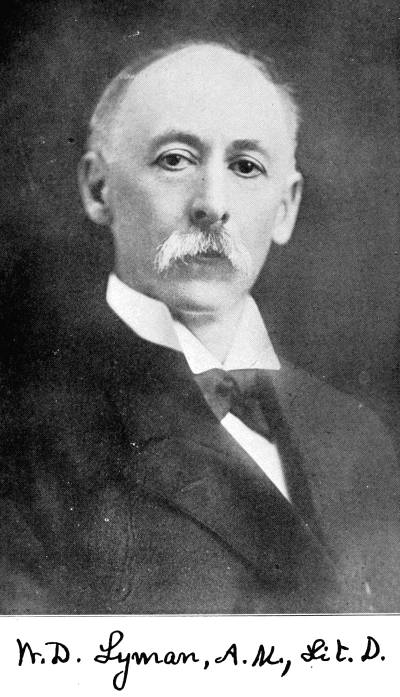
Having completed a short college course at Pacific University in 1873, the young man, after a few months spent in teaching, went east and in 1877 graduated at Williams College, Massachusetts. While there he was known for his interest in debating, oratory and literature, as well as for his informal and independent western way of considering political, social and religious topics. Upon returning to Oregon in the fall of 1877, he entered upon what proved to be his life work, that of a college teacher, writer and public speaker. He became professor of history, oratory, and English literature at Pacific University, where he continued until 1886. During that period he laid the foundations of his subsequent literary career by spending his summer vacations in mountain journeys and explorations of the rivers and wildernesses of the northwest and in embodying the results of his adventures in articles which appeared in various newspapers and magazines, east and west. During this time he became a skillful amateur photographer and has acquired a large collection of views, many of which were the first to be taken of some of the wild scenes which he might be considered the first to make known to the world.
During that period of his life the very important event of marriage occurred. In 1882 Professor Lyman was united in marriage to Miss Mattie Clark of Vancouver, Washington. Mrs. Lyman has become known in Walla Walla and throughout the region about as one of the leaders in social, intellectual and philanthropic life. Four children have been born to Professor and Mrs. Lyman, two sons and two daughters. The oldest, Hubert, born in 1883, is now engaged in business in the Philippine islands. The second, Marjorie, born in 1885, is the wife of Ridgway Gillis, a state highway engineer in charge of an important section of the Pacific highway, with present residence at Kalama, Washington. The third, Willena, born in 1889, is living with her parents.
The fourth, Harold, is now engaged with the Walla Walla Bulletin.
Professor Lyman severed his connection with Pacific University in 1886, and for nearly three years was engaged mainly in literary work. During that period he spent some time at Fresno, California, endeavoring to start a raisin ranch. He was for a time at Santa Fe, New Mexico. In 1889 he became head of the department of history at Whitman College, Walla Walla. He has been thus engaged continuously to the present, with the exception of the year 1891, when he was in Spokane. During these twenty-nine years he has seen Whitman College grow from a struggling frontier institution, largely of a preparatory grade, to a well equipped college supported by a good endowment and by a loyal body of enthusiastic alumni, among whom may be reckoned some of the foremost men and women of the northwest.
During his long residence in Walla Walla, Professor Lyman has been in frequent demand as a speaker and lecturer on many pulpits and platforms throughout the three northwest states, and has thus come to have a very extensive acquaintance. He has been active in political life and has been a candidate, though an unsuccessful one, as a democrat, for the national congress. Brought up as a republican during the Civil war and reconstruction periods, he became a liberal in political views and finally a democrat. As an ardent supporter of Woodrow Wilson for both of his terms, he labored with voice and pen for the election of that statesman whom he regards as in the same class with Washington, Jefferson and Lincoln.
During all his active life a member of the Congregational church, Professor Lyman has become known among his students and friends as very liberal in religious views and has associates among all faiths. He has been active in all forms of municipal betterment, in the prohibition and woman suffrage causes, and since the opening of the great war has made many addresses and written articles of a patriotic character. He firmly believes that it is the God-given mission of the United States to "make the world safe for democracy."
While living in Walla Walla, Professor Lyman has continued his practice of mountaineering. He has been a member of both the Mazama and Mountaineers' Clubs, and in the course of his life has made nine ascensions of the great snow-capped volcanoes of the Cascade range and four of the Olympics, besides many lesser peaks. He has traveled almost the entire length of the Columbia river and many miles of the Snake and other tributaries. The results of these journeys he embodied in what he regards as the most highly literary and artistic of his various books, The Columbia River, published in 1909 by G. P. Putnam's Sons and now entering upon its third edition.
Professor Lyman has become something of a specialist in local history. He was one of the principal writers of The History of the Pacific Northwest in 1889. In 1901 his history of Walla Walla county appeared. In 1906 he wrote the narrative part of a history of Skagit and Snohomish counties. Having witnessed with his own eyes most of the remarkable development of this section and having partaken of the social, industrial and political life of the section in which he lives, he has been able to write sympathetically of the struggles and the triumphs of the pioneers. As a side issue in his life, Professor Lyman has been much interested in waterway transportation. He has been for many years director of the Rivers and Harbors Congress for the state of Washington and has seen many improvements in waterways as a result of the labors of that organization. Opposed on principle to monopoly and special privilege, he has deemed waterways and water power as among the great agencies for preserving the freedom of the people.
HOWARD E. BARR.
That Howard E. Barr enjoys in unusual measure the confidence and respect of his fellow townsmen is indicated in the fact that he is now serving as mayor of Dayton, a position to which he was called by popular vote and in which he is discharging his duties with marked capability and fidelity. He was born in Tennessee, March 18, 1876, a son of Hugh and Emeline (Parker) Barr, who were also natives of Tennessee, in which state the death of the mother occurred. The father afterward removed to Texas, where he is still living. In their family were four children, all of whom survive.
Howard E. Barr was but seven years of age at the time of the removal of the family to the Lone Star state and there he was reared and educated, supplementing his public school training by a course in a college. He was a man of thirty-one years when in 1907 he arrived in Dayton, Washington, where he has since made his home, covering a period of a decade. He here established a barber shop and is still engaged in the business. In community affairs he has taken a helpful interest and on the citizens' ticket he was elected in 1916 to the office of mayor of Dayton, in which capacity he is now serving. He has closely studied the needs of the city, its opportunities and the possibilities for improvement and is giving to the city a businesslike and progressive administration.
In 1909 Mr. Barr was united in marriage to Miss Maud Babb, a native of Texas, and to them has been born a daughter, Geneva R., whose birth occurred July 4, 1912. The family occupies an attractive home in Dayton, where Mr. Barr owns two residences. Mrs. Barr is a member of the Christian church and in his fraternal relations Mr. Barr is an Odd Fellow and a Knight of Pythias, in both of which lodges he has filled all the chairs, showing his high standing among his brethren of the two fraternities. He is a man of genuine worth, alert, energetic and progressive not only in his business connections but also as a public official. He stands for whatever he believes to be best for the community and Dayton has benefited by his administration of her affairs.
ARTHUR H. HALLE.
Arthur H. Halle is prominently connected with hotel ownership and management in the northwest. He is well known as a progressive business man of Walla Walla and before coming to this city was closely associated with hotel interests in various sections of the country. He is, however, a native of Germany, his birth having occurred in Leipzig on the 19th of April, 1877. His father, Paul Halle, lived and died in that country, where he was engaged during his active business career as a traveling salesman. His wife, who bore the maiden name of Laura Muenzner, still resides in Germany.
Arthur H. Halle is one of a family of four children and is the only one residing in America. He pursued his education in the schools of Germany and came to the United States in 1897, when a young man of twenty years. He first made his way to New York and afterward to Chicago, where he was employed in the Grand Pacific Hotel for ten years. Later he removed to Lewiston, Montana, and was afterward located at different periods in Miles City, Billings and Missoula, Montana. He then came to the "garden spot of the northwest," arriving in Walla Walla in 1911. Here he established the Grand Hotel, after which he returned to Missoula to look after his hotel interests in that city. Three years later he again came to Walla Walla to take up his permanent abode. He is associated with Charles Mullemer and J. S. Rick in the ownership of the hotel at Missoula and of the Grand in Walla Walla, the latter being one of the finest hostelries of this city. The Palace at Missoula is of equal rank and both are liberally patronized because of the excellent service rendered to the public. Mr. Halle and his associates maintain the highest standards in hotel management and conduct and displayed something of the spirit of the pioneer in that they have initiated new methods which add to the success of their business and to the comfort of their guests.
In Chicago, in 1901, Mr. Halle was united in marriage to Miss Alice Rick, who was born in that city, a daughter of J. S. Rick, who is yet living, while her mother has passed away. Mr. and Mrs. Halle have become the parents of two children, Laura and Dorothy. In the social circles of Walla Walla Mr. and Mrs. Halle are widely and favorably known, the hospitality of the best homes being freely accorded them.
Mr. Halle has made steady progress since coming to the United States, advancing step by step in the business world, and his enterprise and perseverance have made him one of the successful hotel men of the northwest. His membership relations include connection with the Lutheran church, the Elks and the Commercial Club.
WILLIAM CHARLES PAINTER.
The days of chivalry and knighthood in Europe cannot furnish more interesting or romantic tales than our own western history. Into the wild mountain fastnesses of the unexplored west went brave men whose courage was often called forth in encounters with hostile savages. The land was rich in all natural resources, in metals, in agricultural and commercial possibilities, and awaited the demands of man to yield up its treasures. But its mountain heights were hard to climb, its forests difficult to penetrate and the magnificent trees, the dense bushes or jagged rocks often sheltered the skulking foe, who resented the encroachment of the pale faces upon these "hunting grounds." The establishment of homes in this beautiful region therefore meant sacrifices, hardships and ofttimes death, but there were some men, however, brave enough to meet the red man in his own familiar haunts and undertake the task of reclaiming the district for purposes of civilization. The rich mineral stores of the northwest were thus added to the wealth of the nation, its magnificent forests contributed to the lumber industry and its fertile valleys added to the opportunities of the farmer and stock raiser; and today the northwest is one of the most productive sections of the entire country. That this is so is due to such men as William Charles Painter, whose name is inseparably interwoven with the history of the region. No story of fiction contains more exciting chapters than may be found in his life record. He was one of the most prominent of those who engaged in Indian warfare and for many years he was also a leading figure in the agricultural development of this section of the state. Walla Walla numbered him among her most honored and valued citizens and his death was the occasion of deep and widespread regret.
William C. Painter was born in St. Genevieve, Missouri, April 18, 1830, and there the earliest years of his life were passed. His paternal ancestors came from Mercer county, Pennsylvania. His mother, who bore the maiden name of Jean Moore, was a daughter of Major Robert Moore, a veteran of the War of 1812 and well known in connection with the early history of Oregon. In 1850 the father with his family started for Oregon, but when the Little Blue river was reached the father and two of the sons died of cholera. The mother and the surviving children continued the journey westward with sore hearts but with undaunted courage and finally reached Washington county, Oregon, where donation land claims were secured.
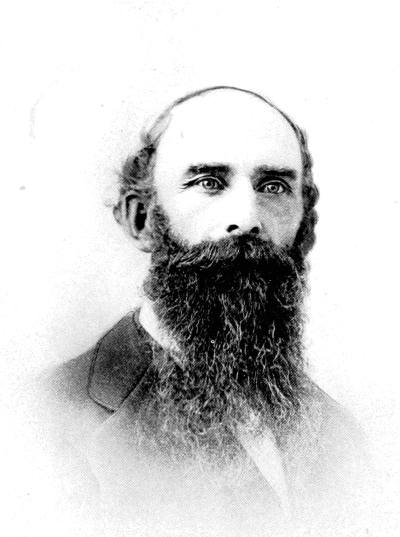
WILLIAM C. PAINTER
There William C. Painter resided until 1863 and was prominently identified with the early development of that section. At the time of the Indian war of 1855 he was one of the first to enlist, becoming a member of Company D, First Oregon Mounted Volunteers, which command fought the Indians for four days near Walla Walla, finally routing the red men, who retreated to the Palouse country. In this and many other engagements of the Indian war Mr. Painter distinguished himself for bravery. He remained with his company until the close of hostilities. In 1855 certain young ladies of the Forest Grove Academy, now the Tualitin Academy and the Pacific University, presented the company with a flag. Mr. Painter's comrades in arms voted that he should become its bearer and the starry banner finally came into his exclusive possession and is still carefully preserved in the Painter household as a priceless relic. Upon its field there are but twenty-one stars and on the flag, inscribed in large letters, are the words, "Co. D, First Oregon Vol., 1855-6." In the war against the Bannock and Piute Indians in 1878, Mr. Painter again engaged in fighting the red men. He was appointed by Governor Ferry captain of a company of forty-two men and was assigned to duty on the gunboat Spokane under command of Major Cress of the regular army. The first engagement in which he participated was at Long Island in the Columbia river below Umatilla, in which the whites were successful. Major Cress, in a letter to Mr. Painter written from Jefferson Barracks, Missouri, under date of April 15, 1897, speaks very highly of the assistance which the latter rendered. After this engagement, in recognition of his valuable service, he was made aid-de-camp on the staff of Governor Ferry, with the rank of lieutenant colonel, and was placed in command of forty-two men. He was then sent to eastern Oregon to assist in defending the people against the Indians who had recently been defeated by General O. O. Howard. He passed south of the retreating bands to Camas Prairie with a view of intercepting the retreat. The hostile savages, learning of his position, by a circuitous route passed around him and escaped, but he captured enough horses to pay the entire expenses of his command. Although no battle was fought in that campaign, it was considered so hazardous that an offer of ten dollars per day for guides was not sufficient to cause anyone to accept and run the risk. In his official report, General O. O. Howard, quoting Captain John A. Cress, said "Captain William C. Painter and the forty-two volunteers from Walla Walla deserve praise for good conduct and bravery, not excepting my Vancouver regiment and Captain Gray, with officers and crew of the steamer Spokane, who stood firmly at their posts under fire."
When the country no longer needed his military aid Captain Painter became a clerk for Flanders & Felton of Wallula, and when the senior member was elected to congress in 1867, Captain Painter took charge of the business. He also became postmaster of Wallula and the agent for the Wells Fargo Express Company. Returning to Walla Walla, he was appointed deputy collector of internal revenue for eastern Washington and in November, 1870, he resigned that position, although his resignation was not accepted until the following May. After retiring from office he made some unfortunate mill investments, in which he lost everything that he had saved. With courageous spirit, however, he again became a wage earner and was thus employed until 1876, when he was appointed receiver of the United States land office and occupied that position in most satisfactory manner until 1878, when he was elected county auditor. He served for four consecutive terms in that position and the Waitsburg Times of March 11, 1887, in speaking of him at his retirement from office, designated him as "the best auditor Walla Walla county ever had." He ever regarded a public office as a public trust and it is well known that no trust reposed in Captain Painter was ever betrayed in the slightest degree. Upon his retirement from the position of county auditor he concentrated his attention on farming, having fifteen hundred acres in the Eureka flats. While thus engaged he still occupied the old home on South Third street in Walla Walla, where the family still reside. He was thus extensively engaged in general agricultural pursuits and continued his farming operations until about two years prior to his death.
On the 7th of January, 1864, Captain Painter was married to Miss Caroline Mitchell, the only daughter of Judge I. Mitchell, of Multnomah county, Oregon, and their children are: Philip M., a resident of Walla Walla county; Charles S., of Montana; Maude M., the wife of Garrett D'Ablaing of Ellensburg; Harry M., a Congregational minister of Seattle; Bonnie Jean, the wife of R. F. MacLane of Walla Walla; Marguerite M., the wife of Herbert Gall of Sascatoon, Canada; Roy R., deceased; Rex M., of Walla Walla county; Caroline M., the wife of H. J. Wolff of Seattle; and Bruce I., of San Francisco. The family circle was broken by the hand of death when on the 4th of December, 1900, Captain Painter died of paralysis. For some time he was a vestryman of the Episcopal church which the family attend. His political allegiance had always been given to the republican party from the time of its organization and he was a most faithful follower of its principles. It is said that at every demonstration of a patriotic nature Captain Painter was called upon to take his place among the leaders, with his battle-scarred Indian war flag. His patriotic sentiments led him to take a prominent part in the Pioneer Association of Oregon and he always made a special effort to be present at its meetings. He was also active among the Indian War Veterans and was the first grand commander of the organization. For years he belonged to the Ancient Order of United Workmen. He gave devoted loyalty to every cause which he espoused and his is a most notable and honorable record of a pioneer, a valiant soldier and one of nature's noblemen.
WILLIS E. L. FORD.
No history of the pioneer development of Walla Walla county and of the vast west would be complete without extended reference to the Ford family, for Willis E. L. Ford and his father have been particularly active in advancing development along those lines which have meant much to the upbuilding and progress of this section. He was born near Oregon City, Oregon, November 29, 1855, a son of Nineveh and Martha Jane (Simpson) Ford. The father was a native of North Carolina, while the mother's birth occurred in Missouri. He crossed the plains in 1843 with Marcus Whitman, making the journey with ox teams, and he built the first tannery in Oregon City and in fact in that entire section of the country. He continued its operation for several years and also conducted a shoe store there. In 1848 he was one of the volunteers who enlisted for service against the Indians and traveled all over this section of the country in pursuit of the red men. It was at this time that the massacre of the white people at Walla Walla occurred. All that the soldiers had to eat for thirty days was the meat of a cayuse pony without salt. His travels over this section of the country brought to Nineveh Ford a good knowledge of the land and its possibilities and in 1859 he removed with his family to the Walla Walla valley, settling upon a farm upon which he resided to the time of his death. It was a wild tract of land when it came into his possession but with characteristic energy he began to break the sod and till the fields. His wife was the first white woman in the valley outside of the garrison. Mr. Ford built a log cabin with puncheon floor and doors and stick chimney and in true pioneer style began his life in Oregon territory. The latchstring of his cabin always hung out, assuring the traveler of a hearty welcome, and the stranger was always free to partake of whatever the table afforded. He worked diligently and persistently in the cultivation of his land and in the course of time his fields brought forth abundant harvests and his once wild tract was converted into a valuable farm. Moreover, he was one of the recognized leaders of the democratic party in this section of the state. He gave to that party his stalwart support, never faltering in his allegiance thereto, and twice he was called upon to represent his district in the state legislature while a resident of Oregon. Fraternally he was connected with the Masons and in his life exemplified the beneficent spirit of the craft, for he was continually extending a helping hand where aid was needed.
Willis E. L. Ford was one of a family of eleven children, seven of whom are now living. He shared with the family in all of the hardships and privations incident to frontier life. Such a life develops a self-reliance and force of character which count for much in the later struggle for existence and business supremacy. He supplemented his early education by study in the seminary in Walla Walla and afterward settled upon a farm in Whitman county, taking up his abode there in 1877. For thirty-five years he lived upon that place, ranking with the leading and representative agriculturists of that section of the state. When more than a third of a century had been passed there he sold his property and in a considerable measure retired from active business life. He purchased a farm of twenty-four acres in College Place and has since lived there, giving his attention to the raising of fruit and also to the conduct of a dairy business. His interests are carefully managed and are bringing to him a substantial measure of success.
In 1886 Mr. Ford was united in marriage to Miss Rhoda A. Andross, who was born in Minnesota, a daughter of William H. and Sophronia (Winigar) Andross, the former a native of England, while the latter was born in the state of New York. They removed westward on leaving Minnesota and became residents of the Walla Walla valley, where both the father and mother passed away. Mr. and Mrs. Ford have become the parents of six children: Grace, who is now a nurse in Los Angeles, California; Frank, also living in California; Edna, who was a college graduate and taught school for one week, after which she was killed by an electric car in Spokane, Washington; Orley, who is a missionary in South America; and John and Orpha, both of whom are at home.
Mr. and Mrs. Ford hold membership with the Seventh Day Adventist church and take an active part in its work, doing all in their power to advance its growth and extend its influence. In politics Mr. Ford maintains a liberal course, not caring to bind himself by party lines. He served on the school board for several years and has ever been a champion of the cause of public education. There are few residents of Walla Walla county more familiar with the story of pioneer life and conditions in this section of the state than he. He was only four years of age when brought to Walla Walla county. In 1877 he served as a volunteer in the Indian war and had his horse killed by his side. He thoroughly understands the red man, his nature and his problems. He has lived to see this section of the country no longer under the dominion of the savage and has witnessed its transformation as the work of modern day progress and improvement has been carried forward, whereby the natural resources of the country have been utilized and its wealth and progress thus greatly enhanced. The name of Ford figures prominently in connection with the history of the Inland Empire and Willis E. L. Ford indeed deserves mention among the honored pioneers.
CHARLES PLUCKER.
Charles Plucker was one of the honored citizens of the Walla Walla valley. He attained the age of eighty-two years but at the time of his death was still giving personal direction to his extensive and important farming interests. His life experiences were varied and prominently connected him with the upbuilding and development of this section of the country. He was born in Germany, November 9, 1835, and was a son of Carl and Mary Plucker, who were also natives of that country, where they spent their entire lives. They had a family of eight children, four of whom are now living.
Charles Plucker, whose name introduces this review, was reared and educated in Germany, spending the first seventeen years of his life in that country. He then determined to try his fortune in the new world and become a resident of America. In 1854, therefore, he made the voyage across the Atlantic and for two years remained a resident of New York. In 1856 he enlisted at the age of nineteen years in the army of his adopted land and was located on Governors island. In 1857 he went to Fort Simcoe as a soldier and was on active military duty there for five years. He was later sent to Fort Colwell and in 1861 he received an honorable discharge, having for five years rendered active aid to the United States government in its efforts to protect American interests and the lives and property of the people upon the northwestern frontier.
Mr. Plucker was then honorably discharged and came to Walla Walla, where he opened a paint shop. He continued in active business in that city for fourteen years and in 1875 he turned his attention to general agricultural interests, purchasing a farm on the Touchet river on section 14, township 8 north, range 33 east. He continued to reside upon that property until his death, being the owner of ten hundred and eighty acres of rich and valuable land which he greatly improved, adding thereto many commodious and substantial modern buildings and all the accessories and conveniences of the highly improved farm of the present day. Few men of his years remain in such active connection with business affairs as did Mr. Plucker. He was, however, a well preserved man physically and mentally and seemed much younger than the record indicated.
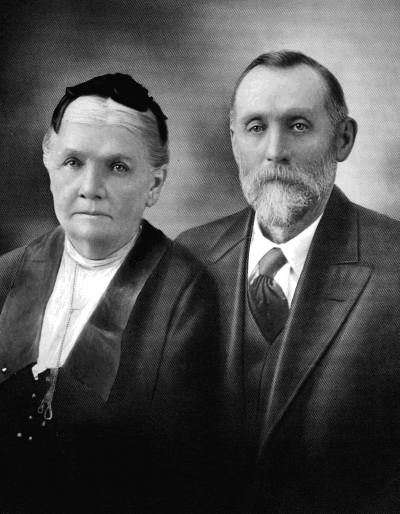
MR. AND MRS. CHARLES PLUCKER
On the 7th of October, 1868, Mr. Plucker was united in marriage to Miss Katherine A. Hauer, also a native of Germany, who came to the United States in 1868. She is a daughter of Christian and Augusta (Lüder) Hauer, who were born, reared and married in Schleswig-Holstein, The father, who was a hatter by trade, died there August 6, 1866. In 1880 the mother came to America with a nephew and her daughter, Mrs. Frederika Roehl Behl, who located in San Francisco. After spending a few months in that city Mrs. Hauer came to Washington to make her home with another daughter, Mrs. Charles Plucker, and here she passed away April 29, 1881, at the age of eighty years. She was the mother of six children, all of whom are now deceased with the exception of Mrs. Plucker. Five children were born to Mr. and Mrs. Plucker, namely: Frederick and Charles, now deceased; W. H., who died at the age of forty-five years; Magdalena, the wife of Peter Conrad; and F. C., at home with his mother.
After a useful and well spent life Mr. Plucker passed away on the 30th of October, 1917. In his political views he was a democrat, supporting the party from the time he became a naturalized American citizen. He served on the school board but did not seek office, preferring to concentrate his efforts and attention upon his business affairs. He especially deserves mention among the self-made men of the state, for he started out in life empty-handed and all that he possessed was acquired through his persistent, earnest and honorable effort. The family is one of prominence here and has been widely and favorably known in the valley since early days.
A. F. ANDERSON.
A. F. Anderson is a retired farmer living in Prescott. He has been closely identified with agricultural interests and is still the owner of valuable farming property, from which he derives a gratifying income, but at the present time he is largely leaving the management and operation of his land to others, for he is enjoying a rest which he has truly earned and richly deserves. He was born in Sweden, September 23, 1844, and was there reared and educated, spending the period of his boyhood and youth in that country. He was also married in his native land and in 1869, when a young man of twenty-five years, he crossed the Atlantic to the new world, making his way first to Kansas, where he resided for about twelve years, or until 1881. He then came to the northwest with Washington as his destination and was section foreman in this state for fifteen years. He also took up a homestead of one hundred and sixty acres and later he purchased one hundred and sixty acres more. His half section is all wheat land and has been brought under a high state of cultivation, large crops being annually gathered. Excellent improvements have been placed upon his farm and there is no accessory or convenience of the model farm property that is not found there. He owns a fine residence in Prescott and his surroundings are indicative of his life of well directed energy and thrift.
In 1869 Mr. Anderson was united in marriage to Miss Mary Carlson, a native of Sweden, and they have become parents of eight children: Hilma; Augusta; Charles, who is now deputy sheriff at Wallula; Wilhelmina; Ada; Edith; Harry; and Genevieve.
Mr. and Mrs. Anderson are well known residents of Prescott. His political allegiance is given to the republican party and he has served as justice of the peace and as school director, while at the present time he is one of the aldermen of the city. His political activity has always been characterized by the utmost devotion to the general good and he has been most true and faithful in his official positions, discharging his duties with marked capability and promptness. Moreover, he is a self-made man and one who deserves great credit for what he has accomplished in a business way. He came to the new world empty-handed when a young man of twenty-five, but he possessed the substantial qualities of courage, determination and industry and has utilized these qualities as the basis of his growing success. Undeterred by the obstacles and difficulties in his path, he has steadily worked his way upward and is now one of the prosperous residents of Prescott.
JOHN A. ROSS.
In the death of John A. Ross, Walla Walla county lost a representative agriculturist, a loyal citizen and a man whose worth in every relation was widely acknowledged. He was born in Pennsylvania, July 16, 1860, and was reared and educated in that state. He there remained until 1879, when, at the age of nineteen years, he bade adieu to friends in the east and started for the Pacific coast. On reaching Walla Walla county he here took up his abode and remained a resident of this section until life's labors were ended in death.
It was in the year 1882 that Mr. Ross secured a faithful companion and helpmate for life's journey in his marriage to Miss Florence Cauvel who was also born in Pennsylvania and was a daughter of John and Matilda (Ketner) Cauvel, who always remained residents of the Keystone state. In their family were fifteen children, of whom eleven are yet living.
Following his marriage Mr. Ross purchased a farm near Pendleton, Oregon, and the family resided upon that place for some time. Eventually, however, he sold that property and removed to Camas prairie, where he again purchased land and followed farming for two years. On the expiration of that period he sold the property and invested in a farm at Sunnyside, where he made his home for five years. Once more he disposed of his property and this time bought a farm near Walla Walla comprising fifty acres, to the further development of which he at once bent his energies, his labors being attended with excellent results. He added many improvements to the place, erected fine buildings thereon and his labors wrought a marked transformation in the property. He was progressive in all that he did, was an energetic farmer and his labors were at all times intelligently directed and characterized by sound business judgment.
The family of Mr. and Mrs. Ross numbered five children: Winifred, who is the wife of George Calhoun; Mabel, the wife of Dale Babcock; Carl, who is now in Idaho; Royal, who is with his mother; and Pauline, the youngest of the family.
The family circle was broken by the hand of death when in July, 1912, Mr. Ross passed away, his remains being interred in the cemetery in Walla Walla. His death was the occasion of sincere and widespread regret of the many who knew him and of deep sorrow to his immediate family, for he possessed attractive social qualities, a genial disposition and a kindly manner that endeared him to those with whom he was brought in contact. He belonged to the Modern Woodmen of America and he gave his political allegiance to the democratic party. He was also a consistent member of the Congregational church, with which his wife is connected, and in the work of the church they ever took a most active and helpful part. Mr. Ross was a man whom to know was to esteem and honor for his life was ever upright and straightforward in its purposes and in its dealings and he was a worthy representative of high standards of manhood and citizenship.
P. B. HAWLEY.
P. B. Hawley is engaged in farming on section 27, township 7 north, range 33 east, and is regarded as one of the representative agriculturists of Walla Walla county. He has been in former years a leading factor in political circles and has been called upon to fill various offices, the duties of which he has discharged with promptness and fidelity. Throughout his entire life he has been a resident of the northwest.
Mr. Hawley was born in Umatilla county, Oregon, on the 30th of June, 1862, a son of Philip L. and Sarah J. (Roberts) Hawley, both of whom were natives of Illinois. They were married, however, in Ohio and in 1861 they crossed the plains to Walla Walla, Washington, attracted by the opportunities of the growing northwest. Subsequently the father removed with his family to Umatilla county, Oregon, where he took up a homestead near Pilot Rock, and thereon resided for two or three years. He then turned his attention to the lumber business, in which he engaged in connection with George H. Reed, forming the Reed & Hawley Lumber Company. They operated mills in Umatilla county and had lumberyards in Walla Walla. The father was identified with this business throughout the remainder of his active life but his labors were terminated in death in 1878. His widow survived him for only a brief period, passing away in 1879.
P. B. Hawley after attending the public schools continued his education in the Whitman College and thus became well qualified for life's practical and responsible duties. In partnership with his brothers, L. R. and W. B. Hawley, he purchased extensive farm lands in Walla Walla county, built irrigation ditches and for seven years the three brothers were most closely associated in the conduct of their farming enterprises. In recent years, however, their holdings have been divided and P. B. Hawley now owns in his home place two hundred and fifty acres of rich and valuable land which he has carefully and persistently cultivated, bringing his fields under a very high state of development, so that he annually gathers good crops. He displays keen sagacity and business discernment in the management of his interests and success in large measure has attended his labors.
In 1905 Mr. Hawley was united in marriage to Miss Lillie Hunziker, of Walla Walla, and to them has been born a daughter, Alida F. He belongs to Trinity Lodge, No. 121, I. O. O. F., of which he became a charter member, and he also has connection with the Modern Woodmen of America. He and his wife are members of the Community church of Touchet and their aid and influence are always given on the side of progress and improvement. He is a well known and representative citizen of Walla Walla county and there are various chapters in his life history well worthy of emulation. He is genial in manner, social in disposition and is cordial but never to the point of familiarity. These qualities have won him personal popularity, while his enterprise and diligence have gained him prominence in business circles.
WILLIAM KIRKMAN.
William Kirkman, deceased, one of the honored pioneers of Walla Walla county, was prominently identified with stock raising interests for a considerable period and previous to that time was engaged in prospecting for a time. His activities were of a character that contributed to the progress and prosperity of the district in which he resided and Walla Walla numbered him among her most honored and valued residents. He was born near Manchester, in Lancashire, England, December 7, 1832, and received his education and grew to manhood in his native country. When about twenty years of age he came to the United States. He had been identified with the firm of Grant Brothers, proprietors of woolen mills in Lancashire, England. It is supposed that these brothers were the originals of Dickens' characters of the Cherable brothers. They had designed a fancy Marseilles vesting and Mr. Kirkman came to America to introduce the goods. For two years he resided in Boston, Massachusetts, after which he made his way westward by the Isthmus of Panama route. He spent some time in the gold mines of California and then proceeded by sailing vessel to Australia and to the Sandwich Islands, but returned to the American continent when the news was received of the discovery of gold in paying quantities on the Fraser river in British Columbia. He proceeded to the gold fields there and for a number of years divided his time between the mines in that region and in California. After making and losing what in those days amounted to several small fortunes he determined to engage in a more stable business and, accordingly, in 1862, he returned to San Francisco and the next year purchased cattle in Oregon, which he drove to the market at Boise, Idaho. He there established himself in the stock business. In 1866 he took an eighty-mule team pack from Walla Walla to Montana, where he disposed of all of his goods. He then became interested in a milk ranch and dairy business, but in 1870 he disposed of his ranch and stock and returned to San Francisco with the intention of making that city his permanent home. However, he afterward came to Walla Walla and entered into partnership with John Dooley for the conduct of a cattle business. Their cattle range extended from Pasco to Spokane and from Sprague to the Snake river and was known as the Figure 3 Ranch. This firm was the first to ship cattle out of the territory to Montana and elsewhere. At a subsequent period Mr. Kirkman became heavily interested in the sheep industry and for many years he was an extensive raiser of both cattle and sheep. During all this time he maintained his partnership relation with Mr. Dooley, their connection continuing for about twenty years. He also invested in farm lands, becoming in time the owner of twelve hundred acres. In 1891 he retired from active life and the year 1892 was spent by him in travel in Europe. He had hoped that freedom from business cares and the pleasure of travel would enable him to regain his health, which had become quite seriously impaired, but this expectation proved futile, as he died at Stevens Point, Wisconsin, April 25, 1893, when on his way home. Mr. Kirkman was a man alive to all public interests and opportunities. He was one of the early contributors to Whitman College and paid the tuition of various students there in order to help them and the institution. When the receipts of the college were too small Mr. Kirkman joined with John F. Boyer to make up the deficit. He was a man of many substantial qualities and thereby gained many friends. He contributed much to the development of the northwest along material, social, intellectual and moral lines, his influence always being on the side of progress and improvement for the individual and for the community.
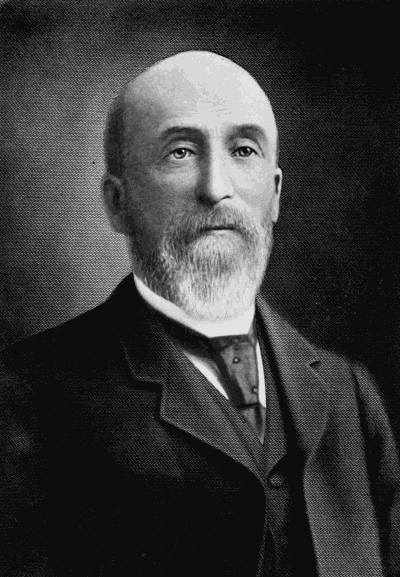
WILLIAM KIRKMAN
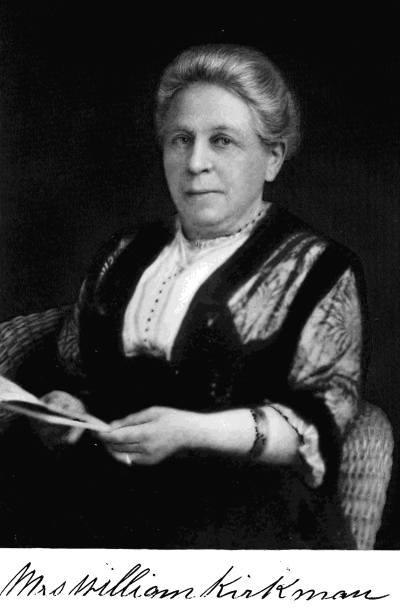
On the 4th of February, 1867, in San Francisco, Mr. Kirkman was united in marriage to Miss Isabella Potts, a native of Ireland and a daughter of Robert and Agnes (Evans) Potts, who passed their entire lives on the Emerald isle. Mrs. Kirkman came to the United States in her girlhood, going to San Francisco to join her two sisters who were already residing there. The four surviving children of Mr. and Mrs. Kirkman are William H., Fannie A., Myrtle B. and Leslie G. The eldest son was horn in Idaho in May, 1868, and pursued his education in Whitman College and in the Boston University, from which he was graduated on the completion of a law course in the class of 1893 and then located for practice in Walla Walla, where he followed his profession for two years. He wedded Maud Ashley, who passed away in 1905, leaving one son, William Leslie, who was born in 1901. William H. Kirkman resided in Walla Walla and filled the office of clerk of the federal court for a year. He was also a member of the city council and a member of the school board. Fraternally he was connected with the Masons as a member of the York Rite and of the Mystic Shrine, and he also held membership with the Elks, in which he filled all of the chairs of the local lodge. Fannie A. is the wife of A. H. Reynolds, a prominent attorney and president of the Farmers Savings Bank of Walla Walla. The youngest son, Leslie G., was born in Walla Walla in June, 1881, and pursued his education in the schools of his native city. He married Mabelle E. Hawman and they have one child, Leslie Gilmore, who was born in 1916. Leslie G. Kirkman is an Elk and a Mason. He resides in Walla Walla and he and his brother are engaged in farming, the latter having retired from law practice, and they are now devoting their attention to the cultivation, development and further improvement of the old homestead property which was left by their father. Myrtle B. Kirkman resides with her mother in Walla Walla.
William Kirkman was very prominent in civic affairs and exerted great influence on many interests that had to do with the upbuilding and progress of Walla Walla. His political allegiance was given to the republican party and he was a delegate to the national republican convention which was held in Minneapolis in 1892 and nominated Benjamin Harrison. He was appointed on the committee with William McKinley to notify Mr. Harrison of his nomination. Mr. Kirkman served on the first board of directors of the penitentiary upon its establishment and was a member of the board of education in Walla Walla, contributing much to the development of its school system. As previously stated, he was closely associated with the welfare and progress of Whitman College and was still a member of its board of directors at the time of his demise. He was a man of sterling qualities, possessing a kindly, genial disposition that endeared him to those who came in contact with him, and was charitable to a fault. Although not a member of any church, he was a liberal contributor to the support of various religious bodies of the city and no worthy cause appealed to him in vain. His interests were broad and embraced all that was worth while in life, yet his greatest care and his fullest devotion were always given to his home and family.
CLEMENT O. BERGEVIN.
Clement O. Bergevin, who is actively engaged in farming on section 35, township 7 north, range 34 east, was born on the old Bergevin homestead in this part of Walla Walla county, his natal day being March 16, 1891. He is a son of Damase and Mary P. (Allard) Bergevin, the former a native of Canada and of French extraction. He is mentioned elsewhere in this work.
Clement O. Bergevin spent his youthful days in his father's home and acquired his education in the old French town school. In 1912 he began farming on his own account. He had been reared to that occupation and early became familiar with the best methods of tilling the soil and cultivating the crops. He thus brought broad experience to his work when he started out independently. He is now cultivating three hundred and twenty acres of land, upon which he now resides and which is a part of his father's estate. He also owns a third equity in a farm of three hundred and twenty acres elsewhere in the same township and a third equity in a five hundred acre tract. His farming interests are thus extensive and important and in all of his business affairs he displays marked energy and determination. His industry has enabled him to overcome obstacles and difficulties in his path and capable management has brought him substantial reward.
On the 12th of May, 1915, Mr. Bergevin was united in marriage to Miss Hazel Johnson, of Walla Walla, a daughter of Edward Johnson, one of the prominent coal dealers of that city. Mr. Bergevin is a member of the Catholic church and is identified with the Knights of Columbus. He has comparatively few outside interests, however, preferring to concentrate his efforts and attention upon his business affairs. He is yet a young man who has only passed the twenty-sixth milestone on life's journey, but already he has made for himself a place in business circles that many a man of twice his years might well envy. He displays good judgment in all that he does and his careful management of his property and his progressive methods of farming are bringing to him merited success.
NELSON McSHERRY.
Nelson McSherry made for himself a creditable position in the business and political circles of Prescott, so that his death was the occasion of deep and widespread regret when on the 27th of July, 1916, he passed away. He was then but sixty-one years of age, his birth having occurred on the 31st of July, 1855. He was a native of Pennsylvania and a son of J. J. and Margaret (Mitchner) McSherry, both of whom were natives of the Keystone state. At an early day they removed with their family to Missouri, settling near Warrensburg, where they spent their remaining days, and there Nelson McSherry was reared and educated. He was a young man of twenty-five years when in 1880 he was united in marriage to Miss Mary E. Harvey, of Warrensburg, and to them were born five children: Lulu, who is the wife of J. D. Walter; Robert, who is living in Nevada; Joseph C., whose home is in Prescott; Urie D.; and Hester.
Mr. and Mrs. McSherry began their domestic life in Missouri and there resided until 1888, when they came with their family to the northwest, establishing their home in Prescott, where Mr. McSherry embarked in business as proprietor of a small mercantile establishment. He adapted himself and his affairs to this part of the country and the conditions here existing and in the course of years he built up a growing and gratifying business. He closely studied the needs of the people in relation to the line of goods which he carried and by reason of his carefully selected stock, his reasonable prices and his straightforward dealing he won a very liberal and well deserved patronage, so that his business became one of the profitable enterprises of the town.
In public affairs Mr. McSherry also took a deep and helpful interest. His fellow townsmen, recognizing his worth and ability, elected him the first mayor of Prescott. He was always ready to advance the interests of the town in every possible way and stood at all times for progress and improvement. Fraternally he was connected with the Woodmen of the World and the Independent Order of Odd Fellows. He was reared a Methodist, but Mrs. McSherry is a member of the Presbyterian church. In 1913, because of failing health, he retired from active business and turned the management of his store over to his sons. Death called him in 1916 and at his passing deep regret was felt for he was a progressive business man, a loyal and patriotic citizen, a faithful friend and a devoted husband and father. He counted it his greatest happiness to provide for the welfare and comfort of his wife and children and in every relation of life he manifested those sterling qualities which command respect, confidence and honor in every land and clime.
GEORGE E. LAMBDIN.
George E. Lambdin has been actively and prominently identified with farming and stock raising interests in the northwest and is now carrying on general agricultural pursuits on section 22, township 7 north, range 32 east, in Walla Walla county. He was born on the 27th of September, 1870, in Montana, his parents being Samuel and Mary E. (Spade) Lambdin. The father was a native of Delaware, while the mother's birth occurred in Ohio. They were married in Iowa and at the time of the opening up of the gold fields in Montana, in 1865, they crossed the plains with ox teams to that state. The father worked in the mines in Deer Lodge valley and also in the Butte mines for six years and the family went through the usual experiences of the mining camp in the west. In 1872 they removed to Walla Walla county, Washington, where Mr. Lambdin preempted a quarter section of land just across the line in Oregon, on the present site of Freewater. Ten years later he crossed the border into Washington and took up a homestead on section 30, township 7 north, range 32 east, in Walla Walla county. He then lived in this immediate vicinity until the time of his death and during the later years of his life made his home with his son, George E., whose name introduces this review. He passed away April 20, 1908.
George E. Lambdin spent his youthful days upon the home farm and acquired a district school education. As early as his seventeenth year he began his career as a sheepman, starting with twenty-five head. While working for H. C. Adams as a sheep herder he accumulated a small number of sheep and his herd multiplied rapidly, so that about 1900 he was in a position to operate for himself on a larger scale and began independent activities. In the intervening years he has acquired from three to four thousand acres of grazing land and while he has recently sold off his own flock, he is associated with C. W. Stevelan in operating sheep interests under lease. In this connection he is among the most prominent sheepmen of the county. His business affairs are wisely and carefully directed. His long experience in connection with the sheep industry has taught him exactly how to care for his flock so that the best results will be achieved. There is no feature of sheep raising with which he is not familiar and his intelligently directed interests have brought very substantial results.
In 1903 Mr. Lambdin was married to Miss Catherine A. Bradley, of Walla Walla county, and they have become the parents of three children: Samuel Allen, Mary Isabelle and Margaret Elizabeth. In politics Mr. Lambdin maintains an independent course, although he is inclined to give his support to the republican party. He belongs to Attalia Lodge, No. 294, I. O. O. F., of Attalia, Washington, and he also has membership with the Modern Woodmen of America and with the Royal Neighbors. He is true and loyal to the teachings of these organizations and exemplifies in his life the beneficent spirit which underlies the different societies. As a business man his position is one of prominence and his capability is widely recognized. He deserves much credit for what he has accomplished, for from an early age he has been dependent upon his own resources. As the years have gone by his labors have brought substantial results and he is today accounted one of the foremost sheepmen of the northwest.
HON. ELGIN V. KUYKENDALL.
Hon. Elgin V. Kuykendall is a member of the state senate of Washington and is one of Pomeroy's foremost attorneys. His record reflects credit and honor upon the district which has honored him. He has done splendid work both as lawyer and lawmaker and has become prominently connected with a profession which has ever been regarded as having much to do with the stability, prosperity and upbuilding of every district, standing as the stern conservator of the rights, privileges and liberties of the individual. His entire life has been spent in the west with its boundless opportunities and limitless resources, and with him opportunity has ever been the clarion call to action. He was born in Oakland, Oregon, October 8, 1870, a son of Dr. G. B. Kuykendall, a foremost citizen and leading pioneer physician of Pomeroy, who is mentioned at length on another page of this work.
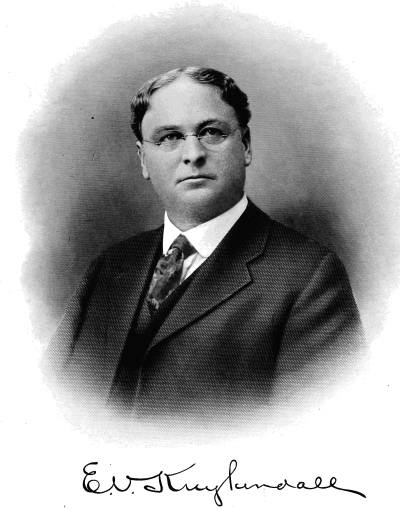
Elgin V. Kuykendall was educated in the public schools of Garfield county and has learned many valuable lessons in the school of experience, for he has ever been a close and attentive observer of men and of measures. Determining upon a professional career, he took up the study of law in 1892, pursuing his reading under the preceptorship of Samuel G. Cosgrove of Pomeroy, who was afterward governor of Washington. In 1894 Mr. Kuykendall was admitted to the bar but did not immediately take up the active practice of the profession but continued to give his attention to educational work, in which for some time he had been engaged. He had proven a capable teacher, imparting readily and clearly to others the knowledge that he had acquired, and in 1894 he was elected county superintendent of schools, in which office he served for one term. During the last year of his incumbency in that position he was appointed to fill out an unexpired term of six months as principal of the Pomeroy high school. In 1897, however, he concentrated his efforts and attention upon the practice of law and in 1898 was elected prosecuting attorney of Garfield county, in which position he served for one term. In 1900 he was elected mayor of Pomeroy and occupied that position for one term, giving to the city a businesslike and progressive administration characterized by needed reforms and measures of public improvement. At the same time he continued in the practice of law independently until February, 1898, when he entered into partnership with Judge Mack F. Gose under the firm name of Gose & Kuykendall, a relationship that existed until the appointment of the senior partner to the supreme bench in 1900. Mr. Kuykendall then practiced alone for two years and in 1911 the present law firm of Kuykendall & McCabe was formed, C. Alexander McCabe being admitted to a partnership that still maintains, the firm occupying now a very prominent position in the legal circles of the state. Their practice is extensive and of an important character and in the conduct thereof Mr. Kuykendall has displayed talent, learning, tact, patience and industry. His legal learning, his analytical mind, the readiness with which he grasps the points in an argument all combine to make him a strong advocate and a wise counselor. In connection with his brothers he has fourteen hundred acres of land held in equity.
In 1896 Mr. Kuykendall was joined in wedlock to Miss Marguerite Scully, a daughter of Matthew Scully, who was one of the pioneer farmers of Asotin county, Washington, and now resides near Twin Falls, Idaho. Mr. and Mrs. Kuykendall have become the parents of four children, as follows: Matthew Lorraine, a student in the Washington State College; Ruth Lenore, who attended the State Normal School at Cheney, Washington, and is now engaged in teaching in Garfield county; Berdina Claire, a high school student at Pomeroy; and Jerome Kenneth, who is attending the graded schools.
Both Mr. and Mrs. Kuykendall are members of the Methodist church and she is president of the Ladies' Aid Society of that church and also president of the Civic Improvement Club of Pomeroy. She is likewise a member of the Red Cross Society.
In his political connection Mr. Kuykendall has always been a stalwart republican and in November, 1916, he was chosen to represent his district in the state senate, where he was made a member of a sub-committee for framing a new probate code. He has been a conspicuous figure in the legislative halls and has served repeatedly as chairman of the state central committee of the republican party, thus taking active part in guiding the destinies of his party in the northwest. While serving as mayor of Pomeroy he was instrumental in establishing the present city park, which the city purchased from Governor Cosgrove. Fraternally he is connected with Garfield Lodge, No. 25, K. P., and has been quite active in the affairs of that organization. He has been a member of the grand judiciary committee of the state for sixteen years, a longer period than that of any other incumbent in the position. He is also identified with the Woodmen of the World. His interests are broad and varied and in relation to the great sociological, economic and political problems of the country he keeps abreast with the best thinking men of the age. He is forceful and his ability and initiative have made him a dynamic power in the public life of southeastern Washington.
J. U. STRAHM.
At a period when the government owned most of the land in Washington and the work of progress and development seemed scarcely begun, J. U. Strahm and his wife came to Walla Walla county and cast in their lot with its pioneer settlers. They here underwent many of the hardships and privations incident to establishing a home on the frontier, but with resolute spirit they met all these and in the course of years came to enjoy the comforts of modern day civilization. Mr. Strahm was born in Switzerland, July 30, 1827, and was but six years of age when brought to America by his parents, the family home being established in Ohio. They afterward removed to Iowa and in 1849 J. U. Strahm removed to California, attracted by the discovery of gold on the Pacific coast. There he remained for three years, after which he returned to Missouri, where in 1864 he was united in marriage to Miss Mary Jane Farley, a daughter of Harvey and Elizabeth (Bruett) Farley, the former a native of Ohio, while the latter was born in Indiana. The father was killed while serving as a soldier in the Civil war and the mother afterward passed away in Tennessee.
Following their marriage Mr. and Mrs. Strahm resolved to try their fortune in the far west and made their way across the country to Walla Walla county, where he took up a homestead near Dixie. There was little to indicate the wonderful changes which were still to occur as the white settlers penetrated into this region and reclaimed its rich resources for the purposes of civilization. The greater part of the land was still unclaimed and uncultivated and the most farsighted could scarcely have dreamed of what the future held in store for this rich district. Mr. Strahm became actively identified with its farming interests and bent his energies to the development of his place, bringing his fields under a high state of cultivation and therefore annually gathering rich harvests.
To Mr. and Mrs. Strahm were born fourteen children, eleven of whom are now living: Ann J., the widow of John Byrd; William H., who is deceased; Elizabeth, the wife of John Glynn; Rosa D., the wife of Tom Hastings; Mary E., the wife of Eldon Buroker; Nora J., the wife of Joel Chitwood; John E.; Nannie V., who is the wife of Alfred Brown; Lucretia R., the wife of Alvin McElvain; Viola, the wife of Fred Wells; Edna, at home; Alma B., the wife of Jene Green; and two who are deceased.