BIOGRAPHICAL (continued 6)
Reading edition
E. H. Leonard was reared to farm life and his education has been practically self acquired. He worked in his father's fields until his twenty-fifth year and in 1898 he became connected with milling operations as an employe of the North Pacific Flour Mills Company at Prescott. In March, 1900, he was made foreman of the mills and in July of the same year, when the mills were acquired by the Portland Flouring Mills Company, Mr. Leonard was made manager, which position he continued to fill until 1904. In that year he was advanced to the position of district manager with the Portland Flouring Mills Company and in that connection had supervision over the mills of Dayton and Prescott and later also of Walla Walla. He continued in that capacity until January 1, 1916, at which time, having acquired an interest in the Preston-Shaffer Milling Company at Waitsburg, he was made assistant manager and removed to Waitsburg. This company also owns mills at Athena, Oregon. At the first meeting of the directors after his removal to Waitsburg, Mr. Leonard was elected to the vice presidency of the company in recognition of his marked ability and his long experience in the milling business. There is no phase of flour manufacture with which he is not familiar and in the operation of the plants of the Preston-Shaffer Company he utilizes the latest improved machinery and the most modern processes, displaying marked enterprise in the control of the business. While thus extensively engaged in milling for nineteen years he has also continued his farming operations and now owns and operates two farms in Walla Walla county, comprising twenty-five hundred acres. He has thus become one of the prominent wheat growers of the Inland Empire. Either one of his business connections are sufficiently extensive and important to rank him with the representative business men of this section of the country. He is both forceful and resourceful and readily recognizes and utilizes opportunities which others pass heedlessly by. He is fortunate in that he possesses character and ability that awaken confidence in others and the simple weight of his character and his ability have carried him into important relations.
In November, 1900, occurred the marriage of Mr. Leonard and Miss Minnie Belle Lieuallen, of Portland, Oregon, and they have become the parents of three children: Mineta Belle, who is attending high school; Edgar Hugh, a student in the graded schools; and Joanna Jeanne.
Mr. Leonard is a republican in his political views and fraternally is connected with Waitsburg Lodge, No. 16, A. F. & A. M.; Dayton Chapter, No. 5, R. A. M.; and Walla Walla Commandery, No. 1, K. T. He also has membership with El Katif Temple, A. A. O. N. M. S., of Spokane, and belongs to Whetstone Lodge, No. 157, K. of P., of Prescott. His record is an inspiring one, for out of a struggle with small opportunities he has come into a field of broad and active influence and usefulness. Quick discernment and the faculty of separating the important features of any subject from its incidental or accidental circumstances have been strong phases in his career. His business has ever balanced up with the principles of truth and honor. He has ever been possessed of sufficient courage to venture where favoring opportunity is presented and his judgment and even-paced energy have carried him forward to the goal of success. His quietude of deportment, his frankness and cordiality of address, with the total absence of anything sinister or anything to conceal, foretoken a man who is ready to meet any obligation of life with the confidence and courage that come of conscious personal ability, right conception of things and an habitual regard for what is best in the exercise of human activity.
JOHN F. BREWER.
Twelve years have passed since John F. Brewer was called to his final rest, but his memory is cherished by many who knew him, as he stood as a high type of manhood and citizenship and was devoted to the welfare and progress not only of his family but of the community in which he lived. He was born in Scotland county, Missouri, November 9, 1842, a son of David and Susan (Small) Brewer, who crossed the plains with an ox team in 1853, reaching Salem, Oregon, where they established their home. Their son, John F., was then a little lad of ten years and he completed his public school training in Salem, while later he pursued a course of study in Sublimity College, some fourteen miles from Salem. He then took up the profession of teaching, which he followed in the public schools for many years, imparting readily and clearly to others the knowledge that he had acquired. In 1872 he removed to the Walla Walla valley, where he engaged in farming. His agricultural interests were carefully and successfully conducted and for many years he concentrated his efforts and attention upon the development of the fields. At length, however, he left the farm and removed to Walla Walla, building a handsome home on Boyer avenue. In 1876 he purchased a large tract of land east of the city and became one of the leading and extensive farmers of Walla Walla county. In 1890 he removed to Seattle, where he platted a tract of land which he called the Walla Walla addition but in this enterprise he was not successful and returned to Walla Walla, where his investments were judiciously made, his business affairs capably managed and his enterprise brought to him a very gratifying and substantial measure of success.
In March, 1872, Mr. Brewer was united in marriage to Miss Adora D. Stanton, a native of Oregon and a daughter of Benjamin and Matilda (Baldwin) Stanton. Her parents were natives of Kentucky and crossed the plains by wagon in 1852, settling near Salem, Oregon. They had a family of eleven children, of whom seven are still living. Mr. and Mrs. Brewer became the parents of nine children, namely: John, who is manager of the Commercial Club at The Dalles, Oregon, but is now in the government service at Portland Oregon; Merton, a practicing attorney at Auburn, Washington; Ada, who has passed away; Frank, living in Walla Walla county; Maud, the wife of Charles Ulm, of Ritzville; Bertha, who is the widow of Eugene Dunbar and now lives in Anchorage, Alaska; Dora, who is the wife of Fred Snedecor, of Corona, California; Roy, who is a sergeant in the United States army with the First Illinois Infantry; and Luella, the wife of Frank Harlow, of Los Angeles, California.
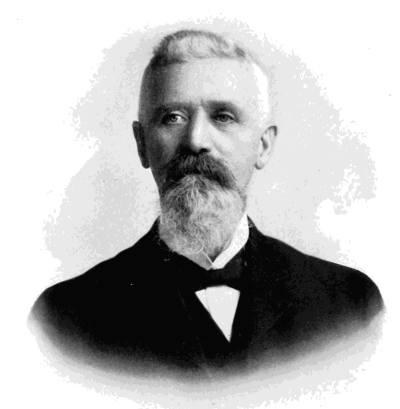
JOHN F. BREWER
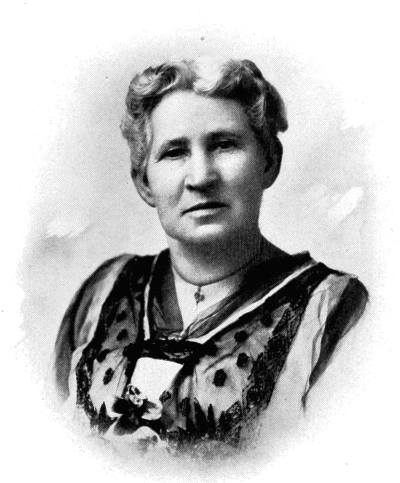
MRS. JOHN F. BREWER
Mrs. Brewer owns a fine residence on Boyer avenue in Walla Walla, where she resides, and in addition she has five hundred and twenty acres of valuable wheat land near the city and another tract of eight hundred acres in Franklin county. She is an active and prominent member of the Sunshine Club and is also connected with the Eastern Star and church organizations. Mr. Brewer left his family in very comfortable financial circumstances when death called him on the 21st of February, 1905. He was one of the valued and respected citizens of this section of the country. He took an active part in the development of Walla Walla county and never withheld his support from any enterprise that he believed would prove beneficial in any way. He was intensely patriotic and he stood for all that was progressive in relation to public affairs. He served for several terms as alderman of his city and at the time of his death was filling the position of councilman for his ward. To him belongs the honor of being the father of the paid fire department of Walla Walla, which has proven successful and satisfactory even beyond his confident predictions. Fraternally he was connected with the Independent Order of Odd Fellows, the Knights of Pythias. the ancient Order of United Workmen and the Royal Arcanum, while his religious faith was indicated by his membership in the First Presbyterian church.
His home paper, in writing of his death, said: "In the death of John Brewer, Walla Walla loses one of her best and most progressive citizens. No citizen of the town had more warm personal friends, and his demise has brought sadness to many a home. As private citizen and public official he always strove to do his full duty. He endeavored to be just to all men and he spoke ill of no one. He was broad-minded and conservative, generous and public spirited. It would be hard to find a man in the community with fewer faults and more virtues. His home life was ideal and it is no wonder that those nearest and dearest to him find it so hard to reconcile themselves to the loss of a kind and loving husband and father."
"I cannot say and will not say That he is dead, he is just away; He has wandered into an unknown land With a cheery smile and a wave of the hand; And left us dreaming how very fair It needs must be, since he lingers there."
VICTOR E. SIEBERT.
Victor E. Siebert is a member of the firm of Osterman & Siebert, known as Walla Walla's foremost architects, in which connection he has developed skill of the highest degree, and his patronage is indicative of the high order of his work. He is a native son of Walla Walla, born October 3, 1884, his parents being Chris and Minnie (Nahen) Siebert, the former a native of Berlin, Germany, while the latter was born in Red Bluff, California. The father was reared to manhood and pursued his education in his native country and served throughout the Franco-Prussian war. Following that conflict, in 1875, he came to the United States, making his way to Oconto, Wisconsin, but after a brief period there passed he removed westward to Washington, establishing his home in Asotin county, where he took up a homestead claim and lived for a few years. He later removed to Walla Walla county and purchased a farm six or eight miles east of the city of Walla Walla, on which he resided for some time. He next removed to the city, where he now makes his home. He is still active in farming in a small way but in a measure has put aside the arduous duties of life.
Victor E. Siebert, whose name introduces this review, was educated in the Baker school of Walla Walla and when eighteen years of age he began the study of architecture in the office of Henry Osterman, with whom he thus remained for three years. He then went east to complete his education and entered the Boston Technical School in the fall of 1906. There he pursued a special course in architecture, attending the institution for four years. After completing his studies he entered into partnership with Peter F. McLaughlin and established business in Pittsfield, Massachusetts, under the firm style of McLaughlin & Siebert. This relationship existed for two and a half years, at the end of which time the partnership was dissolved and in the fall of 1912 Mr. Siebert returned to Walla Walla and entered into partnership relations with Mr. Osterman, his former preceptor. They are well known architects of this city, the firm of Osterman & Siebert occupying a very creditable and enviable position in professional circles. Many of the most important buildings of the northwest have been designed and erected by them and stand as monuments of their skill, their enterprise and business ability.
In 1910 Mr. Siebert was united in marriage to Miss Mary Hoelzel, of Adams, Massachusetts, and they have become the parents of two children, Henry and Gretchen. Mr. Siebert is a consistent member of Blue Mountain Lodge, No. 13, F. & A. M., and also belongs to Columbus Council of the Knights of Kadosh, No. 6, of Walla Walla, and to Oriental Consistory, No. 2, A. & A. S. R. He is also connected with El Katif Temple, A. A. O. N. M. S., of Spokane. His political allegiance is given to the republican party. He belongs to the Walla Walla Commercial Club and is one of the city's representative men, his aid and influence being always given on the side of progress and advancement, reform and improvement. He and his wife are members of the Christian Science church and their genuine personal worth has gained for them a circle of friends almost coextensive with the circle of their acquaintance. Thorough preliminary training has constituted the basis of Mr. Siebert's success in a professional way and fidelity to the highest standards of business has actuated him at every point in his career. The northwest is fortunate in having his services in connection with its important growth and development and Walla Walla is proud to number him among her citizens.
WILLIAM T. LANE.
William T. Lane is a Civil war veteran and a retired farmer who is now living in Starbuck. He was born in Tennessee, December 27, 1841, and is a son of Tidence and Rebecca (Huhn) Lane, who were natives of Tennessee. The father was killed in that state by a falling tree. The mother afterward removed to Missouri, where her last days were passed. They had a family of three children but William T. is the only one now living.
Through the period of his boyhood and youth William T. Lane remained a resident of Tennessee but in 1865, when twenty-four years of age, went to Missouri and established his home in Johnson county. In 1880 he came to Columbia county, where he rented a farm for two years and later he invested his savings in land, becoming owner of a place four miles south of Starbuck, comprising four hundred acres. He occupied that farm for twenty years, devoting his time and energies to its further development and improvement with the result that he converted it into a most valuable and productive agricultural property. At length he sold the place and settled in Starbuck, where he now resides, and through the intervening period he has lived retired, enjoying a well earned rest.
In 1870 Mr. Lane was united in marriage to Miss Nettie Oliphant, a native of Missouri, and they became the parents of seven children: Nancy E., who is the wife of C. A. Gregory; Hattie E., who is the wife of W. E. Phillips; and five who have passed away. The wife and mother died in December, 1908, and was laid to rest in the Starbuck cemetery. She left a husband and two daughters to mourn her Loss. She was devoted to the welfare of her family and had many excellent traits of character which endeared her to all with whom she was brought in contact.
Mr. Lane is a member of the Christian church. He is a veteran of the Civil war, having enlisted in 1861 as a member of Company C, Sixty-first Tennessee Regiment. He was paroled at Vicksburg and came out without a scratch although he had taken part in several hotly contested battles. His life has been a busy and useful one, largely devoted to farming interests, and by unfaltering industry and determination he has advanced steadily on the highroad to success. He is one of the leading men of the valley in which he resides and is enjoying a prosperity which is the merited reward of his labors.
J. W. CLODIUS.
J. W. Clodius is a well known representative of farming interests in Walla Walla county, where he is now engaged in the cultivation of thirteen hundred acres of land. He makes his home on section 34, township 9 north, range 37 east, and his well directed energy and careful management are bringing to him substantial success. He was born April 28, 1889, in the county where he yet resides, his parents being Hans F. and Catherine (Rhode) Clodius, who came to Walla Walla county in 1881. They were both natives of Germany, where they were reared and married, and about 1870 they crossed the Atlantic to the United States, settling in Illinois, where they remained until they came to Washington. On removing to the northwest they established their home in Walla Walla county and the father acquired land from time to time until he owned thirteen hundred acres. He settled on Mill creek and about 1897 removed to the home farm, upon which his son, J. W. Clodius, now resides. There he continued to live until 1913, when he put aside the active work of the fields and removed to Waitsburg, where he is now located. He is numbered among the honored and valued pioneer settlers of his section of the state and made for himself a creditable record in business circles, for through his individual effort, persistency of purpose and honorable dealing he gained a most substantial competence.
J. W. Clodius acquired a public school education and through the period of his boyhood and youth remained at home, assisting his father in the operation of the farm. Upon the latter's removal to Waitsburg he then took charge of the home property and is now engaged in cultivating thirteen hundred acres of rich land. He is thus numbered among the leading agriculturists of the community. The methods which he pursues are most practical and progressive. He is systematic and methodical in all that he does, he employs the latest improved machinery to facilitate the work of the fields and by energy and persistency of purpose is winning success.
On the 8th of November, 1911, Mr. Clodius was united in marriage to Miss Ina Mary Harkins, of Waitsburg, a daughter of James Harkins, who is now deceased. Her mother, who bore the maiden name of Anna Elizabeth Harris, is now living on a farm in Bolles Junction. She was born, reared and married in Illinois, though her husband was a native of Davenport, Iowa. Shortly after their marriage they came west and located in Lane county, Oregon, where they remained until 1898 and then removed to Waitsburg, Washington, where the death of Mr. Harkins occurred. In their family were eight children, seven of whom are still living. Both Mr. and Mrs. Harkins held membership in the Christian church. Mr. and Mrs. Clodius have become the parents of two children, Emory W. and Brenda M.
Fraternally Mr. Clodius is connected with Walla Walla Lodge, No. 287, B. P. O. E. In politics he maintains an independent course, voting according to the dictates of his judgment. He is yet a comparatively young man but has made for himself a most creditable position in agricultural circles and the extent and importance of his farming interests are indicative of his business ability.
THEODORE GROTE.
Theodore Grote, one of the foremost farmers of Columbia county, Washington, owning ten thousand acres of fine wheat and pasture land, was born in Germany, July 5, 1881, a son of John and Anna (Dryer) Grote, also natives of that country. In 1882 they emigrated to America with their family and took up their residence in Ohio, whence three years later they removed to Kansas. They resided in that state for three years and then came to Washington, first locating in Whitman county. In 1893, however, they removed to Walla Walla county, and there the father passed away in 1915, while the mother survives.
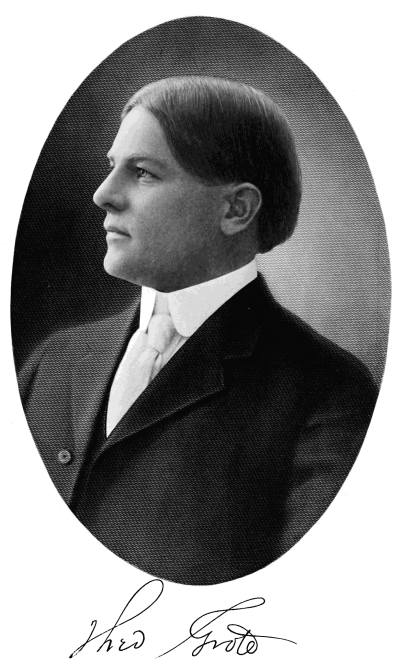
Theodore Grote, who is one of a family of five children, was brought to Washington when a child and in the acquirement of his education attended the common schools. In 1897 he began farming in partnership with his father and brothers, operating eighteen hundred acres of leased land. He devoted six years to that work and then removed to Canada, where for a year he was in the sheep business. He then returned to Walla Walla and purchased fifty-five hundred acres of land and leased six thousand acres. Four years later he sold his property to his brother Ben, but after a period of two years he again purchased land, becoming the owner of a valuable tract in Columbia County on section 10, township 11 north, range 38 east. He has since added to his holdings and is now the owner of ten thousand acres, of which forty-three hundred acres is wheat land and the remainder pasture land. He has a herd of six hundred head of cattle and his stock raising interests are very profitable. As a wheat grower he met with unusual success, and he is always among the first to adopt a new method or implement of value. He is systematic and businesslike in the management of his affairs, realizing that the day of haphazard, unthinking farming has passed.
Mr. Grote was married in February, 1911, to Miss Matie C. Baumann, who was born in Washington. He is an advocate of the principles of the republican party but confines his participation in public affairs to the exercise of his right of franchise. He belongs to the Elks at Walla Walla and is a member of the Masonic Lodge, No. 106 F. & A. M., at Starbuck and of the Royal Arch Chapter at Dayton. His ability stands out as an unquestioned fact and it is generally recognized that he is an important factor in the development of Columbia county along agricultural and stock raising lines.
A. G. LLOYD.
Fifty-eight years ago A. G. Lloyd became a resident of Walla Walla county and in a little log cabin began life in true pioneer style. He had, however, been a resident of the west for a much longer period, the family home having been established in Oregon in 1845. He was born in Missouri, July 25, 1836, his parents being John and Nancy (Walker) Lloyd, both of whom were natives of North Carolina. At a very early period they removed westward to Missouri and in 1845 crossed the plains with ox teams, making the long wearisome journey across the hot stretches of sand and over the mountains, three years before gold had been discovered in California, at which later time the trails to the west were more definitely marked and more easily followed. They located in Benton county, Oregon, where the father took up a donation claim of six hundred acres. There he built a log cabin covered with a clapboard roof and the chimney was built on the outside of the primitive dwelling. Hardships and privations fell to their lot but with stout hearts and undiminished courage they put forth every effort to establish a home on the western frontier and were active with those who were planting the seeds of civilization in Washington. The mother died while the family resided upon the homestead farm and the father afterward removed to Colfax, Washington, where he passed away in 1875. In their family were nine children, but one of whom is now living.
A. G. Lloyd was reared and educated in Oregon, having been but a little lad of nine summers at the time of the removal to the west. There was no phase of pioneer life with which he was not familiar. He served in the Indian war on the Walla Walla river and was in the Seven-Day fight. He became familiar with all of the methods of treacherous warfare practiced by the savages and he aided in reclaiming the region for the purposes of civilization. He was mustered out in July, 1856, and returned to the work of the farm.
In 1858 he was united in marriage to Miss Lois Jasper, a native of Kentucky and a daughter of John and Mary (Heath) Jasper, who were also natives of the Blue Grass state, whence in 1842 they removed to St. Joseph, Missouri. The father died in that state and the mother with her family of six children afterward, in 1854, crossed the plains and became a resident of Benton county, Oregon. In the family were eight children, of whom three are now living.
Mr. and Mrs. Lloyd began their domestic life in Oregon, but in July, 1859, removed to Walla Walla county, Washington, where he secured a homestead claim of one hundred and sixty acres two and a half miles from Waitsburg on the Touchet river. Upon his land he built a log cabin with puncheon floor and door. The home was most primitive but it sheltered stout hearts and willing hands. They bravely faced the conditions of pioneer life in order to secure a home for themselves and for eight years they lived upon that place without change. At the end of that time Mr. Lloyd was able to purchase more land and his widow now owns two hundred acres, for some of which she has been offered three hundred dollars per acre. The rapid settlement of this section of the country, together with the improvements made upon the farm, have greatly enhanced the value of the property, which returns to Mrs. Lloyd a very gratifying annual income. In his business career Mr. Lloyd displayed marked diligence and determination and his farming interests were wisely and carefully managed, so that he became recognized as one of the foremost agriculturists of this section of the state. As the years went on eleven children were added to the family, of whom six are now living, namely: J. C., who is in California; G. M., a resident of Waitsburg; Wesley A., who is occupying the old homestead; Gilla Ann, the wife of C. C. Milinger, of Spokane, Washington; Ralph G., also living in this state; and Angeline, the wife of F. G. Aldridge.
The death of the husband and father occurred January 5, 1915, since which time Mrs. Lloyd has personally managed the farm. Mr. Lloyd not only figured as one of the leading representatives of agricultural life in Walla Walla county but was a most prominent and influential factor in other connections. He attained the thirty-second degree of the Scottish Rite in Masonry and held all of the chairs in the different Masonic branches with which he was affiliated. His political allegiance was given the democratic party and he was one of its recognized leaders. His opinions carried weight in its councils and his efforts were an element in advancing its success. Five times he was elected to represent his district in the general assembly of Washington and he left the impress of his individuality upon many important legislative measures which were enacted during that period. He closely studied the questions and issues of the day and gave his aid and support to any measure or movement which he believed would promote the interests of the commonwealth and stood with equal firmness in opposition to any cause which he believed would be detrimental to the welfare of the community at large. His position was never an equivocal one and he loyally supported every measure in which he believed. None questioned the integrity of his opinions or of his actions. He served as a delegate to both county and state conventions and did much to mold public thought and opinion. Mrs. Lloyd is a member of the Eastern Star and also of the Rebekah lodge and in these organizations has filled all of the chairs. She is a consistent member of the Presbyterian church, while Mr. Lloyd was a member of the Methodist Episcopal church. He was prominent as a man whose constantly expanding powers took him from humble surroundings to the field of large enterprises and continually broadening opportunities. He was reared upon the western frontier and the effort required to live in those ungenerous surroundings, the necessity to make every blow tell and to exercise every inventive faculty developed powers of mind and habits which made him a forceful and resourceful business man and citizen. The early rising, the daily tasks, the economical habits of the country boy prepared him for the struggle that most precede ascendency and step by step Mr. Lloyd gained success in business and prominence in public life.
W. M. TAYLOR.
W. M. Taylor resides in Waitsburg but is identified with farming on section 31, township 9 north, range 38 east, in Columbia county. He has resided in this state since reaching the age of eighteen years. He was born in Johnson county, Missouri, January 31, 1861, and is a son of Simon and Harriet (Burgess) Taylor, who are mentioned in connection with the sketch of his brother, Charles M. Taylor, on another page of this work. The public school system of his native county afforded him his educational privileges. He made good use of his time and opportunities in that direction and when not busy with his textbooks he was assisting in the work of the home farm and thus learning valuable lessons in the school of experience. He had reached the age of eighteen years when he came to Washington, after which he remained at home, cooperating with his father in the development and improvement of a new farm up to the time of his marriage. In the meantime, however, he and his brothers, G. B., J. W. and J. F. Taylor, bought eight hundred acres of land, which they cultivated in partnership, and they also operated one thousand acres belonging to Whitman College. This they leased and the four brothers continued their farming interests together until about 1907, when a division of their holdings was made, and W. M. Taylor acquired three hundred and sixty acres of the land that had been held conjointly before. He has since purchased two hundred and forty acres adjoining his other tract, so that his home farm now comprises six hundred acres and constitutes one of the valuable wheat ranches of Columbia county. The soil is particularly adapted to wheat raising and the crops produced are most extensive and gratifying, for the methods which Mr. Taylor follows in the development of his fields are practical. All of the work on the farm is systematically done and is guided by his sound judgment. He uses the latest improved machinery to facilitate the work of the fields and there is no equipment of the model farm property of the twentieth century that is not found upon his place.
On September 18, 1889, occurred the marriage of Mr. Taylor and Miss Flora Kinyoun, of Johnson county, Missouri, who came to Washington to teach music in 1887. By her marriage she became the mother of two children: Harriet E., the wife of R. B. McElroy, of Spokane, Washington; and Laura E., the wife of Theodore Holsey, of Spokane, this state. The wife and mother passed away in 1897 and on November 29, 1899, Mr. Taylor was again married, his second union being with Mrs. Lillian Devall, née Pinkley, who was a teacher in the public schools of Walla Walla and Columbia counties. To this marriage has been born a daughter, Florence G.
Fraternally Mr. Taylor is connected with Touchet Lodge, No. 5, I. O. O. F., and he also belongs to the Ancient Order of United Workmen. His political views are in accord with the principles of the democratic party. He and his wife are members of the Methodist church and their lives are guided by its teachings and its principles. Aside from his farming interests Mr. Taylor became one of the incorporators of the Exchange Bank of Waitsburg, of which he is still a stockholder. He has made for himself a very creditable position as a substantial farmer and representative citizen of Columbia county. After the harvests are gathered he takes up his abode in Waitsburg, where he has an attractive city home and there spends the winters. The extent and importance of his business interests have made him widely and favorably known and his life record should serve as a source of inspiration and encouragement to others, indicating what may be accomplished through persistent and honorable effort. He has aided in demonstrating the possibilities for grain farming in this section of the state and the worth of his work, both as a source of individual success and of general prosperity, is widely acknowledged.
CHRISTIAN STURM, Sr.
Christian Sturm, who one of the best known and most highly esteemed pioneers of the Walla Walla valley, was born in the kingdom of Wurttemberg, Germany, April 14, 1834. At the age of seventeen, accompanied by a brother, he came to the United States, the ocean voyage taking forty-two days.
He enjoyed telling a good joke on himself which occurred when he landed in New York with little of this world's goods. He met with a traveling Jew who said to him: "Carry these bags and suit cases for me several blocks and I'll pay you twenty-five cents." He accepted the offer and carried the luggage blocks and blocks until, finally in the heart of the city, they entered a building and climbed several flights of stairs. On one of the top floors the Jew took the luggage and asked him to wait a few minutes and he would return and pay him. He waited and waited patiently but the generous Jewish gentleman never returned. It was some little time before it dawned on him that he was "stung." It was a lesson, for the errand caused him to miss his boat and, also, his brother whom he never saw again. That night he spent sight seeing about New York, and while standing about admiring what was a most wonderful building to him he was thrown into jail where he was compelled to remain until morning and he often remarked, "his first and only time in jail was his first night in America."
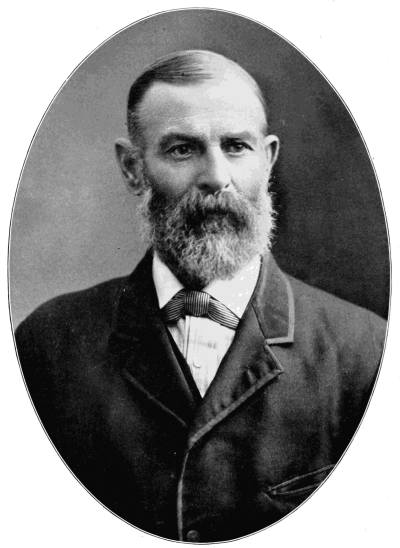
CHRISTIAN STURM, Sr.
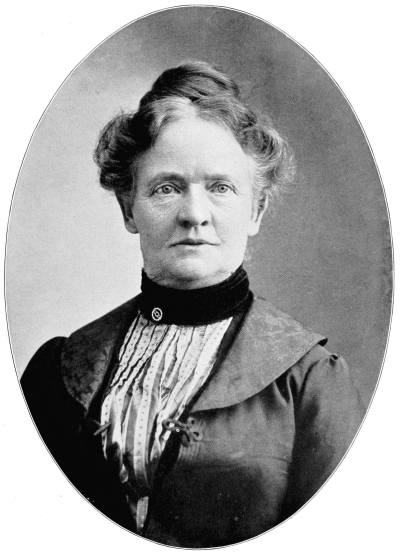
MRS. CHRISTIAN STURM, Sr.
After finishing his education in New York, he moved to Delaware and after spending two years in that state he went to Philadelphia where he enlisted in the service of the U. S. army in 1857. Shortly afterwards his company was moved to Newport, Kentucky, and then to New York; then, by the isthmus of Panama route to San Francisco and from the last named place to Astoria. Astoria at that time had but few buildings. Soon after he was stationed at Vancouver and a little later at the Cascades. With his company he walked to the upper Cascades and took the boat to The Dalles and from there he marched with his troop to Fort Walla Walla. He was five years in the army and during his enlistment he was promoted to the rank of lieutenant. In the army he saw much real fighting. In 1858 he was in the expedition to Colville, which was in command of Colonel Wright. They encountered the Indians, nearly twelve thousand strong, who opened fire on the troops, and the famous battle of Steptoe was fought. During this battle Captain Taylor was killed. Captain Taylor was wearing a silk sash which he took off and presented to Lieutenant Sturm of whom he was very fond. The sash he always kept in memory of momentous hours of danger and as a sacred memento of a true friendship, and it now hangs in its familiar place in his widow's home. The Indians that fought at Steptoe consisted of the Yakimas, Colvilles, Palouses, Spokanes and Coeur d'Alenes. In this famous battle the troops fortified themselves on Steptoe Butte and how bravely they fought history tells. During the battle many Indians were dispatched and as many as one thousand Indian ponies were killed.
After retiring from the army as lieutenant, acting as assistant quartermaster, First Cavalry United States of America, 1862, at Fort Walla Walla (the same fort that President Wilson ordered used in 1917 for a training camp for the Washington State Field Artillery, under command of Major Paul Weyrauch) the wonderful opportunities of the Inland Empire country made a strong appeal to Mr. Sturm. After spending a year mining at Orofino, Idaho, he returned to Walla Walla and went into the livery business with Fred Kraft. After a short time he disposed of his interest in the livery and engaged in the general merchandise business with O. B. Brechtel for a partner. Their store was one of the first in Walla Walla; it was a headquarters for miners returning from the Orofino placer mines; the miners would deposit their gold dust with Messrs. Sturm and Brechtel for safe keeping, there being no banks at that time in Walla Walla. After remaining in the mercantile business for five years Mr. Sturm bought one hundred and sixty acres of land from H. M. Chase two and one-half miles from Walla Walla and engaged in farming. He acquired another adjoining one hundred and sixty acres; also homesteaded one hundred and sixty and preempted one hundred and sixty; then, in later years, he bought five hundred acres more. He was one of the most successful wheat and stock raisers in the valley.
Mr. Sturm was married in 1865 to Miss Marietta Roff. Four sons and two daughters were born to this union, and two sons and two daughters survive. Mrs. Sturm was born September 12, 1844, a daughter of Frederick Roff. Her girlhood was spent in Illinois, but in 1864 she with her parents left Quincy, that state, and they crossed the plains and mountains, using ox and horse teams, the crossing requiring six months. Many were the hardships they endured. Among others, their oxen got on a "poisoned meadow" and died. During the last part of their journey they traveled with a government train and arrived in Walla Walla, October 16, 1864. Mrs. Sturm's father, Frederick Roff, was perhaps the first man to take up a homestead in the valley, filing on one hundred and sixty acres about two and a half miles east of Walla Walla. He there resided until his death, August 2, 1890. Mrs. Sturm survives her husband and resides at the old Sturm home in Walla Walla. More extended mention in regard to the family of Frederick Roff is made in connection with the sketch of Oliver DeWitt, whose wife is a sister of Mrs. Sturm.
Mr. Sturm, who died on January 11, 1909, was one of the foremost pioneers of the western country. Taking up his abode in the northwest when Walla Walla boasted but a few log buildings and the tributary country was but a wilderness, he was one of those sturdy, upright characters who did his full share to help develop the country and make it the success it is today. At all times public spirited and keenly alive and devoted to the interests of the community he was one of the country's true builders. As one of the distinguished pioneers of the country—as a man who performed many good deeds in his day—his name will always be remembered and ever held in the highest respect.
WILLIAM M. SCOTT.
William M. Scott belonged to that class of honored pioneers who have laid broad and deep the foundation upon which has been built the present prosperity and greatness of the state of Washington. He was a resident of Walla Walla from 1905 until his death and for many years was prominently identified with the wheat industry in Umatilla county, Oregon. He was born in McLean county, Illinois, December 29, 1837, and was a son of John B. and Rena (Halsey) Scott. During his infancy he was taken by his maternal grandparents, Mr. and Mrs. Halsey, with whom he remained until his ninth year, when his uncle, Dr. A. K. Scott, became his foster father, and with him William H. Scott remained until 1855, when at the age of eighteen years he started out in life independently. He went to Coffey county, Kansas, where he remained for one year and then started to return to Illinois but stopped off in Daviess county, Missouri, and decided to remain. He there continued until 1859, when he again went to Kansas and in 1860 he started across the plains for the western country, his objective point being the Walla Walla valley, of which he had heard much. The lure of the California gold fields, however, drew him as a magnet and his course was diverted. He was one of the party to which J. L. Stubblefield belonged. The company subsequently divided but Mr. Scott and others proceeded to California. After spending several months in that state he came, in 1861, northward and located at McMinnville, Oregon, where he attended college for a time. In 1862 he engaged in freighting with ox teams from Wallula to Lewiston and subsequently from The Dalles to the Idaho mines. In the fall of 1863 he went to Salem, Oregon, where he resided for seven years. He then crossed the mountains, locating near Prineville, where he was engaged in the live stock business for eight years. In 1878 he removed to Umatilla county, Oregon, where he took up a homestead and a timber culture near Helix. One of these claims subsequently sold for two hundred dollars, but later he bought it back for forty-two hundred dollars. He acquired a full section of six hundred and forty acres of the best land in the wheat belt and engaged in farming eight hundred acres, leasing a quarter section adjoining his place. One year he harvested sixty-six bushels of wheat to the acre upon his farm and he averaged from year to year from forty to forty-five bushels. He experienced all the hardships and privations of early pioneer life and twice in the year 1878 was forced to leave Helix on account of the hostility of the Indians and seek refuge in Fort Walla Walla. However, he persevered and his determination and energy overcame the obstacles in the path of material advancement, while changing conditions, brought about by the settlement of the country, soon obviated the necessity of protecting against Indian attack. In 1905, after many years successfully devoted to farming, he retired from active agricultural life and removed to Walla Walla, where he remained until called to his final home, on January 18, 1915.
Mr. Scott was united in marriage to Miss Anna D. Caplinger, a daughter of Jacob and Jane (Woodside) Caplinger, of Salem, Oregon. They crossed the plains from Fulton county, Illinois, to Oregon in 1845 and settled in Oregon City but after two years removed to Marion county, that state, taking up their abode on the prairie four miles east of Salem, where they remained until called to their final rest. The father died on the 20th of June, 1904, and the mother survived only until the 26th of July of the same year. In 1845, on their journey across the plains, which was made by way of the Mount Hood route, they were there snowbound for more than three weeks with no food but coffee for several days.
Mr. and Mrs. Scott became the parents of nine children, namely: Mary L., who is the wife of J. M. Richardson, of Rosalia; Emma J., who gave her hand in marriage to Dr. E. A. Mann, of Portland, Oregon; John A., who resides in Lacrosse, Washington; Ira C., who operates the home farm for his mother, now residing in Walla Walla; Ray W., who passed away in 1902, when sixteen years of age; and Alexander, Charles, Walter and Bertha, who are also deceased.
In his political views Mr. Scott was a stalwart democrat and in 1890 he was a candidate for county judge of Umatilla county. His life was that of a consistent Christian and for more than twenty years he was an elder in the Church of Christ at Helix. He was also a public-spirited citizen and a factor in the advancement of the county's welfare and interests along many lines. Death called him January 18, 1915. A modern philosopher has said: "Not the good that comes to us, but the good that comes to the world through us, is the measure of our success"; and judged by that standard Mr. Scott was a most successful man, for he went about doing good, extending a helping hand to the poor and needy, assisting in the work of general improvement and shedding around him much of life's sunshine. His widow now occupies a beautiful home on South Division street in Walla Walla. She, too, is a member of the Church of Christ and gives liberally to its support and in charitable work, her benevolences being many.
CHESTER J. WOODS.
Chester J. Woods, a representative agriculturist of Walla Walla county, was born April 23, 1883, on a farm adjoining the one on which he now resides, on section 7, township 9 north, range 37 east. He is a son of Joel Woods, mentioned elsewhere in this work. He pursued his education in the public schools, supplemented by study in the academy at Waitsburg, and through the period of his boyhood and youth he aided largely in the work of the home farm, so that he was well qualified by actual experience to take up farming on his own account when he attained his majority. At that time he purchased land on section 8, becoming the owner of seven hundred acres, all of which is now improved. The fields are carefully cultivated and the buildings upon the place indicate the progressive spirit of the owner. He has always engaged in wheat raising and also in raising stock and both branches of his business are proving profitable. He is also a stockholder in the Self-Oiling Wheel & Bearing Company of Walla Walla.
On the 30th of March, 1910, Mr. Woods was married to Miss Jennie Caplinger, who was born in Umatilla county, Oregon, a daughter of T. W. and Marie Caplinger, who are also natives of that place. They are now residents of Walla Walla. Both Mr. and Mrs. Woods hold membership in the Methodist Episcopal church, of which he is one of the trustees, and they take an active part in its work. Mrs. Woods is a graduate of the Waitsburg high school and Ellensburg Normal School and for seven years successfully engaged in teaching prior to her marriage.
In politics Mr. Woods is a democrat and has served as school director and as clerk but has not been an active worker along political lines. He stands for progress and improvement in public affairs, however, and is willing to support any measure that tends to uphold civic interest. Both he and his wife are held in the highest esteem because of their genuine worth and the hospitality of the best homes in the county is freely accorded them.
PETER McCLUNG.
Peter McClung, of Pomeroy, editor and publisher of the East Washingtonian, was born in Clarke county, Washington, a son of Mathew and Catherine (Wigle) McClung. He was one of four children, the others being: Mrs. Susan Shoemaker, now living in Gresham, Oregon; Mrs. Jennie Buchanan, of Portland; and Edward A., living in Bakersfield, California.
Peter McClung was the third in order of birth and was educated in Clarke and Columbia counties of Washington, attending the schools of Dayton. He learned the printer's trade and as a compositor became connected with the Washingtonian in 1885, his brother-in-law, E. T. Wilson, having founded the paper in 1881. Eight years later, or in 1889, Mr. McClung purchased an interest in the paper and became associated in the business with E. M. Pomeroy, then publisher. Three years afterward he bought out Mr. Pomeroy and has since been owner and publisher thereof. In later years he has been assisted by his son, who pursued a special course in journalism in the State University and who now practically manages the paper.
In 1886 Mr. McClung was united in marriage to Miss Alva E. Pomeroy, a daughter of Joseph M. Pomeroy, who was the founder of the town which bears his name. Mr. and Mrs. McClung have become the parents of two sons: Ray, who has charge at Washington, D. C., of the weekly newspaper publications under the direction of the committee on public information; and Hugh, who is with his father in business.
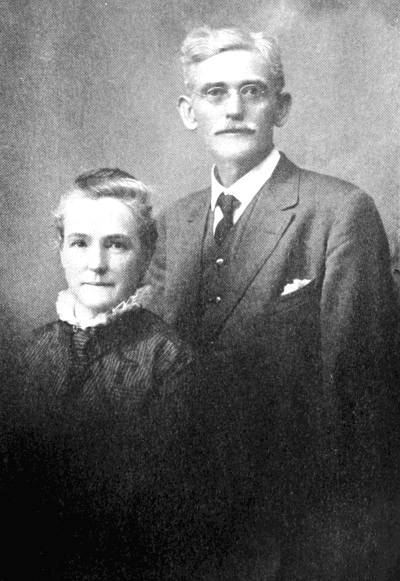
MR. AND MRS. PETER McCLUNG
Fraternally Mr. McClung is an Odd Fellow, and he and his family are connected with the Christian church. In politics he has always maintained an independent course and has the distinction of having published for more than a quarter of a century an absolutely independent paper. His entire life has been passed in the west and with the development and progress of his section of the state he has been helpfully associated.
GEORGE E. KELLOUGH.
Characterized by a spirit of undaunted enterprise, George E. Kellough has won a place among the most substantial and progressive business men of Walla Walla, where he now figures in financial circles as the president of the Third National Bank. He was born in Ontario, Canada, on the 9th of May, 1872, a son of William H. and Ann Grace Kellough, both of whom were natives of Canada. The former was of Irish extraction, while the latter was of French lineage. They spent their entire lives in Canada, residing for many years in Winnipeg, Manitoba, where they were among the pioneer settlers.
George E. Kellough, reared in Winnipeg, there pursued his education in the public schools and at the age of nineteen years, attracted by the broader business opportunities which he felt he might find across the border, he came to the United States and made his way to the western part of the country, reaching Walla Walla county, Washington, in July, 1891. He started in business life here as a ranch hand, but ambition actuated him at every point in his career and continually lured him on to better things. Subsequently he took up a homestead and in time acquired other land, for as his financial resources increased he made judicious investment in property and for some six years was actively and successfully engaged in farming. He then turned his attention to business interests of the city and in 1899 took up his abode in Walla Walla, where he established a clothing and furnishing goods store. He was prominently identified with that business for a decade and built up an extensive trade, ever endeavoring to please his patrons, while his honorable business methods constituted one of the strong features of his growing success. Then a still broader field seemed to open before him and in February, 1910, he made his initial step in financial circles, becoming connected with the Third National Bank as president of the institution, over whose financial policy he has since presided. His plans are well formulated. The business under his direction has been carefully systematized and he has ever recognized the fact that the bank is most worthy of support which most carefully safeguards the interests of depositors. While extending every possible courtesy of the bank to patrons, he has never erred on the side of ultra progressiveness, his actions at all times being tempered by a safe conservatism. His name, therefore, has become a synonym for sound judgment and thorough reliability and he today occupies a central place on the stage of banking activity in Walla Walla county.
In 1893 Mr. Kellough was united in marriage to Miss Viola Purdy, a daughter of Orlando Purdy, who was a Michigan farmer. Mr. and Mrs. Kellough have become the parents of two children, Lance E. and Erma G. Since age conferred upon him the right of franchise Mr. Kellough has given consistent and loyal support to the republican party and has been an earnest and active worker in its ranks. His fellow townsmen, appreciative of his worth and ability, have called him to public office and for two terms, in 1906 and 1907, he served as mayor of Walla Walla, giving to the city a businesslike and progressive administration. He is a member of the Commercial Club, in the work of which he has taken a most active and helpful interest and for one term he served as its president. In this connection he promoted many activities looking to the further development of Walla Walla, the extension of its trade relations and the promotion of its civic standards. He has been very prominent as an Odd Fellow, holding membership in Trinity Lodge, No. 121, I. O. O. F. He has passed through all of the chairs in both the local lodge and in the state organization, and few in Washington have equalled him in active and effective service for the upbuilding of the organization. In fact he is one of the best known Odd Fellows in all the northwestern country. He is likewise connected with the Woodmen of the World, the Fraternal Order of Eagles and the Ancient Order of United Workmen. He is actuated by a spirit of progressiveness in all that he does. There are in his life few leisure hours. He is constantly busied with some interest either for the benefit of his own fortunes or for the upbuilding of the district with which he is connected, and his labors have been effective, beneficial and resultant.
MARCUS ZÜGER, Jr.
Prominent among the most alert and progressive farmers of Walla Walla county is numbered Marcus Züger, Jr., who is the owner of extensive and valuable holdings in Walla Walla and in Garfield counties. He was born January 1, 1878, in the county where he still resides, being a son of Marcus Züger, Sr., of whom mention is made elsewhere in this work. His youthful days were spent in the usual manner of farm bred boys and the habits of industry and close application which he early developed have constituted the foundation of his present success. He remained under the parental roof until he had attained his majority and at the age of twenty-five years, at which time he was married, he began farming for himself on the old homestead, comprising fourteen hundred and sixty-eight acres of land. He has since been prominently and extensively identified with agricultural interests in Walla Walla county and in addition to the old homestead tract he is now the owner of eleven hundred and seventy acres in Garfield county, which is highly improved and which brings to him a gratifying annual rental. He follows the most progressive methods in all of his farm work, utilizes the latest improved machinery and upon his place is found every convenience and accessory of the model farm of the twentieth century. He has closely studied scientific methods of wheat raising, whereby he has greatly enhanced the productiveness of his fields. Aside from his farming interests he is connected with the Exchange Bank at Waitsburg as one of its directors.
In 1904 Mr. Züger was united in marriage to Miss Jennie L. Woodworth, a native of New York, and they have become parents of four children, Margaret D., Arthur Frederick, Kenneth and Erma. Mrs. Züger is a member of the Christian church, while Mr. Züger fraternally is connected with the Masons and with the Knights of Pythias and in his life exemplifies the beneficent spirit on which these organizations are based. His political allegiance is given to the republican party and he has served as county commissioner for two years. He has also proved his friendship to the cause of public education by active service as a member of the school board. He stands for progress and improvement in all things relating to the public welfare and has never allowed personal ambitions or interests to dwarf his public spirit or activities. His views have ever found expression in prompt action rather than in theory and he is a man of stable purpose, accomplishing what he undertakes.
ALFRED LARSON.
Alfred Larson, head miller of the mill of the Portland Flouring Mills Company at Dayton and thus prominently identified with the industrial activity and development of southeastern Washington, was born in Sweden, May 13, 1856, a son of Edward and Margaret Larson, both of whom spent their entire lives in Sweden, the father following the occupation of farming there.
Alfred Larson was reared in his native country and its public schools afforded him his educational opportunities. In 1878, when a young man of twenty-two years, he crossed the Atlantic and made his way to Minneapolis, Minnesota. He had previously learned the miller's trade in Sweden, having entered upon an apprenticeship to that work when a youth of but fifteen years. After coming to the new world he secured employment in the flouring mills of Minneapolis and during two different periods devoted seventeen years to that business in that city, spending the entire time with two companies. In 1891 he first came to the far northwest, making his way to Salem, Oregon, where he was employed as head miller by the Portland Flouring Mills Company. He remained in that position in Salem for four years and then returned to Minneapolis, where he spent the succeeding seven years as second miller in one of the city's most important milling plants. In 1902 he again came to the west, this time accepting the position of head miller in the Creston Mills at Creston, Washington, where he resided for three and a half years. He then went to Condon, Oregon, where he took charge of the plant of the Portland Flouring Mills Company, which he managed for five years. He was transferred to the Albino Mills, owned by the same company at Portland, Oregon, and a year later he resigned his position there to engage in the real estate business in Portland. That, however, proved an unsuccessful venture and he returned to the milling business, accepting the position of head miller of the plant of the Portland Flouring Mills Company at Dayton. In this important position he has since continued and the success of the business at this point is attributable to his skill, enterprise and close application. He has won a substantial position among the foremost millers of the northwest.
In 1882 Mr. Larson was united in marriage to Miss Bertha Corlstrom, who was born in Sweden and emigrated to the United States with a sister when a maiden of fourteen years. Mr. and Mrs. Larson have become the parents of three children, two of whom are living, namely: Mabel, the wife of C. N. Lockridge, who is serving as county clerk of Gilliam county, Oregon; and Wallace, a mechanical engineer and miller who is assisting his father in the mill.
Mr. Larson gives his political allegiance to the republican party and fraternally is identified with the Masons, belonging to Creston Lodge, No. 123, F. & A. M.; Davenport Chapter, No. 25, R. A. M.; Zion Commandery, No. 2, K. T.; and Al Kader Temple, A. A. O. N. M. S., of Portland, Oregon. Mr. Larson's record is that of one who through orderly progression has reached a creditable position in the business world. Coming to America when a young man of twenty-two years without capital save energy, ambition and a knowledge of his trade, he has steadily worked his way upward and among his marked characteristics should be mentioned his fidelity and loyalty to the interests which he serves. This is indicated by the fact that he continued for seventeen years in the employ of but two companies in Minneapolis and that he has been gladly received back into the ranks of the representatives of the Portland Flouring Mills Company, with which company he has been associated for twenty-five years and with which he now occupies a position of responsibility and importance. There is no phase of the milling business with which he is not thoroughly familiar and he is thus well qualified to discharge the onerous duties that devolve upon him in his present connection. Dayton numbers him among her foremost citizens and accords him a high measure of respect and goodwill.
CANTREL R. FRAZIER.
Cantrel R. Frazier is a retired farmer residing at No. 305 Newell street in Walla Walla. He has passed the eighty-sixth milestone on life's journey and well deserves the rest which has come to him, for it is the reward of persistent, earnest and intelligently directed effort in former years. He was born in Barren county, Kentucky, February 15, 1832, a son of Benjamin and Elizabeth (Marshall) Frazier. The mother died in Kentucky, after which the father removed to Missouri in 1846. There his remaining days were passed, his death occurring in that state in the early '70s.
Cantrel R. Frazier in young manhood, or in 1853, when twenty-one years of age, crossed the plains with a drove of cattle belonging to the firm of Packwood & Lewis of San Jose, California. He was accompanied on the trip by his brother William and five months were spent upon the road ere they reached their destination. After the cattle were delivered to their employers they took up a homestead in Tulare county, California, after which they paid ten cents per pound for seed wheat. They planted fifteen acres and harvested six hundred bushels, for which they received six cents per pound. For two years they remained in the Golden state and then returned to Missouri.
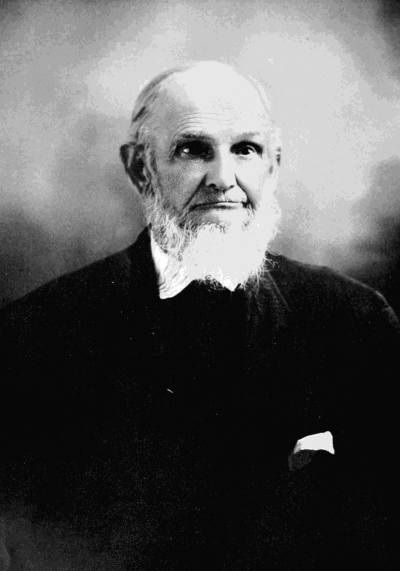
CANTREL R. FRAZIER
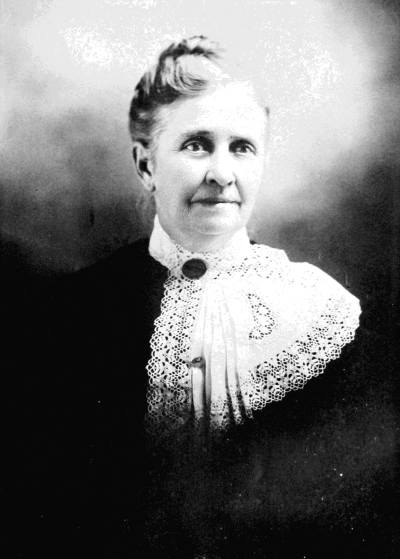
MRS. CANTREL R. FRAZIER
In 1857 Cantrel R. Frazier was united in marriage to Miss Salitha Shubert and in 1864 he again crossed the plains with Walla Walla as his destination. He made the trip with one yoke of oxen and a small wagon and brought with him his wife and two children, one of the children being born in Colorado while they were en route to the Pacific coast.
After reaching Washington, Mr. Frazier homesteaded one hundred and sixty acres of land on Dry creek, about nine miles east of the city of Walla Walla, and upon that farm he resided until his removal to Walla Walla in 1907. He had there lived for forty-three years and his labors had wrought a marked transformation in the appearance of the place. He had planted a variety of fruit and nut trees upon his farm as well as various kinds of grain. Chestnut trees planted in 1884 are now seven feet seven inches in circumference. His fields were most carefully cultivated and the results attained were very gratifying. On the completion of the Northern Pacific Railroad into this section of the state, Mr. Frazier and his wife went back to the old Missouri home on a visit. When he again came to the northwest he brought with him some shell bark and some bull hickory nuts, also some butternut trees and black walnut trees. He likewise has persimmon trees upon his place and one of his apple trees is perhaps the largest apple tree in the state. It measures more than seven feet and seven inches in circumference around the base and has a spread of fifty-seven feet, while in height it has reached forty-two feet. In 1907 it yielded a crop of one hundred and twenty-six and a half boxes of fruit of Frazier's prolific variety. From this old tree a number of gavels have been made by the Commercial Club and one was presented to Mr. Frazier. He owns one hundred and seventy acres of land and his place has been brought under a very high state of development and improvement, so that it yields to him a most gratifying annual return.
Mr. and Mrs. Frazier reared a family of six children; namely Florence, who is the wife of Samuel Philips, formerly of Weston, Oregon, but now of Walla Walla; Benjamin, a cattle man living in northern Washington; Jane, who is the wife of Joseph Gwin, of Walla Walla county; Armeda, who gave her hand in marriage to Samuel McHenry, of St. Francois county, Missouri; John, who follows farming in Walla Walla township; and Dora, the wife of Daniel Neiswanger, of Bend, Oregon. The wife and mother died in 1907 after a happy married life of half a century.
Mr. Frazier was again married in 1907 to Mrs. Missouri Ann Wightman, a native of Wayne county, Missouri, and a daughter of Thomas J. and Lucinda Swezea, the former born in Tennessee and the latter in Missouri. In 1859 the parents, accompanied by their six children, started across the plains with two hundred head of cattle, which dwindled down to about one hundred head before reaching Walla Walla. Mr. Swezea purchased a claim about eight miles from the city on Cottonwood creek. On the 8th of July, 1860, a son, Charles L., was added to the family, he being the first white child born in Walla Walla. Mr. Swezea died at the age of seventy-seven years and his wife at the age of seventy-five. Of their nine children only four are now living, namely: Mrs. Nancy J. Harer, of Walla Walla; Missouri Ann, now Mrs. Frazier; Smith W., a resident of Harrison, Idaho; and Charles L., of Walla Walla county. Mrs. Frazier was a girl of fifteen years when she came to this state and on reaching womanhood married William Wightman, by whom she had one child, Elizabeth, the wife of William Wiseman, of Tacoma.
In his political views Mr. Frazier is a democrat, which party he has supported since reaching adult age. He belongs to the Christian church, while his wife is a member of the Presbyterian church. They are people of genuine personal worth, enjoying in large measure the friendship and kindly regard of those with whom thy have been brought in contact. Their own home is noted for its warm-hearted hospitality and is the scene of many delightful social gatherings. For fifty-three years Mr. Frazier has resided in this county and has been a witness of much of its development and improvement. His own labors have demonstrated in large measure what can be accomplished in the way of raising fruits and nuts in this section. He has ever been progressive in his work and the practical methods which he has followed have brought substantial results. He has never had occasion to regret his determination to try his fortune in the northwest. He here found conditions favorable to the man who is willing to work, for the land is rich in its natural resources and Mr. Frazier accordingly brought his diligence to play with the result that he is today the possessor of a handsome competence which surrounds him with all of the necessities and comforts of life and some of its luxuries.
HENRY S. COPELAND.
Henry S. Copeland, deceased, was one of the early pioneer settlers of Walla Walla county, arriving here in 1862. He found a largely unsettled and undeveloped region in which the work of improvement had scarcely been begun. The Indians in the state far outnumbered the white settlers and only here and there had been founded a little town, showing that the seeds of civilization had been planted on the western frontier which were later to bear fruit in the development of one of the most progressive commonwealths of the Union.
Henry S. Copeland was born in Vermont in 1824 and was a son of Thomas Copeland, who came from Ireland to Canada in young manhood. Later he crossed the border into the United States, establishing his home in Vermont, where he resided up to the time of his death. Both he and his wife died when their son Henry was a small boy. He was born upon a farm and continued to work at farm labor through the period of his youth, dividing his time between the tasks of the fields and attendance at the district schools through the winter months. At an early age he began farming on his own account and 1857 found him in Sacramento, California, while in 1859 he was in the Willamette valley. In 1862 he crossed to Walla Walla, believing that the growing community there would offer him the best opportunities. It was not long thereafter until he had purchased a home and subsequently he took up a homestead claim, southeast of Walla Walla. For many years he was prominently identified with the agricultural interests of this county and from time to time purchased other land until his holdings were very extensive. He utilized every chance for judicious investment and never lost faith in the future of this district, for he readily appreciated the fact that nature was kind to this region and had placed before man many opportunities for successful business in this section.
Mr. Copeland was united in marriage, in the Willamette valley, to Miss Mary Ann Morton, a daughter of William and Catherine Morton, of Illinois, and they became the parents of nine children, four of whom survive. The wife and mother passed away in April, 1957, while the death of Mr. Copeland occurred twelve years earlier in February, 1905. He was very prominent in Masonic circles as well as in his business connections and in his life exemplified the beneficent spirit of the craft. He was ever ready to extend a helping hand to a brother of the fraternity or to aid any fellow traveler on life's journey. He was broad-minded and liberal in his views and had many qualities which made him worthy of the high regard in which he was uniformly held.
JOHN W. BROOKS.
For almost a quarter of a century John W. Brooks has been actively engaged in the practice of law in Walla Walla and throughout that period has steadily forged to the front until he has long since occupied an enviable position in the foremost rank of the attorneys of Washington. He was born in Asheville, North Carolina, September 9, 1870, a son of Charles and Elizabeth (Cagle) Brooks, both of whom were natives of that state, where they spent their entire lives. The father died in the same building in which he was born, passing away in his ninetieth year, after having devoted his entire life to general agricultural pursuits.
John W. Brooks was reared upon the home farm and the public schools afforded him his early educational privileges. Being desirous of preparing for the bar, he afterward entered the University of North Carolina, which conferred upon him his degree as a lawyer upon his graduation with the class of 1892. He was admitted to the bar on the 24th of September of that year and following his admission he opened an office in Asheville, North Carolina, where he remained in practice until the 15th of February, 1893. Thinking that the west offered still better business opportunities, he then left the Atlantic coast to make his way to the Pacific seaboard and eventually arrived in Walla Walla, where he has since practiced independently. He is an able lawyer, possessing comprehensive knowledge of the principles of jurisprudence and is seldom if ever at fault in the application of such principles to the point in litigation. His reasoning is sound, his deductions clear and his arguments convincing. For twenty-four years he has now practiced in Walla Walla and has long been accorded a position of leadership among the attorneys of this section of the state.
On the 18th of July, 1898, Mr. Brooks was united in marriage to Miss Esther Belle Singleton, a daughter of John Singleton, a pioneer of 1857, who for many years was closely identified with the development and progress of Walla Walla county, where he passed away in 1893. His widow still survives at the notable old age of ninety-one years. To Mr. and Mrs. Brooks has been born one child, Virginia, now deceased.
Fraternally Mr. Brooks is identified with Walla Walla Lodge, No. 287, B. P. O. E., with Washington Lodge, No. 19, I. O. O. F., and with the Modern Woodmen of America. He has always been deeply interested in the welfare and progress of the section of the state in which he lives and he has proven his faith in Walla Walla county and its future by making extensive investments in farm lands. The sterling traits of his character have gained him wide acquaintance and he has an extensive circle of friends, who entertain for him the warmest regard by reason of his personal qualities as well as for his professional achievements.
GEORGE TOMPKINS POLLARD.
George Tompkins Pollard is a resident farmer of Columbia county, living on section 6, township 9 north, range 38 east. He is the oldest settler in that district and has been identified with the Inland Empire, its pioneer development and its later progress, since 1855. He was born in Linn county, Missouri, June 15, 1835, a son of Roger B. and Sarah C. (Smith) Pollard. The father was a native of Richmond, Virginia, while the mother's birth occurred in Rockingham county, Virginia. They were married in Shelby county, Kentucky, to which district they had removed in young manhood and womanhood. They began their domestic life in Shelby county, where they remained for a number of years, and about 1820 they established their home in Linn county, Missouri, where they lived for two decades. They afterward moved to the Platte Purchase, settling near St. Joseph, Missouri, where both passed away.
George T. Pollard acquired a district school education in his native state and at sixteen years of age left the parental roof to start out in life on his own account. In the spring of 1852 he crossed the plains with an ox team to California and for three years was engaged in mining on the Cosmos river in what is now Amador county. In July, 1855, he made his way northward into Oregon to visit a brother and while on that visit enlisted in the service to fight the Indians. He took part in the Yakima Indian war and later for three years was engaged in packing supplies for Colonel Rice and Colonel Steptoe and was in the latter's employ when he was defeated by the Indians. Mr. Pollard was in Wallula on the 20th of December, 1855, and on the 22d or 23d participated in the fight with the Indians near Whitman Station. He is the oldest settler now living in this part of the state and there is no one more familiar with every phase of pioneer life and experience than he. His military service made him acquainted with every phase of Indian warfare and later he met all of the hardships and privations incident to the task of developing a new farm. On the 6th of August, 1859, he filed on the homestead where he now lives and upon that place has resided continuously since, covering a period of fifty-eight years. As his financial resources increased he purchased more land from time to time and now owns four hundred and ninety-five acres.
In 1860 Mr. Pollard was united in marriage to Miss Harriet L. Wiseman, of Walla Walla county, who crossed the plains with her father, John Wiseman, in 1852, settling in Linn county, Oregon. Mr. and Mrs. Pollard became the parents of the following children, namely: Melissa; Ann; John B., who is deceased; Mary; Oliver; Etta; Bettie; Ella and Cordelia, who have passed away; Frank; Robert; and Roy.
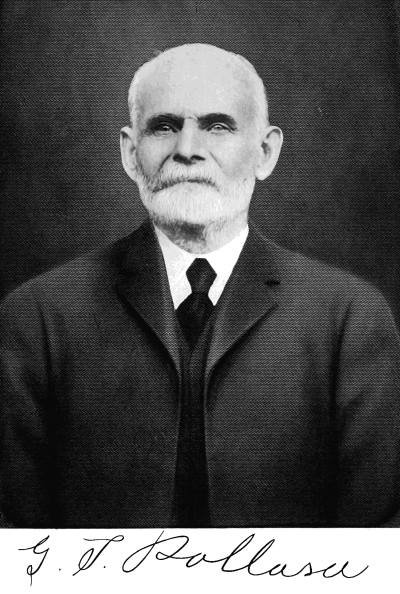
In politics Mr. Pollard is independent, never caring to bind himself by party ties. He was appointed a member of the first board of county commissioners after the organization of Columbia county and was a member of the school board for more than thirty years. At different times he has been urged by his friends to accept nomination for various important political offices but has always refused, preferring to do his public duty as private citizen. He and his wife are members of the Methodist church and their well spent lives have been guided by its teachings. When the state of Washington was yet cut off from the advantages and comforts of the east by the long stretches of sand and the high mountains, he made his way across the plains, braving all the trials and hardships of pioneer life in order to make a home in the Inland Empire, rich in its resources yet unclaimed from the dominion of the red man. As the years have come and gone he has borne his part in the work of general progress and improvement and has been a prominent factor in promoting agricultural development. The days of chivalry and knighthood in Europe cannot furnish more interesting or romantic tales than our own western history.
CHARLES ALEXANDER McCABE.
Charles Alexander McCabe, a well known attorney at law of southeastern Washington, practicing in Pomeroy as a member of the firm of Kuykendall & McCabe, was born June 18, 1889, in the city where he still resides, his parents being Charles A. and Mary (Bohan) McCabe. The father was a native of Ireland and the mother of Pennsylvania. The former came to the United States in 1848, as a boy of eleven years, in company with his parents, who settled in Pennsylvania, where the son attained his majority. About 1864 he determined to try his fortune on the Pacific coast and made his way westward to Walla Walla, after which he operated a pack train and also engaged in prospecting and mining, thus becoming familiar with pioneer experiences and lines of business such as are common in frontier districts. In 1865 he removed to Garfield county, where he turned his attention to the sheep industry and through the following twenty years, except for a few years in Montana, was prominently identified with sheep raising in this section of the state. He subsequently became postmaster of Pomeroy, which position he occupied for several years, discharging his duties with promptness, fidelity and capability. He was also engaged in the jewelry business and for many years ranked with the prominent business men and progressive citizens of Pomeroy, contributing much to its upbuilding and progress along material and other lines. He was married in Pennsylvania in 1888 and passed away in 1913, Mrs. McCabe having preceded him in 1901.
Charles Alexander McCabe, whose name introduces this review, was educated in the public schools of Pomeroy and in Gonzaga College at Spokane. In the fall of 1909 he took up the study of law, reading in the office of Gose & Kuykendall, and in the spring of 1911 he was admitted to practice. Immediately following his admission he entered into his present partnership relations with Mr. Kuykendall, whose former partner, Mack F. Gose, had been elected to the bench. The firm of Kuykendall & McCabe has since been engaged in practice and their clientage is extensive and of a very important character. Mr. McCabe carefully qualified for the practice of law and in the conduct of his cases has shown notable resourcefulness combined with marked ability to accurately apply the principles of jurisprudence to the points in litigation.
In June, 1911, Mr. McCabe was united in marriage to Miss Anna Mock, of Columbia county, Washington, and to them have been born two sons and a daughter: Charles Patrick, Kathleen and Robert Alexander. The parents are communicants of the Catholic church and Mr. McCabe is identified with the Knights of Columbus and also with the Woodmen of the World. Both Mr. and Mrs. McCabe are well known socially in Pomeroy, occupying an enviable position in those circles where true worth and intelligence are accepted as passports into good society.
THOMAS COPELAND.
Thomas Copeland, whose extensive landed possessions aggregate more than three thousand acres, makes his home on section 12, township 6 north, range 36 east, Walla Walla county, where he is extensively engaged in farming and stock raising. He is one of the most progressive agriculturists of this part of the state and his intelligently directed activities have brought him a gratifying measure of success. He is a native son of the west and possesses the spirit of western enterprise. His birth occurred in McMinnville, Oregon, November 26, 1861, his parents being Henry S. and Mary Ann (Morton) Copeland, the former a native of Vermont, while the latter was born in Pennsylvania.
It was in 1849 that Henry S. Copeland crossed the plains to California, attracted by the discovery of gold on the Pacific coast. He remained in that state for a brief period and then made his way northward to Oregon, where he afterward met and married Miss Mary Ann Morton. They took up their abode upon a farm in that state and for a considerable period resided at McMinnville, but in 1863 they came north to Washington and settled in Walla Walla county, where the father secured a homestead, upon which he built a log cabin covered with a clapboard roof. They occupied that primitive dwelling for several years and experienced all the hardships and privations of pioneer life, but as time passed their labors brought substantial reward and they were able to secure more of the comforts of modern day civilization. The little log cabin was replaced by a commodious and substantial residence and other good farm buildings were added to the place, while the fields were brought under a high state of cultivation. In his later years Mr. Copeland retired from active farm work, having become possessed of a comfortable competence that was sufficient to supply him with all of the necessities and some of the luxuries of life through his remaining days. He and his wife removed to Walla Walla and there continued to make their home until called to their final rest. They had a family of ten children, four of whom are yet living.
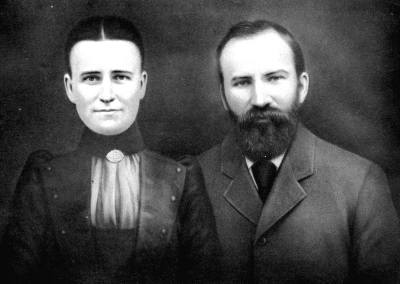
MR. AND MRS. THOMAS COPELAND
Their son Thomas Copeland was but two years of age when the family came from Oregon to Washington, so that he was reared and educated in Walla Walla county. He pursued his studies in one of the old-time log schoolhouses of that early period. The methods of instruction, too, were somewhat primitive and thus his opportunities in that direction were restricted but his training in farm work was of an extensive character. He remained at home until he attained his majority, after which he purchased the farm upon which he now resides, and adding to his possessions at intervals as his financial resources have increased, he has become the owner of over three thousand acres of rich, arable and valuable land. He has made a specialty of raising wheat and also of raising stock. He keeps full bred Hereford cattle and also Clydesdale and Percheron horses upon his place. His stock raising interests have become an important feature of his business and add materially to his annual income. Moreover, his farm is situated in the rich wheat belt of the Inland Empire and his yearly grain crop is a most satisfactory one. In addition to his other interests Mr. Copeland is a stockholder in the Third National Bank of Walla Walla, of which he was one of the organizers.
In March, 1887, Mr. Copeland wedded Miss Minnie Harman, who was born in the state of New York, a daughter of William Harman, who came to Walla Walla at a very early day and continued his residence here until called to the home beyond. To Mr. and Mrs. Copeland have been born four children: Ralph and Clara, at home; Martha, who died at the age of nineteen years; and Glenn, who completes the family.
In politics Mr. Copeland is a stalwart republican and while not an office seeker he has served for twenty-seven years on the school board, the cause of education finding in him indeed a stalwart champion. He belongs to Washington Lodge, No. 19, I. O. O. F., and in his life exemplifies the spirit of the organization, which is based upon the recognition of man's obligations to his fellowmen. His life has been well spent and has gained for him the goodwill and honor of his fellowmen. In business affairs he has always displayed sound judgment and keen discrimination and has readily discerned the essential elements in the successful conduct of any business transaction. His plans have ever been well defined and carefully executed and he never stops short of the accomplishment of his purpose, for he recognizes the fact that when one avenue of opportunity seems closed he can carve out other paths which will lead to the desired goal. He has become connected with a number of important enterprises in this county aside from his farming interests and his business activity makes him a valued and substantial citizen of his district.
THE WALLA WALLA UNION.
One of the pioneers of Walla Walla, getting younger and more vigorous with the passing of years, is the Walla Walla Union, established in 1869 and published continuously ever since. A little four-page weekly, hand set, and with a small circulation at that time, the Union has developed into a metropolitan daily, carrying full, leased-wire Associated Press service and is equipped with modern linotypes and fast rotary presses. The Union has been a part of the community life of Walla Walla for nearly a half century and while in the struggles of early pioneer life it suffered many hardships in common with many of the citizens that it has served during a lifetime, it has grown in strength with the community until today it is a part of the solid worth of the Inland Empire. The Union is the only morning newspaper published within a radius of nearly one hundred miles of Walla Walla. The Union is published by a corporation of which E. G. Robb is president, D. W. Ifft business manager and B. E. La Due managing editor.
JOHN L. WALLACE.
For almost ten years John L. Wallace has been engaged in the abstract, real estate, loan and insurance business in Dayton, where he conducts his interests as a partner in the firm of the Weatherford-Wallace Company, ranking with the leading business men and representative residents of the city. He was born in Harvey county, Kansas, on the 16th of August, 1874, his parents being John T. and Hannah J. (Frederick) Wallace, who came west to Washington in 1886, settling in Whitman county. The father was engaged in educational work for twenty-three years, teaching in Kansas and Missouri, and after coming to Washington he identified himself with mercantile interests and for a number of years was engaged in business in Albion. Subsequently he resumed the profession of teaching and became connected with the schools of Lincoln county, where he was located at the time of his death, which occurred about 1906. For several years he had survived his wife, who died on Christmas day of 1900.
John L. Wallace had the usual advantages of the public schools and in 1892 entered the Portland (Oregon) Business College, where he pursued a commercial course. In the summer of 1893 he was offered and accepted the position of manager of a grain warehouse in Albion and in 1894 and 1895 he was a student in the Washington Agricultural College at Pullman, now the Washington State College. Subsequently he went to Hailey, Idaho, where he was employed for two and a half years in a grocery house. He then returned home but after a year he went to Portland, Oregon, in 1898 and became one of the teachers in the Portland Business College, there spending seven years. While thus engaged he took up the study of law, attending night school, and in 1901 he was admitted to the bar in the state of Oregon. He continued teaching, however, in the business college until 1904, when he returned to Whitman county, Washington, and through the succeeding two years devoted his attention to merchandising in Albion. In the fall of 1907 he was appointed deputy county prosecutor of Whitman county and on the 1st of July, 1908, he came to Dayton, where he bought a partnership in the Geo. B. Baker Company, an abstract, real estate, loan and insurance business. He has since been engaged in this line and has won for himself a prominent position, having a very large clientage. He has negotiated many important realty transfers, has placed many loans and has written a large amount of insurance, so that his business has reached a most gratifying figure.
On the 4th of June, 1902, Mr. Wallace was united in marriage to Miss Sophia A. Schmidt, of Portland, Oregon, by whom he has one child, Dean Leslie. Mr. Wallace was a stalwart supporter of republican principles for many years but in 1912 left the ranks of the party and followed Roosevelt in the organization of the progressive party. He has since been a stanch advocate of progressive republicanism and is recognized as one of the political leaders of this section of the state. Fraternally he is connected with Dayton Lodge, No. 26, F. & A. M.; Dayton Chapter, No. 5, R. A. M.; Alki Lodge, No. 136, I. O. O. F.; and the Dayton Lodge of the Knights of Pythias, while both he and his wife are members of Rainbow Chapter of the Order of the Eastern Star.
For the past seven years Mr. Wallace has served as city clerk of Dayton and has made a most excellent record as a public official, being careful and systematic in the discharge of his duties and at all times prompt and faithful to the trust reposed in him. He has many admirable traits of character, is loyal to the public good, is thoroughly reliable in all business dealings, holds friendship inviolable and is devoted to the welfare of his family. His pronounced characteristics have gained for him a high position in public regard, while his enterprise and indefatigable energy have placed him among the leading business men of his adopted city.
LEON B. KENWORTHY.
Leon B. Kenworthy is actively engaged in the practice of law in Dayton and in a profession where advancement depends entirely upon individual merit and ability he has made for himself a creditable position. He was born in Salem, Oregon, February 16, 1874, a son of James and Lydia A. (Williams) Kenworthy, both of whom were natives of Indiana. In the year 1872 they removed westward to Oregon, settling upon a farm where they resided until 1879. In that year they went to what was then Walla Walla county and took up their abode in Huntsville, where the father secured a tract of land and again engaged in farming, spending his remaining days upon that place, his death occurring October 23, 1911. The mother died October 23, 1917. In their family were ten children, seven of whom are yet living.
Leon B. Kenworthy was reared and educated in Washington, having been but five years of age at the time of the removal of his parents from Oregon to this state. Liberal educational opportunities were accorded him. After completing his common school course he matriculated in Pacific College at Newberg, where he won the Bachelor of Arts degree upon his graduation with the class of 1900. He then pursued his law course, which he completed in 1902, graduating from the law department of the University of Washington. He was admitted to the bar and entered upon active practice in Dayton in 1904. Through the intervening period he has steadily advanced until he now occupies a foremost position in the front rank of leading attorneys in Dayton. He prepares his cases with great thoroughness, is skillful in the presentation of his arguments, is logical in his deductions and sound in his reasoning.
In 1909 Mr. Kenworthy was united in marriage to Miss Alice M. Spurgeon, a native of Illinois, and to them have been born two sons: Jack Garry, deceased; and Max Spurgeon. The parents are members of the Congregational church and in his fraternal relations Mr. Kenworthy is connected with the Knights of Pythias and is a member of the D. O. K. K. in that order. Politically he is a republican, giving stalwart support to the party, and for a number of years he has acceptably filled the office of city attorney, most carefully safe-guarding the legal interests of the city in that position. He stands for progress and improvement in all public affairs and has ever displayed marked devotion to the city's welfare and upbuilding. He owns a fine residence in Dayton and the family occupies an influential position in social circles.
JOSEPH J. ROSE.
Among those whom death has called and who were contributing factors to the agricultural development and improvement of Columbia county was Joseph J. Rose, who while still active in the world's work made his home on section 5, township 9 north, range 39 east, in Columbia county. He was born in Oregon, on the present site of the town of Milton, June 12, 1860, a son of Eli and Catherine (Boldman) Rose, who crossed the plains from Iowa with ox teams in 1859. One child was born to them on their journey. On their arrival in Oregon they camped on the present site of Milton and it was there that the birth of Joseph J. Rose occurred. Not long afterward the parents removed with their family to Washington, taking up their abode in what is now Walla Walla county, about three miles from Dixie. There they lived for many years, giving their attention to agricultural pursuits, but ultimately removed to Dayton, at which time Mr. Rose retired from active business life, having in the intervening years acquired a comfortable competence that was sufficient to supply him and his wife with all of the necessities and some of the luxuries of life.
Joseph J. Rose assisted his father until he reached his twenty-third year and for about two years thereafter operated his father's farm. His youthful experiences were those of the farmbred boy who divides his time between the duties of the schoolroom, the pleasures of the playground and the work of the fields. No event of special importance occurred to vary the routine of life for him in that period. After cultivating his father's land for two years he removed to Columbia county in 1885 and purchased a portion of what is now his old home place about a mile and a half south of Dayton. His first purchase made him owner of two hundred and twenty acres and subsequently he bought other land from time to time, thus adding to his holdings until he had fourteen hundred acres at the time of his demise. The farm which he left is one of the most productive and valuable farms of Columbia county. The soil is naturally rich and careful cultivation has added much to its value. Good buildings have been put upon the farm and the place has been divided into fields of convenient size by well kept fences.
Mr. Rose was married twice. In 1884 he wedded Miss Ida Williams, of Walla Walla county, by whom he had three children, namely: Lena, who is now the wife of T. O. Webster, of Walla Walla; Zelma, who gave her hand in marriage to Earl Harting, of Walla Walla county; and Zenobia, a resident of Walla Walla. In July, 1900, Mr. Rose was again married, his second union being with Miss Mary Brockman, a daughter of W. J. Brockman, who came to Columbia county, Washington, in 1887 and has since passed away. By his second wife Mr. Rose had two pairs of twins, the first of whom died in infancy, while the surviving are Joseph Eli and Emma Catherine.
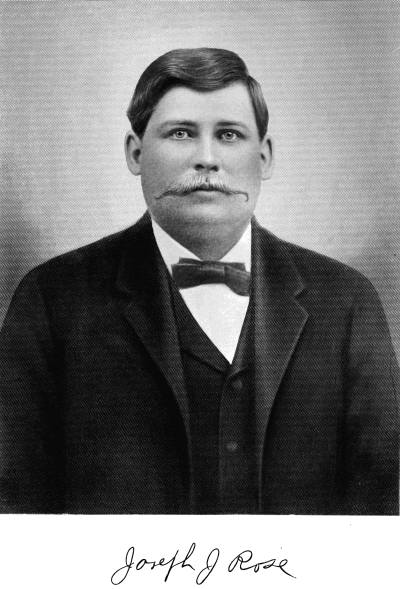
Mr. Rose gave his political allegiance to the democratic party and he served for several years as a member of the school board but was too busy to give much attention to politics and never sought or desired political preferment. He belonged to Columbia Lodge, F. & A. M., and was a faithful follower of the teachings of the craft. He was also a consistent member of the Christian church and died in that faith December 7, 1916, leaving to his family not only the fruits of earnest toil but also the priceless heritage of an untarnished name, which the wise man of old said is more to be chosen than great riches. Mrs. Rose not only possesses those qualities which are essentially womanly and which everywhere command respect, but she is also a capable business woman. Upon the death of her husband she immediately took up the heavy responsibilities in connection with the operation of a farm of fourteen hundred acres and in her management of affairs has proven herself one woman in a thousand. She is now operating the farm on an extensive scale and is meeting with excellent success by reason of her careful management, her systematic methods, her keen sagacity and her enterprise. She occupies one of the prettiest country homes in the county and by reason of her business management is enabled to enjoy not only all of the comforts but also many of the luxuries of life. She belongs to Waitsburg Chapter, No. 9, of the Order of the Eastern Star, and is a devoted member of the Christian church, guiding her life according to its teachings.