Chapter VI
Reading edition
INTELLECTUAL AND RELIGIOUS FORCES OF WALLA WALLA COUNTY; EDUCATIONAL INSTITUTIONS OF WALLA WALLA
While the eastern parts of the United States and pre-eminently New England, above all the State of Massachusetts, have assumed, and to considerable degree justly, that they hold priority in education, yet the people of the Far-West may rightfully claim that within the past dozen or twenty years they have made such gains in educational processes and results as to place them in the front rank. The report of the Russell Sage Foundation a few years ago that for all 'round efficiency the schools of Washington State were entitled to first place in the United States, was not surprising, though gratifying to those familiar with the extraordinary growth in equipment and teaching force during the last decade. As is well known, several western and Pacific Coast states outrun all others in freedom from illiteracy, having practically no permanent residents of proper age and normal faculties unable to read and write. It is one of the glories of American democracy, and in fact the logical consequence of self-government in this or in any country, that the craving for knowledge and power and advancement exists in the masses. Thus and thus only can democracy justify its existence. In the West, and perhaps even most intensely in the Pacific Coast states, the ambition to succeed, the spirit of personal initiative, the feelings of independence and equality, were the legitimate product of the pioneer era.
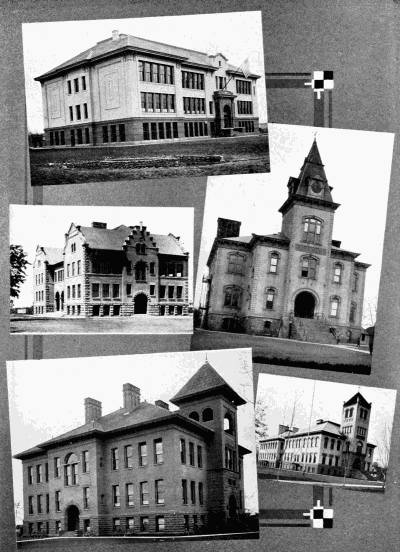
Jefferson School
Green Park School Lincoln School
Washington School Sharpstein School
SCHOOLS OF WALLA WALLA
The state builders, the offspring of the immigrant train, the homesteaders of the Walla Walla country, were, like other westerners, anxious to bequeath to their children better opportunities for education than they in their primitive surroundings could command. Hence they had hardly more than satisfied the fundamental necessities of location, shelter, and some means of income than they began to raise the question of schools. In the earliest numbers of the Washington Statesman the pioneer newspaper of the Inland Empire, beginning in 1861, we find the question of suitable school buildings raised. But that was not the beginning. It is interesting to recall that Doctor and Mrs. Whitman were constantly active in maintaining a school at Waiilatpu, not only as a missionary enterprise for the Indians, but, as time went on, for the children of the immigrants, who gradually formed a little group around the mission. Then after the long period of Indian wars and the establishment of the United States garrison in its present location, there was provision made in 1857 for teaching the children of the garrison together with a few stray children in the community. The teacher of that little group was Harry Freeman of the first dragoons, Troup E. The building used was on the garrison grounds. Among the children were several well known later in Walla Walla and the state, as James and Hugh McCool and their sister Maggie, afterwards Mrs. James Monaghan, mother of the gallant Lieutenant Monaghan, who lost his life heroically in the Samoan Islands and for whom a commemorative monument stands at the southern end of the Monroe Street bridge in Spokane. In that first little company of school children were Robert Smith, Mrs. Michael Kenny, and the Sickler girls, one of whom is now Mrs. Kyger. The first school within the limits of Walla Walla was conducted in 1861-2 by Mrs. A. J. Miner in a private house at about what would now be Alder and Palouse streets. Another pioneer teacher was J. H. Blewett.
PUBLIC SCHOOLS
Prior to 1862 there had been no public school organization. The scholastic needs of the children had been recognized, however, in the first permanent organization of the county on March 26, 1859, by the appointment of Wm. B. Kelly as superintendent of schools. At the election of July 14, 1862, J. F. Wood was chosen superintendent, and District Number 1 was organized, a room rented, and a teacher appointed. Progress seems to have lagged, however, until the fall of 1864, in which year the census showed a school population of 203, though of that number only ninety-three were enrolled. A meeting on December 12th of that year voted to levy a tax of 2½ mills for the erection of a building. Dr. D. S. Baker donated the land now occupied by the Baker School and a building was erected at a cost of $2,000, the first public school building in the Inland Empire. In 1868 a second district numbered 34 was organized in the southwestern part of town at the corner of Willow and Eighth streets. That building with some additions served its purpose till 1879, and in that year the Park Street building, in use for a number of years, was put up at a cost of $2,000. Districts number 1 and 34 were consolidated by the Legislature in 1881 and the board of directors consisted of the directors of the two districts. As a matter of record it is worth while to preserve the names of that board: H. E. Johnson, D. M. Jessee, B. L. Sharpstein, N. T. Caton, Wm. O'Donnell, and F. W. Paine. E. B. Whitman was clerk.
By vote of the district on April 29, 1882, a much more ambitious plan of building was adopted, one commensurate with the progress of the intervening years, and a tax of $17,000 was levied for the purpose of erecting a brick building. That building accordingly was realized on the Baker School ground, in which many of the present "grave and reverend seigniors" of Walla Walla had their first schooling. Not until 1889 was there any high school work in Walla Walla. In that year Prof. R. C. Kerr, who was city superintendent, met the few pupils of high school grade in the Baker School building. In the following year those pupils were transferred to the Paine School, now known as the Lincoln School, which had been erected in 1888.
FIRST HIGH SCHOOL CLASS
The first high school class was graduated in 1893. Up to 1900 there was a total number of high school graduates of eighty. New buildings have been added from time to time and new courses established, with suitable equipment and teaching force. Perhaps we can in no way better indicate the growth of the schools of Walla Walla County and city, than by incorporating here a report prepared by County Supt. G. S. Bond in 1900 for a history of Walla Walla by the author of this work, and contrast with it the last report of City Supt. W. M. Kern. While Walla Walla and adjoining communities have not been considered as of rapid growth, compared with some other parts of the state, a perusal of these reports, seventeen years apart, will give the present citizen some conception of the changes in that short period.
Professor Bond's report follows: "It is the primary object of the writer, in preparing this statement, to present to the public a brief recital of the present condition of the educational facilities of Walla Walla County, rather than attempt to give any account of the history and growth of those facilities. Were it even desirable to do so, it would, for two reasons, prove a somewhat difficult undertaking. The records compiled by the earlier school officers are quite incomplete, if compared with present requirements, and the subdivision of the original county into the present counties of Columbia, Garfield, Asotin and Walla Walla occasioned many changes in the various school districts, and led to a complete re-districting and re-numbering. This, the records in the county superintendent's office show, was done between the years 1879 and 1886.
"In 1891, the county superintendent, by order of the county commissioners, brought together in one book the plats and boundaries of the various districts, numbered consecutively from one to fifty-three. Since that date, to meet the requirements of the constant increase in population, many changes in boundaries have been made and thirteen new districts have been formed, making a total of sixty-six. Six of these are joint with Columbia County.
"The subdivision of the county into sixty-six school districts brings nearly every section within easy range of school facilities. Especially is this true of the eastern and southern portions where the county is most densely populated. With but few exceptions these districts have good, comfortable schoolhouses, furnished with modern patent desks, and fairly well supplied with apparatus. Six new schoolhouses were built, and a considerable amount of furniture was purchased last year.
"A movement which is receiving considerable attention and which is proving of great service to the county is the establishment by private enterprise, entertainment or subscription of district libraries. About twenty have received their books which are eagerly read by both pupils and parents. Others are preparing entertainments to raise a library fund. It is greatly to be hoped that our Legislature may pass some law at this session to encourage the district library. It is one of the measures most needed to improve our rural schools.
"Another feature that is proving of benefit to the country schools is common school graduation. An opportunity to take an examination for graduation is given at various time, to eighth grade pupils in any of the schools. The diplomas admit to high school without further examination. Many take pride in having finished the common school course, and are inducted to remain in school much longer than they otherwise would.
"Eight districts are at present maintaining graded schools. There seems to be a growing sentiment in some of the more densely populated sections to gather together their pupils for the superior advantages of the graded schools. Walla Walla (No. 1) provides an excellent four-year high school course. No. 3 (Waitsburg), also has a high school department.
"Were all the schools in session at the same time there would be required a force of 116 teachers. The districts employing more than one teacher are: Walla Walla—30, Waitsburg—7, Prescott—3, Seeber—3 and Dixie, Wallula, Harrer and Touchet—2 each. Of those employed at this time, 7 hold life diplomas or state certificates, 18 normal diplomas, 25 first grade certificates, 21 second grade, and 15 third grade. Twenty applicants failed last year. If the present crowded condition of the Walla Walla and Waitsburg schools continues next year it will necessitate an increase in the teaching force of five or six at the former place and of one at the latter.
"The Teachers' Reading Circle was reorganized in January, and meetings have been arranged for the more central points throughout the county. The sessions are well attended, the exercises carefully prepared. About fifty teachers have purchased one or more of the books and enrolled as members. All teachers have free access to a library of about seventy-five volumes, treating principally on theory and practice, or the history and philosophy of education.
"Our school districts never began a year on a more solid financial basis than they did the present one. Fifty-one of the sixty-six had a good balance to their credit in the hands of the county treasurer. A comparison of the last financial statement with that of previous years is given to mark the increase.
Receipts 1897 1898 1900
Balance in hands of county treasurer $9,521.43 $9,279.24 $25,838.81
Amount apportioned to districts by county supt. 32,104.54 56,210.31 58,574.66
Amount received from special tax 11,761.62 26,346.81 26,503.99
Amount from sale of school bonds 500.00 1,410.00 500.00
Amount transferred from other districts ........ ........ ........
Amounts from other sources 131.54 82.69 2,212.15
———— ———— ————
Total $54,019.13 $93,347.05 $113,629.61
Expenditures 1897 1898 1900
Amount paid for teachers' wages ........ $47,278.95 $38,691.71
Amount paid for rents, fuel, etc. $38,027.39 10,697.78 13,653.06
Amount paid for interest on bonds 2,578.00 2,645.55 4,301.00
Amount paid for sites, buildings, etc. ........ 2,902.68 32,152.61
Amount paid for interest on warrants 4,113.75 5,649.78 1,650.94
Amount reverting to general school fund 2.75 ........ ........
Amount for other districts ........ ........ 12.86
———— ———— ————
Total $44,721.89 $69,173.94 $90,962.18
Balance on hand 9,297.24 24,173.11 22,667.43
"The hard times experienced two or three years ago materially affected teachers' wages in this county. The average amount paid male teachers, according to the annual report of the county superintendent in 1898, was $56.57; for female teachers, $39.54. For 1900, male teachers, $62.50; female teachers, $52.40. There seems however, to be dawning a brighter future for the conscientious teacher. Rigid examinations for two years have lessened the competition from those who entered the work only because they had no other employment; the districts are able to hold longer terms and pay larger salaries now. The minimum salary this year is $40, other rural districts pay $45 and $50. Salaries in the graded schools are from fifty-five to one hundred dollars per month. The average length of term in 1898 was 6½ months; the average from 1900 is 7¾ months.
"The estimate in the county superintendent's annual report for 1898 places the total value of schoolhouses and grounds at $162,080; of school furniture; $15,317; of apparatus, etc., $3,871; of libraries, $1,690. Amount of insurance on school property, $79,605; of bonds outstanding, $45,300; warrants outstanding, $41,274. The last enumeration of children of school age shows 4,275 resided in the county on June 1st; of these 3,621 were enrolled in the public schools, and made an average daily attendance of 2,076.
"For 1900, schoolhouses and grounds, $194,060; furniture, $16,350; apparatus, $4,000; libraries, $2,450; insurance, $100,650; bonds outstanding, $75,300; warrants outstanding, $82,721.16; children of school age, 4,767; children enrolled, 4,102; average daily attendance, 2,322. Such was the report of the county superintendent in 1900. Now we present the report of city superintendent, W. M. Kern, for year ending in 1917:
Enrollment Boys Girls Total
Elementary schools 1,280 1,234 2,514
High school 428 393 821
Night school 46 81 127
——— ——— ———
Total 1,754 1,708 3,462
Transfers to high school 17 26 43
——— ——— ———
Total actual enrollment 1,737 1,682 3,419
Deduct night school 46 81 127
——— ——— ———
Actual enrollment, grade and high school 1,691 1,601 3,292
Teachers in city schools, 101; valuation of property of city schools, grounds and buildings, $790,000; equipment, $72,000.
"Over seven thousand children of school age reside in Walla Walla County, according to the 1917 school census, completed yesterday. The census shows a total population of school children of 7,331. Of this number 3,928 live in the city school districts and the rest in the other districts of the county.
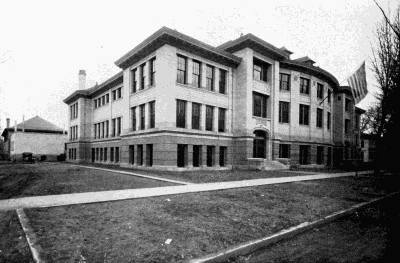
HIGH SCHOOL, WALLA WALLA
"The number of children in the county this year is almost identical with that of last year, 1917 showing a decline of two. Last year's figures showed 7,333, as against 7,331 this year. In the city there was a decline in the number of children, the census this year being 3,982 as against 4,000 last year. The county districts, however, showed a gain of sixteen.
"The city school census of 1917 shows the following:
Number of pupils receiving diplomas—
Boys Girls Total
Green Park 21 12 33
Baker 12 11 23
Sharpstein 17 40 57
Jefferson 17 17 34
Washington 8 6 14
—— —— ——
Total, grades 75 86 161
High school 44 55 99
Per cent of attendance—
Grades 98.17
High school 98.10 "
As will have been seen, Professor Kern's report gives a view of the buildings and other successive additions to the facilities of the public schools of Walla Walla City. Similar development has taken place in Waitsburg, Prescott and Touchet, as will be seen from the following. It may be added that the smaller places, and the country districts also, have experienced a like improvement.
WAITSBURG
Waitsburg has maintained excellent schools for many years. We have presented some facts in regard to the earlier schools of the place, and are giving here a view of present organization and equipment.
At this date the board of education consists of Messrs. N. B. Atkinson, J. A. Danielson, and W. J. Taylor. Miss Mary Dixon is clerk. The faculty consists of the following: Superintendent, James H. Adams; high school, principal and instructor in science and athletics, B. B. Brown; instructor in English, Edna McCroskey; instructor in Latin and German, Freda Paulson; instructor in mathematics, Ione Fenton; instructor in history, Elizabeth Nelson; instructor in domestic science and art, Gladys Persels; instructor in manual training and mechanical drawing, Earl Frazier.
The Central School contains the grades, eight in number, Anna Goff being principal.
Waitsburg is provided with three excellent buildings valued as follows: high school, $20,000; Central School, $25,000; Preston Hall, $35,000. The last named is the pride of the Waitsburg School system. It is, in fact, a structure and an instrumentality of unique interest. It was the gift of W. G. Preston, one of the most conspicuous of the pioneers of Walla Walla County. It was the result of the philanthropic impulse as well as the practical good judgment of its donor, for Mr. Preston had formed the impression during his busy and successful career that a knowledge of the manual arts was vital to the average boy and girl. The building was completed in 1913 and was provided with the most perfect equipment for manual instruction which the space would allow. During the past year there were enrolled in the manual training course, thirty-four boys, in the sewing course thirty-five girls, and in the cooking course, thirteen girls. There is also a well-equipped gymnasium in the building. The campus on which the high school and Preston Hall stand contains five acres of land, about half of which is covered with a grove, while the athletic field occupies the remainder of the open space.
Some other valuable data we derive from the information kindly supplied by Superintendent Adams. We find, as an interesting point worthy of preservation for future comparison, that the average salary during the past year paid the male teachers was $1,308.75, and that of the female teachers was $746.25. Included in these averages are the superintendent and principals. The total enrollment during 1916-17 was: boys, 216, girls, 208. Percentage of daily attendance was 95.1 for the boys and 95.3 for the girls. The number in the high school was: First year, 48; second year, 30; third year, 28; fourth year, 18; a total of 124. The school library contains the following number of volumes: high school, 700; grades, 400.
PRESCOTT
Prescott, while not a large town, is an ideal home town in the midst of a magnificent and extensive farming country, and conducts an amount of business quite beyond the ordinary volume for its population. The county tributary to Prescott produces about seven hundred thousand bushels of grain annually, and here is grown the famous blue-stem wheat, the highest grade milling wheat produced in the Northwest. The land here yields from twenty-five to forty bushels of wheat per acre. Crop failures are quite unknown. The laudable pride and ambition of the people has led them to the construction of so fine a school building as to be a source of wonder and admiration to all visitors. In this elegant building there is sustained a high school department of four years curriculum, with four teachers and, during the past year, forty pupils. Part of the building is occupied by the grades. The value of the school property is estimated at fifty-four thousand dollars, the most of which is included in the high school building. Situated upon a slight eminence overlooking the fertile and beautiful Touchet Valley, with the vast sweep of the wheat covered hills closing it in, this Prescott school building presents an appearance which many large towns might envy. During a number of years past a succession of peculiarly well qualified teachers have devoted themselves to the progress of the Prescott schools, and as a result have lifted them to a status which has been indicated in the high grades which the pupils have attained in higher institutions and the efficiency which they have shown in business engagements upon which they may have entered. Prescott obtains its water supply from the snow-capped Blue Mountains, lying twenty miles to the east. Thus being assured of a perpetual supply of pure water. Prescott is noted for its healthfulness.
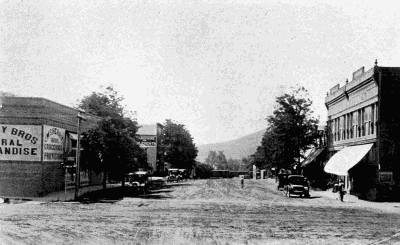
MAIN STREET, PRESCOTT
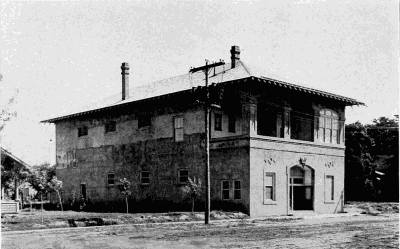
KNIGHTS OF PYTHIAS BUILDING, PRESCOTT
Descending the Touchet about twenty miles we reach its junction with the Walla Walla, and there we find another of the fine little towns which border that beautiful and historic stream.
TOUCHET
The Town of Touchet is at a lower level, only 450 feet above sea level, and by reason of that and of its more westerly situation it has higher temperature and less rainfall than any other of the Touchet towns. It is consequently an irrigated fruit and alfalfa section. The splendid Gardena District on the south and the productive lands in the Touchet and Walla Walla bottoms north and east and at their junction, give the town a commanding location. It is accordingly an active business center, with several well stocked stores, a bank, an attractive church of the Congregational order, and a number of pleasant homes.
The pride of the place, however, like that of Prescott is the school building. This is a singularly attractive building, built for the future, though well utilized in the present. The valuation of school property in the Touchet District is $27,500, practically all represented in the high school building with its equipment. There is a total enrollment of 203 pupils with eight teachers. There are forty pupils in the high school, and a four year course is provided.
GENERAL SCHOOL STATISTICS
The following statistics from the report of the state superintendent for 1917 will indicate the general condition of the schools of Walla Walla County. These figures are for the school year 1915-16.
Male Female Total
Number of census children, June 1, 1916 3,646 3,706 7,352
Number of pupils enrolled in public schools 3,122 2,838 5,960
Average daily attendance 2,466 2,237 4,703
Total number of teachers employed 218
Average salary paid high school teachers $ 990.10
Average salary paid grade teachers 788.45
Average salary of superintendents, principals, and supervisors 1,328.00
Number of children over six years of age not attending school 600
Number of children between the ages of five and fifteen years not attending school 32
From every point of view it may be said that the schools of Walla Walla County (as will be seen in later chapters the same is true of Columbia, Garfield, and Asotin counties) have kept pace with the general progress of the regions in which they are located.
PRIVATE INSTITUTIONS
From the public schools we turn to the various private institutions. Foremost of these, and indeed in many respects the most unique and distinctive feature of Southeastern Washington, both from a historical and existing viewpoint, is Whitman College. This institution grew out of the mission at Waiilatpu, with its brave and patriotic life and tragic end. After the period of Indian wars, beginning with the Whitman Massacre in 1847 and continuing, with some interruptions, till 1858, there occurred a return to Waiilatpu, one of the constructive events in our history. In 1859 Father Cushing Eells came from Forest Grove, Ore., where he had spent some years as a teacher, to the Walla Walla country, with a view to a new enterprise of a very different sort from that which had led Whitman, Spalding, and Gray in 1836, and Eells, Walker, Smith, and Rogers in 1838 to come to Oregon. The first aim was purely missionary. The twenty and more following years had demonstrated the fact that this country was to be a home missionary field, instead of foreign. It was clear to Father Eells that the educational needs of the boys and girls of the new era must be regarded as of first importance. Standing on the little hill at Waiilatpu and viewing the seemingly forsaken grave where Whitman and his associates had been hurriedly interred twelve years before, Father Eells made a vow to himself and his God, feeling as he afterwards said, "The spirit of the Lord upon him," to found a school of higher learning for both sexes, a memorial which he was sure the martyrs of Waiilatpu, if they could speak, would prefer to any other. That vow was the germination of Whitman Seminary, which grew into Whitman College.
In pursuance of his plans, Father Eells acquired from the foreign missionary board the square mile of land at Waiilatpu allowed them as a donation claim and there he made his home for several years. It was his first intention to locate the seminary at the mission ground, but as it became obvious that the "city" would grow up near the fort six miles east, he decided that there was the proper place for his cherished enterprise. The years that followed were years of heroic self-denial and unflagging labor by Father and Mrs. Eells and their two sons, Edwin and Myron. They cut wood, raised chickens, made butter, sold vegetables, exercised the most rigid economy, and by thus raking and scraping and turning every energy and resource to the one aim, they slowly accumulated about four thousand dollars for their unselfish purpose. On October 13, 1866, the first building was dedicated. It was on the location of the present Whitman Conservatory of Music. The building was removed to make way for the conservatory and now composes part of Prentiss Hall, a dormitory for young men. The land on which Whitman Seminary and subsequently the college was located was the gift of Dr. D. S. Baker.
Space does not allow us to enter into the history of the seminary, but the names of those longest and most efficient in its service should be recorded here. Aside from Father Eells and his family, Rev. P. B. Chamberlain, first pastor of the Congregational Church, with Mrs. Chamberlain and Miss Mary A. Hodgden, were the chief teachers during the time of beginning. Later Prof. Wm. Marriner and Capt. W. K. Grim were the chief principals. Associated with the latter was Mr. Samuel Sweeney, still well known as a business man and farmer, and the only one of the seminary teachers still living in Walla Walla, aside from the author of this work, who was for a short time in charge of it in 1878-9. In 1883 the second great step was taken by the coming of Dr. A. J. Anderson, who had been for several years president of the State University at Seattle. The history of Doctor Anderson's connection with Whitman College and the general educational interests of Walla Walla and surrounding country constitutes a history by itself worthy of extended notice. He was ably assisted by his wife, one of the finest spirits of early days in Walla Walla, and by his sons Louis and George, the former of whom became later one of the foremost teachers in the expanded college and is now its vice president. With the coming of Doctor Anderson the seminary was raised to college rank with new courses and added teaching force. In the same year of 1883 a new building was erected which served as the main building for nearly twenty years. For the purpose of raising money for further development Father Eells made a journey to the East at that time. Although he was becoming advanced in years and the work was trying and laborious, he succeeded nobly in his aims, securing $16,000 and laying the foundations of friendships which resulted later in largely added amounts. During the eight years of Doctor Anderson's presidency Whitman College, though cramped for funds and inadequately provided with needed equipment, performed a noble service for the region, laying broad and deep the foundations upon which the enlarged structure of later years was reared. Some of the men and women now holding foremost places in every branch of life in the Northwest, as well as in distant regions, were students at the Whitman College of that period.
After the resignation of Doctor Anderson in 1891 there was a period of loss and uncertainty which was happily ended in 1894 by what might be considered the third great step in the history of the college. This was the election to the presidency of Rev. S. B. L. Penrose, a member of the "Yale Band" of 1890 and during the three years after his arrival the pastor of the Congregational Church at Dayton. Of the monumental work accomplished by Doctor Penrose during the twenty-three years of his presidency, we cannot here speak adequately. Suffice it to say that while Whitman is still a small college in comparison with the state institutions of the Northwest, the increase in buildings, endowment, equipment, courses and instructors has been such as to constitute a chapter of achievements hard to match among the privately endowed colleges of the United States. We have spoken of three great events in the history of the college, the founding of the seminary by Father Eells, the establishment of the college by Doctor Anderson, and the assumption of the presidency by Doctor Penrose. It remains to add a fourth of the great events. This was the raising by Walla Walla and vicinity of the accumulated debts of a series of years caused by the heroic efforts to keep pace with necessary improvements while resources were still scanty. Due to those conditions the college was heavily encumbered and much handicapped as a result. In 1911 an offer of large additions to the endowment was made by the General Education Society of New York, on condition that all debts be raised. This led to a campaign in 1912 for the funds needed for that purpose. This may truly be called a monumental event, both for the permanent establishment of the college upon a secure foundation, as well as a remarkable achievement for Walla Walla. For though the city and county are wealthy and productive, yet to lay right down on the counter the sum of $213,140.30 was notable and the gift was rendered more remarkable in view of the fact that about eighty thousand dollars had just been raised for the Young Men's Christian Association, that churches were raising contributions for expensive buildings, that costly school buildings had just been erected, and that the need of a new high school and a new courthouse building was becoming agitated. It may be added that within a year the burning of St. Mary's Hospital precipitated a call for large contributions to replace it. This was duly accomplished in the erection of one of the best hospitals in the Northwest. It is probably safe to say that the amount put into public buildings, together with contributions to the Young Men's Christian Association, the college, and the hospital, during a period of about three years, exceeded a million dollars—a noteworthy achievement even for a wealthy community, and one demonstrating both the liberality and resources of Walla Walla. From the standpoint of Whitman College it may be said that aside from the indispensable aid which this large contribution afforded, there was another result of the campaign equally valuable. This was the commensurate interest felt by the community in the college and all its works. Up to that debt-raising campaign there had been an indifference and in some quarters even a certain prejudice which crippled the efforts of the college management. With the raising of the debt there was a new sense of harmony and community interest which will bring immeasurable advantage to the future both of the college and the community.
As a matter of permanent historic interest it is well to incorporate here the names of trustees and faculty, as given in the catalog for 1917.
THE BOARD OF TRUSTEES
The president of the college, ex-officio, William Hutchinson Cowles, A. B., Spokane, 1919; Allen Holbrook Reynolds, A. M., Walla Walla, 1919; Louis Francis Anderson, A. M., Walla Walla, 1918; Park Weed Willis, M. D., Seattle, 1920; John Warren Langdon, Walla Walla, 1917; Miles Conway Moore, LL. D., Walla Walla, 1918; Oscar Drumheller, B. S., Walla Walla, 1917; Edwin Alonzo Reser, Walla Walla, 1920.
Numbers indicate the years in which terms of trustees expire. The election takes place at the annual meeting in June.
OFFICERS OF THE BOARD OF TRUSTEES
President, Miles Conway Moore, LL. D.; treasurer, Allen Holbrook Reynolds, A. M.; secretary, Dorsey Marion Hill, Ph. B.
FACULTY
Stephen Beasley Linnard Penrose, D. D., president and Cushing Eells professor of philosophy; Louis Francis Anderson, A. M., vice president and professor of Greek; William Denison Lyman, A. M., Nelson Gales Blalock professor of history; Helen Abby Pepoon, A. B., professor of Latin; Benjamin Harrison Brown, A. M., Nathaniel Shipman professor of physics; Walter Andrew Bratton, A. B., dean of the science group and Alexander Jay Anderson professor of mathematics; James Walton Cooper, A. M., professor of Romance languages; Howard Stidham Brode, Ph. D., Spencer F. Baird professor of biology; Edward Ernest Ruby, A. M., dean of the language group and Clement Biddle Penrose professor of Latin; Helen Louise Burr, A. B., dean of women; Elias Blum, professor of the theory of music; William Hudson Bleakney, Ph. D., professor of Greek; William Rees Davis, A. M., Mary A. Denny professor of English; Walter Crosby Eells, A. M., professor of applied mathematics and drawing; Raymond Vincent Borleske, A. B., director of physical education; Charles Gourlay Goodrich, M. S., professor of German; Frank Loyal Haigh, Ph. D., professor of chemistry; Arthur Chester Millspaugh, Ph. D., professor of political science; Thomas Franklin Day, Ph. D., acting dean of the philosophy group and acting professor of philosophy; Frances Rebecca Gardner, A. B., acting dean of women; William Ezekiel Leonard, A. M., acting professor of economics and business; Walter Cooke Lee, A. B., associate librarian; Milton Simpson, A. M., acting associate professor of English; Harriet Lulu Carstensen, A. M., assistant librarian; Alice Popper, instructor in French and German; Margaret Lucille Leyda, A. B., instructor in English and physical training for women.
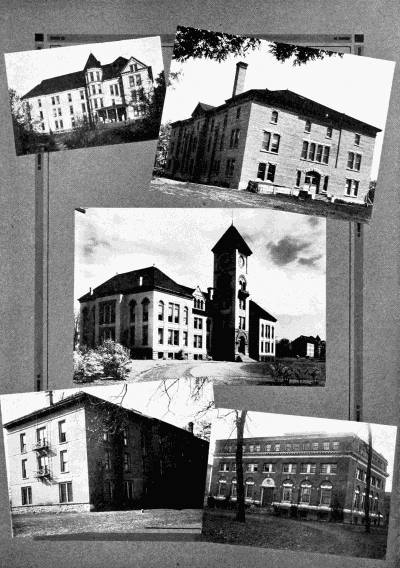
Billings Hall, Department of Science The Gymnasium
Whitman Memorial Building
Reynold's Hall, Young Ladies Dormitory McDowell Hall, Conservatory of Music
GROUP OF WHITMAN COLLEGE BUILDINGS, WALLA WALLA
The catalog shows also that at the present date the college owns equipment, buildings, and grounds to the value of $466,091.40 and endowment funds to the amount of $684,247. The expenses for the session of 1915-16 were $88,892.92. The enrollment of students in the literary departments for 1916-17 was 312, and in the conservatory of music 289.
The graduates of the college who have received bachelor's degrees during the years 1886-1917 aggregate about four hundred and twenty-five. The large majority of these have received their degrees during the seven years ending with the latter date. Classes were very small up to about 1910. Since that time the number of seniors has been from twenty-five to forty. Besides those who have graduated with the regular college literary and scientific degrees, a large number have graduated from academic, normal and conservatory courses.
We are indebted to Mr. W. L. Stirling of the board of trustees of St. Paul's School for Girls for the sketch here subjoined.
HISTORY OF SAINT PAUL'S SCHOOL, WALLA WALLA
Saint Paul's School was opened in September, 1872, as a day school for girls by the Rev. Lemuel H. Wells, a missionary of the Protestant Episcopal Church, who had come to Walla Walla the previous year and organized Saint Paul's Church.
Seeing the need of a girls' school, a board of trustees was selected consisting of the Rev. Lemuel H. Wells, John S. Boyer, Philip Ritz, B. L. Sharpstein, A. B. Elmer, Judge J. D. Mix and John Abbott. Funds were obtained in the East and a frame building was erected near the corner of Third and Poplar streets.
The school prospered, and it was decided to make it a boarding school. More money was raised in the East and in Walla Walla, more land was purchased and a dormitory was built.
In September, 1873, it was opened as Saint Paul's Boarding and Day School for Girls, with Mrs. George Browne as principal. Mrs. Browne was succeeded by Miss Henrietta B. Garretson (who later became Mrs. Lemuel H. Wells) and the Rev. J. D. Lathrop, D. D.
In the earlier days of the school, pupils from Idaho, Montana and Eastern Oregon frequently paid their tuitions in gold dust, and there were a few cases where payment was even made in produce, such as flour, and potatoes. One parent paid in cattle, which remained on the ranch and multiplied until they paid for an addition to one of the school buildings.
The school was successfully maintained until the year 1885, when it was closed. It was reopened in 1897 under Miss Imogen Boyer, as principal. It was incorporated September 14, 1897, by E. B. Whitman, Rev. Francis L. Palmer, B. L. Sharpstein, W. H. Upton, and J. H. Marshall, Rev. F. L. Palmer being chosen its first president.
In 1899 a new site was purchased on Catherine Street, and a new three story building erected named "Appleton Hall." The trustees at that time were Bishop Wells, The Rev. Andreas Bard, B. L. Sharpstein, Levi Ankeny, R. F. Smitten and W. H. Upton. Miss Imogen Boyer was principal, and so continued until her resignation in 1903. Under Miss Boyer's administration the school increased substantially in prestige and in the number of pupils in attendance.
In 1903 Miss Caroline F. Buck was elected principal, and by formal agreement between Bishop Wells and the board of trustees the school was thenceforth to be conducted as a diocesan school of the Protestant Episcopal Church.
In 1904 Miss Buck was succeeded by Rev. Andreas Bard, as principal.
In 1906 funds were secured by Bishop Wells for the erection of a new three story brick dormitory named "Ewing Hall" which greatly increased the accommodations for boarders and materially assisted in the growth of the school.
In 1907 Rev. Andreas Bard resigned and was succeeded by Miss Anna E. Plympton, who remained until 1910. Miss Nettie M. Galbraith was then elected principal, and under her able administration, assisted by Miss Mary E. Atkinson, as vice principal, the school has grown rapidly year by year until it is now the largest, as well as the oldest school for girls in the State of Washington, and probably in the entire Northwest.
In 1911 Bishop Wells secured additional funds for the purchase of the Sharpstein property adjoining the school grounds to allow for expansion in the near future. The acquisition of this fine property 200 feet by 200 feet gave the school a frontage of 543 feet on Catherine Street, one of the finest pieces of property in the city.
In 1916, Bishop Herman Page, of Spokane, succeeded Bishop Wells as president of the board of trustees; the other members of the board at that time being Rev. C. E. Tuke, George A. Evans, W. A. Ritz, Dr. F. W. Rees, H. G. Thompson, Dr. H. R. Keylor, J. W. Langdon and W. L. Stirling.
The need of increased accommodation for boarders being imperative, Bishop Page undertook to raise the sum of $10,000 to $12,000 for a new building provided $5,000 additional should be subscribed by the people of Walla Walla. This was done and a new fire proof brick building was erected in 1917, containing assembly hall, gymnasium and dormitories, and named "Wells Hall" in honor of Bishop Wells, who had founded the school in 1872 and had ever since been its most constant and devoted supporter. Even with its new equipment the school at once became crowded to its capacity, there being fifty boarders, as well as a large number of day scholars, and plans are being considered for another new building.
Although the school now has an annual budget of nearly twenty thousand dollars, it has never been entirely self-supporting, being without endowment, and always having given the greatest possible service at a very moderate charge. The raising of an adequate endowment fund is contemplated as soon as circumstances will permit.
The school offers a systematic and liberal course of study, maintaining kindergarten, primary, intermediate, grammar, grade, academic and music departments, also special post graduate, business, and finishing courses. The course includes eight years in the elementary school, completed in six or seven years when possible, and four years in the academic department. There is also an advanced course offered for irregular students and for those graduated from the high schools and academies.
The instructors are Christian women, and it is the aim of the school to administer to the individual needs of girls; to aid in their moral, intellectual and physical development by offering them the advantages of a well ordered school and the wholesome influence of a refined home. The scholarship of Saint Paul's is attested by the fact that Eastern and Western examiners of leading educational institutions have expressed their willingness to accept its graduates without examination. Saint Paul's covers a wide field, having had among its boarders in recent years scholars from Washington, Oregon, Idaho, Montana, Wyoming, Panama and Alaska.
The location of the school is exceptionally fine, the grounds extensive, well laid out and shaded, and the buildings, four in number, are spacious, well constructed and conveniently arranged and equipped.
THE CATHOLIC ACADEMIES
The Catholic Church has maintained two academies, one for boys and one for girls, for a number of years. These were founded early in the history of Walla Walla. In 1864 the Sisters of Providence opened the doors of a school for girls on the location where St. Mary's Hospital now stands. Rev. J. B. A. Brouillet was at that time at the head of the local church and the school was officially under his oversight. In 1865 St. Patrick's Academy for boys was opened. This was on the site of the present Catholic Church, and the first teacher was H. H. Lamarche. He acted as principal for fifteen years. In 1899 notable changes occurred in the academy. In that year fine and noteworthy exercises in its dedication occurred under charge of Rev. Father M. Flohr. The presence of Bishop E. J. O'Dea added to the interest of the occasion. In August following three brothers from San Francisco arrived to take charge of the academy. In honor of St. J. B. De La Salle, founder of the congregation to which those brothers belonged, the name of the academy was changed to De La Salle Institute. It opened in September, 1899, with 100 pupils. The numbers and influence of this institute have steadily increased. The teachers at the present are: Brother Luke, director; Brothers Damien and Daniel, teachers. The number of boys enrolled is eighty.
The school for girls, founded in 1864, as stated, developed into St. Vincent Academy, and as such it has occupied a position of great influence and usefulness ever since its foundation. Every facility for academic study, with special attention to the varied accomplishments of music, drawing, painting, and decorative work, as well as the practical branches in needle work, in stenography, and in typewriting, is afforded by St. Vincent's Academy. Extracts from the current reports indicate the present conditions.
The Sister Superior in charge of the academy is Sister Mary Mount Carmel. There are six teachers employed at the present time. The enrollment consists of 164 girls and fourteen small boys.
WALLA WALLA COLLEGE
Walla Walla has become known as an educational center, and in addition to the public schools, and private institutions within the city, there is still another outside the city limits entitled to interest. This is Walla Walla College at College Place, a flourishing suburb of the city. The college is under the direction of the Seventh Day Adventists. It was founded by that denomination in 1892 upon land donated by Dr. N. G. Blalock and has been maintained by contributions from the membership of the church and tuitions from the students. In connection with it there is a well conducted hospital. There is a beautiful and commodious main building, besides the other buildings needful to provide for the large number of students who come from elsewhere and make their home at the college. From the current catalog we derive the following exhibit of the managers and faculty.
PRESIDENTS OF WALLA WALLA COLLEGE
William W. Prescott, 1892-94; Edward A. Sutherland, 1894-97; Emmett J. Hibbard,1897-98; Walter B. Sutherland, 1898-1900; E. L. Stewart 1900-02; Charles C. Lewis, 1902-04; Joseph L. Kay, 1904-05; M. E. Cady, 1905-11; Ernest C. Kellogg, 1911-17; Walter I. Smith, 1917-.
BOARD OF TRUSTEES
C. W. Flaiz, College Place, Wash.; H. W. Decker, College Place, Wash.; F. S. Bunch, College Place, Wash.; H. W. Cottrell, Portland, Ore.; J. J. Nethery, College Place, Wash.; J. F. Piper, Seattle, Wash.; G. F. Watson, Bozeman Mont.; F. W. Peterson, College Place, Wash.; E. C. Kellogg, College Place, Wash.
OFFICERS OF THE BOARD
C. W. Flaiz, chairman; E. C. Kellogg, secretary; F. W. Peterson, treasurer.
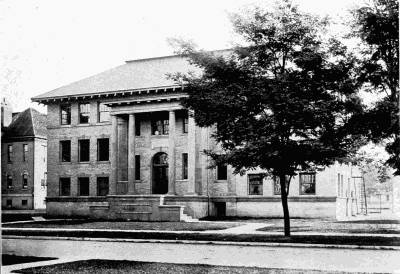
PRESTON HALL, WAITSBURG
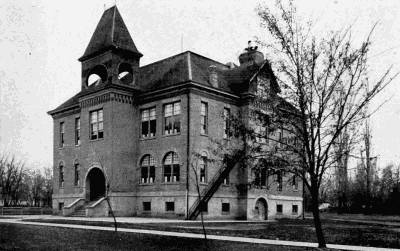
PUBLIC SCHOOL, WAITSBURG
FACULTY
Walter Irvine Smith, president, mathematics and astronomy; Elder O. A. Johnson, Bible and ecclesiastical history; Elder F. S. Bunch, Bible and pastoral training; George W. Rine, history and public speaking; Winifred Lucile Holmden, ancient and modern languages; J. Alvin Renninger, English and Biblical literature; Clara Edna Rogers, rhetoric; Bert Bryan Davis, normal director, psychology and education; William Miller Heidenreich, German; Arthur C. Christensen, chemistry and biology; George Kretschmar, physics and mathematics; A. Wilmar Oakes, director of music, violin, orchestra and chorus; Grace Wood-Reith, pianoforte and voice; Estella Winona Kiehnhoff, pianoforte, voice and harmony; ——, stenography and typewriting; William Carey Raley, bookkeeping and accountancy; Win S. Osborne, art.
NORMAL CRITIC TEACHERS
Charles Oscar Smith, grades seven and eight; Grace Robison-Rine, grades five and six, intermediate methods; Rosella A. Snyder-Davis, grades three and four, manual arts; Anna Aurelia Pierce, grades one and two, primary methods.
INDUSTRIAL DEPARTMENTS
Frank W. Peterson, superintendent; Glen R. Holden, printing; Wm. B. Ammundsen, carpentry; Philip A. Bothwell, baking; Mrs. R. D. Bolter, dressmaking; Mrs. F. W. Vesey, cooking.
The catalog shows an enrollment of 293 pupils.
From a historical and educational standpoint there is no more interesting institution under private control than the
FORMER WAITSBURG ACADEMY
That community of beautiful homes and intelligent citizens, of which much more will be said in other parts of this work, has always recognized the value of education, and it is not surprising to find a demand in the early days for a more advanced type of education than that afforded by the common schools. During the first part of the decade of the '80s that demand eventuated in the appointment by the United Presbyterian Church of Rev. Joseph Alter in 1884 to go to Eastern Washington as a general organizer of home missionary and educational work. The church founded by Mr. Alter secured Rev. W. G. M. Hays as its pastor in 1886. Being filled with the spirit of the need of higher education and encouraged by ample evidence of probable support of a first-class academy, Doctor Hays became a steadfast advocate of such an undertaking and on September 14, 1886, the church building was opened for the meeting of the first classes, Prof. J. G. Thompson being placed in charge of the work. At that time the academy had no corporate existence and no board of trustees. But in 1887 the infant institution was adopted by the synod of Columbia of the United Presbyterian Church of North America and became regularly incorporated with its first board of trustees consisting of the Revs. Hugh F. Wallace, W. G. Irvine, W. A. Spalding, W. G. M. Hays, and J. H. Niblock, and Messrs. A. W. Philips, David Roberts, E. F. Cox, T. J. Hollowell, and J. E. Vans. In May, 1887, in pursuance of the plans of the board, a joint stock company was organized to conduct the academy. Six thousand dollars was raised, of which $4,000 was devoted to a building and the remainder to supplementing tuition as a means of maintenance. During the ten years following the founding, Doctor Hays, Rev. W. R. Stevenson, and Miss Ina F. Robertson made journeys east for the purpose of securing funds for building and endowment. As a result of the last campaign of Miss Robertson, funds were secured for an excellent building which was erected in 1896. During the entire term of its existence Waitsburg Academy received the respect and support of the community, and its teachers were men and women of the highest type.
The principals with their terms of service were these: J. G. Thompson, 1886-9; T. M. McKinney, 1889-90; W. G. M. Hays, 1890-1; Ina F. Robertson, 1891-4; and Rev. J. A. Keener, 1894, to the termination of the life of the institution. For rather sad to relate Waitsburg Academy, in spite of all its excellent work and a growing body of alumni enthusiastic in its support, found itself in the situation which has confronted practically all such educational institutions in the West. When high school instruction was undertaken at Waitsburg it was found that the interest and desire to support that public system was so general that the support of the academy fell off, and though the people of the community had no sentiment other than of commendation, yet their first interest was in the public school system. As an inevitable sequence the academy found it wise to disband. Its building was sold to the district and there the public school work of part of the city is conducted. The academy, though disbanded, had performed a great mission, and the present excellent high school, as well as the general culture and intelligence apparent in the beautiful little City of Waitsburg, may be attributed in large degree to the noble work of the academy.
We have elsewhere given a general view of the public school systems of the county, and in that the schools of Waitsburg appear. But there is one feature of the schools of Waitsburg already named so unique and interesting as to call for further special mention. This is Preston Hall, connected with the high school. This beautiful and well-equipped building was the gift of one of the noblest and most philanthropic citizens of the Inland Empire, a man of whom old Walla Walla County, and particularly Waitsburg, may well be proud. This was W. G. Preston. This big-souled and big-brained builder of the large affairs of his community, had a deep sense of the value of practical industrial training for the growing youth of the land. Carrying out his favorite idea he gave about twenty-six thousand dollars for the creation of a building, with suitable equipment for the best type of industrial education, as well as gymnastic training. While this was but one of the many contributions to the advancement of the community in which the Preston family lived so long and so well, it is perhaps the one which will be most wide-reaching in influence and the one which will perpetuate most effectively the influence of its donor.
Before leaving the subject of the schools it may be suitable to note the fact that the schools in what was old Walla Walla County, as well as the narrower limits which now retain the name, have during the past ten or fifteen years shown a great tendency to build more beautiful and better equipped houses. This has been due partly to the increase in wealth and culture and to the general recognition that the old bare unlovely and forsaken-looking schoolhouses of the earlier times are an affront to the progressive spirit of a time which is demanding the best for the boys and girls, but much of the motive power of this great improvement must be attributed, in Walla Walla County, to the last two superintendents of schools, Mrs. Josephine Preston and Paul Johnson. During the eight years of service of these two efficient public officials the idea of the rural school as a community center and a focus of social life has gained a hold on public interest and support truly wonderful. A debt of gratitude is due these and other incumbents of the same office in the other counties covered by this work in inaugurating a new era in school architecture and beautification of grounds. The influence of this on coming generations for character, patriotism, and efficiency, as well as artistic taste and general culture, will be incalculable. It is fitting that special note be made here of the fact that in the smaller towns of Walla Walla County, Prescott, Touchet, Dixie and Attalia, the school buildings represent large outlay and contain the best modern features. If there is one thing more than another in which the people of this section may take satisfaction, it is the school system, both town and rural.
There is another institution in Walla Walla of rare interest, which while not educational is allied with that branch of social progress. We refer to the Stubblefield Home. From Mr. C. M. Rader, one of the trustees, we derive the following account of this noble institution.
STUBBLEFIELD HOME
To Joseph Loney Stubblefield and his good wife Anna, are indebted the children and widows who in the past have been, or in the future may become members of this home. In early life Mr. and Mrs. Stubblefield experienced the hardships incident to poverty. They emigrated from Missouri in the early '60s and settled about seven miles southeast of Walla Walla, where by most frugal habits and great industry they accumulated, for the early days, a considerable fortune. The wife died in 1874 without issue. She and her husband often talked of the great need of a home for caring for aged widows and orphan children and the wife said she wanted her money to be used for such purpose. She left no will, except as it was impressed in the heart of her husband.
On November 16, 1902, six months after making his will, Joseph L. Stubblefield died at the age of seventy-eight years. By the thirty-first clause of this will he left about one hundred and thirty thousand dollars, the bulk of his accumulations, for the purpose of establishing and maintaining a home for "fatherless or motherless and indigent children, and worthy elderly indigent widows, residents of Washington and Oregon." This fund was willed to R. M. Dorothy, E. A. Reser and Cary M. Rader, who were named as trustees to manage the fund and the home to be established. These trustees were appointed to serve for life, unless any should resign or be removed. The successors of these trustees under the terms of the will are to be appointed by the county commissioners of Walla Walla and Umatilla counties, acting jointly but by and with the consent of the two trustees remaining on the board. A second wife, whom Mr. Stubblefield had amply provided for, attempted to break the will by proceedings in court, but the will was fully sustained both in the Superior and Supreme courts of Washington.
Numerous citizens interested themselves in an attempt to secure the location of the home near Walla Walla and raised a donation of something more than ten thousand dollars to assist in purchasing a suitable site. The trustees purchased the present grounds consisting of forty acres about one mile southeast of the City of Walla Walla and there on November 16, 1904, exactly two years after the death of Mr. Stubblefield, with appropriate ceremonies, the home was formally opened with Alphonso R. Olds as superintendent and his wife Etta C. Olds as matron.
The home remained under the very efficient management of these good people for eight years. On their resignation, occasioned by ill health, Luther J. Campbell and wife Maggie were appointed respectively as superintendent and matron, and have since been in charge of the institution. R. M. Dorothy, in 1912, resigned as trustee and was succeeded on the board by Francis M. Stubblefield, a nephew of Joseph L. Stubblefield. These are the only changes of officials connected with the institution.
The home rapidly filled after the opening and there has since rarely been a vacancy for any considerable time. The number of members in the home is usually close to twenty-five and of these most are children. There have never been more than three widows in the home at one time. The children are taught to work and soon become quite expert for children—the boys as gardeners and the girls at household duties. In 1915 a team of three girls from the home won a prize at the Walla Walla County Fair and also at the State Fair as experts in canning fruits and vegetables. The children attend school at the Berney Graded School.
The fund left by Mr. Stubblefield, by judicious handling, has about doubled and is at present mostly invested in wheat lands, which furnish sufficient income to defray all expenses.
THE CHURCHES OF WALLA WALLA COUNTY
As elsewhere in this work we speak first of the institutions located in Walla Walla City itself. By reason of priority of settlement the institutions of all sorts growing around that point were representative of the entire region and hence belong as truly to the parts which subsequently were set aside for other counties. We shall elsewhere endeavor to give similar brief views of the churches of the other parts of the region covered by our story. As will be obvious to the reader, the limitations of space compel us to consider the churches as a whole, important as they are in the life of the community, without dwelling upon details, significant and inspiring as they often are. Practically all the leading Christian denominations have been represented in Old Walla Walla. The Methodist seems to have been the pioneer among the Protestant denominations, though the Catholic was first to provide a place of worship. It was in 1859 that a structure of piles driven into the ground and covered with shakes was prepared for worship by the Catholics of the little community on Mill Creek. The location was near the present lumber yard on Third Street and Poplar. In 1860 the Methodists built the first regular building on the corner of the present Fifth and Alder. That church had various vicissitudes, for it subsequently moved to Second and Alder and was used for a time as a house for the hosecart of the fire department. Later on it received a second story and became the "Blue Front," still later burned.
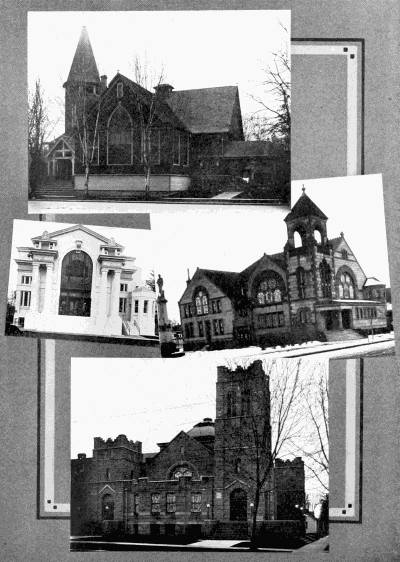
Congregational Church
White Temple Baptist Church Central Christian Church
Presbyterian Church
CHURCHES OF WALLA WALLA
We give here a sketch of the early history of the Methodist Church, not with the desire to overemphasize that denomination at the expense of others, but that by reason of its pioneer nature it was peculiarly typical of the first days. We take this from a historical report prepared by J. M. Hill and E. Smith and presented at the conference at Walla Walla on February 7, 1900. This report contains so much interlocking matter of different kinds as to give it a permanent value:
"On page seventy-four of Rev. H. K. Hines' Missionary History of the Pacific Northwest, we find that the first sermon preached west of the Rocky Mountains was delivered by Rev. Jason Lee at Fort Hall, on Sunday, July 27, 1834. And in a book entitled Wild Life in Oregon, on pages 176-7, we will find that the first Methodist sermon preached at or near Walla Walla was by the Rev. Gustavus Hines, on May 21, 1843, at Doctor Whitman's mission, six miles west of this city. Rev. Gustavus Hines also preached at Rev. H. H. Spalding's Lapwai mission, on Sunday, May 14, 1843.
We find that the first Methodist Episcopal Church organization that was perfected in Walla Walla, or in that part of the country known as Eastern Oregon or Eastern Washington, was in 1859, and at that time the Walla Walla Valley was just commencing to be settled up with stock raisers and traders. The Town of Walla Walla was the principal or most important point, the United States military post being located here, and this place having become the wintering place for miners, packers and freighters from the mines north and east of this country.
The Oregon conference of the Methodist Episcopal Church, having jurisdiction over the church work in this section, took up the matter of supplying it with the gospel, and at the annual conference held at Albany in August, 1859, appointed Rev. J. H. Wilber as presiding elder of this field, calling it the Walla Walla circuit, which took in most of that part of the country east of The Dalles, Oregon, comprising the Grande Ronde, Walla Walla, Snake River and Columbia River valleys as far north as the British line and east to the Rocky Mountains, and appointed Rev. G. M. Berry as pastor for Walla Walla circuit.
Brother Wilber and Brother Berry at once started for their field of labor. They came to Walla Walla and commenced the work by holding meetings at different places, at the homes of some of the people and at times in the old log courthouse at the corner of Main and Fifth streets. Soon after taking up the work Brother Wilber and Brother Berry decided to organize a class at Walla Walla, and on Monday, October 11, 1859, met and organized the first class in the district; also held their first quarterly conference. The quarterly conference was called to order by the presiding elder, Rev. J. H. Wilber, and opened with singing and prayer. The pastor, Rev. G. M. Berry, was appointed secretary of the meeting. The following named brothers were elected as the first board of stewards: S. M. Titus, William B. Kelly, John Moar, A. B. Roberts and T. P. Denney. A. B. Roberts was elected as the recording steward.
In January, 1860, the class decided to build a church in the Town of Walla Walla, and appointed a building committee to undertake the work, consisting of the pastor, Rev. G. M. Berry, Brother Thomas Martin and Brother John Moar. At a meeting held in April, 1860, the committee reported that they had selected for a church site lots 6 and 7, block 10, at the corner of Alder and Fifth streets, and that Rev. G. M. Berry had made application to the Board of County Commissioners asking them to donate the lots to the church. At a meeting held on May 21, 1860, the first board of trustees of the church of Walla Walla was appointed, being Brothers T. P. Denney, S. M. Titus, John Moar, Thomas Martin and William B. Kelly, and on May 22, 1860, lots 6 and 7 of block 10 of the original Town of Walla Walla were transferred to the above named trustees for the church by the Board of County Commissioners of Walla Walla County.
The building committee—the pastor, Rev. G. M. Berry, as its chairman—with the few members, at once took up the work of building the church, which was completed in the fall of 1860. It was the first church of any denomination built in Walla Walla, and was built at a cost of $1,046.52, with unpaid bills to the amount of $131.02. These items are taken from the report of the auditor of accounts of the building committee as reported at the third quarterly conference, held at Walla Walla on June 24, 1861, by Andrew Keys, auditor. The pastor, Rev. G. M. Berry, had practically been Sunday-school superintendent as well as pastor ever since the organisation of the class until the church was completed. We fail to find any record of the dedication of this church.
The Oregon annual conference of 1861 created the Walla Walla district and appointed Rev. John Flinn as presiding elder and pastor of Walla Walla. At the Oregon annual conference, held in 1867, the Walla Walla district was divided into one station and four circuits, viz.: Walla Walla Station, Walla Walla, Waitsburg, Grande Ronde and Umatilla circuits.
In 1868, the class having become strong, and desiring a new location for their church building, the board of trustees procured lots on the corner of Poplar and Second streets, bought on May 30, 1868, from W. J. and Abell Arner for $250.00, and deeded to the following named trustees: H. Parker, T. P. Denney, J. L. Reser, Joseph Paul and John W. McGhee. The old church was moved to the new location, repaired and enlarged, and a parsonage was fitted up just east of the church, facing on Popular Street.
At the Oregon annual conference, held at Eugene, August 5 to 9, 1869, all of the membership and appointments formally denominated Walla Walla Station, Walla Walla Circuit and Dry Creek were formed as one charge and called Walla Walla Circuit, to which Rev. John T. Wolfe was appointed as pastor and Rev. Charles H. Hoxie as assistant pastor.
Rev. James B. Calloway was presiding elder of the district, and on September 18, 1869, called together at Walla Walla all of the official members of the new circuit and organised the first quarterly conference, electing the following board of trustees: Charles Moore, T. P. Denney, D. M. Jessee, M. Emerick, Benjamin Hayward, A. H. Simmons, M. McEverly, William Holbrook and Oliver Gallaher. At the Oregon annual conference, held at Vancouver, on August 25, 1870, Walla Walla City was again made a station, separating it from the Walla Walla Circuit, and Rev. H. C. Jenkins was appointed as pastor.
Early in the spring of 1878, under the leadership of the pastor, Rev. D. G. Strong, the class undertook the erection of a new church building. The old church was sold to Mr. J. F. Abbott for $250.00 and moved off the lots, and through the efforts of the pastor and his board of trustees, consisting of B. F. Burch, J. E. Berryman, M. Middaugh, John Berry and O. P. Lacy, together with the faithful members and friends, the new church was completed at a cost of about $10,000, receiving from the church extension society of the church a donation of $1,000 and a loan of $500. The loan in due time was paid back. After the completion of the new church, Rev. W. G. Simpson was the first pastor and Brother E. Smith was the first Sunday-school superintendent. For some reason not on record the church was not dedicated until August, 1879. The collection and services at the dedication were in charge of Bishop Haven, he being the bishop of the annual conference held at Walla Walla August 7 to 12, 1879.
It having been discovered in 1883 that the board of trustees had never been incorporated under the laws of the Territory of Washington, the quarterly conference directed that articles of incorporation should be prepared. B. L. and J. L. Sharpstein, attorneys, were employed to prepare incorporation papers, and on February 9, 1883, they were signed and acknowledged by the following board of trustees: Donald Ross, C. P. Headley, S. F. Henderson, J. M. Hill, H. C. Sniff, H. C. Chew, E. Smith and G. H. Randall, and filed with the territorial auditor and the auditor of Walla Walla County. At the first meeting of this board of trustees they elected the following officers: J. M. Hill, president; Donald Ross, secretary; C. P. Headley, treasurer.
During the summer of 1887, the class, under the leadership of the pastor, Rev. Henry Brown, with the ladies of the church and the trustees, consisting of J. H. Parker, C. P. Headley, S. F. Henderson, J. M. Hill, H. C. Sniff, H. C. Chew, G. H. Randall and E. Smith, undertook the building of a new parsonage, and with the bequest of $500 from the estate of our departed brother, E. Sherman, designated by him to be used for a new parsonage, and $596.47 raised principally by the efforts of the ladies' parsonage committee, a two-story, seven-room parsonage was erected on the grounds of the old parsonage, facing Poplar Street, and this was turned over to the board of trustees free of debt and fairly well furnished.
During 1887, through the efforts of Rev. J. H. Wilber, a small church was built in the eastern part of the city and called Wilber Chapel. Brother W. J. White donated a lot for that purpose, $300 being received from the Church Extension Society, part of the balance being subscriptions from friends, but the greater part being given by Rev. J. H. Wilber himself. The church cost $1,500 and was deeded to the trustees of the First Methodist Episcopal Church of Walla Walla, viz.: J. H. Parker, J. M. Hill, C. P. Headley, S. F. Henderson, H. C. Sniff, H. C. Chew, G. H. Randall and E. Smith. The church was sold to the German Lutheran Society for the sum of $1,600 on September 5, 1892, returning to the board of the church extension about $400 due them in principal and interest. The dedication of Wilber Chapel was by Rev. N. E. Parsons, presiding elder, assisted by Rev. J. H. Wilber and Rev. Henry Brown. During 1894 the church, under the leadership of Rev. V. C. Evers, the pastor, with the trustees, enlarged the present church by extending it to the north line of the property, increasing the seating capacity of the church with lecture room to 525 persons.
Our church property at this time is free from debt and consists of:
One church building and lot, value $11,500.00; one parsonage and fraction of lot, value $2,000.00; total $13,500.00.
The following are the names of the pastors of Walla Walla and time of service: 1859 to 1861, Rev. George M. Berry; 1861 to 1863, Rev. John Flinn; 1863 to 1865, Rev. William Franklin; 1865 to 1866, Rev. James Deardoff; 1866 to 1867, Rev. John L. Reser; 1867 to 1869, Rev. John T. Wolfe; 1869 to 1870, Rev. C. H. Hoxie; 1870 to 1872, Rev. H. C. Jenkins; 1872 to 1873, Rev. J. W. Miller; 1873 to 1874, Rev. S. G. Havermale; 1874 to 1875, Rev. G. W. Grannis; 1875 to 1876, Rev. S. B. Burrell; 1876 to 1878, Rev. D. G. Strong; 1878 to 1880, Rev. W. G. Simpson; 1880 to 1882, Rev. G. M. Irwin; 1882 to 1883, Rev. A. J. Joslyn; 1883 to 1884, Rev. W. C. Gray; 1884 to 1885, Rev. J. D. Flenner; 1885 to 1886, Rev. D. G. Strong; 1886 to 1889, Rev. Henry Brown; 1889 to 1892, Rev. W. W. Van Dusen; 1892 to 1896, Rev. V. C. Evers; 1896 to 1899, Rev. W. C. Reuter; 1899 to 1900, Rev. Lee A. Johnson.
The following are the names of the presiding elders of Walla Walla district and time of service: 1859 to 1861, Rev. J. H. Wilber; 1861 to 1864, Rev. John Flinn; 1864 to 1866, Rev. Isaac Dillon; 1866 to 1869, Rev. J. B. Calloway; 1860 to 1870, Rev. W. H. Lewis; 1870 to 1874, Rev. H. K. Hines; 1874 to 1878, Rev. S. G. Havermale; 1878 to 1882, Rev. D. G. Strong; 1882 to 1885, Rev. W. S. Turner; 1885 to 1886, Rev. Levi L. Tarr; 1886 to 1888, Rev. N. E. Parsons; 1888 to 1892, Rev. D. G. Strong; 1892 to 1898, Rev. T. A. Towner; 1898 to 1900, Rev. M. H. Marvin."[5]
[5] In article quoted the name Wilber appears a number of times but it should be noted that the correct spelling is Wilbur.
CATHOLIC CHURCH
In 1861 the Catholics built their first permanent house near the present site of St. Vincent's Academy. Bishop Blanchet was present during that period and Father Yunger became pastor. He was succeeded by Rev. J. B. Brouillet, who first came to the Walla Walla country as a missionary to the Indians in 1847.
Connected with the Catholic Church are St. Vincent's Academy and De La Salle Institute, described elsewhere, besides St. Mary's Hospital, founded in 1870 and now established in one of the most perfect buildings in the Northwest.
While our limits do not permit details in regard to each of the churches of Walla Walla, we wish to incorporate a sketch of the early Episcopal Church, for the reason that it casts such as vivid light upon the early days as to give it a special historic value. This sketch was prepared by Edgar Johnson, one of the Whitman College class of 1917, as a research study in his history course and in the judgment of the author is worthy of a place in this volume.
THE EARLY HISTORY OF ST. PAUL'S EPISCOPAL CHURCH
According to the old adage, "Well begun is half done," this church completed half its work in its earliest period. The history of all churches when finally established in a civilized community is much the same. But what was the history of this church before Walla Walla became civilized?
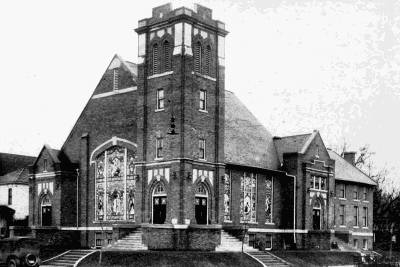
PIONEER METHODIST CHURCH, WALLA WALLA Completed January 1, 1918.
This is the atmosphere I have to picture; the condition of the times as it reflected on the growth of the church, and the condition of the church as it reflected on the growth of civilization in this city.
From the historical data accompanying this review, it will seem that St. Paul's Church was first begun by services held by a traveling missionary, Bishop Morris. The church did not take on definite unity, however, until 1871, when it was placed under the care of Rev. L. H. Wells, a comparatively young missionary from the East. In September, 1871, the first services were held in the building (now gone) on Third Street, between Poplar and Alder streets. This building served as a combined courthouse, hall, church; and the basement housed Stahl's Brewery.
At the time of Bishop Wells' arrival in Walla Walla, this city boasted of one thousand inhabitants, while Eastern Washington had seven thousand settlers. At this date, it would strike us that the little city of one thousand would band itself together to protect themselves from the Indians. But fifteen years or more had passed since the last of the Indian wars, and the wealth of the mines of Idaho and Washington found its way into the city and aided in the carousals of its "short-time" owners. For the uninitiated, the center of the street, or open doorways were the safest stops in the city. The Vigilantes ruled as a secret power behind the throne. Suspicion was fixed upon every law-abiding citizen by those who lived to break the law, as a member of this band.
The wives of several saloon-keepers were members of the church; and one wife succeeded in converting her husband. But inability or lack of desire to learn a new trade, always drove the new convert back into his old business. After efficiently illustrating back-sliding methods thrice over, this particular saloon man never appeared upon the church rolls again. He furnished, however, the material for a story which emphasizes the uncouthness of the times. He maintained a flourishing saloon on the corner of Third and Main streets, and one evening a miner from the Florence District showed up with his nuggets and gold dust. After treating the house several times, he began searching for more amusement. Finally, thinking that the mirror behind the bar might prove a worthy object at which to pelt gold nuggets, he began firing. Needless to say, he smashed it into bits and then careening up to the bar, he simply asked: "How much do I owe?" The saloon-keeper recovered several hundred dollars' worth of nuggets from the floor and after removing the board floor from the saloon succeeded in washing out $200 more from the gold dust which had been lost throughout the previous period. This became an annual event and never failed in bringing a hundred dollars or so.
In 1872 the bishop started his day school, following this in 1873 with a boarding school for girls. In this year a fire burned them out entirely and a larger building was constructed. The life of the bishop was not an easy one. He lived in his little cabin next to the church and whenever a new girl came to the boarding school, he would be forced to give up some of his furniture for the new girl. He was finally reduced to sleeping on a cot, with his overcoat for a coverlet. It was very difficult to keep the coat from falling away during the night; and when another girl came and the couch was needed for her room, the bishop having received no new furniture, built himself a box and filled it with straw, in which he slept and in which he had no difficulty in retaining his overcoat as a comforter.
Gold dust and nuggets were the medium of exchange and the church and school both had gold-weighing scales. Many people carried little scales with them in morocco cases. Gold dust was generally carried in buckskin sacks about a foot in depth and about three inches wide, and many people left them lying about the front porch in disguised covering, as the safest place to keep them from thieves and renegade Indians. Three grades of gold found its way into Walla Walla. These were the Eldorado, Florence and Eagle Creek, so named from the district in which they were mined. Merchants kept on hand small round stones with streaks of all three grades in them, by which to measure the dust, as the three grades were worth different amounts of money.
It was in this atmosphere that the church began, truly, in a missionary district. Yet it grew, and mainly through the spirit of co-operation of the other churches in the territory. At this time there were also the Methodist, Congregational, Presbyterian and the United Brethren churches. Bishop Wells recently told me of the kindness of the United Brethren minister. One day while walking down the street, he was hailed by this minister who was on horseback. The old minister opened the conversation: "Young man, I've been watching you, and so have my congregation. It strikes us that you've seen city life and I'm only a country preacher. If you will take care of my congregation, you may have the church and I'll go into the country, where I can do some good." Naturally, the offer was accepted.
In 1877 the new church was erected, and it still stands. This was built on the corner of Third and Poplar streets. The lumber for it was hauled from Touchet, where there was a mill. One difficulty presented itself, however, and that was that the lumber obtainable from there was very short. But the long haul from Wallula made better lumber almost prohibitive, and the church was built from lumber cut in this vicinity and planed at Touchet.
Even at this date, forty years ago, Walla Walla was little more than a frontier town. The Joseph wars broke out as result of the white man's raid on their land. A few years previous to this the Government had sent out men to see what could be done for the Indians. The white men were open in their statements that they intended to get the Indians' lands. The Joseph war was followed by the Bannock war. In the latter, Walla Walla was seriously threatened, the Indians coming up through Pendleton and striking near the foothills of this city. A very pretty tale is told regarding a Pendleton sheep man and his dog Bob. The Indians murdered the herders, killed many of the sheep and went on their way. The owner stayed in Pendleton fearing to go to his flocks, and did not go near them until a week or two had elapsed. When he did find them, he discovered that the dog Bob had not only gathered all his own sheep into the flock, but had collected more stray sheep from other flocks that had become lost, than the Indians themselves had killed. Furthermore, he had only killed two small lambs for his own sustenance.
Recitation of early events, and incidents could go on forever. And also it is hard to shape a series of stories, and a few simple historical facts, into an interesting history. But the foregoing gives the reader an idea of the times into which the missionary was forced to introduce the Christian teachings. A glance at Walla Walla today, called often the City of Churches, and then the retrospective glance into the '70s, shows the results of the influence which began work at that early date and by its everwidening influence succeeded in civilizing this Northwest.
WORTHY AND POWERFUL PREACHERS
Of the many worthy and powerful preachers of early Walla Walla it may be said that four seem to stand out beyond all others in the minds of pioneers. These are Cushing Eells, missionary, educator, school builder, and all-round saint; John Flinn, a man of somewhat similar type, patient, tireless in good deeds, saintly and unselfish; J. H. Wilbur, one of the big figures of early days; and P. B. Chamberlain, first pastor of the Congregational Church and first principal of Whitman Seminary. Each of these men had his peculiarities, some amusing, some pathetic, all interesting and inspiring. Old-timers, even those not at all given to walking the straight and narrow way, had profound regard for those militant exponents of the gospel. Father Wilbur had worked at the blacksmith's trade before entering the ministry and had muscles of iron and a heart as tender and gentle as ever beat. He was of giant strength and not at all times a non-resistent. It is related that once in Oregon before he came to Walla Walla, some rowdies persisted in disturbing a camp meeting which he was conducting. After warning them a time or two in vain he suddenly descended from the platform, keeping right on with the hymn in stentorian voice, swooped down on the two rowdies, seized them in his brawny hands, knocked their heads together a few times and almost shook the breath out of them, singing all the time, until it was plain that they would interrupt no more services, then returned to the pulpit, going right on as though nothing had happened.
Mr. Chamberlain was a man of very different appearance, small, delicate, refined in tone and speech. At first meeting one had little conception of his tremendous energy and iron will. He was a man of electric oratory and swayed pioneer audiences in his little church or in the groves at public gatherings as few men in Walla Walla ever have. He was, however, a genuine Calvinist in his theology, an intense Sabbatarian, and felt called on to attack secret societies and supposedly unorthodox churches with conscientious severity. Thus, though he was admired and respected by all, he could not maintain a working church. As showing something of the character of the man, we include brief extracts from entries made by him in the records of his church, pertaining to his first church building. The building was completed in 1866 at a cost of $3,500, most of which was Mr. Chamberlain's own money. Of it he says: "So it now stands consecrated to God, as all property should be. I leave it with Him, to be refunded or not as He may, at some future time, move the hearts of the children of men to desire to do." On July 13, 1868, two days after the fire, he writes: "God has put His own final construction upon the last part of the foregoing record. Last Saturday, between twelve and two, our pleasant church was entirely destroyed by fire, the fire originating in a neighbor's barn, situated within a few feet of the church. Thy will, not mine, be done." It is gratifying to record that the Methodists at once offered to share their house with their stricken neighbors and that within a few months the generous contributions of the people of Walla Walla enabled Mr. Chamberlain to gather his congregation again on the same place, corner of Second and Rose, and there the Congregationalists continued to worship under several pastorates until during that of Rev. Austin Rice in 1900 the present building on Palouse and Alder streets was erected.
During the past few years a number of fine church buildings have been erected, of which the Christian, the Presbyterian, the Baptist, the Marvin Methodist, and the First Methodist, may be especially named.
A distinguishing feature of present church life may be said to be the degree to which it has taken hold of municipal and political questions, reforms, and problems of practical life. In that respect the present churches of Walla Walla are essentially modern. Besides the churches named above, the United Brethren, Lutheran, German Methodist, German Congregational and Christian Science Churches, maintain influential organizations, and the Salvation Army is active and useful.
FRATERNAL ORDERS
Somewhat similar to the churches in philanthropic aims and to considerable degree composed of the same type of members are the fraternal orders.
If Walla Walla and its kindred communities may be regarded as the homes of schools and churches, they may in equal degree be regarded as the homes of lodges. Almost all the fraternal orders usual in American cities are found here. As in case of the churches we find ourselves compelled by the limitations of space to accord too brief attention to these important and popular organizations.
The Masonic order has been for many years represented by an active membership, having two lodges, one chapter, a commandery, and a chapter of the Order of the Eastern Star. The first lodge was Walla Walla No. 7, which came into being October 19, 1859. At that date a dispensation was granted to C. R. Allen, Braziel Grounds, A. B. Roberts, H. N. Bruning, T. P. Page, Jonas Whitney, Charles Silverman, J. Freedman, and R. H. Reigert. Not till September 3, 1860, was the lodge organized. A. B. Roberts was the first Worshipful Master; J. M. Kennedy, senior warden; B. Scheideman, junior warden; T. P. Page, treasurer; W. B. Kelly, secretary; C. A. Brooks, senior deacon; J. Caughran, junior deacon; W. H. Babcock, tyler. In the summer of 1864 the lodge built a home at the corner of Third and Alder streets. But this building was destroyed by fire in 1866, and for many years following the lodge held its sessions in the Knights Templar hall in the Dooley Block. For several years past the upper story of the Motett Building on Alder Street has been used as a Masonic lodge room.
The Odd Fellows have been represented in Walla Walla since 1863, and it is a matter of historic interest to record that the first dispensation to organize a lodge of Odd Fellows in Walla Walla was granted in that year to A. H. Purdy, James McAuliff, W. B. Kelly, L. A. Burthy, and Meyer Lazarus. With additions from time to time there have come into existence three lodges, one encampment, one canton, and two lodges of the Daughters of Rebekah. One of the notable institutions of the Odd Fellows is the Home on Boyer Avenue. This is an institution covering the state and now is housed in two commodious and attractive buildings with accommodations for a large number of old people and orphan children. The home is located upon five acres of fertile and wholesome land secured from H. P. Isaacs. The first building of wood was constructed in 1897 and opened for use in December of that year. The second building of brick was constructed in 1914. There are many shade and fruit trees upon the grounds of the home, and it is truly an attractive and beneficent place. The order has also a fine hall on Alder Street.
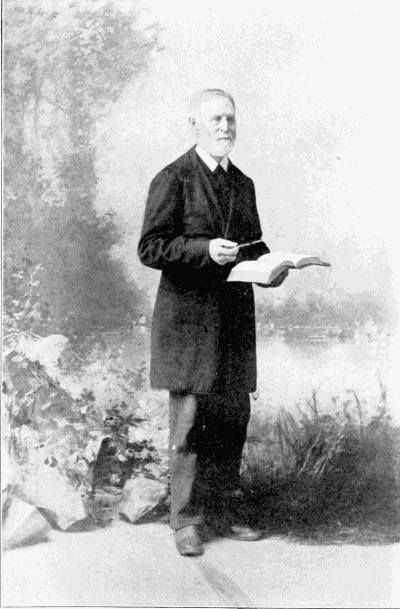
REV. CUSHING EELLS
The "St. Paul of the Northwest." Missionary to the Indians, 1838-47. Afterward teacher and preacher, and founder of Whitman College.
Perhaps most rapid in growth of all the orders in Walla Walla has been the Elks. The Walla Walla lodge of Elks No. 287 was organized August 10, 1894, with fifteen members. The first member to fill the place of Exalted Ruler was Judge W. H. Upton, known for many years as one of the most scholarly, intellectual and capable of the lawyers and jurists of the Inland Empire. His death in 1906 was a great loss, deeply deplored by many circles, not alone in fraternity organizations, in which he was conspicuous, but in all lines of social and professional life. After a slow growth of a number of years the fraternity took on swift development and at the date of this publication the membership exceeds six hundred. The lodge possesses one of the most beautiful buildings in the city, dedicated with a series of appropriate ceremonies and entertainments on May 23, 24, and 25, 1913. The Elks have led many movements for public betterment, as the municipal Christmas trees, park benefits and other benefits, Red Cross campaigns, and other endeavors of philanthropic and patriotic service. One of the recent enterprises of the lodge was the establishment in 1916 of Kooskooskie Park on Mill Creek, fourteen miles above Walla Walla. There in the beautiful shade along the flashing crystal waters of our creek (Pashki the stream ought to be called), the Elks and their friends are wont to disport themselves at intervals in the hot season, as their four-footed prototypes their "totem" of prehistoric times, were accustomed to do. The present Exalted Ruler is C. S. Walters. There is regular publication called The Lariat, issued every new moon by the secretary, Fred S. Hull.
Of what may be called the great standard fraternities the next to be noted is the Knights of Pythias. It is an interesting historical fact that Walla Walla was the first location of a lodge of that order on the Pacific Coast north of San Francisco. That pioneer lodge was known as Ivanhoe Lodge No. 1. Its early records are not available, but it continued in existence till 1882, in which year it surrendered its charter and went out of existence, to be succeeded by Columbia Lodge No. 8, instituted on October 23d of that year. Of the new lodge the first Past Chancellor was S. A. Deckard, and Chancellor Commander W. N. Gedders. The lodge has been maintained with vigor and success to the present date.
Of what may be considered the more specialized and limited organizations there have been and are a number: The Young Men's Institute and Knights of Columbus, Catholic organizations; Woodmen of the World, Modern Woodmen of America, Royal Arcanum, Women of Woodcraft, and National Union, insurance fraternities; and of more miscellaneous character the United Artisans, the Pioneers of the Pacific, the Degree of Honor, Ancient Order of Hibernians, American Yeomen, the Foresters of America, the Rathbone Sisters, Ladies of the Maccabees, Ancient Order United Workmen, Loyal Order of Moose, Improved Order of Red Men, Degree of Pocahontas, Good Templars, Sons of Hermann, Fraternal Order of Eagles, and Order of Washington.
Here as elsewhere throughout our country, and worthy here as everywhere of profound respect, is a post of the Grand Army of the Republic. This was chartered March 12, 1881, and the names appearing upon the charter are these: John H. Smith, J. F. McLean, P. B. Johnson, J. M. Coolidge, R. P. Reynolds, Abram Ellis, James Howe, J. A. Neill, O. F. Wilson, H. O. Simonds, Samuel Nulph, Charles Heim, Isaac Chilberg, A. D. Rockafellow, William Leislie, F. F. Adams, F. B. Morse, R. M. Comstock, and Ambrose Oldaker. The first commander of the post, known as Abraham Lincoln Post, No. 4, G. A. R., was John H. Smith. In April, 1886, the A. Lincoln Relief Corps, No. 5, was established, with twenty-five charter members, Mrs. Jane Erickson being president. Fittingly included with the two previously named posts are the United Spanish War Veterans and the Sons of Veterans.
There are found in Walla Walla also, of more recent date, the Park Association, one of the most important and influential of all in the beautification and sanitation of the city, the Gun Club, Isaac Walton Club, Golf Club, Anti-Tuberculosis League, and several Reading and Art clubs which have played important parts in ministering to the recreation, the health, the intellectual life, and the artistic taste of the people of Walla Walla and the region adjoining. It is to be regretted that the limitations of space forbid including here the many interesting details of these various organizations.
The Walla Walla Commercial Club occupies so commanding a place in the business life of this entire region and has such connections with similar organizations throughout the entire Northwest and even in the nation at large as to be worthy of a history of its own.
COMMERCIAL CLUB
The Commercial Club came into existence in 1885. It was represented in that year by delegates to an Open River meeting in The Dalles. For a number of years it was suggestive and mutually stimulating to its small membership, rather than possessing any regular organization. It met irregularly both in time and place. In 1904 John H. McDonald became secretary, but the organization was not such as to provide for a secretary who could devote his entire time to it, and hence there was not then a real commercial club in the modern sense. But a new era began with the appointment in 1906 of A. C. Moore as the first regular and exclusive secretary. Mr. Moore had come to Walla Walla in 1888 and had been up to 1906 engaged in the O. R. & N. R. R. office. With his entrance into the secretaryship of the club new and broader plans for publicity and expansion by new memberships were begun. In 1908 the first of a series of regular publicity campaigns was begun. That was a time signalized by the seaboard cities of California, Oregon, and Washington—Los Angeles, San Diego, San Francisco, Portland, Seattle, Tacoma, Astoria, Everett and Bellingham—with special efforts to attract immigration and new enterprise. It was the publicity era par excellence.
Tom Richardson and C. C. Chapman of Portland accomplished wonderful things in that city and in Oregon. Both became well known in Walla Walla, where they were greatly admired and where their enthusiasm imparted such an impulse to the Commercial Club as to lead to a new organization with the special aim of advertisement and general publicity. It may be said that the real history of the club as a definite organization begins at that time, 1908.
The articles of incorporation are as follows:
ARTICLES OF INCORPORATION
ARTICLE I
The name of this corporation, and by which it shall be known, is "Walla Walla Commercial Club."
ARTICLE II
The time of existence of this corporation shall be fifty years from the date hereof.
ARTICLE III
The purposes for which this corporation is formed shall be to establish, equip, acquire, keep and maintain club rooms with the usual and convenient appliances of a social club; to engage in literary, educational and social pursuits and to provide ways and means therefor, and for the development of the physical and mental capacities of its members, and others, and for their social advantage, improvement and enjoyment in connection therewith; to advance the prosperity and growth of the City of Walla Walla and of the State of Washington, to encourage the establishment of manufactories and other industries; to seek remunerative markets for home products, and to foster capital and protect labor mutually interested in each others welfare; to collect and disseminate valuable agricultural, manufacturing and commercial information; to extend and develop trade agriculture, merchandise, banking and other lawful business pursuits, and to do any and all things necessary for the accomplishment of these purposes.
ARTICLE IV
The principal place of business of said corporation shall be at Walla Walla, Walla Walla County, State of Washington.
ARTICLE V
The members of this corporation may be individuals, co-partnerships or corporations. It shall have no capital stock, and shares therein shall not be issued. The interest of each member shall be equal to that of any other, and no member can acquire any interest which will entitle him to any greater voice, vote, authority or interest in the corporation than any other member. The corporation may issue membership certificates, which certificates shall be assignable under such provisions, rules and regulations as may be prescribed by the by-laws of the corporation. Memberships in the corporation may be terminated by voluntary withdrawal, by expulsion and by death, and the loss of membership through any such causes and the incidents thereto shall be governed by the by-laws of the corporation.