Chapter III · (continued 2)
Reading edition
"About twenty-two years ago, C. H. Mowrey, with A. L. Darby, purchased the hardware business of H. Darby & Sons, and formed a partnership under the name of Darby & Mowrey, which business they have successfully conducted up to the present time.
"In the jewelry business, both C. A. McCabe and L. J. Whitcomb are dead. Both will be remembered by all old-timers as kind-hearted, honest men. In the last ten years two new jewelry stores have taken their place—L. T. Christopherson and George Simenstad, owners. Both carry large and up-to-date stocks.
"J. H. Hagy sold his shoe store about ten years ago to Powell & Taylor. Later Mr. Powell sold his interest to Taylor Bros., and later D. A. Taylor assumed management of the store and his brother opened a store at Pasco.
"Sacknitz purchased the furniture business from Vassar, and the latter moved away for a time, returning and opening a store under the name of Williamson & Vassar, and later Vassar & Son, who are now conducting the furniture and undertaking business.
"The Central Drug Store, owned and operated by Doctor Kuykendall, was purchased by his son, C. E. Kuykendall, about ten years ago. He is doing business where his father did twenty-seven years ago. The East End Drug Store was sold by I. C. Sanford & Co. to Doctor Black & Son, and later to M. A. Black. Now it is owned by Crump & Dill.
"In 1892 L. F. Koenig sold his interest in the business conducted under the name of Koenig & Bournhouser, in Pataha, and, with O. S. Williamson, opened a store here under the name of L. F. Koenig & Co. This store has been very successful and is operated today under the above name, with E. J. Williamson associated with them.
"J. N. Cardwell & Sons opened a general merchandise store here sixteen years ago, and later purchased the merchandise stock from Fred J. Elsensohn Co., and consolidated the two stores.
"In the spring of 1890, J. S. Thomas, J. S. Davis and H. M. Hathaway organized a hardware store under the name of J. S. Davis & Co. Later the business was purchased by R. E. Wills, C. P. Gammon and J. R. Stevenson, under the name of C. P. Gammon & Co., and later Wills & Stevenson. About fifteen years ago Mr. Stevenson bought Mr. Wills' interest in the business and has since conducted it very successfully.
"In 1890 C. A. Lundy and E. M. Rauch incorporated under the name of C. A. Lundy & Co., and opened a grain and real estate business. Later they dissolved the corporation and Mr. Lundy moved to Lewiston. Mr. Rauch then opened a hardware and implement house, which business he conducts at present.
"About fifteen years ago Mr. J. P. Ford, who at one time previous had been manager for an implement house here, returned and formed a partnership with J. R. Stevenson and opened an implement house. Later he purchased his partner's interest and conducted a very successful business. He sold to Morris & Tewalt, later Mr. Morris purchased the interest of Mr. Tewalt, and became sole owner. He has since enlarged the business, adding furniture and hardware in connection with the implement business. Later he purchased the stock of the Pomeroy Implement Co.
"About twelve years ago Ward & Meyers bought the hardware business of James Hazelton, and a short time afterwards took in T. B. McKeirnan and conducted two stores. Mr. Ward sold his interest to Mr. Meyers, and later the business was purchased by R. J. McKeirnan, J. C. McKeirnan, B. L. Keatts and W. L. Meyers, and implements and hardware were added. Later R. J. McKeirnan bought Mr. Meyers' interest. W. L. Meyers then opened a new harness store.
"About fifteen years ago H. Wenning opened a bakery and grocery, and conducted it until two years ago, when he sold to S. L. Nicholson, who has since managed it.
"A number of pioneers in business not mentioned in the above, who sold their stores and moved away were: Foote & Hull, who were among the earliest business men; George Eller, Hayden Gearhardt, J. D. Tyrell, DeBow, Pomeroy Hardware & Implement Co."
PATAHA CITY
From Pomeroy we turn to its one time rival, three miles up the valley. Pataha City was laid out in 1878 by Angevine J. Favor. In 1882 W. W. Rigsby added to the townsite the tract known as Rigsby's addition. A. F. Beal made the survey of the new town. It was at first called "Favorsburg" and afterwards "Watertown." One of the most important events was the sale of a water right for a flour mill from a large spring south of the town by Cassander Woolery to J. M. Bowman and George Snyder. This was subsequently acquired by John Houser and became one of the most important mill properties in the state.
The Charter of Pataha City was granted by Judge W. G. Langford on April 3, 1888. As indicating the established residents of the town the list of those petitioning for the charter possesses historical interest: J. H. Walker, A. J. Favor, G. D. Wilson, John Harford, John Houser, H. B. Ferguson, W. J. Wills, B. Steele, H. L. Caples, Thomas Cunningham, C. A. Lundy, Robert Gammon, J. S. Dennison, A. McQueen, W. B. Wetzel, A. E. Allen, T. W. Shannon, Elmer Sage, R. M. Smith, Peter Cook, H. C. Krouse, H. Lanning, L. F. Koenig, R. Bornhouser, Charles Ward.
The first meeting of the board of trustees of Pataha was held in Harford & Son's bank, on April 12, 1888. John Harford was mayor, and the councilmen were: John Houser, A. J. Favor, J. H. Walker and G. D. Wilson. H. B. Ferguson was clerk of the board. H. C. Krouse was the city marshal, E. D. Briggs superintendent of streets, and E. C. Harford treasurer.
One of the bitterest contests ever held in Pataha was over the question of prohibition. There was an election under the local option law in June, 1886. In the issue of the East Washingtonian of July 3d, there is a very grave charge against the judges of election, in effect that they allowed foul play with the ballot boxes during the noon recess, as a result of which eighty-two "wet" ballots were deposited in a bunch. It was matter of common knowledge that the "drys" were in a majority in the town, and so extraordinary a result could not fail to excite suspicion. The effort in the interest of the "wets" was unavailing and the entire county finally became dry. On April 7, 1893, a great catastrophe befell the town, for on that day came a fire which destroyed the larger part of the business portion. That was in the very hardest part of the "hard times." The year 1894 was indeed a black year, worse for Garfield County than for Walla Walla and Columbia, for they, being older, had more accumulations to fall back on. Wheat was bringing only 25 or 30 cents a bushel, and a good part of the crop of 1893 had been destroyed by continued rain. In 1894 came the "Great Flood," railroad strikes, bank failures and general chaos in the business world. Among other banks, that of Harford & Son at Pataha closed its doors. Pataha was manifestly on the down grade as a town. It was and is a beautiful and fertile spot and is now fulfilling its mission in the world as a central point of farming production. In April 10, 1911, the question of disincorporation was submitted to vote and by nearly a unanimous decision the charter was surrendered and Pataha ceased to be an incorporation. The business men mainly moved to Pomeroy or elsewhere and the Houser Mill alone remained in undiminished vitality.
The churches of Garfield County and Pomeroy are entitled to a place in any historic review.
The first church organization in the county seems to have been effected in 1878, by Father Peter Paaps, of the Catholic Church on land donated by J. M. Pomeroy and C. A. McCabe. This church has been maintained to this day, and with it a parochial school, conducted at present by the Benedictine Sisters. The present pastor of the Catholic Church is Father Peter Taufen.
The first Methodist preacher in Garfield County was Rev. George W. Kennedy, already spoken of in the chapter on Columbia County. He first came in 1874. Then a year later came Rev. A. J. Joslyn, whose home was in Dayton. There was no church organized as yet. In 1878 Rev. C. E. Rigsby established preaching places at a number of points, the schoolhouses or private residences furnishing meeting places. Two years later Rev. D. E. George took up the work, and he is remembered as a typical pioneer preacher. The first Methodist Church in Pomeroy was built in 1884 during the pastorate of Rev. W. T. Koontz. A number of pastors followed, the last of whom was Rev. A. Monroe. During his time a parsonage was built.
The first Baptist Church was organized on June 3, 1888, by Rev. J. H. Teale, then general missionary for Eastern Washington and Northern Idaho. Rev. S. E. Stearns became the first pastor. The church building was erected in 1895, being dedicated on March 29, 1895, by Rev. A. M. Allyn. Rev. John Cashman was pastor during that period. During the pastorate of Rev. W. E. Sawyer the parsonage was erected. Rev. C. S. Treadwell was pastor from March, 1912, to April, 1914. The church has not a settled pastor at the date of this publication.
Turning to the Christian Church, we find that the first services in the name of that fellowship were conducted in 1886 by Principal Wolverton of the Dayton schools. On November 20, 1887, "Brother" J. B. Daisley organized a church of twenty-five members. Like other early congregations they held services in store buildings, schoolhouses, courthouse, or almost any available shelter. In 1889, a house of worship was erected on a lot donated by Gilbert Dickson, and this was dedicated by "Brother" N. B. Alley in that year. The present pastor is Rev. R. Tibbs Maxey.
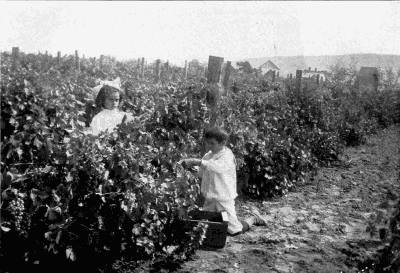
PICKING GRAPES, AUGERMAYLE PLACE, CLARKSTON
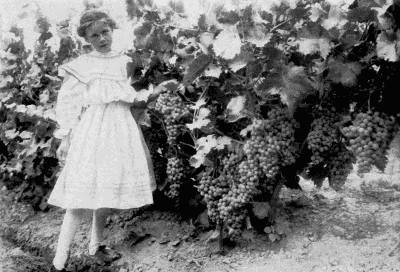
GRAPE-GROWING (AND GIRL-GROWING) AT CLARKSTON
A Seventh Day Adventist organization was effected by Elders Van Horn and Raymond as the outcome of tent meetings conducted by them on the Moses Hunt ranch on Pataha Flat in 1881. In 1902 the organization was removed to Pomeroy, and the next year a building was erected. Occasional church services and regular Sunday School sessions have been maintained, though there is no settled pastor.
The history of the Episcopal Church calls up the names of two of the great figures in the pioneer life of that church, Bishop L. H. Wells and Bishop Paddock. Bishop Wells held services in the old Owsley schoolhouse in 1873. At that time the only member of that church in the whole country was Clara Pomeroy, daughter of J. M. Pomeroy, subsequently Mrs. E. T. Wilson, now living in Tacoma. It is recalled by members of the family that the girl's tuition at St. Paul's School in Walla Walla, of which she was an attendant, was paid by cattle on the range, and that Bishop Wells would go up occasionally to look over his herd, and on such occasions he would preach in the schoolhouse.
Bishop Paddock gave $500 for a building and Bishop Wells raised $1,000 more, and in 1882 a church building was erected. At the present date Rev. John Leacher is pastor.
The Congregational Church in Garfield County, was organized at Pataha in 1890 by the coming of Rev. John Nichols, one of the "Yale Band," of which President Penrose of Whitman College was another. The church was active and a great center of light and stimulation to intellectual and social life for some years. The Harford, Houser, Reynolds, Wills, Rigsby, McCanse, and other leading families of Pataha joined with the pastor to make the church a great force in the whole region. With the decline of Pataha and the retirement of Mr. Nichols the church activities ceased, and the Congregationalists centered their interests on the church at Pomeroy. That was organized on March 15, 1903, by Rev. D. H. Reid. The building of the Cumberland Presbyterian Church was purchased. Rev. Edward Owens became the first pastor. In 1913 Rev. John M. Huggins became settled in that church, and is pastor at this date.
FRATERNAL ORDERS
The fraternal orders are duly represented in Pomeroy. The Masons are represented by the Evening Star Lodge, No. 30, which received a dispensation in 1879. In 1886, a Royal Arch Chapter was duly established.
The Harmony Lodge, No. 16, of the Odd Fellows was granted a dispensation March 29, 1879, and was organized in the May following.
The Fairview Camp, No. 119, of the Woodmen of the World, dates its beginnings to July 5, 1892. There is also an auxiliary, the Women of Woodcraft, organized soon after the beginning of Fairview Camp.
The Knights of Pythias have a strong organization at Pomeroy, known as Garfield Lodge No. 25. It unites with the Masons and Odd Fellows in the ownership of Union Lodge Hall, a commodious and attractive building, the joint ownership of which is an interesting feature of the fraternity life of Pomeroy.
There is also a lodge of Rebekahs, known as Faith Rebekah Lodge, organized on May 25, 1888.
The Modern Woodmen and the Foresters of America have organizations in Pomeroy.
The Women's Christian Temperance Union organization was effected on June 18, 1884. It has been to this day a powerful influence for good, not alone in the line of temperance, but in many directions of community betterment. A free reading room is maintained, a most worthy agency for good.
Perhaps the most unique and practically efficient organization in the whole City of Pomeroy is the Women's Civic Club. This was organized under the leadership of Mrs. Frank Cardwell, as a specific means of public betterment. The installation of drinking fountains, cluster lights, clean-up days and instrumentalities, and park improvements, are to be attributed to this admirable organization.
Worthy of special respect is the post of the Grand Army of the Republic. It is known as McDowell Post, G. A. R.
The post was mustered in by Captain Smith of Vancouver on April 23, 1885, with the following list of officers and high privates:
S. G. Cosgrove. P. C.; B. B. Day, S. V. C.; J. W. Hardin, J. V. C.; J. S. Waldrup, surgeon; Henry C. Thompson, chaplain; D. C. Gardner, Q. M.; James Palmer. O. D.; Charles Lakin, O. G.; J. M. Sawyer, adjutant; Frank Elliott, S. M.; W. C. Potter, Q. M. S.; David Riley, L. M. Hoffeditz, Frank Geiger, W. G. S. Ginger, Cyrus D. Burt, J. P. Finch, B. Talmage. Only one of the charter members, Henry C. Thompson, now resides in Garfield County.
The charter was signed by Department Commander A. Morrow of Vancouver.
The post looks with pride to the monument erected on the courthouse square at a cost of $930. This monument was placed in 1904. Money was raised by a large list of donors, both comrades and their loyal friends, contributing. It was unveiled on the 4th day of July, 1904, in the presence of a large concourse of people from all over Garfield County, besides a number from adjoining counties.
FARMERS' UNION
Garfield County being exclusively a farming community, the Farmers' Union is naturally a powerful organization. In its officers and membership are found many of the most influential farmers of the county, and in view of the fact that our story has necessarily dealt largely with the chief town of the county, it seems just to end this portion of the chapter with a more extended view of the Farmers' Union than we have given to the fraternal orders of the city. We therefore again take advantage of the courtesy of the East Washingtonian by including here an article prepared for its special number by C. W. Cotton.
"Pomeroy Local, No. 10: This local was organized May 4, 1907, by H. D. Cox of Prescott, Wash., with fifteen charter members and the following officers: Chris Brockman, president; H. C. Thompson, vice president; William J. Schmidt, secretary-treasurer; Peter Herke, chaplain; John W. Oliver, conductor; Frank Rach, doorkeeper.
"The present membership numbers 130 and are collectively worth about two million dollars.
"The present officers are: James Oliver, president; William Gammon, vice president; William J. Schmidt, secretary-treasurer; J. W. Ball, chaplain; R. W. G. Mast, conductor; Henry Miller, doorkeeper; and Peter McClung, W. A. DeBow and D. B. Williams, executive board.
"As its work shows, No. 10 is one of the successful locals, its officers efficient and up-to-date—its secretary ranking with the best in the state. Its members own about 200 shares ($10 each) in the Tri-State Terminal Warehouse Company.
"The Pomeroy local organized a warehouse company in June, 1908, with thirty-two stockholders, capital stock, $6,350, divided into 127 shares of $50 each. All the stock was sold by June, 1909, and will have paid for itself in dividends during the first six years of its existence.
"This company built a warehouse, 50 × 450 feet, with a capacity of 200,000 bushels. This warehouse has stored the grain of the members and corrected many abuses of the grain storage business of Pomeroy, materially reduced the price of handling sacks, coal, posts, etc., and in a general way has been a benefit to every farmer in Garfield County.
"The Pomeroy Farmers' Union Warehouse Company's first officers were: William Gammon, president; James Oliver, vice president; William J. Schmidt, secretary; D. B. Williams, treasurer; Ed Lubkins, manager. Trustees: William Gammon, D. B. Williams, James Oliver, William J. Schmidt and J. M. Robinson. The present officers are: William Gammon, president; W. J. Schmidt, vice president; W. A. DeBow, secretary and manager, and D. B. Williams, treasurer.
"Mayview Local, No. 4: This local, the fourth to be given a charter in the State of Washington, was organized by Mr. Cox on May 13, 1907, with twenty-three charter members and the following officers: W. A. DeBow, president; T. E. Tueth, vice president; C. W. Cotton, secretary-treasurer; J. D. Lyon, chaplain; Arthur Ruark, conductor; and Ed Taylor, doorkeeper. Several of these have been continuously re-elected.
"The membership has increased to sixty, though a number have moved away and death has taken five of our brothers—Ed and Bert Leachman, Eph Hess, Charley Ruark and Roy Wade.
"The present officers are: T. E. Tueth, president; A. L. Shelton, vice president; C. W. Cotton, secretary-treasurer; C. E. Watson, chaplain; J. F. Dyche, conductor; and Ed Taylor, doorkeeper. Executive board: J. H. Lambie, C. H. Bishop, E. R. Schneckloth, C. W. Cotton and T. E. Tueth.
"The Mayview local has always taken an active part in union work and for two years furnished one of the five members of the state board.
"In January, 1910, it appealed to the O. R. & N. Co. to build a downtown depot in Pomeroy, without success. Later the appeal was sent to the state railroad commission. An investigation was promised which resulted in the present centrally located depot.
"In 1911 it successfully conducted a trial against the Mayview Tramway Company before the State Public Service Commission.
"In January, 1914, the United States Department of Justice was induced to begin an investigation of the alleged grain bag trust on the Pacific Coast. If this investigation has been thorough it will be some time before grain bags will sell again at 'two for a quarter.'
"It favored the establishment of the paper, Pacific Farmers' Union, bought ten shares of stock, and for quite a while held the highest per cent of subscribers among its members. It was among the first to advocate a national union paper.
"The Mayview local owns about 100 shares in the Tri-State Terminal Warehouse Company and some of its members have profitably shipped their grain there.
"Ever since its organization it has bought grain bags, fuel, fence posts, etc., at a material reduction, and has contracted with the Tri-State Terminal Company for 93,000 grain bags for this year at a price believed to be the best ever given to the farmers of Garfield County.
"Central Local, No. 145: This local was organized by the writer, assisted by T. E. Tueth, January 7, 1911, with fifteen charter members and the following officers: S. Bratcher, president; J. H. Morris, vice president; C. T. Castle, secretary-treasurer; John Daisley, chaplain; J. E. Tueth, conductor; and J. W. Bly, doorkeeper. Other members: W. H. Keith, J. A. Brown, J. S. Tucker, Dennis Porter, W. B. Brown, Henry Lynn, Frank Lynn, Hattie Bratcher, and Harriet E. Bly. This local has kept up its membership and J. E. Tueth is now secretary-treasurer."
THE PRESS OF GARFIELD COUNTY
We have already given a view of the earliest newspapers of what is now Garfield County, founded prior to county division. For the sake of clearness we here name them again, with the date of each:
The Washington Independent was founded April 12, 1880, by F. W. D. Mays; the Pataha Spirit in January, 1881, by G. C. W. Hammond; and the Pomeroy Republican had its first number March 4, 1882, founded by E. T. Wilson. The Republican was practically continued by the East Washingtonian, to which we have frequently referred and which has the distinction of longer continuance under one management than any other paper in Old Walla Walla County, with the exception of the Columbia Chronicle under R. E. Peabody.
Peter McClung, the present proprietor of the Washingtonian, after having been for several years an employee, became joint owner with E. M. Pomeroy in 1889, and in 1893 he became sole proprietor. In 1915 a corporation was formed of Peter McClung and Ray McClung. As a unique feature of this incorporation, and for the sake of creating something like a community paper, a hundred stockholders, the leading men of the town, have small shares in the enterprise. In this, as in its excellent news service and the force and cogency of its editorials, the Washingtonian ranks very high among weekly papers.
Mr. McClung tells us that many attempts at founding newspapers were made during the early history of the county. There were some eight or ten newspaper funerals during those early days. Most of them departed sine die. Two, the Pataha Farmer and the Garfield County Standard, were absorbed by the Washingtonian.
The files of the Republican of 1882 tempt to larger extracts than we have space for. In the advertising columns we find the following lawyers' cards: A. T. Heavilon, Frank H. Brown, J. H. Lister, J. B. Lister.
R. P. Steen calls attention to the Pomeroy Planing Mill. The doctors are represented by J. C. Andrews and J. H. Kennedy. B. B. Day advertises the Pomeroy Flour Mill. That mill was owned by J. H. Abbott, the pioneer stage line manager of Walla Walla. The mill was subsequently burned. Mr. Day also had the first store, sold to Brady and Rush. The St. George Hotel appears, managed by Harry St. George, still a leader in the affairs of Pomeroy. The sawmill of Jay Lynch at Iron Springs appears in the columns. We find also saw mills owned by E. G. Teale and E. Stephens and shingle mill by G. W. Bear on Pataha Flat. Mention is made of the ferry of J. J. Kanawyer across Snake River at Asotin. In the issue of March 18, 1882, is a somewhat vehement discussion of the "Garfield County county-seat contest," with the Walla Walla Union. It appears that the Union had spoken with some contempt of the fuss and of the criticism of Judge Wingard for his technical decision. It avers that the expense was only $65.15. The tone of the article roused the ire of the Republican and it declares that it had cost $4,607.10, besides interest. In the same number is the school report, from which it appears that there were 1,198 pupils in twenty-five districts. That was at the time when Asotin was part of the county.
On July 15, 1882, we find an item to the effect that William Stephens had sold lot 1, block 8, to Doctor Kuykendall and R. E. Butler for $1,000.
In the number of November 11, 1882, is a very interesting item to the effect that Captain Lewis of Asotin had a limekiln two miles below the mouth of Grande Ronde River, and that he had stored there 250 barrels of lime. He anticipated getting out 1,200 barrels the next year. The statement is made that there is a fine ledge of marble near the same place.
In concluding this too brief view of the interesting and important history of Garfield County we are impressed with the thought that if we were to select the especially unique feature of that history it would be found in the fact that this county, one of the small counties of the state and one of the newer ones, has had a remarkable list of men who have risen to prominence in the affairs of the state or of the country. It is quite remarkable to give even a partial list of such character. Two judges of the supreme court of the state, Elmon Scott and Mack Gose, went from Pomeroy. Governor Cosgrove was for many years a citizen of the same place. The greatest individual grain dealer in the United States, it is even said now the greatest in the world, Max Houser of Portland, was born and raised at Pataha. He is now said to be six times a millionaire. Recently he has invested $250,000 in Liberty bonds, and upon his appointment by President Wilson as grain commissioner of the North Pacific Coast, he decided to devote the entire profits of his grain business to the Red Cross. Other business men of great note, as John Davis of Seattle, Frank Williams of Toppenish, and C. G. Austin of Seattle, had their start in Garfield County. Jay Lynch, one of the leaders in early history in this county, subsequently became for many years the Federal agent at the Simcoe Reservation, where he made a great record for the wisdom and justice of his dealing with the Indians.
The members of the Legislature from Garfield have exercised an influence in general legislation far beyond the proportionate size of the county. An instance may be found in the prominent part played by Senator J. R. Stevenson in the Open River movement.
Every one in Pomeroy would think at once of Dr. G. B. Kuykendall as a character entirely out of the ordinary. Besides being a "beloved physician," he has been one of the foremost investigators of history and of Indian myths and character, and has a high order of literary ability such as has given him a special place in the state.
Among local features of distinctive interest and character, we may note those which we have already enumerated; the peculiar community ownership system upon which the East Washingtonian rests, and the Women's Civic Club with all its municipal betterments, not indeed unknown in other towns, for the women of all our towns play a great part in improvement, but apparently carried to a higher degree of efficiency than can be found in other places of the size of Pomeroy.
Sum it all up, and we may say that the people of Garfield County, a genuine red-blooded American community, ambitious, progressive, and enterprising, set a good example to all their neighbors.
GARFIELD COUNTY PIONEER ASSOCIATION
The Garfield County Pioneer Association was organized July 11, 1909.
First officers were as follows:
Mrs. Ella A. DeBow, president.
Secretary, Frank V. Messenger.
Treasurer, Mrs. Addie M. McClung.
There were in addition several vice presidents to represent different sections of the county.
Officers for the past four years:
W. L. Howell, president.
G. B. Kuykendall, secretary.
L. F. Koenig, treasurer and financial secretary.
Vice presidents to represent different parts of the country around.
As an organization which has performed a great function in creating interest in local history and which has done much to preserve early records, the Garfield County Pioneer Association is worthy of special recognition. The association maintains a two days' session each year, and for conspicuous service in the fields upon which this history and others like it must rely, it is fitting that special mention be made of it in closing this chapter.