Chapter V · (continued 2)
Reading edition
"All day long these pack trains filed in constant procession through the streets of the busy little city, bound on long journeys through the mountains to the various mining camps.
"Indians, gaudy with paint and feathers, rode their spotted, picturesque cayuse in gay cavalcades along the trails leading to town to trade for fire water and other less important articles of barter.
"Covered ox wagons laden with dust begrimed children and household goods 'all the way from old Missouri,' ranchmen, and cowboys in all their pristine swagger and splendor helped to make up the motley throng that filled the streets. The cow-girl who rides a horse astride had not then materialized.
"The packers and many of the miners came here to 'winter' as they expressed it in those days. They spent their money prodigally and unstintingly in the saloons, in the gambling and hurdy-gurdy houses, and in the spring would return to the source for fresh supplies of gold.
"Some of the more successful would return to the States and all expected to when they had 'made their pile.' None of us had any idea of making this a permanent place of residence or of being found here fifty years later. As youngsters we sang with lusty voices:
'We'll all go home in the spring, boys, We'll all go home in the spring.'
Later as the years went by and we did not go, there was added by the unsentimental, this refrain:
'Yes, in a horn; Yes, in a horn.'
"This describes conditions existing in old Walla Walla fifty years ago, or in the decade between 1860 and 1870, and are some of the moving pictures painted on the film of my brain when in the fall of 1863 I wandered, a forlorn and homesick lad, into this beautiful valley. Friends and acquaintances I had none, except the two young men who came with me from Montana.
"My resources were exceedingly slender, and the question of how meal tickets were to be obtained was much on my mind. That was fifty-four years ago—and like many of you present here today I watched the years go by with gradually increasing faith in the country's resources; a faith that ripened into love for the beautiful valley, its people and its magnificent surroundings. Walla Walla all these years has been my home, her people became my people, her interests were my interests. It is hoped you will pardon these personal allusions but after all history is defined as 'the essence of innumerable biographies.'
"It is a goodly land—a fit abode for a superior race of people, a race to match its mountains, worthy of its magnificent surroundings.
"Along in the early '60s, stockmen from the Willamette Valley, attracted by the bunch grass that grew in wild luxuriance over all the hills and valleys of this inter-mountain region, brought horses and cattle and established stock ranches along the streams. Later it was discovered that grain would grow on the foothills, and that the yield was surprisingly large. The wheat area was gradually widened and land supposed worthless grew enormous crops. Now wheat has everywhere supplanted the bunch grass and the Inland Empire sends annually about sixty-five million bushels to feed a hungry world.
"Walla Walla in the early '60s was a town of about two thousand inhabitants and the only town between The Dalles and Lewiston. Now this region is filled with cities and towns and villages, dotted all over with the happy homes of a brave, enterprising, peace-loving, law-abiding people.
"Many of us have seen the country in its making, have helped to lay the foundations of the commonwealth, have seen the territory 'put on the robes of state sovereignty,' have seen it become an important unit in the great federation of states, have recently seen its young men pour forth by thousands to engage in a war not of our making but in the language of President Wilson, 'that the world may be made safe for democracy.'
"These pioneer meetings are significant events; they afford opportunity for meeting old friends. They are occasions for retrospection and reminiscence. We live over again in memory 'the brave days of old.' We recount the courage, the lofty purpose, the sacrifices of the early settlers not only of those still living, but of those who have crossed the Great Divide.
"They were a sturdy race; they braved the perils of pioneer life, and 'pushed back the frontiers in the teeth of savage foes.' We are old enough now to begin to have a history. In fact, this Walla Walla country is rich in historic interest, and inspiring history it is. Lewis and Clark passed through it on their way to and from the coast. Whitman established his mission here in 1836 and eleven years later gave up his life as the last full measure of his devotion to the cause he loved so well. Other missionaries and explorers saw it and were impressed with its fertility and the mildness of its climate. Indian wars raged here, and it was here, almost on this spot, that Governor Stevens held the council and made treaties with 5,500 Indians.
"No other part of the northwest has such a historic background. All this will continue to be an inspiration to the people who are to reside here.
"Wherever the early settler built his cabin, or took his claim, he left the impress of his personality. These personal experiences should be woven into history and it is hoped that Professor Lyman in his forthcoming history of old Walla Walla County will include many of these personal memorials.
"The restless impulse, the wanderlust implanted in the race, the impulse that carried the first wave of emigration over Cumberland Gap in the Alleghenies and down the Ohio to Kentucky, 'the dark and bloody ground,' swept over the prairies of Illinois and Iowa, across the Mississippi and Missouri. Here it halted on the edge of the Great American Desert, until the gold discovery in California in '49 gave it new impetus and it swept on again. These indefatigable Americans crossed the Great Plains, they climbed the Rocky Mountains, they opened mines, they felled forests, tilled the land, developed water powers, built mills and manufactories, filling all the wide domain with 'the shining towers of civilization.'
"The liberal land laws of the Government—giving a homestead to each man brave enough and enterprising enough to go out and occupy it, the mines it offered to the prospectors were the powerful factors that gave us population and led to the development of the country.
'All honor to the pioneers—
'They have made this beautiful land of ours To blossom in grain and fruit and flowers.'
"Many of them have passed to a well earned rest. May the living long remain to enjoy the fruit of their labors.
"Walla Walla has been pleased to have you here today and hopes to see you all again at future Pow-wows. Her good wishes go with you wherever you may be."
There have been various interesting and valuable exhibitions in Walla Walla in recent years which are entitled to extended mention, but the limits of our space compel us to forego details. One of the most conspicuous of these has been the "corn-show," maintained by the O.-W. R. R. management. "Farmer" Smith has been conspicuous in these shows, other experts in corn production, as well as in the allied arts of the use of corn in cookery and otherwise, have been in attendance, banquets have been held attended by some of the chief officials of the railroad company, and a public interest has been created already bearing fruit, and sure to be a great factor in agriculture in the future. A hearty tribute is due the O.-W. R. R. for the broad and intelligent policy which has led to this contribution to the productive energies of this region.
WALLA WALLA PAGEANT
To those who were in Walla Walla at the "Pageant of May" in 1914, that spectacle must ever remain as incomparably the most beautiful and poetical exhibition ever given in Walla Walla. Indeed it may well claim precedence over any spectacle ever presented in the Inland Empire. It was in all respects in a class by itself. It was conducted under the auspices of the Woman's Park Club. The Pageant consisted of two movements, diverse in their origin and nature and yet interwoven with such artistic skill as to demonstrate rare poetical ability and inventive genius on the part of the author, Mr. Porter Garnett of Berkeley, Cal.
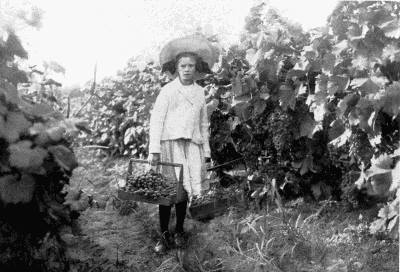
GATHERING TOKAY GRAPES, CLARKSTON
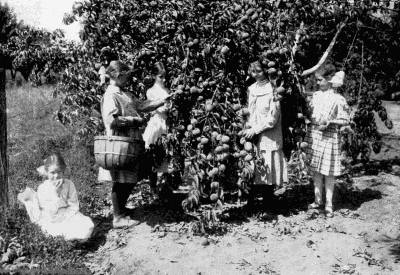
PICKING PEACHES, ADAMS' PLACE, CLARKSTON
This event was of such entirely exceptional character and so well set a pattern for possible future occasions and created such interest in the minds of all who witnessed its beautiful scenes in the park, that the author feels confident that the readers of this volume will be glad to read the Foreword and the Introduction as given in the book prepared by Mr. Garnett and inscribed by him with this graceful dedication:
TO THE WOMEN OF THE WOMAN'S PARK CLUB WHOSE CIVIC PRIDE AND CONSTRUCTIVE IDEALISM HAVE ENABLED THEM TO DARE AND TO ACHIEVE
The foreword is as follows:
FOREWORD
The history of "A Pageant of May" is briefly told.
In November, 1913, the Woman's Park Club, which, in 1911, inaugurated an annual May Festival, conceived the idea of holding a pageant in our city.
Correspondence with the American Pageant Association led to the inviting of Mr. Porter Garnett of Berkeley, California (one of the directors of the association), to come to Walla Walla for a conference. Mr. Garnett arrived on March 26th. On the 30th, having in the meantime selected City Park as the most suitable site, he submitted the outline of "A Pageant of May." It was officially approved on March 31st, and the work of preparation was begun.
Since the construction of a pageant is usually a matter of many months it seems proper, in this case, to call attention to the fact that within a period of seven weeks Mr. Garnett has written the text of "A Pageant of May," designed the costumes and properties, invented the dances, selected the music and rehearsed a cast of over three hundred.
Grateful acknowledgment is made of the assistance of the Commercial Club and of the many citizens of Walla Walla who have given so generously of their time and talent, insuring the success of the "introduction of pageantry in the Northwest."
Grace G. Isaacs, Mabel Baker Anderson, Lydia P. Sutherland, Mary Shipman Penrose, Marie A. Catron,
Executive Committee for the Pageant,
Woman's Park Club.
Mr. Garnett's Introduction, interpreting the Pageant, is presented in these words:
INTRODUCTION
Although May festivals are held in almost every community, it is in the agricultural community, such as this of Walla Walla with its vicinage of fertile acres, that the celebration of spring—the season of renewal—is most appropriate.
A Pageant of May is a May festival and something more. In it, instead of restricting the ceremonies of the more or less hackneyed forms, an effort has been made to utilize the traditional material and to import into it certain elements of freshness and fancy.
The intention has been not so much to give an exhibition as to afford the community an opportunity for self-expression. The real purpose of the pageant is to remind the people of Walla Walla that since they owe their existence to the soil, spring should be for them a season of sincere and spontaneous rejoicing. It should not be necessary to cajole them into celebrating this season which brings in bud and blossom an earnest of the harvest to come. They should not only be willing but eager to make merry on the Green and to dance around the May-poles. They should remember that the earth which gives them sustenance is not their servant but their mistress and that without her generous gifts they would be poor indeed. A pageant of May offers them an opportunity to pay their homage to Earth the Giver whom the Greeks personified and worshipped as the goddess Demeter (Ceres).
In the Masque of Proserpine, which forms the first part of the pageant, the return of spring is treated symbolically. The myth upon which the masque is built has, on account of its peculiar appropriateness, been used at various times and in various ways to celebrate the season of rebirth, but the present adaptation with its free use of comedy is entirely original. It has been necessary, of course, to take many liberties with the accepted versions, notably the excision of that part of the myth which deals with Ceres' wanderings in search of Proserpine. Those who may be desirous of reading the myth in its most charming form are referred to the translation of an Homeric hymn which Walter Pater incorporated in his essay, Demeter and Persephone, contained in his volume "The Greek Spirit."
The second part of the pageant is based upon the traditional English May Day celebrations. The traditions, however, are by no means strictly followed for there seems to be no justification for a rigid adherence in America to customs which are essentially English. I have used Robin Hood and his Merrie Men because, through literature, they have been made the heritage of all English-speaking people; I have, however, omitted the Morris-dance because, in America, it has no significance whatever.
Since it is hoped that the pageant will be interpreted throughout in a spirit of gaiety; since the participants will be expected to forget (as far as possible) that there are any spectators, the spontaneity which is difficult to attain rather than the expertness which is comparatively easy, will be looked for in the May-pole and other dances. To Mrs. E. R. Ormsbee's able direction is due whatever measure of success may be achieved in this regard. The Dance of the Seeds and the Dance of the Fruits and Flowers owe the charm of their form and detail to the inventive fancy and skill of Miss Rachel Drum.
In both the Masque and the Revels realism has been scrupulously avoided because in the author's opinion realism on the stage is inartistic and futile. There is no reason why a pageant—whether of the historical or festival type—should not be consistently expressed in terms of beauty.
To this end the masque feature has been employed as affording the best possible means by which the note of beauty may be introduced. I believe that the introduction of the masque feature in all pageants, by increasing the gap which already exists between formal and creative pageantry and the familiar tawdriness of the street-fair and carnival, would do more to raise the standard of pageantry than any other single thing.
The text of A Pageant of May has been reduced to the simplest possible terms. It contains no were lines than were necessary to unfold the plot and deliver the message. The lines, moreover, have been uniformly written with the fact in view that they were to be delivered and delivered in the open air. Syllables that open the mouth have been more important therefore than poetic embellishments. As far as possible pantomime has been used to reveal the story. A Pageant of May is not intended for closet reading, and if the reader who did not see its realizement in action on the four-acre stage in Walla Walla's city park finds it somewhat jejune he is asked to bear that fact in mind.
I cannot leave unexpressed my grateful acknowledgments to the members of the Costume Committee who have worked most efficiently under the direction of Mrs. A. J. Gillis, the designing of the children's costumes being admirably done by Miss Helen Burr and Mrs. W. E. Most. To the chairman and members of the other committees, and to the organizers and chaperones of the various groups I am indebted for the invaluable assistance which they have rendered. Finally, I would take this opportunity to express my gratitude to the women of the Executive Committee who, putting aside every consideration of personal convenience, have labored indefatigably for the success of the pageant and the benefit of the community.
P. G.
Walla Walla, Washington. May 14, 1914.