Chapter IV · (continued 2)
Reading edition
The educational system of Asotin County, like that of other units of old Walla Walla, has been typically American, one of the bed rock institutions in the upbuilding of the new land. From the first the people of the county have taken pride in their schools and while not absolutely true at all times and in all places to the highest interest of their children—as none are even in the State of Washington—they have results which make a demonstration of high ideals. There has been steady advancement from the log schoolhouse day to date.
The first school in what is now Asotin County was at Anatone, then the most flourishing community in what was then the eastern part of Columbia County. It is worthy of special note that the building was erected and the school maintained by the settlers themselves without any county appropriation. Miss Angie Bean, now Mrs. Tuttle and now living on Anatone Prairie, was the teacher of that pioneer school. We are informed by Mr. John Romaine, who came to Anatone in 1878, that the school was at its best during the first dozen or so years of its existence. As has not infrequently occurred in exclusively grain regions, the large farmers have absorbed the small ones and after a certain stage has been reached population tends to decline. As a result school districts diminish. Thus it has proved at Anatone.
The first school in Asotin City dates to 1881. The first teacher was Miss Blanche Marsilliott. There seems to have been much tribulation at Asotin about building an adequate schoolhouse. Not until 1904 was there sufficient space for the steadily increasing numbers in the town. Even with the handicap of insufficient space and equipment a high standard seems to have been maintained, insomuch that the report of the State College at Pullman indicated that the graduates of the Asotin High School stand at the head in preparation for advanced work.
As giving a clear and effective general view of the present status of the schools of Asotin County, we incorporate here a few paragraphs for which we are indebted to Prof. W. J. Jerome, formerly county superintendent and now city superintendent of Asotin.
PRESENT STATUS ASOTIN COUNTY SCHOOLS
By W. J. Jerome
The county being strictly an agricultural district, except for a small portion devoted to the fruit industry, the school population is comparatively small. Nevertheless the interest in education has always been great and is steadily increasing.
The number of school census children in the county in May, 1917, was 1,777 but the number actually enrolled in the schools of the county for the year was 1,884. The fact that the number enrolled is greater than the number of census children is largely due to the fact that a large number of children come into the schools of Asotin and Clarkston from other places to take advantage of the good schools and the mild winter climate.
The county contains two fully accredited high schools, Asotin and Clarkston. Clarkston had a total enrollment during the past year of 1,005, Asotin, 317. The interest in education in each of these places is very great and each maintains a fully equipped high school not only carrying the regular old line courses but offering courses in industrial arts as well. The Asotin School was the pioneer in the county in the newer branches and is at present the best equipped school in the county for work in manual training, home economics, agriculture and science work. However Clarkston is now beginning a program of industrial education that will soon place that district in the forefront in this line of work.
There are also two other centers, Anatone and Cloverland, which have introduced these new subjects and are rapidly building up splendid little high school centers.
Perhaps the greatest change in the county has come to the one room rural schoolhouse. In many cases the simple log building has been replaced by a neat modern building, heated and ventilated by some of the new heating and ventilating systems and provided with all modern equipment.
Many of the remote rural schools employ normal graduates at good wages, provide hot lunches during the cold weather, have a library, do some work with tools and are as much abreast of the times as the schools of the towns.
In the matter of expense for public education, the question never has been how little but how much can we afford to give or how much can we give. The configuration of the county has made necessary many remote and small communities and it is astonishing how much the people in these remote communities have been willing to sacrifice to educate their children and when it has been impossible to maintain a local school on account of the small valuation or small number of pupils many families have annually moved to town for the winter months to give their children the opportunities of the schools.
The amount spent last year, 1917, for the entire county was $65,793. When it is remembered that we have not a mile of railroad in the county and no manufacturing industries whatever and that our total valuation is but little over $4,000,000, it will be plain that Asotin County shows its interests in education in a most practical way.
Every year a considerable number of young people enter higher institutions of learning, and an increasing number are coming back into the county as teachers, ranchers, etc.
Perhaps the most striking thing about the schools of the county is the great variety of physical conditions found. At Asotin and Clarkston and other points on the Snake River the climate is mild, in fact a veritable winter resort for this entire section, while up on the high flats one could imagine himself on the prairies of Iowa or the Dakotas in the winter. Some of the schools are situated on steep hillsides, some in the great pine woods, some beside the beautiful Asotin Creek. Some of the pupils ride to school on horseback, some come in autos, some in sleds through the deep snow, some cross the wide Snake River every day in row boats, some are brought in by school wagons. Some live next door and some come in from the ranch seven miles away, but the great majority walk in the good old-fashioned way.
Among the teachers responsible for the present condition of Asotin County schools should be mentioned the following: J. B. Jones, for many years superintendent of schools of Asotin, when Asotin maintained the only high school in the county. Mr. Jones served a term as county superintendent and is now a leading banker of the county. Another teacher whose work will never be forgotten is Miss Lillian Clemans, now Mrs. Lillian Clemans Merchant. Mrs. Merchant was a leading teacher in the county for many years and took a leading part in educational matters for four years as county superintendent. J. W. Graham, now superintendent of the Pullman, Wash., schools, but for several years a leading educator of the county as superintendent of the Clarkston schools. W. J. Jerome, at present superintendent of the Asotin city schools, who has been associated with these schools and with the educational interests of the county for eight years. Gus Lybecker has had charge of the Anatone schools for four years and is now beginning a fifth year as the head of a new consolidated district at that place. C. B. Thornton has been associated with the Cloverland schools as principal for several years and is now the county superintendent of schools.
No resume of the schools of the county would be complete that failed to mention the three men who for many years worked together for the Clarkston schools: Dr. P. W. Johnson, W. E. Howard, and Elmer E. Halsey. Dr. H. C. Fulton, G. W. Bailey, William Farrish, W. G. Woodruff, and Kay L. Thompson served Asotin in a similar fashion for many years, indeed some of these men put in as much as twenty years as school board members. In every district there is one or more but usually one central figure, who takes a vital interest in the welfare of the children and gives unstintedly of time and talent for the schools of the district. The author wishes that all these splendid men could be mentioned here, for to them as much as to teachers we owe our schools.
In treating of the other counties, we have devoted considerable space to the churches. These indispensable agencies of the higher motives and higher life have had the same general place in Asotin as in the other counties. To some extent the same men whose names we noted in Walla Walla went on into the newer fields. Early in the history of Asotin City the Baptists effected an organization and erected a church. Soon the Presbyterian, Methodist, United Brethren, and Christian denominations became also established and maintain their church work to the present day.
Clarkston also has a full quota of well sustained churches: Methodist, Christian, Presbyterian, United Brethren, Church of God, Lutheran (Norwegian), St. John's Evangelical (German), Catholic, Adventists, Baptist, and Episcopal.
The fraternal orders are also well represented in both cities. The first lodge in the county was Hope Lodge, I. O. O. F., at Anatone. The Good Templars seem to have been pioneers in lodge organization in Asotin City, dating to 1885. The first Odd Fellow lodge was known as Riverside Lodge No. 41, and was organized in 1886. Other lodges followed, and at the present date we find the following represented: I. O. O. F.; Woodmen of the World; Women of Woodcraft; Grand Army of the Republic; Sons of Veterans; Women's Relief Corps; Modern Woodmen; Rebekahs; United Artisans; Stootki Tribe of Red Men; Masonic.
In Clarkston the orders are the Knights of Pythias, Masons, Odd Fellows, Yeomen, Woodmen of the World, and Modern Woodmen.
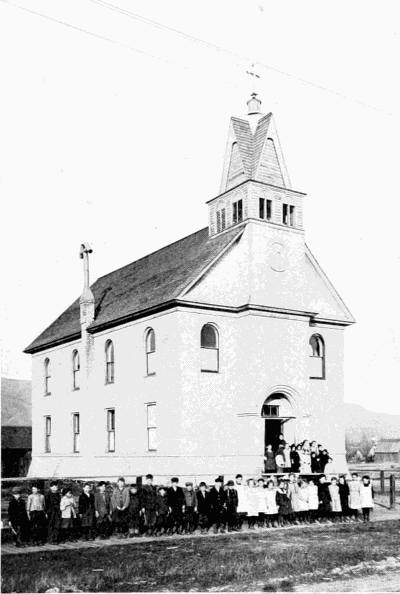
PAROCHIAL SCHOOL, CLARKSTON
Many more interesting and valuable details of the history and present status of this youngest of our four counties might be given here, did space allow. But we must be content to close with further reference to that indispensable aid to the historical writer, and that is the newspaper. We have already spoken of the Sentinel of Asotin and have made our acknowledgments for much valuable data derived from it. Clarkston also has a weekly paper, the Clarkston Republican. The Vinelander, however, was the first paper at that point, appearing in 1898, published by Messrs. Leach, Henshaw and Lewis. The year following C. S. Florence, now of Asotin, acquired the paper and published it for a year, changing the name to the Vineland Journal. At the opening of 1900, Messrs. Lewis and Leach, having retired from their pioneer venture, undertook another by the publication of the Clarkston Chronicle. This also was short lived, being suspended after only about five months. There was still another transient in the field of journalism, the River Press, existing from July, 1903, to April, 1904, the publisher being at first Frank Barnes, followed by B. T. Warren, and he in turn by O. U. Hawkins. Meanwhile the Republican, the only permanent newspaper at Clarkston, had been launched in January, 1901, by L. A. Woodward. After a few unimportant shiftings, by which Mr. Woodward retired and again resumed possession, the Republican in 1904 passed into the possession of Messrs. Willis, Murdock, and Garver. Mr. A. J. Garver became and still continues to be the chief owner. The managing editor at the present date is W. A. Wyatt, and the paper is now known as the Clarkston Republic.
We leave this jewel of a county, with her sister jewels, at this stage of our story, anticipating for her great advances in the developments which are certain to accrue to the world, and particularly to the Pacific Northwest in the better days which are bound to succeed the insanity and destructiveness of the present unholy war which racks the earth.