Chapter V · (continued 2)
Reading edition
That day I took a stroll down by the creek and saw a big fish lying in some shallow water in a little island. I very cautiously slipped around between it and the main creek and put my hands under it and threw it out on land. Then I wrapped my apron around it and went carrying it into camp. It was alive and weighed about eight pounds. We would not eat it for fear it might be sick, but some of the boys wanted it, so I gave it to them. They cooked it and ate it and said it was very good. Next morning we hitched up and traveled on.
The weather was pleasant and we began to see signs of civilization and met another pack train which was loaded with flour, bacon, whisky, and tobacco. I should not have said signs of civilization. But we saw better things further on. Some of our people tried to buy some provisions of them, but they would not sell; said they were taking them to the mines and expected to get a dollar a pound for what they had. Our money was pretty scarce and what we had was greenbacks and only worth fifty cents on the dollar out West.
Then we came to a little garden and a cabin back in the brush. We could see the green lettuce and onions through the fence. Some of our boys said they would make a raid on that garden, but when they got on the fence they saw a tree on the other side and a man hanging by the neck from a limb of that tree. Then they said, "We don't want any garden sass." We learned later that it was only a paddy stuffed with straw. Our provisions were getting scarce and our teams were getting weaker, and we very anxious to get through.
We finally arrived in the Grande Ronde Valley and then we spent the last cent we had to buy a beef bone and some fresh vegetables. Then all got together and made a big dinner. All sat down and ate together. After dinner we all shook hands and said good-bye. Then each one went his own way.
We started to cross the Blue Mountains and one of our mules got sick. We had urged him too much. He seemed to be asleep on his feet, held his eyes shut, and wanted to pull all the time. Well, he pulled through. I had almost learned to love those mules, they had been so faithful.
We arrived in Walla Walla, Wash., footsore and weary, in just three months from the day we started.
When we arrived in this beautiful little valley without a dollar and scarcely any clothing and no provisions we had a pretty hard time. Now, when a family gets their house and everything they have, burned, the people around get together and help them, and it is right they should in this land of plenty; and when a criminal leaves the penitentiary they give him a suit of clothes and some money. But there was no help for the green immigrants, as we were called, and I suppose we were, at least in some respects.
We did not understand the western slang and Indian talk that we heard so much. It was something like this. A man that had been out West about five years was eating dinner with us, said, "That is hiu mucka muck." He was referring to something on the table. We asked him if he liked this country. He said, "You bet your life!" We said, "Why do so many men out West wear revolvers on their belts and big knives in their boot legs?" He said, "It is necessary to keep order; we have a man for breakfast quite often."
Then we would hear the remark, lots of men out West are made to bite the dust with their boots on; and then, you sabba, or savvy, and many such expressions. Well, we finally got initiated. And the people were very kind to us. We never saw a time when we appreciated our neighbors so much. They were friends in need and in deed.
This country was covered with bunch-grass, flowers, Indians, coyotes, and grasshoppers. A few white people were living along the creeks in little huts. Some were growing a little wheat and others small grain and gardens. Everything was very high priced. Wheat sold for a dollar and a half a bushel. There was scarcely any fruit to be had at any price. When I go through this beautiful valley, now a little less than forty years after, and see wagon loads of delicious fruit going to waste it makes me think of those times.
Well, we went to work; had to rustle, kept at it from early morn till late at night. But we would jump from one thing to another. There seemed to be too many chances. First we would settle on one piece of land, then on another. There were thousands and thousands of acres of good unclaimed land all about us, but people thought none but the sloughs would grow anything. After two or three years of changing about we finally bought eighty acres of land and settled down. Paid eight hundred dollars for it. We gave thirty dollars, a horse, and our only cow to make the first payment. At this time we had two children in our family.
Before we had any wheat to sell it came down to fifty cents per bushel. The country up to this time had been settled mostly by men; only some of them had Indian women for wives. The families that settled this country first were nearly all new married people and a baby came to almost every home in less than two years for a dozen years or more.
One day I went to visit a dear neighbor and I was complaining of hard times and she said, "We have been living on boiled wheat for several days." I believe there were a good many others doing the same thing. Those hard times seemed to bind neighbors close together. Three or four of us would get together and go two or three miles to get some wild gooseberries and elderberries and red haws and fix them up for fruit. They were pretty good when there was nothing better.
I will now mention some of the Indian scares that we had to endure. We had been warned by the newspapers to look out for the Indians, as they were on the war path and had murdered some of the white settlers and had mangled them terribly. So one Sunday the people were holding meeting on Mill Creek in a little school house when a little girl came running in, crying, and said, "The Indians are killing my mama and papa." Some of the men hurried to the house, which was about a mile away, and the young boy preacher got on a horse and away he went as fast as his horse could go to warn the people at their homes that the Indians had broken out. He stopped at our house and asked for a fresh horse, as his was about run down. We did not have any, so he went rushing on and stopping at every house to give the alarm. My husband and several of the neighbor men had gone from home that day. Imagine the scene. We were running from one house to another; each one of us had three or four little children. After about a dozen of us got together we decided to go to a log cabin that was near and wait for the Indians to come. There was one man in the cabin and he was getting ready to shoot out through the cracks between the logs. When a man came from the seat of war and said no one is seriously hurt, it was a drunken row and only one Indian was killed, we all went home and the boy preacher got over his scare and has been long since a good and noted preacher. And the Indian that was supposed to be dead came to life again. Some of the men took him to town and had a trial and the jury sentenced him to wash his face. Well, this is one of the many such scares as some others can remember that are yet living.
I will relate one more incident. At this time there was a saw mill at the head of Mill Creek and there were several families living at the mill. The men had built a fort for the women and children in case the Indians should attack them. One day some men who lived in the valley took their teams and wagons and started to go to the mill, but when they got in the mountains they saw a band of Indians coming down the trail beyond the mill. The men at once stopped, unhitched from their wagons, and jumped on their horses and used the tugs for whips and came down the mountains on double quick and reported to all the people along the road what they had seen, and the people were soon leaving their cabins and running for the brush. And those at the mill saw the Indians coming and they went running to the fort. Some one relating the scene said the men could run faster than the women and children and got into the fort first. Well, the Indians came and were friendly and very much surprised when they saw the people running and said they had been back in the mountains hunting and fishing and did not know that there was any war going on.
The health of a people in a new country is usually good, but we would sometimes get sick. Would hardly dare think of sending for a doctor. There was no money to pay one and there could hardly be one found. But there was a woman who lived in our neighborhood that had a good doctor book. It was Doctor Gunn's work. She went by it in her own family, and the neighbors sent for her. She would take her doctor book under her arm and go to visit the sick. Then they would read and study together and use the simple remedies prescribed in that book and get along pretty well. In that way she got into quite a large practice. She often rode a little blue pony. People would sometimes make the remark, "I think there is someone sick at a certain house. I see the blue pony tied at the gate."
This woman officiated where more than a hundred babies were born. She was very successful, never lost a mother or child while she was taking care of them. She most always went back every day for a week to see the patient and wash and dress the baby. And most of the time she had one of her own to take with her. She made no charges, as she did not have any license. But she received a good many presents, and is sometimes yet pleasantly reminded of by-gone days. Just a few days ago she received a photo of five large, stalwart men and a letter from their mother saying these are pictures of your boys; see how they have grown. Then another time a picture came from a distance of two large twin boys and a girl and word saying, see how your boys have grown.
I have not made mention of any names in this sketch, thinking it would be just as interesting without.
Well, I must get back to my pioneer days that I started to write about. Schools and churches were scarce. One woman taught a school in her home of two rooms. She had about a dozen scholars. About one-third of them were part Indian children. As I said before, some of the men that came out West first came alone and took Indian women for wives. People called them squaw men. We remember another woman that taught school in her home of one room. At noon when the children were out playing she would cook dinner and the family would eat, then she would take up her school again.
We would sometimes go three or four miles to church in a home of one room where three or four persons lived. The preacher would stand up in the corner between the table and fireplace and preach, while the congregation sat around on the beds and benches and boxes. Every corner would be full. Many a one received a blessing in those humble meetings. But we did not have to do that way very long. People with such energy soon built school houses and churches.
Building material was hard to get. When one man worked for or sold another man anything he would often pay him in gold dust. They used that a great deal. We would take our little sack of gold dust and go to town to buy things, and the merchants would weigh and blow and spill it till we would not have much left. I said go to town; there was not much town to go to. It was not like the town the little boy said he could not see for the houses. One would hardly know it was a town by the houses. At that time there was about a dozen, mostly business houses, scattered around in Walla Walla.
Mrs. Brewster Ferrel.
Equally characteristic of the first days is the narration of the "first boy in Walla Walla." This was Charles W. Clark. One of the honored citizens of Walla Walla, he was doubtless "the first boy to ride down Main Street," as he expressed it. Through his kindness we are able to present here some scenes from his memory of the first days in the history of Walla Walla.
RECOLLECTIONS OF THE FIRST BOY IN WALLA WALLA
I was born on August 29, 1846, in Oregon, on my father's claim near LaFayette, Yamhill County, from which the family was taken to Oregon City and thence to Portland.
Needless to say, Portland was then a raw, crude town on the edge of the Willamette River, with no business places except on Front and First streets.
In 1855 my father, Ransom Clark, left home for Colville mines. On his way home to Portland he selected the place on the Yellowhawk, since known from his name, ran out the lines with a pocket compass, for there was no Government survey. The place was nearly in a square and extended from about where the road just east of Harry Reynolds' house now is to the present Whitney Road.
My father was on the place in 1855 when the Indian war broke out, and he, like all the other settlers—few in number, of course—was ordered by the United States commandant to leave the country.
That war prevented my father's making proof on the claim, but the Government ruled that since the settlers had been obliged to leave on account of war, they should not lose their time, but could resume possession and continue to prepare for making final proof.
We lived in Portland until 1859, when announcement was made that Indian disturbances were at an end. In the fall of 1858 father had returned to the claim. With the coming of winter he went back to Portland, but on March 1, 1859, he went back again to Walla Walla, taking me with him. I was then twelve years old, a strong, active boy, and accustomed to all sorts of work and capable of being of much assistance to my father in starting the place.
We came from Portland with a team and wagon, putting them on the steamer at Portland and going as far as The Dalles; thence driving to Walla Walla. Mother was left alone in Portland with my brother Will, then two years old.
We had quite a lot of apple and peach trees which we obtained at the Tibbetts and Luelling nurseries, near Oregon City. I can tell you the Walla Walla Valley looked beautiful in those early spring days. It was just a waving sea of new grass, green all over without a fence or anything to obstruct riding anywhere that we might wish.
We reached our claim on March 28th. So far as I remember there was not another white boy in the whole valley, except at the fort, or whose parents were employed at the fort. Some of the army officers had children, but I hardly ever saw them. I had no playmates except the Indian children, and they were very friendly. There were no women, that is, no white women outside the fort, unless two or three transients. There were several Indian women married to white men, former Hudson's Bay men, down the valley at Frenchtown and elsewhere.
When we reached the claim we discovered that "Curly" Drumheller and Samuel Johnson had done some plowing on the south edge of our place, from the spring branch to Russell Creek. We sowed it with oats and there was a good crop, which we threshed out with flails in the fall. We set out some of our fruit trees on the flat just southeast of where Harry Reynolds' house now is. Those were, I am sure, the first trees ever brought to Walla Walla, that is, after those that had been raised from seed by Doctor Whitman at Waiilatpu. John Foster bought the trees which were set on his place from our lot. The bill for those trees from Seth Luelling is still in possession of my brother Will.
After remaining six weeks my father returned to Portland to get my mother and brother. I was left to keep the place, in company with Robert Horton. We had nothing but a tent for a house, but we managed to get along very comfortably. My main work was to cook. I helped plow on John Foster's place to help pay for the logs which Foster had gotten out that spring or summer for making our cabin. On Sundays and sometimes on other days I would go to "town," which was just a mongrel collection of shacks and tents, with a confused mass of settlers, Indians and soldiers straying through. The chief amusement was horse racing and gambling. There was a straightaway track where the cemetery now is and another just about through where the chief part of town now lies. The first circular track was laid out by George Porter about three miles down the valley, running around the peculiar hill on the Sam Smith place, afterward the Tom Lyons place.
The saloon business was very active then and every species of vice flourished. There was a man named Ed Leach who had come with father and me from The Dalles, who had afterwards drifted around town.
One day I was near the saloon owned by W. A. Ball, and I saw that there had just been something going on, for there was a bunch of men standing around talking excitedly.
Ed Leach was there, and seeing me he pulled me over to a place where I saw blood on the ground, and he said, pointing out the puddle of blood, "There, Charlie, is where I got him." He had just killed a man.
Nothing was done about it, so far as I know.
W. A. Ball was uncle of my wife, and one of the first business men in Walla Walla. He was the one especially who insisted on giving the name of Walla Walla to the town. Some wanted to call it Waiilatpu, while some favored Steptoeville.
One day while in town a man called to me saying that he had heard it rumored that my father was dead. I paid no attention to this, for I had heard from him a few days before, that he had safely reached home, was getting ready to return, and that everything was well. There were no mails at that time and the only way to get messages was through the army or by stray travelers. It would take a week or two to hear anything from Portland.
But though I paid no attention to the rumor it proved a sad reality. That very day after I had returned to the tent which I called home, my mother's brother, Uncle Billy Millican, who is still living in Walla Walla, appeared and told me that it was only too true, that my father had been taken suddenly sick and had died a number of days before, and that my mother was even then on her way to Walla Walla.
The next day she came, having come on the Steamer Colonel Wright, of which Lew White was captain, on her second or third trip from The Dalles to Wallula. From that place she came with Capt. F. F. Dent in an army ambulance to Walla Walla. That Captain Dent, by the way, was a brother-in-law of General Grant.
As you can imagine it was a sad, hard journey for a woman who had just been made a widow, and who was soon to be again a mother.
It shows something of the nerve and heroism of pioneer women that they could go through such experiences. My mother had been strongly advised to give up her claim. A man had offered her $300.00 for it, and Judge Shattuck, one of the leading lawyers of Portland, urged her to take it, assuring her that it would be the most that she could ever get out of it. But father had been greatly impressed with the prospective value of the place and the prospects of the town, and my mother had been so much impressed with his views that she determined to hold the claim.
Accordingly, after spending two weeks with me she returned to Portland. I spent that summer, sometimes a very lonesome one, in the tent, or hoeing the garden which he had put out, and in September Robert Horton and Uncle Billy Millican put up a cabin from the logs.
The cabin was put on the present location of Harry Reynolds' house. It was moved from there a few feet many years ago, and put on a good foundation, so that it is now just about as sound as ever. It is undoubtedly the oldest house now existing in the Inland Empire, in which a white woman lived. My mother was about the first white woman in this region, after the missionary period.
My mother came back to Walla Walla in October of that same year, 1859, with her newly born child, then six weeks old, to live the remainder of her life in Walla Walla.
During those early years the valley seemed to be filled with Indians, but they were very kindly and well disposed, and we had no trouble with them, even though a good part of the time we were alone, mother and the baby and the little boy and myself as the nearest a man about the place. We had plenty of horses and cattle and chickens and garden and had an abundance of the necessities, though no elegancies.
There were two principal Indian chiefs, and they, with their squaws and children were often around the house. They were fine Indians. Yellowhawk was one of them, and his location was on the creek named after him, on what is now the Billy Russell place near the Braden schoolhouse. The other was Tintimitsy. His location was on what became the J. H. Abbott place.
As I remember the old town in 1860, there were several shack stores. One was that of Neil McClinchy, on what would now be between Third and Fourth streets.
Baldwin Brothers were about between Second and Third. Frank Worden was located just about where the Third National Bank now is. Guichard and Kohlhauff had a store on the same corner where the White House Clothing Store now is. John F. Abbott had a stable right in what is now Second Street, just about what would be between the Jaycox Store and the Jones Building. There was no order or system to the streets for many years, and, as we know, they are very irregular now, having followed convenient trails or breakings through the cottonwoods and birches which grew on the creek.
The creek at that time ran right on the top of the ground and in high water ran out in many places. Quite a stream at high water ran through just about where Senator Ankeny's house is, over through the present high school grounds and thence joining Garrison Creek.
During the long, cold nights of winter in 1860-61 we lived alone in our cabin. Mother and I would grind our flour in the big coffee-mill. One regular job we had, and often we were up till midnight working at it, and that was to make sacks for the flour-mill which A. H. Reynolds, in partnership with J. A. Sims and Capt. F. F. Dent, put up in 1859 on what is now the Whitney place.
But my mother was anxious that I should have some schooling, and having become married to Mr. Reynolds, she sent me to Portland Academy for two years, and two years more to LaFayette where I lived with my grandparents.
When I returned in 1865 I was a man. Walla Walla was growing. That was right in the midst of the mining times and the Vigilantes, when they had "a man for breakfast" nearly every morning. It was a wild, exciting time, but through it all Walla Walla has grown to be the beautiful city of which we are now so proud.
We have devoted considerable space in the early part of this volume to Indians and Indian wars. The narrative of W. W. Walter gave a view of the Cayuse war from the standpoint of a participant. Other wars with the natives followed. The most spectacular and in many ways most remarkable of all was that of 1877, with the Joseph band of Nez Percés.
We incorporate here an account of the personal experiences of W. S. Clark, one of the leading pioneers of Walla Walla, and one of the best informed students of early history.
THE NEZ PERCÉ WAR
On the morning of June 19, 1877, a courier reached the City of Walla Walla bringing the sad news of the engagement on Camas Prairie between the Nez Percé Indians and Colonel Perry's troop of cavalry in which one-half of Perry's troop had been killed. The news caused a great deal of excitement. Word also came that the citizens of Lewiston were in danger of a raid by the Indians and that the settlers were pouring into town from all sides and help was much needed.
Thomas P. Page, county auditor of Walla Walla County, started to work raising a volunteer company. At 1 o'clock in the afternoon a meeting was called at the courthouse where the facts were presented and resolutions were passed promising aid to the people of the Lewiston District. One hundred names were soon down on the roll and all who could get horses were to start that night. The quartermaster at the fort here gave us rifles and sixty rounds of cartridges apiece. At 6 o'clock that evening the following party left Walla Walla en route to Lewiston: A. Reeves Ayres, John Agu, Ike Abbott, A. L. Bird, Chas. Blewett, W. S. Clark, Lane Gilliam, H. E. Holmes, Albert Hall, Jake Holbrook, Frank Jackson, John Keeney, J. H. Lister, Henry Lacy, Wm. McKearn:, S. H. Maxon, Aleck O'Dell, C. S. Robinson, J. S. Stott, Ben Scott, Albert Small, Frank Waldrip, T. P. Page, L. K. Grimm and J. F. McLean.
We arrived at Dayton at 1 o'clock that night, and put our horses in the livery stable and ourselves to sleep in the hay-mow overhead. Next morning we breakfasted at the hotel. A. R. Ayers, H. E. Holmes and Tom Beall were missing. We traveled to Marengo where a short stop was made and the troops under Colonel Whipple came up. The volunteers took the Indian trails across the hills and the regular troops followed the wagon road. We stopped two hours on the Pataha and then traveled on to Dan Favor's ranch which was about fifteen miles this side of Lewiston, where we went into camp. Here we waited about three hours for supper, there being some misunderstanding as to the getting of the meal. When the troops came up they camped at the same place.
On the morning of the 21st, after paying our bills, we traveled on to Lewiston. Leaving our horses on this side of the river, we crossed over to the town where we met Major Spurgeon, the commander at that place, who gave us to understand that the settlers nearby were in no immediate danger and told us that, if we cared to go on into the Indian country, we could be of service, but would have to be under the command of the regular military authorities.
We re-crossed the river to our horses and, after dinner, signed our names to report to General Howard for eight days of service. We then elected our officers as follows: T. P. Page, captain, L. K. Grimm, lieutenant, and John F. McLean, sergeant. Then we again crossed over to Lewiston, this time with our outfits, and were regularly mustered in for eight days of service. Up to this time, Ayres, Holmes and Beall had not caught up with us. Some thought that they had backed out and gone home, others thought that they would yet come up.
Major Spurgeon directed us to Fort Lapwai to report to General Howard, where we arrived at 6 o'clock in the evening. Here we had supper, after drawing on the post commissary for rations. It rained on us all that night. The morning of the 22d we spent in repairing and fixing up our outfits. At 1 o'clock we were again on the march as General Howard's guard, the troops going in advance. There were three companies of infantry, two companies of cavalry, one company of artillery and one company of volunteers.
As we were starting off from camp that afternoon we were surprised as well as pleased to see Doc Ayers, Doc Holmes and Ike Abbott coming up. They were forgiven for their delinquency when we learned that they had gotten lost, being led astray by Beall whose horse gave out and who then gave up the expedition and went back home. They joined us in the march without waiting to secure any dinner. While we were going up Craig Mountain Ike Abbott's horse got away from him and he did not catch him until several hours later. On the evening of the 22d we made camp on Craig Mountain, putting our horses out with those of the regular troops, and Sergeant McLean detailed J. H. Lister, Frank Waldrip and myself to be on guard the first part of the night and Lane Gilliam, A. L. Bird and Frank Jackson for the latter part. This was our first guard duty and I thought that upon me rested the entire burden of herding those 300 head of horses.
On Saturday, June 23d, we started early and traveled along the mountain until after noon when we reached the great Camas Prairie. I was very much surprised at the extent and richness of this prairie on any part of which, it was claimed, timothy hay would grow. We passed the place where our former citizen, Lew Day, was first attacked by the Indians and later came to Ben Norton's place on Cottonwood where we camped. Owing to the fact that we were in advance of the command, Captain Page put a guard on the house and barn. He placed Henry Lacy as guard over the barn and, after the command came up, Captain Wilkinson started to enter the barn and Henry stopped him. The captain told Henry who he was. Still this did no good and the captain turned and went away. Henry Lacy and Charley Blewett were the youngest members of the company.
The following morning Aleck O'Dell, Lane Gilliam, Al Hall, Jake Holbrook, Ben Scott, Ike Abbott, Wm. McKearn and I got up early and started for Mount Idaho, nineteen miles distant. We passed the place where Norton and his family, John Moore and Miss Bowers had been overtaken by the Indians, also the place where a load of goods for Mount Idaho had been captured by the Indians. We passed through Grangeville and went on to Mount Idaho, arriving there at about 12 o'clock. We hitched our horses to the fence of a man by the name of Aram (?) who gave them some hay. Mr. Brown at the hotel told us that dinner would be at 4 o'clock. We told him that we were hungry and could not wait. He wasn't long in getting us something to eat.
During our stay here O'Dell and one or two others had their horses shod. I went into Volmer's store and wrote a letter home. Mr. Scott, the manager of the store, showed us many courtesies. Both he and Mr. Volmer had formerly lived in Walla Walla. Mr. Scott said that all the people in that district who could were preparing to leave for the Salmon River. Mr. Aram (?) invited us all in to dinner, which invitation we gladly accepted.
Here we secured the following information with regard to the depredations of the Indians. Joseph's band from the Wallowa and the Salmon River Indians under White Bird had been camped on Rocky Canyon, eight miles from Mount Idaho. The Indians attacked on Thursday, June 14th. The settlers on White Bird suffered severely. Jack Manuel was living there with his wife and baby. The baby was killed and Mrs. Manuel, after being horribly mistreated, was locked up in a room of their house and then the house was burned to the ground. James Baker, who lived about a mile below Manuel's place on White Bird, was killed. Samuel Benedict was killed but his wife and little girl escaped and came safely into town. H. C. Brown was shot in the shoulder but escaped in a boat and was later found by the cavalry. Harry Mason was killed but his sister escaped in the brush. William Osborn was also killed. Those killed on John Day's Creek were Henry Elfreys and his nephew, Robert Bland, Dick Divine, and two Frenchmen. The Elfreys were killed by the Indians with their own guns which had been secured while the settlers were at work in the field.
The settlers on Camas Prairie shared a similar fate. According to Mr. Scott, Lew Day left Mount Idaho to place the settlers on the prairie on guard and to give notice to the troops at Lapwai. The Indians overtook him about two miles beyond Norton's house. They immediately fired on him, hitting him twice in the back. Lew turned and went back to Norton's place where he found Norton and his family getting ready to go to Mount Idaho.
Norton, with his wife and boy, Joseph Moore, Miss Bowers, Mr. and Mrs. Chamberlain and their child and Lew Day all got into the wagon and started for town, the Indians following and firing on them. Four miles the other side of Grangeville the Indians succeeded in killing the horses and they were forced to abandon the wagon. Hill Norton and Miss Bowers made their escape and came into Grangeville, bringing the first information of the attack. Norton was killed, Joseph Moore was hit twice, Mrs. Norton was shot through both legs, Mr. Chamberlain and their child were killed, the child's head being split open with a hatchet, and Mrs. Chamberlain was shot in the breast with an arrow. Theodore Schwartz, another settler, was wounded.
At 6 o'clock that evening we started back to camp and arrived there at 9 o'clock. On Monday, June 25th, we left our camp on the Cottonwood and continued our march to Johnson's camp or ranch, where we again made camp. On the road we passed the place where, before the outbreak, about one hundred lodges of Indians had been set at the lakes, on the rocks, in the canyons and on the prairie. Also we passed over the ground of Colonel Perry's retreat. Captain Page picked up some twenty cartridge shells within a distance of fifty yards. At Johnson's we were given a camping ground to the right of the main column, about half a mile from wood and water. The boys were dissatisfied and we secured permission to camp within the enclosure at Johnson's house. H. E. Holmes, Ike Abbott and C. S. Robinson were put on guard.
After breakfast on Tuesday morning, June 26th, we left camp to reconnoiter. We were in advance of the command that day. In our reconnoitering we came across the body of a dead soldier about two miles from camp. We were compelled to rest at times to allow the infantry an opportunity to dig trenches which we might use in case of need. About 12 o'clock we reached the summit looking down on White Bird Creek. During the morning's ride most of the soldiers killed in Colonel Perry's fight with the Indians were buried. For several miles we kept coming upon their dead bodies.
In the afternoon, with Chapman as guide, we rode along the top of the divide between Salmon River and White Bird. It was rough and tiresome riding. We saw fresh tracks and Chapman told us that we were liable to meet Indians at any time. Soon we discovered three Indian scouts across the river and shortly after that we discovered the whole band moving farther up the mountain. We fired a number of shots toward them but they were too far away and we were only wasting our cartridges.
We then left the ridge and went down on the bottom at Manuel's on White Bird. We went inside the gate and looked at the remains of the buildings which the Indians had burned. A few of the volunteers strayed down to the creek and what was their surprise to see, sitting in a little shed which the Indians had spared, a white man whom we all soon found to be Jack Manuel, and whom we had previously reported as among the killed. He had been wounded in the back of the neck by an arrow and had also been shot in the hips.
Our next task was to get Manuel out and away to safety. We soon fixed a pole in a broken buggy that was standing near and by fastening what spare ropes we had to the buggy and to the pommels of our saddles we succeeded in getting him away. Finding that we were not making headway fast enough, our captain sent to Captain Miller for two pack mules which were soon at hand. Then, making the pole into shafts, we soon arrived at camp where we turned Mr. Manuel over to his friends, who were to care for his wounds and take him to Mount Idaho the following day. It had rained all that day and we had had a hard day's work.
On June 27th we broke camp and marched to White Bird, the soldiers burying the dead soldiers we found which they had not had time to bury the preceding day. It was there on the White Bird side of the divide that the terrible battle had taken place. That night we camped within a short distance of the Salmon River which we expected to cross the following day. It seemed likely that, on crossing the river, we would have a fight with the Indians for we could see them for hours that afternoon riding their horses about and swinging themselves from side to side in all kinds of capers.
After we had made camp we received instructions to escort the pack train back to Lewiston where they were going for supplies. On reaching Lewiston the eight days for which we had engaged were up and, believing that the army of General Howard was fully able to conquer Chief Joseph and his braves, we returned to our homes.
On the afternoon after our return came word of the ambushing of Lieutenant Rains and a dozen volunteers and regulars, and the killing of Blewett and Foster near Cottonwood. The troops there had known that the Indians were in the vicinity and the lieutenant called for volunteers to go and hunt for Blewett and Foster, who had gone out earlier in the day and had failed to return as they had been ordered to do. The lieutenant and his men had not been gone long before a volley was heard and, on other troops tracing them up, they found that they had all been killed from ambush at the one volley. Foster had been killed earlier in the day near the road at the entrance to the prairie. Blewett had been killed a little later, around the mountain, undoubtedly after a run for his life.
This Charley Blewett was my next-door neighbor and had been for ten years prior to his death. We were students together at the school in district number one and also at Whitman Seminary. We had all regretted very much leaving Charley but he wanted to stay and Colonel Whipple said that he would look after him. This he did, taking him into his own mess. As soon as conditions would permit we had his remains brought home and he was given a military funeral.
The long chase after Chief Joseph and his Nez Percé Indians, with one or two fights and finally his surrender to General Miles, is now a matter of history. While General Howard has been greatly maligned it must not be forgotten that he was fighting one of the bravest tribes of Indians in the United States.
Among the most attractive features of Walla Walla is the park. This has usually been known as "City Park" for lack of a better name. Discussion has been rife as to a better and a permanent name. That question is still pending but the author ventures to express the opinion here that the most appropriate name would be "Pashki," one of several forms of the Indian name for the location of the park and also used for the creek. The word means "sunflower."
We are fortunate to be able to present a sketch by Miss Grace Isaacs, a "Native Daughter" of Walla Walla, and one of the foremost among the creators of the park.
THE PARK AT WALLA WALLA
"When Mr. Olmstead outlined a plan for Walla Walla's parks ten years ago, it was a source of satisfaction to discover that the work by our first park commission was along similar lines.
"The Olmstead plan included a boulevard encircling the city and connecting a series of parks in the four quarters of the town, embracing land now leased by the golf club and other tracts owned by the city. Its fruition has been regarded by many as a beautiful dream, or an ideal not realized in this generation by some of our men of affairs. Not so, however, with some enthusiasts, encouraged by the president of the Park Commission, John W. Langdon. When the plans for our first City Park were outlined, this forty acre tract, a part of the oldest farm in the valley, had been the property of the city for some years, it having been acquired by the purchase of the water system, and contained two of the main reservoirs of spring water, which then supplied the town. John F. McLean, as a member of the City Council, had endeavored to improve the tract, but was handicapped for lack of funds, and by lack of interest among his colleagues to the extent of a resolution in the council to sell a part of the land for building lots. Mr. McLean opposed this plan so vigorously, and continued to urge the park's improvement so earnestly, that others became interested, and when Mayor Tausick appointed the first Park Commission, Mr. McLean was a member, with Mr. Langdon, John P. Kent, Mrs. J. C. Huckett and Mrs. E. S. Isaacs.
"It was in 1901 that Mrs. Conde Hamlin of St. Paul, a member of the Civic Improvement Committee of the General Federation of Woman's Clubs, at the invitation of The Women's Reading Club and the Art Club of Walla Walla (at that time the only clubs in Walla Walla, though our city has the distinction of having organized in 1885, the second woman's club in the State of Washington, it being also one of the first dozen in the United States), gave us our first public lecture upon Civic Improvement. The Commercial Club supplied the theatre and W. P. Hooper, vice president of the Commercial Club, presided and introduced the speaker. The immediate result was the organizing of local Improvement Clubs of men and women, that did much to prepare public sentiment for a broader development. The Women's Clubs which had already their civic committees, making tentative experiments (of trash cans and such) received an impetus, and finally the Park Commission was appointed, and Mr. Langdon proceeded to draw a plan for the improvement of City Park. A park superintendent was secured and then came the question of money. It would require $4,000 to lay the system of water pipes through forty acres; the Council gasped, and said 'dare we do it?'
"A mass meeting of women was called, and a petition to the Council asking that this work be done, was circulated by women, and assumed the remarkable length of fourteen feet of names when presented to the Council. Needless to say, the argument was irresistible, and the work was hurried to completion. There being still the necessity for funds, the Woman's Park Club thus organized on the broad lines of membership, willingness 'to work for parks' constituting eligibility to membership, and year by year its plans have been carried to completion in proportion to the state of the exchequer. Dreamland, a tract of ten acres in the southwestern part of town, has been acquired, and following Mr. Olmstead's recommendations, an effort is being made to secure land for another in the northwestern area, which is more than a mile from the Dreamland, and two from City Park. There are also eight acres on Boyer Avenue known as 'Wildwood' awaiting development, as well as the land lying along Mill Creek, previously mentioned as leased by the Golf Club. Walla Walla possesses abundant land for all the recreation places she will need for one hundred years at least, if wisely conserved.
"The Park Club established and maintains the playgrounds in two parks, and hopes another season to build swimming pools. For the establishment of this department credit should be given the eloquence of Jane Addams and of Judge Lindsey in depicting the need for the right environment of children in their leisure hours. It was with the hope that preventive measures might make some of the unhappy conditions of cities impossible in this community. The Park Club has for eight years given annually a 'Community' entertainment, usually an open air festival in the park. The Pageant of 1914, written and staged by Porter Garnett of the Pageant Association of America, the artist who has staged so many of the Bohemian Club's Grove Plays, will linger long in memory as 'the most beautiful thing Walla Walla ever did.' It was a wonderful artistic success, owing to the devotion of the Park Club to ideals, which were epitomized by Mr. Garnett as 'those whose Civic pride and constructive idealism have enabled them to dare and to achieve.'
"The year 1917 has been marked by a 'Kirmess,' the proceeds of which are to be devoted to Red Cross work. It is the judgment of all concerned that though the park needs work, the soldiers in the field need our money more."
While there are naturally many more recollections in respect to Walla Walla and its near vicinity, yet we have a number of others of great interest from other parts of the field.
We are turning therefore, now from Walla Walla to the youngest sister of the counties, Asotin. We have first a reminiscence of early settlement in Asotin County, by Mrs. Mary A. Wormell, whose family is among the most prominent of the builders of the county:
SOME PIONEER RECOLLECTIONS OF ASOTIN COUNTY
By Mrs. Mary A. Wormell
In the summer of 1880 the writer came with her family to that portion of Asotin County known as Asotin flat. We arrived late in July from California travelling by the "prairie schooner" route. We had encountered many difficulties and no little discouragement en route, and heard many disparaging stories about the new country towards which we were travelling. One Californian, disgusted and homeward bound, solemnly informed us that we would see icicles in Washington a foot and a half long. And as the darky said: "We have seen all that an' mo'."
One day we met a family taking the back trail that had left our locality the year before with this slogan printed on the new, white cover of their "prairie schooner"—"Washington or Bust." They passed slowly by, a weary, dejected looking outfit, and the weather-beaten old canvas top bore the single word—"Busted." But even this demonstration of defeat did not daunt us, for we were already "busted," had nothing to lose and everything to gain, so we kept right on as the western phrase so aptly puts it—"hitting the trail," to the north that brought us at last to what is now Asotin County. It "looked good" to us then and has kept right on looking good to us ever since.
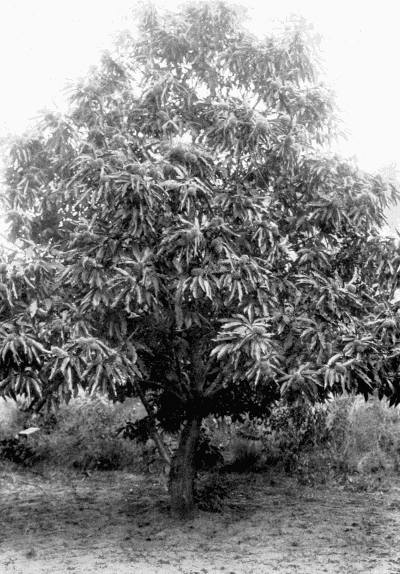
A SPANISH CHESTNUT, CLARKSTON-VINELAND, 1907
The townsite of Asotin at that time was a cattle range. There was one cabin but farther up the river in what was later called the "upper town" was a store and postoffice conducted by Alex Sumpter. We proceeded to climb the hill driving where we could, for there was practically no road. Upon reaching the plateau we gazed out over miles and miles of bunch grass prairie that stretched away, seemingly, in unbroken lines to the foot of the Blue Mountains nearly twenty miles away. As we drove on we passed here and there a settler's home with a few acres broken and fenced. There were the Bean, Ayers, and Bolick ranches, while a little further on we came to the Boyer place. Nearer the mountains there were many families; namely: Whiton, Scott, James and Andrew Robinson, Sangster, Kanawyer, Dodson, Perciful, Flinn, Bay, Huber, Dundrum, Shelman, Foredyce, Sweigert, and many others. We located about four miles from Anatone, which at that time consisted of a small store and postoffice conducted by Chas. Isecke. The only schoolhouse in what is now Asotin County, was located about one-half mile distant from the postoffice. Back in the Blue Mountains a few miles was the saw mill of Messrs. Bean and Farrish.
The immediate neighborhood in which we lived held the honor of being the first on the "flat" visited by the "stork"; Elmer Pintler, second son of Mr. and Mrs. Edward Pintler, being the first white child born on Asotin flat, and Ellen Caroline Bay, daughter of Mr. and Mrs. John Bay was the first girl. Both little toddlers were two years old or thereabouts when we moved into the neighborhood.
The country was now filling up rapidly; all fear of Indian troubles was past, and the people were intent upon making comfortable and permanent homes for themselves and their children. Money was so scarce that it was often said that tamarack rails were "legal tender." Every man was owner of a few, at least, for it was the only fencing known here at that time. Consequently every man, at some time during the year, went into the mountains and demonstrated the accomplishment of Lincoln.
The nearest flour mill was at Colombia Center, some thirty or forty miles distant, and the yearly trips to that point were long and tedious, over a track that could scarcely be called a road. The country was full of cattle, so beef was cheap, being two or three cents per pound, but pork was scarce. Vegetables were also scarce that year, owing to a grasshopper raid. In 1881, instead of grasshoppers, there were crickets, which passed through the country in May, but were too early to do much damage, and the gardens were fairly good that year. These raiding pests did not visit us again and all vegetation flourished in the new soil.
The Pine Grove schoolhouse, the second to be built on the flat, was built in the fall of 1880, and school was conducted there that winter. This was not the first term taught in the district however, as a Mr. Morgan had taught the few children in the neighborhood, the year before in the home of Mr. Pintler. All school districts held at first only three months of school, but it was a beginning out of which has grown our school system of today of which all are so justly proud.
The diversions of the time, for there are no people on earth more sociably inclined than the pioneer, were visiting, dancing, quilting bees, barn and house raisings, "turkey shoots" on holidays, and of course the patriotic celebrations of July Fourth.
As to dress, the people wore what they had and were glad to get it. Cowhide and calico were the latest importations. It was not what they wore but what they were that counted, and that simple garb clothed some of the finest characters that I have ever known. Wherever there was sickness, sorrow, or trouble of whatever sort, that home was filled with friends with sympathetic hearts and helpful hands.
Of churches there were none and no resident minister, though an occasional visiting or circuit minister held services in the schoolhouse, but each school district maintained a flourishing Sunday school. The most convenient and common mode of travel to these gatherings was on horseback.
In 1883 Asotin County was established. We were very proud and later when statehood was granted we felt that we were making progress by leaps and bounds.
Year by year the acreage was increased, new fences were run, and in an amazingly short time, the vast herds of horses and cattle that had grazed peacefully there or wandered in long wavering lines, along the deep old trails to the nearby water holes, gave place to the wide fields of waving grain and passed on to the wilder regions.
And so we grew, the old log cabins with their mud and rock chimneys were replaced by more pretentious dwellings, better farm buildings began to appear, more machinery was purchased, the cayuses and the gaunt range cattle were weeded out to make room for better livestock. Along all lines we sought to improve the general equipment and thus add to the farm's efficiency. Each year brought much progress and some failure. There were hard winters and years of drought. There were good times and hard times, but these were just the incidents common to the life of every community. We weathered them all—and today are proud that our little corner is a worthy part of the "Great Northwest."
In passing along any one of the numerous fine highways of which our county boasts today, one meets occasionally an old pioneer slipping smoothly along in his high powered motor, and there comes to mind a picture of that same traveller, thirty or forty years ago, toiling along that same highway, over a rough rutted course, that could only by the greatest courtesy be called a road, with his jaded cayuse team and lumber wagon, creeping along with the summer sun blazing down upon him or the howling blizzard of winter buffetting, beating him pitilessly, and the biting cold freezing him to the very bone. Picture the contrast, dear reader, and rejoice in the progress of forty years.
In all the years to come we will be found working together for all that makes for development and betterment along all lines, for in such unity alone, can there be real progress. We know that each coming year is better than the last, and all unite in the wish that good old Asotin County may see many of them.
Another of the most prominent of the early families of Asotin County is the Clemans family. A daughter of that family, now well known in Asotin city as Mrs. Lillian Clemans Merchant, was for some years a teacher, and then the superintendent of schools. We are glad to present here a valuable and entertaining account of the early schools of Asotin County from Mrs. Merchant:
BEGINNINGS OF SCHOOLS IN ASOTIN COUNTY
By Mrs. Lillian Clemens Merchant
The writer was not among the earliest settlers of this portion of Washington, having reached the county in the autumn of 1885, although the schools and school systems of the county were still in the embryonic stage, we having enjoyed the privilege of attending school in the first schoolhouse in the county, a little log building 12 by 14 situated about one-half mile from Anatone.
This seat of learning had one window on either side and was furnished as follows: A few rude desks of varying sizes fashioned from rough lumber but soon worn smooth by the activity of the children by whom they were occupied, a long bench made of a hewed log with eight upright pieces driven into it for legs, being used as recitation bench, a small crude table constructed from native wood served for the teacher, a few planed boards painted black in the rear of the room sufficed for a board, a piece of sheep-skin tacked on a block of wood served as an eraser, while a small box heater occupied the center of the room.
Many of the children rode cayuse ponies to school, staking or hobbling them in the open, that they might feast on the tall bunch grass that was so abundant. School was held only during the spring and summer months. On rainy days the riding equipment was of necessity brought into the schoolhouse. The odor emanating from them and the huddled groups of wet children and the lunch pails made a peculiar combination of odors, but in those days we knew nothing of germs. Children were taught to value the privilege of attending school as almost sacred. A year's work was frequently done in a term of three or four months, much stress being placed upon the three R's.
These pioneer children represented many nationalities. One family in the locality were direct descendants of the Wadsworth family of New England to which the poet Longfellow belongs. There were many of Indian blood. One of these young Indian women of distinguished lineage (half breed) grew to womanhood with us. Later losing her father, her mother having died in the girl's infancy, upon opening of the reservation of the Nez Percés, secured her allotment and was persuaded by the teachers of the Indians to attend Carlisle, which she did. But in recent years we happened to be at the interstate fair, and walking into the main pavilion where an Indian baby show was being held, there we saw our schoolmate, a proud and happy mother wrapped in the regulation blanket with the "blue ribbon" pinned on her dusky babe which she held in her arms. Recognition was mutual, but owing to the natural reserve of her race we secured no explanation of conditions.
Fortunately in those early days requirements for securing a teacher's certificate were not rigid, so teachers were plentiful but none qualified to teach beyond the grammar school work, necessitating a removal for high school work which could be ill afforded at that time. At Lewiston, Idaho, about twenty miles distant the Methodist Church established a so-called college which flourished for a time. Many of the young men and women of Asotin County availed themselves of the educational advantages offered by it.
As soon as the normal school at Cheney opened its doors Asotin County was represented, but in order to go there the student was compelled to leave Anatone at 7 A. M., reaching Asotin four hours later and from there another stage was taken which connected with the Uniontown stage in Lewiston, Idaho. About 2 P. M. the Uniontown stage, now designated as a wild-west stage coach, being drawn by six to eight horses, carrying often fourteen to sixteen passengers, took the timid student in charge and transported him as far as Uniontown. It being dark and the train not leaving until morning a stop was made over night. The train was boarded the next morning for Spokane, a stop of a few hours in that thriving little village, and then off to Cheney which was reached later in the afternoon, thus making two days for the trip. But the influence of the splendid men and women in charge of the normal and the excellent opportunities offered the student over his environment in his home county was a splendid recompense for the sacrifice he had to make in leaving Asotin County home folks and friends. But the return of the student and his entry into the teaching profession where he was given a royal welcome by all neighbors and old friends made him feel once more that the effort was more than worth while.
The association of the teachers with the parents in these communities was close indeed. It was the good fortune of the teacher to be entertained over night in every home, although humble, thus acquiring first-hand knowledge of the environment of every child under his or her supervision. It was also the teacher who set the example for the young people in the community thus almost invariably improving the moral status. The teacher was often the Sunday school superintendent or called upon to direct the community choir or was instrumental in organizing debating societies or spelling schools, thus again coming in close contact with the entire neighborhood. Out of this association many friendships were formed that counted for much in the later development of the county. The remuneration received by these teachers rarely exceeded forty dollars per month, many receiving less, but these faithful teachers who still remain in the county in various walks of life have the satisfaction of thinking that their work was appreciated when they observe the places these pioneer children occupy in the county.
The county school superintendent was also an efficient factor in those early days. He might be justly compared to a missionary. Every school board and likewise patrons of the district looked to him for close supervision of the work, as also did every teacher expect in him a high tribunal for the settlement of difficulties that occasionally arose through some misunderstanding.
Since the organization of the county the office of county superintendent has been held by both men and women, as to service about equally divided. Speaking from a woman's standpoint, school visitation in early days in the county was not an easy matter. The roads were extremely poor, schoolhouses far apart, many of which were not accessible by vehicle. One was compelled to drive until the road ceased to be fit for travel or terminated abruptly, at which time the team was converted into saddle horses when the journey was continued. Arduous indeed! was the trip but one was fully repaid when some homesick teacher brightened under the encouragement given and the children put forth an extra effort to make their school the best in the county in attendance or improvement along some line designated by the superintendent, the result to be passed upon by that officer upon the next official visit. Some of the children in these isolated districts were twelve and fourteen years old and never had the privilege of being inside of any public building except their own little schoolhouse, had never had the pleasure of spending a dime. These hardy pioneers always shared their best with the superintendent. We recall one of the young women superintendents having gone out for a survey of the rural schools being entertained in a home over night where the only bed in the home was a bunk nailed up to the side of the wall and filled with straw. This the hostess and her three months' old baby shared with the visitor, while the husband went to the barn loft to sleep. This young woman so hospitably entertained was made to feel in this humble home that those people struggling against poverty knew she was interested in the development of the various districts and always had the loyal support of every one in those communities. All worked for the common aim—the betterment of local conditions.
In early days it was not out of the ordinary for Indians to appear at the farm houses demanding a meal. One incident has been brought to our knowledge where two blanket Indians went into a house asking for a meal in almost unintelligible English, but during the progress of the meal one of the girls of the family was murmuring a few German phrases which she had learned from a neighbor, whereupon the younger of the two Indians asked in splendid English why she had not learned the languages when young. It developed that he was able to converse in five languages, being a college graduate, while at this time Asotin County's children had no advantages above the grammar grades. But let it be said to the credit of these pioneer children who are the fathers and mothers of the present younger generation that they made good and are seeing that their children are getting the best the great state offers educationally.
Thirty years have brought vast changes educationally—classical, industrial and literary courses having been added to our systems, the schools having been inspected and placed upon the accredited lists of the state. Children are provided free transportation to and from schools; hot lunches are provided; buildings equipped with splendid heating systems and sanitary conditions are generally observed. Teachers are paid excellent wages and are well prepared for their work. The county superintendent is provided with an automobile for visitation of schools which are practically all reached by an excellent system of highways.
As an outcome of this superior development many of our young men are holding positions of trust in the present crisis, in the service of Uncle Sam both at home and abroad.
Would we return to the old conditions and times were we given our choice? We love to dwell upon the early times, the struggles, the happy hours, to think of those who were friends during those trying years, but we wish our county to keep pace with the progress of the whole Northwest. So we, in the future, as we have done in the past, as loyal united citizens, will boost for the educational, spiritual and civic growth of Asotin County.
We have given the personal reminiscences of pioneers of Walla Walla and Asotin counties. We are now giving something of the recollections of the first woman in what is now Columbia County, one of the pioneers of 1859, Mrs. Margaret Gilbreath:
S. L. Gilbreath and I were married at Albany, Ore., in March, 1859, and started at once for Washington Territory with a band of cattle, one wagon and team, and three herders.
At the Cascade Mountains two other men, John Wells and Tom Davis, with a wagon and cattle, joined us. We soon found it impossible to hurry on with the wagons, so they were left behind until the road was opened, the rest coming on with the stock. Pack horses carried the camp equipment. It was hard work opening up the trail on account of fallen trees and deep snow. We camped on Butter Creek and sent two men on to find suitable grazing land for our cattle. They returned in a few days reporting that good land with plenty of bunch grass could be homesteaded on the Touchet River. Having succeeded in bringing up our wagons under much difficulty, we continued on our way to Walla Walla.
Captain Dent, commander of Fort Walla Walla, stopped us and insisted that we settle near Walla Walla. We could not do this as the horses of the garrison had eaten all the grass from the range and we were looking for good pasture.
We inquired of the captain if we would be safe from the Indians if we went to the Touchet Valley. He assured us that the Indians were peaceable, which Mr. Gilbreath believed as he had served as volunteer through the Indian wars of 1855 and 1856, and knew of the Nez Percés fighting and scouting for the whites through the war. We found them always friendly, unless they had been drinking.
Leaving Walla Walla we proceeded on our way to The Crossing, which is now Dayton, reaching there August 27, 1859.
Mr. Stubbs, whose real name was Theodore Schnebley, lived here in a log house with his squaw wife. He sold whiskey to the Indians, thereby causing the whites much trouble. In coming into the Valley of the Touchet we left the Indian trail and came down a ravine, in some places having to shovel out places in the ravine to keep the wagons from turning over. These wagons were the first brought into the Touchet Valley.
The next day, after our arrival at The Crossing, we started to build a corral for the cattle, but discovered a den of rattlesnakes. After killing ten we decided to move down the valley to a fine location near a big spring of pure water. This land we homesteaded.
The Indian chiefs were frequent visitors at our cabin, calling soon after we came. Timothy and Lawyer and their friends sometimes sent messengers on ahead to tell us they were coming to dine with us. We would hasten to get ready a good meal for we thought it best to keep them friendly.
Many times we expected trouble from them. Once they rode up the trail shouting and firing off their guns. That night they burned the house of Mr. Stubbs. Sometimes they would imitate wolves howling and slip up near the house to see if there was a man there to know whether to scare the white woman or not.
Once they came and demanded food and money and continued to frighten me
until I grabbed a rifle and started toward them. Then they threw up their hands and laughed and said I was afraid.
Several times they would run a beef into the woods and kill it, carrying home the meat. One night when the Indians had been drinking and were giving us a great scare, two men hunting cattle and Reverend Berry, who preached at our cabin once a month, happened to be there. We were certainly glad to have company.
One day Mr. Gilbreath was plowing rye grass with oxen when Reverend Berry came riding up. He stopped his work and waited for Mr. Berry to come up to him, then said, looking at his clothes and general appearance, "A Methodist preacher, I suppose." "Yes, I am," was the reply. "Well, go on to the house. My wife is a Methodist and will be glad to see you." Reverend Berry preached in our cabin all that fall and winter of 1859 and 1860. His congregation consisted of Mr. and Mrs. Herren, Mr. Stubbs and his dusky wife, Mr. Gilbreath and I, and men who happened to be in the neighborhood. Mr. Berry afterward made his home in Walla Walla for some years.
Whiskey Creek was so named because a band of outlaws made this region their rendezvous, selling whiskey and stealing cattle. Their names were Bill Bunting, John Cooper, Bill Skinner, George Ives and several others who were later hanged in Montana for crimes. The authorities there evidently knew their business, for these were the men who caused the Vigilantes to organize against them. Many prominent men took part in ridding the new country of these undesirables, among them Anderson Cox and J. W. McGhee. It was said that in dealing with the thieves Mr. McGhee said to George Ives who was up for trial: "George, we want you to leave, and we want it to be a long time before you come back." Mr. McGhee's deliberate way of speaking evidently carried weight, for George left.
The first crop of wheat in the Touchet Valley was raised on the land of Israel Davis on Whiskey Creek. He was leaving for the Willamette to buy sheep and Mr. Gilbreath harvested the wheat by cradling, and threshed it out by horses tramping on it. One night a wind came up and Mr. Gilbreath and hired man got up out of bed and began the work of cleaning the eat by pouring pails full of it from a scaffold to the ground. In this manner over a thousand bushels were cleaned. This was intended for seed for the coming year, but the hard winter of 1861 and 1862 followed when food for man and beast became so scarce that most of it was sold to the needy for food, and to keep the teams from starving. Some of the settlers ground the wheat in coffee mills and used it as porridge. We sold our wheat for $2 a bushel. We could have sold at any price but Mr. Gilbreath would not take advantage of their great need.
This was the most terrible winter ever experienced in the valley. The snow drifted so deep that many of the cattle were frozen standing up. Out of 300 of ours two cows and a calf, which we fed, were left. The timber wolves killed a good many cattle that winter. One day a wolf attacked a calf and the mother heard the cry of distress coming from some distance. When she reached it, the wolf was starting to devour the body. The cow fought it from the calf for a day or two, making the most piteous cries. Other cattle smelled the blood and came bawling for miles around. The sound of hundreds of frenzied cattle bawling will not soon be forgotten.
We were fortunate in having plenty of supplies that winter, as we had prepared to send a small pack train to the mines at Elk City. The deep snow made it impossible to get supplies, so the neighbors called on us, and our stores were opened to feed them. Our stock of food was divided among thirteen families. The snow was so deep that only a narrow trail could be kept open to Walla Walla by miners coming to and from the Idaho mines. The snow lay on the ground until March, and in shady places until June. We had to go to Walla Walla in the spring and buy barley for seed.
Miller and Mossman who ran a pony express to the mines, stopped at our cabin for meals, and for exchange of horses. Their saddle-bags were often loaded with gold dust. Joaquin Miller, who is now known as one of our best western poets, was then a rough frontiersman, dressed in buckskin.
Having moved to a new log house, school was held in our cabin in the spring of 1862. Five or six children attended. Mr. Harlin, an Englishman, was the teacher, and he stayed with us.
Another school was taught in 1863 in the Forrest brothers' cabin. These men were brothers-in-law of Jesse N. Day, who later founded Dayton. Frank Harmon was the teacher and A. W. Sweeney of Walla Walla was the first county superintendent.
Reverend Sweeney organized a Cumberland Presbyterian Church at Waitsburg. Among others, Mr. and Mrs. Long and daughter and Mr. Gilbreath and I were charter members.
Our first child who died in infancy was the first white child born in the territory now included in Columbia, Garfield and Asotin counties. The oldest living person born in this territory is Mrs. John Steen, daughter of George Miller.
I was the only white woman in this territory for two months, until Lambert Herren and family came and settled near. Mrs. Robt. Rowley, who was two months old at that time, is the only living one of the Herren family of eight children.
Mrs. Herren was a typical pioneer woman, fearless and kind-hearted, nursing me and others in times of sickness, in the absence of a physician. When the Indians threatened me, I sent for her and she came with shotgun and indignation, and rescued me.
Great changes have taken place since those early days, and many incidents of vital interest to us then have been forgotten, but the kindness and simple living of the early settlers are not easily forgotten.
We have had occasion in this volume to make frequent reference to Mr. and Mrs. J. M. Pomeroy, founders of the town named from them.
One of their daughters, now Mrs. Peter McClung, living still in her home town, was the "first child" in Pomeroy now living there. She has kindly given us a short sketch of what might well be called the atmosphere and the feeling of her childhood home.
We are pleased to include it here as the closing contribution of this chapter of memories.
RECOLLECTIONS OF POMEROY
By Mrs. Peter McClung
To write a story of my experience as a child on the land now occupied by the town of Pomeroy will not require extended space. Days were much the same with the three children of the Pomeroy family isolated from neighbors by distance measured in many miles. Being the youngest of the three children my amusements were in large measure directed by my brother, who was my senior by four years, and my sister, the oldest of the trio.
My earliest recollections recall the counting of the election ballots at our home which was the precinct voting place for the half dozen votes then polled here. It was my great privilege and delight to sit beside my father, for many years one of the members of the election board, and listen to the humdrum tones of the men's voices as they uttered the words that made for the success of some doughty pioneer with political ambitions, or the defeat of one who had fallen a victim to the solicitations of over-zealous friends.
For several years my father cast the only republican ballot in the precinct. I soon reached an age that enabled me to comprehend that fact and know its significance. Our voting precinct contained many thousand square miles—bounded on the south by the Blue Mountains, on the north by the Snake River, on the east by Idaho and on the west by the Touchet River. I sometimes wonder if the deep interest I now feel in all elections and campaigns is not in part due to my early experiences wherein the heat of the neighborhood contests centered about me.
My play time was long and often lonesome, the same, I suppose, as that of other pioneer children reared in the interior of this semi-arid region. Great was my pleasure when I was allowed to ride my pony over the hills after cattle, or to follow my brother on a hunt for prairie chickens or ducks. When my father's two greyhounds, "Peggy" and "John," made one of their frequent raids on the then ever-present coyotes, with the rest of the family my cup of happiness was near the point of bubbling over. Old "Rero's" peculiar bark warned us of the near approach of predaceous animal or bird.
The Pataha Creek then teemed with fish and angling occupied much of my time. The great birds' nests in the trees that fringed the streams, the cubby-holes of the animals along its banks, the caverns in the granite-ribbed Pataha hills, in the fancy of a child, contained wonders impenetrable, yet much there was revealed. With the beginning of the town began a new life for me.
We insert at this point a notable speech upon a notable occasion by one of the most distinguished citizens of Walla Walla, who is also one of our Advisory Board, and whose support and suggestions in the preparation of this work have been of utmost value.
This is Governor Miles C. Moore, last Territorial Governor. Upon his retirement on November 11, 1889, he delivered the following address, one eminently worthy of preservation in the literature of the State of Washington.
ADDRESS OF EX-GOVERNOR MOORE
Ladies and Gentlemen: A custom has grown up here at the capital city and crystallized into unwritten law, which requires the retiring governor to deliver his own valedictory, and also to salute the incoming administration. In accordance with that custom I am here as the last of the race of territorial governors to say "Hail and farewell." Hail to the lusty young State of Washington, rising like a giant in its strength; farewell to old territorial days. It is an occasion for reminiscence, for retrospection. To those of us who have watched at the cradle of Washington's political childhood, this transition to statehood has its pathetic side. It stirs within us memories of the "brave days of old." The past rises before us.
We see again the long line of white canvas-covered wagons leaving the fringe of settlements of the then western frontier, through tear-dimmed eyes we see them disappear down behind the western horizon, entered upon that vast terra incognita, the great American desert of our school days. At last we see them emerge, after months of weary travel upon the plains of eastern Washington, or, later, hewing out paths in the wilderness, striving to reach that "Eden they call Puget Sound." Hither year after year came the pioneers and builded their homes and planted the symbols of their faith upon the banks of your rivers, in the sun-kissed valleys of your inland empire, under the shadows of your grand mountains, and upon the shores of this vast inland sea.
Very gradually we grew. The donation act passed by Congress in 1850, giving to each man and his wife who would settle thereon a square mile of land in this fertile region, attracted the first considerable immigration. It also probably saved to the United States this northwest territory. The entire population, which at the date of organization as a separate territory, in 1853, was 5,500, had grown to only 24,000 in 1870, and to 67,000 in 1880.
Still with an abiding faith in the ultimate greatness of Washington, and the attractions of her climate, when her wealth of resources should become known, the old settler watched through the long years the gradual unfolding of these resources, the slow increase in population. At last the railroad came, linking us with the populous centers of civilization. They poured upon us a restless stream of immigration. A change came over the sleepy old territory. These active, pushing emigrants, the best blood of the older states, are leveling the forests, they are delving in the mines, they are tunneling the mountains, they are toiling in the grain fields, they are building cities, towns and villages, filling the heavens with the shining towers of religion and civilization.
The old settler finds himself in the midst of a strange new age and almost uncomprehended scenes. The old order of things has passed away but your sturdy self-reliant pioneer looks not mournfully into the past. He is with you in the living present, with you here today, rejoicing in the marvelous prosperity visible everywhere around him, rejoicing to see the empire which he wrested from savage foes become the home of a happy people, rejoiced to see that empire, emerged from the condition of territorial vassalage, put on the robes of sovereignty.
We are assembled here to celebrate this event, the most important in the history of Washington, and to put in motion the wheels of the state government. Through many slow revolving years the people of Washington have waited for their exalted privileges. So quietly have they come at last, so quietly have we passed from political infancy to the manly strength and independence of statehood, that we scarce can realize that we have attained the fruition of our hopes.
Let us not forget in this hour of rejoicing the responsibility that comes with autonomy. Let us not forget that under statehood life will still have woes, that there will still be want and misery in this fair land of ours. To reduce these to the minimum is the problem of statesmanship. The responsibility rests largely with our lawmakers now assembled here. A good foundation has been laid in the adoption of an admirable constitution pronounced by an eminent authority "as good as any state now has and probably as good as any will ever get." Upon this you are to build the superstructure of the commonwealth by enacting laws for the millions who are to dwell therein.
You have the storehouse of the centuries from which to draw, the crystallized experience of lawmakers from the days of Justinian down to present times. To fail to give us good laws will be to "sin against light." "Unto whomsoever much is given of him shall be much required." The eyes of all the people are upon you. It is hoped and confidently expected you will bring to the discharge of your duties wisdom, industry and lofty patriotism; that when your work is done it will be found to have been well done; that capital and labor will here have equal recognition and absolute protection; that here will arise an ideal commonwealth, the home of a race to match our mountains, worthy to wear the name of Washington.
Now that I am about to surrender my trust and return to private life, I desire to testify to my grateful appreciation of the uniform kindness, forbearance and courtesy accorded me by the people of Olympia, and by all the citizens of Washington, it has been my good fortune to meet during my brief term of office. I shall always cherish among the pleasant experiences of my life the seven months passed here as Washington's last territorial governor.
To your governor-elect you need no introduction; if not a pioneer, he is at least an old settler. It is a graceful tribute to this class that one of their number was selected to be the first governor of the state. It affords me pleasure to testify to his thorough and absolute devotion to its interests. His every thought is instinct with love for the fair young state. I bespeak for him your generous co-operation and assistance.
With Governor Moore's address as last Territorial governor, this volume may fittingly close. The development of the Territory there so vividly summarized by him, has continued and has indeed exceeded all forecasts during the twenty-eight years of statehood, from 1889 to 1917.
BIOGRAPHICAL
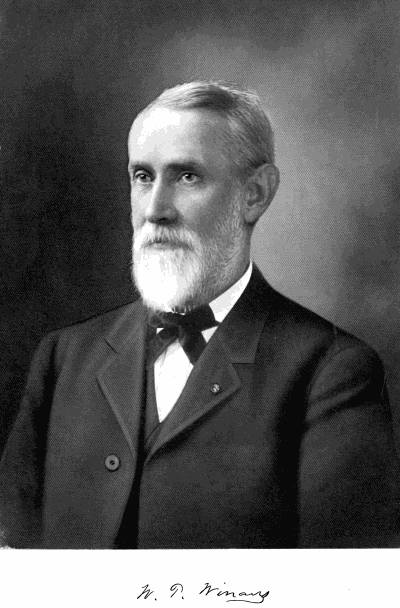
Old Walla Walla County