Chapter II · (continued 2)
Reading edition
It is interesting to note here that the assessed valuation of Dayton in 1917 was $1,027,244.
Various miscellaneous happenings of much interest occurred from time to time during the years covered by the political history which we have been tracing out. Dayton seems to have been peculiarly unfortunate about fires. In addition to those which we have mentioned, there was one on July 17, 1883, which destroyed the Weinhard brewery, and in January, 1884, an attempt, generally supposed by incendiaries, to burn the planing and flour mills of Wait and Prather. A famous criminal suit against C. F. McClary, Frank Taylor and D. Hutchings was brought on the charge of incendiarism, resulting in the acquittal of the first, the discharge of the third by nolle prosequi, and the conviction of Taylor upon his own confession. On September 25, 1884, there was another fire, also supposed to be incendiary, and on March 27, 1885, the Woolen Mills went up in flames, thus ending its untoward career after so promising a start. June 24, 1887, witnessed still another devastation by fire, the worst known in the history of the town, entailing a loss of $112,000.
In 1890, August 11th, there was still another visit of the "fire fiend," causing as great a loss, though not affecting so large a number of individuals. There was yet another fire, not so great, in August, 1891. These hard experiences with fires led to the establishment of a number of fire companies and hose companies, the details of whose history it would be interesting to follow, did space permit. The Columbia Fire Engine Company seems to have been the longest-lived of these, continuing from 1882 to 1892. Since inauguration of the municipal gravity waterworks there have been no destructive fires.
In the year 1890 there was a curious outbreak of burglaries and other light fingered works of art resulting in numerous criticisms of the authorities and a final appeal to Judge Lynch. Leroy Burris, who had been engaged as foreman in the printing office of the Inlander, was implicated in the charge of burglarious practices, was seized by Vigilantes, and after having been brought face to face with a rope was let off with banishment.
In 1892 the general unrest and hard times led to various ugly forms, and one of them was an attempt to imitate Tacoma in the banishment of the Chinese. The effort to run out the Orientals proved a fiasco, however, as the general sentiment of the majority of the citizens was strongly against it, and the sheriff was firm in his announcement of the probable outcome of any violation of the peace. Gradually the agitation subsided and the Chinese, who were few in numbers and were peaceable and law abiding, and who in no manner stood in the way of the rights and privileges of white citizens, remained unmolested. Dayton was saved from that most contemptible and inexcusable of all forms of public riot, a "race war."
The part which Dayton and Columbia County took in raising men for the Washington Volunteer force in the Philippine war is worthy of some special note. Not that the other counties and towns were in any degree deficient in their service, but the number of enlistments at Dayton was remarkable in comparison with the population. The Dayton men were enrolled in Company F of the First Washington Volunteers. Chester F. Miller, whose name has so often appeared in this history in connection with legal and judicial matters, was chosen captain of the company; Charles A. Booker was first lieutenant; George B. Dorr, second lieutenant. The company, like the others of the Washington Volunteers, bore itself with all honor. One member of the company, Edward W. Strain of Pomeroy, a member of one of the most conspicuous pioneer families of Garfield County, was killed in battle, and George B. Fargo and R. A. Chrystal lost their lives by sickness.
Columbia County is so entirely a farming country that there are practically no cities and towns of any considerable size except Dayton.
THE TOWN OF STARBUCK
There are, however, several villages whose records, had we space for them, would afford much matter of interest. The leading one of these is Starbuck. This has become within the last few years a railroad point of much importance, being a division and locomotive station on the O. W. R. & N. System, and, as the result of this, providing homes for a number of families and being the center of a very considerable business. It is the junction of the Pomeroy branch with the main line, and as an immense business is done on that branch, there is the prospect of a steady increase in the business centering at Starbuck. The picturesque and piscatorial Tucanon, of historic fame, and the drainage stream of one of the richest and most beautiful valleys in the state, passes right through the town, and its bright waters impart a needed verdure to the rather arid land as well as diffuse a grateful coolness to the sometimes intense heat which the low altitude and bluffy hill shoulders on either side impose upon the place.
Starbuck may be said to have come into existence with the construction of the railroad and the erection of a warehouse and section house in 1882.
It is referred to in the Chronicle of Dayton in December, 1886, as Starbuck Station. Mention is made also of Col. George Hunter as receiving at that time the appointment as railroad agent. Colonel Hunter was noted as a pioneer and was the author of a book on pioneer life, entitled: "Reminiscences of an Old Timer."
Upon the completion of the Pomeroy branch line in 1886 considerable building ensued. McIntosh Brothers established a store, a depot building and several other buildings were put up. Sad to relate these buildings were destroyed by fire the next year.
In 1888-9 a new era of building came on, the most important structures being the round-house, machine shops, section houses, agent's house, turn-table, and some minor buildings, constructed by the railroad company. But Starbuck seems to have rivaled Dayton in disasters by fire. On May 18, 1893, the valuable structures of the railroad company, with much oil and coal and a number of locomotives, became victims of a fire. The loss to the company was $500,000.
In 1894 Mrs. Mary McIntosh undertook to lay out a town site. The plat was filed on June 1st. In October of the same year Woodend's Addition was platted. In 1906 Starbuck became incorporated as a city of the fourth class.
The municipal officers of the first government were: W. E. Sprout, mayor; C. A. Blackman, John Roddy, Frank Actor, W. F. Gardner and M. Ray, councilmen.
Within the decade following incorporation, Starbuck has increased in population from about four hundred to about seven hundred and fifty. The increased railroad force and added buildings in connection with division headquarters has made substantial increases in business, and at the present the metropolis of the Tucanon is a busy, bustling little city, with a fine school building, several churches, a flourishing bank, a number of stores, and many pleasant homes embowered in trees.
The present city government of Starbuck is composed of the following: Mayor, W. H. Barnhart; councilmen, Wallis Brundson, C. H. List, M. V. McCool, J. H. Walters, L. E. Hukill; treasurer, Sam Walters; clerk, D. C. Guernsey; marshal, James Smith.
There are three churches in Starbuck: Episcopal, of which the pastor is Rev. John Leacher, also pastor of the Episcopal Church at Pomeroy; Christian, the pulpit of which is occupied by Rev. Mr. Diggins of Walla Walla; the Methodist, in which services are maintained, but at present without a stated pastor.
As in all typical towns in the Northwest, Starbuck takes just pride in her schools and makes generous provision for them. The approximate value of the school building, with its equipment, is $35,000. There is a high school department with three grades, having at the present date nineteen pupils. The enrollment in the eight grammar school grades is 121. The faculty at the present time is: Principal, H. C. Hayes; high school instructor, Bertha Botts; grade teachers in order from eighth grade to first, Fred Lehman, Ethel Krouse, May Betts, Mrs. Myrtle Pettyjohn, Mrs. Ethel LeDuc, Mrs. Brooks Harris.
One narration of much interest connected with the near vicinity of Starbuck is the attempt on the part of Dr. Marcel Pietrzycki of Dayton, physician, capitalist, philanthropist, and newspaper proprietor, to establish a sort of co-operative ownership organization on a large ranch a few miles south of Starbuck.
We have given in connection with the Dayton schools the main features of his enterprise.
It would indeed have been an experiment of much interest in sociological lines, but hardly had the good doctor inaugurated his plans when failing health and his lamented death brought the great scheme to an untimely end. A few years later the ranch became the property of the Grote Brothers, who rank among the most extensive farmers of the Northwest. But—lamentable to relate—the mansion which had been the central feature of the builder's roseate schemes, was lost by fire, and the land which was to have been the scene of a great sociological demonstration has become a wheat and cattle ranch.
In the near vicinity is another notable place, the property of one of the most notable families in the region. This is the immense Jackson ranch. This place was founded and developed by Richard A. Jackson, one of the foremost of the builders of old Walla Walla County. He became the most extensive sheep raiser in Columbia and Garfield counties, his holdings belonging to both. His home was established in a fine house upon the Tucanon, and the great areas of grain and pasture land extended for miles from the creek, embracing in all about fifteen thousand acres. Upon the death of Mr. Jackson, Mrs. Jackson, with several of her capable children, continued the business with equal success, and at the present date maintains the former leadership in the production of wool. At the Lewis and Clark Fair at Portland in 1905, and the Alaska Yukon Exposition at Seattle in 1909, there was on exhibition a wool fleece from the Jackson ranch, which was said to be the largest fleece ever known, weighing the almost incredible amount of sixty-nine pounds. At present price of wool that fleece would be worth over thirty dollars.
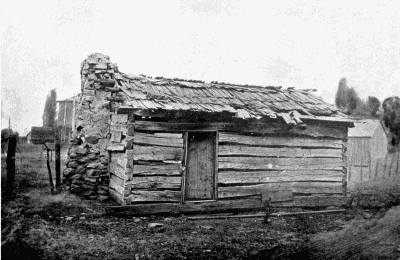
ONE OF THE FIRST HOUSES IN STARBUCK
Still another enterprise of more than local interest, of which the office and headquarters are at Starbuck, is the extensive irrigation project on the Snake River, a short distance above Riparia, founded and mainly owned by Pres. E. A. Bryan, known throughout the state and country as for many years the president of the State College at Pullman. The irrigation tract has been laid out with scientific accuracy and has become a valuable property under the management of A. W. Bryan, son of President Bryan.
A weekly paper, the Starbuck Standard, with a circulation of about four hundred, is published at Starbuck by H. G. Roe. It is now in its fourth year, and performs an excellent part in maintaining publicity in the vicinity. In a recent number of the Standard we note the interesting fact of a mass meeting in the town to prepare for placing the town upon one of the Chautauqua circuits of the Ellison-White Company for the coming year. That a town and community of so small population should undertake so extensive an enterprise is good evidence of the ambition and intelligence of the people.
JOURNALISM IN COLUMBIA COUNTY
As an essential element in the view of the institutions of Columbia County we will give a sketch of its journalism.
At the risk of repetition we will go back to the beginnings, when Dayton was still in Walla Walla County, for the discovery of the first newspaper. That pioneer in the journalistic field was the Dayton News. It first saw the light of this evil world in September, 1874. It was launched largely for the purpose of "booming" the idea of a new county with Dayton as the seat. It was simply a four column sheet. Its politics were democratic. A. J. Cain was the first editor, and Elisha Ping was the financial backer. Mr. Cain had quite an eventful career, both before and after, as a lawyer, writer and soldier, playing an important part in the Nez Percé Indian war of 1877. The News had a varied career, passing through a number of hands, with brief tenure, and in 1881 came into the possession of J. Y. Ostrander as editor, and Walter Crosby as business manager. But it was near its demise. For in August, 1882, it, like other valuable possessions in Dayton at that time, went up on a chariot of fire, and never came down. It had played a good part in the installation of the new county, with Dayton as its official head.
The Columbia Chronicle came into existence on April 20, 1878. It was designed as the republican offset to the News. T. M. May and H. H. Gale were the first proprietors, with E. R. Burk acting a short time as business manager. A "cute" announcement in the first issue is as follows: "Afloat—We have launched the Chronicle and spread sails for a long newspaper voyage, and we do not see any long breakers ahead. If we do not find a breeze, we will make one and sail right along. Fare, $3. All aboard!"
In a somewhat more sober vein the salutatory of the paper, entitled, "Our Bow," proceeds thus: "Friends and fellow-citizens; today we present to you the initial number of the Columbia Chronicle. Not deeming it advisable to salute the public with a lengthy preamble and platform of pledges, about what we will do and what we will not do, we will say in brief: The intention is to establish a newspaper here which shall work for the social and commercial interest of Columbia in particular and Eastern Washington in general. In starting a newspaper in Dayton we believe we are only keeping pace with these modern reading times and the wants and demands of the people.
"We shall endeavor to make the Chronicle a reliable newspaper, advocating the interest of the farmer, stock raiser, and business man, and to aid in developing the resources of this magnificent country. We shall pay special attention to gathering local, territorial and general news, and make the Chronicle interesting as a home paper. Printing our own outside we shall have room for numerous correspondents.
"The Chronicle will be republican in politics, and in all our political and public affairs it will be our aim to advance the best interest of the people, censuring the wrong and advocating the right on general principles."
That initial number of the Chronicle contains local items and advertisements of much interest. Among the former we find mention of the school, in charge of Prof. J. E. Eastham, and containing fifty scholars. Parents are exhorted to co-operate with the teachers in making the school reach its best attainments.
Notice is taken of the death near Lewiston of the Indian Levi, who, with Timothy, had saved Steptoe's command from destruction in 1858 in the disastrous expedition from Walla Walla to Spokane.
There is also an item calling attention to the advisability of tree culture, and settlers are advised to investigate the claims of the Eucalyptus tree, which is stated to have been found very valuable in California. The paper asserts that nothing grows so fast as that tree, unless it be a farm mortgage bearing 1½ per cent interest per month, compounded. Trees in California, it declares, have made a growth of from sixty to seventy feet in ten years.
In the advertising columns of that first number of the Chronicle, we find some names well known throughout the history of Dayton.
The Columbia Hotel appears, of which the proprietors are announced as John Brining and Lane Gilliam. There are a number of cards of lawyers and physicians. Among the former we note T. H. Crawford, R. F. Sturdevant and M. A. Baker. Among the latter are T. C. Frary, J. H. Kennedy, H. R. Littlefield and W. H. Boyd, and the Homeopathists W. W. Day and J. P. VanDusen.
Of the business advertisements we observe the Standard Soap Works, conducted by W. W. Gardner and M. S. McQuarrie. J. A. Gavitt announces his saddle and harness supplies. W. P. Matzger appears as the producer of artistic photographs. D. B. Kimball, contractor, builder and undertaker, occupies space. There is quite an ad. for H. I. and E. A. Torrance as blacksmiths and wagon makers. Also J. Hutcheon and A. Nilsson call attention to their blacksmithing business.
D. C. Guernsey and H. H. Wolfe announce their grand opening for the spring trade of 1878. I. N. Arment announces his extensive stock of watches, clocks, cigars, tobacco, musical instruments, fishing tackle, etc.
Mr. R. E. Peabody, now the proprietor of the Chronicle, set up that first number of the paper and has been connected with it ever since, except during an absence of about a year in Montana. Mr. Peabody is without doubt the dean of all the newspaper men of Eastern Washington. He, in company with O. C. White, became proprietor in 1890, and in a short time the retirement of Mr. White left him the sole proprietor.
In 1908 Dr. Marcel Pietrzycki had an interest in the Chronicle for about four months, during which time he endeavored to advance some radical views on methods of taxation. The connection of the doctor with the paper was suddenly dropped when it became apparent to him that his views were not meeting with popular support.
Doubtless next to Mr. Peabody as a continuous factor in the newspaper field in this region is Al Ricardo. Mr. Ricardo was born in Mexico of Spanish parentage. He came to Walla Walla in 1885, and was connected with the Statesman for fifteen years. In 1900 he went to Dayton and became interested in two papers, the Courier, a democratic paper, and the Press, a populist paper. These papers were combined in 1900 by a company, but in the next year Mr. Ricardo acquired the entire control, which he has continued to the present.
The third of the newspapers is the Dispatch. This was founded in 1903 by Mr. Harris. The unique feature of it was the effort by Mr. Harris to maintain it as a daily. This was the only paper in the district covered by this history outside of Walla Walla, which carried on a daily issue. It soon appeared that the attempt was an undertaking beyond the resources of the field, and in 1905 Mr. Harris sold out to H. C. Benbow, a former resident of Pomeroy, where he had been active both as a teacher and a journalist. Mr. Benbow reduced the Dispatch to the weekly edition and has maintained it to the present on those lines. Its official name is Columbia County Dispatch, and it is now in its sixteenth volume.
The three Dayton papers are clean, well conducted, high-class weeklies, reflecting with accuracy the conditions of the community, as well as exercising a wholesome force in aiding to mobilize the rich resources which center at Dayton. As fulfilling with marked power their functions they may well be a source of pride to their proprietors and of approval to the citizenship.
TWO REMARKABLE CRIMINAL CASES
One feature of life in Columbia County seems to demand some attention, and that is the criminal record. This is not for the sake of mere sensationalism, but because of some features so remarkable that they become interesting as a study of the possibilities of human nature and life.
The first case that we shall touch upon was that of the murder of E. H. Cummins, railroad agent at New York Bar on Snake River. The story has been told in various forms. We derive our information mainly from Dr. E. H. Van Patten of Dayton. The mutilated body of the agent was discovered early on the morning of July 27, 1882. It was evident upon inspection that he had been murdered for the purpose of robbery. The station had been rifled of all valuables, including money. Late in 1882 Canada Owenby, who lived near Pomeroy, was arrested on account of suspicious circumstances. It was known that he had been destitute of money but that soon after the murder had become possessed of considerable money. He was known to have been in Pataha the day before the murder, then to have disappeared, returning the next morning, and getting a blacksmith to remove the shoes of his horse. He had purchased in Pomeroy cartridges for a pistol which he was known to own, which was of just the size which appeared to have been used for the crime. After his arrest he made desperate efforts to escape, leaping, handcuffed, from a second-story window. He had tried to bribe a guard to swear that he saw him in Pomeroy the night of the murder. Again he sought to induce the guards by bribes to let him escape. Still further he asserted that his wife would testify that he was at home the night of the murder, but when she was called to the stand he took advantage of the right to refuse to allow her to be a witness. A bloody shirt was found which appeared to belong to him. The chain was drawing irresistibly around him. The preliminary trial occurred at Dayton on January 13, 1883. Without being put under any "tenth degree inquisition," Owenby was evidently in a dreadful state of mind, and soon after the discharge of the jury through disagreement, he confessed, first to a fellow prisoner, and subsequently to the sheriff and clerk. The confession was somewhat confused and contradictory, but it involved the assertion that three other men, James McPherson, Ezra Snoderly, and one Porter, were concerned in the crime. The three were arrested and brought to Dayton. The officers became so well satisfied that Porter was innocent that he was released.
In June, 1883, Snoderly and McPherson were tried in the district court, presided over by Judge S. C. Wingard. It was an intensely exciting trial. J. K. Rutherford was prosecuting attorney at the time. Judge Godman, Judge Caton, Judge Sturdevant and Colonel George, the most prominent attorneys in the region at that time, were concerned in the case.
The result of the trial was that all three men were convicted of murder, though both McPherson and Snoderly maintained to the last that they were innocent. Great efforts were made for a reprieve. Judge Caton secured a stay of proceedings for McPherson. The news of this excited great feeling throughout the community where the conviction was strong that the three were alike guilty in the revolting crime. During the afternoon of August 4th little knots of men, mainly farmers, might have been seen talking earnestly, breaking up their groups whenever any one not in their confidence approached. It was evident that something portentous was at hand.
The old vigilante organization had representatives in the community. With that element as a nucleus, a committee called the committee of the hundred and one, was speedily organized and about midnight a strong body of men gathered in the courthouse square. They speedily stormed the jail, in spite of the firing of the guard, overpowered him, broke into the cell where McPherson was chained, took him out and hanged him.
On the 7th of August, Snoderly was subjected to a legal execution, in presence of a huge throng, protesting his innocence to the last and extending his hand to Owenby as he passed his cell, with the words, "You are taking my life, the life of an innocent man, but I forgive you and I hope the Lord will forgive you." The sentence of the law was then duly executed.
Owenby was taken to the jail at Walla Walla, still admitting his guilt and declaring that he wished to be hanged, as the deserving punishment.
But—strange to tell—within a few months, on December 25th, he, with a fellow prisoner, escaped. As Sheriff Thompson was going through the corridor of the jail he was struck to the floor by a brick, evidently hurled by one of the prisoners. The jailer rushed to the sheriff's assistance and was stabbed with a pocket knife by one of the convicts. Rushing from their cells, which had been unlocked, the two men opened the outer door with the key taken from the sheriff, and escaped. Securing horses they made their way to the mountains in the vicinity of Weston, Ore. They there captured two more horses, killed a Chinaman, and robbed his body of a considerable sum of money. But within a few days Owenby, his feet frozen and himself in a starving condition, was found in a barn on the DeHaven ranch near Milton. Being taken to Dayton, where some lynch talk was started, but soon abandoned, Owenby lingered a few days, and then died, declaring that all his assertions of the crime were true, and that he and the other men were all guilty and worthy of death.
THE HILL CASE
Of this second remarkable case we shall give but a brief account. Its singular features will appear as we proceed.
A man was shot in a saloon brawl in Colfax, lingered on some days and then died. There was mixed evidence as to who fired the fatal shot, but one of the drunken crew named Hill was charged with the offense and arrested. Feeling was high in Colfax, and Hill's lawyer, the famous Tom Griffiths of Spokane, regarded as one of the greatest criminal lawyers at that time and a prominent politician, secured a change of venue to Dayton. Associated with Mr. Griffiths was J. K. Edmiston, a leading lawyer of Dayton, one of the most prominent citizens and of the highest type of man. Mr. Edmiston seems to have sincerely believed that Hill was innocent. Griffiths made every effort to get Dr. Van Patten of Dayton to testify that a wound of the nature of that received by the murdered man was not necessarily fatal, but that death was the result of drugs administered after the wounding. Dr. Van Patten declared that only six per cent of the wounds of that type had resulted in recovery. He was not called to the witness stand. A Doctor Harvey of Spokane was brought down as an expert witness, and having taken the stand swore that there was evidence that bichloride of mercury had been used with the wounded man, and that death resulted from that and not from the pistol shot. Griffiths worked this testimony with his accustomed skill and success, and the verdict rendered let Hill off with a sentence of six months in the county jail.
Dr. Van Patten remembers that in conversation with Mr. Edmiston, upon the announcement of the verdict, he said, "You have got Hill off with a light sentence, but it will do him little good if he is ever taken to Colfax." Within two weeks after Hill had been returned to the Colfax jail the doors were broken in, the prisoner was hurried into the yard by a group of determined men, and there he was swung from a rope in front of the courthouse.
It would not be safe to venture an opinion as to the rights and wrongs of that Hill tragedy, but on the surface it looks a good deal like one of those cases of "expert testimony" which is sometimes the legitimate parent of lynching cases.