Chapter II
Reading edition
DISTINCTIVE FEATURES IN HISTORY OF COLUMBIA COUNTY
We have already given a general view of the first settlement on the Touchet, in what is now Columbia County. But a valuable paper by Judge Chester F. Miller of Dayton, prepared for a club at that city and published in the Chronicle of April 8, 1916, offers some material so fitting for an introduction that we avail ourselves of it here. Judge Miller discusses the meaning of the names of the local streams as follows:
"It is rather unfortunate that the original Indian name Kinnooenim was not retained instead of the rather harsh sounding name of Tucanon. Many people have the idea that Tucanon derived its name from the tradition that some early expedition buried two cannon on its banks when pressed by the Indians, but the early expeditions, both explorers and Indian fighters, did not carry cannon, they did well if they got over the country with their muskets. The first cannon in this section that we read about were at Fort Taylor, at the mouth of the Tucanon, built by Colonel Wright in 1858, which was some time after the creek had received its present name. I am inclined to adopt the theory that the name is derived from 'tukanin,' the Nez Percé name for cowse or Indian bread root, which was generally used by the Indians in making bread. I have some early recollections of trying to eat some Indian bread made from crushed cowse, flavored with grasshopper legs.
"The name Patit, called by the Indians Pat-ti-ta, is somewhat in doubt, one Indian having told me that it was a Nez Percé word meaning small creek. The word Touchet has never been properly identified, but Ed Raboin thought it was from the French, and came from the exclamation 'touche' used in fencing with foils, when one of the fencers touched the other over a vital spot."
The second extract deals with the expulsion of the settlers in the Indian war of 1855:
"Nathan Olney, the Indian agent at The Dalles, made a trip to the Walla Walla country seeking to pacify Peupeumoxmox, but this chief refused the presents offered and repudiated the treaty. Mr. Olney at once ordered all settlers to leave the country. At this time Chase, LaFontain and Brooke left their cabins on the Touchet in Columbia County on their way to The Dalles for supplies; on arriving at the mouth of the Umatilla, they were informed of the Indian uprising, and returned to Whitman mission, where a conference was had, and all the whites agreed to convert the house of Mr. Brooke, just below the present Huntsville, into a fort and stay with the country. Chase and LaFontain returned to their ranches at Dayton and on the day agreed on for the meeting at the Brooke cabin, LaFontain went down to confer with them, and learned that all the others, who had agreed to stay and fight it out, had concluded to abandon their places and leave the country. Chase and LaFontain concluded to stay, and commenced to fortify the Chase house, which was located in the vicinity of the present Pietrzycki residence. They had three transient hired men, who at first agreed to stay, but on the following day the hired men concluded that they had not lost any Indians, and took their departure. Chase and LaFontain completed their stockade, ran a bucketful of bullets, stocked the cabin with provisions, and dug a tunnel to the banks of the Touchet for water in case of siege, and waited for the Indians.
"They remained for ten days longer, when the constant standing guard and waiting for the Indians, who had not appeared, began to wear on their nerves, and they started for the country of the friendly Nez Perces, picking up Louis Raboin on the Tucanon, and at that time not a white man remained in Southeastern Washington. On the next day after they had left the Indians came and burned the Brooke and Chase houses."
Still another interesting extract tells of the controverted point as to the rights and wrongs of the tragic death of Peupeumoxmox, of which we have spoken in the chapter on Indian wars:
"During this Indian war no fighting was done in Columbia County and I will not mention it further than to say that on December 9, 1855, the battle of the Walla Walla was fought, in which Peupeumoxmox was killed by the guards while held as a hostage. Some 1,500 Indians were engaged in this battle against 350 volunteers. The results were twenty volunteers killed and wounded and 100 dead Indians.
"Some writers, particularly Colonel Gilbert, claim that this chief was murdered, and his body mutilated by the guards, but I don't believe it. My father was one of the guards, and he has told me that when the battle commenced this chief began waving his hands and shouting to his warriors, giving them directions in regard to the battle, and that Colonel Kelley rode up and said, 'Tie them or kill them, I don't give a damn which,' and that when the guards proceeded to tie them the Indians began to struggle, and one by the name of Wolfskin broke away and stabbed Sergt. Maj. Isaac Miller in the arm, and that the guards then began to see red, and the whole thing was off."
In Judge Miller's paper there is also a most valuable view of the permanent settlements on the Touchet following the close of the wars:
"In 1859 the Indian troubles having ended, the Touchet country was declared safe for settlers. The first to arrive were Indian traders, usually squaw-men, who settled at the different crossings of the old Indian trails and engaged in the business of trading bad whiskey to the Indians for their cayuse ponies. Some of these probably slipped in during the fall of '58, as they were here in the spring of '59 when the first homesteaders arrived looking for locations. Bill Bunton, George Ives and Clubfoot George were at the crossing of Whiskey Creek; Freelon Schnebley, known as 'Stubbs,' and Richard Learn, known as 'Big Red,' at the crossing of the Touchet, where Dayton is located; Bill Rexford was at the crossing of the Patit, and John Turner at Pataha City; these were all bad citizens and all squaw-men except Rexford, and it was generally said among the Indians that he was too mean for a squaw to live with. In addition to these, the following squaw-men, who were much better citizens, were here at that time: Louis Raboin, who lived where the trails crossed the Tucanon, having returned to his old place after the Indian troubles; William and Martin Bailey, who lived with their squaws on what is known as the Rainwater place at the upper end of town, and Joe Ruark, known as 'Kentuck,' who lived with his squaw near the Star schoolhouse. The first real settlers to arrive came in the spring of 1859, most of them from the Willamette Valley, many of them having seen the country while serving as volunteers in the Indian wars. They located claims along the Touchet, laid a foundation of four logs, and posted notices that they had taken the claims, and gone to the valley for their stock, and would return in three months.
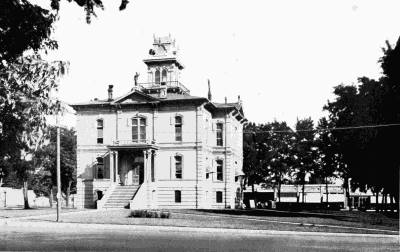
THE COURTHOUSE, DAYTON
"As near as I can learn, the only one who remained at that time was Israel Davis, usually known as 'Hogeye' Davis, who settled where the trails left the Hogeye Creek, and raised a small crop that year. This is conceded to be the first crop raised and harvested in the county. Davis was a bachelor, and two years later was killed by the jealous husband of a woman who was cooking for him. The next who came to stay were Sam Gilbreath and his young wife, and John Wells and Tom Davis, both bachelors, who came in August, 1859. Gilbreath took up a homestead and built his first cabin where the trails entered the valley. This would be where the Smith orchard is now located. Tom Davis bought a location from 'Stubbs' and built a cabin in the vicinity of the Railroad Primary; Wells also bought a location from 'Stubbs' and built across the Touchet from the mouth of the Patit. Lambert Hearn and wife came in October, first locating where the Columbia schoolhouse now stands, but afterwards selling out to the Paynes and moving to the Hearn homestead across the Touchet from Dayton.
"Jesse N. Day was among those who located their claims and returned to the valley for their families; he did not return until the fall of 1860. His claim was where the Chandler slaughter house is now located. He looked over the present site of Dayton, but was afraid Chase and LaFontain might return and make him trouble, and located farther down. Many of those who made their locations in the spring came back in the fall and built cabins. The settlers of 1859, traveling from the crossing down the Touchet were as follows: Wells, Davis, Hearn, Gilbreath, John Forsythe at the Angell place, James Dill at Pomona, James Bennett at the Bateman place, Joe Starr at the Starr bridge, Dave Fudge at the Blize place, George Pollard at his present place, John Fudge at Huntsville, and the Whittaker brothers just below, James Fudge on Whiskey Creek below Bunton's, and Israel Davis on the Hogeye.
"They were all bachelors except Gilbreath and Hearn, so that we had two white women in Columbia County at that time, although Dill was a widower and had one boy with him. Those arriving in 1860 were Elisha Ping and family, G. W. Miller and family, my mother and I being the family, Jesse N. Day and family, and three bachelors, Henry B. Day and Jack and Newt Forrest; the Forrests were brothers of Mrs. Day. Miller and Ping settled on their previously located homesteads on the Patit, and Jesse Day on the Touchet; the Forrests had located the Richardson place the year before and settled there, selling out to R. G. Newland in 1861; Henry Day having 320 acres in the valley, was not eligible for a homestead, but engaged in the cattle business.
"The immigration of 1861 was as follows: William Sherry settled on the Patit above Miller; Alexander Montgomery, Albert Woodward and Cyrus Armstrong on the Patit above Rexford; Jonathan Buzzard on the old Cross place in Johnson Hollow, near Dayton; Ambrose Johnson where the trails crossed Johnson Hollow; Tom Whetstone where the trails entered Whetstone Hollow; Amasa West between Stubbs and the Baileys; Uncle Zeke Hobbs between the Baileys and 'Kentuck;' John Winnett and Henry Owsley farther up the Touchet, and Uncle Tom Winnett and his sons, Bill, Dock, Bob and Lew, on Whiskey Creek and the Hogeye. There were three young fellows with the Winnetts, who do not seem to have taken up land at that time; they were Simon Critchfield, Cy Mathew and Fred Yenney. This year the Paynes bought out Hearn at Columbia schoolhouse, and the Forrests sold to R. G. Newland. During this year my father rented the Stubbs place, broke out a portion of the land and fenced it with cottonwood rails made where the Main Street Bridge now crosses the stream.
"The settlers up to this time were stock men, settling along the stream and grazing their stock on the hills in every direction; they raised a little hay and some oats on the fertile bottom lands; the hills were considered of no value except for grazing; wheat was not raised because there was no available market; surplus oats were hauled to Fort Lapwai, but on account of the distance and crude roads this was not very profitable. When the valleys were taken up the growth of the country stopped and the increase in population was very slow."
ESTABLISHMENT OF COLUMBIA COUNTY
We have given in the last chapter of Part II the story of County division. By act of the Territorial Legislature on November 11, 1875, a line was drawn from Snake River south to a point on the Touchet two miles above Waitsburg; thence south six miles, then east six miles, then south to the state line. All west of that line continued to be Walla Walla County, and that east to the Snake River was included in the new County of Columbia.
By the act, Dayton was the county seat until the next general election, when the seat was to be permanently located by popular vote.
Eliel Oliver, Frank G. Frary, and George T. Pollard were named first commissioners to organize the county. In pursuance of their functions, they met on November 25th and became duly qualified to act. Mr. Frary became chairman of the board and D. C. Guernsey was appointed clerk. Precincts were established as follows: Independent, with polls at Dayton; Patit with polls at schoolhouse near A. Walker's residence; Tucanon, at Platter schoolhouse; Calloway, at Central schoolhouse; Pataha, J. M. Pomeroy's residence; Asotin, usual voting place; Touchet, Washington schoolhouse.
The election occurred on December 21, 1875, and as a result the first officers in Columbia County were duly elected as follows: County commissioners, E. McDonnell, Joseph Harris, H. B. Bateman; Sheriff, S. L. Gilbreath; auditor, A. J. Cain; treasurer, D. C. Guernsey; assessor, R. F. Walker; probate judge, William Ayers and R. F. Sturdevant had a tie of 283 votes each; school superintendent, T. S. Leonard; surveyor, William Ewing; coroner, W. W. Day. The Board of Commissioners met on January 1, 1876, and organized by the election of Mr. Harris as chairman.
Taking up the tie in the office of probate judge, the position was declared vacant, and at the next meeting R. F. Sturdevant was appointed.
Mr. Ewing not qualifying for surveyor, the vacancy was filled by appointment of Charles Truax.
Thus Columbia County was launched upon its career. The chief settlements at that time were on the Touchet, and Dayton was not far from the center of that region. But the county included a great area to the north and east, and though as yet sparsely settled, it was obvious that upon the Tucanon, Pataha, Alpowa and Asotin, and upon the vast plateau between the Blue Mountains and Snake River there would ere long be a large population which would be so remote from Dayton as to make it an inconvenient seat of government.
In fact, hardly had the new officers become installed before there arose the inevitable county-seat fight. It would seem as though the contest would have assumed, even then, the form of a demand for a new county rather than for the location of the seat. Such, however, was not the case, and Marengo on the Tucanon, the historic spot of the home of our active old friend, Louis Raboin (Maringouin, "mosquito," in the French) became a rival of the Touchet metropolis for official headquarters. In the election which took place on November 7, 1876, Dayton received 418 votes and Marengo 300. The latter vote pretty nearly represented at that time the population in the eastern two-thirds of the county, and the result of the election laid the foundation of the speedy demand for another county division.
The officers of Columbia County for the period up to the setting off from it of Garfield County in 1881, may properly be inserted at this point.
Those of the first election in 1875 have already been given. The results of the election of 1876 were: County commissioners, John Sanders, N. C. Williams and W. E. Ayers; probate judge, C. M. McLeran; sheriff, R. P. Steen; auditor, Oliver C. White; treasurer, D. C. Guernsey; assessor, Alonzo L. Sanford; surveyor, Charles E. Truax; coroner, J. H. Kennedy; superintendent of schools, J. E. Edmiston. Surveyor Truax and Probate Judge McLeran resigned, and the vacancies were filled by Alfred T. Beall and Thomas H. Crawford, respectively.
The election of 1878 resulted in the choice of the following: For the Legislature, Councilman L. M. Ringer (joint with Whitman and Stevens counties), and for representatives, T. C. Frary and D. C. Guernsey; county commissioners, E. Oliver, W. W. Sherry and D. B. Pettyjohn; sheriff, R. P. Steen; auditor, Oliver C. White; probate judge, J. A. Starner; treasurer, H. H. Wolfe; assessor, T. J. Mewhinney; surveyor, E. D. Miner; coroner, W. W. Day; superintendent of schools, F. M. McCully. For Constitution, 426; against Constitution, 513.
The officers chosen in 1880 were: Joint councilman, A. H. Butler; councilman for Columbia County, George Hunter; representatives, William Clark, R. P. Steen, W. L. Freeman; county commissioners, W. W. Sherry, Casper Plummer, Allen Embree; probate judge, tie again on J. A. Starner and Walter F. Jones, with 357 votes each, decided by lot in favor of the former; sheriff, John Mustard; auditor, J. W. Jessee; attorney, J. K. Rutherford; treasurer, F. C. Miller; assessor, T. J. Mewhinney; surveyor, E. D. Miner; superintendent of schools, F. M. McCully; coroner, J. Clark; sheep commissioner (a new office created by the preceding Legislature), Charles McCable. There seems to have been in the four elections in Columbia County prior to the subtraction of Garfield, a remarkably even distribution of the two parties. In 1880 there were ten republicans and nine democrats.
A slight change in the county line was made by the Legislature in 1879, by which township 8 north, range 38 east, was subtracted from Columbia and added to Walla Walla.
Most of the events concerned with the industries, newspapers and politics of the Columbia County region, while it was still part of Walla Walla, have been treated of in preceding chapters. We did not, however, trace the organization of the pioneer schools or pioneer churches or give any data in respect to those now existing in Columbia County.
THE FIRST SCHOOL IN THE COUNTY
was organized in 1865 in what was called District No. 15 of Walla Walla County. The house was located on the old Lewiston Road, a mile and a half east of Dayton, near the subsequent residence of John Rowe, lately destroyed by fire. Like most of the pioneer schoolhouses, it was built of logs, with oiled paper windows, big rock fireplace, puncheons for seats and desks with pegs for legs. W. H. Elliott was the teacher in that initial school. At the time of county organization in 1875 there were but few schools, but the number rapidly increased, and a report of January, 1879, gives statistics from thirty-eight districts. A report of November, 1881, shows sixty-two districts. That number was, however, nearly cut in half by the erection of Garfield County, for only thirty-four districts were left in the diminished Columbia.
A report of the superintendent for the year closing August 31, 1882, shows some interesting figures for comparison with others that are to follow:
Number of teachers in county, Males 22
Females 28
Amount expended for teachers' wages $7,800.00
Amount for buildings, exclusive of voluntary contributions 2,500.00
Value of school property 19,488.00
Census of school children 481
Movements looking to graded schools for Dayton were in progress soon after county establishment. After various rebuffs the advocates of progress were gratified by the fulfillment of their aspirations. An excellent building was erected and furnished in 1880, at a cost of $8,000.00. The women of the town bestirred themselves and, as is usual in such cases, they made things go by the formation of an Educational Aid Society. By means of festivals, "feeds" and other allurements such as ordinarily play havoc with the hearts, stomachs and purses of the masculine citizens, this society raised sufficient funds for equipping the rooms and improving the grounds.
When the tasty building was opened to the children of Dayton in October, 1880, it provided for the first graded school in Eastern Washington. The schools of Walla Walla were, of course, larger, but up to that time had not been graded. Supt. C. W. Wheeler of Walla Walla County called attention to that rather discreditable fact in 1881, and within a year the mother county followed the daughter. The teachers in that first graded school in Columbia County were: Principal, F. M. McCully; assistants, J. S. Windell, Sina Coleson, Stella Bowen. During the summer of 1881 two additional buildings were erected and a high school department was added, in charge of S. G. Burdick and Lizzie Geary and Emma Kinnear.
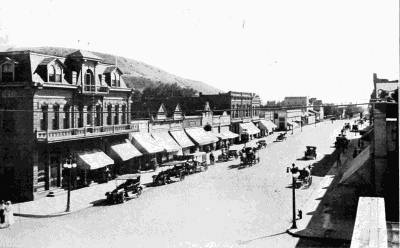
SCENE ON MAIN STREET, DAYTON
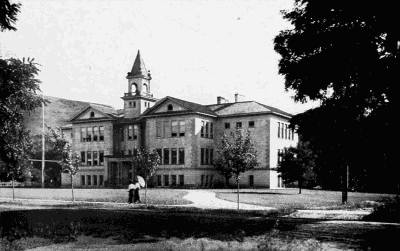
CENTRAL SCHOOL, DAYTON
In 1882 the principalship was conferred upon a teacher destined to become a prominent educator, Prof. J. H. Morgan, subsequently superintendent of public instruction for the state, and for many years afterwards connected with the Normal School at Ellensburg.
For the sake of topical clearness we will take a long step in time and present here the essential features in the report of the superintendent of schools for the county, and that for the superintendent of the Dayton schools for 1917.
We learn from the report of County Superintendent W. W. Hendron for 1916-17 the following:
Total number of districts in Columbia County 43
Number of teachers 83
Number of pupils enrolled 1,721
Value of school property $146,500
In this estimation of value of school property, the Pietrzycki bequest, spoken of later in connection with the Dayton schools, is not included. It may be observed that while there has been a large gain since 1882, there has been relatively a slow increase compared with the industrial and commercial parts of the state. This region has had the phenomenon usual in purely agricultural sections, the absorption of many of the lesser grain farmers by the greater. It is very observable, however, that the schools have made very great gains in organization and equipment.
The present faculty of the Dayton school system is as follows:
C. A. Livengood, superintendent.
S. F. Atwood, principal of high school and instructor in chemistry and algebra.
C. G. Greenslade, instructor in algebra and United States history.
Fred Irvine, instructor in general science and physics.
Laura Wheat, instructor in English and botany.
Jeannette Twyman, instructor in English history, geometry and English.
Jane Olive Jones, instructor in Latin and German.
Waite Matzger, instructor in manual training.
Martha Lyons, instructor in domestic science.
The grade teachers are as follows, in order from the eighth grade to the first, there being subdivisions of each:
W. W. Hendron, principal.
May Meade, Bernice Osborn, Katherine Sharp, Cora Gollihur, Alice Gentry, Cora Gerkon, May Foreman, Nona Richardson, Winnifred Jellum, Anna M. Earhart, Helen Fogg, Pansy Gregg, Olive Peck, Mary George, Elsie Gough, C. Blanchard Smith, music.
From Superintendent Livengood we learn that the value of the Central Building, in which the high school and higher grade students meet, together with the three primary buildings, is assessed, with grounds and equipment, at $76,673. There is, however, a much larger property in possession of the district, and that is found in the properties bequeathed by Dr. Marcel Pietrzycki. This property, consisting of the home in Dayton, with outlying buildings, now employed by the district for school purposes, together with endowment funds, is reckoned at $110,000.
The history of the Pietrzycki bequest to Dayton makes up the most interesting and unique chapter in the history of the town.
Doctor Pietrzycki was born of Polish parents on April 25, 1843, in Galicia, Austria. He established himself in medical practice in Dayton in 1880. He became a successful practitioner, but his mind turned in many directions outside of his profession. Through fortunate land investments in the region between Dayton and Starbuck, he finally acquired an estate, which he called the Lubla Ranch, containing 5,500 acres. He also became president and manager of the Lubla Cattle Company, which owned about 3,500 acres adjoining the ranch. In caring for the products of his ranches the doctor also became owner of the Lubla mills and warehouses at Starbuck.
Doctor Pietrzycki was a man of profound thought along political and sociological lines, and possessed also of a philanthropic nature. He decided to turn his great ranch property into a colonizing enterprise along co-operative lines. His plans were a curious composition of socialistic and feudalistic features. Brought up in Austria with its feudalistic society, he had, nevertheless, by his experiences in America and by his own mental development, become very liberal in his views. He built a veritable castle on the Lubla Ranch, containing twenty-six rooms, doubtless the most expensive farm dwelling in the state. He was endeavoring to execute his plans of bringing colonists from Austria when failing health, together with obstacles in the way of his first plan, induced him to make a change in the disposition of the property. Doctor and Mrs. Pietrzycki—who was a daughter of Rev. J. H. Warren of California, one of the great pioneer church builders of that state, and a woman of great culture and noble character—had been bereaved in the loss of their children and felt that their property might well go to benefactions which would reach the children of the region where their most active years had been spent. Accordingly, after making ample provision for his wife, the doctor left half of his ranch as a legacy to Dayton District for the purpose of maintaining an industrial department in the schools. Upon the death of Mrs. Pietrzycki the home property in Dayton went also for the use of the district, and part of the school units meet there.
Doctor Pietrzycki died in 1910. In the message of Mayor J. A. Muirhead on January 3, 1911, we find the following reference to the bequest:
* * * "Pietrzycki Park, donated to the city by our late esteemed townsman, Dr. Marcel Pietrzycki, and the no less magnificent bequest in his last will and testament, by which the City of Dayton is named as the beneficiary of the greater part of his estate to be used for the establishment of an industrial school in our midst. It is estimated that the amount which will be available for this purpose when the estate is settled up and all bequests paid, will exceed $100,000."
By the terms of the will the judge of the superior court, the mayor of the city, and the clerk of the school board were to be the trustees. But as the doctor, among his other peculiarities, insisted on drawing his will and other papers, without any lawyer's assistance, it was found that the language was such as to compel personal names instead of ex officio appointments, and as a result, Judge C. F. Miller, Dr. C. H. Day and Attorney E. W. Clark became permanent trustees for the management of this unique and valuable bequest.
The practical measures for full realization of the Pietrzycki Foundation are as yet largely tentative, but the fund is in process of application, and within a few years Dayton will have, without question, one of the best equipped industrial schools in the country.
CHURCHES OF COLUMBIA COUNTY
The history of the early churches of the Touchet country is similar to that of Walla Walla. The preachers of that early day had to do pretty much everything of secular as well as spiritual nature. Like other pioneers, those preachers were wholesouled, hearty, often robustious, and representative of the Church Militant and Triumphant as well as the Church Spiritual. They were usually men of eloquence and power, stronger on revivals and "hell-fire" than most of the pastors of this cooler and more scientific age, but playing a noble part in the foundation building of early days.
The Methodists seem to have been the pioneers on the Touchet, and of them Presiding Elder W. Calloway was the first to hold regular services. That was in 1866, and the meetings were held in the schoolhouse on the Touchet. The first regularly organized church dates its beginning on March 20, 1875. Among the pastors of that early church was Rev. S. G. Havermale, who became one of the early settlers in Spokane, filing a homestead claim on the Island, new in the heart of that city, a claim of enormous value, but the profits of which inured more to others than to the pioneer preacher.
The old camp-meetings at Shiloh, just above Huntsville, witnessed many a scene in those days, religious and otherwise.
There was a famous camp ground also on Mill Creek, about six miles above Walla Walla, in the Dudley grove. One of the preachers and authors of national reputation, L. A. Banks, now of Boston, author of that charming book, "An Oregon Boyhood," and other books of wide celebrity, started his career at those old camp grounds of Shiloh and Walla Walla.
One of the some group, who started as a "boy-preacher" in the early '70s was G. W. Kennedy. In recent years he has written a very interesting book called "The Pioneer Campfire." From it we make these extracts, not all of which belong to the Touchet, but to the wider area:
"The Oregon country had no better people than had settled about Rock Creek and the Molalla. I love to remember the annual meeting with these. There were the Boyntons, Morelands, Sanders, Owens, McGowans, Mores, Dimmicks, and others, whose religious zeal was of the pioneer type.
"'Father' Jesse Moreland was a leader, had a deep spiritual life, and often preached an able sermon from the pulpit.
"Those hard-working, intelligent, gospel-inspired, soul-loving preachers and pastors of those early days did a work with which no part of Christian evangelism can show a brighter record, if indeed a parallel. No wonder the people revere those Christian heroes, who laid the foundations in godliness for a stalwart commonwealth.
PASTORAL WORK
"I will speak of a characteristic case of pastoral visiting. It was given me by a man, who at one time was a wild cowboy on our borders; afterwards was converted, and became an 'evangelist.' This is the way he told it:
"'God in His goodness sent a little preacher down to that country. One day we saw a man come riding across the prairie, singing:
"'Jesus, lover of my soul, Let me to thy bosom fly.'
"He came to the ranch, got down and said: 'Boys, I want you to put my pony up and feed him. I am a Methodist circuit rider, and have come out here to stay with you.' We had not asked him, and he did not wait for an invitation. I looked at him and loved him, but I was afraid to get close to him. My heart would not beat right. I was afraid to ride his horse to water for fear it would fall down and kill me. Brother, his horse was religious. His saddle bags would put you under conviction. When we sat down to eat and went to help ourselves as usual, he said, 'Wait, men, I am going to ask a blessing.' Everything was as still as death, and he turned loose, and at once my mind went back to my boyhood, when I had heard the old father ask a blessing in the mountain home. The boys began to eat, and before they were through he said: 'Now, men, don't leave here until we have prayers. After supper we want to have prayers.' I was afraid to go. After supper he took his Bible, and sat down and read a chapter with a good deal of about hell in it. He read as long as he wanted to. He was boss of the devil. He got down on his knees and prayed just as loud as a man could, and just as long as he wanted to pray. He shook us over the very pit. I saw billows of hell. My heart went awful fast, then it would seem to stop dead; it seemed like I was going to die. He told God about everything we had ever done—all the stealing, lying, fighting and cursing. He had the thing in hand. He never consulted us as to how long or how loud he should pray. He did it up exactly right. When prayers were over we were just barely able to walk out, but we got out as quickly as possible. The next morning the preacher asked the blessing again, and said, 'Don't you boys go out until we have had prayers, then I will have to leave you (he talked as though it would nearly break our hearts), but I will be back in about a month.' After breakfast he prayed until it nearly broke our hearts, then he got on his pony and rode away. About a month rolled around, and we got sort of anxious to see the man again. As mean as we were, when we saw a fellow that was straight, we respected him, and we just knew he was. He came again and acted about as he had the other time, but some of us didn't do just as we did before. When he was through the evening prayer, I went out with the boys; told them that prayer had been down on my nerves for a month, I couldn't bear it any longer, that I would quit then and there the blasphemous life I was living. Then went into the bushes and told it all to God. I tell you, before the next day dawned, I was a changed man.' Many a faithful pastor found the stars for his crown, out there among the roughest of men.
PERSONAL CONTACT
"In 1870-71 I was teaching school in Walla Walla. The Methodist Church held its quarterly conference. Rev. H. K. Hines was presiding elder, and Rev. H. C. Jenkins, preacher in charge. They called me into the council and said: 'Brother Kennedy, we think you ought to preach the gospel. Will you accept license and go to work?' Of course I had done the thinking about it before. I replied immediately: 'Yes, if you will bear the responsibility, and stand for the damages that may follow.'
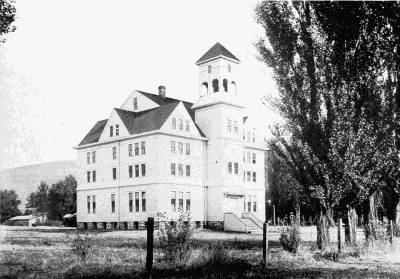
PUBLIC SCHOOL BUILDING, HUNTSVILLE
"Soon after that a protracted meeting began in the old mission church at that place. The pastor told me, one evening, at the close of the meeting, that I must preach the next night. 'No, you must excuse me, Brother Jenkins, I have never preached a sermon in my life, your meeting is growing, and now needs the best preaching.' 'I am older in the work than you are,' he replied, 'and know the meeting better, and I know the expectations of the church in you; you must preach.' That settled the matter. I went home to think and pray and study.
FIRST SERMON
"Before breakfast next morning, the Lord had given the text, Rom. 1-16. 'For I am not ashamed of the gospel of Christ. It is the power of God, unto salvation, to every one that believeth.' Into the grove I went, with my Bible, formed my outlines, and went at the preparation in dead earnest. On my knees with the Bible, before God, I had the struggle of my life. Every temptation came before me. 'What if this was not God's plan?' 'What if I should miserably fail?' 'What if the meeting should fail on my hands?' No one but the young preacher approaching the pulpit for the first time can feel such a burden.
"Father and mother were with me, and we had to walk a mile to church that night. I had told them what was on my mind. We got in late. The church was crowded. Scarce standing room in the aisles. I crowded through, walked onto the platform and went down on my knees behind the pulpit. I had promised the Lord all day that if he would give me liberty and help me to preach that sermon, I would always after preach his word. In a moment, kneeling there, that cloud of burden was lifted, and I had the victory. O, how the Holy Spirit did take that poor sermon of mine, and put His inspiration into it, and His power under it, and make it a power of God, to souls that night! The little that I had put into it was so augmented by the divine. I seemed like a Gideon, shorn of his army, yet working out a great victory. There was victory in my soul and my purpose, and victory in all that meeting that night.
CAMP MEETING
"Our camp meeting that summer (1871) came in June, and was held at the old grounds on Mill Creek, five miles above Walla Walla. There was a very large attendance of people. The old veterans of the pulpit were there, and we 'raw recruits' joined them, making the pulpit force very large. Quite a number of the young men had been put into the work that year. There I heard Dr. L. A. Banks preach his first sermon. There wasn't in him then the prophecy of his remarkable career.
"That meeting was a triumph. Commensurate with the beginning of the meeting was the awakening of souls; and that awakening grew to the most intense inquiry. The altar was filled with 'seekers' night after night. All plan for regular hours for closing was given up, under the press of 'inquiring souls.' On Sunday night quite a number were forward for prayer. There was a tardiness about getting into the life giving light. Late, the benediction was pronounced, and most of the people retired. Most of those seeking souls remained in prayer, determined to get the victory. Some of us remained to pray and exhort and sign. And the meeting went on. One after another 'came through.' Shouts were heard, and the songs went on, and the meeting continued until every one of those struggling ones was brought out into the 'light and liberty of the children of God.' Such shouting of triumph I had never before seen the equal. The sun rose over a new day, and still that meeting didn't close, for we went on singing the triumph of new born souls among the camps of the people.
ANOTHER
"Another camp meeting was held the same year, on the Touchet River, four miles beyond Waitsburg. An equally large attendance there. Rev. A. J. Joslyn and myself went up to help Brother J. H. Adams, preacher in charge. That meeting ran over two Sundays, and when finally it closed, there was not left a single person on the ground that had not become a Christian.
"That year, 1871, in August, our conference was held in Portland, Bishop James presided. I attended, and was admitted as a 'licentiate.' In my class there were John N. Denison, W. T. Chapman, A. J. Joslyn, Ira Ward, J. M. Luark and F. D. Winton. Some of these made noble records in after years.
"I continued teaching in Walla Walla until the next conference. Summer of 1872 I taught the school called the 'Old Mission District'—Whitman Mission—called then Waiilatpu. As a missionary to the Cayuse Indians, Doctor Whitman settled there, in 1836, and continued until the awful massacre of November 29, 1847. That awful afternoon the doctor, his wife and eleven others fell under the murderous tomahawk, thus baptizing the soil of Oregon with their blood, to the cause of Gospel truth. When I stood first on that sacred spot, where yet is the coal and ashes of their burnt mission, and looked just beyond the road, the mound heaped over the thirteen fallen heroes, what memories—what reflections—what communion of soul, bore me away to those scenes of missionary devotion to save a heathen race, and to sacred fellowship with that martyr company! I seemed still treading in the footsteps of the noble Whitman, and to hear still his voice, 'turn ye, turn ye, for why will ye die, O, wandering people.' If it is ever your privilege, go and stand by that monument, now marking the spot. There is something about a monument peculiar to itself. It sanctifies the place. With Moses at the 'Burning Bush' you feel the impulse to remove your sandals, 'for the place whereon you tread is holy ground.' Monumental inscriptions are history in epitome. Here are recorded the deeds of the heroic; great men, great places, and times.
"Our conference was held in Salem that year, where Bishop Foster appointed me to the Yakima circuit, in Washington.
INDIAN POPULATION
"Of course, the whole country there originally belonged to the Indians, and they were always a menace to settlement. On the Simcoe Reservation there were about 3,000 Indians. Then came the Yakima Valley proper; then across on the Columbia at Priest Rapids, there was the Smoholla band of about five hundred. Then Chief Moses and his band were just a little beyond, on the Wenatchee.
"During all the early settlement, there was constant alarm. The spring of '73 the Modoc war came on. The Indians all over the interior were uneasy and many of them took the 'warpath.'
"At the culmination of the battle at the lava beds those treacherous Modocs proposed a treaty, and General Canby, Doctor Thomas, Agent Dyer, and Superintendent Meacham went out to treat with the Indians. But Captain Jack and those four others came with concealed weapons, and at a signal struck down and murdered the peace commission. This inflamed the whole Indian population of the Northwest. At this time I must go to the upper valley and meet my appointments, forty miles away, and through the Indian range, without a single settler. Dodging through as best I could, I found the people badly scared and ready to fort up. Old Chief Smoholla and his band of 200 had come over from Priest Rapids and were camped within the valley.
INTO THE HOSTILE CAMP
"All the people came out on Sunday. Monday came; something must be done to relieve the terrible strain. Accordingly, four of us saddled our horses and started for Smoholla's camp. We went unarmed, thinking it safer to meet them on square footing of friendship. We took them completely by surprise. We asked to see the chief. The Indians spoke in the jargon tongue, and told us to tie our horses and wait the appointment of Chief Smoholla. We took a position on a hill in the middle of their camp, and had a full view. Not long after we saw all the Indian men going down to the council tent. Then they sent out an escort for us.
"As we entered the door of that long wigwam, nearly every warrior was present, ranged on both sides, the chief at the rear end. He looked like a king. Stolid as a statue. He was the war leader of the Columbias. We thought of the treachery of the Modocs, but we could not back out now. On we went until just before the chief. He motioned us to stand there; then asked the reason for our coming. I spoke to him in jargon and explained the purpose of our meeting. Then said we wanted first to preach a sermon to him and his people from the 'white man's book of heaven.'
"That seemed to relieve all apprehension on his part and such a stillness I never saw in any audience before. For the space of half an hour not a muscle moved; not an eyelid quivered. Rigid attention.
"I then told them that our people had become alarmed, for they thought so large a band of Indians meant hostility. And that God had made us all brothers and not enemies. So the Great Father wanted us all to live together in peace on earth. Then the old chief spoke: 'If we are all brothers, why has the white man taken our lands from us? Has the white man any rights here in Kittitas that the Indian has any right to respect? The Indian came first.'
"Well, that was an unanswerable speech. But I excused the white man all possible. 'That we could plow and plant where they could not and still let them hunt and fish.' And I promised utmost friendship on the part of the white brothers.
"We gave them our handshake and pronounced benediction of God on them, and Chief Smoholla agreed to accept that as the 'pipe of peace.' We finally got a change of countenance in that stern face; his hearty farewell—'Klose tillacum mika,' and then under those balm and fir trees we most devoutly thanked God for saving us from savage treachery and rode away.
"It was the influence of Father Wilbur's agency over those Yakimas that kept them quiet—for he certainly was a major general in the management of Indians.
FATHER WILBUR ON THE INDIAN AGENCY
"The Indians at once feared and loved him. While at the agency one time he told us the following story: A German brought a wagon load of liquor on to the reservation and began selling to the Indians. Down near the Satas River, twelve miles away from Fort Simcoe, he built his booth—set a tent—fixed a counter and shelves—put his stock in and was dealing out the 'fire water' as independently as if wholly protected by law. Some of the Indians were getting drunk when Father Wilbur discovered it. He sent word to the sheriff of Yakima County to go down there and arrest the intruder. The sheriff (I well knew him) sent word back that he knew that young German too well. That, having a large family on his hands to support he must let out that job to someone else; that he could have it if he desired. Next morning Father Wilbur saddled his riding mule, took a good riding horse with saddle and some ropes tied on behind. Then he called to his aid an Indian with saddle horse. Together they rode in sight of the booth; they dismounted and tied the three horses to trees. Father Wilbur then gave instruction to the Indian to stay by the horses, ropes in hand, and come to his help when called. With no kind of weapon, he approached the place. The proprietor was ready for him—recognizing the agent—and had a double-barrel shotgun loaded and lying across his counter. When Wilbur got within forty feet the German took up the shotgun, saying, 'if you come any farther I will kill you.' Wilbur stopped; stood with a steady eye upon him, spoke not a word. The German began to pour out a volley of oaths, and after he was exhausted with cursing he took up a whiskey bottle, poured some out into a glass and drank it. While engaged in that act, Wilbur moved up several steps. Then the man took up the shotgun again and swore he'd shoot if he came another step. After another rage of oaths, he took up the bottle and was pouring some more liquor. Seeing now his chance Wilbur sprang, like a cat upon a mouse, right upon that demon—threw him backward on the ground, and was over him. But the German was a young and very stout man—he threw his hand back to his belt, grabbed his sheath knife, and made his aim at Wilbur's side. Seeing the move, he brought his foot with such force against the man's arm that the knife flew clear across the booth. Now, the Indian was on hand, and with the ropes they securely tied the man. Brought the horse—lifted him into the saddle, and soon were out on the road; and within two hours they had that 'demon' locked safely in the 'guard house.' Once a day Father Wilbur would go to his cell and take in bread and water. The man would curse. On going in on the third day he called to Wilbur: 'I have acted the fool, Mr. Wilbur, now if you will release me I will go down to my store of 'fire water'—pour out the last drop of it, go home, and live like a man the balance of my life.' 'I'll take you at your word,' said Wilbur. He saddled the horses and the two rode down to the twelve-mile place. True to his word that German poured out all his whiskey, then telling Father Wilbur 'good-bye' turned away to go home to the Spokane country. 'Hold,' said Wilbur, 'you will need money on your journey, here is twenty dollars—go now, and God bless you.'
"About ten years after Father Wilbur was over in the Palouse country on a preaching tour. Held night meeting at a certain place. At the close of the meeting a good looking, strong young man came forward to shake his hand. 'Father Wilbur, I suppose you will not recognize me. I am far from the place where you last saw me, and a very different man; thanks to God and to yourself. I am the man that tried to ruin your Indians with liquor, and you kept me on bread and water for three days. That little experience made me the man I now am. Come back here, I want to introduce you to my wife and children.' He had kept his word, and was now the strongest man in that church.
OUR CONFERENCE
"Convened in July that summer in the City of Walla Walla—first session of Columbia River Conference. Bishop Merrill presided. There were twelve preachers present, and that made the entire membership of the conference. Those twelve men covered the entire field embraced in the great district, called the Inland Empire. The towns were, The Dalles, Walla Walla, La Grande, Baker City, Boise City and the Village of Pendleton. Indeed all of these were but villages. Not one of them was approached by railroad, excepting The Dalles, not one by any other than stage coach or your own conveyance. Laborious travel was unavoidable. My first year in this territory I reached all the settled portions of two counties and rode 3,000 miles on horseback.
DAYTON CIRCUIT
"When I reached Dayton, my appointment, I found the situation about as frontier, in all respects, as the settlements of the Yakima. Dayton was a town of one hundred people. No church within the entire County of Garfield. The homes of the people were cabins and shanties. There I had the most wonderful revival in all my ministry. Brother Koontz helped me. The people came from the whole country 'round. We begun about the 1st of February with a deep snow and cold weather. Religious conditions seemed as cold as the weather. But soon the spiritual stream broke loose, and what a glorious tide of revival—a veritable stream of salvation. Well nigh one hundred were converted, and the whole country was turned from the service of Satan unto God. Dancing ceased, and it was many years before it could again be revived.
"We were able to build a good church in the town that year. This was the coldest winter that I have ever experienced upon this coast. Thermometer went down to 35 degrees below zero, and was near that for a while. I traveled all the time horseback and certainly had good chance to test the cold. One of my appointments was at a schoolhouse called the 'Turkey Pen,' eight miles out from Dayton. I rode out to the neighborhood on Saturday and to Brother Nealy's home. Next morning was bitter cold. We saddled our horses and started to the schoolhouse, which was about two miles away. We were well wrapped, but about half-way over I became unbearably cold. I tried walking a short way, but on arriving and getting into the house, found that both my ears had been frozen stiff. While Brother Nealy built a fire, finding some coal oil, I proceeded to apply it and thaw out. By the time about a dozen people had come in, I could feel the warm blood coursing all through again, and we went on with the meeting. People said I had preached the 'smartest' sermon that day that they had heard. 'Yes, no doubt, I am the smartest preacher you have listened to lately, physically—give the cold weather the credit.' We all consented.
"After dinner I got into the saddle again, and rode five miles right up that mountain, in face of the storm, to meet another appointment on head of the Patit. No one came out, and after various efforts to build a fire, being too cold to accomplish it—I got on my horse and rode him a mile away to the nearest house. When I dismounted I had to be helped into the house.
"I remained with that kind family until the weather moderated. My presiding elder, Rev. S. G. Havermale, traveled a distance reaching from Pendleton to the Colville, encircling the Spokane and the Clearwater country." This much from Brother Kennedy.
The Cumberland Presbyterian Church of Dayton was organized on September 6, 1874, by Rev. A. W. Sweeney, whose home had been at Walla Walla and then at Waitsburg. He was also a man of much power and connected with all the leading features of church life during that period.
He was succeeded by Revs. R. H. Wills, H. W. Eagan ("Father Eagan," who afterwards lived at Walla Walla and was said to have performed more wedding ceremonies than any preacher in the Inland Empire), and J. C. Van Patten, two of whose sons are noted physicians, one at Dayton and one at Walla Walla, while another son is one of the leading farmers of Columbia County.
The Baptist Church was dedicated on September 22, 1878, Rev. J. B. Bristow being the first pastor. One of the strongest of the early churches of Dayton was the Universalist, organized in 1876 by Rev. A. Morrison. Rev. E. A. McAllister became the pastor the next year and had so strong and enthusiastic a following that his people were able to erect the largest church in town. They could not, however, maintain their lead, and their church, sad to relate, was sold for debt and the congregation disbanded. A Congregational Church was organized and ministered to at intervals by Father Eells, by Rev. E. W. Allen and others, but there was no pastorate of much length till 1890. In that year a notable step occurred in the church life and intellectual life of Dayton, by the coming of Rev. S. B. L. Penrose, one of the "Yale Band," later president of Whitman College at Walla Walla, and one of the leading educators and public speakers of the Northwest. He took up his first pastorate in the Congregational Church at Dayton and remained there from 1890 to 1895, then becoming, after an interval at Honolulu, the president of Whitman College.
A Seventh Day Adventist Church was organized at Dayton in 1877, and three years later a church was built. Their first elder was Ambrose Johnson.
There was also a Presbyterian organization at Dayton during the first decade of its life, but with no building or regular pastor.
At the date of this publication the following churches are in active operation:
The Christian Church, with a membership of 575, Rev. J. Eliott Slimp, pastor; the Congregational, with 140 members, Rev. W. C. Gilmore pastor; Methodist, with 140 members, Rev. A. A. Calendar pastor; Baptist, 90 members, Rev. Lem T. Root, pastor; Episcopal, with 15 members, no settled pastor, but frequently visited by Rev. John Leacher of Pomeroy; United Brethren, 60 members, with Rev. J. H. Wilson as pastor.
DAYTON A CITY OF LODGES
Dayton has been somewhat distinguished as a city of lodges. Their foundation, too, dates to the period of county and city organization. The Odd Fellows secured a charter in February of 1876. On March 8, 1877, Patit Lodge No. 10 was duly organized, the first N. G. being Lee Searcy. The Masons were not much behind in time, for Columbia Lodge No. 26 was organized on October 11, 1877, with J. E. Edmiston as first W. M.
The Ancient Order of United Workmen, the Order of Chosen Friends, the Knights of Pythias, the Good Templars, and the Grand Army of the Republic were all organized during the last years of the '70s or first of the '80s. During the exciting times of the Nez Percé war of 1877 there was a military organization which finally grew into the Columbia Mounted Infantry, and that in turn became the Dayton Grays. This played a somewhat important part in keeping alive a certain interest that made the Dayton country good recruiting ground for the State Guard of Washington, and during the present enrolling year of 1917 very responsive to the national calls.
POLITICAL ANNALS
Resuming the thread of political annals with the election of 1882, the first following the establishment of Garfield County, we find the following tabulation: For delegate to Congress, Thomas Burke, democrat, 673 to 442 for T. H. Brents, republican; for joint councilman from the counties of Walla Walla, Columbia, Garfield and Whitman, J. E. Edmiston, democrat; joint councilman for Columbia and Garfield, N. T. Caton, democrat; representative, Elisha Ping, democrat; joint representative, John Brining, republican; sheriff, J. H. Hosler, democrat; auditor, J. W. Jessee, democrat; probate judge, J. W. Ostrander, democrat; county commissioners, E. Bird, democrat, J. F. Kirby, republican, and E. Crouch, democrat; prosecuting attorney, J. K. Rutherford, democrat; treasurer, F. C. Miller, republican; assessor, Henry Hunter, republican, by a majority of one vote; superintendent of schools, Julia Newkirk, democrat; surveyor, E. D. Miner, republican, without opposition; coroner, Dr. J. Clarke; sheep commissioner, O. E. Mack, democrat.
As will be seen, fourteen of the successful candidates were democrats and five were republicans. The total vote for congressional delegate, which might be considered representative of the general voting population, was 1,115. Thus it will be seen that Columbia County, like Walla Walla, was, during the period before statehood, predominantly democratic, though not by such steady majorities as to be counted on confidently. The gradual transition of those, as of other communities in the state, to prevailing republican dominance, is one of the interesting movements of the times. Various reasons, some good and some poor, may be assigned, varying according to political predilections of the observer. Broadly speaking, the transition was mainly due, in the author's judgment, to that tremendous movement of thought following the civil war, favorable to nationalism, the dominance of nation over state. The strife culminating in the Civil war and reconstruction thoroughly discredited the theory of state sovereignty, and the vast enlargement of Federal power swept into the ranks of nationalists an ever-increasing number of young men. This was more marked in the West than elsewhere, for the reason that state lines and state pride and ties have always been loose and weak in the new land where all sections and nations met on a common footing.
The republican party of the '60s, the party of Lincoln, Seward, Chase and Greeley, was based on a moral issue, that of the inherent wrongfulness of slavery. That of the '70s had rather a political basis, that of national power against local power. The transition again in the period from 1912 to date, whereby the pendulum has swung from republican to democratic leadership, has been based primarily upon economic questions, the conviction having become common that monopoly and privilege had become entrenched behind Federal patronage and that a new order of freedom for the individual must be secured. In the counties under consideration in this volume, as in others in the state and in the West generally, we see the manifestation of these tides of thought and changes of viewpoint. As local studies any one of our counties, Columbia among others, though conservative like most farming sections, furnishes abundant matter for reflection.
The election of 1884 was marked by the short-lived woman suffrage provision. By reason of this the total vote was considerably increased. In Dayton there was a total vote of 1,264, of which women cast 364.
The officials chosen were as follows: Congressman, C. S. Vorhees, democrat, 1,015 to 959 for J. M. Armstrong; joint councilmen, B. B. Day, republican, and C. H. Warner, democrat; representative, A. E. McCall, democrat; joint representative, S. A. Wells, republican; sheriff, J. H. Hosler, democrat; auditor, J. A. Kellogg, republican; county commissioners, J. W. Fields, W. R. Marquis, John Fudge, all republicans; prosecuting attorney, R. F. Sturdevant, republican; probate judge, J. Y. Ostrander, democrat; treasurer, F. C. Miller, republican; assessor, Garrett Romaine, republican; superintendent of schools, R. O. Hawks, republican; surveyor, W. McBride, democrat; coroner, Dr. E. H. Van Patten, democrat; sheep commissioner, H. B. Day, republican. A question of considerable local interest was that frequent one of the building of a courthouse. This proposal carried 986 to 588. Another interesting question before the territory was that of taxing church property. The vote in Columbia County was 802 in favor and 701 against. The proposition, however, did not win in the territory. Twelve republicans and seven democrats were garnered into the official storehouse, as a result of the election of 1884. The tide was turning toward republicanism. In the election of 1886 the republican candidates scored a sweeping success, every county office except that of probate judge being filled by one of that party. The democratic candidate for Congress, however, Charles S. Vorhees, again led the procession with 974 to 940 for C. M. Bradshaw. Wm. Ayers, democrat, was chosen to the council, and George Eckler, a republican, was chosen to the House of Representatives. The local officers were these: Sheriff, W. R. Marquis; auditor, Jay A. Kellogg; county commissioners, John Fudge, J. W. Fields and D. W. Gritman; prosecuting attorney, C. R. Dorr; probate judge, J. H. Gough; treasurer, F. C. Miller; assessor, Garrett Romaine; school superintendent, R. O. Hawks; surveyor, John Patrick; coroner, Dr. E. Bories; sheep commissioner, H. B. Day. There was one rather curious event in that election, leading to a decision by Attorney R. F. Sturdevant, which has some general interest. D. W. Gritman and Alexander Price had an equal number of votes for commissioner, 946. The former was a republican, the latter a democrat. Mr. Sturdevant decided that though the number of votes was equal, Mr. Gritman was entitled to the seat for the reason that the statute provided that no two commissioners should be from the same district and that Mr. Gritman had a majority over the other candidate in his district, while Mr. Price was in a minority in his own district, though having a tie with Mr. Gritman. The decision seems sound and logical. A complication of that sort is avoided by the present law providing for nominations by district, not at large.
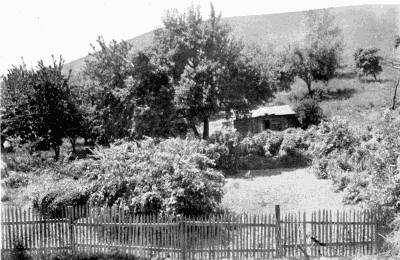
ONE OF THE FIRST HOUSES IN DAYTON
The election of 1888, the last of the territorial days, was in an "off" year, and excited comparatively little contest. There were only 1,351 votes as against 1,914 in the preceding election. The falling off was mainly due to the invalidation of the Woman Suffrage law by Judge Langford, and the consequent elimination of women's votes. The democrats came back in this election, results being as follows: C. S. Voorhees for Congress led John B. Allen by one vote. In the territory, however, the election went the other way, and Mr. Allen took his seat in Congress. M. M. Godman, democrat, was chosen to the council and A. H. Weatherford, of the some party, was chosen representative. The county officers were these: Sheriff, W. R. Marquis, republican; auditor, Jay A. Kellogg, republican; county commissioners, Alexander Price and Daniel Lyons, democrats, and J. C. Lewis, republican; prosecuting attorney, E. H. Fox, democrat; probate judge, J. H. Gough, democrat; assessor, M. R. Hanger, democrat; superintendent of schools, G. S. Livengood, democrat; coroner, Dr. E. H. Van Patten, democrat.
To Columbia County, as to the other counties of the state, the year 1889 was a great date, for it was the date of statehood. The general plan for the election of delegates to the state convention provided for the division of the territory into twenty-five districts, each to have three delegates, of which not more than two could be from any one party. Each party, therefore, nominated two candidates. Those for District No. 9, including all of Columbia County and the precincts of Waitsburg, Coppei, Eureka Flat and Prescott, in Walla Walla County, were: democrats, Lewis Neace and M. M. Godman, and, republicans, E. C. Ross and R. F. Sturdevant. Mr. Ross having the least vote, the others were declared duly chosen.
We have given some space to the "life and works" of the Constitutional Convention of 1889 in a previous chapter, and need say here no more than that Columbia County, in the election which followed in October, 1889, did not accept the Constitution. The vote was 468 for and 730 against. In similar manner Columbia County registered her disapproval of Woman Suffrage by 816 to 422, and of Prohibition by 745 to 484. The result on these three important questions was similar in most of the Inland section, and with reference to Prohibition and Woman Suffrage, it was similar over the state.
The Constitution, however, was sustained by a good vote in the territory, and the state government became duly inaugurated.
The officers chosen in Columbia County in that first election under statehood were these: Congressman, John L. Wilson, republican, and for governor, Elisha P. Ferry, republican, both by very slight majorities, twenty-four in the first case and eighteen in the second; the other state officers having practically the same vote, all republican except J. H. Morgan, democrat, for superintendent of public instruction, chosen by ten over the republican candidate; judge of Superior Court, R. F. Sturdevant, republican; state senator, H. H. Wolfe, republican; representatives, H. B. Day, republican, and A. H. Weatherford, democrat; county clerk, U. Z. Ellis, democrat; other local officers were not chosen in that election, as it was an "extra" coming in with statehood.
The number of votes in that election was 1,314. Though the republicans were in the majority in almost all cases, it was by very scanty majorities, and it was plain that the good old democratic region of the Touchet was not yet entirely given over to republicanism. The precarious hold of that political faith was revealed in the election of 1890, for in that year the tide turned again and the republicans were left high and dry on the flats of Salt River, only two, John Woods for superintendent of schools, and J. C. Lewis for commissioner, being able to navigate their political barks into the desired haven. The total vote was 1,338, being an increase over the preceding year of only twenty-four. The results of the choice were as follows: Congressman, Thomas Carroll; representative to State Legislature, M. M. Godman; county attorney, J. E. Edmiston; clerk, U. Z. Ellis; auditor, J. H. Gough; sheriff, J. A. Thronson; treasurer, W. E. Ayers; commissioner, first district, I. N. E. Rayburn; commissioner, second district, J. C. Lewis; commissioner, third district, Daniel Lyons; school superintendent, John Woods, by two votes; assessor, W. J. Honeycutt; surveyor, Wilson McBride; coroner, Dr. E. H. Van Patten.
ELECTION OF 1892
The leading point of interest in connection with the election of 1892 was that it was the first in which the people of Washington participated in the choice of a President. Moreover it was a very strenuous campaign, and as we view it now it marked peculiarly the turning point in political thought toward the new set of issues, questions of labor and capital, money systems, railroad control and other economic problems, beginning to supplant the issues of the war and reconstruction. In that election the populists and prohibitionists appeared both in our new State of Washington and in the country at large. In Columbia County, as elsewhere, there was much scratching. The democrats carried the bulk of the county offices in this election, the republicans securing only the auditor, attorney and one commissioner. In this election, as is apt to be the case in periods of readjustment, the party in power suffered most.
On the vote for presidential electors the result was as follows: Cleveland, 674; Harrison, 618; Weaver, 188; Bidwell, 95.
At that time two congressmen were elected at large, and hence each of the four parties made two nominations.
The result was that Thomas Carroll and J. A. Mundy, democrats, received 656 and 635, respectively, to 592 and 591 for W. H. Doolittle and J. L. Wilson, republican candidates. H. J. Snively, democratic candidate for governor, had 647 to 571 for J. H. McGraw, republican, but the latter was successful in the state. On the Legislative ticket J. A. Kellogg and U. Z. Ellis for senator had a tie with 597 each, while Ernest Hopkins, populist, had 231.
For representative, S. W. Hamill, democrat, was chosen. R. F. Sturdevant, republican, and J. E. Edmiston, democrat, seem to have been almost constantly pitted against each other, and at this time the latter won the superior judgeship over the former. The county officers chosen were as follows: Sheriff, A. H. Weatherford; auditor, A. P. Cahill; clerk, Garl Taylor; treasurer, W. A. Newman; commissioners, I. N. E. Rayburn and R. H. McHargue, democrats, and L. M. Vannice, republican; assessor, W. J. Honeycutt; attorney, W. H. Fouts. republican; superintendent of schools, Charles H. Terpening; surveyor, T. B. Hicks; coroner, Dr. E. H. Van Patten.
Although there was a tie in Columbia County on vote for senator, and although the democratic candidate for superior judge received a majority, yet in both cases the republican had a majority in the district, composed of Columbia, Garfield and Asotin, and therefore Mr. Kellogg and Mr. Sturdevant occupied those places respectively.
The election of 1894, coming in the very midst of the hardest of the "hard times"—floods, strikes, Coxey armies, bank failures, "30-cent wheat," and general turmoil—was reflected in the great gain in the populistic ranks. This was largely a revolt of democrats against the Cleveland administration, very much as the election of 1892 was a revolt against the extreme tariff and other alleged "monopoly" tendencies of the Harrison administration.
The result was the triumph of the republican candidates, in the triangular conflict. Every position showed a republican triumph. W. H. Doolittle and S. C. Hyde received 677 and 671 votes respectively, while B. F. Heuston and N. T. Caton, democrats, had to be content with 420 and 417, outrun by the populists, W. P. C. Adams and J. C. Van Patten, with 426 and 446. Cornelius Lyman was chosen representative with 668 to 510 for M. M. Godman. The county officials were: Sheriff, Conrad Knobloch; auditor, A. P. Cahill; treasurer, J. H. Fudge; clerk, J. L. Mohundro; attorney, W. H. Fouts; assessor, R. F. Matkin; superintendent of schools, H. B. Ridgeley; coroner, Dr. G. M. Burns; commissioners, C. M. Grupe and Granville Hewitt.
The election of 1896 was characterized by a sweeping reversal of its predecessor. That was the year of the "Peerless Leader" with his "Cross of Gold." A new deal was on and the old democracy was slipping to its final doom. A new democracy, under the oriflamme of the People's Party, a real democracy this time, instead of the pseudo-democracy of the southern slave baron and aristocrat, was making its appeal East and West, but especially West, the logical home of genuine democracy. Fusion tickets and fusion conventions of democrats, silver republicans, and populists, "three-ring circuses" as they were styled by stand-patters, marked that great political campaign of 1896. In Columbia County the triune ticket agreed on by three conventions meeting simultaneously on September 10th apportioned nominations, so that representative, auditor, sheriff and superintendent of schools were of the populists; attorney, assessor, clerk, surveyor, coroner and county commissioners went to the democrats; the silver republicans were cut rather short with the solitary assignment of treasurer.
The combination adopted the usual designation of People's Party. In the election the republicans saved from the general wreck only the clerk and sheriff, by scanty majorities. The total vote was 1,623, somewhat in excess of any cast in the county up to that date.
The vote was as follows: The Bryan electors 847, the McKinley electors, 776; James Hamilton Lewis and W. C. Jones for Congress and John R. Rogers for governor; joint senator, J. C. Van Patten; representative, George Windust; judge Superior Court, M. M. Godman; sheriff, Conrad Knobloch; clerk, J. L. Mohundro; auditor, Dick Harper; treasurer, G. A. Parker; attorney, E. W. Clark; assessor, G. W. Page; superintendent of schools, Mrs. Ella Terpening; surveyor, Ira Trescott; coroner, E. H. Van Patten; commissioners, J. H. McCauley and J. C. Marckley.
The election of 1898 witnessed the same alignment, republicans against the "fusion" of populists, democrats and silver republicans.
The result, however, was another reversal, and all the places were filled by republicans, with the single exception of superintendent of schools. The vote resulted thus: W. L. Jones and F. W. Cushman for Congress; T. A. Anders and Mark A. Fullerton for Supreme Court; representative in Legislature, C. S. Jerard; sheriff, J. D. Smith; clerk, L. L. Ellis; auditor, H. E. Gilham; treasurer, F. W. Guernsey; attorney, W. H. Fouts; assessor, J. F. Porter; superintendent of schools, Mrs. Ella Terpening; surveyor, Ira Trescott; coroner, G. M. Burns; commissioners, Alexander Duffy and Cornelius Lyman.
The election of 1900 made it seem that the "fusion" formation was down and out, for the republicans carried the field by large or good majorities for every candidate. Results thus appear: Electors for McKinley 899 to 712 for those of Bryan; W. L. Jones and F. W. Cushman for Congress; J. M. Frink for governor by 835 to 760 for Governor Rogers; joint state senator, Edward Baumeister; representative, C. S. Jerard; judge Superior Court, C. F. Miller; sheriff, J. D. Smith; clerk, L. L. Ellis; auditor, H. E. Gilham; treasurer, F. W. Guernsey; attorney, R. B. Brown; assessor, J. F. Porter; superintendent of schools, W. W. Hendron; coroner, J. W. McLachlan; commissioners, Cornelius Lyman and Richard Jackson.
In the election of 1902 there was a considerable falling off, over a hundred votes, from that of 1900, and a marked diminution of interest. This was again essentially a republican victory, their adversaries coming through with only the clerk, attorney and treasurer. The official vote follows: W. L. Jones, Francis W. Cushman and W. E. Humphrey for Congress by an average of 808 votes to an average of 609 for the democratic candidates, Cotterill, Holcomb and Cole; representative, Conrad Knobloch, 740 to 732 for the democrat, M. M. Godman; sheriff, O. M. Stine; auditor, E. V. Thompson; clerk, Clark Israel, democrat by 808 to 665 for R. M. Campbell; treasurer, E. W. Alcorn, democrat by 837 to 638 for D. C. Guernsey; attorney, E. W. Clark, democrat, 792 to 681 for R. B. Brown; assessor, Wilbur Hopkins; superintendent of schools, W. W. Hendron; surveyor, John Patrick; coroner, Dr. C. H. Day; commissioners, R. A. Jackson and C. W. Sanders.
With 1904 comes another presidential election, as well as a full state ticket and the intense interest always belonging to such an election. The result of the presidential vote was significant of the state of the public mind, and Columbia County was in this respect an index of the country at large. Roosevelt was forced upon the unwilling managers and bosses of the "G. O. P." by the tremendous sentiment in favor of trust control and other liberal policies by the masses, while Parker was forced upon the unwilling democratic masses by a coterie of reactionary managers in New York. The result showed that the masses would win every time. Parker was snowed under for all time and the already defunct old-time democratic limited management had a rude jolt in its grave clothes, which, strange to record, the republican management of the same type did not heed, and as a logical result they got their jolts in 1912 and 1916. In Columbia, Roosevelt received an overwhelming majority, the electors for him receiving an average of 1,083 to an average of 480 for the Parker electors. Humphrey, W. L. Jones and Cushman received about 250 majority over their democratic opponents. On the other hand, George Turner, democrat, had 886 to 719 for A. E. Mead for governor.
The joint republican candidate for state senator, S. S. Russell, had 880 votes to 727 for Frank Cardwell, democrat. But, reversing again, F. M. Weatherford, democrat, beat W. H. Fouts for the lower house of the State Legislature. The successful county candidates were: Sheriff, F. W. Bauers, democrat; clerk, Clark Israel, democrat; auditor, E. V. Thompson, republican; treasurer, E. W. Alcorn, democrat; attorney, E. W. Clark, democrat; assessor, Wilbur Hopkins, republican; superintendent of schools, C. B. Leatherman, republican; surveyor, Wilson McBride, republican; coroner, Dr. C. H. Day, republican; commissioners, C. W. Sanders and C. E. Shaffer, both republicans.
The election of 1906 resulted thus:
1906
Representatives to Congress— Party Vote
W. E. Humphrey Republican 795
Wesley L. Jones Republican 800
Francis W. Cushman Republican 801
Wm. Blackman Democrat 550
Patrick E. Byrne Democrat 538
Dudley Eshelman Democrat 538
A. Wagenknecht Socialist 30
J. H. Barkley Socialist 29
Emil Herman Socialist 29
A. S. Caton Prohibition 35
J. M. Wilkin Prohibition 35
Wm. Everett Prohibition 36
State senator, Tenth District, covering Asotin, Garfield and Columbia counties.
Stevenson, Senator; Godman was Representative.
State Rep., Eleventh Dist.—John R. Stevenson Republican Successful candidate
M. M. Godman Democrat Successful candidate
Sheriff—F. W. Bauers Democrat Successful candidate
County Clerk—Alvin Harms Democrat Successful candidate
Auditor—Walter A. Frary Republican Successful candidate
Treasurer—Thos. E. Gentry Republican Successful candidate
Attorney—R. M. Sturdevant Republican (No opposition)
Assessor—W. S. Hunt Republican Successful candidate
School Superintendent—Nellie V. Gregg Democrat Successful candidate
Surveyor—F. W. Guernsey Republican Successful candidate
Coroner—Dr. John Huntington Republican Successful candidate
County Commissioner Second District—Chas. Shaffer Republican Successful candidate
County Commissioner Third District—C. J. Thronson Democrat Successful candidate
No record of election of 1908.
Though there is no official record, the county proceedings indicate the following choices:
State Senator, Tenth District (joint)—John R. Stevenson Republican Successful candidate
State Representative, Eleventh District—R. A. Jackson Republican Successful candidate
Sheriff—Ed M. Davis Democrat Successful candidate
Clerk—J. H. Swart Republican Successful candidate
(Mr. Swart resigned July 1, 1910, to accept appointment as county auditor, R. R. Cahill appointed to fill vacancy, Cahill resigned September 1, 1910, account leaving to attend school and W. L. Jackson appointed to fill vacancy. All republicans.)
Auditor—Walter A. Frary Republican Successful candidate
(Mr. Frary resigned July 1, 1910, to accept appointment as postmaster and J. H. Swart appointed to fill vacancy.)
Treasurer—Claude Beckett Republican Successful candidate
Attorney—R. M. Sturdevant Republican (No opposition)
Assessor—A. E. French Democrat Successful candidate
Superintendent of Schools—W. H. Kintner Republican Successful candidate
Coroner—Dr. John Huntington Republican Successful candidate
Engineer—F. W. Guernsey Republican Successful candidate
Commissioner First District—C. B. Bowman Democrat Successful candidate
Commissioner Second District—A. P. Cahill Republican Successful candidate
Commissioner Third District—W. C. Woodward Republican Successful candidate
Superior Judge, Asotin, Garfield and Columbia counties—Chester F. Miller (No Opposition)
1910
Representatives of Congress— Party Votes
Wm. L. LaFollette Republican 820
Harry D. Merritt Democrat 431
David C. Coates Socialist 43
State Representative, Eleventh District—J. A. Fontaine Democrat Successful candidate
Sheriff—Ed M. Davis Democrat Successful candidate
Clerk—J. F. Clancy Democrat Successful candidate
Auditor—J. H. Swart Republican Successful candidate
Treasurer—Claude Beckett Republican Successful candidate
Attorney—R. M. Sturdevant Republican (No opposition)
Assessor—A. E. French Democrat Successful candidate
School Superintendent—Flora Morgan Republican Successful candidate
Engineer—Wilson McBride Democrat Successful candidate
Coroner—B. D. Wiltshire Republican (No opposition)
Commissioner First District—Geo. Spalinger Democrat Successful candidate
Commissioner Second District—C. J. Thronson Democrat Successful candidate
Commissioner Third District—W. C. Woodward Republican Successful candidate
(Owing to county being redistricted thought necessary to elect new commissioners throughout.)
1912
Party Votes
Presidential Electors Republican 672
Presidential Electors Democrat 855
Presidential Electors Socialist 172
Presidential Electors Socialist Labor 2
Presidential Electors Prohibitionist 59
Presidential Electors Progressive 803
Congressmen at Large—
J. E. Frost Republican 818
Henry B. Dewey Republican 836
E. O. Connor Democrat 820
Henry M. White Democrat 826
M. E. Giles Socialist 150
Alfred Wagenknecht Socialist 150
N. A. Thompson Prohibition 49
J. W. Bryan Progressive 611
J. A. Falconer Progressive 619
Congressman Third District—
Wm. L. LaFollette Republican 831
Roscoe M. Drumheller Democrat 999
Robt. Burnes Martin Socialist 136
F. M. Goodwin Progressive 481
Governor—
M. E. Hay Republican 830
Ernest Lister Democrat 986
Anna A. Maley Socialist 148
Abraham L. Brearcliff Socialist Labor 2
Geo. F. Stevers Prohibition 46
Robert T. Hodge Progressive 513
State Senator, Tenth District—J. C. Weatherford Democrat Successful candidate
State Representative, Eleventh District—J.A. Fontaine Democrat Successful candidate
Superior Judge, Asotin, Garfield and Columbia counties—Chester F. Miller (No opposition)
Sheriff—F. W. Bauers Democrat Successful candidate
Clerk—J. F. Clancy Democrat Successful candidate
Auditor—J. H. Swart Republican Successful candidate
Treasurer—James Bradford Democrat Successful candidate
(Mr. Bradford died July 29, 1913, and M. Riggs, democrat, appointed to fill vacancy.)
Attorney—E. W. Clark Democrat Successful candidate
Assessor—Claude Beckett Republican Successful candidate
(Mr. Beckett died July 7, 1914, and Blanch Beckett, his wife, appointed to fill vacancy.)
School Superintendent—Maude L. Tucker Democrat Successful candidate
Engineer—Wilson McBride Democrat Successful candidate
Coroner—Dr. J. M. Miller Democrat Successful candidate
Commissioner Second District—R. H. Prater Republican Successful candidate
Commissioner Third District—J. H. McCauley Democrat Successful candidate
Superior Judge, Asotin, Garfield and Columbia Counties—Chester F. Miller Non-partisan
1914
United States Senator—
Wesley L. Jones Republican 1,126
W. W. Black Democrat 880
Adam H. Barth Socialist 118
Ole Hanson Progressive 223
A. S. Caton Prohibition 122
Representative Third District—
Wm. L. LaFollette Republican 1,229
Roscoe M. Drumheller Democrat 847
John Storland Socialist 112
M. A. Peacock Progressive 234
J. V. Mohr Prohibition 114
State Representative, Eleventh District—John F. Rockhill Republican Successful candidate
Sheriff—W. T. Wooten Republican Successful candidate
Clerk—E. D. Cleveland Democrat Successful candidate
Auditor—J. F. Clancy Democrat Successful candidate
Treasurer—M. Riggs Democrat Successful candidate
Attorney—R. M. Sturdevant Republican Successful candidate
Assessor—Blanch Beckett Republican (No opposition)
School Superintendent—Maude L. Tucker Democrat Successful candidate
Engineer—F. W. Guernsey Republican Successful candidate
Commissioner First District—Geo. Spalinger Democrat Successful candidate
Commissioner Third District—E. L. Lindley Republican Successful candidate
1916
Presidential Electors Republican 1,148
Presidential Electors Democrat 1,164
Presidential Electors Prohibition 25
Presidential Electors Socialist 108
Presidential Electors Socialist Labor 2
United States Senator—
Miles Poindexter Republican 1,269
Geo. Turner Democrat 1,004
Walter J. Thompson Progressive 2
Jos. A. Campbell Prohibition 24
Bruce Rogers Socialist 100
Representative, Fourth District—
Wm. LaFollette Republican 1,321
Chas. W. Masterson Democrat 944
Walter Price Socialist 104
Governor—
Henry McBride Republican 1,082
Ernest Lister Democrat 1,241
Jas. E. Bradford Progressive 3
A. B. L. Gellermann Prohibition 29
L. E. Katterfield Socialist 94
Jas. E. Riodan Socialist Labor 1
State Senator, Tenth District—Elgin V. Kuykendall Republican Successful candidate
State Representative, Eleventh District—Geo. Spalinger Democrat Successful candidate
Sheriff—W. T. Wooten Republican Successful candidate
Clerk—E. D. Cleveland Democrat Successful candidate
Auditor—J. F. Clancy Democrat (No opposition)
(Clancy resigned June 4, 1917, account condition wife's health, and Dick Harper, democrat, appointed to fill vacancy.)
Treasurer—M. Riggs Democrat Successful candidate
Attorney—R. M. Sturdevant Republican (No opposition)
Assessor—Blanch Beckett Republican (No opposition)
Superintendent of Schools—W. W. Hendron Republican Successful candidate
Engineer—Wilson McBride Democrat Successful candidate
Coroner—Dr. J. M. Miller Democrat Successful candidate
Commissioner First District—John R. Blize Republican Successful candidate
Commissioner Second District—R. H. Prater Republican Successful candidate
(Mr. Prater resigned January 24, 1917, for business reasons and C. F. Actor, republican, appointed to fill vacancy.) Superior Judge, Asotin, Garfield and Columbia counties—Chester F. Miller, Non-partisan (no opposition).
(We wish to acknowledge here the valuable assistance of Mr. J. F. Clancy of the auditor's office in compiling these records of election returns.)
MUNICIPAL POLITICS
Turning from the political history of the county to that of the towns, we will give our attention first to Dayton.
Of the founding and of the earliest days of the metropolis of the Touchet we have spoken already. We have also spoken of the schools and churches. It remains to take note of the municipal history and organization and of the journalism of the town. A petition from the citizens looking to incorporation is worthy of preservation, by reason of the fact that it was the first step in that direction, and still more from the fact that it contains what might be regarded as practically an authorized record of the business men of the town of that time. It is dated May 5, 1876, and is addressed to the county commissioners. We are indebted to the "History of Southeastern Washington" for this excerpt:
To the Honorables, the County Commissioners of the County of Columbia, in the Territory of Washington:
We, your petitioners, do most respectfully represent that we are citizens of the Town of Dayton in said county and are qualified electors under the laws of this territory; that we have resided in said town for thirty days and upwards next preceding the date of this petition; that we are desirous that said town should be incorporated, and a police established for our local government; that the territory we wish incorporated is bounded and described as follows, to-wit: The east half of the northwest quarter, and northeast quarter of section 30, and the east half of southeast quarter of section 30, and west half of southwest quarter, and southeast quarter of the southwest quarter of section 29, all in township 10, north, range 39 east; also north half of northeast quarter of southwest quarter and north half of northwest quarter of southeast quarter of section 30, town 10 north, range 39 east, in the County of Columbia and Territory of Washington, a plat of which is hereunto annexed and made a part of this petition. And your petitioners do further represent that said town contains over one hundred and fifty inhabitants and we do most respectfully pray that you incorporate said town. Dated April 27, 1876.
John Mustard, A. L. McCauley, A. Vallen, R. F. Sturdevant, Mc. C. Lyon, J. S. Thomas, R. T. Watrous, F. Maynard, D. C. Guernsey, A. J. Cain, W. O. Matzger, O. C. White, M. Riggs, E. Tatro, F. G. Frary, A. M. Sparks, I. G. Abbott, L. L. Davis, W. W. Day, J. W. Maddox, James Gough, J. M. Hunt, J. M. Sparks, B. Magill, J. N. Day, G. A. Opperman, A. J. Dexter, Wiley Sparks, Salmon Park, G. L. Kirk, C. Hansen, J. H. Lister, P. Stedman, H. S. Critchfield, Thomas T. Elliott, A. Jacobs, J. M. Grinstead, J. H. Kennedy, J. L. Smith, William Hendershott, S. M. Wait, W. S. Newland, George W. Giles, W. A. Belcher, J. Kerby, D. S. Richardson, D. F. Spangler, C. W. Frick, H. P. Keach, W. A. Moody, Thomas Smith, L. E. Harris, R. A. Rowley, R. H. Condon, J. B. Armstrong, W. A. Sparks, C. A. Clark, William E. Coney, Con. Ruttlemiller, L. Ritter, J. H. Kennedy, Edward Owens.
The commissioners granted this request and in pursuance of the territorial law empowering commissions to grant incorporation, they appointed May 22d the date for electing trustees. Apparently the record of the results of that election is not available, but the trustees chosen a year later were J. F. Martin, Perry Steen, George Eckler, William Metzger and W. S. Strong. The assessor reported the population of the town at that time as 526.
In 1877 a sentiment developed that the existing form of incorporation was undesirable, and as the result of a petition by the citizens the trustees appointed an election for July 1, 1878, upon the question of the abandonment of that charter. The decision of the citizens at that election was to abandon the organization and to substitute another. In pursuance of that decision an election for mayor, common council of seven, and a marshal, was held on July 16th. D. C. Guernsey was elected mayor, and the councilmen chosen were J. B. Shrum, G. K. Reed, J. Mustard, J. L. Smith, J. K. Rainwater, Frank Pierce and D. B. Kimball. Edward Tatro was chosen marshal.
One of the interesting points called up by old-timers in that stage of Dayton's history is the development of what is now known as "Brooklyn" or first styled "Across the Patit." Between September, 1878, and March, 1879, fifteen houses were erected. F. M. Day is said to have been the first to build in that new tract, followed soon by Mr. Dunkle and Mr. Brewer. That was for a number of years one of the most popular suburbs of Dayton. Somewhat separated from the business part of the town by the pretty little stream of the Patit, and embowered in trees and shrubbery, it still impresses the visitor as a very charming village section. Dayton Heights in the eastern part of the town has, however, taken the lead as a growing residence section during the past dozen years.
A curious situation in regard to the town government developed. As a result of doubt about the validity of the existing municipal government, Jesse N. Day, the father of the city, refused to pay taxes levied by the county in 1878. County treasurer, H. H. Wolfe, instituted legal proceeding by levying upon property owned by Mr. Day. The latter accordingly brought suit, with David Higgins as his attorney, to secure restitution of his property. N. T. Caton of Walla Walla appeared as counsel for the county. This suit was called January 14, 1880. The result was a decision by Judge Samuel C. Wingard of Walla Walla, judge of the Territorial District Court, that the incorporation of the city was invalid.
The effect of this decision was to necessitate a new incorporation. By common agreement Judge Wingard was requested to give informal advice upon the legal status of the community and the steps that should be taken to give it a proper judicial character. Thus appealed to the judge gave the opinion that Dayton had been organized as a town and was still upon that footing, and that the town might incorporate as a city under territorial laws. Accordingly the old town government resumed and continued until the issuance of a new charter by the Territorial Legislature in 1881, which went into effect with the opening of the next year.
Under the new charter the Government was to consist of mayor chosen yearly; seven councilmen, chosen for two years, three elected in one year and four the next; a marshal chosen by popular vote; and justice, clerk, attorney, treasurer, health officer, surveyor, street commissioner and assessor, appointed by Council. The charter named as mayor and councilmen the following: Mayor, O. C. White; councilmen, G. E. Church, L. E. Harris, J. L. Smith, John Brining, J. E. Edmiston and W. A. Belcher.
The period of inauguration of the new charter was marked by three disasters, a severe fire on December 13, 1880, and another much more serious, on April 2, 1882, by the latter of which a loss of $90,000, partially covered by insurance, was sustained. The other disaster was much greater, and is still referred to with almost bated breath by old-timers. This was the dreadful smallpox scourge in the fall of 1881. It was reported that there were 167 cases and twenty-one deaths. The excitement was great, nearly reaching the proportions of a panic, and as is apt to be the case at such a time, there were "hard feelings" and charges of criminal negligence. Dr. M. Pietrzycki, one of the best physicians and one of the most unique and interesting characters of the city, was health officer at that time, and the testimony seems to be on all hands that his course was firm and wise and that he saved many homes from the deadly scourge.
Meanwhile the charter question was not settled. A memorial was presented to the Territorial Legislature in 1886, setting forth the imperfections of the existing charter and petitioning for still another. This memorial preserves the names of the mayor and councilmen of that year as follows: Mayor, D. B. Kimball; councilmen, D. C. Guernsey, T. J. Taylor, E. Ping, H. H. Wolfe, D. H. Hardin, H. F. McCornack, D. M. Vaughn.
This memorial was not, however, sustained, and the unsatisfactory charter continued in force for a number of years. At a municipal election of July 11, 1904, by a majority of one only of the whole vote of 404, the city voted to abandon the old charter and to adopt the new form of city government. Under that general charter Dayton has remained to this day. Since that new municipal organization went into effect the incumbents of the different offices have been the following:
The city election of December 6, 1904, resulted in the choice of G. T. Jackson for mayor, W. A. Frary for treasurer, R. M. Sturdevant for clerk, H. E. Hamm for attorney, C. H. Day for health officer, and for councilmen, Add. Cahill, G. E. Barclay, Lars Nilsson, E. S. Ryerson, L. F. Jones, W. L. Jackson, and W. H. Van Lew. The entire number of seven were chosen at that first election, one at large, three for two years, and three for one year. Hence in subsequent years there were regularly chosen three for the different wards and one at large each year.
In the election of December, 1905, the officials chosen were: G. T. Jackson, mayor; W. A. Frary, treasurer; R. M. Sturdevant, clerk; Leon B. Kenworthy, attorney; C. H. Day, health officer; Add. Cahill, L. F. Jones, Everett Eager and W. H. Van Lew, councilmen. In that case, as usually, the practice of re-election was held in honor.
In the election of December 4, 1906, results were these: A. Wilson, mayor; G. W. Jackson, treasurer; E. W. Clark, attorney; Jesse Matzger, clerk; C. F. Schlitz, health officer; Add. Cahill, J. D. Israel, Frank Gemmel, C. W. Powell, J. A. Muirhead, councilmen.
Results in the election of 1907 were these: R. L. Nottingham, mayor; G. W. Jackson, treasurer; R. O. Dyer, clerk; E. W. Clark, attorney; C. F. Schlitz, health officer; G. T. Jackson, J. A. Muirhead, L. M. Vannice, H. A. Kaeppler, councilmen.
On December 8, 1908, there were chosen: H. C. Benbow, mayor; G. W. Jackson, treasurer; R. O. Dyer, clerk; E. W. Clark, attorney; C. H. Day, health officer; John Carr, J. D. Israel, Edgar Eager, F. C. Hindle, councilmen.
Choices in December, 1909, were these: J. A. Muirhead, mayor; G. W. Jackson, treasurer; H. B. Ridgeley, clerk; E. W. Clark, attorney; C. H. Day, health officer; Lars Nilsson, L. M. Vannice, Asa Johnson, J. C. Fair, C. H. Torrance, John Carr, councilmen.
On December 6, 1910, the following were chosen: J. A. Muirhead, mayor; J. G. Israel, treasurer; J. L. Wallace, clerk; E. W. Clark, attorney; J. M. Miller, health officer; E. C. Eagleson, George Brown, Oscar Griffis, R. O. Dyer, E. H. Van Patten, councilmen.
On December 5, 1911, there were chosen: J. C. Fair, mayor; J. G. Israel, treasurer; J. L. Wallace, clerk; E. W. Clark, attorney; J. M. Miller, health officer; Dick Harper, W. G. Thompson, A. Nilsson, C. R. Rogg, councilmen.
In December, 1912, we find the choices as follows: Dick Harper, mayor; J. G. Israel, treasurer; J. L. Wallace, clerk; L. B. Kenworthy, attorney; W. W. Day, health officer; C. E. Shaffer, C. F. Schlitz, George Brown, E. E. Eager, councilmen.
In 1913 the choices were: W. C. Goddard, mayor; J. G. Israel, treasurer; L. B. Kenworthy, attorney; J. L. Wallace, clerk; W. W. Day, health officer; C. E. Shaffer, C. R. Rogg, G. F. Price, J. A. Hanger, councilmen.
The election of December 8, 1914, resulted: W. C. Goddard, mayor; J. G. Israel, treasurer; J. L. Wallace, clerk; H. E. Hamm, attorney; W. W. Day, health officer; A. P. Cahill, Willis Wilson, George Carpenter, W. L. Jackson, councilmen.
In 1915 results were: C. H. Day, mayor; J. G. Israel, treasurer; J. L. Wallace, clerk; H. E. Hamm, attorney; A. P. Cahill, C. R. Rogg, A. J. Knight, G. F. Price, J. A. Hanger, councilmen.
The election of December 5, 1916, was thus: H. E. Barr, mayor; J. G. Israel, treasurer; J. L. Wallace, clerk; H. E. Hamm, attorney; Willis Wilson, Lee Rinehart, George Carpenter, W. L. Jackson, councilmen.