Volume 2 — Of the Streets of London. (continued 7)
Reading edition
The master rubbish-carters generally are more particular than they used to be as to the men to whom they commit the care of their horses. It may be easy enough to learn to drive a horse and cart, but a casual labourer will now hardly get employment in rubbish-carting of a “good sort” unless he has attained that preliminary knowledge. The foreman of one of the principal contractors said to me, “It would never do to let a man learn his business by practising on our horses.” I mention this to show, that although rubbish-carting is to be classed among unskilled labours, some training is necessary.
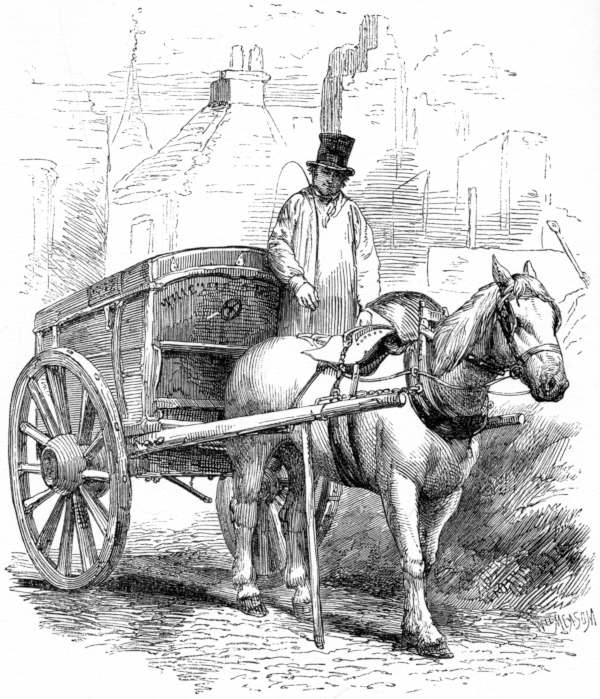
THE RUBBISH CARTER.
[From a Daguerreotype by Beard.]
I am informed that one-third of the working rubbish-carters have been rubbish-carters from their youth, or cart, car, or waggon-drivers, for they all seem to have known changes; or they have been used to the care of horses in the capacity of ostlers, stable-men, helpers, coaching-inn porters, coachmen, grooms, and horse-breakers. Of the remainder, one-half, I am informed, have “had a turn” at such avocations as scavagery, bricklayers’ labouring, dock work, railway excavating, night work, and the many toils to which such men resort in their struggles to obtain bread, whatever may have been their original occupation, which is rarely that of an artizan. The other, and what may be called the greater half of the remaining number, is composed of agricultural labourers who were rubbish-carters in the country, and of the many men who have had the care of horses and vehicles in the provinces, and who have sought the metropolis, depending upon their thews and sinews for a livelihood, as porters, or carmen, or labourers in almost any capacity. The most of these men at the plough, the harrow, the manure-cart, the hay and corn harvests, have been practised carters and horse drivers before they sought the expected gold in the streets of London. Full a third of the whole body of rubbish-carters are Irishmen, who in Ireland were small farmers, or cottiers, or agricultural labourers, or belonged to some of the classes I have described.
The mechanics among rubbish-carters I heard estimated, by men with equal means of information, as one in twenty and one in fifteen. Among these quondam mechanics were more farriers, cart and wheel wrights, than of other classes.
It seems to be regarded as an indispensable thing that working rubbish-carters should have one quality—bodily strength. I am told that one employer, who died a few weeks ago, used to say to any applicant for work, “It’s no use asking for it, if you wish to keep it, unless you can lift a horse up when he’s down.”
As I have shown of the scavagers, &c., the employers in rubbish-carting may be classed as “honourable” and “scurfs.” The men do not use the word “honourable,” nor any equivalent term, but speak of their masters, though with no great distinctiveness, as being either “good,” or “scurfs.” As in other branches of unskilled labour where there are no trade societies or general trade regulations among the operatives, there are few distinctive appellations.
From the facts I have collected in connection with this trade, it would appear that there are 180 master rubbish-carters in the metropolis, about 140 of whom pay 18s. or more per week as wages, while the remaining 40 pay less than that amount. The latter constitute what the men term the scurf portion of the trade; so that the honourable masters among the rubbish-carters may be said to comprise seven-ninths of the whole.
I will first treat of the circumstances, characteristics, and wages of the men employed in the honourable trade.
And first, as regards the division of labour among the operative rubbish-carters, the work is as simple as possible.
There are—
1. The Rubbish-Carters proper, or “carmen,” who are engaged principally in conveying the refuse brick or earth to the several shoots.
2. The Rubbish-Shovellers, or “gangers,” who are engaged principally in filling the cart with the rubbish to be removed. Generally speaking, the two offices are performed by the same individual, who is both carter and shoveller, and it is only in large works that the gangers are employed.
Master builders and others who require the aid of rubbish-carters for the removal of earth or any other kind of rubbish from ground about to be built upon, or from old buildings about to be repaired or pulled down, either hire horses, carts, and carmen, by the day, of the master rubbish-carters, or pay a certain price per load for the removal of the rubbish. If the job be likely to last some length of time, the builders pay the masters so much per load for carting away the rubbish; but if the job be only for a short period, the horses, carts, and carmen are hired of the masters for the time. The price paid to the master rubbish-carter ranges from 2s. 6d. to 3s. 6d. per load for the removal of rubbish and bringing back such bricks, lime, or sand as may be required for the building. The master rubbish-carter, in all cases, pays the men engaged in the removal of the rubbish.
The operative rubbish-carters (except in a very few instances) never work in gangs, either in the construction of new buildings or in old buildings about to be pulled down or repaired. In digging the foundations of new houses, the master builders, or speculators, building upon their own ground employ their own excavators, and engage rubbish-carters to remove the refuse earth, the latter being merely occupied in carting it away.
The principle of simple co-operation or gang-work occasionally prevails; and, when this is the case, the gang is employed in shovelling and picking, while the carman, as the shovellers throw out the rubbish, fills or shovels the rubbish into the cart.
Each rubbish-carter will, on an average, convey away from two to five loads a day, according to the distance he has to take it. Calculating 850 men to remove four loads per diem for five months in a year, the gross quantity of rubbish annually removed would be very nearly 326,000 loads.
In the regular trade the hours of daily labour are twelve, or from six to six; but the men are allowed half an hour for breakfast, an hour for dinner, and half an hour for tea, and almost invariably leave at half-past five, so postponing the “tea” half-hour until after the termination of their work. In winter the hours are generally “between the lights,” but on very short, dark, or foggy days, lanterns are used. The men employed by one firm “often made up,” I was told by one of them, “for lost time, by shovelling by moonlight.” The carman, however, has to get to his stable in the summer at four o’clock in the morning, and to tend his horse after he has done work at night; so that the usual hours of labour with him are fifteen and sixteen per day, as well as Sunday-work.
TABLE SHOWING THE NUMBER OF OPERATIVE RUBBISH-CARTERS EMPLOYED THROUGHOUT LONDON, THE WAGES RECEIVED BY THEM, THE NUMBER OF WEEKS THEY ARE EMPLOYED, AS WELL AS THE QUANTITY OF RUBBISH REMOVED BY THEM IN THE COURSE OF THE YEAR.
Master Rubbish Carters.No. of Operative Rubbish-Carting.No. of Shovellers working in Gangs.Quantity of Rubbish carted Daily.Quantity of Rubbish carted Annually.No. of days in the week each Operative is employed at Rubbish-Carting.No. of weeks during the year each Operative is engaged in Removing Rubbish.Weekly Wages of Rubbish-Carters.Weekly Wages of the Operatives working in Gangs at Rubbish-Carting.
lds.loads.s.s.
Kensington.Mr. J. Bird5..15234062618..
— Hough3..9140462618..
— Dubbins3..9140462618..
— Taylor3..12187262618..
— Gale3..12187262618..
— G. Bird10..20312062618..
Chelsea. — Nicholls10..20312062618..
— Emmerson5..15234062618..
— Freeman5..15234062618..
— Pattison2..693662618..
— Porter6..18280862618..
St. George’s, Hanover-sq. — Rawlins4..16124861318..
— Wells2..862461318..
— Watkins5..15117061318..
— Liddiard5..15117061318..
Westminster. — Farmer4..16192062018..
— Bugbee643023406131818
— Reddin643023406131818
— Francis5..20312062618..
Westminster Improvements. — Chadwick3..15234062618..
— Francis5..20312062618..
— Farmer5..20312062618..
— Duggan8..40624062618..
St. Martin’s. — T. Cooper332418726131820
— Wall221612486131820
— Duggan4..16124861318..
St. James’s, Westminster. — Nicolls5..20156061318..
— Wells2..862461318..
— Watkins5..158106918..
Mary-le-bone. — Freeman3..12280863918..
— Curmock4..16249662618..
— Nicolls8..24187232618..
— Watkins10..40416042618..
— Perkins5..20312062618..
— Culverwell5..20312062618..
West London. — Rutty3..123605618..
— Kitchener3..153606418..
— Wickham3..122405418..
— Porter4..168646918..
West London Improvements. — Crook3..646861318..
— M’Carthy6..30468062620..
— Reddin5..25390062618..
— Rooke6..30468062618..
— Bugbee5..25390062618..
— Chadwick5..25390062618..
London City. — Bateman3..122886418..
— Tame4..122166318..
— Walker2..81446318..
— Harmadu3..92166418..
— Bindy2..6723418..
London City Improvements. — Duggan10..50780062616..
— Bugbee20..1001560062618..
— Gould10..50780062618..
Shoreditch. — Booth5..203603618..
— Styles2..8963418..
— Wood5..2078031318..
— Gould5..20156061318..
Bethnal Green. — Calvert2..824031015..
— Newman2..623431316..
— Rooke4..1662431318..
— Tilley3..1293661318..
Whitechapel. — Newman3..92163816..
— Tomkins2..623431318..
— Abbott2..6903518..
St. George’s in the East. — Clarke6..183604516..
— Calvert4..161923415..
— Newman3..122163616..
— Tomkins2..61083618..
Stepney. — Abbott6..184323818..
— Newman4..162883616..
— Potter3..121803516..
— Church3..122163615..
Paddington. — Curmock3..1293661318..
— Tame6..184323818..
— Humphries6..1870231316..
— Nicolls3..1226831318..
Hampstead. — Seal & Jackson2..693662620..
— Kirtland1..346862620..
— Hingston1..311731320..
— Batterbury1..311731320..
St. Pancras. — Smith2..838441218..
— Perkins8..24187261318..
— Reddin6..24230461618..
— Jay6..24230461618..
— M. Rose3..1246831318..
Islington. — Eldred4..20192061616..
— Croot3..1293661316..
— Speller2..82886616..
— J. Rose5..20156061316..
Hackney. — Piper3..970261318..
— Rumball6..18280862618..
— Booth5..15117061318..
St. Giles’s. — Duggan3..1293661316..
— Freeman4..1662431318..
— Bugbee2..876861618..
— Wall2..82886619..
— Mildwater2..61806518..
St. Giles’s Improvements. — Reddin10..50390061318..
— Bugbee10..50390061318..
— North3..124326618..
— Nicolls5..20156061318..
Strand. — Piper4..163846418..
— Reddin5..204806418..
— Ellis3..121803518..
— Cooper3..121083318..
Holborn. — Lovell2..831231318..
— M’Carthy6..24187261318..
— Wells3..1246831318..
— Ellis3..123243918..
Holborn and New Oxford-street Improvements. — Reddin20..80624061318..
— Bugbee10..40312061318..
— Nicolls5..204803818..
— Ellis6..2493631318..
— T. Brown3..1262441318..
Clerkenwell. — Wood4..165766618..
— Johnstone3..153606417..
— Clarkson6..244326316..
— North3..121443418..
— J. Brown2..61806518..
St. Luke’s. — Rhodes5..205005518..
— Wood5..203603618..
— Dodd5..20120061016..
— Gould10..30234061318..
East London. — Pratt & Sewell3..935131318..
— Tomkins2..623431318..
— Crook2..623431318..
— Abbott2..83846818..
Poplar. — Pine3..123243918..
— Monk3..1278051318..
— Tingey2..824031018..
— Gabriel4..1662431318..
— Jones3..121924418..
St. George’s, — Reddin10..40312061318..
— G. Whitten2..1078061318..
St. Olave’s, — Webbon3..1293661318..
— Reddin10..40312061318..
St. Saviour’s, Southwark. — Bugbee2..6723418..
— Ryder2..6723418..
— Wright1..3363418..
Bermondsey. — Peake5..20312062618..
— Duckett12..36561662618..
— Elworthy8..24374462618..
— Slee5..20312062618..
— Adams422046806391818
Newington. — Gutteris3..92706518..
— Crawley2..82564818..
— Martainbody6..2496041018..
Wandsworth. — Nicholson5..15117061317..
— Mears3..646861317..
— Parsons4..168646917..
— Easton3..157206817..
Lambeth. — J. Whitton10..40208041319..
— G. Whitton8..24124841319..
— Kenning2..1039031318..
Camberwell. — Hook6..1854031018..
— Michel2..83846818..
— Marsland2..81284418..
— Walton2..61444618..
— Evans1..3906518..
Rotherhithe. — Walker10..30324061815..
— Brown8..2493631318..
— Hobman2..36140431318..
— East6..1870231318..
— Stevens5..20156061315..
Greenwich. — Jeffry2..1060061015..
— Turtle5..157206814..
— Hiscock2..643261217..
— Allen2..1078061312..
Woolwich. — Connall5..10156062616..
— Waller3..646861315..
— Miller6..1293661315..
— Fuller8..1696061015..
— Barnes4..126486915..
— Sharpe12..36140431315..
— Taylor8..24201661415..
— Ginno5..2078031315..
— Millard4..1039031315..
— Graham3..927031015..
Lewisham. — Peakes5..158106915..
— Wellard3..1293661315..
— Fleckell6..18140461315..
— Hollis4..122883815..
Total840153134259831
Master Rubbish Carters.No. of Operative Rubbish-Carting.No. of Shovellers working in Gangs.Quantity of Rubbish carted Daily.Quantity of Rubbish carted Annually.
lds.loads.
Kensington.Mr. J. Bird5..152340
— Hough3..91404
— Dubbins3..91404
— Taylor3..121872
— Gale3..121872
— G. Bird10..203120
Chelsea. — Nicholls10..203120
— Emmerson5..152340
— Freeman5..152340
— Pattison2..6936
— Porter6..182808
St. George’s, Hanover-sq. — Rawlins4..161248
— Wells2..8624
— Watkins5..151170
— Liddiard5..151170
Westminster. — Farmer4..161920
— Bugbee64302340
— Reddin64302340
— Francis5..203120
Westminster Improvements. — Chadwick3..152340
— Francis5..203120
— Farmer5..203120
— Duggan8..406240
St. Martin’s. — T. Cooper33241872
— Wall22161248
— Duggan4..161248
St. James’s, Westminster. — Nicolls5..201560
— Wells2..8624
— Watkins5..15810
Mary-le-bone. — Freeman3..122808
— Curmock4..162496
— Nicolls8..241872
— Watkins10..404160
— Perkins5..203120
— Culverwell5..203120
West London. — Rutty3..12360
— Kitchener3..15360
— Wickham3..12240
— Porter4..16864
West London Improvements. — Crook3..6468
— M’Carthy6..304680
— Reddin5..253900
— Rooke6..304680
— Bugbee5..253900
— Chadwick5..253900
London City. — Bateman3..12288
— Tame4..12216
— Walker2..8144
— Harmadu3..9216
— Bindy2..672
London City Improvements. — Duggan10..507800
— Bugbee20..10015600
— Gould10..507800
Shoreditch. — Booth5..20360
— Styles2..896
— Wood5..20780
— Gould5..201560
Bethnal Green. — Calvert2..8240
— Newman2..6234
— Rooke4..16624
— Tilley3..12936
Whitechapel. — Newman3..9216
— Tomkins2..6234
— Abbott2..690
St. George’s in the East. — Clarke6..18360
— Calvert4..16192
— Newman3..12216
— Tomkins2..6108
Stepney. — Abbott6..18432
— Newman4..16288
— Potter3..12180
— Church3..12216
Paddington. — Curmock3..12936
— Tame6..18432
— Humphries6..18702
— Nicolls3..12268
Hampstead. — Seal & Jackson2..6936
— Kirtland1..3468
— Hingston1..3117
— Batterbury1..3117
St. Pancras. — Smith2..8384
— Perkins8..241872
— Reddin6..242304
— Jay6..242304
— M. Rose3..12468
Islington. — Eldred4..201920
— Croot3..12936
— Speller2..8288
— J. Rose5..201560
Hackney. — Piper3..9702
— Rumball6..182808
— Booth5..151170
St. Giles’s. — Duggan3..12936
— Freeman4..16624
— Bugbee2..8768
— Wall2..8288
— Mildwater2..6180
St. Giles’s Improvements. — Reddin10..503900
— Bugbee10..503900
— North3..12432
— Nicolls5..201560
Strand. — Piper4..16384
— Reddin5..20480
— Ellis3..12180
— Cooper3..12108
Holborn. — Lovell2..8312
— M’Carthy6..241872
— Wells3..12468
— Ellis3..12324
Holborn and New Oxford-street Improvements. — Reddin20..806240
— Bugbee10..403120
— Nicolls5..20480
— Ellis6..24936
— T. Brown3..12624
Clerkenwell. — Wood4..16576
— Johnstone3..15360
— Clarkson6..24432
— North3..12144
— J. Brown2..6180
St. Luke’s. — Rhodes5..20500
— Wood5..20360
— Dodd5..201200
— Gould10..302340
East London. — Pratt & Sewell3..9351
— Tomkins2..6234
— Crook2..6234
— Abbott2..8384
Poplar. — Pine3..12324
— Monk3..12780
— Tingey2..8240
— Gabriel4..16624
— Jones3..12192
St. George’s, — Reddin10..403120
— G. Whitten2..10780
St. Olave’s, — Webbon3..12936
— Reddin10..403120
St. Saviour’s, Southwark. — Bugbee2..672
— Ryder2..672
— Wright1..336
Bermondsey. — Peake5..203120
— Duckett12..365616
— Elworthy8..243744
— Slee5..203120
— Adams42204680
Newington. — Gutteris3..9270
— Crawley2..8256
— Martainbody6..24960
Wandsworth. — Nicholson5..151170
— Mears3..6468
— Parsons4..16864
— Easton3..15720
Lambeth. — J. Whitton10..402080
— G. Whitton8..241248
— Kenning2..10390
Camberwell. — Hook6..18540
— Michel2..8384
— Marsland2..8128
— Walton2..6144
— Evans1..390
Rotherhithe. — Walker10..303240
— Brown8..24936
— Hobman2..361404
— East6..18702
— Stevens5..201560
Greenwich. — Jeffry2..10600
— Turtle5..15720
— Hiscock2..6432
— Allen2..10780
Woolwich. — Connall5..101560
— Waller3..6468
— Miller6..12936
— Fuller8..16960
— Barnes4..12648
— Sharpe12..361404
— Taylor8..242016
— Ginno5..20780
— Millard4..10390
— Graham3..9270
Lewisham. — Peakes5..15810
— Wellard3..12936
— Fleckell6..181404
— Hollis4..12288
Total840153134259831
Master Rubbish Carters.No. of days in the week each Operative is employed at Rubbish-Carting.No. of weeks during the year each Operative is engaged in Removing Rubbish.Weekly Wages of Rubbish-Carters.Weekly Wages of the Operatives working in Gangs at Rubbish-Carting.
s.s.
Kensington.Mr. J. Bird62618..
— Hough62618..
— Dubbins62618..
— Taylor62618..
— Gale62618..
— G. Bird62618..
Chelsea. — Nicholls62618..
— Emmerson62618..
— Freeman62618..
— Pattison62618..
— Porter62618..
St. George’s, Hanover-sq. — Rawlins61318..
— Wells61318..
— Watkins61318..
— Liddiard61318..
Westminster. — Farmer62018..
— Bugbee6131818
— Reddin6131818
— Francis62618..
Westminster Improvements. — Chadwick62618..
— Francis62618..
— Farmer62618..
— Duggan62618..
St. Martin’s. — T. Cooper6131820
— Wall6131820
— Duggan61318..
St. James’s, Westminster. — Nicolls61318..
— Wells61318..
— Watkins6918..
Mary-le-bone. — Freeman63918..
— Curmock62618..
— Nicolls32618..
— Watkins42618..
— Perkins62618..
— Culverwell62618..
West London. — Rutty5618..
— Kitchener6418..
— Wickham5418..
— Porter6918..
West London Improvements. — Crook61318..
— M’Carthy62620..
— Reddin62618..
— Rooke62618..
— Bugbee62618..
— Chadwick62618..
London City. — Bateman6418..
— Tame6318..
— Walker6318..
— Harmadu6418..
— Bindy3418..
London City Improvements. — Duggan62616..
— Bugbee62618..
— Gould62618..
Shoreditch. — Booth3618..
— Styles3418..
— Wood31318..
— Gould61318..
Bethnal Green. — Calvert31015..
— Newman31316..
— Rooke31318..
— Tilley61318..
Whitechapel. — Newman3816..
— Tomkins31318..
— Abbott3518..
St. George’s in the East. — Clarke4516..
— Calvert3415..
— Newman3616..
— Tomkins3618..
Stepney. — Abbott3818..
— Newman3616..
— Potter3516..
— Church3615..
Paddington. — Curmock61318..
— Tame3818..
— Humphries31316..
— Nicolls31318..
Hampstead. — Seal & Jackson62620..
— Kirtland62620..
— Hingston31320..
— Batterbury31320..
St. Pancras. — Smith41218..
— Perkins61318..
— Reddin61618..
— Jay61618..
— M. Rose31318..
Islington. — Eldred61616..
— Croot61316..
— Speller6616..
— J. Rose61316..
Hackney. — Piper61318..
— Rumball62618..
— Booth61318..
St. Giles’s. — Duggan61316..
— Freeman31318..
— Bugbee61618..
— Wall6619..
— Mildwater6518..
St. Giles’s Improvements. — Reddin61318..
— Bugbee61318..
— North6618..
— Nicolls61318..
Strand. — Piper6418..
— Reddin6418..
— Ellis3518..
— Cooper3318..
Holborn. — Lovell31318..
— M’Carthy61318..
— Wells31318..
— Ellis3918..
Holborn and New Oxford-street Improvements. — Reddin61318..
— Bugbee61318..
— Nicolls3818..
— Ellis31318..
— T. Brown41318..
Clerkenwell. — Wood6618..
— Johnstone6417..
— Clarkson6316..
— North3418..
— J. Brown6518..
St. Luke’s. — Rhodes5518..
— Wood3618..
— Dodd61016..
— Gould61318..
East London. — Pratt & Sewell31318..
— Tomkins31318..
— Crook31318..
— Abbott6818..
Poplar. — Pine3918..
— Monk51318..
— Tingey31018..
— Gabriel31318..
— Jones4418..
St. George’s, — Reddin61318..
— G. Whitten61318..
St. Olave’s, — Webbon61318..
— Reddin61318..
St. Saviour’s, Southwark. — Bugbee3418..
— Ryder3418..
— Wright3418..
Bermondsey. — Peake62618..
— Duckett62618..
— Elworthy62618..
— Slee62618..
— Adams6391818
Newington. — Gutteris6518..
— Crawley4818..
— Martainbody41018..
Wandsworth. — Nicholson61317..
— Mears61317..
— Parsons6917..
— Easton6817..
Lambeth. — J. Whitton41319..
— G. Whitton41319..
— Kenning31318..
Camberwell. — Hook31018..
— Michel6818..
— Marsland4418..
— Walton4618..
— Evans6518..
Rotherhithe. — Walker61815..
— Brown31318..
— Hobman31318..
— East31318..
— Stevens61315..
Greenwich. — Jeffry61015..
— Turtle6814..
— Hiscock61217..
— Allen61312..
Woolwich. — Connall62616..
— Waller61315..
— Miller61315..
— Fuller61015..
— Barnes6915..
— Sharpe31315..
— Taylor61415..
— Ginno31315..
— Millard31315..
— Graham31015..
Lewisham. — Peakes6915..
— Wellard61315..
— Fleckell61315..
— Hollis3815..
The rubbish-carters are paid by week, 18s. to 20s. being the weekly amount; and by the load, which is indeed piece-work. The payment to the operatives by the load varies from 6d. to 1s. 6d., for it is necessarily regulated by the distance to be traversed. If the rubbish have to be carted a mile to its destination—or, as the men call it, to “the shoot”—of course it is to be so conveyed at a proportionally lower rate than if it had to be driven two or three miles. The employment of men by the load, however, becomes less every year, and the reason, I am assured, is this:—The great stress of the labour falls upon the horse. If the animal be strong and manageable, a man, for the sake of conveying an extra load a day, might overtax its powers, injure it gradually, and deteriorate its strength and its value. The operative carters, on their part, have complained that sometimes even “good” employers have set them to work by the load with “hard old horses,” which no management could get out of their slow, long-accustomed pace. Thus a man might clear by the piece-work but 1s. 6d. a day, with a horse not worth 15l.; while another carter, with a superior animal worth twice as much, might clear 3s. or 3s. 6d. Some “hard” masters, I was informed, liked these old horses, because they were bought cheap, and though they brought in less than superior animals they were easier kept; while if less were earned by the piece-work with such horses, less was paid in wages; and if the horse broke its leg, or was killed, or injured, it was more easily replaced. This mode of employment is, as I have said, less and less carried into effect; but it is still one of the ways in which a working carter may be made a sufferer, because a principal accessary of his work—the horse—may not be capable of the requisite exertion.
The nominal wages of the rubbish-carters in the best employ are from 18s. to 20s. a week; in the worse-paid trade 15s. is the more general price; but even as little as 12s. is given by some masters.
The actual wages are the same as the nominal in the honourable trade, with the addition of perquisites in beer to the men of from 1s. to 2s. weekly, and of “findings,” especially to the carmen, of an amount I could not ascertain, but perhaps realizing 6d. a week. One carman put all he found on one side to buy new year’s clothes for his children, and on new year’s eve last year he had 48s. 0½d., “money, and what brought money;” but this is far from an usual case.
The rate of wages paid to the operative rubbish-carters throughout the different districts of London, I find, by inquiries in each locality, to be by no means uniform. For instance, at Hampstead the wages are unexceptionally 20s. per week; while at Kensington, Chelsea, and indeed the whole of the west districts of London, they are 18s. weekly; in St. Martin’s parish, however, 19s. a week is paid by two masters. In the north districts again, 18s. a week is generally paid; with the exception of Hampstead, where the weekly wages for the same labour are as high as 20s., and Islington, where they are as low as 16s. In the central districts, too, the wages are generally 18s.; the lower rate of 17s. and 16s. per week being paid in certain places by “cutting” and “grasping” individuals, who form isolated exceptions to the rule. In a certain portion of the eastern districts, such as Bethnal Green, St. George’s in the East, and Stepney, 16s. and 15s. a week appears to be the rule; while in Shoreditch and Poplar 18s. is paid by all the masters. The southern districts of the metropolis are equally irregular in their rates of wages. Lewisham pays as low as 15s., and Woolwich the same weekly sum, with one exception. Wandsworth, on the other hand, pays uniformly 17s.; while in Southwark, Bermondsey, Newington, and Camberwell, the wages paid by all are 18s. In Lambeth as much as 19s. is given by two masters out of three; whereas, in Greenwich one master pays 14s., and the other even as low as 12s. a week. When I come to treat of the lower-paid trade, I shall explain the causes of the above difference as regards wages.
The analysis of the facts I have collected on this subject is as follows:—Out of 180 masters, employing among them 840 men, there are—
Wages per Week.
5mastersemploying11 men, andpaying 20s.
5„„30„„19s.
127„„605„„18s.
6„„20„„17s.
16„„70„„16s.
19„„97„„15s.
1„„5„„14s.
1„„2„„12s.
Hence, three-fourths of the operatives may be said to receive 18s. weekly, and about one-sixth 16s.
The perquisites in this trade are more in beer than in money, nor are they derived from the employers, unless exceptionally. They are given to the rubbish-carters by the owners of the premises where they work, and may, in the best trade, amount, in beer or in money to buy beer, to from 1s. 6d. to 2s. weekly per man. The other perquisites are what is found in the digging of the rubbish for the carts, and in the shooting of it. As in other trades of a not dissimilar character, there appears to be no fixed rule as to “treasure trove.” One man told me that in digging or shovelling each man kept what he found; another said the men drank it. Anything found, however, when the cart is emptied is the perquisite of the carman. “It’s luck as is everything;” said one carman. “There was a mate of mine as hadn’t not no better work nor me, once found an old silver coin, like a bad half-crown, as a gen’lman he knowed gave him five good shillings for, and he found a silver spoon as fetched 1s. 9d., in one week, and that same week on the same ground I got nothing but five bad ha’pennies. I once worked in the City where the Sun office now is, just by the Hall of Commerce in Threadneedle-street, and something was found in the Hall as now is; it was a French church once; and an old gent gave us on the sly 1s. a day for beer, to show him or tell him of anything we turned up queer. We did show him things as we thought queer, and they looked queer, but he all’us said ‘Chi-ish,’ or ‘da-amn.’ From what I’ve heard him say to another old cove as sometimes was with him, they looked for something Roman Catholic.” My informant no doubt meant “Roman,” as in digging the foundations of the Hall of Commerce a tesselated Roman pavement was found at a great depth.
Among these workmen are no Trade Societies, no Benefit or Sick-Clubs, and, indeed, no measures whatever for the upholding of accustomed wages, or providing “for a rainy day,” unless individually. If a rubbish-carter be sick, the men in the same employ, whatever their number, 10 or 40, contribute on the Saturday evenings 6d. each, towards his support, until the patient’s convalescence. There are no Houses of Call.
The payment is in the master’s yard on the Saturday evening, and always in money. There are no drawbacks, unless for any period during the hours of regular labour, when a man may have been absent from his work. Fines there are none, except in large establishments among the carmen where many horses are kept, and then, if a man do not keep his regular stable-hours in the mornings, especially the Sunday mornings, he is fined 6d. These fines are spent by the carmen generally, and most frequently in beer.
The usual way of applying for work is to call at the yards or premises, or, more frequently, to take a round in the districts where it is known that buildings or excavations are being carried on, to inquire of the men if a hand be wanted. Sometimes a foreman may be there who has authority to “put on” new hands; if not, the applicant, with the prospect of an engagement in view, calls upon any party he may be directed to. Several men told me that when they were engaged nothing was said about character. The employers seem to be much influenced by the applicant’s appearance.
I must now give a brief description of the rubbish-carter, and the scene of his labours.
Any one who observes, and does not merely see, the labour of the rubbish-carter, will have been struck with the stolid indifference with which these men go about their work, however much the scene of their labours, from its historical associations, may interest the better informed. So it was when the rubbish carters were employed in removing the ruins of the old Houses of Parliament, and of that portion of the Tower which suffered from the ravages of the fire; and so it would be if they were directed to-morrow to commence the demolition and rubbish-carting of Westminster Abbey, the Temple Church, or St. Paul’s, even in their present integrity.
Sometimes the scene of the rubbish-carter’s industry presents what may be called a “piteous aspect.” This was not long ago the case in Cannon-street, City, and the adjacent courts and alleys; when the houses had been cleared of their furniture, the windows were removed (giving the house what may be styled a “blind” look); most of the doors had been taken away, as well as some of the floors. Large cyphers, scrawled in whitewash on the walls and woodwork, intimated the different “lots,” and all spoke of desertion; the only moving thing to be seen, perhaps, was some flapping paper, torn from the sides of a room and which fluttered in the wind.
A scene of exceeding bustle follows the apparent desolateness of the premises. When the whole has been disposed of to the several purchasers, the further and final work of demolition begins. Baskets filled with the old bricks are rapidly lowered by ropes and pulleys into the carts below, it being the carter’s business to empty them, and then up the empty baskets are drawn, as if by a single jerk. The sound of the hammer used in removing and separating the old bricks of the building, the less frequent sound of the pick-axe, the rumble of the stones and bricks into the cart, the noise of the pulleys, the shouts of the men aloft, crying “be-low there!” the half-articulate exclamations of the carters choked with dust, form a curious medley of noises. The atmosphere is usually a cloud of dust, which sticks to the men’s hair like powder. The premises are boarded round, and if adjoining a thoroughfare the boards are closely fitted, to prevent the curious and the loiterers obstructing the current of passengers. The work within is confined to the labourers; “no persons admitted except on business” seems a rule rigidly enforced. The only men inside who appear idle are the over-lookers, or surveyors. They stand with their hands in their breeches’ pockets; and a stranger to the business might account them uninterested spectators, but for the directions they occasionally give, now quietly, and now snappishly; while the Irishmen show an excessive degree of activity, the assumption of which never deceives an overlooker.
From twelve to one is the customary dinner-hour, and then all is quiet. On visiting some new buildings at Maida-hill, I found seven men, out of about 30, all fast asleep in the nooks and corners of the piles of bricks and rubbish, the day being fine. The others were eating their dinners at the public-houses or at their own homes.
In the progress of pulling down, the work of removal goes on very rapidly where a strong force is employed—the number varying from about twelve to 30 men. A four-storied house is often pulled down to its basement, and the contents of the walls, floors, &c., removed, in ten days or a fortnight.
As the work of demolition goes on, the rubbish-carter loads the cart with the old bricks, mortar, and refuse which the labourers have displaced. In some places, where a number of buildings is being removed at the same time, an inclined plane or road is formed by the rubbish-carters, up and down which the horses and vehicles can proceed. Until such means of carriage have been employed, the rubbish from the interior foundation is often shot in a mound within the premises, and carried off when the way has been formed, excepting such portion as may be retained for any purpose.
In hot weather, many of the rubbish-carters in the fair trade work in their shirts, a broad woollen belt being strapped round the waist, which, they say, supports “the small of the back” in their frequent bending and stooping. Some wear woollen night-caps at this work when there is much dust; and nearly all the men in the honourable trade wear the “strong men’s” half-boots, laced up in the front, as the best protectors of the feet from the intrusion of rubbish.
In the cold weather, the rubbish-carter’s working dress is usually a suit of strong drab-white fustian. The suit comprises a jacket with two large pockets. The cost of such a suit, new, at a slop-tailor’s, is from 28s. to 35s.; from a good shop, and of better materials, 40s. to 55s. Some prefer stout corduroy to fustian trowsers; and some work in short smock-frocks.
Having thus shown the nature of the work, the class of men employed, and the amount of remuneration, I proceed to describe the characteristics of the rubbish-carters employed by the honourable masters; I will then describe the state of the labourers who are casually rather than constantly employed; and finally speak of the condition and habits of the lower-paid workers under the cheap masters.
The Ability to Read and Write.—I think I heard of fewer instances of defective education among the rubbish-carters than among other classes of unskilled labourers. The number of men who could read and not write, I found computed at about one-half. It appears that the children of these men are very generally sent to school, which is certainly a healthful sign as to the desire of the parents to do justice to their offspring. As among other classes, I met with uneducated men who had exaggerated notions of the advantages of the capability of reading and writing, and men who possessed such capability representing it as a worthless acquirement.
The majority of the Rubbish-Carters in the honourable trade are, I am informed, really married men, and have families “born in lawful wedlock.” One decent and intelligent man, to whom I was referred, said (his wife being present and confirming his statement): “I don’t know how it is, sir, but they say one scabbed sheep will affect a flock.” “Oh! it’s dreadful,” said the wife; “but some way it seems to run in places. Now, we’ve lived among people much in our own way of life in Clerkenwell, and Pentonville, and Paddington. Well, we’ve reason to believe, that there wasn’t much living together unmarried in Clerkenwell or Pentonville, but a goodish deal in Paddington. I don’t know why, for they seemed to live one with another, just as men do with their wives. But if there’s daughters, sir, as is growing up and gets to know it, as they’re like enough to do, ain’t it a bad example? Yes, indeed,” said the wife, “and I’m told they call going together in that bad way—they ought all to be punished—without ever entering a church or chapel, getting ‘ready married.’” I inquired if they were not perhaps married quietly at the Registrar’s office? “O, that,” said Mrs. B——, “ain’t like being married at all. I would never have consented to such a way, but I’m pretty certain they don’t as much as do that. No, sir,” (in answer to another inquiry), “I hope, and think, it ain’t so bad among young couples as it was, but its bad enough as it is, God he knows.” The proportions of Wedlock and Concubinage I could not learn, for the woman, I was assured, always took the man’s name; and both man and woman, unless in their cups or their quarrels, declared they were man and wife, only there was no good in wasting money to get their “marriage lines” all for no use.
The Politics of the rubbish-carters are, I am assured by some of the best informed among them, of no fixity, or principle, or inclination whatever, as regards one-half of the entire body; and that the other half, whether ignorant or not, are Chartists, the Irish generally excepted; and they, I understood, as I had learned on previous occasions, had no political opinions, unless such as were entertained by their priests. Strong, rude, and ignorant as many of these carters are, I am told that few of them took part in any public manifestation of opinion, or in any disturbance, unless they were out of work. “I think I know them well,” one of their body said to me, “and as long as they have pretty middling of work, it’ll take a very great thing indeed to move ’em. If they was longish out of work and felt a pinch, very likely they’d be found ready for anything.”
With respect to Free Trade, I am told that these men sometimes discuss it, and formerly discussed it far more frequently among themselves, but that it was not above one in a dozen, and of the better sort only, who cared to talk about it either now or then. There seems no doubt that the majority, whether they understand its principles and working or not, are favourable to it; I may say, from all I could learn, that the great majority are. I heard of one rubbish-carter, formerly a small farmer, who left London for some other employment, in the spring, contending, and taking pains to enforce his conviction, that Free Trade would ruin the best interests of rubbish-carters, as year by year there would be more agricultural labourers resorting to the great towns to look for such work as rubbish-carting, for every farmer would employ more Irish labourers at his own terms, and even the 8s. a week, the extent of the earnings of the agricultural labourers in some parishes, would be undersold by the Irish. Last winter, he said, very many countrymen came to London, and would do so the next, and more and more every year, and so make labour cheaper.
As far as I could extend my inquiries and observations, this man’s arguments—although I cannot say I heard any one offer to controvert them—were not considered sound, nor his facts fully established. There were certainly great numbers of good hands out of employment last winter, and many new applicants for work; “but buildings,” I was told by a carman, “are of course always slacker carried on in the winter. Now, this year, so far (beginning of October), things seem to promise pretty well in our business, and so if it’s good this winter and was bad the last, why, as there’s the same Free Trade, it seems as if it had nothing to do with it. There’s not so much building going on now as there was a few years ago, but trade’s steadier, I think.”
Other rubbish-carters, in the best trade, said that they had found little difference for six or eight years, only as bread was cheaper or dearer; and, if Free Trade made bread cheap, no man ought to say a word against it, “no matter about anything else.” Of course I give these opinions as they came to me.
As to Food, these labourers, when in full work, generally live what they consider well; that is, they eat meat and have beer to their meals every day. Three of them told me that they could not say what their living cost separately, as they took all their meals at home with their families, their wives laying out the money. One couple had six children, and the husband said they cost him about 17s. a week in food, or about 2s. 6d. per head, reckoning a pint of beer a day for himself, and not including the youngest, which was an infant at the breast. The father earned 22s. weekly, and the eldest child, a boy, 3s. 6d. a week for carrying out and collecting the papers for a news’-agent. The wife could earn nothing, although an excellent washerwoman, the cares of her family occupying her whole time. She always had “the cold shivers,” she said, “if ever she thought of John’s being out of work, but he was a steady man, and had been pretty fortunate.” If these men were engaged on a job at any distance, they sometimes breakfasted before starting, or carried bread and butter with them, and eat it to a pint of coffee if near enough to a coffee-shop, but in some places they were not near enough. Their dinners they carried with them, generally cold meat and bread, in a basin covered with a plate, a handkerchief being tied round it so as to keep the plate firm and afford a hold to the bearer. “It’s not always, you see, sir,” said a rubbish-carter, “that there’s a butcher’s shop near enough to run to and buy a bit of steak and get it dressed at a tap-room fire, just for buying a pint of beer, and have a knife and fork, and a plate, and salt found you into the bargain, and pepper and mustard too, if you’ll give the girl or the man 1d. a week or so. But we’re glad to get a good cold dinner. O, as to beer, it would be a queer out-of-the-way place indeed where a landlord didn’t send out a man to a building with beer.” One single man, who told me he was only a small eater, gave me the following as his daily bill of fare, as he rarely took any meals at his lodgings:
s.d.
Half-quartern loaf02¾
Butter01
Coffee (twice a day)03
Eleven o’clock beer, sometimes a pint and sometimes half-a-pint, but often obtained as a perquisite (average)01½
½ lb. of beef steak, or a chop, or four or five pennyworth of cold meat from a cook-shop (average)05
Potatoes01
Dinner beer02
Bread and cheese and beer for supper04
18¼
This was the average cost of his daily food, while on Sundays he generally paid 1s. 6d. for breakfast and tea, and a good dinner off a hot joint with baked potatoes from the oven, along with the family and other lodgers. He had a good walk every Sunday morning, he said, but liked to sleep away the afternoon. He found his own Sunday beer, costing 4d. dinner and supper, but he didn’t eat anything at supper, as he wasn’t inclined after resting all day, and so his weekly expenses in food were:—
s.d.
Six working days, at 1s. 8¼d. a day101½
Sunday110
Week’s food1111½
To this, in the way of drink or luxuries, I might add, the carter said, 2d. a day for gin (although he wasn’t a drinker and was very seldom tipsy), “for I treat a friend to a quartern one day and may-be he stands treat the next.” Also 4d. for Sunday gin, as he and the other men took a glass just before dinner for an appetite, and he took one after dinner to send him asleep. Add, too, 3d. a week for tobacco. In all 1s. 7d., which swells the weekly cost of eating, drinking, and smoking to 13s. 6½d. His washing was 4d. a week (he washed his working jacket and trowsers himself), his rent 2s. 6d. for a bed to himself; so that, 16s. 4½d. being spent out of an earning of 18s., he had but 1s. 5½d. a week left for his clothes, shoes, &c. If he wanted a shilling or two for anything, he said, he knocked off his supper, and then nothing was allowed in his reckoning for perquisites, so he might be 2s. in hand, at least 2s., every week in a regular way of living. This man expressed his conviction that no man, who had to work hard, could live at smaller cost than he did. That numbers of men did so, he admitted, but he “couldn’t make it out.” The two ways of living which I have described may be taken as the modes prevalent among this class of labourers, who seek to live “comfortably.” Others who “rough it” live at less cost, dining, for instance, off a pennyworth of pudding and half a pint of beer.
I ascertained that among the rubbish-carters, those most frequently attendant on public worship are the Irish Roman Catholics, and such Englishmen as had been agricultural labourers in rural parishes, and had been reared in the habit of church-going; a habit in which, but not without many exceptions, they still persevere. Among London-bred labourers such habits are rarely formed.
The abodes of the better description of rubbish-carters are not generally in those localities which are crowded with the poor. They reside in the streets off the Edgeware and Harrow-roads, as building has been carried on to a very great extent in Westbourne, Maida-hill, &c.; in Portland-town, Camden-town, Somers-town, about King’s-cross; in Islington, Pentonville, and Clerkenwell; off the Commercial and Mile-end-roads; in Walworth, Camberwell, Kennington, and Newington; and, indeed, in all the quarters where building has been prosecuted on an extensive scale. I was in some of their apartments, and found them tidy and comfortable-looking: one was especially so. Some stone-fruit on the mantel-shelf shone as if newly painted, and the fender and fire-irons glittered from their brightness to the fire of the small grate. The husband, however, was in good earnings, and the wife cleared about 5s. weekly on superior needlework. There was one thing painful to observe—the contrast between the robust and sun-burnt look of the husband, and the delicate and pallid, not to say sickly, appearance of the wife. The rents for unfurnished apartments vary from 2s. to 5s., but rarely the latter, unless the wife take in a little washing. I heard of some at 2s., but very few; 2s. 6d. to 3s. 6d. are common prices.
I heard of no partiality for amusements among the rubbish-carters, beyond what my informant spoke of—a visit to the play. Some, I was told, but principally the younger men, never missed going to a fair, which was not too far off. I think not quite one-half of those I spoke to, with the best earnings, had been to the Exhibition. Of the worst paid, I am told, not one in 50 went; one man told me that he had no amusements but his pipe and his beer. Some of them, I was assured, drank half a gallon of beer in a day, but at intervals, so as not to be intoxicated. “A hand at cribbage” is a favourite public-house game among a few of these men; but not above one in half-a-dozen, I was assured, “knew the cards,” and not one in two dozen played them.
These, then, are the characteristics of the labouring rubbish-carters employed in the honourable trade.
A fine-looking man, upwards of six feet in stature and of proportionate bulk, with so smart a set to his bushy whiskers, and a look of such general tidiness (after he had left off work in the evening), that he might have been taken for a life-guardsman had it not been for a slight slouch of the shoulders, and a very unmilitary gait, gave me the following account:—
“I’m a London man,” he said, “and though I’m not yet 25, I’ve kept myself for the last five years. I’ve worked at rubbish-carting and general ground-work (digging for pipe-laying, &c.,) as we nearly all do, but mainly at rubbish-carting, and I’m at that now. My friends are in the same line, so I helped them: I was big enough, and was brought up that way. O, yes, I can read and write, but I haven’t time, or very seldom, to read anything but a newspaper now and again. I’m a carman now, and have a very good master. I’ve served him, more or less, for three years. I have had 25s. a week, and I have had 29s., but that included over-work. Two hours extra work a day makes an extra day in the week, you see, sir. O, yes, I might have saved money, and I’m trying to save 25l. now to see if I can’t raise a horse and cart, and begin for myself in a small way, general jobbing. I’ve been used to cart mould, and gravel, and turf for gentlemen’s gardens, or when gardens have been laid out in new buildings, as well as rubbish, for the same master. Last year I set to work in hard earnest in the same way, and this is where it is that always stops me. Mr. —— [his employer] is very busy now, and things look pretty well about here [Camden-town], but I don’t know how it is in other parts. It was the same last year, but trade fell off in the winter, and I was three months out of work. O, that’s a common case, especial with young men, for of course the old hands has the preference. That’s where it is, you see, sir; it’s a uncertain trade. It’s always that new shoes is wanted, but it ain’t always new houses. My money all went, and then all my things went to the pawn, and when I got fairly to work again, I had a shirt and a shilling left, and owed some little matters. I’d saved well on to 50s., and could have gone on saving, but for being thrown out. Then, when you get into regular wages again, there’s your uncle to meet, and there’s always something wanted—a pair of half-boots, or a new shirt, or a new tool, or something; so one loses heart about it, and I can’t abear not to appear respectable.
“I pay 2s. a week for my lodging, but it’s only for half a bed. The house is let out that way to single men like me, so each bed brings in 4s. a week. There’s two beds in the room where I sleep; I don’t know how many in all. Why, yes, it’s a respectable sort of a place, but I don’t much like it. There’s plenty such places; some’s decent and some’s not. Oh, certainly, a place of your own’s best, if it’s ever so humble, but it wouldn’t suit a man like me. I may work one week at Paddington, and the next at Bow, and if I had a furnished room at Paddington, what good would it be if I went to work at Bow? Only the bother and expense of removing my sticks again and again. O, people that find lodgings for such as me, know that well enough, and makes a prey of us, of course.
“I take my meals at a public-house or a coffee-shop. O yes, I live well enough. I have meat every day to dinner; a man like me must keep up his strength, and you can’t do that without good meat. It’s all nonsense about vegetables and all that, as if men’s stomachs were like cows’. I have bread and butter and tea or coffee for breakfast and tea, sometimes a few cresses with it just to sweeten the blood, which is the proper use of vegetables. A pint of beer or so for supper, but I don’t care about supper, though now and then I take a bit of bread and cheese with a nice fresh onion to it. Well, I’m sure I can’t say what I lay out in my living in a week; sometimes more and sometimes less. I keep no account; I pay my way as I go on. Some weeks when I get my Saturday night’s wage, I have from 2s. 6d. to 6s. 6d. left from last Saturday night’s money, but that’s only when I’ve had nothing to lay out beyond common. Now, last week I was 4s. 9d. to the good, and this week I shall be about the ditto; but then I want a waistcoat and a silk handkerchief for my neck for Sunday wear; so I must draw on my Saturday night. There’s a gentleman takes care of my money for me, and I carry him what I have over in a week, and he takes care of it for me. I did a good deal of work about his houses—he has a block of them—and his own place, and I’ve gardened for him; and from what I’ve heard, my money’s safer with him than with a Savings’ Bank. When I want to draw he likes to be satisfied what it’s for, and he’s lent me as much as 33s. in different sums, when I was hard up. He’s what I call a real gentleman. He says if I ever go to him tipsy to draw, and says it quite solemn like, he’ll take me by the scruff of the neck and kick me out; though [laughing] he can’t be much above five foot, and has gray hairs, and seems a feeble sort of a man, I mean of a gentleman. He enters all I pay in a book. Here it is, sir, for this year, if you’d like to see it. I wasn’t able to put anything by for a goodish bit. I lost my book once, but I knew how much, and so did Mr. ——, and he put it down in a lump.
£s. d.
July 18In hand130
25Received036
Aug. 9„036
23„050
Sept. 13„096
20„040
27„040
£2126
“If I can’t save a little to start myself on when I’m a single man, I can’t ever after, I fancy; so I’m a trying.
“No, my expenses, over and above my living and lodging and washing, and all that, ain’t heavy. Yes, I’m very fond of a good play, very. Some galleries is 6d., and some 3d.; but then there’s refreshment and that, so it costs 1s. a time. Perhaps I go once a week, but only in autumn and winter, when nights get long, and we leave work at half-past five. The last time I was at the play was at the Marylebone, but there was some opera pieces that don’t suit me; such stuff and nonsense. I like something very lively, or else a deep tragedy. Sadler’s Wells is the place, sir. I mean to go there to-morrow night. Yes, I’m very fond of the pantomimes. Concerts I’ve been at, but don’t care for them. They’re as dear at 2d. as an egg a penny, and an egg’s only a bite.
“Well, I’ve gone to church sometimes, but a carman hasn’t time, for he has his horses to attend to on Sunday mornings, and that uses up his morning. No, I never go now. Work must be done. It ain’t my fault. I’m sure, if I could have my wish, I’d never do anything on a Sunday.
“Yes, there’s far too many as undersells us in work. I know that, but I don’t like to think about them or to talk about them.” [He seemed desirous to ignore the very existence of the scurf rubbish-carters.] “They’re Irish many of them. They’re often quarrelsome and blood-thirsty, but I know many decent men among the Irishmen in our gangs. There’s good and bad among them, as there is among the English. There’s very few of the Irish that are carmen; they haven’t been much used to horses.
“I have done a little as a nightman when I worked for Mr. ——. He was a parish contractor, and undertook such jobs, and liked to put strong men on to them. I didn’t like it. I can’t think it’s a healthy trade. I can’t say, but I heard it represented, that in this particular calling there was a great deal of under-contracting going on when the railway undertakings generally received a severe check, and when a great number of hands were thrown out of employment, and sought employment in rubbish-carting generally, and apart from railway-work. These hands suffered greatly for a long time. The tommy-shops and the middle-man system were enough to swallow the largest amount of railway wages, so that very few had saved money, and they were willing to work for very low wages. A good many of these people went to endeavour to find work at the large new docks being erected at Great Grimsby, near Boston, in Lincolnshire. Some of the more prudent were able to raise the means of emigrating, and from one cause or other the pressure of this surplus labour among rubbish-carters and excavators, as regards the metropolis, became relieved.”
Of Casual Labour in General, and that of the Rubbish-Carters in Particular.
The subject of casual labour is one of such vast importance in connection with the welfare of a nation and its people, and one of which the causes as well as consequences seem to be so utterly ignored by economical writers and unheeded by the public, that I purpose here saying a few words upon the matter in general, with the view of enabling the reader the better to understand the difficulties that almost all unskilled and many skilled labourers have to contend with in this country.
By casual labour I mean such labour as can obtain only occasional as contradistinguished from constant employment. In this definition I include all classes of workers, literate and illiterate, skilled and unskilled, whose professions, trades, or callings expose them to be employed temporarily rather than continuously, and whose incomes are in a consequent degree fluctuating, casual, and uncertain.
In no country in the world is there such an extent, and at the same time such a diversity, of casual labour as in Great Britain. This is attributable to many causes—commercial and agricultural, natural and artificial, controllable and uncontrollable.
I will first show what are the causes of casual labour, and then point out its effects.
The causes of casual labour may be grouped under two heads:—
I. The Brisk and Slack Seasons, and Fit Times, or periodical increase and decrease of work in certain occupations.
II. The Surplus Hands appertaining to the different trades.
First, as to the briskness or slackness of employment in different occupations. This depends in different trades on different causes, among which may be enumerated—
A. The weather.
B. The seasons of the year.
C. The fashion of the day.
D. Commerce and accidents.
I shall deal with each of these causes seriatim.
A. The labour of thousands is influenced by the weather; it is suspended or prevented in many instances by stormy or rainy weather; and in some few instances it is promoted by such a state of things.
Among those whose labour cannot be executed on wet days, or executed but imperfectly, and who are consequently deprived of their ordinary means of living on such days, are—paviours, pipe-layers, bricklayers, painters of the exteriors of houses, slaters, fishermen, watermen (plying with their boats for hire), the crews of the river steamers, a large body of agricultural labourers (such as hedgers, ditchers, mowers, reapers, ploughmen, thatchers, and gardeners), costermongers and all classes of street-sellers (to a great degree), street-performers, and showmen.
With regard to the degree in which agricultural (or indeed in this instance woodland) labour may be influenced by the weather, I may state that a few years back there had been a fall of oaks on an estate belonging to Col. Cradock, near Greta-bridge, and the poor people, old men and women, in the neighbourhood, were selected to strip off the bark for the tanners, under the direction of a person appointed by the proprietor: for this work they were paid by the basket-load. The trees lay in an open and exposed situation, and the rain was so incessant that the “barkers” could scarcely do any work for the whole of the first week, but kept waiting under the nearest shelter in the hopes that it would “clear up.” In the first week of this employment nearly one-third of the poor persons, who had commenced their work with eagerness, had to apply for some temporary parochial relief. A rather curious instance this, of a parish suffering from the casualty of a very humble labour, and actually from the attempt of the poor to earn money, and do work prepared for them.
On the other hand, some few classes may be said to be benefited by the rain which is impoverishing others: these are cabmen (who are the busiest on showery days), scavagers, umbrella-makers, clog and patten-makers. I was told by the omnibus people that their vehicles filled better in hot than in wet weather.
But the labour of thousands is influenced also by the wind; an easterly wind prevailing for a few days will throw out of employment 20,000 dock labourers and others who are dependent on the shipping for their employment; such as lumpers, corn-porters, timber-porters, ship-builders, sail-makers, lightermen, watermen, and, indeed, almost all those who are known as ’long-shoremen. The same state of things prevails at Hull, Bristol, Liverpool, and all our large ports.
Frost, again, is equally inimical to some labourers’ interests; the frozen-out market-gardeners are familiar to almost every one, and indeed all those who are engaged upon the land may be said to be deprived of work by severely cold weather.
In the weather alone, then, we find a means of starving thousands of our people. Rain, wind, and frost are many a labourer’s natural enemies, and to those who are fully aware of the influence of “the elements” upon the living and comforts of hundreds of their fellow-creatures, the changes of weather are frequently watched with a terrible interest. I am convinced that, altogether, a wet day deprives not less than 100,000, and probably nearer 200,000 people, including builders, bricklayers, and agricultural labourers, of their ordinary means of subsistence, and drives the same number to the public-houses and beer-shops (on this part of the subject I have collected some curious facts); thus not only decreasing their income, but positively increasing their expenditure, and that, perhaps, in the worst of ways.
Nor can there be fewer dependent on the winds for their bread. If we think of the vast number employed either directly or indirectly at the various ports of this country, and then remember that at each of these places the prevalence of a particular wind must prevent the ordinary arrival of shipping, and so require the employment of fewer hands; we shall have some idea of the enormous multitude of men in this country who can be starved by “a nipping and an eager air.” If in London alone there are 20,000 people deprived of food by the prevalence of an easterly wind (and I had the calculation from one of the principal officers of the St. Katherine Dock Company), surely it will not be too much to say that throughout the country there are not less than 50,000 people whose living is thus precariously dependent.
Altogether I am inclined to believe, that we shall not be over the truth if we assert there are between 100,000 and 200,000 individuals and their families, or half a million of people, dependent on the elements for their support in this country.
But this calculation refers to those classes only who are deprived of a certain number of days’ work by an alteration of the weather, a cause that is essentially ephemeral in its character. The other series of natural events influencing the demand for labour in this country are of a more continuous nature—the stimulus and the depression enduring for weeks rather than days. I allude to the second of the four circumstances above-mentioned as inducing briskness or slackness of employment in different occupations, viz.:—
B. The seasons.
These are the seasons of the year, and not the arbitrary seasons of fashion, of which I shall speak next.
The following classes are among those exposed to the uncertainty of employment, and consequently of income, from the above cause, since it is only in particular seasons that particular works, such as buildings, will be undertaken, or that open-air pleasure excursions will be attempted: carpenters, builders, brickmakers, painters, plasterers, paper-hangers, rubbish-carters, sweeps, and riggers and lumpers, the latter depending mainly on the arrival of the timber ships to the Thames (and this, owing to the ice in the Baltic Sea and in the river St. Lawrence, &c., takes place only at certain seasons of the year), coal-whippers and coal-porters (the coal trade being much brisker in winter), market-porters, and those employed in summer in steam-boat, railway, van, and barge excursions.
Then there are the casualties attending agricultural labour, for, although the operations of nature are regular “even as the seed time follows the harvest,” there is, almost invariably, a smaller employment of labour after the completion of the haymaking, the sheep-shearing, and the grain-reaping labours.
For the hay and corn harvests it is well known that there is a periodical immigration of Irishmen and women, who clamour for the casual employment; others, again, leave the towns for the same purpose; the same result takes place also in the fruit and pea-picking season for the London green-markets; while in the winter such people return some to their own country, and some to form a large proportion of the casual class in the metropolis. A tall Irishman of about 34 or 35 (whom I had to see when treating of the religion of the street Irish) leaves his accustomed crossing-sweeping at all or most of the seasons I have mentioned, and returns to it for the winter at the end of October; while his wife and children are then so many units to add to the casualties of the street sale of apples, nuts, and onions, by overstocking the open-air markets.
The autumnal season of hop-picking is the grand rendezvous for the vagrancy of England and Ireland, the stream of London vagrancy flowing freely into Kent at that period, and afterwards flowing back with increased volume. Men, women, and children are attracted to the hop harvest. The season is over in less than a month, and then the casual labourers engaged in it (and they are nearly all casual labourers) must divert their industry, or their endeavours for a living, into other channels, swelling the amount of casualty in unskilled work or street-trade.
Numerically to estimate the influence of the seasons on the labour-market of this country is almost an overwhelming task. Let us try, however: there are in round numbers one million agricultural labourers in this country; saying that in the summer four labourers are employed for every three in the winter, there would be 250,000 people and their families, or say 1,000,000 of individuals, deprived of their ordinary subsistence in the winter time; this, of course, does not include those who come from Ireland to assist at the harvest-getting—how many these may be I have no means of ascertaining. Added to these there are the natural vagabonds, whom I have before estimated at another hundred thousand (see p. 408, vol. i.), and who generally help at the harvest work or the fruit or hop-picking.
Then there are the carpenters, who are 163,000 in number; the builders, 9200; the brickmakers, 18,000; the painters, 48,200; the coal-whippers, 9200; the coal-miners, 110,000; making altogether 350,000 people, and estimating that for every four hands employed in the brisk season, there are only three required in the slack, we have 80,000 more families, or 300,000 people, deprived of their living by the casualty of labour; so that if we assert that there are, at the least, including agricultural labourers, 1,250,000 people thus deprived of their usual means of living, we shall not be very wide of the truth.
The next cause of the briskness or slackness of different employments is—
C. Fashion.
The London fashionable season is also the parliamentary season, and is the “briskest” from about the end of February to the middle of July.
The workmen most affected by the aristocratic, popular, or general fashions, are—
Tailors, ladies’ habit-makers, boot and shoe-makers, hatters, glovers, milliners, dress-makers, mantua-makers, drawn and straw bonnet-makers, artificial flower-makers, plumassiers, stay-makers, silk and velvet weavers, saddlers, harness-makers, coach-builders, cabmen, job-coachmen, farriers, livery stable keepers, poulterers, pastry-cooks, confectioners, &c., &c.
The above-mentioned classes may be taken, according to the Occupation Abstract of the last Census, at between 500,000 and 600,000; and, assuming the same ratio as to the difference of employment between the brisk and the slack seasons of the trades, or, in other words, that 25 per cent. less hands are required at the slack than at the brisk time of these trades, we have another 150,000 people, who, with their families, may be estimated altogether at say 500,000, who are thrown out of work at a certain season, and have to starve on as best they can for at least three months in the year.
The last-mentioned of the causes inducing briskness or slackness of employment are—
D. Commerce and Accidents.
Commerce has its periodical fits and starts. The publishers, for instance, have their season, generally from October to March, as people read more in winter than in summer; and this arrangement immediately effects the printers and bookbinders; there is no change, however, as regards the newspapers and periodicals. Again, the early importation to this country of the new foreign fruits gives activity to the dock and wharf labourers and porters and carmen. Thus the arrival here, generally in autumn, of the nut, chestnut, and grape (raisin) produce of Spain; of the almond crops in Portugal, Spain, and Barbary; the date harvest in Morocco, and different parts of Africa; the orange gathering in Madeira, and in St. Michael’s, Terceira, and other islands of the Azores; the fig harvest from the Levant; the plum harvest of the south of France; the currant picking of Zante, Ithaca, and other Ionian Islands;—all these events give an activity, as new fruit is always most saleable, to the traders in these southern productions; and more shopmen, shop-porters, wharf labourers, and assistant lightermen are required—casually required—for the time.
I was told by a grocer, with a country connection, and in a large way of business, that for three weeks or a month before Christmas he required the aid of four fresh hands, a shopman, an errand-boy, and two porters (one skilled in packing), for whom he had nothing to do after Christmas. If in the wide sweep of London trade there be 1000 persons, including the market salesmen, the retail butchers, the carriers, &c., so circumstanced, then 4000 men are casually employed, and for a very brief time.
The brief increase of the carrying business generally about Christmas, by road, water, or railway, is sufficiently indicated by the foregoing account.
The employment, again, in the cotton and woollen manufacturing districts may be said to depend for its briskness on commerce rather than on the seasons.
Accidents, or extraordinary social events, promote casual labour and then depress it. Often they depress without having promoted it.
During the display of the Great Exhibition, there were some thousands employed in the different capacities of police, packing, cleaning, porterage, watching, interpreting, door-keeping and money-taking, cab-regulating, &c.; and after the close of the Exhibition how many were retained? Thus the Great Exhibition fostered casual, or uncertain labour. Foreign revolutions, moreover, affect the trade of England: speculators become timid and will not embark in trade or in any proposed undertaking; the foreign import and export trades are paralysed; and fewer clerks and fewer labourers are employed. Home political agitations, also, have the same effect; as was seen in London during the corn-law riots, about 35 years ago (when only eight members of the House of Commons supported a change in those laws); the Spafields riots in 1817; the affair in St. Peter’s-field, Manchester, in 1819; the disturbances and excitement during the trial of Queen Caroline, in 1820-1, and the loss of life on the occasion of her funeral in 1821; the agitation previously to the passing of the Reform Bill had a like effect; the meeting on Kennington Common on the 10th of April;—in all these periods, indeed, employment decreased. Labour is affected also by the death of a member of the royal family, and the hurried demand for general mourning, but in a very small degree to what was once the case. A West-End tailor employing a great number of hands did not receive a single order for mourning on the death of Queen Adelaide; while on the demise of the Princess Charlotte (in 1817) thousands of operative tailors, throughout the three kingdoms, worked day and night, and for double wages, on the general mourning. Gluts in the markets, an increase of heavy bankruptcies and “panics,” such as were experienced in the money market in 1825-6, and again in 1846, with the failure of banks and merchants, likewise have the effect of augmenting the mass of casual labour; for capitalists and employers, under such circumstances, expend as little as possible in wages or employment until the storm blows over. Bad harvests have a similar depressing effect.
There are also the consequences of changes of taste. The abandonment of the fashions of gentlemen’s wearing swords, as well as embroidered garments, flowing periwigs, large shoe-buckles, all reduced able artizans to poverty by depriving them of work. So it was, when, to carry on the war with France, Mr. Pitt introduced a tax on hair powder. Hundreds of hair-dressers were thrown out of employment, many persons abandoning the fashion of wearing powder rather than pay the tax. There are now city gentlemen, who can remember that when clerks, they had sometimes to wait two or three hours for “their turn” at a barber’s shop on a Sunday morning; for they could not go abroad until their hair was dressed and powdered, and their queues trimmed to the due standard of fashion. So it has been, moreover, in modern times in the substitution of silk for metal buttons, silk hats for stuff, and in the supersedence of one material of dress by another.
These several causes, then, which could only exist in a community of great wealth and great poverty have rendered, and are continually rendering, the labour market uncertain and over-stocked; to what extent they do and have done this, it is, of course, almost impossible to say precisely; but, even with the strongest disposition to avoid exaggeration, we may assert that there are in this country no less than 125,000 families, or 500,000 people, who depend on the weather for their food; 300,000 families, or 1,250,000 people, who can obtain employment only at particular seasons; 150,000 more families, or 500,000 people, whose trade depends upon the fashionable rather than the natural seasons, are thrown out of work at the cessation of the brisk time of their business; and, perhaps, another 150,000 of families, or 500,000 people, dependent on the periodical increase and decrease of commerce, and certain social and political accidents which tend to cause a greater or less demand for labour. Altogether we may assert, with safety, that there are at the least 725,000 families, or three millions of men, women, and children, whose means of living, far from being certain and constant, are of a precarious kind, depending either upon the rain, the wind, the sunshine, the caprice of fashion, or the ebbings and flowings of commerce.
But there is a still more potent cause at work to increase the amount of casual labour in this country. Thus far we have proceeded on the assumption that at the brisk season of each trade there is full employment for all; but this is far from being the case in the great majority, if not the whole, of the instances above cited. In almost all occupations there is in this country a superfluity of labourers, and this alone would tend to render the employment of a vast number of the hands of a casual rather than a regular character. In the generality of trades the calculation is that one-third of the hands are fully employed, one-third partially, and one-third unemployed throughout the year. This, of course, would be the case if there were twice too many work-people; for suppose the number of work-people in a given trade to be 6000, and the work sufficient to employ (fully) only half the quantity, then, of course, 2000 might be occupied their whole time, 2000 more might have work sufficient to occupy them half their time, and the remaining 2000 have no work at all; or the whole 4000 might, on the average, obtain three months’ employment out of the twelve; and this is frequently the case. Hence we see that a surplusage of hands in a trade tends to change the employment of the great majority from a state of constancy and regularity into one of casualty and precariousness.
Consequently it becomes of the highest importance that we should endeavour to ascertain what are the circumstances inducing a surplusage of hands in the several trades of the present day. A surplusage of hands in a trade may proceed from three different causes, viz.:—
1. The alteration of the hours, rate, or mode of working, or else the term of hiring.
2. The increase of the hands themselves.
3. The decrease of the work.
Each of these causes is essentially distinct; in the first case there is neither an increase in the number of hands nor a decrease in the quantity of work, and yet a surplusage of labourers is the consequence, for it is self-evident that if there be work enough in a given trade to occupy 6000 men all the year round, labouring twelve hours per day for six days in the week, the same quantity of work will afford occupation to only 4000 men, or one-third less, labouring between fifteen and sixteen hours per diem for seven days in the week. The same result would, of course, take place, if the workman were made to labour one-third more quickly, and so to get through one-third more work in the same time (either by increasing their interest in their work, by the invention of a new tool, by extra supervision, or by the subdivision of labour, &c., &c.), the same result would, of course, ensue as if they laboured one-third longer hours, viz., one-third of the hands must be thrown out of employment. So, again, by altering the mode or form of work, as by producing on the large scale, instead of the small, a smaller number of labourers are required to execute the same amount of work; and thus (if the market for such work be necessarily limited) a surplusage of labourers is the result. Hence we see that the alteration of the hours, rate, or mode of working may tend as positively to overstock a country with labourers as if the labourers themselves had unduly increased.
But this, of course, is on the assumption that both the quantity of work and the number of hands remain the same. The next of the three causes, above mentioned as inducing a surplusage of hands, is that which arises from a positive increase in the number of labourers, while the quantity of work remains the same or increases at a less rate than the labourers; and the third cause is, where the surplusage of labourers arises not from any alteration in the number of hands, but from a positive decrease in the quantity of work.
These are distinctions necessary to be borne clearly in mind for the proper understanding of this branch of the subject.
In the first case both the number of hands and the quantity of work remain the same, but the term, rate, or mode of working is changed.
In the second, hours, rate, or mode of working remain the same, as well as the quantity of work, but the number of hands is increased.
And in the third case, neither the number of hands nor the hours, rate, or mode of working is supposed to have been altered, but the work only to have decreased.
The surplusage of hands will, of course, be the same in each of these cases.
I will begin with the first, viz., that which induces a surplusage of labourers in a trade by enabling fewer hands to get through the ordinary amount of work. This is what is called the “economy of labour.”
There are, of course, only three modes of economizing labour, or causing the same quantity of work to be done by a smaller number of hands.
1st. By causing the men to work longer.
2nd. By causing the men to work quicker, and so get through more work in the same time.
3rd. By altering the mode of work, or hiring, as in the “large system of production,” where fewer hands are required; or the custom of temporary hirings, where the men are retained only so long as their services are needed, and discharged immediately afterwards.
First, of that mode of economizing labour which depends on an increase of either the ordinary hours or days for work. This is what is usually termed over-work and Sunday-work, both of which are largely creative of surplus hands. The hours of labour in mechanical callings are usually twelve, two of them devoted to meals, or 72 hours (less by the permitted intervals) in a week. In the course of my inquiries for the Chronicle, I met with slop cabinet-makers, tailors, and milliners who worked sixteen hours and more daily, their toil being only interrupted by the necessity of going out, if small masters, to purchase materials, and offer the goods for sale; or, if journeymen in the slop trade, to obtain more work and carry what was completed to the master’s shop. They worked on Sundays also; one tailor told me that the coat he worked at on the previous Sunday was for the Rev. Mr. ——, who “little thought it,” and these slop-workers rarely give above a few minutes to a meal. Thus they toil 40 hours beyond the hours usual in an honourable trade (112 hours instead of 72), in the course of a week, or between three and four days of the regular hours of work of the six working days. In other words, two such men will in less than a week accomplish work which should occupy three men a full week; or 1000 men will execute labour fairly calculated to employ 1500 at the least. A paucity of employment is thus caused among the general body, by this system of over-labour decreasing the share of work accruing to the several operatives, and so adding to surplus hands.
Of over-work, as regards excessive labour, both in the general and fancy cabinet trade, I heard the following accounts, which different operatives concurred in giving; while some represented the labour as of longer duration by at least an hour, and some by two hours, a day, than I have stated.
The labour of the men who depend entirely on “the slaughter-houses” for the purchase of their articles is usually seven days a week the year through. That is, seven days—for Sunday work is all but universal—each of 13 hours, or 91 hours in all; while the established hours of labour in the “honourable trade” are six days of the week, each of 10 hours, or 60 hours in all. Thus 50 per cent. is added to the extent of the production of low-priced cabinet-work, merely from “over-hours;” but in some cases I heard of 15 hours for seven days in the week, or 105 hours in all.
Concerning the hours of labour in this trade, I had the following minute particulars from a garret-master who was a chair-maker:—
“I work from six every morning to nine at night; some work till ten. My breakfast at eight stops me for ten minutes. I can breakfast in less time, but it’s a rest; my dinner takes me say twenty minutes at the outside; and my tea, eight minutes. All the rest of the time I’m slaving at my bench. How many minutes’ rest is that, sir? Thirty-eight; well, say three-quarters of an hour, and that allows a few sucks at a pipe when I rest; but I can smoke and work too. I have only one room to work and eat in, or I should lose more time. Altogether I labour 14¼ hours every day, and I must work on Sundays—at least 40 Sundays in the year. One may as well work as sit fretting. But on Sundays I only work till it’s dusk, or till five or six in summer. When it’s dusk I take a walk. I’m not well-dressed enough for a Sunday walk when it’s light, and I can’t wear my apron on that day very well to hide patches. But there’s eight hours that I reckon I take up every week one with another, in dancing about to the slaughterers. I’m satisfied that I work very nearly 100 hours a week the year through; deducting the time taken up by the slaughterers, and buying stuff—say eight hours a week—it gives more than 90 hours a week for my work, and there’s hundreds labour as hard as I do, just for a crust.”
The East-end turners generally, I was informed, when inquiring into the state of that trade, labour at the lathe from six o’clock in the morning till eleven and twelve at night, being 18 hours’ work per day, or 108 hours per week. They allow themselves two hours for their meals. It takes them, upon an average, two hours more every day fetching and carrying their work home. Some of the East-end men work on Sundays, and not a few either, said my informant. “Sometimes I have worked hard,” said one man, “from six one morning till four the next, and scarcely had any time to take my meals in the bargain. I have been almost suffocated with the dust flying down my throat after working so many hours upon such heavy work too, and sweating so much. It makes a man drink where he would not.”
This system of over-work exists in the “slop” part of almost every business—indeed, it is the principal means by which the cheap trade is maintained. Let me cite from my letters in the Chronicle some more of my experience on this subject. As regards the London mantua-makers, I said:—“The workwomen for good shops that give fair, or tolerably fair wages, and expect good work, can make six average-sized mantles in a week, working from ten to twelve hours a day; but the slop-workers, by toiling from thirteen to sixteen hours a day, will make nine such sized mantles in a week. In a season of twelve weeks 1000 workers for the slop-houses and warehouses would at this rate make 108,000 mantles, or 36,000 more than workers for the fair trade. Or, to put it in another light, these slop-women, by being compelled, in order to live, to work such over-hours as inflict lasting injury on the health, supplant, by their over-work and over-hours, the labour of 500 hands, working the regular hours.”
The following are the words of a chamber-master, working for the cheap shoe trade:—
“From people being obliged to work twice the hours they once did work, or that in reason they ought to work, a glut of hands is the consequence, and the masters are led to make reductions in the wages. They take advantage of our poverty and lower the wages, so as to undersell each other, and command business. My daughters have to work fifteen hours a day that we may make a bare living. They seem to have no spirit and no animation in them; in fact, such very hard work takes the youth out of them. They have no time to enjoy their youth, and, with all their work, they can’t present the respectable appearance they ought.” “I” (interposed my informant’s wife) “often feel a faintness and oppression from my hard work, as if my blood did not circulate.”
The better class of artizans denounce the system of Sunday working as the most iniquitous of all the impositions. They object to it, not only on moral and religious grounds, but economically also. “Every 600 men employed on the Sabbath,” say they, “deprive 100 individuals of a week’s work. Every six men who labour seven days in the week must necessarily throw one other man out of employ for a whole week. The seventh man is thus deprived of his fair share of work by the overtoiling of the other six.” This Sunday working is a necessary consequence of the cheap slop-trade. The workmen cannot keep their families by their six days’ labour, and therefore they not only, under that system, get less wages and do more work, but by their extra labour throw so many more hands out of employment.
Here then, in the over-work of many of the trade, we find a vast cause of surplus hands, and, consequently, of casual labour; and that the work in these trades has not proportionately increased is proven by the fact of the existence of a superfluity of workmen.
Let us now turn our attention to the second of the causes above cited, viz., the causing of men to work quicker, and so to accomplish more in the same time. There are several means of attaining this end; it may be brought about either (a) by making the workman’s gains depend directly on the quantity of work executed by him, as by the substitution of piece-work for day-work; (b) by the omission of certain details or parts necessary for the perfection of the work; (c) by decreasing the workman’s pay, and so increasing the necessity for him to execute a greater quantity of work in order to obtain the same income; (d) increasing the supervision, and encouraging a spirit of emulation among the workpeople; (e) by dividing the labour into a number of simple and minute processes, and so increasing the expertness of the labourers; (f) by the invention of some new tool or machine for expediting the operations of the workman.
I shall give a brief illustration of each of these causes seriatim, showing how they tend to produce a surplusage of hands in the trades to which they are severally applied. And first, as to making the workman’s gains depend directly on the quantity of work executed by him.
Of course there are but two direct modes of paying for labour—either by the day or by the piece. Over-work by day-work is effected by means of what is called the “strapping system” (as described in the Morning Chronicle in my letter upon the carpenters and joiners), where a whole shop are set to race over their work in silence one with another, each striving to outdo the rest, from the knowledge that anything short of extraordinary exertion will be sure to be punished with dismissal. Over-work by piece-work, on the other hand, is almost a necessary consequence of that mode of payment—for where men are paid by the quantity they do, of course it becomes the interest of a workman to do more than he otherwise would.
“Almost all who work by the day, or for a fixed salary, that is to say, those who labour for the gain of others, not for their own, have,” it has been well remarked, “no interest in doing more than the smallest quantity of work that will pass as a fulfilment of the mere terms of their engagement. Owing to the insufficient interest which day labourers have in the result of their labour, there is a natural tendency in such labour to be extremely inefficient—a tendency only to be overcome by vigilant superintendence on the part of the persons who are interested in the result. The ‘master’s eye’ is notoriously the only security to be relied on. But superintend them as you will, day labourers are so much inferior to those who work by the piece, that, as was before said, the latter system is practised in all industrial occupations where the work admits of being put out in definite portions, without involving the necessity of too troublesome a surveillance to guard against inferiority (or scamping) in the execution.” But if the labourer at piece-work is made to produce a greater quantity than at day-work, and this solely by connecting his own interest with that of his employer, how much more largely must the productiveness of workmen be increased when labouring wholly on their own account! Accordingly it has been invariably found that whenever the operative unites in himself the double function of capitalist and labourer, as the “garret-master” in the cabinet trade, and the “chamber-master” in the shoe trade, making up his own materials or working on his own property, his productiveness, single-handed, is considerably greater than can be attained even under the large system of production, where all the arts and appliances of which extensive capital can avail itself are brought into operation.
As regards the increased production by omitting certain details necessary for the due perfection of the work, it may be said that “scamping” adds at least 200 per cent. to the productions of the cabinet-maker’s trade. I ascertained, in the course of my previous inquiries, several cases of this over-work from scamping, and adduce two. A very quick hand, a little master, working, as he called it, “at a slaughtering pace,” for a warehouse, made 60 plain writing-desks in a week of 90 hours; while a first-rate workman, also a quick hand, made 18 in a week of 70 hours. The scamping hand said he must work at the rate he did to make 14s. a week from a slaughter-house; and so used to such style of work had he become, that, though a few years back he did West-end work in the best style, he could not now make eighteen desks in a week, if compelled to finish them in the style of excellence displayed in the work of the journeyman employed for the honourable trade. Perhaps, he added, he couldn’t make them in that style at all. The frequent use of rosewood veneers in the fancy cabinet, and their occasional use in the general cabinet trade gives, I was told, great facilities for scamping. If in his haste the scamping hand injure the veneer, or if it have been originally faulty, he takes a mixture of gum shellac and “colour” (colour being a composition of Venetian red and lamp black), which he has ready by him, rubs it over the damaged part, smooths it with a slightly-heated iron, and so blends it with the colour of the rosewood that the warehouseman does not detect the flaw. In the general, as contradistinguished from the fancy, cabinet trade I found the same ratio of “scamping.” A good workman in the better-paid trade made a four-foot mahogany chest of drawers in five days, working the regular hours, and receiving, at piece-work price, 35s. A scamping hand made five of the same size in a week, and had time to carry them for sale to the warehouses, wait for their purchase or refusal, and buy material. But for the necessity of doing this the scamping hand could have made seven in the 91 hours of his week, though of course in a very inferior manner. “They would hold together for a time,” I was assured, “and that was all; but the slaughterer cared only to have them viewly and cheap.” These two cases exceed the average, and I have cited them to show what can be done under the scamping system.
We now come to the increased rate of working induced by a reduction of the ordinary rate of remuneration of the workman. Not only is it true that over-work makes under-pay, but the converse of the proposition is equally true, that under-pay makes over-work—that is to say, it is true of those trades where the system of piece-work or small mastership admits of the operative doing the utmost amount of work that he is able to accomplish; for the workman in such cases seldom or never thinks of reducing his expenditure to his income, but rather of increasing his labour, so as still to bring his income, by extra production, up to his expenditure. Hence we find that, as the wages of a trade descend, so do the labourers extend their hours of work to the utmost possible limits—they not only toil earlier and later than before, but the Sunday becomes a work-day like the rest (amongst the “sweaters” of the tailoring trade Sunday labour, as I have shown, is almost universal); and when the hours of work are carried to the extreme of human industry, then more is sought to be done in a given space of time, either by the employment of the members of their own family, or apprentices, upon the inferior portion of the work, or else by “scamping it.” “My employer,” I was told by a journeyman tailor working for the Messrs. Nicoll, “reduces my wages one-third, and the consequence is, I put in two stitches where I used to give three.” “I must work from six to eight, and later,” said a pembroke-table-maker to me, “to get 18s. now for my labour, where I used to get 54s. a week—that’s just a third. I could in the old times give my children good schooling and good meals. Now children have to be put to work very young. I have four sons working for me at present.” Not only, therefore, does any stimulus to extra production make over-work, and over-work make under-pay; but under-pay, by becoming an additional provocative to increased industry, again gives rise in its turn to over-work. Hence we arrive at a plain unerring law—over-work makes under-pay and under-pay makes over-work.
But the above means of increasing the rate of working refer solely to those cases where the extra labour is induced by making it the interest of the workman so to do. The other means of extra production is by stricter supervision of journeymen, or those paid by the day. The shops where this system is enforced are termed “strapping-shops,” as indicative of establishments where an undue quantity of work is expected from a journeyman in the course of the day. Such shops, though not directly making use of cheap labour (for the wages paid in them are generally of the higher rate), still, by exacting more work, may of course be said, in strictness, to encourage the system now becoming general, of less pay and inferior skill. These strapping establishments sometimes go by the name of “scamping shops,” on account of the time allowed for the manufacture of the different articles not being sufficient to admit of good workmanship.
Concerning this “strapping” system I received the following extraordinary account from a man after his heavy day’s labour. Never in all my experience had I seen so sad an instance of overwork. The poor fellow was so fatigued that he could hardly rest in his seat. As he spoke he sighed deeply and heavily, and appeared almost spirit-broken with excessive labour:—
“I work at what is called a strapping shop,” he said, “and have worked at nothing else for these many years past in London. I call ‘strapping’ doing as much work as a human being or a horse possibly can in a day, and that without any hanging upon the collar, but with the foreman’s eyes constantly fixed upon you, from six o’clock in the morning to six o’clock at night. The shop in which I work is for all the world like a prison; the silent system is as strictly carried out there as in a model gaol. If a man was to ask any common question of his neighbour, except it was connected with his trade, he would be discharged there and then. If a journeyman makes the least mistake, he is packed off just the same. A man working at such places is almost always in fear; for the most trifling things he’s thrown out of work in an instant. And then the quantity of work that one is forced to get through is positively awful; if he can’t do a plenty of it, he don’t stop long where I am. No one would think it was possible to get so much out of blood and bones. No slaves work like we do. At some of the strapping shops the foreman keeps continually walking about with his eyes on all the men at once. At others the foreman is perched high up, so that he can have the whole of the men under his eye together. I suppose since I knew the trade that a man does four times the work that he did formerly. I know a man that’s done four pairs of sashes in a day, and one is considered to be a good day’s labour. What’s worse than all, the men are every one striving one against the other. Each is trying to get through the work quicker than his neighbours. Four or five men are set the same job, so that they may be all pitted against one another, and then away they go every one striving his hardest for fear that the others should get finished first. They are all bearing along from the first thing in the morning to the last at night, as hard as they can go, and when the time comes to knock off they are ready to drop. I was hours after I got home last night before I could get a wink of sleep; the soles of my feet were on fire, and my arms ached to that degree that I could hardly lift my hand to my head. Often, too, when we get up of a morning, we are more tired than when we went to bed, for we can’t sleep many a night; but we mustn’t let our employers know it, or else they’d be certain we couldn’t do enough for them, and we’d get the sack. So, tired as we may be, we are obliged to look lively, somehow or other, at the shop of a morning. If we’re not beside our bench the very moment the bell’s done ringing, our time’s docked—they wont give us a single minute out of the hour. If I was working for a fair master, I should do nearly one-third, and sometimes a half, less work than I am now forced to get through, and, even to manage that much, I shouldn’t be idle a second of my time. It’s quite a mystery to me how they do contrive to get so much work out of the men. But they are very clever people. They know how to have the most out of a man, better than any one in the world. They are all picked men in the shop—regular ‘strappers,’ and no mistake. The most of them are five foot ten, and fine broad-shouldered, strong-backed fellows too—if they weren’t they wouldn’t have them. Bless you, they make no words with the men, they sack them if they’re not strong enough to do all they want; and they can pretty soon tell, the very first shaving a man strikes in the shop, what a chap is made of. Some men are done up at such work—quite old men and gray with spectacles on, by the time they are forty. I have seen fine strong men, of 36, come in there and be bent double in two or three years. They are most all countrymen at the strapping shops. If they see a great strapping fellow, who they think has got some stuff about him that will come out, they will give him a job directly. We are used for all the world like cab or omnibus horses. Directly they’ve had all the work out of us, we are turned off, and I am sure, after my day’s work is over, my feelings must be very much the same as one of the London cab horses. As for Sunday, it is literally a day of rest with us, for the greater part of us lay a-bed all day, and even that will hardly take the aches and pains out of our bones and muscles. When I’m done and flung by, of course I must starve.”