Volume 2 — Of the Streets of London. (continued 3)
Reading edition
In their payments to their men the contractors show a superiority to the practices of some traders, and even of some dock-companies—the men are never paid at public-houses; the payment, moreover, is always in money. One contractor told me that he would like all his men to be teetotallers, if he could get them, though he was not one himself.
But these remarks refer only to the nominal wages of the scavagers; and I find the nominal wages of operatives in many cases are widely different (either from some additions by way of perquisites, &c., or deductions by way of fines, &c., but oftener the latter) from the actual wages received by them. Again, the average wages, or gross yearly income of the casually-employed men, are very different from those of the constant hands; so are the gains of a particular individual often no criterion of the general or average earnings of the trade. Indeed I find that the several varieties of wages may be classified as follows:—
1. Nominal Wages.—Those said to be paid in a trade.
2. Actual Wages.—Those really received, and which are equal to the nominal wages, plus the additions to, or minus the deductions from, them.
3. Casual Wages.—The earnings of the men who are only occasionally employed.
4. Average Casual or Constant Wages.—Those obtained throughout the year by such as are either occasionally or regularly employed.
5. Individual Wages.—Those of particular hands, whether belonging to the scurf or honourable trade, whether working long or short hours, whether partially or fully employed, and the like.
6. General Wages.—Or the average wages of the whole trade, constant or casual, fully or partially employed, honourable or scurf, long and short hour men, &c., &c., all lumped together and the mean taken of the whole.
Now in the preceding account of the working scavagers’ mode and rate of payment I have spoken only of the nominal wages; and in order to arrive at their actual wages we must, as we have seen, ascertain what additions and what deductions are generally made to and from this amount. The deductions in the honourable trade are, as usual, inconsiderable.
TABLE SHOWING THE DIVISION OF LABOUR, MODE AND RATES OF PAYMENT, NATURE OF WORK PERFORMED, TIME UNEMPLOYED, AND AVERAGE EARNINGS OF THE OPERATIVE SCAVAGERS OF LONDON.
Operative Scavagers.Mode of Payment.Rates of Payment.Nature of Work performed.Time unemployed during the Year.Average casual (or constant) gains throughout the Year.
I. Manual Labourers.
A. Better Paid.
GangerBy the day.18s. weekly, and 2s. allowance.To load the cart and superintend the men.Not two days during the year.20s. per week.
Carman (2 horse) „ „18s. weekly, and 2s. allowance.To take care of the horses, help to load the cart, and take the dirt and slop to the dust-yard.Seldom or never out of employment.20s. „
Ditto (1 horse) „ „16s. weekly, and 2s. allowance.Ditto. ditto. ditto.Ditto. ditto.18s. „
Sweepers „ „16s. weekly, and 2s. allowance.To sweep the district to which they are sent, and collect the dirt or slop ready for carting away.About three months during the year.13s. 6d. „
B. Worse Paid.
Ganger „ „16s. weekly, and 1s. allowance.To load the cart and superintend the men.Three months during the year.12s. 9d. „
Carman „ „15s. weekly, and 1s. allowance.To take charge of the horse and cart, help to load the cart, and take the dirt or slop to the dust-yard.Ditto. ditto.12s. „
Sweepers „ „15s. weekly, and 1s. allowance.To sweep the district, collect the dirt or slop ready for carting off, work in the yard, and load the barge.Ditto. ditto.12s. „
II. Machine Men.
Carman „ „16s. weekly.To take charge of the horse and machine, collect the dirt and take it to the yard.Ditto. ditto.12s. „
Sweepers „ „16s. weekly.To sweep where the machine cannot touch, work in the yard, and load the barges.Ditto. ditto.12s. „
III. Parish Men.
A. Out-door Paupers.
1. Paid in Money.
Married men „ „9s. weekly.Sweep the streets and courts belonging to the parish, and collect the dirt or slop ready for carting away.Six months during the year.4s. 6d. „
Single men „ „6s. weekly.Ditto. ditto. ditto.Ditto. ditto.3s. „
2. Paid part in kind.
Married men „ „6s. 9d. weekly, and 3 quartern loaves.Ditto. ditto. ditto.Ditto. ditto.3s. 4½d. and 3 quartern loaves weekly.
Single men „ „5s. and 3 half-quartern loaves.Ditto. ditto. ditto.Ditto. ditto.2s. 6d. and 3 half-quartern loaves weekly.
B. In-door PaupersAll in kind.Food, lodging, and clothes.Ditto. ditto. ditto.Food, lodging, and clothes.
IV. Street-Orderlies.
Foreman or GangerBy the day.15s. weekly.Superintend the men and see that their work is done well.
Sweepers „ „12s. weekly.Collect the dirt or slop ready for carting away.
Barrow men „ „Collect the short dung as it gathers in the district to which they are appointed.
Barrow boys „ „Ditto. ditto. ditto.
All the tools used by operative scavagers are supplied to them by their employers—the tools being only brooms and shovels; and for this supply there are no stoppages to cover the expense.
Neither by fines nor by way of security are the men’s wages reduced.
The truck system, moreover, is unknown, and has never prevailed in the trade. I heard of only one instance of an approach to it. A yard foreman, some years ago, who had a great deal of influence with his employer, had a chandler’s-shop, managed by his wife, and it was broadly intimated to the men that they must make their purchases there. Complaints, however, were made to the contractor, and the foreman dismissed. One man of whom I inquired did not even know what the “truck system” meant; and when informed, thought they were “pretty safe” from it, as the contractor had nothing which he could truck with the men, and if “he polls us hisself,” the man said, “he’s not likely to let anybody else do it.”
There are, moreover, no trade-payments to which the men are subjected; there are no trade-societies among the working men, no benefit nor sick clubs; neither do parochial relief and family labour characterize the regular hands in the honourable trade, although in sickness they may have no other resource.
Indeed, the working scavagers employed by the more honourable portion of the trade, instead of having any deductions made from their nominal wages, have rather additions to them in the form of perquisites coming from the public. These perquisites consist of allowances of beer-money, obtained in the same manner as the dustmen—not through the medium of their employers (though, to say the least, through their sufferance), but from the householders of the parish in which their labours are prosecuted.
The scavagers, it seems, are not required to sweep any places considered “private,” nor even to sweep the public foot-paths; and when they do sweep or carry away the refuse of a butcher’s premises, for instance—for, by law, the butcher is required to do so himself—they receive a gratuity. In the contract entered into by the city scavagers, it is expressly covenanted that no men employed shall accept gratuities from the householders; a condition little or not at all regarded, though I am told that these gratuities become less every year. I am informed also by an experienced butcher, who had at one time a private slaughter-house in the Borough, that, until within these six or seven years, he thought the scavagers, and even the dustmen, would carry away entrails, &c., in the carts, from the butcher’s and the knacker’s premises, for an allowance.
I cannot learn that the contractors, whether of the honourable or scurf trade, take any advantage of these “allowances.” A working scavager receives the same wage, when he enjoys what I heard called in another trade “the height of perquisites,” or is employed in a locality where there are no such additions to his wages. I believe, however, that the contracting scavagers let their best and steadiest hands have the best perquisited work.
These perquisites, I am assured, average from 1s. to 2s. a week, but one butcher told me he thought 1s. 6d. might be rather too high an average, for a pint of beer (2d.) was the customary sum given, and that was, or ought to be, divided among the gang. “In my opinion,” he said, “there’ll be no allowances in a year or two.” By the amount of these perquisites, then, the scavagers’ gains are so far enhanced.
The wages, therefore, of an operative scavager in full employ, and working for the “honourable” portion of the trade, may be thus expressed:—
Nominal weekly wages16s.
Perquisites in the form of allowances for beer from the public2s.
Actual weekly wages18s.
Of the “Casual Hands” among the Scavagers.
Of the scavagers proper there are, as in all classes of unskilled labour, that is to say, of labour which requires no previous apprenticeship, and to which any one can “turn his hand” on an emergency, two distinct orders of workmen, “the regulars and casuals” to adopt the trade terms; that is to say, the labourers consist of those who have been many years at the trade, constantly employed at it, and those who have but recently taken to it as a means of obtaining a subsistence after their ordinary resources have failed. This mixture of constant and casual hands is, moreover, a necessary consequence of all trades which depend upon the seasons, and in which an additional number of labourers are required at different periods. Such is necessarily the case with dock labour, where an easterly wind prevailing for several days deprives thousands of work, and where the change from a foul to a fair wind causes an equally inordinate demand for workmen. The same temporary increase of employment takes place in the agricultural districts at harvesting time, and the same among the hop growers in the picking season; and it will be hereafter seen that there are the same labour fluctuations in the scavaging trade, a greater or lesser number of hands being required, of course, according as the season is wet or dry.
This occasional increase of employment, though a benefit in some few cases (as enabling a man suddenly deprived of his ordinary means of living to obtain “a job of work” until he can “turn himself round”), is generally a most alarming evil in a State. What are the casual hands to do when the extra employment ceases? Those who have paid attention to the subject of dock labour and the subject of casual labour in general, may form some notion of the vast mass of misery that must be generally existing in London. The subject of hop-picking again belongs to the same question. Here are thousands of the very poorest employed only for a few days in the year. What, the mind naturally asks, do they after their short term of honest independence has ceased? With dock labour the poor man’s bread depends upon the very winds; in scavaging and in street life generally it depends upon the rain; and in market-gardening, harvesting, hop-picking, and the like, it depends upon the sunshine. How many thousands in this huge metropolis have to look immediately to the very elements for their bread, it is overwhelming to contemplate; and yet, with all this fitfulness of employment we wonder that an extended knowledge of reading and writing does not produce a decrease of crime! We should, however, ask ourselves whether men can stay their hunger with alphabets or grow fat on spelling books; and wanting employment, and consequently food, and objecting to the incarceration of the workhouse, can we be astonished—indeed is it not a natural law—that they should help themselves to the property of others?
Concerning the “regular hands” of the contracting scavagers, it may, perhaps, be reasonable to compute that little short of one-half of them have been “to the manner born.” The others are, as I have said, what these regular hands call “casuals,” or “casualties.” As an instance of the peculiar mixture of the regular and casual hands in the scavaging trade, I may state that one of my informants told me he had, at one period, under his immediate direction, fourteen men, of whom the former occupations had been as follows:—
7Always Scavagers (or dustmen, and six of them nightmen when required).
1Pot-boy at a public-house (but only as a boy).
1Stable-man (also nightman).
1Formerly a pugilist, then a showman’s assistant.
1Navvy.
1Ploughman (nightman occasionally).
2Unknown, one of them saying, but gaining no belief, that he had once been a gentleman.
14
In my account of the street orderlies will be given an interesting and elaborate statement of the former avocations, the habits, expenditure, &c., of a body of street-sweepers, 67 in number. This table will be found very curious, as showing what classes of men have been driven to street-sweeping, but it will not furnish a criterion of the character of the “regular hands” employed by the contractors.
The “casuals” or the “casualties” (always called among the men “cazzelties”), may be more properly described as men whose employment is accidental, chanceful, or uncertain. The regular hands of the scavagers are apt to designate any new comer, even for a permanence, any sweeper not reared to or versed in the business, a casual (“cazzel”). I shall, however, here deal with the “casual hands,” not only as hands newly introduced into the trade, but as men of chanceful and irregular employment.
These persons are now, I understand, numerous in all branches of unskilled labour, willing to undertake or attempt any kind of work, but perhaps there is a greater tendency on the part of the surplus unskilled to turn to scavaging, from the fact that any broken-down man seems to account himself competent to sweep the streets.
To ascertain the number of these casual or outside labourers in the scavaging trade is difficult, for, as I have said, they are willing in their need to attempt any kind of work, and so may be “casuals” in divers departments of unskilled labour.
I do not think that I can better approximate the number of casuals than by quoting the opinion of a contracting scavager familiar with his workmen and their ways. He considered that there were always nearly as many hands on the look-out for a job in the streets, as there were regularly employed at the business by the large contractors; this I have shown to be 262, let us estimate therefore the number of casuals at 200.
According to the table I have given at pp. 213, 214, the number of men regularly or constantly employed at the metropolitan trade is as follows:—
Scavagers employed by large contractors262
Ditto small contractors13
Ditto machines25
Ditto parishes218
Ditto street-orderlies60
Total working scavagers in London578
But the prior table given at pp. 186, 187, shows the number of scavagers employed throughout the metropolis in wet and dry weather (exclusive of the street-orderlies) to be as follows:—
Scavagers employed in wet weather531
Ditto in dry weather358
Difference173
Hence it would appear that about one-third less hands are required in the dry than in the wet season of the year. The 170 hands, then, discharged in the dry season are the casually employed men, but the whole of these 170 are not turned adrift immediately they are no longer wanted, some being kept on “odd jobs” in the yard, &c.; nor can that number be said to represent the entire amount of the surplus labour in the trade; but only that portion of it which does obtain even casual employment. After much trouble, and taking the average of various statements, it would appear that the number of casualty or quantity of occasional surplus labour in the scavaging trade may be represented at between 200 and 250 hands.
The scavaging trade, however, is not, I am informed, so overstocked with labourers now as it was formerly. Seven years ago, and from that to ten, there were usually between 200 and 300 hands out of work; this was owing to there being a less extent of paved streets, and comparatively few contractors; the scavaging work, moreover, was “scamped,” the men, to use their own phrase, “licking the work over any how,” so that fewer hands were required. Now, however, the inhabitants are more particular, I am told, “about the crooks and corners,” and require the streets to be swept oftener. Formerly a gang of operative scavagers would only collect six loads of dirt a day, but now a gang will collect nine loads daily. The causes to which the surplus of labourers at present may be attributed are, I find, as follows:—Each operative has to do nearly double the work to what he formerly did, the extra cleansing of the streets having tended not only to employ more hands, but to make each of those employed do more work. The result has, however been followed by an increase in the wages of the operatives; seven years ago the labourers received but 2s. a day, and the ganger 2s. 6d., but now the labourers receive 2s. 8d. a day, and the ganger 3s.
In the city the men have to work very long hours, sometimes as many as 18 hours a day without any extra pay. This practice of overworking is, I find, carried on to a great extent, even with those master scavagers who pay the regular wages. One man told me that when he worked for a certain large master, whom he named, he has many times been out at work 28 hours in the wet (saturated to the skin) without having any rest. This plan of overworking, again, is generally adopted by the small masters, whose men, after they have done a regular day’s labour, are set to work in the yard, sometimes toiling 18 hours a day, and usually not less than 16 hours daily. Often so tired and weary are the men, that when they rise in the morning to pursue their daily labour, they feel as fatigued as when they went to bed. “Frequently,” said one of my informants, “have I gone to bed so worn out, that I haven’t been able to sleep. However” (he added), “there is the work to be done, and we must do it or be off.”
This system of overwork, especially in those trades where the quantity of work to be done is in a measure fixed, I find to be a far more influential cause of surplus labour than “over population.” The mere number of labourers in a trade is, per se, no criterion as to the quantity of labour employed in it; to arrive at this three things are required:—
(1) The number of hands;
(2) The hours of labour;
(3) The rate of labouring;
for it is a mere point of arithmetic, that if the hands in the scavaging trade work 18 hours a day, there must be one-third less men employed than there otherwise would, or in other words one-third of the men who are in work must be thus deprived of it. This is one of the crying evils of the day, and which the economists, filled as they are with their over-population theories, have entirely overlooked.
There are 262 men employed in the Metropolitan Scavaging Trade; one-half of these at the least may be said to work 16 hours per diem instead of 12, or one-third longer than they should; so that if the hours of labour in this trade were restricted to the usual day’s work, there would be employment for one-sixth more hands, or nearly 50 individuals extra.
The other causes of the present amount of surplus labour are—
The many hands thrown out of employment by the discontinuance of railway works.
A less demand for unskilled labour in agricultural districts, or a smaller remuneration for it.
A less demand for some branches of labour (as ostlers, &c.), by the introduction of machinery (applied to roads), or through the caprices of fashion.
It should, however, be remembered, that men often found their opinions of such causes on prejudices, or express them according to their class interests, and it is only a few employers of unskilled labourers who care to inquire into the antecedent circumstances of men who ask for work.
As regards the population part of the question, it cannot be said that the surplus labour of the scavaging trade is referable to any inordinate increase in the families of the men. Those who are married appear to have, on the average, four children, and about one-half of the men have no family at all. Early marriages are by no means usual. Of the casual hands, however, full three-fourths are married, and one-half have families.
There are not more than ten or a dozen Irish labourers who have taken to the scavaging, though several have “tried it on;” the regular hands say that the Irish are too lazy to continue at the trade; but surely the labour of the hodman, in which the Irish seem to delight, is sufficient to disprove this assertion, be the cause what it may. About one-fourth of the scavagers entering the scavaging trade as casual hands have been agricultural labourers, and have come up to London from the several agricultural districts in quest of work; about the same proportion appear to have been connected with horses, such as ostlers, carmen, &c.
The brisk and slack seasons in the scavaging trade depend upon the state of the weather. In the depth of winter, owing to the shortness of the days, more hands are usually required for street cleansing; but a “clear frost” renders the scavager’s labour in little demand. In the winter, too, his work is generally the hardest, and the hardest of all when there is snow, which soon becomes mud in London streets; and though a continued frost is a sort of lull to the scavagers’ labour, after “a great thaw” his strength is taxed to the uttermost; and then, indeed, new hands have had to be put on. At the West End, in the height of the summer, which is usually the height of the fashionable season, there is again a more than usual requirement of scavaging industry in wet weather; but perhaps the greatest exercise of such industry is after a series of the fogs peculiar to the London atmosphere, when the men cannot see to sweep. The table I have given shows the influence of the weather, as on wet days 531 men are employed, and on dry days only 358; this, however, does not influence the Street-Orderly system, as under it the men are employed every day, unless the weather make it an actual impossibility.
According to the rain table given at p. 202, there would appear to be, on an average of 23 years, 178 wet days in London out of the 365, that is to say, about 100 in every 205 days are “rainy ones.” The months having the greatest and least number of wet days are as follows:—
No. of days in the month in which rain falls.
December17
July, August, October16
February, May, November15
January, April14
March, September12
June11
Hence it would appear that June is the least and December the most showery month in the course of the year; the greatest quantity of rain falling in any month is, however, in October, and the least quantity in March. The number of wet days, and the quantity of rain falling in each half of the year, may be expressed as follows:—
Total in No. of wet days.Total depth of rain falling in inches.
The first six months in the year ending June there are8410
The second six months in the year ending December there are9314
Hence we perceive that the quantity of work for the scavagers would fluctuate in the first and last half of the year in the proportion of 10 to 14, which is very nearly in the ratio of 358 to 531, which are the numbers of hands given in table pp. 186, 187, as those employed in wet and dry weather throughout the metropolis.
If, then, the labour in the scavaging trade varies in the proportion of 5 to 7, that is to say, that 5 hands are required at one period and 7 at another to execute the work, the question consequently becomes, how do the 2 casuals who are discharged out of every 7 obtain their living when the wet season is over?
When a scavager is out of employ, he seldom or never applies to the parish; this he does, I am informed, only when he is fairly “beaten out” through sickness or old age, for the men “hate the thought of going to the big house” (the union workhouse). An unemployed operative scavager will go from yard to yard and offer his services to do anything in the dust trade or any other kind of employment in connection with dust or scavaging.
Generally speaking, an operative scavager who is casually employed obtains work at that trade for six or eight months during the year, and the remaining portion of his time is occupied either at rubbish-carting or brick-carting, or else he gets a job for a month or two in a dust-yard.
Many of these men seem to form a body of street-jobbers or operative labourers, ready to work at the docks, to be navvies (when strong enough), bricklayers’ labourers, street-sweepers, carriers of trunks or parcels, window-cleaners, errand-goers, porters, and (occasionally) nightmen. Few of the class seem to apply themselves to trading, as in the costermonger line. They are the loungers about the boundaries of trading, but seldom take any onward steps. The street-sweeper of this week, a “casual” hand, may be a rubbish-carter or a labourer about buildings the next, or he may be a starving man for days together, and the more he is starving with the less energy will he exert himself to obtain work: “it’s not in” a starving or ill-fed man to exert himself otherwise than what may be called passively; this is well known to all who have paid attention to the subject. The want of energy and carelessness begotten by want of food was well described by the tinman, at p. 355 in vol. i.
One casual hand told me that last year he was out of work altogether three months, and the year before not more than six weeks, and during the six weeks he got a day’s work sometimes at rubbish carting and sometimes at loading bricks. Their wives are often employed in the yards as sifters, and their boys, when big enough, work also at the heap, either in carrying off, or else as fillers-in; if there are any girls, one is generally left at home to look after the rest and get the meals ready for the other members of the family. If any of the children go to school, they are usually sent to a ragged school in the neighbourhood, though they seldom attend the school more than two or three times during the week.
The additional hands employed in wet weather are either men who at other times work in the yards, or such as have their “turns” in street-sweeping, if not regularly employed. There appears, however, to be little of system in the arrangement. If more hands are wanted, the gangsman, who receives his orders from the contractor or the contractor’s managing man, is told to put on so many new hands, and over-night he has but to tell any of the men at work that Jack, and Bob, and Bill will be wanted in the morning, and they, if not employed in other work, appear accordingly.
There is nothing, however, which can be designated a labour market appertaining to the trade. No “house of call,” no trade society. If men seek such employment, they must apply at the contractor’s premises, and I am assured that poor men not unfrequently ask the scavagers whom they see at work in the streets where to apply “for a job,” and sometimes receive gruff or abusive replies. But though there is nothing like a labour market in the scavager’s trade, the employers have not to “look out” for men, for I was told by one of their foremen, that he would undertake, if necessary, which it never was, by a mere “round of the docks,” to select 200 new hale men, of all classes, and strong ones, too, if properly fed, who in a few days would be tolerable street-sweepers. It is a calling to which agricultural labourers are glad to resort, and a calling to which any labourer or any mechanic may resort, more especially as regards sweeping or scraping, apart from shovelling, which is regarded as something like the high art of the business.
We now come to estimate the earnings of the casual hands, whose yearly incomes must, of course, be very different from those of the regulars. The constant weekly wages of any workman are of course the average of his casual—and hence we shall find the wages of those who are regularly employed far exceed those of the occasionally employed men:—
£s.d.
Nominal yearly wages at scavaging for 25 weeks in the year, at 16s. per week20160
Perquisites for 26 weeks, at 2s.2120
Actual yearly wages at scavaging2380
Nominal and actual weekly wages at rubbish carting for 20 weeks in the year, at 12s.1200
Unemployed six weeks in the year000
Gross yearly earnings3580
Average casual or constant weekly wages throughout the year154½
Hence the difference between the earnings of the casual and the regular hand would appear to be one-sixth. But the great evil of all casual labour is the uncertainty of the income—for where there is the greatest chance connected with an employment, there is not only the greatest necessity for providence, but unfortunately the greatest tendency to improvidence. It is only when a man’s income becomes regular and fixed that he grows thrifty, and lays by for the future; but where all is chance-work there is but little ground for reasoning, and the accident which assisted the man out of his difficulties at one period is continually expected to do the same good turn for him at another. Hence the casual hand, who passes the half of the year on 18s., and twenty weeks on 12s., and six weeks on nothing, lives a life of excess both ways—of excess of “guzzling” when in work, and excess of privation when out of it—oscillating, as it were, between surfeit and starvation.
A man who had worked in an iron-foundry, but who had “lost his work” (I believe through some misconduct) and was glad to get employment as a street-sweeper, as he had a good recommendation to a contractor, told me that “the misery of the thing” was the want of regular work. “I’ve worked,” he said, “for a good master for four months an end at 2s. 8d. a day, and they were prime times. Then I hadn’t a stroke of work for a fortnight, and very little for two months, and if my wife hadn’t had middling work with a laundress we might have starved, or I might have made a hole in the Thames, for it’s no good living to be miserable and feel you can’t help yourself any how. We was sometimes half-starved, as it was. I’d rather at this minute have regular work at 10s. a week all the year round, than have chance-work that I could earn 20s. a week at. I once had 15s. in relief from the parish, and a doctor to attend us, when my wife and I was both laid up sick. O, there’s no difference in the way of doing the work, whatever wages you’re on for; the streets must be swept clean, of course. The plan’s the same, and there’s the same sort of management, any how.”
Statement of a “Regular Scavager.”
The following statement of his business, his sentiments, and, indeed, of the subjects which concerned him, or about which he was questioned, was given to me by a street-sweeper, so he called himself, for I have found some of these men not to relish the appellation of “scavager.” He was a short, sturdy, somewhat red-faced man, without anything particular in his appearance to distinguish him from the mass of mere labourers, but with the sodden and sometimes dogged look of a man contented in his ignorance, and—for it is not a very uncommon case—rather proud of it.
“I don’t know how old I am,” he said—I have observed, by the by, that there is not any excessive vulgarity in these men’s tones or accent so much as grossness in some of their expressions—“and I can’t see what that consarns any one, as I’s old enough to have a jolly rough beard, and so can take care of myself. I should think so. My father was a sweeper, and I wanted to be a waterman, but father—he hasn’t been dead long—didn’t like the thoughts on it, as he said they was all drownded one time or ’nother; so I ran away and tried my hand as a Jack-in-the-water, but I was starved back in a week, and got a h—— of a clouting. After that I sifted a bit in a dust-yard, and helped in any way; and I was sent to help at and larn honey-pot and other pot making, at Deptford; but honey-pots was a great thing in the business. Master’s foreman married a relation of mine, some way or other. I never tasted honey, but I’ve heered it’s like sugar and butter mixed. The pots was often wanted to look like foreign pots; I don’t know nothing what was meant by it; some b—— dodge or other. No, the trade didn’t suit me at all, master, so I left. I don’t know why it didn’t suit me; cause it didn’t. Just then, father had hurt his hand and arm, in a jam again’ a cart, and so, as I was a big lad, I got to take his place, and gave every satisfaction to Mr. ——. Yes, he was a contractor and a great man. I can’t say as I knows how contracting’s done; but it’s a bargain atween man and man. So I got on. I’m now looked on as a stunning good workman, I can tell you.
“Well, I can’t say as I thinks sweeping the streets is hard work. I’d rather sweep two hours than shovel one. It tires one’s arms and back so, to go on shovelling. You can’t change, you see, sir, and the same parts keeps getting gripped more and more. Then you must mind your eye, if you’re shovelling slop into a cart, perticler so; or some feller may run off with a complaint that he’s been splashed o’ purpose. Is a man ever splashed o’ purpose? No, sir, not as I knows on, in coorse not. [Laughing.] Why should he?
“The streets must be done as they’re done now. It always was so, and will always be so. Did I ever hear what London streets were like a thousand years ago? It’s nothing to me, but they must have been like what they is now. Yes, there was always streets, or how was people that has tin to get their coals taken to them, and how was the public-houses to get their beer? It’s talking nonsense, talking that way, a-asking sich questions.” [As the scavager seemed likely to lose his temper, I changed the subject of conversation.]
“Yes,” he continued, “I have good health. I never had a doctor but twice; once was for a hurt, and the t’other I won’t tell on. Well, I think nightwork’s healthful enough, but I’ll not say so much for it as you may hear some on ’em say. I don’t like it, but I do it when I’s obligated under a necessity. It pays one as overwork; and werry like more one’s in it, more one may be suited. I reckon no men works harder nor sich as me. O, as to poor journeymen tailors and sich like, I knows they’re stunning badly off, and many of their masters is the hardest of beggars. I have a nephew as works for a Jew slop, but I don’t reckon that work; anybody might do it. You think not, sir? Werry well, it’s all the same. No, I won’t say as I could make a veskit, but I’ve sowed my own buttons on to one afore now.
“Yes, I’ve heered on the Board of Health. They’ve put down some night-yards, and if they goes on putting down more, what’s to become of the night-soil? I can’t think what they’re up to; but if they don’t touch wages, it may be all right in the end on it. I don’t know that them there consarns does touch wages, but one’s naterally afeard on ’em. I could read a little when I was a child, but I can’t now for want of practice, or I might know more about it. I yarns my money gallows hard, and requires support to do hard work, and if wages goes down, one’s strength goes down. I’m a man as understands what things belongs. I was once out of work, through a mistake, for a good many weeks, perhaps five or six or more; I larned then what short grub meant. I got a drop of beer and a crust sometimes with men as I knowed, or I might have dropped in the street. What did I do to pass my time when I was out of work? Sartinly the days seemed wery long; but I went about and called at dust-yards, till I didn’t like to go too often; and I met men I know’d at tap-rooms, and spent time that way, and axed if there was any openings for work. I’ve been out of collar odd weeks now and then, but when this happened, I’d been on slack work a goodish bit, and was bad for rent three weeks and more. My rent was 2s. a week then; its 1s. 9d. now, and my own traps.
“No, I can’t say I was sorry when I was forced to be idle that way, that I hadn’t kept up my reading, nor tried to keep it up, because I couldn’t then have settled down my mind to read; I know I couldn’t. I likes to hear the paper read well enough, if I’s resting; but old Bill, as often wolunteers to read, has to spell the hard words so, that one can’t tell what the devil he’s reading about. I never heers anything about books; I never heered of Robinson Crusoe, if it wasn’t once at the Wic. [Victoria Theatre]; I think there was some sich a name there. He lived on a deserted island, did he, sir, all by hisself? Well, I think, now you mentions it, I have heered on him. But one needn’t believe all one hears, whether out of books or not. I don’t know much good that ever anybody as I knows ever got out of books; they’re fittest for idle people. Sartinly I’ve seen working people reading in coffee-shops; but they might as well be resting theirselves to keep up their strength. Do I think so? I’m sure on it, master. I sometimes spends a few browns a-going to the play; mostly about Christmas. It’s werry fine and grand at the Wic., that’s the place I goes to most; both the pantomimers and t’ other things is werry stunning. I can’t say how much I spends a year in plays; I keeps no account; perhaps 5s. or so in a year, including expenses, sich as beer, when one goes out after a stopper on the stage. I don’t keep no accounts of what I gets, or what I spends, it would be no use; money comes and it goes, and it often goes a d——d sight faster than it comes; so it seems to me, though I ain’t in debt just at this time.
“I never goes to any church or chapel. Sometimes I hasn’t clothes as is fit, and I s’pose I couldn’t be admitted into sich fine places in my working dress. I was once in a church, but felt queer, as one does in them strange places, and never went again. They’re fittest for rich people. Yes, I’ve heered about religion and about God Almighty. What religion have I heered on? Why, the regular religion. I’m satisfied with what I knows and feels about it, and that’s enough about it. I came to tell you about trade and work, because Mr. —— told me it might do good; but religion hasn’t nothing to do with it. Yes, Mr. ——’s a good master, and a religious man; but I’ve known masters as didn’t care a d—n for religion, as good as him; and so you see it comes to much the same thing. I cares nothing about politics neither; but I’m a chartist.
“I’m not a married man. I was a-going to be married to a young woman as lived with me a goodish bit as my housekeeper” [this he said very demurely]; “but she went to the hopping to yarn a few shillings for herself, and never came back. I heered that she’d taken up with an Irish hawker, but I can’t say as to the rights on it. Did I fret about her? Perhaps not; but I was wexed.
“I’m sure I can’t say what I spends my wages in. I sometimes makes 12s. 6d. a week, and sometimes better than 21s. with night-work. I suppose grub costs 1s. a day, and beer 6d.; but I keeps no accounts. I buy ready-cooked meat; often cold b’iled beef, and eats it at any tap-room. I have meat every day; mostly more than once a day. Wegetables I don’t care about, only ingans and cabbage, if you can get it smoking hot, with plenty of pepper. The rest of my tin goes for rent and baccy and togs, and a little drop of gin now and then.”
The statement I have given is sufficiently explicit of the general opinions of the “regular scavagers” concerning literature, politics, and religion. On these subjects the great majority of the regular scavagers have no opinions at all, or opinions distorted, even when the facts seem clear and obvious, by ignorance, often united with its nearest of kin, prejudice and suspiciousness. I am inclined to think, however, that the man whose narrative I noted down was more dogged in his ignorance than the body of his fellows. All the intelligent men with whom I conversed, and whose avocations had made them familiar for years with this class, concurred in representing them as grossly ignorant.
This description of the scavagers’ ignorance, &c., it must be remembered, applies only to the “regular hands.” Those who have joined the ranks of the street-sweepers from other callings are more intelligent, and sometimes more temperate.
The system of concubinage, with a great degree of fidelity in the couple living together without the sanction of the law—such as I have described as prevalent among the costermongers and dustmen—is also prevalent among the regular scavagers.
I did not hear of habitual unkindness from the parents to the children born out of wedlock, but there is habitual neglect of all or much which a child should be taught—a neglect growing out of ignorance. I heard of two scavagers with large families, of whom the treatment was sometimes very harsh, and at others mere petting.
Education, or rather the ability to read and write, is not common among the adults in this calling, so that it cannot be expected to be found among their children. Some labouring men, ignorant themselves, but not perhaps constituting a class or a clique like the regular scavagers, try hard to procure for their children the knowledge, the want of which they usually think has barred their own progress in life. Other ignorant men, mixing only with “their own sort,” as is generally the case with the regular scavagers, and in the several branches of the business, often think and say that what they did without their children could do without also. I even heard it said by one scavager that it wasn’t right a child should ever think himself wiser than his father. A man who knew, in the way of his business as a private contractor for night-work, &c., a great many regular scavagers, “ran them over,” and came to the conclusion that about four or five out of twenty could read, ill or tolerably well, and about three out of forty could write. He told me, moreover, that one of the most intelligent fellows generally whom he knew among them, a man whom he had heard read well enough, and always understood to be a tolerable writer, the other day brought a letter from his son, a soldier abroad with his regiment in Lower Canada, and requested my informant to read it to him, as “that kind of writing,” although plain enough, was “beyond him.” The son, in writing, had availed himself of the superior skill of a corporal in his company, so that the letter, on family matters and feelings, was written by deputy and read by deputy. The costermongers, I have shown, when themselves unable to read, have evinced a fondness for listening to exciting stories of courts and aristocracies, and have even bought penny periodicals to have their contents read to them. The scavagers appear to have no taste for this mode of enjoying themselves; but then their leisure is far more circumscribed than that of the costermongers.
It must be borne in mind that I have all along spoken of the regular (many of them hereditary) scavagers employed by the more liberal contractors.
There are yet accounts of habitations, statements of wages, &c., &c., to be given, in connection with men working for the honourable masters, before proceeding to the scurf-traders.
The working scavagers usually reside in the neighbourhood of the dust-yards, occupying “second-floor backs,” kitchens (where the entire house is sublet, a system often fraught with great extortion), or garrets; they usually, and perhaps always, when married, or what they consider “as good,” have their own furniture. The rent runs from 1s. 6d. to 2s. 3d. weekly, an average being 1s. 9d. or 1s. 10d. One room which I was in was but barely furnished,—a sort of dresser, serving also for a table; a chest; three chairs (one almost bottomless); an old turn-up bedstead, a Dutch clock, with the minute-hand broken, or as the scavager very well called it when he saw me looking at it, “a stump;” an old “corner cupboard,” and some pots and domestic utensils in a closet without a door, but retaining a portion of the hinges on which a door had swung. The rent was 1s. 10d., with a frequent intimation that it ought to be 2s. The place was clean enough, and the scavager seemed proud of it, assuring me that his old woman (wife or concubine) was “a good sort,” and kept things as nice as ever she could, washing everything herself, where “other old women lushed.” The only ornaments in the room were three profiles of children, cut in black paper and pasted upon white card, tacked to the wall over the fire-place, for mantel-shelf there was none, while one of the three profiles, that of the eldest child (then dead), was “framed,” with a glass, and a sort of bronze or “cast” frame, costing, I was told, 15d. This was the apartment of a man in regular employ (with but a few exceptions).
Another scavager with whom I had some conversation about his labours as a nightman, for he was both, gave me a full account of his own diet, which I find to be sufficiently specific as to that of his class generally, but only of the regular hands.
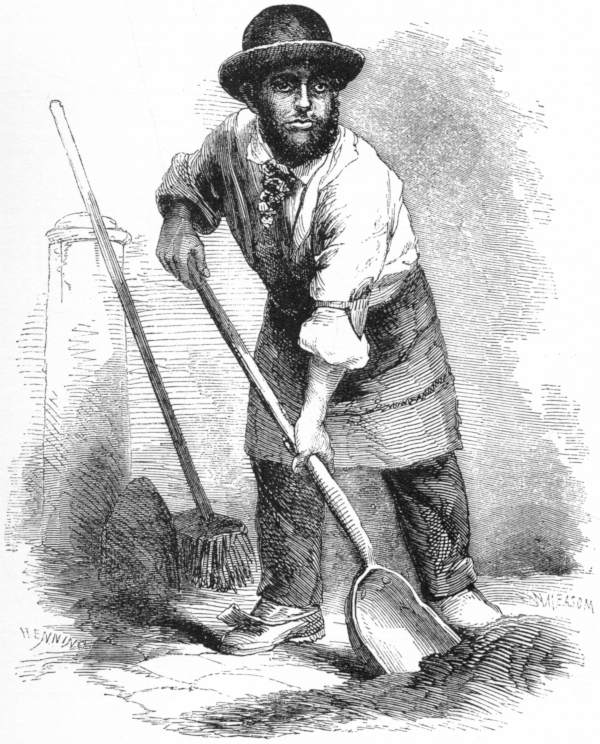
THE LONDON SCAVENGER.
[From a Daguerreotype by Beard.]
The diet of the regular working scavager (or nightman) seems generally to differ from that of mechanics, and perhaps of other working men, in the respect of his being fonder of salt and strong-flavoured food. I have before made the same remark concerning the diet of the poor generally. I do not mean, however, that the scavagers are fond of such animal food as is called “high,” for I did not hear that nightmen or scavagers were more tolerant of what approached putridity than other labouring men, and, despite their calling, might sicken at the rankness of some haunches of venison; but they have a great relish for highly-salted cold boiled beef, bacon, or pork, with a saucer-full of red pickled cabbage, or dingy-looking pickled onions, or one or two big, strong, raw onions, of which most of them seem as fond as Spaniards of garlic. This sort of meat, sometimes profusely mustarded, is often eaten in the beer-shops with thick “shives” of bread, cut into big mouthfuls with a clasp pocket-knife, while vegetables, unless indeed the beer-shop can supply a plate of smoking hot potatoes, are uncared for. The drink is usually beer. The same style of eating and the same kind of food characterize the scavager and nightman, when taking his meal at home with his wife or family; but so irregular, and often of necessity, are these men’s hours, that they may be said to have no homes, merely places to sleep or dose in.
A working scavager and nightman calculated for me his expenses in eating and drinking, and other necessaries, for the previous week. He had earned 15s., but 1s. of this went to pay off an advance of 5s. made to him by the keeper of a beer-shop, or, as he called it, a “jerry.”
Daily.Weekly.
d.s.d.
Rent of an unfurnished room19
Washing (average)3
[The man himself washed the dress in which he worked, and generally washed his own stockings.]
Shaving (when twice a week)1
Tobacco17
[Short pipes are given to these men at the beer-shops, or public-houses which they “use.”]
Beer424
[He usually spent more than 4d. a day in beer, he said, “it was only a pot;” but this week more beer than usual had been given to him in nightwork.]
Gin212
[The same with gin.]
Cocoa (pint at a coffee-shop).1½10½
Bread (quartern loaf) (sometimes 5½d.)636
Boiled salt beef (¾ lb. or ½ lb. daily, “as happened,” for two meals, 6d. per pound, average)424
Pickles or Onions0¼1¾
Butter1
Soap1
132¼
Perhaps this informant was excessive in his drink. I believe he was so; the others not drinking so much regularly. The odd 9d., he told me, he paid to “a snob,” because he said he was going to send his half-boots to be mended.
This man informed me he was a “widdur,” having lost his old ’oman, and he got all his meals at a beer or coffee-shop. Sometimes, when he was a street-sweeper by day and a nightman by night, he had earned 20s. to 22s.; and then he could have his pound of salt meat a day, for three meals, with a “baked tatur or so, when they was in.” I inquired as to the apparently low charge of 6d. per pound for cooked meat, but I found that the man had stated what was correct. In many parts good boiled “brisket,” fresh cut, is 7d. and 8d. per lb., with mustard into the bargain; and the cook-shop keepers (not the eating-house people) who sell boiled hams, beef, &c., in retail, but not to be eaten on the premises, vend the hard remains of a brisket, and sometimes of a round, for 6d., or even less (also with mustard), and the scavagers like this better than any other food. In the brisk times my informant sometimes had “a hot cut” from a shop on a Sunday, and a more liberal allowance of beer and gin. If he had any piece of clothing to buy he always bought it at once, before his money went for other things. These were his proceedings when business was brisk.
In slacker times his diet was on another footing. He then made his supper, or second meal, for tea he seldom touched, on “fagots.” This preparation of baked meats costs 1d. hot—but it is seldom sold hot except in the evening—and ¾d., or more frequently two for 1½d., cold. It is a sort of cake, roll, or ball, a number being baked at a time, and is made of chopped liver and lights, mixed with gravy, and wrapped in pieces of pig’s caul. It weighs six ounces, so that it is unquestionably a cheap, and, to the scavager, a savoury meal; but to other nostrils its odour is not seductive. My informant regretted the capital fagots he used to get at a shop when he worked in Lambeth; superior to anything he had been able to meet with on the Middlesex side of the water. Or he dined off a saveloy, costing 1d., and bread; or bought a pennyworth of strong cheese, and a farthing’s worth of onions. He would further reduce his daily expenditure on cocoa (or coffee sometimes) to 1d., and his bread to three-quarters of a loaf. He ate, however, in average times, a quarter of a quartern loaf to his breakfast (sometimes buying a halfpennyworth of butter), a quarter or more to his dinner, the same to his supper, and the other, with an onion for a relish, to his beer. He was a great bread eater, he said; but sometimes, if he slept in the daytime, half a loaf would “stand over to next day.” He was always hungriest when at work among the street-mud, or night-soil, or when he had finished work.
On my asking him if he meant that he partook of the meals he had described daily, he answered “no,” but that was mostly what he had; and if he bought a bit of cold boiled, or even roast pork, “what offered cheap,” the expense was about the same. When he was drinking, and he did “make a break sometimes,” he ate nothing, and “wasn’t inclined to,” and he seemed rather to plume himself on this, as a point of economy. He had tasted fruit pies, but cared nothing for them; but liked four penn’orth of a hot meat or giblet pie on a Sunday. Batter-pudding he only liked if smoking hot; and it was “uncommon improved,” he said, “with an ingan!” Rum he preferred to gin, only it was dearer, but most of the scavagers, he thought, liked Old Tom (gin) best; but “they was both good.”
Of the drinking of these men I heard a good deal, and there is no doubt that some of them tope hard, and by their conduct evince a sort of belief that the great end of labour is beer. But it must be borne in mind that if inquiries are made as to the man best adapted to give information concerning any rude calling (especially), some talkative member of the body of these working men, some pot-house hero who has persuaded himself and his ignorant mates that he is an oracle, is put forward. As these men are sometimes, from being trained to, and long known in their callings, more prosperous than their fellows, their opinions seem ratified by their circumstances. But in such cases, or in the appearance of such cases, it has been my custom to make subsequent inquiries, or there might be frequent misleadings, were the statements of these men taken as typical of the feelings and habits of the whole body. The statement of the working scavager given under this head is unquestionably typical of the character of a portion of his co-workers, and more especially of what was, and in the sort of hereditary scavagers I have spoken of is, the character of the regular hands. There are now, however, many checks to prolonged indulgence in “lush,” as every man of the ruder street-sweeping class will call it. The contractors must be served regularly; the most indulgent will not tolerate any unreasonable absence from work, so that the working scavagers, at the jeopardy of their means of living, must leave their carouse at an hour which will permit them to rise soon enough in the morning.
The beer which these men imbibe, it should be also remembered, they regard as a proper part of their diet, in the same light, indeed, as they regard so much bread, and that among them the opinion is almost universal, that beer is necessary to “keep up their strength;” there are a few teetotallers belonging to the class; one man thought he knew five, and had heard of five others.
I inquired of the landlord of a beer-shop, frequented by these men, as to their potations, but he wanted to make it appear that they took a half-pint, now and then, when thirsty! He was evidently tender of the character of his customers. The landlord of a public house also frequented by them informed me that he really could not say what they expended in beer, for labourers of all kinds “used his tap,” and as all tap-room liquor was paid for on delivery in his and all similar establishments, he did not know the quantity supplied to any particular class. He was satisfied these men, as a whole, drank less than they did at one time; though he had no doubt some (he seemed to know no distinctions between scavagers, dustmen, and nightmen) spent 1s. a day in drink. He knew one scavager who was dozing about not long since for nearly a week, “sleepy drunk,” and the belief was that he had “found something.” The absence of all accounts prevents my coming to anything definite on this head, but it seems positive that these men drink less than they did. The landlord in question thought the statement I have given as to diet and drink perfectly correct for a regular hand in good earnings. I am assured, however, and it is my own opinion, after long inquiry, that one-third of their earnings is spent in drink.
Of the Influence of Free Trade on the Earnings of the Scavagers.
As regards the influence of Free Trade upon the scavaging business, I could gain little or no information from the body of street-sweepers, because they have never noticed its operation, and the men, with the exception of such as have sunk into street-sweeping from better-informed conditions of life, know nothing about it. Among all, however, I have heard statements of the blessing of cheap bread; always cheap bread. “There’s nothing like bread,” say the men, “it’s not all poor people can get meat; but they must get bread.” Cheap food all labouring men pronounce a blessing, as it unquestionably is, but “somehow,” as a scavager’s carman said to me, “the thing ain’t working as it should.”
In the course of the present and former inquiries among unskilled labourers, street-sellers, and costermongers, I have found the great majority of the more intelligent declare that Free Trade had not worked well for them, because there were more labourers and more street-sellers than were required, for each man to live by his toil and traffic, and because the numbers increased yearly, and the demand for their commodities did not increase in proportion. Among the ignorant, I heard the continual answers of, “I can’t say, sir, what it’s owing to, that I’m so bad off;” or, “Well, I can’t tell anything about that.”
It is difficult to state, however, without positive inquiry, whether this extra number of hands be due to diminished employment in the agricultural districts, since the repeal of the Corn Laws, or whether it be due to the insufficiency of occupation generally for the increasing population. One thing at least is evident, that the increase of the trades alluded to cannot be said to arise directly from diminished agricultural employment, for but few farm labourers have entered these businesses since the change from Protection to Free Trade. If, therefore, Free-Trade principles have operated injuriously in reducing the work of the unskilled labourers, street-sellers, and the poorer classes generally, it can have done so only indirectly; that is to say, by throwing a mass of displaced country labour into the towns, and so displacing other labourers from their ordinary occupations, as well as by decreasing the wages of working-men generally. Hence it becomes almost impossible, I repeat, to tell whether the increasing difficulty that the poor experience in living by their labour, is a consequence or merely a concomitant of the repeal of the Corn Laws; if it be a consequence, of course the poor are no better for the alteration; if, however, it be a coincidence rather than a necessary result of the measure, the circumstances of the poor are, of course, as much improved as they would have been impoverished provided that measure had never become law. I candidly confess I am as yet without the means of coming to any conclusion on this part of the subject.
Nor can it be said that in the scavagers’ trade wages have in any way declined since the repeal of the Corn Laws; so that were it not for the difficulty of obtaining employment among the casual hands, this class must be allowed to have been considerable gainers by the reduction in the price of food, and even as it is, the constant hands must be acknowledged to be so.
I will now endeavour to reduce to a tabular form such information as I could obtain as to the expenditure of the labourer in scavaging before and after the establishment of Free Trade. I inquired, the better to be assured of the accuracy of the representations and accounts I received from labourers, the price of meat then and now. A butcher who for many years has conducted a business in a populous part of Westminster and in a populous suburb, supplying both private families with the best joints, and the poor with their “little bits” their “block ornaments” (meat in small pieces exposed on the chopping-block), their purchases of liver, and of beasts’ heads. In 1845, the year I take as sufficiently prior to the Free-Trade era, my informant from his recollection of the state of his business and from consulting his books, which of course were a correct guide, found that for a portion of the year in question, mutton was as much as 7½d. per lb. (Smithfield prices), now the same quality of meat is but 5d. This, however, was but a temporary matter, and from causes which sometimes are not very ostensible or explicable. Taking the butcher’s trade that year as a whole, it was found sufficiently conclusive, that meat was generally 1d. per lb. higher then than at present. My informant, however, was perfectly satisfied that, although situated in the same way, and with the same class of customers, he did not sell so much meat to the poor and labouring classes as he did five or six years ago, he believed not by one-eighth, although perhaps “pricers of his meat” among the poor were more numerous. For this my informant accounted by expressing his conviction that the labouring men spent their money in drink more than ever, and were a longer time in recovering from the effects of tippling. This supposition, from what I have observed in the course of the present inquiry, is negatived by facts.
Another butcher, also supplying the poor, said they bought less of him; but he could not say exactly to what extent, perhaps an eighth, and he attributed it to less work, there being no railways about London, fewer buildings, and less general employment. About the wages of the labourers he could not speak as influencing the matter. From this tradesmen also I received an account that meat generally was 1d. per lb. higher at the time specified. Pickled Australian beef was four or five years ago very low—3d. per lb.—salted and prepared, and “swelling” in hot water, but the poor “couldn’t eat the stringy stuff, for it was like pickled ropes.” “It’s better now,” he added, “but it don’t sell, and there’s no nourishment in such beef.”
But these tradesmen agreed in the information that poor labourers bought less meat, while one pronounced Free Trade a blessing, the other declared it a curse. I suggested to each that cheaper fish might have something to do with a smaller consumption of butcher’s meat, but both said that cheap fish was the great thing for the Irish and the poor needle-women and the like, who were never at any time meat eaters.
From respectable bakers I ascertained that bread might be considered 1d. a quartern loaf dearer in 1845 than at present. Perhaps the following table may throw a fuller light on the matter. I give it from what I learned from several men, who were without accounts to refer to, but speaking positively from memory; I give the statement per week, as for a single man, without charge for the support of a wife and family, and without any help from other resources.
Before Free Trade.After Free Trade.Saving since Free Trade.
Rent1s. 6d.1s. 6d....
Bread (5 loaves)2s. 11d.2s. 6d.5d.
Butter (½ lb.)5d.5d....
Tea (2 oz.)8d.8d....
Sugar (½ lb.)3d.2d.1d.
Meat (3 lb.)1s. 6d.1s. 3d.3d.
Bacon (1 lb.)5d.5d....
Fish (a dinner a day, 6 days)3d., or 1s. 6d. weekly.2d., or 1s. weekly.6d.
Potatoes or Vegetables (½d. a day)3½d.3½d....
Beer (pot)3½d.3½d....
Total saving, per week, since Free Trade1s. 3d.
In butter, bacon, potatoes, &c., and beer, I could hear of no changes, except that bacon might be a trifle cheaper, but instead of a good quality selling better, although cheaper, there was a demand for an inferior sort.
In the foregoing table the weekly consumption of several necessaries is given, but it is not to be understood that one man consumes them all in a week; they are what may generally be consumed when such things are in demand by the poor, one week after another, or one day after another, forming an aggregate of weeks.
Thus, Free Trade and cheap provisions are an unquestionable benefit, if unaffected by drawbacks, to the labouring poor.
The above statement refers only to a fully employed hand.
The following table gives the change since Free Trade in the earnings of casual hands, and relates to the past and the present expenditure of a scavager. The man, who was formerly a house painter, said he could bring me 50 men similarly circumstanced to himself.
In 1845, per Week.In 1851, per Week.
s.d.s.d.
Rent14Rent18
5 loaves2114 loaves20
Butter05Butter05
Tea06Tea05
Meat (3 lbs.)16Meat (3 lbs.)10
Potatoes03Potatoes02
Beer (a pot)04Beer (a pint)02
73510
Here, then, we find a positive saving in the expenditure of 1s. 5d. per week in this man’s wages, since the cheapening of food.
His earnings, however, tell a different story.
1845.1851.
s.d.s.d.
Earnings of 6 days150
Ditto 3 days76
Weekly Income15076
Expenditure73510
Difference7918
Thus we perceive that the beneficial effects of cheapness are defeated by the dearth of employment among labourers.
It is impossible to come to precise statistics in this matter, but all concurrent evidence, as regards the unskilled work of which I now treat, shows that labour is attainable at almost any rate.
Another drawback to the benefits of cheap food I heard of first in my inquiries (for the Letters on Labour and the Poor, in the Morning Chronicle) among the boot and shoemakers—their rents had been raised in consequence of their landlords’ property having been subjected to the income tax. Numbers of large houses are now let out in single rooms, in the streets off Tottenham-court-road, and near Golden-square, as well as in many other quarters—to men, who, working for West-end tradesmen, must live, for economy of time, near the shops from which they derive their work. Near and in Cunningham-street and other streets, two men, father and son, rent upwards of 30 houses, the whole of which they let out in one or two rooms, it is believed at a very great profit; in fact they live by it.
The rent of these houses, among many others, was raised when the income tax was imposed, the sub-lettors declaring, with what truth no one knew, that the rents were raised to them. It is common enough for capitalists to fling such imposts on the shoulders of the poor, and I heard scavagers complain, that every time they had to change their rooms, they had either to pay more rent by 2d. or 3d. a week, or put up with a worse place. One man who lived at the time of the passing of the Income Tax Bill in Shoe-lane, found his rent raised suddenly 3d. a week, a non-resident landlord or agent calling for it weekly. He was told that the advance was to meet the income tax. “I know nothing about what income tax means,” he said, “but it’s some —— roguery as is put on the poor.” I heard complaints to the same purport from several working scavagers, and the lettors of rooms are the most exacting in places crowded with the poor, and where the poor think or feel they must reside “to be handy for work.” What connection there may be between the questions of Free Trade and the necessity of the income tax, it is not my business now to dilate upon, but it is evident that the circumstances of the country are not sufficiently prosperous to enable parliament to repeal this “temporary” impost.
From a better informed class than the scavagers, I might have derived data on which to form a calculation from account books, &c., but I could hear of none being kept. I remember that a lady’s shoemaker told me that the weekly rents of the ten rooms in the house in which he lived were 4s. 3d. higher than before the income tax, which “came to the same thing as an extra penny on over 50 loaves a week.” It is certain that the great tax-payers of London are the labouring classes.
I have endeavoured to ascertain the facts in connection with this complex subject in as calm and just a manner as possible, leaning neither to the Protectionist nor the Free-Trade side of the question, and I must again in honesty acknowledge, that to the constant hands among the scavagers and dustmen of the metropolis, the repeal of the Corn Laws appears to have been an unquestionable benefit.
I shall conclude this exposition of the condition and earnings of the working scavagers employed by the more honourable masters, with an account of the average income and expenditure of the better-paid hands (regular and casual, as well as single and married), and first, of the unmarried regular hand.
The following is an estimate of the income and expenditure of an unmarried operative scavager regularly employed, working for a large contractor:—
WEEKLY INCOME.WEEKLY EXPENDITURE.
£s.d.£s.d.
Constant Wages.Rent020
Nominal weekly wages0160Washing and mending0010
Perquisites020Clothes, and repairing ditto0010
Actual weekly wages0180Butcher’s meat036
Bacon008
Vegetables004
Cheese004
Beer030
Spirits010
Tobacco0010½
Butter007½
Sugar004
Tea003
Coffee003
Fish004
Soap002
Shaving001
Fruit004
Keep of 2 dogs006
Amusements, as skittles, &c.019
0180
The subjoined represents the income of an unmarried operative scavager casually employed by a small master scavager six months during the year, at 15s. a week, and 20 weeks at sand and rubbish carting, at 12s. a week.
Casual Wages.£s.d.
Nominal weekly wages at scavaging, 16s. for 26 weeks during the year20160
Perquisites, 2s. for 26 weeks during the year2120
Actual weekly wages for 26 weeks during the year0160
Nominal and actual weekly wages at rubbish carting, 12s. for 20 weeks more during the year1200
Average casual or constant weekly wages throughout the year0154½
The expenditure of this man when in work was nearly the same as that of the regular hand; the main exceptions being that his rent was 1s. instead of 2s., and no dogs were kept. When in work he saved nothing, and when out of work lived as he could.
The married scavagers are differently circumstanced from the unmarried; their earnings are generally increased by those of their family.
The labour of the wives and children of the scavagers is not unfrequently in the capacity of sifters in the dust-yards, where the wives of the men employed by the contractors have the preference, and in other but somewhat rude capacities. One of their wives I heard of as a dresser of sheep’s trotters; two as being among the most skilful dressers of tripe for a large shop; one as “a cat’s-meat seller” (her father’s calling); but I still speak of the regular scavagers—I could not meet with one woman “working a slop-needle.” One, indeed, I saw who was described to me as a “feather dresser to an out-and-out negur,” but the woman assured me she was neither badly paid nor badly off. Perhaps by such labour, as an average on the part of the wives, 9d. a day is cleared, and 1s. “on tripe and such like.” Among the “casual’s” wives there are frequent instances of the working for slop shirt-makers, &c., upon the coarser sorts of work, and at “starvation wages,” but on such matters I have often dwelt. I heard from some of these men that it was looked upon as a great thing if the wife’s labour could clear the week’s rent of 1s. 6d. to 2s.
The following may be taken as an estimate of the income and outlay of a better paid and fully employed operative scavager, with his wife and two children:—
WEEKLY INCOME OF THE FAMILY.WEEKLY EXPENDITURE OF THE FAMILY.
£s.d.£s.d.
Nominal weekly wages of man, 16s.Rent030
Perquisites, 2s.Candle003½
Actual weekly wages of man0180Bread021
Nominal weekly wages of wife, 6s.Butter0010
Perquisites in coal and wood, 1s. 4d.Sugar008
Actual weekly wages of wife.074Tea0010
Nominal weekly wages of boy.030Coffee004
184Butcher’s meat036
Bacon012
Potatoes0010
Raw fish004
Herrings004
Beer (at home)020
„ (at work)016
Spirits010
Cheese006
Flour003
Suet003
Fruit003
Rice000½
Soap006
Starch000½
Soda and blue001
Dubbing000½
Clothes for the whole family, and repairing ditto020
Boots and shoes for ditto, ditto016
Milk007
Salt, pepper, and mustard001
Tobacco009
Wear and tear of bedding, crocks, &c.003
Schooling for girl003
Baking Sunday’s dinner002
Mangling003
Amusements and sundries010
176
The subjoined, on the other hand, gives the income and outlay of a casually employed operative scavager (better paid) with his wife and two boys in constant work:—
WEEKLY INCOME OF THE FAMILY.WEEKLY EXPENDITURE OF THE FAMILY.
£s.d.£s.d.
Nominal wages of man at scavaging for six months, at 16s. weekly.Rent036
Ditto at rubbish carting three months, 12s. weekly.Candle006
Average casual wages throughout the year0150Soap004
Nominal weekly wages of wife, 6s. (constant).Soda, starch, and blue002½
Perquisites in wood and coal, 1s. 4d.Bread026
Actual weekly wages of wife074Butter009
Nominal weekly wages of two boys, 7s. the two.Dripping005
Perquisites for running on messages, 1s. the two (constant).Sugar008
Actual weekly wages of the two boys.080Tea008
1104Coffee006
Butcher’s meat036
Bacon010
Potatoes010
Cheese006
Raw fish004
Herrings003
Fried fish003
Flour003
Suet002
Fruit006
Rice001½
Beer (at home)020
„ (at work)019
Spirits010
Tobacco009
Pepper, salt, and mustard001
Milk007
Clothes for man, wife, and family020
Repairing ditto for ditto006
Boots and shoes for ditto016
Repairing ditto for ditto008
Wear and tear of bedding, crocks, &c.003
Baking Sunday’s dinner002
Mangling002
Amusements, sundries, &c.010
1104
Of the Worse Paid Scavagers, or those working for Scurf[18] Employers.
There are in the scavagers’ trade the same distinct classes of employers as appertain to all other trades; these consist of:—
1. The large capitalists.
2. The small capitalists.
As a rule (with some few honourable and dishonourable exceptions, it is true) I find that the large capitalists in the several trades are generally the employers who pay the higher wages, and the small men those who pay the lower. The reasons for this conduct are almost obvious. The power of the capital of the “large master” must be contended against by the small one; and the usual mode of contention in all trades is by reducing the wages of the working men. The wealthy master has, of course, many advantages over the poor one. (1) He can pay ready money, and obtain discounts for immediate payment. (2) He can buy in large quantities, and so get his stock cheaper. (3) He can purchase what he wants in the best markets, and that directly of the producer, without the intervention and profit of the middleman. (4) He can buy at the best times and seasons; and “lay in” what he requires for the purposes of his trade long before it is needed, provided he can obtain it “a bargain.” (5) He can avail himself of the best tools and mechanical contrivances for increasing the productiveness or “economizing the labour” of his workmen. (6) He can build and arrange his places of work upon the most approved plan and in the best situations for the manufacture and distribution of the commodities. (7) He can employ the highest talent for the management or design of the work on which he is engaged. (8) He can institute a more effective system for the surveillance and checking of his workmen. (9) He can employ a large number of hands, and so reduce the secondary expenses (of firing, lighting, &c.) attendant upon the work, as well as the number of superintendents and others engaged to “look after” the operatives. (10) He can resort to extensive means of making his trade known. (11) He can sell cheaper (even if his cost of production be the same), from employing a larger capital, and being able to “do with” a less rate of profit. (12) He can afford to give credit, and so obtain customers that he might otherwise lose.
The small capitalist, therefore, enters the field of competition by no means equally matched against his more wealthy rival. What the little master wants in “substance,” however, he generally endeavours to make up in cunning. If he cannot buy his materials as cheap as a trader of larger means, he uses an inferior or cheaper article, and seeks by some trick or other to palm it off as equal to the superior and dearer kind. If the tools and appliances of the trade are expensive, he either transfers the cost of providing them to the workmen, or else he charges them a rent for their use; and so with the places of work, he mulcts their wages of a certain sum per week for the gas by which they labour, or he makes them do their work at home, and thus saves the expense of a workshop; and, lastly, he pays his men either a less sum than usual for the same quantity of labour, or exacts a greater quantity from them for the same sum of money. By one or other of these means does the man of limited capital seek to counterbalance the advantages which his more wealthy rival obtains by the possession of extensive “resources.” The large employer is enabled to work cheaper by the sheer force of his larger capital. He reduces the cost of production, not by employing a cheaper labour, but by “economizing the labour” that he does employ. The small employer, on the other hand, seeks to keep pace with his larger rival, and strives to work cheap, not by “the economy of labour” (for this is hardly possible in the small way of production), but by reducing the wages of his labourers. Hence the rule in almost every trade is that the smaller capitalists pay a lower rate of wages. To this, however, there are many honourable exceptions among the small masters, and many as dishonourable among the larger ones in different trades. Messrs. Moses, Nicoll, and Hyams, for instance, are men who certainly cannot plead deficiency of means as an excuse for reducing the ordinary rate of wages among the tailors.
Those employers who seek to reduce the prices of a trade are known technologically as “cutting employers,” in contradistinction to the standard employers, or those who pay their workpeople and sell their goods at the ordinary rates.
Of “cutting employers” there are several kinds, differently designated, according to the different means by which they gain their ends. These are:—
1. “Drivers,” or those who compel the men in their employ to do more work for the same wages; of this kind there are two distinct varieties:—
a. The long-hour masters, or those who make the men work longer than the usual hours of labour.
b. The strapping masters, or those who make the men (by extra supervision) “strap” to their work, so as to do a greater quantity of labour in the usual time.
2. Grinders, or those who compel the workmen (through their necessities) to do the same amount of work for less than the ordinary wages.
The reduction of wages thus brought about may or may not be attended with a corresponding reduction in the price of the goods to the public; if the price of the goods be reduced in proportion to the reduction of wages, the consumer, of course, is benefited at the expense of the producer. When it is not followed by a like diminution in the selling price of the article, and the wages of which the men are mulct go to increase the profits of the capitalist, the employer alone is benefited, and is then known as a “grasper.”
Some cutting tradesmen, however, endeavour to undersell their more wealthy rivals, by reducing the ordinary rate of profit, and extending their business on the principle of small profits and quick returns, the “nimble ninepence” being considered “better than the slow shilling.” Such traders, of course, cannot be said to reduce wages directly—indirectly, however, they have the same effect, for in reducing prices, other traders, ever ready to compete with them, but, unwilling, or perhaps unable, to accept less than the ordinary rate of profit, seek to attain the same cheapness by diminishing the cost of production, and for this end the labourers’ wages are almost invariably reduced.
Such are the characteristics of the cheap employers in all trades. Let me now proceed to point out the peculiarities of what are called the scurf employers in the scavaging trade.
The insidious practices of capitalists in other callings, in reducing the hire of labour, are not unknown to the scavagers. The evils of which these workmen have to complain under scurf or slop masters are:—
1. Driving, or being compelled to do more work for the same pay.
2. Grinding, or being compelled to do the same or a greater amount of work for less pay.
1. Under the first head, if the employment be at all regular, I heard few complaints, for the men seemed to have learned to look upon it as an inevitable thing, that one way or other they must submit, by the receipt of a reduced wage, or the exercise of a greater toil, to a deterioration in their means.
The system of driving, or, in other words, the means by which extra work is got out of the men for the same remuneration, in the scavagers’ trade is as follows:—some employers cause their scavagers after their day’s work in the streets, to load the barges with the street and house-collected manure, without any additional payment; whereas, among the more liberal employers, there are bargemen who are employed to attend to this department of the trade, and if their street scavagers are so employed, which is not very often, it is computed as extra work or “over hours,” and paid for accordingly. This same indirect mode of reducing wages (by getting more work done for the same pay) is seen in many piece-work callings. The slop boot and shoe makers pay the same price as they did six or seven years ago, but they have “knocked off the extras,” as the additional allowance for greater than the ordinary height of heel, and the like. So the slop Mayor of Manchester, Sir Elkanah Armitage, within the last year or two, sought to obtain from his men a greater length of “cut” to each piece of woven for the same wages.
Some master scavagers or contractors, moreover, reduce wages by making their men do what is considered the work of “a man and a half” in a week, without the recompense due for the labour of the “half” man’s work; in other words, they require the men to condense eight or nine days’ labour into six, and to be paid for the six days only; this again is usual in the strapping shops of the carpenters’ trade.
Thus the class of street-sweepers do not differ materially in the circumstances of their position from other bodies of workers skilled and unskilled.
Let me, however, give a practical illustration of the loss accruing to the working scavagers by the driving method of reducing wages.
A is a large contractor and a driver. He employs 16 men, and pays them the “regular wages” of the honourable trade; but, instead of limiting the hours of labour to 12, as is usual among the better class of employers, he compels each of his men to work at the least 16 hours per diem, which is one-third more, and for which the men should receive one-third more wages. Let us see, therefore, how much the men in his employ lose annually by these means.
Sum received per Annum.Sum they should receive.Difference.
£s.£s.£s.
4 Gangers, at 18s. a week, for 9 months in the year140821012704
12 Sweepers, at 16s. a week, for 9 months in the year3748499412416
Total wages per Ann.51416709161950
Here, then, we find the annual loss to these men through the system of “driving” to be 195l. per annum.
But A is not the only driver in the scavagers’ trade; out of the 19 masters having contracts for scavaging, as cited in the table given at pp. 213, 214, there are 4 who are regular drivers; and, making the same calculation as above, we have the following results:—
Sum received per Annum.Sum they should receive.Difference.
£s.£s.£s.
26 Gangers, at 18s. a week, for 9 months in the year912121216163044
80 Sweepers, at 16s. a week, for 9 months in the year24960332808320
33081245441611364
Thus we find that the gross sum of which the men employed by these drivers are deprived, is no less than 1136l. per annum.
2. The second or indirect mode of reducing the wages of the men in the scavaging trade is by Grinding; that is to say, by making the men do the same amount of work for less pay. It requires nothing but a practical illustration to render the injury of this particular mode of reduction apparent to the public.
B is a master scavager (a small contractor, though the instances are not confined to this class), and a “Grinder.” He pays 1s. a week less than the “regular wages” of the honourable trade. He employs six men; hence the amount that the workmen in his pay are mulct of every year is as follows:—
Sum received per Annum.Sum they should receive.Difference.
£s.£s.£s.
6 men, at 15s. a week, for 9 months in the year1751018741114
Here the loss to the men is 11l. 14s. per annum, and there is but one such grinder among the 19 master scavagers who have contracts at present.
3. The third and last method of reducing the earnings of the men as above enumerated, is by a combination of both the systems before explained, viz., by grinding and driving united, that is to say, by not only paying the men a smaller wage than the more honourable masters, but by compelling them to work longer hours as well. Let me cite another illustration from the trade.
C is a large contractor, and both a grinder and driver. He employs 28 men, and not only pays them less wages, but makes them work longer hours than the better class of employers. The men in his pay, therefore, are annually mulct of the following sums.
SUMS THE MEN RECEIVE.SUMS THEY SHOULD RECEIVE.
£s.d.£s.d.
7 Gangers, at 16s. a week, for 9 months in the year218807 Gangers, at 18s. a week, for 9 months in the year245140
21 Sweepers, at 15s. a week61450Over work, 4 hours per day6186
83213021 Sweepers, at 16s. a week, 12 hours a day65540
Over work, 4 hours a day16360
1125126
Here the annual loss to the men employed by this one master is 292l. 19s. 6d.
Among the 19 master scavagers there are altogether 7 employers who are both grinders and drivers. These employ among them no less than 111 hands; hence, the gross amount of which their workmen are yearly defrau—no, let me adhere to the principles of political economy, and say deprived—is as under:—
SUM THE MEN ANNUALLY RECEIVE.SUM THEY SHOULD ANNUALLY RECEIVE.
£s.d.£s.d.
28 Gangers, at 16s. a week, employed for 9 months in the year87312028 Gangers, at 18s. a week (12 hours a day), for 9 months in the year982160
83 Sweepers, at 15s. a week, employed for 9 months in the year2427150Over work, 4 hours per day245140
33017083 Sweepers, at 16s. a week, 12 hours a day2589120
Over work, 4 hours per day64780
4465100
Here we perceive the gross loss to the operatives from the system of combined grinding and driving to be no less than 1164l. 3s. per annum.
Now let us see what is the aggregate loss to the working men from the several modes of reducing their wages as above detailed.
£.s.d.
Loss to the working scavagers by the “driving” of employers113640
Ditto by the “grinding”11140
Ditto by the “grinding and driving” of employers116430
Total loss to the working scavagers per annum231210
Now this is a large sum of money to be wrested annually out of the workmen—that it is so wrested is demonstrated by the fact cited at p. 174 in connection with the dust trade.
The wages of the dustmen employed by the large contractors, it is there stated, have been increased within the last seven years from 6d. to 8d. per load. This increase in the rate of remuneration was owing to complaints made by the men to the Commissioners of Sewers, that they were not able to live on their earnings; an inquiry took place, and the result was that the Commissioners decided upon letting the contracts only to such parties as would undertake to pay a fair price to their workmen. The contractors accordingly increased the remuneration of the labourers as mentioned.
Now political economy would tell us that the Commissioners interfered with wages in a most reprehensible manner—preventing the natural operation of the law of Supply and Demand; but both justice and benevolence assure us that the Commissioners did perfectly right. The masters in the dust trade were forced to make good to the men what they had previously taken from them, and the same should be done in the scavaging trade—the contracts should be let only to these masters who will undertake to pay the regular rate of wages, and employ their men only the regular hours; for by such means, and by such means alone, can justice be done to the operatives.
This brings me to the cause of the reduction of wages in the scavaging trade. The scurf trade, I am informed, has been carried on among the master scavagers upwards of 20 years, and arose partly from the contractors having to pay the parishes for the house-dust and street-sweepings, brieze and street manure at that period often selling for 30s. the chaldron or load. The demand for this kind of manure 20 years ago was so great, that there was a competition carried on among the contractors themselves, each out-bidding the other, so as to obtain the right of collecting it; and in order not to lose anything by the large sums which they were induced to bid for the contracts, the employers began gradually to “grind down” their men from 17s. 6d. (the sum paid 20 years back) to 17s. a week, and eventually to 15s., and even 12s. weekly. This is a curious and instructive fact, as showing that even an increase of prices will, under the contract system, induce a reduction of wages. The greed of traders becomes, it appears, from the very height of the prices, proportionally intensified, and from the desire of each to reap the benefit, they are led to outbid one another to such an extent, and to offer such large premiums for the right of appropriation, as to necessitate a reduction of every possible expense in order to make any profit at all upon the transaction. Owing, moreover, to the surplus labour in the trade, the contractors were enabled to offer any premiums and reduce wages as they pleased; for the casually-employed men, when the wet season was over, and their services no longer required, were continually calling upon the contractors, and offering their services at 2s. and 3s. less per week than the regular hands were receiving. The consequence was, that five or six of the master scavagers began to reduce the wages of their labourers, and since that time the number has been gradually increasing, until now there are no less than 21 scurf masters (8 of whom have no contracts) out of the 34 contractors; so that nearly three-fifths of the entire trade belong to the grinding class. Within the last seven or eight years, however, there has been an increase of wages in connection with the city operative scavagers. This was owing mainly to the operatives complaining to the Commissioners that they could not live upon the wages they were then receiving—12s. and 14s. a week. The circumstances inducing the change, I am informed, were as follows:—one of the gangers asked a tradesman in the city to give the street-sweepers “something for beer,” whereupon the tradesman inquired if the men could not find beer out of their wages, and on being assured that they were receiving only 12s. a week, he had the matter brought before the Board. The result was, that the wages of the operatives were increased from 12s. to 15s. and 16s. weekly, since which time there has been neither an increase nor a decrease in their pay. The cheapness of provisions seems to have caused no reduction with them.
Now there are but two “efficient causes” to account for the reduction of wages among the scurf employers in the scavagers’ trade:—(1) The employers may diminish the pay of their men from a disposition to “grind” out of them an inordinate rate of profit. (2) The price paid for the work may be so reduced that, consistent with the ordinary rate of profit on capital, and remuneration for superintendence, greater wages cannot be paid. If the first be the fact, then the employers are to blame, and the parishes should follow the example of the Commissioners of Sewers, and let the work to those contractors only who will undertake to pay the “regular wages” of the honourable trade; but if the latter be the case, as I strongly suspect it is, though some of the masters seem to be more “grasping” than the rest—but in the paucity of returns on this matter, it is difficult to state positively whether the price paid for the labour of the working scavager is in all the parishes proportional to the price paid to the employers for the work (a most important fact to be solved)—if, however, I repeat, the decrease of the wages be mainly due to the decrease in the sums given for the performance of the contract, then the parishes are to blame for seeking to get their work done at the expense of the working men.
The contract system of work, I find, necessarily tends to this diminution of the men’s earnings in a trade. Offer a certain quantity of work to the lowest bidder, and the competition will assuredly be maintained at the operative’s expense. It is idle to expect that, as a general rule, traders will take less than the ordinary rate of profit. Hence, he who underbids will usually be found to underpay. This, indeed, is almost a necessity of the system, and one which the parochial functionaries more than all others should be guarded against—seeing that a decrease of the operative’s wages can but be attended with an increase of the very paupers, and consequently of the parochial expenses, which they are striving to reduce.