Volume 2 — Of the London Chimney-Sweepers. (continued 3)
Reading edition
“Lady M. had a son of tender years, who was supposed to have been stolen for the sake of his clothes. Some time after, there was an occasion when the sweeps were necessary at Montagu House. A servant noticed one of the boys, being at first attracted by his superior manner, and her curiosity being excited fancied a resemblance in him to the lost child. She questioned his master respecting him, who represented that he had found him crying and without a home, and thereupon took him in, and brought him up to his trade. The boy was questioned apart from his master, as to the treatment he received; his answers were favourable; and the consequence was, a compensation was given to the man, and the boy was retained. All doubt was removed as to his identity.”
The annual feast at “White Condick,” so agreeable to the black fraternity, was afterwards continued in another form, and was the origin of a well-known society among the master sweepers, which continued in existence till the abolition of the climbing-boys by Act of Parliament. The masters and the better class of men paid a certain sum yearly, for the purpose of binding the children of the contributors to other trades. In order to increase the funds of this institution, as the dinner to the boys at White Conduit House was an established thing, the masters continued it, and the boys of every master who belonged to the society went in a sort of state to the usual place of entertainment every 1st of May, where they were regaled as formerly. Many persons were in the habit of flocking on this day to White Conduit House to witness the festivities of the sweepers on this occasion, and usually contributed something towards the society. As soon, however, as the Act passed, this also was discontinued, and it is now one of the legends connected with the class.
Sweeping of the Chimneys of Steam-Vessels.
The sweeping of the flues in the boilers of steam-boats, in the Port of London, and also of land boilers in manufactories, is altogether a distinct process, as the machine cannot be used until such time as the parties who are engaged in this business travel a long way through the flues, and reach the lower part of the chimney or funnel where it communicates with the boilers and receives the smoke in its passage to the upper air. The boilers in the large sea-going steamers are of curious construction; in some large steamers there are four separate boilers with three furnaces in each, the flues of each boiler uniting in one beneath the funnel; immediately beyond the end of the furnace, which is marked by a little wall constructed of firebrick to prevent the coals and fire from running off the firebars, there is a large open space very high and wide, and which space after a month’s steaming is generally filled up with soot, somewhat resembling a snow drift collected in a hollow, were it not for its colour and the fact that it is sometimes in a state of ignition; it is, at times, so deep, that a man sinks to his middle in it the moment he steps across the firebridge. Above his head, and immediately over the end of the furnace, he may perceive an opening in what otherwise would appear to be a solid mass of iron; up to this opening, which resembles a doorway, the sweeper must clamber the best way he can, and when he succeeds in this he finds himself in a narrow passage completely dark, but with so strong a current of air rushing through it from the furnaces beneath towards the funnel overhead that it is with difficulty the wick lamp which he carries in his hand can be kept burning. This passage, between the iron walls on either side, is lofty enough for a tall man to stand upright in, but does not seem at first of any great extent; as he goes on, however, to what appears the end, he finds out his mistake, by coming to a sharp turn which conducts him back again towards the open space in the centre of the boiler, but which is now hid from him by the hollow iron walls which on every side surround him, and within which the waters boil and seethe as the living flames issuing from the furnaces rush and roar through these winding passages; another sharp turn leads back to the front of the boilers, and so on for seven or eight turns, backwards and forwards, like the windings in a maze, till at the last turn a light suddenly breaks upon him, and, looking up, he perceives the hollow tube of the funnel, black and ragged with the adhering soot.
Here, then, the labour of the sweeper commences: he is armed with a brush and shovel, and laying down his lamp in a space from which he has previously shovelled away the soot, which in many parts of the passage is knee deep, he brushes down the soot from the sides and roof of the passage, which being done he shovels it before him into the next winding; this process he repeats till he reaches, by degrees, the opening where he ascended. Whenever the accumulation of soot is so great that it is likely to block up the passage in the progress of his work, he wades through and shovels as much as he thinks necessary out of the opening into the large space behind the furnaces, then resumes his work, brushing and shovelling by turns, till the flues are cleared; when this is accomplished, he descends, and the fire bars being previously removed, he shovels the soot, now all collected together, over the firebridge and into the ashpit of the furnace; other persons stand ready in the stoke-hole armed with long iron rakes, with which they drag out the soot from the ashpits; and others shovel it into sacks, which they make fast to tackle secured to the upper deck, by which they “bowse” it up out of the engine-room, and either discharge it overboard or put it into boats preparatory to being taken ashore. In this manner an immense quantity of soot is removed from the boilers of a large foreign-going steamer when she gets into port, after a month or six weeks’ steaming, having burned in that time perhaps 700 or 800 tons of coal: this work is always performed by the stokers and coal-trimmers in the foreign ports, who seldom, if ever, get anything extra for it, although it is no uncommon thing for some of them to be ill for a week after it.
In the port of London, however, the sweeper comes into requisition, who, besides going through the process already described, brings his machine with him, and is thus enabled to cleanse the funnel, and to increase the quantity of soot. Some of the master sweepers, who have the cleansing of the steam-boats in the river, and the sweeping of boiler flues are obliged to employ a good many men, and make a great deal of money by their business. The use of anthracite coals, however, and some modern improvements, by which air at a certain temperature is admitted to certain parts of the furnace, have in many instances greatly lessened, if they have not altogether prevented, the accumulation of soot, by the prevention of smoke; and it seems quite possible, from the statements made by many eminent scientific and practical men who were examined before a select committee of the House of Commons, presided over by Mr. Mackinnon, in 1843, that by having properly-constructed stoves, and a sufficient quantity of pure air properly admitted, not only less fuel might be burned, and produce a greater amount of heat, but soot would cease to accumulate, so that the necessity for sweepers would be no longer felt, and there would be no fear of fires from the ignition of soot in the flues of chimneys; blacks and smoke, moreover, would take their departure together; and with them the celebrated London fog might also, in a great measure, disappear.
The funnels of steamers are generally swept at from 8d. to 1s. 6d. per funnel. The Chelsea steamers are swept by Mr. Allbrook, of Chelsea; the Continental, by Mr. Hawsey, of Rosemary-lane; and the Irish and Scotch steamers, by Mr. Tuff, who resides in the East London district.
Of the “Ramoneur” Company.
The Patent Ramoneur Company demands, perhaps, a special notice. It was formed between four and five years ago, and has now four stations: one in Little Harcourt-street, Bryanstone-square; another in New-road, Sloane-street; a third in Charles-place, Euston-square; and the fourth in William-street, Portland-town.
“This Company has been formed,” the prospectus stated, “for the purpose of cleansing chimneys with the Patent Ramoneur Machine, and introducing various other improvements in the business of chimney sweeping. Chimneys are daily swept with this machine where others have failed.”
The Company charge the usual prices, and all the men employed have been brought up as sweepers. The patent machine is thus described:—
“The Patent Ramoneur Machine consists of four brushes, forming a square head, which, by means of elastic springs, contracts or expands, according to the space it moves in; the rods attached to this head or brush are supplied at intervals with a universal spring-joint, capable of turning even a right angle, and the whole is surmounted with a double revolving ball, having also a universal spring-joint, which leads the brush with certainty into every corner, cleansing its route most perfectly.”
The recommendation held out to the public is, that the patented chimney-machine sweeps cleaner than that in general use, and for the reasons assigned; and that, being constructed with more and better springs, it is capable of “turning even a right angle,” which the common machine often leaves unswept. This was and is commonly said of the difference between the cleansing of the chimney by a climbing-boy and that effected by the present mechanical appliances in general use—the boy was “better round a corner.”
The patent machines now worked in London are fifteen in number, and fifteen men are thus employed. Each man receives as a weekly wage, always in money, 14s., besides a suit of clothes yearly. The suit consists of a jacket, waistcoat, and trousers, of dark-coloured corduroy; also a “frock” or blouse, to wear when at work, and a cap; the whole being worth from 35s. to 40s. This payment is about equivalent to that received weekly by the journeymen in the regular or honourable trade; for although higher in nominal amount as a weekly remuneration, the Ramoneur operatives are not allowed any perquisites whatever. The resident or manager at each station is also a working chimney-sweeper for the Company, and at the same rate as the others, his advantage being that he lives rent-free. At one station which I visited, the resident had two comfortable-looking up-stairs’-rooms (the stations being all in small streets), where he and his wife lived; while the “cellar,” which was indeed but the ground floor, although somewhat lower than the doorstep, was devoted to business purposes, the soot being stored there. It was boarded off into separate compartments, one being at the time quite full of soot. All seemed as clean and orderly as possible. The rent of those two rooms, unfurnished, would not be less than 4s. or 5s. a week, so that the resident’s payment may be put at about 50l. a year. The patent-machine operatives sweep, on an average, the same number of chimneys each, as a master chimney-sweeper’s men in a good way of business in the ordinary trade.
Of the Brisk and Slack Seasons, and the Casual Trade among the Chimney-Sweepers.
As among the rubbish-carters in the unskilled, and the tailors and shoemakers of the skilled trades, the sweepers’ trade also has its slackness and its briskness, and from the same cause—the difference in the seasons. The seasons affecting the sweepers’ trade are, however, the natural seasons of the year, the recurring summer and winter, while the seasons influencing the employment of West-end tailors are the arbitrary seasons of fashion.
The chimney-sweepers’ brisk season is in the winter, and especially at what may be in the respective households the periods of the resumption and discontinuance of sitting-room fires.
The sweepers’ seasons of briskness and slackness, indeed, may be said then to be ruled by the thermometer, for the temperature causes the increase or diminution of the number of fires, and consequently of the production of soot. The thermometrical period for fires appears to be from October to the following April, both inclusive (seven months), for during that season the temperature is below 50°. I have seen it stated, and I believe it is merely a statement of a fact, that at one time, and even now in some houses, it was customary enough for what were called “great families” to have a fixed day (generally Michaelmas-day, Sept. 29) on which to commence fires in the sitting-rooms, and another stated day (often May-day, May 1) on which to discontinue them, no matter what might be the mean temperature, whether too warm for the enjoyment of a fire, or too cold comfortably to dispense with it. Some wealthy persons now, I am told—such as call themselves “economists,” while their servants and dependants apply the epithet “mean”—defer fires until the temperature descends to 42°, or from November to March, both inclusive, a season of only five months.
As this question of the range of the thermometer evidently influences the seasons, and therefore, the casual labour of the sweepers, I will give the following interesting account of the changing temperature of the metropolis, month by month, the information being derived from the observations of 25 years (1805 to 1830), by Mr. Luke Howard. The average temperature appears to be:—
Degrees.
January35·1
February38·9
March42·0
April47·5
May54·9
June59·6
July63·1
August57·1
September50·1
October42·4
November41·9
December38·3
London, I may further state, is 2½ degrees warmer than the country, especially in winter, owing to the shelter of buildings and the multiplicity of the fires in the houses and factories. In the summer the metropolis is about 1¼ degree hotter than the country, owing to want of free air in London, and to a cause little thought about—the reverberations from narrow streets. In spring and autumn, however, the temperature of both town and country is nearly equal.
In London, moreover, the nights are 11·3 degrees colder than the days; in the country they are 15·4 degrees colder. The extreme ranges of the temperature in the day, in the capital, are from 20° to 90°. The thermometer has fallen below zero in the night time, but not frequently.
In London the hottest months are 28 degrees warmer than the coldest; the temperature of July, which is the hottest month, being 63·1; and that of January, the coldest month, 35·1 degrees.
The month in which there are the greatest number of extremes of heat and cold is January. In February and December there are (generally speaking) only two such extreme variations, and five in July; through the other months, however, the extremes are more diffused, and there are only two spring and two autumn months (April and June—September and November), which are not exposed to great differences of temperature.
The mean temperature assumes a rate of increase in the different months, which may be represented by a curve nearly equal and parallel with one representing the progress of the sun in declination.
Hoar-frosts occur when the thermometer is about 39°, and the dense yellow fogs, so peculiar to London, are the most frequent in the months of November, December, and January, whilst the temperature ranges below 40°.
The busy season in the chimney-sweepers’ trade commences at the beginning of November, and continues up to the month of May; during the remainder of the year the trade is “slack.” When the slack season has set in nearly 100 men are thrown out of employment. These, as well as many of the single-handed masters, resort to other kinds of employment. Some turn costermongers, others tinkers, knife-grinders, &c., and others migrate to the country and get a job at haymaking, or any other kind of unskilled labour. Even during the brisk season there are upwards of 50 men out of employment; some of these occasionally contrive to get a machine of their own, and go about “knulling,”—getting a job where they can.
Many of the master sweepers employ in the summer months only two journeymen, whereas they require three in the winter months; but this, I am informed, is not the general average, and that it will be more correct to compute it for the whole trade, in the proportion of two and a half to two. We may, then, calculate that one-fourth of the entire trade is displaced during the slack season.
This, then, may be taken as the extent of casual labour, with all the sufferings it entails upon improvident, and even upon careful working-men.
A youth casually employed as a sweeper gave the following account:—“I jobs for the sweeps sometimes, sir, as I’d job for anybody else, and if you have any herrands to go, and will send me, I’ll be unkimmon thankful. I haven’t no father and don’t remember one, and mother might do well but for the ruin (gin). I calls it ‘ruin’ out of spite. No, I don’t care for it myself. I like beer ten to a farthing to it. She’s a ironer, sir, a stunning good one, but I don’t like to talk about her, for she might yarn a hatful of browns—3s. 6d. a day; and when she has pulled up for a month or more it’s stunning is the difference. I’d rather not be asked more about that. Her great fault against me is as I won’t settle. I was one time put to a woman’s shoemaker as worked for a ware’us. He was a relation, and I was to go prentice if it suited. But I couldn’t stand his confining ways, and I’m sartain sure that he only wanted me for some tin mother said she’d spring if all was square. He was bad off, and we lived bad, but he always pretended he was going to be stunning busy. So I hooked it. I’d other places—a pot-boy’s was one, but no go. None suited.
“Well, I can keep myself now by jobbing, leastways I can partly, for I have a crib in a corner of mother’s room, and my rent’s nothing, and when she’s all right I’m all right, and she gets better as I grows bigger, I think. Well, I don’t know what I’d like to be; something like a lamp-lighter, I think. Well, I look out for sweep jobs among others, and get them sometimes. I don’t know how often. Sometimes three mornings a week for one week; then none for a month. Can any one live by jobbing that way for the sweeps? No, sir, nor get a quarter of a living; but it’s a help. I know some very tidy sweeps now. I’m sure I don’t know what they are in the way of trade. O, yes, now you ask that, I think they’re masters. I’ve had 6d. and half-a-pint of beer for a morning’s work, jobbing like. I carry soot for them, and I’m lent a sort of jacket, or a wrap about me, to keep it off my clothes—though a Jew wouldn’t sometimes look at ’em—and there’s worser people nor sweeps. Sometimes I’ll get only 2d. or 3d. a day for helping that way, a carrying soot. I don’t know nothing about weights or bushels, but I know I’ve found it —— heavy.
“The way, you see, sir, is this here: I meets a sweep as knows me by sight, and he says, ‘Come along, Tom’s not at work, and I want you. I have to go it harder, so you carry the soot to our place to save my time, and join me again at No. 39.’ That’s just the ticket of it. Well, no; I wouldn’t mind being a sweep for myself with my own machine; but I’d rather be a lamp-lighter. How many help sweeps as I do? I can’t at all say. No, I don’t know whether it’s 10, or 20, or 100, or 1000. I’m no scholard, sir, that’s one thing. But it’s very seldom such as me’s wanted by them. I can’t tell what I get for jobbing for sweeps in a year. I can’t guess at it, but it’s not so much, I think, as from other kinds of jobbing. Yes, sir, I haven’t no doubt that the t’others as jobs for sweeps is in the same way as me. I think I may do as much as any of ’em that way, quite as much.”
Of the “Leeks” among the Chimney-Sweepers.
The Leeks are men who have not been brought up to the trade of chimney sweeping, but have adopted it as a speculation, and are so called from their entering green, or inexperienced, into the business. There are I find as many as 200 leeks altogether among the master chimney-sweepers of the metropolis. Of the “high masters” the greater portion are leeks—no less than 92 out of 106. I was informed that one of this class was formerly a solicitor, others had been ladies’ shoemakers, and others master builders and bricklayers. Among the lower-class sweepers who have taken to this trade, there are dustmen, scavagers, bricklayers’ labourers, soldiers, costermongers, tinkers, and various other unskilled labourers.
The leeks are regarded with considerable dislike by the class of masters who have been regularly brought up to the business, and served their apprenticeships as climbing-boys. These look upon the leeks as men who intrude upon, or interfere with, their natural and, as they account it, legal rights—declaring that only such as have been brought up to the business should be allowed to establish themselves in it as masters. The chimney-sweepers, as far as I can learn, have never possessed any guild, or any especial trade regulations, and this opinion of their rights being invaded by the leeks arises most probably from their knowledge that during the climbing-boy system every lad so employed, unless the son of his employer, was obliged to be apprenticed.
This jealousy towards the leeks does not at all affect the operative sweepers, as some of these leeks are good masters, and among them, perhaps, is to be found the majority of the capitalists of the chimney-sweeping trade, paying the best wages, and finding their journeymen proper food and lodging. Into whatever district I travelled I heard the operative chimney-sweepers speak highly in favour of some of the leeks.
Many of the small masters, however, said “it were a shame” for persons who had never known the horrors of climbing to come into the trade and take the bread out of the mouths of those who had undergone the drudgery of the climbing system; and there appears to be some little justice in their remarks.
Since the introduction of machines into the chimney-sweeping trade the masters have increased considerably. In 1816 there were 200 masters, and now there are 350. Before the machines were introduced, the high master sweepers or “great gentlemen,” as they were called, numbered only about 20; their present number is 106. The lower-class and master-men sweepers, on the other hand, were, under the climbing system, from 150 to 180 in number; but at present there are as many as 240 odd. The majority of these fresh hands are “leeks,” not having been bred to the business.
Of the Inferior Chimney-Sweepers—the “Knullers” and “Queriers.”
The majority of occupations in all civilized communities are divisible into two distinct classes, the employers and the employed. The employers are necessarily capitalists to a greater or less extent, providing generally the materials and implements necessary for the work, as well as the subsistence of the workmen, in the form of wages and appropriating the proceeds of the labour, while the employed are those who, for the sake of the present subsistence supplied to them, undertake to do the requisite work for the employer. In some few trades these two functions are found to be united in the same individuals. The class known as peasant proprietors among the cultivators of the soil are at once the labourers and the owners of the land and stock. The cottiers, on the other hand, though renting the land of the proprietor, are, so to speak, peasant farmers, tilling the land for themselves rather than doing so at wages for some capitalist tenant. In handicrafts and manufactures the same combination of functions is found to prevail. In the clothing districts the domestic workers are generally their own masters, and so again in many other branches of production. These trading operatives are known by different names in different trades. In the shoe trade, for instance, they are called “chamber-masters,” in the “cabinet trade” they are termed “garret-masters,” and in “the cooper’s trade” the name for them is “small trading-masters.” Some style them “master-men,” and others, “single-handed masters.” In all occupations, however, the master-men are found to be especially injurious to the interests of the entire body of both capitalists and operatives, for, owing to the limited extent of their resources, they are obliged to find a market for their work, no matter at what the sacrifice, and hence by their excessive competitions they serve to lower the prices of the trade to a most unprecedented extent. I have as yet met with no occupation in which the existence of a class of master-men has worked well for the interest of the trade, and I have found many which they have reduced to a state of abject wretchedness. It is a peculiar circumstance in connection with the master-men that they abound only in those callings which require a small amount of capital, and which, consequently, render it easy for the operative immediately on the least disagreement between him and his employer to pass from the condition of an operative into that of a trading workman. When among the fancy cabinet-makers I had a statement from a gentleman, in Aldersgate-street, who supplied the materials to these men, that a fancy cabinet-maker, the manufacturer of writing-desks, tea-caddies, ladies’ work-boxes, &c., could begin, and did begin, business on less than 3s. 6d. A youth had just then bought materials of him for 2s. 6d. to “begin on a small desk,” stepping at once out of the trammels of apprenticeship into the character of a master-man. Now this facility to commence business on a man’s own account is far greater in the chimney-sweepers’ trade than even in the desk-makers’, for the one needs no previous training, while the other does.
Thus when other trades, skilled or unskilled, are depressed, when casual labour is with a mass of workpeople more general than constant labour, they naturally inquire if they “cannot do better at something else,” and often resort to such trades as the chimney-sweepers’. It is open to all, skilled and unskilled alike. Distress, a desire of change, a vagabond spirit, a hope to “better themselves,” all tend to swell the ranks of the single-handed master chimney-sweepers; even though these men, from the casualties of the trade in the way of “seasons,” &c., are often exposed to great privations.
There are in all 147 single-handed masters, who are thus distributed throughout the metropolis:—
Southwark (17), Chelsea (11), Marylebone, Shoreditch, and Whitechapel (each 9), Hackney, Stepney, and Lambeth (each 8), St. George’s-in-the-East (7), Rotherhithe (6), St. Giles’ and East London (each 5), Bethnal-green, Bermondsey, Camberwell, and Clapham (each 4), St. Pancras, Islington, Walworth, and Greenwich (each 3), St. James’s (Westminster), Holborn, Clerkenwell, St. Luke’s, Poplar, Westminster, West London, City, Wandsworth, and Woolwich (each 1); in all, 147.
Thus we perceive, that the single-handed masters abound in the suburbs and poorer districts; and it is generally in those parts where the lower rate of wages is paid that these men are found to prevail. Their existence appears to be at once the cause and the consequence of the depreciation of the labour.
Of the single-handed masters there is a sub-class known by the name of “knullers” or “queriers.”
The knullers were formerly, it is probable, known as knellers. The Saxon word Cnyllan is to knell (to knull properly), or sound a bell, and the name “knuller” accordingly implies the sounder of a bell, which has been done, there can be no doubt, by the London chimney-sweepers as well as the dustmen, to announce their presence, and as still done in some country parts. One informant has known this to be the practice at the town of Hungerford in Berkshire. The bell was in size between that of the muffin-man and the dustman.
The knuller is also styled a “querier,” a name derived from his making inquiries at the doors of the houses as to whether his services are required or are likely to be soon required, calling even where they know that a regular resident chimney-sweeper is employed. The men go along calling “sweep,” more especially in the suburbs, and if asked “Are you Mr. So-and-So’s man?” answer in the affirmative, and may then be called in to sweep the chimneys, or instructed to come in the morning. Thus they receive the full charge of an established master, who, for the sake of his character and the continuance of his custom, must do his work properly; while if such work be done by the knuller, it will be hurriedly and therefore badly done, as all work is, in a general way, when done under false pretences.
Some of the sharpest of these men, I am told, have been reared up as sweepers; but it appears, although it is a matter difficult to ascertain with precision, the majority have been brought up to some generally unskilled calling, as scavagers, costermongers, tinkers, bricklayers’ labourers, soldiers, &c. The knullers or queriers are almost all to be found among the lower class chimney-sweepers. There are, from the best information to be obtained, from 150 to 200 of them. Not only do they scheme for employment in the way I have described, but some of them call at the houses of both rich and poor, boldly stating that they had been sent by Mr. —— to sweep the flues. I was informed by several of the master sweepers, that many of the fires which happen in the metropolis are owing to persons employing these “knullers,” “for,” say the high masters, “they scamp the work, and leave a quantity of soot lodged in the chimney, which, in the event of a large fire being kept in the range or grate, ignites.” This opinion as to the fires in the chimneys being caused by the scamped work of the knullers must be taken with some allowance. Tradesmen, whose established business is thus, as they account it, usurped, are naturally angry with the usurpers.
There is another evil, so say the regular masters, resulting from the employment of the knullers—the losses accruing to persons employing them, as “they take anything they can lay their hands upon.”
This, also, is a charge easy to make, but not easy to refute, or even to sift. One master chimney-sweeper told me that when chimneys are swept in rich men’s houses there is almost always some servant in attendance to watch the sweepers. If the rich, I am told, be watchful under these circumstances, the poor are more vigilant.
The distribution of the knullers or queriers is as follows:—Southwark (17), Chelsea and St. Giles’ (11 each), Shoreditch and Whitechapel (10 each), Lambeth (9), Marylebone, Stepney and Walworth (8 each), St. George’s in the East and Woolwich (7 each), Islington and Hackney (6 each), East London, Rotherhithe, and Greenwich (5 each), Paddington, St. Pancras, East London, Rotherhithe and Greenwich (5 each), Paddington, St. Pancras, Bethnal Green, Bermondsey, and Clapham (4 each), Westminster, St. Martin’s, Holborn, St. Luke’s, West London, Poplar, and Camberwell (3 each); St. James’s (Westminster), Clerkenwell, City of London, and Wandsworth (2 each), Kensington (1); in all, 183.
Like the single-handed men the knullers abound in the suburbs. I endeavoured to find a knuller who had been a skilled labourer, and was referred to one who, I was told, had been a working plumber, and a “good hand at spouts.” I found him a doggedly ignorant man; he saw no good, he said, in books or newspapers, and “wouldn’t say nothing to me, as I’d told him it would be printed. He wasn’t a going to make a holy-show [so I understood him] of his-self.”
Another knuller (to whom I was referred by a master who occasionally employed him as a journeyman) gave me the following account. He was “doing just middling” when I saw him, he said, but his look was that of a man who had known privations, and the soot actually seemed to bring out his wrinkles more fully, although he told me he was only between 40 and 50 years old; he believed he was not 46.
“I was hard brought up, sir,” he said; “ay, them as’ll read your book—I mean them readers as is well to do—cannot fancy how hard. Mother was a widow; father was nobody knew where; and, poor woman, she was sometimes distracted that a daughter she had before her marriage, went all wrong. She was a washerwoman, and slaved herself to death. She died in the house [workhouse] in Birmingham. I can read and write a little. I was sent to a charity school, and when I was big enough I was put ’prentice to a gunsmith at Birmingham. I’m master of the business generally, but my perticler part is a gun lock-filer. No, sir, I can’t say as ever I liked it; nothing but file file all day. I used to wish I was like the free bits o’ boys that used to beg steel filings of me for their fifth of November fireworks. I never could bear confinement. It’s made me look older than I ought, I know, but what can a poor man do? No, I never cared much about drinking. I worked in an iron-foundry when I was out of my time. I had a relation that was foreman there. Perhaps it might be that, among all the dust and heat and smoke and stuff, that made me a sweep at last, for I was then almost or quite as black as a sweep.
“Then I come up to London; ay, that must be more nor 20 years back. O, I came up to better myself, but I couldn’t get work either at the gun-makers—and I fancy the London masters don’t like Birmingham hands—nor at the iron-foundries, and the iron-foundries is nothing in London to what they is in Staffordshire and Warwickshire; nothing at all, they may say what they like. Well, sir, I soon got very bad off. My togs was hardly to call togs. One night—and it was a coldish night, too—I slept in the park, and was all stiff and shivery next morning. As I was wandering about near the park, I walked up a street near the Abbey—King-street, I think it is—and there was a picture outside a public-house, and a writing of men wanted for the East India Company’s Service. I went there again in the evening, and there was soldiers smoking and drinking up and down, and I ’listed at once. I was to have my full bounty when I got to the depôt—Southampton I think they called it. Somehow I began to rue what I’d done. Well, I hardly can tell you why. O, no; I don’t say I was badly used; not at all. But I had heard of snakes and things in the parts I was going to, and I gently hooked it. I was a navvy on different rails after that, but I never was strong enough for that there work, and at last I couldn’t get any more work to do. I came back to London; well, sir, I can’t say, as you ask, why I came to London ’stead of Birmingham. I seemed to go natural like. I could get nothing to do, and Lord! what I suffered! I once fell down in the Cut from hunger, and I was lifted into Watchorn’s, and he said to his men, ‘Give the poor fellow a little drop of brandy, and after that a biscuit; the best things he can have.’ He saved my life, sir. The people at the bar—they see’d it was no humbug—gathered 7½d. for me. A penny a-piece from some of Maudslay’s men, and a halfpenny from a gent that hadn’t no other change, and a poor woman as I was going away slipt a couple of trotters into my hand.
“I slept at a lodging-house, then, in Baldwin’s-gardens when I had money, and one day in Gray’s inn-lane I picked up an old gent that fell in the middle of the street, and might have been run over. After he’d felt in all his pockets, and found he was all right, he gave me 5s. I knew a sweep, for I sometimes slept in the same house, in King-street, Drury-lane; and he was sick, and was going to the big house. And he told me all about his machines, that’s six or seven years back, and said if I’d pay 2s. 6d. down, and 2s. 6d. a week, if I couldn’t pay more, I might have his machine for 20s. I took it at 17s. 6d., and paid him every farthing. That just kept him out of the house, but he died soon after.
“Yes, I’ve been a sweep ever since. I’ve had to shift as well as I could. I don’t know that I’m what you call a Nuller, or a Querier. Well, if I’m asked if I’m anybody’s man, I don’t like to say ‘no,’ and I don’t like to say ‘yes;’ so I says nothing if I can help it. Yes, I call at houses to ask if anything’s wanted. I’ve got a job that way sometimes. If they took me for anybody’s man, I can’t help that. I lodge with another sweep which is better off nor I am, and pay him 2s. 9d. a week for a little stair-head place with a bed in it. I think I clear 7s. a week, one week with another, but that’s the outside. I never go to church or chapel. I’ve never got into the way of it. Besides, I wouldn’t be let in, I s’pose, in my togs. I’ve only myself. I can’t say I much like what I’m doing, but what can a poor man do?”
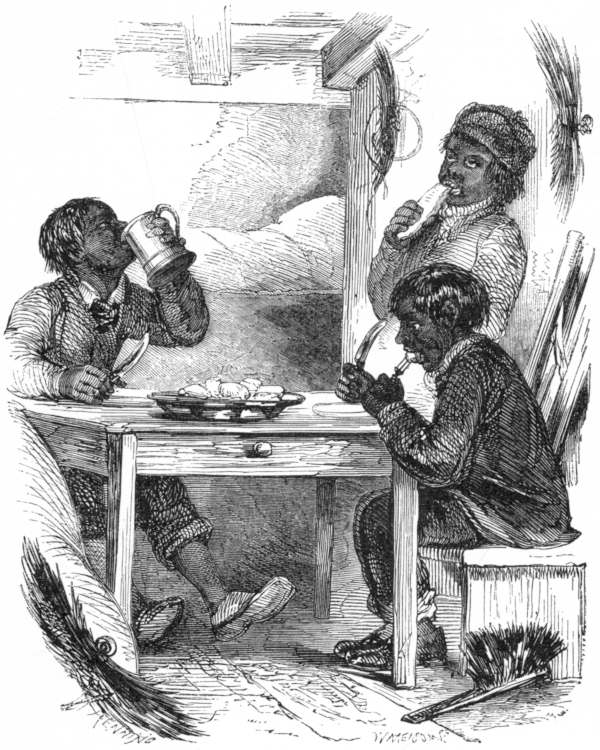
THE SWEEPS’ HOME.
(From a sketch taken on the spot.)
Of the Fires of London.
Connected with the subject of chimney sweeping is one which attracts far less of the attention of the legislature and the public than its importance would seem to demand: I mean the fires in the metropolis, with their long train of calamities, such as the loss of life and of property. These calamities, too, especially as regards the loss of property, are almost all endured by the poor, the destruction of whose furniture is often the destruction of their whole property, as insurances are rarely effected by them; while the wealthier classes, in the case of fires, are not exposed to the evils of houselessness, and may be actually gainers by the conflagration, through the sum for which the property was insured.
“The daily occurrence of fires in the metropolis,” say the Board of Health, “their extent, the number of persons who perish by them, the enormous loss of property they occasion, the prevalence of incendiarism, the apparent apathy with which such calamities are regarded, and the rapidity with which they are forgotten, will hereafter be referred to as evidence of a very low social condition and defective administrative organization. These fires, it was shown nearly a century ago, when the subject of insurance was debated in Parliament, were frequently caused from not having chimneys swept in proper time.” I am informed that a chimney may be on fire for many days, unknown to the inmates of the house, and finally break out in the body of the building by its getting into contact with some beam or wood-work. The recent burning of Limehouse Church was occasioned by the soot collected in the flue taking fire, and becoming red hot, when it ignited the wood-work in the roof. The flue, or pipe, was of iron.
From a return made by Mr. Braidwood of the houses and properties destroyed in the metropolis in the three years ending in 1849 inclusive, it appears that the total number was 1111: of contents destroyed (which, being generally insured separately, should be kept distinct) there were 1013. The subjoined table gives the particulars as to the proportion insured and uninsured:—
Insured.Uninsured.Total.
Houses9141971111
Contents6094041013
15236012124
“The proportion per cent. of the uninsured to the insured, would be—
Insured.Uninsured.Total.
Per Cent.Per Cent.
Houses111182·317·7100
Contents101360·139·9100
212471·728·3100
The following table gives the total number of fires in the metropolis during a series of years:
ABSTRACT OF CAUSES OF FIRE IN THE METROPOLIS, from 1833 to 1849, inclusive.
Compiled by W. Baddeley.
1833183418351836183718381839
Accidents of various kinds, for the most part unavoidable83401413173625
Apparel ignited on the person......7753
Candles, various accidents with56146110157125132128
Carelessness, palpable instances of28..191871714
Children playing with fire or candles....5618512
Drunkenness..23..246
Fire-heat, application of, to various hazardous manufacturing processes31243934224026
Fire-sparks......710129
Fire-works....3..535
Fires kindled on hearths and other improper places7..955158
Flues, foul, defective, &c.71656972535858
Fumigation, incautious..375215
Furnaces, kilns, &c., defective or over-heated..1129121520
Gas20253938314272
Gunpowder33..1312
Hearths, defective, &c...............
Hot cinders put away..............
Lamps......2394
Lime, slaking of..343..42
Linen, drying, airing, &c.....2231483226
Lucifer-matches........8917
Ovens6....63114
Reading, working, or smoking in bed..3......12
Shavings, loose, ignited..69138178
Spontaneous combustion72544513
Stoves, defective, over-heated, &c.18201128363124
Tobacco smoking..6413411
Suspicious........786
Wilful3968567
Unknown1251149196574567
1840184118421843184418451846
Accidents of various kinds, for the most part unavoidable26264419111729
Apparel ignited on the person12595433
Candles, various accidents with169184189166205165229
Carelessness, palpable instances of24251927151415
Children playing with fire or candles21181620231925
Drunkenness55116979
Fire-heat, application of, to various hazardous manufacturing processes29163614212225
Fire-sparks17132317272432
Fire-works14753109
Fires kindled on hearths and other improper places78998127
Flues, foul, defective, &c.898390105847886
Fumigation, incautious3221134
Furnaces, kilns, &c., defective or over-heated15122319172928
Gas48485240335453
Gunpowder....31..1..
Hearths, defective, &c.....352..4
Hot cinders put away....337108
Lamps35226117
Lime, slaking of2542397
Linen, drying, airing, &c.25274133453039
Lucifer-matches18161714191214
Ovens131313101088
Reading, working, or smoking in bed..523....3
Shavings, loose, ignited27352231182535
Spontaneous combustion11222023341918
Stoves, defective, over-heated, &c.48543258445143
Tobacco smoking9221714211929
Suspicious117916797
Wilful9131921111419
Unknown39233260743239
184718481849Total.Average
Accidents of various kinds, for the most part unavoidable20191345227
Apparel ignited on the person312694
Candles, various accidents with2372372412876169
Carelessness, palpable instances of20232430918
Children playing with fire or candles16191523814
Drunkenness537845
Fire-heat, application of, to various hazardous manufacturing processes16222344026
Fire-sparks65634035921
Fire-works618704
Fires kindled on hearths and other improper places3441207
Flues, foul, defective, &c.785678127375
Fumigation, incautious442493
Furnaces, kilns, &c., defective or over-heated14162126316
Gas63655778046
Gunpowder2..2221⅕
Hearths, defective, &c.343241½
Hot cinders put away9511563
Lamps2317765
Lime, slaking of553614
Linen, drying, airing, &c.34364050930
Lucifer-matches9231218811
Ovens8221177
Reading, working, or smoking in bed111221⅓
Shavings, loose, ignited37272133920
Spontaneous combustion1571922813
Stoves, defective, over-heated, &c.37484362637
Tobacco smoking18372423914
Suspicious1711101257
Wilful17251921112
Unknown723876108063
Here, then, we perceive that there are, upon an average of 17 years, no less than 770 “fires” per annum, that is to say, 29 houses in every 10,000 are discovered to be on fire every year; and about one-fourth of these are uninsured. In the year 1833 the total number of fires was only 458, or 20 in every 10,000 inhabited houses, whilst, in 1849, the number had gradually progressed to 838, or 28 in every 10,000 houses.
We have here, however, to deal more particularly with the causes of these fires, of which the following table gives the result of many years’ valuable experience:—
TABULAR EPITOME OF METROPOLITAN FIRES, FROM 1833 to 1849.
By W. Baddeley, 29, Alfred Street, Islington.
18331834183518361837183818391840184118421843
Slightly damaged292338315397357383402451438521489
Seriously damaged13511612513412215216520434224231
Totally destroyed3128313322331726242429
Total No. of Fires458482471564501568584681696769749
False Alarms5963666689807084676179
Alarms from Chimneys on Fire7510610612612710710198928283
Total No. of Calls592651643756717755755863855912911
Insuran. on Building and Contents......169173161169237343321276
Insurances on Building only......7347595892149116124
Insurances on Contents only......1047612811510452112107
Uninsured......218205220242248152220242
184418451846184718481849Total.Average
Slightly damaged5024315765365095826,574470
Seriously damaged2372442382732692282,955211
Totally destroyed23322027272836526
Total No. of Fires7627078348368058389,894770
False Alarms708111988120761,15082
Alarms from Chimneys on Fire9487696686891,30794
Total No. of Calls92687510229901011100312,351882
Insuran. on Building and Contents3133133022633103683,718266
Insurances on Building only1381071371251201631,508108
Insurances on Contents only9473125157134721,453104
Uninsured2172142702912412353,215230
Thus we perceive that, out of an average of 665 fires per annum, the information being derived from 17 years’ experience, the following were the number of fires produced by different causes:—
Average No. of Fires per Annum.
Candles, various accidents with169
Flues, foul, defective, &c.75
Unknown63
Gas46
Stoves over-heated37
Linen, drying, airing, &c.30
Accidents of various kinds, for the most part unavoidable27
Fire heat, application of, to various hazardous manufacturing processes26
Fire sparks21
Shavings, loose, ignited20
Carelessness, palpable instances of18
Furnaces, kilns, &c., defective or over-heated16
Children playing with fire or candles14
Tobacco smoking14
Spontaneous combustion13
Wilful12
Lucifer-matches11
Ovens7
Fires, kindled on hearths and other improper places7
Suspicious7
Lamps5
Drunkenness5
Lime, slaking of4
Apparel, ignited on the person4
Fireworks4
Hot cinders put away3
Incautious fumigation3
Reading, working, or smoking in bed1·33
Hearths defective1·25
665
Here, then, we find that while the greatest proportion of fires are caused by accidents with candles, about one-ninth of the fires above mentioned arise from foul flues, or 75 out of 665, a circumstance which teaches us the usefulness of the class of labourers of whom we have been lately treating.
It would seem that a much larger proportion of the fires are wilfully produced than appear in the above table.
The Board of Health, in speaking of incendiarism in connection with insurance, report:—
“Inquiries connected with measures for the improvement of the population have developed the operation of insurances, in engendering crimes and calamities; negatively, by weakening natural responsibilities and motives to care and forethought; positively, by temptations held out to the commission of crime in the facility with which insurance money is usually obtainable.
“The steady increase in the number of fires in the metropolis, whilst our advance in the arts gives means for their diminution, is ascribable mainly to the operation of these two causes, and to the division and weakening of administrative authority. From information on which we can rely, we feel assured that the crime of incendiarism for the sake of insurance money exists to a far greater extent than the public are aware of.”
Mr. Braidwood has expressed his opinion that only one-half of the property in the metropolis is insured, not as to numbers of property, but as to value; but the proportion of insured and uninsured houses could not be ascertained.
Mr. Baddeley, the inspector to the Society for the Protection of Life from Fire, who had given attention to the subject for the last 30 years, gave the Board the following account of the increase of fires:—
Fires per Annum of Houses and Properties.Of which were Totally Uninsured.Proportion per Cent. of Insured Houses and Properties Burnt.
In the first seven years there were on an average62321565·15
In the second seven years79024469·3
During this period there has been a great increase in the number of dwellings, but this has been chiefly in suburban places, where fires rarely occur.
“The frequency of fires,” it is further stated, “led Mr. Payne, the coroner of the City of London, to revive the exercise of the coroner’s function of inquiring into the causes of fires; most usefully. Out of 58 inquests held by him (in the City of London and the borough of Southwark, which comprise only one-eighteenth of the houses of the metropolis) since 1845, it appears that, 8 were proved to be wilful; 27 apparently accidental; and 23 from causes unknown, including suspicious causes. The proportion of ascertained wilful fires was, therefore, 23 per cent.; which gives strong confirmation to the indications presented by the statistical returns as to the excess of insured property burnt above uninsured.”
The at once mean and reckless criminality of arson, by which a man exposes his neighbours to the risk of a dreadful death, which he himself takes measures to avoid, has long, and on many occasions, gone unpunished in London. The insurance companies, when a demand is made upon them for a loss through fire, institute an inquiry, carried on quietly by their own people. The claimant is informed, if sufficient reasons for such a step appear, that from suspicious circumstances, which had come to the knowledge of the company, the demand would not be complied with, and that the company would resist any action for the recovery of the money. The criminal becomes alarmed, he is afraid of committing himself, and so the matter drops, and the insurance companies, not being required to pay the indemnification, are satisfied to save their money, and let the incendiarism remain unnoticed or unpunished. Mr. Payne, the coroner, has on some occasions strongly commented on this practice as one which showed the want of a public prosecutor.
A few words as regards the means of extinction and help at fires.
Upwards of two years ago the Commissioners of Police instructed their officers to note the time which elapsed between the earliest alarm of fire and the arrival of the first engine. Seventeen fires were noted, and the average duration of time before the fire-brigade or any parochial or local fire-engine, reached the spot, was 36 minutes. Two or three of these fires were in the suburbs; so that in this crowded city, so densely packed with houses and people, fifteen fires raged unchecked for more than half-an-hour.
There are in the metropolis, not including the more distant suburbs, 150 public fire stations, with engines provided under the management of the parochial authorities. The fire-brigade has but seventeen stations on land, and two on the river, which are, indeed, floating engines, one being usually moored near Southwark-bridge, the other having no stated place, being changed in its locality, as may be considered best. In the course of three years, the term of the official inquiry, the engines of the fire-brigade reached on the average the place where a fire was raging thirty-five times as the earliest means of assistance, when the parochial engines did the same only in the proportion of two to the thirty-five.
Mr. Braidwood, the director of the fire-brigade, stated, when questioned on the subject with a view to a report to be laid before Parliament, that “the average time of an engine turning out with horses was from three to seven minutes.” The engines are driven at the rate of ten miles an hour along the streets, which, in the old coaching days, was considered the “best royal mail pace.” Indeed, there have been frequent complaints of the rapidity with which the fire-engines are driven, and if the drivers were not skilful and alert, it would really amount to recklessness.
“Information of the breaking out of a fire,” it is stated in the report, “will be conveyed to the station of the brigade at the rate of about five miles an hour: thus in the case of the occurrence of a fire within a mile of the station, the intelligence may be conveyed to the station in about twelve minutes; the horses will be put to, and the engine got out into the street in about five minutes on the average; it traverses the mile in about six minutes; and the water has to be got into the engine, which will occupy about five minutes, making, under the most favourable circumstances for such a distance, 28 minutes, or for a half-mile distance, an average of not less than 20 minutes.”
The average distance of the occurring fires from a brigade station were, however, during a period of three years, terminating in 1850, upwards of a mile. One was five miles, several four miles, more were two miles, and a mile and a half, while the most destructive fires were at an average distance of a mile and three quarters. Thus it was impossible for a fire-brigade to give assistance as soon as assistance was needed, and, under other circumstances, might have been rendered. And all this damage may and does very often result from what seems so trifling a neglect as the non-sweeping of a chimney.
Mr. W. Baddeley, an engineer, and a high authority on this subject, has stated that he had attended fires for 30 years in London, and that, of 838 fires which took place in 1849, two-thirds might have been easily extinguished had there been an immediate application of water. In some places, he said, delay originated from the turn-cocks being at wide intervals, and some of the companies objecting to let any but their own servants have the command of the main-cocks.
The Board of Health have recommended the formation of a series of street-water plugs within short distances of each other, the water to be constantly on at high pressure night and day, and the whole to be under the charge of a trained body of men such as compose the present fire-brigade, provided at appointed stations with every necessary appliance in the way of hose, pipes, ladders, &c. “The hose should be within the reach,” it is urged in the report, “fixed, and applied on an average of not more than five minutes from the time of the alarm being given; that is to say, in less than one-fourth of the time within which fire-engines are brought to bear under existing arrangements, and with a still greater proportionate diminution of risks and serious accidents.”
Nor is this mode of extinguishing fires a mere experiment. It is successfully practised in some of the American cities, Philadelphia among the number, and in some of our own manufacturing towns. Mr. Emmott, the engineer and manager of the Oldham Water-works, has described the practice in that town on the occurrence of fires:—
“In five cases out of six, the hose is pushed into a water-plug, and the water thrown upon a building on fire, for the average pressure of water in this town is 146 feet; by this means our fires are generally extinguished even before the heavy engine arrives at the spot. The hose is much preferred to the engine, on account of the speed with which it is applied, and the readiness with which it is used, for one man can manage a hose, and throw as much water on the building on fire as an engine worked by many men. On this account we very rarely indeed use the engines, as they possess no advantage whatever over the hose.”
When the city of Hamburgh was rebuilt two or three years back, after its destruction by fire, it was rebuilt chiefly under the direction of Mr. W. Lindley, the engineer, and, as far as Mr. Lindley could accomplish, on sanitary principles, such as the abolition of cesspools. The arrangements for the surface cleansing of the streets by means of the hose and jet and the water-plugs, are made available for the extinction of fires, and with the following results, as communicated by Mr. Lindley:—
“Have there been fires in buildings in Hamburgh in the portion of the town rebuilt?—Yes, repeatedly. They have all, however, been put out at once. If they had had to wait the usual time for engines and water, say 20 minutes or half an hour, these might all have led to extensive conflagrations.
“What has been the effect on insurance?—The effect of the rapid extinction of fires has brought to light to the citizens of Hamburgh, the fact that the greater proportion of their fires are the work of incendiaries, for the sake of the insurance money. A person is absent; smoke is seen to exude; the alarm of fire is given, and the door is forced open, the jet applied, and the fire extinguished immediately. Case after case has occurred, where, upon the fire being extinguished, the arrangements for the spread of the fire are found and made manifest. Several of this class of incendiaries for the insurance money are now in prison. The saving of money alone, by the prevention of fires, would be worth the whole expense of the like arrangement in London, where it is well known that similar practices prevail extensively.”
The following statement was given by Mr. Quick, an engineer, on this subject:—
“After the destruction of the terminus of the South Western Railway by fire, I recommended them to have a 9-inch main, with 3-inch outlets leading to six stand-pipes, with joining screws for hose-pipes to be attached, and that they should carry a 3-inch pipe of the same description up into each floor, so that a hose might be attached in any room where the fire commenced.
“In how many minutes may the hose be attached?—There is only the time of attaching the hose, which need be nothing like a minute. I have indeed recommended that a short length of hose with a short nozzle or branch should be kept attached to the cock, so that the cock has only to be turned, which is done in an instant.
“It appears that fire-engines require 26 men to work each engine of two 7 inch barrels, to produce a jet of about 50 feet high. The arrangement carried out, at your recommendation, with six jets, is equivalent to keeping six such engines, and the power of 156 men, in readiness to act at all times, night and day, at about a minute’s notice, for the extinction of fires?—It will give a power more than equal to that number of men; for the jets given off from a 20-inch main will be much more regular and powerful, and will deliver more water than could be delivered by any engine. The jets at that place would be 70 feet high.”
The system of roof-cisterns, which was at one time popular as a means of extinction, has been found, it appears, on account of their leakage and diffusion of damp, to be but sorry contrivances, and have very generally been discontinued. Mr. Holme, a builder in Liverpool, gives the following, even under the circumstances, amusing account of a fire where such a cistern was provided:—
“The owner of a cotton kiln, which had been repeatedly burnt, took it into his head to erect a large tank in the roof. His idea was, that when a fire occurred, they should have water at hand; and when the fire ascended, it would burn the wooden tank, and the whole of the contents being discharged on the fire like a cataract, it would at once extinguish it. Well, the kiln again took fire; the smoke was so suffocating, that nobody could get at the internal pipe, and the whole building was again destroyed. But what became of the tank? It could not burn, because it was filled with water; consequently, it boiled most admirably. No hole was singed in its side or bottom; it looked very picturesque, but it was utterly useless.”
The necessity of almost immediate help is shown in the following statement by Mr. Braidwood, when consulted on the subject of fire-escapes, which under the present system are not considered sufficiently effective:—
“Taking London to be six miles long and three miles broad, to have anything like an efficient system of fire-escapes, it would be necessary to have one with a man to attend it within a quarter of a mile of each house, as assistance, to be of any use, must generally be rendered within five minutes after the alarm is given. To do this the stations must be within a quarter of a mile of each other (as the escapes must be taken round the angles of the streets): 253 stations would thus be required and as many men.
“At present scaling ladders are kept at all the engine stations, and canvas sheets also at some of them; several lives have been saved by them; but the distance of the stations from each other renders them applicable only in a limited number of instances.”
The engines of the fire-brigade throw up about 90 gallons a minute. Their number is about 100. The cost of a fire-engine is from 60l. to 100l., and the hose, buckets, and general apparatus, cost nearly the same amount.
Of the Sewermen and Nightmen of London.
We now come to the consideration of the last of the several classes of labourers engaged in the removal of the species of refuse from the metropolis. I have before said that the public refuse of a town consists of two kinds:—
I. The street-refuse.
II. The house-refuse.
Of each of these kinds there are two species:—
A. The dry.
B. The wet.
The dry street-refuse consists, as we have seen, of the refuse earth, bricks, mortar, oyster-shells, potsherds, and pansherds.
And the dry house-refuse of the soot and ashes of our fires.
The wet street-refuse consists, on the other hand, of the mud, slop, and surface water of our public thoroughfares.
And the wet house-refuse, of what is familiarly known as the “slops” of our residences, and the liquid refuse of our factories and slaughterhouses.
We have already collected the facts in connection with the three first of these subjects. We have ascertained the total amount of each of these species of refuse which have to be annually removed from the capital. We have set forth the aggregate number of labourers who are engaged in the removal of it, as well as the gross sum that is paid for so doing, showing the individual earnings of each of the workmen, and arriving, as near as possible, at the profits of their employers, as well as the condition of the employed. This has been done, it is believed, for the first time in this country; and if the subject has led us into longer discussions than usual, the importance of the matter, considered in a sanitary point of view, is such that a moment’s reflection will convince us of the value of the inquiry—especially in connection with a work which aspires to embrace the whole of the offices performed by the labourers of the capital of the British Empire.
It now but remains for us to complete this novel and vast inquiry by settling the condition and earnings of the men engaged in the removal of the last species of public refuse. I shall consider, first, the aggregate quantity of wet house-refuse that has to be annually removed; secondly, the means adopted for the removal of it; thirdly, the cost of so doing; and lastly, the number of men engaged in this kind of work, as well as the wages paid to them, and the physical, intellectual, and moral condition in which they exist, or, more properly speaking, are allowed to remain.
Of the Wet House-Refuse of London.
All house-refuse of a liquid or semi-liquid character is wet refuse. It may be called semi-liquid when it has become mingled with any solid substance, though not so fully as to have lost its property of fluidity, its natural power to flow along a suitable inclination.
Wet house-refuse consists of the “slops” of a household. It consists, indeed, of all waste water, whether from the supply of the water companies, or from the rain-fall collected on the roofs or yards of the houses; of the “suds” of the washerwomen, and the water used in every department of scouring, cleansing, or cooking. It consists, moreover, of the refuse proceeds from the several factories, dye-houses, &c.; of the blood and other refuse (not devoted to Prussian blue manufacture or sugar refining) from the butchers’ slaughter-houses and the knackers’ (horse slaughterers’) yards; as well as the refuse fluid from all chemical processes, quantities of chemically impregnated water, for example, being pumped, as soon as exhausted, from the tan-pits of Bermondsey into the drains and sewers. From the great hat-manufactories (chiefly also in Bermondsey and other parts of the Borough) there is a constant flow of water mixed with dyes and other substances, to add to the wet refuse of London.
It is evident, then, that all the water consumed or wasted in the metropolis must form a portion of the total sum of the wet refuse.
There is, however, the exception of what is used for the watering of gardens, which is absorbed at once by the soil and its vegetable products; we must also exclude such portion of water as is applied to the laying of the road and street dust on dry summer days, and which forms a part of the street mud or “mac” of the scavager’s cart, rather than of the sewerage; and we must further deduct the water derived from the street plugs for the supply of the fire-engines, which is consumed or absorbed in the extinction of the flames; as well as the water required for the victualling of ships on the eve of a voyage, when such supply is not derived immediately from the Thames.
The quantity of water required for the diet, or beverage, or general use of the population; the quantity consumed by the maltsters, distillers, brewers, ginger-beer and soda-water makers, and manufacturing chemists; for the making of tea, coffee, or cocoa; and for drinking at meals (which is often derived from pumps, and not from the supplies of the water companies);—the water which is thus consumed, in a prepared or in a simple state, passes into the wet refuse of the metropolis in another form.
Now, according to reports submitted to Parliament when an improved system of water-supply was under consideration, the daily supply of water to the metropolis is as follows:—
Gallons.
From the Water Companies44,383,329
„ „ Artesian Wells8,000,000
„ „ land spring pumps3,000,000
55,383,329
The yearly rain-fall throughout the area of the metropolis is 172,053,477 tons, or 33,589,972,120 gallons, 2 feet deep of rain falling on every square inch of London in the course of the year. The yearly total of the water pumped or falling into the metropolis is as follows:—
Gallons.
Yearly mechanical supply19,215,000,000
„ natural ditto38,539,972,122
57,754,972,122
The reader will find the details of this subject at p. 203 of the present volume. I recapitulate the results here to save the trouble of reference, and briefly to present the question under one head.
Of course the rain which ultimately forms a portion of the gross wet refuse of London, can be only such as falls on that part of the metropolitan area which is occupied by buildings or streets. What falls upon fields, gardens, and all open ground, is absorbed by the soil. But a large proportion of the rain falling upon the streets, is either absorbed by the dry dust, or retained in the form of mud; hence that only which falls on the house-tops and yards can be said to contribute largely to the gross quantity of wet refuse poured into the sewers. The streets of London appear to occupy one-tenth of the entire metropolitan area, and the houses (estimating 300,000 as occupying upon an average 100 square yards each[62]) another tithe of the surface. The remaining 92 square miles out of the 115 now included in the Registrar-General’s limits (which extend, it should be remembered, to Wandsworth, Lewisham, Bow, and Hampstead), may be said to be made up of suburban gardens, fields, parks, &c., where the rain-water would soak into the earth. We have, then, only two-tenths of the gross rain-fall, or 7,700,000,000 gallons, that could possibly appear in the sewers, and calculating one-third of this to be absorbed by the mud and dust of the streets, we come to the conclusion that the total quantity of rain-water entering the sewers is, in round numbers, 5,000,000,000 gallons per annum.
Reckoning, therefore, 5,000,000,000 gallons to be derived from the annual rain-fall, it appears that the yearly supply of water, from all sources, to be accounted for among the wet house-refuse is, in round numbers, 24,000,000,000 gallons.
The refuse water from the factories need not be calculated separately, as its supply is included in the water mechanically supplied, and the loss from evaporation in boiling, &c., would be perfectly insignificant if deducted from the vast annual supply, but 350,000,000 gallons have been allowed for this and other losses.
There is still another source of the supply of wet house-refuse unconnected either with the rain-fall or the mechanical supply of water—I mean such proportion of the blood or other refuse from the butchers’ and knackers’ premises as is washed into the sewers.
Official returns show that the yearly quantity of animals sold in Smithfield is—
Horned cattle224,000
Sheep1,550,000
Calves27,300
Pigs40,000
1,841,300
The blood flowing from a slaughtered bullock, whether killed according to the Christian or the Jewish fashion, amounts, on an average, to 20 quarts; from a sheep, to 6 or 7 quarts; from a pig, 5 quarts; and the same quantity from a calf. The blood from a horse slaughtered in a knackers’ yard is about the same as that from a bullock. This blood used to bring far higher prices to the butcher than can be now realized.
In the evidence taken by a Select Committee of the House of Commons in 1849, concerning Smithfield-market, Mr. Wyld, of the Fox and Knot-yard, Smithfield, stated that he slaughtered about 180 cattle weekly. “We have a sort of well made in the slaughterhouse,” he said, “which receives the blood. I receive about 1l. a week for it; it goes twice a day to Mr. Ton’s, at Bow Common. We used to receive a good deal more for it.” Even the market for blood at Mr. Ton’s, is, I am informed, now done away with. He was a manufacturer of artificial manure, a preparation of night-soil, blood, &c., baked in what may be called “cakes,” and exported chiefly to our sugar-growing colonies, for manure. His manure yard has been suppressed.
I am assured, on the authority of experienced butchers, that at the present time fully three-fourths of the blood from the animals slaughtered in London becomes a component part of the wet refuse I treat of, being washed into the sewers. The more wholesale slaughterers, now that blood is of little value (9 gallons in Whitechapel-market, the blood of two beasts—less by a gallon—can be bought for 3d.), send this animal refuse down the drains of their premises in far greater quantities than was formerly their custom.
Now, reckoning only three-fourths of the blood from the cattle slaughtered in the metropolis, to find its way into the sewers, we have, according to the numbers above given, the following yearly supply:—
Gallons.
From horned cattle840,000
„ sheep1,743,000
„ pigs37,500
„ calves25,590
2,646,090
This is merely the blood from the animals sold in Smithfield-market, the lambs not being included in the return; while a great many pigs and calves are slaughtered by the London tradesmen, without their having been shown in Smithfield.
The ordure from a slaughtered bullock is, on an average, from ½ to ¾ cwt. Many beasts yield one cwt.; and cows “killed full of grass,” as much as two cwt. Of this excrementitious matter, I am informed, about a fourth part is washed into the sewers. In sheep, calves, and pigs, however, there is very little ordure when slaughtered, only 3 or 4 lbs. in each as an average.
Of the number of horses killed there is no official or published account. One man familiar with the subject calculated it at 100 weekly. All the blood from the knackers’ yards is, I am told, washed into the sewers; consequently its yearly amount will be 26,000 gallons.
But even this is not the whole of the wet house-refuse of London.
There are, in addition, the excreta of the inhabitants of the houses. These are said to average ¼ lb. daily per head, including men, women, and children.
It is estimated by Bousingault, and confirmed by Liebig, that each individual produces ¼ lb. of solid excrement and 1¼ lb. of liquid excrement per day, making 1½ lb. each, or 150 lbs. per 100 individuals, of semi-liquid refuse from the water-closet. “But,” says the Surveyor of the Metropolitan Commission of Sewers, “there is other refuse resulting from culinary operations, to be conveyed through the drains, and the whole may be about 250 lbs. for 100 persons.”
The more fluid part of this refuse, however, is included in the quantity of water before given, so that there remains only the more solid excrementitious matter to add to the previous total. This, then, is ¼ lb. daily and individually; or from the metropolitan population of nearly 2,500,000 a daily supply of 600,000 lbs., rather more than 267 tons; and a yearly aggregate for the whole metropolis of 219,000,000 lbs., or very nearly about 100,000 tons.
From the foregoing account, then, the following is shown to be
The Gross Quantity of the Wet House-Refuse of the Metropolis.
Gallons.Lbs.
“Slops” and unabsorbed rain-water24,000,000,000=240,000,000,000
Blood of beasts2,646,000=26,460,000
„ horses26,000=260,000
Excreta219,000,000
Dung of slaughtered cattle17,400,000
Total24,002,657,000=240,263,120,000
Hence we may conclude that the more fluid portion of the wet house-refuse of London amounts to 24,000,000,000 gallons per annum; and that altogether it weighs, in round numbers, about 240,000,000,000 lbs., or 100,000,000 tons.
As these refuse products are not so much matters of trade or sale as other commodities, of course less attention has been given to them, in the commercial attributes of weight and admeasurement. I will endeavour, however, to present an uniform table of the whole great mass of metropolitan wet house-refuse in cubic inches.
The imperial standard gallon is of the capacity of 277·274 cubic inches; and estimating the solid excrement spoken of as the ordinary weight of earth, or of the soil of the land, at 18 cubic feet the ton, we have the following result, calculating in round numbers:—
Wet House-Refuse of the Metropolis.
Liquid24,000,000,000 gal.=6,600,000,000,000cub. in.
Solid100,000 tons=3,110,400,000 „
Thus, by this process of admeasurement, we find the
Wet House-Refuse of London=6,603,110,400,000 cubic in., or 3,820,000,000 cubic feet.
Figures best show the extent of this refuse, “inexpressible” to common appreciation “by numbers that have name.”
Of the Means of Removing the Wet House-refuse.
Whether this mass of filth be, zymotically, the cause of cholera, or whether it be (as cannot be questioned) a means of agricultural fertility, and therefore of national wealth, it must be removed. I need not dilate, in explaining a necessity which is obvious to every man with uncorrupted physical senses, and with the common moral sense of decency.
“Dr. Paley,” it is said, in a recent Report to the Metropolitan Commission of Sewers, “gave to Burckhardt and other travellers a set of instructions as to points of observation of the manners and conditions of the populations amongst whom they travelled. One of the leading instructions was to observe how they disposed of their excreta, for what they did with that showed him what men were; he also inquired what structure they had to answer the purpose of a privy, and what were their habits in respect to it. This information Dr. Paley desired, not for popular use, but for himself, for he was accustomed to say, that the facts connected with that topic gave him more information as to the real condition and civilisation of a population than most persons would be aware of. It would inform him of their real habits of cleanliness, of real decency, self-respect, and connected moral habits of high social importance. It would inform him of the real state of police, and of local administration, and much of the general government.
“The human ordure which defiles the churches, the bases of public edifices and works of art in Rome and Naples, and the Italian cities, gives more sure indications of the real moral and social position of the Italian population than any impressions derived from the edifices and works of art themselves.
“The subject, in relation to which the Jewish lawgiver gave most particular directions, is one on which the serious attention and labour of public administrators may be claimed.”
The next question, is—How is the wet house-refuse to be removed?
There are two ways:—
1. One is, to transport it to a river, or some powerfully current stream by a series of ducts.
2. The other is, to dig a hole in the neighbourhood of the house, there collect the wet refuse of the household, and when the hole or pit becomes full, remove the contents to some other part.
In London the most obvious means of getting rid of a nuisance is to convey it into the Thames. Nor has this been done in London only. In Paris the Seine is the receptacle of the sewage, but, comparatively, to a much smaller extent than in London. The fæcal deposits accumulated in the houses of the French capital are drained into “fixed” and “moveable” cesspools. The contents of both these descriptions of cesspools (of which I shall give an account when I treat of the cesspool system) are removed periodically, under the direction of the government, to large receptacles, called voiries, at Montfaucon, and the Forest of Bondy, where such refuse is made into portable manure. The evils of this system are not a few; but the river is spared the greater pollution of the Thames. Neither is the Seine swayed by the tide as is the Thames, for in London the very sewers are affected by the tidal influence, and are not to be entered until some time before or after high-water. I need not do more, for my present inquiry, than allude to the Liffy, the Clyde, the Humber, and others of the rivers of the United Kingdom, being used for purposes of sewerage, as channels to carry off that of which the law prohibits the retention.
Of the folly, not to say wickedness, of this principle, there can be no doubt. The vegetation which gives, demands food. The grass will wither without its fitting nutriment of manure, as the sheep would perish without the pasturage of the grass. Nature, in temperate and moist climates, is, so to speak, her own manurer, her own restorer. The sheep, which are as wild and active as goats, manure the Cumberland fells in which they feed. In the more cultivated sheep-walks (or, indeed, in the general pasturage) of the northern and some of the midland counties, women, with a wooden implement, may be continually seen in the later autumn, or earlier and milder winter, distributing the “stercoraceous treasure,” as Cowper calls it, which the animals, to use the North Yorkshire word, have “dropped,” as well as any extraneous manure which may have been spread for the purpose. As population and the demand for bread increase, the need of extraneous manures also increases; and Nature in her beneficence has provided that the greater the consumption of food, the greater shall be the promoters of its reproduction by what is loathsome to man, but demanded by vegetation. Liebig, as I shall afterwards show more fully, contends that many an arid and desolate region in the East, brown and burnt with barrenness, became a desolation because men understood not the restoration which all nature demands for the land. He declares that the now desolate regions of the East had been made desolate, because “the inhabitants did not understand the art of restoring exhausted soil.” It would be hopeless now to form, or attempt to form, the “hanging gardens,” or to display the rich florescence “round about Babylon,” to be seen when Alexander the Great died in that city. The Tigris and Euphrates, before and after their junction, Liebig maintains, have carried, and, to a circumscribed degree, still carry, into the sea “a sufficient amount of manure for the reproduction of food for millions of human beings.” It is said that, “could that matter only be arrested in its progress, and converted into bread and wine, fruit and beef, mutton and wool, linen and cotton, then cities might flourish once more in the desert, where men are now digging for the relics of primitive civilization, and discovering the symbols of luxury and ease beneath the barren sand and the sunburnt clay.”
This is one great evil; but in our metropolis there is a greater, a far greater, beyond all in degree, even if the same abuse exist elsewhere. What society with one consent pronounces filth—the evacuations of the human body—is not only washed into the Thames, and the land so deprived of a vast amount of nutriment, but the tide washes these evacuations back again, with other abominations. The water we use is derived almost entirely from the Thames, and therefore the water in which we boil our vegetables and our meat, the water for our coffee and tea, the water brewed for our consumption, comes to us, and is imbibed by us, impregnated over and over again with our own animal offal. We import guano, and drink a solution of our own fæces: a manure which might be made far more valuable than the foreign guano.
Such are a few of the evils of making a common sewer of the neighbouring river.
The other mode of removal is, to convey the wet house-refuse, by drains, to a hole near the house where it is produced, and empty it periodically when full.
The house-drainage throughout London has two characteristics. By one system all excrementitious and slop refuse generally is carried usually along brick drains from the water-closets, privies, sinks, lavatories, &c., of the houses into the cesspools, where it accumulates until its removal (by manual labour) becomes necessary, which is not, as an average, more than once in two years. By the other, and the newer system, all the house-refuse is drained into the public sewer, the cesspool system being thereby abolished. All the houses built or rebuilt since 1848 are constructed on the last-mentioned principle of drainage.
The first of these modes is cesspoolage.
The second is sewerage.
I shall first deal with the sewerage of the metropolis.
Of the Quantity of Metropolitan Sewage.
Having estimated the gross quantity of wet house-refuse produced throughout London in the course of the year, and explained the two modes of removing it from the immediate vicinity of the house, I will now proceed to set forth the quantity of wet house-refuse matter which it has been ascertained is removed with the contents of London sewers.
An experiment was made on the average discharge of sewage from the outlets of Church-lane and Smith-street, Chelsea, Ranelagh, King’s Scholar’s-pond, Grosvenor-wharf, Horseferry-road, Wood-street, King-street, Northumberland-street, Durham-yard, Norfolk-street, and Essex-street (the four last-mentioned places running from the Strand). The experiments were made “under ordinary and extraordinary circumstances,” in the months of May, June, and July, 1844, but the system is still the same, so that the result in the investigation as to the sewage of the year 1844 may be taken as a near criterion of the present, as regards the localities specified and the general quantity.
The surface drained into the outlets before enumerated covers, in its total area, about 7000 acres, of which nearly 3500 may be classed as urban. The observations, moreover, were made generally during fine weather.
I cannot do better by way of showing the reader the minuteness with which these observations were made, than by quoting the two following results, being those of the fullest and smallest discharges of twelve issues into the river. I must premise that these experiments were made on seven occasions, from May 4 to July 12 inclusive, and made at different times, but generally about eight hours after high water. In the Northumberland-street sewer, from which was the largest issue, the width of the sewer at the outlet was five feet. In the King-street sewer (the smallest discharge, as given in the second table) the width of the sewer was four feet. The width, however, does not affect the question, as there was a greater issue from the Norfolk-street sewer of two feet, than from the King-street sewer of four feet in width.
Northumberland Street.
Date.Velocity per second.Quantity discharged per second.
Feet.Cubic Feet.
May 44·60010·511000
„ 94·0006·800000
June 54·0006·800000
„ 104·60010·350000
„ 114·92012·300000
„ 163·6005·940000
July 122·7603·394800
56·095800
Being Mean Discharge per second8·013685
Ditto per 24 hours692382·
King Street.
May 4·147·021756
„ 9·333·079920
June 5·170·020400
„ 10·311·064688
„ 11·300·048000
„ 16·101·004040
July 12·103·008240
·247044
Mean Discharge per second·035292
Ditto per 24 hours3049·
Here we find that the mean discharge per second was, from the Northumberland-street sewer, 692,382· cubic feet per 24 hours, and from the King-street sewer, 3049 cubic feet per 24 hours.
The discharge from the principal outlets in the Westminster district “being the mean of seven observations taken during the summer,” was 1,798,094 cubic feet in 24 hours; the number of acres drained was 7006. The mean discharge per acre, in the course of 24 hours, was found to be about 256 cubic feet, comprising the urban and suburban parts.
The sewage, from the discharge of which this calculation was derived—and the dryness of the weather must not be lost sight of—may be fairly assumed as derived (in a dry season) almost entirely from artificial sources or house drainage, as there was no rain-fall, or but little. “Supposing, therefore,” the Report states, “the entire surface to be urban, we have 540 cubic feet as the mean daily discharge per acre. If, however, the average be taken of the first eight outlets, viz., from Essex-street to Grosvenor-wharf inclusive, which drain a surface wholly urban, the result is 1260 cubic feet per acre in the 24 hours. This excess may be attributed to the number of manufactories, and the densely-populated nature of the locality drained; but, as indicative of the general amount of sewage due to ordinary urban districts, the former ought perhaps to be considered the fairer average.”
It is then assumed—I may say officially—that the average discharge of the urban and suburban sewage from the several districts included within an area of 58 square miles, is equal to 256 cubic feet per acre.
Sq. Miles.
The extent of the jurisdiction included within this area is, on the north side of the Thames43
And on the Surrey and Kent side15
Cubic Feet.
The ordinary daily amount of sewage discharged into the river on the north side is, therefore7,045,120
And on the south side2,457,600
Making a total of9,502,720
Or a quantity equivalent to a surface of more than 36 acres in extent, and 6 feet in depth.
This mass of sewage, it must be borne in mind, is but the daily product of the sewage of the more populous part of the districts included within the jurisdiction of the two commissions of sewers.
The foregoing observations, calculations, and deductions have supplied the basis of many scientific and commercial speculations, but it must be remembered that they were taken between seven and eight years ago. The observations were made, moreover, during fine summer weather, generally, while the greatest discharge is during rainy weather. There has been, also, an increase of sewers in the metropolis, because an increase of streets and inhabited houses. The approximate proportion of the increase of sewers (and there is no precise account of it) is pretty nearly that of the streets, lineally. Another matter has too, of late years, added to the amount of sewage—the abolition of cesspoolage in a considerable degree, owing to the late Building and Sanitary Acts, so that fæcal and culinary matters, which were drained into the cesspool (to be removed by the nightmen), are now drained into the sewer. Altogether, I am assured, on good authority, the daily discharge of the sewers extending over 58 square miles of the metropolis may be now put at 10,000,000 cubic feet, instead of rather more than nine and a half millions. And this gives, as
Cubic Feet.
The annual amount of discharge from the sewers3,650,000,000
The total amount of wet house-refuse, according to the calculation before given, is3,820,000,000
Hence there remains170,000,000
Sq. Miles.
Now it will be seen that the total area from which this amount of sewage is said to be drained is58
But the area of London, according to the Registrar-General’s limits, is115
So that the 3,650,000,000 cubic feet of sewage annually removed from 58 square miles of the metropolis refer to only one-half of the entire area of the true metropolis; but it refers, at the same time, to that part of London which is the most crowded with houses, and since, in the suburbs, the buildings average about 2 to the acre, and, in the densest parts of London, about 30, it is but fair to assume that the refuse would be, at least, in the same proportion, and this is very nearly the fact; for if we suppose the 58 miles of the suburban districts to yield twenty times less sewage than the 58 miles of the urban districts, we shall have 182,500,000 cubic feet to add to the 3,650,000,000 cubic feet before given, or 3,832,500,000 for the sewage of the entire metropolis.
It does not appear that the sewage has ever been weighed so as to give any definite result, but calculating from the weight of water (a gallon, or 10 lbs. of water, comprising 277·274 cubic inches, and 1 ton of liquid comprising 36 cubic feet) the total, from the returns of the investigation in 1844, would be
Tons.
Quantity of sewage daily emptied into the Thames278,000
Ditto Annually101,390,000
In September, 1849, Mr. Banfield, at one time a Commissioner of Sewers, put the yearly quantity of sewage discharged into the Thames at 45,000,000 tons; but this is widely at variance with the returns as to quantity.
Of Ancient Sewers.
The traverser of the London streets rarely thinks, perhaps, of the far extended subterranean architecture below his feet; yet such is indeed the case, for the sewers of London, with all their imperfections, irregularities, and even absurdities, are still a great work; certainly not equal, in all respects, to what once must have existed in Rome, but second, perhaps, only to the giant works of sewerage in the eternal city.
The origin of these Roman sewers seems to be wrapped in as great a mystery as the foundation of the city itself. The statement of the Roman historians is that these sewers were the works of the elder Tarquin, the fifth (apocryphal) king of Rome. Tarquin’s dominions, from the same accounts, did not in any direction extend above sixteen miles, and his subjects could be but banditti, foragers, and shepherds. One conjecture is, that Rome stands on the site of a more ancient city, and that to its earlier possessors may be attributed the work of the sewers. To attribute them to the rudeness and small population of Tarquin’s day, it is contended, is as feasible as it would be to attribute the ruins of ancient Jerusalem, or any others in Asia Minor, to the Turks, or the ruins of Palmyra to the Arabs, because these people enjoy the privilege of possession.

THE SEWER-HUNTER.
[From a Daguerreotype by Beard.]
The main sewer of Rome, the Cloaca Maxima, is said to have been lofty and wide enough for a waggon load of hay to pass clear along it. Another, and more probable account, however, states that it was proposed to enlarge the great sewer to these dimensions, but it does not appear to have been so enlarged. Indeed, when Augustus “made Rome marble,” it was one of his great works also, under the direction of Agrippa, to reconstruct, improve, and enlarge the sewers. It was a project in the days of Rome’s greatness to turn seven navigable rivers into vast subterraneous passages, larger sewers, along which barges might pass, carrying on the traffic of Imperial Rome. In one year the cost of cleansing, renewing, and repairing the sewers is stated to have been 1000 talents of gold, or upwards of 192,000l. Of the average yearly cost we have no information. Some accounts represent these sewers as having been rebuilt after the irruption of the Gauls. In Livy’s time they were pronounced not to be accommodated to the plan of Rome. Some portions of these ancient structures are still extant, but they seem to have attracted small notice even from professed antiquarians; their subterranean character, however, renders such notice little possible. In two places they are still kept in repair, and for their original purpose, to carry off the filth of the city, but only to a small extent.
Our legislative enactments on the subject of sewers are ancient and numerous. The oldest is that of 9 Henry III., and the principal is that of 23 Henry VIII., commonly called the “Statute of Sewers.” These and many subsequent statutes, however, relate only to watercourses, and are silent as regards my present topic—the Refuse of London.
It is remarkable how little is said in the London historians of the sewers. In the two folio volumes of the most searching and indefatigable of all the antiquarians who have described the old metropolis, John Stow, the tailor, there is no account of what we now consider sewers, inclosed and subterranean channels for the conveyance of the refuse filth of the metropolis to its destination—the Thames. Had covered sewers been known, or at any rate been at all common, in Stow’s day, and he died full of years in 1604, and had one of them presented but a crumbling stone with some heraldic, or apparently heraldic, device at its outlet, Stow’s industry would certainly have ferreted out some details. Such, however, is not the case.
This absence of information I hold to be owing to the fact that no such sewers then existed. Our present system of sewerage, like our present system of street-lighting, is a modern work; but it is not, like our gas-lamps, an original English work. We have but followed, as regards our arched and subterraneous sewerage, in the wake of Rome.
As I have said, the early laws of sewers relate to watercourses, navigable communications, dams, ditches, and such like; there is no doubt, however, that in the heart of the great towns the filth of the houses was, by rude contrivances in the way of drainage, or natural fall, emptied into such places. Even in the accounts of the sewers of ancient Rome, historians have stated that it is not easy, and sometimes not possible, to distinguish between the sewers and the aqueducts, and Dr. Lemon, in his English Etymology, speaks of sewers as a species of aqueducts. So, in some of our earlier Acts of Parliament, it is hardly possible to distinguish whether the provisions to be applied to the management of a sewer relate to a ditch to which house-filth was carried—to a channel of water for general purposes—or to an open channel being a receptacle of filth and a navigable stream at the same time.
That the ditches were not sewers for the conveyance of the filth from the houses to any very great, or rather any very general extent, may very well be concluded, because (as I have shown in my account of the early scavagers) the excrementitious matter was deposited during the night in the street, and removed by the proper functionaries in the morning, or as soon as suited their convenience. Though this was the case generally, it is evident that the filth, or a portion of it, from the houses which were built on the banks of the Fleet River (as it was then called, as well as the Fleet Ditch), and on the banks of the other “brooks,” drained into the current stream. The Corporation accounts contain very frequent mention of the cleansing, purifying, and “thorough” cleansing of the Fleet Ditch, the Old Bourne (Holborn Brook), the Wall Brook, &c.
Of all these streams the most remarkable was Fleet Ditch, which was perhaps the first main sewer of London. I give from Stow the following curious account of its origin. It is now open, but only for a short distance, offending the air of Clerkenwell. At one period it was to afford a defence to the City! as the Tower-moat was a defence to the Tower, and fortress.