Volume 2 — Of the London Chimney-Sweepers. (continued 7)
Reading edition
The Commissioners say, “The discovery of M. Salmon awakened the attention of the contractors of Montfaucon, who employed one of our most skilful chemists to find for them a means of disinfection other than that for which M. Salmon had taken out a patent. M. Sanson and some other persons made similar researches, and from their joint investigations it resulted that disinfection might be equally well produced with turf ashes, with carbonized turf, and with the simple débris of this very abundant substance; and that the same success might be obtained with saw-dust, with the refuse matter of the tan-yards, with garden mould, so abundant in the environs of Paris, and with many other substances. A curious experiment has even shown, that after mixing with a clayey earth a portion of fæcal matter, it was only necessary to carbonize this mixture to obtain a perfect disinfectant powder. Theory had already indicated the result.”
This disinfection, however, has not been carried out in the Voiries, nor in the manufacture of poudrette.
From the account of the general refuse depositories of Paris we pass to the particular receptacles or cesspools of the French capital.
The Parisian cesspools are of two sorts:—
1. Fixed or excavated cesspools.
2. Movable cesspools.
“In early times the excavated cesspools or pits were constructed in the rudest manner, and cleaned out more or less frequently, or utterly neglected, at the discretion of their owners. As the city increased in size, however, and as the permeations necessarily taking place into the soil accumulated in the lapse of centuries, the evil resulting was found to be of grave magnitude, calling for prompt and vigorous interference on the part of the authorities. It appears certain that prior to the year 1819 (when a strict ordonnance was issued on the subject) the cesspools were very carelessly constructed. For the most part they were far from water-tight, and very probably were not intended to be otherwise. Consequently, nearly the whole of the fluid matter within them drained into the springs beneath the substratum, or became absorbed by the surrounding soil. Nor was this the only evil: the basement walls of the houses became saturated with the offensive permeations, and the atmosphere, more particularly in the interior of the dwellings, tainted with their exhalations.
“The movable cesspools, for the most part, consist simply of tanks or barrels, which, when full, are removed to some convenient spot for the purpose of their contents being discharged. This form of cesspool, though not leading to that contamination of the substratum which is naturally induced by the fixed or excavated cesspool, may occasion many offensive nuisances from carelessness in overfilling, or in the process of emptying.”
“The movable cesspools are of two kinds; the one,” says Mr. Rammell, “extremely simple and primitive in construction, the other more complicated. The former retains all the refuse, both liquid and solid, passed into it; the latter retains only the solid matter, the liquid being separated by a sort of strainer, and running off into another receptacle.
“The advantage of this separating apparatus is, that those cesspools provided with it require to be emptied less frequently than the others; the solid matter being alone retained in the movable part. The liquid portion is withdrawn from the tank into which it is received by pumping.
“The other kind of movable cesspool consists simply of a wooden cask set on end, and having its top pierced to admit the soil-pipe. It is intended to retain both solid and liquid matter. When full, it is detached, and the aperture in the top having been closed by a tight-fitting lid secured by an iron bar placed across, it is removed, and an empty one immediately substituted for it.
“The movable cesspool last described is much more generally used than the other kind; very few are furnished with the separating apparatus. But the use of either sort, I am told, is not on the increase. The movable cesspools are found, on the whole, to be more expensive than the fixed, besides entailing many inconveniences, one of which is the frequent entrance of workmen upon the premises for the purpose of removing them, which sometimes has to be done every second or third day. Moreover, if the cask becomes in the slightest degree overcharged, there is an overflow of matter.”
Indeed, the movable system of cesspools (it appears from further accounts) seems to be now adopted only in those places where fixed cesspools could not be altered in accordance with the ordonnance, or where it is desired to avoid the first cost of a fixed cesspool.
An ordonnance of 1819 enacts peremptorily that all cesspools, fixed or excavated, then existing, shall be altered in accordance with its provisions upon the first subsequent emptying after the date of the enactment, “or if that be found impracticable, they shall be filled up.” This full delegation of power to a centralised authority was the example prompting our late stringent enactments as to buildings and sewerage.
The French ordonnance provides also that the walls, arches, and bottoms of the cesspools, shall be constructed of a very hard description of stone, known as “pierres meulières” (mill-stone); the mortar used is to be hydraulic lime and clean river sand. Each arch is to be 30 to 35 centimètres (12 to 14 inches) in thickness, and the walls 45 to 50 centimètres (18 to 20 inches); the interior height not to be less than 2 mètres (2 yards 6 inches). A soil-pipe is always to be placed in the middle of the cesspool; its interior diameter is not to be less than 9⅞ inches in pottery-ware piping, or 7⅞ inches in cast iron. A vent-pipe, not less than 9⅞ inches in diameter, is to be carried up to the level of the chimney-tops, or to that of the chimneys of the adjoining houses. This is, if possible, to divert the smell from the house to which the cesspool is attached.
“A principal object of the ordonnance,” it is stated in the Reports, “was to ensure the cesspools being thenceforth made water-tight; so that further pollution of the substratum and springs might be prevented; and the provisions for its attainment have been very strictly enforced by the police. The present cesspools are, in fact, water-tight constructions, retaining the whole of the liquids passed into them until the same are withdrawn by artificial means. The advantage has its attendant inconveniences, and, moreover, has been dearly paid for; for, independently of the cost of the alterations and the increased cost of making the cesspools in the outset—the liquids no longer draining away by natural permeation—the constant expense of emptying them has enormously increased. In the better class of houses, where water is more freely used, the operation has now to be repeated every three, four, or five months, whereas formerly the cesspool was emptied every eighteen months or two years. An increased water supply has added to the evil, moderate even now as the extent of that supply is.”
“It is estimated that, in the better class of houses, the daily quantity of matter, including the water necessary for cleanliness and to ensure the passage of the solids through the soil-pipe, passing into the cesspool from each individual, amounts to 1¾ litre (3·08 English pints). Foreign substances are found in great abundance in the cesspools; the large soil-pipes permitting their easy introduction; so that the cesspool becomes the common receptacle for a great variety of articles that it is desired secretly to get rid of. Article 19 of the Police Regulations directs that nightmen finding any articles in the cesspools, especially such as lead to the suspicion of a crime or misdemeanor, shall make a declaration of the fact the same day to a Commissary of Police.”
In all such matters the police regulations of France are far more stringent and exacting than those of England.
“The cesspools vary considerably in foulness,” continues the Report; “and it is remarkable that those containing the greatest proportion of water are the most foul and dangerous. This is accounted for by the increased quantity of sulphuretted hydrogen gas evolved: and is more particularly the case where, from their large size, or from the small number of people using them, much time is allowed for the matter to stagnate and decompose in them. Soap-suds are said to add materially to their offensive and dangerous condition. The FOULNESS of the cesspools, therefore, would appear to be in direct proportion to the CLEANLY habits of the inmates of the houses to which they respectively belong. Where urine predominates ammoniacal vapours are given off in considerable quantities, and although these affect the eyes of those exposed to them—and the nightmen suffer much from inflammation of these organs—no danger to life results. The inflammation, however, is often sufficiently acute to produce temporary blindness, and from this cause the men are at times thrown out of work for days together.”[77]
The emptying of the cesspools is the next point to be considered.
No cesspool is allowed to be emptied in Paris, and no nightman’s cart, containing soil, is allowed to be in the streets from 8 A.M. to 10 P.M. from October 1st to March 31st, nor from 6 A.M. to 11 P.M. from April 1st to September 30th. In the winter season the hours of labour permitted by law are ten, and in the summer season seven, out of the twenty-four; while in London the hours of night-work are limited to five, without any distinction of season. These hours, however, only relate to the cleansing of the fixed cesspools of Paris.
Fixed or excavated cesspools are emptied into carts, which are driven to the receptacles. As far as regards the removal of night-soil along the streets, there are far more frequent complaints of stench and annoyance in Paris than in London. None of these cesspools can be emptied without authority from the police, and the police exercise a vigilant supervision over the whole arrangements; neither can any cesspool, after being emptied, be closed without a written authority, after inspection, by the Director of Health; nor can a cesspool, if found defective when emptied, be repaired without such authority.
“With regard to the movable cesspool,” it is reported, “the process of emptying is very simple, though undoubtedly demanding a considerable expenditure of labour. The tank or barrel, when filled, is disconnected from the soil-pipe, an empty one being immediately substituted in its place, and the bung-hole being securely closed, it is conveyed away on a vehicle, somewhat resembling a brewer’s dray (which holds about eight or ten of them), to the spot appointed as the depository of its discharged contents. The removal of movable cesspools is allowed to take place during the day.”
In opening a cesspool in Paris, precautions are always taken to prevent accidents which might result from the escape or ignition of the gases.
The general, not to say universal, mode of emptying the fixed or excavated cesspools is to pump the contents into closed carts for transport.
“This operation is,” says Mr. Rammell, “performed with two descriptions of pumps, one working on what may be called the hydraulic principle, the other on the pneumatic. In the former, the valves are placed in the pipe communicating between the cesspool and the cart, and the matter itself is pumped. In the latter, the valves are placed beyond the cart, and the air being pumped out of the cart, the matter flows into it to fill up the vacuum so occasioned. The real principle is of course the same in both cases, the matter being forced up by atmospheric pressure. One advantage of the pneumatic system is, that there are no valves to impede the free passage of matter through the suction-pipe; another, that it permits the use of a pipe of larger diameter.
“The cart employed for the pneumatic system consists of an iron cylinder, mounted sometimes upon four, but generally upon two wheels, the latter arrangement being found to be the more convenient. Previous to use at the cesspool, the carts are drawn to a branch establishment, situate just within the Barrière du Combat, where they are exhausted of air with an air-pump, worked by steam power. A 12-horse engine erected there is capable of exhausting five carts at the same time; the vacuum produced being equal to 28⅜ inches (72 centimètres) of mercury. A cart (in good repair, and upon two wheels) will preserve a practical vacuum for 48 hours after exhaustion.”
The total weight of one of these carts when full is about 3 tons and 8 cwt. This is somewhat more than the weight of the contents of a London waggon employed in night-soil carriage. Three horses are attached to each cart.
When an opening into the cesspool has been effected, a suction-pipe on the pneumatic principle is laid from the cesspool to the cart. This pipe is 315/16 inches in diameter, and is in separate pieces of about 10 feet each, with others shorter (down even to 1 foot), to make up any exact length required. Two kinds are commonly used; one made of leather, having iron wire wound spirally inside to prevent collapse, the other of copper. The leather pipe is used where a certain degree of pliability is required; the copper for the straight parts of the line, and for determined curves; pieces struck from various radii being made for the purpose.
Gutta-percha has been tried as a substitute for leather in the piping, but was pronounced liable to split, and its use was abandoned. So with India-rubber in London.
The communication between the suction-pipe and the vehicle used by the nightmen is opened by withdrawing a plug by means of a forked rod into the “recess” (hollow) of the machine, an operation tasking the muscular powers of two men. This done, the cesspool contents rush into the cart, being forced up by the weight of the atmosphere to occupy the existing vacuum; this occupies about three minutes. The cart, however, is then but three-fourths filled with matter, the remaining fourth being occupied by the rarefied air previously in the cart, and by the air contained in the suction-pipe. This air is next withdrawn by the action of a small air-pump, worked usually by two, but sometimes by one man. The air-pump is placed on the ground at a little distance from the cesspool cart, and communicates with it by a flexible India-rubber tube, an inch in diameter. The air, as fast as it is pumped out, is forced through another India-rubber tube of similar dimensions, which communicates with a furnace, also placed on the ground at a little distance from the air-pump, the pump occupying the middle space between the cart and the furnace, the furnace and the pump being portable. To ascertain when the vehicle is full, a short glass tube is inserted in the end of the air-pipe (the end being of brass), and through this, with the help of a small lantern, the matter is seen to rise.
“The number of carts required for each operation,” states Mr. Rammell, “of course varies according to the size of the cesspool to be emptied; but as these contain on the average about five cartloads, that is the number usually sent.[78]
“In addition to the carts for the transport of the night-soil, a light-covered spring van drawn by one horse is used to carry the tools, &c., required in the process.
“These tools consist of—
“1. An air-pump when the work is to be done on the pneumatic system, and of an hydraulic pump when it is to be done on the hydraulic system.
“2. About 50 mètres of suction-pipe of various forms and lengths.
“3. A furnace for the purpose of burning the gases.
“4. Wooden hods for the removal of the solid night-soil.
“5. Pails, a ladder, pincers, levers, hammers, and other articles.”
I have hitherto spoken of the Pneumatic System of emptying the Parisian cesspools. The results of the Hydraulic System are so similar, as regards time, &c., that only a brief notice is required. The hydraulic pump is worked by four men; it is placed on the ground in the place most convenient for the operation, and the cart is filled in the space of from three to five minutes.
A furnace is used.
“The furnace,” says the Report, “consists of a sheet-iron cylinder, about nine inches in diameter, pierced with small holes, and covered with a conical cap to prevent the flame spreading. The vent-pipe first communicates underneath with a small reservoir, intended to contain the matter in case the operation should be carried too far. A piece is inserted in the bottom of this reservoir, by unscrewing which it may be emptied. The furnace is sometimes fixed upon a plank, which rests upon two projecting pieces behind the cart.”
An indicator is also used to show the advancement of the filling of the cart; a glass tube and a cork float are the chief portions of the apparatus of the indicator.
“Towards the end of the operation, when the quantity of matter remaining in the cesspool, although sufficiently fluid, is too shallow for pumping, it is scooped into a large pail; and, the end of the suction-pipe being introduced, drawn up into the cart. When the matter is in too solid a state to pass through the pipe, it is carried to the cart in hods, unless it is in considerable quantity. In that case it is removed in vessels called tinettes, in the shape of a truncated cone, holding each about 3½ cubic feet. These vessels are closed with a lid, and are lifted into an open waggon for transport.”
Of these two systems the pneumatic is the more costly, and is likely to be supplanted by the hydraulic. Each system, according to Mr. Rammell, is still a nuisance, as, in spite of every precaution, the gases escape the moment the cesspool emptying is commenced, and vitiate the atmosphere. They force their way very often through the joints of the pipes, and are insufficiently consumed in the furnaces. Mr. Rammell mentions his having twice, after witnessing two of these operations, suffered from attacks of illness. On the first occasion, the men omitted to burn the foul air, and the atmosphere being heavy with moisture, the odour was so intense that it was smelt from the Rue du Port Mahon to the Rue Menars, more than 400 yards distant.
The emptying of the cesspools is let by contract, the commune acting in the light of a proprietor. To obtain a contract, a man must have license or permission from the prefect of police, and such license is only granted after proof that the applicant is provided with the necessary apparatus, carts, &c., and also with a suitable dépôt for the reception of the pumps, carts, &c., when not in use. The stock-in-trade of a contractor is inspected at least twice a-year, and if found inadequate or out of repair the license is commonly withdrawn. The “gangs” of nightmen employed by the contractors are fixed by the law at four men each (the number employed in London), but without any legal provision on the subject. The terms of these contracts are not stated, but they appear to have ceased to be undertakings by individual capitalists, being all in the hands of companies, known as compagnies de vidanges (filth companies). There are now eight companies in Paris carrying on these operations. More than half of the whole work, however, is accomplished by one company, the “Compagnie Richer.” The capital invested in their working stock is said to exceed 4,800,000 francs (200,000l.). They now require the labour of 350 horses, and the use of 120 vehicles of different descriptions.
The construction of a cesspool in Paris costs about 18l. as an average. The houses containing from 30 to 70 inmates may have two, and occasionally more, cesspools. Taking the average at one and a half, the capital sunk in a cesspool is 27l. Mr. Rammell says:—
“Adopting these calculations of the number of cesspools to each house, and their cost, and allowing only the small quantity of 1¾ litre (3·08 pints) of matter to each individual, the annual expense of the cesspool system in Paris, per house containing 24 persons, will be,—
“For interest, at 5 per cent upon capital sunk in works of construction, 1l. 7s.
“For extraction and removal of matter, 5l. 11s.
“Total, 6l. 18s.
“The annual expense per inhabitant will be 5s. 9d.
“The latter, then, may be taken as the average yearly sum per head actually paid by that portion of the inhabitants of Paris who use the cesspools.”
The following, among others before shown, are the conclusions arrived at by Mr. Rammell:—
1. “That with the most perfect regulations, and the application of machines constructed upon scientific principles, the operation of emptying cesspools is still a nuisance, not only to the inmates of the house to which it belongs, but to those of the neighbouring houses, and to persons passing in the street.
2. “That the cesspool system of Paris presents an obstacle to the proper extension of the water supply, and consequently represses the growth of habits of personal and domestic cleanliness, with their immense moral results; and that in this respect it may be said to be inconsistent with a high degree of civilization of the masses of any community.
3. “That, compared with a tubular system of refuse drainage, it is an exceedingly expensive mode of disposing of the fæcal refuse of a town.”
Of the Emptying of the London Cesspools by Pump and Hose.
Having now ascertained the quantity of wet house-refuse annually deposited in the cesspools of the metropolis, the next step is to show the means by which these 15,000,000 cubic feet of cesspoolage are removed, and whence they are conveyed, as well as the condition of the labourers engaged in the business.
There are two methods of removing the soil from the tanks:—
1. By pump and hose, or the hydraulic method;
2. By shovel and tube, or manual labour.
The first of these is the new French mode, and the other the old English method of performing the work. The distinctive feature between the two is, that in the one case the refuse is discharged by means of pipes into the sewers, and in the other that it is conveyed by means of carts to some distant night-yard.
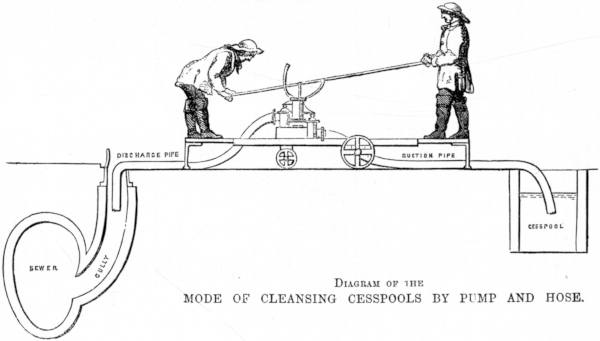
Diagram of the
MODE OF CLEANSING CESSPOOLS BY PUMP AND HOSE.
According to the French method, therefore, the cesspoolage ultimately becomes sewage, the refuse being deposited in a cesspool for a greater or a less space of time, and finally discharged into the sewers; so that it is a kind of intermediate process between the cesspool system and the sewer system of defecating a town, being, as it were, a compound of the two.
The great advantage of the sewer system, as contradistinguished from the cesspool system of defecation, is, that it admits of the wet refuse being removed from the neighbourhood of the house as soon as it is produced; while the advantage of the cesspool system, as contradistinguished from the sewer system, is, that it prevents the contamination of the river whence the town draws its principal supply of water. The cesspool system of defecation remedies the main evil of the sewer system, and the sewer system the main evil of the cesspool system. The French mode of emptying cesspools, however, appears to have the peculiar property of combining the ill effects of both systems without the advantages of either. The refuse of the house not only remains rotting and seething for months under the noses of the household, but it is ultimately—that is, after more than a year’s decomposition—washed into the stream from which the inhabitants are supplied with water, and so returned to them diluted in the form of aqua pura, for washing, cooking, or drinking. The sole benefit accruing from the French mode of nightmanship is, that it performs a noisome operation in a comparatively cleanly manner; but surely this is a small compensation for the evils attendant upon it. The noses of those who prefer stagnant cesspools to rapid sewers cannot be so particularly sensitive, that for the sake of avoiding the smell of the nightman’s cart they would rather that its contents should be discharged into the water that they use for household purposes.
The hydraulic or pump-and-hose method of emptying the cesspools is now practised by the Court of Sewers, who introduced the process into London in the winter of 1847. The apparatus used in this country consists of an hydraulic pump, which is generally placed six or eight feet distant from, but sometimes close to, the cesspool—indeed, on its edge. It is worked by two men, “just up and down,” as one of the labourers described it to me, “like a fire-engine.” A suction-pipe, with an iron nozzle, is placed in the cesspool, into which is first introduced a deodorising fluid, in the proportion, as well as can be estimated, of a pint to a square yard of matter, and diluted with water from the fire-plugs.
The pipes are of leather, the suction-pipes being wrapped with spring-iron wire at the joints. India-rubber pipes were used, and “answered very tidy,” one of the gangers told me, but they were too expensive, the material being soon worn out: they were only tried five or six months. The pipes now employed differ in no respect of size or appearance from the leathern fire-engine pipes; and as the work is always done in the daytime, and no smell arises from it, the neighbourhood is often alarmed, and people begin to ask where the fire is. One outsideman said, “Why, that’s always asked. I’ve been asked—ay, I dare say a hundred times in a day—‘Where’s the fire? where’s the fire?’” A cesspool, by this process, has been emptied into a sewer at 300 yards distant. The pipe is placed within the nearest gullyhole, down which the matter is washed into the sewer. When the cesspool is emptied, it is well sluiced with water; the water is pumped into the sewer, and then the work is complete.
The pumping is occasionally very hard work, making the shoulders and back ache grievously; indeed, some cesspools have been found so long neglected, and so choked with rags and rubbish, that manual labour had to be resorted to, and the matter dug and tubbed out, after the old mode of the nightmen. A square yard of cesspoolage is cleared out, under ordinary circumstances, in an hour; while an average duration of time for the cleansing of a regularly-sized cesspool is from three to four hours.
A pneumatic pump, with an iron cart, drawn by two horses (similar to the French invention), was tried as an experiment, but discontinued in a fortnight.
For the hydraulic method of emptying cesspools, a gang of four men, under the direction of a ganger, who makes a fifth, is required.
The division of labour is as follows:—
1. The pumpmen, who, as their name implies, work the engine or pumps.
2. The holeman, who goes into the cesspool and stirs up the matter, so as to make it as fluid as possible.
3. The outsideman, whose business it is to attend to the pipe, which reaches from the cesspool, along the surface of the street, or other place, to the gullyhole.
4. The ganger, who is the superintendent of the whole, and is only sometimes present at the operation; he is not unfrequently engaged, while one cesspool is being emptied, in making an examination or any necessary arrangement for the opening of another. He also gives notice (acting under the instruction of the clerk of the works) to the water company of the district, that the pumps will be at work in this or that place, a notice generally given a day in advance, and the water is supplied gratuitously, from a street fire-plug, and used at discretion, some cesspool contents requiring three times more water than others to liquefy them sufficient for pumping.
The cesspool-pumping gangs are six in number, each consisting of five men, although the “outsideman” is sometimes a strong youth of seventeen or eighteen. The whole work is done by a contractor, who makes an agreement with the Court of Sewers, and finds the necessary apparatus, appointing his own labourers. All the present labourers, however, have been selected as trusty men from among the flushermen, the contractor concurring in the recommendation of the clerk of the works, or the inspector. The cesspool-sewermen work in six districts. Two divisions (east and west) of Westminster; Finsbury and Holborn; Surrey and Kent; Tower Hamlets (now including Poplar); and the City. The districts vary in size, but there is usually a gang devoted to each: in case of emergency, however, a gang from another district (as among the flushermen) is sent to expedite any pressing work. All the men are paid by the job, the payment being 2s. each per job, to the pumpmen and holeman, and 3s. to the ganger; but in addition to the 2s. per job, the holeman has 6d. a-day extra; and the outsideman has 6d. a-day deducted from the 4s. he would earn in two jobs, which is a frequent day’s work. The men told me that they had four or four and a-half days’ work (or eight or nine jobs) every week; but such was the case more particularly when the householders were less cognizant of the work, and did not think of resorting to it; now, I am assured, the men’s average employment may be put at five days a week, or ten jobs.
The perquisites of these workmen are none, except the householder sends them some refreshment on his own accord. There may be a perquisite, but very rarely, occurring to the holeman, should he find anything in the soil; but the finding is far less common than among the nightmen, with whom the process goes through different stages. I did not hear among cesspool-sewermen of anything being found by them or by their comrades; of course, when the soil is once absorbed into the pipe, it is unseen on its course of deposit down the gullyhole.
The men have no trade societies, and no arrangements of any equivalent nature; no benefit clubs or sick clubs, for which their number, indeed, is too small; or, as my informant sometimes wound up in a climax, “No, nothing that way, sir.” They are sober and industrious men, chiefly married, and with families. Into further statistics, however, of diet, rent, &c., I need not enter, concerning so small a body; they are the same as among other well-conducted labourers.
The men find their own dresses, which are of the same cost, form, and material as I have described to pertain to the flushermen; also their own “picks” and shovels, costing respectively 2s. 6d. and 2s. 3d. each.
One cesspool-sewerman told me, that when he was first a member of one of those gangs he was “awful abused” by the “regular nightmen,” if he came across any of them “as was beery, poor fellows;” but that had all passed over now.
The total sum paid to the six gangs of labourers in the course of the year would, at the rate of ten cesspools emptied per week, amount to the following:—
Yearly Total.
12 pumpmen, 10 jobs a-week each, 20s. per week, or 52l. per year, each£624
6 holemen, ditto, ditto, with 2s. 6d. a-week extra351
6 outsidemen, 20s. a-week, less by 6d. a-day, or 2s. 6d. a-week, 45l. 10s. a-year296
6 gangers, 30s. a-week each, or 78l. per year468
£1739
Any householder, &c., who applies to the Court of Sewers, or to any officer of the court whom he may know, has his cesspool cleansed by the hydraulic method, in the same way as he might employ any tradesman to do any description of work proper to his calling. The charge (by the Court of Sewers) is 5s. or 6s. per square yard, according to pipeage, &c. required; a cesspool emptied by this system costs from 20s. to 30s. The charges of the nightmen, who have to employ horses, &c., are necessarily higher.
Estimating that throughout London 60 cesspools are emptied by the hydraulic method every week, or 3120 every year, and the charge for each to be on an average 25s., we have for the gross receipts 3120 × 25s. =£3900
And deducting from this the sum paid for labour1739
It shows a profit of£2161
This is upwards of 123 per cent; but out of this, interest on capital and wear and tear of machinery have to be paid.
During the year 1851, I am credibly informed that as many as 3000 sewers were emptied by the hydraulic process; and calculating each to have contained the average quantity of refuse, viz. five tons or loads, or about 180 cubic feet, we have an aggregate of 540,000 cubic feet of cesspoolage ultimately carried off by the sewers. This, however, is only a twenty-seventh of the entire quantity.
The sum paid in wages to the men engaged in emptying these 3000 cesspools by the hydraulic process would, at the rate of 2s. per man to the four members of the gang, and 3s. to the ganger, or 11s. in all for each cesspool, amount to 1650l., which is 139l. and 250 cesspools less than the amount above given.
Statement of a Cesspool-Sewerman.
I give the following brief and characteristic statement, which is peculiar in showing the habitual restlessness of the mere labourer. My informant was a stout, hale-looking man, who had rarely known illness. All these sort of labourers (nightmen included) scout the notion of the cholera attacking them!
“Work, sir? Well, I think I do know what work is, and has known it since I was a child; and then I was set to help at the weaving. My friends were weavers at Norwich, and 26 years ago, until steam pulled working men down from being well paid and well off, it was a capital trade. Why, my father could sometimes earn 3l. at his work as a working weaver; there was money for ever then; now 12s. a-week is, I believe, the tip-top earnings of his trade. But I didn’t like the confinement or the close air in the factories, and so, when I grew big enough, I went to ground-work in the city (so he frequently called Norwich); I call ground-work such as digging drains and the like. Then I ’listed into the Marines. Oh, I hardly know what made me; men does foolish things and don’t know why; it’s human natur. I’m sure it wasn’t the bounty of 3l. that tempted me, for I was doing middling, and sometimes had night-work as well as ground-work to do. I was then sent to Sheerness and put on board the Thunderer man-of-war, carrying 84 guns, as a marine. She sailed through the Straits (of Gibraltar), and was three years and three months blockading the Dardanelles, and cruising among the islands. I never saw anything like such fortifications as at the Dardanelles; why, there was mortars there as would throw a ton weight. No, I never heard of their having been fired. Yes, we sometimes got leave for a party to go ashore on one of the islands. They called them Greek islands, but I fancy as how it was Turks near the Dardanelles. O yes, the men on the islands was civil enough to us; they never spoke to us, and we never spoke to them. The sailors sometimes, and indeed the lot of us, would have bits of larks with them, laughing at ’em and taking sights at ’em and such like. Why, I’ve seen a fine-dressed Turk, one of their grand gentlemen there, when a couple of sailors has each been taking a sight at him, and dancing the shuffle along with it, make each on ’em a low bow, as solemn as could be. Perhaps he thought it was a way of being civil in our country! I’ve seen some of the head ones stuck over with so many knives, and cutlasses, and belts, and pistols, and things, that he looked like a cutler’s shop-window. We were ordered home at last, and after being some months in barracks, which I didn’t relish at all, were paid off at Plymouth. Oh, a barrack life’s anything but pleasant, but I’ve done with it. After that I was eight years and a quarter a gentleman’s servant, coachman, or anything (in Norwich), and then got tired of that and came to London, and got to ground and new sewer-work, and have been on the sewers above five years. Yes, I prefer the sewers to the Greek islands. I was one of the first set as worked a pump. There was a great many spectators; I dare say as there was 40 skientific gentlemen. I’ve been on the sewers, flushing and pumping, ever since. The houses we clean out, all says it’s far the best plan, ours is. ‘Never no more nightmen,’ they say. You see, sir, our plan’s far less trouble to the people in the house, and there’s no smell—least I never found no smell, and it’s cheap, too. In time the nightmen’ll disappear; in course they must, there’s so many new dodges comes up, always some one of the working classes is a being ruined. If it ain’t steam, it’s something else as knocks the bread out of their mouths quite as quick.”
Of the Present Disposal of the Night-Soil.
It would appear, according to the previous calculations, that of the 15,000,000 cubic feet of house-refuse annually deposited in the cesspools of the metropolis, about 500,000 cubic feet are pumped by the French process into the sewers; consequently there still remains about 14,500,000 cubic feet, or about 404,000 loads, to be disposed of by other means. I shall now proceed to explain how the cesspoolage proper, that is to say, that which is removed by cartage rather than by being discharged into the sewers, is ultimately got rid of.
Until about twenty months ago, when the new sanitary regulations concerning the disposal of night-soil came into operation, the cesspool matter was “shot” in a night-yard, generally also a dust-yard. These were the yards of the parish contractors, and were situate in Maiden-lane, Paddington, &c., &c. Any sweeper-nightman, or any nightman, was permitted by the proprietor of one of these places to deposit his night-soil there. For this the depositor received no payment, the privilege of having “a shoot” being accounted sufficient.
There were, till within these six or eight years, I was informed, 60 places where cesspool manure could be shot. These included the nightmen’s yards and the wharves of manure dealers (some of the small coasting vessels taking it as ballast); but as regards the cesspool filth, there are now none of these places of deposit, though some little, I was told, might be done by stealth.
Of one of these night-yard factories Dr. Gavin gave, in 1848, the following account:—
“On the western side of Spitalfields workhouse, and entering from a street called Queen-street, is a nightman’s yard. A heap of dung and refuse of every description, about the size of a tolerably large house, lies piled to the left of the yard; to the right is an artificial pond, into which the contents of cesspools are thrown. The contents are allowed to desiccate in the open air; and they are frequently stirred for that purpose. The odour which was given off when the contents were raked up, to give me an assurance that there was nothing so very bad in the alleged nuisance, drove me from the place with the utmost speed.
“On two sides of this horrid collection of excremental matter was a patent manure manufactory. To the right in this yard was a large accumulation of dung, &c., but to the left there was an extensive layer of a compost of blood, ashes, and nitric acid, which gave out the most horrid, offensive, and disgusting concentration of putrescent odours it has ever been my lot to be the victim of. The whole place presented a most foul and filthy aspect, and an example of the enormous outrages which are perpetrated in London against society.
“It is a curious fact, that the parties who had charge of these two premises were each dead to the foulness of their own most pestilential nuisances. The nightman’s servant accused the premises of the manure manufacturer as the source of perpetual foul smells, but thought his yard free from any particular cause of complaint; while the servant of the patent manure manufacturer diligently and earnestly asserted the perfect freedom of his master’s yard from foul exhalations; but considered that the raking up of the drying night-soil on the other side of the wall was ‘quite awful, and enough to kill anybody.’
“Immediately adjoining the patent manure manufactory is the establishment of a bottle merchant. He complained to me in the strongest terms of the expenses and annoyances he had been put to through the emanations which floated in the atmosphere having caused his bottles to spoil the wine which was placed in such as had not been very recently washed. He was compelled frequently to change his straw, and frequently to wash his bottles, and considered that unless the nuisance could be suppressed, he would be compelled to leave his present premises.”
This and similar places were suppressed soon after the passing of the sanitary measures of September, 1848.
The cesspool refuse, which was disposed of for manure, was at that time first shot into recesses in the night-yard, where it was mixed with exhausted hops procured from the brewhouses, which were said to absorb the liquid portions, when stirred up with the matter, and to add not only to the consistency of the mass, but to its readier portability for land manure or for stowage in a barge. It was also mixed with littered straw from the mews, and with stable manure generally. An old man who had worked many years—he did not know how many—in one of these yards, told me that when this night-soil was “fresh shot and first mixed” (with the hops, &c.), the stench was often dreadful. “How we stood it,” he said, “I don’t know; but we did stand it.”
In one of the night-and-dust-yards, I ascertained that as many as 50 loads, half of them waggon-loads, have been shot from the proprietor’s own carts, and from the carts of the nightmen “using” the yard, in one morning, but the average “shoot” was about ten loads (half a waggon) a-day for six days in the week.
Of the mode of manufacture of this manure, a full account has been given in the details of the cesspool system of Paris, for the process was the same in London, although on a much smaller scale; and indeed the manufacture here was chiefly in the hands of Frenchmen.
The manure was, after it had been deposited for periods varying from one month to five or six, sold to farmers and gardeners at from 4s. to 5s. the cart-load, although 4s., I was informed, might have been the general average. The cesspool matter, considered per se, was not worth, of late years, I am told, above 2s. a ton (or a load, which is sometimes rather more and sometimes less than a ton). It was when mixed that the price was 4s. to 5s. a ton. This cesspool filth was shot on the premises of the manufacturer gratuitously, as it was in any of the night-yards. It was not until it had been kept some time, and had been mixed (generally) with other manures, and sometimes with road-sweepings, that this manure was used in gardens; for it was said that if this had not been done, its ammoniacal vapours would have been absorbed and retained by the leaves of the fruit-trees.
This night-soil manure was devoted to two purposes—to the manufacture of deodorized and portable manure for exportation (chiefly to our sugar-growing colonies), and to the fertilization of the land around London.
When manufactured into manure it was shipped—in new casks generally, the manure casks of the outward voyage being transformed into the brown sugar casks of the homeward-bound vessels. I was told by a seaman who some years ago sailed to the West Indies, that these manure casks in damp weather gave out an unpleasant odour.
It was only to the home cultivators who resided at no great distance from a night-yard, from five to six miles or a little more, that this manure was sold to be carted away; their attendance at the markets with carts, waggons, and horses, giving them facilities of conveying the manure at a cheap rate. But upwards of three-fourths of the whole was sent in barges into the more distant country parts, having a ready water communication either by the Thames or by canal.
The purchaser nearer home conveyed it away in his own cart, and with his own horses, which had perhaps come up to town laden with cabbages to Covent Garden, or hay to Cumberland-market, the cart being made water-tight for the purpose. The “legal hours” to be observed in the cleansing of cesspools, and the transport of the contents upon such cleansing, not being required to be observed in this second transport of the cesspool manure, it was carted away at any hour, as stable dung now is.
It is not possible at the present time, when night-yards are no longer permitted to exist in London, and the manufacture of the night-soil manure is consequently suppressed, to ascertain the precise quantities disposed of commercially, in a former state of things.
The money returns to the master-nightman for the manure he now collects need no figures. The law requires him to refrain from shooting this soil in his own yard, or in any inhabited part of the metropolis, and it is shot on the nearest farm to which he has access, merely for the privilege of shooting it, the farmer paying nothing for the deposit, with which he does what he pleases. It is mixed with other refuse, I was told, at present, and kept as compost, or used on the land, but the change is too recent for the establishment of any systematic traffic in the article.
Of the Working Nightmen and the Mode of Work.
Nightwork, by the provisions of the Police Act, is not to be commenced before twelve at night, nor continued beyond five in the morning, winter and summer alike. This regulation is known among the nightmen as the “legal hours,” and tends, in a measure, to account for the heterogeneous class of labourers who still seek nightwork; for strong men think little of devoting a part of the night, as well as the working hours of the day, to toil. A rubbish-carter, a very powerfully-built man, told me he was partial to nightwork, and always looked out for it, even when in daily employ, as “it was sometimes like found money.” The scavengers, sweeps, dustmen, and labourers known as ground-workers, are anxious to obtain night-work when out of regular employment; and, ten years and more since, it was often an available and remunerative resource.
Night-work is, then, essentially, and perhaps necessarily, extra-work, rather than a distinct calling followed by a separate class of workers. The generality of nightmen are scavengers, or dustmen, or chimney-sweepers, or rubbish-carters, or pipe-layers, or ground-workers, or coal-porters, carmen or stablemen, or men working for the market-gardeners round London—all either in or out of employment. Perhaps there is not at the present time in the whole metropolis a working nightman who is solely a working nightman.
It is almost the same with the master-nightmen. They are generally master-chimney-sweepers, scavengers, rubbish-carters, and builders. Some of the contractors for the public street scavengery, and the house-dust-bin emptying, are (or have been) among the largest employers of nightmen, but only in their individual trading capacity, for they have no contracts with the parishes concerning the emptying of cesspools; indeed the parish or district corporations have nothing to do with the matter. I have already shown, that among the best-patronised master-nightmen are now the Commissioners of the Court of Sewers.
For how long a period the master and working chimney-sweepers and scavengers have been the master and labouring nightmen I am unable to discover, but it may be reasonable to assume that this connexion, as a matter of trade, existed in the metropolis at the commencement of the eighteenth century.
The police of Paris, as I have shown, have full control over cesspool cleansing, but the police of London are instructed merely to prevent night-work being carried on at a later or earlier period than “the legal hours;” still a few minutes either way are not regarded, and the legal hours, I am told, are almost always adhered to.
Nightwork is carried on—and has been so carried on, within the memory of the oldest men in the trade, who had never heard their predecessors speak of any other system—after this method:—A gang of four men (exclusive of those who have the care of the horses, and who drive the night-carts to and from the scenes of the men’s labours at the cesspools) are set to work. The labour of the gang is divided, though not with any individual or especial strictness, as follows:—
1. The holeman, who goes into the cesspool and fills the tub.
2. The ropeman, who raises the tub when filled.
3. The tubmen (of whom there are two), who carry away the tub when raised, and empty it into the cart.
The mode of work may be thus briefly described:—Within a foot, or even less sometimes, though often as much as three feet, below the surface of the ground (when the cesspool is away from the house) is what is called the “main hole.” This is the opening of the cesspool, and is covered with flag stones, removable, wholly or partially, by means of the pickaxe. If the cesspool be immediately under the privy, the flooring, &c., is displaced. Should the soil be near enough to the surface, the tub is dipped into it, drawn out, the filth scraped from its exterior with a shovel, or swept off with a besom, or washed off by water flung against it with sufficient force. This done, the tubmen insert the pole through the handles of the tub, and bear it on their shoulders to the cart. The mode of carriage and the form of the tub have been already shown in an illustration, which I was assured by a nightman who had seen it in a shopwindow (for he could not read), was “as nat’ral as life, tub and all.”
Thus far, the ropeman and the holeman generally aid in filling the tub, but as the soil becomes lower, the vessel is let down and drawn up full by the ropeman. When the soil becomes lower still, a ladder is usually planted inside the cesspool; the “holeman,” who is generally the strongest person in the gang, descends, shovels the tub full, having stirred up the refuse to loosen it, and the contents, being drawn up by the ropeman, are carried away as before described.
The labour is sometimes severe. The tub when filled, though it is never quite filled, weighs rarely less than eight stone, and sometimes more; “but that, you see, sir,” a nightman said to me, “depends on the nature of the sile.”
Beer, and bread and cheese, are given to the nightmen, and frequently gin, while at their work; but as the bestowal of the spirit is voluntary, some householders from motives of economy, or from being real or pretended members or admirers of the total-abstinence principles, refuse to give any strong liquor, and in that case—if such a determination to withhold the drink be known beforehand—the employers sometimes supply the men with a glass or two; and the men, when “nothing better can be done,” club their own money, and send to some night-house, often at a distance, to purchase a small quantity on their own account. One master-nightman said, he thought his men worked best, indeed he was sure of it, “with a drop to keep them up;” another thought it did them neither good nor harm, “in a moderate way of taking it.” Both these informants were themselves temperate men, one rarely tasting spirits. It is commonly enough said, that if the nightmen have no “allowance,” they will work neither as quickly nor as carefully as if accorded the customary gin “perquisite.” One man, certainly a very strong active person, whose services where quickness in the work was indispensable might be valuable (and he had work as a rubbish-carter also), told me that he for one would not work for any man at nightwork if there was not a fair allowance of drink, “to keep up his strength,” and he knew others of the same mind. On my asking him what he considered a “fair” allowance, he told me that at least a bottle of gin among the gang of four was “looked for, and mostly had, over a gentleman’s cesspool. And little enough, too,” the man said, “among four of us; what it holds if it’s public-house gin is uncertain: for you must know, sir, that some bottles has great ‘kicks’ at their bottoms. But I should say that there’s been a bottle of gin drunk at the clearing of every two, ay, and more than every two, out of three cesspools emptied in London; and now that I come to think on it, I should say that’s been the case with three out of every four.”
Some master-nightmen, and more especially the sweeper-nightmen, work at the cesspools themselves, although many of them are men “well to do in the world.” One master I met with, who had the reputation of being “warm,” spoke of his own manual labour in shovelling filth in the same self-complacent tone that we may imagine might be used by a grocer, worth his “plum,” who quietly intimates that he will serve a washerwoman with her half ounce of tea, and weigh it for her himself, as politely as he would serve a duchess; for he wasn’t above his business: neither was the nightman.
On one occasion I went to see a gang of nightmen at work. Large horn lanterns (for the night was dark, though at intervals the stars shone brilliantly) were placed at the edges of the cesspool. Two poles also were temporarily fixed in the ground, to which lanterns were hung, but this is not always the case. The work went rapidly on, with little noise and no confusion.
The scene was peculiar enough. The artificial light, shining into the dark filthy-looking cavern or cesspool, threw the adjacent houses into a deep shade. All around was perfectly still, and there was not an incident to interrupt the labour, except that at one time the window of a neighbouring house was thrown up, a night-capped head was protruded, and then down was banged the sash with an impatient curse. It appeared as if a gentleman’s slumbers had been disturbed, though the nightmen laughed and declared it was a lady’s voice! The smell, although the air was frosty, was for some little time, perhaps ten minutes, literally sickening; after that period the chief sensation experienced was a slight headache; the unpleasantness of the odour still continuing, though without any sickening effect. The nightmen, however, pronounced the stench “nothing at all;” and one even declared it was refreshing!
The cesspool in this case was so situated that the cart or rather waggon could be placed about three yards from its edge; sometimes, however, the soil has to be carried through a garden and through the house, to the excessive annoyance of the inmates. The nightmen whom I saw evidently enjoyed a bottle of gin, which had been provided for them by the master of the house, as well as some bread and cheese, and two pots of beer. When the waggon was full, two horses were brought from a stable on the premises (an arrangement which can only be occasionally carried out) and yoked to the vehicle, which was at once driven away; a smaller cart and one horse being used to carry off the residue.
TABLE SHOWING THE NUMBER OF MASTER-SWEEPS, DUST, AND OTHER CONTRACTORS, AND MASTER-BRICKLAYERS, THROUGHOUT THE METROPOLIS, ENGAGED IN NIGHT-WORK, AS WELL AS THE NUMBER OF CESSPOOLS EMPTIED, AND QUANTITY OF SOIL COLLECTED YEARLY. ALSO THE PRICE PAID TO EACH OPERATIVE PER LOAD, OR PER NIGHT, AND THE TOTAL AMOUNT ANNUALLY PAID TO THE MASTER-NIGHTMEN.
SWEEPS EMPLOYED AS NIGHTMENNumber of Cesspools emptied during the year.Quantity of Night-soil collected annually.Number of operative Nightmen employed to empty each Cesspool.Total number of times the working Nightmen are employed during the year.Sum paid to each operative Nightman engaged in removing soil from Cesspools.Total Amount paid to the operative Nightmen during the year.Total Amount paid to Master-Nightmen during the year for emptying Cesspools, at 10s. per load.
Loads.Pence.£s.d.£.
Kensington.Hurd848324614024
Francis12724486116036
Russell848324614024
Hough201204807310060
Chelsea.Burns12723366116036
Clements10603306110030
Groves181083546214054
Clayton20120360630060
Sheppard1484456622032
Nie1696348628048
Haddox20120360630060
Albrook301804120755090
Westminster.Peacock603604240710100180
Reiley40240416076134120
White20120360630060
Ramsbottom12723366116036
Ness12723366116036
Porter10603306110430
Edwards848324614024
Andrews848324614024
Foreman10603306110430
St. Martin’s.Wakefield848324614024
Whateley6363186018018
Templeton10603306110030
Pearce10603306110030
Marylebone.Effery2723366116036
Brigham10603306110030
Ballard848324614024
Pottle2515041007315075
Shadwick20120360630060
Wilson20120360630060
Lewis10603306110030
Cuss3018041207410090
Wood20120360630060
Paddington.Prichard20120360630060
Randall251503756315075
Brown10603306110030
Lamb20120360630060
Bolton10603306110030
Davis848324614024
Rickwood84832461404
Elkins6363186018018
Hampstead.Kippin848324614024
Bowden848324614024
Islington.Hughes251503756315075
Boven20120360630060
Chilcott251503756315075
Baker12723366116036
Burrows20120360630060
St. Pancras.Justo848324614024
Neill848324614024
Robinson12723366116036
Marriage20120360630060
Rose12723366116036
Hall20120360630060
Jenkins12723366116036
Steel4243126012012
Lake603604240710100180
Hewlett10603306110030
Snell10603306110030
McDonald301804120755090
Hackney.Mason20120360630060
Clark12723366116036
Starkey2515041006315075
Attewell201204807310060
Brown12723366116036
St. Giles and St. George’s, Bloomsbury.Store20120360630060
Richards20120360630060
Norris12723366316036
Eldridge848324614024
Davis10603306110030
Francis10603306110030
Tiney12723366116036
Johnson848324614024
Tinsey848324614024
Randall4243126012012
Day603604240710100180
Strand.Catlin10603306110030
Richards848324614024
Hutchins848324614024
Barker4243126012012
Holborn.Duck301804120755090
Eagle201204807310060
Froome12723366116036
Smith12723366116036
Clerkenwell.Davis301803906410090
Brown201204807310060
Day12723366116036
Hawkins848324614024
Grant848324614024
St. Luke’s.Brown20120480730060
Mawley20120480730060
Stevens12723366116036
Badger848324614024
Lewis848324614024
East London.Crozier301804120755090
James201204807310060
Dawson848324614024
Newell201204807310060
Lumley848324614024
Harvey6363186018018
West London.Rayment20120480630060
Clarke20120480730060
Watson12723366116036
Desater12723366116036
London, City.Tyler and Tyso301804120755090
Burgess201204807310060
Wilson201204807310060
Potter10603306110030
Wright848324614024
Shoreditch.Wells20120480630060
Whittle20120480630060
Collins1590345625045
Crew12723366116036
Atwood12723366116036
Conroy10603306110030
Pusey6363186018018
Pedrick848324614024
Bethnal Green.Crosby848324614024
Mull12723366116036
Darby20120480630060
Hall20120480630060
Collins12723366116036
Whitechapel.Brazier10603306110030
Harrison20120360630060
Harris1696348628048
Mantz848324614024
Whitehead20120480630060
St. George-in-the-East.Rawton20120480630060
Wrotham20120480630060
Harewood20120360630060
Rawthorn2515041006315075
Darling20120480630060
Jones1590345625045
Johnson12723366116036
Simpson1590345625045
Bermondsey.Wilkinson12723366116036
Goring10603306110036
Lively848324624030
Stone954327617024
Ward6363186018024
Walworth and Newington.Kingsbury6363186018027
Goodge4243126012018
Wells1590345625018
Wilks12723366116012
James10603306110045
Morgan848324614036
Croney848324614030
Holmes84834614024
Stepney.Newell10603306110030
Fleming20120360630060
Tuff20120360630060
Hillingsworth12723366116036
Smith10603306110030
Field848324614024
Poplar.Weaver181083546214054
Strawson12723366116036
Culloder848324614024
Ward10603306110030
St. Olave’s, St. Saviour’s, and St. George’s, Southwark.Vines12723366116036
Humfry1590345625045
Young10603306110030
James12723366116036
Penn10603306110030
Holliday848324614024
Muggeridge1590345625045
Alcorn12723366116036
Fisher12723266116036
Goode10603306110030
Smith848324614024
Roberts848324614024
Pilkington954327617027
Lindsey6363186018018
Daycock6363186018018
Moulton4243126012012
Lambeth.Roberts251504100747675
Holland12723366116036
Ballard12723366116036
Brown848324614024
Mills10603306110030
Giles6363186018018
Spooner6363186018018
Green4243126012012
Barnham4243126012012
Price4243126012012
Christchurch, Lambeth.Plummer181083546214054
Steers12723366116036
Clare10603306110030
Garlick848324614024
Hudson6363186018018
Jones4243126012012
Wandsworth & Battersea.Foreman1590345625045
Smith10603306110030
Giles848324614024
Davis6363186018018
Flushman4243126012012
Rotherhithe.Shelley6363186018018
Richardson20120480630060
Norris848324614024
Smith12723366116036
Dyer848324614024
Greenwich & Deptford.Manning3018041206410090
Vines20120480630060
Roseworthy20120480630060
Tyler12723366116036
Munshin12723366116036
Woolwich.Pearce3018041206410090
Fiddeman12723366116036
Sims12723366116036
Smithers12723366116036
Rooke848324614024
James848324614024
Lewisham.Ridgeway20120480630060
Binney10603306110030
Total for Sweep-nightmen2992149603&410,0626&7d.455150£7480
SWEEPS EMPLOYED AS NIGHTMENNumber of Cesspools emptied during the year.Quantity of Night-soil collected annually.Number of operative Nightmen employed to empty each Cesspool.Total number of times the working Nightmen are employed during the year.Sum paid to each operative Nightman engaged in removing soil from Cesspools.
Loads.Pence.
Kensington.Hurd8483246
Francis12724486
Russell8483246
Hough201204807
Chelsea.Burns12723366
Clements10603306
Groves181083546
Clayton201203606
Sheppard14844566
Nie16963486
Haddox201203606
Albrook3018041207
Westminster.Peacock6036042407
Reiley4024041607
White201203606
Ramsbottom12723366
Ness12723366
Porter10603306
Edwards8483246
Andrews8483246
Foreman10603306
St. Martin’s.Wakefield8483246
Whateley6363186
Templeton10603306
Pearce10603306
Marylebone.Effery2723366
Brigham10603306
Ballard8483246
Pottle2515041007
Shadwick201203606
Wilson201203606
Lewis10603306
Cuss3018041207
Wood201203606
Paddington.Prichard201203606
Randall251503756
Brown10603306
Lamb201203606
Bolton10603306
Davis8483246
Rickwood8483246
Elkins6363186
Hampstead.Kippin8483246
Bowden8483246
Islington.Hughes251503756
Boven201203606
Chilcott251503756
Baker12723366
Burrows201203606
St. Pancras.Justo8483246
Neill8483246
Robinson12723366
Marriage201203606
Rose12723366
Hall201203606
Jenkins12723366
Steel4243126
Lake6036042407
Hewlett10603306
Snell10603306
McDonald3018041207
Hackney.Mason201203606
Clark12723366
Starkey2515041006
Attewell201204807
Brown12723366
St. Giles and St. George’s, Bloomsbury.Store201203606
Richards201203606
Norris12723366
Eldridge8483246
Davis10603306
Francis10603306
Tiney12723366
Johnson8483246
Tinsey8483246
Randall4243126
Day6036042407
Strand.Catlin10603306
Richards8483246
Hutchins8483246
Barker4243126
Holborn.Duck3018041207
Eagle201204807
Froome12723366
Smith12723366
Clerkenwell.Davis301803906
Brown201204807
Day12723366
Hawkins8483246
Grant8483246
St. Luke’s.Brown201204807
Mawley201204807
Stevens12723366
Badger8483246
Lewis8483246
East London.Crozier3018041207
James201204807
Dawson8483246
Newell201204807
Lumley8483246
Harvey6363186
West London.Rayment201204806
Clarke201204807
Watson12723366
Desater12723366
London, City.Tyler and Tyso3018041207
Burgess201204807
Wilson201204807
Potter10603306
Wright8483246
Shoreditch.Wells201204806
Whittle201204806
Collins15903456
Crew12723366
Atwood12723366
Conroy10603306
Pusey6363186
Pedrick8483246
Bethnal Green.Crosby8483246
Mull12723366
Darby201204806
Hall201204806
Collins12723366
Whitechapel.Brazier10603306
Harrison201203606
Harris16963486
Mantz8483246
Whitehead201204806
St. George-in-the-East.Rawton201204806
Wrotham201204806
Harewood201203606
Rawthorn2515041006
Darling201204806
Jones15903456
Johnson12723366
Simpson15903456
Bermondsey.Wilkinson12723366
Goring10603306
Lively8483246
Stone9543276
Ward6363186
Walworth and Newington.Kingsbury6363186
Goodge4243126
Wells15903456
Wilks12723366
James10603306
Morgan8483246
Croney8483246
Holmes848346
Stepney.Newell10603306
Fleming201203606
Tuff201203606
Hillingsworth12723366
Smith10603306
Field8483246
Poplar.Weaver181083546
Strawson12723366
Culloder8483246
Ward10603306
St. Olave’s, St. Saviour’s, and St. George’s, Southwark.Vines12723366
Humfry15903456
Young10603306
James12723366
Penn10603306
Holliday8483246
Muggeridge15903456
Alcorn12723366
Fisher12723266
Goode10603306
Smith8483246
Roberts8483246
Pilkington9543276
Lindsey6363186
Daycock6363186
Moulton4243126
Lambeth.Roberts2515041007
Holland12723366
Ballard12723366
Brown8483246
Mills10603306
Giles6363186
Spooner6363186
Green4243126
Barnham4243126
Price4243126
Christchurch, Lambeth.Plummer181083546
Steers12723366
Clare10603306
Garlick8483246
Hudson6363186
Jones4243126
Wandsworth & Battersea.Foreman15903456
Smith10603306
Giles8483246
Davis6363186
Flushman4243126
Rotherhithe.Shelley6363186
Richardson201204806
Norris8483246
Smith12723366
Dyer8483246
Greenwich & Deptford.Manning3018041206
Vines201204806
Roseworthy201204806
Tyler12723366
Munshin12723366
Woolwich.Pearce3018041206
Fiddeman12723366
Sims12723366
Smithers12723366
Rooke8483246
James8483246
Lewisham.Ridgeway201204806
Binney10603306
Total for Sweep-nightmen2992149603&410,0626&7d.
SWEEPS EMPLOYED AS NIGHTMENTotal Amount paid to the operative Nightmen during the year.Total Amount paid to Master-Nightmen during the year for emptying Cesspools, at 10s. per load.
£s.d.£.
Kensington.Hurd14024
Francis116036
Russell14024
Hough310060
Chelsea.Burns116036
Clements110030
Groves214054
Clayton30060
Sheppard22032
Nie28048
Haddox30060
Albrook55090
Westminster.Peacock10100180
Reiley6134120
White30060
Ramsbottom116036
Ness116036
Porter110430
Edwards14024
Andrews14024
Foreman110430
St. Martin’s.Wakefield14024
Whateley018018
Templeton110030
Pearce110030
Marylebone.Effery116036
Brigham110030
Ballard14024
Pottle315075
Shadwick30060
Wilson30060
Lewis110030
Cuss410090
Wood30060
Paddington.Prichard30060
Randall315075
Brown110030
Lamb30060
Bolton110030
Davis14024
Rickwood1404
Elkins018018
Hampstead.Kippin14024
Bowden14024
Islington.Hughes315075
Boven30060
Chilcott315075
Baker116036
Burrows30060
St. Pancras.Justo14024
Neill14024
Robinson116036
Marriage30060
Rose116036
Hall30060
Jenkins116036
Steel012012
Lake10100180
Hewlett110030
Snell110030
McDonald55090
Hackney.Mason30060
Clark116036
Starkey315075
Attewell310060
Brown116036
St. Giles and St. George’s, Bloomsbury.Store30060
Richards30060
Norris316036
Eldridge14024
Davis110030
Francis110030
Tiney116036
Johnson14024
Tinsey14024
Randall012012
Day10100180
Strand.Catlin110030
Richards14024
Hutchins14024
Barker012012
Holborn.Duck55090
Eagle310060
Froome116036
Smith116036
Clerkenwell.Davis410090
Brown310060
Day116036
Hawkins14024
Grant14024
St. Luke’s.Brown30060
Mawley30060
Stevens116036
Badger14024
Lewis14024
East London.Crozier55090
James310060
Dawson14024
Newell310060
Lumley14024
Harvey018018
West London.Rayment30060
Clarke30060
Watson116036
Desater116036
London, City.Tyler and Tyso55090
Burgess310060
Wilson310060
Potter110030
Wright14024
Shoreditch.Wells30060
Whittle30060
Collins25045
Crew116036
Atwood116036
Conroy110030
Pusey018018
Pedrick14024
Bethnal Green.Crosby14024
Mull116036
Darby30060
Hall30060
Collins116036
Whitechapel.Brazier110030
Harrison30060
Harris28048
Mantz14024
Whitehead30060
St. George-in-the-East.Rawton30060
Wrotham30060
Harewood30060
Rawthorn315075
Darling30060
Jones25045
Johnson116036
Simpson25045
Bermondsey.Wilkinson116036
Goring110036
Lively24030
Stone17024
Ward018024
Walworth and Newington.Kingsbury018027
Goodge012018
Wells25018
Wilks116012
James110045
Morgan14036
Croney14030
Holmes14024
Stepney.Newell110030
Fleming30060
Tuff30060
Hillingsworth116036
Smith110030
Field14024
Poplar.Weaver214054
Strawson116036
Culloder14024
Ward110030
St. Olave’s, St. Saviour’s, and St. George’s, Southwark.Vines116036
Humfry25045
Young110030
James116036
Penn110030
Holliday14024
Muggeridge25045
Alcorn116036
Fisher116036
Goode110030
Smith14024
Roberts14024
Pilkington17027
Lindsey018018
Daycock018018
Moulton012012
Lambeth.Roberts47675
Holland116036
Ballard116036
Brown14024
Mills110030
Giles018018
Spooner018018
Green012012
Barnham012012
Price012012
Christchurch, Lambeth.Plummer214054
Steers116036
Clare110030
Garlick14024
Hudson018018
Jones012012
Wandsworth & Battersea.Foreman25045
Smith110030
Giles14024
Davis018018
Flushman012012
Rotherhithe.Shelley018018
Richardson30060
Norris14024
Smith116036
Dyer14024
Greenwich & Deptford.Manning410090
Vines30060
Roseworthy30060
Tyler116036
Munshin116036
Woolwich.Pearce410090
Fiddeman116036
Sims116036
Smithers116036
Rooke14024
James14024
Lewisham.Ridgeway30060
Binney110030
Total for Sweep-nightmen455150£7480
DUST AND OTHER CONTRACTORS ENGAGED AS NIGHTMEN.
Loads.Pence.£s.d.£s.
Darke5030042008100015710
Cooper300180041200860009450
Dodd300180041200860009450
Starkey2501500410008500078710
Williams20012004800840006300
Boyer15090046008300047210
Gore20012004800840006300
Limpus20012004800840006300
Emmerson15090046008300047210
Duggins3602160414408720011340
Bugbee2501500410008500078710
Gould20012004800840006300
Reddin20012004800840006300
Newman20012004800840006300
Tame300180041200860009450
Sinnot20012004800840006300
Tomkins20012004800840006300
Cordroy15090046008300047210
Samuels15090046008300047210
Robinson1006004400820003150
Bird1006004400820003150
Clarke1006004400820003150
Brown1006004400820003150
Bonner15090046008300047210
Guess1006004400820003150
Jeffries20012004800840006300
Ryan603604240812001890
Hewitt1006004400820003150
Leimming5030042008100015710
Ellis1006004400820003150
Monk15090046008300047210
Phillips250100041000833685250
Porter20012004800840006300
Dubbins15090046008300047210
Taylor1006004400820003150
Nicholls250100041000833685250
Freeman1006004400820003150
Pattison20012004800840006300
Rawlins15090046008300047210
Watkins20012004800840006300
Liddiard1006004400820003150
Farmer2501500410008500078710
Francis15090046008300047210
Chadwick20012004800840006300
Perkins804804320816002520
Culverwell1006004400820003150
Rutty15090046008300047210
Crook1006004400820003150
M’Carthy5030042008100015710
Bateman1006004400820003150
Boothe2501500410008500078710
Wood1006004400820003150
Calvert15090046008300047210
Tilley20012004800840006300
Abbott1006004400820003150
Potter2501500410008500078710
Church1006004400820003150
Humphries20012004800840006300
Jackson1006004400820003150
Batterbury5030042008100015710
Smith503004200810 0 0157 10
Perkins20012004800840 0 06300
Rose503004200810 0 0157 10
Croot1509004600830 0 0472 10
Speller503004200810 0 0157 10
Piper503004200810 0 0157 10
North1006004400820 0 03150
Crooker1509004600830 0 0472 10
Tingey1006004400820 0 03150
Jones20012004800840 0 06300
Whitten300180041200860 0 09450
Webbon1509004600830 0 0472 10
Ryder1006004400830 0 03150
Wright1509004600830 0 0472 10
Duckett300180041200860 0 09450
Elworthy20012004800840 0 06300
Slee20012004800840 0 06300
Adams1509004600830 0 0472 10
Gutteris503004200810 0 0157 10
Martainbody20012004800840 0 06300
Nicholson1006004400820 0 03150
Mears1006004400820 0 03150
Parsons1509004600830 0 0472 10
Kenning20012004800840 0 06300
Hooke250150041000850 0 0787 10
Michell1006004400820 0 03150
Walton20012004800840 0 06300
Evans503004200810 0 0157 10
Walker905404360818 0 0283 10
Hobman20012004800840 0 06300
Stevens250150041000850 0 0787 10
Jeffry1509004600830 0 0472 10
Hiscock20012004800840 0 06300
Allen1006004400820 0 03150
Connall1006004400820 0 03150
Waller503004200810 0 0157 10
Mullard503004200810 0 0157 10
Miller1006004400820 0 03150
Barnes1509004600830 0 0472 10
Sharpe1006004400820 0 03150
Graham1509004600830 0 0472 10
Wellard1006004400820 0 03150
Hollis503004200810 0 0157 10
Fletcher1509004600830 0 0472 10
Hearne1006004400820 0 03150
Stapleton503004200810 0 0157 10
Martin20012004800840 0 06300
Prett and Sewell300180041200860 0 09450
Jenkins20012004800840 0 06300
Westley1509004600830 0 0472 10
Bird1006004400820 0 03150
Gale20012004800840 0 06300
Porter1006004400820 0 03150
Wells20012004800840 0 06300
Hall250150041000850 0 0787 10
Kitchener1509004600830 0 0472 10
Wickham1006004400820 0 03150
Walker20012004800840 0 06300
Bindy1006004400820 0 03150
Styles250150041000850 0 0787 10
Kirtland1006004400820 0 03150
Kingston1006004400820 0 03150
Eldred1509004600830 0 0472 10
Rumball250150041000850 0 0787 10
Mildwater603604240812 0 01890
Lovell1006004400820 0 03150
Clarkson1509004600830 0 0472 10
Rhodes1006004400820 0 03150
Pine20012004800840 0 06300
Monk250150041000850 0 0787 10
Gabriel1006004400820 0 03150
Packer20012004800840 0 06300
Crawley250150041000850 0 0787 10
Easton1509004600830 0 0472 10
Marsland1509004600830 0 0472 10
East1006004400820 0 03150
Turtle20012004800840 0 06300
Fuller20012004800840 0 06300
Taylor1006004400820 0 03150
Ginnow1509004600830 0 0472 10
Peakes1509004600830 0 0472 10
Fleckell503004200860 0 0157 10
Cook503004200810 0 0157 10
Stewart1006004400820 0 03150
Cooper1006004400820 0 03150
Bentley20012004800840 0 06300
Harford20012004800840 0 06300
Litten1006004400820 0 03150
Mills1509004600830 0 0472 10
Voy1006004400820 0 03150
Cortman503004200810 0 0157 10
Forster1006004400820 0 03150
Davison1509004600830 0 0472 10
Williams250150041000850 0 0787 10
Draper20012004800840 0 06300
Claxton1006004400820 0 03150
Robertson503004200810 0 0157 10
Cornwall1006004400820 0 03150
Price1509004600830 0 0472 10
Milligan20012004800840 0 06300
West250150041000850 0 0787 10
Wilson1006004400820 0 03150
Lawn1006004400820 0 03150
Oakes503004200810 0 0157 10
Joliffe1509004600830 0 0472 10
Liley1006004400820 0 03130
Treagle1207204480824 0 03780
Coleman503004200810 0 0157 10
Brooker20012004800840 0 06300
Dignam20012004800840 0 06300
Hillier1509004600830 0 0472 10
Simmonds1509004600830 0 0472 10
Penrose1006004400820 0 03150
Jordan20012004800840 0 06300
Macey1006004400820 0 03150
Williams1509004600830 0 0472 10
Palmer20012004800840 0 06500
Anderson1006004400820 0 03150
George20012004800840 0 06300
Hasleton503004200810 0 0157 10
Willis250150041000850 0 0787 10
Farringdon503004200810 0 0157 10
Doyle1006004400820 0 03150
Lamb1006004400820 0 03150
Bolton20012004800840 0 06300
Lovelock250150041000850 0 0787 10
Ashfield503004200810 0 0157 10
Braithwaite1006004400820 0 03150
Total for Dust and other Contractors engaged as Nightmen27,820139,1004101,2408d.£5596 13 4£73,027 10
MASTER-BRICKLAYERS ENGAGED AS NIGHTMEN.
Loads.Average 2 Cesspools a Night.£.s.d.£.s.
Albon10060044005s. ea.12 1003150
Danver1509004600„18 150472 10
Buck905404360„1150283 10
Aldred1509004600„18 150472 10
Bowler1509004600„18 150472 10
Deacon250150041000„3150787 10
Barrett20012004800„25006300
Elmes905404360„1150283 10
Gray1006004400„12 1003150
Emmerton1509004600„18 150472 10
Coleman1006004400„12 1003150
Belchier250150041000„31507870
Wade20012004800„25006300
Turner1006004400„12 1003150
Sutton1509004600„18 150472 10
Cutmore20012004800„25006300
Plowman1509004600„18 150472 10
Brockwell20012004800„25006300
Bellamy20012004800„25006300
Janes503004200„650157 10
Higgs503004200„650157 10
Avery1006004400„12 1003150
Bailey1509004600„18 150472 10
Pitman20012004800„25006300
Hosier1509004600„18 150472 10
Chambers1509004600„18 150472 10
Turner1006004400„12 1003150
Sutton1509004600„18 150472 10
Phenix804804320„10002520
Elsden503004200„650157 10
Fuller20012004800„25006300
Heath20012004800„25006300
Beach804804320„10002520
Jones1006004400„12 1003150
Gilbert250150041000„3150787 10
Green1006004400„12 1003150
King250150041000„3150787 10
Parker1509004600„18 150472 10
Kelsey20012004800„25006300
Palmer250150041000„3150787 10
Sinclair1006004400„12 1003150
Peck20012004800„25006300
Young503004200„650157 10
Winter1006004400„12 1003150
Wolfe905404360„1150283 10
Taber503004200„650157 10
Kellow1006004400„12 1003150
Mercer1509004600„18 150472 10
Oswell250150041000„3150787 10
Mallett905404360„1150283 10
Handley18010804720„22 1005670
Bull1509004600„18 150472 10
Atkinson20012004800„25006300
Dennis250150041000„3150787 10
Fordham1006004400„12 1003150
Wigmore1509004600„18 150472 10
Ricketts300180041200„37 1009450
Linnegar250150041000„3150787 10
Price1006004400„12 1003150
James300180041200„37 1009450
Wills18010804720„22 1005670
Templar1006004400„12 1003150
Tolley503004200„650157 10
Smallman1006004400„12 1003150
Macey1509004600„18 150472 10
Livermore250150041000„3150787 10
Oakham250150041000„3150787 10
Rudd1006004400„12 1003150
Kerridge1509004600„18 150472 10
Perrin1509004600„18 150472 10
Thomas300180041200„37 1009450
Moore1509004600„18 150472 10
Reeves20012004800„25006300
Pearson1006004400„12 1003150
Stollery503004200„650157 10
Connew250150041000„3150787 10
Floyd1006004400„12 1003150
Girling300180041200„37 1009450
Gilbert1509004600„18 150742 10
Carter250150041000„3150787 10
Clayden20012004800„25006300
Bibbing503004200„650157 10
Dunn1006004400„12 1003150
Howell1006004400„12 1003150
Fursey1006004400„12 1003150
Archer250150041000„3150787 10
Hart300180041200„37 1009450
Cole1006004400„12 1003150
Essex250150041000„3150787 10
Hinton1006004400„12 1003150
Wiseman1509004600„18 150472 10
Tepner20012004800„25006300
Unwin250150041000„3150787 10
Treharne300180041200„37 1009450
Havenny503004200„650157 10
Williams1006004400„12 1003150
Plant20012004800„25006300
Linfield250150041000„3150787 10
Morris1509004600„18 150472 10
Jenkins300180041200„37 1009450
Buck20012004800„25006300
Hadnutt1509004600„18 150472 10
Cuming20012004800„25006300
Douglas1006004400„12 1003150
Hogden300180041200„37 1009450
M’Currey300180041200„37 1009450
Warne503004200„650157 10
Whitechurch20012004800„25006300
Stevenson1509004600„18 150472 10
Izard300180041200„37 1009450
Jones250150041000„3150787 10
Rutley1006004400„12 1003150
Prichard20012004800„25006300
Watts250150041000„3150787 10
Woodcock1509004600„18 150472 10
Osborn300180041200„37 1009450
Morland250150041000„3150787 10
Brown300180041200„37 1009450
Hughes1509004600„18 150472 10
Total for Master-Bricklayers engaged as Nightmen19,88099,400459,5205s.£2,4850£52,1850
SUMMARY OF THE ABOVE TABLE.
MASTER-SWEEPS EMPLOYED AS NIGHTMEN INNumber of Masters employed as Nightmen.Number of Cesspools emptied during the year.Quantity of Night soil collected annually.Number of working Nightmen employed to each Cesspool.Sum per load paid to each operative Nightman engaged in removing soil from Cesspools.Total amount paid to Master-Nightmen during the Year for emptying Cesspools.
Loads.Pence.£s.d.
Kensington4482403 & 46 & 712000
Chelsea81407003 & 46 & 735000
Westminster91809003645000
St. Martin’s434170368500
Marylebone91557753 & 46 & 7387 100
Paddington810753536267 100
Hampstead21680364000
Islington4824103620500
St. Pancras132261,1303 & 46 & 756500
Hackney5894453 & 46 & 7222 100
St. Giles’s and St. George’s, Bloomsbury111728603 & 46 & 743000
Strand430150367500
Holborn4743703 & 46 & 718500
Clerkenwell5783903 & 46 & 719500
St. Luke’s5683403 & 46 & 717000
East London6924603 & 46 & 723000
West London4643203 & 46 & 716000
London, City5884403 & 46 & 722000
Shoreditch7954753 & 46237 100
Bethnal-green5683403 & 4617000
Whitechapel5663303616500
St. George’s-in-the-East81527603 & 4638000
Stepney6804003620000
Poplar4482403612000
St. Olave’s, St. Saviour’s, and St. George’s, Southwark1615778536392 100
Bermondsey6603003615000
Walworth and Newington87135536177 100
Lambeth10914553 & 46 & 7227 100
Christchurch, Lambeth6582903614500
Wandsworth and Battersea54321536107 100
Rotherhithe5542703 & 4613500
Greenwich and Deptford5944703 & 46 & 723500
Woolwich6824103 & 4620500
Lewisham2301503 & 467500
Total for Sweeps employed as Nightmen2142,99214,9603 & 46 & 77,48000
Total for Dust and other Contractors employed as Nightmen18827,820139,6004872,02700
Total for Bricklayers employed as Nightmen11919,88099,40045s. a night52,18500
Gross Total52150,692253,9603 & 46d. 7d. & 8d. per 1d. & 5s. per night.131,692 100
A TABLE SHOWING THE QUANTITY OF REFUSE BOUGHT, COLLECTED, OR FOUND, IN THE STREETS OF LONDON.
Articles bought collected, or found.Annual gross quantity.Average Number of Buyers, and quantity sold Daily or Weekly.
Refuse Metal.
Copper291,600 lbs.200 buyers¼ cwt. each weekly
Brass291,600 „200do.¼„ do.
Iron2,329,600 „200do.2„ do.
Steel62,400 „200do.6lbs. do.
Lead1,164,800 „200do.1cwt. do.
Pewter291,600 „200do.¼„ do.
Horse & Carriage Furniture.
Carriages120 „4do.30 sets yearly
Wheels (4, from coach-builders)600 sets100do.8 do.
Wheels, in pairs for carts & trucks600 pairs50do.12 pairs yearly
Springs for trucks and small carts780 „5do.3„ weekly
Lace, from coach-builders1,344 lbs.12do.112 lbs. yearly
Fringe and tassels, from ditto2,688 „12do.224„ do.
Coach & carriage linings, singly15612do.13 yearly
Harness (carriage pairs)60 pairs10do.6 pairs do.
Ditto (single sets)144 sets12do.12 sets do.
Ditto (sets of donkey and pony)41,600 „100do.8 sets weekly
Saddles1,040 „10do.2„ do.
Collars2,080 „10do.4„ do.
Bridles4,160 „10do.6„ do.
Pads2,080 „10do.4„ do.
Bits4,160 „10do.3„ do.
Leather (new cuttings from coach-builders)58,136 lbs.24do.22 cwt. yearly
Ditto (morocco cuttings from do.)960 „20do.48„ do.
Old leather (waste from ditto)53,760 „12do.20„ do.
Refuse Linen, Cotton, &c.
Rags (woollen, consisting of tailors’ shreds, old flannel drugget, carpet, and moreen)4,659,200 lbs.200do.4„ weekly
Ditto (coloured cotton)2,912,000 „200do.2½ „ do.
Ditto (white)1,164,800 „200do.1„ do.
Canvas44,800 „200do.2„ yearly
Rope and sacking291,200 „200do.¼„ weekly
Paper.
Waste paper1,397,760 „60 colls. each disposing of 4 cwt. weekly
Glass and Crockeryware.
Bottles (common and doctors’)62,400 doz.200 buyers, 24 weekly
Ditto (wine)31,200 „200do.12 do.
Ditto (porter and stout)4,800 „200do.24 dozen yearly
Flint glass15,600 lbs.200do.1½ lbs. weekly
Pickling jars7,200 „200do.36 yearly
Gallipots20,800 doz.200do.24 weekly
Obtained of the Street Buyers.Price per pound weight, &c.Average Yearly Money Value.Parties to whom sold.
£s. d.
1-500th6d. per lb.7,29000Sold to brass-founders and pewterers.
„4d. „4,8606 8Do. do.
1-200th¼d. „2,246 13 4Do. to iron-founders and manufacturers.
none1d. „26000Do. to manufacturers.
1-500th1½d. „7,28000Do. to brass-founders and pewterers.
„5d. „6,075 13 4Do. do.
28,182 13 4
none11l. each1,32000Sold to Jew dealers.
„25s. a set75000Do. to costers and small tradesmen.
„7s. a pair21000Do. do.
„6s. per pair23400Do. to costers and others.
„1d. per lb.5 12 0Do. to cab-masters and to Jews.
„½d. „5 12 0Do. to Jews.
„25s. each19500Do. to cab-masters.
„3l. per pair18000Do. to omnibus proprietors.
„30s. per set21600Do. to cab-masters.
harness-makers4s. a set8,32000Do. to little master harness-makers.
none4s. „20300Do. do.
„9d. „7800Do. do. and marine stores.
„9d. „138 13 4Do. do. do.
„6d. „5200Do. do.
„2d. „34 13 4Do. do. do.
„4d. „985 12 0Do. to Jews and also to gunsmiths.
„1s. 6d. „7200Do. to tailors’ trimming-sellers.
„2½d. „56000Do. to Jews.
13,5602 8
1-1000th½d. per lb.9,706 13 4Sold for manure and to nail up fruit-trees.
1-500th½d. „6,066 13 4Do. to paper-makers and for quilts.
1-1000th2d. „9,706 13 4Do. to paper-makers.
none1d. „186 13 4Do. to chance customers.
1-500th½d. „606 13 4Do. for oakum and sacking to mend old sacks.
36,898 13 4
all18s. per cwt.11,23200Do. to shopkeepers.
1-100th2d. per doz.52000Do. to doctors and chemists.
1-200th6d. „78000Do. to Brit. wine merchants & ale stores.
none6d. „12000Do. to ale and porter stores.
1-1000th¼d. per lb.165 0Do. to glass manufacturers.
none¾d. each22 100Do. to Italian warehouses, &c.
„2d. per doz.1736 8Do. do.
1,632 18
Refuse Apparel.
Coats624,000300 colls. each purchasing 8 coats daily
Trousers312,000 pairs300do.do.4 pr. trousers do.
Waistcoats312,000300do.do.3 waistcoats do.
Under-waistcoats46,800300do.do.3 weekly
Breeches and gaiters15,600 pairs300do.do.1 pair weekly
Dressing-gowns3,000100do.do.30 yearly
Cloaks (men’s)1,000100do.do.10 cloaks yearly
Boots and shoes1,560,000 pairs100do.do.60 pairs daily
Boot and shoe soles648,000 dz. pr100 do.each collecting 30 dz. pr. daily
Boot legs520,000„ „200do.do.50 „ weekly
Hats1,879,000300 colls. each purchasing 24 hats daily
Boys’ suits3,600300do.do.12 suits yearly
Shirts and chemises626,400300do.do.8 daily
Stockings of all kinds783,000 pairs100do.do.30 pair daily
Drawers (men’s and women’s)93,600„300do.do.6 „ weekly
Women’s dresses of all kinds496,800300do.do.6 dresses daily
Petticoats939,600300do.do.12 daily
Women’s stays261,000 pairs100do.do.10 pair do.
Children’s shirts187,92060do.do.12 daily
Ditto petticoats261,000200do.do.5 do.
Ditto frocks522,000200do.do.10 do.
Cloaks (women’s), capes, visites, &c.5,20020do.do.5 cloaks weekly
Bonnets1,409,400150do.do.3 doz. daily
Shawls of all kinds469,800300do.do.6 daily
Fur boas and victorines261,000100do.do. 10 do.
Fur tippets and muffs130,500100do.do.5 do.
Umbrella and parasol frames518,400200 do., each collecting 12 daily
Household Refuse.
Tea-leaves78,000 lbs.............
Fish-skins3,900„25do.do.2 lbs. weekly for 6 months.
Hare-skins80,00050do.do.50 weekly
Kitchen-stuff62,400 lbs.200do.do.6 lbs. weekly
Dripping52,000„200do.do.5 „ do.
Bones3,494,400„200 buyers 3 cwt. weekly
Hogwash2,504,000 gals.200 do., each purchasing 40 gal. daily
Dust (from houses)900,000 loads............
Soot800,000 bush.800 colls. each collectg. 19 bush. weekly
Soil (from cesspools)750,000 loads............
Street Refuse.
Street sweepings (scavengers’)140,983„444 do.the whole „ 452 lds. daily
Ditto (street orderlies’)2,817„546 do.do. „9 „ do.
Coal and coke (mudlarks’)64,656 cwt.550 do., each collecting 42 lbs. do.
“Pure”52,000 pails200 do.do.5 pails weekly
Cigar ends2,240 lbs.50 do.do.8½ lbs. do.
bt. of old clo’men6s. each187,20000Sold to old clo’men and wholesale dealers.
„3s. 3d. per pr.50,70000Do. do.
„7d. each9,10000Do. do.
„2d. „39000Do. to wholesale and wardrobe dealers.
„2s. per pair1,56000Do. to old clo’men and wholesale dealers.
„4s. 2d. each62500Do. to wholesale and wardrobe dealers.
„10s. „50000Do. to wholesale dealers.
„7d. per pair45,50000Do. to wardrobe dealers and second-hand boot and shoe makers.
none1s. per dz. pr.32,40000Do. to Jews and gunsmiths to temper gun-barrels.
„5s. „130,00000Do. to translators.
bt. of old clo’men4d. each31,20000Do. to dealers and master hatters.
„3s. a suit54000Do. Jew dealers.
„4d. each10,40000Do. to old clo’men and wholesale dealers.
„1d. per pair3,272 100Do. to wholesale and wardrobe dealers.
„3d. „1,17000Do. do.
„1s. 9d. each41,107 100Do. do.
„7d. „27,40500Do. do.
„5d. per pair5,437 100Do. do.
„3d. a doz.195 15 0Do. do.
„1½d. each1,639 11 8Do. do.
„4d. „8,70000Do. do.
„4s. „1,04000Do. to wholesale dealers.
„6d. „35,23500Do. do.
„1s. 2d. „27,40500Do. to wholesale and wardrobe dealers.
„1s. 2d. „15,22000Do. do.
„1s. 2d. „7,612 100Do. do.
all5d. „10,30000Do. to Jews and old umbrella menders.
675,5556 8
„2½d. per lb.812 100Do. to merchants to re-make into tea.
costers and fishmongers1d. „165 0Do. to brewers to fine their ale.
all1s. a doz.3336 8Do. to Jews, hatters, and furriers.
none1½d. per lb.39000Do. at marine stores.
„3d. „65000Do. do.
1-1000th¼d. „105,62500Do. for manure, knife-handles, &c.
all1d. per gallon10,4336 8Do. to pig-dealers.
none2s. 6d. per ld.112,50000Do. for manure and to brickmakers.
„5d. per bushel16,666 13 4Do. to farmers, graziers, and gardeners.
„10s. per load375,00000Do. for manure.
622,4271 8
„3s. „21,1479 0Do. do.
„2s. 6d. „2,3522 6Do. do.
„8d. per cwt.2,151 17 4Do. to the poor.
„1s. per pail2,60000Do. to tanners and leather-dressers.
street-finders8d. per lb.74 13 4Do. to Jews in Rosemary-lane.
28,3262 2
Gross Total1,406,5921 6
Curious and ample as this Table of Refuse is—one, moreover, perfectly original—it is not sufficient, by the mere range of figures, to convey to the mind of the reader a full comprehension of the ramified vastness of the Second-Hand trade of the metropolis. Indeed tables are for reference more than for the current information to be yielded by a history or a narrative.
I will, therefore, offer a few explanations in elucidation, as it were, of the tabular return.
I must, as indeed I have done in the accompanying remarks, depart from the order of the details of the table to point out, in the first instance, the particulars of the greatest of the Second-Hand trades—that in Clothing. In this table the reader will find included every indispensable article of man’s, woman’s, and child’s apparel, as well as those articles which add to the ornament or comfort of the person of the wearer; such as boas and victorines for the use of one sex, and dressing-gowns for the use of the other. The articles used to protect us from the rain, or the too-powerful rays of the sun, are also included—umbrellas and parasols. The whole of these articles exceed, when taken in round numbers, twelve millions and a quarter, and that reckoning the “pairs,” as in boots and shoes, &c., as but one article. This, still pursuing the round-number system, would supply nearly five articles of refuse apparel to every man, woman, and child in this, the greatest metropolis of the world.
I will put this matter in another light. There are about 35,000 Jews in England, nearly half of whom reside in the metropolis. 12,000, it is further stated on good authority, reside within the City of London. Now at one time the trade in old clothes was almost entirely in the hands of the City Jews, the others prosecuting the same calling in different parts of London having been “Wardrobe Dealers,” chiefly women, (who had not unfrequently been the servants of the aristocracy); and even these wardrobe dealers sold much that was worn, and (as one old clothes-dealer told me) much that was “not, for their fine customers, because the fashion had gone by,” to the “Old Clo” Jews, or to those to whom the street-buyers carried their stock, and who were able to purchase on a larger scale than the general itinerants. Now, supposing that even one twelfth of these 12,000 Israelites were engaged in the old-clothes trade (which is far beyond the mark), each man would have twelve hundred and twenty-five articles to dispose of yearly, all second-hand!
Perhaps the most curious trade is that in waste paper, or as it is called by the street collectors, in “waste,” comprising every kind of used or useless periodical, and books in all tongues. I may call the attention of my readers, by way of illustrating the extent of this business in what is proverbially refuse “waste paper,” to their experience of the penny postage. Three or four sheets of note paper, according to the stouter or thinner texture, and an envelope with a seal or a glutinous and stamped fastening, will not exceed half-an-ounce, and is conveyed to the Orkneys and the further isles of Shetland, the Hebrides, the Scilly and Channel Islands, the isles of Achill and Cape Clear, off the western and southern coasts of Ireland, or indeed to and from the most extreme points of the United Kingdom, and no matter what distance, provided the letter be posted within the United Kingdom, for a penny. The weight of waste or refuse paper annually disposed of to the street collectors, or rather buyers, is 1,397,760 lbs. Were this tonnage, as I may call it, for it comprises 12,480 tons yearly, to be distributed in half-ounce letters, it would supply material, as respects weight, for forty-four millions, seven hundred and twenty-eight thousand, four hundred and thirty letters on business, love, or friendship.
I will next direct attention to what may be, by perhaps not over-straining a figure of speech, called “the crumbs which fall from the rich man’s table;” or, according to the quality of the commodity of refuse, of the tables of the comparatively rich, and that down to a low degree of the scale. These are not, however, unappropriated crumbs, to be swept away uncared for; but are objects of keen traffic and bargains between the possessors or their servants and the indefatigable street-folk. Among them are such things as champagne and other wine bottles, porter and ale bottles, and, including the establishments of all the rich and the comparative rich, kitchen-stuff, dripping, hog-wash, hare-skins, and tea-leaves. Lastly come the very lowest grades of the street-folk—the finders; men who will quarrel, and have been seen to quarrel, with a hungry cur for a street-found bone; not to pick or gnaw, although Eugène Sue has seen that done in Paris; and I once, very early on a summer’s morning, saw some apparently houseless Irish children contend with a dog and with each other for bones thrown out of a house in King William-street, City—as if after a very late supper—not to pick or gnaw, I was saying, but to sell for manure. Some of these finders have “seen better days;” others, in intellect, are little elevated above the animals whose bones they gather, or whose ordure (“pure”), they scrape into their baskets.
I do not know that the other articles in the arrangement of the table of street refuse, &c., require any further comment. Broken metal, &c., can only be disposed of according to its quality or weight, and I have lately shown the extent of the trade in such refuse as street-sweepings, soot and night-soil.
The gross total, or average yearly money value, is 1,406,592l. for the second-hand commodities I have described in the foregoing pages; or as something like a minimum is given, both as to the number of the goods and the price, we may fairly put this total at a million and a half of pounds sterling!