Volume 2 — Of the London Chimney-Sweepers. (continued 6)
Reading edition
On the question of how best to deal with sewers such as the Friar-street, Messrs. John Roe and John Phillips (surveyors) and Mr. Henry Austin (consulting engineer) have agreed in the following opinion:—
“The most simple and convenient method would be by placing large strong fires in shafts directly over the crown of the sewers. The expense of each furnace, with the inclosure around it, will be about 20l. The fires would be fed almost constantly, by which little smoke would be generated. The heat to be produced from these fires would rarefy the air so much as to create rapidly ascending currents in the shafts, and strong draughts through the sewers, the foul air in which would then be drawn to the fires and there consumed; and as it was being destroyed fresh air would be drawn in at all the existing inlets of house and street drains, pushing forward and supplying the place of the foul air.”
Concerning the explosions of, or deaths in, the sewers from the impure gases, there is, I believe, no statistical account. The most remarkable catastrophe of this kind was the death of five persons in a sewer in Pimlico, in October, 1849; of these, three were regular sewer-men, and the others were a policeman and Mr. Wells, a surgeon, who went into the sewer in the hopes of giving assistance. Mr. Phillips, the then chief surveyor of the Commission of Sewers, stated that the cause of these deaths in the sewers was entirely an exceptional case, and the gas which had caused the accident inquired into was not a sewer gas. “There is often,” he said, “a great escape of gas from the mains, which found its way into the sewers. The gas, however, which has done the mischief in the present instance would not explode.”
Dr. Ure’s opinion was, that the deceased men died from asphixia, caused by inhaling sulphuretted hydrogen and carbonic acid gas in mixture with prussic vapour, and that these noxious emanations were derived from the refuse lime of gas-works thrown in with other rubbish to make up the road above the sewer. Other scientific gentlemen attributed the five deaths to the action of sulphuretted hydrogen gas, or, according to Dr. Lyon Playfair, to be chemically correct, hydro-sulphate of ammonia. The coroner (Mr. Bedford), in summing up, said that Mr. Phillips wished it to be supposed that gas lime was the cause of the foul gas; and Dr. Ure said that gas lime had to do with the calamity. But Dr. Miller, Mr. Richard Phillips, Mr. Campbell, and Dr. Playfair, more especially the latter, were perfectly sure that lime had nothing to do with it. The verdict was the following:—“We find that Daniel Pert, Thomas Gee, and John Attwood died from the inhalation of noxious gas generated in a neglected and unventilated sewer in Kenilworth-street. And we find that Henry Wells and John Walsh met their deaths from the same cause, in their laudable endeavours to save the lives of the first three sufferers. The jury unanimously consider the commissioners and officers of the Metropolitan Sewers are much to blame for having neglected to avail themselves of the unusual advantages offered, from the local situation of the Grosvenor-canal, for the purpose of flushing the sewers in this district.”
Of “Flushing” and “Plonging,” and other Modes of Washing the Sewers.
The next step in our inquiry—and that which at present concerns us more than any other—is the mode of removing the solid deposits from the sewers, as well as the condition of the workmen connected with that particular branch of labour. The sewers are the means by which a larger proportion of the wet refuse of the metropolis is removed from our houses, and we have now to consider the means by which the more solid part of this refuse is removed from the sewers themselves. The latter operation is quite as essential to health and cleanliness as the former; for to allow the filth to collect in the channels which are intended to remove it, and there to remain decomposing and vitiating the atmosphere of the metropolis, is manifestly as bad as not to remove it at all; and since the more solid portions of the sewage will collect and form hard deposits at the bottom of each duct, it becomes necessary that some means should be devised for the periodical purgation of the sewers themselves.
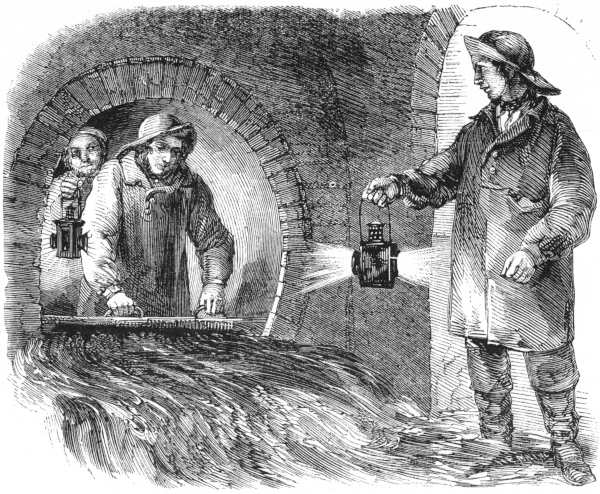
FLUSHING THE SEWERS.
(Partly from a Daguerreotype by Beard, and partly from a Sketch kindly lent by Mr. Whiting.)
There have been two modes of effecting this object. The one has been the carting away of the more solid refuse, and the other the washing of it away, or, as it is termed, flushing in the case of the covered sewers, and plonging in the case of the open ones. Under both systems, whether the refuse be carted or flushed away, the hard deposit has to be first loosened by manual labourers—the difference consisting principally in the means of after-removal.
The first of these systems—viz., the cartage method—was that which prevailed in the metropolis till the year 1847. I shall therefore give a brief description of this mode of cleansing the sewers before proceeding to treat of the now more general mode of “flushing.”
Under the old system, the clearing away of the deposit was a “nightman’s” work, differing little, except in being more toilsome, offensive to the public, and difficult. A hole was made from the street down into the sewer where the deposit was thickest, and the deposit was raised by means of a tub, filled below, drawn up to the street, and emptied into a cart, or spread in mounds in the road to be shovelled into some vehicle. A nightman told me that this mode of work was sometimes a great injury to his trade, because “when it was begun on a night many of the householders sleeping in the neighbourhood used to say to themselves, or to their missusses, as they turned in their beds, ‘It’s them ere cussed cesspools again! I wish they was done away with.’ An’ all the time, sir, the cesspools was as hinnocent and as sweet as a hangel.”
This clumsy and filthy process is now but occasionally resorted to. A man who had superintended a labour of this kind in a narrow, but busy thoroughfare in Southwark, told me that these sewer labourers were the worst abused men in London. No one had a good word for them.
But there have been other modes of removing the indurated sewage, besides that of cartage; and which, though not exactly flushing, certainly consisted in allowing the deposit to be washed away. Some of these contrivances were curious enough.
I learn from a Report printed in 1849, that the King’s Scholars’ Pond Sewer, in the city of Westminster, running near the Abbey, contained a continuous bed of deposit, of soil, sand, and filth, from 10 to 30 inches in depth, and this for a mile and a half next the river—the first mile yielding more than 6000 loads of matter. This sewer was to be cleansed.
“We first used a machine,” says Mr. J. Lysander Hale, “in the form of a plough and harrow combined; a horse dragged it through the deposit in the sewer; one man attended the horse, and another guided the plough. The work done by this machine, in cutting a channel through the soil and causing the water to move through it quickly, was effectual to remove the deposit; but as the sewer is a tidal sewer, and its sole entrance for a horse being its outlet, the machine could only be used for a small part of any day. Sometimes with a strong breeze up the river, the tide would not recede sufficiently to permit the horse to get in at all (and it did not appear advisable to incur the expense of 50l. to build a sideway entrance for the animal), so that under these circumstances we were obliged to discontinue the use of the horse and plough; which, under other circumstances, would have been very effective.” From this time, I understand, the sewers of London have remained unploughed by means of horse labour.
But the plough was not altogether abandoned, and as horse-power was not found very easily applicable, water-power was resorted to. The plough and harrow were attached to a barge, which was introduced into the sewer. The sluice gates were kept shut until the ebb of the tide made the difference of level between the contents of the sewer and the surface of the Thames equal to some eight feet. “The gates were then suddenly opened, and the rapid and deep current of water following, was then sufficient to bring the barge and plough down the sewer with a force equal to five or six horse-power.”
This last-mentioned method was also soon abandoned. We now come to the more approved plan of “flushing.”
“The term ‘flushing sewers’ implies,” says Mr. Haywood, in his Report, “cleansing by the application of bodies of water in the sewers; this is periodically effected, varying in intervals according to the necessities of the sewerage or other circumstances.”
The flushing system has a two-fold object, viz., to remove old deposits and prevent the accumulation of new. When the deposit is not allowed to accumulate and harden, “flushing consists,” says Mr. Haywood, “simply in heading back and letting off flush at once” (hence the origin of the term) “that which has been delivered into the sewers in a certain number of hours by the various houses draining into them, diluted with large quantities of water specially employed for the purpose.”
Though the operation of “flushing” is one of modern introduction, as regards the metropolis—one, indeed, which may be said to have originated in the modern demand for improved sanitary regulations—it has been practised in some country parts since the days of Henry VIII.
Flushing was practised also by those able engineers, the ancient Romans. One of the grand architectural remains of that people, the best showing their system of flushing, is in the Amphitheatre at Nismes, in France. The site of the ruined amphitheatre presents a large elliptical area, 114,251 superficial feet comprising its extent. Around the arena ran a large sewer 3 feet 6 inches in width, and 4 feet 9 inches in height. With this sewer, elliptical in shape, 348 pipes communicated, carrying into it the rain-fall and the refuse caused by the resort of 23,000 persons, for the seats alone contained that number. “The system of flushing, practised here,” says Mr. Cresy, “with such advantage, deserves to be noticed, there being means of driving through this elliptical sewer a volume of water at pleasure, with such force that no solid matter could by any possibility remain within any of the drains or sewers. An aqueduct, 2 feet 8 inches in width, and 6 feet in height, brought this water from the reservoirs of Nismes, not only to fill but to purge the whole of these sewers; after traversing the arena, it deviated a little to the south-west, where it was carried out at the sixth arcade, east of the southern entrance. Man-holes and steps to descend into this capacious vaulted aqueduct were introduced in several places; and there can be no doubt that by directing for some hours such a stream of water through it, the greatest cleanliness was preserved throughout all the sewers of the building.”
The flushing of sewers appears to have been introduced into the metropolis by Mr. John Roe in the year 1847, but did not come into general use till some years later. There used to be a partial flushing of the London sewers twelve years ago. The mode of flushing as at present practised is as follows:—
In the first instance the inspector examines and reports the condition of the sewer, and receives and issues his orders accordingly. When the sewer is ordered to be flushed—and there is no periodical or regular observance of time in the operation—the men enter the sewers and rake up the deposit, loosening it everywhere, so as to render the whole easy to be swept along by the power of the volume of water. The sewers generally are, in their widest part, provided with grooves, or, as the men style them, “framings.” Into these framings are fitted, or permanently attached, what I heard described as “penstocks,” but which are spoken of in some of the reports as “traps,” “gates,” or “sluice gates.” They are made both of wood and iron. By a series of bolts and adjustments, the penstocks can be fixed ready for use when the tide is highest in the sewer, and the volume of water the greatest. They then, of course, are in the nature of dams, the water having accumulated in consequence of the stoppage. The deposit having been loosened, the bolts are withdrawn, when the gates suddenly fly back, and the accumulated water and stirred-up sewage sweeps along impetuously, while the men retreat into some side recesses adapted for the purpose. The same is done with each penstock until the matter is swept through the outlet. The men always follow the course of this sewage-current when the sewer is of sufficient capacity to enable them to do so, throwing or pushing forward any more solid matter with their shovels.
“To flush we generally go and draw a slide up and let a flush of water down,” said one man to me, “and then we have iron rakers to loosen the stuff. We have got another way that we do it as well; one man stands here, when the flush of water’s coming down, with a large board; then he lets the water rise to the top of this board, and then there’s two or three of us on ahead, with shovels, loosening the stuff—then he ups with this board and lets a good heavy flush of water come down. Precious hard work it is, I can assure you. I’ve had many a wet shirt. We stand up to our fork in the water, right to the top of our jack-boots, and sometimes over them.” “Ah, I should think you often get over the top of yours, for you come home with your stockings wet enough, goodness knows,” exclaimed his wife, who was present. “When there’s a good flush of water coming down,” he resumed, “we’re obligated to put our heads fast up against the crown of the sewer, and bear upon our shovels, so that we may not be carried away, and taken bang into the Thames. You see there’s nothing for us to lay hold on. Why, there was one chap went and lifted a slide right up, when he ought to have had it up only 9 or 10 inches at the furthest, and he nearly swamped three of us. If we should be taken off our legs there’s a heavy fall—about 3 feet—just before you comes to the mouth of the sewer, and if we was to get there, the water is so rapid nothing could save us. When we goes to work we nails our lanterns up to the crown of the sewer. When the slide is lifted up the rush is very great, and takes all before it. It roars away like a wild beast. We’re always obliged to work according to tide, both above and below ground. When we have got no water in the sewer we shovels the dirt up into a bank on both sides, so that when the flush of water comes down the loosened dirt is all carried away by it. After flushing, the bottom of the sewer is as clean as this floor, but in a couple of months the soil is a foot to 15 inches deep, and middling hard.”
“Flushing-gates,” an engineer has reported, “are chiefly of use in sewers badly constructed and without falls, but containing plenty of water; and they are of very little use where the gate has to be shut 24 hours and longer, before a head of water has accumulated; but where intermittent flushing is practised, strong smells are often caused solely by the stagnation of the water or sewage while accumulating behind the gate.”
The most general mode of flushing at present adopted is not to keep in the water, &c., which has flowed into the sewer from the streets and houses, as well as the tide of the river, but to convey the flushing water from the plugs of the water companies into the kennels, and so into the sewers. I find in one of the Reports acknowledgments of the liberal supplies granted for flushing by the several companies. The water of the Surrey Canal has been placed, for the same object, at the disposal of the Sewer Commissioners.
It is impossible to “flush” at all where a sewer has a “dead-end;” that is, where there is a “block,” as in the case of the Kenilworth-street sewer, Pimlico, in which five persons lost their lives in 1848.
There is no difference in the system of flushing in the Metropolitan and City jurisdictions, except that for the greater facilities of the process, the City provides water-tanks in Newgate-market, where the heads of three sewers meet, and where the accumulation of animal garbage, and the fierceness and numbers of the rats attracted thereby, were at one time frightful; at Leadenhall-market, and elsewhere, such tanks were also provided to the number of ten, the largest being the Newgate-market tank, which is a brick cistern of 8000 gallons capacity. Of these tanks, however, only four are now kept filled, for this collection of water is found unnecessary, the regular system of flushing answering the purpose without them; and I understand that in a little time there will be no tanks at all. The tank is filled, when required, by a water company, and the penstocks being opened, the water rushes into the sewers with great force. There is also another point peculiar to the City—in it all the sewers are flushed regularly twice a week; in the metropolitan sewers, only when the inspector pronounces flushing to be required. The City plan appears the best to prevent the accumulation of deposit.
There still remains to be described the system of “plonging,” or mode of cleansing the open sewers, as contradistinguished from “flushing,” or the cleansing of the covered sewers.
“When we go plonging,” one man said, “we has long poles with a piece of wood at the end of them, and we stirs up the mud at the bottom of the ditches while the tide’s a going down. We has got slides at the end of the ditches, and we pulls these up and lets out the water, mud, and all, into the Thames.” “Yes, for the people to drink,” said a companion drily. “We’re in the water a great deal,” continued the man. “We can’t walk along the sides of all of ’em.”
The difference of cost between the old method of removal and the new, that is to say, between carting and flushing, is very extraordinary.
This cartage work was done chiefly by contract and according to a Report of the surveyors to the Commissioners (Aug. 31, 1848), the usual cost for such work (almost always done during the night) was 7s. the cubic yard; that is, 7s. for the removal of a cubic yard of sewage by manual labour and horse and cart. In February, 1849 (the date of another Report on the subject), the cost of removing a cubic yard by the operation of flushing, was but 8d. This gives the following result, but in what particular time, instance, or locality, is not mentioned:—
79,483 cubic yards of deposit removed by the contract flushing system, at 8d. per cubic yard£2,649
Same quantity by the old system of casting and cartage, 7s. per cubic yard27,819
Difference£25,170
“It appears, therefore,” says Mr. Lovick, “that by the adoption of the contract flushing system, a saving has been effected within the comparatively short period of its operation over the filthy and clumsy system formerly practised, of 25,170l., showing the cost of this system to be ten and a half times greater than the cost of flushing by contract.”
An official Report states: “When the accumulations of years had to be removed from the sewers, the rate of cost per lineal mile has varied from about 40l. to 58l., or from 6d. to 8d. per lineal yard. The works in these cases (excepting those in the City) have not exceeded nine lineal miles.”
“On an average of weeks,” says Mr. Lovick, in his Report on flushing operations, a few months after the introduction of the contract system, in Sept., 1848, “under present arrangements, about 62 miles of sewers are passed through each week, and deposit prevented from accumulating in them by periodic (weekly) flushing. The average cost per lineal mile per week is about 2l. 10s.
“The nature of the agreements with the contractors or gangers are now for the prevention of accumulations of deposit in a district. For this purpose the large districts are subdivided, each subdivision being let to one man. In the Westminster district there are four, in the Holborn and Finsbury two, in the Surrey and Kent, seven subdivisions.
“The Tower Hamlets and Poplar districts are each let to one man.
“In the Tower Hamlets it will be perceived that a reduction of 8l. has been effected for the performance of precisely the same work as that heretofore performed; the rates of charge standing thus:—
“Under the day-work system 23l. per week.
„contract„15l.„
“In those portions specially contracted for, the work has been let by the lineal measure of the sewer, in preference to the amount of deposit removed.
“In the Surrey and Kent districts the open ditches have been cleansed thrice as often as formerly.
“A large proportion of the deposit removed is from the open ditches; in these the accumulations are rapid and continuous, caused chiefly by their being the receptacles for the ashes and refuse of the houses, the refuse of manufactories, and the sweepings of the roads.
“In the covered sewers one of the chief sources of accumulation is the detritus and mud from the streets, swept into the sewers.
“The accumulations from these sources will not, I think, be over-estimated at two-thirds of the whole amount of deposit removed.
“The contracts in operation, February, 1849, with the districts which they embrace, are as follows:—
“Table No. I.
Districts.Sewers let for Prevention of Accumulations of Deposit.Average Rate of Work performed in Sewers passed through each Week.Contract Charge per Week.
Lineal Feet.Lineal Feet.£s.d.
Westminster485,795150,6154000
Holborn & Finsbury355,085118,0002300
Tower Hamlets223,73830,0001500
Surrey and Kent440,64240,0007500
Poplar26,0002,0006160
1,531,260340,615159160
Westminster—Attendance on Flaps, &c.400
£163160
“The weekly cost prior to the contract system was in the several districts as follows:—
“Table No. II.
£s. d.
In the Westminster District78100
„ Holborn and Finsbury do.24170
„ Tower Hamlets do.2300
„ Surrey and Kent do.5680
„ Poplar do.6130
18980
Hence there would appear to have been a saving of 25l. 12s. effected. But by what means was this brought about? It is the old story, I regret to say—a reduction of the wages of the labouring men. But this, indeed, is the invariable effect of the contract system. The wages of the flushermen previous to Sept., 1848, were 24s. to 27s. a week; under the present system they are 21s. to 22s. Here is a reduction of 4s. per week per man, at the least; and as there were about 150 hands employed at this period, it follows that the gross weekly saving must have been equal to 30l., so that, according to the above account, there would have been about 5l. left for the contractors or middlemen. It is unworthy of gentlemen to make a parade of economy obtained by such ignoble means.
The engineers, however, speak of flushing as what is popularly understood as but “a make-shift”—as a system imperfect in itself, but advantageously resorted to because obviating the evils of a worse system still.
“With respect to these operations,” says Mr. Lovick, in a Report on the subject, in February, 1849, “I may be permitted to state that, although I do not approve of the flushing as an ultimate system, or as a system to be adopted in the future permanent works of sewerage, or that its use should be contemplated with regulated sizes of sewers, regulated supplies of water, and proper falls, it appears to be the most efficacious and economical for the purpose to which it is adapted of any yet introduced.”
A gentleman who was at one time connected professionally with the management of the public sewerage, said to me,—
“Mr. John Roe commenced the general system of flushing sewers in London in 1847. It is, however, but a clumsy expedient, and quite incompatible with a perfect system of sewerage. It has, nevertheless, been usefully applied as an auxiliary to the existing system, though the cost is frightful.”
Of the Working Flushermen.
When the system of sewer cleansing first became general, as I have detailed, the number of flushermen employed, I am assured, on good authority, was about 500. The sewers were, when this process was first resorted to, full of deposit, often what might be called “coagulated” deposit, which could not be affected except by constantly repeated efforts. There are now only about 100 flushermen, for the more regularly flushing is repeated, the easier becomes the operation.
Until about 18 months ago, the flushermen were employed directly by the Court of Sewers, and were paid (“in Mr. Roe’s time,” one man said, with a sigh) from 24s. to 27s. a week; now the work is all done by contract. There are some six or seven contractors, all builders, who undertake or are responsible for the whole work of flushing in the metropolitan districts (I do not speak of the City), and they pay the working flushermen 21s. a week, and the gangers 22s. This wage is always paid in money, without drawbacks, and without the intervention of any other middleman than the contractor middleman. The flushermen have no perquisites except what they may chance to find in a sewer. Their time of labour is 6½ hours daily.
The state of the tide, however, sometimes, as a matter of course, compels the flushermen to work at every hour of the day and night. At all times they carry lights, common oil lamps, with cotton wicks; only the inspectors carry Davy’s safety-lamp. I met no man who could assign any reason for this distinction, except that “the Davy” gave “such a bad light.”
The flushermen wear, when at work, strong blue overcoats, waterproofed (but not so much as used to be the case, the men then complaining of the perspiration induced by them), buttoned close over the chest, and descending almost to the knees, where it is met by huge leather boots, covering a part of the thigh, such as are worn by the fishermen on many of our coasts. Their hats are fan-tailed, like the dustmen’s. The flushermen are well-conducted men generally, and, for the most part, fine stalwart good-looking specimens of the English labourer; were they not known or believed to be temperate, they would not be employed. They have, as a body, no benefit or sick clubs, but a third of them, I was told, or perhaps nearly a third, were members of general benefit societies. I found several intelligent men among them. They are engaged by the contractors, upon whom they call to solicit work.
“Since Mr. Roe’s time,” and Mr. Roe is evidently the popular man among the flushermen, or somewhat less than four years ago, the flushermen have had to provide their own dresses, and even their own shovels to stir up the deposit. To contractors, the comforts or health of the labouring men must necessarily be a secondary consideration to the realization of a profit. New men can always be found; safe investments cannot.
The wages of the flushermen therefore have been not only decreased, but their expenses increased. A pair of flushing-boots, covering a part of the thigh, similar to those worn by sea-side fishermen, costs 30s. as a low price, and a flusherman wears out three pairs in two years. Boot stockings cost 2s. 6d. The jacket worn by the men at their work in the sewers, in the shape of a pilot-jacket, but fitting less loosely, is 7s. 6d.; a blue smock, of coarse common cloth (generally), worn over the dress, costs 2s. 6d.; a shovel is 2s. 6d. “Ay, sir,” said one man, who was greatly dissatisfied with this change, “they’ll make soldiers find their own regimentals next; and, may be, their own guns, a’cause they can always get rucks of men for soldiers or labourers. I know there’s plenty would work for less than we get, but what of that? There always is. There’s hundreds would do the work for half what the surveyors and inspectors gets; but it’s all right among the nobs.”
Nor is the labour of the flushermen at all times so easy or of such circumscribed hours as I have stated it to be in the regular way of flushing. When small branch-sewers have to be flushed, the deposit must first be loosened, or the water, instead of sweeping it away, would flow over it, and in many of these sewers (most frequent in the Tower Hamlets) the height is not more than 3 feet. Some of the flushermen are tall, bulky, strong fellows, and cannot stand upright in less than from 5 feet 8 inches to 6 feet, and in loosening the deposit in low narrow sewers, “we go to work,” said one of them, “on our bellies, like frogs, with a rake between our legs. I’ve been blinded by steam in such sewers near Whitechapel Church from the brewhouses; I couldn’t see for steam; it was a regular London fog. You must get out again into a main sewer on your belly; that’s what makes it harder about the togs, they get worn so.”
The division of labour among the flushermen appears to be as follows:—
The Inspector, whose duty it is to go round the several sewers and see which require to be flushed.
The Ganger, or head of the working gang, who receives his orders from the inspector, and directs the men accordingly.
The Lock-keeper, or man who goes round to the sewers which are about to be flushed, and fixes the “penstocks” for retaining the water.
The Gang, which consists of from three to four men, who loosen the deposit from the bottom of the sewer. Among these there is generally a “for’ard man,” whose duty it is to remove the penstocks.
The ganger gets 1s. a week over and above the wages of the men.
TABLE SHOWING THE DISTRICTS UNDER THE MANAGEMENT OF THE COMMISSIONERS OF SEWERS; ALSO THE NUMBER AND SALARIES OF THE CLERKS OF THE WORKS, ASSISTANT CLERKS OF THE WORKS, AND INSPECTORS OF FLUSHING, PAID BY THE COMMISSIONERS, AND THE NUMBER AND WAGES PAID TO THE FLUSHERMEN BY THE GENERAL CONTRACTORS.
Districts.Paid by the Commissioners of Sewers.
Clerks of Works.Assist. Clerks of Works[71].Inspectors of Flushings.Flap & Sluice Keepers.Aggregate Total.
No.Annual Salary of the whole.No.Rate of Annual Salary.No.Annual Salary of the whole.No.Yearly Wages of the whole.
£££££
Fulham and Hammersmith.—Counter’s Creek and Ranelagh Districts345044001120....970
Westminster Sewers.—Western Division, Eastern Division, Regent-street District, Holborn Division4600330018063901370
Finsbury Division.—Tower Hamlets Levels, and Poplar and Blackwall Districts3450220032801701000
Districts south of the Thames345066004320123741744
Total1319501515009800198345084
City........1803148228
Districts.Paid by Contractors.
Gangers.Flushers.Aggregate Total.
No.Weekly Wage of each.No.Weekly Wage of each.
s.£s.
Fulham and Hammersmith.—Counter’s Creek and Ranelagh Districts22213218244
Westminster Sewers.—Western Division, Eastern Division, Regent-street District, Holborn Division32230211809 12
Finsbury Division.—Tower Hamlets Levels, and Poplar and Blackwall Districts32227211645 16
Districts south of the Thames22222211315 12
Total10..92..55954
City122921548 12
Total cost of flushing the sewers£12,000 per annum.
⁂ The above division of districts is the one adopted by the Commissioners of Sewers, but the districts of the Flushermen are more numerous than those above given, being as follows:—
Ganger.Flushermen.
Fulham and Hammersmithemploying1and61st District of Commissioners.
Counter’s Creek and Ranelagh Districts.„1„7
Westminster (Western Division)„1„102nd District of Commissioners.
Ditto (Eastern Division)„1„12
Holborn Division„1„8
Finsbury Division„1„93rd District of Commissioners.
Tower Hamlets Levels„1„10
Poplar and Blackwall„1„8
Districts south of the Thames„2„224th District of Commissioners.
City„1„9
Holborn and Finsbury districts are under one contractor, and so are the two divisions of Westminster. The same men who flush Holborn flush the Finsbury district also, 17 being the average number employed; but the Finsbury district requires rather more men than the Holborn; and the same men who work on the western division of Westminster flush also the eastern, the number of flushers in the western district being more, on account of its being the larger division.
The inspector receives 80l. per annum.
The table on p. 429 shows the number of clerks of the works, inspectors of flushing, flap and sluice keepers, gangers, and flushermen employed in the several districts throughout the metropolis, as well as the salaries and wages of each and the whole.
None of the flushermen can be said to have been “brought up to the business,” for boys are never employed in the sewers. Neither had the labourers been confined in their youth to any branch of trade in particular, which would appear to be consonant to such employment. There are now among the flushermen men who have been accustomed to “all sorts of ground work:” tailors, pot-boys, painters, one jeweller (some time ago there was also one gentleman), and shoemakers. “You see, sir,” said one informant, “many of such like mechanics can’t live above ground, so they tries to get their bread underneath it. There used to be a great many pensioners flushermen, which weren’t right,” said one man, “when so many honest working men haven’t a penny, and don’t know which way to turn theirselves; but pensioners have often good friends and good interest. I don’t hear any complaints that way now.”
Among the flushermen are some ten or twelve men who have been engaged in sewer-work of one kind or another between 20 and 30 years. The cholera, I heard from several quarters, did not (in 1848) attack any of the flushermen. The answer to an inquiry on the subject generally was, “Not one that I know of.”
“It is a somewhat singular circumstance,” says Mr. Haywood, the City Surveyor, in his Report, dated February, 1850, “that none of the men employed in the City sewers in flushing and cleansing, have been attacked with, or have died of, cholera during the past year; this was also the case in 1832-3. I do not state this to prove that the atmosphere of the sewers is not unhealthy—I by no means believe an impure atmosphere is healthy—but I state the naked fact, as it appears to me a somewhat singular circumstance, and leave it to pathologists to argue upon.”
“I don’t think flushing work disagrees with my husband,” said a flusherman’s wife to me, “for he eats about as much again at that work as he did at the other.” “The smell underground is sometimes very bad,” said the man, “but then we generally take a drop of rum first, and something to eat. It wouldn’t do to go into it on an empty stomach, ’cause it would get into our inside. But in some sewers there’s scarcely any smell at all. Most of the men are healthy who are engaged in it; and when the cholera was about many used to ask us how it was we escaped.”
The following statement contains the history of an individual flusherman:—
“I was brought up to the sea,” he said, “and served on board a man-of-war, the Racer, a 16-gun brig, laying off Cuba, in the West Indies, and there-away, watching the slavers. I served seven years. We were paid off in ’43 at Portsmouth, and a friend got me into the shores. It was a great change from the open sea to a close shore—great; and I didn’t like it at all at first. But it suits a married man, as I am now, with a family, much better than being a seaman, for a man aboard a ship can hardly do his children justice in their schooling and such like. Well, I didn’t much admire going down the man-hole at first—the ‘man-hole’ is a sort of iron trap-door that you unlock and pull up; it leads to a lot of steps, and so you get into the shore—but one soon gets accustomed to anything. I’ve been at flushing and shore work now since ’43, all but eleven weeks, which was before I got engaged.
“We work in gangs from three to five men.” [Here I had an account of the process of flushing, such as I have given.] “I’ve been carried off my feet sometimes in the flush of a shore. Why, to-day,” (a very rainy and windy day, Feb. 4,) “it came down Baker-street, when we flushed it, 4 foot plomb. It would have done for a mill-dam. One couldn’t smoke or do anything. Oh, yes, we can have a pipe and a chat now and then in the shore. The tobacco checks the smell. No, I can’t say I felt the smell very bad when I first was in a shore. I’ve felt it worse since. I’ve been made innocent drunk like in a shore by a drain from a distiller’s. That happened me first in Vine-street shore, St. Giles’s, from Mr. Rickett’s distillery. It came into the shore like steam. No, I can’t say it tasted like gin when you breathed it—only intoxicating like. It was the same in Whitechapel from Smith’s distillery. One night I was forced to leave off there, the steam had such an effect. I was falling on my back, when a mate caught me. The breweries have something of the same effect, but nothing like so strong as the distilleries. It comes into the shore from the brewers’ places in steam. I’ve known such a steam followed by bushels of grains; ay, sir, cart-loads washed into the shore.
“Well, I never found anything in a shore worth picking up but once a half-crown. That was in the Buckingham Palace sewer. Another time I found 16s. 6d., and thought that was a haul; but every bit of it, every coin, shillings and sixpences and joeys, was bad—all smashers. Yes, of course it was a disappointment, naturally so. That happened in Brick-lane shore, Whitechapel. O, somebody or other had got frightened, I suppose, and had shied the coins down into the drains. I found them just by the chapel there.”
A second man gave me the following account of his experience in flushing:—
“You remember, sir, that great storm on the 1st August, 1848. I was in three shores that fell in—Conduit-street and Foubert’s-passage, Regent-street. There was then a risk of being drowned in the shores, but no lives were lost. All the house-drains were blocked about Carnaby-market—that’s the Foubert’s-passage shore—and the poor people was what you might call houseless. We got in up to the neck in water in some places, ’cause we had to stoop, and knocked about the rubbish as well as we could, to give a way to the water. The police put up barriers to prevent any carts or carriages going that way along the streets. No, there was no lives lost in the shores. One man was so overcome that he was falling off into a sort of sleep in Milford-lane shore, but was pulled out. I helped to pull him. He was as heavy as lead with one thing or other—wet, and all that. Another time, six or seven year ago, Whitechapel High-street shore was almost choked with butchers’ offal, and we had a great deal of trouble with it.”
Of the Rats in the Sewers.
I will now state what I have learned from long-experienced men, as to the characteristics of the rats in the sewers. To arrive even at a conjecture as to the numbers of these creatures—now, as it were, the population of the sewers—I found impossible, for no statistical observations have been made on the subject; but all my informants agreed that the number of the animals had been greatly diminished within these four or five years.
In the better-constructed sewers there are no rats. In the old sewers they abound. The sewer rat is the ordinary house or brown rat, excepting at the outlets near the river, and here the water-rat is seen.
The sewer-rat is the common brown or Hanoverian rat, said by the Jacobites to have come in with the first George, and established itself after the fashion of his royal family; and undoubtedly such was about the era of their appearance. One man, who had worked twelve years in the sewers before flushing was general, told me he had never seen but two black (or old English) rats; another man, of ten years’ experience, had seen but one; others had noted no difference in the rats. I may observe that in my inquiries as to the sale of rats (as a part of the live animals dealt in by a class in the metropolis), I ascertained that in the older granaries, where there were series of floors, there were black as well as brown rats. “Great black fellows,” said one man who managed a Bermondsey granary, “as would frighten a lady into asterisks to see of a sudden.”
The rat is the only animal found in the sewers. I met with no flusherman or other sewer-worker who had ever seen a lizard, toad, or frog there, although the existence of these creatures, in such circumstances, has been presumed. A few live cats find their way into the subterranean channels when a house-drain is being built, or is opened for repairs, or for any purpose, and have been seen by the flushermen, &c., wandering about, looking lost, mewing as if in misery, and avoiding any contact with the sewage. The rats also—for they are not of the water-rat breed—are exceedingly averse to wetting their feet, and “take to the sewage,” as it was worded to me, only in prospect of danger; that is, they then swim across or along the current to escape with their lives. It is said that when a luckless cat has ventured into the sewers, she is sometimes literally worried by the rats. I could not hear of such an attack having been witnessed by any one; but one intelligent and trustworthy man said, that a few years back (he believed about eight years) he had in one week found the skeletons of two cats in a particular part of an old sewer, 21 feet wide, and in the drains opening into it were perfect colonies of rats, raging with hunger, he had no doubt, because a system of trapping, newly resorted to, had prevented their usual ingress into the houses up the drains. A portion of their fur adhered to the two cats, but the flesh had been eaten from their bones. About that time a troop of rats flew at the feet of another of my informants, and would no doubt have maimed him seriously, “but my boots,” said he, “stopped the devils.” “The sewers generally swarms with rats,” said another man. “I runs away from ’em; I don’t like ’em. They in general gets away from us; but in case we comes to a stunt end where there’s a wall and no place for ’em to get away, and we goes to touch ’em, they fly at us. They’re some of ’em as big as good-sized kittens. One of our men caught hold of one the other day by the tail, and he found it trying to release itself, and the tail slipping through his fingers; so he put up his left hand to stop it, and the rat caught hold of his finger, and the man’s got an arm now as big as his thigh.” I heard from several that there had been occasionally battles among the rats, one with another.
“Why, sir,” said one flusherman, “as to the number of rats, it ain’t possible to say. There hasn’t been a census (laughing) taken of them. But I can tell you this—I was one of the first flushermen when flushing came in general—I think it was before Christmas, 1847, under Mr. Roe—and there was cart-loads and cart-loads of drowned rats carried into the Thames. It was in a West Strand shore that I saw the most. I don’t exactly remember which, but I think Northumberland-street. By a block or a hitch of some sort, there was, I should say, just a bushel of drowned rats stopped at the corner of one of the gates, which I swept into the next stream. I see far fewer drowned rats now than before the shores was flushed. They’re not so plenty, that’s one thing. Perhaps, too, they may have got to understand about flushing, they’re that ’cute, and manage to keep out of the way. About Newgate-market was at one time the worst for rats. Men couldn’t venture into the sewers then, on account of the varmint. It’s bad enough still, I hear, but I haven’t worked in the City for a few years.”
The rats, from the best information at my command, do not derive much of their sustenance from the matter in the sewers, or only in particular localities. These localities are the sewers neighbouring a connected series of slaughter-houses, as in Newgate-market, Whitechapel, Clare-market, parts adjoining Smithfield-market, &c. There, animal offal being (and having been to a much greater extent five or six years ago) swept into the drains and sewers, the rats find their food. In the sewers, generally, there is little food for them, and none at all in the best-constructed sewers, where there is a regular and sometimes rapid flow, and little or no deposit.
The sewers are these animals’ breeding grounds. In them the broods are usually safe from the molestation of men, dogs, or cats. These “breeding grounds” are sometimes in the holes (excavated by the industry of the rats into caves) which have been formed in the old sewers by a crumbled brick having fallen out. Their nests, however, are in some parts even more frequent in places where old rotting large house-drains or smaller sewers, empty themselves into a first-class sewer. Here, then, the rats breed, and, in spite of precautions, find their way up the drains or pipes, even through the openings into water-closets, into the houses for their food, and almost always at night. Of this fact, builders, and those best informed, are confident, and it is proved indirectly by what I have stated as to the deficiency of food for a voracious creature in all the sewers except a few. One man, long in the service of the Commissioners of Sewers, and in different capacities, gave me the following account of what may be called a rat settlement. The statement I found confirmed by other working men, and by superior officers under the same employment.
“Why, sir, in the Milford-lane sewer, a goodish bit before you get to the river, or to the Strand—I can’t say how far, a few hundred yards perhaps—I’ve seen, and reported, what was a regular chamber of rats. If a brick didn’t fall out from being rotted, the rats would get it out, and send it among other rubbish into the sewer, for this place was just the corner of a big drain. I couldn’t get into the rat-hole, of course not, but I’ve brought my lamp to the opening, and—as well as others—have seen it plain. It was an open place like a lot of tunnels, one over another. Like a lot of rabbit burrows in the country—as I’ve known to be—or like the partitions in the pigeon-houses: one here and another there. The rat-holes, as far as I could tell, were worked one after another. I should say, in moderation, that it was the size of a small room; well, say about 6 yards by 4. I can’t say about the height from the lowest tunnel to the highest. I don’t see that any one could. Bless you, sir, I’ve sometimes heerd the rats fighting and squeaking there, like a parcel of drunken Irishmen—I have indeed. Some of them were rare big fellows. If you threw the light of your lamp on them sudden, they’d be off like a shot. Well, I should say, there was 100 pair of rats there—there might be more, besides all their young-uns. If a poor cat strayed into that sewer, she dursn’t tackle the rats, not she. There’s lots of such places, sir, here, and there, and everywhere.”
“I believe rats,” says a late enthusiastic writer on the subject, under the cognomen of Uncle James, “to be one of the most fertile causes of national and universal distress, and their attendants, misery and starvation.”
From the author’s inquiries among practical men, and from his own study of the natural history of the rat, he shows that these animals will have six, seven, or eight nests of young in the year, for three or four years together; that they have from twelve to twenty-three at a litter, and breed at three months old; and that there are more female than male rats, by ten to six.
The author seems somewhat of an enthusiast about rats, and as the sewerage is often the head-quarters of these animals—their “breeding-ground” indeed—I extract the following curious matter. He says:—
“Now, I propose to lay down my calculations at something less than one-half. In the first place, I say four litters in the year, beginning and ending with a litter, so making thirteen litters in three years; secondly to have eight young ones at a birth, half male and half female; thirdly, the young ones to have a litter at six months old.
“At this calculation, I will take one pair of rats; and at the expiration of three years what do you suppose will be the amount of living rats? Why no less a number than 646,808.
“Mr. Shaw’s little dog ‘Tiny,’ under six pounds weight, has destroyed 2525 pairs of rats, which, had they been permitted to live, would, at the same calculation and in the same time, have produced 1,633,190,200 living rats!
“And the rats destroyed by Messrs. Shaw and Sabin in one year, amounting to 17,000 pairs, would, had they been permitted to live, have produced, at the above calculation and in the same time, no less a number than 10,995,736,000 living rats!
“Now, let us calculate the amount of human food that these rats would destroy. In the first place, my informants tell me that six rats will consume day by day as much food as a man; secondly, that the thing has been tested, and that the estimate given was, that eight rats would consume more than an ordinary man.
“Now, I—to place the thing beyond the smallest shadow of a doubt—will set down ten rats to eat as much as a man, not a child; nor will I say anything about what rats waste. And what shall we find to be the alarming result? Why, that the first pair of rats, with their three years’ progeny, would consume in the night more food than 64,680 men the year round, and leaving eight rats to spare!”
The author then puts forth the following curious statement:—
“And now for the vermin destroyed by Messrs. Shaw and Sabin—34,000 yearly! Taken at the same calculation, with their three years’ progeny—can you believe it?—they would consume more food than the whole population of the earth? Yes, if Omnipotence would raise up 29,573,600 more people, these rats would consume as much food as them all! You may wonder, but I will prove it to you:—The population of the earth, including men, women, and children, is estimated to be 970,000,000 souls; and the 17,000 rats in three years would produce 10,995,736,000: consequently, at ten rats per man, there would be sufficient rats to eat as much food as all the people on the earth, and leaving 1,295,736,000. So that if the human family were increased to 1,099,573,600, instead of 970,000,000, there would be rats enough to eat the food of them all! Now, sirs, is not this a most appalling thing, to think that there are at the present time in the British Empire thousands—nay, millions—of human beings in a state of utter starvation, while rats are consuming that which would place them and their families in a state of affluence and comfort? I ask this simple question: Has not Parliament, ere now, been summoned upon matters of far less importance to the empire? I think it has.”
The author then advocates the repeal of the “rat-tax,” that is, the tax on what he calls the “true friend of man and remorseless destroyer of rats,” the well-bred terrier dog. “Take the tax off rat-killing dogs” he says, “and give a legality to rat-killing, and let there be in each parish a man who will pay a reward per head for dead rats, which are valuable for manure (as was done in the case of wolves in the old days), and then rats would be extinguished for ever!” Uncle James seems to be a perfect Malthus among rats. The over-population and over-rat theories are about equal in reason.
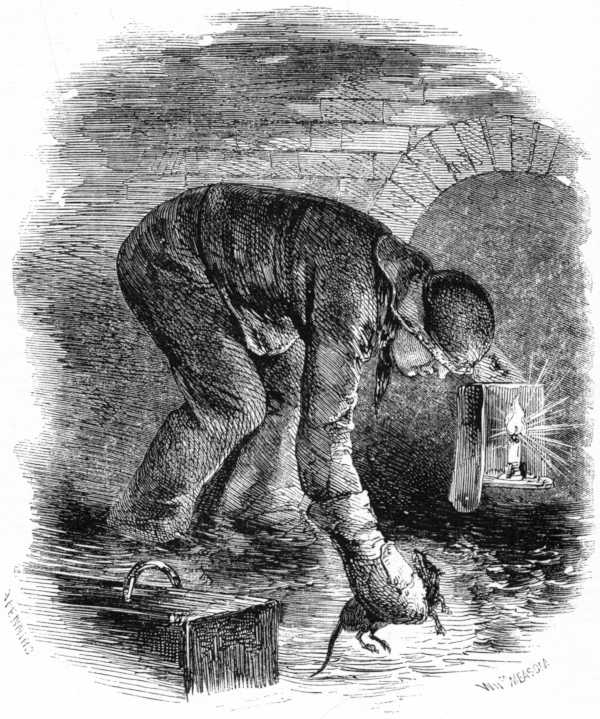
THE RAT-CATCHERS OF THE SEWERS.
[From a Daguerreotype by Beard.]
Of the Cesspoolage and Nightmen of the Metropolis.
I have already shown—it may be necessary to remind the reader—that there are two modes of removing the wet refuse of the metropolis: the one by carrying it off by means of sewers, or, as it is designated, sewerage; and the other by depositing it in some neighbouring cesspool, or what is termed cesspoolage.
The object of sewerage is “to transport the wet refuse of a town to a river, or some powerfully current stream, by a series of ducts.” By the system of cesspoolage, the wet refuse of the household is collected in an adjacent tank, and when the reservoir is full, the contents are removed to some other part.

LONDON NIGHTMEN.
[From a Daguerreotype by Beard.]
The gross quantity of wet refuse annually produced in the metropolis, and which consequently has to be removed by one or other of the above means, is, as we have seen,—liquid, 24,000,000,000 gallons; solid, 100,000 tons; or altogether, by admeasurement, 3,820,000,000 cubic feet.
The quantity of this wet refuse which finds its way into the sewers by street and house-drainage is, according to the experiments of the Commissioners of Sewers (as detailed at p. 388), 10,000,000 cubic feet per day, or 3,650,000,000 cubic feet per annum, so that there remain about 170,000,000 cubic feet to be accounted for. But, as we have before seen, the extent of surface from which the amount of so-called Metropolitan sewage was removed was only 58 square miles, whereas that from which the calculation was made concerning the gross quantity of wet refuse produced throughout the metropolis was 115 square miles, or double the size. The 58 miles measured by the Commissioners, however, was by far the denser moiety of the town, and that in which the houses and streets were as 15 to 1; so that, allowing the remaining 58 miles of the suburban districts to have produced 20 times less sewage than the urban half of the metropolis, the extra yield would have been about 180,500,000 cubic feet. But the greater proportion, if not the whole, of the latter quantity of wet house-refuse would be drained into open ditches, where a considerable amount of evaporation and absorption is continually going on, so that a large allowance must be made for loss by these means. Perhaps, if we estimate the quantity of sewage thus absorbed and evaporated at between 10 and 20 per cent of the whole, we shall not be wide of the truth, so that we shall have to reduce the 182,000,000 cubic feet of suburban sewage to somewhere about 150,000,000 cubic feet.
This gives us the quantity of wet refuse carried off by the sewers (covered and open) of the metropolis, and deducted from the gross quantity of wet house-refuse, annually produced (3,820,000,000 cubic feet), leaves 20,000,000 cubic feet for the gross quantity carried off by other means than the sewers; that is to say, the 20,000,000 cubic feet, if the calculation be right, should be about the quantity deposited every year in the London cesspools. Let us see whether this approximates to anything like the real quantity.
To ascertain the absolute quantity of wet refuse annually conveyed into the metropolitan cesspools, we must first ascertain the number and capacity of the cesspools themselves.
Of the city of London, where the sewer-cesspool details are given with a minuteness highly commendable, as affording statistical data of great value, Mr. Heywood gives us the following returns:—
“House-Drainage of the City.
“The total number of premises drained during the year was310
“The approximate number of premises drained at the expiration of the year 1850 was10,923
“The total number of premises which may now therefore be said to be drained is11,233
“And undrained5,067
“I am induced,” adds Mr. Heywood, “to believe, from the reports of the district inspectors, that a very far larger number of houses are already drained than are herein given. Indeed my impression is, that as many as 3000 might be deducted from the 5067 houses as to the drainage of which you have no information.
“Now, until the inspectors have completed their survey of the whole of the houses within the city,” continues the City surveyor, “precise information cannot be given as to the number of houses yet undrained; such information appears to me very important to obtain speedily, and I beg to recommend that instructions be given to the inspectors to proceed with their survey as rapidly as possible.”
Hence it appears, that out of the 16,299 houses comprised within the boundaries of the City, rather less than one-third are reported to have cesspools. Concerning the number of cesspools without the City, the Board of Health, in a Report on the cholera in 1849, put forward one of its usual extraordinary statements.
“At the last census in 1841,” runs the Report, “there were 270,859 houses in the metropolis. It is KNOWN that there is scarcely a house without a cesspool under it, and that a large number have two, three, four, and MORE under them; so that the number of such receptacles in the metropolis may be taken at 300,000. The exposed surface of each cesspool measures on an average 9 feet, and the mean depth of the whole is about 6½ feet; so that each contains 58½ cubic feet of fermenting filth of the most poisonous, noisome, and disgusting nature. The exhaling surface of all the cesspools (300,000 × 9) = 2,700,000 feet, or equal to 62 acres nearly; and the total quantity of foul matter contained within them (300,000 × 58½) = 17,550,000 cubic feet; or equal to one enormous elongated stagnant cesspool 50 feet in width, 6 feet 6 inches in depth, and extending through London from the Broadway at Hammersmith to Bow-bridge, a length of 10 miles.
“This,” say the Metropolitan Sanitary Commissioners, a body of functionaries so intimately connected with the Board, that the one is ever ready to swear to what the other asserts, “there is reason to believe is an under estimate!”
Let us now compare this statement, which declares it to be known that there is scarcely a house in London without a cesspool, and that many have two, three, four, and even more under them—let us compare this, I say, with the facts which were elicited by the same functionaries by means of a house-to-house inquiry in three different parishes—a poor, a middle-class, and a rich one—the average rental of each being 22l., 119l., and 128l.
RESULTS OF A HOUSE-TO-HOUSE INQUIRY IN THE PARISHES OF ST. GEORGE THE MARTYR, SOUTHWARK, ST. ANNE’S, SOHO, AND ST. JAMES’S, AS TO THE STATE OF THE WORKS OF WATER SUPPLY AND DRAINAGE.
CONDITION OF THE HOUSES.PARISHES.
St George the Martyr, Southwark.St. Anne’s, Soho.St. James’s.
From which replies have been received(Number)5,7131,3392,960
With supply of Water—
To the house or premises(Per cent)80·9795·5696·48
Near the privy„48·8738·9943·42
Butts or cisterns, covered(Number)1,8797761,621
„ „ uncovered„2,074294393
With a sink(Per cent)48·3189·2986·70
With a Well—
On or near premises„5·3213·9713·85
Well tainted or foul„46·923·717·36
Houses damp in lower parts„52·1330·9026·67
Houses with stagnant water on premises„18·547·952·95
Houses flooded in times of storm„18·155·044·05
Houses with Drain—
To premises„87·5697·1296·42
Houses with drains emitting offensive smells„45·1137·6221·41
Houses with drains stopped at times„22·3728·5013·97
Houses with dust-bin„42·6992·3489·80
Houses receiving offensive smells from adjoining premises„27·8222·5416·74
Houses with privy„97·0370·6362·53
Houses with cesspool„82·1247·2736·62
Houses with water-closet„10·0645·9965·86
In this minute and searching investigation there is not only an official guide to an estimation of the number of cesspools in London, but a curious indication of the character of the houses in the respective parishes. In the poorer parish of St. George the Martyr, Southwark, the cesspools were to every 100 houses as 82·12; in the aristocratic parish of St. James, Westminster, as only 36·62; while in what may be represented, perhaps, as the middle-class parish of St. Anne, Soho, the cesspools were 47·27 per cent. The number of wells on or near the premises, and the proportion of those tainted; the ratio of the dampness of the lower parts of the houses, of the stagnant water on the premises, and of the flooding of the houses on occasions of storms, are all significant indications of the difference in the circumstances of the inhabitants of these parishes—of the difference between the abodes of the rich and the poor, the capitalists and the labouring classes. But more significant still, perhaps, of the domestic wants or comforts of these dwellings, is the proportion of water-closets to the houses in the poor parish and the rich; in the one they were but 10·06 per cent; in the other 65·86 per cent.
These returns are sufficient to show the extravagance of the Board’s previous statement, that there is “scarcely a house in London without a cesspool under it,” while “a large number have two, three, four, and more,” for we find that even in the poorer parishes there are only 82 cesspools to 100 houses. Moreover, the engineers, after an official examination and inquiry, reported that in the “fever-nest, known as Jacob’s-island, Bermondsey,” there were 1317 dwelling-houses and 648 cesspools, or not quite 50 cesspools to 100 houses.
In rich, middle-class, and poor parishes, the proportion of cesspools, then, it appears from the inquiries of the Board of Health (their guesses are of no earthly value), gives us an average of something between 50 or 60 cesspools to every 100 houses. A subordinate officer whom I saw, and who was engaged in the cleansing and the filling-up of cesspools when condemned, or when the houses are to be drained anew into the sewers and the cesspools abolished, thought from his own experience, the number of cesspools to be less than one-half, but others thought it more.
On the other hand, a nightman told me he was confident that every two houses in three throughout London had cesspools; in the City, however, we perceive that there is, at the utmost, only one house in every three undrained. It will, therefore, be safest to adopt a middle course, and assume 50 per cent of the houses of the metropolis to be still without drainage into the sewers.
Now the number of houses being 300,000, it follows that the number of cesspools within the area of the metropolis are about 150,000; consequently the next step in the investigation is to ascertain the average capacity of each, and so arrive at the gross quantity of wet house-refuse annually deposited in cesspools throughout London.
The average size of the cesspools throughout the metropolis is said, by the Board of Health, to be 9 feet by 6½, which gives a capacity of 58½ cubic feet, and this for 150,000 houses = 8,775,000 cubic feet. But according to all accounts these cesspools require on an average two years to fill, so that the gross quantity of wet refuse annually deposited in such places can be taken at only half the above quantity, viz. in round numbers, 4,500,000 cubic feet. This by weight, at the rate of 35·9 cubic feet to the ton, gives 125,345 tons. This, however, would appear to be of a piece with the generality of the statistics of the Board of Health, and as wide of the truth as was the statement that there was scarcely a house in London without a cesspool, while many had three, four, and even more. But I am credibly informed that the average size of a cesspool is rather more than 5 feet square and 6½ deep, so that the ordinary capacity would be 5¾ × 5¼ × 6½ = 197 cubic feet, and this multiplied by 150,000 gives an aggregate capacity of 29,550,000 cubit feet. But as the cesspools, according to all accounts, become full only once in two years, it follows that the gross quantity of cesspoolage annually deposited throughout the metropolis must be only one-half that quantity, or about 14,775,000 cubic feet.
The calculation may be made another way, viz. by the experience of the nightmen and the sewer-cesspoolmen as to the average quantity of refuse removed from the London cesspools whenever emptied, as well as the average number emptied yearly.
The contents of a cesspool are never estimated for any purpose of sale or labour by the weight, but always, as regards the nightmen’s work, by the load. Each night-cart load of soil is considered, on an average, a ton in weight, so that the nightmen readily estimate the number of tons by the number of cart-loads obtained. The men employed in the cleansing of the cesspools by the new system of pumping agree with the nightmen as to the average contents of a cesspool.
As a general rule, a cesspool is filled every two years, and holds, when full, about five tons. One man, who had been upwards of 30 years in the nightman’s business, who had worked at it more or less all that time himself, and who is now foreman to a parish contractor and master-nightman in a large way, spoke positively on the subject. The cesspools, he declared, were emptied, as an average, by nightmen, once in two years, and their average contents were five loads of night-soil, it having been always understood in the trade that a night-cartload was about a ton.[72] The total of the cesspool matter is not affected by the frequency or paucity of the cleansing away of the filth, for if one cesspool be emptied yearly, another is emptied every second, third, fourth, or fifth year, and, according to the size, the fair average is five tons of cesspoolage emptied from each every other year. One master-nightman had emptied as much as fourteen tons of night-soil from a cesspool or soil-tank, and a contractor’s man had once emptied as many as eighteen tons, but both agreed as to the average of five tons every two years from all. Neither knew the period of the accumulation of the fourteen or the eighteen tons, but supposed to be about five or six years.
According to this mode of estimate, the quantity of wet house-refuse deposited in cesspools would be equal to 150,000 × 5, or 750,000 tons every two years. This, by admeasurement, at the rate of 35·9 cubic feet to the ton, gives 26,925,000 cubic feet; and as this is the accumulation of two years, it follows that 13,462,500 cubic feet is the quantity of cesspoolage deposited yearly.
There is still another mode of checking this estimate.
I have already given (see p. 385, ante) the average production of each individual to the wet refuse of the metropolis. According to the experiments of Boussingault, confirmed by Liebig, this, as I have stated, amounted to ¼ lb. of solid and 1¼ lb. of liquid excrement from each individual per diem (= 150 lbs. for every 100 persons), while, including the wet refuse from culinary operations, the average yield, according to the surveyor of the Commissioners of Sewers, was equal to about 250 lbs. for every 100 individuals daily. I may add that this calculation was made officially, with engineering minuteness, with a view to ascertain what quantity of water, and what inclination in its flow, would be required for the effective working of a system of drainage to supersede the cesspools.[73] Now the census of 1841 shows us that the average number of inhabitants to each house throughout the metropolis was 7·6, and this for 150,000 houses would give 1,140,000 people; consequently the gross quantity of wet refuse proceeding from this number of persons, at the rate of 250 lbs. to every 100 people daily, would be 464,400 tons per annum; or, by admeasurement, at the rate of 35·9 cubic feet to the ton, it would be equal to 16,670,950 cubic feet.
A small proportion of this amount of cesspoolage ultimately makes its appearance in the sewers, being pumped into them directly from the cesspools when full by means of a special apparatus, and thus tends not only to swell the bulk of sewage, but to decrease in a like proportion the aggregate quantity of wet house-refuse, which is removed by cartage; but though the proportion of cesspoolage which finally appears as sewage is daily increasing, still it is but trifling compared with the quantity removed by cartage.
Here, then, we have three different estimates as to the gross quantity of the London cesspoolage, each slightly varying from the other two.
Cubic Feet.
The first, drawn from the average capacity of the London cesspools, makes the gross annual amount of cesspoolage14,775,000
The second, deduced from the average quantity removed from each cesspool13,462,500
And the third, calculated from the individual production of wet refuse16,670,950
The mean of these three results is, in round numbers, 15,000,000 cubic feet, so that the statement would stand thus:—
The quantity of wet house-refuse annually carried off by sewers (chiefly covered) from the urban moiety of the metropolis is (in cubic feet)3,650,000,000
The quantity annually carried off by sewers (principally open) from the suburban moiety of the metropolis150,000,000
The total amount of wet house-refuse annually carried off by the sewers of the metropolis3,800,000,000
The gross amount of wet house-refuse annually deposited in cesspools throughout the metropolis15,000,000
The total amount of sewage and cesspoolage of the metropolis 3,815,000,000
Thus we perceive that the total quantity of wet house-refuse annually removed, corresponds so closely with the gross quantity of wet house-refuse annually produced, that we may briefly conclude the gross sewage of London to be equal to 3,800,000,000 cubic feet, and the gross cesspoolage to be equal to 15,000,000 cubic feet.
The accuracy of the above conclusion may be tested by another process; for, unless the Board of Health’s conjectural mode of getting at facts be adopted, it is absolutely necessary that statistics not only upon this, but indeed any subject, be checked by all the different modes there may be of arriving at the same conclusion. False facts are worse than no facts at all.
The number of nightmen may be summed up as follows:—
Masters521
Labourers200,000
The number of cesspools emptied during the past year by these men may be estimated at 50,692; and the quantity of soil removed, 253,460 loads, or tons, and this at the rate of 35·9 cubic ft. to the ton gives a total of 6,099,214 cubic ft.
It might, perhaps, be expected, that from the quantity of fæcal refuse proceeding from the inhabitants of the metropolis, a greater quantity would be found in the existent cesspools; but there are many reasons for the contrary.
One prime cause of the dispersion of cesspoolage is, that a considerable quantity of the night-soil does not find its way into the cesspools at all, but is, when the inhabitants have no privies to their dwellings, thrown into streets, and courts, and waste places.
I cannot show this better than by a few extracts from Dr. Hector Gavin’s work, published in 1848, entitled, “Sanitary Ramblings; being Sketches and Illustrations of Bethnal Green, &c.”
“Digby-walk, Globe-road.—Part of this place is private property, and the landlord of the new houses has built a cesspool, into which to drain his houses, but he will not permit the other houses to drain into this cesspool, unless the parish pay to him 1l., a sum which it will not pay.” Of course the inhabitants throw their garbage and filth into the street or the by-places.
“Whisker’s-gardens.—This is a very extensive piece of ground, which is laid out in neat plots, as gardens. The choicest flowers are frequently raised here, and great taste and considerable refinement are evidently possessed by those who cultivate them. Now, among the cultivators are the poor, even the very poor, of Bethnal-green.... Attached to all these little plots of ground are summer-houses. In the generality of cases they are mere wooden sheds, cabins, or huts. It is very greatly to be regretted that the proprietors of these gardens should permit the slight and fragile sheds in them to be converted into abodes for human beings.... Sometimes they are divided into rooms; they are planted on the damp undrained ground. The privies are sheds erected over holes in the ground; the soil itself is removed from these holes and is dug into the ground to promote its fertility.
“Three Colt-lane.—A deep ditch has been dug on either side of the Eastern Counties Railway by the Company. These ditches were dug by the Company to prevent the foundations of the arches being endangered, and are in no way to be considered as having been dug to promote the health of the neighbourhood. The double privies attached to the new houses (22 in number) are immediately contiguous to this ditch, and are constructed so that the night-soil shall drain into it. For this purpose the cesspools are small, and the bottoms are above the level of the ditch.”
It would be easy to multiply such proofs of night-soil not finding its way into the cesspools, but the subject need not be further pursued, important as in many respects it may be. I need but say, that in the several reports of the Board of Health are similar accounts of other localities. The same deficiency of cesspoolage is found in Paris, and from the same cause.
What may be the quantity of night-soil which becomes part of the contents of the street scavenger’s instead of the nightman’s cart, no steps have been taken, or perhaps can be taken, by the public sanitary bodies to ascertain. Many of the worst of the nuisances (such as that in Digby-street) have been abolished, but they are still too characteristic of the very poor districts. The fault, however, appears to be with the owners of property, and it is seldom they are coerced into doing their duty. The doubt of its “paying” a capitalist landlord to improve the unwholesome dwellings of the poor seems to be regarded as a far more sacred right, than the right of the people to be delivered from the foul air and vile stenches to which their poverty may condemn them.
There is, moreover, the great but unascertained waste from cesspool evaporation, and it must be recollected that of the 2½ lbs. of cesspool refuse, calculated as the daily produce of each individual, 2¼ lbs. are liquid.
The gross cesspoolage of Paris should amount to upwards of 600,000 cubic mètres, or more than 21,000,000 cubic feet, at the estimate of three pints daily per head. The quantity actually collected, however, amounts to only 230,000 cubic mètres, or rather more than 8,000,000 cubic feet, which is 13,000,000 cubic feet less than the amount produced.
In London, the cesspoolage of 150,000 undrained houses should, at the rate of 2½ lbs. to each individual and 15 inhabitants to every two houses, amount to 16,500,000 cubic feet, or about 460,000 loads, whereas the quantity collected amounts to but little more than 250,000 loads, or about 9,000,000 cubic feet. Hence, the deficiency is 210,000 loads, or 7,500,000 cubic feet, which is nearly half of the entire quantity.
In Paris, then, it would appear that only 38 per cent of the refuse which is not removed by sewers is collected in the cesspools, whereas in London about 54½ per cent is so collected. The remainder in both cases is part deposited in by-places and removed by the scavenger’s cart, part lost in evaporation, whereas a large proportion of the deficiency arises from a less quantity of water than the amount stated being used by the very poor.
We have now to see the means by which this 15,000,000 cubic feet of cesspoolage is annually removed, as well as to ascertain the condition and incomes of the labourers engaged in the removal of it.
Of the Cesspool System of London.
A cesspool, or some equivalent contrivance, has long existed in connexion with the structure of the better class of houses in the metropolis, and there seems every reason to believe—though I am assured, on good authority, that there is no public or official record of the matter known to exist—that their use became more and more general, as in the case of the sewers, after the rebuilding of the City, consequent upon the great fire of 1666.
The older cesspools were of two kinds—“soil-tanks” and “bog-holes.”
“Soil-tanks” were the filth receptacles of the larger houses, and sometimes works of solid masonry; they were almost every size and depth, but always perhaps much deeper than the modern cesspools, which present an average depth of 6 feet to 6½ feet.
The “bog-hole” was, and is, a cavity dug into the earth, having less masonry than the soil-tank, and sometimes no masonry at all, being in like manner the receptacle for the wet refuse from the house.
The difference between these old contrivances and the present mode is principally in the following respect: the soil-tank or bog-hole formed a receptacle immediately under the privy (the floor of which has usually to be removed for purposes of cleansing), whereas the refuse is now more frequently carried into the modern cesspool by a system of drainage. Sometimes the soil-tank was, when the nature of the situation of the premises permitted, in some outer place, such as an obscure part of the garden or court-yard; and perhaps two or more bog-holes were drained into it, while often enough, by means of a grate or a trap-door, any kind of refuse to be got rid of was thrown into it.
I am informed that the average contents of a bog-hole (such as now exist) are a cubic yard of matter; some are round, some oblong, for there is, or was, great variation.
Of the few remaining soil-tanks the varying sizes prevent any average being computable.
What the old system of cesspoolage was may be judged from the fact, that until somewhere about 1830 no cesspool matter could, without an indictable offence being committed, be drained into a sewer! Now, no new house can be erected, but it is an indictable offence if the cesspool (or rather water-closet) matter be drained anywhere else than into the sewer! The law, at the period specified, required most strangely, so that “the drains and sewers might not be choked,” that cesspools should “be not only periodically emptied, but made by nightmen.”
The principal means of effecting the change from cesspoolage to sewerage was the introduction of Bramah’s water-closets, patented in 1808, but not brought into general use for some twenty years or more after that date. The houses of the rich, owing to the refuse being drained away from the premises, improved both in wholesomeness and agreeableness, and so the law was relaxed.
There are two kinds of cesspools, viz. public and private.
The public cesspools are those situated in courts, alleys, and places, which, though often packed thickly with inhabitants, are not horse-thoroughfares, or thoroughfares at all; and in such places one, two, or more cesspools receive the refuse from all the houses. I do not know that any official account of public cesspools has been published as to their number, character, &c., but their number is insignificant when compared with those connected with private houses. The public cesspools are cleansed, and, where possible, filled up by order of the Commissioners of Sewers, the cost being then defrayed out of the rate.
The private cesspools are cleansed at the expense of the occupiers of the houses.
Of the Cesspool and Sewer System of Paris.
As the Court of Sewers have recently adopted some of the French regulations concerning cesspoolage, I will now give an account of the cesspool system of France.
When after the ravages of the epidemic cholera of 1848-9, sanitary commissioners under the authority of the legislature pursued their inquiries, it was deemed essential to report upon the cesspool system of Paris, as that capital had also been ravaged by the epidemic. The task was entrusted to Mr. T. W. Rammell, C.E.
Even in what the French delight to designate—and in some respects justly—the most refined city in the world, a filthy and indolent custom, once common, as I have shown, in England, still prevails. In Paris, the kitchen and dry house-refuse (and formerly it was the fæcal refuse also) is deposited in the dark of the night in the streets, and removed, as soon as the morning light permits, by the public scavengers. But the refuse is not removed unexamined before being thrown into the cart of the proper functionary. There is in Paris a large and peculiar class, the chiffonniers (literally, in Anglo-Saxon rendering, the raggers, or rag-finders). These men nightly traverse the streets, each provided with a lantern, and generally with a basket strapped to the back; the poorer sort, however—for poverty, like rank, has its gradations—make a bag answer the purpose; they have also a pole with an iron hook to its end; and a small shovel. The dirt-heaps or mounds of dry house-refuse are carefully turned over by these men; for their morrow’s bread, as in the case of our own street-finders, depends upon something saleable being acquired. Their prizes are bones (which sometimes they are seen to gnaw); bits of bread; wasted potatoes; broken pots, bottles, and glass; old pans and odd pieces of old metal; cigar-ends; waste-paper, and rags. Although these people are known as rag-pickers, rags are, perhaps, the very thing of which they pick the least, because the Parisians are least apt to throw them away. In some of the criminal trials in the French capital, the chiffonniers have given evidence (but not much of late) of what they have found in a certain locality, and supplied a link, sometimes an important one, to the evidence against a criminal. With these refuse heaps is still sometimes mixed matter which should have found its way into the cesspools, although this is an offence punishable, and occasionally punished.
Before the habits of the Parisians are too freely condemned, let it be borne in mind that the houses of the French capital are much larger than in London, and that each floor is often the dwelling-place of a family. Such is generally the case in London in the poorer districts, but in Paris it pervades almost all districts. There, some of the houses contain 70, not fugitive but permanent, inmates. The average number of inhabitants to each house, according to the last census, was upwards of twenty-four (in London the average is 7·6), the extremes being eleven to each house in St. Giles’s and between five and six in the immediate suburbs (see p. 165, ante). Persons who are circumstanced then, as are the Parisians, can hardly have at their command the proper means and appliances for a sufficient cleanliness, and for the promotion of what we consider—but the two words are unknown to the French language—the comforts of a home.
“The greater portion of the liquid refuse,” writes Mr. Rammell, “including water, which has been used in culinary or cleansing processes, is got rid of by means of open channels laid across the court-yards and the foot pavements to the street gutters, along which it flows until it falls through the nearest gully into the sewers, and ultimately into the Seine. If produced in the upper part of a house, this description of refuse is first poured into an external shoot branching out of the rainwater pipe, with one of which every floor is usually provided. Iron pipes have been lately much introduced in place of the open channels across the foot pavements; these are laid level with the surface, and are cast with an open slit, about one inch in width, at the top, to afford facility for cleansing. During the busy parts of the day there are constant streams of such fluids running through most of the streets of Paris, the smell arising from which is by no means agreeable. In hot weather it is the practice to turn on the public stand pipes for an hour or two, to dilute the matter and accelerate its flow.”
“With respect to fæcal refuse,” says Mr. Rammell, “and much of the house-slops, particularly those of bed-chambers, the cesspool is universally adopted in Paris as the immediate receptacle.”
By far the greater proportion of the wet house-refuse of Paris, therefore, is deposited in cesspools.
I shall, then, immediately proceed to show the quantity of matter thus collected yearly, as well as the means by which it is removed.
The aggregate quantity of the cesspool matter of Paris has greatly increased in quantity within the present century, though this might have been expected, as well from the increase of population as from the improved construction of cesspools (preventing leakage), and the increased supply of water in the French metropolis.
The following figures show both the aggregate quantity and the increase that has taken place in the cesspoolage of Paris, from 1810 to the present time:—
Cub. Mètres.Cub. Feet.
In 1810 the total quantity of refuse matter deposited in the basins at Montfaucon amounted to50,151=1,770,330
In 1811 the quantity was49,545=1,748,938
In 181249,235=1,737,995
Giving an average for the three years of49,877=1,760,658
The quantity at present conveyed to Montfaucon and Bondy amounts, according to M. Héloin (a very good authority), to from 600 to 700 cubic mètres daily, giving, in round numbers, an annual quantity of230,000=8,119,000
This shows an increase in 36 years of very nearly 400 per cent, but still it constitutes little more than one-half the cesspoolage of London.
The quantity of refuse matter which is daily drawn from the cesspools, Mr. Rammell states—and he had every assistance from the authorities in prosecuting his inquiries—at “between 600 and 700 cubic mètres; (21,180 and 24,710 cubic feet), giving, in round numbers, the annual quantity of 230,000 cubic mètres.
“Dividing this annual quantity at 230,000 cubic mètres (or 8,000,000 cubic feet) by the number of the population of Paris (94,721 individuals, according to the last census), we have 243 litres only as the annual produce from each individual. The daily quantity of matter (including water necessary for cleanliness) passing from each person into the cesspool in the better class of houses is stated to be 1¾ litre (3·08 pints), or 638 litres annually. The discrepancy between these two quantities, wide as it is, must be accounted for by the fact of a large proportion of the lower orders in Paris rarely or ever using any privy at all, and by allowing for the small quantity of water made use of in the inferior class of houses. There can be no doubt that this latter quantity of 1¾ litre daily is very nearly correct, and not above the average quantity used in houses where a moderate degree of cleanliness is observed. This proportion was ascertained to hold good in the case of some barracks in Paris, where the contents of the cesspools were accurately measured, the total quantity divided by the number of men occupying the barracks, and the quotient by the number of days since the cesspools had been last emptied; the result showing a daily quantity of 1¾ litre from each individual.
“The average charge per cubic mètre for extraction and transport of the cesspoolage is nine francs, giving a gross annual charge of 2,070,000 francs (82,800l. sterling), which sum, it would appear, is paid every year by the house-proprietors of Paris for the extraction of the matter from their cesspools, and its transport to the Voirie.”
Mr. Rammell says that, were a tubular system of house-drainage, such as has been described under the proper head, adopted in Paris, in lieu of the present mode, it would cost less than one-tenth of the expense now incurred.
The principal place of deposit for the general refuse of Paris has long been at Montfaucon. A French writer, M. Jules Garnier, in a recent work, “A Visit to Montfaucon,” says:—“For more than nine hundred years Montfaucon has been devoted to this purpose. There the citizens of Paris deposited their filth before the walls of the capital extended beyond what is now the central quarter. The distance between Paris and Montfaucon was then more than a mile and a half.” Thus it appears that Montfaucon was devoted to its present purposes, of course in a much more limited degree, as early as the reign of King Charles the Simple.
This deposit of cesspool matter is the property of the commune (as in the city of London it would be said to belong to the “corporation”), and it is farmed out, for terms of nine years, to the highest bidders. The amount received by the commune has greatly increased, as the following returns, which are official, will show:—
A.D.Francs£
1808 the cesspoolage fetched97,000,abt.3,880
1817„75,000,„3,000
1834„165,000,„7,000
1843„525,000,„21,000
It is here that the “poudrette,”[74] of which I have spoken elsewhere, is prepared. Besides this branch of commerce, Montfaucon has establishments for the extracting of ammonia from the cesspool matter, and the right of doing so is now farmed out for 80,000 francs a-year (3200l).
Montfaucon is on the north side of Paris, and the place of refuse deposit is known as the Voirie. The following account of it, and of the manufacture of poudrette, is curious in many respects:—
“The area, which is about 40 acres in extent, is divided into three irregular compartments:—
“1. The system of basins.
“2. The ground used for spreading and drying the matter.
“3. The place where the matter is heaped up after having been dried.
“The basins, standing for the most part in gradations, one above another, by reason of the slope of the ground, are six in number. The two upper ones, which are upon a level, first receive the soil upon its arrival at the Voirie; the four others are receptacles for the more liquid portion as it gradually flows off from the upper basins.
“There is a great difference in the character of the soil brought; that taken from the upper part of the cesspools, and amounting to a large proportion of the whole, being entirely liquid; while the remainder is more or less solid, according to the depth at which it is taken. The whole, however, during winter or rainy weather, is indiscriminately deposited in the upper basins; but in dry weather, the nearly solid portion is at once thrown upon the drying-ground.”[75]
“The quantity of poudrette sold in 1818 was:—
At the Voirie50,000 setiers[76]
Sent into the departments20,000„
Total sale70,000„
at prices of 7, 8, and 9 francs the setier.
“This is equal, at the average price of 8 francs, to 22,400l. sterling.
“The refuse liquids, as fast as they overflow the basins, or are passed through the chemical works, are conducted into the public sewers, and through them into the Seine, nearly opposite the Jardin des Plantes. They thus fall into the river at the very commencement of its course through Paris, and pollute its waters before they have reached the various works lower down and near the centre of the city, where they are raised and distributed for household purposes, for the supply of baths, and for the public fountains.
“Rats are found by thousands in the Voirie, and their voracity is such, that I have often known them, during a single night, convert into skeletons the carcasses of twenty horses which had been brought thither the evening before. The bones are burnt to heat the coppers, or to get rid of them.
“Speaking of the disgusting practices at the Voirie, Mr. Gisquet says, ‘I have seen men stark naked, passing entire days in the midst of the basins, seeking for any objects of value they might contain. I have seen others fishing for the rotten fish the market inspectors had caused to be thrown into the basins. Two cartloads of spoilt and stinking mackerel were thrown into the largest of the basins; two hours afterwards all the fish had disappeared.’
“The emanations from the Voirie are, as may well be supposed, most powerfully offensive. To a stranger unaccustomed to the atmosphere surrounding them it would be almost impossible to make the tour of the basins without being more or less affected with a disposition to nausea. Large and numerous bubbles of gas are seen constantly rising from a lake of urine and water, while evaporation of the most foul description is going on from many acres of surrounding ground, upon which the solid matter is spread to dry.”
The late M. Parent du Châtelet, a high authority on this matter, stated (in 1833) that the emanations from the Voirie were insupportable within a circumference of 2000 mètres (about a mile and a quarter, English measure); while the winds carried them sometimes, as was shown when an official inquiry was made as to the ravages and causes of cholera, 2½ miles; and in certain states of the atmosphere, 8 French miles (not quite 5 English miles). The same high authority has also stated, that in addition to the emanations from the cesspool matter at the Voirie the greater part of the carcasses of about 12,000 horses, and between 25,000 and 30,000 smaller animals, were allowed to rot upon the ground there.
To abate this nuisance a new Voirie was, more than 20 years since, formed in the forest of Bondy, 8 miles from Paris. It consists of eight basins, four on each side of the Canal de l’Ourcq, arranged like those at Montfaucon. The area of these basins is little short of 96,000 square yards, and their collective capacity upwards of 261,000 cubic yards. The expectations of the relief that would be experienced from the establishment of the new Voirie in the forest have not been realized. The movable cesspools only have been conveyed there, by boats on the canal, to be emptied; the empty casks being conveyed back by the same boats. The basins are not yet full; for the conveyance by the Canal de l’Ourcq is costly, and in winter its traffic is sometimes suspended by its being frozen. In one year the cost of conveying these movable cesspools to Bondy was little short of 1500l.
In the latest Report on this subject (1835) the Commissioners, of whom M. Parent du Châtelet was one, recommend that all the cesspool matter at the Voiries should be disinfected. M. Salmon, after a course of chemical experiments (the Report of the Commission states), disinfected and carbonized a mass of mud and filth, containing much organic matter, deposited (from a sewer) on the banks of the Seine.