Volume 2 — OF THE STREET-SELLERS OF LIVE ANIMALS.
Reading edition
The live animals sold in the streets include beasts, birds, fish, and reptiles, all sold in the streets of London.
The class of men carrying on this business—for they are nearly all men—is mixed; but the majority are of a half-sporting and half-vagrant kind. One informant told me that the bird-catchers, for instance, when young, as more than three-fourths of them are, were those who “liked to be after a loose end,” first catching their birds, as a sort of sporting business, and then sometimes selling them in the streets, but far more frequently disposing of them in the bird-shops. “Some of these boys,” a bird-seller in a large way of business said to me, “used to become rat-catchers or dog-sellers, but there’s not such great openings in the rat and dog line now. As far as I know, they’re the same lads, or just the same sort of lads, anyhow, as you may see ‘helping,’ holding horses, or things like that, at concerns like them small races at Peckham or Chalk Farm, or helping any way at the foot-races at Camberwell.” There is in this bird-catching a strong manifestation of the vagrant spirit. To rise long before daybreak; to walk some miles before daybreak; from the earliest dawn to wait in some field, or common, or wood, watching the capture of the birds; then a long trudge to town to dispose of the fluttering captives; all this is done cheerfully, because there are about it the irresistible charms, to this class, of excitement, variety, and free and open-air life. Nor do these charms appear one whit weakened when, as happens often enough, all this early morn business is carried on fasting.
The old men in the bird-catching business are not to be ranked as to their enjoyment of it with the juveniles, for these old men are sometimes infirm, and can but, as one of them said to me some time ago, “hobble about it.” But they have the same spirit, or the sparks of it. And in this part of the trade is one of the curious characteristics of a street-life, or rather of an open-air pursuit for the requirements of a street-trade. A man, worn out for other purposes, incapable of anything but a passive, or sort of lazy labour—such as lying in a field and watching the action of his trap-cages—will yet in a summer’s morning, decrepid as he may be, possess himself of a dozen or even a score of the very freest and most aspiring of all our English small birds, a creature of the air beyond other birds of his “order”—to use an ornithological term—of sky-larks.
The dog-sellers are of a sporting, trading, idling class. Their sport is now the rat-hunt, or the ferret-match, or the dog-fight; as it was with the predecessors of their stamp, the cock-fight; the bull, bear, and badger bait; the shrove-tide cock-shy, or the duck hunt. Their trading spirit is akin to that of the higher-class sporting fraternity, the trading members of the turf. They love to sell and to bargain, always with a quiet exultation at the time—a matter of loud tavern boast afterwards, perhaps, as respects the street-folk—how they “do” a customer, or “do” one another. “It’s not cheating,” was the remark and apology of a very famous jockey of the old times, touching such measures; “it’s not cheating, it’s outwitting.” Perhaps this expresses the code of honesty of such traders; not to cheat, but to outwit or over-reach. Mixed with such traders, however, are found a few quiet, plodding, fair-dealing men, whom it is difficult to classify, otherwise than that they are “in the line, just because they likes it.” The idling of these street-sellers is a part of their business. To walk by the hour up and down a street, and with no manual labour except to clean their dogs’ kennels, and to carry them in their arms, is but an idleness, although, as some of these men will tell you, “they work hard at it.”
Under the respective heads of dog and bird-sellers, I shall give more detailed characteristics of the class, as well as of the varying qualities and inducements of the buyers.
The street-sellers of foreign birds, such as parrots, parroquets, and cockatoos; of gold and silver fish; of goats, tortoises, rabbits, leverets, hedgehogs; and the collectors of snails, worms, frogs, and toads, are also a mixed body. Foreigners, Jews, seamen, countrymen, costermongers, and boys form a part, and of them I shall give a description under the several heads. The prominently-characterized street-sellers are the traders in dogs and birds.
Of the former Street-Sellers, “Finders,” Stealers, and Restorers of Dogs.
Before I describe the present condition of the street-trade in dogs, which is principally in spaniels, or in the description well known as lap-dogs, I will give an account of the former condition of the trade, if trade it can properly be called, for the “finders” and “stealers” of dogs were the more especial subjects of a parliamentary inquiry, from which I derive the official information on the matter. The Report of the Committee was ordered by the House of Commons to be printed, July 26, 1844.
In their Report the Committee observe, concerning the value of pet dogs:—“From the evidence of various witnesses it appears, that in one case a spaniel was sold for 105l., and in another, under a sheriff’s execution, for 95l. at the hammer; and 50l. or 60l. are not unfrequently given for fancy dogs of first-rate breed and beauty.” The hundred guineas’ dog above alluded to was a “black and tan King Charles’s spaniel;”—indeed, Mr. Dowling, the editor of Bell’s Life in London, said, in his evidence before the Committee, “I have known as much as 150l. given for a dog.” He said afterwards: “There are certain marks about the eyes and otherwise, which are considered ‘properties;’ and it depends entirely upon the property which a dog possesses as to its value.”
I need not dwell on the general fondness of the English for dogs, otherwise than as regards what were the grand objects of the dog-finders’ search—ladies’ small spaniels and lap-dogs, or, as they are sometimes called, “carriage-dogs,” by their being the companions of ladies inside their carriages. These animals first became fashionable by the fondness of Charles II. for them. That monarch allowed them undisturbed possession of the gilded chairs in his palace of Whitehall, and seldom took his accustomed walk in the park without a tribe of them at his heels. So “fashionable” were spaniels at that time and afterwards, that in 1712 Pope made the chief of all his sylphs and sylphides the guard of a lady’s lapdog. The fashion has long continued, and still continues; and it was on this fashionable fondness for a toy, and on the regard of many others for the noble and affectionate qualities of the dog, that a traffic was established in London, which became so extensive and so lucrative, that the legislature interfered, in 1844, for the purpose of checking it.
I cannot better show the extent and lucrativeness of this trade, than by citing a list which one of the witnesses before Parliament, Mr. W. Bishop, a gunmaker, delivered in to the Committee, of “cases in which money had recently been extorted from the owners of dogs by dog-stealers and their confederates.” There is no explanation of the space of time included under the vague term “recently;” but the return shows that 151 ladies and gentlemen had been the victims of the dog-stealers or dog-finders, for in this business the words were, and still are to a degree, synonymes, and of these 62 had been so victimized in 1843 and in the six months of 1844, from January to July. The total amount shown by Mr. Bishop to have been paid for the restoration of stolen dogs was 977l. 4s. 6d., or an average of 6l. 10s. per individual practised upon. This large sum, it is stated on the authority of the Committee, was only that which came within Mr. Bishop’s knowledge, and formed, perhaps, “but a tenth part in amount” of the whole extortion. Mr. Bishop was himself in the habit of doing business “in obtaining the restitution of dogs,” and had once known 18l.—the dog-stealers asked 25l.—given for the restitution of a spaniel. The full amount realized by this dog-stealing was, according to the above proportion, 9772l. 5s. In 1843, 227l. 3s. 6d. was so realized, and 97l. 14s. 6d. in the six months of 1844, within Mr. Bishop’s personal knowledge; and if this be likewise a tenth of the whole of the commerce in this line, a year’s business, it appears, averaged 2166l. to the stealers or finders of dogs. I select a few names from the list of those robbed of dogs, either from the amount paid, or because the names are well known. The first payment cited is from a public board, who owned a dog in their corporate capacity:
£s.d.
Board of Green Cloth800
Hon. W. Ashley (v. t.[5])1500
Sir F. Burdett660
Colonel Udney (v. t.)1200
Duke of Cambridge3000
Count Kielmansegge900
Mr. Orby Hunter (v. t.)1500
Mrs. Holmes (v. t.)5000
Sir Richard Phillips (v. t.)2000
The French Ambassador1116
Sir R. Peel200
Edw. Morris, Esq.1700
Mrs. Ram (v. t.)1500
Duchess of Sutherland500
Wyndham Bruce, Esq. (v. t.)2500
Capt. Alexander (v. t.)2200
Sir De Lacy Evans300
Judge Littledale200
Leonino Ippolito, Esq. (v. t.)1000
Mr. Commissioner Rae500
Lord Cholmondeley (v. t.)1200
Earl Stanhope800
Countess of Charlemont (v. t. in 1843)1200
Lord Alfred Paget1000
Count Leodoffe (v. t.)700
Mr. Thorne (whipmaker)12120
Mr. White (v. t.)1500
Col. Barnard (v. t.)14140
Mr. T. Holmes1500
Earl of Winchelsea600
Lord Wharncliffe (v. t.)1200
Hon. Mrs. Dyce Sombre220
M. Ude (v. t.)10100
Count Batthyany1400
Bishop of Ely4100
Count D’Orsay1000
Thus these 36 ladies and gentlemen paid 438l. 5s. 6d. to rescue their dogs from professional dog-stealers, or an average, per individual, of upwards of 12l.
These dog appropriators, as they found that they could levy contributions not only on royalty, foreign ambassadors, peers, courtiers, and ladies of rank, but on public bodies, and on the dignitaries of the state, the law, the army, and the church, became bolder and more expert in their avocations—a boldness which was encouraged by the existing law. Prior to the parliamentary inquiry, dog-stealing was not an indictable offence. To show this, Mr. Commissioner Mayne quoted Blackstone to the Committee: “As to those animals which do not serve for food, and which therefore the law holds to have no intrinsic value, as dogs of all sorts, and other creatures kept for whim and pleasure—though a man may have a base property therein, and maintain a civil action for the loss of them, yet they are not of such estimation as that the crime of stealing them amounts to larceny.” The only mode of punishment for dog-stealing was by summary conviction, the penalty being fine or imprisonment; but Mr. Commissioner Mayne did not know of any instance of a dog-stealer being sent to prison in default of payment. Although the law recognised no property in a dog, the animal was taxed; and it was complained at the time that an unhappy lady might have to pay tax for the full term upon her dog, perhaps a year and a half after he had been stolen from her. One old offender, who stole the Duke of Beaufort’s dog, was transported, not for stealing the dog, but his collar.
The difficulty of proving the positive theft of a dog was extreme. In most cases, where the man was not seen actually to seize a dog which could be identified, he escaped when carried before a magistrate. “The dog-stealers,” said Inspector Shackell, “generally go two together; they have a piece of liver; they say it is merely bullock’s liver, which will entice or tame the wildest or savagest dog which there can be in any yard; they give it him, and take him from his chain. At other times,” continues Mr. Shackell, “they will go in the street with a little dog, rubbed over with some sort of stuff, and will entice valuable dogs away.... If there is a dog lost or stolen, it is generally known within five or six hours where that dog is, and they know almost exactly what they can get for it, so that it is a regular system of plunder.” Mr. G. White, “dealer in live stock, dogs, and other animals,” and at one time a “dealer in lions, and tigers, and all sorts of things,” said of the dog-stealers: “In turning the corners of streets there are two or three of them together; one will snatch up a dog and put into his apron, and the others will stop the lady and say, ‘What is the matter?’ and direct the party who has lost the dog in a contrary direction to that taken.”
In this business were engaged from 50 to 60 men, half of them actual stealers of the animals. The others were the receivers, and the go-betweens or “restorers.” The thief kept the dog perhaps for a day or two at some public-house, and he then took it to a dog-dealer with whom he was connected in the way of business. These dealers carried on a trade in “honest dogs,” as one of the witnesses styled them (meaning dogs honestly acquired), but some of them dealt principally with the dog-stealers. Their depots could not be entered by the police, being private premises, without a search-warrant—and direct evidence was necessary to obtain a search-warrant—and of course a stranger in quest of a stolen dog would not be admitted. Some of the dog-dealers would not purchase or receive dogs known to have been stolen, but others bought and speculated in them. If an advertisement appeared offering a reward for the dog, a negotiation was entered into. If no reward was offered, the owner of the dog, who was always either known or made out, was waited upon by a restorer, who undertook “to restore the dog if terms could be come to.” A dog belonging to Colonel Fox was once kept six weeks before the thieves would consent to the Colonel’s terms. One of the most successful restorers was a shoemaker, and mixed little with the actual stealers; the dog-dealers, however, acted as restorers frequently enough. If the person robbed paid a good round sum for the restoration of a dog, and paid it speedily, the animal was almost certain to be stolen a second time, and a higher sum was then demanded. Sometimes the thieves threatened that if they were any longer trifled with they would inflict torture on the dog, or cut its throat. One lady, Miss Brown of Bolton-street, was so worried by these threats, and by having twice to redeem her dog, “that she has left England,” said Mr. Bishop, “and I really do believe for the sake of keeping the dog.” It does not appear, as far as the evidence shows, that these threats of torture or death were ever carried into execution; some of the witnesses had merely heard of such things.
The shoemaker alluded to was named Taylor, and Inspector Shackell thus describes this person’s way of transacting business in the dog “restoring” line: “There is a man named Taylor, who is one of the greatest restorers in London of stolen dogs, through Mr. Bishop.” [Mr. Bishop was a gunmaker in Bond-street.] “It is a disgrace to London that any person should encourage a man like that to go to extort money from ladies and gentlemen, especially a respectable man. A gentleman applied to me to get a valuable dog that was stolen, with a chain on his neck, and the name on the collar; and I heard Mr. Bishop himself say that it cost 6l.; that it could not be got for less. Capt. Vansittart (the owner of the dog) came out; I asked him particularly, ‘Will you give me a description of the dog on a piece of paper,’ and that is his writing (producing a paper). I went and made inquiry; and the captain himself, who lives in Belgrave-square, said he had no objection to give 4l. for the recovery of the dog, but would not give the 6l. I went and took a good deal of trouble about it. I found out that Taylor went first to ascertain what the owner of the dog would give for it, and then went and offered 1l. for the dog, then 2l., and at last purchased it for 3l.; and went and told Capt. Vansittart that he had given 4l. for the dog; and the dog went back through the hands of Mr. Bishop.”
The “restorers” had, it appears, the lion’s share in the profits of this business. One witness had known of as much as ten guineas being given for the recovery of a favourite spaniel, or, as the witness styled it, for “working a dog back,” and only two of these guineas being received by “the party.” The wronged individual, thus delicately intimated as the “party,” was the thief. The same witness, Mr. Hobdell, knew 14l. given for the restoration of a little red Scotch terrier, which he, as a dog-dealer, valued at four shillings!
One of the coolest instances of the organization and boldness of the dog-stealers was in the case of Mr. Fitzroy Kelly’s “favourite Scotch terrier.” The “parties,” possessing it through theft, asked 12l. for it, and urged that it was a reasonable offer, considering the trouble they were obliged to take. “The dog-stealers were obliged to watch every night,” they contended, through Mr. Bishop, “and very diligently; Mr. Kelly kept them out very late from their homes, before they could get the dog; he used to go out to dinner or down to the Temple, and take the dog with him; they had a deal of trouble before they could get it.” So Mr. Kelly was expected not only to pay more than the value of his dog, but an extra amount on account of the care he had taken of his terrier, and for the trouble his vigilance had given to the thieves! The matter was settled at 6l. Mr. Kelly’s case was but one instance.
Among the most successful of the practitioners in this street-finding business were Messrs. “Ginger” and “Carrots,” but a parliamentary witness was inclined to believe that Ginger and Carrots were nicknames for the same individual, one Barrett; although he had been in custody several times, he was considered “a very superior dog-stealer.”
If the stolen dog were of little value, it was safest for the stealers to turn him loose; if he were of value, and unowned and unsought for, there was a ready market abroad. The stewards, stokers, or seamen of the Ostend, Antwerp, Rotterdam, Hamburgh, and all the French steamers, readily bought stolen fancy dogs; sometimes twenty to thirty were taken at a voyage. A steward, indeed, has given 12l. for a stolen spaniel as a private speculation. Dealers, too, came occasionally from Paris, and bought numbers of these animals, and at what the dog foragers considered fair prices. One of the witnesses (Mr. Baker, a game dealer in Leadenhall-market) said:—“I have seen perhaps twenty or thirty dogs tied up in a little room, and I should suppose every one of them was stolen; a reward not sufficiently high being offered for their restoration, the parties get more money by taking them on board the different steam-ships and selling them to persons on board, or to people coming to this country to buy dogs and take them abroad.”
The following statement, derived from Mr. Mayne’s evidence, shows the extent of the dog-stealing business, but only as far as came under the cognizance of the police. It shows the number of dogs “lost” or “stolen,” and of persons “charged” with the offence, and “convicted” or “discharged.” Nearly all the dogs returned as lost, I may observe, were stolen, but there was no evidence to show the positive theft:—
Dogs Stolen. Dogs Lost. Persons Charged. Convicted. Discharged.
1841 43 521 51 19 32
1842 54 561 45 17 28
1843 60 606 38 18 20
In what proportion the police-known thefts stood to the whole number, there was no evidence given; nor, I suppose, could it be given.
The dog-stealers were not considered to be connected with housebreakers, though they might frequent the same public-houses. Mr. Mayne pronounced these dog-stealers a genus, a peculiar class, “what they call dog-fanciers and dog-stealers; a sort of half-sporting, betting characters.”
The law on the subject of dog-stealing (8 and 9 Vict., c. 47) now is, that “If any person shall steal any dog, every such offender shall be deemed guilty of a misdemeanor, and, being convicted thereof before any two or more justices of the peace, shall, for the first offence, at the discretion of the said justices, either be committed to the common gaol or house of correction, there to be imprisoned only, or be imprisoned and kept to hard labour, for any term not exceeding six calendar months, or shall forfeit and pay over and above the value of the said dog such sum of money, not exceeding 20l., as to the said justices shall seem meet. And if any person so convicted shall afterwards be guilty of the same offence, every such offender shall be guilty of an indictable misdemeanor, and, being convicted thereof, shall be liable to suffer such punishment, by fine or imprisonment, with or without hard labour, or by both, as the court in its discretion shall award, provided such imprisonment do not exceed eighteen months.”
Of a Dog-“Finder”.—A “Lurker’s” Career.
Concerning a dog-finder, I received the following account from one who had received the education of a gentleman, but whom circumstances had driven to an association with the vagrant class, and who has written the dog-finder’s biography from personal knowledge—a biography which shows the variety that often characterizes the career of the “lurker,” or street-adventurer.
“If your readers,” writes my informant, “have passed the Rubicon of ‘forty years in the wilderness,’ memory must bring back the time when the feet of their childish pilgrimage have trodden a beautiful grass-plot—now converted into Belgrave-square; when Pimlico was a ‘village out of town,’ and the ‘five fields’ of Chelsea were fields indeed. To write the biography of a living character is always delicate, as to embrace all its particulars is difficult; but of the truthfulness of my account there is no question.
“Probably about the year of the great frost (1814), a French Protestant refugee, named La Roche, sought asylum in this country, not from persecution, but from difficulties of a commercial character. He built for himself, in Chelsea, a cottage of wood, nondescript in shape, but pleasant in locality, and with ample accommodations for himself and his son. Wife he had none. This little bazaar of mud and sticks was surrounded with a bench of rude construction, on which the Sunday visitors to Ranelagh used to sit and sip their curds and whey, while from the entrance—far removed in those days from competition—
‘There stood uprear’d, as ensign of the place, Of blue and red and white, a checquer’d mace, On which the paper lantern hung to tell How cheap its owner shaved you, and how well.’
Things went on smoothly for a dozen years, when the old Frenchman departed this life.
“His boy carried on the business for a few months, when frequent complaints of ‘Sunday gambling’ on the premises, and loud whispers of suspicion relative to the concealment of stolen goods, induced ‘Chelsea George’—the name the youth had acquired—to sell the good-will of the house, fixtures, and all, and at the eastern extremity of London to embark in business as a ‘mush or mushroom-faker.’ Independently of his appropriation of umbrellas, proper to the mush-faker’s calling, Chelsea George was by no means scrupulous concerning other little matters within his reach, and if the proprietors of the ‘swell cribs’ within his ‘beat’ had no ‘umbrellas to mend,’ or ‘old ’uns to sell,’ he would ease the pegs in the passage of the incumbrance of a greatcoat, and telegraph the same out of sight (by a colleague), while the servant went in to make the desired inquiries. At last he was ‘bowl’d out’ in the very act of ‘nailing a yack’ (stealing a watch). He ‘expiated,’ as it is called, this offence by three months’ exercise on the ‘cockchafer’ (tread-mill). Unaccustomed as yet to the novelty of the exercise, he fell through the wheel and broke one of his legs. He was, of course, permitted to finish his time in the infirmary of the prison, and on his liberation was presented with five pounds out of ‘the Sheriffs’ Fund.’
“Although, as I have before stated, he had never been out of England since his childhood, he had some little hereditary knowledge of the French language, and by the kind and voluntary recommendation of one of the police-magistrates of the metropolis, he was engaged by an Irish gentleman proceeding to the Continent as a sort of supernumerary servant, to ‘make himself generally useful.’ As the gentleman was unmarried, and mostly stayed at hotels, George was to have permanent wages and ‘find himself,’ a condition he invariably fulfilled, if anything was left in his way. Frequent intemperance, neglect of duty, and unaccountable departures of property from the portmanteau of his master, led to his dismissal, and Chelsea George was left, without friends or character, to those resources which have supported him for some thirty years.
“During his ‘umbrella’ enterprise he had lived in lodging-houses of the lowest kind, and of course mingled with the most depraved society, especially with the vast army of trading sturdy mendicants, male and female, young and old, who assume every guise of poverty, misfortune, and disease, which craft and ingenuity can devise or well-tutored hypocrisy can imitate. Thus initiated, Chelsea George could ‘go upon any lurk,’ could be in the last stage of consumption—actually in his dying hour—but now and then convalescent for years and years together. He could take fits and counterfeit blindness, be a respectable broken-down tradesman, or a soldier maimed in the service, and dismissed without a pension.
“Thus qualified, no vicissitudes could be either very new or very perplexing, and he commenced operations without delay, and pursued them long without desertion. The ‘first move’ in his mendicant career was taking them on the fly; which means meeting the gentry on their walks, and beseeching or at times menacing them till something is given; something in general was given to get rid of the annoyance, and, till the ‘game got stale,’ an hour’s work, morning and evening, produced a harvest of success, and ministered to an occasion of debauchery.
“His less popular, but more upright father, had once been a dog-fancier, and George, after many years vicissitude, at length took a ‘fancy’ to the same profession, but not on any principles recognised by commercial laws. With what success he has practised, the ladies and gentlemen about the West-end have known, to their loss and disappointment, for more than fifteen years past.
“Although the police have been and still are on the alert, George has, in every instance, hitherto escaped punishment, while numerous detections connected with escape have enabled the offender to hold these officials at defiance. The ‘modus operandi’ upon which George proceeds is to varnish his hands with a sort of gelatine, composed of the coarsest pieces of liver, fried, pulverised, and mixed up with tincture of myrrh.” [This is the composition of which Inspector Shackell spoke before the Select Committee, but he did not seem to know of what the lure was concocted. My correspondent continues]: “Chelsea George caresses every animal who seems ‘a likely spec,’ and when his fingers have been rubbed over the dogs’ noses they become easy and perhaps willing captives. A bag carried for the purpose, receives the victim, and away goes George, bag and all, to his printer’s in Seven Dials. Two bills and no less—two and no more, for such is George’s style of work—are issued to describe the animal that has thus been found, and which will be ‘restored to its owner on payment of expenses.’ One of these George puts in his pocket, the other he pastes up at a public-house whose landlord is ‘fly’ to its meaning, and poor ‘bow-wow’ is sold to a ‘dealer in dogs,’ not very far from Sharp’s alley. In course of time the dog is discovered; the possessor refers to the ‘establishment’ where he bought it; the ‘dealer makes himself square,’ by giving the address of ‘the chap he bought ’un of,’ and Chelsea George shows a copy of the advertisement, calls in the publican as a witness, and leaves the place ‘without the slightest imputation on his character.’ Of this man’s earnings I cannot speak with precision: it is probable that in a ‘good year’ his clear income is 200l.; in a bad year but 100l., but, as he is very adroit, I am inclined to believe that the ‘good’ years somewhat predominate, and that the average income may therefore exceed 150l. yearly.”
Of the Present Street-Sellers of Dogs.
It will have been noticed that in the accounts I have given of the former street-transactions in dogs, there is no mention of the sellers. The information I have adduced is a condensation of the evidence given before the Select Committee of the House of Commons, and the inquiry related only to the stealing, finding, and restoring of dogs, the selling being but an incidental part of the evidence. Then, however, as now, the street-sellers were not implicated in the thefts or restitution of dogs, “just except,” one man told me, “as there was a black sheep or two in every flock.” The black sheep, however, of this street-calling more frequently meddled with restoring, than with “finding.”
Another street dog-seller, an intelligent man,—who, however did not know so much as my first informant of the state of the trade in the olden time,—expressed a positive opinion, that no dog-stealer was now a street-hawker (“hawker” was the word I found these men use). His reasons for this opinion, in addition to his own judgment from personal knowledge, are cogent enough: “It isn’t possible, sir,” he said, “and this is the reason why. We are not a large body of men. We stick pretty closely, when we are out, to the same places. We are as well-known to the police, as any men whom they most know, by sight at any rate, from meeting them every day. Now, if a lady or gentleman has lost a dog, or it’s been stolen or strayed—and the most petted will sometimes stray unaccountably and follow some stranger or other—why where does she, and he, and all the family, and all the servants, first look for the lost animal? Why, where, but at the dogs we are hawking? No, sir, it can’t be done now, and it isn’t done in my knowledge, and it oughtn’t to be done. I’d rather make 5s. on an honest dog than 5l. on one that wasn’t, if there was no risk about it either.” Other information convinces me that this statement is correct.
Of these street-sellers or hawkers there are now about twenty-five. There may be, however, but twenty, if so many, on any given day in the streets, as there are always some detained at home by other avocations connected with their line of life. The places they chiefly frequent are the Quadrant and Regent-street generally, but the Quadrant far the most. Indeed before the removal of the colonnade, one-half at least of all the dog-sellers of London would resort there on a very wet day, as they had the advantage of shelter, and generally of finding a crowd assembled, either lounging to pass the time, or waiting “for a fair fit,” and so with leisure to look at dogs. The other places are the West-end squares, the banks of the Serpentine, Charing-cross, the Royal Exchange, and the Bank of England, and the Parks generally. They visit, too, any public place to which there may be a temporary attraction of the classes likely to be purchasers—a mere crowd of people, I was told, was no good to the dog-hawkers, it must be a crowd of people that had money—such as the assemblage of ladies and gentlemen who crowd the windows of Whitehall and Parliament-street, when the Queen opens or prorogues the houses. These spectators fill the street and the Horse-guards’ portion of the park as soon as the street mass has dispersed, and they often afford the means of a good day’s work to the dog people.
Two dogs, carefully cleaned and combed, or brushed, are carried in a man’s arms for street-vending. A fine chain is generally attached to a neat collar, so that the dog can be relieved from the cramped feel he will experience if kept off his feet too long. In carrying these little animals for sale—for it is the smaller dogs which are carried—the men certainly display them to the best advantage. Their longer silken ears, their prominent dark eyes and black noses, and the delicacy of their fore-paws, are made as prominent as possible, and present what the masses very well call “quite a pictur.” I have alluded to the display of the Spaniels, as they constitute considerably more than half of the street trade in dogs, the “King Charleses” and the “Blenheims” being disposed of in nearly equal quantities. They are sold for lap-dogs, pets, carriage companions or companions in a walk, and are often intelligent and affectionate. Their colours are black, black and tan, white and liver-colour, chestnut, black and white, and entirely white, with many shades of these hues, and inter-blendings of them, one with another, and with gray.
The small Terriers are, however, coming more into fashion, or, as the hawkers call it, into “vogue.” They are usually black, with tanned muzzles and feet, and with a keen look, their hair being short and smooth. Some, however, are preferred with long and somewhat wiry hair, and the colour is often strongly mixed with gray. A small Isle of Skye terrier—but few, I was informed know a “real Skye”—is sometimes carried in the streets, as well as the little rough dogs known as Scotch terriers. When a street-seller has a litter of terrier pups, he invariably selects the handsomest for the streets, for it happens—my informant did not know why, but he and others were positive that so it was—that the handsomest is the worst; “the worst,” it must be understood as regards the possession of choice sporting qualities, more especially of pluck. The terrier’s education, as regards his prowess in a rat-pit, is accordingly neglected; and if a gentleman ask, “Will he kill rats?” the answer is in the negative; but this is no disparagement to the sale, because the dog is sold, perhaps, for a lady’s pet, and is not wanted to kill rats, or to “fight any dog of his weight.”
The Pugs, for which, 40 to 50 years ago, and, in a diminished degree, 30 years back, there was, in the phrase of the day, “quite a rage,” provided only the pug was hideous, are now never offered in the streets, or so rarely, that a well-known dealer assured me he had only sold one in the streets for two years. A Leadenhall tradesman, fond of dogs, but in no way connected with the trade, told me that it came to be looked upon, that a pug was a fit companion for only snappish old maids, and “so the women wouldn’t have them any longer, least of all the old maids.”
French Poodles are also of rare street-sale. One man had a white poodle two or three years ago, so fat and so round, that a lady, who priced it, was told by a gentleman with her, that if the head and the short legs were removed, and the inside scooped out, the animal would make a capital muff; yet even that poodle was difficult of sale at 50s.
Occasionally also an Italian Greyhound, seeming cold and shivery on the warmest days, is borne in a hawker’s arms, or if following on foot, trembling and looking sad, as if mentally murmuring at the climate.
In such places as the banks of the Serpentine, or in the Regent’s-park, the hawker does not carry his dogs in his arms, so much as let them trot along with him in a body, and they are sure to attract attention; or he sits down, and they play or sleep about him. One dealer told me that children often took such a fancy for a pretty spaniel, that it was difficult for either mother, governess, or nurse, to drag them away until the man was requested to call in the evening, bringing with him the dog, which was very often bought, or the hawker recompensed for his loss of time. But sometimes the dog-dealers, I heard from several, meet with great shabbiness among rich people, who recklessly give them no small trouble, and sometimes put them to expense without the slightest return, or even an acknowledgment or a word of apology. “There’s one advantage in my trade,” said a dealer in live animals, “we always has to do with principals. There’s never a lady would let her most favouritest maid choose her dog for her. So no parkisits.”
The species which I have enumerated are all that are now sold in the streets, with the exception of an odd “plum-pudding,” or coach-dog (the white dog with dark spots which runs after carriages), or an odd bull-dog, or bull-terrier, or indeed with the exception of “odd dogs” of every kind. The hawkers are, however, connected with the trade in sporting dogs, and often through the medium of their street traffic, as I shall show under the next head of my subject.
There is one peculiarity in the hawking of fancy dogs, which distinguishes it from all other branches of street-commerce. The purchasers are all of the wealthier class. This has had its influence on the manners of the dog-sellers. They will be found, in the majority of cases, quiet and deferential men, but without servility, and with little of the quality of speech; and I speak only of speech which among English people is known as “gammon,” and among Irish people as “blarney.” This manner is common to many; to the established trainer of race-horses for instance, who is in constant communication with persons in a very superior position in life to his own, and to whom he is exceedingly deferential. But the trainer feels that in all points connected with his not very easy business, as well, perhaps, as in general turf knowingness, his royal highness (as was the case once), or his grace, or my lord, or Sir John, was inferior to himself; and so with all his deference there mingles a strain of quiet contempt, or rather, perhaps, of conscious superiority, which is one ingredient in the formation of the manners I have hastily sketched.
The customers of the street-hawkers of dogs are ladies and gentlemen, who buy what may have attracted their admiration. The kept mistresses of the wealthier classes are often excellent customers. “Many of ’em, I know,” was said to me, “dotes on a nice spaniel. Yes, and I’ve known gentlemen buy dogs for their misses; I couldn’t be mistaken when I might be sent on with them, which was part of the bargain. If it was a two-guinea dog or so, I was told never to give a hint of the price to the servant, or to anybody. I know why. It’s easy for a gentleman that wants to please a lady, and not to lay out any great matter of tin, to say that what had really cost him two guineas, cost him twenty.” If one of the working classes, or a small tradesman, buy a dog in the streets, it is generally because he is “of a fancy turn,” and breeds a few dogs, and traffics in them in hopes of profit.
The homes of the dog-hawkers, as far as I had means of ascertaining—and all I saw were of the same character—are comfortable and very cleanly. The small spaniels, terriers, &c.,—I do not now allude to sporting dogs—are generally kept in kennels, or in small wooden houses erected for the purpose in a back garden or yard. These abodes are generally in some open court, or little square or “grove,” where there is a free access of air. An old man who was sitting at his door in the summer evening, when I called upon a dog-seller, and had to wait a short time, told me that so quiet were his next-door neighbour’s (the street-hawker’s) dogs, that for some weeks, he did not know his newly-come neighbour was a dog-man; although he was an old nervous man himself, and couldn’t bear any unpleasant noise or smell. The scrupulous observance of cleanliness is necessary in the rearing or keeping of small fancy dogs, for without such observance the dog would have a disagreeable odour about it, enough to repel any lady-buyer. It is a not uncommon declaration among dog-sellers that the animals are “as sweet as nuts.” Let it be remembered that I have been describing the class of regular dog-sellers, making, by an open and established trade, a tolerable livelihood.
The spaniels, terriers, &c., the stock of these hawkers, are either bred by them—and they all breed a few or a good many dogs—or they are purchased of dog-dealers (not street-sellers), or of people who having a good fancy breed of “King Charleses,” or “Blenheims,” rear dogs, and sell them by the litter to the hawkers. The hawkers also buy dogs brought to them, “in the way of business,” but they are wary how they buy any animal suspected to be stolen, or they may get into “trouble.” One man, a carver and gilder, I was informed, some ten years back, made a good deal of money by his “black-patched” spaniels. These dogs had a remarkable black patch over their eyes, and so fond was the dog-fancier, or breeder of them, that when he disposed of them to street-sellers or others, he usually gave a portrait of the animals, of his own rude painting, into the bargain. These paintings he also sold, slightly framed, and I have seen them—but not so much lately—offered in the streets, and hung up in poor persons’ rooms. This man lived in York-square, behind the Colosseum, then a not very reputable quarter. It is now Munster-square, and of a reformed character, but the seller of dogs and the donor of their portraits has for some time been lost sight of.
The prices at which fancy-dogs are sold in the streets are about the same for all kinds. They run from 10s. to 5l. 5s., but are very rarely so low as 10s., as “it’s only a very scrubby thing for that.” Two and three guineas are frequent street prices for a spaniel or small terrier. Of the dogs sold, as I have before stated, more than one-half are spaniels. Of the remainder, more than one-half are terriers; and the surplusage, after this reckoning, is composed in about equal numbers of the other dogs I have mentioned. The exportation of dogs is not above a twentieth of what it was before the appointment of the Select Committee, but a French or Belgium dealer sometimes comes to London to buy dogs.
It is not easy to fix upon any per-centage as to the profit of the street dog-sellers. There is the keep and the rearing of the animal to consider; and there is the same uncertainty in the traffic as in all traffics which depend, not upon a demand for use, but on the caprices of fashion, or—to use the more appropriate word, when writing on such a subject—of “fancy.” A hawker may sell three dogs in one day, without any extraordinary effort, or, in the same manner of trading, and frequenting the very same places, may sell only one in three days. In the winter, the dogs are sometimes offered in public houses, but seldom as regards the higher-priced animals.
From the best data I can command, it appears that each hawker sells “three dogs and a half, if you take it that way, splitting a dog like, every week the year through; that is, sir, four or five one week in the summer, when trade’s brisk and days are long, and only two or three the next week, when trade may be flat, and in winter when there isn’t the same chance.” Calculating, then, that seven dogs are sold by each hawker in a fortnight, at an average price of 50s. each, which is not a high average, and supposing that but twenty men are trading in this line the year through, we find that no less a sum than 9100l. is yearly expended in this street-trade. The weekly profit of the hawker is from 25s. to 40s. More than seven-eighths of these dogs are bred in this country, Italian greyhounds included.
A hawker of dogs gave me a statement of his life, but it presented so little of incident or of change, that I need not report it. He had assisted and then succeeded his father in the business; was a pains-taking, temperate, and industrious man, seldom taking even a glass of ale, so that the tenour of his way had been even, and he was prosperous enough.
I will next give an account of the connection of the hawkers of dogs with the “sporting” or “fancy” part of the business; and of the present state of dog “finding,” to show the change since the parliamentary investigation.
I may observe that in this traffic the word “fancy” has two significations. A dog recommended by its beauty, or any peculiarity, so that it be suitable for a pet-dog, is a “fancy” animal; so is he if he be a fighter, or a killer of rats, however ugly or common-looking; but the term “sporting dog” seems to become more and more used in this case: nor is the first-mentioned use of the word “fancy,” at all strained or very original, for it is lexicographically defined as “an opinion bred rather by the imagination than the reason, inclination, liking, caprice, humour, whim, frolick, idle scheme, vagary.”
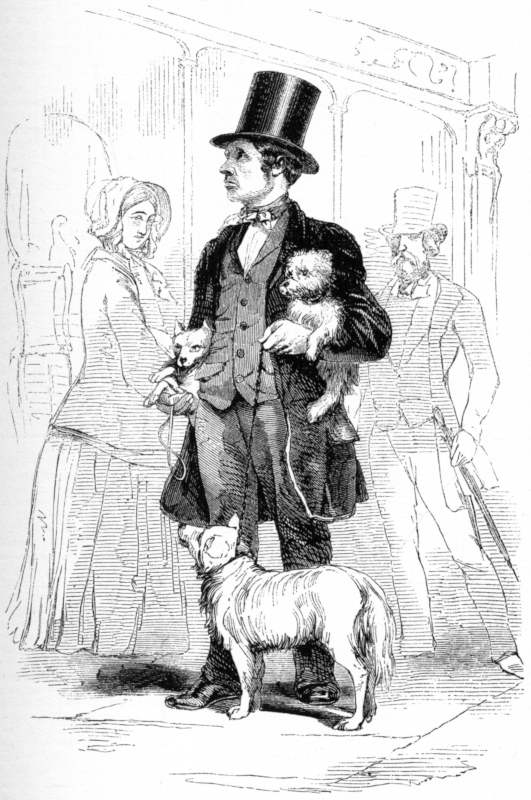
THE STREET DOG-SELLER.
Of the Street-Sellers of Sporting Dogs.
The use, if use it may be styled, of sporting, or fighting dogs, is now a mere nothing to what it once was. There are many sports—an appellation of many a brute cruelty—which have become extinct, some of them long extinct. Herds of bears, for instance, were once maintained in this country, merely to be baited by dogs. It was even a part of royal merry-making. It was a sport altogether congenial to the spirit of Henry VIII.; and when his daughter, then Queen Mary, visited her sister Elizabeth at Hatfield House, now the residence of the Marquess of Salisbury, there was a bear-baiting for their delectation—after mass. Queen Elizabeth, on her accession to the throne, seems to have been very partial to the baiting of bears and of bulls; for she not unfrequently welcomed a foreign ambassador with such exhibitions. The historians of the day intimate—they dared do no more—that Elizabeth affected these rough sports the most in the decline of life, when she wished to seem still sprightly, active, and healthful, in the eyes of her courtiers and her subjects. Laneham, whose veracity has not been impeached—though Sir Walter Scott has pronounced him to be as thorough a coxcomb as ever blotted paper—thus describes a bear-bait in presence of the Queen, and after quoting his description I gladly leave the subject. I make the citation in order to show and contrast the former with the present use of sporting dogs.
“It was a sport very pleasant to see the bear, with his pink eyes leering after his enemies, approach; the nimbleness and wait of the dog to take his advantage; and the force and experience of the bear again to avoid his assaults: if he were bitten in one place, how he would pinch in another to get free; that if he were taken once, then by what shift with biting, with clawing, with roaring with tossing and tumbling, he would work and wind himself from them; and, when he was loose, to shake his ears twice or thrice, with the blood and the slaver hanging about his physiognomy.”
The suffering which constituted the great delight of the sport was even worse than this, in bull-baiting, for the bull gored or tossed the dogs to death more frequently than the bear worried or crushed them.
The principal place for the carrying on of these barbarities was at Paris Garden, not far from St. Saviour’s Church, Southwark. The clamour, and wrangling, and reviling, with and without blows, at these places, gave a proverbial expression to the language. “The place was like a bear-garden,” for “gardens” they were called. These pastimes beguiled the Sunday afternoons more than any other time, and were among the chief delights of the people, “until,” writes Dr. Henry, collating the opinions of the historians of the day, “until the refined amusements of the drama, possessing themselves by degrees of the public taste, if they did not mend the morals of the age, at least forced brutal barbarity to quit the stage.”
Of this sport in Queen Anne’s days, Strutt’s industry has collected advertisements telling of bear and bull-baiting at Hockley-in-the-Hole, and “Tuttle”-fields, Westminster, and of dog-fights at the same places. Marylebone was another locality famous for these pastimes, and for its breed of mastiffs, which dogs were most used for baiting the bears, whilst bull-dogs were the antagonists of the bull. Gay, who was a sufficiently close observer, and a close observer of street-life too, as is well shown in his “Trivia,” specifies these localities in one of his fables:—
“Both Hockley-hole and Mary-bone The combats of my dog have known.”
Hockley-hole was not far from Smithfield-market.
In the same localities the practice of these sports lingered, becoming less and less every year, until about the middle of the last century. In the country, bull-baiting was practised twenty times more commonly than bear-baiting; for bulls were plentiful, and bears were not. There are, perhaps, none of our older country towns without the relic of its bull-ring—a strong iron ring inserted into a large stone in the pavement, to which the baited bull was tied; or a knowledge of the site where the bull-ring was. The deeds of the baiting-dogs were long talked of by the vulgar. These sports, and the dog-fights, maintained the great demand for sporting dogs in former times.
The only sporting dogs now in request—apart, of course, from hunting and shooting (remnants of the old barbarous delight in torture or slaughter), for I am treating only of the street-trade, to which fox-hounds, harriers, pointers, setters, cockers, &c., &c., are unknown—are terriers and bull-terriers. Bull-dogs cannot now be classed as sporting, but only as fancy dogs, for they are not good fighters, I was informed, one with another, their mouths being too small.
The way in which the sale of sporting dogs is connected with street-traffic is in this wise: Occasionally a sporting-dog is offered for sale in the streets, and then, of course, the trade is direct. At other times, gentlemen buying or pricing the smaller dogs, ask the cost of a bull-dog, or a bull-terrier or rat-terrier, and the street-seller at once offers to supply them, and either conducts them to a dog-dealer’s, with whom he may be commercially connected, and where they can purchase those dogs, or he waits upon them at their residences with some “likely animals.” A dog-dealer told me that he hardly knew what made many gentlemen so fond of bull-dogs, and they were “the fonder on ’em the more blackguarder and varmint-looking the creatures was,” although now they were useless for sport, and the great praise of a bull-dog, “never flew but at head in his life,” was no longer to be given to him, as there were no bulls at whose heads he could now fly.
Another dog-dealer informed me—with what truth as to the judgment concerning horses I do not know, but no doubt with accuracy as to the purchase of the dogs—that Ibrahim Pacha, when in London, thought little of the horses which he saw, but was delighted with the bull-dogs, “and he weren’t so werry unlike one in the face hisself,” was said at the time by some of the fancy. Ibrahim, it seems, bought two of the finest and largest bull-dogs in London, of Bill George, giving no less than 70l. for the twain. The bull-dogs now sold by the street-folk, or through their agency in the way I have described, are from 5l. to 25l. each. The bull-terriers, of the best blood, are about the same price, or perhaps 10 to 15 per cent. lower, and rarely attaining the tip-top price.
The bull-terriers, as I have stated, are now the chief fighting-dogs, but the patrons of those combats—of those small imitations of the savage tastes of the Roman Colosseum, may deplore the decay of the amusement. From the beginning, until well on to the termination of the last century, it was not uncommon to see announcements of “twenty dogs to fight for a collar,” though such advertisements were far more common at the commencement than towards the close of the century. Until within these twelve years, indeed, dog-matches were not unfrequent in London, and the favourite time for the regalement was on Sunday mornings. There were dog-pits in Westminster, and elsewhere, to which the admission was not very easy, for only known persons were allowed to enter. The expense was considerable, the risk of punishment was not a trifle, and it is evident that this Sunday game was not supported by the poor or working classes. Now dog-fights are rare. “There’s not any public dog-fights,” I was told, “and very seldom any in a pit at a public-house, but there’s a good deal of it, I know, at the private houses of the nobs.” I may observe that “the nobs” is a common designation for the rich among these sporting people.
There are, however, occasionally dog-fights in a sporting-house, and the order of the combat is thus described to me: “We’ll say now that it’s a scratch fight; two dogs have each their corner of a pit, and they’re set to fight. They’ll fight on till they go down together, and then if one leave hold, he’s sponged. Then they fight again. If a dog has the worst of it he mustn’t be picked up, but if he gets into his corner, then he can stay for as long as may be agreed upon, minute or half-minute time, or more than a minute. If a dog won’t go to the scratch out of his corner, he loses the fight. If they fight on, why to settle it, one must be killed—though that very seldom happens, for if a dog’s very much punished, he creeps to his corner and don’t come out to time, and so the fight’s settled. Sometimes it’s agreed beforehand, that the master of a dog may give in for him; sometimes that isn’t to be allowed; but there’s next to nothing of this now, unless it’s in private among the nobs.”
It has been said that a sportsman—perhaps in the relations of life a benevolent man—when he has failed to kill a grouse or pheasant outright, and proceeds to grasp the fluttering and agonised bird and smash its skull against the barrel of his gun, reconciles himself to the sufferings he inflicts by the pride of art, the consciousness of skill—he has brought down his bird at a long shot; that, too, when he cares nothing for the possession of the bird. The same feeling hardens him against the most piteous, woman-like cry of the hare, so shot that it cannot run. Be this as it may, it cannot be urged that in matching a favourite dog there can be any such feeling to destroy the sympathy. The men who thus amuse themselves are then utterly insensible to any pang at the infliction of pain upon animals, witnessing the infliction of it merely for a passing excitement: and in this insensibility the whole race who cater to such recreations of the wealthy, as well as the wealthy themselves, participate. There is another feeling too at work, and one proper to the sporting character—every man of this class considers the glories of his horse or his dog his own, a feeling very dear to selfishness.
The main sport now, however, in which dogs are the agents is rat-hunting. It is called hunting, but as the rats are all confined in a pit it is more like mere killing. Of this sport I have given some account under the head of rat-catching. The dogs used are all terriers, and are often the property of the street-sellers. The most accomplished of this terrier race was the famous dog Billy, the eclipse of the rat pit. He is now enshrined—for a stuffed carcase is all that remains of Billy—in a case in the possession of Charley Heslop of the Seven Bells behind St. Giles’s Church, with whom Billy lived and died. His great feat was that he killed 100 rats in five minutes. I understand, however, that it is still a moot point in the sporting world, whether Billy did or did not exceed the five minutes by a very few seconds. A merely average terrier will easily kill fifty rats in a pit in eight minutes, but many far exceed such a number. One dealer told me that he would back a terrier bitch which did not weigh 12 lbs. to kill 100 rats in six minutes. The price of these dogs ranges with that of the bull-terriers.
The passion for rat-hunting is evidently on the increase, and seems to have attained the popularity once vouchsafed to cock-fighting. There are now about seventy regular pits in London, besides a few that are run up for temporary purposes. The landlord of a house in the Borough, familiar with these sports, told me that they would soon have to breed rats for a sufficient supply!
But it is not for the encounter with dogs alone, the issue being that so many rats shall be killed in a given time, that these vermin are becoming a trade commodity. Another use for them is announced in the following card:—
A FERRET MATCH.
A Rare Evening’s Sport for the Fancy will take place at the “—— ——,” —— STREET, NEW ROAD, On Tuesday Evening next, May 27.
Mr. —— —— has backed his Ferret against Mr. W. B——’s Ferret to kill 6 Rats each, for 10s. a-side.
He is still open to match his Ferret for £1 to £5 to kill against any other Ferret in London.
Two other Matches with Terriers will come off the same Evening.
Matches take place every —— Evening. Rats always on hand for the accommodation of Gentlemen to try their dogs.
Under the Management of ——
As a rat-killer, a ferret is not to be compared to a dog; but his use is to kill rats in holes, inaccessible to dogs, or to drive the vermin out of their holes into some open space, where they can be destroyed. Ferrets are worth from 1l. to 4l. They are not animals of street-sale.
The management of these sports is principally in the hands of the street dog-sellers, as indeed is the dog-trade generally. They are the breeders, dealers, and sellers. They are compelled, as it were, to exhibit their dogs in the streets, that they may attract the attention of the rich, who would not seek them in their homes in the suburbs. The evening business in rat-hunting, &c., for such it is principally, perhaps doubles the incomes I have specified as earned merely by street-sale. The amount “turned over” in the trade in sporting-dogs yearly in London, was computed for me by one of the traders at from 12,000l. to 15,000l. He could not, however, lay down any very precise statistics, as some bull-dogs, bull-terriers, &c., were bred by butchers, tanners, publicans, horse-dealers, and others, and disposed of privately.
In my account of the former condition of the dog-trade, I had to dwell principally on the stealing and restoring of dogs. This is now the least part of the subject. The alteration in the law, consequent upon the parliamentary inquiry, soon wrought a great change, especially the enactment of the 6th Sect. in the Act 8 and 9 Vict. c. 47. “Any person who shall corruptly take any money or reward, directly or indirectly, under pretence or upon account of aiding any person to recover any dog which shall have been stolen, or which shall be in the possession of any person not being the owner thereof, shall be guilty of a misdemeanour, and punishable accordingly.”
There may now, I am informed, be half a dozen fellows who make a precarious living by dog-stealing. These men generally keep out of the way of the street dog-sellers, who would not scruple, they assure me, to denounce their practices, as the more security a purchaser feels in the property and possession of a dog, the better it is for the regular business. One of these dog-stealers, dressed like a lime-burner—they generally appear as mechanics—was lately seen to attempt the enticing away of a dog. Any idle good-for-nothing fellow, slinking about the streets, would also, I was informed, seize any stray dog within his reach, and sell it for any trifle he could obtain. One dealer told me that there might still be a little doing in the “restoring” way, and with that way of life were still mixed up names which figured in the parliamentary inquiry, but it was a mere nothing to what it was formerly.
From a man acquainted with the dog business I had the following account. My informant was not at present connected with the dog and rat business, but he seemed to have what is called a “hankering after it.” He had been a pot-boy in his youth, and had assisted at the bar of public-houses, and so had acquired a taste for sporting, as some “fancy coves” were among the frequenters of the tap-room and skittle-ground. He had speculated a little in dogs, which a friend reared, and he sold to the public-house customers. “At last I went slap into the dog-trade,” he said, “but I did no good at all. There’s a way to do it, I dare say, or perhaps you must wait to get known, but then you may starve as you wait. I tried Smithfield first—it’s a good bit since, but I can’t say how long—and I had a couple of tidy little terriers that we’d bred; I thought I’d begin cheap to turn over money quick, so I asked 12s. a-piece for them. O, in course they weren’t a werry pure sort. But I couldn’t sell at all. If a grazier, or a butcher, or anybody looked at them, and asked their figure, they’d say, ‘Twelve shillings! a dog what ain’t worth more nor 12s. ain’t worth a d—n!’ I asked one gent a sovereign, but there was a lad near that sung out, ‘Why, you only axed 12s. a bit since; ain’t you a-coming it?’ After that, I was glad to get away. I had five dogs when I started, and about 1l. 8s. 6d. in money, and some middling clothes; but my money soon went, for I could do no business, and there was the rent, and then the dogs must be properly fed, or they’d soon show it. At last, when things grew uncommon taper, I almost grudged the poor things their meat and their sop, for they were filling their bellies, and I was an ’ung’ring. I got so seedy, too, that it was no use trying the streets, for any one would think I’d stole the dogs. So I sold them one by one. I think I got about 5s. apiece for them, for people took their advantage on me. After that I fasted oft enough. I helped about the pits, and looked out for jobs of any kind, cleaning knives and spittoons at a public-house, and such-like, for a bite and sup. And I sometimes got leave to sit up all night in a stable or any out-house with a live rat trap that I could always borrow, and catch rats to sell to the dealers. If I could get three lively rats in a night, it was good work, for it was as good as 1s. to me. I sometimes won a pint, or a tanner, when I could cover it, by betting on a rat-hunt with helpers like myself—but it was only a few places we were let into, just where I was known—’cause I’m a good judge of a dog, you see, and if I had it to try over again, I think I could knock a tidy living out of dog-selling. Yes, I’d like to try well enough, but it’s no use trying if you haven’t a fairish bit of money. I’d only myself to keep all this time, but that was one too many. I got leave to sleep in hay-lofts, or stables, or anywhere, and I have slept in the park. I don’t know how many months I was living this way. I got not to mind it much at last. Then I got to carry out the day and night beers for a potman what had hurt his foot and couldn’t walk quick and long enough for supplying his beer, as there was five rounds every day. He lent me an apron and a jacket to be decent. After that I got a potman’s situation. No, I’m not much in the dog and rat line now, and don’t see much of it, for I’ve very little opportunity. But I’ve a very nice Scotch terrier to sell if you should be wanting such a thing, or hear of any of your friends wanting one. It’s dirt cheap at 30s., just about a year old. Yes, I generally has a dog, and swops and sells. Most masters allows that in a quiet respectable way.”
Of the Street Sellers of Live Birds.
The bird-sellers in the streets are also the bird-catchers in the fields, plains, heaths, and woods, which still surround the metropolis; and in compliance with established precedent it may be proper that I should give an account of the catching, before I proceed to any further statement of the procedures subsequent thereunto. The bird-catchers are precisely what I have described them in my introductory remarks. An intelligent man, versed in every part of the bird business, and well acquainted with the character of all engaged in it, said they might be represented as of “the fancy,” in a small way, and always glad to run after, and full of admiration of, fighting men. The bird-catcher’s life is one essentially vagrant; a few gipsies pursue it, and they mix little in street-trades, except as regards tinkering; and the mass, not gipsies, who become bird-catchers, rarely leave it for any other avocation. They “catch” unto old age. During last winter two men died in the parish of Clerkenwell, both turned seventy, and both bird-catchers—a profession they had followed from the age of six.
The mode of catching I will briefly describe. It is principally effected by means of nets. A bird-net is about twelve yards square; it is spread flat upon the ground, to which it is secured by four “stars.” These are iron pins, which are inserted in the field, and hold the net, but so that the two “wings,” or “flaps,” which are indeed the sides of the nets, are not confined by the stars. In the middle of the net is a cage with a fine wire roof, widely worked, containing the “call-bird.” This bird is trained to sing loudly and cheerily, great care being bestowed upon its tuition, and its song attracts the wild birds. Sometimes a few stuffed birds are spread about the cage as if a flock were already assembling there. The bird-catcher lies flat and motionless on the ground, 20 or 30 yards distant from the edge of the net. As soon as he considers that a sufficiency of birds have congregated around his decoy, he rapidly draws towards him a line, called the “pull-line,” of which he has kept hold. This is so looped and run within the edges of the net, that on being smartly pulled, the two wings of the net collapse and fly together, the stars still keeping their hold, and the net encircles the cage of the call-bird, and incloses in its folds all the wild birds allured round it. In fact it then resembles a great cage of net-work. The captives are secured in cages—the call-bird continuing to sing as if in mockery of their struggles—or in hampers proper for the purpose, which are carried on the man’s back to London.
The use of the call-bird as a means of decoy is very ancient. Sometimes—and more especially in the dark, as in the taking of nightingales—the bird-catcher imitates the notes of the birds to be captured. A small instrument has also been used for the purpose, and to this Chaucer, although figuratively, alludes: “So, the birde is begyled with the merry voice of the foulers’ whistel, when it is closed in your nette.”
Sometimes, in the pride of the season, a bird-catcher engages a costermonger’s poney or donkey cart, and perhaps his boy, the better to convey the birds to town. The net and its apparatus cost 1l. The call-bird, if he have a good wild note—goldfinches and linnets being principally so used—is worth 10s. at the least.
The bird-catcher’s life has many, and to the constitution of some minds, irresistible charms. There is the excitement of “sport”—not the headlong excitement of the chase, where the blood is stirred by motion and exercise—but still sport surpassing that of the angler, who plies his finest art to capture one fish at a time, while the bird-catcher despises an individual capture, but seeks to ensnare a flock at one twitch of a line. There is, moreover, the attraction of idleness, at least for intervals, and sometimes long intervals—perhaps the great charm of fishing—and basking in the lazy sunshine, to watch the progress of the snares. Birds, however, and more especially linnets, are caught in the winter, when it is not quite such holiday work. A bird-dealer (not a street-seller) told me that the greatest number of birds he had ever heard of as having been caught at one pull was nearly 200. My informant happened to be present on the occasion. “Pulls” of 50, 100, and 150 are not very unfrequent when the young broods are all on the wing.
Of the bird-catchers, including all who reside in Woolwich, Greenwich, Hounslow, Isleworth, Barnet, Uxbridge, and places of similar distance, all working for the London market, there are about 200. The localities where these men “catch,” are the neighbourhoods of the places I have mentioned as their residences, and at Holloway, Hampstead, Highgate, Finchley, Battersea, Blackheath, Putney, Mortlake, Chiswick, Richmond, Hampton, Kingston, Eltham, Carshalton, Streatham, the Tootings, Woodford, Epping, Snaresbrook, Walthamstow, Tottenham, Edmonton—wherever, in fine, are open fields, plains, or commons around the metropolis.
I will first enumerate the several birds sold in the streets, as well as the supply to the shops by the bird-catchers. I have had recourse to the best sources of information. Of the number of birds which I shall specify as “supplied,” or “caught,” it must be remembered that a not-very-small proportion die before they can be trained to song, or inured to a cage life. I shall also give the street prices. All the birds are caught by the nets with call-birds, excepting such as I shall notice. I take the singing birds first.
The Linnet is the cheapest and among the most numerous of what may be called the London-caught birds, for it is caught in the nearer suburbs, such as Holloway. The linnet, however,—the brown linnet being the species—is not easily reared, and for some time ill brooks confinement. About one-half of those birds die after having been caged a few days. The other evening a bird-catcher supplied 26 fine linnets to a shopkeeper in Pentonville, and next morning ten were dead. But in some of those bird shops, and bird chambers connected with the shops, the heat at the time the new broods are caught and caged, is excessive; and the atmosphere, from the crowded and compulsory fellowship of pigeons, and all descriptions of small birds, with white rats, hedgehogs, guinea-pigs, and other creatures, is often very foul; so that the wonder is, not that so many die, but that so many survive.
Some bird-connoisseurs prefer the note of the linnet to that of the canary, but this is far from a general preference. The young birds are sold in the streets at 3d. and 4d. each; the older birds, which are accustomed to sing in their cages, from 1s. to 2s. 6d. The “catch” of linnets—none being imported—may be estimated, for London alone, at 70,000 yearly. The mortality I have mentioned is confined chiefly to that year’s brood. One-tenth of the catch is sold in the streets. Of the quality of the street-sold birds I shall speak hereafter.
The Bullfinch, which is bold, familiar, docile, and easily attached, is a favourite cage-bird among the Londoners; I speak of course as regards the body of the people. It is as readily sold in the streets as any other singing bird. Piping bullfinches are also a part of street-trade, but only to a small extent, and with bird-sellers who can carry them from their street pitches, or call on their rounds, at places where they are known, to exhibit the powers of the bird. The piping is taught to these finches when very young, and they must be brought up by their tutor, and be familiar with him. When little more than two months old, they begin to whistle, and then their training as pipers must commence. This tuition, among professional bullfinch-trainers, is systematic. They have schools of birds, and teach in bird-classes of from four to seven members in each, six being a frequent number. These classes, when their education commences, are kept unfed for a longer time than they have been accustomed to, and they are placed in a darkened room. The bird is wakeful and attentive from the want of his food, and the tune he is to learn is played several times on an instrument made for the purpose, and known as a bird-organ, its notes resembling those of the bullfinch. For an hour or two the young pupils mope silently, but they gradually begin to imitate the notes of the music played to them. When one commences—and he is looked upon as the most likely to make a good piper—the others soon follow his example. The light is then admitted and a portion of food, but not a full meal, is given to the birds. Thus, by degrees, by the playing on the bird-organ (a flute is sometimes used), by the admission of light, which is always agreeable to the finch, and by the reward of more and more, and sometimes more relishable food, the pupil “practises” the notes he hears continuously. The birds are then given into the care of boys, who attend to them without intermission in a similar way, their original teacher still overlooking, praising, or rating his scholars, till they acquire a tune which they pipe as long as they live. It is said, however, that only five per cent. of the number taught pipe in perfect harmony. The bullfinch is often pettish in his piping, and will in many instances not pipe at all, unless in the presence of some one who feeds it, or to whom it has become attached.
The system of training I have described is that practised by the Germans, who have for many years supplied this country with the best piping bullfinches. Some of the dealers will undertake to procure English-taught bullfinches which will pipe as well as the foreigners, but I am told that this is a prejudice, if not a trick, of trade. The mode of teaching in this country, by barbers, weavers, and bird-fanciers generally, who seek for a profit from their pains-taking, is somewhat similar to that which I have detailed, but with far less elaborateness. The price of a piping bullfinch is about three guineas. These pipers are also reared and taught in Leicestershire and Norfolk, and sent to London, as are the singing bullfinches which do not “pipe.”
The bullfinches netted near London are caught more numerously about Hounslow than elsewhere. In hard winters they are abundant in the outskirts of the metropolis. The yearly supply, including those sent from Norfolk, &c., is about 30,000. The bullfinch is “hearty compared to the linnet,” I was told, but of the amount which are the objects of trade, not more than two-thirds live many weeks. The price of a good young bullfinch is 2s. 6d. and 3s. They are often sold in the streets for 1s. The hawking or street trade comprises about a tenth of the whole.
The sale of piping bullfinches is, of course, small, as only the rich can afford to buy them. A dealer estimated it at about 400 yearly.
The Goldfinch is also in demand by street customers, and is a favourite from its liveliness, beauty, and sometimes sagacity. It is, moreover, the longest lived of our caged small birds, and will frequently live to the age of fifteen or sixteen years. A goldfinch has been known to exist twenty-three years in a cage. Small birds, generally, rarely live more than nine years. This finch is also in demand because it most readily of any bird pairs with the canary, the produce being known as a “mule,” which, from its prettiness and powers of song, is often highly valued.
Goldfinches are sold in the streets at from 6d. to 1s. each, and when there is an extra catch, and they are nearly all caught about London, and the shops are fully stocked, at 3d. and 4d. each. The yearly catch is about the same as that of the linnet, or 70,000, the mortality being perhaps 30 per cent. If any one casts his eye over the stock of hopping, chirping little creatures in the window of a bird-shop, or in the close array of small cages hung outside, or at the stock of a street-seller, he will be struck by the preponderating number of goldfinches. No doubt the dealer, like any other shopkeeper, dresses his window to the best advantage, putting forward his smartest and prettiest birds. The demand for the goldfinch, especially among women, is steady and regular. The street-sale is a tenth of the whole.
The Chaffinch is in less request than either of its congeners, the bullfinch or the goldfinch, but the catch is about half that of the bullfinch, and with the same rate of mortality. The prices are also the same.
Greenfinches (called green birds, or sometimes green linnets, in the streets) are in still smaller request than are chaffinches, and that to about one-half. Even this smaller stock is little saleable, as the bird is regarded as “only a middling singer.” They are sold in the open air, at 2d. and 3d. each, but a good “green bird” is worth 2s. 6d.
Larks are of good sale and regular supply, being perhaps more readily caught than other birds, as in winter they congregate in large quantities. It may be thought, to witness the restless throwing up of the head of the caged sky-lark, as if he were longing for a soar in the air, that he was very impatient of restraint. This does not appear to be so much the fact, as the lark adapts himself to the poor confines of his prison—poor indeed for a bird who soars higher and longer than any of his class—more rapidly than other wild birds, like the linnet, &c. The mortality of larks, however, approaches one-third.
The yearly “take” of larks is 60,000. This includes sky-larks, wood-larks, tit-larks, and mud-larks. The sky-lark is in far better demand than any of the others for his “stoutness of song,” but some prefer the tit-lark, from the very absence of such stoutness. “Fresh-catched” larks are vended in the streets at 6d. and 8d., but a seasoned bird is worth 2s. 6d. One-tenth is the street-sale.
The larks for the supply of fashionable tables are never provided by the London bird-catchers, who catch only “singing larks,” for the shop and street-traffic. The edible larks used to be highly esteemed in pies, but they are now generally roasted for consumption. They are principally the produce of Cambridgeshire, with some from Bedfordshire, and are sent direct (killed) to Leadenhall-market, where about 215,000 are sold yearly, being nearly two-thirds of the gross London consumption.
It is only within these twelve or fifteen years that the London dealers have cared to trade to any extent in Nightingales, but they are now a part of the stock of every bird-shop of the more flourishing class. Before that they were merely exceptional as cage-birds. As it is, the “domestication,” if the word be allowable with reference to the nightingale, is but partial. Like all migratory birds, when the season for migration approaches, the caged nightingale shows symptoms of great uneasiness, dashing himself against the wires of his cage or his aviary, and sometimes dying in a few days. Many of the nightingales, however, let the season pass away without showing any consciousness that it was, with the race of birds to which they belonged, one for a change of place. To induce the nightingale to sing in the daylight, a paper cover is often placed over the cage, which may be gradually and gradually withdrawn until it can be dispensed with. This is to induce the appearance of twilight or night. On the subject of this night-singing, however, I will cite a short passage.
“The Nightingale is usually supposed to withhold his notes till the sun has set, and then to be the only songster left. This is, however, not quite true, for he sings in the day, often as sweetly and as powerfully as at night; but amidst the general chorus of other singing birds, his efforts are little noticed. Neither is he by any means the only feathered musician of the night. The Wood-lark will, to a very late hour, pour forth its rich notes, flying in circles round the female, when sitting on her nest. The Sky-lark, too, may frequently be heard till near midnight high in the air, soaring as if in the brightness of a summer’s morning. Again we have listened with pleasure long after dark to the warblings of a Thrush, and been awakened at two in the morning by its sweet serenade.” It appears, however, that this night-singing, as regards England, is on fine summer nights when the darkness is never very dense. In far northern climates larks sing all night.
I am inclined to believe that the mortality among nightingales, before they are reconciled to their new life, is higher than that of any other bird, and much exceeding one-half. The dealers may be unwilling to admit this; but such mortality is, I have been assured on good authority, the case; besides that, the habits of the nightingale unfit him for a cage existence.
The capture of the nightingale is among the most difficult achievements of the profession. None are caught nearer than Epping, and the catchers travel considerable distances before they have a chance of success. These birds are caught at night, and more often by their captor’s imitation of the nightingale’s note, than with the aid of the call-bird. Perhaps 1000 nightingales are reared yearly in London, of which three-fourths may be, more or less, songsters. The inferior birds are sold at about 2s. each, the street-sale not reaching 100, but the birds, “caged and singing,” are worth 1l. each, when of the best; and 10s. 12s. and 15s. each when approaching the best. The mortality I have estimated.
Redbreasts are a portion of the street-sold birds, but the catch is not large, not exceeding 3000, with a mortality of about a third. Even this number, small as it is, when compared with the numbers of other singing birds sold, is got rid of with difficulty. There is a popular feeling repugnant to the imprisonment, or coercion in any way, of “a robin,” and this, no doubt has its influence in moderating the demand. The redbreast is sold, when young, both in the shops and streets for 1s., when caged and singing, sometimes for 1l. These birds are considered to sing best by candlelight. The street-sale is a fifth, or sometimes a quarter, all young birds, or with the rarest exceptions.
The Thrush, Throstle, or (in Scottish poetry) Mavis, is of good sale. It is reared by hand, for the London market, in many of the villages and small towns at no great distance, the nests being robbed of the young, wherever they can be found. The nestling food of the infant thrush is grubs, worms, and snails, with an occasional moth or butterfly. On this kind of diet the young thrushes are reared until they are old enough for sale to the shopkeeper, or to any private patron. Thrushes are also netted, but those reared by hand are much the best, as such a rearing disposes the bird the more to enjoy his cage life, as he has never experienced the delights of the free hedges and thickets. This process the catchers call “rising” from the nest. A throstle thus “rose” soon becomes familiar with his owner—always supposing that he be properly fed and his cage duly cleaned, for all birds detest dirt—and among the working-men of England no bird is a greater favourite than the thrush; indeed few other birds are held in such liking by the artisan class. About a fourth of the thrushes supplied to the metropolitan traders have been thus “rose,” and as they must be sufficiently grown before they will be received by the dealers, the mortality among them, when once able to feed themselves, in their wicker-work cages, is but small. Perhaps somewhere about a fourth perish in this hand-rearing, and some men, the aristocrats of the trade, let a number go when they have ascertained that they are hens, as these men exert themselves to bring up thrushes to sing well, and then they command good prices. Often enough, however, the hens are sold cheap in the streets. Among the catch supplied by netting, there is a mortality of perhaps more than a third. The whole take is about 35,000. Of the sale the streets have a tenth proportion. The prices run from 2s. 6d. and 3s. for the “fresh-caught,” and 10s., 1l., and as much as 2l. for a seasoned throstle in high song. Indeed I may observe that for any singing bird, which is considered greatly to excel its mates, a high price is obtainable.
Blackbirds appear to be less prized in London than thrushes, for, though with a mellower note, the blackbird is not so free a singer in captivity. They are “rose” and netted in the same manner as the thrush, but the supply is less by one-fifth. The prices, mortality, street-sale, &c., are in the same ratio.
The street-sale of Canaries is not large; not so large, I am assured by men in the trade, as it was six or seven years ago, more especially as regarded the higher-priced birds of this open-air traffic. Canaries are now never brought from the group of islands, thirteen in number, situate in the North Atlantic and near the African coast, and from which they derive their name. To these islands and to these alone (as far as is known to ornithologists) are they indigenous. The canary is a slow flyer and soon wearied; this is one reason no doubt for its not migrating. This delightful songster was first brought into England in the reign of Elizabeth, at the era when so many foreign luxuries (as they were then considered, and stigmatised accordingly) were introduced; of these were potatoes, tobacco, turkeys, nectarines, and canaries. I have seen no account of what was the cost of a canary-bird when first imported, but there is no doubt that they were very dear, as they were found only in the abodes of the wealthy. This bird-trade seems, moreover, to have been so profitable to the Spaniards, then and now the possessors of the isles, that a government order for the killing or setting at liberty of all hen canaries, caught with the males, was issued in order that the breed might be confined to its native country; a decree not attended with successful results as regards the intention of the then ruling powers.
The foreign supply to this country is now principally from Holland and Germany, where canaries are reared in great numbers, with that care which the Dutch in especial bestow upon everything on which money-making depends, and whence they are sent or brought over in the spring of every year, when from nine to twelve months old. Thirty years ago, the Tyrolese were the principal breeders and purveyors of canaries for the London market. From about the era of the peace of 1814, on the first abdication of Napoleon, for ten or twelve years they brought over about 2000 birds yearly. They travelled the whole way on foot, carrying the birds in cages on their backs, until they reached whatever port in France or the Netherlands (as Belgium then was) they might be bound for. The price of a canary of an average quality was then from 5s. to 8s. 6d., and a fair proportion were street-sold. At that period, I was told, the principal open-air sale for canaries (and it is only of that I now write) was in Whitechapel and Bethnal-green. All who are familiar with those localities may smile to think that the birds chirping and singing in these especially urban places, were bred for such street-traffic in the valleys of the Rhætian Alps! I presume that it was the greater rapidity of communication, and the consequent diminished cost of carriage, between England, Holland, and Germany, that caused the Tyrolese to abandon the trade as one unremunerative—even to men who will live on bread, onions, and water.
I have, perhaps, dwelt somewhat at length on this portion of the subject, but it is the most curious portion of all, for the canary is the only one of all our singing-birds which is solely a household thing. Linnets, finches, larks, nightingales, thrushes, and blackbirds, are all free denizens of the open air, as well as prisoners in our rooms, but the canary with us is unknown in a wild state. “Though not very handy,” wrote, in 1848, a very observant naturalist, the late Dr. Stanley, Bishop of Norwich, “canaries might possibly be naturalized in our country, by putting their eggs in the nests of sparrows, chaffinches, or other similar birds. The experiment has been partially tried in Berkshire, where a person for years kept them in an exposed aviary out of doors, and where they seemed to suffer no inconvenience from the severest weather.”
The breeding of canaries in this country for the London supply has greatly increased. They are bred in Leicester and Norwich, weavers being generally fond of birds. In London itself, also, they are bred to a greater extent than used to be the case, barbers being among the most assiduous rearers of the canary. A dealer who trades in both foreign and home-bred birds thought that the supply from the country, and from the Continent, was about the same, 8000 to 9000 each, not including what were sold by the barbers, who are regarded as “fanciers,” not to say interlopers, by the dealers. No species of birds are ever bred by the shop-dealers. The price of a brisk canary is 5s. or 6s.; but they are sold in the streets as low as 1s. each, a small cage worth 6d. being sometimes included. These, however, are hens. As in the life of a canary there is no transition from freedom to enthralment, for they are in a cage in the egg, and all their lives afterwards, they are subject to a far lower rate of mortality than other street-sold birds. A sixteenth of the number above stated as forming the gross supply are sold in the streets.
The foregoing enumeration includes all the singing-birds of street-traffic and street-folk’s supply. The trade I have thus sketched is certainly one highly curious. We find that there is round London a perfect belt of men, employed from the first blush of a summer’s dawn, through the heats of noon, in many instances during the night, and in the chills of winter; and all labouring to give to city-pent men of humble means one of the peculiar pleasures of the country—the song of the birds. It must not be supposed that I would intimate that the bird-catcher’s life, as regards his field and wood pursuits, is one of hardship. On the contrary, it seems to me to be the very one which, perhaps unsuspected by himself, is best suited to his tastes and inclinations. Nor can we think similar pursuits partake much of hardship when we find independent men follow them for mere sport, to be rid of lassitude.
But the detail of the birds captured for the Londoners by no means ends here. I have yet to describe those which are not songsters, and which are a staple of street-traffic to a greater degree than birds of song. Of these my notice may be brief.
The trade in Sparrows is almost exclusively a street-trade and, numerically considered, not an inconsiderable one. They are netted in quantities in every open place near London, and in many places in London. It is common enough for a bird-catcher to obtain leave to catch sparrows in a wood-yard, a brick-field, or places where is an open space certain to be frequented by these bold and familiar birds. The sparrows are sold in the streets generally at 1d. each, sometimes halfpenny, and sometimes 1½d., and for no purpose of enjoyment (as in the case of the cheap song birds), but merely as playthings for children; in other words, for creatures wilfully or ignorantly to be tortured. Strings are tied to their legs and so they have a certain degree of freedom, but when they offer to fly away they are checked, and kept fluttering in the air as a child will flutter a kite. One man told me that he had sometimes sold as many as 200 sparrows in the back streets about Smithfield on a fine Sunday. These birds are not kept in cages, and so they can only be bought for a plaything. They oft enough escape from their persecutors.
But it is not merely for the sport of children that sparrows are purveyed, but for that of grown men, or—as Charles Lamb, if I remember rightly, qualifies it, when he draws a Pentonville sportsman with a little shrubbery for his preserve—for grown cockneys. The birds for adult recreation are shot in sparrow-matches; the gentleman slaughtering the most being, of course, the hero of a sparrow “battue.” One dealer told me that he had frequently supplied dozens of sparrows for these matches, at 2s. the dozen, but they were required to be fine bold birds! One dealer thought that during the summer months there were as many sparrows caught close to and within London as there were goldfinches in the less urban districts. These birds are sold direct from the hands of the catcher, so that it is less easy to arrive at statistics than when there is the intervention of dealers who know the extent of the trade carried on. I was told by several, who had no desire to exaggerate, that to estimate this sparrow-sale at 10,000 yearly, sold to children and idlers in the streets, was too low, but at that estimate, the outlay, at 1d. a sparrow, would be 850l. The adult sportsmen may slaughter half that number yearly in addition. The sporting sparrows are derived from the shopkeepers, who, when they receive the order, instruct the catchers to go to work.