Volume 2 — CROSSING-SWEEPERS. (continued 2)
Reading edition
“After I leave I have a cup of tea, and after that I go to bed; very frequently I’m in bed at nine o’clock. I have my cup of tea if I can anyway get it; but I’m forced to go without that sometimes.
“When my sight was better, I used to be very partial to reading; but I can’t see the print, sir, now. I used to read the Bible, and the newspaper. Story-books I have read, too, but not many novels. Yes, Robinson Crusoe I know, but not the Pilgrim’s Progress. I’ve heard of it; they tell me it is a very interesting book to read, but I never had it. We never have any ladies or Scripture-readers come to our lodgings; you see, we’re so out, they might come a dozen times and not find us at home.
“I wear out three brooms in a-week; but in the summer one will last a fortnight. I give threepence ha’penny for them; there are twopenny-ha’penny brooms, but they are not so good, they are liable to have their handles come out. It is very fatiguing standing so many hours; my legs aches with pain, and swells. I was once in Middlesex Hospital for sixteen weeks with my legs. My eyes have been weak from a child. I have got a gathering in my head from catching cold standing on the crossing. I had the fever this time twelvemonth. I laid a fortnight and four days at home, and seven weeks in the hospital. I took the diarrhœa after that, and was six weeks under the doctor’s hands. I used to do odd jobs, but my health won’t permit me now. I used to make two or three shillings a-week by ’em, and get scraps and things. But I get no broken victuals now.
“I never get anything from servants; they don’t get more than they know what to do with.
“I don’t get a drop of beer once in a month.
“I don’t know but what this being out may be the best thing, after all; for if I was at home all my time, it would not agree with me.”
Statement of “Old John,” the Waterman at the Farringdon-street Cab-stand, concerning the Old Black Crossing-Sweeper who left £800 to Miss Waithman.
“Yes, sir, I knew him for many year, though I never spoke to him in all my life. He was a stoutish, thickset man, about my build, and used to walk with his broom up and down—so.”
Here “Old John” imitated the halt and stoop of an old man.
“He used to touch his hat continually,” he went on. “‘Please remember the poor black man,’ was his cry, never anything else. Oh yes, he made a great deal of money. People gave more then than they do now. Where they give one sixpence now, they used to give ten. It’s just the same by our calling. Lived humbly? Yes, I think he did; at all events, he seemed to do so when he was on his crossing. He got plenty of odds-and-ends from the corner there—Alderman Waithman’s, I mean; he was a very sober, quiet sort of man. No, sir, nothing peculiar in his dress. Some blacks are peculiar in their dress; but he would wear anything he could get give him. They used to call him Romeo, I think. Cur’ous name, sir; but the best man I ever knew was called Romeo, and he was a black.
“The crossing-sweeper had his regular customers; he knew their times, and was there to the moment. Oh yes, he was always. Hail, rain, or snow, he never missed. I don’t know how long he had the crossing. I remember him ever since I was a postboy in Doctors’ Commons; I knew him when I lived in Holborn, and I haven’t been away from this neighbourhood since 1809.
“No, sir, there’s no doubt about his leaving the money to Miss Waithman. Everybody round about here knows it; just ask them, sir. Miss Waithman (an old maid she were, sir) used to be very kind to him. He used to sweep from Alderman Waithman’s (it’s the Sunday Times now) across to the opposite side of the way.
“When he died, an old man, as had been a soldier, took possession of the crossing. How did he get it? Why, I say, he took it. First come, first sarved, sir; that’s their way. They never sell crossings. Sometimes (for a lark) they shift, and then one stands treat—a gallon of beer, or something of that sort. The perlice interfered with the soldier—you know the sweepers is all forced to go if the perlice interfere; now with us, sir, we are licensed, and they can’t make us move on. They interfered, I say, with the old soldier, because he used to get so drunk. Why, at a public-house close at hand, he would spent seven, eight, and ten shillings on a night, three or four days together. He used to gather so many blackguards round the crossing, they were forced to move him at last. A young man has got it now; he has had it three year. He is not always here, sometimes away for a week at a stretch; but, you see, he knows the best times to come, and then he is sure to be here. The little boys come with their brooms now and then, but the perlice always drive them away.”
3. The Able-bodied Irish Crossing-Sweeper.
The Old Irish Crossing-Sweeper.
This man, a native of “County Corruk,” has been in England only two years and a half. He wears a close-fitting black cloth cap over a shock of reddish hair; round his neck he has a coloured cotton kerchief, of the sort advertised as “Imitation Silk.” His black coat is much torn, and his broom is at present remarkably stumpy. He waits quietly at the post opposite St. ——’s Church, to receive whatever is offered him. He is unassuming enough in his manner, and, as will be seen, not even bearing any malice against his two enemies, “The Swatestuff Man” and “The Switzer.” He says:—
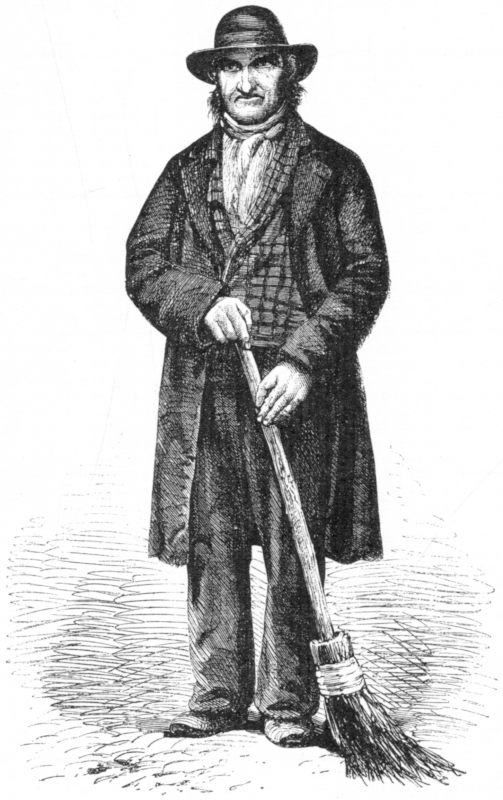
THE IRISH CROSSING-SWEEPER.
[From a Photograph.]
“I’ve been at this crossin’ near upon two year. Whin I first come over to England (about two years and a half ago), I wint a haymakin’, but, you see, I couldn’t get any work; and afther thrampin’ about a good bit, why my eyesight gettin’ very wake, and I not knowin’ what to do, I took this crossin’.
“How did I get it?—Will, sir, I wint walkin’ about and saw it, and nobody on it. So one mornin’ I brought a broom wid me and stood here. Yes, sir, I was intherfered wid. The man with one arm—a Switzer they calls him—he had had the crossin’ on Sundays for a long while gone, and he didn’t like my bein’ here at all, at all. ‘B——y Irish’ he used to call me, and other scandalizin’ names; and he and the swatestuff man opposite, who was a friend of his, tried everythin’ they could to git me off the crossin’. But sure I niver harrumed them at all, at all.
“Yis, sir, I have my rigular custhomers: there’s Mr. ——, he’s gone to Sydenham; he’s very kind, sir. He gives me a shilling a-month. He left worrud with the sarvint while he’s away to give me a shilling on the first day in every month. He gave me a letter to the Eye Hospital, in Goulden Square, because of the wakeness of my eyesight; but they’ll niver cure it at all, at all, sir, for wake eyes runs in my family. My sister, sir, has wake eyes; she is working at Croydon.
“Oh no, indeed, and it isn’t the gintlefolks that thry to get me off the crossin’; they’d rather shupport me, sir. But the poor payple it is that don’t like me.
“Eighteenpince I’ve made in a day, and more: niver more than two shillings, and sometimes not sixpence. Will, sir, I am not like the others; I don’t run afther the ladies and gintlemen—I don’t persevere. Yestherday I took sixpence, by chance, for takin’ some luggage for a lady. The day before yestherday I took three ha’pence; but I think I got somethin’ else for a bit of worruk thin.
“Yes, winther is better than summer. I don’t know which people is the most liberal. Sure, sir, I don’t think there’s much difference. Oh yes, sir, young men are very liberal sometimes, and so are young ladies. Perhaps old ladies or old gintlemen give the most at a time,—sometimes sixpence,—perhaps more; but thin, sir, you don’t git anything else for a long time.
“The boy-sweepers annoy me very much, indeed; they use such scandalizin’ worruds to me, and throw dirrut, they do. They know whin the police is out of the way, so I git no purtiction.
“Sure, sir, and I think it right that ivery person should attind the worruship to which he belongs. I am a Catholic, sir, and attind mass at St. Pathrick’s, near St. Giles’s, ivery Sunday, and I thry to be at confission wonst a month.
“Whin first I took to the crossin’, I was rather irrigular; but that was because of the Switzer man—that’s the man with the one arm; he used to say he would lock me up, and iverything. But I have been rigular since.
“I come in the morruning just before eight, in time to catch the gintlefolks going into prayers; and I leave at half-past seven to eight at night. I wait so late because I have to bring a gintleman wather for his flowers, and that I do the last thing.
“I live, sir, in —— lane, behind St. Giles’s Church, in the first-flure front, sir; and I pay one-and-threepence a-week. There are three bids in the room. In one bid, a man, his wife, his mother, and their little girl—Julia, they call her—sleep; in the other bid, there’s a man and his wife and child. Yes, I am single, and have the third bid to myself. I come from County Corruk; the others in the room are all Irish, and come from County Corruk too. They sill fruit in the sthreet; in the winther they sill onions, and sometimes oranges.
“There a Scotch gintleman as brings me my breakfast every morning; indeed, yes, and he brings it himself, he does. He has gone to Scotland now, but he will be back in a week. He brings me some bread and mate, and a pinny for a half pint of beer, sir. He has done it almost all the time I have been here.
“The Switzer man, sir, took out boards for the Polytickner, or some place like that. He got fifteen shillings a-week, and used to come here on Sundays. Yes, sir, I come here on Sundays; but it is not better than other days. Some people says to me, they would rather I went to church; but I tells ’em I do; and sure, sir, afther mass, there’s no harrum in a little sweepin’ between whiles.
“No, sir, there’s not a crossin’-sweeper in Ould Ireland. Well, sir, I niver was in Dublin; but I’ve been in Corruk, sir, and they don’t have any crossin’ sweepers there.
“Whin I git home of a night, sir, I am very tired; but I always offer up my devotions before sleepin’. Ah, sir, I should niver have swipt crossin’s if a friend of mine hadn’t died; he was collector of tolls in Clarnykilts, and I used to be with him. He lost his situation, and so I came to England.
“The Switzer man, I think he used to sweep at eight o’clock, just as the people were goin’ to prayers. Oh, sir, he was always black-geyardin’ me. ‘Go back to your own counthry,’ says he—a furriner himsilf, too.
“Will, yes sir, I do wish for bad weather; a good wit day, and a dry day afther, is the best.
“Sure and they can’t turn me off my crossin’ only for my bad conduct, and I thry to be quiet and take no notice.
“Yis, sir, I have always been a church-goer, and I am seventy-five. I used to have some good rigular customers, but somehow I haven’t seen anythin’ of them for this last twelvemonth. Ah! it’s in the betther neighbourhoods that people give rigularly. I niver get any broken victuals. Three-and-sixpence is the outside of my earnings, taking one week with the other.
“What is the laste I ever took? Will, sir, for three days I haven’t taken a farthin’. The worust week I iver had was thirteen or fourteen pence altogether; the best week I iver had was the winter before last—that harrud winter, sir, I remember takin’ seven shillings thin; but the man at Portman-square makes the most.
“Well, sir, I belave there’s some of every nation in the world as sweeps crossin’s in London.”
The Female Irish Crossing-Sweeper.
In a street not far from Gordon-square and the New-road, I found this poor old woman resting from her daily labour. She was sitting on the stone ledge of the iron railings at the corner of the street, huddled up in the way seemingly natural to old Irishwomen, her broom hidden as much as possible under her petticoats. Her shawl was as tidy as possible for its age. She was sixty-seven years, and had buried two husbands and five children, fractured her ribs, and injured her groin, and had nothing left to comfort her but her crossing, her ha’porth of snuff, and her “drop of biled wather,” by which name she indicated her “tay.”
She was very civil and intelligent, and answered my inquiries very readily, and with rather less circumlocution than the Irish generally display. She seemed much hurt at the closing of the Old St. Pancras churchyard. “They buried my child where they’ll never bury me, sir,” she cried.
She told the story of her accident with many involuntary movements of her hand towards the injured part, and took a sparing pinch of snuff from a little black snuff-box, inlaid with mother-of-pearl, for which she said she had given a penny. She proceeded thus:—“I’m an Irishwoman, sir, and it’s from Kinsale I come, twelve miles beyond Corruk, to the left-hand side, a seaport town, and a great place for fish. It’s fifty years the sixteenth of last June since I came in St. Giles’s parish, and there my ildest child wint did. Buried she is in Ould St. Pancras churchyarrud, where they’ll never bury me, sir, for they’ve done away with burying in churchyarruds. That girl was forty-one year of age the seventeenth of last February, born in Stratford, below Bow, in Essex. Ah! I was comfortable there; I lived there three year and abouts. I was in sarvice at Mr. ——’s, a Frinch gintleman he was, and kept a school, where they taught Frinch and English both; but I dare say they are all gone did years ago. He was a very ould gintleman, and so was his lady; she was a North-of-England lady, but very stout, and had no children but a son and daughter. I was quite young when my aunt brought me over. My uncle was three year here before my aunt, and he died at Whitechapel. I was bechuxt sixteen and seventeen when I come over, and I reckon meself at sixty-seven come next Christmas, as well as I can guess. I never had a mother, sir; she died when I was only six months old. My father, sir, was maltster to Mr. Walker the distiller, in Corruk. Ah! indeed, and my father was well to do wonst. Early or late, wit or dry, he had a guinea a-week, but he worruked day and night; he was to attind to the corun, and he would have four min, or five or six, undther him, according as busy they might be. My father has been did four-and-twinty year, and I wouldn’t know a crature if I wint home. Father come over, sir, and wanted me to go back very bad, but I wouldn’t. I was married thin, and had buried some of my childer in St. Pancras; and for what should I lave England?
“Oh! sir, I buried three in eight months,—two sons and their father. My husband was two year and tin months keeping his bed; he has been did fifteen years to the eighth of last March; but I’ve been married again.
“Siven childer I’ve had, and ounly two alive, and they’ve got enough to do to manage for thimsilves. The boy, he follers the market, and my daughter, she is along with her husband; sure he sills in the streets, sir. I see very little of her,—she lives over in the Borough.
“I think I’ll be afther going down to Kent, beyant Maidstone, a hop-picking, if I can git as much as to take me down the road.
“My daughter’s husband and me don’t agree, so I’m bitter not to see them.
“Ivery day, sir—ivery day in the week I am here. This morunning I was here at eight—that was earlier than usual, but I came out because I had not broke my fast with anything but a drop of wather, and that I had two tumblers of it from the house at the corrunner. I intind to go home and take two hirrings, and have a drop of biled wather—tay, I mane, sir.
“I come here at about half-past nine to half-past ten, but I’m gitting a very bad leg. I goes home about five or six.
“I have taken two ha’pennies this morning; thruppence I took yisterday; the day before I took, I think, fourpence ha’penny; that was my taking on Monday; on Sunday I mustered a shilling; on Saturday—I declare, sir, I forgit—fourpence or thruppence, I suppose, but my frinds is out of town very much. They gives me a penny rigular every Sunday, or a ha’penny, and some tuppence. Of a Sunday in the good time I may take eighteenpence or sixteenpence.
“Oh, yes, of Christmas it’s better, it is—four or five shillings on a Christmas-day.
“On the Monday fortnight, before last Christmas twelvemonth, I had two ribs broke, and one fractured, and my grine (groin) bone injured. Oh! the pains that I feel even now, sir. I lived then in Phillip’s-gardens, up there in the New-road. The policeman took me to the hospital. It was eighteen days I niver got off my bid. I came out in the morunning of the Christmas-eve. I hild on by the railings as I wint along, and I thought I niver should git home. How I was knocked down was by a cart; I had my eye bad thin, the lift one, and had a cloth over it. I was just comin’ out of the archway of the courrut (close by the beer-shop) away from Mr. ——’s house, when crossing to the green-grocer’s to git two pound of praties for my supper, I didn’t see the cart comin’. I was knocked down by the shaft. They called, and they called, and he wouldn’t stop, and it wint over me, it did. It was loaded with cloth; I don’t know if it wasn’t a Shoolbred’s cart, but the boy said to the hospital-doctor and to the policeman it was heavily loaded. The boy gave me a shilling, and that was all the money I received. For a twelvemonth I couldn’t hardly walk.
“On that Christmas-day I took four-and-tinpence, but I owed it all for rint and things; and I’m sure it’s a good man that let me run it the score.
“Is it a shillin’ I iver git? Well, thin, sir, there’s one gintleman, but he’s out of town—Sir George Hewitt—niver passes without givin’ me a shillin’.
“I have taken one-and-ninepence on a Sunday, and I’ve taken two shillin’s. Upon my sowl, I’ve often gone home with three ha’pence and tuppence. For this month past, put ivery day together, I haven’t taken three shilling a-week.
“I wear two brooms out in a week in bad wither, and thin p’rhaps I take four to five shillin’, Sunday included; but for the three year since here I’ve been on this crossin’, I niver took tin shillin’, sir, niver.
“Yes, there was a man here before me: he had bad eyes, and he was obligated to lave and go into the worrukhouse; he lost the sight of one of his eyes when he came back again. I knew him sweepin’ here a long time. When he come back, I said, ‘Father,’ says I, ‘I wint on your crossin’.’ ‘Ah,’ says he, ‘you’ve got a bad crossin’, poor woman; I wouldn’t go on it again, I wouldn’t;’ and I niver seen him since. I don’t know whether he is living or not.
“A wit day makes fourpence or fippence difference sometimes.
“Indeed, I have heard of crossin’-sweepers makin’ so much and so much. I hear people talkin’ about it, but, for my parrut, I wouldn’t give heed to what they say. In Oxford-street, towards the Parruks, there was a man, years ago, they say, by all accounts left a dale of money.
“I am niver annoyed by boys. I don’t spake to none of them. I was in sarvice till I got married, thin I used to sill fruit through Kentish Town, Highgate, and Hampstead; but I niver sould in the streets, sir, and had my rigular customers like any greengrocer. I had a good connixion, I had; but, by gitting old and feeble, and sick, and not being able to go about, I was forrussed to give it up, I was. I couldn’t carry twelve pound upon my hid—no, not if I was to get a sov’rin a-day for it, now.
“I niver lave the crossin’. I haven’t got a frind; nor a day’s pleasure I niver take.
“Oh, yes, sir, I must have a pinch—this is my snuff-box. I take a ha’porth a-day, and that’s the only comforrut I’ve got—that and a cup of tay; for I can’t dthrink cocoa or coffee-tay.
“My feeding is a bit of brid and butther. I haven’t bought a bit of mate these three months. I used to git two penn’orth of bones and mate at Mrs. Baker’s, down there; but mate is so dear, that they don’t have ’em now, and it’s ashamed I am of botherin’ thim so often. I frequintly have a hirrin’. Oh dear! no sir. Wather is my dthrink. I can’t afforrud no beer. Sometimes I have a penn’orth of gin and could water, and I find it do me a worruld of good. Sometimes I git enough to eat, but lately, indeed, I can’t git that. I declare I don’t know which people give the most; the gintlemen give me more in wit wither, for then the ladies, you see, can’t let their dresses out of their hands.
“I am a Catholic, sir. I go to St. Pathrick’s sometimes, or I go to Gordon-street Churruch. I don’t care which I go to—it’s all the same to me; but I haven’t been to churruch for months. I’ve nothing to charge mysilf wid; and, indeed, I haven’t been to confission for some year.
“Tradespeople are very kind, indeed they are.
“Yes, I think I’ll go to Kint a hop-pickin’; and as for my crossin’, I lave it, sir, just as it is. I go five miles beyant Maidstone. I worruked fifteen years at Mr. ——; he was a pole-puller and binsman in the hop-ground.
“I’ve not been down there since the year before last. I was too poorly after that accident. We make about eighteenpence, two shillin’s, or one shillin’, ’cording as the hops is good. No lodging nor fire to pay; and we git plinty of good milk chape there. I manage thin to save a little money to hilp us in the winther.
“I live in —— street, Siven Dials; but I’m going to lave my son—we can’t agree. We live in the two-pair back. I pay nothing a-week, only bring home ivery ha’penny to hilp thim. Sometimes I spind a pinny or tuppence out on mysilf.
“My son is doin’ very badly. He sills fruit in the sthreets; but he’s niver been used to it before; and he has pains in his limbs with so much walking. He has no connixion, and with the sthrawbirries now he’s forrused to walk about of a night as will as a day, for they won’t keep till the morrunning; they all go mouldy and bad. My son has been used to the bricklaying, sir: he can lit in a stove or a copper, or do a bit of plasther or lath, or the like. His wife is a very just, clane, sober woman, and he has got three good childer; there is Catherine, who is named afther me, she is nearly five; Illen, two years and six months, named after her mother; and Margaret, the baby, six months ould—and she is called afther my daughter, who is did.”
4. The Occasional Crossing-Sweepers.
The Sunday Crossing-Sweeper.
“I’m a Sunday crossing-sweeper,” said an oyster-stall keeper, in answer to my inquiries. “I mean by that, I only sweep a crossing on a Sunday. I pitch in the Lorrimore-road, Newington, with a few oysters on week-days, and I does jobs for the people about there, sich as cleaning a few knives and forks, or shoes and boots, and windows. I’ve been in the habit of sweeping a crossing about four or five years.
“I never knowed my father, he died when I was a baby. He was a ’terpreter, and spoke seven different languages. My father used to go with Bonaparte’s army, and used to ’terpret for him. He died in the South of France. I had a brother, but he died quite a child, and my mother supported me and a sister by being cook in a gentleman’s family: we was put out to nurse. My mother couldn’t afford to put me to school, and so I can’t read nor write. I’m forty-one years old.
“The fust work I ever did was being boy at a pork-butcher’s. I used to take out the meat wot was ordered. At last my master got broke up, and I was discharged from my place, and I took to sellin’ a few sprats. I had no thoughts of taking to a crossing then. I was ten year old. I remember I give two shillings for a ‘shallow;’ that’s a flat basket with two handles; they put ’em a top of ‘well-baskets,’ them as can carry a good load. A well-basket’s almost like a coffin; it’s a long un like a shallow, on’y it’s a good deal deeper—about as deep as a washin’ tub. I done very fair with my sprats till they got dear and come up very small, so then I was obliged to get a few plaice, and then I got a few baked ’taters and sold them. I hadn’t money enough to buy a tin—I could a got one for eight shillings—so I put ’em in a cross-handle basket, and carried ’em round the streets, and into public-houses, and cried ‘Baked taters, all hot!’ I used only to do this of a night, and it brought me about four or five shillings a-week. I used to fill up the day by going round to gentlemen’s houses where I was known, to run for errands and clean knives and boots, and that brought me sich a thing as four shillings a-week more altogether.
“I never had no idea then of sweeping a crossing of a Sunday; but at last I was obliged to push to it. I kept on like this for many years, and at last a gentleman named Mr. Jackson promised to buy me a tin, but he died. My mother went blind through a blight; that was the cause of my fust going out to work, and so I had to keep her; but I didn’t mind that: I thought it was my duty so to do.
“About ten years ago I got married; my wife used to go out washing and ironing. I thought two of us would get on better than one, and she didn’t mind helpin’ me to keep my mother, for I was determined my mother shouldn’t go into the workhouse so long as I could help it.
“A year or two after I got married, I found I must do something more to help to keep home, and then I fust thought of sweepin’ a crossing on Sundays; so I bought a heath broom for twopence-ha’penny, and I pitched agin’ the Canterbury Arms, Kennington; it was between a baker’s shop and a public-house and butcher’s; they told me they’d all give me something if I’d sweep the crossing reg’lar.
“The best places is in front of chapels and churches, ’cause you can take more money in front of a church or a chapel than wot you can in a private road, ’cos they look at it more, and a good many thinks when you sweeps in front of a public-house that you go and spend your money inside in waste.
“The first Sunday I went at it, I took eighteenpence. I began at nine o’clock in the morning and stopped till four in the afternoon. The publican give fourpence, and the baker sixpence, and the butcher threepence, so that altogether I got above a half-crown. I stopped at this crossing a year, and I always knocked up about two shillings or a half-crown on the Sunday. I very seldom got anythink from the ladies; it was most all give by the gentlemen. Little children used sometimes to give me ha’pence, but it was when their father give it to ’em; the little children like to do that sort of thing.
“The way I come to leave this crossing was this here: the road was being repaired, and they shot down a lot of stones, so then I couldn’t sweep no crossing. I looked out for another place, and I went opposite the Duke of Sutherland public-house in the Lorrimore-road. I swept there one Sunday, and I got about one-and-sixpence. While I was sweeping this crossing, a gentleman comes up to me, and he axes me if I ever goes to chapel or church; and I tells him, ‘Yes;’ I goes to church, wot I’d been brought up to; and then he says, ‘You let me see you at St. Michael’s Church, Brixton, and I’ll ’courage you, and you’ll do better if you come up and sweep in front there of a Sunday instead of where you are; you’ll be sure to get more money, and get better ’couraged. It don’t matter what you do,’ he says, ‘as long as it brings you in a honest crust; anythink’s better than thieving.’ And then the gent gives me sixpence and goes away.
“As soon as he’d gone I started off to his church, and got there just after the people was all in. I left my broom in the churchyard. When I got inside the church, I could see him a-sitten jest agin the communion table, so I walks to the free seats and sets down right close again the communion table myself, for his pew was on my right, and he saw me directly and looked and smiled at me. As he was coming out of the church he says, says he, ‘As long as I live, if you comes here on a Sunday reg’lar I shall always ’courage you.’
“The next Sunday I went up to the church and swept the crossing, and he see me there, but he didn’t give me nothink till the church was over, and then he gave me a shilling, and the other people give me about one-and-sixpence; so I got about two-and-sixpence altogether, and I thought that was a good beginning.
“The next Sunday the gen’elman was ill, but he didn’t forget me. He sent me sixpence by his servant, and I got from the other people about two shillings more. I never see that gentleman after, for he died on the Saturday. His wife sent for me on the Sunday; she was ill a-bed, and I see one of the daughters, and she gave me sixpence, and said I was to be there on Monday morning. I went on the Monday, and the lady was much worse, and I see the daughter again. She gave me a couple of shirts, and told me to come on the Friday, and when I went on that day I found the old lady was dead. The daughter gave me a coat, and trousers, and waistcoat.
“After the daughters had buried the father and mother they moved. I kept on sweeping at the church, till at last things got so bad that I come away, for nobody give me nothink. The houses about there was so damp that people wouldn’t live in ’em.
“So then I come up into Lorrimore-road, and there I’ve been ever since. I don’t get on wonderful well there. Sometimes I don’t get above sixpence all day, but it’s mostly a shilling or so. The most I’ve took is about one-and-sixpence. The reason why I stop there is, because I’m known there, you see. I stands there all the week selling highsters, and the people about there give me a good many jobs. Besides, the road is rather bad there, and they like to have a clean crossing of a Sunday.
“I don’t get any more money in the winter (though it’s muddier) than I do in the summer; the reason is, ’cause there isn’t so many people stirring about in the winter as there is in the summer.
“One broom will carry me over three Sundays, and I gives twopence-ha’penny a-piece for ’em. Sometimes the people bring me out at my crossing—’specially in cold weather—a mug of hot tea and some bread and butter, or a bit of meat. I don’t know any other crossing-sweeper; I never ’sociates with nobody. I always keeps my own counsel, and likes my own company the best.
“My wife’s been dead five months, and my mother six months; but I’ve got a little boy seven year old; he stops at school all day till I go home at night, and then I fetches him home. I mean to do something better with him than give him a broom: a good many people would set him on a crossing; but I mean to keep him at school. I want to see him read and write well, because he’ll suit for a place then.
“There’s some art in sweeping a crossing even. That is, you mustn’t sweep too hard, ’cos if you do, you wears a hole right in the road, and then the water hangs in it. It’s the same as sweeping a path; if you sweeps too hard you wears up the stones.
“To do it properly, you must put the end of the broom-handle in the palm of your right hand, and lay hold of it with your left, about halfway down; then you takes half your crossing, and sweeps on one side till you gets over the road; then you turns round and comes back doing the other half. Some people holds the broom before ’em, and keeps swaying it back’ards and for’ards to sweep the width of the crossing all in one stroke, but that ain’t sich a good plan, ’cause you’re apt to splash people that’s coming by; and besides, it wears the road in holes and wears out the broom so quick. I always use my broom steady. I never splash nobody.
“I never tried myself, but I’ve seen some crossin’-sweepers as could do all manner of things in mud, sich as diamonds, and stars, and the moon, and letters of the alphabet; and once in Oxford-street I see our Saviour on his cross in mud, and it was done well, too. The figure wasn’t done with the broom, it was done with a pointed piece of stick; it was a boy as I see doin’ it, about fifteen. He didn’t seem to take much money while I was a-looking at him.
“I don’t think I should a took to crossin’ sweeping if I hadn’t got married; but when I’d got a couple of children (for I’ve had a girl die; if she’d lived she’d a been eight year old now,) I found I must do a somethin’, and so I took to the broom.”
B. The Afflicted Crossing-Sweepers.
The Wooden-legged Sweeper.
This man lives up a little court running out of a wide, second-rate street. It is a small court, consisting of some half-dozen houses, all of them what are called by courtesy “private.”
I inquired at No. 3 for John ——; “The first-floor back, if you please, sir;” and to the first-floor back I went.
Here I was answered by a good-looking and intelligent young woman, with a baby, who said her husband had not yet come home, but would I walk in and wait? I did so; and found myself in a very small, close room, with a little furniture, which the man called “his few sticks,” and presently discovered another child—a little girl. The girl was very shy in her manner, being only two years and two months old, and as her mother said, very ailing from the difficulty of cutting her teeth, though the true cause seemed to be want of proper nourishment and fresh air. The baby was a boy—a fine, cheerful, good-tempered little fellow, but rather pale, and with an unnaturally large forehead. The mantelpiece of the room was filled with little ornaments of various sorts, such as bead-baskets, and over them hung a series of black profiles—not portraits of either the crossing-sweeper or any of his family, but an odd lot of heads, which had lost their owners many a year, and served, in company with a little red, green, and yellow scripture-piece, to keep the wall from looking bare. Over the door (inside the room) was nailed a horse-shoe, which, the wife told me, had been put there by her husband, for luck.
A bed, two deal tables, a couple of boxes, and three chairs, formed the entire furniture of the room, and nearly filled it. On the window-frame was hung a small shaving-glass; and on the two boxes stood a wicker-work apology for a perambulator, in which I learnt the poor crippled man took out his only daughter at half-past four in the morning.
“If some people was to see that, sir,” said the sweeper, when he entered and saw me looking at it, “they would, and in fact they do say, ‘Why, you can’t be in want.’ Ah! little they know how we starved and pinched ourselves before we could get it.”
There was a fire in the room, notwithstanding the day was very hot; but the window was wide open, and the place tolerably ventilated, though oppressive. I have been in many poor people’s “places,” but never remember one so poor in its appointments and yet so free from effluvia.
The crossing-sweeper himself was a very civil sort of man, and in answer to my inquiries said:—
“I know that I do as I ought to, and so I don’t feel hurt at standing at my crossing. I have been there four years. I found the place vacant. My wife, though she looks very well, will never be able to do any hard work; so we sold our mangle, and I took to the crossing: but we’re not in debt, and nobody can’t say nothing to us. I like to go along the streets free of such remarks as is made by people to whom you owes money. I had a mangle in —— Yard, but through my wife’s weakness I was forced to part with it. I was on the crossing a short time before that, for I knew that if I parted with my mangle and things before I knew whether I could get a living at the crossing I couldn’t get my mangle back again.
“We sold the mangle only for a sovereign, and we gave two-pound-ten for it; we sold it to the same man that we bought it of. About six months ago I managed for to screw and save enough to buy that little wicker chaise, for I can’t carry the children because of my one leg, and of course the mother can’t carry them both out together. There was a man had the crossing I’ve got; he died three or four years before I took it; but he didn’t depend on the crossing—he did things for the tradespeople about, such as carpet-beating, messages, and so on.
“When I first took the crossing I did very well. It happened to be a very nasty, dirty season, and I took a good deal of money. Sweepers are not always civil, sir.
“I wish I had gone to one of the squares, though. But I think after —— street is paved with stone I shall do better. I am certain I never taste a bit of meat from one week’s end to the other. The best day I ever made was five-and-sixpence or six shillings; it was the winter before last. If you remember, the snow laid very thick on the ground, and the sudden thaw made walking so uncomfortable, that I did very well. I have taken as little as sixpence, fourpence, and even twopence. Last Thursday I took two ha’pence all day. Take one week with the other, seven or eight shillings is the very outside.
“I don’t know how it is, but some people who used to give me a penny, don’t now. The boys who come in wet weather earn a great deal more than I do. I once lost a good chance, sir, at the corner of the street leading to Cavendish-square. There’s a bank, and they pay a man seven shillings a-week to sweep the crossing: a butcher in Oxford Market spoke for me; but when I went up, it unfortunately turned out that I was not fit, from the loss of my leg. The last man they had there they were obliged to turn away—he was so given to drink.
“I think there are some rich crossing-sweepers in the city, about the Exchange; but you won’t find them now during this dry weather, except in by-places. In wet weather, there are two or three boys who sweep near my crossing, and take all my earnings away. There’s a great able-bodied man besides—a fellow strong enough to follow the plough. I said to the policeman, ‘Now, ain’t this a shame?’ and the policeman said, ‘Well, he must get his living as well as you.’ I’m always civil to the police, and they’re always civil to me—in fact, I think sometimes I’m too civil—I’m not rough enough with people.
“You soon tell whether to have any hopes of people coming across. I can tell a gentleman directly I see him.
“Where I stand, sir, I could get people in trouble everlasting; there’s all sorts of thieving going on. I saw the other day two or three respectable persons take a purse out of an old lady’s pocket before the baker’s shop at the corner; but I can’t say a word, or they would come and throw me into the road. If a gentleman gives me sixpence, he don’t give me any more for three weeks or a month; but I don’t think I’ve more than three or four gentlemen as gives me that. Well, you can scarcely tell the gentleman from the clerk, the clerks are such great swells now.
“Lawyers themselves dress very plain; those great men who don’t come every day, because they’ve clerks to do their business for them, they give most. People hardly ever stop to speak unless it is to ask you where places are—you might be occupied at that all day. I manage to pay my rent out of what I take on Sunday, but not lately—this weather religious people go pleasuring.
“No, I don’t go now—the fact is, I’d like to go to church, if I could, but when I come home I am tired; but I’ve got books here, and they do as well, sir. I read a little and write a little.
“I lost my leg through a swelling—there was no chloroform then. I was in the hospital three years and a half, and was about fifteen or sixteen when I had it off. I always feel the sensation of the foot, and more so at change of weather. I feel my toes moving about, and everything; sometimes, it’s just as if the calf of my leg was itching. I feel the rain coming; when I see a cloud coming my leg shoots, and I know we shall have rain.
“My mother was a laundress—my father has been dead nineteen years my last birthday. My mother was subject to fits, so I was forced to stop at home to take care of the business.
“I don’t want to get on better, but I always think, if sickness or anything comes on——
“I am at my crossing at half-past eight; at half-past eleven I come home to dinner. I go back at one or two till seven.
“Sometimes I mind horses and carts, but the boys get all that business. One of these little customers got sixpence the other day for only opening the door of a cab. I don’t know how it is they let these little boys be about; if I was the police, I wouldn’t allow it.
“I think it’s a blessing, having children—(referring to his little girl)—that child wants the gravy of meat, or an egg beaten up, but she can’t get it. I take her out every morning round Euston-square and those open places. I get out about half-past four. It is early, but if it benefits her, that’s no odds.”
One-legged Sweeper at Chancery-lane.
“I don’t know what induced me to take that crossing, except it was that no one was there, and the traffic was so good—fact is, the traffic is too good, and people won’t stop as they cross over, they’re very glad to get out of the way of the cabs and the omnibuses.
“Tradespeople never give me anything—not even a bit of bread. The only thing I get is a few cuttings, such as crusts of sandwiches and remains of cheese, from the public-house at the corner of the court. The tradespeople are as distant to me now as they were when I came, but if I should pitch up a tale I should soon get acquainted with them.
“We have lived in this lodging two years and a half, and we pay one-and-ninepence a-week, as you may see from the rent-book, and that I manage to earn on Sundays. We owe four weeks now, and, thank God, it’s no more.
“I was born, sir, in —— street, Berkeley-square, at Lord ——’s house, when my mother was minding the house. I have been used to London all my life, but not to this part; I have always been at the west-end, which is what I call the best end.
“I did not like the idea of crossing-sweeping at first, till I reasoned with myself, Why should I mind? I’m not doing any hurt to anybody. I don’t care at all now—I know I’m doing what I ought to do.
“A man had better be killed out of the way than be disabled. It’s not pleasant to know that my wife is suckling that great child, and, though she is so weakly, she can’t get no meat.
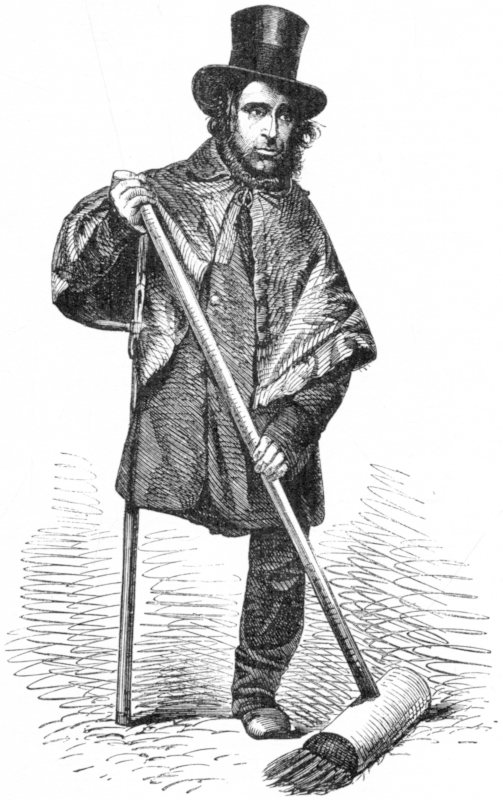
THE ONE-LEGGED SWEEPER AT CHANCERY-LANE.
[From a Photograph.]
“I’ve been knocked down twice, sir—both times by cabs. The last time it was a fortnight before I could get about comfortably again. The fool of a fellow was coming along, not looking at his horse, but talking to somebody on the cab-rank. The place was as free as this room, if he had only been looking before him. Nobody hollered till I was down, but plenty hollered then. Ah, I often notice such carelessness—it’s really shameful. I don’t think those ‘shofuls’ (Hansoms) should be allowed—the fact is, if the driver is not a tall man he can’t see his horse’s head.
“A nasty place is end of —— street: it narrows so suddenly. There’s more confusion and more bother about it than any place in London. When two cabs gets in at once, one one way and one the other, there’s sure to be a row to know which was the first in.”
The Most Severely-Afflicted of all the Crossing-Sweepers.
Passing the dreary portico of the Queen’s Theatre, and turning to the right down Tottenham Mews, we came upon a flight of steps leading up to what is called “The Gallery,” where an old man, gasping from the effects of a lung disease, and feebly polishing some old harness, proclaimed himself the father of the sweeper I was in search of, and ushered me into the room where he lay a-bed, having had a “very bad night.”
The room itself was large and of a low pitch, stretching over some stables; it was very old and creaky (the sweeper called, it “an old wilderness”), and contained, in addition to two turn-up bedsteads, that curious medley of articles which, in the course of years, an old and poor couple always manage to gather up. There was a large lithograph of a horse, dear to the remembrance of the old man from an indication of a dog in the corner. “The very spit of the one I had for years; it’s a real portrait, sir, for Mr. Hanbart, the printer, met me one day and sketched him.” There was an etching of Hogarth’s in a black frame; a stuffed bird in a wooden case, with a glass before it; a piece of painted glass, hanging in a place of honour, but for which no name could be remembered, excepting that it was “of the old-fashioned sort.” There were the odd remnants, too, of old china ornaments, but very little furniture; and, finally, a kitten.
The father, worn out and consumptive, had been groom to Lord Combermere. “I was with him, sir, when he took Bonyparte’s house at Malmasong. I could have had a pension then if I’d a liked, but I was young and foolish, and had plenty of money, and we never know what we may come to.”
The sweeper, although a middle-aged man, had all the appearance of a boy—his raw-looking eyes, which he was always wiping with a piece of linen rag, gave him a forbidding expression, which his shapeless, short, bridgeless nose tended to increase. But his manners and habits were as simple in their character as those of a child; and he spoke of his father’s being angry with him for not getting up before, as if he were a little boy talking of his nurse.
He walks, with great difficulty, by the help of a crutch; and the sight of his weak eyes, his withered limb, and his broken shoulder (his old helpless mother, and his gasping, almost inaudible father,) form a most painful subject for compassion.
The crossing-sweeper gave me, with no little meekness and some slight intelligence, the following statement:—
“I very seldom go out on a crossin’ o’ Sundays. I didn’t do much good at it. I used to go to church of a Sunday—in fact, I do now when I’m well enough.
“It’s fifteen year next January since I left Regent-street. I was there three years, and then I went on Sundays occasionally. Sometimes I used to get a shilling, but I have given it up now—it didn’t answer; besides, a lady who was kind to me found me out, and said she wouldn’t do any more for me if I went out on Sundays. She’s been dead these three or four years now.
“When I was at Regent-street I might have made twelve shillings a-week, or something thereabout.
“I am seven-and-thirty the 26th day of last month, and I have been lame six-and-twenty years. My eyes have been bad ever since my birth. The scrofulous disease it was that lamed me—it come with a swelling on the knee, and the outside wound broke about the size of a crown piece, and a piece of bone come from it; then it gathered in the inside and at the top. I didn’t go into the hospital then, but I was an out-patient, for the doctor said a close confined place wouldn’t do me no good. He said that the seaside would, though; but my parents couldn’t afford to send me, and that’s how it is. I did go to Brighton and Margate nine years after my leg was bad, but it was too late then.
“I have been in Middlesex Hospital, with a broken collar-bone, when I was knocked down by a cab. I was in a fortnight there, and I was in again when I hurt my leg. I was sweeping my crossin’ when the top came off my crutch. I fell back’ards, and my leg doubled under me. They had to carry me there.
“I went into the Middlesex Hospital for my eyes and leg. I was in a month, but they wouldn’t keep me long, there’s no cure for me.
“My leg is very painful, ’specially at change of weather. Sometimes I don’t get an hour’s sleep of a night—it was daylight this morning before I closed my eyes.
“I went on the crossing first because my parents couldn’t keep me, not being able to keep theirselves. I thought it was the best thing I could do, but it’s like all other things, it’s got very bad now. I used to manage to rub along at first—the streets have got shockin’ bad of late.
“To tell the truth, I was turned away from Regent-street by Mr. Cook, the furrier, corner of Argyle Street. I’ll tell you as far as I was told. He called me into his passage one night, and said I must look out for another crossin’, for a lady, who was a very good customer of his, refused to come while I was there; my heavy afflictions was such that she didn’t like the look of me. I said, ‘Very well;’ but because I come there next day and the day after that, he got the policeman to turn me away. Certainly the policeman acted very kindly, but he said the gentleman wanted me removed, and I must find another crossing.
“Then I went down Charlotte-street, opposite Percy Chapel, at the corner of Windmill-street. After that I went to Wells-street, by getting permission of the doctor at the corner. He thought that it would be better for me than Charlotte-street, so he let me come.
“Ah! there ain’t so many crossing-sweepers as there was; I think they’ve done away with a great many of them.
“When I first went to Wells-street, I did pretty well, because there was a dress-maker’s at the corner, and I used to get a good deal from the carriages that stopped before the door. I used to take five or six shillings in a day then, and I don’t take so much in a week now. I tell you what I made this week. I’ve made one-and-fourpence, but it’s been so wet, and people are out of town; but, of course, it’s not always alike—sometimes I get three-and-sixpence or four shillings. Some people gives me a sixpence or a fourpenny-bit; I reckons that all in.
“I am dreadful tired when I comes home of a night. Thank God my other leg’s all right! I wish the t’other was as strong, but it never will be now.
“The police never try to turn me away; they’re very friendly, they’ll pass the time of day with me, or that, from knowing me so long in Oxford-street.
“My broom sometimes serves me a month; of course, they don’t last long now it’s showery weather. I give twopence-halfpenny a piece for ’em, or threepence.
“I don’t know who gives me the most; my eyes are so bad I can’t see. I think, though, upon an average, the gentlemen give most.
“Often I hear the children, as they are going by, ask their mothers for something to give to me; but they only say, ‘Come along—come along!’ It’s very rare that they lets the children have a ha’penny to give me.
“My mother is seventy the week before next Christmas. She can’t do much now; she does though go out on Wednesdays or Saturdays, but that’s to people she’s known for years who is attached to her. She does her work there just as she likes.
“Sometimes she gets a little washing—sometimes not. This week she had a little, and was forced to dry it indoors; but that makes ’em half dirty again.
“My father’s breath is so bad that he can’t do anything except little odd jobs for people down here; but they’ve got the knack now, a good many on ’em, of doin’ their own.
“We have lived here fifteen years next September; it’s a long time to live in such an old wilderness, but my old mother is a sort of woman as don’t like movin’ about, and I don’t like it. Some people are everlasting on the move.
“When I’m not on my crossin’ I sit poking at home, or make a job of mending my clothes. I mended these trousers in two or three places.
“It’s all done by feel, sir. My mother says it’s a good thing we’ve got our feeling at least, if we haven’t got our eyesight.”
The Negro Crossing-Sweeper, who had lost both his Legs.
This man sweeps a crossing in a principal and central thoroughfare when the weather is cold enough to let him walk; the colder the better, he says, as it “numbs his stumps like.” He is unable to follow this occupation in warm weather, as his legs feel “just like corns,” and he cannot walk more than a mile a-day. Under these circumstances he takes to begging, which he thinks he has a perfect right to do, as he has been left destitute in what is to him almost a strange country, and has been denied what he terms “his rights.” He generally sits while begging, dressed in a sailor shirt and trousers, with a black neckerchief round his neck, tied in the usual nautical knot. He places before him the placard which is given beneath, and never moves a muscle for the purpose of soliciting charity. He always appears scrupulously clean.
I went to see him at his home early one morning—in fact, at half-past eight, but he was not then up. I went again at nine, and found him prepared for my visit in a little parlour, in a dirty and rather disreputable alley running out of a court in a street near Brunswick-square. The negro’s parlour was scantily furnished with two chairs, a turn-up bedstead, and a sea-chest. A few odds and ends of crockery stood on the sideboard, and a kettle was singing over a cheerful bit of fire. The little man was seated on a chair, with his stumps of legs sticking straight out. He showed some amount of intelligence in answering my questions. We were quite alone, for he sent his wife and child—the former a pleasant-looking “half-caste,” and the latter the cheeriest little crowing, smiling “piccaninny” I have ever seen—he sent them out into the alley, while I conversed with himself.
His life is embittered by the idea that he has never yet had “his rights”—that the owners of the ship in which his legs were burnt off have not paid him his wages (of which, indeed, he says, he never received any but the five pounds which he had in advance before starting), and that he has been robbed of 42l. by a grocer in Glasgow. How true these statements may be it is almost impossible to say, but from what he says, some injustice seems to have been done him by the canny Scotchman, who refuses him his “pay,” without which he is determined “never to leave the country.”
“I was on that crossing,” he said, “almost the whole of last winter. It was very cold, and I had nothing at all to do; so, as I passed there, I asked the gentleman at the baccer-shop, as well as the gentleman at the office, and I asked at the boot-shop, too, if they would let me sweep there. The policeman wanted to turn me away, but I went to the gentleman inside the office, and he told the policeman to leave me alone. The policeman said first, ‘You must go away,’ but I said, ‘I couldn’t do anything else, and he ought to think it a charity to let me stop.’
“I don’t stop in London very long, though, at a time; I go to Glasgow, in Scotland, where the owners of the ship in which my legs were burnt off live. I served nine years in the merchant service and the navy. I was born in Kingston, in Jamaica; it is an English place, sir, so I am counted as not a foreigner. I’m different from them Lascars. I went to sea when I was only nine years old. The owners is in London who had that ship. I was cabin-boy; and after I had served my time I became cook, or when I couldn’t get the place of cook I went before the mast. I went as head cook in 1851, in the Madeira barque; she used to be a West Indy trader, and to trade out when I belonged to her. We got down to 69 south of Cape Horn; and there we got almost froze and perished to death. That is the book what I sell.”
The “Book” (as he calls it) consists of eight pages, printed on paper the size of a sheet of note paper; it is entitled—
“BRIEF SKETCH OF THE LIFE OF EDWARD ALBERT!
A native of Kingston, Jamaica.
Showing the hardships he underwent and the sufferings he endured in having both legs amputated.
HULL: W. HOWE, PRINTER.”
It is embellished with a portrait of a black man, which has evidently been in its time a comic “nigger” of the Jim-Crow tobacco-paper kind, as is evidenced by the traces of a tobacco-pipe, which has been unskilfully erased.
The “Book” itself is concocted from an affidavit made by Edward Albert before “P. Mackinlay, Esq., one of Her Majesty’s Justices of the Peace for the country (so it is printed) of Lanark.”
I have seen the affidavit, and it is almost identical with the statement in the “book,” excepting in the matter of grammar, which has rather suffered on its road to Mr. Howe, the printer.
The following will give an idea of the matter of which it is composed:—
“In February, 1851, I engaged to serve as cook on board the barque Madeira, of Glasgow, Captain J. Douglas, on her voyage from Glasgow to California, thence to China, and thence home to a port of discharge in the United Kingdom. I signed articles, and delivered up my register-ticket as a British seaman, as required by law. I entered the service on board the said vessel, under the said engagement, and sailed with that vessel on the 18th of February, 1851. I discharged my duty as cook on board the said vessel, from the date of its having left the Clyde, until June the same year, in which month the vessel rounded Cape Horne, at that time my legs became frost bitten, and I became in consequence unfit for duty.
“In the course of the next day after my limbs became affected, the master of the vessel, and mate, took me to the ship’s oven, in order, as they said, to cure me; the oven was hot at the time, a fowl that was roasting therein having been removed in order to make room for my feet, which was put into the oven; in consequence of the treatment, my feet burst through the intense swelling, and mortification ensued.
“The vessel called, six weeks after, at Valpariso, and I was there taken to an hospital, where I remained five months and a half. Both my legs were amputated three inches below my knees soon after I went to the hospital at Valpariso. I asked my master for my wages due to me, for my service on board the vessel, and demanded my register-ticket; when the captain told me I should not recover, that the vessel could not wait for me, and that I was a dead man, and that he could not discharge a dead man; and that he also said, that as I had no friends there to get my money, he would only put a little money into the hands of the consul, which would be applied in burying me. On being discharged from the hospital I called on the consul, and was informed by him that master had not left any money.
“I was afterwards taken on board one of her Majesty’s ships, the Driver, Captain Charles Johnston, and landed at Portsmouth; from thence I got a passage to Glasgow, ware I remained three months. Upon supplication to the register-office for seamen, in London, my register-ticket has been forwarded to the Collector of Customs, Glasgow; and he is ready to deliver it to me upon obtaining the authority of the Justices of the Peace, and I recovered the same under the 22nd section of the General Merchant Seaman’s Act. Declares I cannot write.
“(Signed) David Mackinlay, J. P.
“The Justices having considered the foregoing information and declaration, finds that Edward Albert, therein named the last-register ticket, sought to be covered under circumstances which, so far as he was concerned, were unavoidable, and that no fraud was intended or committed by him in reference thereto, therefore authorised the Collector and Comptroller of Customs at the port of Glasgow to deliver to the said Edward Albert the register-ticket, sought to be recovered by him all in terms of 22nd section of the General Merchant Seamen’s Act.
“(Signed) David Mackinlay, J. P.
“Glasgow, Oct. 6th, 1852.
“Register Ticket, No. 512, 652, age 25 years.”
“I could make a large book of my sufferings, sir, if I liked,” he said, “and I will disgrace the owners of that ship as long as they don’t give me what they owe me.
“I will never leave England or Scotland until I get my rights; but they says money makes money, and if I had money I could get it. If they would only give me what they owe me, I wouldn’t ask anybody for a farthing, God knows, sir. I don’t know why the master put my feet in the oven; he said to cure me: the agony of pain I was in was such, he said, that it must be done.
“The loss of my limbs is bad enough, but it’s still worse when you can’t get what is your rights, nor anything for the sweat that they worked out of me.
“After I went down to Glasgow for my money I opened a little coffee-house; it was called ‘Uncle Tom’s Cabin.’ I did very well. The man who sold me tea and coffee said he would get me on, and I had better give my money to him to keep safe, and he used to put it away in a tin box which I had given four-and-sixpence for. He advertised my place in the papers, and I did a good business. I had the place open a month, when he kept all my savings—two-and-forty pounds—and shut up the place, and denied me of it, and I never got a farthing.
“I declare to you I can’t describe the agony I felt when my legs were burst; I fainted away over and over again. There was four men came; I was lying in my hammock, and they moved the fowl that was roasting, and put my legs in the oven. There they held me for ten minutes. They said, it would take the cold out; but after I came out the cold caught ’em again, and the next day they swole up as big round as a pillar, and burst, and then like water come out. No man but God knows what I have suffered and went through.
“By the order of the doctor at Valparaiso, the sick patients had to come out of the room I went into; the smell was so bad I couldn’t bear it myself—it was all mortification—they had to use chloride o’ zinc to keep the smell down. They tried to save one leg, but the mortification was getting up into my body. I got better after my legs were off.
“I was three months good before I could turn, or able to lift up my hand to my head. I was glad to move after that time, it was a regular relief to me; if it wasn’t for good attendance, I should not have lived. You know they don’t allow tobaccer in a hospital, but I had it; it was the only thing I cared for. The Reverend Mr. Armstrong used to bring me a pound a fortnight; he used to bring it regular. I never used to smoke before; they said I never should recover, but after I got the tobaccer it seemed to soothe me. I was five months and a half in that place.
“Admiral Moseley, of the Thetis frigate, sent me home; and the reason why he sent me home was, that after I came well, I called on Mr. Rouse, the English consul, and he sent me to the boarding-house, till such time as he could find a ship to send me home in. I was there about two months, and the boarding-master, Jan Pace, sent me to the consul.
“I used to get about a little, with two small crutches, and I also had a little cart before that, on three wheels; it was made by a man in the hospital. I used to lash myself down in it. That was the best thing I ever had—I could get about best in that.
“Well, I went to the consul, and when I went to him, he says, ‘I can’t pay your board; you must beg and pay for it;’ so I went and told Jan Pace, and he said, ‘If you had stopped here a hundred years, I would not turn you out;’ and then I asked Pace to tell me where the Admiral lived. ‘What do you want with him?’ says he. I said, ‘I think the Admiral must be higher than the consul.’ Pace slapped me on the back. Says he, ‘I’m glad to see you’ve got the pluck to complain to the Admiral.’
“I went down at nine o’clock the next morning, to see the Admiral. He said, ‘Well, Prince Albert, how are you getting on?’ So I told him I was getting on very bad; and then I told him all about the consul; and he said, as long as he stopped he would see me righted, and took me on board his ship, the Thetis; and he wrote to the consul, and said to me, ‘If the consul sends for you, don’t you go to him; tell him you have no legs to walk, and he must walk to you.’
“The consul wanted to send me back in a merchant ship, but the Admiral wouldn’t have it, so I came in the Driver, one of Her Majesty’s vessels. It was the 8th of May, 1852, when I got to Portsmouth.
“I stopped a little while—about a week—in Portsmouth. I went to the Admiral of the dockyard, and he told me I must go to the Lord Mayor of London. So I paid my passage to London, saw the Lord Mayor, who sent me to Mr. Yardley, the magistrate, and he advertised the case for me, and I got four pounds fifteen shillings, besides my passage to Glasgow. After I got there, I went to Mr. Symee a Custom-house officer (he’d been in the same ship with me to California); he said, ‘Oh, gracious, Edward, how have you lost your limbs!’ and I burst out a crying. I told him all about it. He advised me to go to the owner. I went there; but the policeman in London had put my name down as Robert Thorpe, which was the man I lodged with; so they denied me.
“I went to the shipping office, where they reckonised me; and I went to Mr. Symee again, and he told me to go before the Lord Mayor (a Lord Provost they call him in Scotland), and make an affidavit; and so, when they found my story was right, they sent to London for my seaman’s ticket; but they couldn’t do anything, because the captain was not there.
“When I got back to London, I commenced sweeping the crossin’, sir. I only sweep it in the winter, because I can’t stand in the summer. Oh, yes, I feel my feet still: it is just as if I had them sitting on the floor, now. I feel my toes moving, like as if I had ’em. I could count them, the whole ten, whenever I work my knees. I had a corn on one of my toes, and I can feel it still, particularly at the change of weather.
“Sometimes I might get two shillings a-day at my crossing, sometimes one shilling and sixpence, sometimes I don’t take above sixpence. The most I ever made in one day was three shillings and sixpence, but that’s very seldom.
“I am a very steady man. I don’t drink what money I get; and if I had the means to get something to do, I’d keep off the streets.
“When I offered to go to the parish, they told me to go to Scotland, to spite the men who owed me my wages.
“Many people tell me I ought to go to my country; but I tell them it’s very hard—I didn’t come here without my legs—I lost them, as it were, in this country; but if I had lost them in my own country, I should have been better off. I should have gone down to the magistrate every Friday, and have taken my ten shillings.
“I went to the Merchant Seaman’s Fund, and they said that those who got hurted before 1852 have been getting the funds, but those who were hurted after 1852 couldn’t get nothing—it was stopped in ’51, and the merchants wouldn’t pay any more, and don’t pay any more.
“That’s scandalous, because, whether you’re willing or not, you must pay two shillings a-month (one shilling a-month for the hospital fees, and one shilling a-month to the Merchant Seaman’s Fund), out of your pay.
“I am married: my wife is the same colour as me, but an Englishwoman. I’ve been married two years. I married her from where she belonged, in Leeds. I couldn’t get on to do anything without her. Sometimes she goes out and sells things—fruit, and so on—but she don’t make much. With the assistance of my wife, if I could get my money, I would set up in the same line of business as before, in a coffee-shop. If I had three pounds I could do it: it took well in Scotland. I am not a common cook, either; I am a pastrycook. I used to make all the sorts of cakes they have in the shops. I bought the shapes, and tins, and things to make them proper.
“I’ll tell you how I did—there was a kind of apparatus; it boils water and coffee, and the milk and the tea, in different departments; but you couldn’t see the divisions—the pipes all ran into one tap, like. I’ve had a sixpence and a shilling for people to look at it: it cost me two pound ten.
“Even if I had a coffee-stall down at Covent-garden, I should do; and, besides, I understand the making of eel-soup. I have one child,—it is just three months and a week old. It is a boy, and we call it James Edward Albert. James is after my grandfather, who was a slave.
“I was a little boy when the slaves in Jamaica got their freedom: the people were very glad to be free; they do better since, I know, because some of them have got property, and send their children to school. There’s more Christianity there than there is here. The public-house is close shut on Saturday night, and not opened till Monday morning. No fruit is allowed to be sold in the street. I am a Protestant. I don’t know the name of the church, but I goes down to a new-built church, near King’s-cross. I never go in, because of my legs; but I just go inside the door; and sometimes when I don’t go, I read the Testament I’ve got here: in all my sickness I took care of that.
“There are a great many Irish in this place. I would like to get away from it, for it is a very disgraceful place,—it is an awful, awful place altogether. I haven’t been in it very long, and I want to get out of it; it is not fit.
“I pay one-and-sixpence rent. If you don’t go out and drink and carouse with them, they don’t like it; they make use of bad language—they chaff me about my misfortune—they call me ‘Cripple;’ some says ‘Uncle Tom,’ and some says ‘Nigger;’ but I never takes no notice of ’em at all.”
The following is a verbatim copy of the placard which the poor fellow places before him when he begs. He carries it, when not in use, in a little calico bag which hangs round his neck:—
KIND CHRISTIAN FRIENDS
THE UNFORTUNATE EDWARD ALBERT
WAS COOK ON BOARD THE BARQUE MADEIRA OF GLASGOW CAPTAIN J. DOUGLAS IN FEBRUARY 1851 WHEN AFTER ROUNDING CAPE HORNE HE HAD HIS LEGS AND FEET FROST BITTEN WHEN in that state the master and mate put my Legs and Feet into the Oven as they said to cure me the Oven being hot at the time a fowl was roasting was took away to make room for my feet and legs in consequence of this my feet and legs swelled and burst——Mortification then Ensued after which my legs were amputated Three Inches below the knees soon after my entering the Hospital at Valpariso.
AS I HAVE NO OTHER MEANS TO GET A LIVELYHOOD BUT BY APPEALING TO A GENEROUS PUBLIC YOUR KIND DONATIONS WILL BE MOST THANKFULLY RECEIVED.
The Maimed Irish Crossing-Sweeper.
He stands at the corner of —— street, where the yellow omnibuses stop, and refers to himself every now and then as the “poor lame man.” He has no especial mode of addressing the passers-by, except that of hobbling a step or two towards them and sweeping away an imaginary accumulation of mud. He has lost one leg (from the knee) by a fall from a scaffold, while working as a bricklayer’s labourer in Wales, some six years ago; and speaks bitterly of the hard time he had of it when he first came to London, and hobbled about selling matches. He says he is thirty-six, but looks more than fifty; and his face has the ghastly expression of death. He wears the ordinary close cloth street-cap and corduroy trousers. Even during the warm weather he wears an upper coat—a rough thick garment, fit for the Arctic regions. It was very difficult to make him understand my object in getting information from him: he thought that he had nothing to tell, and laid great stress upon the fact of his never keeping “count” of anything.
He accounted for his miserably small income by stating that he was an invalid—“now and thin continually.” He said—
“I can’t say how long I have been on this crossin’; I think about five year. When I came on it there had been no one here before. No one interferes with me at all, at all. I niver hard of a crossin’ bein’ sould; but I don’t know any other sweepers. I makes no fraydom with no one, and I always keeps my own mind.
“I dunno how much I earn a-day—p’rhaps I may git a shilling, and p’rhaps sixpence. I didn’t git much yesterday (Sunday)—only sixpence. I was not out on Saturday; I was ill in bed, and I was at home on Friday. Indeed, I did not get much on Thursday, only tuppence ha’penny. The largest day? I dunno. Why, about a shilling. Well, sure, I might git as much as two shillings, if I got a shillin’ from a lady. Some gintlemen are good—such a gintleman as you, now, might give me a shilling.
“Well, as to weather, I likes half dry and half wit; of course I wish for the bad wither. Every one must be glad of what brings good to him; and, there’s one thing, I can’t make the wither—I can’t make a fine day nor a wit one. I don’t think anybody would interfere with me; certainly, if I was a blaggya’rd I should not be left here; no, nor if I was a thief; but if any other man was to come on to my crossing, I can’t say whether the police would interfere to protect me—p’rhaps they might.
“What is it I say to shabby people? Well, by J——, they’re all shabby, I think. I don’t see any difference; but what can I do? I can’t insult thim, and I was niver insulted mysilf, since here I’ve been, nor, for the matter of that, ever had an angry worrud spoken to me.
“Well, sure, I dunno who’s the most liberal; if I got a fourpinny bit from a moll I’d take it. Some of the ladies are very liberal; a good lady will give a sixpence. I never hard of sweepin’ the mud back again; and as for the boys annoying me, I has no coleaguein’ with boys, and they wouldn’t be allowed to interfere with me—the police wouldn’t allow it.
“After I came from Wales, where I was on one leg, selling matches, then it was I took to sweep the crossin’. A poor divil must put up with anything, good or bad. Well, I was a laborin’ man, a bricklayer’s labourer, and I’ve been away from Ireland these sixteen year. When I came from Ireland I went to Wales. I was there a long time; and the way I broke my leg was, I fell off a scaffold. I am not married; a lame man wouldn’t get any woman to have him in London at all, at all. I don’t know what age I am. I am not fifty, nor forty; I think about thirty-six. No, by J——, it’s not mysilf that iver knew a well-off crossin’-sweeper. I don’t dale in them at all.
“I got a dale of friends in London assist me (but only now and thin). If I depinded on the few ha’pence I get, I wouldn’t live on ’em; what money I get here wouldn’t buy a pound of mate; and I wouldn’t live, only for my frinds. You see, sir, I can’t be out always. I am laid up nows and thins continually. Oh, it’s a poor trade to big on the crossin’ from morning till night, and not get sixpence. I couldn’t do with it, I know.
“Yes, sir, I smoke; it’s a comfort, it is. I like any kind I’d get to smoke. I’d like the best if I got it.
“I am a Roman Catholic, and I go to St. Patrick’s, in St. Giles’s; a many people from my neighbourhood go there. I go every Sunday, and to Confession just once a-year—that saves me.
“By the Lord’s mercy! I don’t get broken victuals, nor broken mate, not as much as you might put on the tip of a forruk; they’d chuck it out in the dust-bin before they’d give it to me. I suppose they’re all alike.
“The divil an odd job I iver got, master, nor knives to clane. If I got their knives to clane, p’rhaps I might clane them.
“My brooms cost threepence ha’penny; they are very good. I wear them down to a stump, and they last three weeks, this fine wither. I niver got any ould clothes—not but I want a coat very bad, sir.
“I come from Dublin; my father and mother died there of cholera; and when they died, I come to England, and that was the cause of my coming.
“By my oath it didn’t stand me in more than eighteenpence that I took here last week.
“I live in —— lane, St. Giles’s Church, on the second landing, and I pay eightpence a week. I haven’t a room to mysilf, for there’s a family lives in it wid me.
“When I goes home I just smokes a pipe, and goes to bid, that’s all.”
II.—JUVENILE CROSSING-SWEEPERS.
A. The Boy Crossing-Sweepers.
Boy Crossing-Sweepers and Tumblers.
A remarkably intelligent lad, who, on being spoken to, at once consented to give all the information in his power, told me the following story of his life.
It will be seen from this boy’s account, and the one or two following, that a kind of partnership exists among some of these young sweepers. They have associated themselves together, appropriated several crossings to their use, and appointed a captain over them. They have their forms of trial, and “jury-house” for the settlement of disputes; laws have been framed, which govern their commercial proceedings, and a kind of language adopted by the society for its better protection from its arch-enemy, the policeman.
I found the lad who first gave me an insight into the proceedings of the associated crossing-sweepers crouched on the stone steps of a door in Adelaide-street, Strand; and when I spoke to him he was preparing to settle down in a corner and go to sleep—his legs and body being curled round almost as closely as those of a cat on a hearth.
The moment he heard my voice he was upon his feet, asking me to “give a halfpenny to poor little Jack.”
He was a good-looking lad, with a pair of large mild eyes, which he took good care to turn up with an expression of supplication as he moaned for his halfpenny.
A cap, or more properly a stuff bag, covered a crop of hair which had matted itself into the form of so many paint-brushes, while his face, from its roundness of feature and the complexion of dirt, had an almost Indian look about it; the colour of his hands, too, was such that you could imagine he had been shelling walnuts.
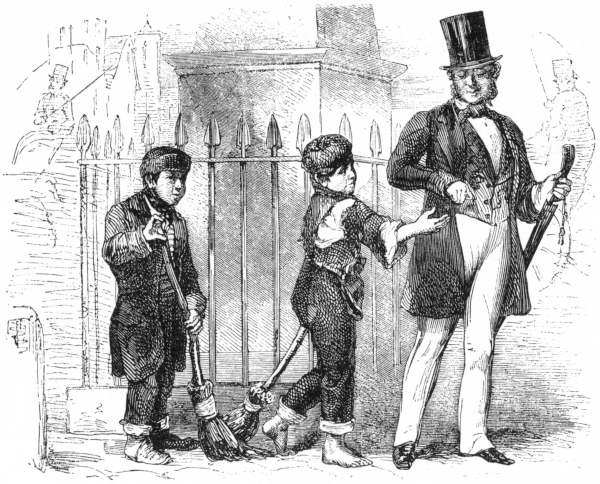
THE BOY CROSSING-SWEEPERS.
[From a Daguerreotype by Beard.]
He ran before me, treading cautiously with his naked feet, until I reached a convenient spot to take down his statement, which was as follows:—
“I’ve got no mother or father; mother has been dead for two years, and father’s been gone more than that—more nigh five years—he died at Ipswich, in Suffolk. He was a perfumer by trade, and used to make hair-dye, and scent, and pomatum, and all kinds of scents. He didn’t keep a shop himself, but he used to serve them as did; he didn’t hawk his goods about, neether, but had regular customers, what used to send him a letter, and then he’d take them what they wanted. Yes, he used to serve some good shops: there was H——’s, of London Bridge, what’s a large chemist’s. He used to make a good deal of money, but he lost it betting; and so his brother, my uncle, did all his. He used to go up to High Park, and then go round by the Hospital, and then turn up a yard, where all the men are who play for money [Tattersall’s]; and there he’d lose his money, or sometimes win,—but that wasn’t often. I remember he used to come home tipsy, and say he’d lost on this or that horse, naming wot one he’d laid on; and then mother would coax him to bed, and afterwards sit down and begin to cry.
“I was not with father when he died (but I was when he was dying), for I was sent up along with eldest sister to London with a letter to uncle, who was head servant at a doctor’s. In this letter, mother asked uncle to pay back some money wot he owed, and wot father lent him, and she asked him if he’d like to come down and see father before he died. I recollect I went back again to mother by the Orwell steamer. I was well dressed then, and had good clothes on, and I was given to the care of the captain—Mr. King his name was. But when I got back to Ipswich, father was dead.
“Mother took on dreadful; she was ill for three months afterwards, confined to her bed. She hardly eat anything: only beaf-tea—I think they call it—and eggs. All the while she kept on crying.
“Mother kept a servant; yes, sir, we always had a servant, as long as I can recollect; and she and the woman as was there—Anna they called her, an old lady—used to take care of me and sister. Sister was fourteen years old (she’s married to a young man now, and they’ve gone to America; she went from a place in the East India Docks, and I saw her off). I used, when I was with mother, to go to school in the morning, and go at nine and come home at twelve to dinner, then go again at two and leave off at half-past four,—that is, if I behaved myself and did all my lessons right; for if I did not I was kept back till I did them so. Mother used to pay one shilling a-week, and extra for the copy-books and things. I can read and write—oh, yes, I mean read and write well—read anything, even old English; and I write pretty fair,—though I don’t get much reading now, unless it’s a penny paper—I’ve got one in my pocket now—it’s the London Journal—there’s a tale in it now about two brothers, and one of them steals the child away and puts another in his place, and then he gets found out, and all that, and he’s just been falling off a bridge now.
“After mother got better, she sold all the furniture and goods and came up to London;—poor mother! She let a man of the name of Hayes have the greater part, and he left Ipswich soon after, and never gave mother the money. We came up to London, and mother took two rooms in Westminster, and I and sister lived along with her. She used to make hair-nets, and sister helped her, and used to take ’em to the hair-dressers to sell. She made these nets for two or three years, though she was suffering with a bad breast;—she died of that—poor thing!—for she had what doctors calls cancer—perhaps you’ve heard of ’em, sir,—and they had to cut all round here (making motions with his hands from the shoulder to the bosom). Sister saw it, though I didn’t.
“Ah! she was a very good, kind mother, and very fond of both of us; though father wasn’t, for he’d always have a noise with mother when he come home, only he was seldom with us when he was making his goods.
“After mother died, sister still kept on making nets, and I lived with her for some time, until she told me she couldn’t afford to keep me no longer, though she seemed to have a pretty good lot to do; but she would never let me go with her to the shops, though I could crochet, which she’d learned me, and used to run and get her all her silks and things what she wanted. But she was keeping company with a young man, and one day they went out, and came back and said they’d been and got married. It was him as got rid of me.
“He was kind to me for the first two or three months, while he was keeping her company; but before he was married he got a little cross, and after he was married he begun to get more cross, and used to send me to play in the streets, and tell me not to come home again till night. One day he hit me, and I said I wouldn’t be hit about by him, and then at tea that night sister gave me three shillings, and told me I must go and get my own living. So I bought a box and brushes (they cost me just the money) and went cleaning boots, and I done pretty well with them, till my box was stole from me by a boy where I was lodging. He’s in prison now—got six calendar for picking pockets.
“Sister kept all my clothes. When I asked her for ’em, she said they was disposed of along with all mother’s goods; but she gave me some shirts and stockings, and such-like, and I had very good clothes, only they was all worn out. I saw sister after I left her, many times. I asked her many times to take me back, but she used to say, ‘It was not her likes, but her husband’s, or she’d have had me back;’ and I think it was true, for until he came she was a kind-hearted girl; but he said he’d enough to do to look after his own living; he was a fancy-baker by trade.
“I was fifteen the 24th of last May, sir, and I’ve been sweeping crossings now near upon two years. There’s a party of six of us, and we have the crossings from St. Martin’s Church as far as Pall Mall. I always go along with them as lodges in the same place as I do. In the daytime, if it’s dry, we do anythink what we can—open cabs, or anythink; but if it’s wet, we separate, and I and another gets a crossing—those who gets on it first, keeps it,—and we stand on each side and take our chance.
“We do it in this way:—if I was to see two gentlemen coming, I should cry out, ‘Two toffs!’ and then they are mine; and whether they give me anythink or not they are mine, and my mate is bound not to follow them; for if he did he would get a hiding from the whole lot of us. If we both cry out together, then we share. If it’s a lady and gentleman, then we cries, ‘A toff and a doll!’ Sometimes we are caught out in this way. Perhaps it is a lady and gentleman and a child; and if I was to see them, and only say, ‘A toff and a doll,’ and leave out the child, then my mate can add the child; and as he is right and I wrong, then it’s his party.