Volume 2 — Of the London Chimney-Sweepers.
Reading edition
Chimney-Sweepers are a consequence of two things—chimneys and the use of coals as fuel; and these are both commodities of comparatively recent introduction.
It is generally admitted that the earliest mention of chimneys is in an Italian MS., preserved in Venice, in which it is recorded that chimneys were thrown down in that city from the shock of an earthquake in 1347. In England, down even to the commencement of the reign of Elizabeth, the greater part of the houses in our towns had no chimneys; the fire was kindled on a hearth-stone on the floor, or on a raised grate against the wall or in the centre of the apartment, and the smoke found its way out of the doors, windows, or casements.
During the long, and—as regards civil strife—generally peaceful, reign of Elizabeth, the use of chimneys increased. In a Discourse prefixed to an edition of Holinshed’s “Chronicles,” in 1577, Harrison, the writer, complains, among other things, “marvellously altered for the worse in England,” of the multitude of chimneys erected of late. “Now we have many chimneys,” he says, “and our tenderlings complain of rheums, catarrhs, and poses. Then we had none but reredoses, and our heads did never ache.”[57] He demurs, too, to the change in the material of which the houses were constructed: “Houses were once builded of willow, then we had oaken men; but now houses are made of oak, and our men not only become willow, but a great many altogether of straw, which is a sore alteration.”
In Shakespeare’s time, the chimney-sweepers seem to have become a recognised class of public cleansers, for in “Cymbeline” the poet says—
“Fear no more the heat o’ the sun, Nor the furious winter’s rages; Thou thy worldly task hast done, Home art gone, and ta’en thy wages: Golden lads and girls all must, As chimney-sweepers come to dust.”
In this beautiful passage there is an intimation, by the “chimney-sweepers” being contrasted with the “golden lads and girls,” that their employment was regarded as of the meanest, a repute it bears to the present day.
But chimneys seem, like the “sweeps” or “sweepers,” to have been a necessity of a change of fuel. In the days of “rere-dosses,” our ancestors burnt only wood, so that they were not subjected to so great an inconvenience as we should be were our fires kindled without the vent of the chimney. Our fuel is coal, which produces a greater quantity of soot, and of black smoke, which is the result of imperfect combustion, than any other fuel, the smoke from wood being thin and pure in comparison.
The first mention of the use of coal as fuel occurs in a charter of Henry III., granting licence to the burgesses of Newcastle to dig for coal. In 1281 Newcastle is said to have had some slight trade in this article. Shortly afterwards coal began to be imported into London for the use of smiths, brewers, dyers, soap-boilers, &c. In 1316, during the reign of Edward I., its use in London was prohibited because of the supposed injurious influence of the smoke. In 1600 the use of coal in the metropolis became universal; about 200 vessels were employed in the London trade, and about 200,000 chaldrons annually imported.
In 1848, however, there were, besides the railway-borne coals, 12,267 cargoes imported, or 3,418,340 tons. The London coal trade now employs 2700 vessels and 21,600 seamen, and constitutes one-fourth of the whole general trade of the Thames.
To understand the necessity for chimney-sweepers, and the extent of the work for them to do, that is to say, the quantity of soot deposited in our chimneys during the combustion of the three and a half millions of tons of coals that are now annually consumed in London, we must first comprehend the conditions upon which the evolution of soot depends, soot being simply the fine carbonaceous particles condensed from the smoke of coal fuel, and deposited against the sides of the chimneys during its ascent between the walls to the tops of our houses. These conditions appear to have been determined somewhat accurately during the investigations of the Smoke Prevention Committee.
There are two kinds of smoke from the ordinary materials of combustion—(A) Opaque, or black smoke; (B) Transparent, or invisible smoke.
A. The Opaque smoke, though the most offensive and annoying from its dirtying properties, is, like the muddiest water, the least injurious to animal or vegetable health. It consists of the particles of unconsumed carbon which have not been deposited in the form of soot in the flue or chimney. This is the black smoke which will be further described.
B. Transparent smoke is composed of gases which are for the most part invisible, such as carbonic acid and carbonic oxide; also of sulphurous acid, but smokes with that component are both visible and invisible. The sulphurous acid is said by Professor Brande to destroy vegetation, for it has long been a cause of wonder why vegetation in towns did not flourish, since carbonic acid (which is so largely produced from the action of our fires) is the vital air of trees, shrubs, and plants[58].
I may here observe, that several of the scientific men who gave the results of years of observation and study in their evidence to the Committee of the House of Commons, remarked on the popular misunderstanding of what smoke was, it being generally regarded as something visible. But in the composition of smoke, it appears, one product may be visible, and another invisible, and both offensive; while “occasionally you may have from the same materials varieties of products, all invisible, according to the manner to which they are supplied with air.”
The Committee requested Dr. Reid to prepare a definition of “smoke,” and more especially of “black smoke.” The following is the substance of the doctor’s definition, or rather description:—
1. Black Smoke consists essentially of carbon separated by heat from coal or other combustible bodies. If this smoke be produced at a very high temperature, the carbon forms a loose and powdery soot, comparatively free from other substances; while the lower the temperature at which black soot is formed, the larger is the amount of other substances with which it is mingled, among which are the following:—carbon, water, resin, oily and other inflammable products of various volatilities, ammonia, and carbonate of ammonia.
When the carbon, oils, resin, and water are associated together in certain proportions, they constitute tar. Soft pitch is produced if the tar be so far heated that the water is expelled; and hard pitch (resin blackened by carbon) when the oils are volatilized.
In all cases of ordinary combustion, carbonic acid is formed by the red-hot cinders, or by gases or other compounds containing carbon, acting on the oxygen of the air. This carbonic acid is discharged in general as an invisible gas. If the carbonic acid pass through red-hot cinders, or any carbonaceous smoke at a high temperature, it loses one particle of oxygen, and becomes carbonic oxide gas. The lost oxygen, uniting with carbon, forms an additional amount of carbonic oxide gas, which passes to the external atmosphere as an invisible gas, unless kindled in its progress, or at the top of the chimney, when its temperature is sufficiently elevated by the action of air. Carbonic oxide gas burns with a blue flame, and produces carbonic acid gas.
Black smoke is always associated with carburetted hydrogen gases. These may be mechanically blended with the oils and resins, but must be carefully distinguished from them. They form more essentially, when in a state of combustion, the inflammable matters that constitute flame.
2. Smoke from Charcoal, Coke, and Anthracite, is always invisible if the material be dry. A flame may appear, however, if carbonic oxide be formed.
3. Wood or Pyroligneous Smoke is rarely black. Water and carbonic acid are the products of the full combustion of wood, omitting the consideration of the ash that remains.
4. Sulphurous Smokes. Tons of sulphur are annually evolved in various conditions from copper-works. Offensive sulphurous smokes are often evolved from various chemical works, as gas-works, acid-works, &c.
5. Hydrochloric Acid Smoke is evolved in general in large quantities from alkali works.
6. Metallic Smokes—when ores of lead, copper, arsenic, &c., are used—often contain offensive matter in a minute state of division, and suspended in the smoke evolved from the furnaces.
7. Putrescent Smokes, loaded with the products of decayed animal and vegetable matter, are evolved at times from drains in visible vapours, more especially in damp weather. The fœtid particles, when associated with moisture in this smoke, are entirely decomposed when subjected to heat.
Dr. Ure says, speaking of the cause of the ordinary black smoke above described, “The inevitable conversion of atmospheric air into carbonic acid has been hitherto the radical defect of almost all furnaces. The consequence is, that this gaseous matter is mixed with an atmosphere containing far too little oxygen, and instead of burning the carbon and hydrogen, which constitute the coal gases, the carbon is deposited partly in a pulverized form, constituting smoke or soot, and a great deal of the carbon gets half-burnt, and forms what is well known under the name of carbonic oxide, which is half-burnt charcoal.”
“The ordinary smoke,” Professor Faraday said, in his examination before the Committee, “is the visible black part of the products, the unburnt portions of the carbon. If you prevent the production of carbonic oxide or carbonic acid, you increase the production of smoke. You must with coal fuel either have carbonic acid or oxide, or else black smoke.
“Which is the least noxious?” he was asked, and answered, “As far as regards health, carbonic acid and carbonic oxide are most noxious to health; but it is not so much a question of health as of cleanliness and comfort, because I believe that this town is as healthy as other places where there are not these fires.
“It is partly the impure coal gas evolved after the fresh charge of coal which originates the smokes, when not properly supplied with air; but it is a very mixed question. When a fresh charge of coal is put upon the fire, a great quantity of evaporable matter, which would be called impure coal gas according to the language of the question, is produced; and as that matter travels on in the heated place, if there be a sufficient supply of air, both the hydrogen and the carbon are entirely burnt. But if there be an insufficient supply of air, the hydrogen is taken possession of first, and the carbon is set free in its black and solid form; and if that goes into the cool part of the chimney before fresh air gets to it, that carbon is so carried out into the atmosphere and is the smoke in question. Generally speaking, the great rush of smoke is when coal is first put on the fire; and that from the want of a sufficient supply of oxygen at the right time, because the carbon is cooled so low as not to take fire.”
This eminent chemist stated also that there was no difference in the ultimate chemical effect upon the air between a wood fire and a coal fire, but with wood there was not so much smoke set free in the heated place, which caused a difference in the gaseous products of wood combustion and of coal combustion. He thought that perhaps wood was the fuel which would be most favourable to health as affecting the atmosphere, inasmuch as it produced more water, and less carbonic acid, as the product of combustion.
What may be called the peculiarities of a smoky and sooty atmosphere are of course more strongly developed in London than elsewhere, as the following curious statements show:—
Dr. Reid, in describing metropolitan smoke, spoke of “those black portions of soot that every one is familiar with, which annoy us, for instance, at the Houses of Parliament to such an extent that I have been under the necessity of putting up a veil, about 40 feet long and 12 feet deep, on which, on a single evening, taking the worst kind of weather for the production of soot, we can count occasionally 200,000 visible portions of soot excluded at a single sitting. We count with the naked eye the number of pieces entangled upon a square inch. I have examined the amount deposited on different occasions in different parts of London at the tops of some houses; and on one occasion at the Horse Guards the amount of soot deposited was so great, that it formed a complete and continuous film, so that when I walked upon it I saw the impression of my foot left as distinctly on that occasion as when snow lies upon the ground. The film was exceedingly thin, but I could discover no want of continuity. On other occasions I have noticed in London that the quantity that escapes into individual houses is so great that in a single night I have observed a mixture of soot and of hoar frost collecting at the edge of the door, and forming a stripe three-quarters of an inch in breadth, and bearing an exact resemblance to a pepper and salt grey cloth. Those that I refer to are extreme occasions.”
Mr. Booth mentioned, that one of the gardeners of the Botanic Garden in the Regent’s-park, could tell the number of days sheep had been in the park from the blackness of their wool, its oleaginous power retaining the black.
Dr. Ure informed the Committee that a column of smoke might be seen extending in different directions round London, according to the way of the wind, for a distance of from 20 to 30 miles; and that Sir William Herschel had told him that when the wind blew from London he could not use his great telescope at Slough.
It was stated, moreover, that when a respirator is washed, the water is rendered dirty by the particles of soot adhering to the wire gauze, and which, but for this, would have entered the mouth.
Professor Brande said, on the subject of the public health being affected by smoke, “I cannot say that my opinion is that smoke produces any unhealthiness in London; it is a great nuisance certainly; but I do not think we have any good evidence that it produces disease of any kind.”
“This Committee,” said Mr. Beckett, “have been told that, by the mechanical effects of smoke upon the chest and lungs, disease takes place; that is, by swallowing a certain quantity of smoke the respiratory organs are injured; can you give any opinion upon that?”—“One would conceive,” replied the Professor, “that that is the case; but when we compare the health of London with that of any other town or place where they are comparatively free or quite free from smoke, we do not find that difference which we should expect in regard to health.”
Mr. E. Solly, lecturer on chemistry at the Royal Institution, expressed his opinion of the effect of smoke upon the health of towns:—
“My impression is,” he said, “that it produces decided evil in two or three ways: first, mechanically; the solid black carbonaceous matter produces a great deal of disease; it occasions dirt amongst the lower orders, and, if they will not take pains to remove it, it engenders disease. If we could do away the smoke nuisance, I believe a great deal of that disease would be put an end to. But there is another point, and that is, the bad effects produced by the gases, sulphurous acid and other compounds of that nature, which are given out. If we do away with smoke, we shall still have those gases; and I have no doubt that those gases produce a great part of the disease that is produced by smoke.”
On the other hand Dr. Reid thought that smoke was more injurious from the dirt it created than from causing impurity in the atmosphere, although “it was obvious enough that the inspiration of a sooty atmosphere must be injurious to persons of a delicate constitution.” Dr. Ure pronounced smoke, in the common sense of visible black smoke, unwholesome, but “not so eminently as the French imagine.”
Many witnesses stated their conviction that where poor people resided amongst smoke, they felt it impossible to preserve cleanliness in their persons or their dwellings, and that made them careless of their homes and indifferent to a decency of appearance, so that the public-house, and places where cleanliness and propriety were in no great estimation, became places of frequent resort, on the plain principle that if a man’s home were uncomfortable, he was not likely to stay in it.
“I think,” said Mr. Booth, “one great effect of the evil of smoke is upon the dwellings of the poor; it renders them less attentive to their personal appearance, and, in consequence, to their social condition.”
It was also stated that there were “certain districts inhabited by the poor, where they will not hang out their clothes to be cleansed; they say it is of no use to do it, they will become dirty as before, and consequently they do not have their clothes washed.” The districts specified as presenting this characteristic are St. George’s-in-the East and the neighbourhood of Old-street, St. Luke’s.
It must not be lost sight of, that whatever evils, moral or physical, without regarding merely pecuniary losses, are inflicted by the excess of smoke, they fall upon the poor, and almost solely on the poor. It is the poor who must reside, as was said, and with a literality not often applicable to popular phrases, “in the thick of it,” and consequently there must either be increased washing or increased dirt.
To effect the mitigation of the nuisance of smoke, two points were considered:—
A. The substitution of some other material, containing less bituminous matter, for the “Newcastle coal.”
B. The combustion of the smoke, before its emission into the atmospheric air, by means of mechanical contrivances founded on scientific principles.
As regards the first consideration (A) it was recommended that anthracite, or stone Welsh coal, which is a smokeless fuel, should be used instead of the Newcastle coal. This coal is almost the sole fuel in Philadelphia, a city of Quaker neatness beyond any in the United States of North America, and sometimes represented as the cleanest in the world. The anthracite coal is somewhat dearer than Newcastle coal in London, but only in a small degree.
Coke was also recommended as a substitute for coal in private dwellings.
“Are you of opinion,” Dr. Reid was asked, “that smoke may be in a great measure prevented by extending the use of gas and coke?” He answered, “In numerous cities, where large quantities of gas are produced, coke is very frequently the principal fuel of the poor, and the difficulty of lighting that coke, and the difficulty of having heat developed by it in sufficient quantity, necessarily led me to look at the construction of the fire-places adapted for it. And on a general review of the question, I do entertain the opinion, that if education were more extended amongst the humblest classes with respect to the economy of their own fireside (I mean, literally, the fire-place, at present), and if gas were greatly extended, so that they did not drain the coal of the gas-works of the last dregs of gaseous matter, which are of very little use as gas, and more to be considered as adding to the bulk for sale than as valuable gas, that a coke might be left which would be easily accendible, which would be economical, and which, if introduced into fire-places where an open fire is desired, would entirely remove the necessity of sweeping chimneys even with machines, and would at the same time give as economical a fire as any ordinary fire-place can produce, for an ordinary coal fire rarely is powerful in its calorific emanations till the mass of gas has been expelled, and we see the cherry-red fire. The amount of gas that has escaped previously to the production or coking of the fire, is the gas that is valuable in a manufactory, and if therefore the individual consumer could have, not the hard-burnt stony coke, but the soft coke, in the condition that would give at once a cherry-red fire, we should attain the two great objects—of economising gas, and at the same time of having a lively cheerful fire. Then this led me to look particularly at the price of a gas lamp for a poor man. In a poor man’s family, where the breakfast, the tea and dinner, require the principal attention, and he has some plain cooking utensils, in the heat of summer I believe that he will produce as much heat as he wants for those purposes from a single burner, which can be turned on and left all day, which shall not risk any boiling over, and by having this pure heat directed to the object to be warmed, instead of having a heavy iron grate, this plan would, if gas were generally introduced even into the humblest apartments, prove a great source of economy in summer.”
Dr. Reid also told the Committee that there was a great prejudice against the use of coke, many persons considering that it produced a sulphurous smell; but as all ordinary coal coked itself, or became coke in an open fire, and was never powerfully calorific till it became coke, the prejudice would die away.
Very little is said in the Report about the smoke of private houses; an allusion, however, is made to that portion of the investigation:—“Your Committee have received the most gratifying assurances of the confident hope entertained by several of the highest scientific authorities examined by them, that the black smoke proceeding from fires in private dwellings, and all other places, may eventually be entirely prevented, either by the adoption of stoves and grates formed for a perfect combustion of the common bituminous coal, or by the use of coke, or of anthracite; but they are of opinion that the present knowledge on that subject is not such as to justify any legislative interference with these smaller fires.”
“I should, in prospect,” Professor Faraday said to the Committee, “look forward to the possibility of a great reduction of the smoke from coal fires in houses; but my impression is, that, in the present state of things, it would be tyrannical to determine that that must be done which at present we do not know can be done. Still, I think there is reason to believe that it can be effected in a very high degree.”
Dr. Ure also thought that to extend any smoke enactment to private dwellings might be tyrannical in the present state of the chimneys, but he had no doubt that smoke might be consumed in fires in private dwellings.
Such, then, are the causes and remedies for smoke, and consequently of soot, for smoke, or rather opaque smoke, consists, as we have seen, of merely the gases of combustion with minute particles of carbon diffused throughout them; and as smoke is the result of the imperfect burning of our coals, it follows that chimney-sweepers are but a consequence of our ignorance, and that, as we grow wiser in the art of economising our fuel, we shall be gradually displacing this branch of labourers—the means of preventing smoke being simply the mode of displacing the chimney-sweepers—and this is another of the many facts to teach us that not only are we doubling our population in forty years, but we are likewise learning every year how to do our work with a less number of workers, either by inventing some piece of mechanism that will enable one “hand” to do as much as one hundred, or else doing away with some branch of labour altogether. Here lies the great difficulty of the time. A new element—science, with its offspring, steam—has been introduced into our society within the last century, decreasing labour at a time when the number of our labourers has been increasing at a rate unexampled in history; and the problem is, how to reconcile the new social element with the old social institutions, doing as little injury as possible to the community.
Suppose, for instance, the “smoke nuisance” entirely prevented, and that Professor Faraday’s prophecy as to the great reduction of the smoke from coal fires in houses were fulfilled, and that the expectations of the sanguine and intense Committee, who tell us that they have “received the most gratifying assurances of the confident hope entertained by several of the highest scientific authorities, that the black smoke proceeding from fires in private dwellings and all other places may be eventually entirely prevented,”—suppose that these expectations, I say, be realized (and there appears to be little doubt of the matter), what is to become of the 1000 to 1500 “sweeps” who live, as it were, upon this very smoke? Surely the whole community should not suffer for them, it will be said. True; but unfortunately the same argument is being applied to each particular section of the labouring class,—and the labourers make up by far the greater part of the community. If we are daily displacing a thousand labourers by the annihilation of this process, and another thousand by the improvement of that, what is to be the fate of those we put on one side? and where shall we find employment for the hundred thousand new “hands” that are daily coming into existence among us? This is the great problem for earnest thoughtful men to work out!
But we have to deal here with the chimney-sweepers as they are, and not as they may be in a more scientific age. And, first, as to the quantity of soot annually deposited at present in the London chimneys.
The quantity of soot produced in the metropolis every year may be ascertained in the following manner:—
The larger houses are swept in some instances once a month, but generally once in three months, and yield on an average six bushels of soot per year. A moderate-sized house, belonging to the “middle class,” is usually swept four times a year, and gives about five bushels of soot per annum; while houses occupied by the working and poorer classes are seldom swept more than twice, and sometimes only once, in the twelvemonth, and yield about two bushels of soot annually.
The larger houses—the residences of noblemen and the more wealthy gentry—may, then, be said to produce an average of six bushels of soot annually; the houses of the more prosperous tradesmen, about five bushels; while those of the humbler classes appear to yield only two bushels of soot per annum. There are, according to the last returns, in round numbers, 300,000 inhabited houses at present in the metropolis, and these, from the “reports” of the income and property tax, may be said to consist, as regards the average rentals, of the proportions given in the next page.
TABLE SHOWING THE NUMBER OF HOUSES, AT DIFFERENT AVERAGE RENTALS, THROUGHOUT THE METROPOLIS.
Number of Houses whose Average Rental is above £50.Number of Houses whose Average Rental is above £30 and below £50.Number of Houses whose Average Rental is below £30.
Average Rental.Number of Houses.Average Rental.Number of Houses.Average Rental.Number of Houses.
£££
Hanover-square, May Fair1508,795Poplar446,882Chelsea297,629
St. James’s1283,460Pancras4118,731Wandsworth298,290
St. Martin’s1192,323Hampstead401,719St. Luke’s286,421
London City1177,329Kensington4017,292Lambeth2820,520
Marylebone7115,955Clerkenwell387,259Lewisham275,936
Strand663,938East London384,785Whitechapel268,832
West London652,745St. Saviour’s364,613Hackney259,861
St. Giles’s604,778Westminster366,647Camberwell259,417
Holborn524,517St. Olave’s352,365Rotherhithe232,834
53,840Islington3513,558St. George’s, Southwark227,005
St. George’s-in-the-East326,151Newington2210,468
90,002Greenwich2214,423
Shoreditch2015,433
Stepney2016,346
Bermondsey187,095
Bethnal Green913,370
163,880
Here we see that the number of houses whose average rental is above 50l. is 53,840; while those whose average rental is above 30l., and below 50l., are 90,002 in number; and those whose rental is below 30l. are as many as 163,880; the average rental for all London, 40l. Now, adopting the estimate before given as to the proportionate yield of soot from each of these three classes of houses, we have the following items:—
Bushels of Soot per Annum.
53,840 houses at a yearly rental above 50l., producing 6 bushels of soot each per annum323,040
90,002 houses at a yearly rental above 30l. and below 50l., producing 5 bushels of soot each per annum450,010
163,880 houses at a yearly rental below 30l., producing 2 bushels of soot each per annum327,760
Total number of bushels of soot annually produced throughout London1,100,810
This calculation will be found to be nearly correct if tried by another mode. The quantity of soot depends greatly upon the amount of volatile or bituminous matter in the coals used. By a table given at p. 169 of the second volume of this work it will be seen that the proportion of volatile matter contained in the several kinds of coal are as follows:—
Cannel or gas coals contain 40 to 60 per cent. of volatile matter.
Newcastle or “house” coals, about 37 per cent.
Lancashire and Yorkshire coals, 35 to 40 per cent.
South Welsh or “steam” coals, 11 to 15 per cent.
Anthracite or “stone” coals, none.
The house coals are those chiefly used throughout London, so that every ton of such coals contains about 800 lbs. of volatile matter, a considerable proportion of which appears in the form of smoke; but what proportion and what is the weight of the carbonaceous particles or soot evolved in a given quantity of smoke, I know of no means of judging. I am informed, however, by those practically acquainted with the subject, that a ton of ordinary house coals will produce between a fourth and a half of a bushel of soot[59]. Now there are, say, 3,500,000 tons of coal consumed annually in London; but a large proportion of this quantity is used for the purposes of gas, for factories, breweries, chemical works, and steam-boats. The consumption of coal for the making of gas in London, in 1849, was 380,000 tons; so that, including the quantity used in factories, breweries, &c., we may, perhaps, estimate the domestic consumption of the metropolis at 2,500,000 tons yearly, which, for 300,000 houses, would give eight tons per house. And when we remember the amount used in large houses and in hotels, as well as by the smaller houses, where each room often contains a different family, this does not appear to be too high an average. Mr. M’Culloch estimates the domestic consumption at one ton per head, men, women, and children; and since the number of persons to each house in London is 7·5, this would give nearly the same result. Estimating the yield of soot to be three-eighths of a bushel per ton, we have, in round numbers, 1,000,000 bushels of soot as the gross quantity deposited in the metropolitan chimneys every year.
Or, to check the estimate another way, there are 350 master sweepers throughout London. A master sweeper in a “large way of business” collects, I am informed, one day with another, from 30 to 40 bushels of soot; on the other hand, a small master, or “single-handed” chimney-sweeper is able to gather only about 5 bushels, and scarcely that. One master sweeper said that about 10 bushels a day would, he thought, be a fair average quantity for all the masters, reckoning one day with another; so that at this rate we should have 1,095,500 bushels for the gross quantity of soot annually collected throughout the metropolis.
We may therefore assume the aggregate yield of soot throughout London to be 1,000,000 bushels per annum. Now what is done with this immense mass of refuse matter? Of what use is it?
The soot is purchased from the masters, whose perquisite it is, by the farmers and dealers. It is used by them principally for meadow land, and frequently for land where wheat is grown; not so much, I understand, as a manure, as for some quality in it which destroys slugs and other insects injurious to the crops[60]. Lincolnshire is one of the great marts for the London soot, whither it is transported by railway. In Hertfordshire, Cambridge, Norfolk, Suffolk, Essex, and Kent, however, and many other parts, London soot is used in large quantities; there are persons who have large stores for its reception, who purchase it from the master sweepers, and afterwards sell it to the farmers and send it as per order, to its destination. These are generally the manure-merchants, of whom the Post-Office Directory gives 26 names, eight being marked as dealers in guano. I was told by a sweeper in a large way of business that he thought these men bought from a half to three-quarters of the soot; the remainder being bought by the land-cultivators in the neighbourhood of London. Soot is often used by gardeners to keep down the insects which infest their gardens.
The value of the Soot collected throughout London is the next subject to engage our attention. Many sweepers have represented it as a very curious fact, and one for which they could advance no sufficient reason, that the price of a bushel of soot was regulated by the price of the quartern loaf, so that you had only to know that the quartern loaf was 5d. to know that such was the price of a bushel of soot. This, however, is hardly the case at present; the price of the quartern loaf (not regarding the “seconds,” or inferior bread), is now, at the end of December, 1851, 5d. to 6d. according to quality. The price of soot per bushel is but 5d., and sometimes but 4½d., but 5d. may be taken as an average.
Now 1,000,000 bushels of soot, at 5d., will be found to yield 20,833l. 6s. 8d. per annum. But the whole of this quantity is not collected by the chimney-sweepers, for many of the poorer persons seldom have their chimneys swept; and by the table given in another place, it will be seen that not more than 800,000 bushels are obtained in the course of the year by the London “sweeps.” Hence we may say, that there are 800,000 bushels of soot annually collected from the London chimneys, and that this is worth not less than 16,500l. per annum.
The next question is, how many people are employed in collecting this quantity of refuse matter, and how do they collect it, and what do they get, individually and collectively, for so doing?
To begin with the number of master and journeymen sweepers employed in removing these 800,000 bushels of soot from our chimneys: according to the Census returns, the number of “sweeps” in the metropolis in the years 1841 and 1831 were as follows:—
Chimney-sweepers.1841.1831.Increase in ten years.
Males, 20 years and upwards619421198
„ under 20 years370no returns.
Females, 20 years & upwards44„
1033
But these returns, such as they are, include both employers and employed, in one confused mass. To disentangle the economical knot, we must endeavour to separate the number of master sweepers from the journeymen. According to the Post-Office Directory the master sweepers amount to no more than 32, and thus there would be one more than 1000 for the number of the metropolitan journeymen sweepers; these statements, however, appear to be very wide of the truth.
In 1816 it was represented to the House of Commons, that there were within the bills of mortality, 200 masters, all—except the “great gentlemen,” as one witness described them, who were about 20 in number—themselves working at the business, and that they had 150 journeymen and upwards of 500 apprentices, so that there must then have been 850 working sweepers altogether, young and old.
These numbers, it must be borne in mind, were comprised in the limits of the bills of mortality 34 years ago. The parishes in the old bills of mortality were 148; there are now in the metropolis proper 176, and, as a whole, the area is much more densely covered with dwelling-houses. Taking but the last ten years, 1841 to 1851, the inhabited houses have increased from 262,737 to 307,722, or, in round numbers, 45,000.
Now in 1811 the number of inhabited houses in the metropolis was 146,019, and in 1821 it was 164,948; hence in 1816 we may assume the inhabited houses to have been about 155,000; and since this number required 850 working sweepers to cleanse the London chimneys, it is but a rule of three sum to find how many would have been required for the same purpose in 1841, when the inhabited houses had increased to 262,737; this, according to Cocker, is about 1400; so that we must come to the conclusion either that the number of working sweepers had not kept pace with the increase of houses, or that the returns of the census were as defective in this respect as we have found them to be concerning the street-sellers, dustmen, and scavagers. Were we to pursue the same mode of calculation, we should find that if 850 sweepers were required to cleanse the chimneys of 155,000 houses, there should be 1687 such labourers in London now that the houses are 307,722 in number.
But it will be seen that in 1816 more than one-half (or 500 out of 850) of the working chimney-sweepers were apprentices, and in 1841 the chimney-sweepers under 20 years of age, if we are to believe the census, constituted more than one-third of the whole body (or 370 out of 1033). Now as the use of climbing boys was prohibited in 1842, of course this large proportion of the trade has been rendered useless; so that, estimating the master and journeymen sweepers at 250 in 1816, it would appear that about 500 would be required to sweep the chimneys of the metropolis at present. To these, of course, must be added the extra number of journeymen necessary for managing the machines. And considering the journeymen to have increased threefold since the abolition of the climbing boys, we must add 300 to the above number, which will make the sum total of the individuals employed in this trade to amount to very nearly 800.
By inquiries throughout the several districts of the metropolis, I find that there are altogether 350 master sweepers at present in London; 106 of these are large masters, who seldom go out on a round, but work to order, having a regular custom among the more wealthy classes; while the other 244 consist of 92 small masters and 152 “single-handed” masters, who travel on various rounds, both in London and the suburbs, seeking custom. Of the whole number, 19 reside within the City boundaries; from 90 to 100 live on the Surrey side, and 235 on the Middlesex side of the Thames (without the City boundaries). A large master employs from 2 to 10 men, and 2 boys; and a small one only 2 men or sometimes 1 man and a boy, while a single-handed master employs no men nor boys at all, but does all the work himself.
The 198 masters employ among them 12 foremen, 399 journeymen, and 62 boys, or 473 hands, and adding to them the single-handed master-men who work at the business themselves, we have 823 working men in all; so that, on the whole, there are not less than between 800 and 900 persons employed in cleansing the London chimneys of their soot.
The next point that presents itself in due order to the mind is, as to the mode of working among the chimney-sweepers; that is to say, how are the 800,000 bushels of soot collected from the 300,000 houses by these 820 working sweepers? But this involves a short history of the trade.
Of the Sweepers of Old, and the Climbing Boys.
Formerly the chimneys used to be cleansed by the house servants, for a person could easily stand erect in the huge old-fashioned constructions, and thrust up a broom as far as his strength would permit. Sometimes, however, straw was kindled at the mouth of the chimney, and in that way the soot was consumed or brought down to the ground by the action of the fire. But that there were also regular chimney-sweepers in the latter part of the sixteenth century is unquestionable; for in the days of the First James and Charles, poor Piedmontese, and more especially Savoyards, resorted to England for the express purpose. How long they laboured in this vocation is unknown. The Savoyards, indeed, were then the general showmen and sweeps of Europe, and so they are still in some of the cities of Italy and France.
As regards the first introduction of English children into chimneys—the establishment of the use of climbing boys—nothing appears, according to the representations made to Parliament on several occasions, to be known; and little attention seems to have been paid to the condition of these infants—some were but little better—until about 1780, when the benevolent Jonas Hanway, who is said, but not uncontradictedly, to have been the first person who regularly used an umbrella in the streets of London, called public attention to the matter. In 1788 Mr. Hanway and others brought a bill into Parliament for the better protection of the climbing boys, requiring, among other provisions, all master sweepers to be licensed, and the names and ages of all their apprentices registered. The House of Lords, however, rejected this bill, and the 28th George III., c. 48, was passed in preference. The chief alterations sought to be effected by the new Act were, that no sweeper should have more than six apprentices, and that no boy should be apprenticed at a tenderer age than eight years. Previously there were no restrictions in either of those respects.
These provisions were, however, very generally violated. By one of those “flaws” or omissions, so very common and so little creditable to our legislation, it was found that there was no prohibition to a sweeper’s employing his own children at what age he pleased; and “some,” or “several,” for I find both words used, employed their sons, and occasionally their daughters, in chimney climbing at the ages of six, five, and even between four and five years! The children of others, too, were continually being apprenticed at illegal ages, for no inquiry was made into the lad’s age beyond the statement of his parents, or, in the case of parish apprentices, beyond the (in those days) not more trustworthy word of the overseers. Thus boys of six were apprenticed—for apprenticeship was almost universal—as boys of eight, by their parents; while parish officers and magistrates consigned the workhouse orphans, as a thing of course, to the starvation and tyranny which they must have known were very often in store for them when apprenticed to sweepers.
The following evidence was adduced before Parliament on the subject of infant labour in this trade:—
Mr. John Cook, a master sweeper, then of Great Windmill-street and Kentish-town, the first who persevered in the use of the machine years before its use was compulsory, stated that it was common for parents in the business to employ their own children, under the age of seven, in climbing; and that as far as he knew, he himself was only between six and seven when he “came to it;” and that almost all master sweepers had got it in their bills that they kept “small boys for register-stoves, and such like as that.”
Mr. T. Allen, another master sweeper, was between four and five when articled to an uncle.
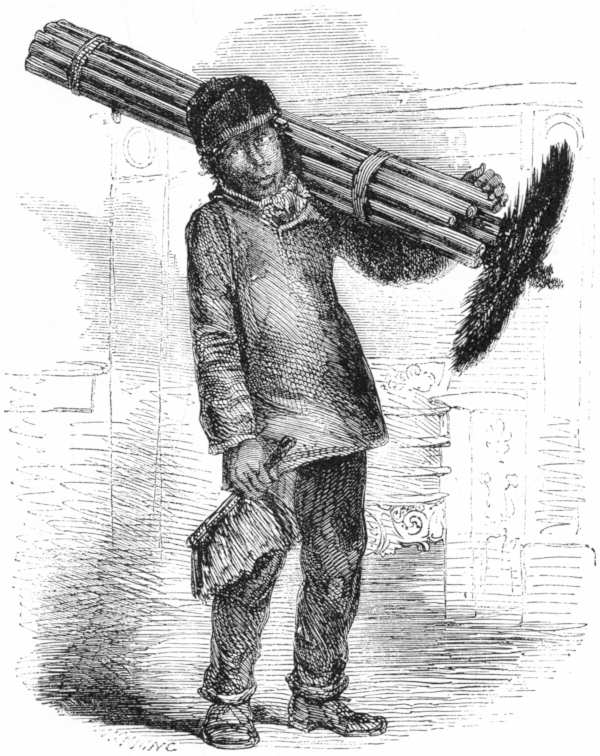
THE LONDON SWEEP
[From a Daguerreotype by Beard.]
Mr. B. M. Forster, a private gentleman, a member of the “Committee to promote the Superseding of Climbing Boys,” said, “Some are put to the employment very young; one instance of which occurred to a child in the neighbourhood of Shoreditch, who was put to the trade at four and a quarter years, or thereabouts. The father of a child in Whitechapel told me last week, that his son began climbing when he was four years and eight months old. I have heard of some still younger, but only from vague report.”
This sufficiently proves at what infantine years children were exposed to toils of exceeding painfulness. The smaller and the more slenderly formed the child, the more valuable was he for the sweeping of flues, the interior of some of them, to be ascended and swept, being but seven inches square.
I have mentioned the employment of female children in the very unsuitable labour of climbing chimneys. The following is all the information given on the subject.
Mr. Tooke was asked, “Have you ever heard of female children being so employed?” and replied, “I have heard of cases at Hadley, Barnet, Windsor, and Uxbridge; and I know a case at Witham, near Colchester, of that sort.”
Mr. B. M. Foster said, “Another circumstance, which has not been mentioned to the Committee, is, that there are several little girls employed; there are two of the name of Morgan at Windsor, daughters of the chimney-sweeper who is employed to sweep the chimneys of the Castle; another instance at Uxbridge, and at Brighton, and at Whitechapel (which was some years ago), and at Headley near Barnet, and Witham in Essex, and elsewhere.” He then stated, on being asked, “Do you not think that girls were employed from their physical form being smaller and thinner than boys, and therefore could get up narrower flues?” “The reason that I have understood was, because their parents had not a sufficient number of boys to bring up to the business.” Mr. Foster did not know the ages of these girls.
The inquiry by a Committee of the House of Commons, which led more than any other to the prohibition of this infant and yet painful labour in chimney-sweeping, was held in 1817, and they recommended the “preventing the further use of climbing boys in sweeping of chimneys;” a recommendation not carried into effect until 1832. The matter was during the interval frequently agitated in Parliament, but there were no later investigations by Committees.
I will adduce, specifically, the grievances, according to the Report of 1817, of the climbing boys; but will first present the following extract from the evidence of Mr. W. Tooke, a gentleman who, in accordance with the Hon. Henry Grey Bennet, M.P., and others, exerted himself on the behoof of the climbing boys. When he gave his evidence, Mr. Tooke was the secretary to a society whose object was to supersede the necessity of employing climbing boys. He said:—
“In the year 1800, the Society for Bettering the Condition of the Poor took up the subject, but little or nothing appears to have been done upon that occasion, except that the most respectable master chimney-sweepers entered into an association and subscription for promoting the cleanliness and health of the boys in their respective services. The Institution of which I am treasurer, and which is now existing, was formed in February, 1803. In consequence of an anonymous advertisement, a large meeting was held at the London Coffee House, and the Society was established; immediate steps were then taken to ascertain the state of the trade; inspectors were appointed to give an account of all the master chimney-sweepers within the bills of mortality, their general character, their conduct towards their apprentices, and the number of those apprentices. It was ascertained, that the total number of master chimney-sweepers, within the bills of mortality, might be estimated at 200, who had among them 500 apprentices; that not above 20 of those masters were reputable tradesmen in easy circumstances, who appeared generally to conform to the provisions of the Act; and which 20 had, upon an average, from four to five apprentices each. We found about 90 of an inferior class of master chimney-sweepers who averaged three apprentices each, and who were extremely negligent both of the health, morals, and education of those apprentices; and about 90, the remainder of the 200 masters, were a class of chimney-sweepers recently journeymen, who took up the trade because they had no other resource; they picked up boys as they could, who lodged with themselves in huts, sheds, and cellars, in the outskirts of the town, occasionally wandering into the villages round, where they slept on soot-bags, and lived in the grossest filth.”
The grievances I have spoken of were thus summed up by the Parliamentary Committee. After referring to the ill-usage and hardships sustained by the climbing boys (the figures being now introduced for the sake of distinctness) it is stated:—
“It is in evidence that (1) they are stolen from” [and sold by] “their parents, and inveigled out of workhouses; (2) that in order to conquer the natural repugnance of the infants to ascend the narrow and dangerous chimneys to clean which their labour is required, blows are used; that pins are forced into their feet by the boy that follows them up the chimney, in order to compel them to ascend it, and that lighted straw has been applied for that purpose; (3) that the children are subject to sores and bruises, and wounds and burns on their thighs, knees, and elbows; and that it will require many months before the extremities of the elbows and knees become sufficiently hard to resist the excoriations to which they are at first subject.”
1. With regard to the stealing or kidnapping of children—for there was often a difficulty in procuring climbing boys—I find mention in the evidence, as of a matter, but not a very frequent matter, of notoriety. One stolen child was sold to a master sweeper for 8l. 8s. Mr. G. Revely said:—
“I wish to state to the Committee that case in particular, because it comes home to the better sort of persons in higher life. It seems that the child, upon being asked various questions, had been taken away: the child was questioned how he came into that situation; he said all that he could recollect was (as I heard it told at that time) that he and his sister, with another brother, were together somewhere, but he could not tell where; but not being able to run so well as the other two, he was caught by a woman and carried away and was sold, and came afterwards into the hands of a chimney-sweeper. He was not afterwards restored to his family, and the mystery was never unravelled; but he was advertised, and a lady took charge of him.
“This child, in 1804, was forced up a chimney at Bridlington in Yorkshire, by a big boy, the younger boy being apparently but four years old. He fell and bruised his legs terribly against the grate. The Misses Auckland of Boynton, who had heard of the child, and went to see him, became interested by his manners, and they took him home with them; the chimney-sweeper, who perhaps got alarmed, being glad to part with him. Soon after he got to Boynton, the seat of Sir George Strickland, a plate with something to eat was brought him; on seeing a silver fork he was quite delighted, and said, ‘Papa had such forks as those.’ He also said the carpet in the drawing-room was like papa’s; the housekeeper showed him a silver watch, he asked what sort it was—‘Papa’s was a gold watch;’ he then pressed the handle and said, ‘Papa’s watch rings, why does not yours?’ Sir George Strickland, on being told this circumstance, showed him a gold repeater, the little boy pressed the spring, and when it struck, he jumped about the room, saying, ‘Papa’s watch rings so.’ At night, when he was going to bed, he said he could not go to bed until he had said his prayers; he then repeated the Lord’s Prayer, almost perfectly. The account he gave of himself was that he was gathering flowers in his mamma’s garden, and that the woman who sold him to the sweeper, came in and asked him if he liked riding? He said, ‘Yes,’ and she told him he should ride with her. She put him on a horse, after which they got into a vessel, and the sails were put up, ‘and away we went.’ He had no recollection of his name, or where he lived, and was too young to think his father could have any other name than that of papa. He started whenever he heard a servant in the family at Boynton called George, and looked as if he expected to see somebody he knew; on inquiry, he said he had an uncle George, whom he loved dearly. He says his mamma is dead, and it is thought his father may be abroad. From many things he says, he seems to have lived chiefly with an uncle and aunt, whom he invariably says were called Mr. and Mrs. Flembrough. From various circumstances, it is thought impossible he should be the child of the woman who sold him, his manners being ‘very civilized,’ quite those of a child well educated; his dialect is good, and that of the south of England. This little boy, when first discovered, was conjectured to be about four years old, and is described as having beautiful black eyes and eye-lashes, a high nose, and a delicate soft skin.”
Mr. J. Harding, a master sweeper, had a fellow apprentice who had been enticed away from his parents. “It is a case of common occurrence,” he said, “for children stolen, to be employed in this way. Yes, and children in particular are enticed out of workhouses: there are a great many who come out of workhouses.”
The following cases were also submitted to the Committee:—
“A poor woman had been obliged by sickness to go into an hospital, and while she was there her child was stolen from her house, taken into Staffordshire, and there apprenticed to a chimney-sweeper. By some happy circumstance she learned his fate; she followed him, and succeeded in rescuing him from his forlorn situation. Another child, who was an orphan, was tricked into following the same wretched employment by a chimney-sweeper, who gave him a shilling, and made him believe that by receiving it he became his apprentice; the poor boy, either discovering or suspecting that he had been deceived, anxiously endeavoured to speak to a magistrate who happened to come to the house in which he was sweeping chimneys, but his master watched him so closely that he could not succeed. He at last contrived to tell his story to a blind soldier, who determined to right the poor boy, and by great exertions succeeded in procuring him his liberty.”
It was in country places, however, that the stealing and kidnapping of children was the most frequent, and the threat of “the sweeps will get you” was often held out, to deter children from wandering. These stolen infants, it is stated, were usually conveyed to some distance by the vagrants who had secured them, and sold to some master sweeper, being apprenticed as the child of the vendors, for it was difficult for sweepers in thinly-peopled places to get a supply of climbing boys. It was shown about the time of the Parliamentary inquiry, in the course of a trial at the Lancaster assizes, that a boy had been apprenticed to a sweeper by two travelling tinkers, man and woman, who informed him that the child was stolen from another “traveller,” 80 miles away, who was “too fond of it to make it a sweep.” The price of the child was not mentioned.
Respecting the sale of children to be apprentices to sweepers, Mr. Tooke was able to state that, although in 1816, the practice had very much diminished of late, parents in many instances still sold their children for three, four, or five guineas. This sum was generally paid under the guise of an apprentice fee, but it was known to be and was called a “sale,” for the parents, real or nominal, never interfered with the master subsequently, but left the infant to its fate.
2. I find the following account of the means resorted to, in order to induce, or more frequently compel, these wretched infants to work.
The boy in the first instance went for a month, or any term agreed upon, “on trial,” or “to see how he would suit for the business.” During this period of probation he was usually well treated and well fed (whatever the character of the master), with little to do beyond running errands, and observing the mode of work of the experienced climbers. When, however, he was “bound” as an apprentice, he was put with another lad who had been for some time at the business. The new boy was sent first up the chimney, and immediately followed by the other, who instructed him how to ascend. This was accomplished by the pressure of the knees and the elbows against the sides of the flue. By pressing the knees tightly the child managed to raise his arms somewhat higher, and then by pressing his elbows in like manner he contrived to draw up his legs, and so on. The inside of the flue presented a smooth surface, and there were no inequalities where the fingers or toes could be inserted. Should the young beginner fall, he was sure to light on the shoulders of the boy beneath him, who always kept himself firmly fixed in expectation of such a mishap, and then the novice had to commence anew; in this manner the twain reached the top by degrees, sweeping down the soot, and descended by the same method. This practice was very severe, especially on new boys, whose knees and elbows were torn by the pressure and the slipping down continually—the skin being stripped off, and frequently breaking out in frightful sores, from the constant abrasions, and from the soot and dirt getting into them.
In his evidence before Parliament in 1817 (for there had been previous inquiries), Mr. Cook gave an account of the training of these boys, and on being asked:—“Do the elbows and knees of the boys, when they first begin the business, become very sore, and afterwards get callous, and are those boys employed in sweeping chimneys during the soreness of those parts?” answered, “It depends upon the sort of master they have got; some are obliged to put them to work sooner than others; you must keep them a little at it, or they will never learn their business, even during the sores.” He stated further, that the skin broke generally, and that the boys could not ascend chimneys during the sores without very great pain. “The way that I learn boys is,” he continued, “to put some cloths over their elbows and over their knees till they get the nature of the chimney—till they get a little used to it: we call it padding them, and then we take them off, and they get very little grazed indeed after they have got the art; but very few will take that trouble. Some boys’ flesh is far worse than others, and it takes more time to harden them.” He was then asked:—“Do those persons still continue to employ them to climb chimneys?” and the answer was: “Some do; it depends upon the character of the master. None of them of that class keep them till they get well; none. They are obliged to climb with those sores upon them. I never had one of my own apprentices do that.” This system of padding, however, was but little practised; but in what proportion it was practised, unless by the respectable masters, who were then but few in number, the Parliamentary papers, the only information on the subject now attainable, do not state. The inference is, that the majority, out of but 20 of these masters, with some 80 or 100 apprentices, did treat them well, and what was so accounted. The customary way of training these boys, then, was such as I have described; some even of the better masters, whose boys were in the comparison well lodged and fed, and “sent to the Sunday school” (which seems to have comprised all needful education), considered “padding and such like” to be “new-fangled nonsense.”
I may add also, that although the boy carried up a brush with him, it was used but occasionally, only when there were “turns” or defects in the chimney, the soot being brought down by the action of the shoulders and limbs. The climber wore a cap to protect his eyes and mouth from the soot, and a sort of flannel tunic, his feet, legs, and arms being bare. Some of these lads were surprisingly quick. One man told me that, when in his prime as a climbing boy, he could reach the top of a chimney about as quickly as a person could go up stairs to the attics.
The following is from the evidence of Mr. Cook, frequently cited as an excellent master:—
“What mode do you adopt to get the boy to go up the chimney in the first instance?—We persuade him as well as we can; we generally practise him in one of our own chimneys first; one of the boys who knows the trade goes up behind him, and when he has practised it perhaps ten times, though some will require twenty times, they generally can manage it. The boy goes up with him to keep him from falling; after that, the boy will manage to go up with himself, after going up and down several times with one under him: we do this, because if he happens to make a slip he will be caught by the other.
“Do you find many boys show repugnance to go up at first?—Yes, most of them.
“And if they resist and reject, in what way do you force them up?—By telling them we must take them back again to their father and mother, and give them up again; and their parents are generally people who cannot maintain them.
“So that they are afraid of going back to their parents for fear of being starved?—Yes; they go through a deal of hardship before they come to our trade.
“Did you use any more violent means?—Sometimes a rod.
“Did you ever hear of straw being lighted under them?—Never.
“You never heard of any means being made use of, except being beat and being sent home?—No; no other.
“You are aware, of course, that those means being gentle or harsh must depend very much upon the character of the individual master?—It does.
“Of course you must know that there are persons of harsh and cruel disposition; have you not often heard of masters treating their apprentices with great cruelty, particularly the little boys, in forcing them to go up those small flues, which the boys were unwilling to ascend?—Yes; I have forced up many a one myself.
“By what means?—By threatenings, and by giving them a kick or a slap.”
It was also stated that the journeymen used the boys with greater cruelty than did the masters—indeed a delegated tyranny is often the worst—that for very little faults they kicked and slapped the children, and sometimes flogged them with a cat, “made of rope, hard at each end, and as thick as your thumb.”
Mr. John Fisher, a master chimney-sweeper, said:—“Many masters, are very severe with their children. To make them go up the chimneys I have seen them make them strip themselves naked; I have been obliged myself to go up a chimney naked.”
As respects the cruelties of driving boys up chimneys by kindling straw beneath their feet, or thrusting pins into the soles of their feet, I find the following statements given on the authority of B. M. Forster, Esq., a private gentleman residing in Walthamstow:—
“A lad was ordered to sweep a chimney at Wandsworth; he came down after endeavouring to ascend, and this occurred several times before he gave up the point; at last the journeyman took some straw or hay, and lighted it under him to drive him up: when he endeavoured to get up the last time, he found there was a bar across the chimney, which he could not pass; he was obliged in consequence to come down, and the journeyman beat him so cruelly, to use his own expression, that he could not stand for a fortnight.
“In the whole city of Norwich I could find only nine climbing boys, two of whom I questioned on many particulars; one was with respect to the manner in which they are taught to climb; they both agreed in that particular, that a larger boy was sent up behind them to prick their feet, if they did not climb properly. I purposely avoided mentioning about pricking them with pins, but asked them how they did it; they said that they thrust the pins into the soles of their feet. A third instance occurred at Walthamstow; a man told me that some he knew had been taught in the same way; I believe it to be common, but I cannot state any more instances from authority.”
3. On the subject of the sores, bruises, wounds, burns, and diseases, to which chimney-sweepers in their apprenticeships were not only exposed, but, as it were, condemned, Mr. R. Wright, a surgeon, on being examined before the Committee, said, “I shall begin with Deformity. I am well persuaded that the deformity of the spine, legs, arms, &c., of chimney-sweepers, generally, if not wholly, proceeds from the circumstance of their being obliged not only to go up chimneys at an age when their bones are in a soft and growing state, but likewise from their being compelled by their too merciless masters and mistresses to carry bags of soot (and those very frequently for a great length of distance and time) by far too heavy for their tender years and limbs. The knees and ancle joints mostly become deformed, in the first instance, from the position they are obliged to put them in, in order to support themselves, not only while climbing up the chimney, but more particularly so in that of coming down, when they rest solely on the lower extremities.
“Sore eyes and eyelids, are the next to be considered. Chimney-sweepers are very subject to inflammation of the eyelids, and not unfrequently weakness of sight, in consequence of such inflammation. This I attribute to the circumstance of the soot lodging on the eyelids, which first produces irritability of the part, and the constantly rubbing them with their dirty hands, instead of alleviating, increases the disease; for I have observed in a number of cases, when the patient has ceased for a time to follow the business, and of course the original cause has been removed, that with washing and keeping clean they were soon got well.
“Sores, for the same reasons, are generally a long time in healing.
“Cancer is another and a most formidable disease, which chimney-sweepers in particular are liable to, especially that of the scrotum; from which circumstance, by way of distinction, it is called the ‘chimney-sweeper’s cancer.’ Of this sort of cancer I have seen several instances, some of which have been operated on; but, in general, they are apt to let them go too far before they apply for relief. Cancers of the lips are not so general as cancers of the scrotum. I never saw but two instances of the former, and several of the latter.”
The “chimney-sweep’s cancer” was always lectured upon as a separate disease at Guy’s and Bartholomew’s Hospitals, and on the question being put to Mr. Wright: “Do the physicians who are intrusted with the care and management of those hospitals think that disease of such common occurrence, that it is necessary to make it a part of surgical education?”—he replied: “Most assuredly; I remember Mr. Cline and Mr. Cooper were particular on that subject; and having one or two cases of the kind in the hospital, it struck my mind very forcibly. With the permission of the Committee I will relate a case that occurred lately, which I had from one of the pupils of St. Thomas’s Hospital; he informed me that they recently had a case of a chimney-sweeper’s cancer, which was to have been operated on that week, but the man ‘brushed’ (to use their expression) or rather walked off; he would not submit to the operation: similar instances of which I have known myself. They dread so much the knife, in consequence of foolish persons telling them it is so formidable an operation, and that they will die under it. I conceive without the operation it is death; for cancers are of that nature that unless you extricate them entirely they will never be cured.”
Of the chimney-sweeper’s cancer, the following statement is given in the Report: “Mr. Cline informed your Committee by letter, that this disease is rarely seen in any other persons than chimney-sweepers, and in them cannot be considered as frequent; for during his practice in St. Thomas’s hospital, for more than 40 years, the number of those could not exceed 20. But your Committee have been informed that the dread of the operation which it is necessary to perform, deters many from submitting to it; and from the evidence of persons engaged in the trade, it appears to be much more common than Mr. Cline seems to be aware of.
“Cough and Asthma.—Chimney-sweepers are, from their being out at all hours and in all weathers, very liable to cough and inflammation of the chest.
“Burns.—They are very subject to burns, from their being forced up chimneys while on fire, or soon after they have been on fire, and while over-heated; and however they may cry out, their inhuman masters pay not the least attention, but compel them, too often with horrid imprecations, to proceed.
“Stunted growth, in this unfortunate race of the community, is attributed, in a great measure, to their being brought into the business at a very early age.”
To accidents they were frequently liable in the pursuit of their callings, and sometimes these accidents were the being jammed or fixed, or, as it was called in the trade, “stuck,” in narrow and heated flues, sometimes for hours, and until death.
Among these hapless lads were indeed many deaths from accidents, cruelty, privation, and exhaustion, but it does not appear that the number was ever ascertained. There were also many narrow escapes from dreadful deaths. I give instances of each:—
“On Monday morning, the 29th of March, 1813, a chimney-sweeper of the name of Griggs, attended to sweep a small chimney in the brewhouse of Messrs. Calvert and Co., in Upper Thames-street; he was accompanied by one of his boys, a lad of about eight years of age, of the name of Thomas Pitt. The fire had been lighted as early as two o’clock the same morning, and was burning on the arrival of Griggs and his little boy at eight; the fire-place was small, and an iron pipe projected from the grate some little distance, into the flue; this the master was acquainted with (having swept the chimneys in the brewhouse for some years) and therefore had a tile or two taken from the roof, in order that the boy might descend the chimney. He had no sooner extinguished the fire than he suffered the lad to go down; and the consequence, as might be expected, was his almost immediate death, in a state, no doubt, of inexpressible agony. The flue was of the narrowest description, and must have retained heat sufficient to have prevented the child’s return to the top, even supposing he had not approached the pipe belonging to the grate, which must have been nearly red-hot; this, however, was not clearly ascertained on the inquest, though the appearance of the body would induce an opinion that he had been unavoidably pressed against the pipe. Soon after his descent, the master, who remained on the top, was apprehensive that something had happened, and therefore desired him to come up; the answer of the boy was, ‘I cannot come up, master; I must die here.’ An alarm was given in the brewhouse, immediately, that he had stuck in the chimney, and a bricklayer who was at work near the spot attended, and after knocking down part of the brickwork of the chimney, just above the fire-place, made a hole sufficiently large to draw him through. A surgeon attended, but all attempts to restore life were ineffectual. On inspecting the body, various burns appeared; the fleshy part of the legs, and a great part of the feet more particularly, were injured; those parts, too, by which climbing boys most effectually ascend or descend chimneys, viz., the elbows and knees, seemed burnt to the bone; from which it must be evident that the unhappy sufferer made some attempts to return as soon as the horrors of his situation became apparent.”
“In the improvement made some years since by the Bank of England, in Lothbury, a chimney, belonging to a Mr. Mildrum, a baker, was taken down, but before he began to bake, in order to see that the rest of the flue was clear, a boy was sent up, and after remaining some time, and not answering to the call of his master, another boy was ordered to descend from the top of the flue and to meet him half-way; but this being found impracticable, they opened the brickwork in the lower part of the flue, and found the first-mentioned boy dead. In the mean time the boy in the upper part of the flue called out for relief, saying, he was completely jammed in the rubbish and was unable to extricate himself. Upon this a bricklayer was employed with the utmost expedition, but he succeeded only in obtaining a lifeless body. The bodies were sent to St. Margaret’s Church, Lothbury, and a coroner’s inquest, which sat upon them, returned the verdict—Accidental Death.”
“In the beginning of the year 1808, a chimney-sweeper’s boy being employed to sweep a chimney in Marsh-street, Walthamstow, in the house of Mr. Jeffery, carpenter, unfortunately, in his attempt to get down, stuck in the flue and was unable to extricate himself. Mr. Jeffery, being within hearing of the boy, immediately procured assistance. As the chimney was low, and the top of it easily accessible from without, the boy was taken out in about ten minutes, the chimney-pot and several rows of bricks having been previously removed; if he had remained in that dreadful situation many minutes longer, he must have died. His master was sent for, and he arrived soon after the boy had been released; he abused him for the accident, and, after striking him, sent him with a bag of soot to sweep another chimney. The child appeared so very weak when taken out that he could scarcely stand, and yet this wretched being, who had been up ever since three o’clock, had before been sent by his master to Wanstead, which with his walk to Marsh-street made about five miles.”
“In May, 1817, a boy employed in sweeping a chimney in Sheffield got wedged fast in one of the flues, and remained in that situation near two hours before he could be extricated, which was at length accomplished by pulling down part of the chimney.”
On one occasion a child remained above two hours in some danger in a chimney, rather than venture down and encounter his master’s anger. The man was held to bail, which he could not procure.
As in the cases I have described (at Messrs. Calvert’s, and in Lothbury), the verdict was usually “Accidental Death,” or something equivalent.
It was otherwise, however, where wilful cruelty was proven.
The following case was a subject of frequent comment at the time:—
“On Friday, 31st May, 1816, William Moles and Sarah his wife, were tried at the Old Bailey for the wilful murder of John Hewley, alias Haseley, a boy about six years of age, in the month of April last, by cruelly beating him. Under the direction of the learned judge, they were acquitted of the crime of murder, but the husband was detained to take his trial as for a misdemeanor, of which he was convicted upon the fullest evidence, and sentenced to two years’ imprisonment. The facts, as proved in this case, are too shocking in detail to relate: the substance of them is, that he was forced up the chimney on the shoulder of a bigger boy, and afterwards violently pulled down again by the leg and dashed upon a marble hearth; his leg was thus broken, and death ensued in a few hours, and on his body and knees were found scars arising from wounds of a much older date.”
This long-continued system of cruelties, of violations of public and private duties, bore and ripened its natural fruits. The climbing boys grew up to be unhealthy, vicious, ignorant, and idle men, for during their apprenticeships their labour was over early in the day, and they often passed away their leisure in gambling in the streets with one another and other children of their stamp, as they frequently had halfpence given to them. They played also at “chuck and toss” with the journeymen, and of course were stripped of every farthing. Thus they became indolent and fond of excitement. When a lad ceased to be an apprentice, although he might be but 16, he was too big to climb, and even if he got employment as a journeyman, his remuneration was wretched, only 2s. a week, with his board and lodging. There were, however, far fewer complaints of being insufficiently fed than might have been expected, but the sleeping places were execrable: “They sleep in different places,” it was stated, “sometimes in sheds, and sometimes in places which we call barracks (large rooms), or in the cellar (where the soot was kept); some never sleep upon anything that can be called a bed; some do.”
Mr. T. Allen, a master sweep for 22 years, gave the Committee the following account of the men’s earnings and (what may be called) the General Perquisites of the trade under the exploded system:—
“If a man be 25 years of age, he has no more than 2s. a week; he is not clothed, only fed and lodged in the same manner as the boys. The 2s. a week is not sufficient to find him clothes and other necessaries, certainly not; it is hardly enough to find him with shoe-leather, for they walk over a deal of ground in going about the streets. The journeyman is able to live upon those wages, for he gets halfpence given him: supposing he is 16 or 20 years of age, he gets the boys’ pence from them and keeps it; and if he happens to get a job for which he receives a 1s., he gets 6d. of that, and his master the other 6d. The boys’ pence are what the boys get after they have been doing their master’s work; they get a 1d. or so, and the journeyman takes it from them, and ‘licks’ them if they do not give it up.” [These “jobs,” after the master’s work had been done, were chance jobs, as when a journeyman on his round was called on by a stranger, and unexpectedly, to sweep a chimney. Sometimes, by arrangement of the journeyman and the lad, the proceeds never reached the master’s pocket. Sometimes, but rarely, such jobs were the journeyman’s rightful perquisite.] “Men,” proceeds Mr. Allen, “who are 22 and 23 years of age will play with the young boys and win their money. That is, they get half the money from them by force, and the rest by fraud. They are driven to this course from the low wages which the masters give them, because they have no other means to get anything for themselves, not even the few necessaries which they may want; for even what they want to wash with they must get themselves. As to what becomes of the money the boys get on May-day, when they are in want of clothes, the master will buy them, as check shirts or handkerchiefs. These masters get a share of the money which the boys collect on May-day. The boys have about 1s. or 1s. 6d.; the journeyman has also his share; then the master takes the remainder, which is to buy the boys’ clothes and other necessaries, as they say. I cannot exactly tell what the average amount is that a boy will get on the May-day; the most that my boy ever got was 5s. But I think that the boys get more than that; I should think they get as much as 9s. or 10s. apiece. The Christmas-boxes are generally, I believe, divided among themselves (among the boys); but I cannot say rightly. It is spent in buying silk handkerchiefs, or Sunday shoes, I believe; but I am not perfectly sure.”
Of the condition and lot of the operatives who were too big to go up chimneys, Mr. J. Fisher, a master-sweeper, gave the following account:—“They get into a roving way, and go about from one master to another, and they often come to no good end at last. They sometimes go into the country, and after staying there some time, they come back again; I took a boy of that sort very lately and kept him like my own, and let him go to school; he asked me one Sunday to let him go to school, and I was glad to let him go, and I gave him leave; he accordingly went, and I have seen nothing of him since; before he went he asked me if I would let him come home to see my child buried; I told him to ask his school-master, but he did not come back again. I cannot tell what has become of him; he was to have served me for twelve months. I did not take him from the parish; he came to me. He said his parents were dead. The effect of the roving habit of the large boys when they become too large to climb, is, that they get one with another and learn bad habits from one another; they never will stop long in any one place. They frequently go into the country and get various places; perhaps they stop a month at each; some try to get masters themselves, and some will get into bad company, which very often happens. Then they turn thieves, they get lazy, they won’t work, and people do not like to employ them lest they should take anything out of their houses. The generality of them never settle in any steady business. They generally turn loose characters, and people will not employ them lest they should take anything out of the house.”
The criminal annals of the kingdom bear out the foregoing account. Some of these boys, indeed, when they attained man’s estate, became, in a great measure, through their skill in climbing, expert and enterprising burglars, breaking into places where few men would have cared to venture. One of the most daring feats ever attempted and accomplished was the escape from Newgate by a sweeper about 15 years ago. He climbed by the aid of his knees and elbows a height of nearly 80 feet, though the walls, in the corner of the prison-yard, where this was done, were nearly of an even surface; the slightest slip could not have failed to have precipitated the sweeper to the bottom. He was then under sentence of death for highway robbery.
“His name was Whitehead, and he done a more wonderfuller thing nor that,” remarked an informant, who had been his master. “We was sweeping the bilers in a sugar-house, and he went from the biler up the flue of the chimney, it was nearly as high as the Monument, that chimney; I should say it was 30 or 40 feet higher nor the sugar-house. He got out at the top, and slid down the bare brickwork on the outside, on to the roof of the house, got through an attic window in the roof, and managed to get off without any one knowing what became of him. That was the most wonderfullest thing I ever knowed in my life. I don’t know how he escaped from being killed, but he was always an oudacious feller. It was nearly three months after afore we found him in the country. I don’t know where they sent him to after he was brought back to Newgate, but I hear they made him a turnkey in a prison somewhere, and that he’s doing very well now.” The feat at the sugar-house could be only to escape from his apprenticeship.
In the course of the whole Parliamentary evidence the sweepers, reared under the old climbing system, are spoken of as a “short-lived” race, but no statistics could be given. Some died old men in middle age, in the workhouses. Many were mere vagrants at the time of their death.
I took the statement of a man who had been what he called a “climbing” in his childhood, but as he is now a master-sweeper, and has indeed gone through all grades of the business, I shall give it in my account of the present condition of the sweepers.
Climbing is still occasionally resorted to, especially when repairs are required, “but the climbing boys,” I was told, “are now men.” These are slight dwarfish men, whose services are often in considerable request, and cannot at all times be commanded, as there are only about twenty of them in London, so effectually has climbing been suppressed. These little men, I was told, did pretty well, not unfrequently getting 2s. or 2s. 6d. for a single job.
As regards the labour question, during the existence of the climbing boys, we find in the Report the following results:—
The nominal wages to the journeymen were 2s. a week, with board and lodging. The apprentices received no wages, their masters being only required to feed, lodge, and clothe them.
The actual wages were the same as the nominal, with the addition of 1s. as perquisites in money. There were other perquisites in liquor or broken meat.
In the Reports are no accounts of the duration of labour throughout the year, nor can I obtain from master-sweepers, who were in the business during the old mode, any sufficient data upon which to found any calculations. The employment, however, seems to have been generally continuous, running through the year, though in the course of the twelvemonth one master would have four and another six different journeymen, but only one at a time. The vagrant propensities of the class is a means of accounting for this.
The nominal wages of those journeymen who resided in their own apartments were generally 14s. a week, and their actual about 2s. 6d. extra in the form of perquisites. Others resided “on the premises,” having the care of the boys, with board and lodgings and 5s. a week in money nominally, and 7s. 6d. actually, the perquisites being worth 2s. 6d.
Concerning the general or average wages of the whole trade, I can only present the following computation.
Mr. Tooke, in his evidence before the House of Commons, stated that the Committee, of which he was a member, had ascertained that one boy on an average swept about four chimneys daily, at prices varying from 6d. to 1s. 6d., or a medium return of about 10d. per chimney, exclusive of the soot, then worth 8d. or 9d. a bushel. “It appears,” he said, “from a datum I have here, that those chimney-sweepers who keep six boys (the greatest number allowed by law) gain, on an average, nearly 270l.; five boys, 225l.; four boys, 180l.; three boys, 135l.; two boys, 90l.; and one boy 45l. (yearly), exclusive of the soot, which is, I should suppose, upon an average, from half a bushel to a bushel every time the chimney is swept.”
“Out of the profits you mention,” he was then asked, “the master has to maintain the boys?”—“Yes,” was the answer, “and when the expenses of house and cellar rent, and the wages of journeymen, and the maintenance of apprentices, are taken into the account, the number of master chimney-sweepers is not only more than the trade will support, but exceeds, by above one-third, what the public exigency requires. The Committee also ascertained that the 200 master chimney-sweepers in the metropolis were supposed to have in their employment 150 journeymen and 500 boys.”
The matter may be reduced to a tabular form, expressing the amount in money—for it is not asserted that the masters generally gained on the charge for their journeymen’s board and lodging—as follows:—
Expenditure of Master Chimney-Sweepers under the Climbing-Boy System.
Yearly.
20 journeymen at individual wages, 14s. each weekly£780
30 ditto, say 12s. weekly936
100 ditto, 10s. ditto2,600
Board, Lodging, and Clothing of 500 boys, 4s. 6d. weekly5,850
Rent, 20 large traders, 10s.520
Do. 30 others, 7s.546
Do. 150 do., 3s. 6d.1,365
20 horses (keep), 10s.520
General wear and tear200
£13,317
It appears that about 180 of the master chimney-sweepers were themselves working men, in the same way as their journeymen.
The following, then, may be taken as the—
Yearly Receipts of the Master Sweepers under the Climbing-Boy System.
Yearly.
Payment for sweeping 624,000 chimneys (4 daily, according to evidence before Parliament, by each of 500 boys), 10d. per chimney, or yearly£26,000
Soot (according to same account), say 5d. per chimney13,000
Total£39,000
Yearly expenditure13,317
Yearly profit£25,683
This yielded, then, according to the information submitted to the House of Commons Select Committee, as the profits of the trade prior to 1817, an individual yearly gain to each master sweeper of 128l.; but, taking Mr. Tooke’s average yearly profit for the six classes of tradesmen, 270l., 225l., 180l., 135l., 90l., and 45l. respectively, the individual profit averages above 157l.
The capital, I am informed, would not average above two guineas per master sweeper, nothing being wanted beyond a few common sacks, made by the sweepers’ wives, and a few brushes. Only about 20 had horses, but barrows were occasionally hired at a busy time.
In the foregoing estimates I have not included any sums for apprentice fees, as I believe there would be something like a balance in the matter, the masters sometimes paying parents such premiums for the use of their children as they received from the parishes for the tuition and maintenance of others.
Of the morals, education, religion, marriage, &c., of sweepers, under the two systems, I shall speak in another place.
It may be somewhat curious to conclude with a word of the extent of chimneys swept by a climbing boy. One respectable master-sweeper told me that for eleven years he had climbed five or six days weekly. During this period he thought he had swept fifteen chimneys as a week’s average, each chimney being at least 40 feet in height; so traversing, in ascending and descending, 686,400 feet, or 130 miles of a world of soot. This, however, is little to what has been done by a climber of 30 years’ standing, one of the little men of whom I have spoken. My informant entertained no doubt that this man had, for the first 22 years of his career, climbed half as much again as he himself had; or had traversed 2,059,200 feet of the interior of chimneys, or 390 miles. Since the new Act this man had of course climbed less, but had still been a good deal employed; so that, adding his progresses for the last 9 years to the 22 preceding, he must have swept about 456 miles of chimney interiors.
Of the Chimney-Sweepers of the Present Day.
The chimney-sweepers of the present day are distinguished from those of old by the use of machines instead of climbing boys, for the purpose of removing the soot from the flues of houses.
The chimney-sweeping machines were first used in this country in the year 1803. They were the invention of Mr. Smart, a carpenter, residing at the foot of Westminster-bridge, Surrey. On the earlier trials of the machine (which was similar to that used at present, and which I shall shortly describe), it was pronounced successful in 99 cases out of 100, according to some accounts, but failing where sharp angles occurred in the flue, which arrested its progress.
“Means have been suggested,” said Mr. Tooke, formerly mentioned, in his evidence before a Committee of the House of Commons, “for obviating that difficulty by fixed apparatus at the top of the flue with a jack-chain and pulley, by which a brush could be worked up and down, or it could be done as is customary abroad, as I have repeatedly seen it at Petersburgh, and heard of its being done universally on the Continent, by letting down a bullet with a brush attached to it from the top; but to obviate the inconvenience, which is considerable, from persons going upon the roof of a house, Mr. John White, junior, an eminent surveyor, has suggested the expediency of putting iron shutters or registers to each flue, in the roof or cockloft of each house; by opening which, and working the machine upwards and downwards, or letting down the bullet, which is the most compendious manner, the chimney will be most effectually cleansed; and, by its aperture at bottom being kept well closed, it would be done with the least possible dirt and inconvenience to the family.”
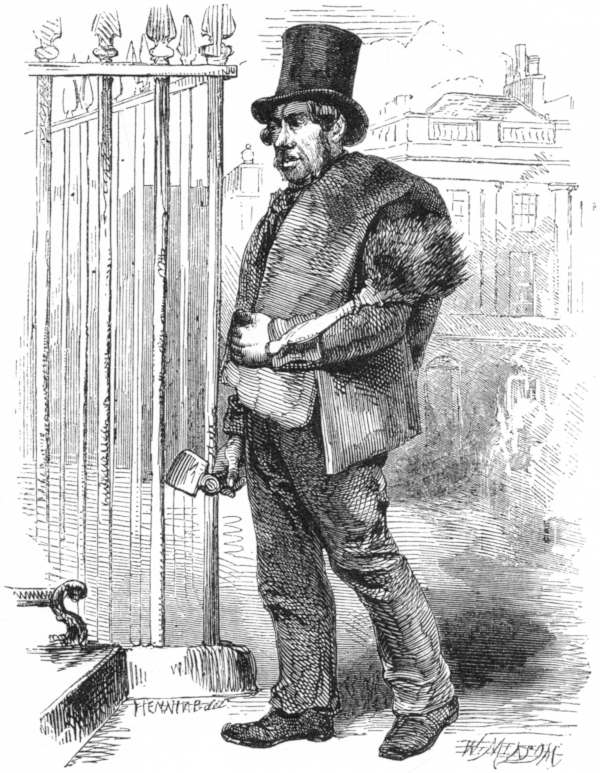
ONE OF THE FEW REMAINING CLIMBING SWEEPS.
[From a Daguerreotype by Beard.]
The society for the supersedence of the labour of climbing boys promoted the adoption of the machines by all the means in their power, presenting the new instrument gratuitously to several master sweepers who were too poor to purchase it. Experiments were made and duly published as to the effectual manner in which the chimneys at Guildhall, the Mansion House, the then new Custom House, Dulwich College, and in other public edifices, had been cleansed by the machine. But these statements seem to have produced little effect. People thought, perhaps, that the mechanical means which might very well cleanse the chimneys of large public buildings—and it was said that the chimneys of the Custom House were built with a view to the use of the machine—might not be so serviceable for the same purposes in small private dwellings. Experiments continued to be made, often in the presence of architects, of the more respectable sweepers, and of ladies and gentlemen who took a philanthropic interest in the question, between the years 1803 and 1817, but with little influence upon the general public, for in 1817 Mr. Smart supposed that there were but 50 or 60 machines in general use in the metropolis, and those, it appeared from the evidence of several master sweepers, were used chiefly in gentlemen’s houses, many of those gentlemen having to be authoritative with their servants, who, if not controlled, always preferred the services of the climbing boys. Most servants had perquisites from the master sweepers, in the largest and most profitable ways of business, and they seemed to fear the loss of those perquisites if any change took place.
The opposition in Parliament, and in the general indifference of the people, to the efforts of “the friends of the climbing boy” to supersede his painful labours by the use of machinery, was formidable enough, but that of the servants appears to have been more formidable still. Mr. Smart showed this in his explanations to the Committee. The whole result of his experience was that servants set their faces against the introduction of the machine, grumbling if there were not even the appearance of dirt on the furniture after its use. “The first winter I went out with this machine,” said Mr. Smart, “I went to Mr. Burke’s in Token-house Yard, who was a friend of mine, with a man to sweep the chimneys, and after waiting above an hour in a cold morning, the housekeeper came down quite in a rage, that we should presume to ring the bell or knock at the door; and when we got admittance, she swore she wished the machine and the inventor at the devil; she did not know me. We swept all the chimneys, and when we had done I asked her what objection she had to it now; she said, a very serious one, that if there was a thing by which a servant could get any emolument, some d——d invention was sure to take it away from them, for that she received perquisites.”