Volume 2 — OF THE STREET-FINDERS OR COLLECTORS. (continued 2)
Reading edition
Some few years ago, the main sewers, having their outlets on the river side, were completely open, so that any person desirous of exploring their dark and uninviting recesses might enter at the river side, and wander away, provided he could withstand the combination of villanous stenches which met him at every step, for many miles, in any direction. At that time it was a thing of very frequent occurrence, especially at the spring tides, for the water to rush into the sewers, pouring through them like a torrent, and then to burst up through the gratings into the streets, flooding all the low-lying districts in the vicinity of the river, till the streets of Shadwell and Wapping resembled a Dutch town, intersected by a series of muddy canals. Of late, however, to remedy this defect, the Commissioners have had a strong brick wall built within the entrance to the several sewers. In each of these brick walls there is an opening covered by a strong iron door, which hangs from the top and is so arranged that when the tide is low the rush of the water and other filth on the inner side, forces it back and allows the contents of the sewer to pass into the river, whilst when the tide rises the door is forced so close against the wall by the pressure of the water outside that none can by any possibility enter, and thus the river neighbourhoods are secured from the deluges which were heretofore of such frequent occurrence.
Were it not a notorious fact, it might perhaps be thought impossible, that men could be found who, for the chance of obtaining a living of some sort or other, would, day after day, and year after year, continue to travel through these underground channels for the offscouring of the city; but such is the case even at the present moment. In former times, however, this custom prevailed much more than now, for in those days the sewers were entirely open and presented no obstacle to any one desirous of entering them. Many wondrous tales are still told among the people of men having lost their way in the sewers, and of having wandered among the filthy passages—their lights extinguished by the noisome vapours—till, faint and overpowered, they dropped down and died on the spot. Other stories are told of sewer-hunters beset by myriads of enormous rats, and slaying thousands of them in their struggle for life, till at length the swarms of the savage things overpowered them, and in a few days afterwards their skeletons were discovered picked to the very bones. Since the iron doors, however, have been placed on the main sewers a prohibition has been issued against entering them, and a reward of 5l. offered to any person giving information so as to lead to the conviction of any offender. Nevertheless many still travel through these foul labyrinths, in search of such valuables as may have found their way down the drains.
The persons who are in the habit of searching the sewers, call themselves “shore-men” or “shore-workers.” They belong, in a certain degree, to the same class as the “mud-larks,” that is to say, they travel through the mud along shore in the neighbourhood of ship-building and ship-breaking yards, for the purpose of picking up copper nails, bolts, iron, and old rope. The shore-men, however, do not collect the lumps of coal and wood they meet with on their way, but leave them as the proper perquisites of the mud-larks. The sewer-hunters were formerly, and indeed are still, called by the name of “Toshers,” the articles which they pick up in the course of their wanderings along shore being known among themselves by the general term “tosh,” a word more particularly applied by them to anything made of copper. These “Toshers” may be seen, especially on the Surrey side of the Thames, habited in long greasy velveteen coats, furnished with pockets of vast capacity, and their nether limbs encased in dirty canvas trowsers, and any old slops of shoes, that may be fit only for wading through the mud. They carry a bag on their back, and in their hand a pole seven or eight feet long, on one end of which there is a large iron hoe. The uses of this instrument are various; with it they try the ground wherever it appears unsafe, before venturing on it, and, when assured of its safety, walk forward steadying their footsteps with the staff. Should they, as often happens, even to the most experienced, sink in some quagmire, they immediately throw out the long pole armed with the hoe, which is always held uppermost for this purpose, and with it seizing hold of any object within their reach, are thereby enabled to draw themselves out; without the pole, however, their danger would be greater, for the more they struggled to extricate themselves from such places, the deeper they would sink; and even with it, they might perish, I am told, in some part, if there were nobody at hand to render them assistance. Finally, they make use of this pole to rake about the mud when searching for iron, copper, rope, and bones. They mostly exhibit great skill in discovering these things in unlikely places, and have a knowledge of the various sets of the tide, calculated to carry articles to particular points, almost equal to the dredgermen themselves. Although they cannot “pick up” as much now as they formerly did, they are still able to make what they call a fair living, and can afford to look down with a species of aristocratic contempt on the puny efforts of their less fortunate brethren the “mudlarks.”
To enter the sewers and explore them to any considerable distance is considered, even by those acquainted with what is termed “working the shores,” an adventure of no small risk. There are a variety of perils to be encountered in such places. The brick-work in many parts—especially in the old sewers—has become rotten through the continual action of the putrefying matter and moisture, and parts have fallen down and choked up the passage with heaps of rubbish; over these obstructions, nevertheless, the sewer-hunters have to scramble “in the best way they can.” In such parts they are careful not to touch the brick-work over head, for the slightest tap might bring down an avalanche of old bricks and earth, and severely injure them, if not bury them in the rubbish. Since the construction of the new sewers, the old ones are in general abandoned by the “hunters;” but in many places the former channels cross and re-cross those recently constructed, and in the old sewers a person is very likely to lose his way. It is dangerous to venture far into any of the smaller sewers branching off from the main, for in this the “hunters” have to stoop low down in order to proceed; and, from the confined space, there are often accumulated in such places, large quantities of foul air, which, as one of them stated, will “cause instantious death.” Moreover, far from there being any romance in the tales told of the rats, these vermin are really numerous and formidable in the sewers, and have been known, I am assured, to attack men when alone, and even sometimes when accompanied by others, with such fury that the people have escaped from them with difficulty. They are particularly ferocious and dangerous, if they be driven into some corner whence they cannot escape, when they will immediately fly at any one that opposes their progress. I received a similar account to this from one of the London flushermen. There are moreover, in some quarters, ditches or trenches which are filled as the water rushes up the sewers with the tide; in these ditches the water is retained by a sluice, which is shut down at high tide, and lifted again at low tide, when it rushes down the sewers with all the violence of a mountain torrent, sweeping everything before it. If the sewer-hunter be not close to some branch sewer, so that he can run into it, whenever the opening of these sluices takes place, he must inevitably perish. The trenches or water reservoirs for the cleansing of the sewers are chiefly on the south side of the river, and, as a proof of the great danger to which the sewer-hunters are exposed in such cases, it may be stated, that not very long ago, a sewer on the south side of the Thames was opened to be repaired; a long ladder reached to the bottom of the sewer, down which the bricklayer’s labourer was going with a hod of bricks, when the rush of water from the sluice, struck the bottom of the ladder, and instantly swept away ladder, labourer, and all. The bricklayer fortunately was enjoying his “pint and pipe” at a neighbouring public-house. The labourer was found by my informant, a “shore-worker,” near the mouth of the sewer quite dead, battered, and disfigured in a frightful manner. There was likewise great danger in former times from the rising of the tide in the sewers, so that it was necessary for the shore-men to have quitted them before the water had got any height within the entrance. At present, however, this is obviated in those sewers where the main is furnished with an iron door towards the river.
The shore-workers, when about to enter the sewers, provide themselves, in addition to the long hoe already described, with a canvas apron, which they tie round them, and a dark lantern similar to a policeman’s; this they strap before them on their right breast, in such a manner that on removing the shade, the bull’s-eye throws the light straight forward when they are in an erect position, and enables them to see everything in advance of them for some distance; but when they stoop, it throws the light directly under them, so that they can then distinctly see any object at their feet. The sewer-hunters usually go in gangs of three or four for the sake of company, and in order that they may be the better able to defend themselves from the rats. The old hands who have been often up (and every gang endeavours to include at least one experienced person), travel a long distance, not only through the main sewers, but also through many of the branches. Whenever the shore-men come near a street grating, they close their lanterns and watch their opportunity of gliding silently past unobserved, for otherwise a crowd might collect over head and intimate to the policeman on duty, that there were persons wandering in the sewers below. The shore-workers never take dogs with them, lest their barking when hunting the rats might excite attention. As the men go along they search the bottom of the sewer, raking away the mud with their hoe, and pick, from between the crevices of the brick-work, money, or anything else that may have lodged there. There are in many parts of the sewers holes where the brick-work has been worn away, and in these holes clusters of articles are found, which have been washed into them from time to time, and perhaps been collecting there for years; such as pieces of iron, nails, various scraps of metal, coins of every description, all rusted into a mass like a rock, and weighing from a half hundred to two hundred weight altogether. These “conglomerates” of metal are too heavy for the men to take out of the sewers, so that if unable to break them up, they are compelled to leave them behind; and there are very many such masses, I am informed, lying in the sewers at this moment, of immense weight, and growing larger every day by continual additions. The shore-men find great quantities of money—of copper money especially; sometimes they dive their arm down to the elbow in the mud and filth and bring up shillings, sixpences, half-crowns, and occasionally half-sovereigns and sovereigns. They always find the coins standing edge uppermost between the bricks in the bottom, where the mortar has been worn away. The sewer-hunters occasionally find plate, such as spoons, ladles, silver-handled knives and forks, mugs and drinking cups, and now and then articles of jewellery; but even while thus “in luck” as they call it, they do not omit to fill the bags on their backs with the more cumbrous articles they meet with—such as metals of every description, rope and bones. There is always a great quantity of these things to be met with in the sewers, they being continually washed down from the cesspools and drains of the houses. When the sewer-hunters consider they have searched long enough, or when they have found as much as they can conveniently take away, the gang leave the sewers and, adjourning to the nearest of their homes, count out the money they have picked up, and proceed to dispose of the old metal, bones, rope, &c.; this done, they then, as they term it, “whack” the whole lot; that is, they divide it equally among all hands. At these divisions, I am assured, it frequently occurs that each member of the gang will realise from 30s. to 2l.—this at least was a frequent occurrence some few years ago. Of late, however, the shore-men are obliged to use far more caution, as the police, and especially those connected with the river, who are more on the alert, as well as many of the coal-merchants in the neighbourhood of the sewers, would give information if they saw any suspicious persons approaching them.
The principal localities in which the shore-hunters reside are in Mint-square, Mint-street, and Kent-street, in the Borough—Snow’s-fields, Bermondsey—and that never-failing locality between the London Docks and Rosemary-lane which appears to be a concentration of all the misery of the kingdom. There were known to be a few years ago nearly 200 sewer-hunters, or “toshers,” and, incredible as it may appear, I have satisfied myself that, taking one week with another, they could not be said to make much short of 2l. per week. Their probable gains, I was told, were about 6s. per day all the year round. At this rate the property recovered from the sewers of London would have amounted to no less than 20,000l. per annum, which would make the amount of property lost down the drains of each house amount to 1s. 4d. a year. The shore-hunters of the present day greatly complain of the recent restrictions, and inveigh in no measured terms against the constituted authorities. “They won’t let us in to work the shores,” say they, “’cause there’s a little danger. They fears as how we’ll get suffocated, at least they tells us so; but they don’t care if we get starved! no, they doesn’t mind nothink about that.”
It is, however, more than suspected that these men find plenty of means to evade the vigilance of the sewer officials, and continue quietly to reap a considerable harvest, gathered whence it might otherwise have rotted in obscurity.
The sewer-hunters, strange as it may appear, are certainly smart fellows, and take decided precedence of all the other “finders” of London, whether by land or water, both on account of the greater amount of their earnings, and the skill and courage they manifest in the pursuit of their dangerous employment. But like all who make a living as it were by a game of chance, plodding, carefulness, and saving habits cannot be reckoned among their virtues; they are improvident, even to a proverb. With their gains, superior even to those of the better-paid artizans, and far beyond the amount received by many clerks, who have to maintain a “respectable appearance,” the shore-men might, with but ordinary prudence, live well, have comfortable homes, and even be able to save sufficient to provide for themselves in their old age. Their practice, however, is directly the reverse. They no sooner make a “haul,” as they say, than they adjourn to some low public-house in the neighbourhood, and seldom leave till empty pockets and hungry stomachs drive them forth to procure the means for a fresh debauch. It is principally on this account that, despite their large gains, they are to be found located in the most wretched quarter of the metropolis.
It might be supposed that the sewer-hunters (passing much of their time in the midst of the noisome vapours generated by the sewers, the odour of which, escaping upwards from the gratings in the streets, is dreaded and shunned by all as something pestilential) would exhibit in their pallid faces the unmistakable evidence of their unhealthy employment. But this is far from the fact. Strange to say, the sewer-hunters are strong, robust, and healthy men, generally florid in their complexion, while many of them know illness only by name. Some of the elder men, who head the gangs when exploring the sewers, are between 60 and 80 years of age, and have followed the employment during their whole lives. The men appear to have a fixed belief that the odour of the sewers contributes in a variety of ways to their general health; nevertheless, they admit that accidents occasionally occur from the air in some places being fully impregnated with mephitic gas.
I found one of these men, from whom I derived much information, and who is really an active intelligent man, in a court off Rosemary-lane. Access is gained to this court through a dark narrow entrance, scarcely wider than a doorway, running beneath the first floor of one of the houses in the adjoining street. The court itself is about 50 yards long, and not more than three yards wide, surrounded by lofty wooden houses, with jutting abutments in many of the upper stories that almost exclude the light, and give them the appearance of being about to tumble down upon the heads of the intruders. This court is densely inhabited; every room has its own family, more or less in number; and in many of them, I am assured, there are two families residing, the better to enable the one to whom the room is let to pay the rent. At the time of my visit, which was in the evening, after the inmates had returned from their various employments, some quarrel had arisen among them. The court was so thronged with the friends of the contending individuals and spectators of the fight that I was obliged to stand at the entrance, unable to force my way through the dense multitude, while labourers and street-folk with shaggy heads, and women with dirty caps and fuzzy hair, thronged every window above, and peered down anxiously at the affray. There must have been some hundreds of people collected there, and yet all were inhabitants of this very court, for the noise of the quarrel had not yet reached the street. On wondering at the number, my informant, when the noise had ceased, explained the matter as follows: “You see, sir, there’s more than 30 houses in this here court, and there’s not less than eight rooms in every house; now there’s nine or ten people in some of the rooms, I knows, but just say four in every room, and calculate what that there comes to.” I did, and found it, to my surprise, to be 960. “Well,” continued my informant, chuckling and rubbing his hands in evident delight at the result, “you may as well just tack a couple a hundred on to the tail o’ them for make-weight, as we’re not werry pertikler about a hundred or two one way or the other in these here places.”
In this court, up three flights of narrow stairs that creaked and trembled at every footstep, and in an ill-furnished garret, dwelt the shore-worker—a man who, had he been careful, according to his own account at least, might have money in the bank and be the proprietor of the house in which he lived. The sewer-hunters, like the street-people, are all known by some peculiar nickname, derived chiefly from some personal characteristic. It would be a waste of time to inquire for them by their right names, even if you were acquainted with them, for none else would know them, and no intelligence concerning them could be obtained; while under the title of Lanky Bill, Long Tom, One-eyed George, Short-armed Jack, they are known to every one.
My informant, who is also dignified with a title, or as he calls it a “handle to his name,” gave me the following account of himself: “I was born in Birmingham, but afore I recollects anythink, we came to London. The first thing I remembers is being down on the shore at Cuckold’s P’int, when the tide was out and up to my knees in mud, and a gitting down deeper and deeper every minute till I was picked up by one of the shore-workers. I used to git down there every day, to look at the ships and boats a sailing up and down; I’d niver be tired a looking at them at that time. At last father ’prenticed me to a blacksmith in Bermondsey, and then I couldn’t git down to the river when I liked, so I got to hate the forge and the fire, and blowing the bellows, and couldn’t stand the confinement no how,—at last I cuts and runs. After some time they gits me back ag’in, but I cuts ag’in. I was determined not to stand it. I wouldn’t go home for fear I’d be sent back, so I goes down to Cuckold’s P’int and there I sits near half the day, when who should I see but the old un as had picked me up out of the mud when I was a sinking. I tells him all about it, and he takes me home along with hisself, and gits me a bag and an o, and takes me out next day, and shows me what to do, and shows me the dangerous places, and the places what are safe, and how to rake in the mud for rope, and bones, and iron, and that’s the way I comed to be a shore-worker. Lor’ bless you, I’ve worked Cuckold’s P’int for more nor twenty year. I know places where you’d go over head and ears in the mud, and jist alongside on ’em you may walk as safe as you can on this floor. But it don’t do for a stranger to try it, he’d wery soon git in, and it’s not so easy to git out agin, I can tell you. I stay’d with the old un a long time, and we used to git lots o’ tin, specially when we’d go to work the sewers. I liked that well enough. I could git into small places where the old un couldn’t, and when I’d got near the grating in the street, I’d search about in the bottom of the sewer; I’d put down my arm to my shoulder in the mud and bring up shillings and half-crowns, and lots of coppers, and plenty other things. I once found a silver jug as big as a quart pot, and often found spoons and knives and forks and every thing you can think of. Bless your heart the smells nothink; it’s a roughish smell at first, but nothink near so bad as you thinks, ’cause, you see, there’s sich lots o’ water always a coming down the sewer, and the air gits in from the gratings, and that helps to sweeten it a bit. There’s some places, ’specially in the old sewers, where they say there’s foul air, and they tells me the foul air ’ill cause instantious death, but I niver met with anythink of the kind, and I think if there was sich a thing I should know somethink about it, for I’ve worked the sewers, off and on, for twenty year. When we comes to a narrow-place as we don’t know, we takes the candle out of the lantern and fastens it on the hend of the o, and then runs it up the sewer, and if the light stays in, we knows as there a’n’t no danger. We used to go up the city sewer at Blackfriars-bridge, but that’s stopped up now; it’s boarded across inside. The city wouldn’t let us up if they knew it, ’cause of the danger, they say, but they don’t care if we hav’n’t got nothink to eat nor a place to put our heads in, while there’s plenty of money lying there and good for nobody. If you was caught up it and brought afore the Lord Mayor, he’d give you fourteen days on it, as safe as the bellows, so a good many on us now is afraid to wenture in. We don’t wenture as we used to, but still it’s done at times. There’s a many places as I knows on where the bricks has fallen down, and that there’s dangerous; it’s so delaberated that if you touches it with your head or with the hend of the o, it ’ill all come down atop o’ you. I’ve often seed as many as a hundred rats at once, and they’re woppers in the sewers, I can tell you; them there water rats, too, is far more ferociouser than any other rats, and they’d think nothink of tackling a man, if they found they couldn’t get away no how, but if they can why they runs by and gits out o’ the road. I knows a chap as the rats tackled in the sewers; they bit him hawfully: you must ha’ heard on it; it was him as the watermen went in arter when they heard him a shouting as they was a rowin’ by. Only for the watermen the rats would ha’ done for him, safe enough. Do you recollect hearing on the man as was found in the sewers about twelve year ago?—oh you must—the rats eat every bit of him, and left nothink but his bones. I knowed him well, he was a rig’lar shore-worker.
“The rats is wery dangerous, that’s sartain, but we always goes three or four on us together, and the varmint’s too wide awake to tackle us then, for they know they’d git off second best. You can go a long way in the sewers if you like; I don’t know how far. I niver was at the end on them myself, for a cove can’t stop in longer than six or seven hour, ’cause of the tide; you must be out before that’s up. There’s a many branches on ivery side, but we don’t go into all; we go where we know, and where we’re always sure to find somethink. I know a place now where there’s more than two or three hundred weight of metal all rusted together, and plenty of money among it too; but it’s too heavy to carry it out, so it ’ill stop there I s’pose till the world comes to an end. I often brought out a piece of metal half a hundred in weight, and took it under the harch of the bridge, and broke it up with a large stone to pick out the money. I’ve found sovereigns and half sovereigns over and over ag’in, and three on us has often cleared a couple of pound apiece in one day out of the sewers. But we no sooner got the money than the publican had it. I only wish I’d back all the money I’ve guv to the publican, and I wouldn’t care how the wind blew for the rest of my life. I never thought about taking a hammer along with me into the sewer, no; I never thought I’d want it. You can’t go in every day, the tides don’t answer, and they’re so pertikler now, far more pertikler than formerly; if you was known to touch the traps, you’d git hauled up afore the beak. It’s done for all that, and though there is so many eyes about. The “Johnnys” on the water are always on the look out, and if they sees any on us about, we has to cut our lucky. We shore workers sometimes does very well other ways. When we hears of a fire anywheres, we goes and watches where they shoots the rubbish, and then we goes and sifts it over, and washes it afterwards, then all the metal sinks to the bottom. The way we does it is this here: we takes a barrel cut in half, and fills it with water, and then we shovels in the siftings, and stirs ’em round and round and round with a stick; then we throws out that water and puts in some fresh, and stirs that there round ag’in; arter some time the water gets clear, and every thing heavy’s fell to the bottom, and then we sees what it is and picks it out. I’ve made from a pound to thirty shilling a day, at that there work on lead alone. The time the Parliament Houses was burnt, the rubbish was shot in Hyde Park, and Long J—— and I goes to work it, and while we were at it, we didn’t make less nor three pounds apiece a day; we found sovereigns and half sovereigns, and lots of silver half melted away, and jewellery, such as rings, and stones, and brooches; but we never got half paid for them. I found two sets of bracelets for a lady’s arms, and took ’em to a jeweller, and he tried them jist where the “great” heat had melted the catch away, and found they was only metal double plated, or else he said as how he’d give us thirty pounds for them; howsomever, we takes them down to a Jew in Petticoat-lane, who used to buy things of us, and he gives us 7l. 10s. for ’em. We found so many things, that at last Long J—— and I got to quarrel about the “whacking;” there was cheatin’ a goin’ on; it wasn’t all fair and above board as it ought to be, so we gits to fightin’, and kicks up sich a jolly row, that they wouldn’t let us work no more, and takes and buries the whole on the rubbish. There’s plenty o’ things under the ground along with it now, if anybody could git at them. There was jist two loads o’ rubbish shot at one time in Bishop Bonner’s-fields, which I worked by myself, and what do you think I made out of that there?—why I made 3l. 5s. The rubbish was got out of a cellar, what hadn’t been stirred for fifty year or more, so I thinks there ought to be somethink in it, and I keeps my eye on it, and watches where it’s shot; then I turns to work, and the first thing I gits hold on is a chain, which I takes to be copper; it was so dirty, but it turned out to be all solid goold, and I gets 1l. 5s. for it from the Jew; arter that I finds lots o’ coppers, and silver money, and many things besides. The reason I likes this sort of life is, ’cause I can sit down when I likes, and nobody can’t order me about. When I’m hard up, I knows as how I must work, and then I goes at it like sticks a breaking; and tho’ the times isn’t as they was, I can go now and pick up my four or five bob a day, where another wouldn’t know how to get a brass farden.”
There is a strange tale in existence among the shore-workers, of a race of wild hogs inhabiting the sewers in the neighbourhood of Hampstead. The story runs, that a sow in young, by some accident got down the sewer through an opening, and, wandering away from the spot, littered and reared her offspring in the drain, feeding on the offal and garbage washed into it continually. Here, it is alleged, the breed multiplied exceedingly, and have become almost as ferocious as they are numerous. This story, apocryphal as it seems, has nevertheless its believers, and it is ingeniously argued, that the reason why none of the subterranean animals have been able to make their way to the light of day is, that they could only do so by reaching the mouth of the sewer at the river-side, while, in order to arrive at that point, they must necessarily encounter the Fleet ditch, which runs towards the river with great rapidity, and as it is the obstinate nature of a pig to swim against the stream, the wild hogs of the sewers invariably work their way back to their original quarters, and are thus never to be seen. What seems strange in the matter is, that the inhabitants of Hampstead never have been known to see any of these animals pass beneath the gratings, nor to have been disturbed by their gruntings. The reader of course can believe as much of the story as he pleases, and it is right to inform him that the sewer-hunters themselves have never yet encountered any of the fabulous monsters of the Hampstead sewers.
Of the Mud-Larks.
There is another class who may be termed river-finders, although their occupation is connected only with the shore; they are commonly known by the name of “mud-larks,” from being compelled, in order to obtain the articles they seek, to wade sometimes up to their middle through the mud left on the shore by the retiring tide. These poor creatures are certainly about the most deplorable in their appearance of any I have met with in the course of my inquiries. They may be seen of all ages, from mere childhood to positive decrepitude, crawling among the barges at the various wharfs along the river; it cannot be said that they are clad in rags, for they are scarcely half covered by the tattered indescribable things that serve them for clothing; their bodies are grimed with the foul soil of the river, and their torn garments stiffened up like boards with dirt of every possible description.
Among the mud-larks may be seen many old women, and it is indeed pitiable to behold them, especially during the winter, bent nearly double with age and infirmity, paddling and groping among the wet mud for small pieces of coal, chips of wood, or any sort of refuse washed up by the tide. These women always have with them an old basket or an old tin kettle, in which they put whatever they chance to find. It usually takes them a whole tide to fill this receptacle, but when filled, it is as much as the feeble old creatures are able to carry home.
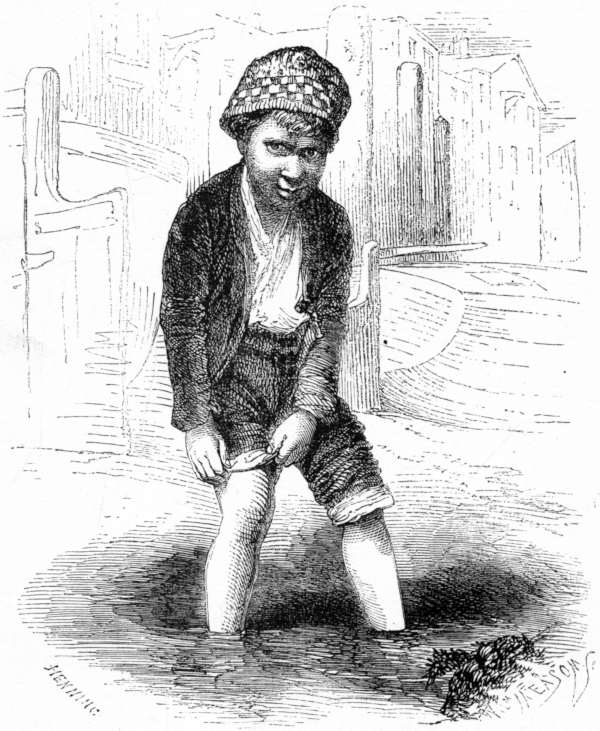
THE MUD-LARK.
[From a Daguerreotype by Beard.]
The mud-larks generally live in some court or alley in the neighbourhood of the river, and, as the tide recedes, crowds of boys and little girls, some old men, and many old women, may be observed loitering about the various stairs, watching eagerly for the opportunity to commence their labours. When the tide is sufficiently low they scatter themselves along the shore, separating from each other, and soon disappear among the craft lying about in every direction. This is the case on both sides of the river, as high up as there is anything to be found, extending as far as Vauxhall-bridge, and as low down as Woolwich. The mud-larks themselves, however, know only those who reside near them, and whom they are accustomed to meet in their daily pursuits; indeed, with but few exceptions, these people are dull, and apparently stupid; this is observable particularly among the boys and girls, who, when engaged in searching the mud, hold but little converse one with another. The men and women may be passed and repassed, but they notice no one; they never speak, but with a stolid look of wretchedness they plash their way through the mire, their bodies bent down while they peer anxiously about, and occasionally stoop to pick up some paltry treasure that falls in their way.
The mud-larks collect whatever they happen to find, such as coals, bits of old-iron, rope, bones, and copper nails that drop from ships while lying or repairing along shore. Copper nails are the most valuable of all the articles they find, but these they seldom obtain, as they are always driven from the neighbourhood of a ship while being new-sheathed. Sometimes the younger and bolder mud-larks venture on sweeping some empty coal-barge, and one little fellow with whom I spoke, having been lately caught in the act of so doing, had to undergo for the offence seven days’ imprisonment in the House of Correction: this, he says, he liked much better than mud-larking, for while he staid there he wore a coat and shoes and stockings, and though he had not over much to eat, he certainly was never afraid of going to bed without anything at all—as he often had to do when at liberty. He thought he would try it on again in the winter, he told me, saying, it would be so comfortable to have clothes and shoes and stockings then, and not be obliged to go into the cold wet mud of a morning.
The coals that the mud-larks find, they sell to the poor people of the neighbourhood at 1d. per pot, holding about 14 lbs. The iron and bones and rope and copper nails which they collect, they sell at the rag-shops. They dispose of the iron at 5 lbs. for 1d., the bones at 3 lbs. a 1d., rope a ½d. per lb. wet, and ¾d. per lb. dry, and copper nails at the rate of 4d. per lb. They occasionally pick up tools, such as saws and hammers; these they dispose of to the seamen for biscuit and meat, and sometimes sell them at the rag-shops for a few halfpence. In this manner they earn from 2½d. to 8d. per day, but rarely the latter sum; their average gains may be estimated at about 3d. per day. The boys, after leaving the river, sometimes scrape their trousers, and frequent the cab-stands, and try to earn a trifle by opening the cab-doors for those who enter them, or by holding gentlemen’s horses. Some of them go, in the evening, to a ragged school, in the neighbourhood of which they live; more, as they say, because other boys go there, than from any desire to learn.
At one of the stairs in the neighbourhood of the pool, I collected about a dozen of these unfortunate children; there was not one of them over twelve years of age, and many of them were but six. It would be almost impossible to describe the wretched group, so motley was their appearance, so extraordinary their dress, and so stolid and inexpressive their countenances. Some carried baskets, filled with the produce of their morning’s work, and others old tin kettles with iron handles. Some, for want of these articles, had old hats filled with the bones and coals they had picked up; and others, more needy still, had actually taken the caps from their own heads, and filled them with what they had happened to find. The muddy slush was dripping from their clothes and utensils, and forming a puddle in which they stood. There did not appear to be among the whole group as many filthy cotton rags to their backs as, when stitched together, would have been sufficient to form the material of one shirt. There were the remnants of one or two jackets among them, but so begrimed and tattered that it would have been difficult to have determined either the original material or make of the garment. On questioning one, he said his father was a coal-backer; he had been dead eight years; the boy was nine years old. His mother was alive; she went out charing and washing when she could get any such work to do. She had 1s. a day when she could get employment, but that was not often; he remembered once to have had a pair of shoes, but it was a long time since. “It is very cold in winter,” he said, “to stand in the mud without shoes,” but he did not mind it in summer. He had been three years mud-larking, and supposed he should remain a mud-lark all his life. What else could he be? for there was nothing else that he knew how to do. Some days he earned 1d., and some days 4d.; he never earned 8d. in one day, that would have been a “jolly lot of money.” He never found a saw or a hammer, he “only wished” he could, they would be glad to get hold of them at the dolly’s. He had been one month at school before he went mud-larking. Some time ago he had gone to the ragged-school; but he no longer went there, for he forgot it. He could neither read nor write, and did not think he could learn if he tried “ever so much.” He didn’t know what religion his father and mother were, nor did know what religion meant. God was God, he said. He had heard he was good, but didn’t know what good he was to him. He thought he was a Christian, but he didn’t know what a Christian was. He had heard of Jesus Christ once, when he went to a Catholic chapel, but he never heard tell of who or what he was, and didn’t “particular care” about knowing. His father and mother were born in Aberdeen, but he didn’t know where Aberdeen was. London was England, and England, he said, was in London, but he couldn’t tell in what part. He could not tell where he would go to when he died, and didn’t believe any one could tell that. Prayers, he told me, were what people said to themselves at night. He never said any, and didn’t know any; his mother sometimes used to speak to him about them, but he could never learn any. His mother didn’t go to church or to chapel, because she had no clothes. All the money he got he gave to his mother, and she bought bread with it, and when they had no money they lived the best way they could.
Such was the amount of intelligence manifested by this unfortunate child.
Another was only seven years old. He stated that his father was a sailor who had been hurt on board ship, and been unable to go to sea for the last two years. He had two brothers and a sister, one of them older than himself; and his elder brother was a mud-lark like himself. The two had been mud-larking more than a year; they went because they saw other boys go, and knew that they got money for the things they found. They were often hungry, and glad to do anything to get something to eat. Their father was not able to earn anything, and their mother could get but little to do. They gave all the money they earned to their mother. They didn’t gamble, and play at pitch and toss when they had got some money, but some of the big boys did on the Sunday, when they didn’t go a mud-larking. He couldn’t tell why they did nothing on a Sunday, “only they didn’t;” though sometimes they looked about to see where the best place would be on the next day. He didn’t go to the ragged school; he should like to know how to read a book, though he couldn’t tell what good it would do him. He didn’t like mud larking, would be glad of something else, but didn’t know anything else that he could do.
Another of the boys was the son of a dock labourer,—casually employed. He was between seven and eight years of age, and his sister, who was also a mud-lark, formed one of the group. The mother of these two was dead, and there were three children younger than themselves.
The rest of the histories may easily be imagined, for there was a painful uniformity in the stories of all the children: they were either the children of the very poor, who, by their own improvidence or some overwhelming calamity, had been reduced to the extremity of distress, or else they were orphans, and compelled from utter destitution to seek for the means of appeasing their hunger in the mud of the river. That the majority of this class are ignorant, and without even the rudiments of education, and that many of them from time to time are committed to prison for petty thefts, cannot be wondered at. Nor can it even excite our astonishment that, once within the walls of a prison, and finding how much more comfortable it is than their previous condition, they should return to it repeatedly. As for the females growing up under such circumstances, the worst may be anticipated of them; and in proof of this I have found, upon inquiry, that very many of the unfortunate creatures who swell the tide of prostitution in Ratcliff-highway, and other low neighbourhoods in the East of London, have originally been mud-larks; and only remained at that occupation till such time as they were capable of adopting the more easy and more lucrative life of the prostitute.
As to the numbers and earnings of the mud-larks, the following calculations fall short of, rather than exceed, the truth. From Execution Dock to the lower part of Limehouse Hole, there are 14 stairs or landing-places, by which the mud-larks descend to the shore in order to pursue their employment. There are about as many on the opposite side of the water similarly frequented.
At King James’ Stairs, in Wapping Wall, which is nearly a central position, from 40 to 50 mud-larks go down daily to the river; the mud-larks “using” the other stairs are not so numerous. If, therefore, we reckon the number of stairs on both sides of the river at 28, and the average number of mud-larks frequenting them at 10 each, we shall have a total of 280. Each mud-lark, it has been shown, earns on an average 3d. a day, or 1s. 6d. per week; so that the annual earnings of each will be 3l. 18s., or say 4l., a year, and hence the gross earnings of the 280 will amount to rather more than 1000l. per annum.
But there are, in addition to the mud-larks employed in the neighbourhood of what may be called the pool, many others who work down the river at various places as far as Blackwall, on the one side, and at Deptford, Greenwich, and Woolwich, on the other. These frequent the neighbourhoods of the various “yards” along shore, where vessels are being built; and whence, at certain times, chips, small pieces of wood, bits of iron, and copper nails, are washed out into the river. There is but little doubt that this portion of the class earn much more than the mud-larks of the pool, seeing that they are especially convenient to the places where the iron vessels are constructed; so that the presumption is, that the number of mud-larks “at work” on the banks of the Thames (especially if we include those above bridge), and the value of the property extracted by them from the mud of the river, may be fairly estimated at double that which is stated above, or say 550 gaining 2000l. per annum.
As an illustration of the doctrines I have endeavoured to enforce throughout this publication, I cite the following history of one of the above class. It may serve to teach those who are still sceptical as to the degrading influence of circumstances upon the poor, that many of the humbler classes, if placed in the same easy position as ourselves, would become, perhaps, quite as “respectable” members of society.
The lad of whom I speak was discovered by me now nearly two years ago “mud-larking” on the banks of the river near the docks. He was a quick, intelligent little fellow, and had been at the business, he told me, about three years. He had taken to mud-larking, he said, because his clothes were too bad for him to look for anything better. He worked every day, with 20 or 30 boys, who might all be seen at daybreak with their trowsers tucked up, groping about, and picking out the pieces of coal from the mud on the banks of the Thames. He went into the river up to his knees, and in searching the mud he often ran pieces of glass and long nails into his feet. When this was the case, he went home and dressed the wounds, but returned to the river-side directly, “for should the tide come up,” he added, “without my having found something, why I must starve till next low tide.” In the very cold weather he and his other shoeless companions used to stand in the hot water that ran down the river side from some of the steam-factories, to warm their frozen feet.
At first he found it difficult to keep his footing in the mud, and he had known many beginners fall in. He came to my house, at my request, the morning after my first meeting with him. It was the depth of winter, and the poor little fellow was nearly destitute of clothing. His trousers were worn away up to his knees, he had no shirt, and his legs and feet (which were bare) were covered with chilblains. On being questioned by me he gave the following account of his life:—
He was fourteen years old. He had two sisters, one fifteen and the other twelve years of age. His father had been dead nine years. The man had been a coal-whipper, and, from getting his work from one of the publican employers in those days, had become a confirmed drunkard. When he married he held a situation in a warehouse, where his wife managed the first year to save 4l. 10s. out of her husband’s earnings; but from the day he took to coal-whipping she had never saved one halfpenny, indeed she and her children were often left to starve. The man (whilst in a state of intoxication) had fallen between two barges, and the injuries he received had been so severe that he had lingered in a helpless state for three years before his death. After her husband’s decease the poor woman’s neighbours subscribed 1l. 5s. for her; with this sum she opened a greengrocer’s shop, and got on very well for five years.
When the boy was nine years old his mother sent him to the Red Lion school at Green-bank, near Old Gravel-lane, Ratcliffe-highway; she paid 1d. a week for his learning. He remained there for a year; then the potato-rot came, and his mother lost upon all she bought. About the same time two of her customers died 30s. in her debt; this loss, together with the potato-disease, completely ruined her, and the whole family had been in the greatest poverty from that period. Then she was obliged to take all her children from their school, that they might help to keep themselves as best they could. Her eldest girl sold fish in the streets, and the boy went to the river-side to “pick up” his living. The change, however, was so great that shortly afterwards the little fellow lay ill eighteen weeks with the ague. As soon as the boy recovered his mother and his two sisters were “taken bad” with a fever. The poor woman went into the “Great House,” and the children were taken to the Fever Hospital. When the mother returned home she was too weak to work, and all she had to depend on was what her boy brought from the river. They had nothing to eat and no money until the little fellow had been down to the shore and picked up some coals, selling them for a trifle. “And hard enough he had to work for what he got, poor boy,” said his mother to me on a future occasion, sobbing; “still he never complained, but was quite proud when he brought home enough for us to get a bit of meat with; and when he has sometimes seen me down-hearted, he has clung round my neck, and assured me that one day God would see us cared for if I would put my trust in Him.” As soon as his mother was well enough she sold fruit in the streets, or went out washing when she could get a day’s work.
The lad suffered much from the pieces of broken glass in the mud. Some little time before I met with him he had run a copper nail into his foot. This lamed him for three months, and his mother was obliged to carry him on her back every morning to the doctor. As soon, however, as he could “hobble” (to use his mother’s own words) he went back to the river, and often returned (after many hours’ hard work in the mud) with only a few pieces of coal, not enough to sell even to get them a bit of bread. One evening, as he was warming his feet in the water that ran from a steam factory, he heard some boys talking about the Ragged School in High-street, Wapping.
“They was saying what they used to learn there,” added the boy. “They asked me to come along with them for it was great fun. They told me that all the boys used to be laughing and making game of the master. They said they used to put out the gas and chuck the slates all about. They told me, too, that there was a good fire there, so I went to have a warm and see what it was like. When I got there the master was very kind to me. They used to give us tea-parties, and to keep us quiet they used to show us the magic lantern. I soon got to like going there, and went every night for six months. There was about 40 or 50 boys in the school. The most of them was thieves, and they used to go thieving the coals out of barges along shore, and cutting the ropes off ships, and going and selling it at the rag-shops. They used to get ¾d. a lb. for the rope when dry, and ½d. when wet. Some used to steal pudding out of shops and hand it to those outside, and the last boy it was handed to would go off with it. They used to steal bacon and bread sometimes as well. About half of the boys at the school was thieves. Some had work to do at ironmongers, lead-factories, engineers, soap-boilers, and so on, and some had no work to do and was good boys still. After we came out of school at nine o’clock at night, some of the bad boys would go a thieving, perhaps half-a-dozen and from that to eight would go out in a gang together. There was one big boy of the name of C——; he was 18 years old, and is in prison now for stealing bacon; I think he is in the House of Correction. This C—— used to go out of school before any of us, and wait outside the door as the other boys came out. Then he would call the boys he wanted for his gangs on one side, and tell them where to go and steal. He used to look out in the daytime for shops where things could be ‘prigged,’ and at night he would tell the boys to go to them. He was called the captain of the gangs. He had about three gangs altogether with him, and there were from six to eight boys in each gang. The boys used to bring what they stole to C——, and he used to share it with them. I belonged to one of the gangs. There were six boys altogether in my gang; the biggest lad, that knowed all about the thieving, was the captain of the gang I was in, and C—— was captain over him and over all of us.
“There was two brothers of them; you seed them, sir, the night you first met me. The other boys, as was in my gang, was B—— B——, and B—— L——, and W—— B——, and a boy we used to call ‘Tim;’ these, with myself, used to make up one of the gangs, and we all of us used to go a thieving every night after school-hours. When the tide would be right up, and we had nothing to do along shore, we used to go thieving in the daytime as well. It was B—— B——, and B—— L——, as first put me up to go thieving; they took me with them, one night, up the lane [New Gravel-lane], and I see them take some bread out of a baker’s, and they wasn’t found out; and, after that, I used to go with them regular. Then I joined C——’s gang; and, after that, C—— came and told us that his gang could do better than ourn, and he asked us to join our gang to his’n, and we did so. Sometimes we used to make 3s. or 4s. a day; or about 6d. apiece. While waiting outside the school-doors, before they opened, we used to plan up where we would go thieving after school was over. I was taken up once for thieving coals myself, but I was let go again.”
I was so much struck with the boy’s truthfulness of manner, that I asked him, would, he really lead a different life, if he saw a means of so doing? He assured me he would, and begged me earnestly to try him. Upon his leaving me, 2s. were given him for his trouble. This small sum (I afterwards learned) kept the family for more than a fortnight. The girl laid it out in sprats (it being then winter-time); these she sold in the streets.
I mentioned the fact to a literary friend, who interested himself in the boy’s welfare; and eventually succeeded in procuring him a situation at an eminent printer’s. The subjoined letter will show how the lad conducted himself while there.
“Whitefriars, April 22, 1850.
“Messrs. Bradbury and Evans beg to say that the boy J. C. has conducted himself in a very satisfactory manner since he has been in their employment.”
The same literary friend took the girl into his service. She is in a situation still, though not in the same family.
The boy now holds a good situation at one of the daily newspaper offices. So well has he behaved himself, that, a few weeks since, his wages were increased from 6s. to 9s. per week. His mother (owing to the boy’s exertions) has now a little shop, and is doing well.
This simple story requires no comments, and is narrated here in the hope that it may teach many to know how often the poor boys reared in the gutter are thieves, merely because society forbids them being honest lads.
Of the London Dustmen, Nightmen, Sweeps, and Scavengers.
These men constitute a large body, and are a class who, all things considered, do their work silently and efficiently. Almost without the cognisance of the mass of the people, the refuse is removed from our streets and houses; and London, as if in the care of a tidy housewife, is always being cleaned. Great as are the faults and absurdities of many parts of our system of public cleansing, nevertheless, when compared with the state of things in any continental capital, the superiority of the metropolis of Great Britain is indisputable.
In all this matter there is little merit to be attributed to the workmen, except that they may be well drilled; for the majority of them are as much machines, apart from their animation, as are the cane and whalebone made to cleanse the chimney, or the clumsy-looking machine which, in its progress, is a vehicular scavenger, sweeping as it goes.
These public cleansers are to be thus classified:—
1. Dustmen, or those who empty and remove the collection of ashes, bones, vegetables, &c., deposited in the dust-bins, or other refuse receptacles throughout the metropolis.
2. Nightmen, or those who remove the contents of the cesspools.
3. Sweeps, or those who remove the soot from the chimneys.
4. Scavengers, or those who remove the dirt from the streets, roads, and markets.
Let me, however, before proceeding further with the subject, lay before the reader the following important return as to the extent and contents of this prodigious city: for this document I am indebted to the Commissioners of Police, gentlemen from whom I have derived the most valuable information since the commencement of my inquiries, and to whose courtesy and consideration I am anxious to acknowledge my many obligations.
RETURN SHOWING THE EXTENT, POPULATION, AND POLICE FORCE IN THE METROPOLITAN POLICE DISTRICT AND THE CITY OF LONDON IN SEPTEMBER, 1850.
Inner District[7].Outer District.Total.
Area (in square miles) 91 609½ 700½ 1¾ 702¼
Parishes 82 136 218 97 315
Streets, Roads, &c. (length of, in miles) 1,700 1,936 3,636 50 3,686
Number of Houses inhabited 289,912 59,995 349,907 15,613 365,520
„ „ uninhabited 11,868 1,437 13,305 387 13,692
„ „ being built 4,634 1,097 5,731 23 5,754
Population 1,986,629350,3312,336,960125,0002,461,960
Police Force 4,844 660 5,504 568 6,072
18th September, 1850.
The total here given can hardly be considered as the dimensions of the metropolis; though, where the capital begins and ends, it is difficult to say. If, however, London be regarded as concentring within the Inner Police District, then, adding the extent and contents of that district to those of the City, as above detailed, we have the subjoined statement as to the dimensions and inhabitants of the
Metropolis Proper.
Area92¾ square miles.
Parishes179
Length of street, roads, &c.1750 miles.
Number of inhabited houses305,525
Ditto uninhabited12,255
Ditto being built4657
Population2,111,629
Police force5412
But if the extent of even this “inner district” be so vast as almost to overpower the mind with its magnitude—if its population be greater than that of the entire kingdom of Hanover, and almost equal to that of the republic of Switzerland—if its houses be so numerous that placed side by side they would form one continuous line of dwellings from its centre to Moscow—if its streets and roads be nearly equal in length to one quarter of the diameter of the earth itself,—what a task must the cleansing of such a bricken wilderness be, and yet, assuredly, though it be by far the greatest, it is at the same time by far the cleanest city in the world.
The removal of the refuse of a large town is, perhaps, one of the most important of social operations. Not only is it necessary for the well-being of a vast aggregation of people that the ordure should be removed from both within and around their dwellings as soon as it is generated, but nature, ever working in a circle and reproducing in the same ratio as she destroys, has made this same ordure not only the cause of present disease when allowed to remain within the city, but the means of future health and sustenance when removed to the fields.
In a leading article in the Morning Chronicle, written about two years since, I said—
“That man gets his bones from the rocks and his muscles from the atmosphere, is beyond all doubt. The iron in his blood and the lime in his teeth were originally in the soil. But these could not be in his body unless they had previously formed part of his food. And yet we can neither live on air nor on stones. We cannot grow fat upon lime, and iron is positively indigestible in our stomachs. It is by means of the vegetable creation alone that we are enabled to convert the mineral into flesh and blood. The only apparent use of herbs and plants is to change the inorganic earth, air, and water, into organic substances fitted for the nutrition of animals. The little lichen, which, by means of the oxalic acid that it secretes, decomposes the rocks to which it clings, and fits their lime for ‘assimilation’ with higher organisms, is, as it were, but the primitive bone-maker of the world. By what subtle transmutation inorganic nature is changed into organic, and dead inert matter quickened with life, is far beyond us even to conjecture. Suffice it that an express apparatus is required for the process—a special mechanism to convert the ‘crust of the earth,’ as it is called, into food for man and beast.
“Now, in Nature everything moves in a circle—perpetually changing, and yet ever returning to the point whence it started. Our bodies are continually decomposing and recomposing—indeed, the very process of breathing is but one of decomposition. As animals live on vegetables, even so is the refuse of the animal the vegetable’s food. The carbonic acid which comes from our lungs, and which is poison for us to inhale, is not only the vital air of plants, but positively their nutriment. With the same wondrous economy that marks all creation, it has been ordained that what is unfitted for the support of the superior organisms, is of all substances the best adapted to give strength and vigour to the inferior. That which we excrete as pollution to our system, they secrete as nourishment to theirs. Plants are not only Nature’s scavengers but Nature’s purifiers. They remove the filth from the earth, as well as disinfect the atmosphere, and fit it to be breathed by a higher order of beings. Without the vegetable creation the animal could neither have been nor be. Plants not only fitted the earth originally for the residence of man and the brute, but to this day they continue to render it habitable to us. For this end their nature has been made the very antithesis to ours. The process by which we live is the process by which they are destroyed. That which supports respiration in us produces putrefaction in them. What our lungs throw off, their lungs absorb—what our bodies reject, their roots imbibe.
“Hence, in order that the balance of waste and supply should be maintained—that the principle of universal compensation should be kept up, and that what is rejected by us should go to the sustenance of plants, Nature has given us several instinctive motives to remove our refuse from us. She has not only constituted that which we egest the most loathsome of all things to our senses and imagination, but she has rendered its effluvium highly pernicious to our health—sulphuretted hydrogen being at once the most deleterious and offensive of all gases. Consequently, as in all other cases where the great law of Nature has to be enforced by special sanctions, a double motive has been given us to do that which it is necessary for us to do, and thus it has been made not only advantageous to us to remove our refuse to the fields, but positively detrimental to our health, and disgusting to our senses, to keep it in the neighbourhood of our houses.
“In every well-regulated State, therefore, an effective and rapid means for carrying off the ordure of the people to a locality where it may be fruitful instead of destructive, becomes a most important consideration. Both the health and the wealth of the nation depend upon it. If to make two blades of wheat grow where one grew before is to confer a benefit on the world, surely to remove that which will enable us at once to do this, and to purify the very air which we breathe, as well as the water which we drink, must be a still greater boon to society. It is, in fact, to give the community not only a double amount of food, but a double amount of health to enjoy it. We are now beginning to understand this. Up to the present time we have only thought of removing our refuse—the idea of using it never entered our minds. It was not until science taught us the dependence of one order of creation upon another, that we began to see that what appeared worse than worthless to us was Nature’s capital—wealth set aside for future production.”
In connection with this part of the subject, viz., the use of human refuse, I would here draw attention to those erroneous notions, as to the multiplication of the people, which teach us to look upon the increase of the population beyond certain limits as the greatest possible evil that can befall a community. Population, it is said, multiplies itself in a geometrical ratio, whereas the produce of the land is increased only in arithmetical proportion; that is to say, while the people are augmented after the rate of—
2 4 8 16 32 64
the quantity of food for them can be extended only in the following degrees:—
2 4 6 8 10 12
The cause of this is said to be that, after a certain stage in the cultivation of the soil, the increase of the produce from land is not in proportion to the increase of labour devoted to it; that is to say, doubling the labour does not double the crop; and hence it is asserted that the human race increasing at a quicker rate than the food, insufficient sustenance must be the necessary lot of a portion of the people in every densely-populated community.
That men of intelligence and education should have been persuaded by so plausible a doctrine at the time of its first promulgation may be readily conceived, for then the notions concerning organic chemistry were vague in the extreme, and the great universal law of Waste and Supply remained to be fully developed; but that men pretending to the least scientific knowledge should in these days be found advocating the Population Theory is only another of the many proofs of the indisposition of even the strongest minds to abandon their pet prejudices. Assuredly Malthus and Liebig are incompatible. If the new notions as to the chemistry of vegetation be true, then must the old notions as to population be utterly unfounded. If what we excrete plants secrete—if what we exhale they inspire—if our refuse is their food—then it follows that to increase the population is to increase the quantity of manure, while to increase the manure is to augment the food of plants, and consequently the plants themselves. If the plants nourish us, we at least nourish them. It seems never to have occurred to the economists that plants themselves required sustenance, and consequently they never troubled themselves to inquire whence they derived the elements of their growth. Had they done this they would never have even expected that a double quantity of mere labour upon the soil should have doubled the produce; but they would rather have seen that it was utterly impossible for the produce to be doubled without the food in the soil being doubled likewise; that is to say, they would have perceived that plants could not, whatever the labour exerted upon their cultivation, extract the elements of their organization from the earth and air, unless those elements previously existed in the land and atmosphere in which they grew, and that such elements, moreover, could not exist there without some organic being to egest them.
This doctrine of the universal Compensation extending throughout the material world, and more especially through the animal and vegetable kingdom, is, perhaps, one of the grandest and most consoling that science has yet revealed to us, making each mutually dependent on the other, and so contributing each to the other’s support. Moreover it is the more comforting, as enabling us almost to demonstrate the falsity of a creed which is opposed to every generous impulse of our nature, and which is utterly irreconcilable with the attributes of the Creator.
“Thanks to organic chemistry,” I said two years ago in the Morning Chronicle, “we are beginning to wake up. Science has taught us that the removal of the ordure of towns to the fields is a question that concerns not only our health, but, what is a far more important consideration with us, our breeches pockets. What we, in our ignorance, had mistaken for refuse of the vilest kind, we have now learned to regard as being, with reference to its fertilizing virtues, ‘a precious ore, running in rich veins beneath the surface of our streets.’ Whereas, if allowed to reek and seethe in cesspools within scent of our very hearths, or to pollute the water that we use to quench our thirst and cook our food, it becomes, like all wealth badly applied, converted into ‘poison:’ as Romeo says of gold to the apothecary—
‘Doing more murders in this loathsome world Than those poor compounds which thou mayst not sell.’
“Formerly, in our eagerness to get rid of the pollution, we had literally not looked beyond our noses: hence our only care was to carry off the nuisance from the immediate vicinity of our own residences. It was no matter to us what became of it, so long as it did not taint the atmosphere around us. This the very instincts of our nature had made objectionable to us; so we laid down just as many drains and sewers as would carry our night-soil to the nearest stream; and thus, instead of poisoning the air that we breathed, we poisoned the water that we drank. Then, as the town extended—for cities, like mosaic work, are put together piecemeal—street being dovetailed to street, like county to county in our children’s geographical puzzles—each new row of houses tailed on its drains to those of its neighbours, without any inquiry being made as to whether they were on the same level or not. The consequence of this is, that the sewers in many parts of our metropolis are subject to an ebb and flood like their central stream, so that the pollution which they remove at low-water, they regularly bring back at high-water to the very doors of the houses whence they carried it.
“According to the average of the returns, from 1841 to 1846, we are paying two millions every year for guano, bone-dust, and other foreign fertilizers of our soil. In 1845, we employed no fewer than 683 ships to bring home 220,000 tons of animal manure from Ichaboe alone; and yet we are every day emptying into the Thames 115,000 tons of a substance which has been proved to be possessed of even greater fertilizing powers. With 200 tons of the sewage that we are wont to regard as refuse, applied to the irrigation of one acre of meadow land, seven crops, we are told, have been produced in the year, each of them worth from 6l. to 7l.; so that, considering the produce to have been doubled by these means, we have an increase of upwards of 20l. per acre per annum effected by the application of that refuse to the surface of our fields. This return is at the rate of 10l. for every 100 tons of sewage; and, since the total amount of refuse discharged into the Thames from the sewers of the metropolis is, in round numbers, 40,000,000 tons per annum, it follows that, according to such estimate, we are positively wasting 4,000,000l. of money every year; or, rather, it costs us that amount to poison the waters about us. Or, granting that the fertilizing power of the metropolitan refuse is—as it is said to be—as great for arable as for pasture-lands, then for every 200 tons of manure that we now cast away, we might have an increase of at least 20 bushels of corn per acre. Consequently the entire 40,000,000 tons of sewage, if applied to fatten the land instead of to poison the water, would, at such a rate of increase, swell our produce to the extent of 4,000,000 bushels of wheat per annum. Calculating then that each of these bushels would yield 16 quartern loaves, it would follow that we fling into the Thames no less than 246,000,000 lbs. of bread every year; or, still worse, by pouring into the river that which, if spread upon our fields, would enable thousands to live, we convert the elements of life and health into the germs of disease and death, changing into slow but certain poisons that which, in the subtle transmutation of organic nature, would become acres of life-sustaining grain.” I shall have more to say subsequently on this waste and its consequences.
These considerations show how vastly important it is that in the best of all possible ways we should collect, remove, and use the scavengery and excrementitious matter of our streets and houses.
Now the removal of the refuse of London is no slight task, consisting, as it does, of the cleansing of 1750 miles of streets and roads; of collecting the dust from 300,000 dust-bins; of emptying (according to the returns of the Board of Health) the same number of cesspools, and sweeping near upon 3,000,000 chimneys.
A task so vast it might naturally be imagined would give employment to a number of hands, and yet, if we trusted the returns of the Occupation Abstract of 1841, the whole of these stupendous operations are performed by a limited number of individuals.
RETURN OF THE NUMBER OF SWEEPS, DUSTMEN, AND NIGHTMEN IN THE METROPOLIS, ACCORDING TO THE CENSUS OF 1841.
Total.Males.Females.
20 years and upwards.Under 20.20 years and upwards.Under 20.
Chimney Sweepers103361937044
Scavengers and Nightmen2542271017
I am informed by persons in the trade that the “females” here mentioned as chimney-sweepers, and scavengers, and nightmen, must be such widows or daughters of sweeps and nightmen as have succeeded to their businesses, for that no women work at such trades; excepting, perhaps, in the management and care of the soot, in assisting to empty and fill the bags. Many females, however, are employed in sifting dust, but the calling of the dustman and dustwoman is not so much as noticed in the population returns.
According to the occupation abstract of the previous decennial period, the number of males of 20 years and upwards (for none others were mentioned) pursuing the same callings in the metropolis in 1831, were as follows:—
Soot and chimney-sweepers421
Nightmen and scavengers130
Hence the increase in the adult male operatives belonging to these trades, between 1831 and 1841, was, for Chimney-sweeps, 198; and Scavengers and Nightmen, 97.
But these returns are preposterously incorrect. In the first place it was not until 1842 that the parliamentary enactment prohibiting the further employment of climbing-boys for the purpose of sweeping chimneys came into operation. At that time the number of inhabited houses in the metropolis was in round numbers 250,000, and calculating these to have contained only eight rooms each, there would have been at the least 2,000,000 chimneys to sweep. Now, according to the government returns above cited—the London climbing-boys (for the masters did not and could not climb) in 1841 numbered only 370; at which rate there would have been but one boy to no less than 5400 chimneys! Pursuing the same mode of testing the validity of the “official” statements, we find, as the nightmen generally work in gangs of four, that each of the 63, or say 64, gangs comprised in the census returns, would have had 4000 cesspools to empty of their contents; while, working both as scavengers and nightmen (for, according to the census, they were the only individuals following those occupations in London), they would after their nocturnal labours have had about 27 miles of streets and roads to cleanse—a feat which would certainly have thrown the scavengering prowess of Hercules into the shade.
Under the respective heads of the dustmen, nightmen, sweeps, and scavengers, I shall give an account of the numbers, &c., employed, and a resumé of the whole. It will be sufficient here to mention that my investigations lead to the conclusion that, of men working as dustmen (a portion of whom are employed as nightmen and scavengers) there are at present about 1800 in the metropolis. The census of 1841, as I have pointed out, mentions no dustman whatever!
But I have so often had instances of the defects of this national numbering of the people that I have long since ceased to place much faith in its returns connected with the humbler grades of labour. The costermongers, for example, I estimate at about 10,000, whereas the government reports, as has been before mentioned, ignore the very existence of such a class of people, and make the entire hawkers, hucksters, and pedlars of the metropolis to amount to no more than 2045. Again, the London “coal labourers, heavers, and porters” are said, in the census of 1841, to be only 1700 in number; I find, however, that there are no less than 1800 “registered” coal-whippers, and as many coal porters; so that I am in no way inclined to give great credence to the “official enumerations.” The difficulties which beset the perfection of such a document are almost insuperable, and I have already heard of returns for the forthcoming document, made by ignorant people as to their occupations, which already go far to nullify the facts in connection with the employment of the ignorant and profligate classes of the metropolis.
Before quitting this part of the subject, viz., the extent of surface, the length of streets, and the number of houses throughout the metropolis requiring to be continually cleansed of their refuse, as well as the number of people as continually engaged in so cleansing them, let me here append the last returns of the Registrar General, copied from the census of 1851, as to the dimensions and contents of the metropolis according to that functionary, so that they may be compared with those of the metropolitan police before given.
In Weale’s “London Exhibited,” which is by far the most comprehensive description of the metropolis that I have seen, it is stated that it is “only possible to adopt a general idea of the giant city,” as its precise boundaries and extent cannot be defined. On the north of the Thames, we are told, London extends to Edmonton and Finchley; on the west it stretches to Acton and Hammersmith; on the east it reaches Leyton and Ham; while on the south of the Thames the metropolis is said to embrace Wandsworth, Streatham, Lewisham, Woolwich, and Plumstead. “To each of these points,” says Mr. Weale, but upon what authority he does not inform us, “continuous streets of houses reach; but the solid mass of houses lies within narrow bounds—with these several long arms extending from it. The greatest length of street, from east to west,” he adds, “is about fourteen miles, and from north to south about thirteen miles. The solid mass is about seven miles by four miles, so that the ground covered with houses is not less than 20 square miles.”
Mr. McCulloch, in his “London in 1850-51,” has a passage to the same effect. He says, “The continued and rapid increase of buildings renders it difficult to ascertain the extent of the metropolis at any particular period. If we include in it those parts only that present a solid mass of houses, its length from east to west may be taken at six miles, and its breadth from north to south at about three miles and a half. There is, however, a nearly continuous line of houses from Blackwall to Chelsea, a distance of about seven miles, and from Walworth to Holloway, of four and a half miles. The extent of surface covered by buildings is estimated at about sixteen square miles, or above 10,000 acres, so that M. Say, the celebrated French economist, did not really indulge in hyperbole when he said, ‘Londres n’est plus une ville: c’est une province couverte de maisons!’ (London is no longer a town: it is a province covered with houses).”
The Government authorities, however, appear to have very different notions from either of the above gentlemen as to the extent of the metropolis.
The limits of London, as at present laid down by the Registrar General, include 176 parishes, besides several precincts, liberties, and extra-parochial places, comprising altogether about 115 square miles. According to the old bills of mortality, London formerly included only 148 parishes, which were located as follows:—
Parishes within the walls of the city97
Parishes without the walls17
Parishes in the city and liberties of Westminster10
Out parishes in Middlesex and Surrey24
148
The parishes which have been annexed to the above at different periods since the commencement of the present century are:—
Parishes added by the late Mr. Rickman (see Pop. Abstracts, 1801-31) (including Chelsea, Kensington, Paddington, St. Marylebone, and St. Pancras)5
Parishes added by the Registrar General, 1838 (including Hammersmith, Fulham, Stoke Newington, Stratford-le-Bow, Bromley, Camberwell, Deptford, Greenwich, and Woolwich)10
Parishes added by the Registrar General in 1844 (including Clapham, Battersea, Wandsworth, Putney, Lower Tooting, and Streatham)6
Parishes added by the Registrar General in 1846 (comprising Hampstead, Charlton, Plumstead, Eltham, Lee, Kidbroke, and Lewisham)7
Total number of parishes in the metropolis, as defined by the Registrar General176
The extent of London, according to the limits assigned to it at the several periods above mentioned, was—
Stat. Acres.Sq. miles.
London within the old bills of mortality, from 172621,08032
London, within the limits adopted by the late Mr. Rickman, 1801-3129,85046
London, within the limits adopted by the Registrar General, 1838-4344,85070
London, within the limits adopted by the Registrar General, 1844-4655,65087
London, within the limits adopted by the Registrar General in 1847-5174,070115
“London,” observes Mr. Weale, “has now swallowed up many cities, towns, villages, and separate jurisdictions. The four commonwealths, or kingdoms, of the Middle Saxons, East Saxons, the South Rick, and the Kentwaras, once ruled over its surface. It now embraces the episcopal cities of London and Westminster, the towns of Woolwich, Deptford, and Wandsworth, the watering places of Hampstead, Highgate, Islington, Acton, and Kilburn, the fishing town of Barking, the once secluded and ancient villages of Ham, Hornsey, Sydenham, Lee, Kensington, Fulham, Lambeth, Clapham, Paddington, Hackney, Chelsea, Stoke Newington, Newington Butts, Plumstead, and many others.”
The 176 parishes now included by the Registrar General within the boundaries of the metropolis, are arranged by him into five districts, of which the areas, population, and number of inhabited houses were on the 31st of March, 1851, as undermentioned:—
TABLE SHOWING THE AREA, NUMBER OF INHABITED HOUSES, AND POPULATION OF THE DIFFERENT PARTS OF THE METROPOLIS, 1841-51.
Divisions of Metropolis.Statute Acres.Population.Inhabited Houses.
1841.1851.1841.1851.
West Districts.
Kensington7,86074,898119,99010,96217,292
Chelsea78040,24356,5435,6487,629
St. George’s, Hanover-square1,09066,65773,2077,6308,795
Westminster84056,80265,6096,4396,647
St. Martin’s-in-the-Fields26025,13224,5572,4392,323
St. James’s, Westminster16537,45736,4263,5903,460
North Districts.
Marylebone1,490138,383157,67914,16915,955
Hampstead (added 1846)2,07010,10911,9861,4111,719
Pancras2,600129,969167,19814,76618,731
Islington3,05055,77995,1548,50813,558
Hackney3,95042,32858,4247,1929,861
Central Districts.
St Giles’s25054,37854,0624,9594,778
Strand16343,66744,4464,3273,938
Holborn18844,53246,5714,6034,517
Clerkenwell32056,79964,7056,9467,259
St. Luke’s24049,90854,0586,3856,421
East London[9]23039,71844,4074,7964,785
West London29,18828,8293,0102,745
London, City of[10]37056,00955,9087,9217,329
East Districts.
Shoreditch62083,564109,20912,64215,433
Bethnal Green76074,20690,17011,78213,370
Whitechapel31671,87979,7568,8348,832
St George’s in the East23041,41648,3755,9856,151
Stepney2,51890,831110,66914,36416,346
Poplar1,25031,17147,1575,0666,882
South Districts.
St. Saviour’s, Southwark[11]33,02735,7294,6594,613
St. Olave’s, Southwark[11]19,86919,3672,5232,365
Bermondsey62035,00248,1285,6747,095
St. George’s, Southwark[11]59046,71851,8256,6637,005
Newington63054,69364,8059,37010,468
Lambeth3,640116,072139,24017,79120,520
Wandsworth (added 1843)10,80039,91850,7706,4598,290
Camberwell4,57039,93154,6686,8439,417
Rotherhithe69013,94017,7782,4202,834
Greenwich4,57081,12599,40411,99514,423
Lewisham (added 1846)16,35023,05134,8313,9665,936
Total London Division74,0701,948,3692,361,640262,737307,722
In order to be able to compare the average density of the population in the various parts of London, I have made a calculation as to the number of persons and houses to the acre, as well as the number of inhabitants to each house. I have also computed the annual rate of increase of the population from 1841-51, in the several localities here mentioned, and append the result. It will be seen that, while what are popularly known as the suburbs have increased, both in houses and population, at a considerable rate, some of the more central parts of London, on the contrary, have decreased not only in the number of people, but in the number of dwellings as well. This has been the case in St. Martin’s-in-the-Fields, St. James’s, Westminster, St. Giles’s, and the City of London.
TABLE SHOWING THE INCREASE OF THE POPULATION AND INHABITED HOUSES, AS WELL AS THE NUMBER OF PEOPLE AND HOUSES TO EACH ACRE, AND THE NUMBER OF PERSONS TO EACH HOUSE IN THE DIFFERENT PARTS OF THE METROPOLIS IN 1841-51.
Yearly Increase of Population per annum, from 1841-51.Yearly Increase of Inhabited Houses, from 1841-51.Number of People to the Acre, 1851.Number of Inhabited Houses to the Acre, 1851.Number of Persons to each House, 1851.
West Districts.
Kensington 4,509·2 633·0 15·2 2·2 6·9
Chelsea 1,630·0 198·1 72·4 9·7 7·4
St. George’s, Hanover-square 655·0 11·6 67·1 8·0 8·3
Westminster 880·7 20·8 80·4 8·2 9·8
North Districts.
Marylebone 1,926·6 178·6 105·8 10·3 9·8
Hampstead 187·7 30·8 5·7 ·8 6·9
St. Pancras 3,722·9 396·5 64·3 7·2 8·9
Islington 3,937·5 505·0 31·5 4·4 7·0
Hackney 1,609·6 719·2 14·7 2·3 5·9
Central Districts.
Strand 77·9decr. 38·9[12] 272·2 24·1 11·2
Holborn 203·9decr. 8·6[12] 247·7 24·0 10·3
Clerkenwell 790·6 31·3 202·2 22·6 8·9
St. Luke’s 415·0 3·6 225·2 26·7 8·4
East and West London 433·0decr. 27·6[12] 318·4 32·7 9·7
East Districts.
Shoreditch 2,564·5 279·1 176·1 24·8 7·0
Bethnal-green 1,596·4 158·8 118·6 17·5 6·7
Whitechapel 787·7decr. ·2[12] 252·3 27·9 9·0
St. George’s-in-the-East 695·9 16·6 210·3 26·7 7·8
Stepney 1,983·8 198·2 43·9 6·4 6·7
Poplar 1,598·6 181·6 37·7 5·5 6·8
South Districts.
St. Saviour’s, St. Olave’s, and St. George’s, Southwark 730·7 13·8 181·2 23·7 7·6
Bermondsey 1,312·6 142·1 77·6 11·2 6·7
Newington 1,011·2 109·8 102·8 16·6 6·1
Lambeth 2,316·8 272·9 38·2 5·6 6·7
Wandsworth 1,085·2 183·1 4·7 ·7 6·1
Camberwell 1,473·7 257·4 12·4 2·0 5·8
Rotherhithe 383·8 41·4 25·7 4·1 6·2
Greenwich 1,827·9 242·8 21·7 3·1 6·8
Lewisham 1,178·0 197·0 2·1 ·3 5·6
Total for all London 41,327·1 4,498·5 31·8 4·1 7·6
By the above table we perceive that St. Martin’s-in-the-Fields, St. James’s, Westminster, St. Giles’s, the Strand, and the City have all decreased both in population and houses since 1841. The population has diminished most of all in St. James’s, and the houses the most in the City. The suburban districts, however, such as Chelsea, Marylebone, St. Pancras, Islington, Hackney, Shoreditch, Bethnal-green, Stepney, Poplar, Bermondsey, Newington, Lambeth, Wandsworth, Camberwell, Greenwich, and Lewisham, have all increased greatly within the last ten years, both in dwellings and people. The greatest increase of the population, as well as houses, has been in Kensington, where the yearly addition has been 4500 people, and 630 houses.
The more densely-populated districts are, St. James’s, Westminster, St. Giles’s, the Strand, Holborn, Clerkenwell, St. Luke, Whitechapel, and St. George’s-in-the-East, in all of which places there are upwards of 200 people to the acre, while in East and West London, in which the population is the most dense of all, the number of people exceeds 300 to the acre. The least densely populated districts are Hampstead, Wandsworth, and Lewisham, where the people are not more than six, and as few as two to the acre.
The districts in which there are the greatest number of houses to a given space, are St. James’s, Westminster, the Strand, Holborn, Clerkenwell, St. Luke’s, Shoreditch, and St. George’s-in-the-East, in all of which localities there are upwards of 20 dwellings to each acre of ground, while in East and West London, which is the most closely built over of all, the number of houses to each acre are as many as 32. Hampstead and Lewisham appear to be the most open districts; for there the houses are not more than eight and three to every ten acres of ground.
The localities in which the houses are the most crowded with inmates are the Strand and St. Giles’s, where there are more than eleven people to each house, and St. Martin’s-in-the-Fields, and St. James’s, Westminster, and Holborn, where each house has on an average ten inmates, while in Lewisham and Wandsworth the houses are the least crowded, for there we find only five people to every house.
Now, comparing this return with that of the metropolitan police, we have the following results as to the extent and contents of the Metropolis Proper:—
According to Registrar General.According to Metropolitan Police.
Area (in statute acres)74,07058,880
Parishes176179
Number of inhabited houses307,722305,525
Population2,361,6402,111,629
Hence it will be seen that both the extent and contents of these two returns differ most materially.
1st. The superficies of the Registrar General’s metropolis is very nearly 13 square miles, or 15,190 statute acres, greater than the metropolis of the police commissioners.
2nd. The number of inhabited houses is 2197 more in the one than in the other.
3rd. The population of London, according to the Registrar General’s limits, is 250,011, or a quarter of a million, more than it is according to the limits of the metropolitan police.
It were much to be desired that some more definite and scientific mode, not only of limiting, but of dividing the metropolis, were to be adopted. At present there are, perhaps, as many different metropolises, so to speak, and as many different modes of apportioning the several parts of the whole into districts, as there are public bodies whose operations are specially confined to the capital. The Registrar General has, as we have seen, one metropolis divided into western, northern, central, eastern, and southern districts. The metropolitan police commissioners have another metropolis apportioned into its A divisions, B divisions, and so forth; and the Post Office has a third metropolis parcelled out in a totally different manner; while the London City Mission, the Scripture Readers, the Ragged Schools, and the many other similar metropolitan institutions, all seem to delight in creating a distinct metropolis for themselves, thus tending to make the statistical “confusion worse confounded.”
Of the Dustmen of London.
Dust and rubbish accumulate in houses from a variety of causes, but principally from the residuum of fires, the white ash and cinders, or small fragments of unconsumed coke, giving rise to by far the greater quantity. Some notion of the vast amount of this refuse annually produced in London may be formed from the fact that the consumption of coal in the metropolis is, according to the official returns, 3,500,000 tons per annum, which is at the rate of a little more than 11 tons per house; the poorer families, it is true, do not burn more than 2 tons in the course of the year, but then many such families reside in the same house, and hence the average will appear in no way excessive. Now the ashes and cinders arising from this enormous consumption of coal would, it is evident, if allowed to lie scattered about in such a place as London, render, ere long, not only the back streets, but even the important thoroughfares, filthy and impassable. Upon the Officers of the various parishes, therefore, has devolved the duty of seeing that the refuse of the fuel consumed throughout London is removed almost as fast as produced; this they do by entering into an agreement for the clearance of the “dust-bins” of the parishioners as often as required, with some person who possesses all necessary appliances for the purpose—such as horses, carts, baskets, and shovels, together with a plot of waste ground whereon to deposit the refuse. The persons with whom this agreement is made are called “dust-contractors,” and are generally men of considerable wealth.