Volume 2 — OF THE STREET-SELLERS OF LIVE ANIMALS. (continued 2)
Reading edition
Starlings used to be sold in very great quantities in the streets, but the trade is now but the shadow of its former state. The starling, too, is far less numerous than it was, and has lost much of its popularity. It is now seldom seen in flocks of more than 40, and it is rare to see a flock at all, although these birds at one period mustered in congregations of hundreds and even thousands. Ruins, and the roofs of ancient houses and barns—for they love the old and decaying buildings—were once covered with them. The starling was moreover the poor man’s and the peasant’s parrot. He was taught to speak, and sometimes to swear. But now the starling, save as regards his own note, is mute. He is seldom tamed or domesticated and taught tricks. It is true starlings may be seen carried on sticks in the street as if the tamest of the tame, but they are “braced.” Tapes are passed round their bodies, and so managed that the bird cannot escape from the stick, while his fetters are concealed by his feathers, the street-seller of course objecting to allow his birds to be handled.
Starlings are caught chiefly Ilford way, I was told, and about Turnham-green. Some are “rose” from the nest. The price is from 9d. to 2s. each. About 3000 are sold annually, half in the streets. After having been braced, or ill-used, the starling, if kept as a solitary bird, will often mope and die.
Jackdaws and Magpies are in less demand than might be expected from their vivacity. Many of the other birds are supplied the year round, but daws and pies for only about two months, from the middle of June to the middle of August. The price is from 6d. to 1s. and about 1000 are thus disposed of, in equal quantities, one-half in the streets. These birds are for the most part reared from the nest, but little pains appear to be taken with them.
The Redpole is rather a favourite bird among street-buyers, especially where children are allowed to choose birds from a stock. I am told that they most frequently select a goldfinch or a redpole. These birds are supplied for about two months. About 800 or 1000 is the extent of the take. The mortality and prices are the same as with the goldfinch, but a goldfinch in high song is worth twice as much as the best redpole. About a third of the sale of the redpole is in the streets.
There are also 150 or 200 Black-caps sold annually in the open air, at from 3d. to 5d. each.
These are the chief birds, then, that constitute the trade of the streets, with the addition of an occasional yellow-hammer, wren, jay, or even cuckoo. They also, with the addition of pigeons, form the stock of the bird-shops.
I have shown the number of birds caught, the number which survive for sale, and the cost; and, as usual, under the head of “Statistics,” will be shown the whole annual expenditure. This, however, is but a portion of the London outlay on birds. There is, in addition, the cost of their cages and of their daily food. The commonest and smallest cage costs 6d., a frequent price being 1s. A thrush’s basket-cage cannot be bought, unless rubbish, under 2s. 6d. I have previously shown the amount paid for the green food of birds, and for their turfs, &c., for these are all branches of street-commerce. Of their other food, such as rape and canary-seed, German paste, chopped eggs, biscuit, &c., I need but intimate the extent by showing what birds will consume, as it is not a portion of street-trade.
A goldfinch, it has been proved by experimentalising ornithologists, will consume 90 grains, in weight, of canary-seed in 24 hours. A greenfinch, for whose use 80 grains of wheat were weighed out, ate 79 of them in 24 hours; and, on another occasion ate, in the same space of time, 100 grains of a paste of eggs and flour. Sixteen canaries consumed 100 grains’ weight of food, each bird, in 24 hours. The amount of provision thus eaten was about one-sixth of the full weight of the bird’s body, or an equivalent, were a man to swallow victuals in the same proportion, of 25 lbs. in 24 hours. I may remark, moreover, that the destruction of caterpillars, insects, worms, &c., by the small birds, is enormous, especially during the infancy of their nestlings. A pair of sparrows fed their brood 36 times an hour for 14 hours of a long spring day, and, it was calculated, administered to them in one week 3400 caterpillars. A pair of chaffinches, also, carried nearly as great a number of caterpillars for the maintenance of their young.
The singing-birds sold in the street are offered either singly in small cages, when the cage is sold with the bird, or they are displayed in a little flock in a long cage, the buyer selecting any he prefers. They always appear lively in the streets, or indeed a sale would be hopeless, for no one would buy a dull or sick bird. The captives are seen to hop and heard to chirp, but they are not often heard to sing when thus offered to the public, and it requires some little attention to judge what is but an impatient flutter, and what is the fruit of mere hilarity.
The places where the street-sellers more especially offer their birds are—Smithfield, Clerkenwell-green, Lisson-grove, the City and New roads, Shepherdess-walk, Old Street-road, Shoreditch, Spitalfields, Whitechapel, Tower-hill, Ratcliffe-highway, Commercial-road East, Poplar, Billingsgate, Westminster Broadway, Covent-garden, Blackfriars-road, Bermondsey (mostly about Dock-head), and in the neighbourhood of the Borough Market. The street-sellers are also itinerant, carrying the birds in cages, holding them up to tempt the notice of people whom they see at the windows, or calling at the houses. The sale used to be very considerable in the “Cut” and Lambeth-walk. Sometimes the cages with their inmates are fastened to any contiguous rail; sometimes they are placed on a bench or stall; and occasionally in cages on the ground.
To say nothing, in this place, of the rogueries of the bird-trade, I will proceed to show how the street-sold birds are frequently inferior to those in the shops. The catcher, as I have stated, is also the street-seller. He may reach the Dials, or whatever quarter the dealer he supplies may reside in, with perhaps 30 linnets and as many goldfinches. The dealer selects 24 of each, refusing the remaining dozen, on account of their being hens, or hurt, or weakly birds. The man then resorts to the street to effect a sale of that dozen, and thus the streets have the refuse of the shops. On the other hand, however, when the season is at its height, and the take of birds is the largest, as at this time of year, the shops are “stocked.” The cages and recesses are full, and the dealer’s anxiety is to sell before he purchases more birds. The catchers proceed in their avocation; they must dispose of their stock; the shopkeeper will not buy “at any figure,” and so the streets are again resorted to, and in this way fine birds are often sold very cheap. Both these liabilities prevail the year through, but most in the summer, and keep up a sort of poise; but I apprehend that the majority, perhaps the great majority, of the street-sold birds, are of an inferior sort, but then the price is much lower. On occasions when the bird-trade is overdone, the catchers will sell a few squirrels, or gather snails for the shops.
The buyers of singing-birds are eminently the working people, along with the class of tradesmen whose means and disposition are of the same character as those of the artisan. Grooms and coachmen are frequently fond of birds; many are kept in the several mews, and often the larger singing-birds, such as blackbirds and thrushes. The fondness of a whole body of artificers for any particular bird, animal, or flower, is remarkable. No better instance need be cited than that of the Spitalfields weavers. In the days of their prosperity they were the cultivators of choice tulips, afterwards, though not in so full a degree, of dahlias, and their pigeons were the best “fliers” in England. These things were accomplished with little cost, comparatively, for the weavers were engaged in tasks, grateful and natural to their tastes and habitudes; and what was expense in the garden or aviary of the rich, was an exercise of skill and industry on the part of the silk-weaver. The humanising and even refining influence of such pursuits is very great, and as regards these pure pleasures it is not seldom that the refinement which can appreciate them has proceeded not to but from the artisans. The operatives have often been in the van of those who have led the public taste from delighting in the cruelty and barbarity of bear and bull-baiting and of cock-fighting—among the worst of all possible schools, and very influential those schools were—to the delight in some of the most beautiful works of nature. It is easy to picture the difference of mood between a man going home from a dog-fight at night, or going home from a visit to his flowers, or from an examination to satisfy himself that his birds were “all right.” The families of the two men felt the difference. Many of the rich appear to remain mere savages in their tastes and sports. Battues, lion and hippopotamus hunting, &c.,—all are mere civilized barbarisms. When shall we learn, as Wordsworth says,
“Never to blend our pleasure or our pride With sorrow of the meanest thing that feels.”
But the change in Spitalfields is great. Since the prevalence of low wages the weaver’s garden has disappeared, and his pigeon-cote, even if its timbers have not rotted away, is no longer stocked with carriers, dragoons, horsemen, jacobins, monks, poulters, turtles, tumblers, fantails, and the many varieties of what is in itself a variety—the fancy-pigeon. A thrush, or a linnet, may still sing to the clatter of the loom, but that is all. The culture of the tulip, the dahlia, and (sometimes) of the fuchsia, was attended, as I have said, with small cost, still it was cost, and the weaver, as wages grew lower, could not afford either the outlay or the loss of time. To cultivate flowers, or rear doves, so as to make them a means of subsistence, requires a man’s whole time, and to such things the Spitalfields man did not devote his time, but his leisure.
The readers who have perused this work from its first appearance will have noticed how frequently I have had to comment on the always realized indication of good conduct, and of a superior taste and generally a superior intelligence, when I have found the rooms of working people contain flowers and birds. I could adduce many instances. I have seen and heard birds in the rooms of tailors, shoemakers, coopers, cabinet-makers, hatters, dressmakers, curriers, and street-sellers,—all people of the best class. One of the most striking, indeed, was the room of a street-confectioner. His family attended to the sale of the sweets, and he was greatly occupied at home in their manufacture, and worked away at his peppermint-rock, in the very heart of one of the thickliest populated parts of London, surrounded by the song of thrushes, linnets, and goldfinches, all kept, not for profit, but because he “loved” to have them about him. I have seldom met a man who impressed me more favourably.
The flowers in the room are more attributable to the superintending taste of a wife or daughter, and are found in the apartments of the same class of people.
There is a marked difference between the buyers or keepers of birds and of dogs in the working classes, especially when the dog is of a sporting or “varmint” sort. Such a dog-keeper is often abroad and so his home becomes neglected; he is interested about rat-hunts, knows the odds on or against the dog’s chance to dispatch his rats in the time allotted, loses much time and customers, his employers grumbling that the work is so slowly executed, and so custom or work falls off. The bird-lover, on the other hand, is generally a more domestic, and, perhaps consequently, a more prosperous and contented man. It is curious to mark the refining qualities of particular trades. I do not remember seeing a bull-dog in the possession of any of the Spitalfields silk-weavers: with them all was flowers and birds. The same I observed with the tailors and other kindred occupations. With slaughterers, however, and drovers, and Billingsgatemen, and coachmen, and cabmen, whose callings naturally tend to blunt the sympathy with suffering, the gentler tastes are comparatively unknown. The dogs are almost all of the “varmint” kind, kept either for rat-killing, fighting, or else for their ugliness. For “pet” or “fancy” dogs they have no feeling, and in singing birds they find little or no delight.
Of the Bird-Catchers who are Street-Sellers.
The street-sellers of birds are called by themselves “hawkers,” and sometimes “bird hawkers.”
Among the bird-catchers I did not hear of any very prominent characters at present, three of the best known and most prominent having died within these ten months. I found among all I saw the vagrant characteristics I have mentioned, and often united with a quietness of speech and manner which might surprise those who do not know that any pursuit which entails frequent silence, watchfulness, and solitude, forms such manners. Perhaps the man most talked of by his fellow-labourers, was Old Gilham, who died lately. Gilham was his real name, for among the bird-catchers there is not that prevalence of nicknames which I found among the costermongers and patterers. One reason no doubt is, that these bird-folk do not meet regularly in the markets. It is rarely, however, that they know each other’s surnames, Old Gilham being an exception. It is Old Tom, or Young Mick, or Jack, or Dick, among them. I heard of no John or Richard.
For 60 years, almost without intermission, Old Gilham caught birds. I am assured that to state that his “catch” during this long period averaged 100 a week, hens included, is within the mark, for he was a most indefatigable man; even at that computation, however, he would have been the captor, in his lifetime, of three hundred and twelve thousand birds! A bird-catcher who used sometimes to start in the morning with Old Gilham, and walk with him until their roads diverged, told me that of late years the old man’s talk was a good deal of where he had captured his birds in the old times: “‘Why, Ned,’ he would say to me, proceeded his companion, ‘I’ve catched goldfinches in lots at Chalk Farm, and all where there’s that railway smoke and noise just by the hill (Primrose Hill). I can’t think where they’ll drive all the birds to by and bye. I dare say the first time the birds saw a railway with its smoke, and noise to frighten them, and all the fire too, they just thought it was the devil was come.’ He wasn’t a fool, wasn’t old Gilham, sir. ‘Why,’ he’d go on for to say, ‘I’ve laid many a day at Ball’s Pond there, where it’s nothing but a lot of houses now, and catched hundreds of birds. And I’ve catched them where there’s all them grand squares Pimlico way, and in Britannia Fields, and at White Condic. What with all these buildings, and them barbers, I don’t know what the bird-trade’ll come to. It’s hard for a poor man to have to go to Finchley for birds that he could have catched at Holloway once, but people never thinks of that. When I were young I could make three times as much as I do now. I’ve got a pound for a good sound chaffinch as I brought up myself.’ Ah, poor old Gilham, sir; I wish you could have seen him, he’d have told you of some queer changes in his time.”
A shopkeeper informed me that a bird-catcher had talked to him of even “queerer” changes. This man died eight or ten years ago at an advanced age, but beyond the fact of his offering birds occasionally at my informant’s shop, where he was known merely as “the old man,” he could tell me nothing of the ancient bird-catcher, except that he was very fond of a talk, and used to tell how he had catched birds between fifty and sixty years, and had often, when a lad, catched them where many a dock in London now stands. “Where there’s many a big ship now in deep water, I’ve catched flocks of birds. I never catched birds to be sure at them docks,” he would add, “as was dug out of the houses. Why, master, you’ll remember their pulling down St. Katherine’s Church, and all them rummy streets the t’other side of the Tower, for a dock.” As I find that the first dock constructed on the north side of the Thames, the West India dock, was not commenced until the year 1800, there seems no reason to discredit the bird-catcher’s statement. Among other classes of street-sellers I have had to remark the little observation they extended to the changes all around, such as the extension of street-traffic to miles and miles of suburbs, unknown till recently. Two thousand miles of houses have been built in London within the last 20 years. But with the bird-catchers this want of observance is not so marked. Of necessity they must notice the changes which have added to the fatigues and difficulties of their calling, by compelling them, literally, to “go further a-field.”
A young man, rather tall, and evidently active, but very thin, gave me the following account. His manners were quiet and his voice low. His dress could not so well be called mean as hard worn, with the unmistakable look of much of the attire of his class, that it was not made for the wearer; his surtout, for instance, which was fastened in front by two buttons, reached down to his ancles, and could have inclosed a bigger man. He resided in St. Luke’s, in which parish there are more bird-catchers living than in any other. The furniture of his room was very simple. A heavy old sofa, in the well of which was a bed, a table, two chairs, a fender, a small closet containing a few pots and tins, and some twenty empty bird-cages of different sizes hung against the walls. In a sort of wooden loft, which had originally been constructed, he believed, for the breeding of fancy-pigeons, and which was erected on the roof, were about a dozen or two of cages, some old and broken, and in them a few live goldfinches, which hopped about very merrily. They were all this year’s birds, and my informant, who had “a little connection of his own,” was rearing them in hopes they would turn out good specs, quite “birds beyond the run of the streets.” The place and the cages, each bird having its own little cage, were very clean, but at the time of my visit the loft was exceedingly hot, as the day was one of the sultriest. Lest this heat should prove too great for the finches, the timbers on all sides were well wetted and re-wetted at intervals, for about an hour at noon, at which time only was the sun full on the loft.
“I shall soon have more birds, sir,” he said, “but you see I only put aside here such as are the very best of the take; all cocks, of course. O, I’ve been in the trade all my life; I’ve had a turn at other things, certainly, but this life suits me best, I think, because I have my health best in it. My father—he’s been dead a goodish bit—was a bird-catcher as well, and he used to take me out with him as soon as I was strong enough; when I was about ten, I suppose. I don’t remember my mother. Father was brought up to brick-making. I believe that most of the bird-catchers that have been trades, and that’s not half a quarter perhaps, were brick-makers, or something that way. Well, I don’t know the reason. The brick-making was, in my father’s young days, carried on more in the country, and the bird-catchers used to fall in with the brick-makers, and so perhaps that led to it. I’ve heard my father tell of an old soldier that had been discharged with a pension being the luckiest bird-catcher he knowed. The soldier was a catcher before he first listed, and he listed drunk. I once—yes, sir, I dare say that’s fifteen year back, for I was quite a lad—walked with my father and captain” (the pensioner’s sobriquet) “till they parted for work, and I remember very well I heard him tell how, when on march in Portingal—I think that’s what he called it, but it’s in foreign parts—he saw flocks of birds; he wished he could be after catching them, for he was well tired of sogering. I was sent to school twice or thrice, and can read a little and write a little; and I should like reading better if I could manage it better. I read a penny number, or the ‘police’ in a newspaper, now and then, but very seldom. But on a fine day I hated being at school. I wanted to be at work, to make something at bird-catching. If a boy can make money, why shouldn’t he? And if I’d had a net, or cage, and a mule of my own, then, I thought, I could make money.” [I may observe that the mule longed for by my informant was a “cross” between two birds, and was wanted for the decoy. Some bird-catchers contend that a mule makes the best call-bird of any; others that the natural note of a linnet, for instance, was more alluring than the song of a mule between a linnet and a goldfinch. One birdman told me that the excellence of a mule was, that it had been bred and taught by its master, had never been at large, and was “better to manage;” it was bolder, too, in a cage, and its notes were often loud and ringing, and might be heard to a considerable distance.]
“I couldn’t stick to school, sir,” my informant continued, “and I don’t know why, lest it be that one man’s best suited for one business, and another for another. That may be seen every day. I was sent on trial to a shoemaker, and after that to a ropemaker, for father didn’t seem to like my growing up and being a bird-catcher, like he was. But I never felt well, and knew I should never be any great hand at them trades, and so when my poor father went off rather sudden, I took to the catching at once and had all his traps. Perhaps, but I can’t say to a niceness, that was eleven year back. Do I like the business, do you say, sir? Well, I’m forced to like it, for I’ve no other to live by.” [The reader will have remarked how this man attributed the course he pursued, evidently from natural inclination, to its being the best and most healthful means of subsistence in his power.] “Last Monday, for my dealers like birds on a Monday or Tuesday best, and then they’ve the week before them,—I went to catch in the fields this side of Barnet, and started before two in the morning, when it was neither light nor dark. You must get to your place before daylight to be ready for the first flight, and have time to lay your net properly. When I’d done that, I lay down and smoked. No, smoke don’t scare the birds; I think they’re rather drawn to notice anything new, if all’s quite quiet. Well, the first pull I had about 90 birds, nearly all linnets. There was, as well as I can remember, three hedge-sparrows among them, and two larks, and one or two other birds. Yes, there’s always a terrible flutter and row when you make a catch, and often regular fights in the net. I then sorted my birds, and let the hens go, for I didn’t want to be bothered with them. I might let such a thing as 35 hens go out of rather more than an 80 take, for I’ve always found, in catching young broods, that I’ve drawn more cocks than hens. How do I know the difference when the birds are so young? As easy as light from dark. You must lift up the wing, quite tender, and you’ll find that a cock linnet has black, or nearly black, feathers on his shoulder, where the hens are a deal lighter. Then the cock has a broader and whiter stripe on the wing than the hen has. It’s quite easy to distinguish, quite. A cock goldfinch is straighter and more larger in general than a hen, and has a broader white on his wing, as the cock linnet has; he’s black round the beak and the eye too, and a hen’s greenish thereabouts. There’s some gray-pates (young birds) would deceive any one until he opens their wings. Well, I went on, sir, until about one o’clock, or a little after, as well as I could tell from the sun, and then came away with about 100 singing birds. I sold them in the lump to three shopkeepers at 2s. 2d. and 2s. 6d. the dozen. That was a good day, sir; a very lucky day. I got about 17s., the best I ever did but once, when I made 19s. in a day.
“Yes, it’s hard work is mine, because there’s such a long walking home when you’ve done catching. O, when you’re at work it’s not work but almost a pleasure. I’ve laid for hours though, without a catch. I smoke to pass the time when I’m watching; sometimes I read a bit if I’ve had anything to take with me to read; then at other times I thinks. If you don’t get a catch for hours, it’s only like an angler without a nibble. O, I don’t know what I think about; about nothing, perhaps. Yes, I’ve had a friend or two go out catching with me just for the amusement. They must lie about and wait as I do. We have a little talk of course: well, perhaps about sporting; no, not horse-racing, I care nothing for that, but it’s hardly business taking any one with you. I supply the dealers and hawk as well. Perhaps I make 12s. a week the year through. Some weeks I’ve made between 3l. and 4l., and in winter, when there’s rain every day, perhaps I haven’t cleared a penny in a fortnight. That’s the worst of it. But I make more than others because I have a connection and raise good birds.
“Sometimes I’m stopped by the farmers when I’m at work, but not often, though there is some of ’em very obstinate. It’s no use, for if a catcher’s net has to be taken from one part of a farm, after he’s had the trouble of laying it, why it must be laid in another part. Some country people likes to have their birds catched.”
My informant supplied shopkeepers and hawked his birds in the streets and to the houses. He had a connection, he said, and could generally get through them, but he had sometimes put a bird or two in a fancy house. These are the public-houses resorted to by “the fancy,” in some of which may be seen two or three dozen singing-birds for sale on commission, through the agency of the landlord or the waiter. They are the property of hawkers or dealers, and must be good birds, or they will not be admitted.
The number of birds caught, and the proportion sold in the streets, I have already stated. The number of bird-catchers, I may repeat, is about the same as that of street bird-sellers, 200.
Of the Crippled Street Bird-Seller.
From the bird-seller whose portrait will be given in the next number of this work I have received the following account. The statement previously given was that of a catcher and street-seller, as are the great majority in the trade; the following narrative is that of one who, from his infirmities, is merely a street-seller.
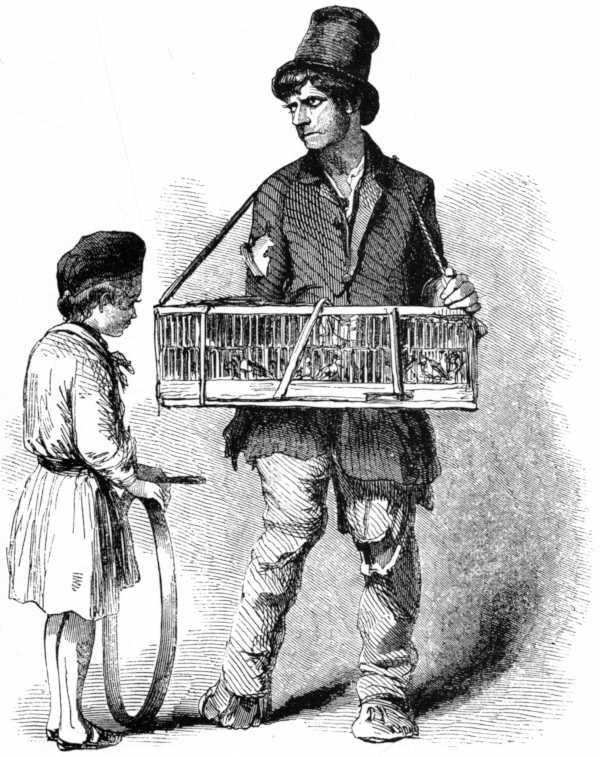
THE CRIPPLED STREET BIRD-SELLER.
[From a Daguerreotype by Beard.]
The poor man’s deformity may be best understood by describing it in his own words: “I have no ancle.” His right leg is emaciated, the bone is smaller than that of his other leg (which is not deformed), and there is no ancle joint. The joints of the wrists and shoulders are also defective, though not utterly wanting, as in the ancle. In walking this poor cripple seems to advance by means of a series of jerks. He uses his deformed leg, but must tread, or rather support his body, on the ball of the misformed foot, while he advances his sound leg; then, with a twist of his body, after he has advanced and stands upon his undeformed leg and foot, he throws forward the crippled part of his frame by the jerk I have spoken of. His arms are usually pressed against his ribs as he walks, and convey to a spectator the notion that he is unable to raise them from that position. This, however, is not the case; he can raise them, not as a sound man does, but with an effort and a contortion of his body to humour the effort. His speech is also defective, his words being brought out, as it were, by jerks; he has to prepare himself, and to throw up his chin, in order to converse, and then he speaks with difficulty. His face is sun-burnt and healthy-looking. His dress was a fustian coat with full skirts, cloth trowsers somewhat patched, and a clean coarse shirt. His right shoe was suited to his deformity, and was strapped with a sort of leather belt round the lower part of the leg.
A considerable number of book-stall keepers, as well as costermongers, swag-barrowmen, ginger-beer and lemonade sellers, orange-women, sweet-stuff vendors, root-sellers, and others, have established their pitches—some of them having stalls with a cover, like a roof—from Whitechapel workhouse to the Mile End turnpike-gate; near the gate they are congregated most thickly, and there they are mixed with persons seated on the forms belonging to adjacent innkeepers, which are placed there to allow any one to have his beer and tobacco in the open air. Among these street-sellers and beer-drinkers is seated the crippled bird-seller, generally motionless.
His home is near the Jews’ burial-ground, and in one of the many “places” which by a misnomer, occasioned by the change in the character and appearance of what were the outskirts, are still called “Pleasant.” On seeking him here, I had some little difficulty in finding the house, and asking a string of men, who were chopping fire-wood in an adjoining court, for the man I wanted, mentioning his name, no one knew anything about him; though when I spoke of his calling, “O,” they said, “you want Old Billy.” I then found Billy at his accustomed pitch, with a very small stock of birds in two large cages on the ground beside him, and he accompanied me to his residence. The room in which we sat had a pile of fire-wood opposite the door; the iron of the upper part of the door-latch being wanting was replaced by a piece of wood—and on the pile sat a tame jackdaw, with the inquisitive and askant look peculiar to the bird. Above the pile was a large cage, containing a jay—a bird seldom sold in the streets now—and a thrush, in different compartments. A table, three chairs, and a hamper or two used in the wood-cutting, completed the furniture. Outside the house were cages containing larks, goldfinches, and a very fine starling, of whose promising abilities the bird-seller’s sister had so favourable an opinion that she intended to try and teach it to talk, although that was very seldom done now.
The following is the statement I obtained from the poor fellow. The man’s sister was present at his desire, as he was afraid I could not understand him, owing to the indistinctness of his speech; but that was easy enough, after awhile, with a little patience and attention.
“I was born a cripple, sir,” he said, “and I shall die one. I was born at Lewisham, but I don’t remember living in any place but London. I remember being at Stroud though, where my father had taken me, and bathed me often in the sea himself, thinking it might do me good. I’ve heard him say, too, that when I was very young he took me to almost every hospital in London, but it was of no use. My father and mother were as kind to me and as good parents as could be. He’s been dead nineteen years, and my mother died before him. Father was very poor, almost as poor as I am. He worked in a brick-field, but work weren’t regular. I couldn’t walk at all until I was six years old, and I was between nine and ten before I could get up and down stairs by myself. I used to slide down before, as well as I could, and had to be carried up. When I could get about and went among other boys, I was in great distress, I was teased so. Life was a burthen to me, as I’ve read something about. They used to taunt me by offering to jump me” (invite him to a jumping match), “and to say, I’ll run you a race on one leg. They were bad to me then, and they are now. I’ve sometimes sat down and cried, but not often. No, sir, I can’t say that I ever wished I was dead. I hardly know why I cried. I suppose because I was miserable. I learned to read at a Sunday school, where I went a long time. I like reading. I read the Bible and tracts, nothing else; never a newspaper. It don’t come in my way, and if it did I shouldn’t look at it, for I can’t read over well and it’s nothing to me who’s king or who’s queen. It can never have anything to do with me. It don’t take my attention. There’ll be no change for me in this world. When I was thirteen my father put me into the bird trade. He knew a good many catchers. I’ve been bird-selling in the streets for six-and-twenty years and more, for I was 39 the 24th of last January. Father didn’t know what better he could put me to, as I hadn’t the right use of my hands or feet, and at first I did very well. I liked the birds and do still. I used to think at first that they was like me; they was prisoners, and I was a cripple. At first I sold birds in Poplar, and Limehouse, and Blackwall, and was a help to my parents, for I cleared 9s. or 10s. every week. But now, oh dear, I don’t know where all the money’s gone to. I think there’s very little left in the country. I’ve sold larks, linnets, and goldfinches, to captains of ships to take to the West Indies. I’ve sold them, too, to go to Port Philip. O, and almost all those foreign parts. They bring foreign birds here, and take back London birds. I don’t know anything about foreign birds. I know there’s men dressed as sailors going about selling them; they’re duffers—I mean the men. There’s a neighbour of mine, that’s very likely never been 20 miles out of London, and when he hawks birds he always dresses like a countryman, and duffs that way.
“When my father died,” continued the man, “I was completely upset; everything in the world was upset. I was forced to go into the workhouse, and I was there between four and five months. O, I hated it. I’d rather live on a penny loaf a day than be in it again. I’ve never been near the parish since, though I’ve often had nothing to eat many a day. I’d rather be lamer than I am, and be oftener called silly Billy—and that sometimes makes me dreadful wild—than be in the workhouse. It was starvation, but then I know I’m a hearty eater, very hearty. Just now I know I could eat a shilling plate of meat, but for all that I very seldom taste meat. I live on bread and butter and tea, sometimes bread without butter. When I have it I eat a quartern loaf at three meals. It depends upon how I’m off. My health’s good. I never feel in any pain now; I did when I first got to walk, in great pain. Beer I often don’t taste once in two or three months, and this very hot weather one can’t help longing for a drop, when you see people drinking it all sides of you, but they have the use of their limbs.” [Here two little girls and a boy rushed into the room, for they had but to open the door from the outside, and, evidently to tease the poor fellow, loudly demanded “a ha’penny bird.” When the sister had driven them away, my informant continued.] “I’m still greatly teased, sir, with children; yes, and with men too, both when they’re drunk and sober. I think grown persons are the worst. They swear and use bad language to me. I’m sure I don’t know why. I know no name they call me by in particular when I’m teased, if it isn’t ‘Old Hypocrite.’ I can’t say why they call me ‘hypocrite.’ I suppose because they know no better. Yes, I think I’m religious, rather. I would be more so, if I had clothes. I get to chapel sometimes.” [A resident near the bird-seller’s pitch, with whom I had some conversation, told me of “Billy” being sometimes teased in the way described. Some years ago, he believed it was at Limehouse, my informant heard a gentlemanly-looking man, tipsy, d—n the street bird-seller for Mr. Hobbler, and bid him go to the Mansion House, or to h—l. I asked the cripple about this, but he had no recollection of it; and, as he evidently did not understand the allusion to Mr. Hobbler, I was not surprised at his forgetfulness.]
“I like to sit out in the sunshine selling my birds,” he said. “If it’s rainy, and I can’t go out, because it would be of no use, I’m moped to death. I stay at home and read a little; or I chop a little fire-wood, but you may be very sure, sir, its little I can do that way. I never associate with the neighbours. I never had any pleasure, such as going to a fair, or like that. I don’t remember having ever spent a penny in a place of amusement in my life. Yes, I’ve often sat all day in the sun, and of course a deal of thoughts goes through my head. I think, shall I be able to afford myself plenty of bread when I get home? And I think of the next world sometimes, and feel quite sure, quite, that I shan’t be a cripple there. Yes, that’s a comfort, for this world will never be any good to me. I feel that I shall be a poor starving cripple, till I end, perhaps, in the workhouse. Other poor men can get married, but not such as me. But I never was in love in my life, never.” [Among the vagrants and beggars, I may observe, there are men more terribly deformed than the bird-seller, who are married, or living in concubinage.] “Yes, sir,” he proceeded, “I’m quite reconciled to my lameness, quite; and have been for years. O, no, I never fret about that now; but about starving, perhaps, and the workhouse.
“Before father died, the parish allowed us 1s. 6d. and a quartern loaf a week; but after he was buried, they’d allow me nothing; they’d only admit me into the house. I hadn’t a penny allowed to me when I discharged myself and came out. I hardly know how ever I did manage to get a start again with the birds. I knew a good many catchers, and they trusted me. Yes, they was all poor men. I did pretty tidy by bits, but only when it was fine weather, until these five years or so, when things got terrible bad. Particularly just the two last years with me. Do you think times are likely to mend, sir, with poor people? If working-men had only money, they’d buy innocent things like birds to amuse them at home; but if they can’t get the money, as I’ve heard them say when they’ve been pricing my stock, why in course they can’t spend it.”
“Yes, indeed,” said the sister, “trade’s very bad. Where my husband and I once earned 18s. at the fire-wood, and then 15s., we can’t now earn 12s. the two of us, slave as hard as we will. I always dread the winter a-coming. Though there may be more fire-wood wanted, there’s greater expenses, and it’s a terrible time for such as us.”
“I dream sometimes, sir,” the cripple resumed in answer to my question, “but not often. I often have more than once dreamed I was starving and dying of hunger. I remember that, for I woke in a tremble. But most dreams is soon forgot. I’ve never seemed to myself to be a cripple in my dreams. Well, I can’t explain how, but I feel as if my limbs was all free like—so beautiful. I dream most about starving I think, than about anything else. Perhaps that’s when I have to go to sleep hungry. I sleep very well, though, take it altogether. If I had only plenty to live upon there would be nobody happier. I’m happy enough when times is middling with me, only one feels it won’t last. I like a joke as well as anybody when times is good; but that’s been very seldom lately.
“It’s all small birds I sell in the street now, except at a very odd time. That jackdaw there, sir, he’s a very fine bird. I’ve tamed him myself, and he’s as tame as a dog. My sister’s a very good hand among birds, and helps me. She once taught a linnet to say ‘Joey’ as plain as you can speak it yourself, sir. I buy birds of different catchers, but haven’t money to buy the better kinds, as I have to sell at 3d., and 4d., and 6d. mostly. If I had a pound to lay out in a few nice cages and good birds, I think I could do middling, this fine weather particler, for I’m a very good judge of birds, and know how to manage them as well as anybody. Then birds is rather dearer to buy than they was when I was first in the trade. The catchers have to go further, and I’m afeared the birds is getting scarcer, and so there’s more time taken up. I buy of several catchers. The last whole day that I was at my pitch I sold nine birds, and took about 3s. If I could buy birds ever so cheap, there’s always such losses by their dying. I’ve had three parts of my young linnets die, do what I might, but not often so many. Then if they die all the food they’ve had is lost. There goes all for nothing the rape and flax-seed for your linnets, canary and flax for your goldfinches, chopped eggs for your nightingales, and German paste for your sky-larks. I’ve made my own German paste when I’ve wanted a sufficient quantity. It’s made of pea-meal, treacle, hog’s-lard, and moss-seed. I sell more goldfinches than anything else. I used to sell a good many sparrows for shooting, but I haven’t done anything that way these eight or nine years. It’s a fash’nable sport still, I hear. I’ve reared nightingales that sung beautiful, and have sold them at 4s. a piece, which was very cheap. They often die when the time for their departure comes. A shopkeeper as supplied such as I’ve sold would have charged 1l. a piece for them. One of my favouritest birds is redpoles, but they’re only sold in the season. I think it’s one of the most knowingest little birds that is; more knowing than the goldfinch, in my opinion.
“My customers are all working people, all of them. I sell to nobody else; I make 4s. or 5s.; I call 5s. a good week at this time of year, when the weather suits. I lodge with a married sister; her husband’s a wood-chopper, and I pay 1s. 6d. a week, which is cheap, for I’ve no sticks of my own. If I earn 4s. there’s only 2s. 6d. left to live on the week through. In winter, when I can make next to nothing, and must keep my birds, it is terrible—oh yes, sir, if you believe me, terrible!”
Of the Tricks of the Bird-Duffers.
The tricks practised by the bird-sellers are frequent and systematic. The other day a man connected with the bird-trade had to visit Holloway, the City, and Bermondsey. In Holloway he saw six men, some of whom he recognised as regular bird-catchers and street-sellers, offering sham birds; in the City he found twelve; and in Bermondsey six, as well as he could depend upon his memory. These, he thought, did not constitute more than a half of the number now at work as bird-“duffers,” not including the sellers of foreign birds. In the summer, indeed, the duffers are most numerous, for birds are cheapest then, and these tricksters, to economise time, I presume, buy of other catchers any cheap hens suited to their purpose. Some of them, I am told, never catch their birds at all, but purchase them.
The greenfinch is the bird on which these men’s art is most commonly practised, its light-coloured plumage suiting it to their purposes. I have heard these people styled “bird-swindlers,” but by street-traders I heard them called “bird-duffers,” yet there appears to be no very distinctive name for them. They are nearly all men, as is the case in the bird trade generally, although the wives may occasionally assist in the street-sale. The means of deception, as regards the greenfinch especially, are from paint. One aim of these artists is to make their finch resemble some curious foreign bird, “not often to be sold so cheap, or to be sold at all in this country.” They study the birds in the window of the naturalists’ shops for this purpose. Sometimes they declare these painted birds are young Java sparrows (at one time “a fashionable bird”), or St. Helena birds, or French or Italian finches. They sometimes get 5s. for such a “duffing bird;” one man has been known to boast that he once got a sovereign. I am told, however, by a bird-catcher who had himself supplied birds to these men for duffing, that they complained of the trade growing worse and worse.
It is usually a hen which is painted, for the hen is by far the cheapest purchase, and while the poor thing is being offered for sale by the duffers, she has an unlimited supply of hemp-seed, without other food, and hemp-seed beyond a proper quantity, is a very strong stimulus. This makes the hen look brisk and bold, but if newly caught, as is usually the case, she will perhaps be found dead next morning. The duffer will object to his bird being handled on account of its timidity; “but it is timid only with strangers!” “When you’ve had him a week, ma’am,” such a bird-seller will say, “you’ll find him as lovesome and tame as can be.” One jealous lady, when asked 5s. for a “very fine Italian finch, an excellent singer,” refused to buy, but offered a deposit of 2s. 6d., if the man would leave his bird and cage, for the trial of the bird’s song, for two or three days. The duffer agreed; and was bold enough to call on the third day to hear the result. The bird was dead, and after murmuring a little at the lady’s mismanagement, and at the loss he had been subjected to, the man brought away his cage. He boasted of this to a dealer’s assistant who mentioned it to me, and expressed his conviction that it was true enough. The paints used for the transformation of native birds into foreign are bought at the colour-shops, and applied with camel-hair brushes in the usual way.
When canaries are “a bad colour,” or have grown a paler yellow from age, they are re-dyed, by the application of a colour sold at the colour-shops, and known as “the Queen’s yellow.” Blackbirds are dyed a deeper black, the “grit” off a frying-pan being used for the purpose. The same thing is done to heighten the gloss and blackness of a jackdaw, I was told, by a man who acknowledged he had duffed a little; “people liked a gay bright colour.” In the same way the tints of the goldfinch are heightened by the application of paint. It is common enough, moreover, for a man to paint the beaks and legs of the birds. It is chiefly the smaller birds which are thus made the means of cheating.
Almost all the “duffing birds” are hawked. If a young hen be passed off for a good singing bird, without being painted, as a cock in his second singing year, she is “brisked up” with hemp-seed, is half tipsy in fact, and so passed off deceitfully. As it is very rarely that even the male birds will sing in the streets, this is often a successful ruse, the bird appearing so lively.
A dealer calculated for me, from his own knowledge, that 2000 small birds were “duffed” yearly, at an average of from 2s. 6d. to 3s. each.
As yet I have only spoken of the “duffing” of English birds, but similar tricks are practised with the foreign birds.
In parrot-selling there is a good deal of “duffing.” The birds are “painted up,” as I have described in the case of the greenfinches, &c. Varnish is also used to render the colours brighter; the legs and beak are frequently varnished. Sometimes a spot of red is introduced, for as one of these duffers observed to a dealer in English birds, “the more outlandish you make them look, the better’s the chance to sell.” Sometimes there is little injury done by this paint and varnish, which disappear gradually when the parrot is in the cage of a purchaser; but in some instances when the bird picks himself where he has been painted, he dies from the deleterious compound. Of this mortality, however, there is nothing approaching that among the duffed small birds.
Occasionally the duffers carry really fine cockatoos, &c., and if they can obtain admittance into a lady’s house, to display the beauty of the bird, they will pretend to be in possession of smuggled silk, &c., made of course for duffing purposes. The bird-duffers are usually dressed as seamen, and sometimes pretend they must sell the bird before the ship sails, for a parting spree, or to get the poor thing a good home. This trade, however, has from all that I can learn, and in the words of an informant, “seen its best days.” There are now sometimes six men thus engaged; sometimes none: and when one of these men is “hard up,” he finds it difficult to start again in a business for which a capital of about 1l. is necessary, as a cage is wanted generally. The duffers buy the very lowest priced birds, and have been known to get 2l. 10s. for what cost but 8s., but that is a very rare occurrence, and the men are very poor, and perhaps more dissipated than the generality of street-sellers. Parrot duffing, moreover, is seldom carried on regularly by any one, for he will often duff cigars and other things in preference, or perhaps vend really smuggled and good cigars or tobacco. Perhaps 150 parrots, paroquets, or cockatoos, are sold in this way annually, at from 15s. to 1l. 10s. each, but hardly averaging 1l., as the duffer will sell, or raffle, the bird for a small sum if he cannot dispose of it otherwise.
Of the Street-Sellers of Foreign Birds.
This trade is curious, but far from extensive as regards street-sale. There is, moreover, contrary to what might be expected, a good deal of “duffing” about it. The “duffer” in English birds disguises them so that they shall look like foreigners; the duffer in what are unquestionably foreign birds disguises them that they may look more foreign—more Indian than in the Indies.
The word “Duffer,” I may mention, appears to be connected with the German Durffen, to want, to be needy, and so to mean literally a needy or indigent man, even as the word Pedlar has the same origin—being derived from the German Bettler, and the Dutch Bedelaar—a beggar. The verb Durffen, means also to dare, to be so bold as to do; hence, to Durff, or Duff, would signify to resort to any impudent trick.
The supply of parrots, paroquets, cockatoos, Java sparrows, or St. Helena birds, is not in the regular way of consignment from a merchant abroad to one in London. The commanders and mates of merchant vessels bring over large quantities; and often enough the seamen are allowed to bring parrots or cockatoos in the homeward-bound ship from the Indies or the African coast, or from other tropical countries, either to beguile the tedium of the voyage, for presents to their friends, or, as in some cases, for sale on their reaching an English port. More, I am assured, although statistics are hardly possible on such a subject, are brought to London, and perhaps by one-third, than to all the other ports of Great Britain collectively. Even on board the vessels of the royal navy, the importation of parrots used to be allowed as a sort of boon to the seamen. I was told by an old naval officer that once, after a long detention on the west coast of Africa, his ship was ordered home, and, as an acknowledgment of the good behaviour of his men, he permitted them to bring parrots, cockatoos, or any foreign birds, home with them, not limiting the number, but of course under the inspection of the petty officers, that there might be no violation of the cleanliness which always distinguishes a vessel of war. Along the African coast, to the southward of Sierra Leone, the men were not allowed to land, both on account of the unhealthiness of the shores, and of the surf, which rendered landing highly dangerous, a danger, however, which the seamen would not have scrupled to brave, and recklessly enough, for any impulse of the minute. As if by instinct, however, the natives seemed to know what was wanted, for they came off from the shores in their light canoes, which danced like feathers on the surf, and brought boat-loads of birds; these the seamen bought of them, or possessed themselves of in the way of barter.
Before the ship took her final departure, however, she was reported as utterly uninhabitable below, from the incessant din and clamour: “We might as well have a pack of women aboard, sir,” was the ungallant remark of one of the petty officers to his commander. Orders were then given that the parrots, &c., should be “thinned,” so that there might not be such an unceasing noise. This was accordingly done. How many were set at liberty and made for the shore—for the seamen in this instance did not kill them for their skins, as is not unfrequently the case—the commander did not know. He could but conjecture; and he conjectured that something like a thousand were released; and even after that, and after the mortality which takes place among these birds in the course of a long voyage, a very great number were brought to Plymouth. Of these, again, a great number were sent or conveyed under the care of the sailors to London, when the ship was paid off. The same officer endeavoured on this voyage to bring home some very large pine-apples, which flavoured, and most deliciously, parts of the ship when she had been a long time at sea; but every one of them rotted, and had to be thrown overboard. He fell into the error, Captain —— said, of having the finest fruit selected for the experiment; an error which the Bahama merchants had avoided, and consequently they succeeded where he failed. How the sailors fed the parrots, my informant could hardly guess, but they brought a number of very fine birds to England, some of them with well-cultivated powers of speech.
This, as I shall show, is one of the ways by which the London supply of parrots, &c., is obtained; but the permission, as to the importation of these brightly-feathered birds, is, I understand, rarely allowed at present to the seamen in the royal navy. The far greater supply, indeed more than 90 per cent. of the whole of the birds imported, is from the merchant-service. I have already stated, on the very best authority, the motives which induce merchant-seamen to bring over parrots and cockatoos. That to bring them over is an inducement to some to engage in an African voyage is shown by the following statement, which was made to me, in the course of a long inquiry, published in my letters in the Morning Chronicle, concerning the condition of the merchant-seamen.
“I would never go to that African coast again, only I make a pound or two in birds. We buy parrots, gray parrots chiefly, of the natives, who come aboard in their canoes. We sometimes pay 6s. or 7s., in Africa, for a fine bird. I have known 200 parrots on board; they make a precious noise; but half the birds die before they get to England. Some captains won’t allow parrots.”
When the seamen have settled themselves after landing in England, they perhaps find that there is no room in their boarding-houses for their parrots; these birds are not admitted into the Sailors’ Home; the seamen’s friends are stocked with the birds, and look upon another parrot as but another intruder, an unwelcome pensioner. There remains but one course—to sell the birds, and they are generally sold to a highly respectable man, Mr. M. Samuel, of Upper East Smithfield; and it is from him, though not always directly, that the shopkeepers and street-sellers derive their stock-in-trade. There is also a further motive for the disposal of parrots, paroquets, and cockatoos to a merchant. The seafaring owner of those really magnificent birds, perhaps, squanders his money, perhaps he gets “skinned” (stripped of his clothes and money from being hocussed, or tempted to helpless drunkenness), or he chooses to sell them, and he or his boarding-house keeper takes the birds to Mr. Samuel, and sells them for what he can get; but I heard from three very intelligent seamen whom I met with in the course of my inquiry, and by mere chance, that Mr. Samuel’s price was fair and his money sure, considering everything, for there is usually a qualification to every praise. It is certainly surprising, under these circumstances, that such numbers of these birds should thus be disposed of.
Parrots are as gladly, or more gladly, got rid of, in any manner, in different regions in the continents of Asia and America, than with us are even rats from a granary. Dr. Stanley, after speaking of the beauty of a flight of parrots, says:—“The husbandman who sees them hastening through the air, with loud and impatient screams, looks upon them with dismay and detestation, knowing that the produce of his labour and industry is in jeopardy, when visited by such a voracious multitude of pilferers, who, like the locusts of Egypt, desolate whole tracts of country by their unsparing ravages.” A contrast with their harmlessness, in a gilded cage in the houses of the wealthy, with us! The destructiveness of these birds, is then, one reason why seamen can obtain them so readily and cheaply, for the natives take pleasure in catching them; while as to plentifulness, the tropical regions teem with bird, as with insect and reptile, life.
Of parrots, paroquets, and cockatoos, there are 3000 imported to London in the way I have described, and in about equal proportions. They are sold, wholesale, from 5s. to 30s. each.
There are now only three men selling these brilliant birds regularly in the streets, and in the fair way of trade; but there are sometimes as many as 18 so engaged. The price given by a hawker for a cockatoo, &c., is 8s. or 10s., and they are retailed at from 15s. to 30s., or more, “if it can be got.” The purchasers are the wealthier classes who can afford to indulge their tastes. Of late years, however, I am told, a parrot or a cockatoo seems to be considered indispensable to an inn (not a gin-palace), and the innkeepers have been among the best customers of the street parrot-sellers. In the neighbourhood of the docks, and indeed along the whole river side below London-bridge, it is almost impossible for a street-seller to dispose of a parrot to an innkeeper, or indeed to any one, as they are supplied by the seamen. A parrot which has been taught to talk is worth from 4l. to 10l., according to its proficiency in speech. About 500 of these birds are sold yearly by the street-hawkers, at an outlay to the public of from 500l. to 600l.
Java sparrows, from the East Indies, and from the Islands of the Archipelago, are brought to London, but considerable quantities die during the voyage and in this country; for, though hardy enough, not more than one in three survives being “taken off the paddy seed.” About 10,000, however, are sold annually, in London, at 1s. 6d. each, but a very small proportion by street-hawking, as the Java sparrows are chiefly in demand for the aviaries of the rich in town and country. In some years not above 100 may be sold in the streets; in others, as many as 500.
In St. Helena birds, known also as wax-bills and red-backs, there is a trade to the same extent, both as regards number and price; but the street-sale is perhaps 10 per cent. lower.
Of the Street-Sellers of Birds’-Nests.
The young gypsy-looking lad, who gave me the following account of the sale of birds’-nests in the streets, was peculiarly picturesque in his appearance. He wore a dirty-looking smock-frock with large pockets at the side; he had no shirt; and his long black hair hung in curls about him, contrasting strongly with his bare white neck and chest. The broad-brimmed brown Italian-looking hat, broken in and ragged at the top, threw a dark half-mask-like shadow over the upper part of his face. His feet were bare and black with mud: he carried in one hand his basket of nests, dotted with their many-coloured eggs; in the other he held a live snake, that writhed and twisted as its metallic-looking skin glistened in the sun; now over, and now round, the thick knotty bough of a tree that he used for a stick. The portrait of the youth is here given. I have never seen so picturesque a specimen of the English nomads. He said, in answer to my inquiries:—
“I am a seller of birds’-nesties, snakes, slow-worms, adders, ‘effets’—lizards is their common name—hedgehogs (for killing black beetles); frogs (for the French—they eats ’em); snails (for birds); that’s all I sell in the summer-time. In the winter I get all kinds of wild flowers and roots, primroses, ‘butter-cups’ and daisies, and snow-drops, and ‘backing’ off of trees; (‘backing’ it’s called, because it’s used to put at the back of nosegays, it’s got off the yew trees, and is the green yew fern). I gather bulrushes in the summer-time, besides what I told you; some buys bulrushes for stuffing; they’re the fairy rushes the small ones, and the big ones is bulrushes. The small ones is used for ‘stuffing,’ that is, for showing off the birds as is stuffed, and make ’em seem as if they was alive in their cases, and among the rushes; I sell them to the bird-stuffers at 1d. a dozen. The big rushes the boys buys to play with and beat one another—on a Sunday evening mostly. The birds’-nesties I get from 1d. to 3d. a-piece for. I never have young birds, I can never sell ’em; you see the young things generally dies of the cramp before you can get rid of them. I sell the birds’-nesties in the streets; the threepenny ones has six eggs, a half-penny a egg. The linnets has mostly four eggs, they’re 4d. the nest; they’re for putting under canaries, and being hatched by them. The thrushes has from four to five—five is the most; they’re 2d.; they’re merely for cur’osity—glass cases or anything like that. Moor-hens, wot build on the moors, has from eight to nine eggs, and is 1d. a-piece; they’re for hatching underneath a bantam-fowl, the same as partridges. Chaffinches has five eggs; they’re 3d., and is for cur’osity. Hedge-sparrows, five eggs; they’re the same price as the other, and is for cur’osity. The Bottletit—the nest and the bough are always put in glass cases; it’s a long hanging nest, like a bottle, with a hole about as big as a sixpence, and there’s mostly as many as eighteen eggs; they’ve been known to lay thirty-three. To the house-sparrow there is five eggs; they’re 1d. The yellow-hammers, with five eggs, is 2d. The water-wagtails, with four eggs, 2d. Blackbirds, with five eggs, 2d. The golden-crest wren, with ten eggs—it has a very handsome nest—is 6d. Bulfinches, four eggs, 1s.; they’re for hatching, and the bulfinch is a very dear bird. Crows, four eggs, 4d. Magpies, four eggs, 4d. Starlings, five eggs, 3d. The egg-chats, five eggs, 2d. Goldfinches, five eggs, 6d., for hatching. Martins, five eggs, 3d. The swallow, four eggs, 6d.; it’s so dear because the nest is such a cur’osity, they build up again the house. The butcher-birds—hedge-murderers some calls them, for the number of birds they kills—five eggs, 3d. The cuckoo—they never has a nest, but lays in the hedge-sparrow’s; there’s only one egg (it’s very rare you see the two, they has been got, but that’s seldom) that is 4d., the egg is such a cur’osity. The greenfinches has four or five eggs, and is 3d. The sparrer-hawk has four eggs, and they’re 6d. The reed-sparrow—they builds in the reeds close where the bulrushes grow; they has four eggs, and is 2d. The wood-pigeon has two eggs, and they’re 4d. The horned owl, four eggs; they’re 6d. The woodpecker—I never see no more nor two—they’re 6d. the two; they’re a great cur’osity, very seldom found. The kingfishers has four eggs, and is 6d. That’s all I know of.
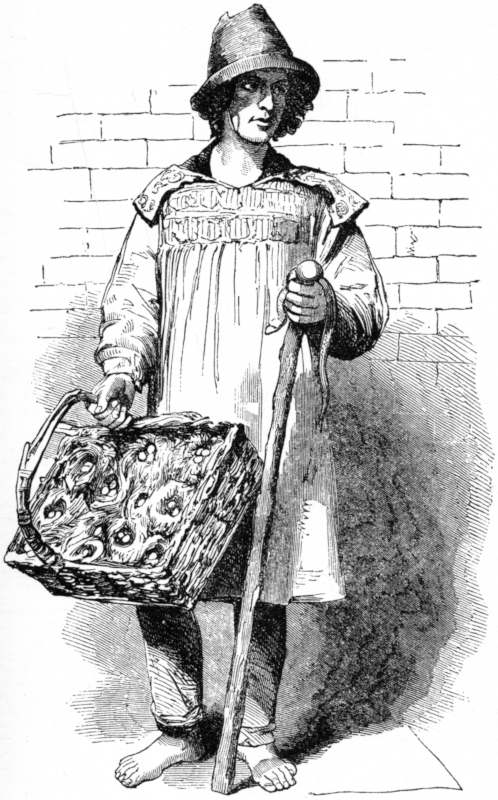
STREET-SELLER OF BIRDS’ NESTS.
“I gets the eggs mostly from Witham and Chelmsford, in Essex; Chelmsford is 20 mile from Whitechapel Church, and Witham, 8 mile further. I know more about them parts than anywhere else, being used to go after moss for Mr. Butler, of the herb-shop in Covent Garden. Sometimes I go to Shirley Common and Shirley Wood, that’s three miles from Croydon, and Croydon is ten from Westminster-bridge. When I’m out bird-nesting I take all the cross country roads across fields and into the woods. I begin bird-nesting in May and leave off about August, and then comes the bulrushing, and they last till Christmas; and after that comes the roots and wild flowers, which serves me up to May again. I go out bird-nesting three times a week. I go away at night, and come up on the morning of the day after. I’m away a day and two nights. I start between one and two in the morning and walk all night—for the coolness—you see the weather’s so hot you can’t do it in the daytime. When I get down I go to sleep for a couple of hours. I ‘skipper it’—turn in under a hedge or anywhere. I get down about nine in the morning, at Chelmsford, and about one if I go to Witham. After I’ve had my sleep I start off to get my nests and things. I climb the trees, often I go up a dozen in the day, and many a time there’s nothing in the nest when I get up. I only fell once; I got on the end of the bough and slipped off. I p’isoned my foot once with the stagnant water going after the bulrushes,—there was horseleeches, and effets, and all kinds of things in the water, and they stung me, I think. I couldn’t use my foot hardly for six weeks afterwards, and was obliged to have a stick to walk with. I couldn’t get about at all for four days, and should have starved if it hadn’t been that a young man kept me. He was a printer by trade, and almost a stranger to me, only he seed me and took pity on me. When I fell off the bough I wasn’t much hurt, nothing to speak of. The house-sparrow is the worst nest of all to take; it’s no value either when it is got, and is the most difficult of all to get at. You has to get up a sparapet (a parapet) of a house, and either to get permission, or run the risk of going after it without. Partridges’ eggs (they has no nest) they gives you six months for, if they see you selling them, because it’s game, and I haven’t no licence; but while you’re hawking, that is showing ’em, they can’t touch you. The owl is a very difficult nest to get, they builds so high in the trees. The bottle-tit is a hard nest to find; you may go all the year round, and, perhaps, only get one. The nest I like best to get is the chaffinch, because they’re in the hedge, and is no bother. Oh, you hasn’t got the skylark down, sir; they builds on the ground, and has five eggs; I sell them for 4d. The robin-redbreast has five eggs, too, and is 3d. The ringdove has two eggs, and is 6d. The tit-lark—that’s five blue eggs, and very rare—I get 4d. for them. The jay has five eggs, and a flat nest, very wiry, indeed; it’s a ground bird; that’s 1s.—the egg is just like a partridge egg. When I first took a kingfisher’s nest, I didn’t know the name of it, and I kept wondering what it was. I daresay I asked three dozen people, and none of them could tell me. At last a bird-fancier, the lame man at the Mile-end gate, told me what it was. I likes to get the nesties to sell, but I havn’t no fancy for birds. Sometimes I get squirrels’ nesties with the young in ’em—about four of ’em there mostly is, and they’re the only young things I take—the young birds I leaves; they’re no good to me. The four squirrels brings me from 6s. to 8s. After I takes a bird’s nest, the old bird comes dancing over it, chirupping, and crying, and flying all about. When they lose their nest they wander about, and don’t know where to go. Oftentimes I wouldn’t take them if it wasn’t for the want of the victuals, it seems such a pity to disturb ’em after they’ve made their little bits of places. Bats I never take myself—I can’t get over ’em. If I has an order for ’em, I buys ’em of boys.
“I mostly start off into the country on Monday and come up on Wednesday. The most nesties as ever I took is twenty-two, and I generally get about twelve or thirteen. These, if I’ve an order, I sell directly, or else I may be two days, and sometimes longer, hawking them in the street. Directly I’ve sold them I go off again that night, if it’s fine; though I often go in the wet, and then I borrow a tarpaulin of a man in the street where I live. If I’ve a quick sale I get down and back three times in a week, but then I don’t go so far as Witham, sometimes only to Rumford; that is 12 miles from Whitechapel Church. I never got an order from a bird-fancier; they gets all the eggs they want of the countrymen who comes up to market.
“It’s gentlemen I gets my orders of, and then mostly they tells me to bring ’em one nest of every kind I can get hold of, and that will often last me three months in the summer. There’s one gentleman as I sells to is a wholesale dealer in window-glass—and he has a hobby for them. He puts ’em into glass cases, and makes presents of ’em to his friends. He has been one of my best customers. I’ve sold him a hundred nesties, I’m sure. There’s a doctor at Dalston I sell a great number to—he’s taking one of every kind of me now. The most of my customers is stray ones in the streets. They’re generally boys. I sells a nest now and then to a lady with a child; but the boys of twelve to fifteen years of age is my best friends. They buy ’em only for cur’osity. I sold three partridges’ eggs yesterday to a gentleman, and he said he would put them under a bantam he’d got, and hatch ’em.
“The snakes, and adders, and slow-worms I get from where there’s moss or a deal of grass. Sunny weather’s the best for them, they won’t come out when it’s cold; then I go to a dung-heap, and turn it over. Sometimes, I find five or six there, but never so large as the one I had to-day, that’s a yard and five inches long, and three-quarters of a pound weight. Snakes is 5s. a pound. I sell all I can get to Mr. Butler, of Covent-garden. He keeps ’em alive, for they’re no good dead. I think it’s for the skin they’re kept. Some buys ’em to dissect: a gentleman in Theobalds-road does so, and so he does hedgehogs. Some buys ’em for stuffing, and others for cur’osities. Adders is the same price as snakes, 5s. a pound after they first comes in, when they’re 10s. Adders is wanted dead; it’s only the fat and skin that’s of any value; the fat is used for curing p’isoned wounds, and the skin is used for any one as has cut their heads. Farmers buys the fat, and rubs it into the wound when they gets bitten or stung by anything p’isonous. I kill the adders with a stick, or, when I has shoes, I jumps on ’em. Some fine days I get four or five snakes at a time; but then they’re mostly small, and won’t weigh above half a pound. I don’t get many adders—they don’t weigh many ounces, adders don’t—and I mostly has 9d. a-piece for each I gets. I sells them to Mr. Butler as well.
“The hedgehogs is 1s. each; I gets them mostly in Essex. I’ve took one hedgehog with three young ones, and sold the lot for 2s. 6d. People in the streets bought them of me—they’re wanted to kill the black-beetles; they’re fed on bread and milk, and they’ll suck a cow quite dry in their wild state. They eat adders, and can’t be p’isoned, at least it says so in a book I’ve got about ’em at home.
“The effets I gets orders for in the streets. Gentlemen gives me their cards, and tells me to bring them one; they’re 2d. apiece. I get them at Hampstead and Highgate, from the ponds. They’re wanted for cur’osity.
“The snails and frogs I sell to Frenchmen. I don’t know what part they eat of the frog, but I know they buy them, and the dandelion root. The frogs is 6d. and 1s. a dozen. They like the yellow-bellied ones, the others they’re afraid is toads. They always pick out the yellow-bellied first; I don’t know how to feed ’em, or else I might fatten them. Many people swallows young frogs, they’re reckoned very good things to clear the inside. The frogs I catch in ponds and ditches up at Hampstead and Highgate, but I only get them when I’ve a order. I’ve had a order for as many as six dozen, but that was for the French hotel in Leicester-square; but I have sold three dozen a week to one man, a Frenchman, as keeps a cigar shop in R—r’s-court.
“The snails I sell by the pailful—at 2s. 6d. the pail. There is some hundreds in a pail. The wet weather is the best times for catching ’em; the French people eats ’em. They boils ’em first to get ’em out of the shell and get rid of the green froth; then they boils them again, and after that in vinegar. They eats ’em hot, but some of the foreigners likes ’em cold. They say they’re better, if possible, than whelks. I used to sell a great many to a lady and gentleman in Soho-square, and to many of the French I sell 1s.’s worth, that’s about three or four quarts. Some persons buys snails for birds, and some to strengthen a sickly child’s back; they rub the back all over with the snails, and a very good thing they tell me it is. I used to take 2s.’s worth a week to one woman; it’s the green froth that does the greatest good. There are two more birds’-nest sellers besides myself, they don’t do as many as me the two of ’em. They’re very naked, their things is all to ribbins; they only go into the country once in a fortnight. They was never nothing, no trade—they never was in place—from what I’ve heard—either of them. I reckon I sell about 20 nesties a week take one week with another, and that I do for four months in the year. (This altogether makes 320 nests.) Yes, I should say, I do sell about 300 birds’-nests every year, and the other two, I’m sure, don’t sell half that. Indeed they don’t want to sell; they does better by what they gets give to them. I can’t say what they takes, they’re Irish, and I never was in conversation with them. I get about 4s. to 5s. for the 20 nests, that’s between 2d. and 3d. apiece. I sell about a couple of snakes every week, and for some of them I get 1s., and for the big ones 2s. 6d.; but them I seldom find. I’ve only had three hedgehogs this season, and I’ve done a little in snails and frogs, perhaps about 1s. The many foreigners in London this season hasn’t done me no good. I haven’t been to Leicester-square lately, or perhaps I might have got a large order or two for frogs.”
Life of a Bird’s-Nest Seller.
“I am 22 years of age. My father was a dyer, and I was brought up to the same trade. My father lived at Arundel, in Sussex, and kept a shop there. He had a good business as dyer, scourer, calico glazer, and furniture cleaner. I have heard mother say his business in Arundel brought him in 300l. a year at least. He had eight men in his employ, and none under 30s. a week. I had two brothers and one sister, but one of my brothers is since dead. Mother died five years ago in the Consumption Hospital, at Chelsea, just after it was built. I was very young indeed when father died; I can hardly remember him. He died in Middlesex Hospital: he had abscesses all over him; there were six-and-thirty at the time of his death. I’ve heard mother say many times that she thinked it was through exerting himself too much at his business that he fell ill. The ruin of father was owing to his house being burnt down; the fire broke out at two in the morning; he wasn’t insured: I don’t remember the fire; I’ve only heerd mother talk about it. It was the ruin of us all she used to tell me; father had so much work belonging to other people; a deal of moreen curtains, five or six hundred yards. It was of no use his trying to start again: he lost all his glazing machines and tubs, and his drugs and ‘punches.’ From what I’ve heerd from mother they was worth some hundreds. The Duke of Norfolk, after the fire, gave a good lot of money to the poor people whose things father had to clean, and father himself came up to London. I wasn’t two year old when that happened. We all come up with father, and he opened a shop in London and bought all new things. He had got a bit of money left, and mother’s uncle lent him 60l. We lived two doors from the stage door of the Queen’s Theatre, in Pitt-street, Charlotte-street, Fitzroy-square; but father didn’t do much in London; he had a new connection to make, and when he died his things was sold for the rent of the house. There was only money enough to bury him. I don’t know how long ago that was, but I think it was about three years after our coming to London, for I’ve heerd mother say I was six years old when father died. After father’s death mother borrowed some more money of her uncle, who was well to do. He was perfumer to her Majesty: he’s dead now, and left the business to his foreman. The business was worth 2000l. His wife, my mother’s aunt, is alive still, and though she’s a woman of large property, she won’t so much as look at me. She keeps her carriage and two footmen; her address is, Mrs. Lewis, No. 10, Porchester-terrace, Bayswater. I have been in her drawing-room two or three times. I used to take letters to her from mother: she was very kind to me then, and give me several half-crowns. She knows the state I am in now. A young man wrote a letter to her, saying I had no clothes to look after work in, and that I was near starving, but she sent no answer to it. The last time I called at her house she sent me down nothing, and bid the servant tell me not to come any more. Ever since I’ve wanted it I’ve never had nothing from her, but before that she used to give me something whenever I took a letter from mother to her. The last half-crown I got at her house was from the cook, who gave it me out of her own money because she’d known my mother.
“I’ve got a grandmother living in Woburn-place; she’s in service there, and been in the family for twenty years. The gentleman died lately and left her half his property. He was a foreigner and had no relations here. My grandmother used to be very good to me, and when I first got out of work she always gave me something when I called, and had me down in her room. She was housekeeper then. She never offered to get me a situation, but only gave me a meal of victuals and a shilling or eighteen-pence whenever I called. I was tidy in my dress then. At last a new footman came, and he told me as I wasn’t to call again; he said, the family didn’t allow no followers. I’ve never seen my grandmother since that time but once, and then I was passing with my basket of birds’ nests in my hand just as she was coming out of the door. I was dressed about the same then as you seed me yesterday. I was without a shirt to my back. I don’t think she saw me, and I was ashamed to let her see me as I was. She was kind enough to me, that is, she wouldn’t mind about giving me a shilling or so at a time, but she never would do nothing else for me, and yet she had got plenty of money in the bank, and a gold watch, and all, at her side.
“After father died, as I was saying, mother got some money from her uncle and set up on her own account; she took in glazing for the trade. Father had a few shops that he worked for, and they employed mother after his death. She kept on at this for eighteen months and then she got married again. Before this an uncle of mine, my father’s brother, who kept some lime-kilns down in Bury St. Edmunds, consented to take my brother and sister and provide for them, and four or five year ago he got them both into the Duke of Norfolk’s service, and there they are now. They’ve never seen me since I was a child but once, and that was a few year ago. I’ve never sent to them to say how badly I was off. They’re younger than I am, and can only just take care of theirselves. When mother married again, her husband came to live at the house; he was a dyer. He behaved very well to me. Mother wouldn’t send me down to uncle’s, she was too fond of me. I was sent to school for about eighteen months, and after that I used to assist in the glazing at home, and so I went on very comfortable for some time. Nine year ago I went to work at a French dyer’s, in Rathbone-place. My step-father got me there, and there I stopped six year. I lived in the house after the first eighteen months of my service. Five year ago mother fell ill; she had been ailing many years, and she got admitted into the Consumption Hospital, at Brompton. She was there just upon three months and was coming out the next day (her term was up), when she died on the over night. After that my step-father altered very much towards me. He didn’t want me at home at all. He told me so a fortnight after mother was in her grave. He took to drinking very hearty directly she was gone. He would do anything for me before that. He used to take me with him to every place of amusement what he went to, but when he took to drinking he quite changed; then he got to beat me, and at last he told me I needn’t come there any more.
“After that, I still kept working in Rathbone-place, and got a lodging of my own; I used to have 9s. a week where I was, and I paid 2s. a week for my bed, and washing, and mending. I had half a room with a man and his wife; I went on so for about two years, and then I was took bad with the scarlet fever and went to Gray’s-inn-lane hospital. After I was cured of the scarlet fever, I had the brain fever, and was near my death; I was altogether eight weeks in the hospital, and when I come out I could get no work where I had been before. The master’s nephew had come from Paris, and they had all French hands in the house. He wouldn’t employ an English hand at all. He give me a trifle of money, and told me he would pay my lodgings for a week or two while I looked for work. I sought all about and couldn’t find any; this was about three year ago. People wouldn’t have me because I didn’t know nothing about the English mode of business. I couldn’t even tell the names of the English drugs, having been brought up in a French house. At last, my master got tired of paying for my lodging, and I used to try and pick up a few pence in the streets by carrying boxes and holding horses, it was all as I could get to do; I tried all I could to find employment, and they was the only jobs I could get. But I couldn’t make enough for my lodging this way, and over and over again I’ve had to sleep out. Then I used to walk the streets most of the night, or lie about in the markets till morning came in the hopes of getting a job. I’m a very little eater, and perhaps that’s the luckiest thing for such as me; half a pound of bread and a few potatoes will do me for the day. If I could afford it, I used to get a ha’porth of coffee and a ha’porth of sugar, and make it do twice. Sometimes I used to have victuals give to me, sometimes I went without altogether; and sometimes I couldn’t eat. I can’t always.
“Six weeks after I had been knocking about in the streets in the manner I’ve told you, a man I met in Covent-Garden market told me he was going into the country to get some roots (it was in the winter time and cold indeed; I was dressed about the same as I am now, only I had a pair of boots); and he said if I chose to go with him, he’d give me half of whatever he earned. I went to Croydon and got some primroses; my share came to 9d., and that was quite a God-send to me, after getting nothing. Sometimes before that I’d been two days without tasting anything; and when I got some victuals after that, I couldn’t touch them. All I felt was giddy; I wasn’t to say hungry, only weak and sicklified. I went with this man after the roots two or three times; he took me to oblige me, and show me the way how to get a bit of food for myself; after that, when I got to know all about it, I went to get roots on my own account. I never felt a wish to take nothing when I was very hard up. Sometimes when I got cold and was tired, walking about and weak from not having had nothing to eat, I used to think I’d break a window and take something out to get locked up; but I could never make my mind up to it; they never hurt me, I’d say to myself. I do fancy though, if anybody had refused me a bit of bread, I should have done something again them, but I couldn’t, do you see, in cold blood like.
“When the summer came round a gentleman whom I seed in the market asked me if I’d get him half a dozen nesties—he didn’t mind what they was, so long as they was small, and of different kinds—and as I’d come across a many in my trips after the flowers, I told him I would do so—and that first put it into my head; and I’ve been doing that every summer since then. It’s poor work, though, at the best. Often and often I have to walk 30 miles out without any victuals to take with me, or money to get any, and 30 miles again back, and bring with me about a dozen nesties; and, perhaps, if I’d no order for them, and was forced to sell them to the boys, I shouldn’t get more than a shilling for the lot after all. When the time comes round for it, I go Christmasing and getting holly, but that’s more dangerous work than bird-nesting; the farmers don’t mind your taking the nesties, as it prevents the young birds from growing up and eating their corn. The greater part of the holly used in London for trimming up the churches and sticking in the puddings, is stolen by such as me, at the risk of getting six months for it. The farmers brings a good lot to market, but we is obligated to steal it. Take one week with another, I’m sure I don’t make above 5s. You can tell that to look at me. I don’t drink, and I don’t gamble; so you can judge how much I get when I’ve had to pawn my shirt for a meal. All last week I only sold two nesties—they was a partridge’s and a yellow-hammer’s; for one I got 6d., and the other 3d., and I had been thirteen miles to get them. I got beside that a fourpenny piece for some chickweed which I’d been up to Highgate to gather for a man with a bad leg (it’s the best thing there is for a poultice to a wound), and then I earned another 4d. by some mash (marsh) mallow leaves (that there was to purify the blood of a poor woman): that, with 4d. that a gentleman give to me, was all I got last week; 1s. 9d. I think it is altogether. I had some victuals give to me in the street, or else I daresay I should have had to go without; but, as it was, I gave the money to the man and his wife I live with. You see they had nothing, and as they’re good to me when I want, why, I did what I could for them. I’ve tried to get out of my present life, but there seems to be an ill luck again me. Sometimes I gets a good turn. A gentleman gives me an order, and then I saves a shilling or eighteenpence, so as to buy something with that I can sell again in the streets; but a wet day is sure to come, and then I’m cracked up, obligated to eat it all away. Once I got to sell fish. A gentleman give me a crown-piece in the street, and I borrowed a barrow at 2d. a day, and did pretty well for a time. In three weeks I had saved 18s.; then I got an order for a sack of moss from one of the flower-sellers, and I went down to Chelmsford, and stopped for the night in Lower Nelson-street, at the sign of “The Three Queens.” I had my money safe in my fob the night before, and a good pair of boots to my feet then; when I woke in the morning my boots was gone, and on feeling in my fob my money was gone too. There was four beds in the rooms, feather and flock; the feather ones was 4d., and the flock 3d. for a single one, and 2½d. each person for a double one. There was six people in the room that night, and one of ’em was gone before I awoke—he was a cadger—and had took my money with him. I complained to the landlord—they call him George—but it was no good; all I could get was some victuals. So I’ve been obliged to keep to birds’-nesting ever since.