Volume 1 — Of Wandering Tribes in General.
Reading edition
Of the thousand millions of human beings that are said to constitute the population of the entire globe, there are—socially, morally, and perhaps even physically considered—but two distinct and broadly marked races, viz., the wanderers and the settlers—the vagabond and the citizen—the nomadic and the civilized tribes. Between these two extremes, however, ethnologists recognize a mediate variety, partaking of the attributes of both. There is not only the race of hunters and manufacturers—those who live by shooting and fishing, and those who live by producing—but, say they, there are also the herdsmen, or those who live by tending and feeding, what they consume.
Each of these classes has its peculiar and distinctive physical as well as moral characteristics. “There are in mankind,” says Dr. Pritchard, “three principal varieties in the form of the head and other physical characters. Among the rudest tribes of men—the hunters and savage inhabitants of forests, dependent for their supply of food on the accidental produce of the soil and the chase—a form of head is prevalent which is mostly distinguished by the term “prognathous,” indicating a prolongation or extension forward of the jaws. A second shape of the head belongs principally to such races as wander with their herds and flocks over vast plains; these nations have broad lozenge-shaped faces (owing to the great development of the cheek bones), and pyramidal skulls. The most civilized races, on the other hand—those who live by the arts of cultivated life,—have a shape of the head which differs from both of those above mentioned. The characteristic form of the skull among these nations may be termed oval or elliptical.”
These three forms of head, however, clearly admit of being reduced to two broadly-marked varieties, according as the bones of the face or those of the skull are more highly developed. A greater relative development of the jaws and cheek bones, says the author of the “Natural History of Man,” indicates a more ample extension of the organs subservient to sensation and the animal faculties. Such a configuration is adapted to the wandering tribes; whereas, the greater relative development of the bones of the skull—indicating as it does a greater expansion of the brain, and consequently of the intellectual faculties—is especially adapted to the civilized races or settlers, who depend mainly on their knowledge of the powers and properties of things for the necessaries and comforts of life.
Moreover it would appear, that not only are all races divisible into wanderers and settlers, but that each civilized or settled tribe has generally some wandering horde intermingled with, and in a measure preying upon, it.
According to Dr. Andrew Smith, who has recently made extensive observations in South Africa, almost every tribe of people who have submitted themselves to social laws, recognizing the rights of property and reciprocal social duties, and thus acquiring wealth and forming themselves into a respectable caste, are surrounded by hordes of vagabonds and outcasts from their own community. Such are the Bushmen and Sonquas of the Hottentot race—the term “sonqua” meaning literally pauper. But a similar condition in society produces similar results in regard to other races; and the Kafirs have their Bushmen as well as the Hottentots—these are called Fingoes—a word signifying wanderers, beggars, or outcasts. The Lappes seem to have borne a somewhat similar relation to the Finns; that is to say, they appear to have been a wild and predatory tribe who sought the desert like the Arabian Bedouins, while the Finns cultivated the soil like the industrious Fellahs.
But a phenomenon still more deserving of notice, is the difference of speech between the Bushmen and the Hottentots. The people of some hordes, Dr. Andrew Smith assures us, vary their speech designedly, and adopt new words, with the intent of rendering their ideas unintelligible to all but the members of their own community. For this last custom a peculiar name exists, which is called “cuze-cat.” This is considered as greatly advantageous in assisting concealment of their designs.
Here, then, we have a series of facts of the utmost social importance. (1) There are two distinct races of men, viz.:—the wandering and the civilized tribes; (2) to each of these tribes a different form of head is peculiar, the wandering races being remarkable for the development of the bones of the face, as the jaws, cheek-bones, &c., and the civilized for the development of those of the head; (3) to each civilized tribe there is generally a wandering horde attached; (4) such wandering hordes have frequently a different language from the more civilized portion of the community, and that adopted with the intent of concealing their designs and exploits from them.
It is curious that no one has as yet applied the above facts to the explanation of certain anomalies in the present state of society among ourselves. That we, like the Kafirs, Fellahs, and Finns, are surrounded by wandering hordes—the “Sonquas” and the “Fingoes” of this country—paupers, beggars, and outcasts, possessing nothing but what they acquire by depredation from the industrious, provident, and civilized portion of the community;—that the heads of these nomades are remarkable for the greater development of the jaws and cheekbones rather than those of the head;—and that they have a secret language of their own—an English “cuze-cat” or “slang” as it is called—for the concealment of their designs: these are points of coincidence so striking that, when placed before the mind, make us marvel that the analogy should have remained thus long unnoticed.
The resemblance once discovered, however, becomes of great service in enabling us to use the moral characteristics of the nomade races of other countries, as a means of comprehending the more readily those of the vagabonds and outcasts of our own. Let us therefore, before entering upon the subject in hand, briefly run over the distinctive, moral, and intellectual features of the wandering tribes in general.
The nomad then is distinguished from the civilized man by his repugnance to regular and continuous labour—by his want of providence in laying up a store for the future—by his inability to perceive consequences ever so slightly removed from immediate apprehension—by his passion for stupefying herbs and roots, and, when possible, for intoxicating fermented liquors—by his extraordinary powers of enduring privation—by his comparative insensibility to pain—by an immoderate love of gaming, frequently risking his own personal liberty upon a single cast—by his love of libidinous dances—by the pleasure he experiences in witnessing the suffering of sentient creatures—by his delight in warfare and all perilous sports—by his desire for vengeance—by the looseness of his notions as to property—by the absence of chastity among his women, and his disregard of female honour—and lastly, by his vague sense of religion—his rude idea of a Creator, and utter absence of all appreciation of the mercy of the Divine Spirit.
Strange to say, despite its privations, its dangers, and its hardships, those who have once adopted the savage and wandering mode of life, rarely abandon it. There are countless examples of white men adopting all the usages of the Indian hunter, but there is scarcely one example of the Indian hunter or trapper adopting the steady and regular habits of civilized life; indeed, the various missionaries who have visited nomade races have found their labours utterly unavailing, so long as a wandering life continued, and have succeeded in bestowing the elements of civilization, only on those compelled by circumstances to adopt a settled habitation.
Of the Wandering Tribes of this Country.
The nomadic races of England are of many distinct kinds—from the habitual vagrant—half-beggar, half-thief—sleeping in barns, tents, and casual wards—to the mechanic on tramp, obtaining his bed and supper from the trade societies in the different towns, on his way to seek work. Between these two extremes there are several mediate varieties—consisting of pedlars, showmen, harvest-men, and all that large class who live by either selling, showing, or doing something through the country. These are, so to speak, the rural nomads—not confining their wanderings to any one particular locality, but ranging often from one end of the land to the other. Besides these, there are the urban and suburban wanderers, or those who follow some itinerant occupation in and round about the large towns. Such are, in the metropolis more particularly, the pickpockets—the beggars—the prostitutes—the street-sellers—the street-performers—the cabmen—the coachmen—the watermen—the sailors and such like. In each of these classes—according as they partake more or less of the purely vagabond, doing nothing whatsoever for their living, but moving from place to place preying upon the earnings of the more industrious portion of the community, so will the attributes of the nomade tribes be found to be more or less marked in them. Whether it be that in the mere act of wandering, there is a greater determination of blood to the surface of the body, and consequently a less quantity sent to the brain, the muscles being thus nourished at the expense of the mind, I leave physiologists to say. But certainly be the physical cause what it may, we must all allow that in each of the classes above-mentioned, there is a greater development of the animal than of the intellectual or moral nature of man, and that they are all more or less distinguished for their high cheek-bones and protruding jaws—for their use of a slang language—for their lax ideas of property—for their general improvidence—their repugnance to continuous labour—their disregard of female honour—their love of cruelty—their pugnacity—and their utter want of religion.
Of the London Street-folk.
Those who obtain their living in the streets of the metropolis are a very large and varied class; indeed, the means resorted to in order “to pick up a crust,” as the people call it, in the public thoroughfares (and such in many instances it literally is,) are so multifarious that the mind is long baffled in its attempts to reduce them to scientific order or classification.
It would appear, however, that the street-people may be all arranged under six distinct genera or kinds.
These are severally:
I. Street-sellers.
II. Street-buyers.
III. Street-Finders.
IV. Street-Performers, Artists, and Showmen.
V. Street-Artizans, or Working Pedlars; and
VI. Street-Labourers.
The first of these divisions—the Street-Sellers—includes many varieties; viz.—
1. The Street-sellers of Fish, &c.—“wet,” “dry,” and shell-fish—and poultry, game, and cheese.
2. The Street-sellers of Vegetables, fruit (both “green” and “dry”), flowers, trees, shrubs, seeds, and roots, and “green stuff” (as water-cresses, chickweed and grun’sel, and turf).
3. The Street-sellers of Eatables and Drinkables,—including the vendors of fried fish, hot eels, pickled whelks, sheep’s trotters, ham sandwiches, peas’-soup, hot green peas, penny pies, plum “duff,” meat-puddings, baked potatoes, spice-cakes, muffins and crumpets, Chelsea buns, sweetmeats, brandy-balls, cough drops, and cat and dog’s meat—such constituting the principal eatables sold in the street; while under the head of street-drinkables may be specified tea and coffee, ginger-beer, lemonade, hot wine, new milk from the cow, asses milk, curds and whey, and occasionally water.
4. The Street-sellers of Stationery, Literature, and the Fine Arts—among whom are comprised the flying stationers, or standing and running patterers; the long-song-sellers; the wall-song-sellers (or “pinners-up,” as they are technically termed); the ballad sellers; the vendors of play-bills, second editions of newspapers, back numbers of periodicals and old books, almanacks, pocket books, memorandum books, note paper, sealing-wax, pens, pencils, stenographic cards, valentines, engravings, manuscript music, images, and gelatine poetry cards.
5. The Street-sellers of Manufactured Articles, which class comprises a large number of individuals, as, (a) the vendors of chemical articles of manufacture—viz., blacking, lucifers, corn-salves, grease-removing compositions, plating-balls, poison for rats, crackers, detonating-balls, and cigar-lights. (b) The vendors of metal articles of manufacture—razors and pen-knives, tea-trays, dog-collars, and key-rings, hardware, bird-cages, small coins, medals, jewellery, tin-ware, tools, card-counters, red-herring-toasters, trivets, gridirons, and Dutch ovens. (c) The vendors of china and stone articles of manufacture—as cups and saucers, jugs, vases, chimney ornaments, and stone fruit. (d) The vendors of linen, cotton, and silken articles of manufacture—as sheeting, table-covers, cotton, tapes and thread, boot and stay-laces, haberdashery, pretended smuggled goods, shirt-buttons, etc., etc.; and (e) the vendors of miscellaneous articles of manufacture—as cigars, pipes, and snuff-boxes, spectacles, combs, “lots,” rhubarb, sponges, wash-leather, paper-hangings, dolls, Bristol toys, sawdust, and pin-cushions.
6. The Street-sellers of Second-hand Articles, of whom there are again four separate classes; as (a) those who sell old metal articles—viz. old knives and forks, keys, tin-ware, tools, and marine stores generally; (b) those who sell old linen articles—as old sheeting for towels; (c) those who sell old glass and crockery—including bottles, old pans and pitchers, old looking glasses, &c.; and (d) those who sell old miscellaneous articles—as old shoes, old clothes, old saucepan lids, &c., &c.
7. The Street-sellers of Live Animals—including the dealers in dogs, squirrels, birds, gold and silver fish, and tortoises.
8. The Street-sellers of Mineral Productions and Curiosities—as red and white sand, silver sand, coals, coke, salt, spar ornaments, and shells.
These, so far as my experience goes, exhaust the whole class of street-sellers, and they appear to constitute nearly three-fourths of the entire number of individuals obtaining a subsistence in the streets of London.
The next class are the Street-Buyers, under which denomination come the purchasers of hareskins, old clothes, old umbrellas, bottles, glass, broken metal, rags, waste paper, and dripping.
After these we have the Street-Finders, or those who, as I said before, literally “pick up” their living in the public thoroughfares. They are the “pure” pickers, or those who live by gathering dogs’-dung; the cigar-end finders, or “hard-ups,” as they are called, who collect the refuse pieces of smoked cigars from the gutters, and having dried them, sell them as tobacco to the very poor; the dredgermen or coal-finders; the mud-larks, the bone-grubbers; and the sewer-hunters.
Under the fourth division, or that of the Street-Performers, Artists, and Showmen, are likewise many distinct callings.
1. The Street-Performers, who admit of being classified into (a) mountebanks—or those who enact puppet-shows, as Punch and Judy, the fantoccini, and the Chinese shades. (b) The street-performers of feats of strength and dexterity—as “acrobats” or posturers, “equilibrists” or balancers, stiff and bending tumblers, jugglers, conjurors, sword-swallowers, “salamanders” or fire-eaters, swordsmen, etc. (c) The street-performers with trained animals—as dancing dogs, performing monkeys, trained birds and mice, cats and hares, sapient pigs, dancing bears, and tame camels. (d) The street-actors—as clowns, “Billy Barlows,” “Jim Crows,” and others.
2. The Street Showmen, including shows of (a) extraordinary persons—as giants, dwarfs, Albinoes, spotted boys, and pig-faced ladies. (b) Extraordinary animals—as alligators, calves, horses and pigs with six legs or two heads, industrious fleas, and happy families. (c) Philosophic instruments—as the microscope, telescope, thaumascope. (d) Measuring-machines—as weighing, lifting, measuring, and striking machines; and (e) miscellaneous shows—such as peep-shows, glass ships, mechanical figures, wax-work shows, pugilistic shows, and fortune-telling apparatus.
3. The Street-Artists—as black profile-cutters, blind paper-cutters, “screevers” or draughtsmen in coloured chalks on the pavement, writers without hands, and readers without eyes.
4. The Street Dancers—as street Scotch girls, sailors, slack and tight rope dancers, dancers on stilts, and comic dancers.
5. The Street Musicians—as the street bands (English and German), players of the guitar, harp, bagpipes, hurdy-gurdy, dulcimer, musical bells, cornet, tom-tom, &c.
6. The Street Singers, as the singers of glees, ballads, comic songs, nigger melodies, psalms, serenaders, reciters, and improvisatori.
7. The Proprietors of Street Games, as swings, highflyers, roundabouts, puff-and-darts, rifle shooting, down the dolly, spin-’em-rounds, prick the garter, thimble-rig, etc.
Then comes the Fifth Division of the Street-Folk, viz., the Street-Artizans, or Working Pedlars;
These may be severally arranged into three distinct groups—(1) Those who make things in the streets; (2) Those who mend things in the streets; and (3) Those who make things at home and sell them in the streets.
1. Of those who make things in the streets there are the following varieties: (a) the metal workers—such as toasting-fork makers, pin makers, engravers, tobacco-stopper makers. (b) The textile-workers—stocking-weavers, cabbage-net makers, night-cap knitters, doll-dress knitters. (c) The miscellaneous workers,—the wooden spoon makers, the leather brace and garter makers, the printers, and the glass-blowers.
2. Those who mend things in the streets, consist of broken china and glass menders, clock menders, umbrella menders, kettle menders, chair menders, grease removers, hat cleaners, razor and knife grinders, glaziers, travelling bell hangers, and knife cleaners.
3. Those who make things at home and sell them in the streets, are (a) the wood workers—as the makers of clothes-pegs, clothes-props, skewers, needle-cases, foot-stools and clothes-horses, chairs and tables, tea-caddies, writing-desks, drawers, work-boxes, dressing-cases, pails and tubs. (b) The trunk, hat, and bonnet-box makers, and the cane and rush basket makers. (c) The toy makers—such as Chinese roarers, children’s windmills, flying birds and fishes, feathered cocks, black velvet cats and sweeps, paper houses, cardboard carriages, little copper pans and kettles, tiny tin fireplaces, children’s watches, Dutch dolls, buy-a-brooms, and gutta-percha heads. (d) The apparel makers—viz., the makers of women’s caps, boys and men’s cloth caps, night-caps, straw bonnets, children’s dresses, watch-pockets, bonnet shapes, silk bonnets, and gaiters. (e) The metal workers,—as the makers of fire-guards, bird-cages, the wire workers. (f) The miscellaneous workers—or makers of ornaments for stoves, chimney ornaments, artificial flowers in pots and in nose-gays, plaster-of-Paris night-shades, brooms, brushes, mats, rugs, hearthstones, firewood, rush matting, and hassocks.
Of the last division, or Street-Labourers, there are four classes:
1. The Cleansers—such as scavengers, nightmen, flushermen, chimney-sweeps, dustmen, crossing-sweepers, “street-orderlies,” labourers to sweeping-machines and to watering-carts.
2. The Lighters and Waterers—or the turncocks and the lamplighters.
3. The Street-Advertisers—viz., the bill-stickers, bill-deliverers, boardmen, men to advertising vans, and wall and pavement stencillers.
4. The Street-Servants—as horse holders, link-men, coach-hirers, street-porters, shoe-blacks.
Of the Number of Costermongers and other Street-folk.
The number of costermongers,—that it is to say, of those street-sellers attending the London “green” and “fish markets,”—appears to be, from the best data at my command, now 30,000 men, women, and children. The census of 1841 gives only 2,045 “hawkers, hucksters, and pedlars,” in the metropolis, and no costermongers or street-sellers, or street-performers at all. This number is absurdly small, and its absurdity is accounted for by the fact that not one in twenty of the costermongers, or of the people with whom they lodged, troubled themselves to fill up the census returns—the majority of them being unable to read and write, and others distrustful of the purpose for which the returns were wanted.
The costermongering class extends itself yearly; and it is computed that for the last five years it has increased considerably faster than the general metropolitan population. This increase is derived partly from all the children of costermongers following the father’s trade, but chiefly from working men, such as the servants of greengrocers or of innkeepers, when out of employ, “taking to a coster’s barrow” for a livelihood; and the same being done by mechanics and labourers out of work. At the time of the famine in Ireland, it is calculated, that the number of Irish obtaining a living in the London streets must have been at least doubled.
The great discrepancy between the government returns and the accounts of the costermongers themselves, concerning the number of people obtaining a living by the sale of fish, fruit, and vegetables, in the streets of London, caused me to institute an inquiry at the several metropolitan markets concerning the number of street-sellers attending them: the following is the result:
During the summer months and fruit season, the average number of costermongers attending Covent-garden market is about 2,500 per market-day. In the strawberry season there are nearly double as many, there being, at that time, a large number of Jews who come to buy; during that period, on a Saturday morning, from the commencement to the close of the market, as many as 4,000 costers have been reckoned purchasing at Covent-garden. Through the winter season, however, the number of costermongers does not exceed upon the average 1,000 per market morning. About one-tenth of the fruit and vegetables of the least expensive kind sold at this market is purchased by the costers. Some of the better class of costers, who have their regular customers, are very particular as to the quality of the articles they buy; but others are not so particular; so long as they can get things cheap, I am informed, they do not care much about the quality. The Irish more especially look out for damaged articles, which they buy at a low price. One of my informants told me that the costers were the best customers to the growers, inasmuch as when the market is flagging on account of the weather, they (the costers) wait and make their purchases. On other occasions, such as fine mornings, the costers purchase as early as others. There is no trust given to them—to use the words of one of my informants, they are such slippery customers; here to-day and gone to-morrow.
At Leadenhall market, during the winter months, there are from 70 to 100 costermongers general attendants; but during the summer not much more than one-half that number make their appearance. Their purchases consist of warren-rabbits, poultry, and game, of which about one-eighth of the whole amount brought to this market is bought by them. When the market is slack, and during the summer, when there is “no great call” for game, etc., the costers attending Leadenhall-market turn their hand to crockery, fruit, and fish.
The costermongers frequenting Spitalfields-market average all the year through from 700 to 1,000 each market-day. They come from all parts, as far as Edmonton, Edgeware, and Tottenham; Highgate, Hampstead, and even from Greenwich and Lewisham. Full one-third of the produce of this market is purchased by them.
The number of costermongers attending the Borough-market is about 250 during the fruit season, after which time they decrease to about 200 per market morning. About one-sixth of the produce that comes into this market is purchased by the costermongers. One gentleman informed me, that the salesmen might shut up their shops were it not for these men. “In fact,” said another, “I don’t know what would become of the fruit without them.”
The costers at Billingsgate-market, daily, number from 3,000 to 4,000 in winter, and about 2,500 in summer. A leading salesman told me that he would rather have an order from a costermonger than a fishmonger; for the one paid ready money, while the other required credit. The same gentleman assured me, that the costermongers bought excellent fish, and that very largely. They themselves aver that they purchase half the fish brought to Billingsgate—some fish trades being entirely in their hands. I ascertained, however, from the authorities at Billingsgate, and from experienced salesmen, that of the quantity of fish conveyed to that great mart, the costermongers bought one-third; another third was sent into the country; and another disposed of to the fishmongers, and to such hotel-keepers, or other large purchasers, as resorted to Billingsgate.
The salesmen at the several markets all agreed in stating that no trust was given to the costermongers. “Trust them!” exclaimed one, “O, certainly, as far as I can see them.”
Now, adding the above figures together, we have the subjoined sum for the gross number of
COSTERMONGERS ATTENDING THE LONDON MARKETS.
Billingsgate-market3,500
Covent-garden4,000
Spitalfields1,000
Borough250
Leadenhall100
8,850
Besides these, I am credibly informed, that it may be assumed there are full 1,000 men who are unable to attend market, owing to the dissipation of the previous night; another 1,000 are absent owing to their having “stock on hand,” and so requiring no fresh purchases; and further, it may be estimated that there are at least 2,000 boys in London at work for costers, at half profits, and who consequently have no occasion to visit the markets. Hence, putting these numbers together, we arrive at the conclusion that there are in London upwards of 13,000 street-sellers, dealing in fish, fruit, vegetables, game, and poultry alone. To be on the safe side, however, let us assume the number of London costermongers to be 12,000, and that one-half of these are married and have two children (which from all accounts appears to be about the proportion); and then we have 30,000 for the sum total of men, women, and children dependent on “costermongering” for their subsistence.
Large as this number may seem, still I am satisfied it is rather within than beyond the truth. In order to convince myself of its accuracy, I caused it to be checked in several ways. In the first place, a survey was made as to the number of stalls in the streets of London—forty-six miles of the principal thoroughfares were travelled over, and an account taken of the “standings.” Thus it was found that there were upon an average upwards of fourteen stalls to the mile, of which five-sixths were fish and fruit-stalls. Now, according to the Metropolitan Police Returns, there are 2,000 miles of street throughout London, and calculating that the stalls through the whole of the metropolis run upon an average only four to the mile, we shall thus find that there are 8,000 stalls altogether in London; of these we may reckon that at least 6,000 are fish and fruit-stalls. I am informed, on the best authority, that twice as many costers “go rounds” as have standings; hence we come to the conclusion that there are 18,000 itinerant and stationary street-sellers of fish, vegetables, and fruit, in the metropolis; and reckoning the same proportion of wives and children as before, we have thus 45,000 men, women, and children, obtaining a living in this manner. Further, “to make assurance doubly sure,” the street-markets throughout London were severally visited, and the number of street-sellers at each taken down on the spot. These gave a grand total of 3,801, of which number two-thirds were dealers in fish, fruit, and vegetables; and reckoning that twice as many costers again were on their rounds, we thus make the total number of London costermongers to be 11,403, or calculating men, women, and children, 28,506. It would appear, therefore, that if we estimate the gross number of individuals subsisting on the sale of fish, fruit, and vegetables, in the streets of London, at between twenty-five and thirty thousand, we shall not be very wide of the truth.
But, great as is this number, still the costermongers are only a portion of the street-folk. Besides these, there are, as we have seen, many other large classes obtaining their livelihood in the streets. The street musicians, for instance, are said to number 1,000, and the old clothesmen the same. There are supposed to be at the least 500 sellers of water-cresses; 200 coffee-stalls; 300 cats-meat men; 250 ballad-singers; 200 play-bill sellers; from 800 to 1,000 bone-grubbers and mud-larks; 1,000 crossing-sweepers; another thousand chimney-sweeps, and the same number of turncocks and lamp-lighters; all of whom, together with the street-performers and showmen, tinkers, chair, umbrella, and clock-menders, sellers of bonnet-boxes, toys, stationery, songs, last dying-speeches, tubs, pails, mats, crockery, blacking, lucifers, corn-salves, clothes-pegs, brooms, sweetmeats, razors, dog-collars, dogs, birds, coals, sand,—scavengers, dustmen, and others, make up, it may be fairly assumed, full thirty thousand adults, so that, reckoning men, women, and children, we may truly say that there are upwards of fifty thousand individuals, or about a fortieth-part of the entire population of the metropolis getting their living in the streets.
Now of all modes of obtaining subsistence, that of street-selling is the most precarious. Continued wet weather deprives those who depend for their bread upon the number of people frequenting the public thoroughfares of all means of living; and it is painful to think of the hundreds belonging to this class in the metropolis who are reduced to starvation by three or four days successive rain. Moreover, in the winter, the street-sellers of fruit and vegetables are cut off from the ordinary means of gaining their livelihood, and, consequently, they have to suffer the greatest privations at a time when the severity of the season demands the greatest amount of physical comforts. To expect that the increased earnings of the summer should be put aside as a provision against the deficiencies of the winter, is to expect that a precarious occupation should beget provident habits, which is against the nature of things, for it is always in those callings which are the most uncertain, that the greatest amount of improvidence and intemperance are found to exist. It is not the well-fed man, be it observed, but the starving one that is in danger of surfeiting himself.
Moreover, when the religious, moral, and intellectual degradation of the great majority of these fifty thousand people is impressed upon us, it becomes positively appalling to contemplate the vast amount of vice, ignorance and want, existing in these days in the very heart of our land. The public have but to read the following plain unvarnished account of the habits, amusements, dealings, education, politics, and religion of the London costermongers in the nineteenth century, and then to say whether they think it safe—even if it be thought fit—to allow men, women, and children to continue in such a state.
Of the Varieties of Street-folk in general, and Costermongers in particular.
Among the street-folk there are many distinct characters of people—people differing as widely from each in tastes, habits, thoughts and creed, as one nation from another. Of these the costermongers form by far the largest and certainly the mostly broadly marked class. They appear to be a distinct race—perhaps, originally, of Irish extraction—seldom associating with any other of the street-folks, and being all known to each other. The “patterers,” or the men who cry the last dying-speeches, &c. in the street, and those who help off their wares by long harrangues in the public thoroughfares, are again a separate class. These, to use their own term, are “the aristocracy of the street-sellers,” despising the costers for their ignorance, and boasting that they live by their intellect. The public, they say, do not expect to receive from them an equivalent for their money—they pay to hear them talk. Compared with the costermongers, the patterers are generally an educated class, and among them are some classical scholars, one clergyman, and many sons of gentlemen. They appear to be the counterparts of the old mountebanks or street-doctors. As a body they seem far less improvable than the costers, being more “knowing” and less impulsive. The street-performers differ again from those; these appear to possess many of the characteristics of the lower class of actors, viz., a strong desire to excite admiration, an indisposition to pursue any settled occupation, a love of the tap-room, though more for the society and display than for the drink connected with it, a great fondness for finery and predilection for the performance of dexterous or dangerous feats. Then there are the street mechanics, or artizans—quiet, melancholy, struggling men, who, unable to find any regular employment at their own trade, have made up a few things, and taken to hawk them in the streets, as the last shift of independence. Another distinct class of street-folk are the blind people (mostly musicians in a rude way), who, after the loss of their eyesight, have sought to keep themselves from the workhouse by some little excuse for alms-seeking. These, so far as my experience goes, appear to be a far more deserving class than is usually supposed—their affliction, in most cases, seems to have chastened them and to have given a peculiar religious cast to their thoughts.
Such are the several varieties of street-folk, intellectually considered—looked at in a national point of view, they likewise include many distinct people. Among them are to be found the Irish fruit-sellers; the Jew clothesmen; the Italian organ boys, French singing women, the German brass bands, the Dutch buy-a-broom girls, the Highland bagpipe players, and the Indian crossing-sweepers—all of whom I here shall treat of in due order.
The costermongering class or order has also its many varieties. These appear to be in the following proportions:—One-half of the entire class are costermongers proper, that is to say, the calling with them is hereditary, and perhaps has been so for many generations; while the other half is composed of three-eighths Irish, and one-eighth mechanics, tradesmen, and Jews.
Under the term “costermonger” is here included only such “street-sellers” as deal in fish, fruit, and vegetables, purchasing their goods at the wholesale “green” and fish markets. Of these some carry on their business at the same stationary stall or “standing” in the street, while others go on “rounds.” The itinerant costermongers, as contradistinguished from the stationary street-fishmongers and greengrocers, have in many instances regular rounds, which they go daily, and which extend from two to ten miles. The longest are those which embrace a suburban part; the shortest are through streets thickly peopled by the poor, where duly to “work” a single street consumes, in some instances, an hour. There are also “chance” rounds. Men “working” these carry their wares to any part in which they hope to find customers. The costermongers, moreover, diversify their labours by occasionally going on a country round, travelling on these excursions, in all directions, from thirty to ninety and even a hundred miles from the metropolis. Some, again, confine their callings chiefly to the neighbouring races and fairs.
Of all the characteristics attending these diversities of traders, I shall treat severally. I may here premise, that the regular or “thorough-bred costermongers,” repudiate the numerous persons who sell only nuts or oranges in the streets, whether at a fixed stall, or any given locality, or who hawk them through the thoroughfares or parks. They repudiate also a number of Jews, who confine their street-trading to the sale of “coker-nuts” on Sundays, vended from large barrows. Nor do they rank with themselves the individuals who sell tea and coffee in the streets, or such condiments as peas-soup, sweetmeats, spice-cakes, and the like; those articles not being purchased at the markets. I often heard all such classes called “the illegitimates.”
Of Costermongering Mechanics.
“From the numbers of mechanics,” said one smart costermonger to me, “that I know of in my own district, I should say there’s now more than 1,000 costers in London that were once mechanics or labourers. They are driven to it as a last resource, when they can’t get work at their trade. They don’t do well, at least four out of five, or three out of four don’t. They’re not up to the dodges of the business. They go to market with fear, and don’t know how to venture a bargain if one offers. They’re inferior salesmen too, and if they have fish left that won’t keep, it’s a dead loss to them, for they aren’t up to the trick of selling it cheap at a distance where the coster ain’t known; or of quitting it to another, for candle-light sale, cheap, to the Irish or to the ‘lushingtons,’ that haven’t a proper taste for fish. Some of these poor fellows lose every penny. They’re mostly middle-aged when they begin costering. They’ll generally commence with oranges or herrings. We pity them. We say, ‘Poor fellows! they’ll find it out by-and-bye.’ It’s awful to see some poor women, too, trying to pick up a living in the streets by selling nuts or oranges. It’s awful to see them, for they can’t set about it right; besides that, there’s too many before they start. They don’t find a living, it’s only another way of starving.”
Ancient Calling of Costermongers.
The earliest record of London cries is, according to Mr. Charles Knight, in Lydgate’s poem of “London Lyckpeny,” which is as old as the days of Henry V., or about 430 years back. Among Lydgate’s cries are enumerated “Strawberries ripe and cherries in the rise;” the rise being a twig to which the cherries were tied, as at present. Lydgate, however, only indicates costermongers, but does not mention them by name.
It is not my intention, as my inquiries are directed to the present condition of the costermongers, to dwell on this part of the question, but some historical notice of so numerous a body is indispensable. I shall confine myself therefore to show from the elder dramatists, how the costermongers flourished in the days of Elizabeth and James I.
“Virtue,” says Shakespeare, “is of so little regard in these coster-monger times, that true valour is turned bear-herd.” Costermonger times are as old as any trading times of which our history tells; indeed, the stationary costermonger of our own day is a legitimate descendant of the tradesmen of the olden time, who stood by their shops with their open casements, loudly inviting buyers by praises of their wares, and by direct questions of “What d’ye buy? What d’ye lack?”
Ben Jonson makes his Morose, who hated all noises, and sought for a silent wife, enter “upon divers treaties with the fish-wives and orange-women,” to moderate their clamour; but Morose, above all other noisy people, “cannot endure a costard-monger; he swoons if he hear one.”
In Ford’s “Sun’s Darling” I find the following: “Upon my life he means to turn costermonger, and is projecting how to forestall the market. I shall cry pippins rarely.”
In Beaumont and Fletcher’s “Scornful Lady” is the following:
“Pray, sister, do not laugh; you’ll anger him, And then he’ll rail like a rude costermonger.”
Dr. Johnson, gives the derivation of costard-monger (the orthography he uses), as derived from the sale of apples or costards, “round and bulky like the head;” and he cites Burton as an authority: “Many country vicars,” writes Burton, “are driven to shifts, and if our great patrons hold us to such conditions, they will make us costard-mongers, graziers, or sell ale.”
“The costard-monger,” says Mr. Charles Knight, in his “London,” “was originally an apple-seller, whence his name, and, from the mention of him in the old dramatists, he appears to have been frequently an Irishman.”
In Ireland the word “costermonger” is almost unknown.
Of the Obsolete Cries of the Costermongers.
A brief account of the cries once prevalent among the street-sellers will show somewhat significantly the change in the diet or regalements of those who purchase their food in the street. Some of the articles are not vended in the public thoroughfares now, while others are still sold, but in different forms.
“Hot sheep’s feet,” for instance, were cried in the streets in the time of Henry V.; they are now sold cold, at the doors of the lower-priced theatres, and at the larger public-houses. Among the street cries, the following were common prior to the wars of the Roses: “Ribs of beef,”—“Hot peascod,”—and “Pepper and saffron.” These certainly indicate a different street diet from that of the present time.
The following are more modern, running from Elizabeth’s days down to our own. “Pippins,” and, in the times of Charles II., and subsequently, oranges were sometimes cried as “Orange pips,”—“Fair lemons and oranges; oranges and citrons,”—“New Wall-fleet oysters,” [“fresh” fish was formerly cried as “new,”]—“New-river water,” [I may here mention that water-carriers still ply their trade in parts of Hampstead,]—“Rosemary and lavender,”—“Small coals,” [a cry rendered almost poetical by the character, career, and pitiful end, through a practical joke, of Tom Britton, the “small-coal man,”]—“Pretty pins, pretty women,”—“Lilly-white vinegar,”—“Hot wardens” (pears)—“Hot codlings,”—and lastly the greasy-looking beverage which Charles Lamb’s experience of London at early morning satisfied him was of all preparations the most grateful to the stomach of the then existing climbing-boys—viz., “Sa-loop.” I may state, for the information of my younger readers, that saloop (spelt also “salep” and “salop”) was prepared, as a powder, from the root of the Orchis mascula, or Red-handed Orchis, a plant which grows luxuriantly in our meadows and pastures, flowering in the spring, though never cultivated to any extent in this country; that required for the purposes of commerce was imported from India. The saloop-stalls were superseded by the modern coffee-stalls.
There were many other cries, now obsolete, but what I have cited were the most common.
Of the Costermongers “economically” considered.
Political economy teaches us that, between the two great classes of producers and consumers, stand the distributors—or dealers—saving time, trouble, and inconvenience to, the one in disposing of, and to the other in purchasing, their commodities.
But the distributor was not always a part and parcel of the economical arrangements of the State. In olden times, the producer and consumer were brought into immediate contact, at markets and fairs, holden at certain intervals. The inconvenience of this mode of operation, however, was soon felt; and the pedlar, or wandering distributor, sprang up as a means of carrying the commodities to those who were unable to attend the public markets at the appointed time. Still the pedlar or wandering distributor was not without his disadvantages. He only came at certain periods, and commodities were occasionally required in the interim. Hence the shopkeeper, or stationary distributor, was called into existence, so that the consumer might obtain any commodity of the producer at any time he pleased. Hence we see that the pedlar is the primitive tradesman, and that the one is contradistinguished from the other by the fact, that the pedlar carries the goods to the consumer, whereas, in the case of the shopkeeper, the consumer goes after the goods. In country districts, remote from towns and villages, the pedlar is not yet wholly superseded; “but a dealer who has a fixed abode, and fixed customers, is so much more to be depended on,” says Mr. Stewart Mill, “that consumers prefer resorting to him if he is conveniently accessible, and dealers, therefore, find their advantage in establishing themselves in every locality where there are sufficient customers near at hand to afford them a remuneration.” Hence the pedlar is now chiefly confined to the poorer districts, and is consequently distinguished from the stationary tradesman by the character and means of his customers, as well as by the amount of capital and extent of his dealings. The shopkeeper supplies principally the noblemen and gentry with the necessaries and luxuries of life, but the pedlar or hawker is the purveyor in general to the poor. He brings the greengrocery, the fruit, the fish, the water-cresses, the shrimps, the pies and puddings, the sweetmeats, the pine-apples, the stationery, the linendrapery, and the jewellery, such as it is, to the very door of the working classes; indeed, the poor man’s food and clothing are mainly supplied to him in this manner. Hence the class of travelling tradesmen are important, not only as forming a large portion of the poor themselves, but as being the persons through whom the working people obtain a considerable part of their provisions and raiment.
But the itinerant tradesman or street-seller is still further distinguished from the regular fixed dealer—the stallkeeper from the shopkeeper—the street-wareman from the warehouseman, by the arts they respectively employ to attract custom. The street-seller cries his goods aloud at the head of his barrow; the enterprising tradesman distributes bills at the door of his shop. The one appeals to the ear, the other to the eye. The cutting costermonger has a drum and two boys to excite attention to his stock; the spirited shopkeeper has a column of advertisements in the morning newspapers. They are but different means of attaining the same end.
The London Street Markets on a Saturday Night.
The street sellers are to be seen in the greatest numbers at the London street markets on a Saturday night. Here, and in the shops immediately adjoining, the working-classes generally purchase their Sunday’s dinner; and after pay-time on Saturday night, or early on Sunday morning, the crowd in the New-cut, and the Brill in particular, is almost impassable. Indeed, the scene in these parts has more of the character of a fair than a market. There are hundreds of stalls, and every stall has its one or two lights; either it is illuminated by the intense white light of the new self-generating gas-lamp, or else it is brightened up by the red smoky flame of the old-fashioned grease lamp. One man shows off his yellow haddock with a candle stuck in a bundle of firewood; his neighbour makes a candlestick of a huge turnip, and the tallow gutters over its sides; whilst the boy shouting “Eight a penny, stunning pears!” has rolled his dip in a thick coat of brown paper, that flares away with the candle. Some stalls are crimson with the fire shining through the holes beneath the baked chestnut stove; others have handsome octohedral lamps, while a few have a candle shining through a sieve: these, with the sparkling ground-glass globes of the tea-dealers’ shops, and the butchers’ gaslights streaming and fluttering in the wind, like flags of flame, pour forth such a flood of light, that at a distance the atmosphere immediately above the spot is as lurid as if the street were on fire.
The pavement and the road are crowded with purchasers and street-sellers. The housewife in her thick shawl, with the market-basket on her arm, walks slowly on, stopping now to look at the stall of caps, and now to cheapen a bunch of greens. Little boys, holding three or four onions in their hand, creep between the people, wriggling their way through every interstice, and asking for custom in whining tones, as if seeking charity. Then the tumult of the thousand different cries of the eager dealers, all shouting at the top of their voices, at one and the same time, is almost bewildering. “So-old again,” roars one. “Chestnuts all ’ot, a penny a score,” bawls another. “An ’aypenny a skin, blacking,” squeaks a boy. “Buy, buy, buy, buy, buy—bu-u-uy!” cries the butcher. “Half-quire of paper for a penny,” bellows the street stationer. “An ’aypenny a lot ing-uns.” “Twopence a pound grapes.” “Three a penny Yarmouth bloaters.” “Who’ll buy a bonnet for fourpence?” “Pick ’em out cheap here! three pair for a halfpenny, bootlaces.” “Now’s your time! beautiful whelks, a penny a lot.” “Here’s ha’p’orths,” shouts the perambulating confectioner. “Come and look at ’em! here’s toasters!” bellows one with a Yarmouth bloater stuck on a toasting-fork. “Penny a lot, fine russets,” calls the apple woman: and so the Babel goes on.
One man stands with his red-edged mats hanging over his back and chest, like a herald’s coat; and the girl with her basket of walnuts lifts her brown-stained fingers to her mouth, as she screams, “Fine warnuts! sixteen a penny, fine war-r-nuts.” A bootmaker, to “ensure custom,” has illuminated his shop-front with a line of gas, and in its full glare stands a blind beggar, his eyes turned up so as to show only “the whites,” and mumbling some begging rhymes, that are drowned in the shrill notes of the bamboo-flute-player next to him. The boy’s sharp cry, the woman’s cracked voice, the gruff, hoarse shout of the man, are all mingled together. Sometimes an Irishman is heard with his “fine ating apples;” or else the jingling music of an unseen organ breaks out, as the trio of street singers rest between the verses.
Then the sights, as you elbow your way through the crowd, are equally multifarious. Here is a stall glittering with new tin saucepans; there another, bright with its blue and yellow crockery, and sparkling with white glass. Now you come to a row of old shoes arranged along the pavement; now to a stand of gaudy tea-trays; then to a shop with red handkerchiefs and blue checked shirts, fluttering backwards and forwards, and a counter built up outside on the kerb, behind which are boys beseeching custom. At the door of a tea-shop, with its hundred white globes of light, stands a man delivering bills, thanking the public for past favours, and “defying competition.” Here, alongside the road, are some half-dozen headless tailors’ dummies, dressed in Chesterfields and fustian jackets, each labelled, “Look at the prices,” or “Observe the quality.” After this is a butcher’s shop, crimson and white with meat piled up to the first-floor, in front of which the butcher himself, in his blue coat, walks up and down, sharpening his knife on the steel that hangs to his waist. A little further on stands the clean family, begging; the father with his head down as if in shame, and a box of lucifers held forth in his hand—the boys in newly-washed pinafores, and the tidily got-up mother with a child at her breast. This stall is green and white with bunches of turnips—that red with apples, the next yellow with onions, and another purple with pickling cabbages. One minute you pass a man with an umbrella turned inside up and full of prints; the next, you hear one with a peepshow of Mazeppa, and Paul Jones the pirate, describing the pictures to the boys looking in at the little round windows. Then is heard the sharp snap of the percussion-cap from the crowd of lads firing at the target for nuts; and the moment afterwards, you see either a black man half-clad in white, and shivering in the cold with tracts in his hand, or else you hear the sounds of music from “Frazier’s Circus,” on the other side of the road, and the man outside the door of the penny concert, beseeching you to “Be in time—be in time!” as Mr. Somebody is just about to sing his favourite song of the “Knife Grinder.” Such, indeed, is the riot, the struggle, and the scramble for a living, that the confusion and uproar of the New-cut on Saturday night have a bewildering and saddening effect upon the thoughtful mind.
Each salesman tries his utmost to sell his wares, tempting the passers-by with his bargains. The boy with his stock of herbs offers “a double ’andful of fine parsley for a penny;” the man with the donkey-cart filled with turnips has three lads to shout for him to their utmost, with their “Ho! ho! hi-i-i! What do you think of this here? A penny a bunch—hurrah for free trade! Here’s your turnips!” Until it is seen and heard, we have no sense of the scramble that is going on throughout London for a living. The same scene takes place at the Brill—the same in Leather-lane—the same in Tottenham-court-road—the same in Whitecross-street; go to whatever corner of the metropolis you please, either on a Saturday night or a Sunday morning, and there is the same shouting and the same struggling to get the penny profit out of the poor man’s Sunday’s dinner.
Since the above description was written, the New Cut has lost much of its noisy and brilliant glory. In consequence of a New Police regulation, “stands” or “pitches” have been forbidden, and each coster, on a market night, is now obliged, under pain of the lock-up house, to carry his tray, or keep moving with his barrow. The gay stalls have been replaced by deal boards, some sodden with wet fish, others stained purple with blackberries, or brown with walnut-peel; and the bright lamps are almost totally superseded by the dim, guttering candle. Even if the pole under the tray or “shallow” is seen resting on the ground, the policeman on duty is obliged to interfere.
The mob of purchasers has diminished one-half; and instead of the road being filled with customers and trucks, the pavement and kerb-stones are scarcely crowded.
The Sunday Morning Markets.
Nearly every poor man’s market does its Sunday trade. For a few hours on the Sabbath morning, the noise, bustle, and scramble of the Saturday night are repeated, and but for this opportunity many a poor family would pass a dinnerless Sunday. The system of paying the mechanic late on the Saturday night—and more particularly of paying a man his wages in a public-house—when he is tired with his day’s work, lures him to the tavern, and there the hours fly quickly enough beside the warm tap-room fire, so that by the time the wife comes for her husband’s wages, she finds a large portion of them gone in drink, and the streets half cleared, so that the Sunday market is the only chance of getting the Sunday’s dinner.
Of all these Sunday-morning markets, the Brill, perhaps, furnishes the busiest scene; so that it may be taken as a type of the whole.
The streets in the neighbourhood are quiet and empty. The shops are closed with their different-coloured shutters, and the people round about are dressed in the shiney cloth of the holiday suit. There are no “cabs,” and but few omnibuses to disturb the rest, and men walk in the road as safely as on the footpath.
As you enter the Brill the market sounds are scarcely heard. But at each step the low hum grows gradually into the noisy shouting, until at last the different cries become distinct, and the hubbub, din, and confusion of a thousand voices bellowing at once again fill the air. The road and footpath are crowded, as on the over-night; the men are standing in groups, smoking and talking; whilst the women run to and fro, some with the white round turnips showing out of their filled aprons, others with cabbages under their arms, and a piece of red meat dangling from their hands. Only a few of the shops are closed, but the butcher’s and the coal-shed are filled with customers, and from the door of the shut-up baker’s, the women come streaming forth with bags of flour in their hands, while men sally from the halfpenny barber’s smoothing their clean-shaved chins. Walnuts, blacking, apples, onions, braces, combs, turnips, herrings, pens, and corn-plaster, are all bellowed out at the same time. Labourers and mechanics, still unshorn and undressed, hang about with their hands in their pockets, some with their pet terriers under their arms. The pavement is green with the refuse leaves of vegetables, and round a cabbage-barrow the women stand turning over the bunches, as the man shouts, “Where you like, only a penny.” Boys are running home with the breakfast herring held in a piece of paper, and the side-pocket of the apple-man’s stuff coat hangs down with the weight of the halfpence stored within it. Presently the tolling of the neighbouring church bells breaks forth. Then the bustle doubles itself, the cries grow louder, the confusion greater. Women run about and push their way through the throng, scolding the saunterers, for in half an hour the market will close. In a little time the butcher puts up his shutters, and leaves the door still open; the policemen in their clean gloves come round and drive the street-sellers before them, and as the clock strikes eleven the market finishes, and the Sunday’s rest begins.
The following is a list of the street-markets, and the number of costers usually attending:—
MARKETS ON THE SURREY SIDE.
New-cut, Lambeth300
Lambeth-walk104
Walworth-road22
Camberwell15
Newington45
Kent-street, Borough38
Bermondsey107
Union-street, Borough29
Great Suffolk-street46
Blackfriars-road58
764
MARKETS ON THE MIDDLESEX SIDE.
Brill and Chapel-st., Somers’ Town300
Camden Town50
Hampstead-rd. and Tottenham-ct.-rd.333
St. George’s Market, Oxford-street177
Marylebone37
Edgeware-road78
Crawford-street145
Knightsbridge46
Pimlico32
Tothill-st. & Broadway, Westminster119
Drury-lane22
Clare-street139
Exmouth-street and Aylesbury-street, Clerkenwell142
Leather-lane150
St. John’s-street47
Old-street (St. Luke’s)46
Whitecross-street, Cripplegate150
Islington79
City-road49
Shoreditch100
Bethnal-green100
Whitechapel258
Mile End105
Commercial-rd. (East)114
Limehouse88
Ratcliffe Highway122
Rosemary-lane119
3147
We find, from the foregoing list of markets, held in the various thoroughfares of the metropolis, that there are 10 on the Surrey side and 27 on the Middlesex side of the Thames. The total number of hucksters attending these markets is 3,911, giving an average of 105 to each market.
Habits and Amusements of Costermongers.
I find it impossible to separate these two headings; for the habits of the costermonger are not domestic. His busy life is past in the markets or the streets, and as his leisure is devoted to the beer-shop, the dancing-room, or the theatre, we must look for his habits to his demeanour at those places. Home has few attractions to a man whose life is a street-life. Even those who are influenced by family ties and affections, prefer to “home”—indeed that word is rarely mentioned among them—the conversation, warmth, and merriment of the beer-shop, where they can take their ease among their “mates.” Excitement or amusement are indispensable to uneducated men. Of beer-shops resorted to by costermongers, and principally supported by them, it is computed that there are 400 in London.
Those who meet first in the beer-shop talk over the state of trade and of the markets, while the later comers enter at once into what may be styled the serious business of the evening—amusement.
Business topics are discussed in a most peculiar style. One man takes the pipe from his mouth and says, “Bill made a doogheno hit this morning.” “Jem,” says another, to a man just entering, “you’ll stand a top o’ reeb?” “On,” answers Jem, “I’ve had a trosseno tol, and have been doing dab.” For an explanation of what may be obscure in this dialogue, I must refer my readers to my remarks concerning the language of the class. If any strangers are present, the conversation is still further clothed in slang, so as to be unintelligible even to the partially initiated. The evident puzzlement of any listener is of course gratifying to the costermonger’s vanity, for he feels that he possesses a knowledge peculiarly his own.
Among the in-door amusements of the costermonger is card-playing, at which many of them are adepts. The usual games are all-fours, all-fives, cribbage, and put. Whist is known to a few, but is never played, being considered dull and slow. Of short whist they have not heard; “but,” said one, whom I questioned on the subject, “if it’s come into fashion, it’ll soon be among us.” The play is usually for beer, but the game is rendered exciting by bets both among the players and the lookers-on. “I’ll back Jem for a yanepatine,” says one. “Jack for a gen,” cries another. A penny is the lowest sum laid, and five shillings generally the highest, but a shilling is not often exceeded. “We play fair among ourselves,” said a costermonger to me—“aye, fairer than the aristocrats—but we’ll take in anybody else.” Where it is known that the landlord will not supply cards, “a sporting coster” carries a pack or two with him. The cards played with have rarely been stamped; they are generally dirty, and sometimes almost illegible, from long handling and spilled beer. Some men will sit patiently for hours at these games, and they watch the dealing round of the dingy cards intently, and without the attempt—common among politer gamesters—to appear indifferent, though they bear their losses well. In a full room of card-players, the groups are all shrouded in tobacco-smoke, and from them are heard constant sounds—according to the games they are engaged in—of “I’m low, and Ped’s high.” “Tip and me’s game.” “Fifteen four and a flush of five.” I may remark it is curious that costermongers, who can neither read nor write, and who have no knowledge of the multiplication table, are skilful in all the intricacies and calculations of cribbage. There is not much quarrelling over the cards, unless strangers play with them, and then the costermongers all take part one with another, fairly or unfairly.
It has been said that there is a close resemblance between many of the characteristics of a very high class, socially, and a very low class. Those who remember the disclosures on a trial a few years back, as to how men of rank and wealth passed their leisure in card-playing—many of their lives being one continued leisure—can judge how far the analogy holds when the card-passion of the costermongers is described.
“Shove-halfpenny” is another game played by them; so is “Three up.” Three halfpennies are thrown up, and when they fall all “heads” or all “tails,” it is a mark; and the man who gets the greatest number of marks out of a given amount—three, or five, or more—wins. “Three-up” is played fairly among the costermongers; but is most frequently resorted to when strangers are present to “make a pitch,”—which is, in plain words, to cheat any stranger who is rash enough to bet upon them. “This is the way, sir,” said an adept to me; “bless you, I can make them fall as I please. If I’m playing with Jo, and a stranger bets with Jo, why, of course, I make Jo win.” This adept illustrated his skill to me by throwing up three halfpennies, and, five times out of six, they fell upon the floor, whether he threw them nearly to the ceiling or merely to his shoulder, all heads or all tails. The halfpence were the proper current coins—indeed, they were my own; and the result is gained by a peculiar position of the coins on the fingers, and a peculiar jerk in the throwing. There was an amusing manifestation of the pride of art in the way in which my obliging informant displayed his skill.
“Skittles” is another favourite amusement, and the costermongers class themselves among the best players in London. The game is always for beer, but betting goes on.
A fondness for “sparring” and “boxing” lingers among the rude members of some classes of the working men, such as the tanners. With the great majority of the costermongers this fondness is still as dominant as it was among the “higher classes,” when boxers were the pets of princes and nobles. The sparring among the costers is not for money, but for beer and “a lark”—a convenient word covering much mischief. Two out of every ten landlords, whose houses are patronised by these lovers of “the art of self-defence,” supply gloves. Some charge 2d. a night for their use; others only 1d. The sparring seldom continues long, sometimes not above a quarter of an hour; for the costermongers, though excited for a while, weary of sports in which they cannot personally participate, and in the beer-shops only two spar at a time, though fifty or sixty may be present. The shortness of the duration of this pastime may be one reason why it seldom leads to quarrelling. The stake is usually a “top of reeb,” and the winner is the man who gives the first “noser;” a bloody nose however is required to show that the blow was veritably a noser. The costermongers boast of their skill in pugilism as well as at skittles. “We are all handy with our fists,” said one man, “and are matches, aye, and more than matches, for anybody but reg’lar boxers. We’ve stuck to the ring, too, and gone reg’lar to the fights, more than any other men.”
“Twopenny-hops” are much resorted to by the costermongers, men and women, boys and girls. At these dances decorum is sometimes, but not often, violated. “The women,” I was told by one man, “doesn’t show their necks as I’ve seen the ladies do in them there pictures of high life in the shop-winders, or on the stage. Their Sunday gowns, which is their dancing gowns, ain’t made that way.” At these “hops” the clog-hornpipe is often danced, and sometimes a collection is made to ensure the performance of a first-rate professor of that dance; sometimes, and more frequently, it is volunteered gratuitously. The other dances are jigs, “flash jigs”—hornpipes in fetters—a dance rendered popular by the success of the acted “Jack Sheppard”—polkas, and country-dances, the last-mentioned being generally demanded by the women. Waltzes are as yet unknown to them. Sometimes they do the “pipe-dance.” For this a number of tobacco-pipes, about a dozen, are laid close together on the floor, and the dancer places the toe of his boot between the different pipes, keeping time with the music. Two of the pipes are arranged as a cross, and the toe has to be inserted between each of the angles, without breaking them. The numbers present at these “hops” vary from 30 to 100 of both sexes, their ages being from 14 to 45, and the female sex being slightly predominant as to the proportion of those in attendance. At these “hops” there is nothing of the leisurely style of dancing—half a glide and half a skip—but vigorous, laborious capering. The hours are from half-past eight to twelve, sometimes to one or two in the morning, and never later than two, as the costermongers are early risers. There is sometimes a good deal of drinking; some of the young girls being often pressed to drink, and frequently yielding to the temptation. From 1l. to 7l. is spent in drink at a hop; the youngest men or lads present spend the most, especially in that act of costermonger politeness—“treating the gals.” The music is always a fiddle, sometimes with the addition of a harp and a cornopean. The band is provided by the costermongers, to whom the assembly is confined; but during the present and the last year, when the costers’ earnings have been less than the average, the landlord has provided the harp, whenever that instrument has added to the charms of the fiddle. Of one use to which these “hops” are put I have given an account, under the head of “Marriage.”
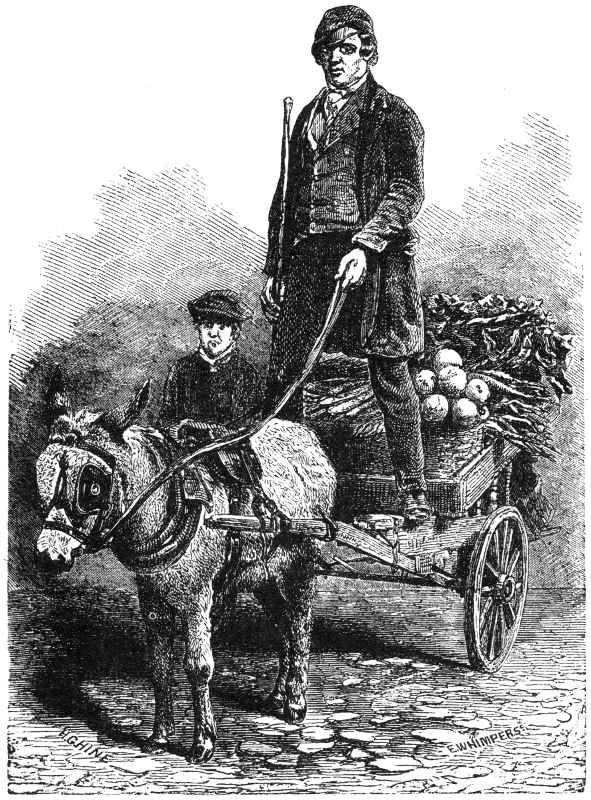
THE LONDON COSTERMONGER.
“Here Pertaters! Kearots and Turnups! Fine Brockello-o-o!”
[From a Daguerreotype by Beard.]
The other amusements of this class of the community are the theatre and the penny concert, and their visits are almost entirely confined to the galleries of the theatres on the Surrey-side—the Surrey, the Victoria, the Bower Saloon, and (but less frequently) Astley’s. Three times a week is an average attendance at theatres and dances by the more prosperous costermongers. The most intelligent man I met with among them gave me the following account. He classes himself with the many, but his tastes are really those of an educated man:—“Love and murder suits us best, sir; but within these few years I think there’s a great deal more liking for deep tragedies among us. They set men a thinking; but then we all consider them too long. Of Hamlet we can make neither end nor side; and nine out of ten of us—ay, far more than that—would like it to be confined to the ghost scenes, and the funeral, and the killing off at the last. Macbeth would be better liked, if it was only the witches and the fighting. The high words in a tragedy we call jaw-breakers, and say we can’t tumble to that barrikin. We always stay to the last, because we’ve paid for it all, or very few costers would see a tragedy out if any money was returned to those leaving after two or three acts. We are fond of music. Nigger music was very much liked among us, but it’s stale now. Flash songs are liked, and sailors’ songs, and patriotic songs. Most costers—indeed, I can’t call to mind an exception—listen very quietly to songs that they don’t in the least understand. We have among us translations of the patriotic French songs. ‘Mourir pour la patrie’ is very popular, and so is the ‘Marseillaise.’ A song to take hold of us must have a good chorus.” “They like something, sir, that is worth hearing,” said one of my informants, “such as the ‘Soldier’s Dream,’ ‘The Dream of Napoleon,’ or ‘I ’ad a dream—an ’appy dream.’”
The songs in ridicule of Marshal Haynau, and in laudation of Barclay and Perkin’s draymen, were and are very popular among the costers; but none are more popular than Paul Jones—“A noble commander, Paul Jones was his name.” Among them the chorus of “Britons never shall be slaves,” is often rendered “Britons always shall be slaves.” The most popular of all songs with the class, however, is “Duck-legged Dick,” of which I give the first verse.
“Duck-legged Dick had a donkey, And his lush loved much for to swill, One day he got rather lumpy, And got sent seven days to the mill. His donkey was taken to the green-yard, A fate which he never deserved. Oh! it was such a regular mean yard, That alas! the poor moke got starved. Oh! bad luck can’t be prevented, Fortune she smiles or she frowns, He’s best off that’s contented, To mix, sirs, the ups and the downs.”
Their sports, are enjoyed the more, if they are dangerous and require both courage and dexterity to succeed in them. They prefer, if crossing a bridge, to climb over the parapet, and walk along on the stone coping. When a house is building, rows of coster lads will climb up the long ladders, leaning against the unslated roof, and then slide down again, each one resting on the other’s shoulders. A peep show with a battle scene is sure of its coster audience, and a favourite pastime is fighting with cheap theatrical swords. They are, however, true to each other, and should a coster, who is the hero of his court, fall ill and go to a hospital, the whole of the inhabitants of his quarter will visit him on the Sunday, and take him presents of various articles so that “he may live well.”
Among the men, rat-killing is a favourite sport. They will enter an old stable, fasten the door and then turn out the rats. Or they will find out some unfrequented yard, and at night time build up a pit with apple-case boards, and lighting up their lamps, enjoy the sport. Nearly every coster is fond of dogs. Some fancy them greatly, and are proud of making them fight. If when out working, they see a handsome stray, whether he is a “toy” or “sporting” dog, they whip him up—many of the class not being very particular whether the animals are stray or not.
Their dog fights are both cruel and frequent. It is not uncommon to see a lad walking with the trembling legs of a dog shivering under a bloody handkerchief, that covers the bitten and wounded body of an animal that has been figuring at some “match.” These fights take place on the sly—the tap-room or back-yard of a beer-shop, being generally chosen for the purpose. A few men are let into the secret, and they attend to bet upon the winner, the police being carefully kept from the spot.
Pigeons are “fancied” to a large extent, and are kept in lath cages on the roofs of the houses. The lads look upon a visit to the Red-house, Battersea, where the pigeon-shooting takes place, as a great treat. They stand without the hoarding that encloses the ground, and watch for the wounded pigeons to fall, when a violent scramble takes place among them, each bird being valued at 3d. or 4d. So popular has this sport become, that some boys take dogs with them trained to retrieve the birds, and two Lambeth costers attend regularly after their morning’s work with their guns, to shoot those that escape the ‘shots’ within.
A good pugilist is looked up to with great admiration by the costers, and fighting is considered to be a necessary part of a boy’s education. Among them cowardice in any shape is despised as being degrading and loathsome, indeed the man who would avoid a fight, is scouted by the whole of the court he lives in. Hence it is important for a lad and even a girl to know how to “work their fists well”—as expert boxing is called among them. If a coster man or woman is struck they are obliged to fight. When a quarrel takes place between two boys, a ring is formed, and the men urge them on to have it out, for they hold that it is a wrong thing to stop a battle, as it causes bad blood for life; whereas, if the lads fight it out they shake hands and forget all about it. Everybody practises fighting, and the man who has the largest and hardest muscle is spoken of in terms of the highest commendation. It is often said in admiration of such a man that “he could muzzle half a dozen bobbies before breakfast.”
To serve out a policeman is the bravest act by which a costermonger can distinguish himself. Some lads have been imprisoned upwards of a dozen times for this offence; and are consequently looked upon by their companions as martyrs. When they leave prison for such an act, a subscription is often got up for their benefit. In their continual warfare with the force, they resemble many savage nations, from the cunning and treachery they use. The lads endeavour to take the unsuspecting “crusher” by surprise, and often crouch at the entrance of a court until a policeman passes, when a stone or a brick is hurled at him, and the youngster immediately disappears. Their love of revenge too, is extreme—their hatred being in no way mitigated by time; they will wait for months, following a policeman who has offended or wronged them, anxiously looking out for an opportunity of paying back the injury. One boy, I was told, vowed vengeance against a member of the force, and for six months never allowed the man to escape his notice. At length, one night, he saw the policeman in a row outside a public-house, and running into the crowd kicked him savagely, shouting at the same time: “Now, you b——, I’ve got you at last.” When the boy heard that his persecutor was injured for life, his joy was very great, and he declared the twelvemonth’s imprisonment he was sentenced to for the offence to be “dirt cheap.” The whole of the court where the lad resided sympathized with the boy, and vowed to a man, that had he escaped, they would have subscribed a pad or two of dry herrings, to send him into the country until the affair had blown over, for he had shown himself a “plucky one.”
It is called “plucky” to bear pain without complaining. To flinch from expected suffering is scorned, and he who does so is sneered at and told to wear a gown, as being more fit to be a woman. To show a disregard for pain, a lad, when without money, will say to his pal, “Give us a penny, and you may have a punch at my nose.” They also delight in tattooing their chests and arms with anchors, and figures of different kinds. During the whole of this painful operation, the boy will not flinch, but laugh and joke with his admiring companions, as if perfectly at ease.
Gambling of Costermongers.
It would be difficult to find in the whole of this numerous class, a youngster who is not—what may be safely called—a desperate gambler. At the age of fourteen this love of play first comes upon the lad, and from that time until he is thirty or so, not a Sunday passes but he is at his stand on the gambling ground. Even if he has no money to stake, he will loll away the morning looking on, and so borrow excitement from the successes of others. Every attempt made by the police, to check this ruinous system, has been unavailing, and has rather given a gloss of daring courage to the sport, that tends to render it doubly attractive.
If a costermonger has an hour to spare, his first thought is to gamble away the time. He does not care what he plays for, so long as he can have a chance of winning something. Whilst waiting for a market to open, his delight is to find out some pieman and toss him for his stock, though, by so doing, he risks his market-money and only chance of living, to win that which he will give away to the first friend he meets. For the whole week the boy will work untiringly, spurred on by the thought of the money to be won on the Sunday. Nothing will damp his ardour for gambling, the most continued ill-fortune making him even more reckless than if he were the luckiest man alive.
Many a lad who had gone down to the gambling ground, with a good warm coat upon his back and his pocket well filled from the Saturday night’s market, will leave it at evening penniless and coatless, having lost all his earnings, stock-money, and the better part of his clothing. Some of the boys, when desperate with “bad luck,” borrow to the utmost limit of their credit; then they mortgage their “king’s-man” or neck-tie, and they will even change their cord trousers, if better than those of the winner, so as to have one more chance at the turn of fortune. The coldest winter’s day will not stop the Sunday’s gathering on the river-side, for the heat of play warms them in spite of the sharp wind blowing down the Thames. If the weather be wet, so that the half-pence stick to the ground, they find out some railway-arch or else a beer-shop, and having filled the tap-room with their numbers, they muffle the table with handkerchiefs, and play secretly. When the game is very exciting, they will even forget their hunger, and continue to gamble until it is too dark to see, before they think of eating. One man told me, that when he was working the races with lemonade, he had often seen in the centre of a group, composed of costers, thimble-riggers and showmen, as much as 100l. on the ground at one time, in gold and silver. A friend of his, who had gone down in company with him, with a pony-truck of toys, lost in less than an hour his earnings, truck, stock of goods, and great-coat. Vowing to have his revenge next time, he took his boy on his back, and started off on the tramp to London, there to borrow sufficient money to bring down a fresh lot of goods on the morrow, and then gamble away his earnings as before.
It is perfectly immaterial to the coster with whom he plays, whether it be a lad from the Lambeth potteries, or a thief from the Westminster slums. Very often, too, the gamblers of one costermonger district, will visit those of another, and work what is called “a plant” in this way. One of the visitors will go before hand, and, joining a group of gamblers, commence tossing. When sufficient time has elapsed to remove all suspicion of companionship, his mate will come up and commence betting on each of his pals’ throws with those standing round. By a curious quickness of hand, a coster can make the toss tell favourably for his wagering friend, who meets him after the play is over in the evening, and shares the spoil.
The spots generally chosen for the Sunday’s sport are in secret places, half-hidden from the eye of the passers, where a scout can give quick notice of the approach of the police: in the fields about King’s-cross, or near any unfinished railway buildings. The Mint, St. George’s-fields, Blackfriars’-road, Bethnal-green, and Marylebone, are all favourite resorts. Between Lambeth and Chelsea, the shingle on the left side of the Thames, is spotted with small rings of lads, half-hidden behind the barges. One boy (of the party) is always on the look out, and even if a stranger should advance, the cry is given of “Namous” or “Kool Eslop.” Instantly the money is whipped-up and pocketed, and the boys stand chattering and laughing together. It is never difficult for a coster to find out where the gambling parties are, for he has only to stop the first lad he meets, and ask him where the “erht pu” or “three up” is going on, to discover their whereabouts.
If during the game a cry of “Police!” should be given by the looker-out, instantly a rush at the money is made by any one in the group, the costers preferring that a stranger should have the money rather than the policeman. There is also a custom among them, that the ruined player should be started again by a gift of 2d. in every shilling lost, or, if the loss is heavy, a present of four or five shillings is made; neither is it considered at all dishonourable for the party winning to leave with the full bloom of success upon him.
That the description of one of these Sunday scenes might be more truthful, a visit was paid to a gambling-ring close to ——. Although not twenty yards distant from the steam-boat pier, yet the little party was so concealed among the coal-barges, that not a head could be seen. The spot chosen was close to a small narrow court, leading from the street to the water-side, and here the lad on the look-out was stationed. There were about thirty young fellows, some tall strapping youths, in the costers’ cable-cord costume,—others, mere boys, in rags, from the potteries, with their clothes stained with clay. The party was hidden from the river by the black dredger-boats on the beach; and it was so arranged, that should the alarm be given, they might leap into the coal-barges, and hide until the intruder had retired. Seated on some oars stretched across two craft, was a mortar-stained bricklayer, keeping a look-out towards the river, and acting as a sort of umpire in all disputes. The two that were tossing had been playing together since early morning; and it was easy to tell which was the loser, by the anxious-looking eye and compressed lip. He was quarrelsome too; and if the crowd pressed upon him, he would jerk his elbow back savagely, saying, “I wish to C——t you’d stand backer.” The winner, a short man, in a mud-stained canvas jacket, and a week’s yellow beard on his chin, never spake a word beyond his “heads,” or “tails;” but his cheeks were red, and the pipe in his mouth was unlit, though he puffed at it.
In their hands they each held a long row of halfpence, extending to the wrist, and topped by shillings and half-crowns. Nearly every one round had coppers in his hands, and bets were made and taken as rapidly as they could be spoken. “I lost a sov. last night in less than no time,” said one man, who, with his hands in his pockets, was looking on; “never mind—I musn’t have no wenson this week, and try again next Sunday.”
The boy who was losing was adopting every means to “bring back his luck again.” Before crying, he would toss up a halfpenny three times, to see what he should call. At last, with an oath, he pushed aside the boys round him, and shifted his place, to see what that would do; it had a good effect, for he won toss after toss in a curiously fortunate way, and then it was strange to watch his mouth gradually relax and his brows unknit. His opponent was a little startled, and passing his fingers through his dusty hair, said, with a stupid laugh, “Well, I never see the likes.” The betting also began to shift. “Sixpence Ned wins!” cried three or four; “Sixpence he loses!” answered another; “Done!” and up went the halfpence. “Half-a-crown Joe loses!”—“Here you are,” answered Joe, but he lost again. “I’ll try you a ‘gen’” (shilling) said a coster; “And a ‘rouf yenap’” (fourpence), added the other. “Say a ‘exes’” (sixpence).—“Done!” and the betting continued, till the ground was spotted with silver and halfpence.
“That’s ten bob he’s won in five minutes,” said Joe (the loser), looking round with a forced smile; but Ned (the winner) never spake a word, even when he gave any change to his antagonist; and if he took a bet, he only nodded to the one that offered it, and threw down his money. Once, when he picked up more than a sovereign from the ground, that he had won in one throw, a washed sweep, with a black rim round his neck, said, “There’s a hog!” but there wasn’t even a smile at the joke. At last Joe began to feel angry, and stamping his foot till the water squirted up from the beach, cried, “It’s no use; luck’s set in him—he’d muck a thousand!” and so he shifted his ground, and betted all round on the chance of better fortune attending the movement. He lost again, and some one bantering said, “You’ll win the shine-rag, Joe,” meaning that he would be “cracked up,” or ruined, if he continued.
When one o’clock struck, a lad left, saying, he was “going to get an inside lining” (dinner). The sweep asked him what he was going to have. “A two-and-half plate, and a ha’p’orth of smash” (a plate of soup and a ha’p’orth of mashed potatoes), replied the lad, bounding into the court. Nobody else seemed to care for his dinner, for all stayed to watch the gamblers.
Every now and then some one would go up the court to see if the lad watching for the police was keeping a good look-out; but the boy never deserted his post, for fear of losing his threepence. If he had, such is the wish to protect the players felt by every lad, that even whilst at dinner, one of them, if he saw a policeman pass, would spring up and rush to the gambling ring to give notice.
When the tall youth, “Ned,” had won nearly all the silver of the group, he suddenly jerked his gains into his coat-pocket, and saying, “I’ve done,” walked off, and was out of sight in an instant. The surprise of the loser and all around was extreme. They looked at the court where he had disappeared, then at one another, and at last burst out into one expression of disgust. “There’s a scurf!” said one; “He’s a regular scab,” cried another; and a coster declared that he was “a trosseno, and no mistake.” For although it is held to be fair for the winner to go whenever he wishes, yet such conduct is never relished by the losers.
It was then determined that “they would have him to rights” the next time he came to gamble; for every one would set at him, and win his money, and then “turn up,” as he had done.
The party was then broken up, the players separating to wait for the new-comers that would be sure to pour in after dinner.
“Vic. Gallery.”
On a good attractive night, the rush of costers to the threepenny gallery of the Coburg (better known as “the Vic”) is peculiar and almost awful.
The long zig-zag staircase that leads to the pay box is crowded to suffocation at least an hour before the theatre is opened; but, on the occasion of a piece with a good murder in it, the crowd will frequently collect as early as three o’clock in the afternoon. Lads stand upon the broad wooden bannisters about 50 feet from the ground, and jump on each others’ backs, or adopt any expedient they can think of to obtain a good place.
The walls of the well-staircase having a remarkably fine echo, and the wooden floor of the steps serving as a sounding board, the shouting, whistling, and quarrelling of the impatient young costers is increased tenfold. If, as sometimes happens, a song with a chorus is started, the ears positively ache with the din, and when the chant has finished it seems as though a sudden silence had fallen on the people. To the centre of the road, and all round the door, the mob is in a ferment of excitement, and no sooner is the money-taker at his post than the most frightful rush takes place, every one heaving with his shoulder at the back of the person immediately in front of him. The girls shriek, men shout, and a nervous fear is felt lest the massive staircase should fall in with the weight of the throng, as it lately did with the most terrible results. If a hat tumbles from the top of the staircase, a hundred hands snatch at it as it descends. When it is caught a voice roars above the tumult, “All right, Bill, I’ve got it”—for they all seem to know one another—“Keep us a pitch and I’ll bring it.”
To any one unaccustomed to be pressed flat it would be impossible to enter with the mob. To see the sight in the gallery it is better to wait until the first piece is over. The ham-sandwich men and pig-trotter women will give you notice when the time is come, for with the first clatter of the descending footsteps they commence their cries.
There are few grown-up men that go to the “Vic” gallery. The generality of the visitors are lads from about twelve to three-and-twenty, and though a few black-faced sweeps or whitey-brown dustmen may be among the throng, the gallery audience consists mainly of costermongers. Young girls, too, are very plentiful, only one-third of whom now take their babies, owing to the new regulation of charging half-price for infants. At the foot of the staircase stands a group of boys begging for the return checks, which they sell again for 1½d. or 1d., according to the lateness of the hour.
At each step up the well-staircase the warmth and stench increase, until by the time one reaches the gallery doorway, a furnace-heat rushes out through the entrance that seems to force you backwards, whilst the odour positively prevents respiration. The mob on the landing, standing on tiptoe and closely wedged together, resists any civil attempt at gaining a glimpse of the stage, and yet a coster lad will rush up, elbow his way into the crowd, then jump up on to the shoulders of those before him, and suddenly disappear into the body of the gallery.
The gallery at “the Vic” is one of the largest in London. It will hold from 1500 to 2000 people, and runs back to so great a distance, that the end of it is lost in shadow, excepting where the little gas-jets, against the wall, light up the two or three faces around them. When the gallery is well packed, it is usual to see piles of boys on each others shoulders at the back, while on the partition boards, dividing off the slips, lads will pitch themselves, despite the spikes.
As you look up the vast slanting mass of heads from the upper boxes, each one appears on the move. The huge black heap, dotted with faces, and spotted with white shirt sleeves, almost pains the eye to look at, and should a clapping of hands commence, the twinkling nearly blinds you. It is the fashion with the mob to take off their coats; and the cross-braces on the backs of some, and the bare shoulders peeping out of the ragged shirts of others, are the only variety to be found. The bonnets of the “ladies” are hung over the iron railing in front, their numbers nearly hiding the panels, and one of the amusements of the lads in the back seats consists in pitching orange peel or nutshells into them, a good aim being rewarded with a shout of laughter.
When the orchestra begins playing, before “the gods” have settled into their seats, it is impossible to hear a note of music. The puffed-out cheeks of the trumpeters, and the raised drumsticks tell you that the overture has commenced, but no tune is to be heard. An occasional burst of the full band being caught by gushes, as if a high wind were raging. Recognitions take place every moment, and “Bill Smith” is called to in a loud voice from one side, and a shout in answer from the other asks “What’s up?” Or family secrets are revealed, and “Bob Triller” is asked where “Sal” is, and replies amid a roar of laughter, that she is “a-larning the pynanney.”
By-and-by a youngster, who has come in late, jumps up over the shoulders at the door, and doubling himself into a ball, rolls down over the heads in front, leaving a trail of commotion for each one as he passes aims a blow at the fellow. Presently a fight is sure to begin, and then every one rises from his seat whistling and shouting; three or four pairs of arms fall to, the audience waving their hands till the moving mass seems like microscopic eels in paste. But the commotion ceases suddenly on the rising of the curtain, and then the cries of “Silence!” “Ord-a-a-r!” “Ord-a-a-r!” make more noise than ever.
The “Vic” gallery is not to be moved by touching sentiment. They prefer vigorous exercise to any emotional speech. “The Child of the Storm’s” declaration that she would share her father’s “death or imprisonment as her duty,” had no effect at all, compared with the split in the hornpipe. The shrill whistling and brayvos that followed the tar’s performance showed how highly it was relished, and one “god” went so far as to ask “how it was done.” The comic actor kicking a dozen Polish peasants was encored, but the grand banquet of the Czar of all the Russias only produced merriment, and a request that he would “give them a bit” was made directly the Emperor took the willow-patterned plate in his hand. All affecting situations were sure to be interrupted by cries of “orda-a-r;” and the lady begging for her father’s life was told to “speak up old gal;” though when the heroine of the “dummestic dreamer” (as they call it) told the general of all the Cossack forces “not to be a fool,” the uproar of approbation grew greater than ever,—and when the lady turned up her swan’s-down cuffs, and seizing four Russian soldiers shook them successively by the collar, then the enthusiasm knew no bounds, and the cries of “Bray-vo Vincent! Go it my tulip!” resounded from every throat.
Altogether the gallery audience do not seem to be of a gentle nature. One poor little lad shouted out in a crying tone, “that he couldn’t see,” and instantly a dozen voices demanded “that he should be thrown over.”
Whilst the pieces are going on, brown, flat bottles are frequently raised to the mouth, and between the acts a man with a tin can, glittering in the gas-light, goes round crying, “Port-a-a-a-r! who’s for port-a-a-a-r.” As the heat increased the faces grew bright red, every bonnet was taken off, and ladies could be seen wiping the perspiration from their cheeks with the play-bills.
No delay between the pieces will be allowed, and should the interval appear too long, some one will shout out—referring to the curtain—“Pull up that there winder blind!” or they will call to the orchestra, saying, “Now then you catgut-scrapers! Let’s have a ha’purth of liveliness.” Neither will they suffer a play to proceed until they have a good view of the stage, and “Higher the blue,” is constantly shouted, when the sky is too low, or “Light up the moon,” when the transparency is rather dim.
The dances and comic songs, between the pieces, are liked better than anything else. A highland fling is certain to be repeated, and a stamping of feet will accompany the tune, and a shrill whistling, keep time through the entire performance.
But the grand hit of the evening is always when a song is sung to which the entire gallery can join in chorus. Then a deep silence prevails all through the stanzas. Should any burst in before his time, a shout of “orda-a-r” is raised, and the intruder put down by a thousand indignant cries. At the proper time, however, the throats of the mob burst forth in all their strength. The most deafening noise breaks out suddenly, while the cat-calls keep up the tune, and an imitation of a dozen Mr. Punches squeak out the words. Some actors at the minor theatres make a great point of this, and in the bill upon the night of my visit, under the title of “There’s a good time coming, boys,” there was printed, “assisted by the most numerous and effective chorus in the metropolis—” meaning the whole of the gallery. The singer himself started the mob, saying, “Now then, the Exeter Hall touch if you please gentlemen,” and beat time with his hand, parodying M. Jullien with his baton. An “angcore” on such occasions is always demanded, and, despite a few murmurs of “change it to ‘Duck-legged Dick,’” invariably insisted on.