Volume 1 — OF THE STREET-SELLERS OF MANUFACTURED ARTICLES. (continued 3)
Reading edition
Of the Street-Sellers of Children’s Gilt Watches.
These articles were first introduced into general street sale about 10 years ago. They were then German made. The size was not much larger than that of a shilling, and to this tiny watch was appended as tiny a chain and seal. The street-price was only 1d., and the wholesale price was 8s. the gross. They were sold at eight of the swag-shops, all “English and foreign,” or “English and German” establishments. From the price it would appear that the profit was 4d. a dozen, but as the street-sellers had to “take the watches as they came,” the profit was but 3d., as a dozen watches in a gross had broken glasses, or were otherwise damaged and unsaleable. The supply of these watches was not equal to the demand, for when a case of them was received, “it could have been sold twice over.” One street-seller told me that he had sold 15 and even 16 dozen of these watches on a day, and that once on a Saturday night, and early on Sunday morning, he had sold 2 gross, or 24 dozen. Such, however, was not the regular sale; a “good week” was a profit of 15s.
About six years ago gilt watches of a very superior kind were sold in the streets in a different way. They were French made, and were at first vended at 1s. each. Some were displayed in case-boxes, fitted up with divisions, in which were placed the watches with the guard-chains, about three-quarters of a yard long, coiled round them. There were also two or three keys, one in the form of a pistol. The others were hung from a small pole, sometimes a dozen, and sometimes two, being so suspended, and they had a good glittering appearance in a bright light; this street fashion still continues. The street-sellers, however, are anxious not to expose these watches too much, as they are easily injured by the weather, and any stain or injury is irreparable. The shilling sale continued prosperously for about six weeks, and then the wholesale price—owing, the street-sellers were told at the swag-shops, to “an opposition in the trade in Paris,”—was reduced to 4s. 6d. the dozen, and the retail street-price to 6d. each. When the trade was “at its best” there were thirty men and twenty women selling these watches, all May, June, and July, and each clearing from 12s. to 20s. (but rarely the latter sum) a week. Last “season” there were for the same period about half the number of sellers mentioned, averaging a profit of about 15d. a day each, or 9s. a week. The cry is—“Handsome present for 6d. Beautiful child’s watch and chain, made of Peruvian metal, by working jewellers out of employ. Only 6d. for a handsome present.”
The vendors of these watches are the regular street-sellers, some of them being tolerably good patterers. One of these men, in the second year of the street-sale of watches, appeared one morning in an apron and sleeves, to which brass and copper filings were made to adhere, and he announced himself as an English working jeweller unemployed, offering his own manufactures for sale, “better finished and more solider nor the French.” The man’s sale was greatly increased. On the following day, however, four other English working jewellers appeared in Leicester-square and its approaches, each in besprinkled apron and sleeves, and each offering the productions of his own handicraft! The apron and sleeves were therefore soon abandoned.
Among the best “pitches,”—for the watch-sellers are not itinerant, though they walk to and fro—are the Regent’s-park, Leicester-square, the foot of London-bridge, and of Blackfriars-bridge, and at the several railway stations.
The principal purchasers, I was told by an intelligent patterer, who sometimes “turned his hand to the watches,” were “fathers and mothers,” he thought, “and them as wished to please such parties.”
Calculating that twenty-five persons now vend watches for twelve weeks in the year, and—as they are 10 per cent. cheaper than they were at the swag-shops—that each clears 8s. weekly, we find 360l. yearly expended in London streets in these toy watches.
Of the Street-Sellers of Tinware.
The sellers of tins, who carry them under their arms, or in any way on a round, apart from the use of a vehicle, are known as hand-sellers. The word hand-seller is construed by the street-traders as meaning literally hand-seller, that is to say, a seller of things held or carried in the hand; but the term is clearly derived from the Scotch handsell, as in “handsell penny.” Handsell, according to Jamieson, the Scotch etymologist, means, (1) “The first money that a trader receives for goods; also a gift conferred at a particular season. (2) A piece of bread given before breakfast.” Ihre, the Gothic lexicographer, views the term handsell as having sprung from the Mæso-Gothic hunsla (sacrifice or offering). This is the same as the Anglo-Sax husl (the Eucharist), whence comes the English housel and unhouseled; and he considers the word to have originally meant a gift or offering of any kind. Hence, the hand-sellers of tin and other wares in the street, would mean simply those who offered such tin or other wares for sale. The goods they dispose of are dripping-pans (sometimes called “square pans”), sold at from 3d. to 18d., the 3d. pans being “6 inch,” and the 18d. “15 inch;” cullenders, 6d. to 9d.; hand-bowls, for washerwomen, 1s. (now a very small portion of the trade); roasting-jacks, with tin bodies, 6d. to 1s. 6d. (this used to be the best article for profit and ready sale in the trade, but “they are going out of date”); and the smaller articles of graters, &c.
The hand-sellers also trade in other articles which are less portable; the principal sale, however, is at “stands,” and there chiefly on a Saturday night, the greatest business-time of street-commerce! These less portable articles are tea-kettles, 10d. to 18d.; saucepans of all sizes, the smallest being the “open pints” at 2d. or 2½d. each (they cost them 20d. a dozen; it’s a bargain to get them at 18d.), and the largest the “nine quart;” but the kinds most in demand are the “three pints” and “two quarts,” sold at 6d. and 8d. There are also fish-kettles in this street-traffic, though to a very limited extent—“one fish-kettle,” I was told, “to four-and-twenty saucepans;” the selling price for the fish-kettles is 5s. and 3s. 6d. each; candlesticks are sold at 4d. to 1s.; and shaving-pots, 4d. A few tin things used to be sold at the mews, but the trade is now almost entirely abandoned. These were tins for singeing horses, 2s. 6d. each when first introduced, ten or twelve years ago, but now 1s., and stable lanterns, of punched tin, which cannot be sold now for more than 1s. each, though they cost 10s. per dozen at a tin-shop.
There are other tin articles vended in the streets, but they will be more properly detailed in my account of street-artisans, as the maker and the street-seller are the same individual. Among these are Dutch ovens, which are rarely offered now by those who purchase their goods at the tin-shops, as the charge there is 6d. “Why,” said a working tinman to me, “I’ve had 10d. many a week for making ovens, and the stuff found. It takes two plates of tin to make an oven, that’s 3d. at any tin-shop, before a minute’s labour is given to it, and yet the men who hawk their own goods sell their ovens regularly enough at 4d. It’s the ruin of the trade.” The tin-shops, I may observe, supply the artisans with the materials they require, as well as the ready-made articles, to the street-seller.
One of the largest street-stands “in tin” is in St. John-street, Clerkenwell, on Saturday evenings, but the proprietor pertains to the artisan class, though he buys some of his goods at the tin-shops.
The hand-sellers of tin are about 100 in number, and 60 of that number may be said to be wives and children of the remaining 40; as the majority of the itinerant vendors of tinware are married men with families. “Tins” are not a heavy carriage, and can very well be borne from house to house by women, while children sell such things as nutmeg-graters, pepper-boxes, extinguishers, and save-alls. Those who sell the larger tin articles in the streets are generally the makers of them. “A dozen years back or more, perhaps, there was,” I was informed, “some prime block-tin tea-pots sold in the streets; there’s none now. Metal’s druv out tin.”
Among the street tin-sellers I heard many complaints of the smallness, and the constantly diminishing rate of their earnings. “Our people has bad luck, too,” said one man, “or they isn’t wide awake. You may remember, sir, that a few weeks back, a new save-all came in, and was called candle-wedges, and went off well. It was a tin thing, and ought by rights to have been started by the tin-shops for us. But it was first put out by the swag-men at 3s. the gross. The first and second days the men were soon sold out. Them as could patter tidy did the best—I tried, but you see, sir, I’m no scholar. Well, they went at night to Mr. ——’s, in Houndsditch, I think it is, and he says, ‘I’m out of them, but I’ll have some in the morning.’ They goes in the morning, and the swag says: ‘O, I can’t afford ’em at three shillings, you can have ’em at four.’ He put 1s. exter on the gross, cause they sold, nothing else, sir; and a relation of mine heard the swag shopkeeper say, ‘Why, they’re cheap at four; Jim (the street-seller) there made 3s. 3d. on ’em yesterday. I ain’t a going to slave, and pay rent, and rates, and taxes, to make your fortens; it ain’t likely.’ You see, sir, they was sold at ½d. each, and cost ¼d., which is 3d. a dozen, and so the swag got a higher profit, while the poor fellows had to sell for less profit.”
From the most reliable information which I could acquire, it appears that these tin-sellers, taken altogether, do not earn above 6s. a week each, as regards the adult men, and half that as regards the children and women. To realize this amount, the adults must take 13s., and the women and children 7s., for the latter are less “priced down.” Thus, if we calculate an average receipt, per individual, of 10s. weekly, reckoning 100 sellers, we find a yearly expenditure on tins, bought in the street, of 2500l. The trade is greatest in the suburbs, and some men, who have become “known on their rounds,” supply houses, by order, with all the tins they require.
There is a branch of the tin-trade carried on in a way which I have shown prevailed occasionally among the costermongers, viz., the selling of goods on commission. This system is now carried on among all the parties who trade “from” swag-barrows.
The word “swag” which has been so often used in this work of late, is, like many other of the street-terms, of Scotch origin (as handseller, and busker). The Scotch word is sweg or swack, and means, according to Jamieson, a quantity, a considerable number, a large collection of any kind. (The root appears to be an ancient German term, sweig—a flock, a herd.) Hence a Swag Warehouse is a warehouse containing a large collection of miscellaneous goods; and a Swag Barrow, a barrow laden with a considerable assortment of articles. The slang term swag means booty, plunder—that is to say, the collection of goods—the “lot,” the “heap” stolen.
Of these swag-barrowmen, there are not less than 150, and the barrows are mostly the property of three individuals, who are not street-sellers themselves. One of these men has 50 barrows of his own, and employs 50 men to work them. The barrow proprietor supplies not only the vehicle, but the stock, and the men’s remuneration is 3d. in the 1s. on the amount of sales. Each article they sell is charged to the public 1d. The tin-wares of the swag-barrows are nutmeg-graters, bread-graters, beer-warmers, fish-slices, goblets, mugs, save-alls, extinguishers, candle-shades, money-boxes, children’s plates, and rattles. In addition to the tin-wares, the swag-barrows are stocked with brooches, rings, pot-ornaments, plates, small crockeryware, toys, &c., each article being also vended at 1d. The trade is so far stationary, that the men generally confine themselves to one neighbourhood, if not to one street. The majority of the swag-barrowmen have been costermongers, and nearly the whole have been engaged in street avocations all their lives. One man familiar with the trade thought I might state that the whole were of this description; for though there was lately a swag-barrowman who had been a tradesman in an extensive way, there was, he believed, no such exception at the present time. These barrowmen are nearly all uneducated, and are plodding and persevering men, though they make few exertions to better their condition. As the barrow and stock are supplied to them, without any outlay on their part, their faculties are not even sharpened, as among many of the costermongers, by the necessity of providing stock-money, and knowing how to bargain and buy to advantage. They have merely to sell. Their commission furnishes little or nothing more than the means of a bare subsistence. The great sale is on Saturday nights at the street-markets, and to the working people, who then crowd those places, and, as one said to me, “has a few pennies to lay out.” At such times as much as 3l. has been taken by a swag-barrowman. During the other days of the week their earnings are small. It is considered a first-rate week, and there must be all the facilities for street-trade afforded by fine weather, to take 2s. a day (clearing 6d.), and 3l. on a Saturday night. This gives the swag-barrowman a commission of 18s.; but I am informed, by competent persons, that the average of the weekly profits of these street-traders does not exceed 10s. a week. This shows a yearly receipt, by the men working the barrows, of 3900l. as their profit or payment, and a gross receipt of 11,700l. Of this large amount nearly two-thirds, I am assured, is expended on tin-wares.
The prime cost, at the tin-shops, of these wares, to the barrow proprietors, are 7s. and 7s. 6d. the gross, leaving from 1½d. to 2d. profit on every shilling, over the 3d. commission paid to the salesman. The tins are all made in London. The jewellery, and other stock of the swag-barrows, are bought at the general swag-shops, of which I have before spoken.
Of the Life of a Tin-Ware Seller.
The following street-biography was communicated to me in writing. It is, I believe, a striking instance of the vicissitudes and privations to which a street-life is subject. It forms, moreover, a curious example of those moral contradictions which make the same individual at one time give way hopelessly to the force of circumstances, and at another resolutely control them.
“My object,” says my correspondent, “for writing this, what some folks no doubt will call a nonsensical epistle, is merely to show how much human nature is capable of enduring in the shape of privations. People in easy circumstances will scarcely credit what I am about to relate; and many of the poor will smile at what I have termed hardships, and at my folly in endeavouring to paint the misery I have endured, which will appear slight when compared to what they themselves have suffered.
“I am the son of a mechanic who was accidentally drowned some weeks previous to my birth. My mother, through industry and perseverance, endeavoured to support me and my sister till we arrived at the ages of 15 and 18, I being the younger. I entered a gentleman’s service as pantry-boy, where I continued until I considered myself competent to take a higher situation. Still a servant’s life was not the bent of my inclinations; martial music and viewing soldiers on parade made me think that a rifle was a more graceful tool than a toasting-fork. I resolved to serve his Majesty, and for that purpose enlisted in the 60th Rifles on the route for India, but Providence ordained it otherwise. On the afternoon on which I ’listed I fell by accident and broke my leg, and as I was not sworn in I was entitled to no pension. I was six months confined to my bed, and it was three years before I could go without my crutch. Grief for my misfortunes had borne my mother to an early grave, and I was left a cripple and destitute. Whether by design or accident I do not recollect, but I met with the lady (Lady M——) in whose service I first entered as pantry-boy; she took pity on my forlorn condition, and kindly invited me to her Mansion, where I remained until completely restored to health, but still crippled. After this I was employed painting and glazing, &c., and, considering myself competent to get my living in that line, I resolved to go to London—the theatre of all my misery to come, for I was disappointed. On reaching the metropolis my paint-brush was turned into a shovel, my paint-pot into a dust sieve, for I could only get employed by a man to work in a dust-yard at 10s. a week. From thence I went to a firm belonging to a friend at Beckenham, near Croydon, as working time-keeper, or foreman; but during a fair in that village I neglected to back the time, and being discharged was cast upon the world again with only 3s. in my pocket, which I eat and drank up, having no idea of street trading. Then came my trials; but having had sufficient food during the day, I did not feel much the effects of my first night in the streets. The next day I had no food, and towards dusk began bitterly to feel my situation; that night I slept, or rather lay, in an empty house. Towards noon of the next day I felt weak, and drank large quantities of water, for I had no particular desire for food. Passing by a shop where old clothes were offered for sale, I saw a man wretched in appearance disposing of an old vest for a few pence. I caught the malady and was instantly spoiled of my coat, having received in exchange for it 2s. and an old frock—such as are generally worn by waggoners or countrymen. I more than once smiled at my novel appearance. A penny loaf, a drink of water, and a threepenny lodging was the first assault upon my 2s. I regretted, however, the 3d. paid for my lodging, and determined not to risk another, for my bedfellows were so numerous, and of such teazing propensities, that they would not allow me to sleep; truly indeed is it said that ‘poverty makes us acquainted with strange bedfellows.’ At this time I formed an acquaintance with a man whose condition was similar to my own; he engaged to put me ‘fly to a dodge’ or two; an explanation from him was necessary to make me acquainted with the sense of his words, which I soon found simply meant artful manœuvres. One of these dodges was to snooze (a term for sleeping) in the Adelphi arches; I felt grateful for such a mark of disinterested friendship, and next day my friend and me fared sumptuously on the produce of my coat, and at night we repaired to the Arches in question, and there found a comfortable lodging in a hay-loft. I lay for some time, but did not sleep. I was several times addressed by my companion in an under tone, ‘Are you asleep,’ he whispered, ‘ain’t it a stunning dos?’ (which means a good bed). I was not in a mood for conversation, and made no reply; to silence him completely I affected to snore, and this had the desired effect. For a few minutes he was quite quiet, and then he commenced with great caution to unlace my boots, with a view to stealing them. I perceived his object, and immediately left my lodging and companion. I felt grieved and disappointed at the loss of one in whom I placed all confidence; but this time wisdom was purchased cheaply, inasmuch as I suffered no loss except that my money might have lasted me a little longer. The remainder of that night I strayed about the Strand and Charing-cross, after a drink of water; I took a seat on a curb surrounding the pump; many wretched beings came and seated themselves beside me, and a conversation ensued respecting their several destinations during the day. One proposed going to Hungerford-market to do a feed on decayed shrimps or other offal laying about the market; another proposed going to Covent-garden to do a ‘tightener’ of rotten oranges, to which I was humorously invited; I accepted the invitation, and proceeded with my new companion. I fared well; I filled my hat, took a seat, and made a most delicious breakfast. I remained strolling about the Garden all day, and towards evening was invited by my companions to a ‘dos’ in an open shed in Islington; this I declined, alleging that I had a lodging, but that night I slept amongst a heap of stones near the pillar at Charing-cross. I continued to attend the Garden for several weeks, subsisting entirely on the offal of that market. One day I took notice of a man there selling chestnut leaves; I enquired how he obtained them: he told me he plucked them from the trees without hindrance, and directed me to where I could obtain some. I went to a grove in the vicinity of Kilburn, and lay there all night. Next morning I found no leaves, so I returned disappointed to town, and on going through the market a woman employed me to carry a bushel of pears some little distance for her for a penny. I felt quite elevated in anticipation of such a treat as a penny loaf, but alas! I fell down under the weight of the fruit and poverty; my employer, however, kindly gave me the penny, though some of her pears were injured, and I had not taken them half the required distance. With the money I purchased a loaf, and sat on a stone near the pump in Covent Garden and began my meal. Here I soon had a companion, who after rincing a lettuce at the pump, began to devour it. I shared my loaf with him. ‘O God!’ said he, ‘what are we destined to suffer. I have escaped the bullets of the Carlists in Spain to die in the streets of London with hunger.’ I felt an interest in the poor fellow, who I discovered in the course of conversation had been a gentleman’s servant in his time; he assured me he had been living in the same way for several weeks as I myself had been. Towards night my companion asked me where I slept. I told him my different haunts, he told me I’d better go to the straw-yard with him; this was a place I had not yet heard of; it was the nightly refuge for the houseless poor. I accompanied him without hesitation; my confidence was not misplaced; I slept there several nights. Bread was distributed to us night and morning, and this was fortunate, for the Garden began to fail. In the course of conversation with some of the inmates of the Refuge, we found that we could obtain employment at stone-breaking; this we tried the next morning, and succeeded. We worked all day, and received 6d. each on leaving work. We then made up our minds to go to lodgings that we might have an opportunity of washing what were once shirts.
“Misery had not had that wasting influence on my companion as it had on me. I was at this time a complete skeleton; a puff of wind would cause me to stagger. I continued stone-breaking, but about noon of the third day I sunk exhausted on the heap of stones before me. Poverty had done its work, and I anticipated with pleasure approaching dissolution. I was assisted to my lodging by my companion, and went to bed. When the woman at the lodging-house discovered that I was ill, she ordered some of her domestics to dress me and put me in the street, alleging that she was under a penalty of 20l. were it discovered that she lodged a sick stranger. I was, therefore, cast into the street at 12 o’clock at night. My companion then gave me the 3d. he had earned that day to procure me a lodging if possible, and he slept in the streets the remainder of the night. I went to another lodging, concealing as much as possible my illness; my money was taken, and I was conducted to bed. I spent a wretched night, and next morning I was very bad. The landlady led me to the workhouse; I was admitted directly; had they detained me asking questions I should have sunk on the floor. My disorder was pronounced English cholera. I lay three weeks in a precarious state, but at the end of seven weeks was recovered sufficiently to walk about. I was then discharged; but on going towards the Abbey in Westminster I fainted, and on recovery found myself surrounded by a number of persons. I was advised to return to the house; I did so, and was admitted for a short time, after which I was again discharged, but I received out-door relief twice a week; and for some time a small portion of bread and cheese as well. I had now lost not only all hope, but even desire of bettering my condition; during these trials I made none acquainted with my privations, save those situated as I was. I now altered my condition as regards sleeping; I walked about during the night, and slept a portion of the day on a heap of sand near Westminster-bridge. I then remembered to have a poor relative in Kensington; I did not plead distress, but merely asked whether she knew where I might procure employment. I had a cup of tea, the first I had tasted since I was in the workhouse, a period of five weeks. Being asked some question by my relative, I could not help making reference to some of my sufferings. At this place I found a young man of whom I had had a previous acquaintance; I told him of my inability to procure a lodging, and he allowed me without the knowledge of his parents to sleep in the stable-loft; the bed was hard, but the coal sacks kept me warm. Here I had many opportunities of earning a few pence, and I began to regain my spirits. On one occasion, seeing a lad illtreated by a young man who was much his superior in size and strength, I interposed, and it may be conjectured in what manner. This circumstance procured me a friend, for, with the assistance of the lad I had protected, I was enabled to live tolerably well, and after a short while I got a situation at a coal-shed at 10s. a week. I continued in this place eighteen months, but, my master giving up the business, I was again cast on the world. I then began to think seriously of some way of living, and for the first time asked for the loan of 15s. With this I purchased a few articles of furniture, laid out 7s. 6d. for two hundred of oranges, with which I walked and hawked about two days, taking but 4d. during the time. I disposed of the remainder of my stock, wholesale, for 6s.; with this I purchased a small tin saucepan, a piece of marble slab, and commenced sugar-boiling. I retailed my manufacture in the streets. By dint of perseverance and economy I managed to live this way through the winter and a portion of the spring; but summer being now come, people needed none of my compounds to warm their mouths, so it was necessary for me to change my hand. What should I do? Thoughts came and vanished at their births. I recollected having seen a person selling rings at a penny each; I made up my mind to try the same. I laid out 5s. in a tray and stock; after arranging the goods to the best advantage I sallied into the streets. The glittering baubles took for a while, but when discoloured were useless. Having once a considerable stock of these soiled rings, I was prompted to begin “lot selling.” After calculating the profits, I commenced selling in that line. As this continued for seven weeks I managed to get a living. The system then became general; every street in the metropolis contained a lot seller, so I was determined to change my hand. One day in the street I saw a girl with a bundle of old umbrellas going towards a marine store shop; I asked if the umbrellas were for sale; she replied in the affirmative; the price she asked was 4d.; I became a purchaser. With these old umbrellas I commenced a new life. I bought some trifling tools necessary for repairing umbrellas, and, after viewing well the construction of the articles, I commenced operations. I succeeded, and in a little time could not only mend an old umbrella, but make a new one. This way of living I followed three years. In one of my walks through the streets crying old umbrellas to sell, I saw a street tinker repairing a saucepan; he seemed so very comfortable with his fire-pan before him, that I resolved from that moment to become a tinker, and for that purpose I bought a few tools, prepared a budget, and sallied into the streets with as much indifference as if I had been at the business since my birth. After a little practice I fancied I was fit for better things than mending old saucepans, and flattered myself that I was able to make a new one. This I resolved to attempt, and succeeded so well, that I at once abandoned the rainy-day system, and commenced manufacturing articles in tin-ware, such as are now sold in the streets, namely funnels, nutmeg-graters, penny mugs, extinguishers, slices, savealls, &c. I soon became known to the street-sellers and swag-shop proprietors. The prices I get are low, and I am deficient in some of the tools necessary to forward the work, with the required speed to procure returns adequate to my expenses; but thanks to the Lord I am better off than ever I expected to be, with the difference only of a somewhat shattered constitution. There are many at the present day suffering as I have done, and they may be found in and about the different markets of the metropolis.”
Of the Street-sellers of Dog-Collars.
Of these street-traders there are now regularly twelve; one man counted to me fourteen, but two of these only sold dog-collars occasionally, when they could not get employment in their trade as journeymen brass-founders. Of the regular hands, one, two, and sometimes three sell only dog-collars (with the usual adjuncts of locks, and sometimes chains, and key-rings), but even these, when their stock-money avails, prefer uniting to the collars some other trifling article.
Two of the most profitable pitches for the sale of these articles are in the neighbourhood of the Old Swan Pier, off Thames-street, and at a corner of the Bank. Neither of these two traders confines his stock to dog-collars, though they constitute the most valuable portion of it. The one sells, in addition to his collars, key-rings, keys and chains, dog-whistles, stamps with letters engraved upon them, printer’s type, in which any name or initials may be set up, shaving-brushes, trowser-straps, razors, and a few other light articles. The other sells little more than “dog” articles, with the addition of brass padlocks and small whips. But the minor commodities are frequently varied, according to the season and to the street-seller’s opinion of what may “sell.”
Some of these traders hang their wares against the rails of any public or other building in a good situation, where they can obtain leave. Others have stalls, with “a back,” from the corners of which hang the strings of dog-collars, one linked within another. The manner in which one street-seller displays his wares is shown in the illustration before given. Of the whole number, half are either itinerant on a round, or walk up and down a thoroughfare and an adjacent street or two. “Dog-collars,” said one man, “is no good at Saturday-night markets. People has said to me—for I was flat enough to try once—‘Dogs! pooh, I’ve hardly grub enough for the kids.’ For all that, sir, some poor people has dogs, and is very fond of them too; ay, and I’ve sold them collars, but seldom. I think it’s them as has no children has dogs.”
The collars most in demand are brass. One man pointed out to me the merits of his stock, which he retailed from 6d. each (for the very small ones) to 3s.—for collars seemingly big enough for Pyrenean sheep dogs. Some of the street-sold collars have black and red rims and linings; others are of leather, often scarlet, stitched ornamentally over a sort of jointed iron or wire-work. A few are of strong compact steel chain-work; “but them’s more the fashion,” said one seller, “for sporting dogs, like pointers and greyhounds, and is very seldom bought in the streets. It’s the pet dogs as is our best friends.”
The dog-collar sellers have, as regards perhaps one-half, been connected in their youth with some mechanical occupation in metal manufacture. Four, I am told, are or were pensioners to a small amount, as soldiers or sailors.
Some further particulars of the business will be found in the following statement given me by a man in the trade. He was sickly-looking, seemed dispirited at first, but to recover his spirits as he conversed, and spoke with a provincial (I presume a Warwickshire or Staffordshire) accent.
“I served my time, sir; my relations put me—for my parents died when I was a boy—to a harness furniture maker, in Wa’sall (Walsal), who supplied Mr. Dixon, a saddler’s ironmonger, in a good way. I had fair makings, and was well treated, and when I was out of my time I worked for another master, and I then found I could make my pad territs” (the round loops of the harness pad, through which the reins are passed), “my hooks, my buckles, my ornaments (some of ’em crests), as well as any man. I worked only in brass, never plated, but sometimes the body for plating, and mostly territs and hooks. Thinking I’d better myself, I came to London. I was between five and six weeks before I got a stroke of work, and my money had gone. I found that London harness makers and coachmakers’ names was put on Walsal-made goods, and ‘London made’ and ‘town made’ was put too. They might be as good, but they wasn’t town made no more nor I am. I can’t tell what I suffered, and felt, and thought, as at last I walked the streets. I was afraid to call at any brass-worker’s—for I can do many sorts of brass work—I was so shabby. I called once at Mr. A——’s, near Smithfield, and he, or his foreman perhaps it was, says to me, ‘Give that tug-buckle a file.’ I’d had nothing to eat but an apple I found in the street that day, and my hand trembled, and so he told me that drunkards, with trembling hands, wouldn’t do there. I was never a drinking man; and at that time hadn’t tasted so much as beer for ten days. My landlady—I paid her 1s. a week for half a bed with a porter—trusted me my rent, ’cause I paid her when I had it; but I walked about, narvussed and trembling, and frightened at every sudden sound. No, sir, I’ve stood looking over a bridge, but, though I may have thought of suicide, I never once had really a notion of it. I don’t know how to tell it, but I felt stupified like, as much as miserable. I felt I could do nothing. Perhaps I shouldn’t have had power of mind to drown myself if I’d made up my resolution; besides, it’s a dreadful wickedness. I always liked reading, and, before I was fairly beaten out, used to read at home, at shop-windows, and at book-stalls, as long as I dared, but latterly, when I was starving, I couldn’t fix my mind to read anyhow. One night I met a Wa’s’ll friend, and he took me to his inn, and gave me a good beef-steak supper and some beer, and he got me a nice clean bed in the house. In the morning he gave me what did me most good of all, a good new shirt, and 5s. I got work two days after, and kept it near five years, with four masters, and married and saved 12l. We had no family to live, and my poor wife died in the cholera in 1849, and I buried her decently, thank God, for she was a good soul. When I thought the cholera was gone, I had it myself, and was ill long, and lost my work, and had the same sufferings as before, and was without soles to my shoes or a shirt to my back, ’till a gentleman I’d worked for lent me 1l., and then I went into this trade, and pulled up a little. In six weeks I paid 15s. of my debt, and had my own time for the remaining 5s. Now I get an odd job with my master sometimes, and at others sell my collars, and chains, and key-rings, and locks, and such like. I’m ashamed of the dog-collar locks; I can buy them at 2d. a dozen, or 1s. 6d. a gross; they’re sad rubbish. In two or three weeks sometimes, the wire hasp is worn through, just by the rattling of the collar, and the lock falls off. I make now, one way and another, about 10s. a week. My lodging’s 2s. a week for a bed-room—it’s a closet tho’, for my furniture all went. God’s good, and I’ll see better days yet. I have sure promise of regular work, and then I can earn 30s. to 40s. I do best with my collars about the docks. I’m sure I don’t know why.”
I am told that each of the street-sellers of dog-collars sell on the average a dozen a week, at a medium receipt of 12s. (“sometimes 20s., and sometimes 6s.”), though some will sell three and even four dozen collars in the week. Any regular dog-collar seller will undertake to get a name engraved upon it at 1d. a letter. The goods are bought at a swag-shop, or an establishment carried on in the same way. The retailer’s profit is 35 per cent.
Reckoning 12s. weekly taken by twelve men, we find 374l. expended yearly in the streets in dog-collars.
Of the Life of a Street-Seller of Dog-Collars.
From the well-known vendor of these articles whose portrait was given in No. 10 of this work, I had the following sketch of his history:—
“I was born in Brewer-street, St. James,” he said, in answer to my questions; “I am 73 years of age. My father and mother were poor people; I never went to school; my father died while I was young; my mother used to go out charing; she couldn’t afford to pay for schooling, and told me, I must look out and yearn my own living while I was a mere chick. At ten years of age I went to sea in the merchant sarvice. While I was in the merchant sarvice, I could get good wages, for I soon knowed my duty. I was always of an industrious turn, and never liked to be idle; don’t you see what I mean. In ’97 I was pressed on board the Inconstant frigate; I was paid off six months arterwards, but hadn’t much to take, and that, like all other young men who hadn’t larned the dodges of life, I spent very soon; but I never got drunk—thank God!” said the old man, “I never got drunk, or I shouldn’t ha been what I am now at 73 years of age. I was drafted into the Woolwich 44-gun ship; from her to the Overisal.” I inquired how the name of the ship was spelt; “Oh I am not scholard enough for that there,” he replied, “tho’ I did larn to read and write when abord a man of war. I larned myself. But you must look into a Dutch dictionary, for it’s a Dutch name. I then entered on board the Amphine frigate, and arter I had sarved some months in her, I entered the merchant sarvice again, and arter that I went to Greenland to the whale-fishery—they calls me here in the college” (he is now an inmate of Greenwich Hospital) “‘Whaler Ben,’ but I arnt affronted—most on ’em here have nicknames. I went three voyages besides to the West Ingees. I never got drunk even there, though I was obliged to drink rum; it wouldn’t ha done to ha drunk the water NEAT, there was so many insects in it. When my sailor’s life was over I comes to Liverpool and marries a wife—aye and as good a wife as any poor man ever had in England. I had saved a goodish bit o’ money, nearly 300l., for I was not so foolish as some of the poor sailors, who yearns their money like horses and spends it like asses, I say. Well we sets up a shop—a chandler shop—in Liverpool: me and my old ’ooman does; and I also entered into the pig-dealing line. I used to get some of my pigs from Ireland, and some I used to breed myself, but I was very misfortunate. You recollect the year when the disease was among the cattle, in course you recollects that; well, sir, I lost 24 pigs and a horse in one year, and that was a good loss for a poor man, wer’n’t it? I thought it werry hard, for I’d worked hard for my money at sea, and I was always werry careful, arter I knowed what life was. My poor wife too used to trust a good deal in the shop and by-and-by, behold you, me and my old ’ooman was on our beam ends. My wife was took ill too—and, for the purpose of getting the best adwice, I brings her to London, but her cable had run out, and she died, and I’ve been a poor forlorned creatur’ ever since. You wouldn’t think it, but arter that I never slept on a bed for seven years. I had blankets and my clothes—but what I means is that I never had a bed to lie on. I sold most of my bits o’ things to bury my wife. I didn’t relish applying to the parish. I kept a few sticks tho’, for I don’t like them ere lodging-houses. I can’t be a werry bad kerackter, for I was seven years under one landlord, and I warrant me if I wanted a room agin he would let me have one. Arter my wife died, knowing some’at about ropes I gets work at Maberley’s, the great contractors—in course you knows him. I made rope traces for the artillery; there’s a good deal of leather-work about the traces, and stitching them, you see, puts me up to the making of dogs’-collars. I was always handy with my fingers, and can make shoes or anythink. I can work now as well as ever I could in my life, only my eyes isn’t so good. Ain’t it curious now, sir, that wot a man larns in his fingers he never forgets? Well being out o’ work, I was knocking about for some time, and then I was adwised to apply for a board to carry at one of them cheap tailors, but I didn’t get none; so I takes to hawking link buttons and key rings, and buys some brass dog-collars; it was them brass collars as made me bethought myself as I could make some leather ones. Altho’ I had been better off I didn’t think it any disgrace to get a honest living. The leather collars is harder to make than the brass ones, only the brass ones wants more implements. There are about a dozen selling in the streets as makes brass-collars—there’s not much profit on the brass ones. People says there’s nothing like leather, and I thinks they are right. Well, sir, as I was a telling you, I commences the leather-collar making,—in course I didn’t make ’em as well at first as I do now. It was werry hard lines at the best of times. I used to get up at 4 o’clock in the morning in the summer time, and make my collars; then I’d turn out about 9, and keep out until 7 or 8 at night. I seldom took more than 2s. per day. What profit did I get out of 2s.? Why, lor’ bless you, sir! if I hadn’t made them myself, I shouldn’t have got no profit at all. But as it was, if I took 2s., the profits was from 1s. to 1s. 6d.; howsomever, sometimes I didn’t take 6d. Wet days too used to run me aground altogether; my rheumatics used to bore me always when the rain come down, and then I couldn’t get out to sell. If I’d any leather at them times I used to make it up; but if I hadn’t none, why I was obligated to make the best on it. Oh, sir! you little knows what I’ve suffered; many a banyan day I’ve had in my little room—upon a wet day—aye, and other days too. Why, I think I’d a starved if it hadn’t a been for the ’bus-men about Hungerford-market. They are good lads them there ’bus lads to such as me; they used to buy my collars when they didn’t want them. Ask any on ’em if they know anything about old Tom, the collar-maker, and see if they don’t flare up and respect me. They used sometimes to raffle my collars and give ’em back to me. Mr. Longstaff too, the landlord of the Hungerford Arms—I believe it’s called the Hungerford Hotel—has given me something to eat very often when I was hungry, and had nothing myself. There’s what you call a hor’nary there every day. You knows what I mean—gentlemen has their grub there at so much a head, or so much a belly it should be, I says. I used to come in for the scraps, and werry thankful I was for them I can assure you. Yes, Mr. Longstaff is what you may call a good man. He’s what you calls a odd man, and a odd man’s always a good man. All I got to say is, ‘God bless him!’ he’s fed me many time when I’ve been hungry. I used to light upon other friends too,—landlords of public-houses, where I used to hawk my collars; they seemed to take to me somehow; it wer’n’t for what I spent in their houses I’m sure, seeing as how I’d nothing to spend. I had no pension for my sarvice, and so I was adwised to apply for admission to ‘the house here’ (Greenwich Hospital). I goes to Somerset-House; another poor fellow was making a application at the same time; but I didn’t nothing till one very cold day, when I was standing quite miserable like with my collars. I’d been out several hours and hadn’t taken a penny, when up comes the man as wanted to get into the house, running with all his might to me. I thought he was going to tell me he had got into the house, and I was glad on it, for, poor fellow, he was werry bad off; howsomever he says to me, ‘Tom,’ says he, ‘they wants you at the Admirality.’ ‘Does they?’ says I, and ’cordingly away I goes; and arter telling the admiral my sarvice, and answering a good many questions as he put to me, the admiral says, says he, ‘The order will be made out; you shall go into the house.’ I think the admiral knowed me or somethink about me, you see. I don’t know his name, and it would’nt ha’ done to have axed. God bless him, whoever he is, I says, and shall say to my dying day; it seemed like Providence. I hadn’t taken a ha’penny all that day; I was cold and hungry, and suffering great pain from my rheumatics. Thank God,” exclaimed the old man in conclusion, “I am quite comfortable now. I’ve everythink I want except a little more tea and shuggar, but I’m quite content, and thank God for all his mercies.”
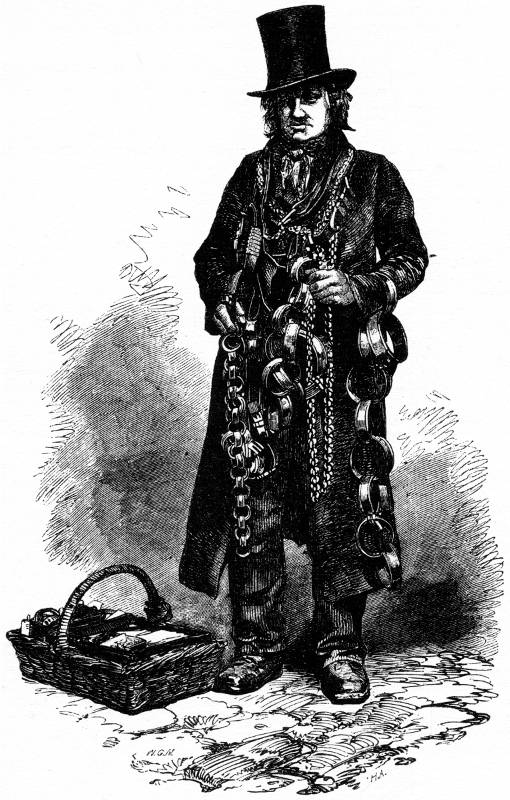
THE STREET-SELLER OF DOGS’ COLLARS.
[From a Daguerreotype by Beard.]
The old man informed me moreover that he did not think there were more than half-a-dozen street-sellers besides himself who made leather collars; it was a poor trade, he said, and though the other makers were younger than he was, he “could lick them all at stitching.” He did not believe, he told me, that any of the collar-sellers sold more than he did—if as many—for he had friends that perhaps other men had not. He makes collars now sometimes, and wishes he could get some shopkeeper to sell them for him, and then maybe, he says, he could obtain a little more tea and shuggar, and assist a sister-in-law of his whom he tells me is in great distress, and whom he has been in the habit of assisting for many years, notwithstanding his poverty. The old man, during the recital of his troubles, was affected to tears several times—especially when he spoke of his wife, and the distress he had undergone—and with much sincerity blessed God for the comforts that he now enjoys.
Of the Street-Sellers of Tools.
These people are of the same class as the sellers of hardware articles, though so far a distinct body that they generally sell tools only.
The tools are of the commonest kind, and supplied by the cheapest swag-shops, from which establishments the majority of the street-traders derive their supplies. They are sometimes displayed on a small barrow, sometimes on a stall, and are mostly German-made.
The articles sold and the price asked—and generally obtained, as no extravagant profit is demanded—is shown by the following:—
Claw hammers, 6d. Large claw, black and glaze-faced, 1s. Pincers, 4d.; larger ones, 6d. Screw-drivers, from 2d. to 1s.! Flat-nose pliers, 6d. a pair; squares, 6d. to 1s. Carpenters’ oil-cans, from 9d. to 1s. 3d. Nests of brad-awls (for joiners, and in wooden cases), 6d. to 2s. Back saws, 1s. to 2s. 6d.
While many of the street-sellers of tools travel the several thoroughfares and suburbs of the metropolis, others vend tools of a particular kind in particular localities. These localities and sellers may be divided into four distinct classes:—(1) The street-sellers of tools in the markets; (2) The street-sellers of tools at the docks and warehouses; (3) The street-sellers of tools at mews, stable-yards, and job-masters’; and (4) The street-sellers of tools to working men at their workshops.
The markets which are usually frequented by the vendors of tools are Newgate and Leadenhall. There are, I am informed, only five or six street-sellers who at present frequent these markets on the busy days. The articles in which they deal are butchers’ saws, cleavers, steels, meat-hooks, and knives; these saws they sell from 2s. to 4s. each; knives and steels, from 9d. to 1s. 3d. each; cleavers, from 1s. 6d. to 2s. each; and meat-hooks at 1d., 2d., and 3d. each, according to the size. It is very seldom, however, that cleavers are sold by the street-sellers, as they are too heavy to carry about. I am told that the trade of the tool-sellers in Newgate and Leadenhall markets is now very indifferent, owing chiefly to the butchers having been so frequently imposed upon by the street-sellers, that they are either indisposed or afraid to deal with them. When the itinerant tool-sellers are not occupied at the markets they vend their wares to tradesmen at private shops, but often without success. “It is a poor living,” said one of the hawkers to me; “sometimes little better than starving. I have gone out a whole day and haven’t taken a farthing.” I am informed that the greater portion of these street-sellers are broken-down butchers. The tools they vend are purchased at the Brummagem warehouses. To start in this branch of the street-business 5s. or 10s. usually constitutes the amount of capital invested in stock, and the average takings of each are about 2s. or 2s. 6d. a day.
“A dozen years back twenty such men offered saws at my shop,” said a butcher in a northern suburb to me; “now there’s only one, and he seems half-starving, poor fellow, and looks very hungrily at the meat. Perhaps it’s a way he’s got to have a bit given him, as it is sometimes.”
The only street-seller of tools at present frequenting Billingsgate-market is an elderly man, who is by trade a working cutler. The articles he displays upon his tray are oyster-knives, fish-knives, steels, scissors, packing-needles, and hammers. This tradesman makes his own oyster-knives and fish-knives; the scissors and hammers are second-hand; and the packing-needles are bought at the ironmongers. Sometimes brad-awls, gimlets, nails, and screws form a part of his stock. He informed me that he had frequented Billingsgate-market upwards of ten years. “Wet or dry,” he said, “I am here, and I often suffer from rheumatics in the head and limbs. Sometimes I have taken only a few pence; on other occasions I have taken 3s. or 4s., but this is not very often. However, what with the little I take at Billingsgate, and at other places, I can just get a crust, and go on from day to day.”
The itinerant saw-sellers offer their goods to any one in the street as well as at the shops, and are at the street markets on Saturday evenings with small saws for use in cookery. With the butchers they generally barter rather than sell, taking any old saw in exchange with so much money, for a new one. “I was brought up a butcher,” said one of these saw-sellers, “and worked as a journeyman, off and on, between twenty and thirty year. But I grew werry delicate from rheumaticks, and my old ’ooman was bad too, so that we once had to go into Marylebone work’us. I had no family living, perhaps they’re better as it is. We discharged ourselves after a time, and they gave us 5s. I then thought I’d try and sell a few saws and things. A master-butcher that’s been a friend to me, lent me another 5s., and I asked a man as sold saws to butchers to put me in the way of it, and he took me to a swag-shop. I do werry badly, sir, but I’ll not deny, and I can’t deny—not anyhow—when you tell me Mr. —— told you about me—that there’s ’elps to me. If I make a bargain, for so much; or for old saws or cleavers, or any old butcher thing, and so much; a man wot knows me says, ‘Well, old boy, you don’t look satisfied; here’s a bit of steak for you.’ Sometimes it’s a cut off a scrag of mutton, or weal; that gives the old ’ooman and me a good nourishing bit of grub. I can work at times, and every Saturday a’most I’m now a porter to a butcher. I carries his meat from Newgate, when he’s killed hisself, and wants no more than a man’s weight from the market; and when he ’asn’t killed hisself in course he hires a cart. I makes 1s. a day the year round, I think, on saws, and my old ’ooman makes more than ’arf as much at charing, and there’s the ’elps, and then I gets 18d. and my grub every Saturday. It’s no use grumbling; lots isn’t grubbed ’arf so well as me and my old ’ooman. My rent’s 20d. a week.”
The articles vended by the second class of the street-sellers of tools, or those whose purchasers are mostly connected with the docks and warehouses, consist of iron-handled claw-hammers, spanners, bed-keys, and corkscrews. Of these street-traders there are ten or twelve, and the greater portion of them are blacksmiths out of employ. Some make their own hammers, whereas others purchase the articles they vend at the swag-shops. “We sell more hammers and bed-keys than other things,” said one, “and sometimes we sells a corkscrew to the landlord of a public-house, and then we have perhaps half-a-pint of beer. Our principal customers for spanners are wheelwrights. Those for hammers are egg-merchants, oilmen, wax and tallow-chandlers, and other tradesmen who receive or send out goods in wooden cases; as well as chance customers in the streets.” The amount of capital required to start in the line is from 5s. to 15s.: “it is not much use,” said one, “to go to shop with less than 10s.”
A third class of the street-sellers of tools are the vendors of curry-combs and brushes, mane-combs, scrapers, and clipping instruments; and these articles are usually sold at the several mews, stable-yards, and jobbing-masters’ in and about the metropolis. The sellers are mostly broken-down grooms, who, not being able to obtain a situation, resort to street-selling as a last shift. “It is the last coach, when a man takes to this kind of living,” said one of my informants, a groom in a “good place;” “and it’s getting worse and worse. The poor fellows look half-starved. Why, what do you think I gave for these scissors? I got ’em for 6d. and a pint of beer, and I should have to give perhaps half-a-crown for ’em at a shop.” The trade is fast declining, and to gentlemen’s carriage mews the street-sellers of such tools rarely resort, as the instruments required for stable-use are now bought, by the coachmen, of the tradesmen who supply their masters. At the “mixed mews,” as I heard them called, there are two men who, along with razors, knives, and other things, occasionally offer “clipping” and “trimming” scissors. Four or five years ago there were four of these street-sellers. The trimming-scissors are, in the shops, 1s. 6d. to 2s. 6d. a pair. There is one trade still carried on in these places, although it is diminutive compared to what it was: I allude to the sale of curry-combs. Those vended by street-sellers at the mews are sold at 7d. or 6d. The best sale for these curry-combs is about Coventry-street and the Haymarket, and at the livery-stables generally. Along with curry-combs, the street-vendors sell wash-leathers, mane-combs (horn), sponges (which were like dried moss for awhile, I was told, got up by the Jews, but which are now good), dandy-brushes (whalebone-brushes, to scrape dirt from a horse’s legs, before he is groomed), spoke-brushes (to clean carriage-wheels), and coach-mops. One dweller in a large West-end mews computed that 100 different street-traders resorted thither daily, and that twenty sold the articles I have specified. In this trade, I am assured, there are no broken-down coachmen or grooms, only the regular street-sellers. A commoner curry-comb is sold at 2d. (prime cost 1s. 3d. a dozen), at Smithfield, on market-days, and to the carmen, and the owners of the rougher sort of horses; but this trade is not extensive.
There may be ten men, I am told, selling common “currys;” and they also sell other articles (often horse oil-cloths and nose-bags) along with them.
The last class of street-sellers is the beaten-out mechanic or workman, who, through blindness, age, or infirmities, is driven to obtain a livelihood by supplying his particular craft with their various implements. Of this class, as I have before stated, there are six men in London who were brought up as tailors, but are now, through some affliction or privation, incapacitated from following their calling. These men sell needles at four and five for 1d.; thimbles 1d. to 2d. each; scissors from 1s. to 2s. 6d.; and wax 1d. the lump. There are also old and blind shoemakers, who sell a few articles of grindery to their shopmates, as they term them, as well as a few decayed members of other trades, hawking the implements of the handicraft to which they formerly belonged. But as I have already given a long account of one of this class, under the head of the blind needle-seller, there is no occasion for me to speak further on the subject.
From one of the street-traders in saws I had the following account of his struggles, as well as the benefit he received from teetotalism, of which he spoke very warmly. His room was on the fourth floor of a house in a court near Holborn, and was clean and comfortable-looking. There were good-sized pictures, in frames, of the Queen, the Last Supper, and a Rural Scene, besides minor pictures: some of these had been received in exchange for saws with street-picture-sellers. A shelf was covered with china ornaments, such as are sold in the streets; the table had its oil-skin cover, and altogether I have seldom seen a more decent room. The rent, unfurnished, was 2s. a week.
“I’ve been eight years in this trade, sir,” the saw-seller said, “but I was brought up to a very different one. When a lad I worked in a coal-pit along with my father, but his behaviour to me was so cruel, he beat me so, that I ran away, and walked every step from the north of England to London. I can’t say I ever repented running away—much as I’ve gone through. My money was soon gone when I got to London, and my way of speaking was laughed at. [He had now very little of a provincial accent.] That’s fourteen year back. Why, indeed, sir, it puzzles me to tell you how I lived then when I did live. I jobbed about the markets, and slept, when I could pay for a lodging, at the cheap lodging-houses; so I got into the way of selling a few things in the streets, as I saw others do. I sold laces and children’s handkerchiefs. Sometimes I was miserable enough when I hadn’t a farthing, and if I managed to make a sixpence I got tipsy on it. For six weeks I slept every night in the Peckham Union. For another five or six weeks I slept every night in the dark arches by the Strand. I’ve sometimes had twenty or thirty companions there. I used to lie down on the bare stones, and was asleep in a minute, and slept like a top all night, but waking was very bad. I felt stiff, and sore, and cold, and miserable. How I lived at all is a wonder to me. About eleven years ago I was persuaded to go to a Temperance Meeting in Harp Alley (Farringdon-street), and there I signed the pledge; that is, I made my mark, for I can’t read or write, which has been a great hinder to me. If I’d been a scholard a teetotal gent would have got me into the police three years ago, about the time I got married. I did better, of course, when I was a teetotaller—no more dark arches. I sold a few little shawls in the streets then, but it was hardly bread and butter and coffee at times. Eight year ago I thought I would try saw-selling: a shopkeeper advised me, and I began on six salt saws, which I sold to oilmen. They’re for cutting salt only, and are made of zinc, as steel would rust and dirty the salt. The trade was far better at first than it is now. In good weeks I earned 16s. to 18s. In bad weeks 10s. or 12s. Now I may earn 10s., not more, a week, pretty regular: yesterday I made only 6d. Oilmen are better customers than chance street-buyers, for I’m known to them. There’s only one man besides myself selling nothing but saws. I walk, I believe, 100 miles every week, and that I couldn’t do, I know, if I wasn’t teetotal. I never long for a taste of liquor if I’m ever so cold or tired. It’s all poisonous.”
The saws sold are 8 inch, which cost at the swag-shops 8s. and 8s. 6d. a dozen; 10 inch, 9s. and 9s. 6d.; and so on, the price advancing according to the increased size, to 18 inch, 13s. 6d. the dozen. Larger sizes are seldom sold in the streets. The second man’s earnings, my informant believed, were the same as his own.
The wife of my informant, when she got work as an embroideress, could earn 11s. and 12s. At present she was at work braiding dresses for a dressmaker, at 2½d. each. By hard work, and if she had not her baby to attend to, she could earn no more than 7½d. a day. As it was she did not earn 6d.
Of the Beggar Street-Sellers.
Under this head I include only such of the beggar street-sellers as are neither infirm nor suffering from any severe bodily affliction or privation. I am well aware that the aged—the blind—the lame and the halt often pretend to sell small articles in the street—such as boot-laces, tracts, cabbage-nets, lucifer-matches, kettle-holders, and the like; and that such matters are carried by them partly to keep clear of the law, and partly to evince a disposition to the public that they are willing to do something for their livelihood. But these being really objects of charity, they belong more properly to the second main division of this book, in which the poor, or those that can’t work, and their several means of living, will be treated of.
Such, though beggars, are not “lurkers”—a lurker being strictly one who loiters about for some dishonest purpose. Many modes of thieving as well as begging are termed “lurking”—the “dead lurk,” for instance, is the expressive slang phrase for the art of entering dwelling-houses during divine service. The term “lurk,” however, is mostly applied to the several modes of plundering by representations of sham distress.
It is of these alone that I purpose here treating—or rather of that portion of them which pretends to deal in manufactured articles.
In a few instances the street-sellers of small articles of utility are also the manufacturers. Many, however, say they are the producers of the things they offer for sale, thinking thus to evade the necessity of having a hawker’s licence. The majority of these petty dealers know little of the manufacture of the goods they vend, being mere tradesmen. Some few profess to be the makers of their commodities, solely with the view of enlisting sympathy, and thus either selling the trifles they carry at an enormous profit, or else of obtaining alms.
An inmate of one of the low lodging-houses has supplied me with the following statement:—“Within my recollection,” says my informant, “the great branch of trade among these worthies, was the sale of sewing cotton, either in skeins or on reels. In the former case, the article cost the ‘lurkers’ about 8d. per pound; one pound would produce thirty skeins, which, sold at one penny each, or two for three halfpence, produced a heavy profit. The lurkers could mostly dispose of three pounds per day; the article was, of course, damaged, rotten, and worthless.
“The mode of sale consisted in the ‘lurkers’ calling at the several houses in a particular district, and representing themselves as Manchester cotton spinners out of employ. Long tales, of course, were told of the distresses of the operatives, and of the oppression of their employers; these tales had for the most part been taught them at the padding-ken, by some old and experienced dodger of ‘the school;’ and if the spokesman could patter well, a much larger sum was frequently obtained in direct alms than was reaped by the sale.”
Cotton on reels was—except to the purchaser—a still better speculation; the reels were large, handsomely mounted, and displayed in bold relief such inscriptions as the following:—
PIKE’S PATENT COTTON. 120 Yards.
The reader, however, must divide the “120 yards,” here mentioned, by 12, and then he will arrive at something like the true secret as to the quantity; for the surface only was covered by the thread.
“The ‘cotton Lurk’ is now ‘cooper’d’ (worn out); a more common dodge—and, of course, only an excuse for begging—is to envelope a packet of ‘warranted’ needles, or a few inches of ‘real Honiton lace’ in an envelope, with a few lines to the ‘Lady of the House,’ or a printed bill, setting forth the misery of the manufacturers, and the intention of the parties leaving the ‘fakement’ to presume to call for an answer in a few hours. I subjoin a copy of one of these documents.
‘THE LACE-MAKERS’ APPEAL.
‘It is with extreme regret we thus presume to trespass on your time and attention, we are Lace Makers by trade, and owing to the extensive improvements in Machinery, it has made hand labour completely useless.
‘So that it has thrown hundreds of honest and industrious men out of employment, your petitioners are among the number. Fifteen men with their families have left their homes with the intention of emigrating to South Australia, and the only means we have of supporting ourselves till we can get away, is by the sale of some Frame Thread and Traced Lace Collars of our own manufacture, at the following low prices—Fashionable Frame Lace Collars 3d. each, warranted to wash and wear well; Frame Thread Collars 6d. each, Traced Lace Collars 1s. each, the best that can be made, and we trust we shall meet with that encouragement from the Friends of Industry which our necessities require.
‘The enclosed two 6d.
‘The party calling for this, will have an assortment of the Newest Patterns of Frame Thread Lace and Edgings for your inspection, and the smallest purchase will be thankfully received and gratefully remembered by G. DAVIS, Lace Makers.
‘We beg to state that a number of the families being destitute of clothing, the bearer is authorised to receive any articles of such in exchange for Lace, Edgings or Collars.
‘ALLEN, Printer, Long-row, Nottingham.’
“These are left by one of ‘the school’ at the houses of the gentry, a mark being placed on the door post of such as are ‘bone’ or ‘gammy,’ in order to inform the rest of ‘the school’ where to call, and what houses to avoid. As the needles cost but a few pence per thousand, and the lace less than one halfpenny per yard—a few purchasers of the former at 1s. per packet (25 needles), or of the latter at 2s. 6d. per yard, is what these ‘lurkers’ term a ‘fair day’s work for a fair day’s wages.’
“Another and very extensive branch of the pseudo-‘manufacturing’ fraternity is to be found among the sham street-sellers of cutlery.
“At some of the least respectable of the swag-shops may be bought all the paraphernalia requisite in order to set up as the real manufacturer of Sheffield and ‘Brummagem’ goods—including, beside the cutlery, chamois-leather aprons, paper caps (ready crushed, to give them the appearance of age and usage), and last, but not least, a compound of black lead and tallow, to ‘take the granny’ off them as has white ’ands, so as the flat’s shan’t ‘tumble’ to the ‘unworkmanlike’ appearance of the palms of the ‘lurker.’
“Thus ‘got up’ for the part,” continues my informant, “and provided with a case of razors, which perhaps has cost him two groats, and (if he can raise as much) a noggin o’ rum to ‘give him cheek’ and make him ‘speak up’ to his victims—‘Jack Beaver,’ the ‘king of the street-cutlers,’ will sally forth, and meet, intercept, and follow any gentleman who seems a ‘likely spec,’ till worried perhaps by importunity, the ‘swell’ buys what he does not want, and, I need scarcely add, what he cannot use. Next, in importance, to ‘Jack Beaver,’ is the notorious ‘Pat Connor.’ Pat ‘does nothing on the blob,’ that is to say (he does not follow people and speak to them on the streets). His ‘dodge’—and it has been for years a successful one—is to go round to the public offices, dressed as before described, with the exception of being in his shirt sleeves (he has every day a clean shirt), and teaze the clerks till they purchase a pen-knife. He has been known to sell from fifteen to twenty knives in one day, at two shillings each, the first cost being about threepence-halfpenny. Of course he is often interrupted by porters and other officials, but he always carries in one hand a roll of wire, and a small hammer in the other, and having got the name of some gentleman up stairs, he pretends that he is going to mend Mr. So-and-so’s bell. This worthy, a short time ago, made free—in the Custom House—with a timepiece, belonging to one of the clerks, for which the ‘Sheffield manufacturer’ got twelve months in Newgate. I have not seen him since,” adds my informant, “and therefore imagine that he is now taking a provincial tour.”
Of the “House of Lords,” a Street-Seller’s Defunct Club.
I have given an account of a defunct club, of which the “paper workers” were the chief members; and I have now to do the same of a society not very dissimilar in its objects, of which the street-sellers of manufactured articles constituted the great majority. It was called the “house of lords,” and was established about eight years ago, at the Roebuck-tavern, Holborn, and existed three years. Its object was to relieve its members in sickness. The subscription was 2d. a week, and the relief to a sick member was as many pennies a week as the club contained members, with, in any pressing case, an additional halfpenny, which the members paid into the fund, over and above their weekly subscription. For the greater part of its existence the club contained ninety members (a few of them honorary), and there were very few cases of “declaring on the fund” by sick members. At one period for many weeks there were no such declarations, and the “house of lords” had 30l. in hand. One of the leading members, a very intelligent man, who had “a good connection in hardware,” had taken great pains to prepare a code of rules, which, having been approved by the other members, it was considered time that the “house of lords” should be enrolled. Delays, however, intervened. “To tell you the truth, sir,” one of them said, “we were afraid to employ an attorney, and thought of waiting upon Mr. Tidd Pratt ourselves, but it wasn’t to be.”
The club was, moreover, looked upon as somewhat select. “No costers were admitted, sir,” I was told by a hardware seller in the streets; “not but what there’s many very industrious and honest men among them, but they’re in a different line, and are a different sort of people to us.” The members met once a week, and, though they were merry and talkative enough, drunkenness was strongly discouraged. It was common for the subscribers who were regarded as the “geniuses” of the trade, to take counsel together, and “invent any new move.” They were reputed to be knowing among the most knowing, in all street arts and dodges, and the way in which the club came to an end, considering the strong claims to knowingness of its members, was curious enough.
One Saturday evening a member who was considered a respectable man, and was sufficiently regular in his payments, appeared at the weekly meeting, introducing his landlord, who, as a non-member, had to pay 1d. for admission. The man told how his family had suffered from illness, and how he had been ill, and got into arrears of rent, for he did not like to distress the fund; and how his landlord was then in possession of his “sticks,” which must be sold in the morning if he could not pay 15s.; and, moreover, how his landlord—a very kind-hearted, indulgent man—was forced to do this, for he himself was in difficulties. The members voted that the 15s. should be advanced; but before the next meeting night it was discovered that the statement of the poor member in arrears was an imposition. The landlord was merely a confederate; the worthy couple had been drinking together, and, to prolong their tippling, had hit upon the roguish scheme I have mentioned.
This, among other things, lowered the confidence of the members. The numbers fell off until it was thought best to “wind up the concern.” The small funds in hand were fairly apportioned among the remaining members, and the club ceased to exist.
Another Street-sellers’ Club has recently been formed by the men themselves, of which the following is the prospectus, and it is to be hoped that this attempt on the part of the street-folk to better their condition will meet with a better fate than its predecessor:—
Our motto is “To live honestly by daily perseverance and industry.”
Street Mechanics, Labourers, Hawkers, &c. PROTECTION ASSOCIATION, HELD AT THE LAMB TAVERN, NEW TURNSTILE, HOLBORN, Proprietor, Mr. White.
The above-named classes are kindly invited to attend a Meeting convened for
Sunday Evening next,
And every succeeding Sunday Evening, at the above house, to carry out the object unanimously agreed to by the Enrolled Members and the General Committee. Furthermore, to take into consideration the most appropriate means whereby we may be enabled to assist each other in the time of adversity.
COMMITTEE:
Mr.Taylor, Chairman,Mr.Thoresby,
—Travers,—Dowse,
—Cowan,—Manly,
—Moody,—Morris,
—Moore,—Lawson,
—Hand,—Lamb,
—Martin.
Mr. J. White, Treasurer. Mr. F. A. Thoresby, Secretary.
The chair will be taken at Seven o’clock, and the Committee are requested to be in attendance one hour previous.
Of the Street-Sellers of Crockery and Glass-Wares.
We now come to a new class of the street-sellers of manufactured articles—viz., the “crocks,” as they are termed. I have before alluded to one characteristic of these traders—that they all strive to be barterers in preference to salesmen. They also present other varying qualities when compared with other classes of street-sellers. Of these “crocks,” there are, from the best data I could obtain from men in the trade, and from the swag-shop people who supply them, 250 men and 150 women; of these, 120 couples (man and woman) “work” together; of the remainder, sometimes two men work in unison, and some women work singly. On my inquiring of one of these street folk if ever three worked together, I was told that such was never the case, as the “crocks” would quote a saying: “Two’s good company, three’s none at all.” Of the men and women carrying on this traffic conjointly more than half are married; showing a difference of habits to the costermongers. The reason assigned to me by one of the class (himself once a costermonger) was that the interest of the man and woman in the business was closer than in costermongering, while the serviceableness of a woman helpmate in “swopping,” or bartering, was much greater. This prompts the women, I am told, even if they are unmarried at the outset, to insist upon wedlock; and the man—sometimes, perhaps, to secure a valuable “help,” at others, it may be, from better motives—consents to what in this rank of life, and under the circumstances of such street-traders, is more frequently the woman’s offer than the man’s. The trade, in its present form, has not been known more than twelve years.
The goods, which are all bought at the crock swag-shops, of which an account is given below, are carried in baskets on the head, the men having pads on the cloth caps which they wear—or sometimes a padding of hay or wool inside the cap—while the women’s pads are worn outside their bonnets or caps, the bonnet being occasionally placed on the basket. The goods, though carried in baskets on the head to the locality of the traffic, are, whilst the traffic is going on, usually borne from house to house, or street to street, on the arm, or when in large baskets carried before them by the two hands. These baskets are strongly made; the principal mart is close to Spitalfields-market.
The men engaged in this trade are usually strong, robust, and red-faced. Most of them are above the middle stature; very few are beyond middle age, and the majority of them are under or little more than 30. The women, more than the men, have contracted a stoop or bend to one side, not so much by carrying weights on the head, as by carrying them on the arm. The weights they carry are from three to five stone. The dress of the men is the same as the costermongers, with the exception of shooting-cut jackets being more frequent among the “crocks” than the costers, and red plush waistcoats are very popular with them. When not at work, or on Sundays—for they never work on the Sabbath, though they do not go to church or chapel—these men are hardly ever seen to wear a hat. Both men and women wear strong boots and, unless when “hard-up,” silk handkerchiefs. Their places of residence are, as regards the majority, in Spitalfields, Bethnal-green, and Shoreditch. Of the others the greater portion reside in the neighbourhood of Kent-street, in the Borough. Their abode usually consists of one room, which is in most cases more comfortable, and better furnished than those of the costers. “We pick up a tidy ornament now and then,” one crock said, “such as a picture, in the way of swop, and our good women likes to keep them at home for a bit of show.” They live well, in general, dining out almost every day; and I am told that, as a body, they have fewer children than any other class of street-folk.
The trade is almost entirely itinerant. Crock-sellers are to be seen at street-markets on Saturday nights, but they are not the regular crocks, who, as I have said, do not care to sell. The crocks go on “rounds,” the great trade being in the suburbs. Sometimes a round lasts a week, the couple resting at a fresh place every night. Others have a round for each day of the week.
The long rounds are to Greenwich, Woolwich, Northfleet, Gravesend, Stroud, Rochester, Chatham, and then to Maidstone. Some will then make Maidstone the head-quarters, and work the neighbouring villages—such as East Farleigh, Town Malling, Yalding, Aylesford, and others. The return to town may be direct by railway, or by some other route, if any stock remains unsold. On these long rounds the higher priced goods are generally carried, and stock is forwarded from London to the “crock” whilst on the round, if the demand require it. Another long round is Vauxhall, Wandsworth, Kingston-on-Thames, and Guildford, with divergings to the villages. The return from Guildford is often by Richmond, Kew, &c. A third long round is Hampstead, Kilburn, Barnet, Watford, and so on to St. Alban’s. The other long rounds are less frequented; but some go to Uxbridge; others to Windsor and Eton, and as far as Reading; others to Cambridge, by Tottenham, Edmonton, Ware, &c. When no trade is to be done close to London, the “crocks” often have themselves and their wares conveyed to any town by rail. The short, or town rounds, are the Dover-road, New Kent-road, Walworth, Camberwell, and back by Newington; Kennington, Brixton, Clapham, and back by Vauxhall; Bayswater, Notting-hill, and back by Paddington; Camden Town, St. John’s Wood, and Hampstead; Stoke Newington, Dalston, Clapton, Shacklewell, and Stamford-hill; Mile-end, Stratford, and Bow; Limehouse, Poplar, and back by the Commercial-road. It would be easy to cite other routes, but these show the character of the trade. Some occupy two days. A few crocks “work” the poor neighbourhoods, such as Hoxton, Kingsland-road, parts of Hackney, &c., and cry, “Here we are—now, ladies, bring out your old hats, old clothes, old umbrellers, old anythink; old shoes, metal, old anythink; here we are!”
The trade, from the best information I could acquire, is almost equally divided into what may be called “fancy” and “useful” articles. A lodging-letter, for instance, will “swop” her old gowns and boots, and drive keen bargains for plates, dishes, or wash-hand basins and jugs. A housekeeper, who may be in easier circumstances, will exchange for vases and glass wares. Servant-maids swop clothes and money for a set of china, “’gainst they get married.” Perhaps there are no more frequent collisions between buyer and seller than in the crock swag-shops. A man who had once been an assistant in one of these places, told me that some of the “crocks” were tiresome beyond measure, and every now and then a minute or two was wasted by the “crock” and the swag-shopman in swearing one at another. Some of these street traffickers insist upon testing the soundness of every article, by striking the middle finger nail against it. This they do to satisfy their customers also, in the course of trade, especially in poor neighbourhoods.
From the best data at my command, one quarter of the goods sold at the swag-shops are sold to the crock dealers I have described, and in about equal proportions as to amount in fancy or useful articles. There are, in addition to the crock barterers, perhaps 100 traders who work the poor streets, chiefly carrying their goods in barrows, but they sell, and though they will barter, do not clamour for it. They cry: “Free trade for ever! Here’s cup and saucer for a halfpenny! Pick ’em out at your own price! Tea-pot for three half-pence! Pick ’em out! Oho! oho! Giving away here!” They rattle dishes and basins as they make this noise. These men are all supplied at the swag-shops, buying what is called “common lots,” and selling at 30 per cent. profit. Such traders have only been known in the streets for five years, and for three or four months of the year half of these “go to costering.” The barrows are about seventy in number, and there are thirty stalls. Seven-eighths of the “barrow-crocks” are men. The swag-barrowmen also sell small articles of crockery wares, and altogether one half of the trade of the crock swag-shops (which I have described) is a trade for the streets.
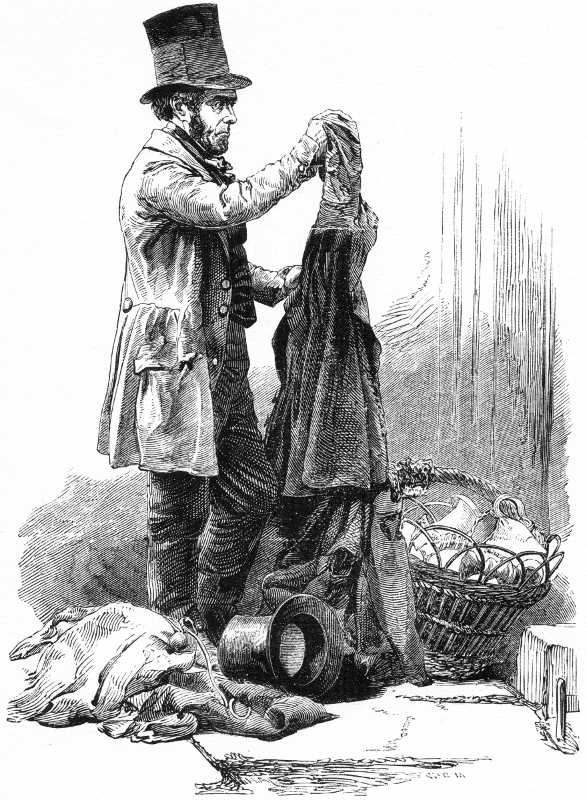
THE STREET-SELLER OF CROCKERY-WARE
BARTERING FOR OLD CLOTHES.
[From a Daguerreotype by Beard.]
Of the way in which the “crock barterers” dispose of their wares, &c., I have given an account below. They are rapidly supplanting the “old clo’” trade of the Jews.
The hucksters of crockery-ware are a considerable class. One who has great experience in the business thinks there must be some hundreds employed in it throughout London. He says he meets many at the swag warehouses on the evenings that he goes there. He is often half an hour before he can be served. There are seven or eight swag warehouses frequented by the hucksters, and at the busy time my informant has often seen as many as twenty-five at each house, and he is satisfied that there must be three or four hundred hucksters of china and glass throughout the metropolis. The china and glass in which they deal are usually purchased at the east end of the town, upon the understanding that if the huckster is unable to dispose of them in the course of the day the articles will be taken back in the morning, if uninjured, and the money returned. The hucksters usually take out their goods early in the day. Their baskets are commonly deposited at the warehouse, and each warehouse has from thirty to forty baskets left there over-night, when the unsold articles are returned. The baskets are usually filled with china and glass and ornaments, to the amount of from 5s. to 15s., according to the stock-money of the huckster. A basket filled with 15s. worth of china is considered, I am told, “a very tidy stock.” In the same neighbourhood as they get the crockery, are made the baskets in which it is carried. For these baskets they pay from 2s. to 6s., and they are made expressly for the hucksters; indeed, on one side of a well-known street at the east end, the baskets made in the cellars may be seen piled outside the houses up to the second-floor windows. The class of persons engaged in hawking china through the metropolis are either broken-down tradesmen or clerks out of place, or Jews, or they may be Staffordshire men, who have been regularly bred to the business. They carry different kinds of articles. The Staffordshire man may generally be known by the heavy load of china that he carries with him. He has few light or fancy articles in his basket; it is filled chiefly with plates and dishes and earthenware pans. The broken-down tradesmen carries a lighter load. He prefers tea services and vases, and rummers and cruet-stands, as they are generally of a more delicate make than the articles carried by the Staffordshire men. The Jew, however, will carry nothing of any considerable weight. He takes with him mostly light, showy, Bohemian goods—which are difficult “to be priced” by his customers, and do not require much labour to hawk about. The hucksters usually start on their rounds about nine. There are very few who take money; indeed they profess to take none at all. “But that is all flam,” said my informant. “If any one was to ask me the price of an article in an artful way like, I shouldn’t give him a straight-forward answer. To such parties we always say, ‘Have you got any old clothes?’” The hucksters do take money when they can get it, and they adopt the principle of exchanging their goods for old clothes merely as a means of evading the licence. Still they are compelled to do a great deal in the old clothes’ line. When they take money they usually reckon to get 4d. in the shilling, but at least three-fourths of their transactions consist of exchanges for old clothes. “A good tea-service we generally give,” said my informant, “for a left-off suit of clothes, hat, and boots—they must all be in a decent condition to be worth that. We give a sugar-basin for an old coat, and a rummer for a pair of old Wellington boots. For a glass milk-jug I should expect a waistcoat and trowsers, and they must be tidy ones too. But there’s nothing so saleable as a pair of old boots to us. There is always a market for old boots, when there is not for old clothes. You can any day get a dinner out of old Wellingtons; but as for coats and waistcoats—there’s a fashion about them, and what pleases one don’t another. I can sell a pair of old boots going along the streets if I carry them in my hand. The snobs will run after us to get them—the backs are so valuable. Old beaver hats and waistcoats are worth little or nothing. Old silk hats, however, there’s a tidy market for. They are bought for the shops, and are made up into new hats for the country. The shape is what is principally wanted. We won’t give a farden for the polka hats with the low crowns. If we can double an old hat up and put it in our pockets, it’s more valuable to us than a stiff one. We know that the shape must be good to stand that. As soon as a hatter touches a hat he knows by the touch or the stiffness of it whether it’s been ‘through’ the fire or not; and if so, they’ll give it you back in a minute. There is one man who stands in Devonshire-street, Bishopsgate-street, waiting to buy the hats of us as we go into the market, and who purchases at least thirty dozen of us a week. There will be three or four there besides him looking out for us as we return from our rounds, and they’ll either outbid one another, according as the demand is, or they’ll all hold together to give one price. The same will be done by other parties wanting the old umbrellas that we bring back with us. These are valuable principally for the whalebone. Cane ribbed ones are worth only from 1d. to 2d., and that’s merely the value of the stick and the supporters. Iron skewers are made principally out of the old supporters of umbrellas.” The china and crockery bought by the hucksters at the warehouses are always second-rate articles. They are most of them a little damaged, and the glass won’t stand hot water. Every huckster, when he starts, has a bag, and most of them two—the one for the inferior, and the other for the better kind of old clothes he buys. “We purchase gentlemen’s left-off wearing apparel. This is mostly sold to us by women. They are either the wives of tradesmen or mechanics who sell them to us, or else it is the servant of a lodging-house, who has had the things given to her, and with her we can deal much easier than the others. She’s come to ’em light, and of course she parts with ’em light,” said the man, “and she’ll take a pair of sugar basins worth about 6d., you know, for a thing that’ll fetch two or three shillings sometimes. But the mistresses of the houses are she-dragons. They wants a whole dinner chany service for their husband’s rags. As for plates and dishes, they think they can be had for picking up. Many a time they sells their husband’s things unbeknown to ’em, and often the gentleman of the house coming up to the door, and seeing us make a deal—for his trowsers maybe—puts a stop to the whole transaction. Often and often I’ve known a woman sell the best part of her husband’s stock of clothes for chany ornaments for her mantelpiece. And I’m sure the other day a lady stripped the whole of her passage, and gave me almost a new great coat, that was hanging up in the hall, for a few trumpery tea-things. But the greatest ‘screws’ we has to deal with are some of the ladies in the squares. They stops you on the sly in the streets, and tells you to call at their house at sitch a hour of the day, and when you goes there they smuggles you quietly into some room by yourselves, and then sets to work Jewing away as hard as they can, pricing up their own things, and downcrying yourn. Why, the other day I was told to call at a fashionable part of Pimlico, so I gave a person 3d. to mind the child, and me and my good woman started off at eight in the morning with a double load. But, bless you, when we got there, the lady took us both into a private room unbeknown to the servants, and wanted me to go and buy expressly for her a green and white chamber service all complete, with soap trays and brush trays, together with four breakfast cups—and all this here grand set-out she wanted for a couple of old washed-out light waistcoats, and a pair of light trowsers. She tried hard to make me believe that the buttons alone on the waistcoats was worth 6d. a piece, but I knowed the value of buttons afore she was borned; at first start off I’m sure they wouldn’t have cost 1d. each, so I couldn’t make a deal of it no how, and I had to take all my things back for my trouble. I asked her even for a pint of beer, but she wouldn’t listen to no such thing. We generally cry as we go, ‘any old clothes to sell or exchange,’ and I look down the area, and sometimes knock at the door. If I go out with a 15s. basket of crockery, may be after a tidy day’s work I shall come home with 1s. in my pocket (perhaps I shall have sold a couple of tumblers, or half a dozen plates), and a bundle of old clothes, consisting of two or three old shirts, a coat or two, a suit of left-off livery, a woman’s gown may be, or a pair of old stays, a couple of pair of Wellingtons, and a waistcoat or so. These I should have at my back, and the remainder of my chany and glass on my head, and werry probably a humberella or two under my arm, and five or six old hats in my hand. This load altogether will weigh about three quarters of a cwt., and I shall have travelled fifteen miles with that, at least; for as fast as I gets rid on the weight of the crockery, I takes up the weight of the old clothes. The clothes I hardly know the value on till I gets to the Clothes Exchange, in Houndsditch. The usual time for the hucksters arriving there is between three and four in the winter, or between five and six in the summer. In fact, we must be at the Exchange at them hours, because there all our buyers is, and we can’t go out the next day until we’ve sold our lot. We can’t have our baskets stocked again until we’ve got the money for our old clothes.” The Exchange is a large square plot of damp ground, about an acre in extent, enclosed by a hoarding about eight feet high, on the top of which is a narrow sloping roof, projecting sufficiently forward to shelter one person from the rain. Across this ground are placed four rows of double seats, ranged back to back. Here meet all the Jew clothesmen, hucksters, dealers in second-hand shoes, left-off wardrobe keepers, hareskin dealers, umbrella dealers and menders, and indeed buyers and sellers of left-off clothes and worn-out commodities of every description. The purchasers are of all nations, and in all costumes. Some are Greeks, others Swiss, and others Germans; some have come there to buy up old rough charity clothing and army coats for the Irish market, others have come to purchase the hareskins and old furs, or else to pick up cheap old teapots and tea-urns. The man with the long flowing beard and greasy tattered gaberdine is worth thousands, and he has come to make another sixpence out of the rags and tatters that are strewn about the ground in heaps for sale. At a little before three o’clock the stream of rag-sellers sets in in a flood towards this spot. At the gate stands “Barney Aaron,” to take the half-penny admission of every one entering the ground. By his side stands his son with a leather pouch of half-pence, to give change for any silver that may be tendered. The stench of the old clothes is positively overpowering. Every one there is dressed in his worst. If he has any good clothes he would not put them on. Almost each one that enters has a bag at his back, and scarcely has he passed the gate before he is surrounded by some half dozen eager Jews—one feels the contents of the bundle on the huckster’s back—another clamours for the first sight. A third cries, “I’m sure you have something that’ll suit me.” “You know me,” says a fourth, “I’m a buyer, and give a good price.” “Have you got any breaking?” asks this Jew, who wants an old coat or two to cut up into cloth caps—“Have you got any fustian, any old cords, or old boats?” And such is the anxiety and greediness of the buyers, that it is as much as the seller can do to keep his bundle on his back. At length he forces his way to a seat, and as he empties the contents of his sack on the ground, each different article is snapped up and eagerly overhauled by the different Jews that have followed him to his seat. Then they all ask what sum is wanted for the several things, and they, one and all, bid one quarter of the price demanded. I am assured that it requires the greatest vigilance to prevent the things being carried off unpaid in the confusion. While this scene is going on, a Jew, perched upon a high stage in the centre of the ground, shouts aloud to the multitude, “Hot wine, a half-penny a glass, here.” Beside him stands another, with smoking cans of hot eels; and next to this one is a sweet-meat stall, with a crowd of Jew boys gathered round the keeper of it, gambling with marbles for Albert rock and hardbake. Up and down between the seats push women with baskets of sheep’s trotters on their arms, and screaming, “Legs of mutton, two for a penny; who’ll give me a handsel—who’ll give me a handsel?” After them comes a man with a large tin can under his arm, and roaring, “Hot pea, oh! hot pea, oh!” In one corner is a coffee and beer shop. Inside this are Jews playing at draughts, or settling and wrangling about the goods they have bought of one another. In fact, in no other place is such a scene of riot, rags, and filth to be witnessed. The cause of this excitement is the great demand on the part of the poor, and the cheap clothiers as well, for those articles which are considered as worthless by the rich. The old shoes are to be cobbled up, and the cracks heel-balled over, and sold out to the working-classes as strong durable articles. The Wellingtons are to be new fronted, and disposed of to clerks who are expected to appear respectable upon the smallest salaries. The old coats and trowsers are wanted for the slop-shops; they are to be “turned,” and made up into new garments. The best black suits are to be “clobbered” up—and those which are more worn in parts are to be cut up and made into new cloth caps for young gentlemen, or gaiters for poor curates; whilst others are to be transformed into the “best boys’ tunics.” Such as are too far gone are bought to be torn to pieces by the “devil,” and made up into new cloth—or “shoddy” as it is termed—while such as have already done this duty are sold for manure for the ground. The old shirts, if they are past mending, are bought as “rubbish” by the marine store dealers, and sold as rags to the paper-mills, to be changed either into the bank-note, the newspaper, or the best satin note-paper.