Volume 1 — OF THE STREET-SELLERS OF STATIONERY, LITERATURE, AND THE FINE ARTS. (continued 2)
Reading edition
This informant did not represent that he had originated these little pieces of intelligence, only that he had been a party to their sale, and a party to originating one or two. Another patterer—and of a higher order of genius—told me that all which was stated was undoubtedly correct, “but me and my mates, sir,” he said, “did Haynau in another style. A splendid slum, sir! Capital! We assassinated him—mys-terious. Then about Rush. His hanging hisself in prison was a fake, I know; but we’ve had him lately. His ghost appeared—as is shown in the Australian papers—to Emily Sandford, and threatened her; and took her by the neck, and there’s the red marks of his fingers to be seen on her neck to this day!” The same informant was so loud in his praise of the “Ass-sass-sination” of Haynau that I give the account. I have little doubt it was his own writing. It is confused in passages, and has a blending of the “I” and the “we:”—
“We have just received upon undisputed authority, that, that savage and unmanly tyrant, that enemy to civil and religious liberty, the inhuman Haynau has at last finished his career of guilt by the hand of an assassin, the term assassin I have no doubt will greet harshly upon the ears of some of our readers, yet never the less I am compelled to use it although I would gladly say the average of outraged innocence, which would be a name more suitable to one who has been the means of ridden the world of such a despicable monster.”
[My informant complained bitterly, and not without reason, of the printer. “Average,” for instance (which I have italicised), should be “avenger.” The “average of outraged innocence!”]
“It appears by the Columns of the Corour le Constituonal of Brussels,” runs the paper, “that the evening before last, three men one of which is supposed to be the miscreant, Haynau entered a Cafe in the Neighbourhood of Brussels kept by a man in the name of Priduex, and after partaking of some refreshments which were ordered by his two companions they desired to be shown to their chambers, during their stay in the public or Travellers Room, they spoke but little and seemed to be very cautious as to joining in the conversations which was passing briskly round the festive board, which to use the landlord’s own words was rather strange, as his Cafe was mostly frequented by a set of jovial fellows. M. Priduex goes on to state that after the three strangers had retired to rest some time a tall and rather noble looking man enveloped in a large cloak entered and asked for a bed, and after calling for some wine he took up a paper and appeared to be reading it very attentively, in due time he was shown to bed and all passed on without any appearance of anything wrong until about 6 o’clock in the morning, when the landlord and his family, were roused by a noise over head and cries of murder, and upon going up stairs to ascertain the cause, he discovered the person who was [known] to be Marshal Haynau, lying on his bed with his throat cut in a frightful manner, and his two companions standing by his bed side bewailing his loss. On the table was discovered a card, on which was written these words ‘Monster, I am avenged at last.’ Suspicion went upon the tall stranger, who was not anywhere to be found, the Garde arms instantly were on the alert, and are now in active persuit of him but up to the time of our going to press nothing further has transpired.”
It is very easy to stigmatise the death-hunter when he sets off all the attractions of a real or pretended murder,—when he displays on a board, as does the standing patterer, “illustrations” of “the ’dentical pick-axe” of Manning, or the stable of Good,—or when he invents or embellishes atrocities which excite the public mind. He does, however, but follow in the path of those who are looked up to as “the press,”—as the “fourth estate.” The conductors of the Lady’s Newspaper sent an artist to Paris to give drawings of the scene of the murder by the Duc de Praslin,—to “illustrate” the blood-stains in the duchess’s bed-chamber. The Illustrated London News is prompt in depicting the locality of any atrocity over which the curious in crime may gloat. The Observer, in costly advertisements, boasts of its 20 columns (sometimes with a supplement) of details of some vulgar and mercenary bloodshed,—the details being written in a most honest deprecation of the morbid and savage tastes to which the writer is pandering. Other weekly papers have engravings—and only concerning murder—of any wretch whom vice has made notorious. Many weekly papers had expensive telegraphic despatches of Rush’s having been hung at Norwich, which event, happily for the interest of Sunday newspapers, took place in Norwich at noon on a Saturday. [I may here remark, that the patterers laugh at telegraphs and express trains for rapidity of communication, boasting that the press strives in vain to rival them,—as at a “hanging match,” for instance, the patterer has the full particulars, dying speech, and confession included—if a confession be feasible—ready for his customers the moment the drop falls, and while the criminal may still be struggling, at the very scene of the hanging. At a distance he sells it before the hanging. “If the Times was cross-examined about it,” observed one patterer, “he must confess he’s outdone, though he’s a rich Times, and we is poor fellows.” But to resume—]
A penny-a-liner is reported, and without contradiction, to have made a large sum by having hurried to Jersey in Manning’s business, and by being allowed to accompany the officers when they conducted that paltry tool of a vindictive woman from Jersey to Southampton by steamer, and from Southampton to London by “special engine,” as beseemed the popularity of so distinguished a rascal and homicide; and next morning the daily papers, in all the typographical honour of “leads” and “a good place,” gave details of this fellow’s—this Manning’s—conversation, looks, and demeanour.
Until the “respectable” press become a more healthful public instructor, we have no right to blame the death-hunter, who is but an imitator—a follower—and that for a meal. So strong has this morbid feeling about criminals become, that an earl’s daughter, who had “an order” to see Bedlam, would not leave the place until she had obtained Oxford’s autograph for her album! The rich vulgar are but the poor vulgar—without an excuse for their vulgarity.
“Next to murders, fires are tidy browns,” I was told by a patterer experienced both in “murders” and “fires.” The burning of the old Houses of Parliament was very popular among street-sellers, and for the reason which ensures popularity to a commercial people; it was a source of profit, and was certainly made the most of. It was the work of incendiaries,—of ministers, to get rid of perplexing papers,—of government officers with troublesome accounts to balance,—of a sporting lord, for a heavy wager,—of a conspiracy of builders,—and of “a unsuspected party.” The older “hands” with whom I conversed on the subject, all agreed in stating that they “did well” on the fire. One man said, “No, sir, it wasn’t only the working people that bought of me, but merchants and their clerks. I s’pose they took the papers home with ’em for their wives and families, which is a cheap way of doing, as a newspaper costs 3d. at least. But stop, sir,—stop; there wasn’t no threepennies then,—nothing under 6d., if they wasn’t more; I can’t just say, but it was better for us when newspapers was high. I never heard no sorrow expressed,—not in the least. Some said it was a good job, and they wished the ministers was in it.” The burning of the Royal Exchange was not quite so beneficial to the street-sellers, but “was uncommon tidy.” The fire at the Tower, however, was almost as great a source of profit as that of the Houses of Parliament, and the following statement shows the profit reaped.
My informant had been a gentleman’s servant, his last place being with a gentleman in Russell-square, who went to the East Indies, and his servant was out of a situation so long that he “parted with everything.” When he was at the height of his distress, he went to see the fire at the Tower, as he “had nothing better to do.” He remained out some hours, and before he reached his lodging, men passed him, crying the full and true particulars of the fire. “I bought one,” said the man, “and changed my last shilling. It was a sudden impulse, for I saw people buy keenly. I never read it, but only looked at the printer’s name. I went to him at the Dials, and bought some, and so I went into the paper trade. I made 6s. or 7s. some days, while the Tower lasted; and 3s. and 4s. other days, when the first polish was off. I sold them mostly at 1d. a piece at first. It was good money then. The Tower was good, or middling good, for from 14 to 20 days. There was at least 100 men working nothing but the Tower. There’s no great chance of any more great buildings being burnt; worse luck. People don’t care much about private fires. A man in this street don’t heed so much who’s burnt to death in the next. But the foundation-stone of the new Royal Exchange—fire led to that—was pretty fair, and portraits of Halbert went off, so that it was for two or three days as good as the Tower. Fires is our best friends next to murders, if they’re good fires. The hopening of the Coal Exchange was rather tidy. I’ve been in the streets ever since, and don’t see how I could possibly get out of them. At first I felt a great degradation at being driven to the life. I shunned grooms and coachmen, as I might be known to them. I didn’t care for others. That sort of feeling wears out though. I’m a widower now, and my family feels, as I did at first, that what I’m doing is ‘low.’ They won’t assist—though they may give me 1s. now and then—but they won’t assist me to leave the streets. They’ll rather blame me for going into them, though there was only that, or robbing, or starving. The fire at Ben. Caunt’s, where the poor children was burnt to hashes, was the best of the private house fires that I’ve worked, I think. I made 4s. on it one day. He was the champion once, and was away at a fight at the time, and it was a shocking thing, and so people bought.”
After the burning of York Minster by Jonathan Martin, I was told by an old hand, the (street) destruction of the best known public buildings in the country was tried; such as Canterbury Cathedral, Dover Castle, the Brighton Pavilion, Edinburgh Castle, or Holyrood House—all known to “travelling” patterers—but the success was not sufficiently encouraging. It was no use, I was told, firing such places as Hampton Court or Windsor Castle, for unless people saw the reflection of a great fire, they wouldn’t buy.
Of the Sellers of Second Editions.
These “second editions” are, and almost universally, second or later editions of the newspapers, morning and evening, but three-fourths of the sale may be of the evening papers, and more especially of the Globe and Standard.
I believe that there is not now in existence—unless it be in a workhouse and unknown to his fellows, or engaged in some other avocation and lost sight of by them—any one who sold “second editions” (the Courier evening paper being then in the greatest demand) at the time of the Duke of York’s Walcheren expedition, at the period of the battle of the Nile, during the continuance of the Peninsular war, or even at the battle of Waterloo. There were a few old men—some of whom had been soldiers or sailors, and others who have simulated it—surviving within these 5 or 6 years, and some later, who “worked Waterloo,” but they were swept off, I was told, by the cholera.
I was assured by a gentlemen who had a perfect remembrance of the “second editions” (as they were generally called) sold in the streets, and who had often bought them upwards of forty years ago, that a sketch in the “Monthly Review,” in a notice of Scott’s “Lord of the Isles” (published in 1815), gave the best notion he had met with of what the second edition sale really was. At the commencement of the sixth canto of his poem, Sir Walter, somewhat too grandiloquently, in the judgment of his reviewer, asks—
“O who, that shared them, ever shall forget The emotions of the spirit-rousing time, When breathless in the mart the couriers met, Early and late, at evening and at prime?”
“Who,” in his turn asks the reviewer, “can avoid conjuring up the idea of men with broad sheets of foolscap, scored with ‘VICTORIES’ rolled round their hats, and horns blowing loud defiance in each other’s mouth, from the top to the bottom of Pall-mall or the Haymarket, when he reads such a passage? We actually hear the Park and Tower guns, and the clattering of ten thousand bells, as we read, and stop our ears from the close and sudden intrusion of some hot and horn-fisted patriot, blowing ourselves, as well as Bonaparte to the devil!”
The horn carried by these “horn-fisted” men was a common tin tube, from two to three feet long, and hardly capable of being made to produce any sound beyond a sudden and discordant “trump, trump.” The men worked with papers round their hats, in a way not very dissimilar to that of the running patterers of to-day.
The “editions” cried by these men during the war-time often contained spurious intelligence, but for that the editors of the journals were responsible—or the stock-jobbers who had imposed upon them. Any one who has consulted a file of newspapers of the period to which I have referred, will remember how frequent, and how false, were the announcements, or the rumours, of the deaths of Bonaparte, his brothers, or his marshals, in battle or by assassination.
As there was no man who was personally conversant with this traffic in what is emphatically enough called the “war-time,” I sought out an old street-patterer who had been acquainted with the older hands in the trade, whose experience stretched to the commencement of the present century, and from him I received the following account:
“Oh, yes,” he began, “I’ve worked ‘seconds.’ We used to call the editions generally seconds, and cry them sometimes, as the latest editions, whatever it was. There was Jack Griffiths, sir,—now wasn’t he a hand at a second edition? I believe you. I do any kind of patter now myself, but I’ve done tidy on second editions, when seconds was to be had. Why, Jack Griffiths, sir—he’d been a sailor and was fond of talking about the sea—Jack Griffiths—you would have liked to have heard him—Jack told me that he once took 10s. 6d.—it was Hyde Park way—for a second edition of a paper when Queen Caroline’s trial was over. Besides Jack, there was Tom Cole, called the Wooden Leg (he’d been a soldier I believe), and Whitechapel, and Old Brummagem, and Hell-fire Jack. Hell-fire Jack was said to be something to a man that was a trainer, and a great favourite of the old Duke of Queensberry, and was called Hell-fire Dick; but I can’t say how it was. I began to work second editions, for the first time when George IV. died. They went off pretty well at 1s. a piece, and for three or four I got 2s. 6d. If it’s anything good I get 1s. still, but very seldom any more. I always show anybody that asks that the paper is just what I’ve cried it. There’s no regular cry; we cries what’s up: ‘Here’s the second edition of the Globe with the full perticlers of the death of his Majesty King George IV.’ We work much in the same way as the running patter. Three of us shouts in the same spot. I was one of three who one night sold five quires, mostly Globe and Standard. It was at the Reform Bill time, and something about the Reform Bill. I never much heeded what the paper was about. I only wanted the patter, and soon got it. A mate, or any of us, looks out for anything good in the evening papers, to be ready. Why that night I speak of I was kept running backards and for’ards to the newspaper offices—and how they does keep you waiting at times!—mostly the Globe and Standard; we worked them all at the West End. There’s twenty-seven papers to a quire, and we gave 4d. a piece for ’em and sold none, as well as I mind, for under 1s. I carried them mostly under my arm or in my hat, taking care they wasn’t spoiled. Belgrave-square way, and St. George’s, Hanover-square way, and Hyde Park way, are the best. The City’s no good. There’s only sixpences there. The coffee-shops has spoiled the City, as I’m afeard they will other parts. Murders in second editions don’t sell now, and aren’t tried much, beyond a few, if there’s a late verdict. Curviseer (Courvoisier) was tidy. The trial weren’t over ’til evening, and I sold six papers, and got 7s. for them, to gentlemen going away by the mail. I’ve heard that Greenacre was good in the same way, but I wasn’t in town at the time. The French Revolution—the last one—was certainly a fairish go. Lewis Fillup was good many ways. When he used to be shot at—if the news weren’t too early in the day—and when he got to England, and when he was said to have got back, or to have been taken. Why, of course he wern’t to compare with Rush in the regular patter, but he was very fair. I have nothing to say against him, and wish he was alive, and could do it all over again. Lord Brougham’s death wern’t worth much to us. You remember the time, I dare say, sir, when they said he killed hisself in the papers, to see what folks would say on him. The resignation of a prime minister is mostly pretty good. Lord Melbourne was, and so was Sir Robert Peel. There’s always somebody to say, ‘Hurra! that’s right!’ and to buy a paper because he’s pleased. I had a red paper in my hat when I worked the French Revolution. French news is generally liked in a fashionable drag. Irish news is no good, for people don’t seem to believe it. Smith O’Brien’s battle, though, did sell a little. It’s not possible to tell you exactly what I’ve made on seconds. How can I? One week I may have cleared 1l. in them, and for six months before not a blessed brown. Perhaps—as near as I can recollect and calculate—I’ve cleared 3l. (if that) each year, one with another, in second editions in my time, and perhaps twenty others has done the same.”
Another man who also knew the old hands said to me: “Lord bless us, how times is changed! you should have heard Jack Griffiths tell how he cried his gazettes: ‘He-ere’s the London Gazette Ex-terornary, containing the hof-ficial account of the bloody and decisive wictory of Sally-manker.’ Something that way. Patter wern’t required then; the things sold theirselves. Why, the other day I was talking to a young chap that conceits hisself to be a hout-and-houter in patter, and I mentions Jack’s crying Gazettes and getting 5s. apiece for many a one on ’em, and this young chap says, says he: ‘Gazettes! What did they cry Gazettes?—bankrupts, and all that?’ ‘Bankrupts be blowed!’ said I, ‘wictories!’ I heerd Waterloo cried when I was a little ’un. The speeches on the opening of parliament, which the newspapers has ready, has no sale in the crowd to what they had. I only sold two papers at 6d. each this last go. I ventured on no more, or should have been a loser. If the Queen isn’t there, none’s sold. But we always has a speech ready, as close as can be got from what the morning papers says. One gent. said to me: ‘But that ain’t the real speech!’ ‘It’s a far better,’ says I, and so it is. Why now, sir, there’s some reading and spirit in this bit. The Queen says:
‘It is my determination by the assistance of divine providence to uphold and protect the Protestant Church of the British Empire, which has been enjoyed three hundred years without interuption, the Religion which our ancestors struggled to obtain. And as long as it shall please God to spare me, I will endeavour to maintain the rights and perogatives of our holy Protestant Church. And now my Lords, I leave you to your duties, to the helm of the state, to the harbour of peace, and happiness.’”
This man showed me the street speech, which was on a broad sheet set off with the royal arms. The topics and arrangement were the same as those in the speech delivered by her Majesty.
On Monday morning last (Feb. 24), I asked the man who told me that prime ministers’ resignations were “pretty good” for the street traffic, if he had been well remunerated by the sale of the evening papers of Saturday, with the account of Lord John Russell’s resignation. “It wern’t tried, sir,” he answered; “there was nothing new in the evenings, and we thought nobody seemed to care about it. The newspaper offices and their boarders (as he called the men going about with announcements on boards) didn’t make very much of it, so we got up a song instead, but it was no good,—not salt to a fresh herring—for there was some fresh herrings in. It was put strong, though. This was the last verse:
‘From the House to the Palace it has caused a bother, Old women are tumbling one over another, The Queen says it is with her, one thing or ’tother, They must not discharge Little John; Her Majesty vows that she is not contented, And many ere long will have cause to repent it, Had she been in the house she would nobly resent it, And fought like a brick for Lord John.’”
Adopting the calculation of my first informant, and giving a profit of 150 per cent., we find 150l. yearly expended in the streets, in second editions, or probably it might be more correct to say 200l. in a year of great events, and 50l. in a year when such events are few.
Of the Standing Patterers.
The standing patterer I have already described in his resemblance to the mountebank of old, and how, like his predecessor, he required a “pitch” and an audience. I need but iterate that these standing patterers are men who remain in one place, until they think they have exhausted the custom likely to accrue there, or until they are removed by the police; and who endeavour to attract attention to their papers, or more commonly pamphlets, either by means of a board with coloured pictures upon it, illustrative of the contents of what they sell, or else by gathering a crowd round about them, in giving a lively or horrible description of the papers or books they are “working.” The former is what is usually denominated in street technology, “board work.” A few of the standing patterers give street recitations or dialogues.
Some of the “illustrations” most “in vogue” of late for the boards of the standing patterers were,—the flogging of the nuns of Minsk, the blood streaming from their naked shoulders, (anything against the Emperor of Russia, I was told, was a good street subject for a painting); the young girl, Sarah Thomas, who murdered her mistress in Bristol, dragged to the gallows by the turnkeys and Calcraft, the hangman; Calcraft himself, when charged with “starving his mother;” Haynau, in the hands of the draymen; the Mannings, and afterwards the Sloanes. The two last-mentioned were among the most elaborate, each having a series of “compartments,” representing the different stages of the events in which those heroes and heroines flourished. I shall speak afterwards of street-artists who are the painters of these boards, and then describe the pictures more fully. There are also, as before alluded to, what may be called “cocks” in street paintings, as well as street literature.
Two of the most favourite themes of the standing patterers were, however, the “Annals of the White House in Soho-square,” and the “Mysteries of Mesmerism.” Both supplied subjects to the boards.
The White House was a notorious place of ill fame. Some of the apartments, it is said, were furnished in a style of costly luxury; while others were fitted up with springs, traps, and other contrivances, so as to present no appearance other than that of an ordinary room, until the machinery was set in motion. In one room, into which some wretched girl might be introduced, on her drawing a curtain as she would be desired, a skeleton, grinning horribly, was precipitated forward, and caught the terrified creature in his, to all appearance, bony arms. In another chamber the lights grew dim, and then seemed gradually to go out. In a little time some candles, apparently self-ignited, revealed to a horror stricken woman, a black coffin, on the lid of which might be seen, in brass letters, Anne, or whatever name it had been ascertained the poor wretch was known by. A sofa, in another part of the mansion, was made to descend into some place of utter darkness; or, it was alleged, into a room in which was a store of soot or ashes.
Into the truth or exaggeration of these and similar statements, it is not my business to inquire; but the standing patterer made the most of them. Although the house in question has been either rebuilt or altered—I was told that each was the case—and its abominable character has ceased to apply to it for some years, the patterer did not scruple to represent it as still in existence (though he might change the venue as to the square at discretion) and that all the atrocities perpetrated—to which I have not ventured even to allude—were still the ordinary procedures of “high life.” Neither did the standing patterer scruple, as one man assured me, to “name names;” to attribute vile deeds to any nobleman or gentleman whose name was before the public; and to embellish his story by an allusion to a recent event. He not unfrequently ended with a moral exhortation to all ladies present to avoid this “abode of iniquity for the rich.” The board was illustrated with skeletons, coffins, and other horrors; but neither on it, nor in a hardly intelligible narrative which the patterer sold, was there anything indecent.
The “Mysteries of Mesmerism” was an account of the marvels of that “newly-discovered and most wonderful power in natur and art.” With it Dr. Elliotson’s, or some well-known name, was usually associated, and any marvel was “pattered,” according to the patterer’s taste and judgment. The illustrations were of persons, generally women, in a state of coma, but in this also there was no indecency; nor was there in the narrative sold.
Of these two popular exhibitions there are, I am informed, none now in town, and both, I was told, was more the speculations of a printer, who sent out men, than in the hands of the regular patterers.
It may tend somewhat to elucidate the character of the patterers, if I here state, that in my conversation with the whole of them, I heard from their lips strong expressions of disgust at Sloane,—far stronger than were uttered in abhorrence of any murderer. Rush, indeed, was, and is, a popular man among them. One of them told me, that not long before Madame Tussaud’s death, he thought of calling upon that “wenerable lady,” and asking her, he said, “to treat me to something to drink the immortal memory of Mr. Rush, my friend and her’n.”
It is admitted by all concerned in the exercise of street elocution, that “the stander” must have “the best of patter.” He usually works alone,—there are very rarely two at standing patter,—and beyond his board he has no adventitious aids, as in the running patter, so that he must be all the more effective; but the board is pronounced “as good as a man.” When the standing patterer visits the country, he is accompanied by a mate, and the “copy of werses” is then announced as being written by an “under-paid curate” within a day’s walk. “It tells mostly, sir,” said one man; “for it’s a blessing to us that there always is a journeyman parson what the people knows, and what the patter fits.” Sometimes the poetry is attributed to a sister of mercy, or to a popular poetess; very frequently, by the patterers who best understand the labouring classes, to Miss Eliza Cook. Sometimes the verses are written by “a sympathising gent. in that parish,” but his name wasn’t to be mentioned. Another intelligent patterer whom I questioned on the subject, told me that my information was correct. “It’s just the same in the newspapers,” he continued; “why the ‘sympathising gent.’ is the same with us as what in the newspapers is called “other intelligence (about any crime), to publish which might defeat the ends of justice.” That means, they know nothing at all about it, and can’t so much as venture on a guess. I’ve known a little about it for the papers, sir,—it doesn’t matter in what line.”
Some standing patterers are brought up to the business from childhood. Some take to it through loss of character, or through their inability to obtain a situation from intemperate habits, and some because “a free life suits me best.” In a former inquiry into a portion of this subject, I sought a standing patterer, whom I found in a threepenny lodging-house in Mint-street, Southwark. On my inquiring what induced him to adopt, or pursue, that line of life, he said:—
“It was distress that first drove me to it. I had learnt to make willow bonnets, but that branch of trade went entirely out. So, having a wife and children, I was drove to write out a paper that I called ‘The People’s Address to the King on the Present State of the Nation.’ I got it printed, and took it into the streets and sold it. I did very well with it, and made 5s. a day while it lasted. I never was brought up to any mechanical trade. My father was a clergyman” [here he cried bitterly]. “It breaks my heart when I think of it. I have as good a wife as ever lived, and I would give the world to get out of my present life. It would be heaven to get away from the place where I am. I am obliged to cheer up my spirits. If I was to give way to it, I shouldn’t live long. It’s like a little hell to be in the place where we live” [crying], “associated with the ruffians that we are. My distress of mind is awful, but it won’t do to show it at my lodgings—they’d only laugh to see me down-hearted; so I keep my trouble all to myself. Oh, I am heartily sick of this street work—the insults I have to put up with—the drunken men swearing at me. Yes, indeed, I am heartily sick of it.”
This poor man had some assistance forwarded to him by benevolent persons, after his case had appeared in my letter in the Morning Chronicle. This was the means of his leaving the streets, and starting in the “cloth-cap trade.” He seemed a deserving man.
Experience of a Standing Patterer.
From one of this body I received, at the period just alluded to, the following information:—
“I have taken my 5s. a day (said my informant); but ‘paper’ selling now isn’t half so good as it used to be. People haven’t got the money to lay out; for it all depends with the working man. The least we take in a day is, upon an average, sixpence; but taking the good and bad together, I should say we take about 10s. a week. I know there’s some get more than that, but then there’s many take less. Lately, I know, I haven’t taken 9s. a week myself, and people reckon me one of the best patterers in the trade. I’m reckoned to have the gift—that is, the gift of the gab. I never works a last dying speech on any other than the day of execution—all the edge is taken off of it after that. The last dying speeches and executions are all printed the day before. They’re always done on the Sunday, if the murderers are to be hung on the Monday. I’ve been and got them myself on the Sunday night, over and over again. The flying stationers goes with the papers in their pockets, and stand under the drop, and as soon as ever it falls, and long before the breath is out of the body, they begin bawling out.” [Here my informant gave a further account of the flying stationers under the gallows, similar to what I have given. He averred that they “invented every lie likely to go down.”] “‘Here you have also an exact likeness,’ they say, ‘of the murderer, taken at the bar of the Old Bailey!’ when all the time it is an old wood-cut that’s been used for every criminal for the last forty years. I know the likeness that was given of Hocker was the one that was given for Fauntleroy; and the wood-cut of Tawell was one that was given for the Quaker that had been hanged for forgery twenty years before. Thurtell’s likeness was done expressly for the ‘papers;’ and so was the Mannings’ and Rush’s likenesses too. The murders are bought by men, women, and children. Many of the tradespeople bought a great many of the affair of the Mannings. I went down to Deptford with mine, and did uncommonly well. I sold all off. Gentlefolks won’t have anything to do with murders sold in the street; they’ve got other ways of seeing all about it. We lay on the horrors, and picture them in the highest colours we can. We don’t care what’s in the ‘papers’ in our hands. All we want to do is to sell ’em; and the more horrible we makes the affairs, the more sale we have. We do very well with ‘love-letters.’ They are ‘cocks;’ that is, they are all fictitious. We give it out that they are from a tradesman in the neighbourhood, not a hundred yards from where we are a-standing. Sometimes we say it’s a well-known sporting butcher; sometimes it’s a highly respectable publican—just as it will suit the tastes of the neighbourhood. I got my living round Cornwall for one twelvemonth with nothing else than a love-letter. It was headed, ‘A curious and laughable love-letter and puzzle, sent by a sporting gentleman to Miss H—s—m, in this neighbourhood;’ that suits any place that I may chance to be in; but I always patter the name of the street or village where I may be. This letter, I say, is so worded, that had it fallen into the hands of her mamma or papa, they could not have told what it meant; but the young lady, having so much wit, found out its true meaning, and sent him an answer in the same manner. You have here, we say, the number of the house, the name of the place where she lives (there is nothing of the kind, of course), and the initials of all the parties concerned. We dare not give the real names in full, we tell them; indeed, we do all we can to get up the people’s curiosity. I did very well with the ‘Burning of the House of Commons.’ I happened by accident to put my pipe into my pocket amongst some of my papers, and burnt them. Then, not knowing how to get rid of them, I got a few straws. I told the people that my burnt papers were parliamentary documents that had been rescued from the flames, and that, as I dare not sell them, I would let them have a straw for a penny, and give them one of the papers. By this trick I got rid of my stock twice as fast, and got double the price that I should have done. The papers had nothing at all to do with the House of Commons. Some was ‘Death and the Lady,’ and ‘Death and the Gentleman,’ and others were the ‘Political Catechism,’ and 365 lies, Scotch, English, and Irish, and each lie as big round as St. Paul’s. I remember a party named Jack Straw, who laid a wager, half-a-gallon of beer, that he’d bring home the money for two dozen blank papers in one hour’s time. He went out into the Old-street-road, and began a patter about the political affairs of the nation, and Sir Robert Peel, and the Duke of Wellington, telling the public that he dared not sell his papers, they were treasonable; so he gave them with a straw—that he sold for one penny. In less than the hour he was sold clean out, and returned and drank the beer. The chief things that I work are quarter-sheets of recitations and dialogues. One is ‘Good Advice to Young Men on Choosing their Wives.’ I have done exceedingly well with that—it’s a good moral thing. Another is the ‘Drunkard’s Catechism;’ another is ‘The Rent Day; or, the Landlord gathering his Rents.’ This is a dialogue between the landlord and his tenant, beginning with ‘Good morning, Mrs. Longface; have you got my rent ready, ma’am?’ The next one is ‘The Adventures of Larry O’Flinn.’ It’s a comic story, and a very good got-up thing. Another is ‘A Hint to Husbands and Wives;’ and ‘A Pack of Cards turned into a Bible, a Prayer-book, and an Almanack.’ These cards belonged to Richard Middleton, of the 60th regiment of foot, who was taken a prisoner for playing at cards in church during divine service. But the best I do is ‘The Remarkable Dream of a Young Man of loose character, who had made an agreement to break into a gentleman’s house at twelve at night on Whitsun Monday, but, owing to a little drink that he took, he had a remarkable dream, and dreamed he was in hell. The dream had such influence on his mind that he refused to meet his comrade. His comrade was taken up for the burglary, found guilty, and executed for it. This made such an impression on the young man’s mind that he became a reformed character.’ There is a very beautiful description of hell in this paper,” said my informant, “that makes it sell very well among the old women and the apprentice lads, for the young man was an apprentice himself. It’s all in very pretty poetry, and a regular ‘cock.’ The papers that I work chiefly are what are called ‘the standing patters;’ they’re all of ’em stereotype, and some of them a hundred years old. We consider the ‘death hunters’ are the lowest grade in the trade. We can make most money of the murders while they last, but they don’t last, and they merely want a good pair of lungs to get them off. But it’s not every one, sir, that can work the standing patters. Many persons I’ve seen try at it and fail. One old man I knew tried the ‘Drunkard’s Catechism’ and the ‘Soldier’s Prayer-book and Bible.’ He could manage to patter these because they’ll almost work themselves; but ‘Old Mother Clifton’ he broke down in. I heard him do it in Sun-street and in the Blackfriars-road; but it was such a dreadful failure—he couldn’t humour it a bit—that, thinks I to myself, you’ll soon have to give up, and sure enough he’s never been to the printer’s since. He’d a very poor audience, chiefly boys and girls, and they were laughing at him because he made so many blunders in it. A man that’s never been to school an hour can go and patter a dying speech or ‘A Battle between Two Ladies of Fortune.’ They require no scholarship. All you want is to stick a picture on your hat, to attract attention, and to make all the noise you can. It’s all the same when they does an ‘Assassination of Louis Philippe,’ or a ‘Diabolical Attempt on the Life of the Queen’—a good stout pair of lungs and plenty of impudence is all that is required. But to patter ‘Bounce, the Workhouse Beadle, and the Examination of the Paupers before the Poor-law Commissioners,’ takes a good head-piece and great gift of the gab, let me tell you. It’s just the same as a play-actor. I can assure you I often feel very nervous. I begin it, and walk miles before I can get confidence in myself to make the attempt. I got rid of two quire last night. I was up among the gentlemen’s servants in Crawford-street, Baker-street, and I had a very good haul out of the grown-up people. I cleared 1s. 8d. altogether. I did that from seven till nine in the evening. It’s all chance-work. If it’s fine, and I can get a crowd of grown-up people round me, I can do very well, but I can’t do anything amongst the boys. There’s very little to be done in the day-time. I begin at ten in the day, and stop out till one. After that I starts off again at five, and leaves off about ten at night. Marylebone, Paddington, and Westminster I find the best places. The West-end is very good the early part of the week, for any thing that’s genteel, such as the ‘Rich Man and his Wife quarrelling because they have no Family.’ Our customers there are principally the footmen, the grooms, and the maid-servants. The east end of the town is the best on Friday and Saturday evenings. I very often go to Limehouse on Friday evening. Most part of the dock-men are paid then, and anything comic goes off well among them. On Saturdays I go to the New-cut, Ratcliff-highway, the Brill, and such places. I make mostly 2s. clear on a Saturday night. After nineteen years’ experience of the patter and paper line in the streets, I find that a foolish nonsensical thing will sell twice as fast as a good moral sentimental one; and, while it lasts, a good murder will cut out the whole of them. It’s the best selling thing of any. I used at one time to patter religious tracts in the street, but I found no encouragement. I did the ‘Infidel Blacksmith’—that would not sell. ‘What is Happiness? a Dialogue between Ellen and Mary’—that was no go. No more was the ‘Sorrows of Seduction.’ So I was driven into the comic standing patters.”
The more recent “experiences” of standing patterers, as they were detailed to me, differ so little in subject, or anything else, from what I have given concerning running patterers, that to cite them would be a repetition.
From the best information to be obtained, I have no doubt that there are always at least 20 standing patterers—sometimes they are called “boardmen”—at work in London. Some of them “run” occasionally, but an equal number or more, of the regular “runners” resort now and then to the standing patter, so the sum is generally kept up.
Notwithstanding the drawbacks of bad weather, which affects the standing, and does not affect the running, patterer; and notwithstanding the more frequent interruptions of the police, I am of opinion that the standing patterer earns on an average 1s. a week more than his running brother. His earnings too are often all his own; whereas the runners are a ‘school,’ and, their gains divided. More running patterers become, on favourable occasions, stationary, with boards, perhaps in the proportion of five to four, than the stationary become itinerant. One standing patterer told me, that, during the excitement about the Sloanes, he cleared full 3s. a day for more than a week; but at other times he had cleared only 1s. 6d. in a whole week, and he had taken nothing when the weather was too wet for the standing work, and there was nothing up to “run” with.
If, then, 20 standing patterers clear 10s. weekly, each, the year through—“taking” 15s. weekly—we find that 780l. is yearly expended in the standing patter of London streets.
The capital required for the start of the standing is greater than that needed by the running patterer. The painting for a board costs 3s. 6d.; the board and pole, with feet, to which it is attached, 5s. 6d.; and stock-money, 2s.; in all, 11s.
Of Political Litanies, Dialogues, etc.
To “work a litany” in the streets is considered one of the higher exercises of professional skill on the part of the patterer. In working this, a clever patterer—who will not scruple to introduce anything out of his head which may strike him as suitable to his audience—is very particular in his choice of a mate, frequently changing his ordinary partner, who may be good “at a noise” or a ballad, but not have sufficient acuteness or intelligence to patter politics as if he understood what he was speaking about. I am told that there are not twelve patterers in London whom a critical professor of street elocution will admit to be capable of ‘working a catechism’ or a litany. “Why, sir,” said one patterer, “I’ve gone out with a mate to work a litany, and he’s humped it in no time.” To ‘hump,’ in street parlance, is equivalent to ‘botch,’ in more genteel colloquialism. “And when a thing’s humped,” my informant continued, “you can only ‘call a go.’” To ‘call a go,’ signifies to remove to another spot, or adopt some other patter, or, in short, to resort to some change or other in consequence of a failure.
An elderly man, not now in the street trade, but who had “pattered off a few papers” some years ago, told me that he had heard three or four old hands—“now all dead, for they’re a short-lived people”—talk of the profits gained and the risk ran by giving Hone’s parodies on the Catechism, Litany, St. Athanasius’ Creed, &c. in the streets, after the three consecutive trials and the three acquittals of Hone had made the parodies famous and Hone popular. To work them in the streets was difficult, “for though,” said my informant, “there was no new police in them days, there was plenty of officers and constables ready to pull the fellows up, and though Hone was acquitted, a beak that wanted to please the high dons, would find some way of stopping them that sold Hone’s things in the street, and so next to nothing could be done that way, but a little was done.” The greatest source of profit, I learned from the reminiscences of the same man, was in the parlours and tap-rooms of public-houses, where the patterers or reciters were well paid “for going through their catechisms,” and sometimes, that there might be no interruption, the door was locked, and even the landlord and his servants excluded. The charge was usually 2d. a copy, but 1d. was not refused.
During Queen Caroline’s trial there were the like interruptions and hindrances to similar performances; and the interruptions continued during the passing of the Catholic Emancipation Bill until about the era of the Reform Bill, and then the hindrance was but occasional. “And perhaps it was our own fault, sir,” said one patterer, “that we was then molested at all in the dialogues and catechisms and things; but we was uncommon bold, and what plenty called sarcy, at that time: we was so.”
Thus this branch of a street profession continued to be followed, half surreptitiously, until after the subsidence of the political ferment consequent on the establishment of a new franchise and the partial abolition of an old one. The calling, however, has never been popular among street purchasers, and I believe that it is sometimes followed by a street-patterer as much from the promptings of the pride of art as from the hope of gain.
The street-papers in the dialogue form have not been copied nor derived from popular productions—but even in the case of Political Litanies and Anti-Corn-law Catechisms and Dialogues are the work of street authors.
One intelligent man told me, that properly to work a political litany, which referred to ecclesiastical matters, he “made himself up,” as well as limited means would permit, as a bishop! and “did stunning, until he was afraid of being stunned on skilly.” Of the late papers on the subject of the Pope, I cite the one which was certainly the best of all that appeared, and concerning which indignant remonstrances were addressed to some of the newspapers. The “good child” in the patter, was a tall bulky man; the examiner (also the author), was rather diminutive:—
“The old English Bull John v. the Pope’s Bull of Rome.
“My good Child as it is necessary at this very important crisis; when, that good pious and very reasonable old gentleman Pope Pi-ass the nineth has promised to favor us with his presence, and the pleasures of Popery—and trampled on the rights and privilages which, we, as Englishmen, and Protestants, have engaged for these last three hundred years—Since Bluff, king Hal. began to take a dislike to the broad brimmed hat of the venerable Cardinal Wolsey, and proclaimed himself an heretic; It is necessary I say, for you, and all of you, to be perfect in your Lessons so as you may be able to verbly chastize this saucy prelate, his newly made Cardinal Foolishman, and the whole host of Puseites and protect our beloved Queen, our Church, and our Constitution.
“Q. Now my boy can you tell me what is your Name?
“A. B—— Protestant.
“Q. How came you by that name?
“A. At the time of Harry the stout, when Popery was in a galloping consumption the people protested against the surpremacy and instalence of the Pope; and his Colleges had struck deep at the hallow tree of superstition I gained the name of Protestant, and proud am I, and ever shall be to stick to it till the day of my death.
“Let us say.
“From all Cardinals whether wise or foolish. Oh! Queen Spare us.
“Spare us, Oh Queen.
“From the pleasure of the Rack, and the friendship of the kind hearted officers of the Inquisition. Oh! Johnny hear us.
“Oh! Russell hear us.
“From the comforts of being frisled like a devil’d kindney. Oh! Nosey save us.
“Hear us Oh Arthur.
“From such saucy Prelates, as Pope Pi-ass. Oh! Cumming’s save us.
“Save us good Cumming.
“And let us have no more Burnings in smithfield, no more warm drinks in the shape of boiled oil, or, molten lead, and send the whole host of Pusyites along with the Pope, Cardinals to the top of mount Vesuvius there to dine off of hot lava, so that we may live in peace & shout long live our Queen, and No Popery!”
For some pitches the foregoing was sufficient, for a street auditory “hates too long a patter;” but where a favourable opportunity offered, easily tested by the pecuniary beginnings, the “Lesson of the Day” was given in addition, and was inserted after the second “Answer” in the foregoing parody, so preceding the “Let us say:”
“The Lesson of the Day.
“You seem an intelligent lad, so I think you are quite capable of Reading with me the Lessons for this day’s service.
“Now the Lesson for the day is taken from all parts of the Book of Martyr’s, beginning at just where you like.
“It was about the year 1835, that a certain renagade of the name of Pussy—I beg his pardon, I mean Pusey, like a snake who stung his master commenced crawling step by step, from the master; he was bound to serve to worship a puppet, arrayed in a spangle and tincel of a romish showman.
“And the pestelance that he shed around spread rapidly through the minds of many unworthy members of our established Church; even up to the present year, 1850, inasmuch that St Barnabus, of Pimlico, unable to see the truth by the aid of his occulars, mounted four pounds of long sixes in the mid-day, that he might see through the fog of his own folly, by which he was surrounded.
“And Pope Pi-ass the nineth taking advantage of the hubub, did create unto himself a Cardinal in the person of one Wiseman of Westminster.
“And Cardinal broadbrim claimed four counties in England as his dioces, and his master the Pope claimed as many more as his sees, but the people of England could not see that, so they declared aloud they would see them blowed first.
“So when Jack Russell heard of his most impudent intentions, he sent him a Letter saying it was the intention of the people of England never again to submit to their infamous mumerys for the burnings in Smithfield was still fresh in their memory.
“And behold great meetings were held in different parts of England where the Pope was burnt in effigy, like unto a Yarmouth Bloater, as a token of respect for him and his followers.
“And the citizens of London were stanch to a man, and assembled together in the Guildhall of our mighty City and shouted with stentarian lungs, long live the Queen and down with the Pope, the sound of which might have been heard even unto the vatican of Rome.
“And when his holyness the Pope heard that his power was set at naught, his nose became blue even as a bilberry with rage and declared Russell and Cummings or any who joined in the No Popery cry, should ever name the felisity of kissing his pious great toe.
“Thus Endeth the Lesson.”
In the course of my inquiries touching this subject I had more than once occasion to observe that an acute patterer had always a reason, or an excuse for anything. One quick-witted Irishman, whom I knew to be a Roman Catholic, was “working” a “patter against the Pope,” (not the one I have given), and on my speaking to him on the subject, and saying that I supposed he did it for a living, he replied: “That’s it then, sir. You’re right, sir, yes. I work it just as a Catholic lawyer would plead against a Catholic paper for a libel on Protestants—though in his heart he knew the paper was right—and a Protestant lawyer would defend the libel hammer and tongs. Bless you, sir, you’ll not find much more honour that way among us (laughing) than among them lawyers; not much.” The readiness with which the sharpest of those men plead the doings not only of tradesmen, but of the learned and sacred professions, to justify themselves, is remarkable.
Sometimes a dialogue is of a satirical nature. One man told me that the “Conversation between Achilles and the Wellington Statue,” of which I give the concluding moiety, was “among the best,” (he meant for profit), “but no great thing.” My informant was Achilles—or, as he pronounced it, Atchilees—and his mate was the statue, or “man on the horse.” The two lines, in the couplet form, which precede every two paragraphs of dialogue, seem as if they represent the speakers wrongfully. The answer should be attributed, in each case, to Achilles.
“The hoarse voice it came from the statue of Achilles And ’twas answer’d thus by the man on the horse.
“Little man of little mind havn’t I now got iron blinds, and bomb-proof rails when danger assails, a cunning devised job, to keep out an unruly mob, with high and ambitious views and remarkable queer shoes; I say, Old Nakedness, I say, come and see my frontage over the way, but I believe you can’t get out after ten!
“No, you’re as near where you are as at Quatre Bras, I hear a great deal what the public think and feel, plain as the nose on your face, we’re deemed a national disgrace; they grumble at your high-ness, and at my want of shyness, and say many unpleasant things of Ligny and Marchienne!
“The hoarse voice it came from the statue of Achilles And ’twas answer’d thus by the man on the horse.
“Ah! its a few days since the Nive, where Soult found me all alive, and the grand toralloo I made at Bordeaux; wasn’t I in a nice mess, when Boney left Elba and left no address, besides 150 other jobs with the chill off I could bring to view.
“But then people will say, poor unfortunate Ney, and that you were dancing at a ball, and not near Hogumont at all, and that the job of St. Helena might have been done rather cleaner, and it was a shameful go to send Sir Hudson Lowe, and that you took particular care of No. 1, at Waterloo.
“The hoarse voice it came from the statue of Achilles And ’twas answer’d thus by the man on the horse.
“Why flog ’em and ’od ’rot em, who said ‘Up Guards and at ’em!’ and you know that nice treat I received in Downing Street, when hooted by a thousand or near, defended by an old grenadier, so no whopping I got, good luck to his old tin pot, oh! there’s a deal of brass in me I’ll allow.
“Its prophecied you’ll break down, they’re crying it about town, and many jokes are past, that you’re brought to the scaffold at last, and they say I look black, because I’ve no shirt to my back, and its getting broad daylight, I vow!
“The hoarse voice it came from the statue of Achilles But ’twas answer’d thus by the man on the horse.
“H. V. HOOKER.”
Of parodies other than the sort of compound of the Litany and other portions of the Church Service, which I have given, there are none in the streets—neither are there political duets. Such productions as parodies on popular songs, “Cab! cab! cab!” or “Trip! trip! trip!” are now almost always derived, for street-service, from the concert-rooms. But they relate more immediately to ballads, or street song; and not to patter.
Of “Cocks,” etc.
These “literary forgeries,” if so they may be called, have already been alluded to under the head of the “Death and Fire Hunters,” but it is necessary to give a short account of a few of the best and longest known of those stereotyped; no new cocks, except for an occasion, have been printed for some years.
One of the stereotyped cocks is, the “Married Man Caught in a Trap.” One man had known it sold “for years and years,” and it served, he said, when there was any police report in the papers about sweethearts in coal-cellars, &c. The illustration embraces two compartments. In one a severe-looking female is assaulting a man, whose hat has been knocked off by the contents of a water-jug, which a very stout woman is pouring on his head from a window. In the other compartment, as if from an adjoining room, two women look on encouragingly. The subject matter, however, is in no accordance with the title or the embellishment. It is a love-letter from John S—n to his most “adorable Mary.” He expresses the ardour of his passion, and then twits his adored with something beyond a flirtation with Robert E—, a “decoyer of female innocence.” Placably overlooking this, however, John S—n continues:—
“My dearest angel consent to my request, and keep me no longer in suspense—nothing, on my part, shall ever be wanting to make you happy and comfortable. My apprenticeship will expire in four months from hence, when I intend to open a shop in the small ware line, and your abilities in dress-making and self-adjusting stay-maker, and the assistance of a few female mechanics, we shall be able to realize an independency.”
“Many a turn in seductions talked about in the papers and not talked about nowhere,” said one man, “has that slum served for, besides other things, such as love-letters, and confessions of a certain lady in this neighbourhood.”
Another old cock is headed, “Extraordinary and Funny Doings in this Neighbourhood.” The illustration is a young lady, in an evening dress, sitting with an open letter in her hand, on a sort of garden-seat, in what appears to be a churchyard. After a smart song, enforcing the ever-neglected advice that people should “look at home and mind their own business,” are two letters, the first from R. G.; the answer from S. H. M. The gentleman’s epistle commences:—
“Madam, “The love and tenderness I have hitherto expressed for you is false, and I now feel that my indifference towards you increases every day, and the more I see you the more you appear ridiculous in my eyes and contemptible— I feel inclined & in every respect disposed & determined to hate you. Believe me, I never had any inclination to offer you my hand.”
The lady responds in a similar strain, and the twain appear very angry, until a foot-note offers an explanation: “By reading every other line of the above letters the true meaning will be found.”
Of this class of cocks I need cite no other specimens, but pass on to one of another species—the “Cruel and Inhuman Murder Committed on the Body of Capt. Lawson.” The illustration is a lady, wearing a coronet, stabbing a gentleman, in full dress, through the top button of his waistcoat. The narrative commences:—
“WITH surprise we have learned that this neighbourhood for a length of time was amazingly alarmed this day by a crowd of people carrying the body of Mr. James Lawless, to a doctor while streams of blood besmeared the way in such a manner that the cries of Murder re-echoed the sound of numerous voices. It appears that the cause of alarm, originated through a court-ship attended with a solemn promise of marriage between him and miss Lucy Guard, a handsome young Lady of refined feelings with the intercourse of a superior enlightened mind she lived with her aunt who spared neither pain nor cost to improve the talents of miss G. those seven years past, since the death of her mother in Ludgate Hill, London, and bore a most excellent character until she got entangled by the delumps alcurement of Mr. L.”
The writer then deplores Miss Guard’s fall from virtue, and her desertion by her betrayer, “on account of her fortune being small.” Capt. Lawson, or Mr. James Lawless, next woos a wealthy City maiden, and the banns are published. What follows seems to me to be a rather intricate detail:—
“We find that the intended bride learned that Miss Guard, held certain promissory letters of his, and that she was determined to enter an action against him for a breach of promise, which moved clouded Eclipse over the extacy of the variable miss Lawless who knew that Miss G had Letters of his sufficient to substantiate her claims in a court.”
Lawson visits Miss Guard to wheedle her out of his letters, but “she drew a large carving-knife and stabbed him under the left breast.” At the latest account the man was left without hope of recovery, while “the valiant victress” was “ordered to submit to judicial decorum in the nineteenth year of her age.” The murders and other atrocities for which this “cock” has been sponsor, are—I was informed emphatically—a thundering lot!
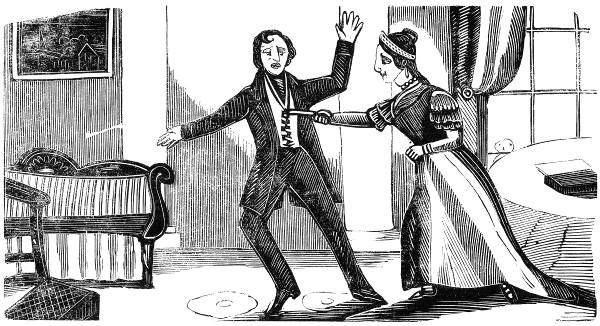
ILLUSTRATIONS OF STREET-ART—No. II.
Murder of Captain Lawson.
(A “COCK.”)
I conclude with another cock, which may be called a narrative “on a subject,” as we have “ballads on a subject” (afterwards to be described), but with this difference, that the narrative is fictitious, and the ballad must be founded on a real event, however embellished. The highest newspaper style, I was told, was aimed at. Part of the production reads as if it had done service during the Revolution of February, 1848.
“Express from Paris. Supposed Death of LOUIS NAPOLEON. We stop the press to announce, That Luis Napoleon has been assasinated, by some it is said he is shot dead, by others that he is only wounded in the right arm.
“We have most important intelligence from Paris. That capital is in a state of insurrection. The vivacious people, who have herefore defeated the goverment by paving-stones, have again taken up those missiles. On Tuesday the Ministers forbade the reform banquet, and the prefect of police published a proclamation warning the people to respect the laws, which he declared were violated, and he meant to enforce them. But the people dispised the proclamation and rejected his authority. They assembled in great multitudes round the Chambers of Deputies, and forced their way over the walls. They were attacked by the troops and dispersed, but, re-assembled in various quarters. They showed their hatred of M. Guizot by demolishing his windows and attempting to force an entrance into his hotel, but were again repulced by the troops. All the military in Paris, and all the National Guard, have been summoned to arms, and every preparation made on the part of the government to put down the people.
“The latter have raised barricades in various places, and have unpaved the streets, overturned omnibusses, and made preparations for a vigorous assault, or a protracted resistance.
“Five o’Closk—At this moment the Rue St. Honore is blockaded by a detachment dragoons, who fill the market-place near the Rue des Petits Champs, and are charging the people sword in hand, carriages full of deople are being taken to the hospitals.
“In fact the maddest excitement reigns throughout the capital.
“Half past Six.—During the above we have instituted enquiries at the Foreign office, they have not received any inteligence of the above report, if it has come, it must have been by pigeon express. We have not given the above in our columns with a view of its authenticity, any further information as soon as obtained shall be immediately announced to the public.”
Of “Strawing.”
I have already alluded to “strawing,” which can hardly be described as quackery. It is rather a piece of mountebankery. Many a quack—confining the term to its most common signification, that of a “quack doctor”—has faith in the excellence of his own nostrums, and so proffers that which he believes to be curative: the strawer, however, sells what he knows is not what he represents it.
The strawer offers to sell any passer by in the streets a straw and to give the purchaser a paper which he dares not sell. Accordingly as he judges of the character of his audience, so he intimates that the paper is political, libellous, irreligious, or indecent.
I am told that as far back as twenty-five or twenty-six years, straws were sold, but only in the country, with leaves from the Republican, a periodical published by Carlile, then of Fleet-street, which had been prosecuted by the government; but it seems that the trade died away, and was little or hardly known again until the time of the trial of Queen Caroline, and then but sparingly. The straw sale reached its highest commercial pitch at the era of the Reform Bill. The most successful trader in the article is remembered among the patterers as “Jack Straw,” who was oft enough represented to me as the original strawer. If I inquired further, the answer was: “He was the first in my time.” This Jack Straw was, I am told, a fine-looking man, a natural son of Henry Hunt, the blacking manufacturer. He was described to me as an inveterate drunkard and a very reckless fellow. One old hand was certain that this man was Hunt’s son, as he himself had “worked” with him, and was sometimes sent by him when he was “in trouble,” or in any strait, to 32, Broadwall, Blackfriars, for assistance, which was usually rendered. (This was the place where Hunt’s “Matchless Blacking” and “Roasted Corn” were vended.) Jack Straw’s principal “pitch” was at Hyde Park Corner, “where,” said the man whom I have mentioned as working with him, “he used to come it very strong against Old Nosey, the Hyde Park bully as he called him. To my knowledge he’s made 10s., and he’s made 15s. on a night. O, it didn’t matter to him what he sold with his straws, religion or anything. There was no three-pennies (threepenny newspapers) then, and he had had a gentleman’s education, and knew what to say, and so the straws went off like smoke.” The articles which this man “durst not sell” were done up in paper, so that no one could very well peruse them on the spot, as a sort of stealth was implied. On my asking Jack Straw’s co-worker if he had ever drank with him, “Drank with him!” he answered, “Yes, many a time. I’ve gone out and pattered, or chaunted, or anything, to get money to buy him two glasses of brandy—and good brandy was very dear then—before he could start, for he was all of a tremble until he had his medicine. If I couldn’t get brandy, it was the best rum, ’cause he had all the tastes of a gentleman. Ah! he’s been dead some years, sir, but where he died I don’t know. I only heard of his death. He was a nice kindly fellow.”
The ruse in respect of strawing is not remarkable for its originality. It was an old smuggler’s trick to sell a sack and give the keg of contraband spirit placed within it and padded out with straw so as to resemble a sack of corn. The hawkers, prior to 1826, when Mr. Huskisson introduced changes into the Silk Laws, gave “real Ingy handkerchiefs” (sham) to a customer, and sold him a knot of tape for about 4s. The price of a true Bandana, then prohibited, and sold openly in the draper’s shops, was about 8s. The East India Company imported about a million of Bandanas yearly; they were sold by auction for exportation to Hamburgh, &c., at about 4s. each, and were nearly all smuggled back again to England, and disposed of as I have stated.
It is not possible to give anything like statistics as to the money realised by strawing. A well-informed man calculated that when the trade was at its best, or from 1832 to 1836, there might be generally fifty working it in the country and twenty in London; they did not confine themselves, however, to strawing, but resorted to it only on favourable opportunities. Now there are none in London—their numbers diminished gradually—and very rarely any in the country.
Of the Sham Indecent Street-trade.
This is one of those callings which are at once repulsive and ludicrous; repulsive, when it is considered under what pretences the papers are sold, and ludicrous, when the disappointment of the gulled purchaser is contemplated.
I have mentioned that one of the allurements held out by the strawer was that his paper—the words used by Jack Straw—could “not be admitted into families.” Those following the “sham indecent trade” for a time followed his example, and professed to sell straws and give away papers; but the London police became very observant of the sale of straws—more especially under the pretences alluded to—and it has, for the last ten years, been rarely pursued in the streets.
The plan now adopted is to sell the sealed packet itself, which the “patter” of the street-seller leads his auditors to believe to be some improper or scandalous publication. The packet is some coloured paper, in which is placed a portion of an old newspaper, a Christmas carol, a religious tract, or a slop-tailor’s puff (given away in the streets for the behoof of another class of gulls). The enclosed paper is, however, never indecent.
From a man who had, not long ago, been in this trade, I had the following account. He was very anxious that nothing should be said which would lead to a knowledge that he was my informant. After having expressed his sorrow that he had ever been driven to this trade from distress, he proceeded to justify himself. He argued—and he was not an ignorant man—that there was neither common sense nor common justice in interfering with a man like him, who, “to earn a crust, pretended to sell what shop-keepers, that must pay church and all sorts of rates, sold without being molested.” The word “shopkeepers” was uttered with a bitter emphasis. There are, or were, he continued, shops—for he seemed to know them all—and some of them had been carried on for years, in which shameless publications were not only sold, but exposed in the windows; and why should he be considered a greater offender than a shopkeeper, and be knocked about by the police? There are, or lately were, he said, such shops in the Strand, Fleet-street, a court off Ludgate-hill, Holborn, Drury-lane, Wych-street, the courts near Drury-lane Theatre, Haymarket, High-street, Bloomsbury, St. Martin’s-court, May’s buildings, and elsewhere, to say nothing of Holywell-street! Yet he must be interfered with!
[I may here remark, that I met with no street-sellers who did not disbelieve, or affect to disbelieve, that they were really meddled with by the police for obstructing the thoroughfare. They either hint, or plainly state, that they are removed solely to please the shop-keepers. Such was the reiterated opinion, real or pretended, of my present informant.]
I took a statement from this man, but do not care to dwell upon the subject. The trade, in the form I have described, had been carried on, he thought, for the last six years. At one time, 20 men followed it; at present, he believed there were only 6, and they worked only at intervals, and as opportunities offered: some going out, for instance, to sell almanacs or memorandum books, and, when they met with a favourable chance, offering their sealed packets. My informant’s customers were principally boys, young men, and old gentlemen; but old gentlemen chiefly when the trade was new. This street-seller’s “great gun,” as he called it, was to make up packets, as closely resembling as he could accomplish it, those which were displayed in the windows of any of the shops I have alluded to. He would then station himself at some little distance from one of those shops, and, if possible, so as to encounter those who had stopped to study the contents of the window, and would represent—broadly enough, he admitted, when he dared—that he could sell for 6d. what was charged 5s., or 2s. 6d., or whatever price he had seen announced, “in that very neighbourhood.” He sometimes ventured, also, to mutter something, unintelligibly, about the public being imposed upon! On one occasion, he took 6s. in the street in about two hours. On another evening he took 4s. 8d. in the street and was called aside by two old gentlemen, each of whom told him to come to an address given (at the West-end), and ask for such and such initials. To one he sold two packets for 2s.; to the other, five packets, each 1s.—or 11s. 8d. in one evening. The packets were in different coloured papers, and had the impressions of a large seal on red wax at the back; and he assured the old gents., as he called them, one of whom, he thought, was “silly,” that they were all different. “And very likely,” he said, chucklingly, “they were different; for they were made out of a lot of missionary tracts and old newspapers that I got dirt cheap at a ‘waste’ shop. I should like to have seen the old gent.’s face, as he opened his 5s. worth, one after another!” This trade, however, among old gentlemen, was prosperous for barely a month: “It got blown then, sir, and they wouldn’t buy any more, except a very odd one.”
This man—and he believed it was the same with all the others in the trade—never visited the public-houses, for a packet would soon have been opened and torn there, which, he said, people was ashamed to do in the public streets. As well as he could recollect, he had never sold a single packet to a girl or a woman. Drunken women of the town had occasionally made loud comments on his calling, and offered to purchase; but on such occasions, fearful of a disturbance, he always hurried away.
I have said that the straw trade is now confined to the country, and I give a specimen of the article vended there, by the patterer in the sham indecent trade. It was purchased of a man, who sold it folded in the form of a letter, and is addressed, “On Royal Service. By Express. Private. To Her Royal Highness, Victoria, Princess Royal. Kensington Palace, London. Entered at Stationer’s Hall.” The man who sold it had a wisp of straw round his neck, and introduced his wares with the following patter:
“I am well aware that many persons here present will say what an absurd idea—the idea of selling straws for a halfpenny each, when there are so many lying about the street; but the reason is simply this: I am not allowed by the authorities to sell these papers, so I give them away and sell my straws. There are a variety of figures in these papers for gentlemen; some in the bed, some on the bed, some under the bed.” The following is a copy of the document thus sold:—
“Bachelors or Maidens, Husbands and Wives, Will love each other and lead happy lives; If both these Letters to read are inclined, Secrets worth knowing therein they will find.
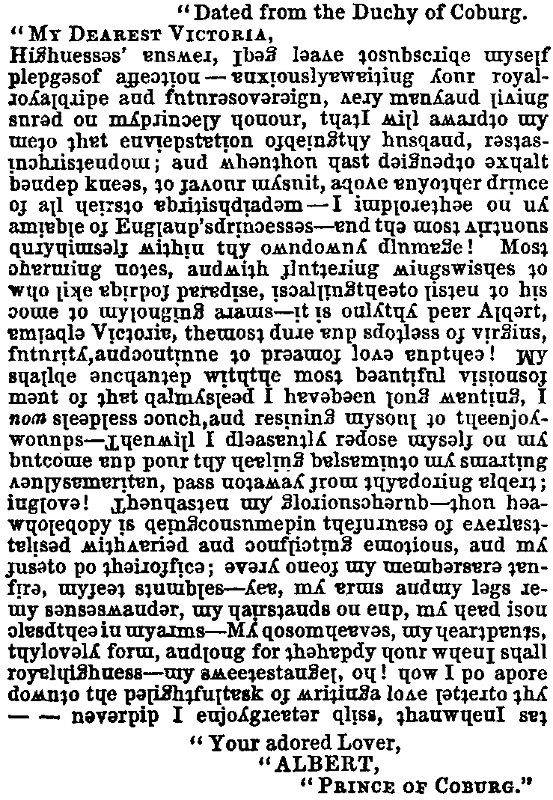
“Dated from the Duchy of Coburg.
“My Dearest Victoria,
——never did I enjoy greater bliss, than when I sat down to the delightful task of writing a love letter to thy royal highness—my sweetest angel, oh! how I do adore thy lovely form, and long for the happy hour when I shall clasp thee in my arms—My bosom heaves, my heart pants, my senses wander, my hair stands on end, my head is on fire, my feet stumbles—yea, my arms and my legs refuse to do their office; every one of my members are tantalised with varied and conflicting emotions, and my whole body is being consumed in the furnase of everlasting love! Then hasten my glorious cherub—thou heavenly samaritan, pass not away from thy adoring albert; but come and pour thy healing balsam into my smarting wounds—Then will I pleasantly repose myself on my now sleepless couch, and resining my soul to the enjoyment of that balmy sleep I have been long wanting, I shall be enchanted with the most beautiful visions of futurity, and continue to dream of love and thee! My amiable Victoria, the most pure and spotless of virgins, come to my longing arams—it is only thy dear Albert who like a bird of paradise, is calling thee to listen to his charming notes, and with fluttering wings wishes to bury himself within thy own downy plumage! Most amiable of England’s princesses—and the most virtuous of all heirs to a british diadem—I implore thee on ny bended knees, to favour my suit, above any other prince in christendom; and when thou hast deigned to exhalt me to that envied station of being thy husband, rest assured on my princely honour, that I will award to my royal bride and future sovereign, very many and living pledges of affection—anxiously awaiting your royal-Highnesses’ answer, I beg leave to subscribe myself
“Your adored Lover, “ALBERT, “Prince of Coburg.”
On the back of this page is the following cool initiation of the purchaser into the mysteries of the epistle:
“Directions for the purchasers to understand the Royal Love Letters, and showing them how to practise the art of Secret Letter Writing:—
“Proceed to lay open ‘Albert’s Letter’ by the side of ‘Victoria’s,’ and having done so, then look carefully down them until you have come to a word at the left hand corner, near the end of each Letter, having two marks thus — —, when you must commence with that word, and read from left to right after you have turned them bottom upwards before a looking glass so that you may peruse the copy reflected therein. But you must notice, throughout all the words every other letter is upside down, also every other word single; but the next two words being purposely joined together, therefore they are double; and in addition to those letters placed upside down, makes it more mysterious in the reading. The reader is recommended to copy each word in writing, when he will be able to read the letters forward, and after a little practice he can soon learn to form all his words in the same curious manner, when he wants to write a ‘secret letter.’
“Be sure when holding it up side down before a looking-glass, that the light of a candle, is placed between then by the reflection it will show much plainer, and be sooner discovered.
“If you intend to practise a Joke and make it answer the purpose of a Valentine, write what you think necessary on the adjoining blank page; then post it, with the superscription filled up in this manner:—After the word To, write the name and address of the party also place the word FROM before ‘VICTORIA’S’ name: then the address on the outside of this letter will read somewhat after the following fashion:—To Mr. or Mrs. so and so, (with the number if any,) in such and such a street: at the same time your letter will appear as if it came from Royalty.
“N.B. You must first buy both the letters, as the other letter is an answer to this one; and because, without the reader has got both letters, he will not have the secrets perfect.”
Notwithstanding the injunction to buy both letters, and the seeming necessity of having both to understand the “directions,” the patterer was selling only the one I have given.
That the trade in sham indecent publications was, at one time, very considerable, and was not unobserved by those who watch, as it is called, “the signs of the times,” is shown by the circumstance that the Anti-Corn-Law League paper, called the Bread Basket, could only be got off by being done up in a sealed packet, and sold by patterers as a pretended improper work.
The really indecent trade will be described hereafter.
For a month my informant thought he had cleared 35s. a week; for another month, 20s.; and as an average, since that time, from 5s. to 7s. 6d. weekly, until he discontinued the trade. It is very seldom practised, unless in the evening, and perhaps only one street-seller depends entirely upon it.
Supposing that 6 men last year each cleared 6s. weekly, we find upwards of 93l. expended yearly in the streets on this rubbish.
The capital required to start in the business is 6d. or 1s., to be expended in paper, paste, and sometimes sealing-wax.
Of Religious Tract Sellers.
The sellers of religious tracts are now, I am informed, at the least, about 50, but they were at one time, far more numerous. When penny books were few and very small, religious tracts were by far the cheapest things in print. It is common, moreover, for a religious society, or an individual, to give a poor person, children especially, tracts for sale. A great many tract sellers, from 25 to 35 years ago, were, or pretended to be, maimed old soldiers or sailors. The traffic is now in the hands of what may be called an anomalous body of men. More than one half of the tract sellers are foreigners, such as Malays, Hindoos, and Negros. Of them, some cannot speak English, and some—who earn a spare subsistence by selling Christian tracts—are Mahometans, or worshippers of Bramah! The man whose portrait supplies the daguerreotyped illustration of this number is unable to speak a word of English, and the absence of an interpreter, through some accident, prevented his statement being taken at the time appointed. I shall give it, however, with the necessary details on the subject, under another head.
With some men and boys, I am informed, tract-selling is but a pretext for begging.
Of a Benefit Society of Patterers.
In the course of my inquiries, I received an account of an effort made by a body of these people to provide against sickness,—a step so clearly in the right direction, and perhaps so little to be expected from the habits of the class, that I feel bound to notice it. It was called the “Street-sellers’ Society;” but as nearly all the bonâ-fide members (or those who sought benefit from its funds) were patterers in paper, or ballad-singers, I can most appropriately notice their proceedings here.
The society “sprung up accidental,” as it was expressed to me. A few paper-workers were conversing of the desirableness of such an institution, and one of the body suggested a benefit club, which it was at once determined to establish. It was accordingly established between six and seven years ago, and was carried on for about four years. The members varied in number from 40 to 50; but of a proportion of 40, as many as 18 might be tradesmen who were interested in the street-trade, either in supplying the articles in demand for it, or from keeping public-houses resorted to by the fraternity, or any such motive, or who were merely curious to mix in such society. Mr. C—— was conductor; Mr. J. H—— (a poet, and the writer of “Black Bess,” “the Demon of the Sea,” and other things which “took” in the streets), secretary; and a well-known patterer was under-conductor, with which office was mixed up the rather onerous duties of a kind of master of the ceremonies on meeting-nights. None of the officers were paid.
The subscription was 2d. a week, and meetings of the members were held once a week. Each member, not an officer, paid ½d. for admission to the fund, and could introduce a visitor, who also paid ½d. No charge was made for the use of the club-room (in a public-house), which was entirely in the control of the members. Every one using bad language, or behaving improperly, was fined ½d., and on a second offence was ejected, and sometimes, if the misbehaviour was gross, on the first. Any one called upon to sing, and refusing, or being unable, was fined ½d., and was liable to be called upon again, and pay another fine. A visitor sometimes, instead of ½d., offered 6d. when fined; but this was not accepted,—only ½d. could be received. The members’ wives could and did often accompany their husbands to the meetings; but women of the town, whether introduced by members or not, were not permitted to remain. “They found their way in a few times,” said the man who was under-conductor to me, “but I managed to work them out without any bother, and without insulting them—God forbid!”
The assistance given was 5s. weekly to sick members, who were not in arrear in their subscriptions. If the man had a family to support, a gathering was made for him, in addition to his weekly allowance,—for the members were averse to “distress the box” (fund). There was no allowance for the burial of a member, but a gathering took place, and perhaps a raffle, to raise funds for a wake (sometimes) and an interment; and during the existence of the society, three members, I was told, were buried that way “comfortably.” The subscriptions were paid up regularly enough; “indeed,” said a member to me, “if a man earned anything, his mates knew of it: we all know how the cat jumps that way, so he must either pay or be scratched.” The members not unfrequently lent each other money to pay up their subscriptions. Fashionable young “swells,” I was told, often visited the house, and stayed till 3 or 4 in the morning, but were very seldom in the club-room, which was closed regularly at 12. After that hour, the “swells” who were bent upon seeing life—(and they are a class whom the patterers, on all such occasions, not so very unreasonably consider “fair game” for bamboozling)—could enjoy the society congenial to their tastes or gratifying to their curiosity. On one occasion two policemen were among the visitors, and were on friendly terms enough with the members, some of whom they had seen before.
From the beginning there seems to have been a distrust of one another among the members, but a distrust not invincible or the club would never have been formed. Instead of the “box,” or fund (the money being deposited in a box), being allowed to accumulate, so that an investment might be realised, available for any emergency, the fund was divided among the members quarterly, and then the subscription went on anew. The payments, however, fell off. The calling of the members was precarious, their absence in the country was frequent, and so the society ceased to exist, but the members were satisfied that every thing was done honourably.
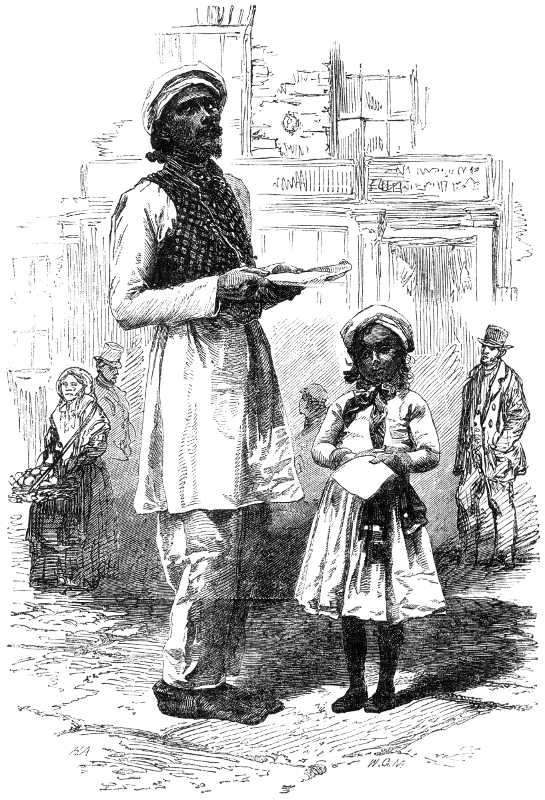
HINDOO TRACT-SELLER.
[From a Daguerreotype by Beard.]
The purpose to which the funds, on a quarterly division, were devoted, was one not confined to such men as the patterers—to a supper. “None of your light suppers, sir,” said a member; “not by no means. And we were too fly to send anybody to market but ourselves. We used to go to Leadenhall, and buy a cut off a sirloin, which was roasted prime, and smelt like a angel. But not so often, for its a dear jint, the bones is heavy. One of the favouritest jints was a boiled leg of mutton with caper trimmings. That is a good supper,—I believe you, my hero.”
Of the Abodes, Tricks, Marriage, Character, and Characteristics of the Different Grades of Patterers.
Having now giving an account of those who may be called the literary patterers (proper), or at any rate of those who do not deem it vain so to account themselves, because they “work paper,” I proceed to adduce an account of the different grades of patterers generally, for patter has almost as many divisions as literature. There is patter pathetic, as from beggars; bouncing, to puff off anything of little or no value; comic, as by the clowns; descriptive, as in the cases where the vendor describes, however ornately, what he really sells; religious, as occasionally by the vendors of tracts; real patter (as it is understood by the profession) to make a thing believed to be what it is not; classical, as in the case of the sale of stenographic cards, &c.; and sporting, as in race cards.
The pattering tribe is by no means confined to the traffic in paper, though it may be the principal calling as regards the acuteness of its professors. Among these street-folk are the running and standing patterers (or stationers as they are sometimes, but rarely, styled)—and in these are included, the Death and Fire Hunters of whom I have spoken; Chaunters; Second Edition-sellers; Reciters; Conundrum-sellers; Board-workers; Strawers; Sellers of (Sham) Indecent Publications; Street Auctioneers; Cheap Jacks; Mountebanks (quacks); Clowns; the various classes of Showmen; Jugglers; Conjurors; Ring-sellers for wagers; Sovereign-sellers; Corn-curers; Grease-removers; French-polishers; Blacking-sellers; Nostrum-vendors; Fortune-tellers; Oratorical-beggars; Turnpike-sailors; the classes of Lurkers; Stenographic Card-sellers, and the Vendors of Race-cards or lists.
The following accounts have been written for me by the same gentleman who has already described the Religion, Morals, &c., of patterers. He has for some years resided among the class, and has pursued a street calling for his existence. What I have already said of his opportunities of personal observation and of dispassionate judgment I need not iterate.
“I wish,” says the writer in question, “in the disclosures I am now about to make concerning the patterers generally, to do more than merely put the public on their guard. I take no cruel delight in dragging forth the follies of my fellow-men. Before I have done with my subject, I hope to draw forth and exhibit some of the latent virtues of the class under notice, many of whom I know to sigh in secret over that one imprudent step (whatever its description), which has furnished the censorious with a weapon they have been but too ready to wield. The first thing for me to do is to give a glance at the habitations of these outcasts, and to set forth their usual conduct, opinions, conversation and amusements. As London (including the ten mile circle), is the head quarters of lodging-house life, and least known, because most crowded, I shall lift the veil which shrouds the vagrant hovel where the patterer usually resides.
“As there are many individuals in lodging-houses who are not regular patterers or professional vagrants, being rather, as they term themselves, ‘travellers’ (or tramps), so there are multitudes who do not inhabit such houses who really belong to the fraternity, pattering, or vagrant. Of these some take up their abode in what they call ‘flatty-kens,’ that is, houses the landlord of which is not ‘awake’ or ‘fly’ to the ‘moves’ and dodges of the trade; others resort to the regular ‘padding-kens,’ or houses of call for vagabonds; while others—and especially those who have families—live constantly in furnished rooms, and have little intercourse with the ‘regular’ travellers, tramps, or wanderers.
“The medium houses the London vagrant haunts, (for I have no wish to go to extremes either way,) are probably in Westminster, and perhaps the fairest ‘model’ of the ‘monkry’ is the house in Orchard-street—once the residence of royalty—which has been kept and conducted for half a century by the veteran who some fifty years ago was the only man who amused the population with that well-known ditty,
‘If I’d as much money as I could tell, I would not cry young lambs to sell.’
Mister (for that is the old man’s title) still manufactures lambs, but seldom goes out himself; his sons (obedient and exemplary young men) take the toys into the country, and dispose of them at fairs and markets. The wife of this man is a woman of some beauty and good sound sense, but far too credulous for the position of which she is the mistress.
“So much for the establishment. I have now to deal with the inmates.
“No one could be long an inmate of Mr. ——’s without discerning in the motley group persons who had seen better days, and, seated on the same bench, persons who are ‘seeing’ the best days they ever saw. When I took up my abode in the house under consideration, I was struck by the appearance of a middle-aged lady-like woman, a native of Worcester, bred to the glove trade, and brought up in the lap of plenty, and under the high sanction of religious principle. She had evidently some source of mental anguish. I believe it was the conduct of her husband, by whom she had been deserted, and who was living with a woman to whom, it is said, the wife had shown much kindness. By her sat a giant in size, and candour demands that I should say a ‘giant in sin.’ When Navy Jem, as he is called, used to work for his living (it was a long while ago) he drove a barrow at the formation of the Great Western Railway. At present the man lies in bed till mid-day, and when he makes his appearance in the kitchen,