Volume 1 — OF THE STREET-SELLERS OF STATIONERY, LITERATURE, AND THE FINE ARTS.
Reading edition
We now come to a class of street-folk wholly distinct from any before treated of. As yet we have been dealing principally with the uneducated portion of the street-people—men whom, for the most part, are allowed to remain in nearly the same primitive and brutish state as the savage—creatures with nothing but their appetites, instincts, and passions to move them, and made up of the same crude combination of virtue and vice—the same generosity combined with the same predatory tendencies as the Bedouins of the desert—the same love of revenge and disregard of pain, and often the same gratitude and susceptibility to kindness as the Red Indian—and, furthermore, the same insensibility to female honour and abuse of female weakness, and the same utter ignorance of the Divine nature of the Godhead as marks either Bosjesman, Carib, or Thug.
The costers and many other of the street-sellers before described, however, are bad—not so much from their own perversity as from our selfishness. That they partake of the natural evil of human nature is not their fault but ours,—who would be like them if we had not been taught by others better than ourselves to controul the bad and cherish the good principles of our hearts.
The street-sellers of stationery, literature, and the fine arts, however, differ from all before treated of in the general, though far from universal, education of the sect. They constitute principally the class of street-orators, known in these days as “patterers,” and formerly termed “mountebanks,”—people who, in the words of Strutt, strive to “help off their wares by pompous speeches, in which little regard is paid either to truth or propriety.” To patter, is a slang term, meaning to speak. To indulge in this kind of oral puffery, of course, requires a certain exercise of the intellect, and it is the consciousness of their mental superiority which makes the patterers look down upon the costermongers as an inferior body, with whom they object either to be classed or to associate. The scorn of some of the “patterers” for the mere costers is as profound as the contempt of the pickpocket for the pure beggar. Those who have not witnessed this pride of class among even the most degraded, can form no adequate idea of the arrogance with which the skilled man, no matter how base the art, looks upon the unskilled. “We are the haristocracy of the streets,” was said to me by one of the street-folks, who told penny fortunes with a bottle. “People don’t pay us for what we gives ’em, but only to hear us talk. We live like yourself, sir, by the hexercise of our hintellects—we by talking, and you by writing.”
But notwithstanding the self-esteem of the patterers, I am inclined to think that they are less impressionable and less susceptible of kindness than the costers whom they despise. Dr. Conolly has told us that, even among the insane, the educated classes are the most difficult to move and govern through their affections. They are invariably suspicious, attributing unworthy motives to every benefit conferred, and consequently incapable of being touched by any sympathy on the part of those who may be affected by their distress. So far as my experience goes it is the same with the street-patterers. Any attempt to befriend them is almost sure to be met with distrust. Nor does their mode of life serve in any way to lessen their misgivings. Conscious how much their own livelihood depends upon assumption and trickery, they naturally consider that others have some “dodge,” as they call it, or some latent object in view when any good is sought to be done them. The impulsive costermonger, however, approximating more closely to the primitive man, moved solely by his feelings, is as easily humanized by any kindness as he is brutified by any injury.
The patterers, again, though certainly more intellectual, are scarcely less immoral than the costers. Their superior cleverness gives them the power of justifying and speciously glossing their evil practices, but serves in no way to restrain them; thus affording the social philosopher another melancholy instance of the evil of developing the intellect without the conscience—of teaching people to know what is morally beautiful and ugly, without teaching them at the same time to feel and delight in the one and abhor the other—or, in other words, of quickening the cunning and checking the emotions of the individual.
Among the patterers marriage is as little frequent as among the costermongers; with the exception of the older class, who “were perhaps married before they took to the streets.” Hardly one of the patterers, however, has been bred to a street life; and this constitutes another line of demarcation between them and the costermongers.
The costers, we have seen, are mostly hereditary wanderers—having been as it were born to frequent the public thoroughfares; some few of the itinerant dealers in fish, fruit, and vegetables, have it is true been driven by want of employment to adopt street-selling as a means of living, but these are, so to speak, the aliens rather than the natives of the streets. The patterers, on the other hand, have for the most part neither been born and bred nor driven to a street life—but have rather taken to it from a natural love of what they call “roving.” This propensity to lapse from a civilized into a nomad state—to pass from a settler into a wanderer—is a peculiar characteristic of the pattering tribe. The tendency however is by no means extraordinary; for ethnology teaches us, that whereas many abandon the habits of civilized life to adopt those of a nomadic state of existence, but few of the wandering tribes give up vagabondising and betake themselves to settled occupations. The innate “love of a roving life,” which many of the street-people themselves speak of as the cause of their originally taking to the streets, appears to be accompanied by several peculiar characteristics; among the most marked of these are an indomitable “self-will” or hatred of the least restraint or controul—an innate aversion to every species of law or government, whether political, moral, or domestic—a stubborn, contradictory nature—an incapability of continuous labour, or remaining long in the same place occupied with the same object, or attending to the same subject—an unusual predilection for amusements, and especially for what partakes of the ludicrous—together with a great relish of all that is ingenious, and so finding extreme delight in tricks and frauds of every kind. There are two patterers now in the streets (brothers)—well-educated and respectably connected—who candidly confess they prefer that kind of life to any other, and would not leave it if they could.
Nor are the patterers less remarkable than the costermongers for their utter absence of all religious feeling. There is, however, this distinction between the two classes—that whereas the creedlessness of the one is but the consequence of brutish ignorance, that of the other is the result of natural perversity and educated scepticism—as the street-patterers include many men of respectable connections, and even classical attainments. Among them, may be found the son of a military officer, a clergyman, a man brought up to the profession of medicine, two Grecians of the Blue-coat School, clerks, shopmen, and a class who have been educated to no especial calling—some of the latter being the natural sons of gentlemen and noblemen—and who, when deprived of the support of their parents or friends, have taken to the streets for bread. Many of the younger and smarter men, I am assured, reside with women of the town, though they may not be dependent for their livelihood on the wages got by the infamy of these women. Not a few of the patterers, too, in their dress and appearance, present but little difference to that of the “gent.” Some wear a moustache, while others indulge in a Henri-Quatre beard. The patterers are, moreover, as a body, not distinguished by that good and friendly feeling one to another which is remarkable among costermongers. If an absence of heartiness and good fellowship be characteristic of an aristocracy—as some political philosophers contend—then the patterers may indeed be said to be the aristocrats of the streets.
The patterers or oratorical street-sellers include among their class many itinerant traders, other than the wandering “paper-workers”—as those vending the several varieties of street-literature are generally denominated. The Cheap Jacks, or oratorical hucksters of hardware at fairs and other places, are among the most celebrated and humorous of this class. The commercial arts and jests of some of these people, display considerable cleverness. Many of their jokes, it is true, are traditional—and as purely a matter of parrotry as the witticisms of the “funny gentlemen” on the stage, but their ready adaptation of accidental circumstances to the purposes of their business, betrays a modicum of wit far beyond that which falls to the share of ordinary “low comedians.” The street-vendors of cough drops—infallible cures for the toothache and other ailments—also belong to the pattering class. These are, as was before stated, the remains of the obsolete mountebanks of England and the saltinbanque of France—a class of al fresco orators who derived their names from the bench—the street pulpit, rostrum, or platform—that they ascended, in order the better to deliver their harangues. The street jugglers, actors, and showmen, as well as the street-sellers of grease-removing compositions, corn-salve, razor-paste, plating-balls, waterproof blacking, rat poisons, sovereigns sold for wagers, and a multiplicity of similar street-trickeries—such as oratorical begging—are other ingenious and wordy members of the same chattering, jabbering, or “pattering” fraternity. These will all be spoken of under the head of the different things they respectively sell or do. For the present we have only to deal with that portion of the “pattering” body who are engaged in the street sale of literature—or the “paper-workers” as they call themselves. The latter include the “running patterers,” or “death-hunters;” being men (no women) engaged in vending last dying speeches and confessions—in hawking “se-cond edi-tions” of newspapers—or else in “working,” that is to say, in getting rid of what are technically termed “cocks;” which, in polite language, means accounts of fabulous duels between ladies of fashion—of apocryphal elopements, or fictitious love-letters of sporting noblemen and certain young milliners not a hundred miles from the spot—“cooked” assassinations and sudden deaths of eminent individuals—pretended jealous affrays between Her Majesty and the Prince Consort (but these papers are now never worked)—or awful tragedies, including mendacious murders, impossible robberies, and delusive suicides.
The sellers of these choice articles, however, belong more particularly to that order or species of the pattering genus known as “running patterers,” or “flying stationers,” from the fact of their being continually on the move while describing the attractions of the “papers” they have to sell. Contradistinguished from them, however, are the “standing patterers,” or those for whose less startling announcements a crowd is necessary, in order that the audience may have time to swallow the many marvels worked by their wares. The standing patterers require, therefore, what they term a “pitch,” that is to say a fixed locality, where they can hold forth to a gaping multitude for, at least, some few minutes continuously. They are mainly such street-sellers as deal in nostrums and the different kinds of street “wonders.” Occasionally, however, the running patterer (who is especially literary) transmigrates into a standing one, betaking himself to “board work,” as it is termed in street technology, and stopping at the corners of thoroughfares with a large pictorial placard raised upon a pole, and glowing with a highly-coloured exaggeration of the interesting terrors of the pamphlet he has for sale. This is either “The Life of Calcraft, the Hangman,” “The Diabolical Practices of Dr. —— on his Patients when in a state of Mesmerism,” or “The Secret Doings at the White House, Soho,” and other similar attractively-repulsive details. Akin to this “board work” is the practice of what is called “strawing,” or selling straws in the street, and giving away with them something that is either really or fictionally forbidden to be sold,—as indecent papers, political songs, and the like. This practice, however, is now seldom resorted to, while the sale of “secret papers” is rarely carried on in public. It is true, there are three or four patterers who live chiefly by professing to dispose of “sealed packets” of obscene drawings and cards for gentlemen; but this is generally a trick adopted to extort money from old debauchees, young libertines, and people of degraded or diseased tastes; for the packets, on being opened, seldom contain anything but an odd number of some defunct periodical. There is, however, a large traffic in such secret papers carried on in what is called “the public-house trade,” that is to say, by itinerant “paper-workers” (mostly women), who never make their appearance in the streets, but obtain a livelihood by “busking,” as it is technically termed, or, in other words, by offering their goods for sale only at the bars and in the tap-rooms and parlours of taverns. The excessive indulgence of one appetite is often accompanied by the disease of a second; the drunkard, of course, is supereminently a sensualist, and is therefore easily taken by anything that tends to stimulate his exhausted desires: so sure is it that one form of bestiality is a necessary concomitant of another. There is another species of patterer, who, though usually included among the standing patterers, belongs rather to an intermediate class, viz., those who neither stand nor “run,” as they descant upon what they sell; but those walk at so slow a rate that, though never stationary, they can hardly be said to move. These are the reciters of dialogues, litanies, and the various street “squibs” upon passing events; they also include the public propounders of conundrums, and the “hundred and fifty popular song” enumerators—such as are represented in the engraving here given. Closely connected with them are the “chaunters,” or those who do not cry, but (if one may so far stretch the English language) sing the contents of the “papers” they vend.
These traffickers constitute the principal street-sellers of literature, or “paper-workers,” of the “pattering” class. In addition to them there are many others vending “papers” in the public thoroughfares, who are mere traders resorting to no other acts for the disposal of their goods than a simple cry or exposition of them; and many of these are but poor, humble, struggling, and inoffensive dealers. They do not puff or represent what they have to sell as what it is not—(allowing them a fair commercial latitude). They are not of the “enterprising” class of street tradesmen. Among these are the street-sellers of stationery—such as note-paper, envelopes, pens, ink, pencils, sealing-wax, and wafers. Belonging to the same class, too, are the street-vendors of almanacs, pocket-books, memorandum and account-books. Then there are the sellers of odd numbers of periodicals and broadsheets, and those who vend either playing cards, conversation cards, stenographic cards, and (at Epsom, Ascot, &c.) racing cards. Besides these, again, there are the vendors of illustrated cards, such as those embellished with engravings of the Crystal Palace, Views of the Houses of Parliament, as well as the gelatine poetry cards—all of whom, with the exception of the racing-card sellers (who belong generally to the pattering tribe), partake of the usual characteristics of the street-selling class.
After these may be enumerated the vendors of old engravings out of inverted umbrellas, and the hawkers of coloured pictures in frames. Then there are the old book-stalls and barrows, and “the pinners-up,” as they are termed, or sellers of old songs pinned against the wall, as well as the vendors of manuscript music. Moreover, appertaining to the same class, there are the vendors of playbills and “books of the performance” outside the theatre; and lastly, the pretended sellers of tracts—such as the Lascars and others, who use this kind of street traffic as a cloak for the more profitable trade of begging. The street-sellers of images, although strictly comprised within those who vend fine art productions in the public thoroughfares will be treated of under the head of The Street Italians, to which class they mostly belong.
Of the former and present Street-patterers.
Of the street-patterers the running (or flying) trader announces the contents of the paper he is offering for sale, as he proceeds on his mission. It is usually the detail of some “barbarious and horrible murder,” or of some extraordinary occurrence—such as the attack on Marshal Haynau—which has roused public attention; or the paper announced as descriptive of a murder, or of some exciting event, may in reality be some odd number of a defunct periodical. “It’s astonishing,” said one patterer to me, “how few people ever complain of having been took in. It hurts their feelings to lose a halfpenny, but it hurts their pride too much, when they’re had, to grumble in public about it.” On this head, then, I need give no further general explanation.
In times of excitement the running patterer (or “stationer,” as he was and is sometimes called) has reaped the best harvest. When the Popish plot agitated England in the reign of Charles II. the “Narratives” of the design of a handful of men to assassinate a whole nation, were eagerly purchased in the streets and taverns. And this has been the case during the progress of any absorbing event subsequently. I was told by a very old gentleman, who had heard it from his grandfather, that in some of the quiet towns of the north of England, in Durham and Yorkshire, there was the greatest eagerness to purchase from the street-sellers any paper relative to the progress of the forces under Charles Edward Stuart, in 1745. This was especially the case when it became known that the “rebels” had gained possession of Carlisle, and it was uncertain what might be their route southward. About the period of the “affair of the ’45,” and in the autumn following the decisive battle of Culloden (in April, 1746), the “Northern Lights” were more than usually brilliant, or more than usually remarked, and a meteor or two had been seen. The street-sellers were then to be found in fairs and markets, vending wonderful accounts of these wonderful phenomena.
I have already alluded to the character of the old mountebank, and to his “pompous orations,” having “as little regard to truth as to propriety.” There certainly is little pompousness in the announcements of the patterers, though in their general disregard of truth they resemble those of the mountebank. The mountebank, however, addressed his audience from a stage, and made his address attractive by mixing up with it music, dancing, and tumbling; sometimes, also, equestrianism on the green of a village; and by having always the services of a merry-andrew, or clown. The nostrums of these quacks were all as unequalled for cheapness as for infallibility, and their impudence and coolness ensured success. Their practices are as well exposed in some of the Spectators of 1711-12 as the puppet-playing of Powel was good-humouredly ridiculed. One especial instance is cited, where a mountebank, announcing himself a native of Hammersmith, where he was holding forth, offered to make a present of 5s. to every brother native of Hammersmith among his audience. The mountebank then drew from a long bag a handful of little packets, each of which, he informed the spectators, was constantly sold for 5s. 6d., but that out of love to his native hamlet he would bate the odd 5s. to every inhabitant of the place. The whole assembly immediately closed with his generous offer.
There is a scene in Moncrieff’s popular farce of “Rochester,” where the hero personates a mountebank, which may be here cited as affording a good idea of the “pompous orations” indulged in by the street orators in days of yore:
“Silence there, and hear me, for my words are more precious than gold; I am the renowned and far-famed Doctor Paracelsus Bombastes Esculapus Galen dam Humbug von Quack, member of all the colleges under the Moon: M.D., L.M.D., F.R.S., L.L.D., A.S.S.—and all the rest of the letters in the alphabet: I am the seventh son of a seventh son—kill or cure is my motto—and I always do it; I cured the great Emperor of Nova Scotia, of a polypus, after he had been given over by all the faculty—he lay to all appearance dead; the first pill he took, he opened his eyes; the second, he raised his head; and the third, he jumped up and danced a hornpipe. I don’t want to sound my own praise—blow the trumpet, Balaam (Balaam blows trumpet); but I tapped the great Cham of Tartary at a sitting, of a terrible dropsy, so that I didn’t leave a drop in him! I cure the palsy, the dropsy, the lunacy, and all the sighs, without costing anybody a sigh; vertigo, pertigo, lumbago, and all the other go’s are sure to go, whenever I come.”
In his unscrupulousness and boldness in street announcements, and sometimes in his humour and satire, we find the patterer of the present day to be the mountebank of old descended from his platform into the streets—but without his music, his clown, or his dress.
There was formerly, also, another class, differing little from the habits of that variety of patterers of the present day who “busk” it, or “work the public-houses.”
“The jestours,” says Mr. Strutt, in his “Sports and Pastimes of the People of England,” “or, as the word is often written in the old English dialect, ‘gesters,’ were the relaters of the gestes, that is, the actions of famous persons, whether fabulous or real; and these stories were of two kinds, the one to excite pity, and the other to move laughter, as we learn from Chaucer:
‘And jestours that tellen tales, Both of wepying and of game.’
The tales of ‘game,’ as the poet expresses himself were short jocular stories calculated to promote merriment, in which the reciters paid little respect to the claims of propriety or even of common decency. The tales of ‘game,’ however, were much more popular than those of weeping, and probably for the very reason that ought to have operated the most powerfully for their suppression. The gestours, whose powers were chiefly employed in the hours of conviviality, finding by experience that lessons of instruction were much less seasonable at such times, than idle tales productive of mirth and laughter, accommodated their narrations to the general taste of the times, regardless of the mischiefs they occasioned by vitiating the morals of their hearers. Hence it is that the author of the ‘Vision of Pierce the Ploughman’ calls them contemptibly ‘japers and juglers, and janglers of gests.’ He describes them as haunters of taverns and common ale-houses, amusing the lower classes of the people with ‘myrth of minstrelsy and losels’ tales,’ (loose vulgar tales,) and calls them tale-tellers and ‘tutelers in ydell,’ (tutors of idleness,) occasioning their auditory, ‘for love of tales, in tavernes to drink,’ where they learned from them to jangle and to jape, instead of attending to their more serious duties.
“The japers, I apprehend, were the same as the bourdours, or rybauders, an inferior class of minstrels, and properly called jesters in the modern acceptation of the word; whose wit, like that of the merry-andrews of the present day (1800) consisted in low obscenity accompanied with ludicrous gesticulation. They sometimes, however, found admission into the houses of the opulent. Knighton, indeed, mentions one of these japers who was a favourite in the English court, and could obtain any grant from the king ‘a burdando,’ that is, by jesting. They are well described by the poet:
‘As japers and janglers, Judas’ chyldren, Fayneth them fantasies, and fooles them maketh.’
“It was a very common and a very favourite amusement, so late as the 16th century, to hear the recital of verses and moral speeches, learned for that purpose by a set of men who obtained their livelihood thereby, and who, without ceremony, intruded themselves, not only into taverns and other places of public resort, but also into the houses of the nobility.”
The resemblance of the modern patterer to the classes above mentioned will be seen when I describe the public-house actor and reciter of the present day, as well as the standing patterer, who does not differ so much from the running patterer in the quality of his announcements, as in his requiring more time to make an impression, and being indeed a sort of lecturer needing an audience; also of the present reciters “of verses and moral speeches.” But of these curious classes I shall proceed to treat separately.
Of the Habits, Opinions, Morals, and Religion of Patterers generally.
In order that I might omit nothing which will give the student of that curious phase of London life in London streets—the condition of the patterers—a clear understanding of the subject, I procured the following account from an educated gentleman (who has been before alluded to in this work), and as he had been driven to live among the class he describes, and to support himself by street-selling, his remarks have of course all the weight due to personal experience, as well as to close observation:—
“If there is any truth in phrenology,” writes the gentleman in question, “the patterers—to a man—are very large in the organ of ‘self-esteem,’ from which suggestion an enquiry arises, viz., whether they possess that of which they may justly pique themselves. To arrive at truth about the patterers is very difficult, and indeed the persons with whom they live are often quite in the dark about the history, or in some cases the pursuits of their lodgers.
“I think that the patterers may be divided into three classes. First,—those who were well born and brought up. Secondly,—those whose parents have been dissipated and gave them little education. Thirdly,—those who—whatever their early history—will not be or do anything but what is of an itinerant character. I shall take a glance at the first of these classes, presupposing that they were cradled in the lap of indulgence, and trained to science and virtue.
“If these people take to the streets, they become, with here and there an exception, the most reprobate and the least reclaimable. I was once the inmate of a lodging-house, in which there were at one time five University-men, three surgeons, and several sorts of broken-down clerks, or of other professional men. Their general habits were demoralised to the last degree—their oaths more horrid, extravagant, and far-fetched than anything I ever heard: they were stupid in logic, but very original in obscenity. Most of them scoffed at the Bible, or perverted its passages to extenuate fraud, to justify violence, or construct for themselves excuses for incontinence and imposition. It will appear strange that these educated persons, when they turn out upon the street, generally sell articles which have no connection with literature, and very little with art. The two brothers, who sell that wonder-working paste which removes grease from the outside of your collar by driving it further in, were both scholars of Christ’s Hospital. They were second Grecians, and might have gone to college; but several visits to suburban fairs, and their accompanying scenes of debauch, gave them a penchant for a vagabond life, and they will probably never relinquish it. The very tall man—there are several others—who sells razors and paste on a red pagoda-looking stall, was apprenticed to a surgeon in Colchester, with a premium of 300 guineas; and the little dark-visaged man, who sells children’s money-boxes and traps to catch vermin, is the son of a late upholsterer in Bath, who was also a magistrate of that city. The poor man alluded to was a law-student, and kept two terms in Trinity Hall, Cambridge. Many similar cases might be mentioned—cases founded on real observation and experience. Some light may be thrown upon this subject by pointing out the modus operandi by which a friend of mine got initiated into the ‘art and mystery of patterism.’ ‘I had lived,’ he said, ‘more than a year among the tradesmen and tramps, who herd promiscuously together in low lodging-houses. One afternoon I was taking tea at the same table with a brace of patterers. They eyed me with suspicion; but, determined to know their proceedings, I launched out the only cant word I had then learned. They spoke of going to Chatham. Of course, I knew the place, and asked them, “Where do you stall to in the huey?” which, fairly translated, means, “Where do you lodge in the town?” Convinced that I was “fly,” one of them said, “We drop the main toper (go off the main road) and slink into the crib (house) in the back drum (street).” After some altercation with the “mot” of the “ken” (mistress of the lodging-house) about the cleanliness of a knife or fork, my new acquaintance began to arrange “ground,” &c., for the night’s work. I got into their confidence by degrees; and I give below a vocabulary of their talk to each other:’
Word.Meaning.
CrabshellsShoes.
KitePaper.
NestsVarieties.
StickyWax.
ToffGentleman.
BurerkLady.
CamisterMinister.
CrocusDoctor.
BluffAn excuse.
BalmyInsane.
Mill TagA shirt.
SmeeshA shift.
Hay-bagA woman.
DoxyA wife.
FlamA lie.
TevissA shilling.
BullA crown.
FlagAn apron.
“The cant or slang of the patterer is not the cant of the costermonger, but a system of their own. As in the case of the costers, it is so interlarded with their general remarks, while their ordinary language is so smothered and subdued, that unless when they are professionally engaged and talking of their wares, they might almost pass for foreigners.
“There can be no doubt,” continues my informant, “that the second class of street-patterers, to whom nature, or parents, or circumstances have been unpropitious, are the most moral, and have a greater sense of right and wrong, with a quicksightedness about humane and generous things, to which the ‘aristocratic’ patterer is a stranger. Of the dealers in useful or harmless wares—although, of course, they use allowable exaggeration as to the goodness of the article—many are devout communicants at church, or members of dissenting bodies; while others are as careless about religion, and are still to be found once or twice a week in the lecture-rooms of the Mechanics’ Institute nearest to their residence. Orchard-street, Westminster, is a great locality for this sort of patterers. Three well-known characters,—Bristol George, Corporal Casey, and Jemmy the Rake, with a very respectable and highly-informed man called ‘Grocer,’ from his having been apprenticed to that business,—have maintained a character for great integrity among the neighbours for many years.
“I come now to the third class of patterers,—those who, whatever their early pursuits and pleasures, have manifested a predilection for vagrancy, and neither can nor will settle to any ordinary calling. There is now on the streets a man scarcely thirty years old, conspicuous by the misfortune of a sabre-wound on the cheek. He is a native of the Isle of Man. His father was a captain in the Buffs, and himself a commissioned officer at seventeen. He left the army, designing to marry and open a boarding-school. The young lady to whom he was betrothed died, and that event might affect his mind; at any rate, he has had 38 situations in a dozen years, and will not keep one a week. He has a mortal antipathy to good clothes, and will not keep them one hour. He sells anything—chiefly needle-cases. He ‘patters’ very little in a main drag (public street); but in the little private streets he preaches an outline of his life, and makes no secret of his wandering propensity. His aged mother, who still lives, pays his lodgings in Old Pye-street.
“From the hasty glance I have taken at the patterers, any well-constructed mind may deduce the following inference: although a great amount of intelligence sometimes consists with a great want of principle, that an utter want of education, or mis-education, leaves man, like a reed floating on the stream of time, to follow every direction which the current of affairs may give him.
“There is yet another and a larger class, who are wanderers from choice,—who would rather be street-orators, and quacks, and performers, than anything else in the world. In nine cases out of ten, the street-patterers are persons of intemperate habits, no veracity, and destitute of any desire to improve their condition, even where they have the chance. One of this crew was lately engaged at a bazaar; he had 18s. a week, and his only work was to walk up and down and extol the articles exhibited. This was too monotonous a life; I happened to pass him by as he was taking his wages for the week, and heard him say, ‘I shall cut this b—y work; I can earn more on the streets, and be my own master.’”
It would be a mistake to suppose that the patterers, although a vagrant, are a disorganized class. There is a telegraphic dispatch between them, through the length and breadth of the land. If two patterers (previously unacquainted) meet in the provinces, the following, or something like it, will be their conversation:—“Can you ‘voker romeny’ (can you speak cant)? What is your ‘monekeer’ (name)?”—Perhaps it turns out that one is “White-headed Bob,” and the other “Plymouth Ned.” They have a “shant of gatter” (pot of beer) at the nearest “boozing ken” (ale-house), and swear eternal friendship to each other. The old saying, that “When the liquor is in, the wit is out,” is remarkably fulfilled on these occasions, for they betray to the “flatties” (natives) all their profits and proceedings.
It is to be supposed that, in country districts, where there are no streets, the patterer is obliged to call at the houses. As they are mostly without the hawker’s licence, and sometimes find wet linen before it is lost, the rural districts are not fond of their visits; and there are generally two or three persons in a village reported to be “gammy,” that is (unfavourable). If a patterer has been “crabbed,” that is (offended) at any of the “cribbs” (houses), he mostly chalks a signal on or near the door. I give one or two instances:
“Bone,” meaning good.

“Cooper’d,” spoiled by the imprudence of some other patterer.

“Gammy,” likely to have you taken up.

“Flummuxed,” sure of a month in quod.

In most lodging-houses there is an old man who is the guide to every “walk” in the vicinity, and who can tell every house, on every round, that is “good for a cold ’tater.” In many cases there is over the kitchen mantle-piece a map of the district, dotted here and there with memorandums of failure or success.
Patterers are fond of carving their names and avocations about the houses they visit. The old jail at Dartford has been some years a “padding-ken.” In one of the rooms appears the following autographs:
“Jemmy, the Rake, bound to Bristol; bad beds, but no bugs. Thank God for all things.”
“Razor George and his moll slept here the day afore Christmas; just out of ‘stir’ (jail), for ‘muzzling a peeler.’”
“Scotch Mary, with ‘driz’ (lace), bound to Dover and back, please God.”
Sometimes these inscriptions are coarse and obscene; sometimes very well written and orderly. Nor do they want illustrations.
At the old factory, Lincoln, is a portrait of the town beadle, formerly a soldier; it is drawn with different-coloured chalks, and ends with the following couplet:
“You are a B for false swearing, In hell they’ll roast you like a herring.”
Concubinage is very common among patterers, especially on their travels; they have their regular rounds, and call the peregrination “going on circuit.” For the most part they are early risers; this gives them a facility for meeting poor girls who have had a night’s shelter in the union workhouses. They offer such girls some refreshment,—swear they are single men,—and promise comforts certainly superior to the immediate position of their victims. Consent is generally obtained; perhaps a girl of 14 or 15, previously virtuous, is induced to believe in a promise of constant protection, but finds herself, the next morning, ruined and deserted; nor is it unlikely that, within a month or two, she will see her seducer in the company of a dozen incidental wives. A gray-headed miscreant called “Cutler Tom” boasts of 500 such exploits; and there is too great reason to believe that the picture of his own drawing is not greatly overcharged.
Some of the patterers are married men, but of this class very few are faithful to the solemn obligation. I have heard of a renowned patterer of this class who was married to four women, and had lived in criminal intercourse with his own sister, and his own daughter by one of the wives. This sad rule has, however, I am happy to state, some splendid exceptions. There is a man called “Andy”—well known as the companion of “Hopping Ned;” this “Andy” has a wife of great personal attractions, a splendid figure, and teeth without a parallel. She is a strictly-virtuous woman, a most devoted wife, and tender mother; very charitable to any one in want of a meal, and very constant (she is a Catholic) in her religious duties. Another man of the same school, whose name has escaped me, is, with his wife, an exception to the stigma on almost the whole class; the couple in question have no children. The wife, whose name is Maria, has been in every hospital for some complaint in her knees, probably white swelling: her beauty is the theme of applause, and whenever she opens her mouth silence pervades the “paddin’ ken.” Her common conversation is music and mathematics combined, her reading has been masculine and extensive, and the whisper of calumny has never yet attacked her own demeanour or her husband’s.
Of patterers who have children, many are very exemplary; sending them to Day and Sunday-schools, causing them to say grace before and after meals, to attend public worship, and always to speak the truth: these, instances, however, stand in fearful contrast with the conduct of other parents.
“I have seen,” proceeds my reverend informant, “fathers and mothers place their boys and girls in positions of incipient enormity, and command them to use language and gestures to each other, which would make an harlot blush, and almost a heathen tremble. I have hitherto viewed the patterer as a salesman,—having something in his hand, on whose merits, real or pretended, he talks people out of their money. By slow degrees prosperity rises, but rapid is the advance of evil. The patterer sometimes gets ‘out of stock,’ and is obliged, at no great sacrifice of conscience, to ‘patter’ in another strain. In every large town sham official documents, with crests, seals, and signatures, can be got for half-a-crown. Armed with these, the patterer becomes a ‘lurker,’—that is, an impostor; his papers certify any and every ‘ill that flesh is heir to.’ Shipwreck is called a ‘shake lurk;’ loss by fire is a ‘glim.’ Sometimes the petitioner has had a horse, which has dropped dead with the mad staggers; or has a wife ill or dying, and six or seven children at once sickening of the small-pox. Children are borrowed to support the appearance; the case is certified by the minister and churchwardens of a parish which exists only in imagination; and as many people dislike the trouble of investigation, the patterer gets enough to raise a stock in trade, and divides the spoil between the swag-shop and the gin-palace. Sometimes they are detected, and get a ‘drag’ (three months in prison). They have many narrow escapes: one occurs to me, of a somewhat ludicrous character. A patterer and lurker (now dead) known by the name of ‘Captain Moody,’ unable to get a ‘fakement’ written or printed, was standing almost naked in the streets of a neighbouring town. A gentleman stood still and heard his piteous tale, but having been ‘done’ more than once, he resolved to examine the affair, and begged the petitioner to conduct him to his wife and children, who were in a garret on a bed of languishing, with neither clothes, food, nor fire, but, it appeared, with faith enough to expect a supply from ‘Him who feedeth the ravens,’ and in whose sacred name even a cold ’tater was implored. The patterer, or half-patterer and half-beggar, took the gentleman (who promised a sovereign if every thing was square) through innumerable and intricate windings, till he came to an outhouse or sort of stable. He saw the key outside the door, and begged the gentleman to enter and wait till he borrowed a light of a neighbour, to show him up-stairs. The illumination never arrived, and the poor charitable man found that the miscreant had locked him into the stable. The patterer went to the padding-ken,—told the story with great glee, and left that locality within an hour of the occurrence.”
[Concerning the mendicancy and vagrancy of patterers, I shall have more to say when I speak of vagrancy in general, and when I describe the general state and characteristics of the low lodging-houses in London, and those in the country, which are in intimate connection with the metropolitan abodes of the vagrant. My present theme is the London patterer, who is also a street-seller.]
Of the Publishers and Authors of Street-Literature.
The best known, and the most successful printer and publisher of all who have directed their industry to supply the “paper” in demand for street sale, and in every department of street literature, was the late “Jemmy Catnach,” who is said to have amassed upwards of 10,000l. in the business. He is reported to have made the greater part of this sum during the trial of Queen Caroline, by the sale of whole-sheet “papers,” descriptive of the trial, and embellished with “splendid illustrations.” The next to Catnach stood the late “Tommy Pitt,” of the noted toy and marble-warehouse. These two parties were the Colburn and Bentley of the “paper” trade. Catnach retired from business some years ago, and resided in a country-house at Barnet, but he did not long survive his retirement. “He was an out and out sort,” said one old paper-worker to me, “and if he knew you—and he could judge according to the school you belonged to, if he hadn’t known you long—he was friendly for a bob or two, and sometimes for a glass. He knew the men that was stickers though, and there was no glass for them. Why, some of his customers, sir, would have stuck to him long enough, if there’d been a chance of another glass—supposing they’d managed to get one—and then would have asked him for a coach home! When I called on him, he used to say, in his north country way—he wasn’t Scotch, but somewhere north of England—and he was pleasant with it, ‘Well, d— you, how are you?’ He got the cream of the pail, sir.”
The present street literature printers and publishers are, Mrs. Ryle (Catnach’s niece and successor), Mr. Birt, and Mr. Paul (formerly with Catnach), all of the Seven Dials; Mr. Powell (formerly of Lloyd’s), Brick-lane, Whitechapel; and Mr. Good, Aylesbury-street, Clerkenwell. Mr. Phairs, of Westminster; Mr. Taylor, of the Waterloo-road; and Mr. Sharp, of Kent-street, Borough, have discontinued street printing. One man greatly regretted Mr. Taylor’s discontinuing the business; “he was so handy for the New-cut, when it was the New-cut.” Some classes of patterers, I may here observe, work in “schools” or “mobs” of two, three, or four, as I shall afterwards show.
The authors and poets who give its peculiar literature, alike in prose or rhyme, to the streets, are now six in number. They are all in some capacity or other connected with street-patter or song, and the way in which a narrative or a “copy of werses” is prepared for press is usually this:—The leading members of the “schools,” some of whom refer regularly to the evening papers, when they hear of any out-of-the-way occurrence, resort to the printer and desire its publication in a style proper for the streets. This is usually done very speedily, the school (or the majority of them) and the printer agreeing upon the author. Sometimes an author will voluntarily prepare a piece of street literature and submit it to a publisher, who, as in the case of other publishers, accepts or declines, as he believes the production will or will not prove remunerative. Sometimes the school carry the manuscript with them to the printer, and undertake to buy a certain quantity, to insure publication. The payment to the author is the same in all cases—a shilling.
Concerning the history and character of our street and public-house literature, I shall treat hereafter, when I can comprise the whole, and after the descriptions of the several classes engaged in the trade will have paved the way for the reader’s better appreciation of the curious and important theme. I say, important; because the street-ballad and the street-narrative, like all popular things, have their influence on masses of the people. Specimens will be found adduced, as I describe the several classes, or in the statements of the patterers.
It must be borne in mind that the street author is closely restricted in the quality of his effusion. It must be such as the patterers approve, as the chaunters can chaunt, the ballad-singers sing, and—above all—such as street-buyers will buy. One chaunter, who was a great admirer of the “Song of the Shirt,” told me that if Hood himself had written the “Pitiful Case of Georgy Sloan and his Wife,” it would not have sold so well as a ballad he handed to me, from which I extract a verse:
“Jane Willbred we did starve and beat her very hard I confess we used her very cruel, But now in a jail two long years we must bewail, We don’t fancy mustard in the gruel.”
What I have said of the necessity which controls street authorship, may also be said of the art which is sometimes called in to illustrate it.
The paper now published for the streets is classed as quarter sheets, which cost (wholesale) 1s. a gross; half sheets, which cost 2s.; and whole or broad sheets (such as for executions), which cost 3s. 6d. a gross the first day, and 3s. the next day or two, and afterwards, but only if a ream be taken, 5s. 6d.; a ream contains forty dozen. When “illustrated,” the charge is from 3d. to 1s. per ream extra. The books, for such cases as the Sloanes, or the murder of Jael Denny, are given in books—which are best adapted for the suburban and country trade, when London is “worked” sufficiently—are the “whole sheet” printed so as to fold into eight pages, each side of the paper being then, of course, printed upon. A book is charged from 6d. to 1s. extra (to a whole sheet) per gross, and afterwards the same extra per ream.
Of Long Song-sellers.
I have this week given a daguerreotype of a well-known long-song seller, and have preferred to give it as the trade, especially as regards London, has all but disappeared, and it was curious enough. “Long songs” first appeared between nine and ten years ago.
The long-song sellers did not depend upon patter—though some of them pattered a little—to attract customers, but on the veritable cheapness and novel form in which they vended popular songs, printed on paper rather wider than this page, “three songs abreast,” and the paper was about a yard long, which constituted the “three” yards of song. Sometimes three slips were pasted together. The vendors paraded the streets with their “three yards of new and popular songs” for a penny. The songs are, or were, generally fixed to the top of a long pole, and the vendor “cried” the different titles as he went along. This branch of “the profession” is confined solely to the summer; the hands in winter usually taking to the sale of song-books, it being impossible to exhibit “the three yards” in wet or foggy weather. The paper songs, as they fluttered from a pole, looked at a little distance like huge much-soiled white ribbons, used as streamers to celebrate some auspicious news. The cry of one man, in a sort of recitative, or, as I heard it called by street-patterers, “sing-song,” was, “Three yards a penny! Three yards a penny! Beautiful songs! Newest songs! Popular Songs! Three yards a penny! Song, song, songs!” Others, however, were generally content to announce merely “Three yards a penny!” One cried “Two under fifty a fardy!” As if two hundred and fifty songs were to be sold for a farthing. The whole number of songs was about 45. They were afterwards sold at a halfpenny, but were shorter and fewer. It is probable that at the best had the songs been subjected to the admeasurement of a jury, the result might have been as little satisfactory as to some tradesmen who, however, after having been detected in attempts to cheat the poor in weights and scales, and to cheat them hourly, are still “good men and true” enough to be jurymen and parliamentary electors. The songs, I am informed, were often about 2½ yards, (not as to paper but as to admeasurement of type); 3 yards, occasionally, at first, and not often less than 2 yards.
The crying of the titles was not done with any other design than that of expressing the great number of songs purchasable for “the small charge of one penny.” Some of the patterers I conversed with would have made it sufficiently droll. One man told me that he had cried the following songs in his three yards, and he believed in something like the following order, but he had cried penny song books, among other things, lately, and might confound his more ancient and recent cries:
“I sometimes began,” he said, “with singing, or trying to sing, for I’m no vocalist, the first few words of any song, and them quite loud. I’d begin
‘The Pope he leads a happy life, He knows no care’——
‘Buffalo gals, come out to-night;’ ‘Death of Nelson;’ ‘The gay cavalier;’ ‘Jim along Josey;’ ‘There’s a good time coming;’ ‘Drink to me only;’ ‘Kate Kearney;’ ‘Chuckaroo-choo, choo-choo-choot-lah;’ ‘Chockala-roony-ninkaping-nang;’ ‘Paga-daway-dusty-kanty-key;’ ‘Hottypie-gunnypo-china-coo’ (that’s a Chinese song, sir); ‘I dreamed that I dwelt in marble halls;’ ‘The standard bearer;’ ‘Just like love;’ ‘Whistle o’er the lave o’t;’ ‘Widow Mackree;’ ‘I’ve been roaming;’ ‘Oh! that kiss;’ ‘The old English gentleman,’ &c., &c. &c. I dares say they was all in the three yards, or was once, and if they wasn’t there was others as good.”
The chief purchasers of the “long songs” were boys and girls, but mostly boys, who expended 1d. or ½d. for the curiosity and novelty of the thing, as the songs were not in the most readable form. A few working people bought them for their children, and some women of the town, who often buy anything fantastic, were also customers.
When “the three yards was at their best,” the number selling them was about 170; the wholesale charge is from 3d. to 5d. a dozen, according to size. The profit of the vendors in the first instance was about 8d. a dozen. When the trade had all the attractions of novelty, some men sold ten dozen on fine days, and for three or four of the summer months; so clearing between 6s. and 7s. a day. This, however, was not an average, but an average might be at first 21s. a week profit. I am assured that if twenty persons were selling long songs in the street last summer it was “the outside,” as long songs are now “for fairs and races and country work.” Calculating that each cleared 9s. in a week, and to clear that took 15s., the profit being smaller than it used to be, as many must be sold at ½d. each—we find 120l. expended in long songs in the streets. The character of the vendor is that of a patterer of inferior genius.
The stock-money required is 1s. to 2s.; which with 2d. for a pole, and ½d. for paste, is all the capital needed. Very few were sold in the public-houses, as the vendors scrupled to expose them there, “for drunken fellows would snatch them, and make belts of them for a lark.”
Of Running Patterers.
Few of the residents in London—but chiefly those in the quieter streets—have not been aroused, and most frequently in the evening, by a hurly-burly on each side of the street. An attentive listening will not lead any one to an accurate knowledge of what the clamour is about. It is from a “mob” or “school” of the running patterers (for both those words are used), and consists of two, three, or four men. All these men state that the greater the noise they make, the better is the chance of sale, and better still when the noise is on each side of a street, for it appears as if the vendors were proclaiming such interesting or important intelligence, that they were vieing with one another who should supply the demand which must ensue. It is not possible to ascertain with any certitude what the patterers are so anxious to sell, for only a few leading words are audible. One of the cleverest of running patterers repeated to me, in a subdued tone, his announcements of murders. The words “Murder,” “Horrible,” “Barbarous,” “Love,” “Mysterious,” “Former Crimes,” and the like, could only be caught by the ear, but there was no announcement of anything like “particulars.” If, however, the “paper” relate to any well-known criminal, such as Rush, the name is given distinctly enough, and so is any new or pretended fact. The running patterers describe, or profess to describe, the contents of their papers as they go rapidly along, and they seldom or ever stand still. They usually deal in murders, seductions, crim.-cons., explosions, alarming accidents, “assassinations,” deaths of public characters, duels, and love-letters. But popular, or notorious, murders are the “great goes.” The running patterer cares less than other street-sellers for bad weather, for if he “work” on a wet and gloomy evening, and if the work be “a cock,” which is a fictitious statement or even a pretended fictitious statement, there is the less chance of any one detecting the ruse. But of late years no new “cocks” have been printed, excepting for temporary purposes, such as I have specified as under its appropriate head in my account of “Death and Fire-Hunters.” Among the old stereotyped “cocks” are love-letters. One is well known as “The Husband caught in a Trap,” and being in an epistolary form subserves any purpose: whether it be the patterer’s aim to sell the “Love Letters” of any well-known person, such as Lola Montes, or to fit them for a local (pretended) scandal, as the “Letters from a Lady in this neighbourhood to a Gentleman not 100 miles off.”
Of running patterers there are now in London from 80 to 100. They reside—some in their own rooms, but the majority in lodging-houses—in or near Westminster, St Giles’s, Whitechapel, Stratford, Deptford, Wandsworth, and the Seven Dials. The “Dials,” however, is their chief locality, being the residence of the longest-established printers, and is the “head meet” of the fraternity.
It is not easy to specify with exactitude the number of running or flying patterers at any one time in London. Some of these men become, occasionally, standing patterers, chaunters, or ballad-singers—classes I shall subsequently describe—and all of them resort at intervals to country rounds. I heard, also, many complaints of boys having of late “taken to the running patter” when anything attractive was before the public, and of ignorant fellows—that wouldn’t have thought of it at one time—“trying their hands at it.” Waiving these exceptional augmentations of the number, I will take the body of running patterers, generally employed in their peculiar craft in London, at 90. To ascertain their earnings presents about the same difficulties as to ascertain their number; for as all they earn is spent—no patterer ever saving money—they themselves are hardly able to tell their incomes. If any new and exciting fact be before the public, these men may each clear 20s. a week; when there is no such fact, they may not earn 5s. The profit is contingent, moreover, upon their being able to obtain 1d., or only ½d., for their paper. Some represented their average weekly earnings at 12s. 6d. the year through; some at 10s. 6d.; and others at less than half of 12s. 6d. Reckoning, however, that only 9s. weekly is an average profit per individual, and that 14s. be taken to realise that profit, we find 3,276l. expended yearly on running patterers in London; but in that sum the takings of the chaunters must be included, as they are members of the same fraternity, and work with the patterers.
The capital required to commence as a running patterer is but the price of a few papers—from 2d. to 1s. The men have no distinctive dress: “our togs,” said one of them, “is in the latest fashion of Petticoat-lane;” unless on the very rare occasions, when some character has to be personated, and then coloured papers and glazed calicoes are made available. But this is only a venture of the old hands.
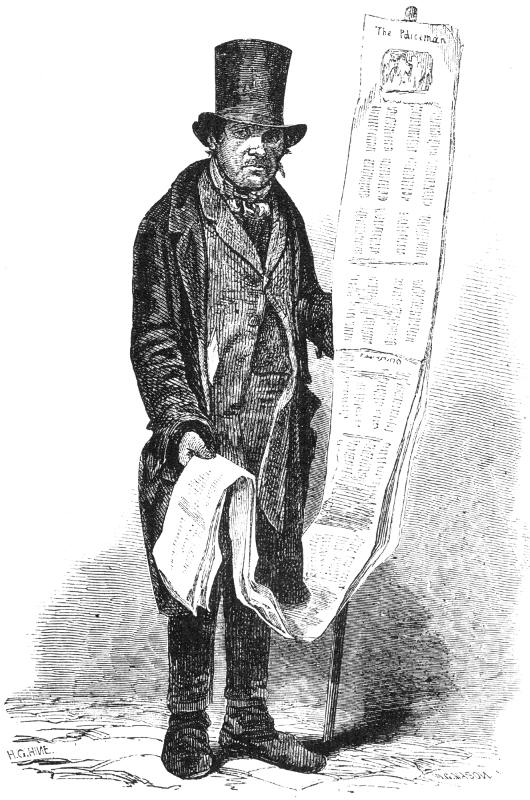
LONG-SONG SELLER.
“Two under fifty for a fardy’!”
[From a Daguerreotype by Beard.]
Experience of a Running Patterer.
From a running patterer, who has been familiar with the trade for many years, I received, upwards of a twelvemonth ago, the following statement. He is well known for his humour, and is a leading man in his fraternity. After some conversation about “cocks,” the most popular of which, my informant said, was the murder at Chigwell-row, he continued:
“That’s a trump, to the present day. Why, I’d go out now, sir, with a dozen of Chigwell-rows, and earn my supper in half an hour off of ’em. The murder of Sarah Holmes at Lincoln is good, too—that there has been worked for the last five year successively every winter. Poor Sarah Holmes! Bless her! she has saved me from walking the streets all night many a time. Some of the best of these have been in work twenty years—the Scarborough murder has full twenty years. It’s called ‘The Scarborough Tragedy.’ I’ve worked it myself. It’s about a noble and rich young naval officer seducing a poor clergyman’s daughter. She is confined in a ditch, and destroys the child. She is taken up for it, tried, and executed. This has had a great run. It sells all round the country places, and would sell now if they had it out. Mostly all our customers is females. They are the chief dependence we have. The Scarborough Tragedy is very attractive. It draws tears to the women’s eyes to think that a poor clergyman’s daughter, who is remarkably beautiful, should murder her own child; it’s very touching to every feeling heart. There’s a copy of verses with it, too. Then there’s the Liverpool Tragedy—that’s very attractive. It’s a mother murdering her own son, through gold. He had come from the East Indies, and married a rich planter’s daughter. He came back to England to see his parents after an absence of thirty years. They kept a lodging-house in Liverpool for sailors; the son went there to lodge, and meant to tell his parents who he was in the morning. His mother saw the gold he had got in his boxes, and cut his throat—severed his head from his body; the old man, upwards of seventy years of age, holding the candle. They had put a washing-tub under the bed to catch his blood. The morning after the murder, the old man’s daughter calls and inquires for a young man. The old man denies that they have had any such person in the house. She says he had a mole on his arm, in the shape of a strawberry. The old couple go up-stairs to examine the corpse, and find they have murdered their own son, and then they both put an end to their existence. This is a deeper tragedy than the Scarborough Murder. That suits young people better; they like to hear about the young woman being seduced by the naval officer; but the mothers take more to the Liverpool Tragedy—it suits them better. Some of the ‘cocks’ were in existence long before ever I was born or thought of. The ‘Great and important battle between the two young ladies of fortune,’ is what we calls ‘a ripper.’ I should like to have that there put down correct,” he added, “’cause I’ve taken a tidy lot of money out of it.”
My informant, who had been upwards of 20 years in the running patter line, told me that he commenced his career with the “Last Dying Speech and Full Confession of William Corder.” He was sixteen years of age, and had run away from his parents. “I worked that there,” he said, “down in the very town (at Bury) where he was executed. I got a whole hatful of halfpence at that. Why, I wouldn’t even give ’em seven for sixpence—no, that I wouldn’t. A gentleman’s servant come out and wanted half a dozen for his master and one for himself in, and I wouldn’t let him have no such thing. We often sells more than that at once. Why, I sold six at one go to the railway clerks at Norwich about the Manning affair, only a fortnight back. But Steinburgh’s little job—you know he murdered his wife and family, and committed suicide after—that sold as well as any ‘die.’ Pegsworth was an out-and-out lot. I did tremendous with him, because it happened in London, down Ratcliff-highway—that’s a splendid quarter for working—there’s plenty of feelings—but, bless you, some places you go to you can’t move no how, they’ve hearts like paving-stones. They wouldn’t have ‘the papers’ if you’d give them to ’em—especially when they knows you. Greenacre didn’t sell so well as might have been expected, for such a diabolical out-and-out crime as he committed; but you see he came close after Pegsworth, and that took the beauty off him. Two murderers together is never no good to nobody. Why there was Wilson Gleeson, as great a villain as ever lived—went and murdered a whole family at noon-day—but Rush coopered him—and likewise that girl at Bristol—made it no draw to any one. Daniel Good, though, was a first-rater; and would have been much better if it hadn’t been for that there Madam Toosow. You see, she went down to Roehampton, and guv 2l. for the werry clogs as he used to wash his master’s carriage in; so, in course, when the harristocracy could go and see the real things—the werry identical clogs—in the Chamber of ’Orrors, why the people wouldn’t look at our authentic portraits of the fiend in human form. Hocker wasn’t any particular great shakes. There was a deal expected from him, but he didn’t turn out well. Courvoisier was much better; he sold wery well, but nothing to Blakesley. Why I worked him for six weeks. The wife of the murdered man kept the King’s Head that he was landlord on open on the morning of the execution, and the place was like a fair. I even went and sold papers outside the door myself. I thought if she war’n’t ashamed, why should I be? After that we had a fine ‘fake’—that was the fire of the Tower of London—it sold rattling. Why we had about forty apprehended for that—first we said two soldiers was taken up that couldn’t obtain their discharge, and then we declared it was a well-known sporting nobleman who did it for a spree. The boy Jones in the Palace wasn’t much of an affair for the running patterers; the ballad singers—or street screamers, as we calls ’em—had the pull out of that. The patter wouldn’t take; they had read it all in the newspapers before. Oxford, and Francis, and Bean were a little better, but nothing to crack about. The people doesn’t care about such things as them. There’s nothing beats a stunning good murder, after all. Why there was Rush—I lived on him for a month or more. When I commenced with Rush, I was 14s. in debt for rent, and in less than fourteen days I astonished the wise men in the east by paying my landlord all I owed him. Since Dan’el Good there had been little or nothing doing in the murder line—no one could cap him—till Rush turned up a regular trump for us. Why I went down to Norwich expressly to work the execution. I worked my way down there with ‘a sorrowful lamentation’ of his own composing, which I’d got written by the blind man expressly for the occasion. On the morning of the execution we beat all the regular newspapers out of the field; for we had the full, true, and particular account down, you see, by our own express, and that can beat anything that ever they can publish; for we gets it printed several days afore it comes off, and goes and stands with it right under the drop; and many’s the penny I’ve turned away when I’ve been asked for an account of the whole business before it happened. So you see, for herly and correct hinformation, we can beat the Sun—aye, or the moon either, for the matter of that. Irish Jem, the Ambassador, never goes to bed but he blesses Rush the farmer; and many’s the time he’s told me we should never have such another windfall as that. But I told him not to despair; there’s a good time coming, boys, says I, and, sure enough, up comes the Bermondsey tragedy. We might have done very well, indeed, out of the Mannings, but there was too many examinations for it to be any great account to us. I’ve been away with the Mannings in the country ever since. I’ve been through Hertfordshire, Cambridgeshire, and Suffolk, along with George Frederick Manning and his wife—travelled from 800 to 1,000 miles with ’em, but I could have done much better if I had stopped in London. Every day I was anxiously looking for a confession from Mrs. Manning. All I wanted was for her to clear her conscience afore she left this here whale of tears (that’s what I always calls it in the patter), and when I read in the papers (mind they was none of my own) that her last words on the brink of heternity was, ‘I’ve nothing to say to you, Mr. Rowe, but to thank you for your kindness,’ I guv her up entirely—had completely done with her. In course the public looks to us for the last words of all monsters in human form, and as for Mrs. Manning’s, they were not worth the printing.”
Of the Recent Experience of a Running Patterer.
From the same man I had the following account of his vocation up to the present time:
“Well, sir,” he said, “I think, take them altogether, things hasn’t been so good this last year as the year before. But the Pope, God bless him! he’s been the best friend I’ve had since Rush, but Rush licked his Holiness. You see, the Pope and Cardinal Wiseman is a one-sided affair; of course the Catholics won’t buy anything against the Pope, but all religions could go for Rush. Our mob once thought of starting a cardinal’s dress, and I thought of wearing a red hat myself. I did wear a shovel hat when the Bishop of London was our racket; but I thought the hat began to feel too hot, so I shovelled it off. There was plenty of paper that would have suited to work with a cardinal’s hat. There was one,—‘Cardinal Wiseman’s Lament,’—and it was giving his own words like, and a red hat would have capped it. It used to make the people roar when it came to snivelling, and grumbling at little Jack Russell—by Wiseman, in course; and when it comes to this part—which alludes to that ’ere thundering letter to the Bishop of Durham—the people was stunned:
‘He called me a buffalo, bull, and a monkey, And then with a soldier called Old Arthur conkey Declared they would buy me a ninepenny donkey, And send me to Rome to the Pope.’
“They shod me, sir. Who’s they? Why, the Pope and Cardinal Wiseman. I call my clothes after them I earn money by to buy them with. My shoes I call Pope Pius; my trowsers and braces, Calcraft; my waistcoat and shirt, Jael Denny; and my coat, Love Letters. A man must show a sense of gratitude in the best way he can. But I didn’t start the cardinal’s hat; I thought it might prove disagreeable to Sir Robert Peel’s dress lodgers.” [What my informant said further of the Pope, I give under the head of the Chaunter.] “There was very little doing,” he continued, “for some time after I gave you an account before; hardly a slum worth a crust and a pipe of tobacco to us. A slum’s a paper fake,—make a foot-note of that, sir. I think Adelaide was the first thing I worked after I told you of my tomfooleries. Yes it was,—her helegy. She weren’t of no account whatsomever, and Cambridge was no better nor Adelaide. But there was poor Sir Robert Peel,—he was some good; indeed, I think he was as good as 5s. a day to me for the four or five days when he was freshest. Browns were thrown out of the windows to us, and one copper cartridge was sent flying at us with 13½d. in it, all copper, as if it had been collected. I worked Sir Robert at the West End, and in the quiet streets and squares. Certainly we had a most beautiful helegy. Well, poor gentleman, what we earned on him was some set-off to us for his starting his new regiment of the Blues—the Cook’s Own. Not that they’ve troubled me much. I was once before Alderman Kelly, when he was Lord Mayor, charged with obstructing, or some humbug of that sort. ‘What are you, my man?’ says he quietly, and like a gentleman. ‘In the same line as yourself, my lord,’ says I. ‘How’s that?’ says he. ‘I’m a paper-worker for my living, my lord,’ says I. I was soon discharged; and there was such fun and laughing, that if I’d had a few slums in my pocket, I believe I could have sold them all in the justice-room.
“Haynau was a stunner, and the drayman came their caper just in the critical time for us, as things was growing very taper. But I did best with him in chaunting; and so, as you want to hear about chaunting, I’ll tell you after. We’re forced to change our patter—first running, then chaunting, and then standing—oftener than we used to.
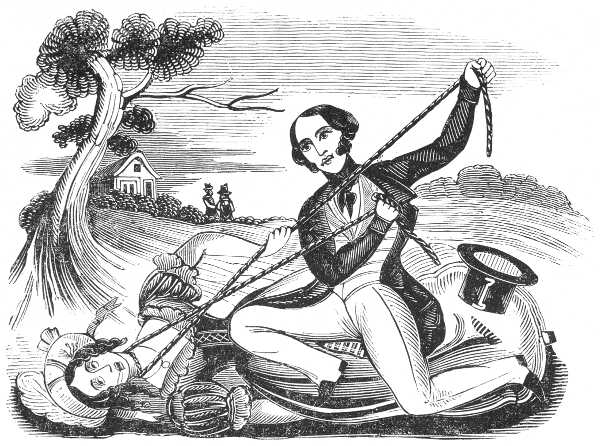
ILLUSTRATIONS OF STREET-ART—No. I.
Horrible and Bar-bari-ous Murder of Poor JAEL DENNY, THE ILL-FATED VICTIM OF THOMAS DRORY.
“Then Calcraft was pretty tidy browns. He was up for starving his mother,—and what better can you expect of a hangman? Me and my mate worked him down at Hatfield, in Essex, where his mother lives. It’s his native, I believe. We sold her one. She’s a limping old body. I saw the people look at her, and they told me arterards who she was. ‘How much?’ says she. ‘A penny, marm,’ say I. ‘Sarve him right,’ says she. We worked it, too, in the street in Hoxton where he lives, and he sent out for two, which shows he’s a sensible sort of character in some points, after all. Then we had a ‘Woice from the Gaol! or the Horrors of the Condemned Cell! Being the Life of William Calcraft, the present Hangman.’ It’s written in the high style, and parts of it will have astonished the hangman’s nerves before this. Here’s a bit of the patter, now:
“Let us look at William Calcraft,” says the eminent author, “in his earliest days. He was born about the year 1801, of humble but industrious parents, at a little village in Essex. His infant ears often listened to the children belonging to the Sunday schools of his native place, singing the well-known words of Watt’s beautiful hymn,
‘When e’er I take my walks abroad, How many poor I see, &c.’
But alas for the poor farmer’s boy, he never had the opportunity of going to that school to be taught how to shun ‘the broad way leading to destruction.’ To seek a chance fortune he travelled up to London where his ignorance and folorn condition shortly enabled that fell demon which ever haunts the footsteps of the wretched, to mark him for her own.”
“Isn’t that stunning, sir? Here it is in print for you. ‘Mark him for her own!’ Then, poor dear, he’s so sorry to hang anybody. Here’s another bit:
‘But in vain he repents, he has no real friend in the world but his wife, to whom he can communicate his private thoughts, and in return receive consolation, can any lot be harder than this? Hence his nervous system is fast breaking down, every day rendering him less able to endure the excruciating and agonizing torments he is hourly suffering, he is haunted by remorse heaped upon remorse, every fresh victim he is required to strangle being so much additional fuel thrown upon that mental flame which is scorching him.’
“You may believe me, sir, and I can prove the fact—the author of that beautiful writing ain’t in parliament! Think of the mental flame, sir! O, dear.
“Sirrell was no good either. Not salt to a herring. Though we worked him in his own neighbourhood, and pattered about gold and silver all in a row. ‘Ah!’ says one old woman, ‘he was a ’spectable man.’ ‘Werry, marm,’ says I.
“Hollest weren’t no good either, ’cause the wictim was a parson. If it had happened a little later, we’d have had it to rights; the newspapers didn’t make much of it. We’d have shown it was the ‘Commencement of a Most Horrid and Barbarious Plot got up by the Pope and Cardinal Wiseman for-r the Mas-ser-cree-ing of all good Protestant Ministers.’ That would have been the dodge, sir! A beautiful idear, now, isn’t it? But the murder came off badly, and you can’t expect fellows like them murderers to have any regard for the interest of art and literature. Then there’s so long to wait between the murder and the trial, that unless the fiend in human form keeps writing beautiful love-letters, the excitement can’t be kept up. We can write the love-letters for the fiend in human? That’s quite true, and we once had a great pull that way over the newspapers. But Lord love you, there’s plenty of ’em gets more and more into our line. They treads in our footsteps, sir; they follows our bright example. O! isn’t there a nice rubbing and polishing up. This here copy won’t do. This must be left out, and that put in; ’cause it suits the walk of the paper. Why, you must know, sir. I know. Don’t tell me. You can’t have been on the Morning Chronicle for nothing.
“Then there was the ‘Horrid and Inhuman Murder, Committed by T. Drory, on the Body of Jael Denny, at Donninghurst, a Village in Essex.’ We worked it in every way. Drory had every chance given to him. We had half-sheets, and copies of werses, and books. A very tidy book it was, setting off with showing how ‘The secluded village of Donninghurst has been the scene of a most determined and diabolical murder, the discovery of which early on Sunday, the 12th, in the morning has thrown the whole of this part of the country into a painful state of excitement.’ Well, sir, well—very well; that bit was taken from a newspaper. Oh, we’re not above acknowledging when we condescends to borrow from any of ’em. If you remember, when I saw you about the time, I told you I thought Jael Denny would turn out as good as Maria Martin. And without any joke or nonsense, sir, it really is a most shocking thing. But she didn’t. The weather coopered her, poor lass! There was money in sight, and we couldn’t touch it; it seemed washed away from us, for you may remember how wet it was. I made a little by her, though. For all that, I haven’t done with Master Drory yet. If God spares my life, he shall make it up to me. Why, now, sir, is it reasonable, that a poor man like me should take so much pains to make Drory’s name known all over the country, and walk miles and miles in the rain to do it, and get only a few bob for my labour? It can’t be thought on. When the Wile and Inhuman Seducer takes his trial, he must pay up my just claims. I’m not going to take all that trouble on his account, and let him off so easy.”
My informant then gave me an account of his sale of papers relating to the Pope and Cardinal Wiseman, but as he was then a chaunter, rather than a patterer (the distinction is shown under another head), I give his characteristic account, as the statement of a chaunter. He proceeded after having finished his recital of the street business relating to the Pope, &c.:
“My last paying caper was the Sloanes. They beat Haynau. I declare to you, sir, the knowingest among us couldn’t have invented a cock to equal the conduct of them Sloanes. Why, it’s disgusting to come near the plain truth about them. I think, take it altogether, Sloane was as good as the Pope, but he had a stopper like Pius the Ninth, for that was a one-sided affair, and the Catholics wouldn’t buy; and Sloane was too disgusting for the gentry, or better sort, to buy him. But I’ve been in little streets where some of the windows was without sashes, and some that had sashes had stockings thrust between the frames, and I’ve taken half a bob in ha’pennies. Oh! you should have heard what poor women said about him, for it was women that bought him most. They was more savage against him than against her. Why, they had fifty deaths for him. Rolling in a barrel, with lots of sharp nails inside, down Primrose-hill, and turned out to the women on Kennington-common, and boiled alive in oil or stuff that can’t be mentioned, or hung over a slow fire. ‘O, the poor dear girl,’ says they, ‘what she’s suffered.’ We had accounts of Mistress Sloane’s apprehension before the papers. We had it at Jersey, and they had it at Boulogne, but we were first. Then we discovered, because we must be in advance of the papers, that Miss Devaux was Sloane’s daughter by a former wife, and Jane Wilbred was Mrs. Sloane’s daughter by a former husband, and was entitled to 1,000l. by rights. Haynau was a fool to Sloane.
“I don’t know of anything fresh that’s in hand, sir. One of our authors is coming out with something spicy, against Lord John, for doing nothing about Wiseman; ’cause he says as no one thing that he’s written for Lord John ever sold well, something against him may.”
Of the Chaunters.
“As the minstrel’s art,” writes Mr. Strutt, in his “Sports and Pastimes,” “consisted of several branches, the professors were distinguished by different denominations, as ‘rimours, chanterres, conteours, jougleours or jongleurs, jestours, lecours, and troubadours or trouvers:’ in modern language, rhymers, singers, story-tellers, jugglers, relaters of heroic actions, buffoons, and poets; but all of them were included under the general name of minstrel. An eminent French antiquary says of the minstrels, that some of them themselves composed the subjects they sang or related, as the trouvers and the conteurs; and some of them used the compositions of others, as the jougleours and the chanteurs. He further remarks, that the trouvers may be said to have embellished their productions with rhyme, while the conteurs related their histories in prose; the jougleours, who in the middle ages were famous for playing upon the vielle” [a kind of hurdy-gurdy], “accompanied the songs of the trouvers. These jougleours were also assisted by the chanteurs; and this union of talents rendered the compositions more harmonious and more pleasing to the auditory, and increased their rewards, so that they readily joined each other, and travelled together in large parties. It is, however, very certain that the poet, the songster, and the musician were frequently united in the same person.” My account of the authors, &c., of street literature shows that the analogy still holds.
The French antiquary quoted was Fauchet, in his “Origine de la Langue et Poësie Françoise” (1581); and though he wrote concerning his own country, his descriptions apply equally to the English minstrels, who were principally Normans, for many reigns after the Conquest, and were of the same race, and habits, and manners as on the French side of the Channel.
Of the minstrels, I shall have more to say when I treat of the ballad-singers and the bands of street and public-house musicians of to-day, between whom and the minstrels of old there is, in many respects, a somewhat close resemblance. Minstrelsy fell gradually from its high estate, and fell so low that, in the 39th year of Elizabeth’s reign—a period when the noblest poetry of any language was beginning to command the ear of the educated in England—the minstrels were classed in a penal statute with rogues, vagabonds, and sturdy beggars! Putenham, in his “Arte of English Poesie” (1589), speaks of “taverne minstrels that give a fit of mirth for a groat.” One of the statutes enacted in Cromwell’s Protectorate was directed against all persons “commonly called fidlers or minstrells.”
In the old times, then, the jougeleurs and jestours were assisted by the chanteurs. In the present day the running patterer—who, as I have shown, is the sufficiently legitimate descendant of the jestour, and in some respects of the mountebank—is accompanied generally by a chaunter, so presenting a further point of resemblance between ancient and modern street-folk. The chaunter now not only sings, but fiddles, for within these few years the running patterers, to render their performances more attractive, are sometimes accompanied by musicians. The running performer then, instead of hurrying along with the members of his mob, making sufficient noise to arouse a whole street, takes his stand with the chaunter in any promising place, and as the songs which are the most popular are—as is the case at many of the concert-rooms—sometimes “spoken” as well as sung, the performers are in their proper capacity, for the patterer not only “speaks,” but speaks more than is set down for him, while the chaunter fiddles and sings. Sometimes the one patters while the other sings, and their themes are the same.
I am told, however, that there are only fifty running patterers who are regularly their own chaunters, fiddling to their songs, while the mob work as usual, or one man sings, or speaks and sings, with the chaunter. Two of these men are known as Brummagem Jack, and the Country Paganini. From twenty to thirty patterers, however, are chaunters also, when they think the occasion requires it.
Further to elucidate chaunting, and to show the quality of the canticles, and the way of proceeding, I cite a statement of his experience as a chaunter, from the running patterer, whose details of his more especial business I have already given, but who also occasionally chaunts:—
Of the Experience of a Chaunter.
“The Pope, sir,” he began, “was as one-sided to chaunt as to patter, in course. We had the Greeks (the lately-arrived Irish) down upon us more than once. In Liverpool-street, on the night of the meeting at Guildhall about the Papal Aggression, we had a regular skrimmage. One gentleman said: ‘Really, you shouldn’t sing such improper songs, my men.’ Then up comes another, and he was a little crusted with port wine, and he says: ‘What, against that cove the Pope! Here, give me half a dozen of the papers.’ The city was tidy for the patter, sir, or the chaunt; there was sixpences; but there was shillings at the West End. And for the first time in their innocent lives, the parsons came out as stunning patrons of the patter. One of ’em as we was at work in the street give a bit of a signal and was attended to without any parade to the next street, and was good for half-a-crown! Other two stopped, that wery same day, and sent a boy to us with a Joey. Then me and my mate went to the Rev. W.’s, him as came it so strong for the fire-works on the Fifth of November. And we pattered and we pattered, and we chaunted and we chaunted, but no go for a goodish bit. His servant said he weren’t at home. In course that wouldn’t do for us, so down he came his-self at last, and says, werry soft: ‘Come to-morrow morning, my men, and there’ll be two gentlemen to hear you.’ We stuck to him for something in hand, but he said the business had cost him so much already, he really couldn’t. Well, we bounced a bob out of him, and didn’t go near him again. After all we did for his party, a shilling was black ingratitude. Of course we has no feeling either for or agin the Pope. We goes to it as at an election; and let me tell you, sir, we got very poorly paid, it couldn’t be called paid, for working for Lord John at the City Election; and I was the original of the live rats, which took well. But there’s a good time coming to pay Lord Johnny off.
“Some of the tunes—there’s no act of parliament about tunes, you know, sir—was stunners on the fiddle; as if a thousand bricks was falling out of a cart at once. I think ‘The Pope and Cardinal Wiseman,’ one of the first of the songs, did as well as any. This werse was greatly admired:—
‘Now Lord John Russell did so bright, to the Bishop of Durham a letter write Saying while I’ve a hand I’ll fight, The pope and cardinal wiseman, Lord John’s ancestor as I tell, Lord William Russell then known well His true religion would not sell, A martyr he in glory fell, And now Lord John so bold and free, Has got a rope as we may see, To hang up on each side of a tree, The pope and cardinal wiseman.’
“This finishing werse, too, was effective, and out came a few browns:—
‘Now we don’t care a fig for Rome, why can’t they let the girls alone, And mind their business at home, the pope and cardinal wiseman. With their monsical red cardinals hat, And lots of wafers in a sack, If they come here with all their clack, we’ll wound them fil fal la ra whack, In England they shall not be loose, Their hum bugging is all no use, If they come here we’ll cook their goose, The pope and Cardinal Wiseman. CHORUS Monks and Nuns and fools afloat, We’ll have no bulls shoved down our throat, Cheer up and shout down with the Pope, And his bishop cardinal Wiseman.’
“Then there was another, sir. ‘The Pope he is coming; oh, crikey, oh dear!’ to the tune of the ‘Camels are coming.’ There was one bit that used to tickle them. I mayn’t exactly remember it, for I didn’t do anything beyond a spurt in it, and haven’t a copy for you, but it tickled ’em with others. This was the bit:—
‘I’ve heard my old grandmother’s grandmother say, They burnt us in Smithfield full ten every day. O, what shall I do, for I feel very queer, The Pope he’s a-coming, oh! crikey, oh, dear!’
“Bless you, sir, if I see a smart dressed servant girl looking shyly out of the street-door at us, or through the area railings, and I can get a respectful word in and say, ‘My good young lady, do buy of a poor fellow, we haven’t said a word to your servants, we hasn’t seen any on ’em,’ then she’s had, sir, for 1d. at least, and twice out of thrice; that ‘good young lady’ chloroforms her.
“Then this one, now, is stunning. It’s part of what the Queen was a going to sing at the opening of the parliament, but she changed her mind, and more’s the pity, for it would have had a grand effect. It’s called ‘The Queen, the Pope, and the Parliament,’ and these is the best of the stanzas; I calls them werses in common, but stanzas for Wick:
‘My lords and my gentlemen all, The bishops and great house of commons On you for protection I call, For you know I am only a woman, I am really quite happy indeed— To meet you like birds of a feather, So I hope you will all struggle with me, And pull away boys altogether, My name is Victoria the Queen. ‘Our bishops and deans did relent, And say they for ever was undone, Bishop Philpott a long challenge sent To his lordship the bishop of London, To fight him on Hounslow Heath— But the bishop of London was coosey, He gave him one slap in the mouth, And then sent a letter to pusey, No humbuggery stories for vick— ‘I heard my old grandfather say His great grandmother easily loved reckon When they made a fool run away, Whose name was king Jemmy the second. Billy gave him a ticket for soup, Though Bill married old Jemmy’s daughter He knocked him from old Palace yard, To Ireland, across the Boyne water, Long life to Victoria the Queen. ‘Come here my old friend Joey Hume, I know you in silence wont mope now, Go up and get inside the moon And make fast a great torry rope now, And then give a spring and a jump And you to a peerage shall rise then, For we’ll swing up old Pius the Pope And his eminence cardinal Wiseman, Old England and down with the Pope.’
“Then there wasn’t no risk with Haynau—I told you of the Pope first, ’cause he was most chaunted—no fear of a ferricadouzer for the butcher. How is it spelled, sir? Well, if you can’t find it in the dictionary, you must use your own judgment. What does it mean? It means a dewskitch (a good thrashing). I’ve been threatened with dark nights about the Pope, after the Greeks has said: ‘Fat have you to say agin the holy gintleman? To the divil wid all the likes o’ ye.’ Haynau was a fair stage and no favour. This werse was best liked:—
‘The other day as you must know, In Barclay’s brewhouse he did go And signed his bloody name “Haynau.” The fellow that flogged the women. Baron Rothchild did him shend, And in the letter which he penn’d He shaid the sheneral wash his friend, And so good a man he could not mend. CHORUS Rumpsey bumsy—bang him well— Make his back and sides to swell Till he roars aloud with dreadful yell, The fellow that flogged the women.’
“The women bought very free; poor women, mostly; we only worked him to any extent in the back drags. One old body at Stepney was so pleased that she said, ‘O, the bloody-minded willain! Whenever you come this way again, sir, there’s always 1d. for you.’ She didn’t pay in advance though.
“Then it ended, sir, with a beautiful moral as appeals to every female bosom:—
‘That man who would a female harm, Is never fit to live.’
“We always likes something for the ladies, bless ’em. They’re our best customers.
“Then there was poor Jael Denny, but she was humped, sir, and I’ve told you the reason. Her copy of werses began:—
‘Since Corder died on Buystree, No mortal man did read or see, Of such a dreadful tragedy, As I will now unfold. A maid in bloom—to her silent tomb, Is hurried in the prime of life, How could a villain cause such strife She worthy was a famous wife. The like was seldom told. CHORUS. She was young and gay, Like the flowers of may, In youth and vigour health and bloom, She is hurried to the silent tomb. Through Essex, such a dreadfull gloom, Jael Denny’s murder caused.’
“My last chaunt was Jane Wilbred; and her werses—and they did tidy well—began:—
‘A Case like this you seldom read, Or one so sad and true, And we sincerely hope the perper- trators both will rue To serve a friendless servant girl, Two years they did engage, Her name it is Jane Willbred, And eighteen years of age.’
“What do you think of the Great Exhibition, sir? I shall be there. Me and my mates. We are going to send in a copy of werses in letters of gold for a prize. We’ll let the foreigners know what the real native melodies of England is, and no mistake.”
Of the Death and Fire Hunters.
I have described the particular business of the running patterer, who is known by another and a very expressive cognomen—as a “Death Hunter.” This title refers not only to his vending accounts of all the murders that become topics of public conversation, but to his being a “murderer” on his own account, as in the sale of “cocks” mentioned incidentally in this narrative. If the truth be saleable, a running patterer prefers selling the truth, for then—as one man told me—he can “go the same round comfortably another day.” If there be no truths for sale—no stories of criminals’ lives and loves to be condensed from the diffusive biographies in the newspapers—no “helegy” for a great man gone—no prophecy and no crim. con.—the death hunter invents, or rather announces, them. He puts some one to death for the occasion, which is called “a cock.” The paper he sells may give the dreadful details, or it may be a religious tract, “brought out in mistake,” should the vendor be questioned on the subject; or else the poor fellow puts on a bewildered look and murmurs, “O, it’s shocking to be done this way—but I can’t read.” The patterers pass along so rapidly that this detection rarely happens.
One man told me that in the last eight or ten years, he, either singly or with his “mob,” had twice put the Duke of Wellington to death, once by a fall from his horse, and the other time by a “sudden and myst-erious” death, without any condescension to particulars. He had twice performed the same mortal office for Louis Phillipe, before that potentate’s departure from France; each death was by the hands of an assassin; “one was stabbing, and the other a shot from a distance.” He once thought of poisoning the Pope, but was afraid of the street Irish. He broke Prince Albert’s leg, or arm, (he was not sure which), when his royal highness was out with his harriers. He never had much to say about the Queen; “it wouldn’t go down,” he thought, and perhaps nothing had lately been said. “Stop, there, sir,” said another patterer, of whom I inquired as to the correctness of those statements, (after my constant custom in sifting each subject thoroughly,) “stop, stop, sir. I have had to say about the Queen lately. In coorse, nothing can be said against her, and nothing ought to; that’s true enough, but the last time she was confined, I cried her accouchement (the word was pronounced as spelt to a merely English reader, or rather more broadly) of three! Lord love you, sir, it would have been no use crying one; people’s so used to that; but a Bobby came up and he stops me, and said it was some impudence about the Queen’s coachman! Why look at it, says I, fat-head—I knew I was safe—and see if there’s anything in it about the Queen or her coachman! And he looked, and in coorse there was nothing. I forget just now what the paper was about.” My first-mentioned informant had apprehended Feargus O’Connor on a charge of high treason. He assassinated Louis Napoleon, “from a fourth edition of the Times,” which “did well.” He caused Marshal Haynau to die of the assault by the draymen. He made Rush hang himself in prison. He killed Jane Wilbred, and put Mrs. Sloane to death; and he announced the discovery that Jane Wilbred was Mrs. Sloane’s daughter.