Volume 1 — Of Wandering Tribes in General. (continued 3)
Reading edition
Of the Education of the “Coster-Lads.”
Among the costers the term education is (as I have already intimated) merely understood as meaning a complete knowledge of the art of “buying in the cheapest market and selling in the dearest.” There are few lads whose training extends beyond this. The father is the tutor, who takes the boy to the different markets, instructs him in the art of buying, and when the youth is perfect on this point, the parent’s duty is supposed to have been performed. Nearly all these boys are remarkable for their precocious sharpness. To use the words of one of the class, “these young ones are as sharp as terriers, and learns every dodge of business in less than half no time. There’s one I knows about three feet high, that’s up to the business as clever as a man of thirty. Though he’s only twelve years old he’ll chaff down a peeler so uncommon severe, that the only way to stop him is to take him in charge!”
It is idle to imagine that these lads, possessed of a mental acuteness almost wonderful, will not educate themselves in vice, if we neglect to train them to virtue. At their youthful age, the power of acquiring knowledge is the strongest, and some kind of education is continually going on. If they are not taught by others, they will form their own characters—developing habits of dissipation, and educing all the grossest passions of their natures, and learning to indulge in the gratification of every appetite without the least restraint.
As soon as a boy is old enough to shout well and loudly, his father takes him into the streets. Some of these youths are not above seven years of age, and it is calculated that not more than one in a hundred has ever been to a school of any kind. The boy walks with the barrow, or guides the donkey, shouting by turns with the father, who, when the goods are sold, will as a reward, let him ride home on the tray. The lad attends all markets with his father, who teaches him his business and shows him his tricks of trade; “for,” said a coster, “a governor in our line leaves the knowledge of all his dodges to his son, jist as the rich coves do their tin.”
The life of a coster-boy is a very hard one. In summer he will have to be up by four o’clock in the morning, and in winter he is never in bed after six. When he has returned from market, it is generally his duty to wash the goods and help dress the barrow. About nine he begins his day’s work, shouting whilst the father pushes; and as very often the man has lost his voice, this share of the labour is left entirely to him. When a coster has regular customers, the vegetables or fish are all sold by twelve o’clock, and in many coster families the lad is then packed off with fruit to hawk in the streets. When the work is over, the father will perhaps take the boy to a public-house with him, and give him part of his beer. Sometimes a child of four or five is taken to the tap-room, especially if he be pretty and the father proud of him. “I have seen,” said a coster to me, “a baby of five year old reeling drunk in a tap-room. His governor did it for the lark of the thing, to see him chuck hisself about—sillyfied like.”
The love of gambling soon seizes upon the coster boy. Youths of about twelve or so will as soon as they can get away from work go to a public-house and play cribbage for pints of beer, or for a pint a corner. They generally continue playing till about midnight, and rarely—except on a Sunday—keep it up all night.
It ordinarily happens that when a lad is about thirteen, he quarrels with his father, and gets turned away from home. Then he is forced to start for himself. He knows where he can borrow stock-money and get his barrow, for he is as well acquainted with the markets as the oldest hand at the business, and children may often be seen in the streets under-selling their parents. “How’s it possible,” said a woman, “for people to live when there’s their own son at the end of the court a-calling his goods as cheap again as we can afford to sell ourn.”
If the boy is lucky in trade, his next want is to get a girl to keep home for him. I was assured, that it is not at all uncommon for a lad of fifteen to be living with a girl of the same age, as man and wife. It creates no disgust among his class, but seems rather to give him a position among such people. Their courtship does not take long when once the mate has been fixed upon. The girl is invited to “raffles,” and treated to “twopenny hops,” and half-pints of beer. Perhaps a silk neck handkerchief—a “King’s-man” is given as a present; though some of the lads will, when the arrangement has been made, take the gift back again and wear it themselves. The boys are very jealous, and if once made angry behave with great brutality to the offending girl. A young fellow of about sixteen told me, as he seemed to grow angry at the very thought, “If I seed my gal a talking to another chap I’d fetch her sich a punch of the nose as should plaguy quick stop the whole business.” Another lad informed me, with a knowing look, “that the gals—it was a rum thing now he come to think on it—axully liked a feller for walloping them. As long as the bruises hurted, she was always thinking on the cove as gived ’em her.” After a time, if the girl continues faithful, the young coster may marry her; but this is rarely the case, and many live with their girls until they have grown to be men, or perhaps they may quarrel the very first year, and have a fight and part.
These boys hate any continuous work. So strong is this objection to continuity that they cannot even remain selling the same article for more than a week together. Moreover none of them can be got to keep stalls. They must be perpetually on the move—or to use their own words “they like a roving life.” They all of them delight in dressing “flash” as they call it. If a “governor” was to try and “palm off” his old cord jacket upon the lad that worked with him, the boy wouldn’t take it. “Its too big and seedy for me,” he’d say, “and I aint going to have your leavings.” They try to dress like the men, with large pockets in their cord jackets and plenty of them. Their trowsers too must fit tight at the knee, and their boots they like as good as possible. A good “King’s-man,” a plush skull cap, and a seam down the trowsers are the great points of ambition with the coster boys.
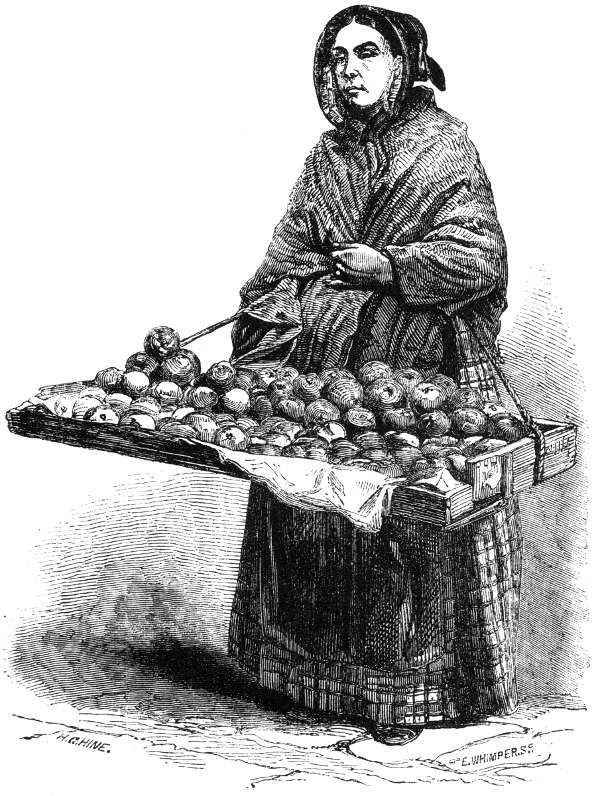
THE COSTER-GIRL.
“Apples! An ’aypenny a lot, Apples!”
[From a Daguerreotype by Beard.]
A lad about fourteen informed me that “brass buttons, like a huntman’s, with foxes’ heads on em, looked stunning flash, and the gals liked em.” As for the hair, they say it ought to be long in front, and done in “figure-six” curls, or twisted back to the ear “Newgate-knocker style.” “But the worst of hair is,” they add, “that it is always getting cut off in quod, all along of muzzling the bobbies.”
The whole of the coster-boys are fond of good living. I was told that when a lad started for himself, he would for the first week or so live almost entirely on cakes and nuts. When settled in business they always manage to have what they call “a relish” for breakfast and tea, “a couple of herrings, or a bit of bacon, or what not.” Many of them never dine excepting on the Sunday—the pony and donkey proprietors being the only costers whose incomes will permit them to indulge in a “fourpenny plate of meat at a cook’s shop.” The whole of the boys too are extremely fond of pudding, and should the “plum duff” at an eating-house contain an unusual quantity of plums, the news soon spreads, and the boys then endeavour to work that way so as to obtain a slice. While waiting for a market, the lads will very often spend a shilling in the cakes and three cornered puffs sold by the Jews. The owners toss for them, and so enable the young coster to indulge his two favourite passions at the same time—his love of pastry, and his love of gambling. The Jews crisp butter biscuits also rank very high with the boys, who declare that they “slip down like soapsuds down a gully hole.” In fact it is curious to notice how perfectly unrestrained are the passions and appetites of these youths. The only thoughts that trouble them are for their girls, their eating and their gambling—beyond the love of self they have no tie that binds them to existence.
The Life of a Coster-Lad.
One lad that I spoke to gave me as much of his history as he could remember. He was a tall stout boy, about sixteen years old, with a face utterly vacant. His two heavy lead-coloured eyes stared unmeaningly at me, and, beyond a constant anxiety to keep his front lock curled on his cheek, he did not exhibit the slightest trace of feeling. He sank into his seat heavily and of a heap, and when once settled down he remained motionless, with his mouth open and his hands on his knees—almost as if paralyzed. He was dressed in all the slang beauty of his class, with a bright red handkerchief and unexceptionable boots.
“My father” he told me in a thick unimpassioned voice, “was a waggoner, and worked the country roads. There was two on us at home with mother, and we used to play along with the boys of our court, in Golding-lane, at buttons and marbles. I recollects nothing more than this—only the big boys used to cheat like bricks and thump us if we grumbled—that’s all I recollects of my infancy, as you calls it. Father I’ve heard tell died when I was three and brother only a year old. It was worse luck for us!—Mother was so easy with us. I once went to school for a couple of weeks, but the cove used to fetch me a wipe over the knuckles with his stick, and as I wasn’t going to stand that there, why you see I aint no great schollard. We did as we liked with mother, she was so precious easy, and I never learned anything but playing buttons and making leaden ‘bonces,’ that’s all,” (here the youth laughed slightly.) “Mother used to be up and out very early washing in families—anything for a living. She was a good mother to us. We was left at home with the key of the room and some bread and butter for dinner. Afore she got into work—and it was a goodish long time—we was shocking hard up, and she pawned nigh everything. Sometimes, when we had’nt no grub at all, the other lads, perhaps, would give us some of their bread and butter, but often our stomachs used to ache with the hunger, and we would cry when we was werry far gone. She used to be at work from six in the morning till ten o’clock at night, which was a long time for a child’s belly to hold out again, and when it was dark we would go and lie down on the bed and try and sleep until she came home with the food. I was eight year old then.
“A man as know’d mother, said to her, ‘Your boy’s got nothing to do, let him come along with me and yarn a few ha’pence,’ and so I became a coster. He gave me 4d. a morning and my breakfast. I worked with him about three year, until I learnt the markets, and then I and brother got baskets of our own, and used to keep mother. One day with another, the two on us together could make 2s. 6d. by selling greens of a morning, and going round to the publics with nuts of a evening, till about ten o’clock at night. Mother used to have a bit of fried meat or a stew ready for us when we got home, and by using up the stock as we couldn’t sell, we used to manage pretty tidy. When I was fourteen I took up with a girl. She lived in the same house as we did, and I used to walk out of a night with her and give her half-pints of beer at the publics. She were about thirteen, and used to dress werry nice, though she weren’t above middling pretty. Now I’m working for another man as gives me a shilling a week, victuals, washing, and lodging, just as if I was one of the family.
“On a Sunday I goes out selling, and all I yarns I keeps. As for going to church, why, I can’t afford it,—besides, to tell the truth, I don’t like it well enough. Plays, too, ain’t in my line much; I’d sooner go to a dance—its more livelier. The ‘penny gaffs’ is rather more in my style; the songs are out and out, and makes our gals laugh. The smuttier the better, I thinks; bless you! the gals likes it as much as we do. If we lads ever has a quarrel, why, we fights for it. If I was to let a cove off once, he’d do it again; but I never give a lad a chance, so long as I can get anigh him. I never heard about Christianity; but if a cove was to fetch me a lick of the head, I’d give it him again, whether he was a big ’un or a little ’un. I’d precious soon see a henemy of mine shot afore I’d forgive him,—where’s the use? Do I understand what behaving to your neighbour is?—In coorse I do. If a feller as lives next me wanted a basket of mine as I wasn’t using, why, he might have it; if I was working it though, I’d see him further! I can understand that all as lives in a court is neighbours; but as for policemen, they’re nothing to me, and I should like to pay ’em all off well. No; I never heerd about this here creation you speaks about. In coorse God Almighty made the world, and the poor bricklayers’ labourers built the houses arterwards—that’s my opinion; but I can’t say, for I’ve never been in no schools, only always hard at work, and knows nothing about it. I have heerd a little about our Saviour,—they seem to say he were a goodish kind of a man; but if he says as how a cove’s to forgive a feller as hits you, I should say he know’d nothing about it. In coorse the gals the lads goes and lives with thinks our walloping ’em wery cruel of us, but we don’t. Why don’t we?—why, because we don’t. Before father died, I used sometimes to say my prayers, but after that mother was too busy getting a living to mind about my praying. Yes, I knows!—in the Lord’s prayer they says, ‘Forgive us our trespasses, as we forgives them as trespasses agin us.’ It’s a very good thing, in coorse, but no costers can’t do it.”
Of the “Penny Gaff.”
In many of the thoroughfares of London there are shops which have been turned into a kind of temporary theatre (admission one penny), where dancing and singing take place every night. Rude pictures of the performers are arranged outside, to give the front a gaudy and attractive look, and at night-time coloured lamps and transparencies are displayed to draw an audience. These places are called by the costers “Penny Gaffs;” and on a Monday night as many as six performances will take place, each one having its two hundred visitors.
It is impossible to contemplate the ignorance and immorality of so numerous a class as that of the costermongers, without wishing to discover the cause of their degradation. Let any one curious on this point visit one of these penny shows, and he will wonder that any trace of virtue and honesty should remain among the people. Here the stage, instead of being the means for illustrating a moral precept, is turned into a platform to teach the cruelest debauchery. The audience is usually composed of children so young, that these dens become the school-rooms where the guiding morals of a life are picked up; and so precocious are the little things, that the girl of nine will, from constant attendance at such places, have learnt to understand the filthiest sayings, and laugh at them as loudly as the grown-up lads around her. What notions can the young female form of marriage and chastity, when the penny theatre rings with applause at the performance of a scene whose sole point turns upon the pantomimic imitation of the unrestrained indulgence of the most corrupt appetites of our nature? How can the lad learn to check his hot passions and think honesty and virtue admirable, when the shouts around him impart a glory to a descriptive song so painfully corrupt, that it can only have been made tolerable by the most habitual excess? The men who preside over these infamous places know too well the failings of their audiences. They know that these poor children require no nicely-turned joke to make the evening pass merrily, and that the filth they utter needs no double meaning to veil its obscenity. The show that will provide the most unrestrained debauchery will have the most crowded benches; and to gain this point, things are acted and spoken that it is criminal even to allude to.
Not wishing to believe in the description which some of the more intelligent of the costermongers had given of these places, it was thought better to visit one of them, so that all exaggeration might be avoided. One of the least offensive of the exhibitions was fixed upon.
The “penny gaff” chosen was situated in a broad street near Smithfield; and for a great distance off, the jingling sound of music was heard, and the gas-light streamed out into the thick night air as from a dark lantern, glittering on the windows of the houses opposite, and lighting up the faces of the mob in the road, as on an illumination night. The front of a large shop had been entirely removed, and the entrance was decorated with paintings of the “comic singers,” in their most “humourous” attitudes. On a table against the wall was perched the band, playing what the costers call “dancing tunes” with great effect, for the hole at the money-taker’s box was blocked up with hands tendering the penny. The crowd without was so numerous, that a policeman was in attendance to preserve order, and push the boys off the pavement—the music having the effect of drawing them insensibly towards the festooned green-baize curtain.
The shop itself had been turned into a waiting-room, and was crowded even to the top of the stairs leading to the gallery on the first floor. The ceiling of this “lobby” was painted blue, and spotted with whitewash clouds, to represent the heavens; the boards of the trap-door, and the laths that showed through the holes in the plaster, being all of the same colour. A notice was here posted, over the canvass door leading into the theatre, to the effect that “Ladies and Gentlemen to the front places must pay Twopence.”
The visitors, with a few exceptions, were all boys and girls, whose ages seemed to vary from eight to twenty years. Some of the girls—though their figures showed them to be mere children—were dressed in showy cotton-velvet polkas, and wore dowdy feathers in their crushed bonnets. They stood laughing and joking with the lads, in an unconcerned, impudent manner, that was almost appalling. Some of them, when tired of waiting, chose their partners, and commenced dancing grotesquely, to the admiration of the lookers-on, who expressed their approbation in obscene terms, that, far from disgusting the poor little women, were received as compliments, and acknowledged with smiles and coarse repartees. The boys clustered together, smoking their pipes, and laughing at each other’s anecdotes, or else jingling halfpence in time with the tune, while they whistled an accompaniment to it. Presently one of the performers, with a gilt crown on his well greased locks, descended from the staircase, his fleshings covered by a dingy dressing-gown, and mixed with the mob, shaking hands with old acquaintances. The “comic singer,” too, made his appearance among the throng—the huge bow to his cravat, which nearly covered his waistcoat, and the red end to his nose, exciting neither merriment nor surprise.
To discover the kind of entertainment, a lad near me and my companion was asked “if there was any flash dancing.” With a knowing wink the boy answered, “Lots! show their legs and all, prime!” and immediately the boy followed up his information by a request for a “yennep” to get a “tib of occabot.” After waiting in the lobby some considerable time, the performance inside was concluded, and the audience came pouring out through the canvass door. As they had to pass singly, I noticed them particularly. Above three-fourths of them were women and girls, the rest consisting chiefly of mere boys—for out of about two hundred persons I counted only eighteen men. Forward they came, bringing an overpowering stench with them, laughing and yelling as they pushed their way through the waiting-room. One woman carrying a sickly child with a bulging forehead, was reeling drunk, the saliva running down her mouth as she stared about her with a heavy fixed eye. Two boys were pushing her from side to side, while the poor infant slept, breathing heavily, as if stupified, through the din. Lads jumping on girls’ shoulders, and girls laughing hysterically from being tickled by the youths behind them, every one shouting and jumping, presented a mad scene of frightful enjoyment.
When these had left, a rush for places by those in waiting began, that set at defiance the blows and strugglings of a lady in spangles who endeavoured to preserve order and take the checks. As time was a great object with the proprietor, the entertainment within began directly the first seat was taken, so that the lads without, rendered furious by the rattling of the piano within, made the canvass partition bulge in and out, with the strugglings of those seeking admission, like a sail in a flagging wind.
To form the theatre, the first floor had been removed; the whitewashed beams however still stretched from wall to wall. The lower room had evidently been the warehouse, while the upper apartment had been the sitting-room, for the paper was still on the walls. A gallery, with a canvass front, had been hurriedly built up, and it was so fragile that the boards bent under the weight of those above. The bricks in the warehouse were smeared over with red paint, and had a few black curtains daubed upon them. The coster-youths require no very great scenic embellishment, and indeed the stage—which was about eight feet square—could admit of none. Two jets of gas, like those outside a butcher’s shop, were placed on each side of the proscenium, and proved very handy for the gentlemen whose pipes required lighting. The band inside the “theatre” could not compare with the band without. An old grand piano, whose canvass-covered top extended the entire length of the stage, sent forth its wiry notes under the be-ringed fingers of a “professor Wilkinsini,” while another professional, with his head resting on his violin, played vigorously, as he stared unconcernedly at the noisy audience.
Singing and dancing formed the whole of the hours’ performance, and, of the two, the singing was preferred. A young girl, of about fourteen years of age, danced with more energy than grace, and seemed to be well-known to the spectators, who cheered her on by her Christian name. When the dance was concluded, the proprietor of the establishment threw down a penny from the gallery, in the hopes that others might be moved to similar acts of generosity; but no one followed up the offering, so the young lady hunted after the money and departed. The “comic singer,” in a battered hat and the huge bow to his cravat, was received with deafening shouts. Several songs were named by the costers, but the “funny gentleman” merely requested them “to hold their jaws,” and putting on a “knowing” look, sang a song, the whole point of which consisted in the mere utterance of some filthy word at the end of each stanza. Nothing, however, could have been more successful. The lads stamped their feet with delight; the girls screamed with enjoyment. Once or twice a young shrill laugh would anticipate the fun—as if the words were well known—or the boys would forestall the point by shouting it out before the proper time. When the song was ended the house was in a delirium of applause. The canvass front to the gallery was beaten with sticks, drum-like, and sent down showers of white powder on the heads in the pit. Another song followed, and the actor knowing on what his success depended, lost no opportunity of increasing his laurels. The most obscene thoughts, the most disgusting scenes were coolly described, making a poor child near me wipe away the tears that rolled down her eyes with the enjoyment of the poison. There were three or four of these songs sung in the course of the evening, each one being encored, and then changed. One written about “Pine-apple rock,” was the grand treat of the night, and offered greater scope to the rhyming powers of the author than any of the others. In this, not a single chance had been missed; ingenuity had been exerted to its utmost lest an obscene thought should be passed by, and it was absolutely awful to behold the relish with which the young ones jumped to the hideous meaning of the verses.
There was one scene yet to come, that was perfect in its wickedness. A ballet began between a man dressed up as a woman, and a country clown. The most disgusting attitudes were struck, the most immoral acts represented, without one dissenting voice. If there had been any feat of agility, any grimacing, or, in fact, anything with which the laughter of the uneducated classes is usually associated, the applause might have been accounted for; but here were two ruffians degrading themselves each time they stirred a limb, and forcing into the brains of the childish audience before them thoughts that must embitter a lifetime, and descend from father to child like some bodily infirmity.
When I had left, I spoke to a better class costermonger on this saddening subject. “Well, sir, it is frightful,” he said, “but the boys will have their amusements. If their amusements is bad they don’t care; they only wants to laugh, and this here kind of work does it. Give ’em better singing and better dancing, and they’d go, if the price was as cheap as this is. I’ve seen, when a decent concert was given at a penny, as many as four thousand costers present, behaving themselves as quietly and decently as possible. Their wives and children was with ’em, and no audience was better conducted. It’s all stuff talking about them preferring this sort of thing. Give ’em good things at the same price, and I know they will like the good, better than the bad.”
My own experience with this neglected class goes to prove, that if we would really lift them out of the moral mire in which they are wallowing, the first step must be to provide them with wholesome amusements. The misfortune, however, is, that when we seek to elevate the character of the people, we give them such mere dry abstract truths and dogmas to digest, that the uneducated mind turns with abhorrence from them. We forget how we ourselves were originally won by our emotions to the consideration of such subjects. We do not remember how our own tastes have been formed, nor do we, in our zeal, stay to reflect how the tastes of a people generally are created; and, consequently, we cannot perceive that a habit of enjoying any matter whatsoever can only be induced in the mind by linking with it some æsthetic affection. The heart is the mainspring of the intellect, and the feelings the real educers and educators of the thoughts. As games with the young destroy the fatigue of muscular exercise, so do the sympathies stir the mind to action without any sense of effort. It is because “serious” people generally object to enlist the emotions in the education of the poor, and look upon the delight which arises in the mind from the mere perception of the beauty of sound, motion, form, and colour—or from the apt association of harmonious or incongruous ideas—or from the sympathetic operation of the affections; it is because, I say, the zealous portion of society look upon these matters as “vanity,” that the amusements of the working-classes are left to venal traders to provide. Hence, in the low-priced entertainments which necessarily appeal to the poorer, and, therefore, to the least educated of the people, the proprietors, instead of trying to develop in them the purer sources of delight, seek only to gratify their audience in the coarsest manner, by appealing to their most brutal appetites. And thus the emotions, which the great Architect of the human mind gave us as the means of quickening our imaginations and refining our sentiments, are made the instruments of crushing every operation of the intellect and debasing our natures. It is idle and unfeeling to believe that the great majority of a people whose days are passed in excessive toil, and whose homes are mostly of an uninviting character, will forego all amusements, and consent to pass their evenings by their no firesides, reading tracts or singing hymns. It is folly to fancy that the mind, spent with the irksomeness of compelled labour, and depressed, perhaps, with the struggle to live by that labour after all, will not, when the work is over, seek out some place where at least it can forget its troubles or fatigues in the temporary pleasure begotten by some mental or physical stimulant. It is because we exact too much of the poor—because we, as it were, strive to make true knowledge and true beauty as forbidding as possible to the uneducated and unrefined, that they fly to their penny gaffs, their twopenny-hops, their beer-shops, and their gambling-grounds for pleasures which we deny them, and which we, in our arrogance, believe it is possible for them to do without.
The experiment so successfully tried at Liverpool of furnishing music of an enlivening and yet elevating character at the same price as the concerts of the lowest grade, shows that the people may be won to delight in beauty instead of beastiality, and teaches us again that it is our fault to allow them to be as they are and not their’s to remain so. All men are compound animals, with many inlets of pleasure to their brains, and if one avenue be closed against them, why it but forces them to seek delight through another. So far from the perception of beauty inducing habits of gross enjoyment as “serious” people generally imagine, a moment’s reflection will tell us that these very habits are only the necessary consequences of the non-development of the æsthetic faculty; for the two assuredly cannot co-exist. To cultivate the sense of the beautiful is necessarily to inculcate a detestation of the sensual. Moreover, it is impossible for the mind to be accustomed to the contemplation of what is admirable without continually mounting to higher and higher forms of it—from the beauty of nature to that of thought—from thought to feeling, from feeling to action, and lastly to the fountain of all goodness—the great munificent Creator of the sea, the mountains, and the flowers—the stars, the sunshine, and the rainbow—the fancy, the reason, the love and the heroism of man and womankind—the instincts of the beasts—the glory of the angels—and the mercy of Christ.
Of the Coster-Girls.
The costermongers, taken as a body, entertain the most imperfect idea of the sanctity of marriage. To their undeveloped minds it merely consists in the fact of a man and woman living together, and sharing the gains they may each earn by selling in the street. The father and mother of the girl look upon it as a convenient means of shifting the support of their child over to another’s exertions; and so thoroughly do they believe this to be the end and aim of matrimony, that the expense of a church ceremony is considered as a useless waste of money, and the new pair are received by their companions as cordially as if every form of law and religion had been complied with.
The notions of morality among these people agree strangely, as I have said, with those of many savage tribes—indeed, it would be curious if it were otherwise. They are a part of the Nomades of England, neither knowing nor caring for the enjoyments of home. The hearth, which is so sacred a symbol to all civilized races as being the spot where the virtues of each succeeding generation are taught and encouraged, has no charms to them. The tap-room is the father’s chief abiding place; whilst to the mother the house is only a better kind of tent. She is away at the stall, or hawking her goods from morning till night, while the children are left to play away the day in the court or alley, and pick their morals out of the gutter. So long as the limbs gain strength the parent cares for nothing else. As the young ones grow up, their only notions of wrong are formed by what the policeman will permit them to do. If we, who have known from babyhood the kindly influences of a home, require, before we are thrust out into the world to get a living for ourselves, that our perceptions of good and evil should be quickened and brightened (the same as our perceptions of truth and falsity) by the experience and counsel of those who are wiser and better than ourselves,—if, indeed, it needed a special creation and example to teach the best and strongest of us the law of right, how bitterly must the children of the street-folk require tuition, training, and advice, when from their very cradles (if, indeed, they ever knew such luxuries) they are doomed to witness in their parents, whom they naturally believe to be their superiors, habits of life in which passion is the sole rule of action, and where every appetite of our animal nature is indulged in without the least restraint.
I say thus much because I am anxious to make others feel, as I do myself, that we are the culpable parties in these matters. That they poor things should do as they do is but human nature—but that we should allow them to remain thus destitute of every blessing vouchsafed to ourselves—that we should willingly share what we enjoy with our brethren at the Antipodes, and yet leave those who are nearer and who, therefore, should be dearer to us, to want even the commonest moral necessaries is a paradox that gives to the zeal of our Christianity a strong savour of the chicanery of Cant.
The costermongers strongly resemble the North American Indians in their conduct to their wives. They can understand that it is the duty of the woman to contribute to the happiness of the man, but cannot feel that there is a reciprocal duty from the man to the woman. The wife is considered as an inexpensive servant, and the disobedience of a wish is punished with blows. She must work early and late, and to the husband must be given the proceeds of her labour. Often when the man is in one of his drunken fits—which sometimes last two or three days continuously—she must by her sole exertions find food for herself and him too. To live in peace with him, there must be no murmuring, no tiring under work, no fancied cause for jealousy—for if there be, she is either beaten into submission or cast adrift to begin life again—as another’s leavings.
The story of one coster girl’s life may be taken as a type of the many. When quite young she is placed out to nurse with some neighbour, the mother—if a fond one—visiting the child at certain periods of the day, for the purpose of feeding it, or sometimes, knowing the round she has to make, having the infant brought to her at certain places, to be “suckled.” As soon as it is old enough to go alone, the court is its play-ground, the gutter its school-room, and under the care of an elder sister the little one passes the day, among children whose mothers like her own are too busy out in the streets helping to get the food, to be able to mind the family at home. When the girl is strong enough, she in her turn is made to assist the mother by keeping guard over the younger children, or, if there be none, she is lent out to carry about a baby, and so made to add to the family income by gaining her sixpence weekly. Her time is from the earliest years fully occupied; indeed, her parents cannot afford to keep her without doing and getting something. Very few of the children receive the least education. “The parents,” I am told, “never give their minds to learning, for they say, ‘What’s the use of it? that won’t yarn a gal a living.’” Everything is sacrificed—as, indeed, under the circumstances it must be—in the struggle to live—aye! and to live merely. Mind, heart, soul, are all absorbed in the belly. The rudest form of animal life, physiologists tell us, is simply a locomotive stomach. Verily, it would appear as if our social state had a tendency to make the highest animal sink into the lowest.
At about seven years of age the girls first go into the streets to sell. A shallow-basket is given to them, with about two shillings for stock-money, and they hawk, according to the time of year, either oranges, apples, or violets; some begin their street education with the sale of water-cresses. The money earned by this means is strictly given to the parents. Sometimes—though rarely—a girl who has been unfortunate during the day will not dare to return home at night, and then she will sleep under some dry arch or about some market, until the morrow’s gains shall ensure her a safe reception and shelter in her father’s room.
The life of the coster-girls is as severe as that of the boys. Between four and five in the morning they have to leave home for the markets, and sell in the streets until about nine. Those that have more kindly parents, return then to breakfast, but many are obliged to earn the morning’s meal for themselves. After breakfast, they generally remain in the streets until about ten o’clock at night; many having nothing during all that time but one meal of bread and butter and coffee, to enable them to support the fatigue of walking from street to street with the heavy basket on their heads. In the course of a day, some girls eat as much as a pound of bread, and very seldom get any meat, unless it be on a Sunday.
There are many poor families that, without the aid of these girls, would be forced into the workhouse. They are generally of an affectionate disposition, and some will perform acts of marvellous heroism to keep together the little home. It is not at all unusual for mere children of fifteen to walk their eight or ten miles a day, carrying a basket of nearly two hundred weight on their heads. A journey to Woolwich and back, or to the towns near London, is often undertaken to earn the 1s. 6d. their parents are anxiously waiting for at home.
Very few of these girls are married to the men they afterwards live with. Their courtship is usually a very short one; for, as one told me, “the life is such a hard one, that a girl is ready to get rid of a little of the labour at any price.” The coster-lads see the girls at market, and if one of them be pretty, and a boy take a fancy to her, he will make her bargains for her, and carry her basket home. Sometimes a coster working his rounds will feel a liking for a wench selling her goods in the street, and will leave his barrow to go and talk with her. A girl seldom takes up with a lad before she is sixteen, though some of them, when barely fifteen or even fourteen, will pair off. They court for a time, going to raffles and “gaffs” together, and then the affair is arranged. The girl tells her parents “she’s going to keep company with so-and-so,” packs up what things she has, and goes at once, without a word of remonstrance from either father or mother. A furnished room, at about 4s. a week is taken, and the young couple begin life. The lad goes out as usual with his barrow, and the girl goes out with her basket, often working harder for her lover than she had done for her parents. They go to market together, and at about nine o’clock her day’s selling begins. Very often she will take out with her in the morning what food she requires during the day, and never return home until eleven o’clock at night.
The men generally behave very cruelly to the girls they live with. They are as faithful to them as if they were married, but they are jealous in the extreme. To see a man talking to their girl is sufficient to ensure the poor thing a beating. They sometimes ill-treat them horribly—most unmercifully indeed—nevertheless the girls say they cannot help loving them still, and continue working for them, as if they experienced only kindness at their hands. Some of the men are gentler and more considerate in their treatment of them, but by far the larger portion are harsh and merciless. Often when the Saturday night’s earnings of the two have been large, the man will take the entire money, and as soon as the Sunday’s dinner is over, commence drinking hard, and continue drunk for two or three days together, until the funds are entirely exhausted. The women never gamble; they say, “it gives them no excitement.” They prefer, if they have a spare moment in the evening, sitting near the fire making up and patching their clothes. “Ah, sir,” said a girl to me, “a neat gown does a deal with a man; he always likes a girl best when everybody else likes her too.” On a Sunday they clean their room for the week and go for a treat, if they can persuade their young man to take them out in the afternoon, either to Chalk Farm or Battersea Fields—“where there’s plenty of life.”
After a girl has once grown accustomed to a street-life, it is almost impossible to wean her from it. The muscular irritability begotten by continued wandering makes her unable to rest for any time in one place, and she soon, if put to any settled occupation, gets to crave for the severe exercise she formerly enjoyed. The least restraint will make her sigh after the perfect liberty of the coster’s “roving life.” As an instance of this I may relate a fact that has occurred within the last six months. A gentleman of high literary repute, struck with the heroic strugglings of a coster Irish girl to maintain her mother, took her to his house, with a view of teaching her the duties of a servant. At first the transition was a painful one to the poor thing. Having travelled barefoot through the streets since a mere child, the pressure of shoes was intolerable to her, and in the evening or whenever a few minutes’ rest could be obtained, the boots were taken off, for with them on she could enjoy no ease. The perfect change of life, and the novelty of being in a new place, reconciled her for some time to the loss of her liberty. But no sooner did she hear from her friends, that sprats were again in the market, than, as if there were some magical influence in the fish, she at once requested to be freed from the confinement, and permitted to return to her old calling.
Such is the history of the lower class of girls, though this lower class, I regret to say, constitutes by far the greater portion of the whole. Still I would not for a moment have it inferred that all are bad. There are many young girls getting their living, or rather helping to get the living of others in the streets, whose goodness, considering the temptations and hardships besetting such an occupation, approximates to the marvellous. As a type of the more prudent class of coster girls, I would cite the following narrative received from the lips of a young woman in answer to a series of questions.
The Life of a Coster Girl.
I wished to have obtained a statement from the girl whose portrait is here given, but she was afraid to give the slightest information about the habits of her companions, lest they should recognize her by the engraving and persecute her for the revelations she might make. After disappointing me some dozen times, I was forced to seek out some other coster girl.
The one I fixed upon was a fine-grown young woman of eighteen. She had a habit of curtsying to every question that was put to her. Her plaid shawl was tied over the breast, and her cotton-velvet bonnet was crushed in with carrying her basket. She seemed dreadfully puzzled where to put her hands, at one time tucking them under her shawl, warming them at the fire, or measuring the length of her apron, and when she answered a question she invariably addressed the fireplace. Her voice was husky from shouting apples.
“My mother has been in the streets selling all her lifetime. Her uncle learnt her the markets and she learnt me. When business grew bad she said to me, ‘Now you shall take care on the stall, and I’ll go and work out charing.’ The way she learnt me the markets was to judge of the weight of the baskets of apples, and then said she, ‘Always bate ’em down, a’most a half.’ I always liked the street-life very well, that was if I was selling. I have mostly kept a stall myself, but I’ve known gals as walk about with apples, as have told me that the weight of the baskets is sich that the neck cricks, and when the load is took off, its just as if you’d a stiff neck, and the head feels as light as a feather. The gals begins working very early at our work; the parents makes them go out when a’most babies. There’s a little gal, I’m sure she an’t more than half-past seven, that stands selling water-cresses next my stall, and mother was saying, ‘Only look there, how that little one has to get her living afore she a’most knows what a penn’orth means.’
“There’s six on us in family, and father and mother makes eight. Father used to do odd jobs with the gas-pipes in the streets, and when work was slack we had very hard times of it. Mother always liked being with us at home, and used to manage to keep us employed out of mischief—she’d give us an old gown to make into pinafores for the children and such like! She’s been very good to us, has mother, and so’s father. She always liked to hear us read to her whilst she was washing or such like! and then we big ones had to learn the little ones. But when father’s work got slack, if she had no employment charing, she’d say, ‘Now I’ll go and buy a bushel of apples,’ and then she’d turn out and get a penny that way. I suppose by sitting at the stall from nine in the morning till the shops shuts up—say ten o’clock at night, I can earn about 1s. 6d. a day. It’s all according to the apples—whether they’re good or not—what we makes. If I’m unlucky, mother will say, ‘Well, I’ll go out to-morrow and see what I can do;’ and if I’ve done well, she’ll say ‘Come you’re a good hand at it; you’ve done famous.’ Yes, mother’s very fair that way. Ah! there’s many a gal I knows whose back has to suffer if she don’t sell her stock well; but, thank God! I never get more than a blowing up. My parents is very fair to me.
“I dare say there ain’t ten out of a hundred gals what’s living with men, what’s been married Church of England fashion. I know plenty myself, but I don’t, indeed, think it right. It seems to me that the gals is fools to be ’ticed away, but, in coorse, they needn’t go without they likes. This is why I don’t think it’s right. Perhaps a man will have a few words with his gal, and he’ll say, ‘Oh! I ain’t obligated to keep her!’ and he’ll turn her out: and then where’s that poor gal to go? Now, there’s a gal I knows as came to me no later than this here week, and she had a dreadful swole face and a awful black eye; and I says, ‘Who’s done that?’ and she says, says she, ‘Why, Jack’—just in that way; and then she says, says she, ‘I’m going to take a warrant out to-morrow.’ Well, he gets the warrant that same night, but she never appears again him, for fear of getting more beating. That don’t seem to me to be like married people ought to be. Besides, if parties is married, they ought to bend to each other; and they won’t, for sartain, if they’re only living together. A man as is married is obligated to keep his wife if they quarrels or not; and he says to himself, says he, ‘Well, I may as well live happy, like.’ But if he can turn a poor gal off, as soon as he tires of her, he begins to have noises with her, and then gets quit of her altogether. Again, the men takes the money of the gals, and in coorse ought to treat ’em well—which they don’t. This is another reason: when the gal is in the family way, the lads mostly sends them to the workhouse to lay in, and only goes sometimes to take them a bit of tea and shuggar; but, in coorse, married men wouldn’t behave in such likes to their poor wives. After a quarrel, too, a lad goes and takes up with another young gal, and that isn’t pleasant for the first one. The first step to ruin is them places of ‘penny gaffs,’ for they hears things there as oughtn’t to be said to young gals. Besides, the lads is very insinivating, and after leaving them places will give a gal a drop of beer, and make her half tipsy, and then they makes their arrangements. I’ve often heerd the boys boasting of having ruined gals, for all the world as if they was the first noblemen in the land.
“It would be a good thing if these sort of goings on could be stopped. It’s half the parents’ fault; for if a gal can’t get a living, they turns her out into the streets, and then what’s to become of her? I’m sure the gals, if they was married, would be happier, because they couldn’t be beat worse. And if they was married, they’d get a nice home about ’em; whereas, if they’s only living together, they takes a furnished room. I’m sure, too, that it’s a bad plan; for I’ve heerd the gals themselves say, ‘Ah! I wish I’d never seed Jack’ (or Tom, or whatever it is); ‘I’m sure I’d never be half so bad but for him.’
“Only last night father was talking about religion. We often talks about religion. Father has told me that God made the world, and I’ve heerd him talk about the first man and woman as was made and lived—it must be more than a hundred years ago—but I don’t like to speak on what I don’t know. Father, too, has told me about our Saviour what was nailed on a cross to suffer for such poor people as we is. Father has told us, too, about his giving a great many poor people a penny loaf and a bit of fish each, which proves him to have been a very kind gentleman. The Ten Commandments was made by him, I’ve heerd say, and he performed them too among other miracles. Yes! this is part of what our Saviour tells us. We are to forgive everybody, and do nobody no injury. I don’t think I could forgive an enemy if she injured me very much; I’m sure I don’t know why I couldn’t, unless it is that I’m poor, and never learnt to do it. If a gal stole my shawl and didn’t return it back or give me the value on it, I couldn’t forgive her; but if she told me she lost it off her back, I shouldn’t be so hard on her. We poor gals ain’t very religious, but we are better than the men. We all of us thanks God for everything—even for a fine day; as for sprats, we always says they’re God’s blessing for the poor, and thinks it hard of the Lord Mayor not to let ’em come in afore the ninth of November, just because he wants to dine off them—which he always do. Yes, we knows for certain that they eats plenty of sprats at the Lord Mayor’s ‘blanket.’ They say in the Bible that the world was made in six days: the beasts, the birds, the fish, and all—and sprats was among them in coorse. There was only one house at that time as was made, and that was the Ark for Adam and Eve and their family. It seems very wonderful indeed how all this world was done so quick. I should have thought that England alone would have took double the time; shouldn’t you, sir? But then it says in the Bible, God Almighty’s a just and true God, and in coorse time would be nothing to him. When a good person is dying, we says, ‘The Lord has called upon him, and he must go,’ but I can’t think what it means, unless it is that an angel comes—like when we’re a-dreaming—and tells the party he’s wanted in heaven. I know where heaven is; it’s above the clouds, and they’re placed there to prevent us seeing into it. That’s where all the good people go, but I’m afeerd,”—she continued solemnly—“there’s very few costers among the angels—’specially those as deceives poor gals.
“No, I don’t think this world could well go on for ever. There’s a great deal of ground in it, certainly, and it seems very strong at present; but they say there’s to be a flood on the earth, and earthquakes, and that will destroy it. The earthquake ought to have took place some time ago, as people tells me, but I never heerd any more about it. If we cheats in the streets, I know we shan’t go to Heaven; but it’s very hard upon us, for if we didn’t cheat we couldn’t live, profits is so bad. It’s the same with the shops, and I suppose the young men there won’t go to Heaven neither; but if people won’t give the money, both costers and tradesmen must cheat, and that’s very hard. Why, look at apples! customers want them for less than they cost us, and so we are forced to shove in bad ones as well as good ones; and if we’re to suffer for that, it does seem to me dreadful cruel.”
Curious and extravagant as this statement may perhaps appear to the uninitiated, nevertheless it is here given as it was spoken; and it was spoken with an earnestness that proved the poor girl looked upon it as a subject, the solemnity of which forced her to be truthful.
Of Costermongers and Thieves.
Concerning the connection of these two classes I had the following account from a costermonger: “I’ve known the coster trade for twelve years, and never knew thieves go out a costering as a cloak; they may have done so, but I very much doubt it. Thieves go for an idle life, and costermongering don’t suit them. Our chaps don’t care a d—n who they associate with,—if they’re thieves they meet ’em all the same, or anything that way. But costers buy what they call ‘a gift,’—may-be it’s a watch or coat wot’s been stolen—from any that has it to sell. A man will say: ‘If you’ve a few shillings, you may make a good thing of it. Why this identical watch is only twenty shillings, and it’s worth fifty;’ so if the coster has money, he buys. Thieves will get 3d. where a mechanic or a coster will earn ½d., and the most ignorant of our people has a queer sort of respect for thieves, because of the money they make. Poverty’s as much despised among costers as among other people. People that’s badly off among us are called ‘cursed.’ In bad weather it’s common for costers to ‘curse themselves,’ as they call having no trade. ‘Well, I’m cursed,’ they say when they can make no money. It’s a common thing among them to shout after any one they don’t like, that’s reduced, ‘Well, ain’t you cursed?’” The costers, I am credibly informed, gamble a great deal with the wealthier class of thieves, and win of them the greater part of the money they get.
Of the more provident Costermongers.
Concerning this head, I give the statement of a man whose information I found fully confirmed:—“We are not such a degraded set as some believe; sir, but a living doesn’t tumble into a man’s mouth, now a days. A good many of us costers rises into greengrocers and coal-sheds, and still carries on their rounds as costers, all the same. Why, in Lock’s-fields, I could show you twenty such, and you’d find them very decent men, sir—very. There’s one man I know, that’s risen that way, who is worth hundreds of pounds, and keeps his horse and cart like a gentleman. They rises to be voters, and they all vote liberal. Some marry the better kind of servants,—such servant-maids as would’nt marry a rag and bottle shop, but doesn’t object to a coal shed. It’s mostly younger men that manages this. As far as I have observed, these costers, after they has settled and got to be housekeepers, don’t turn their backs on their old mates. They’d have a nice life of it if they did—yes! a very nice life.”
Of the Homes of the Costermongers.
The costermongers usually reside in the courts and alleys in the neighbourhood of the different street-markets. They themselves designate the locality where, so to speak, a colony of their people has been established, a “coster district,” and the entire metropolis is thus parcelled out, almost as systematically as if for the purposes of registration. These costermonger districts are as follows, and are here placed in the order of the numerical importance of the residents:
The New Cut (Lambeth).
Whitecross-street.
Leather-lane.
The Brill, Somers’ Town.
Whitechapel.
Camberwell.
Walworth.
Peckham.
Bermondsey.
The Broadway, Westminster.
Shoreditch.
Paddington and Edgeware Road.
Tottenham-court Road.
Drury-lane.
Old-street Road.
Clare Market.
Ratcliffe Highway.
Lisson-grove.
Petticoat and Rosemary-lane.
Marylebone-lane.
Oxford-street.
Rotherhithe.
Deptford.
Dockhead.
Greenwich.
Commercial-road (East).
Poplar.
Limehouse.
Bethnal-green.
Hackney-road.
Kingsland.
Camden Town.
The homes of the costermongers in these places, may be divided into three classes; firstly, those who, by having a regular trade or by prudent economy, are enabled to live in comparative ease and plenty; secondly, those who, from having a large family or by imprudent expenditure, are, as it were, struggling with the world; and thirdly, those who for want of stock-money, or ill success in trade are nearly destitute.
The first home I visited was that of an old woman, who with the assistance of her son and girls, contrived to live in a most praiseworthy and comfortable manner. She and all her family were teetotallers, and may be taken as a fair type of the thriving costermonger.
As I ascended a dark flight of stairs, a savory smell of stew grew stronger at each step I mounted. The woman lived in a large airy room on the first floor (“the drawing-room” as she told me laughing at her own joke), well lighted by a clean window, and I found her laying out the savory smelling dinner looking most temptingly clean. The floor was as white as if it had been newly planed, the coke fire was bright and warm, making the lid of the tin saucepan on it rattle up and down as the steam rushed out. The wall over the fire-place was patched up to the ceiling with little square pictures of saints, and on the mantel-piece, between a row of bright tumblers and wine glasses filled with odds and ends, stood glazed crockeryware images of Prince Albert and M. Jullien. Against the walls, which were papered with “hangings” of four different patterns and colours, were hung several warm shawls, and in the band-box, which stood on the stained chest of drawers, you could tell that the Sunday bonnet was stowed safely away from the dust. A turn-up bedstead thrown back, and covered with a many-coloured patch-work quilt, stood opposite to a long dresser with its mugs and cups dangling from the hooks, and the clean blue plates and dishes ranged in order at the back. There were a few bushel baskets piled up in one corner, “but the apples smelt so,” she said, “they left them in a stable at night.”
By the fire sat the woman’s daughter, a pretty meek-faced gray-eyed girl of sixteen, who “was home nursing” for a cold. “Steve” (her boy) I was informed, was out working. With his help, the woman assured me, she could live very comfortably—“God be praised!” and when he got the barrow he was promised, she gave me to understand, that their riches were to increase past reckoning. Her girl too was to be off at work as soon as sprats came in. “Its on Lord Mayor’s-day they comes in,” said a neighbour who had rushed up to see the strange gentleman, “they says he has ’em on his table, but I never seed ’em. They never gives us the pieces, no not even the heads,” and every one laughed to their utmost. The good old dame was in high spirits, her dark eyes sparkling as she spoke about her “Steve.” The daughter in a little time lost her bashfulness, and informed me “that one of the Polish refugees was a-courting Mrs. M——, who had given him a pair of black eyes.”
On taking my leave I was told by the mother that their silver gilt Dutch clock—with its glass face and blackleaded weights—“was the best one in London, and might be relied on with the greatest safety.”
As a specimen of the dwellings of the struggling costers, the following may be cited:
The man, a tall, thick-built, almost good-looking fellow, with a large fur cap on his head, lived with his family in a front kitchen, and as there were, with his mother-in-law, five persons, and only one bed, I was somewhat puzzled to know where they could all sleep. The barrow standing on the railings over the window, half shut out the light, and when any one passed there was a momentary shadow thrown over the room, and a loud rattling of the iron gratings above that completely prevented all conversation. When I entered, the mother-in-law was reading aloud one of the threepenny papers to her son, who lolled on the bed, that with its curtains nearly filled the room. There was the usual attempt to make the fireside comfortable. The stone sides had been well whitened, and the mantel-piece decorated with its small tin trays, tumblers, and a piece of looking-glass. A cat with a kitten were seated on the hearth-rug in front. “They keeps the varmint away,” said the woman, stroking the “puss,” “and gives a look of home.” By the drawers were piled up four bushel baskets, and in a dark corner near the bed stood a tall measure full of apples that scented the room. Over the head, on a string that stretched from wall to wall, dangled a couple of newly-washed shirts, and by the window were two stone barrels, for lemonade, when the coster visited the fairs and races.
Whilst we were talking, the man’s little girl came home. For a poor man’s child she was dressed to perfection; her pinafore was clean, her face shone with soap, and her tidy cotton print gown had clearly been newly put on that morning. She brought news that “Janey” was coming home from auntey’s, and instantly a pink cotton dress was placed by the mother-in-law before the fire to air. (It appeared that Janey was out at service, and came home once a week to see her parents and take back a clean frock.) Although these people were living, so to speak, in a cellar, still every endeavour had been made to give the home a look of comfort. The window, with its paper-patched panes, had a clean calico blind. The side-table was dressed up with yellow jugs and cups and saucers, and the band-boxes had been stowed away on the flat top of the bedstead. All the chairs, which were old fashioned mahogany ones, had sound backs and bottoms.
Of the third class, or the very poor, I chose the following “type” out of the many others that presented themselves. The family here lived in a small slanting-roofed house, partly stripped of its tiles. More than one half of the small leaden squares of the first-floor window were covered with brown paper, puffing out and crackling in the wind, while through the greater part of the others were thrust out ball-shaped bundles of rags, to keep out the breeze. The panes that did remain were of all shapes and sizes, and at a distance had the appearance of yellow glass, they were so stained with dirt. I opened a door with a number chalked on it, and groped my way up a broken tottering staircase.
It took me some time after I had entered the apartment before I could get accustomed to the smoke, that came pouring into the room from the chimney. The place was filled with it, curling in the light, and making every thing so indistinct that I could with difficulty see the white mugs ranged in the corner-cupboard, not three yards from me. When the wind was in the north, or when it rained, it was always that way, I was told, “but otherwise,” said an old dame about sixty, with long grisly hair spreading over her black shawl, “it is pretty good for that.”
On a mattrass, on the floor, lay a pale-faced girl—“eighteen years old last twelfth-cake day”—her drawn-up form showing in the patch-work counterpane that covered her. She had just been confined, and the child had died! A little straw, stuffed into an old tick, was all she had to lie upon, and even that had been given up to her by the mother until she was well enough to work again. To shield her from the light of the window, a cloak had been fastened up slantingly across the panes; and on a string that ran along the wall was tied, amongst the bonnets, a clean nightcap—“against the doctor came,” as the mother, curtsying, informed me. By the side of the bed, almost hidden in the dark shade, was a pile of sieve baskets, crowned by the flat shallow that the mother “worked” with.
The room was about nine feet square, and furnished a home for three women. The ceiling slanted like that of a garret, and was the colour of old leather, excepting a few rough white patches, where the tenants had rudely mended it. The white light was easily seen through the laths, and in one corner a large patch of the paper looped down from the wall. One night the family had been startled from their sleep by a large mass of mortar—just where the roof bulged in—falling into the room. “We never want rain water,” the woman told me, “for we can catch plenty just over the chimney-place.”
They had made a carpet out of three or four old mats. They were “obligated to it, for fear of dropping anything through the boards into the donkey stables in the parlour underneath. But we only pay ninepence a week rent,” said the old woman, “and mustn’t grumble.”
The only ornament in the place was on the mantel-piece—an old earthenware sugar-basin, well silvered over, that had been given by the eldest girl when she died, as a remembrance to her mother. Two cracked tea-cups, on their inverted saucers, stood on each side, and dressed up the fire-side into something like tidiness. The chair I sat on was by far the best out of the three in the room, and that had no back, and only half its quantity of straw.
The parish, the old woman told me, allowed her 1s. a week and two loaves. But the doctor ordered her girl to take sago and milk, and she was many a time sorely puzzled to get it. The neighbours helped her a good deal, and often sent her part of their unsold greens;—even if it was only the outer leaves of the cabbages, she was thankful for them. Her other girl—a big-boned wench, with a red shawl crossed over her bosom, and her black hair parted on one side—did all she could, and so they lived on. “As long as they kept out of the ‘big house’ (the workhouse) she would not complain.”
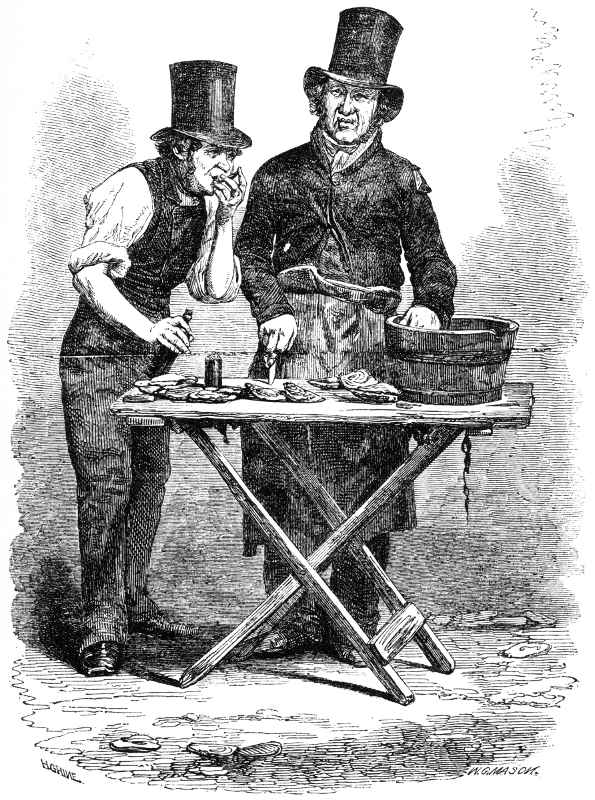
THE OYSTER STALL.
“Penny a lot, Oysters! Penny a lot!”
[From a Daguerreotype by Beard.]
I never yet beheld so much destitution borne with so much content. Verily the acted philosophy of the poor is a thing to make those who write and preach about it hide their heads.
Of the Dress of the Costermongers.
From the homes of the costermongers we pass to a consideration of their dress.
The costermonger’s ordinary costume partakes of the durability of the warehouseman’s, with the quaintness of that of the stable-boy. A well-to-do “coster,” when dressed for the day’s work, usually wears a small cloth cap, a little on one side. A close-fitting worsted tie-up skull-cap, is very fashionable, just now, among the class, and ringlets at the temples are looked up to as the height of elegance. Hats they never wear—excepting on Sunday—on account of their baskets being frequently carried on their heads. Coats are seldom indulged in; their waistcoats, which are of a broad-ribbed corduroy, with fustian back and sleeves, being made as long as a groom’s, and buttoned up nearly to the throat. If the corduroy be of a light sandy colour, then plain brass, or sporting buttons, with raised fox’s or stag’s heads upon them—or else black bone-buttons, with a flower-pattern—ornament the front; but if the cord be of a dark rat-skin hue, then mother-of-pearl buttons are preferred. Two large pockets—sometimes four—with huge flaps or lappels, like those in a shooting-coat, are commonly worn. If the costermonger be driving a good trade and have his set of regular customers, he will sport a blue cloth jacket, similar in cut to the cord ones above described; but this is looked upon as an extravagance of the highest order, for the slime and scales of the fish stick to the sleeves and shoulders of the garment, so as to spoil the appearance of it in a short time. The fashionable stuff for trousers, at the present, is a dark-coloured “cable cord,” and they are made to fit tightly at the knee and swell gradually until they reach the boot, which they nearly cover. Velveteen is now seldom worn, and knee-breeches are quite out of date. Those who deal wholly in fish wear a blue serge apron, either hanging down or tucked up round their waist. The costermonger, however, prides himself most of all upon his neckerchief and boots. Men, women, boys and girls, all have a passion for these articles. The man who does not wear his silk neckerchief—his “King’s-man” as it is called—is known to be in desperate circumstances; the inference being that it has gone to supply the morning’s stock-money. A yellow flower on a green ground, or a red and blue pattern, is at present greatly in vogue. The women wear their kerchiefs tucked-in under their gowns, and the men have theirs wrapped loosely round the neck, with the ends hanging over their waistcoats. Even if a costermonger has two or three silk handkerchiefs by him already, he seldom hesitates to buy another, when tempted with a bright showy pattern hanging from a Field-lane door-post.
The costermonger’s love of a good strong boot is a singular prejudice that runs throughout the whole class. From the father to the youngest child, all will be found well shod. So strong is their predilection in this respect, that a costermonger may be immediately known by a glance at his feet. He will part with everything rather than his boots, and to wear a pair of second-hand ones, or “translators” (as they are called), is felt as a bitter degradation by them all. Among the men, this pride has risen to such a pitch, that many will have their upper-leathers tastily ornamented, and it is not uncommon to see the younger men of this class with a heart or a thistle, surrounded by a wreath of roses, worked below the instep, on their boots. The general costume of the women or girls is a black velveteen or straw bonnet, with a few ribbons or flowers, and almost always a net cap fitting closely to the cheek. The silk “King’s-man” covering their shoulders, is sometimes tucked into the neck of the printed cotton-gown, and sometimes the ends are brought down outside to the apron-strings. Silk dresses are never worn by them—they rather despise such articles. The petticoats are worn short, ending at the ankles, just high enough to show the whole of the much-admired boots. Coloured, or “illustrated shirts,” as they are called, are especially objected to by the men.
On the Sunday no costermonger will, if he can possibly avoid it, wheel a barrow. If a shilling be an especial object to him, he may, perhaps, take his shallow and head-basket as far as Chalk-farm, or some neighbouring resort; but even then he objects strongly to the Sunday-trading. They leave this to the Jews and Irish, who are always willing to earn a penny—as they say.
The prosperous coster will have his holiday on the Sunday, and, if possible, his Sunday suit as well—which usually consists of a rough beaver hat, brown Petersham, with velvet facings of the same colour, and cloth trousers, with stripes down the side. The women, generally, manage to keep by them a cotton gown of a bright showy pattern, and a new shawl. As one of the craft said to me—“Costers likes to see their gals and wives look lady-like when they takes them out.” Such of the costers as are not in a flourishing way of business, seldom make any alteration in their dress on the Sunday.
There are but five tailors in London who make the garb proper to costermongers; one of these is considered somewhat “slop,” or as a coster called him, a “springer-up.”
This springer-up is blamed by some of the costermongers, who condemn him for employing women at reduced wages. A whole court of costermongers, I was assured, would withdraw their custom from a tradesman, if one of their body, who had influence among them, showed that the tradesman was unjust to his workpeople. The tailor in question issues bills after the following fashion. I give one verbatim, merely withholding the address for obvious reasons:
“ONCE TRY YOU’LL COME AGAIN.
Slap-up Tog and out-and-out Kicksies Builder.
Mr. —— nabs the chance of putting his customers awake, that he has just made his escape from Russia, not forgetting to clap his mawleys upon some of the right sort of Ducks, to make single and double backed Slops for gentlemen in black, when on his return home he was stunned to find one of the top manufacturers of Manchester had cut his lucky and stepped off to the Swan Stream, leaving behind him a valuable stock of Moleskins, Cords, Velveteens, Plushes, Swandowns, &c., and I having some ready in my kick, grabbed the chance, and stepped home with my swag, and am now safe landed at my crib. I can turn out toggery of every description very slap up, at the following low prices for
Ready Gilt—Tick being no go.
Upper Benjamins, built on a downey plan, a monarch to half a finnuff. Slap up Velveteen Togs, lined with the same, 1 pound 1 quarter and a peg. Moleskin ditto, any colour, lined with the same, 1 couter. A pair of Kerseymere Kicksies, any colour, built very slap up, with the artful dodge, a canary. Pair of stout Cord ditto, built in the ‘Melton Mowbray’ style, half a sov. Pair of very good broad Cord ditto, made very saucy, 9 bob and a kick. Pair of long sleeve Moleskin, all colours, built hanky-spanky, with a double fakement down the side and artful buttons at bottom, half a monarch. Pair of stout ditto, built very serious, 9 times. Pair of out-and-out fancy sleeve Kicksies, cut to drop down on the trotters, 2 bulls. Waist Togs, cut long, with moleskin back and sleeves, 10 peg. Blue Cloth ditto, cut slap, with pearl buttons, 14 peg. Mud Pipes, Knee Caps, and Trotter Cases, built very low.
“A decent allowance made to Seedy Swells, Tea Kettle Purgers, Head Robbers, and Flunkeys out of Collar.
“N.B. Gentlemen finding their own Broady can be accommodated.”
Of the Diet and Drink of Costermongers.
It is less easy to describe the diet of costermongers than it is to describe that of many other of the labouring classes, for their diet, so to speak, is an “out-door diet.” They breakfast at a coffee-stall, and (if all their means have been expended in purchasing their stock, and none of it be yet sold) they expend on the meal only 1d., reserved for the purpose. For this sum they can procure a small cup of coffee, and two “thin” (that is to say two thin slices of bread and butter). For dinner—which on a week-day is hardly ever eaten at the costermonger’s abode—they buy “block ornaments,” as they call the small, dark-coloured pieces of meat exposed on the cheap butchers’ blocks or counters. These they cook in a tap-room; half a pound costing 2d. If time be an object, the coster buys a hot pie or two; preferring fruit-pies when in season, and next to them meat-pies. “We never eat eel-pies,” said one man to me, “because we know they’re often made of large dead eels. We, of all people, are not to be had that way. But the haristocrats eats ’em and never knows the difference.” I did not hear that these men had any repugnance to meat-pies; but the use of the dead eel happens to come within the immediate knowledge of the costermongers, who are, indeed, its purveyors. Saveloys, with a pint of beer, or a glass of “short” (neat gin) is with them another common week-day dinner. The costers make all possible purchases of street-dealers, and pride themselves in thus “sticking to their own.” On Sunday, the costermonger, when not “cracked up,” enjoys a good dinner at his own abode. This is always a joint—most frequently a shoulder or half-shoulder of mutton—and invariably with “lots of good taturs baked along with it.” In the quality of their potatoes these people are generally particular.
The costermonger’s usual beverage is beer, and many of them drink hard, having no other way of spending their leisure but in drinking and gambling. It is not unusual in “a good time,” for a costermonger to spend 12s. out of every 20s. in beer and pleasure.
I ought to add, that the “single fellows,” instead of living on “block ornaments” and the like, live, when doing well, on the best fare, at the “spiciest” cook-shops on their rounds, or in the neighbourhood of their residence.
There are some families of costermongers who have persevered in carrying out the principles of teetotalism. One man thought there might be 200 individuals, including men, women, and children, who practised total abstinence from intoxicating drinks. These parties are nearly all somewhat better off than their drinking companions. The number of teetotallers amongst the costers, however, was more numerous three or four years back.
Of the Cries, Rounds, and Days of Costermongers.
I shall now proceed to treat of the London costermongers’ mode of doing business.
In the first place all the goods they sell are cried or “hawked,” and the cries of the costermongers in the present day are as varied as the articles they sell. The principal ones, uttered in a sort of cadence, are now, “Ni-ew mackerel, 6 a shilling.” (“I’ve got a good jacketing many a Sunday morning,” said one dealer, “for waking people up with crying mackerel, but I’ve said, ‘I must live while you sleep.’”) “Buy a pair of live soles, 3 pair for 6d.”—or, with a barrow, “Soles, 1d. a pair, 1d. a pair;” “Plaice alive, alive, cheap;” “Buy a pound crab, cheap;” “Pine-apples, ½d. a slice;” “Mussels a penny a quart;” “Oysters, a penny a lot;” “Salmon alive, 6d. a pound;” “Cod alive, 2d. a pound;” “Real Yarmouth bloaters, 2 a penny;” “New herrings alive, 16 a groat” (this is the loudest cry of any); “Penny a bunch turnips” (the same with greens, cabbages, &c.); “All new nuts, 1d. half-pint;” “Oranges, 2 a penny;” “All large and alive-O, new sprats, O, 1d. a plate;” “Wi-ild Hampshire rabbits, 2 a shilling;” “Cherry ripe, 2d. a pound;” “Fine ripe plums, 1d. a pint;” “Ing-uns, a penny a quart;” “Eels, 3lbs. a shilling—large live eels 3lbs. a shilling.”
The continual calling in the streets is very distressing to the voice. One man told me that it had broken his, and that very often while out he lost his voice altogether. “They seem to have no breath,” the men say, “after calling for a little while.” The repeated shouting brings on a hoarseness, which is one of the peculiar characteristics of hawkers in general. The costers mostly go out with a boy to cry their goods for them. If they have two or three hallooing together, it makes more noise than one, and the boys can shout better and louder than the men. The more noise they can make in a place the better they find their trade. Street-selling has been so bad lately that many have been obliged to have a drum for their bloaters, “to drum the fish off,” as they call it.
In the second place, the costermongers, as I said before, have mostly their little bit of a “round;” that is, they go only to certain places; and if they don’t sell their goods they “work back” the same way again. If they visit a respectable quarter, they confine themselves to the mews near the gentlemen’s houses. They generally prefer the poorer neighbourhoods. They go down or through almost all the courts and alleys—and avoid the better kind of streets, unless with lobsters, rabbits, or onions. If they have anything inferior, they visit the low Irish districts—for the Irish people, they say, want only quantity, and care nothing about quality—that they don’t study. But if they have anything they wish to make a price of, they seek out the mews, and try to get it off among the gentlemen’s coachmen, for they will have what is good; or else they go among the residences of mechanics,—for their wives, they say, like good-living as well as the coachmen. Some costers, on the other hand, go chance rounds.
Concerning the busiest days of the week for the coster’s trade, they say Wednesdays and Fridays are the best, because they are regular fish days. These two days are considered to be those on which the poorer classes generally run short of money. Wednesday night is called “draw night” among some mechanics and labourers—that is, they then get a portion of their wages in advance, and on Friday they run short as well as on the Wednesday, and have to make shift for their dinners. With the few halfpence they have left, they are glad to pick up anything cheap, and the street-fishmonger never refuses an offer. Besides, he can supply them with a cheaper dinner than any other person. In the season the poor generally dine upon herrings. The poorer classes live mostly on fish, and the “dropped” and “rough” fish is bought chiefly for the poor. The fish-huckster has no respect for persons, however; one assured me that if Prince Halbert was to stop him in the street to buy a pair of soles of him, he’d as soon sell him a “rough pair as any other man—indeed, I’d take in my own father,” he added, “if he wanted to deal with me.” Saturday is the worst day of all for fish, for then the poor people have scarcely anything at all to spend; Saturday night, however, the street-seller takes more money than at any other time in the week.
Of the Costermongers on their Country Rounds.
Some costermongers go what they term “country rounds,” and they speak of their country expeditions as if they were summer excursions of mere pleasure. They are generally variations from a life growing monotonous. It was computed for me that at present three out of every twenty costermongers “take a turn in the country” at least once a year. Before the prevalence of railways twice as many of these men carried their speculations in fish, fruit, or vegetables to a country mart. Some did so well that they never returned to London. Two for instance, after a country round, settled at Salisbury; they are now regular shopkeepers, “and very respectable, too,” was said to me, “for I believe they are both pretty tidy off for money; and are growing rich.” The railway communication supplies the local-dealer with fish, vegetables, or any perishable article, with such rapidity and cheapness that the London itinerant’s occupation in the towns and villages about the metropolis is now half gone.
In the following statement by a costermonger, the mode of life on a country round, is detailed with something of an assumption of metropolitan superiority.
“It was fine times, sir, ten year back, aye, and five year back, in the country, and it ain’t so bad now, if a man’s known. It depends on that now far more than it did, and on a man’s knowing how to work a village. Why, I can tell you if it wasn’t for such as me, there’s many a man working on a farm would never taste such a nice thing as a fresh herring—never, sir. It’s a feast at a poor country labourer’s place, when he springs six-penn’orth of fresh herrings, some for supper, and some in salt for next day. I’ve taken a shillings’-worth to a farmer’s door of a darkish night in a cold autumn, and they’d a warm and good dish for supper, and looked on me as a sort of friend. We carry them relishes from London; and they like London relishes, for we know how to set them off. I’ve fresh herringed a whole village near Guildford, first thing in the morning. I’ve drummed round Guildford too, and done well. I’ve waked up Kingston with herrings. I’ve been as welcome as anything to the soldiers in the barracks at Brentwood, and Romford, and Maidstone with my fresh herrings; for they’re good customers. In two days I’ve made 2l. out of 10s. worth of fresh herrings, bought at Billingsgate. I always lodge at a public-house in the country; so do all of us, for the publicans are customers. We are well received at the public-houses; some of us go there for the handiness of the ‘lush.’ I’ve done pretty well with red herrings in the country. A barrel holds (say) 800. We sell the barrels at 6d. a piece, and the old women fight after them. They pitch and tar them, to make water-barrels. More of us would settle in the country, only there’s no life there.”
The most frequented round is from Lambeth to Wandsworth, Kingston, Richmond, Guildford, and Farnham. The costermonger is then “sold out,” as he calls it,—he has disposed of his stock, and returns by the way which is most lightly tolled, no matter if the saving of 1d. or 2d. entail some miles extra travelling. “It cost me 15d. for tolls from Guildford for an empty cart and donkey,” said a costermonger just up from the country.
Another round is to Croydon, Reigate, and the neighbourhoods; another to Edgeware, Kilburn, Watford, and Barnet; another to Maidstone; but the costermonger, if he starts trading at a distance, as he now does frequently, has his barrow and goods sent down by railway to such towns as Maidstone, so he saves the delay and cost of a donkey-cart. A “mate” sees to the transmission of the goods from London, the owner walking to Maidstone to be in readiness to “work” them immediately he receives them. “The railway’s an ease and a saving,” I was told; “I’ve got a stock sent for 2s., and a donkey’s keep would cost that for the time it would be in travelling. There’s 5,000 of us, I think, might get a living in the country, if we stuck to it entirely.”
If the country enterprise be a failure, the men sometimes abandon it in “a pet,” sell their goods at any loss, and walk home, generally getting drunk as the first step to their return. Some have been known to pawn their barrow on the road for drink. This they call “doing queer.”
In summer the costermongers carry plums, peas, new potatoes, cucumbers, and quantities of pickling vegetables, especially green walnuts, to the country. In winter their commodities are onions, fresh and red herrings, and sprats. “I don’t know how it is,” said one man to me, “but we sell ing-uns and all sorts of fruits and vegetables, cheaper than they can buy them where they’re grown; and green walnuts, too, when you’d think they had only to be knocked off a tree.”
Another costermonger told me that, in the country, he and his mates attended every dance or other amusement, “if it wasn’t too respectable.” Another said: “If I’m idle in the country on a Sunday, I never go to church. I never was in a church; I don’t know why, for my silk handkerchief’s worth more than one of their smock-frocks, and is quite as respectable.”
Some costermongers confine their exertions to the fairs and races, and many of them are connected with the gipsies, who are said to be the usual receivers of the stolen handkerchiefs at such places.
Of the Earnings of Costermongers.
The earnings of the costermonger—the next subject of inquiry that, in due order, presents itself—vary as much as in more fashionable callings, for he is greatly dependent on the season, though he may be little affected by London being full or empty.
Concurrent testimony supplied me with the following estimate of their earnings. I cite the average earnings (apart from any charges or drawbacks), of the most staple commodities:
In January and February the costers generally sell fish. In these months the wealthier of the street fishmongers, or those who can always command “money to go to market,” enjoy a kind of monopoly. The wintry season renders the supply of fish dearer and less regular, so that the poorer dealers cannot buy “at first hand,” and sometimes cannot be supplied at all; while the others monopolise the fish, more or less, and will not sell it to any of the other street-dealers until a profit has been realised out of their own regular customers, and the demand partially satisfied. “Why, I’ve known one man sell 10l. worth of fish—most of it mackarel—at his stall in Whitecross-street,” said a costermonger to me, “and all in one snowy day, in last January. It was very stormy at that time, and fish came in unregular, and he got a haul. I’ve known him sell 2l. worth in an hour, and once 2l. 10s. worth, for I then helped at his stall. If people has dinner parties they must have fish, and gentlemen’s servants came to buy.” The average earnings however of those that “go rounds” in these months are computed not to exceed 8s. a week; Monday and Saturday being days of little trade in fish.
“March is dreadful,” said an itinerant fish seller to me; “we don’t average, I’m satisfied, more nor 4s. a week. I’ve had my barrow idle for a week sometimes—at home every day, though it had to be paid for, all the same. At the latter end of March, if it’s fine, it’s 1s. a week better, because there’s flower roots in—‘all a-growing,’ you know, sir. And that lasts until April, and we then make above 6s. a week. I’ve heard people say when I’ve cried ‘all a-growing’ on a fine-ish day, ‘Aye, now summer’s a-coming.’ I wish you may get it, says I to myself; for I’ve studied the seasons.”
In May the costermonger’s profit is greater. He vends fresh fish—of which there is a greater supply and a greater demand, and the fine and often not very hot weather insures its freshness—and he sells dried herrings and “roots” (as they are called) such as wall-flowers and stocks. The average earnings then are from 10s. to 12s. a week.