Volume 1 — OF THE STREET-SELLERS OF MANUFACTURED ARTICLES. (continued 6)
Reading edition
“Formerly the blind people in the street used to make a great deal of money; up to the beginning of the peace, and during all the war, the blind got money in handfuls. Where there was one blind man travelling then, there’s ten now. If they didn’t take 2l. and 2l. 10s. a day in a large town, it was reckoned a bad day’s work for the musicianers. Almost all the blind people then played music. In war time there was only one traveller (tramp); there are 100 now. There was scarcely a common lodging-house then in one town out of the three; and now there’s not a village hardly in the country but what there’s one, and perhaps two or three. Why the lodging-houses coin money now. Look at a traveller’s house where there’s twenty beds (two in each bed), at 3d. each, and that’s 10s. you know. There was very few blind beggars then, and what there was done well. Certainly, done well; they could get hatfuls of money almost, but then money was of no valley scarcely; you could get nothing for it most; but now if you get a little, you can buy a plenty with it. What is worth 6d. now fetched 2s. then. I wasn’t in the streets then, I wish I had been, I should have made a fortin, I think I should. The blind beggars then could get 2l. a day if they went to look for it.” “I myself,” said one, “when I first began, have gone and sat myself down by the side of the road and got my 1l., all in half-pence. When I went to Braintree, I stood beside a public-house, the ‘Orange Tree,’ just by where the foot-people went on to the fair ground, and I took 15s. a day for two days only, standing there a pattering my lamentation from 1 o’clock till the dusk in the evening. This is what I said:—
‘You feeling Christians look with pity, Unto my grief relate— Pity my misfortune, For my sufferings are great. ‘I’m bound in dismal darkness— A prisoner I am led; Poor and blind, just in prime, Brought to beg my bread. ‘When in my pleasant youthful days In learning took delight,
(and when I was in the country I used to say)
And by the small-pox I lost my precious sight.
(some says by an inflammation)
‘I’ve lost all earthly comforts, But since it is God’s will, The more I cannot see the day, He’ll be my comfort still. ‘In vain I have sought doctors, Their learned skill did try, But they could not relieve me, Nor spare one single eye. ‘So now in dismal darkness For ever more must be, To spend my days in silent tears, Till death doth set me free. ‘But had I all the treasures That decks an Indian shore, Was all in my possession, I’d part with that wealthy store, ‘If I once more could gain my sight, And when could gladly view That glorious light to get my bread, And work once more like you. ‘Return you, tender Christians dear, And pity my distress; Relieve a helpless prisoner, That’s blind and comfortless. ‘I hope that Christ, our great Redeemer, Your kindness will repay, And reward you with a blessing On the judgment day.’
“Some say ‘pity the poor blind,’ but the lamentation is better. It’s a very feeling thing. Many people stands still and hears it right through, and gives a halfpenny. I’d give one myself any day to hear it well said. I’m sure the first time I heard it the very flesh crept on my bones. I larnt it to one blind man myself last summer.
“Now just to show you the difference of things two year afterwards: I went to the very same place where I had took 1l. by the road side, as I told, and all I got was 4s., so you can see how things was falling. The day I took the 1l., there was only one blind man in the town beside me; but when I got the 4s., there was three men blind there. But things now is much worse—bless you, a hundred times worse. If I went now to Braintree fair, I don’t think as I should take 3s. You see there’s so many blind men now about that I should’nt wonder if there’d be eight or ten at that very fair; they don’t know where to run to now to get a halfpenny; there’s so many blind people that persons makes game of them. If they see two near one another, they cries out, there’s opposition! See what things is come to. Twelve year ago I should have thought the town was completely done, and people quite tired of me. If I didn’t get my shilling going down only one side of a street, and now I may go up and down and not get a penny. If I get 3d. I am very well satisfied. But mind, I may perhaps sometimes meet a gentlemen who may give me a shilling, or one who may give me 2s. 6d.; a person the other day tapped me on the shoulder, near Brook-street, and said, ‘Here’s half-a-crown for you.’ Why, even five year ago one gentleman gave me 1l. twice over within three months, and Prince Napoleon gave me a sovereign last 23rd June was two year. I know the date, because that’s the day the blind people goes to the Cloth Hall to get their quarter’s money, 25s., and I thought I was as good as they.” My informant told me he does better than any of them. “Not one does better than me,” he said, “because I sticks to it night and day. It’s 12 o’clock every night before I leave the streets. You know I leaves home by ten of a morning. I will have it to get a living. Many says they don’t know how I stand it to keep so long on my legs. I only has two meals a day—my breakfast, a bit of summat about five or six at a public-house—my dog though has plenty. I feeds him well, poor fellow. Many times I sleep as I go, and knock my stick just the same as if I was awake. I get a comfortable living—always a little in debt. I’ve got a very good kerackter, thank God—indeed all the blind men has—they can always get credit; and my dog gets me many a shilling that I wouldn’t get at all. But then it’s dreadful slavery. I’ve never no amusement—always out excepting on Sunday. Then I’ve got 5l. from Cloth Hall, besides a small pension of 1s., and 2s. 6d., and 5s. a year from different gentlemen, who allows us poor blind a small pension yearly. There are many gentleman do this at the West-end. Some will allow 10s. a year, and some only 1s. a year, to a stated number; and they all pay on a particular day that they may appoint. The Earl of Mansfield allows twenty-four destitute blind people 10s. 6d. a year; and his mother gives two blind 1l., and four 10s. The Baroness Rothschild gives to between seventy and eighty 5s. a piece once a year.” (“Bless her,” said my informant, most heartily, “she is a good woman.”) “The Earl Stanhope gives to between forty and fifty the same sum every year, and he’s a fine kind-hearted gentleman. The Earl of Cork’s brother gives eight or nine of us a shilling a piece once a year. Lady Otway Cave, she is very good to us; she gives seventy or eighty of us 1s. each every fust of May; but the butler, like a many more, I am told, takes advantage of the blind, and puts them off with 6d., and takes a receipt from them for 1s. The Earl of Normanton gives 2s. 6d. to ten of us. Mrs. Managan, of May-fair, gives three 2s. 6d. a piece. The Hon. Miss Brande 1s. a piece to eight. Lady Clements, Grosvenor-square, 2s. a piece to fifteen. The Marchioness of Aylesbury, 5s. a piece to about thirty. The Earl of Harrowby gives twelve 5s. a piece. Lord Dudley Stuart gives to seven or eight 5s. a piece. Mr. Gurney, 1s. a piece to forty. Mr. Ellis, Arlington-street, 2s. 6d. a piece to fourteen. The Marquis of Bute used to give 5s. a piece to sixty or seventy; but the Marchioness, since his death, has discontinued his allowance. The Dean of Westminster gives 1s. a piece to thirty on Boxing-day. Mr. Spottiswoode, 1s. a piece to about fourteen. Archbishop of Oxford, 5s. a piece to twelve. Rev. Sir Samuel Jarvis, 2s. 6d. a piece to five. Lady Dundas, 1s. a piece to about fourteen or fifteen. The Earl of Besborough, 1s. each to ten. Lord Stafford, 1s. each to about twenty; he used to give 2s. 6d., but, owing to his servant, I am told the sum has been reduced to 1s. Lady Isabella Thynne, 1s. to ten. The Countess of Carlisle, 2s. 6d. each to sixteen. Earl Fitzwilliam used to give 5s. to some, and 2s. 6d. to others, to about twenty. The Countess of Essex, 2s. 6d. each to three. Lord Hatherton, 2s. 6d. each to twelve. John Ashley Warr, Esq., 5s. each to twenty-four. Lord Tynemouth, 2s. 6d. each to forty. Miss Vaughan, 2s. 6d. each to forty (this is bequeathed for ever). Lord Saltoun, 5s. each to three. Mr. Hope, 1s. each to fifty. Mr. Warren (Bryanstone-square), 1s. each to twenty-five. Miss Howard (York-place), 1s. each to every blind person that calls on Boxing-day. Sir John Curtis, 1s. each to eighty (this is also a bequest). Lady Beresford, 1s. each to forty. Lord Robert Grosvenor gives 1l. each to some few. The Countess of Andover, 2s. 6d. a piece to ten. Lord Stanley used to give 3s. to about twelve; but two years ago the allowance was discontinued. The Marquis of Bristol gives 10s. to eighteen. The Bishop of London, 5s. to every one that can obtain a minister’s signature. Mr. Mackenzie (Devonshire-place), 2s. 6d. to ten. Mr. Deacon, 2s. 6d. to ten. Miss Sheriff (Manchester-square), 1s. to twenty. Miss Morrison (Cadogan-place), 1s. each to ten. Mrs. Kittoye (Wilton-crescent), 1s. to twenty. Mrs. Ferguson, 2s. 6d. each to seven. The Earl of Haddington, 10s. each to twelve.” I am assured that these are only half of the donors to the blind, and that, with the exception of Lady Liddledam, there is not one person living eastward of Tottenham Court-road, who allows the smallest pension to the blind. My informant told me that he knew of no attorneys, barristers, surgeons, physicians, soldiers or sailors, who distributed any money to the blind, nor one tradesman. “I think I get 10s. a week regular,” he said. “While the quality’s in town I’m safe. For other times I can’t count above 5s. a week at the outside—if it’s the least damp in the world, the quality will not come out. The musicians, you see, have got the chance of a damp day, for then all the best people’s at home; but such as me does well only when they’re out. If it wasn’t for the pensions that the quality gives to the blind during the winter, they couldn’t do at all. The blind people who have guides pay them no wages, they find them their victuals and clothes; but the guides are mostly children, and the blind are very good to them; many that I know spoils them.”
The blind people are mostly all of a religious turn of mind. They all make a point of attending divine service; and the majority of them are Catholics. My informant knew only five among his blind neighbours who were Protestants—and two of these were Presbyterians, one a Methodist, and two Churchmen; and on the other hand he numbered up fourteen Catholics, all going to the same chapel, and living within a short distance of himself. They are peculiarly distinguished by a love of music. “It’s a sure bit of bread to the most; besides, it makes them independent, you see, and that’s a great thing to people like us.” There is not one teetotaller, I am told, among the street blind, but they are not distinguished by a love of drink. The blind musicians often, when playing at public-houses, are treated to drink, and, indeed, when performing in the streets, are taken by drunken men to play at taverns, and there supplied with liquor; but they do not any of them make a habit of drinking. There is, however, one now in prison who is repeatedly intoxicated; and this, the blind say, is a great injury to them; for people who see one of them drunk in the streets, believe that they are all alike; and there is one peculiarity among them all—being continually mistaken for one another. However different they may be in features, still, from the circumstance of their being blind, and being mostly accompanied by a dog, or a guide, few persons can distinguish one from another. They are mostly very jealous, they tell me, because they say every one takes advantage of their affliction, even their own children, and their own wives. “Some of the wives dress themselves very gaily, because they know their husbands can’t see their fine clothes, particularly those that have got no children—then there’s none to tell. But, pray mind I only speaking of some of them—don’t blame the whole. People never took no money out of my dog’s basket—two gals of the town once did try to steal a shilling out of it, that some gentleman had dropped in, but the dog barked, and they gave a scream, and run away. Many of the blind men have married blind women—they say that they don’t like seeing women. If seeing men find it a hard job to take care of seeing women, how are blind men to do it?” My informant knows six blind men who have married blind wives—the blind wives, I am told, stick closer to home—and do not want to go to plays, or dances, or shows, and have no love of dress—and they are generally more sober than those who can see. “A blind person,” says one, “has no reason to be as wicked as those that can see—there’s not half the temptation, you know. The women do all their household duties as well as if they had their eyesight. They make puddings and pies, and boil them, or send them to the oven, as well, as quick, and as handy as a woman that can see. They sweep the floor without leaving a speck; and tidy the room, and black-lead the grate, and whiten the hearth, and dress the chimney-piece off quite handsome, I can tell you. They take great pride in their chimney-piece—they like other people to see it—and they take great pride in having their house quite clean and neat. Where I live it’s the remark of all, that they who can’t see have their houses the cleanest. I don’t know of any blind person that has a looking-glass over the mantelpiece, though. I’m sure that many would, if they had the money, just to please their friends. And, what’s more strange, the blind wives will wash their husbands’ shirts quite clean.” “The blind are very fond of their children, you see, sir,” said one; “we owe so much to them, they’re such helps to us, even from their very infancy. You’ll see a little thing that can hardly walk, leading her blind father about, and then, may be, our affliction makes them loves us the more. The blind people are more comfortable at home—they are more together, and more dependent on one another, and don’t like going out into company as others do. With women a love of company is mostly of a love of seeing others, and being seen themselves, so the blind wives is happy and contented at home. No man that could see, unless he was a profligate, would think of marrying a blind woman; and the blind women knows this, and that’s why they love their blind husbands the more—they pity one another, and so can’t help liking each other.” Now, it’s strange, that with so many blind couples living together, no one ever heard of any accident from fire with blind people—the fact is, their blindness makes them so careful, that there’s no chance of it: besides, when there’s two blind people together, they never hardly light a candle at all, except when a stranger comes in, and then they always ask him, before he leaves, to put the light out.
The blind people generally are persons of great feeling; they are very kind and charitable to persons who are in any way afflicted, or even to poor persons. Many of those who live on charity themselves are, I am assured, very generous to those that want. One told me that “a beggar had come to his house, and he had made him cry with his story; my heart” he said, “was that full I was ashamed.” They’re not particularly proud, though they like to be well-dressed, and they say that no one can get a wife so soon as a blind man. One assured me that he’d go into any lodging-house in the country and get two or three if he wanted—only they’d fight, he said. “You see in the lodging-houses there are many woman whose husbands (but they’re not married, you know) have told them to go on and said they would follow them, which of course they don’t; or there’s many in such places as wants a companion. When a blind man goes into one of these houses, a woman is sure to say to him, ‘Can I fetch you anything, master?’ Half an ounce of tea may be, and when they’ve got it, of course, they’re invited to have a cup, and that does the business. She becomes the blind man’s guide after that. The next morning, after telling one another where to meet—‘I’m going such a road,’ they whisper to each other,—away they starts. I’ve known many a blind man run away with a seeing man’s wife. The women, I think, does it for a living, and that’s all.
“I can’t see the least light in the world—not the brightest sun that ever shone. I have pressed my eye-balls—they are quite decayed, you see; but I have pushed them in, and they have merely hurt me, and the water has run from them faster than ever. I have never seen any colours when I did so.” (This question was asked to discover whether the illusion called “peacock’s feathers” could still be produced by pressure on the nerve). “I have been struck on the eye since I have been blind, and then I have seen a flash of fire like lightning. I know it’s been like that, because I’ve seen the lightning sometimes, when it’s been very vivid, even since I was stone blind. It was terrible pain when I was struck on the eye. A man one day was carrying some chairs along the street, and struck me right in the eye-ball with the end of the leg of one of the chairs; and I fell to the ground with the pain. I thought my heart was coming out of my mouth; then I saw the brightest flash that ever I saw, either before or since I was blind.” (I irritated the ball of the eye with the object of discovering whether the nerve was decayed, but found it impossible to produce any luminous impression—though I suspect this arose principally from the difficulty of getting him to direct his eye in the proper direction). “I know the difference of colours, because I remember them; but I can’t distinguish them by my touch, nor do I think that any blind man in the world ever could. I have heard of blind people playing at cards, but it’s impossible they can do so any other way than by having them marked. I know many that plays cards that way.” He was given two similar substances, but of different colours, to feel, but could not distinguish between them—both were the same to him, he said, “with the exception that one felt stiffer than the other. I know hundreds of people myself—and they know hundreds more—and none of us has ever heard of one that could tell colours by the feel. There’s blind people in the school can tell the colours of their rods; but they do so by putting their tongue to them, and so they can distinguish them that’s been dipped in copperas from them that hasn’t. I know blind people can take a clock to pieces, and put it together again, as well as any person that can see. Blind people gets angry when they hear people talk of persons seeing with their fingers. A man has told me that a blind person in St. James’s workhouse could read the newspaper with his fingers, but that, the blind know, is quite impossible.”
Many blind men can, I am told, distinguish between the several kinds of wood by touch alone. Mahogany, oak, ash, elm, deal, they say, have all a different feel. They declare it is quite ridiculous, the common report, that blind people can discern colours by the touch. One of my informants, who assured me that he was considered to be one of the cleverest of blind people, told me that he had made several experiments on this subject, and never could distinguish the least difference between black or red, or white, or yellow, or blue, or, indeed, any of the mixed colours. “My wife,” said one, “went blind so young, that she doesn’t never remember having seen the light; and I am often sorry for her that she has no idea of what a beautiful thing light or colours is. We often talk about it together, and then she goes a little bit melancholy, because I can’t make her understand what the daylight is like, or the great delight that there is in seeing it. I’ve often asked whether she knows that the daylight and the candlelight is of different colours, and she has told me she thinks they are the same; but then she has no notion of colours at all. Now, it’s such people as these I pities.” I told the blind man of Sanderson’s wonderful effect of imagination in conceiving that the art of seeing was similar to that of a series of threads being drawn from the distant object to the eye; and he was delighted with the explanation, saying, “he could hardly tell how a born blind man could come at such an idea.” On talking with this man, he told me he remembered having seen a looking-glass once—his mother was standing putting her cap on before it, and he thought he never saw anything so pretty as the reflection of the half-mourning gown she had on, and the white feathery pattern upon it (he was five years old then). He also remembered having seen his shadow, and following it across the street; these were the only two objects he can call to mind. He told me that he knew many blind men who could not comprehend how things could be seen, round or square, all at once; they are obliged, they say, to pass their fingers all over them; and how it is that the shape of a thing can be known in an instant, they cannot possibly imagine. I found out that this blind man fancied the looking-glass reflected only one object at once—only the object that was immediately in front of it; and when I told him that, looking in the glass, I could see everything in the room, and even himself, with my back turned towards him, he smiled with agreeable astonishment. He said, “You see how little I have thought about the matter.” There was a blind woman of his acquaintance, he informed me, who could thread the smallest needle with the finest hair in a minute, and never miss once. “She’ll do it in a second. Many blind women thread their needles with their tongues; the woman who stitches by the Polytechnic always does so.” My informant was very fond of music. One of the blind makes his own teeth, he told me; his front ones have all been replaced by one long bit of bone which he has fastened to the stumps of his two eye teeth: he makes them out of any old bit of bone he can pick up. He files them and drills a hole through them to fasten them into his head, and eats his food with them. He is obliged to have teeth because he plays the clarionet in the street. “Music,” he said, “is our only enjoyment, we all like to listen to it and learn it.” It affects them greatly, they tell me, and if a lively tune is played, they can hardly help dancing. “Many a tune I’ve danced to so that I could hardly walk the next day,” said one. Almost all of the blind men are clever at reckoning. It seems to come natural to them after the loss of their sight. By counting they say they spend many a dull hour—it appears to be all mental arithmetic with them, for they never aid their calculations by their fingers or any signs whatever. My informant knew a blind man who could reckon on what day it was new moon for a hundred years back, or when it will be new moon a century to come—he had never had a book read to him on the subject in his life—he was one of the blind wandering musicians. My informant told me he often sits for hours and calculates how many quarters of ounces there are in a ship-load of tea, and such like things. Many of the blind are very partial to the smell of flowers. My informant knew one blind man about the streets who always would have some kind of smelling flowers in his room.
“The blind are very ingenious; oh, very!” said one to me, “they can do anything that they can feel. One blind man who kept a lodging-house at Manchester and had a wife fond of drink, made a little chest of drawers (about two feet high), in which he used to put his money, and so cleverly did he arrange it that neither his wife nor any one else could get at the money without breaking the drawers all to pieces. Once while her blind husband was on his travels, she opened every drawer by means of false keys, and though she took each one out, she could find no means to get at the money, which she could hear jingling inside when she shook it. At last she got so excited over it that she sent for a carpenter, and even he was obliged to confess that he could not get to it without taking the drawers to pieces. The same blind man had a great fancy for white mice, and made a little house for them out of pieces of wood cut into the shape of bricks: there were doors, windows, and all,” said my informant. The blind are remarkable for the quickness of their hearing—one man assured me he could hear the lamp-posts in the streets, and, indeed, any substance (any solid thing he said) that he passed in the street, provided it be as high as his ear; if it were below that he could not hear it so well.
“Do you know, I can hear any substance in the street as I pass it by, even the lamp-post or a dead wall—anything that’s the height of my head, let it be ever so small, just as well, and tell what it is as well as you as can see. One night I was coming home—you’ll be surprised to hear this—along Burlington-gardens, between twelve and one o’clock, and a gentleman was following me. I knew he was not a poor man by his walk, but I didn’t consider he was watching me. I just heerd when I got between Sackville-street and Burlington-street. Oh, I knows every inch of the street, and I can go as quick as you can, and walk four mile an hour; know where I am all the while. I can tell the difference of the streets by the sound of my ear—a wide street and a narrow street—I can’t tell a long street till I get to the bottom of it. I can tell when I come to an opening or a turning just by the click on the ear, without either my touching with hand or stick. Well, as I was saying, this gentleman was noticing me, and just as I come to turn up Cork-street, which, you know, is my road to go into Bond-street, on my way home; just as I come into Cork-street, and was going to turn round the corner, the sergeant of police was coming from Bond-street, at the opposite corner of Cork-street, I heerd him, and he just stopped to notice me, but didn’t know the gentleman was noticing me too. I whipped round the corner as quick as any man that had his sight, and said, ‘Good night, policeman.’ I can tell a policeman’s foot anywhere, when he comes straight along in his regular way while on his beat, and they all know it too. I can’t tell it where there’s a noise, but in the stillness of the night nothing would beat me. I can’t hear the lamp-posts when there’s a noise. When I said, ‘Good night, policeman,’ the gentleman whipped across to him, and says, ‘Is that man really blind?’ and by this time I was half way up Cork-street, when the gentleman hallooed to me to stop; and he comes up, and says, says he, ‘Are you really blind?’ The sergeant of police was with him, and he says, ‘Yes, he is really blind, sir;’ and then he says, ‘How is it that you go so cleverly along the street if you’re blind?’ Well, I didn’t want to stop bothering with him, so I merely says, ‘I do far cleverer things than that. I can hear the lamp-post as well as you that can see it.’ He says, ‘Yes, because you know the distance from one to another.’ The sergeant stood there all the time, and he says, ‘No, that can’t be, for they’re not a regular distance one from another.’ Then the gentleman says, ‘Now, could you tell if I was standing in the street when you passed me by?’ I said, ‘Yes; but you mustn’t stand behind the lamp-post to deceive me with the sound of the substance.’ Then he went away to try me, and a fine try we had. He will laugh when he sees that they’re all put down. When he went away I recollected that if he didn’t stand as near to the pavement as the lamp-post is, and remain still, he’d deceive me. Oh, certainly, I couldn’t hear him if he was far off, and I shouldn’t hear him in the same way as I can hear the lamp-posts if he didn’t stand still. The policeman hallooed after him, and told him that he mustn’t deceive me; but he wouldn’t make no answer, for fear I should catch the sound of his voice and know where he was. I had agreed to touch every substance as I went along and round the street to look for him; we always call it looking though we are blind. Well, when he had stood still the sergeant told me to go; he’s the sergeant of St. James’ station-house, and has been often speaking to me since about it; and on I went at the rate of about three mile an hour, and touched every lamp-post without feeling for them, but just struck them with my stick as I went by, without stopping, and cried out, ‘There’s a substance.’ At last I come to him. There’s a mews, you know, just by the hotel in Cork-street, and the gentleman stood between the mews and Clifford-street, in Cork-street; and when I come up to him, I stopped quite suddenly, and cried out ‘There’s a substance.’ As I was offering to touch him with my stick, he drew back very softly, just to deceive me. Then he would have another try, but I picked him out again, but that wouldn’t satisfy him, and he would try me a third time; and then, when I come up to him, he kept drawing back, right into the middle of the road. I could hear the stones scrunch under his feet; so I says, ‘Oh, that’s not fair;’ and he says, ‘Well, I’m bet.’ Then he made me a present, and said that he would like to spend an hour some night with me again. I don’t think he was a doctor, ’cause he never took no notice of my eyes, but he was a real gentleman—the sergeant said so.
“When I dream, it’s just the same as I am now, I dream of hearing and touching. The last dream that I had was about a blind man—that’s in prison just now. I went into his wife’s house, I knew it was her house by the sound of my foot in it. I can tell whether a place is clean or dirty by the sound. Then I heard her say, ‘Well, how do you get on?’ and I said ‘Very well;’ and she said ‘Sit down,’ and after sitting there a little while, I heard a voice at the door, and I said to her, ‘Bless me, wouldn’t you think that was John;’ she said, ‘Yes, I would,’ but she took no farther notice, and I heard his voice repeatedly. I thought he was speaking to a child, and I got up and went to the door, and says, ‘Halloa! is this you;’ I was quite surprised and took him by the arm (laying his hand on his own) and he was in his shirt sleeves. I knew that by the feel. Then I was kind of afeard of him, though I am not afeard of anything. I was rather surprised that he should come out three weeks before his time. Then I dreamt that he tried to frighten and pushed me down on the floor, that way (making the motion sideways), to make me believe he was a ghost. I felt it as plain as I should if you were to do the same to me now. I says to him ‘Don’t be so foolish, sit down’, and I pushed him away and got up. When I got up, his wife says to him, ‘Sit down, John, and don’t be so foolish; sit down, and behave yourself;’ and then we set down the two of us, just on the edge of the bed (here he moved his hand along the edge of the table). I thought it was turned down. He’s a very resolute man and a wicked one, this blind man is, so I would like to have been out from him, but I was afeard to go, for he’d got a hold of me; after that I waked and I heerd no more. But it’s my real opinion that he’s dead now, it is indeed, through having such dreams of him I think so; and the same night his wife dreamt that I was killed and all knocked into about a hundred pieces; and those two dreams convince me something’s come to him. Oh, I do firmly believe in dreams, that I do; they’re sent for people to foresee things, I’m certain of it, if people will only take notice of ’em. I have been many times in prison myself, while I’ve been travelling the country. You know in many towns they comes and takes you up without given you never no warning if they catches you begging. I was took up once in Liverpool, once in Hull, once in Exeter, and once in Biddeford, in Devonshire. Most of the times I had a month, and one of them only seven days. I think that’s very unjust—never to say you mustn’t do it; but to drag you off without never no warning. Every time before I was put in quod I had always dreamt that my father was starving to death for want of victuals, and at last I got to know whenever I dreamt that, I was sure of going to prison. I never dreamt about my mother; she died, you see, when I was very young, and I never remember hearing her speak but once or twice. My father never did the thing that was right to me, and I didn’t care much about him. When I was at home I was very fond of pigeons, and my mind went so much upon them, that I used to dream of it the night before, always when they had eggs, and when my rabbits had young ones too. I know when I wake in the morning that I am awake by my thoughts. Sometimes I dream I’ve got a lot of money in my hand, and when I wake and put my hand to feel it, it’s gone, there’s none there, and so I know it’s been only a dream. I’m much surprised at my disappointment though.”
Many of the blind are very fond of keeping birds and animals; some of them keep pigeons in one of their rooms, others have cocks and hens, and others white mice and rabbits, and almost all have dogs, though all are not led about by them. Some blind men take delight in having nothing but bull-dogs, not to lead them, but solely for fancy. Nobody likes a dog so much as a blind man, I am told—“they can’t—the blind man is so much beholden to his dog, he does him such favours and sarvices.” “With my dog I can go to any part of London as independent as any one who has got his sight. Yesterday afternoon when I left your house, sir, I was ashamed of going through the street. People was a saying, ‘Look’ee there, that’s the man as says he’s blind.’ I was going so quick, it was so late you know, they couldn’t make it out, but without my dog I must have crawled along, and always be in great fear. The name of my present dog is ‘Keeper;’ he is a mongrel breed; I have had him nine years, and he is with me night and day, goes to church with me and all. If I go out without him, he misses me, and then he scampers all through the streets where I am in the habit of going, crying and howling after me, just as if he was fairly out of his mind. It’s astonishing. Often, before my first blind wife died (for I’ve been married twice to blind women, and once to a seeing woman), I used to say I’d sooner lose my wife than my dog; but when I did lose her I was sorry that ever I did say so. I didn’t know what it was. I’m sorry for it yet, and ever will be sorry for it; she was a very good woman, and had fine principles. I shall never get another that I liked so much as the first. My dog knows every word I say to him. Tell him to turn right or left, or cross over, and whip! round he goes in a moment. Where I go for my tobacco, at the shop in Piccadilly, close to the Arcade—it’s down six or seven steps, straight down—and when I tells Keeper to go to the baccy shop, off he is, and drags me down the steps, with the people after me, thinking he’s going to break my neck down the place, and the people stands on top the steps making all kinds of remarks, while I’m below. If he was to lose me to-night or to-morrow, he’d come back here and rise the whole neighbourhood. He knows any public-house, no matter whether he was there before or not; just whisper to him, go to the public-house, and away he scampers and drags me right into the first he comes to. Directly I whisper to him, go to the public-house, he begins playing away with the basket he has in his mouth, throwing it up and laying it down—throwing it and laying it down for pleasure; he gets his rest there, and that’s why he’s so pleased. It’s the only place I can go to in my rounds to sit down. Oh, he’s a dear clever fellow. Now, only to show you how faithful he is, one night last week I was coming along Burlington-gardens, and I stopped to light my pipe as I was coming home, and I let him loose to play a bit and get a drink; and after I had lit my pipe I walked on, for I knew the street very well without any guide. I didn’t take notice of the dog, for I thought he was following me. I was just turning into Clifford-street when I heard the cries of him in Burlington-gardens. I know his cry, let him be ever so far away; the screech that he set up was really quite dreadful; it would grieve anybody to hear him. So I puts my fingers in my mouth and gives a loud whistle; and at last he heard me, and then up he comes tearing along and panting away as if his heart was in his mouth; and when he gets up to me he jumped up to me right upon my back, and screams like—as if really he wanted to speak—you can’t call it panting, because it’s louder than that, and he does pant when he a’n’t tired at all; all I can say is, it’s for all the world like his speaking, and I understands it as such. If I say a cross word to him after he’s lost—such as, ah, you rascal, you—he’ll just stand of one side, and give a cry just like a Christian. I’ve known him break the windows up two story high when I’ve left him behind, and down he would have been after me only he durstn’t jump out. I’ve had Keeper nine year. The dog I had before him was Blucher; he was a mongrel too; he had a tail like a wolf, an ear like a fox, and a face black like a monkey. I had him thirteen year. He was as clever as Keeper, but not so much loved as he is. At last he went blind; he was about two year losing his sight. When I found his eyes was getting bad I got Keeper. The way I first noticed him going blind was when I would come to cross a street on my way home; at nightfall the shade of the house on the opposite side, as we was crossing, would frighten him and drive him in the middle of the road; and he wouldn’t draw to the pavement till he found he was wrong; and then after that he began to run again the lamp-posts in the dark; when he did this he’d cry out just like a Christian. I was sorry for him, and he knowed that, for I used to fret. I was sorry for him on account of my own affliction. At last I was obligated to take to Keeper. I got him of another blind man, but he had no larning in him when he come to me. I was a long time teaching him, for I didn’t do it all at once. I could have teached him in a week, but I used to let the old dog have a run, while I put Keeper into the collar for a bit” (here the blind man was some time before he could proceed for his tears), “and so he larnt all he knows, little by little. Now Keeper and Blucher used to agree pretty well; but I’ve got another dog now, named Dash, and Keeper’s as jealous of him as a woman is of a man. If I say, ‘Come Keeper, come and have the collar on,’ I may call twenty times before he’ll come; but if I say, ‘Dash, come and have the collar on,’ Keeper’s there the first word, jumping up agin me, and doing anything but speak. At last my old Blucher went stone blind, as bad as his master; it was, poor thing; and then he used to fret so when I went out without him that I couldn’t bear it, and so got at length to take him always with me, and then he used to follow the knock of my stick. He done so for about six months, and then I was one night going along Piccadilly and I stops speaking to a policeman, and Blucher misses me; he couldn’t hear where I was for the noise of the carriages. He didn’t catch the sound of my stick, and couldn’t hear my voice for the carriages, so he went seeking me into the middle of the road, and there a buss run over him, poor thing. I heerd him scream out and I whistled to him, and he came howling dreadful on to the pavement again. I didn’t think he was so much hurt then, for I puts the collar on him to take him safe back, and he led me home blind as he was. The next morning he couldn’t rise up at all, his hind parts was useless to him. I took him in my arms and found he couldn’t move. Well, he never eat nor drink nothing for a week, and got to be in such dreadful pain that I was forced to have him killed. I got a man to drown him in a bag. I could’nt have done it myself for all the world. It would have been as bad to me as killing a Christian. I used to grieve terribly after I’d lost him. I couldn’t get him off my mind. I had had him so many years, and he had been with me night and day, my constant companion, and the most faithful friend I ever had, except Keeper: there’s nothing in the world can beat Keeper for faithfulness—nothing.”
Of the Life of a Blind boot-lace Seller.
The blind boot lace-seller who gave me the following history of his life was the original of the portrait given in No. 17. He was a tall, strongly-built man. In face he was ghastly, his cheek bones were sharp and high, his nose flat to his face, and his eyes were so deeply sunk in that he had more the appearance of a death’s head than of a living man. His shirt was scrupulously clean. He wore a bright red cotton neckerchief and a plaid waistcoat of many colours. His dog accompanied him and never left his master’s side one moment.
“It’s very sorrowful—very sorrowful indeed to hear that,” said the boot-lace seller to me, on my reading him the account of the blind needle-seller; “it touches me much to hear that. But you see I don’t grieve for the loss of my sight as he do, poor man. I don’t remember ever seeing any object. If there was a thing with many colours in it, I could dissarn the highest colour. I couldn’t tell one from another, but only the highest.
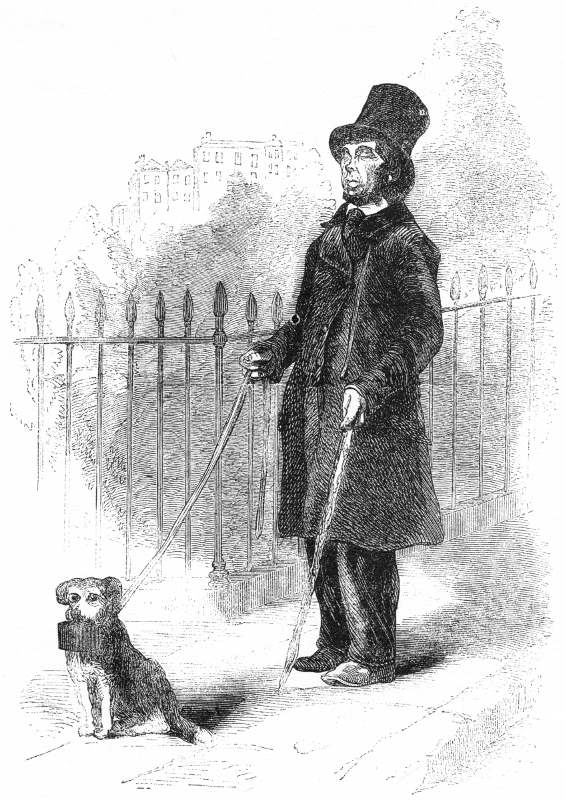
THE BLIND BOOT-LACE SELLER.
[From a Daguerreotype by Beard.]
“I was born in Northumberland,” he said, “about five-and-fifty years ago. My father was a grocer and had 1,000l. worth of freehold property besides his business, which was very large for a small town; his was the principal shop, and in the general line. He had a cart of his own, in which he attended market. I was very comfortably brought up, never wanted for nothing, and had my mother lived I should have had an independent fortune. At five years old, while mother was still alive, I caught the small pox. I had four sisters and one brother, and we all six had it at once; that was before the vaccination was properly established. I’ve heerd said that father did not want to have us inoculated, because of the people coming backwards and forwards to the shop. I only wish vaccination had been in vogue then as it is now, and I shouldn’t have lost my eyes. God bless the man who brought it up, I say; people doesn’t know what they’ve got to thank him for. Well, all my sisters and brothers had not a mark upon them. It laid hold of only me. They couldn’t lay a finger upon me, they was obligated to lift me up in one of my father’s shirts, by holding the corners of it like a sheet. As soon as ever the pock began to decay it took away my eyes altogether. I didn’t lose both my eyeballs till about twenty years after that, though my sight was gone for all but the shadow of daylight and any high colours. At sixteen years of age my left eye bursted; I suffered terribly then—oh terribly! yes, that I did. The black-and-white like all mixed together, the pock came right through the star of the eye the doctor said; and when I was five-and-twenty my other eye-ball bursted, and then my eyes was quite out of my head. Till that time I could see a little bit; I could tell the daylight, and I could see the moon, but not the shape of it. I never could see a star, and do you know I grieved about the loss of that little bit of sight as much as if I was losing the whole of it. As my eye-ball sloughed day by day, I could see the light going away by little, every day till the week’s end. When I looked at the daylight just before it all went, I could see the light look as red as fire—as red as blood; and when it all left me, oh, I was dreadful sorrowful, I thought I was lost altogether. But, I shouldn’t have been so bad off, as I said, if mother had lived, but she died when I was about six year old. I didn’t care much about her, indeed I took a dreadful dislike to her. I heerd her say one day to a person in the shop, that she would sooner see me dead and buried than be as I was, but now I know that it was her fondness for me. Mother catched a cold, and died after six day’s illness. When she was gone, father got to neglect his business. He had no one then to attend to it, and he took and shut up the shop. He lost heart, you see. He took and turned all the tenants out of his property, and furnished all the rooms of a large house suitable for the quality that used to come to the town to bathe. He mortgaged the place for 250l. to buy the furniture, and that was the ruin of him. Eighteen years afterwards the lawyers got the better of him, and all the family was turned out of the door without a penny. My father they’d put in jail before. He died a few years afterwards in the workhouse. When the family was turned out, there was only my eldest brother away at sea, and my eldest sister in sarvice; so me and my three sisters was sent in the wide world without the means of getting a crust or a place to put our heads in. All my sisters after that got into sarvice, and I went to drive some coal carts at North Shields. The coal carts was father’s, and they was all he had left out of his property; so I used to go to Wall’s End and fill the carts, then take them down to North Shields and sell them at the people’s doors. We never used to sell less than the load. I did all this, blind as I was, without a person to guide, and continued at it night and day for about fifteen year. It was well known to the whole country side. I was the talk for miles round. They couldn’t believe I was blind; though they see my eyes was gone, still they couldn’t hardly believe. Then, after the fifteen year, me and my father had a complete fall out. He took an advantage of my sister. He had borrowed 20l. of her, and when he could he wouldn’t pay her. He behaved as bad as father could, and then I broke with him.” (He then went over the whole story, and was affected, even to speechlessness, at the remembrance of his family troubles. Into these there is no necessity to enter here; suffice it, the blind man appears to have behaved very nobly.) “I came away and went to my brother, who was well off at Hull; when I got there, I found he had gone to Russia and died there that very spring. While I was on my way to Hull, I used to go to sleep at the lodging-houses for travellers. I had never been in one before, and there I got to think, from what I heerd, that a roving life was a fine pleasant one. The very first lodging-house I went into was one in Durham, and there persons as was coming the same road persuaded me to go and beg with them, but I couldn’t cheek it; it was too near hand at home. We came on to Darlington, that was 18 miles further, that day. They still kept company with me, and wanted me to beg, but I wouldn’t; I couldn’t face it. I thought people would know me. The next day we started on our way to Northallerton, and then my few shillings was all gone; so that night we went to seek relief, and got a pennyworth of milk, and a penny loaf each and our bed. The parish gave us a ticket to a lodging-house. The next morning we started from Northallerton, and then I was very hungry; all I had the day before was the pennyworth of bread I got from the parish. Then as we got about a mile out of the town, there was a row of houses, and the Scotchman who was with me says, ‘If ye’ll gang up wi’ me, I’ll speak for ye.’ Well, we went up and got 3d., and plenty of bread and butter; almost every house we got something at; then I was highly delighted; thinks I, this is a business—and so I did. We shared with the other man who had come on the road with us, and after that we started once more, and then I was all eager to go on with the same business. You see I’d never had no pleasure, and it seemed to me like a new world—to be able to get victuals without doing anything—instead of slaving as I’d been with a couple of carts and horses at the coal-pits all the time. I didn’t think the country was half so big, and you couldn’t credit the pleasure I felt in going about it. I felt as if I didn’t care for nothing; it was so beautiful to be away there quite free, without any care in the world, for I could see plainly I could always get the best of victuals, and the price of my lodgings. There’s no part in all England like Yorkshire for living. We used to go to all the farm-houses, we wouldn’t miss one if it was half a mile off the road; if the Scotchman who was with me could only see a road he’d take me up it, and we got nice bits of pie and meat, and bread and cake, indeed as much as would serve four people, when we got to the lodging-house at night and a few shillings beside. I soon got not to care about the loss of my brother. At last we got to make so much money that I thought it was made to chuck about the streets. We got it so easy, you see. It was only 4s. or 5s., but then I was only a flatty or I could have made 14s. or 15s. at least. This was in Borough-bridge, and there at a place called, I think, Bridely-hill, there was a lodging-house without never a bed in it at all; but only straw littered on the ground, and here I found upwards of sixty or seventy, all tramps, and living in different ways, pattering, and thieving, and singing, and all sorts; and that night I got to think it was the finest scene I had ever known. I grew pleaseder, and pleaseder, with the life, and wondered how any one could follow any other. There was no drunkenness, but it was so new and strange, and I’d never known nothing of life before, that I was bewildered, like, with over-joy at it. Then I soon got to think I’d have the summer’s pleasure out and wouldn’t go near Hull till the back end of the year, for it was the month of May, that what I’m talking about took place; and so things went on. I never thought of home, or sisters, or anything, indeed. I was so over-joyed that I could think of nothing else. Whenever I got to a new county it seemed like getting into a new nation, and when I heard we were close upon a new place I used to long and long to get into it. At last I left the Scotchman and took up with an old sailor, a man-of-warsman, who was coming up to London to get his pension, and he was a regular ‘cadger’ like the other who had put me ‘fly to the dodge,’ though none of us wer’nt ‘fly’ to nothing then. I can’t tell you, I wanted to, how I longed to be in town, and, as I came through the streets with him, I didn’t know whether I carried the streets or they carried me. You see I had heard people talk about London in North Shields, and I thought there was no poor people there at all—none but ladies and gentlemen and sailors. In London the sailor drew his pension, and he and me got robbed, and then the sailor left me, and then I started off without a penny into the country; and at Stratford-le-Bow I began, for the first time, to say, ‘Pity the poor blind.’ Up to this time I had never axed no one—never spoke, indeed—the cadgers who had been with me had done this for me, and glad to have the chance of sharing with me. A blind man can get a guide at any place, because they know he’s sure to get something. I took only 5d. at Stratford-le-Bow, and then started on my way to Romford; and there, in the lodging-house, I met a blind man, who took me in partnership with him, and larnt me my business complete—that he just did, and since then I’ve been following it, and that’s about two or three and twenty year ago. Since I’ve been in London, and that’s fourteen year, I’ve lived very regular, always had a place, and attended my church. If it hadn’t been for the lodging-houses I should never, may be, have been as I am; though, I must confess, I always had a desire to find out travelling, but couldn’t get hold of any one to put me in the way of it. I longed for a roving life and to shake a loose leg, still I couldn’t have done much else after my quarrel with my father. My sister had offered to lend me money enough to buy a horse and cart for myself, but I didn’t like that, and thought I’d get it of my brother at Hull; and that and the padding kens is solely the cause of my being as I am; and since I first travelled there’s more now than ever—double and treble as many.”
Of the Low Lodging-Houses.
The revelations of the Blind Boot-Lace Seller concerning the low lodging-houses make me anxious to arouse the public to a full sense of the atrocities committed and countenanced in those infamous places. It will have been noticed that the blind man frankly tells us that he was “taught his business” as a mendicant in one of these houses of call for vagabonds of all kinds—beggars, prostitutes, cheats, and thieves. Up to the time of his starting to see his brother at Hull, he appears to have had no notion of living but by his labour, and, more especially, no wish to make a trade of his affliction. Till then he seems to have been susceptible of some of the nobler impulses of humanity, and to have left his home solely because he refused to be party to a fraud on his own sister. Unfortunately, however, on his way to carry out his generous purposes, he put up for the night at the “travellers’” house in the town where he arrived, at the end of his first day’s journey; from the very minute that he set foot in the place he was a lost man. Here were assembled scores of the most degraded and vicious members of society, lying in ambush, as it were, like tigers in the jungle, ready to spring upon and make a prey of any one who came within the precincts of their lair. To such as these—sworn to live on the labours of others, and knowing almost to a sixpence the value of each human affliction as a means of operating upon both the heart-strings and the purse-strings of the more benevolent of the industrious or the affluent—to such as these, I say, a blind man, unskilled in the art and system of mendicancy, was literally a God-send. A shipwreck or a colliery explosion, as they too well knew, some of the more sceptical of the public might call in question, but a real blind man, with his eye-balls gone, was beyond all doubt; and to inspire faith, as they were perfectly aware, was one of the most important and difficult processes of the beggar’s craft. Besides, of all misfortunes, blindness is one which, to those who have their sight, appears not only the greatest of human privations, but a privation which wholly precludes the possibility of self-help, and so gives the sufferer the strongest claim on our charity. In such a place, therefore, as a low lodging-house, the common resort of all who are resolved not to work for their living, it was almost impossible for a blind man to pass even an hour without every virtuous principle of his nature being undermined, and overtures of the most tempting character being made to him. To be allowed to go partners in so valuable a misfortune was a privilege that many there would strive for; accordingly, as we have seen, the day after the blind man entered the low lodging-house, he who, up to that time, had been, even in his affliction, earning his living, was taken out by one of the “travellers,” and taught how much better a living—how much more of the good things of this world—he could get by mendicancy than by industry; and from the very hour when the blind man learnt this, the most dangerous lesson that any human being can possibly be taught, he became, heart and soul, an ingrained beggar. His description of the delight he felt when he found that he had no longer any need to work—that he could rove about the country as he pleased—without a care, without a purpose—with a perfect sense of freedom, and a full enjoyment of the open air in the day, and the wild licence of the lodging-house society at night, satisfied that he could get as much food and drink, and even money as he needed, solely for the asking for it; his description of this is a frank confession of a few of the charms of vagabondism—charms to which the more sedate are not only strangers, but of which they can form no adequate conception. The pleasure of “shaking a loose leg,” as the vagrants themselves call it, is, perhaps, known only in its intensity by those wayward spirits who object to the restraint of work or the irksomeness of any settled pursuit. The perfect thoughtlessness that the blind man describes as the first effect produced upon him by his vagabondism is the more remarkable, because it seems to have effaced from his mind all regard, even for the sister for whose sake he had quitted his home—though to those who have made a study of the vagrant character it is one of those curious inconsistencies which form the principal feature in the idiosyncrasy of the class, and which, indeed, are a necessary consequence of the very purposelessness, or want of some permanent principle or feeling, which constitutes, as it were, the mainspring of vagabondism. Indeed, the blind man was a strange compound of cunning and good feeling; at one moment he was weeping over the afflictions of others—he was deeply moved when I read to him the sufferings of the Crippled Nutmeg-Grater Seller; and yet, the next minute he was grinning behind his hand, so that his laughter might be concealed from me, in a manner that appeared almost fiendish. Still, I am convinced that at heart he was far from a bad man; there was, amid the degradation that necessarily comes of habitual mendicancy, a fine expression of sympathy, that the better class of poor always exhibit towards the poor; nor could I help wondering when I heard him—the professed mendicant—tell me how he had been moved to tears by the recital of the sufferings of another mendicant—sufferings that might have been as profitable a stock in trade to the one as his blindness was to the other; though it is by no means unusual for objects of charity to have their objects of charity, and to be imposed upon by fictitious or exaggerated tales of distress, almost as often as they impose upon others by the very same means.
I now invite the reader’s attention to the narratives given below as to the character of the low lodging-houses. The individuals furnishing me with those statements, it should be observed, were not “picked” people, but taken promiscuously from a number belonging to the same class. I shall reserve what else I may have to remark on the subject till the conclusion of those statements.
Prisons, tread-mills, penal settlements, gallows, I said, eighteen months ago, in the ‘Morning Chronicle,’ are all vain and impotent as punishments—and Ragged Schools and City missions are of no avail as preventives of crime—so long as the wretched dens of infamy, brutality, and vice, termed “padding-kens” continue their daily and nightly work of demoralization. If we would check the further spread of our criminals—and within the last four years they have increased from 24,000 to 30,000—we must apply ourselves to the better regulation and conduct of these places. At present they are not only the preparatory schools, but the finishing academies for every kind of profligacy and crime.
“The system of lodging-houses for travellers, otherwise trampers,” says the Constabulary Commissioners’ Report, “requires to be altogether revised; at present they are in the practice of lodging all the worst characters unquestioned, and are subject to no other control than an occasional visit of inspection from the parish officers, accompanied by the constables, whose power of interference—if they have a legal right of entry—does not extend to some of the most objectionable points connected with those houses, as they can merely take into custody such persons as they find in commission of some offence. The state in which those houses are found on the occasion of such visit, proves how much they require interference. The houses are small, and yet as many as thirty travellers, or even thirty-five, have been found in one house; fifteen have been found sleeping in one room, three or four in a bed—men, women, and children, promiscuously: beds have been found occupied in a cellar. It is not necessary to urge the many opportunities of preparing for crime which such a state of things presents, or the actual evils arising from such a mode of harbouring crowds of low and vicious persons.”
According to the report of the Constabulary Commissioners, there were in 1839—
Mendicants’ Lodging-houses.Lodgers.Total No. of Inmates.
In London221average 11or 2,431
In Liverpool17661,056
Bristol697483
Bath149126
Kingston-on-Hull11333
Newcastle-on-Tyne783234
Chester (see Report, p. 35)1503450
6194,813
Moreover, the same Report tells us, at p. 32, that there is a low lodging-house for tramps in every village. By the Post-office Directory there are 3823 postal towns in England and Wales; and assuming that in each of these towns there are two “travellers’” houses, and that each of these, upon an average, harbours every night ten tramps (in a list given at p. 311, there were in 83 towns no less than 678 low lodging-houses, receiving 10,860 lodgers every night; this gives, on an average, 8 such houses to each town, and 16 lodgers to each such house), we have thus 76,460 for the total number of the inmates of such houses.
To show the actual state of these lodging-houses from the testimony of one who had been long resident in them, I give the following statement. It was made to me by a man of superior education and intelligence (as the tone of his narrative fully shows), whom circumstances, which do not affect the object of my present letter, and therefore need not be detailed, had reduced from affluence to beggary, so that he was compelled to be a constant resident in those places. All the other statements that I obtained on the subject—and they were numerous—were corroborative of his account to the very letter:—
“I have been familiar, unfortunately for me, with low lodging-houses, both in town and country, for more than ten years. I consider that, as to the conduct of those places, it is worse in London than in the country—while in the country the character of the keeper is worse than in London, although but a small difference can be noted. The worst I am acquainted with, though I haven’t been in it lately, is in the neighbourhood of Drury-lane—this is the worst both for filth and for the character of the lodgers. In the room where I slept, which was like a barn in size, the tiles were off the roof, and as there was no ceiling, I could see the blue sky from where I lay. That may be altered now. Here I slept in what was called the single men’s room, and it was confined to men. In another part of the house was a room for married couples, as it was called, but of such apartments I can tell you more concerning other houses. For the bed with the view of the blue sky I paid 3d. If it rained there was no shelter. I have slept in a room in Brick-lane, Whitechapel, in which were fourteen beds. In the next bed to me, on the one side, was a man, his wife, and three children, and a man and his wife on the other. They were Irish people, and I believe the women were the men’s wives—as the Irish women generally are. Of all the women that resort to these places the Irish are far the best for chastity. All the beds were occupied, single men being mixed with the married couples. The question is never asked, when a man and woman go to a lodging-house, if they are man and wife. All must pay before they go to bed, or be turned into the street. These beds were made—as all the low lodging-house beds are—of the worst cotton flocks stuffed in coarse, strong canvas. There is a pair of sheets, a blanket, and a rug. I have known the bedding to be unchanged for three months; but that is not general. The beds are an average size. Dirt is the rule with them, and cleanliness the exception. They are all infested with vermin. I never met with an exception. No one is required to wash before going to bed in any of these places (except at a very few, where a very dirty fellow would not be admitted), unless he has been walking on a wet day without shoes or stockings, and then he must bathe his feet. The people who slept in the room I am describing were chiefly young men, almost all accompanied by young females. I have seen girls of fifteen sleep with ‘their chaps’—in some places with youths of from sixteen to twenty. There is no objection to any boy and girl occupying a bed, even though the keeper knows they were previously strangers to each other. The accommodation for purposes of decency is very bad in some places. A pail in the middle of a room, to which both sexes may resort, is a frequent arrangement. No delicacy or decency is ever observed. The women are, I think, worse than the men. If any one, possessing a sense of shame, says a word of rebuke, he is at once assailed, by the women in particular, with the coarsest words in the language. The Irish women are as bad as the others with respect to language, but I have known them keep themselves covered in bed when the other women were outraging modesty or decency. The Irish will sleep anywhere to save a halfpenny a night, if they have ever so much money.” [Here he stated certain gross acts common to lodging-houses, which cannot be detailed in print.] “It is not uncommon for a boy or man to take a girl out of the streets to these apartments. Some are the same as common brothels, women being taken in at all hours of the day or night. In most, however, they must stay all night as a married couple. In dressing or undressing there is no regard to decency, while disgusting blackguardism is often carried on in the conversation of the inmates. I have known decent people, those that are driven to such places from destitution, perhaps for the first time, shocked and disgusted at what they saw. I have seen a decent married pair so shocked and disgusted that they have insisted on leaving the place, and have left it. A great number of the lodging-houses are large old buildings, which were constructed for other purposes; these houses are not so ill-ventilated, but even there, where so many sleep in one room, the air is hot and foul. In smaller rooms, say twelve feet by nine, I have seen four beds placed for single men, with no ventilation whatsoever, so that no one could remain inside in warmish weather, without every door and window open; another room in the same house, a little larger, had four double beds, with as many men and women, and perhaps with children. The Board of Health last autumn compelled the keepers of these places to whitewash the walls and ceilings, and use limewash in other places; before that, the walls and ceilings looked as if they had been blackwashed, but still you could see the bugs creeping along those black walls, which were not black enough to hide that. In some houses in the summer you can hardly place your finger on a part of the wall free from bugs. I have scraped them off by handfulls.
“Nothing can be worse to the health than these places, without ventilation, cleanliness, or decency, and with forty people’s breaths perhaps mingling together in one foul choking steam of stench. [The man’s own words.] They are the ready resort of thieves and all bad characters, and the keepers will hide them if they can from the police, or facilitate any criminal’s escape. I never knew the keepers give any offender up, even when rewards were offered. If they did, they might shut up shop. These houses are but receptacles, with a few exceptions, for beggars, thieves, and prostitutes, and those in training for thieves and prostitutes—the exceptions are those who must lodge at the lowest possible cost. I consider them in every respect of the worst possible character, and think that immediate means should be adopted to improve them. Fights, and fierce fights too, are frequent in them, and I have often been afraid murder would be done. They are money-making places, very. One person will own several—as many as a dozen. In each house he has one or more ‘deputies,’ chiefly men. Some of these keepers are called respectable men; some live out in the country, leaving all to deputies. They are quite a separate class from the keepers of regular brothels. In one house that I know they can accommodate eighty single men; and when single men only are admitted, what is decent, or rather what is considered decent in such places, is less unfrequent. Each man in such houses pays 4d. a night, a bed to each man or boy; that is 26s. 8d. nightly, or 486l. 13s. 4d. a year, provided the beds be full every night—and they are full six nights out of seven. Besides that, some of the beds supply double turns; for many get up at two to go to Covent-garden or some other market, and their beds are then let a second time to other men; so that more than eighty are frequently accommodated, and I suppose 500l. is the nearest sum to be taken for an accurate return. The rent is very trifling; the chief expense to be deducted from the profits of the house in question is the payment of three and sometimes four deputies, receiving from 7s. to 12s. a week each—say an average of from 30s. to 40s. a week—as three or four are employed. Fire (coke being only used) and gas are the other expenses. The washing is a mere trifle. Then there are the parochial and the water-rates. The rent is always low, as the houses are useable for nothing but such lodgings. The profits of the one house I have described cannot be less than 300l. a year, and the others are in proportion. Now, the owner of this house has, I believe, 10 more such houses, which, letting only threepenny beds (some are lower than that), may realise a profit of about 200l. a year each. These altogether yield a clear profit of 2300l. for the eleven of them; but on how much vice and disease that 2300l. has been raised is a question beyond a schoolmaster. The missionaries visit these lodging-houses, but, judging from what I have heard said by the inmates in all of them, when the missionaries have left, scarcely any good effect has resulted from the visits. I never saw a clergyman of any denomination in any one of these places, either in town or country. In London the master or deputy of the low lodging-house does not generally meddle with the disposal of stolen property, as in the country. This is talked about, alike in the town and country houses, very openly and freely before persons known only to be beggars, and never stealing: it is sufficient that they are known as tramps. In London the keepers must all know that stolen property is nightly brought into the house, and they wink at its disposal, but they won’t mix themselves up with disposing of it. If it be provisions that have been stolen, they are readily disposed of to the other inmates, and the owner or deputy of the house may know nothing about it, and certainly would not care to interfere if he did. I never heard robberies planned there, but there are generally strangers present, and this may deter. I believe more robberies are planned in low coffee-shops than in lodging-houses. The influence of the lodging-house society on boys who have run away from their parents, and have got thither, either separately or in company with lads who have joined them in the streets, is this:—Boys there, after paying their lodgings, may exercise the same freedom from every restraint as they see the persons of maturer years enjoy. This is often pleasant to a boy, especially if he has been severely treated by his parents or master; he apes, and often outdoes, all the men’s ways, both in swearing and lewd talk, and so he gets a relish for that sort of life. After he has resorted to such places—the sharper boys for three, and the duller for six months—they are adepts at any thieving or vice. Drunkenness, and even moderate drinking, is very rare among them. I seldom or never see the boys drink—indeed, thieves of all ages are generally sober men. Once get to like a lodging-house life, and a boy can hardly be got out of it. I said the other day to a youth, ‘I wish I could get out of these haunts and never see a lodging-house again;’ and he replied, ‘If I had ever so much money I would never live anywhere else.’ I have seen the boys in a lodging-house sit together telling stories, but paid no attention to them.”
Statement of a Young Pickpocket.
To show the class of characters usually frequenting these lodging-houses, I will now give the statement of a boy—a young pickpocket—without shoes or stockings. He wore a ragged, dirty, and very thin great coat, of some dark jean or linen, under which was another thin coat, so arranged that what appeared rents—and, indeed, were rents, but designedly made—in the outer garment, were slits through which the hand readily reached the pockets of the inner garment, and could there deposit any booty. He was a slim, agile lad, with a sharp but not vulgar expression, and small features. His hands were of singular delicacy and beauty. His fingers were very long, and no lady’s could have been more taper. A burglar told me that with such a hand he ought to have made his fortune. He was worth 20l. a week, he said, as a “wire,” that is, a picker of ladies’ pockets. When engaged “for a turn,” as he told me he once was by an old pickpocket, the man looked minutely at his fingers, and approved of them highly. His hands, the boy said, were hardly serviceable to him when very cold. His feet were formed in the same symmetrical and beautiful mould as his hands. “I am 15,” he said. “My father was a potter, and I can’t recollect my mother” (many of the thieves are orphans or motherless). “My father has been dead about five years. I was then working at the pottery in High-street, Lambeth, earning about 4s. a week; in good weeks, 4s. 6d. I was in work eight months after my father died; but one day I broke three bottles by accident, and the foreman said ‘I shan’t want you any more;’ and I took that as meant for a discharge; but I found afterwards that he did’nt so mean it. I had 2s. and a suit of clothes then, and tried for work at all the potteries; but I couldn’t get any. It was about the time Smithfield fair was on. I went, but it was a very poor concern. I fell asleep in a pen in the afternoon, and had my shoes stolen off my feet. When I woke up, I began crying. A fellow named Gyp then came along (I knew his name afterwards), and he said, ‘What are you crying for?’ and I told him, and he said, ‘Pull off your stockings, and come with me, and I’ll show you where to sleep.’ So I did, and he took me to St. Olave’s workhouse, having first sold my stockings. I had never stolen anything until then. There I slept in the casual ward, and Gyp slept there too. In the morning we started together for Smithfield, where he said he had a job to sweep the pens, but he couldn’t sweep them without pulling off his coat, and it would look so queer if he hadn’t a shirt—and he hadn’t one. He promised to teach me how to make a living in the country if I would lend him mine, and I was persuaded—for I was an innocent lad then—and went up a gateway and stripped off my shirt and gave it to him, and soon after he went into a public-house to get half a pint of beer; he went in at one door and out at another, and I didn’t see him for six months afterwards. That afternoon I went into Billingsgate market and met some boys, and one said, ‘Mate, how long have you been knocking about; where did you doss?’ I didn’t know what they meant, and when they’d told me they meant where did I sleep? I told them how I’d been served. And they said, ‘Oh! you must expect that, until you learn something,’ and they laughed. They all know’d Gyp; he was like the head of a Billingsgate gang once. I became a pal with these boys at Billingsgate, and we went about stealing fish and meat. Some boys have made 2s. in a morning, when fish is dear—those that had pluck and luck; they sold it at half-price. Billingsgate market is a good place to sell it; plenty of costermongers are there who will buy it, rather than of the salesmen. I soon grew as bad as the rest at this work. At first I sold it to other boys, who would get 3d. for what they bought at 1d. Now they can’t do me. If I can get a thing cheap where I lodge, and have the money, and can sell it dear, that’s the chance. I carried on this fish rig for about two years, and went begging a little, too. I used to try a little thieving sometimes in Petticoat-lane. They say the ‘fliest’ is easy to take in sometimes—that’s the artfullest; but I could do no good there. At these two years’ end, I was often as happy as could be; that is, when I had made money. Then I met B——, whom I had often heard of as an uncommon clever pickpocket; he could do it about as well as I can now, so as people won’t feel it. Three of his mates were transported for stealing silver plate. He and I became pals, and started for the country with 1d. We went through Foot’s Cray, and passed a farm where a man’s buried at the top of a house; there’s something about money while a man’s above ground; I don’t understand it, but it’s something like that. A baker, about thirty miles from London, offended us about some bread; and B—— said ‘I’ll serve him out.’ We watched him out, and B—— tried at his pocket, saying, ‘I’ll show you how to do a handkerchief;’ but the baker looked round, and B—— stopped; and just after that I flared it (whisked the handkerchief out); and that’s the first I did. It brought 1s. 3d. We travelled across country, and got to Maidstone, and did two handkerchiefs. One I wore round my neck, and the other the lodging-housekeeper pawned for us for 1s. 6d. In Maidstone, next morning, I was nailed, and had three months of it. I didn’t mind it so much then, but Maidstone’s far worse now, I’ve heard. I have been in prison three times in Brixton, three times in the Old Horse (Bridewell), three times in the Compter, once in the Steel, and once in Maidstone—thirteen times in all, including twice I was remanded, and got off; but I don’t reckon that prison. Every time I came out harder than I went in. I’ve had four floggings; it was bad enough—a flogging was—while it lasted; but when I got out I soon forgot it. At a week’s end I never thought again about it. If I had been better treated I should have been a better lad. I could leave off thieving now as if I had never thieved, if I could live without.” [I am inclined to doubt this part of the statement.] “I have carried on this sort of life until now. I didn’t often make a very good thing of it. I saw Manning and his wife hung. Mrs. Manning was dressed beautiful when she came up. She screeched when Jack Ketch pulled the bolt away. She was harder than Manning, they all said; without her there would have been no murder. It was a great deal talked about, and Manning was pitied. It was a punishment to her to come on the scaffold and see Manning with the rope about his neck, if people takes it in the right light. I did 4s. 6d. at the hanging—two handkerchiefs, and a purse with 2s. in it—the best purse I ever had; but I’ve only done three or four purses. The reason is, because I’ve never been well dressed. If I went near a lady, she would say, ‘Tush, tush, you ragged fellow!’ and would shrink away. But I would rather rob the rich than the poor; they miss it less. But 1s. honest goes further than 5s. stolen. Some call that only a saying, but it’s true. All the money I got soon went—most of it a-gambling. Picking pockets, when any one comes to think on it, is the daringest thing that a boy can do. It didn’t in the least frighten me to see Manning and Mrs. Manning hanged. I never thought I should come to the gallows, and I never shall—I’m not high-tempered enough for that. The only thing that frightens me when I’m in prison is sleeping in a cell by myself—you do in the Old Horse and the Steel—because I think things may appear. You can’t imagine how one dreams when in trouble. I’ve often started up in a fright from a dream. I don’t know what might appear. I’ve heard people talk about ghosts and that. Once, in the County, a tin had been left under a tap that went drip—drip—drip. And all in the ward were shocking frightened; and weren’t we glad when we found out what it was! Boys tell stories about haunted castles, and cats that are devils; and that frightens one. At the fire in Monument-yard I did 5s. 7d.—3s. in silver and 2s. 3d. in handkerchiefs, and 4d. for three pairs of gloves. I sell my handkerchiefs in the Lane (Petticoat-lane). I carry on this trade still. Most times I’ve got in prison is when I’ve been desperate from hunger, and have said to B——, ‘Now I’ll have money, nailed or not nailed.’ I can pick a woman’s pocket as easy as a man’s, though you wouldn’t think it. If one’s in prison for begging, one’s laughed at. The others say, ‘Begging! Oh, you cadger!’ So a boy is partly forced to steal for his character. I’ve lived a good deal in lodging-houses, and know the ways of them. They are very bad places for a boy to be in. Where I am now, when the place is full, there’s upwards of 100 can be accommodated. I won’t be there long. I’ll do something to get out of it. There’s people there will rob their own brother. There’s people there talk backward—for one they say eno, for two owt, for three eerht, for four ruof, for five evif, for six exis. I don’t know any higher. I can neither read nor write. In this lodging-house there are no women. They talk there chiefly about what they’ve done, or are going to do, or have set their minds upon, just as you and any other gentlemen might do. I have been in lodging-houses in Mint-street and Kent-street, where men and women and children all slept in one room. I think the men and women who slept together were generally married, or lived together; but it’s not right for a big boy to sleep in the same room. Young men have had beds to themselves, and so have young women there; but there’s a deputy comes into the room, every now and then, to see there’s nothing wrong. There’s little said in these places, the people are generally so tired. Where I am there’s horrid language—swearing, and everything that’s bad. They are to be pitied, because there’s not work for honest people, let alone thieves. In the lodging-houses the air is very bad, enough to stifle one in bed—so many breaths together. Without such places my trade couldn’t be carried on; I couldn’t live. Some though would find another way out. Three or four would take a room among them. Anybody’s money’s good—you can always get a room. I would be glad to leave this life, and work at a pottery. As to sea, a bad captain would make me run away—sure. He can do what he likes with you when you’re out at sea. I don’t get more than 2s. a week, one week with the other, by thieving; some days you do nothing until hunger makes your spirits rise. I can’t thieve on a full belly. I live on 2s. a week from thieving, because I understand fiddling—that means, buying a thing for a mere trifle, and selling it for double, or for more, if you’re not taken in yourself. I’ve been put up to a few tricks in lodging-houses, and now I can put others up to it. Everybody must look after themselves, and I can’t say I was very sorry when I stole that 2s. from a poor woman, but I’d rather have had 1s. 6d. from a rich one. I never drink—eating’s my part. I spend chief part of my money in pudding. I don’t like living in lodging-houses, but I must like it as I’m placed now—that sort of living, and those lodging-houses, or starving. They bring tracts to the lodging-houses—pipes are lighted with them; tracts won’t fill your belly. Tracts is no good, except to a person that has a home; at the lodging-houses they’re laughed at. They seldom are mentioned. I’ve heard some of them read by missionaries, but can’t catch anything from them. If it had been anything bad, I should have caught it readily. If an innocent boy gets into a lodging-house, he’ll not be innocent long—he can’t. I know three boys who have run away, and are in the lodging-houses still, but I hope their father has caught them. Last night a little boy came to the lodging-house where I was. We all thought he had run away, by the way he spoke. He stayed all night, but was found out in two or three falsehoods. I wanted to get him back home, or he’ll be as bad as I am in time, though he’s nothing to me; but I couldn’t find him this morning; but I’ll get him home yet, perhaps. The Jews in Petticoat-lane are terrible rogues. They’ll buy anything of you—they’ll buy what you’ve stolen from their next-door neighbours—that they would, if they knew it. But they’ll give you very little for it, and they threaten to give you up if you won’t take a quarter of the value of it. ‘Oh! I shee you do it,’ they say, ‘and I like to shee him robbed, but you musht take vot I give.’ I wouldn’t mind what harm came to those Petticoat-laners. Many of them are worth thousands, though you wouldn’t think it.” After this I asked him what he, as a sharp lad, thought was the cause of so many boys becoming vagrant pickpockets? He answered, “Why, sir, if boys runs away, and has to shelter in low lodging-houses—and many runs away from cruel treatment at home—they meet there with boys such as me, or as bad, and the devil soon lays his hand on them. If there wasn’t so many lodging-houses there wouldn’t be so many bad boys—there couldn’t. Lately a boy came down to Billingsgate, and said he wouldn’t stay at home to be knocked about any longer. He said it to some boys like me; and he was asked if he could get anything from his mother, and he said ‘yes, he could.’ So he went back, and brought a brooch and some other things with him to a place fixed on, and then he and some of the boys set off for the country; and that’s the way boys is trapped. I think the fathers of such boys either ill-treat them, or neglect them; and so they run away. My father used to beat me shocking; so I hated home. I stood hard licking well, and was called ‘the plucked one.’” This boy first stole flowers, currants, and gooseberries out of the clergyman’s garden, more by way of bravado, and to ensure the approbation of his comrades, than for anything else. He answered readily to my inquiry, as to what he thought would become of him?—“Transportation. If a boy has great luck he may carry on for eight years. Three or four years is the common run, but transportation is what he’s sure to come to in the end.” This lad picked my pocket at my request, and so dexterously did he do his “work,” that though I was alive to what he was trying to do, it was impossible for me to detect the least movement of my coat. To see him pick the pockets, as he did, of some of the gentlemen who were present on the occasion, was a curious sight. He crept behind much like a cat with his claws out, and while in the act held his breath with suspense; but immediately the handkerchief was safe in his hand, the change in the expression of his countenance was most marked. He then seemed almost to be convulsed with delight at the success of his perilous adventure, and, turning his back, held up the handkerchief to discover the value of his prize, with intense glee evident in every feature.