Volume 1 — OF THE STREET-SELLERS OF EATABLES AND DRINKABLES. (continued 4)
Reading edition
“I sell herbs, too, but it’s not a street sale: I supply them to orders from my connection. It’s not a large trade. I sell horehound, for tea or decoctions; coltsfoot, for smoking as herb tobacco (I gather the coltsfoot myself, but buy the horehound of a shopkeeper, as it’s cultivated); ground-ivy is sold only for the blood (but little of it); hyssop for wind; and Irish moss for consumption. I’m never asked for anything improper. They won’t ask me for —— or ——. And I’m never asked for washes or cosmetics; but a few nettles are ordered of me for complexions.
“Well, sir, I’d rather not state the quantities I sell, or my profits, or prices. I make what keeps myself, my wife, and seven children, and that’s all I need say about it. I’d rather say no more on that part of the business: and so, I’m sure you won’t press me. I don’t know what others in the trade make. They buy of confectioners, and are only imitators of me. They buy coltsfoot-candy, and such like; how it’s made so cheap, I don’t know. In the summer, I give up cough-drop selling, and take to gold fish.”
I am told that the cough-drop-makers, who are also street-sellers, prepare their sticks, &c., much in the same method as the manufacturers of the ordinary sweet-stuff (which I have described), using the decoction, generally of horehound or coltsfoot, as the “scents” are used. In the old times, it would appear that the preparation of a medicinal confection was a much more elaborate matter, if we may judge by the following extract from an obsolete medical work treating of the matter. The author styles such preparations “lohochs,” which is an Arabic word, he says, and signifies “a thing to be licked.” It would appear that the lohoch was not so hard as the present cough-drop. The following is one of the receipts, “used generally against diseases in the breast and lungs:”—
“Lohoch de farfara,” the Lohoch of Coltsfoot.
Take of coltsfoot roots cleansed 8 ozs., marsh-mallow roots 4 ozs., boil them in a sufficient quantity of water, and press the pulp through a sieve, dissolve it again in the decoction, and let it boil once or twice; then take it from the fire, and add 2 lbs. of white sugar, honey of raisins 14 ozs., juice of liquorice 2½ drams, stir them well with a wooden pestle, sprinkling in of saffron and cloves in powder, of each 1 scruple, cinnamon and mace, of each 2 scruples; make them into a lohoch according to art. It is good for a cough and roughness of the windpipe.
Without wishing to infringe upon professional secrets, I may mention that the earnings of the principal man in the trade may be taken at 30s. a week for 20 weeks; that of another at 15s. for the same period; and those of the remaining four at 5s. each, weekly; but the latter sell acid drops, and other things bought of the chemists. Allowing the usual cent. per cent., we then find 130l. expended by street-buyers on cough-drops.
The best cough-drop stall seen in the streets is a kind of barrow, which can be shut up like a piano: it cost 3l. 10s. complete with the distilling apparatus before described. Scales and weights cost 5s., and the stock-money for the supply of such a stall need not exceed 10s.; or, in all, about 4l. 10s. For an ordinary trade—ready-made articles forming the stock—the capital would be, stall and trestle, 7s.; scales and weights (which are not always used), 3s. 6d., and stock-money, 2s. 6d.; in all, 13s.
Of the Street-sellers of Ices and of Ice Creams.
I have already treated of the street luxury of pine-apples, and have now to deal with the greater street rarity of ice-creams.
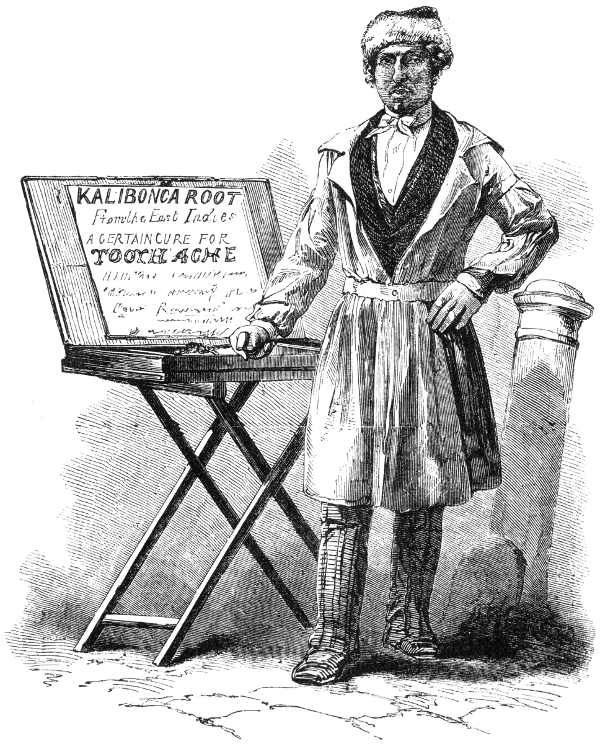
DOCTOR BOKANKY, THE STREET HERBALIST.
[From a Daguerreotype by Beard.]
“Now then for the Kalibonca Root, that was brought from Madras in the East Indies. It’ll cure the toothache, head-ache, giddiness in the head, dimness of sight, rheumatics in the head, and is highly recommended for the ague; never known to fail; and I’ve sold it for this six and twenty year. From one penny to sixpence the packet. The best article in England.”
A quick-witted street-seller—but not in the “provision” line—conversing with me upon this subject, said: “Ices in the streets! Aye, and there’ll be jellies next, and then mock turtle, and then the real ticket, sir. I don’t know nothing of the difference between the real thing and the mock, but I once had some cheap mock in an eating-house, and it tasted like stewed tripe with a little glue. You’ll keep your eyes open, sir, at the Great Exhibition; and you’ll see a new move or two in the streets, take my word for it. Penny glasses of champagne, I shouldn’t wonder.”
Notwithstanding the sanguine anticipations of my street friend, the sale of ices in the streets has not been such as to offer any great encouragement to a perseverance in the traffic.
The sale of ice-creams was unknown in the streets until last summer, and was first introduced, as a matter of speculation, by a man who was acquainted with the confectionary business, and who purchased his ices of a confectioner in Holborn. He resold these luxuries daily to street-sellers, sometimes to twenty of them, but more frequently to twelve. The sale, however, was not remunerative, and had it not been generally united with other things, such as ginger-beer, could not have been carried on as a means of subsistence. The supplier of the street-traders sometimes went himself, and sometimes sent another to sell ice-cream in Greenwich Park on fine summer days, but the sale was sometimes insufficient to pay his railway expenses. After three or four weeks’ trial, this man abandoned the trade, and soon afterwards emigrated to America.
Not many weeks subsequent to “the first start,” I was informed, the trade was entered into by a street-seller in Petticoat-lane, who had become possessed, it was said, of Masters’s Freezing Apparatus. He did not vend the ices himself for more than two or three weeks, and moreover confined his sale to Sunday mornings; after a while he employed himself for a short time in making ices for four or five street-sellers, some of whom looked upon the preparation as a wonderful discovery of his own, and he then discontinued the trade.
There were many difficulties attending the introduction of ices into street-traffic. The buyers had but a confused notion how the ice was to be swallowed. The trade, therefore, spread only very gradually, but some of the more enterprising sellers purchased stale ices from the confectioners. So little, however, were the street-people skilled in the trade, that a confectioner told me they sometimes offered ice to their customers in the streets, and could supply only water! Ices were sold by the street-vendors generally at 1d. each, and the trade left them a profit of 4d. in 1s., when they served them “without waste,” and some of the sellers contrived, by giving smaller modicums, to enhance the 4d. into 5d.; the profit, however, was sometimes what is expressively called “nil.” Cent. per cent.—the favourite and simple rate known in the streets as “half-profits” was rarely attained.
From a street-dealer I received the following account:—
“Yes, sir, I mind very well the first time as I ever sold ices. I don’t think they’ll ever take greatly in the streets, but there’s no saying. Lord! how I’ve seen the people splutter when they’ve tasted them for the first time. I did as much myself. They get among the teeth and make you feel as if you tooth-ached all over. I sold mostly strawberry ices. I haven’t an idee how they’re made, but it’s a most wonderful thing in summer—freezing fruits in that way. One young Irish fellow—I think from his look and cap he was a printer’s or stationer’s boy—he bought an ice of me, and when he had scraped it all together with the spoon, he made a pull at it as if he was a drinking beer. In course it was all among his teeth in less than no time, and he stood like a stattey for a instant, and then he roared out,—‘Jasus! I’m kilt. The could shivers is on to me!’ But I said, ‘O, you’re all right, you are;’ and he says, ‘What d’you mane, you horrid horn,[8] by selling such stuff as that. An’ you must have the money first, bad scran to the likes o’ you!’
“The persons what enjoyed their ices most,” the man went on, “was, I think, servant maids that gulped them on the sly. Pr’aps they’d been used, some on ’em, to get a taste of ices on the sly before, in their services. We sees a many dodges in the streets, sir—a many. I knew one smart servant maid, treated to an ice by her young man—they seemed as if they was keeping company—and he soon was stamping, with the ice among his teeth, but she knew how to take hern, put the spoon right into the middle of her mouth, and when she’d had a clean swallow she says: ‘O, Joseph, why didn’t you ask me to tell you how to eat your ice?’ The conceit of sarvant gals is ridiculous. Don’t you think so, sir? But it goes out of them when they gets married and has to think of how to get broth before how to eat ices. One hot day, about eleven, a thin tall gentleman, not very young, threw down 1d. to me, and says, says he, ‘As much ice as you can make for that.’ He knew how to take it. When he’d done, he says, says he, ‘By G—, my good feller, you’ve saved my life. I’ve been keeping it up all night, and I was dying of a burnt-up throat, after a snooze, and had only 1d. So sick and hot was my stomach, I could have knelt down and taken a pull at the Thames’—we was near it at the time—‘You’ve saved my life, and I’ll see you again.’ But I’ve never see’d him since. He was a gentleman, I think. He was in black, and wore a big black and gold ring—only one.
“The rest of my customers for ices, was people that bought out of curiosity, and there was gentlemen’s servants among ’em, very little fellows some of ’em; and doctors’ boys; and mechanics as was young and seemed of a smartish sort; and boys that seemed like schoolboys; and a few women of the town,—but mine’s not much of a pitch for them.”
From the information I obtained, I may state that, if the sale of street ices be calculated at twenty persons taking, not earning, 1s. 6d. daily for four weeks, it is as near the mark as possible. This gives an expenditure of 42l. in street ices, with a profit to the vendors of from 10 to 25 per cent. I am told that an unsuccessful start has characterised other street trades—rhubarb for instance, both in the streets and markets—which have been afterwards successful and remunerative.
For capital in the ice trade a small sum was necessary, as the vendors had all stalls and sold other commodities, except the “original street ice man,” who was not a regular street trader, but a speculator. A jar—in which the ices were neither sufficiently covered nor kept cooled, though it was often placed in a vessel or “cooler,” containing cold water—cost 1s., three cups, 3d. (or three glasses, 1s.), and three spoons, 3d., with 2s. stock-money; the total is, presuming glasses were used, 4s., or, with a vessel for water, 5s.
OF THE CAPITAL AND INCOME OF THE STREET-SELLERS OF EATABLES AND DRINKABLES.
I now give a summary of the Capital and Income of the street-sellers of eatables and drinkables. But, first, I will endeavour to arrive at an estimate of the total number of people belonging to the class.
The street-sellers engaged in the sale of eatables and drinkables, are, summing the several items before given, altogether 6,347: of whom 300 sell pea-soup and hot eels; 150, pickled whelks; 300, fried fish; 300, sheeps’ trotters; 60, ham-sandwiches; 200, baked ’tatoes; 4, hot green peas; 150, meat; 25, bread; 1,000, cat and dogs’ meat; 300, coffee and tea; 1,700, ginger-beer, lemonade, sherbet, &c.; 50, elder-wine; 4, peppermint-water; 28, milk; 100, curds and whey and rice-milk; 60, water; 50, pies; 6, boiled pudding; 6, plum “duff”; 150, cakes and tarts; 4, plum-cakes; 30, other cheaper cakes; 150, gingerbread-nuts; 500, cross-buns; 500, muffins and crumpets; 200, sweet stuff; 6, cough-drops; 20, ice-creams. But many of the above are only temporary trades. The street-sale of hot cross-buns, for instance, lasts only for a day; that of muffins and crumpets, baked potatoes, plum-“duff,” cough-drops, elder-wine, and rice-milk, are all purely winter trades, while the sale of ginger-beer, lemonade, ice-creams, and curds and whey, is carried on solely in the summer. By this means the number of the street-sellers of eatables and drinkables, never at any one time reaches the amount before stated. In summer there are, in addition to the 10,000 costers before mentioned, about 3,000 people, and in winter between 4,000 and 5,000, engaged in the eatable and drinkable branch of the street-traffic.
As regards the Capital and Income, many minute accounts have been prepared.
To show the care, as well as the fulness with which these returns have been made, I give one of the Tables in its integrity, merely remarking, that similar tables relative to all the other articles have been made; but I condense the details, lest a repetition, however curious in its statistics, should prove wearisome:
Capital, or Stock in Trade, of the Street-sellers of Eatables and Drinkables.
Street-sellers of Hot Eels.£s.d.
200stalls, at 6s.6000
100baskets, at 1s.500
200eel-kettles, at 3s. 6d.3500
100jars for itinerants, at 6d.2100
300stew-pans, at 2s.3000
300strainers, at 1s.1500
300ladles, at 4d.500
2,400cups, at 1d.1000
2,400spoons, at 1d.1000
200chafing-dishes, at 6d.500
200glasses for candles, at 3d.2100
240vendors’ stock-money, at 5s. each6000
60ditto, at 25s. each7500
100itinerants’ ditto, at 2s. each1000
300cloths, at 4d. each500
300pairs of sleeves, at 4d. per pair500
300aprons at 4d. each500
£339100
Street-sellers of Pea Soup.
150 soup-kettles, 4s. each; 150 ladles, 6d. each; 150 pepper-boxes, 1d. each; 150 mint-boxes, 3d. each; 150 chafing-dishes, 6d. each; 1,800 basons, 1d. each; 1,800 spoons, 1d. each; stock-money, 3s. 6d. each[9]8150
Street-sellers of Pickled Whelks.
100 stalls, 4s. each; 150 baskets, 2s. 6d. each; 150 tin boilers, 2s. 6d. each; 75 pans, 9d. each; 150 jars, 6d. each; 150 flour-dredgers, 4d. each; 1,800 saucers, ½d. each; 150 table-spoons, 2d. each; 150 knives, 2d. each; 150 vinegar-bottles, 1d. each; 150 serge aprons, 2s. each; stock-money, for 150 vendors, 5s. each125189
Street-sellers of Fried Fish.
300 trays, 1s. 6d. each; 300 frying-pans, 1s. 6d. each; 300 salt-dredgers, 3d. each; 300 knives, 2d. each; 300 earthenware pans, 1s. each; 300 shallows, 1s. each; stock-money, for 150 vendors, 5s. each15650
Street-sellers of Sheeps’ Trotters.
300 baskets, 1s. 4d. each; 300 cotton cloths, 4d. each; 300 forks, 2d. each; 300 knives, 3d. each; 300 pepper-boxes, 1d. each; 300 salt-cellars, 1d. each; stock-money, for 300 sellers, 1s. each48150
Street-sellers of Ham Sandwiches.
60 baskets, 2s. each; 60 tin boilers, 2s. each; 60 knives and forks, 6d. per pair; 60 mustard-pots, 1d. each; 60 spoons, 1d. each; 60 cloths, 5d. each; 60 aprons, 4d. each; 60 pairs of sleeves, 4d. per pair; stock-money for 60 vendors, 7s. 2d. weekly38150
Street-sellers of Baked ’Tatoes.
300 cans, 2l. each; 300 knives, 3d. each; 300 pepper-boxes, 1d. each; stock-money for 300 vendors, 10s. each75500
Street-sellers of Hot Green Peas.
4 cans, 2s. 6d. each; 4 vinegar-bottles, 1d. each; 4 pepper-boxes, 3d. each; 12 saucers, 1d. each; 12 spoons, 1d. each; 4 cloths, 4d. each; stock-money for 4 vendors, 2s. each128
Street-sellers of Meat (“Hawking Butchers.”)
150 baskets, 4s. 6d. each; 150 saws, 2s. each; 150 cleavers, 1s. 6d. each; 150 steels, 1s. 6d. each; 150 belts for baskets, 1s. each; 150 do. for waist, 6d. each; 150 cloths, 6d. each; 150 aprons, 6d. each; 150 pairs of sleeves, 4d. per pair; 150 vendors’ stock-money, 6s. each per day13850
Street-sellers of Bread.
12 baskets, 4s. 6d. each; 12 barrows, 40s. each; 1 long bread-basket, 40s.; 1 barrow, 30s.; 13 sacks, 1s. each; stock-money for 25 vendors, at 1l. each55170
Street-sellers of Cats’ and Dogs’-meat.
500 barrows, 18s. each; 1,000 baskets, 1s. 6d. each; 500 sets of weights and scales, 4s. each; 1,000 knives, 8d. each; 1,000 steels, 1s. each; stock-money of 1,500 vendors, 7s. 6d. per head1,08368
Street-sellers of Coffee and Tea.
150 tables, 2s. 6d. each; 75 stalls, 6s. each; 75 coffee-barrows, 1l. each; 400 coffee-cans (100 vendors having two cans, and 200 only one), 8s. each; 1,200 half-pint cups and saucers, 3d. each, and 900 pints, 6d. each; 2,100 spoons, 1d. each; 900 plates, 1½d. each; 300 knives, 2d. each; 300 pans, 9d. each; 600 canisters, 5d. each; 50 screens, 2s. 6d. each; stock-money of 300 vendors, 5s. each435120
Street-sellers of Ginger-beer.
300 barrows, 1l. each; 1,000 stalls, 5s. each; 175 fountains, 7l. each; 20 ditto, 20l. each; 3 ditto, 100l. each; 9,000 glasses, 5d. each; 1,500 tanks, 1s. each; 3,000 towels, 6d. each; 500 sets of brewing utensils, corks, &c., 5s. each; 500 gross of bottles, 10s. per gross, and stock-money for 1,500 vendors, 5s. each3,562100
Street-sellers of Lemonade, Nectar, Sherbet, &c.[10]
200 stalls, 6s. each; 500 stone barrels, 5s. 6d. each; 1,200 glasses, 4½d. each; 400 towels, 6d. each; 200 jars, 2s. each; 2,400 glass bottles, 3d. each; stock-money for 200 vendors, 2s. 6d. each30500
Street-sellers of Elder-wine.
3 elder-wine carriages and apparatus, 7l. each; 47 ditto ditto, 3l. 10s. each; 300 small wine-glasses, 2d. each; stock-money, 3s. per head195100
Street-sellers of Peppermint-water.
2 kegs, 3s. 6d. each; 2 jars, 2s. each; 16 glasses, 3d. each; 4 cloths, 4d. each; stock-money, for four vendors, 1s. each104
Milk-sellers in the Park.
16 cows, 20l. each; 8 lockers, 3l. each; 32 fixed seats, 3s. each; 48 forms, 3s. each; 48 glasses, 4½d. each; 96 cups, 1d. each; 8 halters, for cows, 6d. each; 8 pans, 1s. each; 16 towels, 6d. each35860
Milk-sellers in Markets, &c.
20 yokes and pairs of cans, 15s. each; 20 sets of measures, 2s. per set; stock-money for 20 vendors, 3s. each2000
Street-sellers of Curds and Whey.
100 stalls, 5s. each; 100 saucepans, to scald the milk in, 2s. each; 300 cups, 1d. each; 300 glasses, 5d. each; 600 spoons, ½d. each; 100 tin kettles, for stalls, at 3s. 6d. each; 100 small tubs, 1s. each; 100 cloths, 3d. each; stock-money for 100 vendors, at 2s. each77100
Street-sellers of Rice-milk.[11]
50 kettles and braziers, for stall, 4s. the two; 300 spice or peppermint-boxes, 1d. each; stock-money for fifty vendors, 1s. 3d. each1476
Water-carriers.
120 pails, 2s. each; 60 yokes, 5s. each2700
Street Piemen.
50 pie-cans, 1l. each; 25 turn halfpenny boards, to gamble with, 2s. 6d. each; 50 gross of tin pie-dishes, 12s. per gross; 50 aprons, 8d. each; 100 tins, 1s. each (for baking pies upon), stock-money, for 50 vendors, 6s. 6d. each106010
Street-sellers of Boiled Puddings.
6 stands, 6s. each; 6 cans, 2s. 6d. each; 6 pots (tin), 2s. each; 6 chafing-dishes and stands, 5d. each; 6 forks, 2d. each; 6 cloths, 6d. each; stock-money, for 6 vendors, 2s. 6d. each446
Street-sellers of Plum-duff.
6 baskets, 1s. 9d. each; 6 saucepans, 2s. each; 6 cloths, 6d. each; 6 knives, 2d. each; stock-money, for 6 vendors, 2s. each1186
Street-sellers of Cakes, Tarts, &c.
150 trays, 1s. 9d. each; 150 cloths, 1s. 3d. each; 150 straps, 6d. each; stock-money, 16s. 6d. each15000
Other and inferior Cake-sellers.
30 trays, 1s. 9d. each; 30 straps, 6d. each; stock-money, 2s. 6d. each726
Street-sellers of Plum-cake.
4 trays, 1s. 9d. each; 4 baskets, 1s. 6d. each; 4 cloths (oil-cloth covers for baskets), 1s. each; 4 knives, 2d. each; stock-money, for 4 sellers, 4s. each1188
Gingerbread-nut Makers and Sellers.
50 ovens, 5l. each; 50 peels and rakes, 3s. the two; 750 tins, 1s. each; 50 lamps, for fairs, 6s. each; 50 stalls, 6s. each; 50 sets of scales and 100 sets of weights, half of them false, 7s. 6d. each; 100 canisters, 2s. each; 50 barrows, 30s. each; 50 baskets, 6s. each; 50 baizes, 1s. each; 50 cloths to cover stall, 1s. each; stock-money, for 50 makers and sellers, 14s. each483150
Gingerbread-nut Sellers (not Makers.)
150 trays, 1s. 9d. each; 150 straps, 6d. each; stock-money, for 150 sellers, 1s. 6d. each2856
Street-sellers of Hot cross Buns.
500 baskets, 2s. 6d. each; 500 flannels and cloths, 2s. the two; stock-money, for 500 sellers, 2s. 6d. each17500
Street-sellers of Muffins and Crumpets.
500 baskets, 2s. 6d. each; 500 cloths, 1s. each; stock-money, for 500 sellers, 5s. each212100
Street-sellers of Sweet-stuff.
6 barrows, 1l. 10s. each; 150 trays, 1s. 9d. each; 50 saucepans, 2s. each; 18 canisters (long tin), 2s. each; 44 stalls, at 4s. each; 50 sets of weights and scales, at 4s. each; stock-money, for 150 vendors, 3s. each7046
Street-sellers of Cough Drops.
2 stills and barrows, 3l. 10s. each; 4 stalls, 7s. each; 6 weights and scales, 3s. 6d. each; stock-money, for 6 sellers, 2s. 6d. each1040
Street-sellers of Ices.
20 jars, 1s. each; 20 coolers, 2s. each; 30 cups, 1d. each, and 30 glasses, 4d. each; 60 spoons, 1d. each; stock-money, for 20 vendors, 2s. per head5176
Total Capital invested in the Street Sale of Eatables and Drinkables9,077125
Income, or “Takings,” of Street-sellers of Eatables and Drinkables.
Street-sellers of Hot Eels.
There are upwards of 1,000,000 lbs. weight of hot eels sold yearly in the streets of London. 140 vendors each sell 6 lbs. of eels daily at their stands; 60 sell 40 lbs. daily; and 100 itinerant sell 5 lbs. nightly at the public-houses. The first mentioned take on an average 2s. daily; the second 16s.; and the third 1s. 8d. This gives a yearly street expenditure in the trade in hot eels amounting to£19,448
Street-sellers of Pea-soup.
The annual street consumption of pea-soup amounts to 1,680 gallons. 100 vendors sell each 4 gallons daily; and 50 vendors, each sell upon an average 10 gallons daily. The first mentioned take 3s. a day; and the last, 7s. 6d. This gives a street expenditure during the winter season of five months, of£4,050
Street-sellers of Pickled Whelks.
According to the Billingsgate returns, there are nearly 5,000,000 of whelks sold yearly in the streets of London. These are retailed in a boiled state, and flavoured with vinegar, at four a penny. 150 vendors take on an average 13s. weekly. This gives an annual street expenditure, of£5,000
Street-sellers of Fried Fish.
150 sellers make 10s. 6d. weekly, or yearly 27l. 6s.; and 150 sellers make half that amount, 13l. 13s. per annum. Reckoning 20l. a year as a medium earning, and adding 90 per cent. for profit, the annual consumption of fried fish supplied by London street-sellers amounts to 684,000 lbs., and the sum expended thereupon to£11,400
Street-sellers of Sheep’s Trotters.
In the wholesale “trotter” establishment there are prepared, weekly, 20,000 sets, or 80,000 feet; giving a yearly average of 4,160,000 trotters, or the feet of 1,040,000 sheep. Of this quantity the street-folk buy seven-eighths, or 3,640,000 trotters yearly. The number of sheep trotter-sellers may be taken at 300; which gives an average of nearly 60 sets a week per individual. There is then expended yearly in London streets on trotters, calculating their sale, retail, at ½d. each, 6,500l.; but though the regular price is ½d., some trotters are sold at four for 1½d., very few higher than ½d., and some are kept until they are unsaleable, so that the amount thus expended may be estimated at£6,000
Street-sellers of Ham-sandwiches.
60 vendors, take 8s. a week, and sell annually 486,800 sandwiches, at a cost of£1,800
Street-sellers of Baked ’Tatoes.
300 vendors, sell upon an average ¾ cwt. of baked potatoes daily, or 1,755 tons in the season. The average takings of each vendor amount to 6s. a day; and the receipts of the whole number throughout the season (which lasts from the latter end of September till March inclusive), a period of 6 months, are£14,000
The Street-sellers of Hot Green Peas.
The chief man of business sells 3 gallons a day (which, at 1d. the quarter-pint, would be 8s., my informant said 7s.), the other three together sell the same quantity; hence there is an annual street consumption of 1,870 gallons, and a street expenditure on “hot green peas” of£250
Street-sellers of Meat.
The hawking butchers, taking their number at 150, sell 747,000 lbs. of meat, and take annually£12,450
Street-sellers of Bread.
25 men take 45s. a day for five months in the summer, and 12 regular traders take 1l. 12s. per day; this gives an annual street consumption of 700,000 quartern loaves of bread, and a street expenditure of£9,000
Street-sellers of Cats and Dogs’ Meat.
There are 300,000 cats in the metropolis, and from 900 to 1,000 horses, averaging 2 cwt. of meat each, boiled down every week; the quantity of cats’ and dogs’ meat used throughout London is about 200,000 lbs. per week, and this, sold at the rate of 2½d. per lb., gives 2,000l. a week for the money spent in cats’ and dogs’ meat, or per year, upwards of£100,000
Street-sellers of Coffee, Tea, &c.
Each coffee-stall keeper on an average clears 1l. a week, and his takings may be said to be at least double that sum; hence the quantity of coffee sold annually in the streets, is about 550,000 gallons, while the yearly street expenditure for tea, coffee, &c., amounts to£31,200
Street-sellers of Ginger-beer.
The bottles of ginger-beer sold yearly in the streets number about 4,798,000, and the total street consumption of the same beverage may be said to be about 250,000 gallons per annum. 200 street-sellers of ginger-beer in the bottle trade of the penny class take 30s. a week each (thus allowing for inferior receipts in bad weather); 300 take 20s. each, selling their “beer” for the most part at ½d. the bottle, while the remaining 400 “in a small way” take 6s. each; hence there is expended in the bottled ginger-beer of the streets 11,480l. Adding the receipts from the fountains and the barrels, the barrel season continuing only ten weeks, the total sum expended annually in street ginger-beer amounts altogether to£14,660
Street-sellers of Lemonade, Sherbet, Nectar, &c.
There are 200 persons, chiefly men, selling solely lemonade, &c., and an additional 300 uniting the sale with that of ginger-beer. Their average receipts on fine days are 3s. 6d. a day, or, allowing for wet weather and diminished receipts, 10s. a week. The receipts, then, for this street luxury, show a street expenditure in such a summer as the last, of 2,800l., among those who do not unite ginger-beer with the trade. Calculating that those who do unite ginger-beer with it sell only one-half as much as the others, we find a total outlay of£4,900
Street-sellers of Elder-wine.
50 vendors clear 5s. a week for 16 weeks by the sale of elder-wine in the streets, their profit being at least cent. per cent.; hence the street consumption of this beverage in the course of the year is 1,500 gallons, and the outlay£200
Street-sellers of Peppermint-water.
Calculating that 4 “pepperminters” take 2s. a day the year round, Sundays excepted, we find that 900 gallons of peppermint-water are consumed every year in the streets of London, while the sum expended in it amounts annually to£125
Street-sellers of Milk in the Markets, Parks, &c.
The vendors in the markets clear about 1s. 6d. a day each, for three months; and as the profit is rather more than cent. per cent., there are about 4,000 gallons of milk thus sold yearly. The quantity sold in the park averages 20 quarts a day for a period of nine months, or 1,170 gallons in the year. This is retailed at 4d. per quart; hence the annual expenditure is£344
Street-sellers of Curds and Whey.
50 sellers dispose of 12½ gallons in 3 weeks; the other 50 sell only half as much. Taking the season at 3 months, the annual consumption of curds and whey in the streets is 2,812 double gallons (as regards the ingredients of milk), which is retailed at a cost to the purchasers of£412
Street-sellers of Rice-milk.
Calculating that 50 sellers dispose of 24 quarts weekly, while one-half of the remaining 25 sell 12 quarts each per week at 1d. the half-pint, and the other half vend 24 quarts at ½d. the half-pint, there are about 3,000 gallons of rice-milk yearly consumed in the streets of London, while the expenditure amounts to£320
Water-carriers.
The number of water-carriers are sixty, and their average earnings through the year 5s. a week; hence the sum annually expended in water thus obtained amounts to£780
Street Piemen.
There are fifty street piemen plying their trade in London, the year through, their average takings are one guinea a week; hence there is an annual street consumption of pies of nearly to three-quarters of a million, and a street expenditure amounting to£3,000
Street-sellers of Meat and Currant Puddings.
Each street-seller gets rid of, on an average, 85 dozen, or 1,020 puddings; there are now but six street-sellers (regularly) of these comestibles; hence the weekly aggregate would be—allowing for bad weather—5,400, and the total 129,600 meat and currant puddings sold in the streets, in a season of 24 weeks. This gives an annual expenditure on the part of the street boys and girls (who are the principal purchasers), and of the poor persons who patronise the street-trade, of about£270
Street-sellers of Plum “duff.”
Calculating 42s. a week as the takings of six persons, for five months, we find there is yearly expended in the street purchase of plum dough upwards of£250
Street-sellers of Cakes, Tarts, &c.
Reckoning 150 cake-sellers, each taking 6s. a week—a sufficiently low average—the street consumption of cakes, tarts, &c., will be 1,123,200 every year, and the street outlay about£2,350
Street-sellers of other and inferior Cakes.
The sale of the inferior street cakes realises about a fifth of that taken by the other cake-sellers; hence it may be estimated yearly at£450
Street-sellers of Gingerbread-nuts.
150 gingerbread-nut-sellers take 17s. each weekly (clearing 9s.); at this rate the sum spent yearly in “spice” nuts in the streets of London amounts to£6,630
Street-sellers of Hot-cross Buns.
There are nearly 100,000 hot-cross buns sold every Good Friday in the streets of London; hence there is expended in one day, upon the buns thus bought about£300
Street-sellers of Muffins and Crumpets.
There are 500 muffin-sellers, each clearing 4s. and taking 12s. a week on an average; hence the metropolitan street sale of muffins and crumpets will be in 20 weeks about 120,000 dozen, and the sum expended thereon£6,000
Street-sellers of Sweet-stuff.
The number of sweet-stuff sellers in London amounts to 200, each of whom, on an average, clears 10s., and takes 20s. weekly; the yearly consumption, therefore, of rocks, candies, hard-bakes, &c., purchased in the streets is nearly two and a half millions of halfpenny-worths, or (at the rate of ½d. an ounce) about 70 tons weight per annum, costing the consumers about£10,000
Street-sellers of Cough-drops.
The earnings of the principal man in the “cough-drop” street trade may be taken at 30s. a week for twenty weeks; that of another at 15s. for the same period; and those of the remaining four street-sellers of the same compound at 5s. each, weekly; allowing the usual cent. per cent., we find there is annually expended by street-buyers on cough-drops£130
Street-sellers of Ice Creams.
The sale of street ices may be calculated at twenty persons, taking 1s. 6d. daily for four weeks. This gives a street consumption of 10,000 penny ices, and an annual expenditure thereon of£42
Total Sum expended Yearly on Street Eatables and Drinkables£203,115