Volume 1 — OF THE STREET-SELLERS OF EATABLES AND DRINKABLES. (continued 2)
Reading edition
Of “trotting” butchers, keeping their own horses, there are now none, but there are still, I am told, about six of the class who contrive, by hiring, or more frequently borrowing, horses of some friendly butcher, to live by trotting. These men are all known, and all call upon known customers—often those whom they have served in their prosperity, for the trotting butcher is a “reduced” man—and are not likely to be succeeded by any in the same line, or—as I heard it called—“ride” of business. These traders not subsisting exactly upon street traffic, or on any adventure depending upon door by door, or street by street, commerce, but upon a connection remaining from their having been in business on their own accounts, need no further mention.
The present class of street-traders in raw meat are known to the trade as “hawking” butchers, and they are as thoroughly street-sellers as are the game and poultry “hawkers.” Their number, I am assured, is never less than 150, and sometimes 200 or even 250. They have all been butchers, or journeymen butchers, and are broken down in the one case, or unable to obtain work in the other. They then “watch the turn of the markets,” as small meat “jobbers,” and—as on the Stock Exchange—“invest,” when they account the market at the lowest. The meat so purchased is hawked in a large basket carried on the shoulders, if of a weight too great to be sustained in a basket on the arm. The sale is confined almost entirely to public-houses, and those at no great distance from the great meat marts of Newgate, Leadenhall, and Whitechapel. The hawkers do not go to the suburbs. Their principal trade is in pork and veal,—for those joints weigh lighter, and present a larger surface in comparison with the weight, than do beef or mutton. The same may be said of lamb; but of that they do not buy one quarter so much as of pork or veal.
The hawking butcher bought his meat last year at from 2½d. to 5½d. the pound, according to kind and quality. He seldom gave 6d., even years ago, when meat was dearer; for it is difficult—I was told by one of these hawkers—to get more than 6d. per lb. from chance customers, no matter what the market price. “If I ask 7½d. or 7d.,” he said, “I’m sure of one answer—‘Nonsense!’ I never goes no higher nor 6d.” Sometimes—and especially if he can command credit for two or three days—the hawking butcher will buy the whole carcass of a sheep. If he reside near the market, he may “cut it up” in his own room; but he can generally find the necessary accommodation at some friendly butcher’s block. If the weather be “bad for keeping,” he will dispose of a portion of the carcass to his brother-hawkers; if cold, he will persevere in hawking the whole himself. He usually, however, buys only a hind or fore-quarter of mutton, or other meat, except beef, which he buys by the joint, and more sparingly than he buys any other animal food. The hawker generally has his joints weighed before he starts, and can remember the exact pounds and ounces of each, but the purchasers generally weigh them before payment; or, as one hawker expressed it, “They goes to the scales before they come to the tin.”
Many of these hawkers drink hard, and, being often men of robust constitution, until the approach of age, can live “hard,”—as regards lodging, especially. One hawker I heard of slept in a slaughter-house, on the bare but clean floor, for nearly two years: “But that was seven years ago, and no butcher would allow it now.”
Of the Experience of a Hawking Butcher.
A middle-aged man, the front of his head being nearly bald, and the few hairs there were to be seen shining strongly and lying flat, as if rubbed with suet or dripping, gave me the following account. He was dressed in the usual blue garb of the butcher:—
“I’ve hawked, sir—well, perhaps for fifteen years. My father was a journeyman butcher, and I helped him, and so grew up to it. I never had to call regular work, and made it out with hawking. Perhaps I’ve hawked, take it altogether, nearly three quarters of every year. The other times I’ve had a turn at slaughtering. But I haven’t slaughtered for these three or four years; I’ve had turns as a butcher’s porter, and wish I had more, as it’s sure browns, if it’s only 1s. 6d. a day: but there’s often a bit of cuttings. I sell most pork of anything in autumn and winter, and most mutton in summer; but the summer isn’t much more than half as good as the winter for my trade. When I slaughtered I had 3s. for an ox, 4d. for a sheep, and 1s. for a pig. Calves is slaughtered by the master’s people generally. Well, I dare say it is cruel the way they slaughter calves; you would think it so, no doubt. I believe they slaughter cheaper now. If I buy cheap—and on a very hot day and a slow market, I have bought a fore, aye, and a hind, quarter of mutton, about two and a half stone each (8 lbs. to the stone), at 2d. a pound; but that’s only very, very seldom—when I buy cheap sir, I aim at 2d. a pound over what I give, if not so cheap at 1d., and then its low to my customers. But I cut up the meat, you see, myself, and I carry it. I sell eight times as much to public-houses and eating-houses as anywhere else; most to the publics if they’ve ordinaries, and a deal for the publics’ families’ eating, ’cause a landlord knows I wouldn’t deceive him,—and there’s a part of it taken out in drink, of course, and landlords is good judges. Trade was far better years back. I’ve heard my father and his pals talk about a hawking butcher that twenty years ago was imprisoned falsely, and got a honest lawyer to bring his haction, and had 150l. damages for false imprisonment. It was in the Lord Mayor’s Court of Equity, I’ve heard. It was a wrong arrest. I don’t understand the particulars of it, but it’s true; and the damages was for loss of time and trade. I’m no lawyer myself; not a bit. I have sold the like of a loin of mutton, when it was small, in a tap-room, to make chops for the people there. They’ll cook chops and steaks for a pint of beer, at a public; that is, you must order a pint—but I’ve sold it very seldom. When mutton was dearer it was easier to sell it that way, for I sold cheap; and at one public the mechanics—I hardly know just what they was, something about building—used to gather there at one o’clock and wait for ‘Giblets’; so they called me there. I live a good bit on the cuttings of the meat I hawk, or I chop a meal off if I can manage or afford it, or my wife—(I’ve only a wife and she earns never less than 2s. a week in washing for a master butcher—I wish I was a master butcher,—and that covers the rent)—my wife makes it into broth. Take it all the year round, I s’pose I sell three stun a day (24 lb.), and at 1d. a pound profit. Not a farthing more go round and round. I don’t think the others, altogether, do as much, for I’m known to a many landlords. But some make 3s. and 4s. a day oft enough. I’ve made as much myself sometimes. We all aim at 1d. a pound profit, but have to take less in hot weather sometimes. Last year 4d. the pound has been a haverage price to me for all sorts.”
“Dead salesmen,” as they are called—that is, the market salesmen of the meat sent so largely from Scotland and elsewhere, ready slaughtered—expressed to me their conviction that my informant’s calculation was correct, and might be taken as an average; so did butchers. Thus, then, we find that the hawking butchers, taking their number at 150, sell 747,000 lbs. of meat, producing 12,450l. annually, one-fourth being profit; this gives an annual receipt of 83l. each, and an annual earning of 20l. 15s. The capital required to start in this trade is about 20s., which is usually laid out as follows:—A basket for the shoulders, which costs 4s. 6d.; a leathern strap, 1s.; a basket for the arm, 2s. 6d.; a butcher’s knife, 1s.; a steel, 1s. 6d.; a leather belt for the waist to which the knife is slung, 6d.; a chopper, 1s. 6d.; and a saw, 2s.; 6s. stock-money, though credit is sometimes given.
Of the Street-sellers of Ham-Sandwiches.
The ham-sandwich-seller carries his sandwiches on a tray or flat basket, covered with a clean white cloth; he also wears a white apron, and white sleeves. His usual stand is at the doors of the theatres.
The trade was unknown until eleven years ago, when a man who had been unsuccessful in keeping a coffee-shop in Westminster, found it necessary to look out for some mode of living, and he hit upon the plan of vending sandwiches, precisely in the present style, at the theatre doors. The attempt was successful; the man soon took 10s. a night, half of which was profit. He “attended” both the great theatres, and was “doing well;” but at five or six weeks’ end, competitors appeared in the field, and increased rapidly, and so his sale was affected, people being regardless of his urging that he “was the original ham-sandwich.” The capital required to start in the trade was small; a few pounds of ham, a proportion of loaves, and a little mustard was all that was required, and for this 10s. was ample. That sum, however, could not be commanded by many who were anxious to deal in sandwiches; and the man who commenced the trade supplied them at 6d. a dozen, the charge to the public being 1d. a-piece. Some of the men, however, murmured, because they thought that what they thus bought were not equal to those the wholesale sandwich-man offered for sale himself; and his wholesale trade fell off, until now, I am told, he has only two customers among street-sellers.
Ham sandwiches are made from any part of the bacon which may be sufficiently lean, such as “the gammon,” which now costs 4d. and 5d. the pound. It is sometimes, but very rarely, picked up at 3½d. When the trade was first started, 7d. a pound was paid for the ham, but the sandwiches are now much larger. To make three dozen a pound of meat is required, and four quartern loaves. The “ham” may cost 5d., the bread 1s. 8d. or 1s. 10d., and the mustard 1d. The proceeds for this would be 3s., but the trade is very precarious: little can be done in wet weather. If unsold, the sandwiches spoil, for the bread gets dry, and the ham loses its fresh colour; so that those who depend upon this trade are wretchedly poor. A first-rate week is to clear 10s.; a good week is put at 7s.; and a bad week at 3s. 6d. On some nights they do not sell a dozen sandwiches. There are halfpenny sandwiches, but these are only half the size of those at a penny.
The persons carrying on this trade have been, for the most part, in some kind of service—errand-boys, pot-boys, foot-boys (or pages), or lads engaged about inns. Some few have been mechanics. Their average weekly earnings hardly exceed 5s., but some “get odd jobs” at other things.
“There are now, sir, at the theatres this (the Strand) side the water, and at Ashley’s, the Surrey, and the Vic., two dozen and nine sandwiches.” So said one of the trade, who counted up his brethren for me. This man calculated also that at the Standard, the saloons, the concert-rooms, and at Limehouse, Mile-end, Bethnal-green-road, and elsewhere, there might be more than as many again as those “working” the theatres—or 70 in all. They are nearly all men, and no boys or girls are now in the trade. The number of these people, when the large theatres were open with the others, was about double what it is now.
The information collected shows that the expenditure in ham-sandwiches, supplied by street-sellers, is 1,820l. yearly, and a consumption of 436,800 sandwiches.
To start in the ham-sandwich street-trade requires 2s. for a basket, 2s. for kettle to boil ham in, 6d. for knife and fork, 2d. for mustard-pot and spoon, 7d. for ½ cwt. of coals, 5s. for ham, 1s. 3d. for bread, 4d. for mustard, 9d. for basket, cloth, and apron, 4d. for over-sleeves—or a capital of 12s. 11d.
Of the Experience of a Ham Sandwich-seller.
A young man gave me the following account. His look and manners were subdued; and, though his dress was old and worn, it was clean and unpatched:—
“I hardly remember my father, sir,” he said; “but I believe, if he’d lived, I should have been better off. My mother couldn’t keep my brother and me—he’s older than me—when we grew to be twelve or thirteen, and we had to shift for ourselves. She works at the stays, and now makes only 3s. a week, and we can’t help her. I was first in place as a sort of errand-boy, then I was a stationer’s boy, and then a news agent’s boy. I wasn’t wanted any longer, but left with a good character. My brother had gone into the sandwich trade—I hardly know what made him—and he advised me to be a ham sandwich-man, and so I started as one. At first, I made 10s., and 7s., and 8s. a week—that’s seven years, or so—but things are worse now, and I make 3s. 6d. some weeks, and 5s. others, and 6s. is an out-and-outer. My rent’s 2s. a week, but I haven’t my own things. I am so sick of this life, I’d do anything to get out of it; but I don’t see a way. Perhaps I might have been more careful when I was first in it; but, really, if you do make 10s. a week, you want shoes, or a shirt—so what is 10s. after all? I wish I had it now, though. I used to buy my sandwiches at 6d. a dozen, but I found that wouldn’t do; and now I buy and boil the stuff, and make them myself. What did cost 6d., now only costs me 4d. or 4½d. I work the theatres this side of the water, chiefly the ’Lympic and the ’Delphi. The best theatre I ever had was the Garding, when it had two galleries, and was dramatic—the operas there wasn’t the least good to me. The Lyceum was good, when it was Mr. Keeley’s. I hardly know what sort my customers are, but they’re those that go to theaytres: shopkeepers and clerks, I think. Gentlemen don’t often buy of me. They have bought, though. Oh, no, they never give a farthing over; they’re more likely to want seven for 6d. The women of the town buy of me, when it gets late, for themselves and their fancy men. They’re liberal enough when they’ve money. They sometimes treat a poor fellow in a public-house. In summer I’m often out ’till four in the morning, and then must lie in bed half next day. The ’Delphi was better than it is. I’ve taken 3s. at the first “turn out” (the leaving the theatre for a short time after the first piece), “but the turn-outs at the Garding was better than that. A penny pie-shop has spoiled us at the ’Delphi and at Ashley’s. I go out between eight and nine in the evening. People often want more in my sandwiches, though I’m starving on them. ‘Oh,’ they’ll say, ‘you’ve been ’prenticed to Vauxhall, you have.’ ‘They’re 1s. there,’ says I, ‘and no bigger. I haven’t Vauxhall prices.’ I stand by the night-houses when it’s late—not the fashionables. Their customers would’nt look at me; but I’ve known women, that carried their heads very high, glad to get a sandwich afterwards. Six times I’ve been upset by drunken fellows, on purpose, I’ve no doubt, and lost all my stock. Once, a gent. kicked my basket into the dirt, and he was going off—for it was late—but some people by began to make remarks about using a poor fellow that way, so he paid for all, after he had them counted. I am so sick of this life, sir. I do dread the winter so. I’ve stood up to the ankles in snow till after midnight, and till I’ve wished I was snow myself, and could melt like it and have an end. I’d do anything to get away from this, but I can’t. Passion Week’s another dreadful time. It drives us to starve, just when we want to get up a little stock-money for Easter. I’ve been bilked by cabmen, who’ve taken a sandwich; but, instead of paying for it, have offered to fight me. There’s no help. We’re knocked about sadly by the police. Time’s very heavy on my hands, sometimes, and that’s where you feel it. I read a bit, if I can get anything to read, for I was at St. Clement’s school; or I walk out to look for a job. On summer-days I sell a trotter or two. But mine’s a wretched life, and so is most ham sandwich-men. I’ve no enjoyment of my youth, and no comfort.
“Ah, sir! I live very poorly. A ha’porth or a penn’orth of cheap fish, which I cook myself, is one of my treats—either herrings or plaice—with a ’tatur, perhaps. Then there’s a sort of meal, now and then, off the odds and ends of the ham, such as isn’t quite viewy enough for the public, along with the odds and ends of the loaves. I can’t boil a bit of greens with my ham, ’cause I’m afraid it might rather spoil the colour. I don’t slice the ham till it’s cold—it cuts easier, and is a better colour then, I think. I wash my aprons, and sleeves, and cloths myself, and iron them too. A man that sometimes makes only 3s. 6d. a week, and sometimes less, and must pay 2s. rent out of that, must look after every farthing. I’ve often walked eight miles to see if I could find ham a halfpenny a pound cheaper anywhere. If it was tainted, I know it would be flung in my face. If I was sick there’s only the parish for me.”
Of the Street-sellers of Bread.
The street-trade in bread is not so extensive as might be expected, from the universality of the consumption. It is confined to Petticoat-lane and the poorer districts in that neighbourhood. A person who has known the East-end of town for nearly fifty years, told me that as long as he could recollect, bread was sold in the streets, but not to the present extent. In 1812 and 1813, when bread was the dearest, there was very little sold in the streets. At that time, and until 1815, the Assize Acts, regulating the bread-trade, were in force, and had been in force in London since 1266. Previously to 1815 bakers were restricted, by these Acts, to the baking of three kinds of bread—wheaten, standard wheaten, and household. The wheaten was made of the best flour, the standard wheaten of the different kinds of flour mixed together, and the household of the coarser and commoner flour. In 1823, however, it was enacted that within the City of London and ten miles round, “it shall be lawful for the bakers to make and sell bread made of wheat, barley, rye, oats, buck-wheat, Indian-corn, peas, beans, rice, or potatoes, or any of them, along with common salt, pure-water, eggs, milk, barm-leaven, potato, or other yeast, and mixed in such proportions as they shall think fit.” I mention this because my informant, as well as an old master baker with whom I conversed on the subject, remembered that every now and then, after 1823, but only for two or three years, some speculative trader, both in shops and in the streets, would endeavour to introduce an inferior, but still a wholesome, bread, to his customers, such as an admixture of barley with wheat-flour, but no one—as far as I could learn—persevered in the speculation for more than a week or so. Their attempts were not only unsuccessful but they met with abuse, from street-buyers especially, for endeavouring to palm off “brown” bread as “good enough for poor people.” One of my elder informants remembered his father telling him that in 1800 and 1801, George III. had set the example of eating brown bread at his one o’clock dinner, but he was sometimes assailed as he passed in his carriage, with the reproachful epithet of “Brown George.” This feeling continues, for the poor people, and even the more intelligent working-men, if cockneys, have still a notion that only “white” bread is fit for consumption. Into the question of the relative nutrition of breads, I shall enter when I treat of the bakers.
During a period of about four months in the summer, there are from twenty to thirty men daily selling stale bread. Of these only twelve sell it regularly every day of the year, and they trade chiefly on their own account. Of the others, some are sent out by their masters, receiving from 1s. to 2s. for their labour. Those who sell on their own account, go round to the bakers’ shops about Stepney, Mile-end, and Whitechapel, and purchase the stale-bread on hand. It is sold to them at ½d., 1d. and 1½d. per quartern less than the retail shop price; but when the weather is very hot, and the bakers have a large quantity of stale-bread on hand, the street-sellers sometimes get the bread at 2d. a quartern less than the retail price. All the street-sellers of bread have been brought up as bakers. Some have resorted to the street-trade, I am told, when unable to procure work; others because it is a less toilsome, and sometimes a more profitable means of subsistence, than the labour of an operative baker. It is very rarely that any of the street-traders leave their calling to resume working as journeymen. Some of these traders have baskets containing the bread offered for street-sale; others have barrows, and one has a barrow resembling a costermonger’s, with a long basket made to fit upon it. The dress of these vendors is a light coat of cloth or fustian; corduroy, fustian, or cloth trousers, and a cloth cap or a hat, the whole attire being, what is best understood as “dusty,” ingrained as it is with flour.
From one bread-seller, a middle-aged man, with the pale look and habitual stoop of a journeyman baker, I had the following account:
“I’ve known the street-trade a few years; I can’t say exactly how many. I was a journeyman baker before that, and can’t say but what I had pretty regular employment; but then, sir, what an employment it is! So much night-work, and the heat of the oven, with the close air, and sleeping on sacks at nights (for you can’t leave the place), so that altogether it’s a slave’s life. A journeyman baker hasn’t what can be called a home, for he’s so much away at the oven; he’d better not be a married man, for if his wife isn’t very careful there’s talk, and there’s unhappiness about nothing perhaps. I can’t be thought to speak feelingly that way though, for I’ve been fortunate in a wife. But a journeyman baker’s life drives him to drink, almost whether he will or not. A street life’s not quite so bad. I was out of work two or three weeks, and I certainly lushed too much, and can’t say as I tried very hard to get work, but I had a pound or two in hand, and then I began to think I’d try and sell stale bread in the streets, for it’s a healthfuller trade than the other; so I started, and have been at it ever since, excepting when I work a few days, or weeks, for a master baker; but he’s a relation, and I assist him when he’s ill. My customers are all poor persons,—some in rags, and some as decent as their bad earnings’ll let them. No doubt about it, sir, there’s poor women buy of me that’s wives of mechanics working slop, and that’s forced to live on stale bread. Where there’s a family of children, stale bread goes so very much further. I think I sell to few but what has families, for a quartern’s too much at a time for a single woman. I often hear my customers talk about their children, and say they must make haste, as the poor things are hungry, and they couldn’t get them any bread sooner. O, it’s a hard fight to live, all Spitalfields and Bethnal-green way, for I know it all. There are first the journeyman bakers over-worked and fretted into drinking, a-making the bread, and there are the poor fellows in all sorts of trade over-worked to get money to buy it. I’ve had women that looked as if they was ‘reduced,’ come to me of an evening as soon as it was dusk, and buy stale bread, as if they was ashamed to be seen. Yes, I give credit. Some has a week’s credit regular, and pays every Saturday night. I lose very little in trusting. I sometimes have bread over and sell it—rather than hold it over to next day—for half what it cost me. I have given it away to begging people, sooner than keep it to be too stale, and they would get something for it at a lodging-house. The lodging-house keepers never buy of me that I know of. They can buy far cheaper than I can—you understand, sir. Perhaps, altogether, I make about a guinea every week; wet weather and short days are against me. I don’t sell more, I think, on a Saturday than on other nights. The nights are much of a muchness that way.”
The average quantity sold by each vendor during the summer months is 150 quarterns daily, usually at 4d., but occasionally at 3d. the quartern. One man informed me that he had sold in one day 350 quarterns, receiving 5l. 16s. 8d. for them.
The number of men (for if there be women they are the men’s wives) engaged daily throughout the year in the street-sale of bread is 12. These sell upon an average 100 quarterns each per day: taking every day in the year 1l. 12s. each (a few being sold at 3d.)
Calculating then the four months’ trade in summer at 150 quarterns per day per man, and reckoning 15 men so selling, and each receiving 45s. (thus allowing for the threepenny sale); and taking the receipts of the 12 regular traders at 1l. 12s. per day, we find nearly 9,000l. annually expended in the street purchase of 700,000 quartern loaves of bread. The profits of the sellers vary from 1l. to 2l. a week, according to the extent of their business.
To start in this branch of the street-trade a capital is required according to the following rate:—Stock-money for bread, average 1l.; (largest amount required, 5l.; smallest, 10s.); a basket, 4s. 6d. Of those who are employed in the summer, one-half have baskets, and the other half bakers’ barrows; while of those who attend the year through, 8 have baskets at 4s. 6d. each, 3 have barrows at 40s. each, and one a barrow and the long basket, before mentioned. The barrow costs 30s., and the basket 2l.
Of the Street-Sellers of Hot Green Peas.
The sale of hot green peas in the streets is of great antiquity, that is to say, if the cry of “hot peas-cod,” recorded by Lydgate (and formerly alluded to), may be taken as having intimated the sale of the same article. In many parts of the country it is, or was, customary to have “scaldings of peas,” often held as a sort of rustic feast. The peas were not shelled, but boiled in the pod, and eaten by the pod being dipped in melted butter, with a little pepper, salt, and vinegar, and then drawn through the teeth to extract the peas, the pod being thrown away. The mention of peas-cod (or pea-shell) by Lydgate renders it probable that the “scalding” method was that then in use in the streets. None of the street-sellers, however, whom I saw, remembered the peas being vended in any other form than shelled and boiled as at present.
The sellers of green peas have no stands, but carry a round or oval tin pot or pan, with a swing handle; the pan being wrapped round with a thick cloth, to retain the heat. The peas are served out with a ladle, and eaten by the customers, if eaten in the street, out of basins, provided with spoons, by the pea-man. Salt, vinegar, and pepper, are applied from the vendor’s store, at the customer’s discretion.
There are now four men carrying on this trade. They wear no particular dress, “just what clothes we can get,” said one of them. One, who has been in the trade twenty-five years, was formerly an inn-porter; the other three are ladies’ shoemakers in the day-time, and pea-sellers in the evening, or at early morning, in any market. Their average sale is three gallons daily, with a receipt of 7s. per man. Seven gallons a day is accounted a large sale; but the largest of all is at Greenwich fair, when each pea-man will take 35s. in a day. Each vendor has his district. One takes Billingsgate, Rosemary-lane, and its vicinity; another, the Old Clothes Exchange, Bishopsgate, Shoreditch, and Bethnal-green; a third, Mile-end and Stepney; and a fourth, Ratcliffe-highway, Limehouse, and Poplar. Each man resides in his “round,” for the convenience of boiling his peas, and introducing them to his customers “hot and hot.”
The peas used in this traffic are all the dried field pea, but dried green and whole, and not split, or prepared, as are the yellow peas for soup or puddings. They are purchased at the corn-chandlers’ or the seed-shops, the price being 2s. the peck (or two gallons.) The peas are soaked before they are boiled, and swell considerably, so that one gallon of the dried peas makes rather more than two gallons of the boiled. The hot green peas are sold in halfpennyworths; a halfpennyworth being about a quarter of a pint. The cry of the sellers is, “Hot green peas! all hot, all hot! Here’s your peas hot, hot, hot!”
Of the Experience of a Hot Green Pea Seller.
The most experienced man in the trade gave me the following account:—
“Come the 25th of March, sir, and I shall have been 26 years in the business, for I started it on the 25th of March—it’s a day easy for to remember, ’cause everybody knows it’s quarter-day—in 1825. I was a porter in coaching-inns before; but there was a mishap, and I had to drop it. I didn’t leave ’cause I thought the pea line might be better, but because I must do something, and knew a man in the trade, and all about it. It was a capital trade then, and for a good many years after I was in it. Many a day I’ve taken a guinea, and, sometimes, 35s.; and I have taken two guineas at Greenwich Fair, but then I worked till one or two in the morning from eleven the day before. Money wasn’t so scarce then. Oh, sir, as to what my profit was or is, I never tell. I wouldn’t to my own wife; neither her that’s living nor her that’s dead.” [A person present intimated that the secret might be safely confided to the dead wife, but the pea-seller shook his head.] “Now, one day with another, except Sundays, when I don’t work, I may take 7s. I always use the dried peas. They pay better than fresh garden-peas would at a groat a peck. People has asked for young green peas, but I’ve said that I didn’t have them. Billingsgate’s my best ground. I sell to the costers, and the roughs, and all the parties that has their dinners in the tap-rooms—they has a bit of steak, or a bit of cold meat they’ve brought with them. There’s very little fish eat in Billingsgate, except, perhaps, at the ord’n’ries (ordinaries). I’m looked for as regular as dinner-time. The landlords tell me to give my customers plenty of pepper and salt, to make them thirsty. I go on board the Billingsgate ships, too, and sometimes sell 6d. worth to captain and crew. It’s a treat, after a rough voyage. Oh, no, sir, I never go on board the Dutch eel-vessels. There’s nothing to be got out of scaly fur’ners (foreigners.) I sell to the herring, and mackarel, and oyster-boats, when they’re up. My great sale is in public-houses, but I sometimes sell 2d. or 3d. worth to private houses. I go out morning, noon, and night; and at night I go my round when people’s having a bite of supper, perhaps, in the public-houses. I sell to the women of the town then. Yes, I give them credit. To-night, now (Saturday), I expect to receive 2s. 3d., or near on to it, that I’ve trusted them this week. They mostly pay me on a Saturday night. I lose very little by them. I’m knocked about in public-houses by the Billingsgate roughs, and I’ve been bilked by the prigs. I’ve known at least six people try my trade, and fail in it, and I was glad to see them broke. I sell twice as much in cold weather as in warm.”
I ascertained that my informant sold three times as much as the other dealers, who confine their trade principally to an evening round. Reckoning that the chief man of business sells 3 gallons a day (which, at 1d. the quarter-pint, would be 8s., my informant said 7s.), and that the other three together sell the same quantity, we find a street-expenditure on hot green peas of 250l. and a street consumption of 1870 gallons. The peas, costing 2s. the two gallons, are vended for 4s. or 5s., at the least, as they boil into more than double the quantity, and a gallon, retail, is 2s. 8d.; but the addition of vinegar, pepper, &c., may reduce the profit to cent. per cent., while there is the heaping up of every measure retail to reduce the profit. Thus, independent of any consideration as to the labour in boiling, &c. (generally done by the women), the principal man’s profit is 21s. a week; that of the others 7s. each weekly.
The capital required to start in the business is—can, 2s. 6d.; vinegar-bottle and pepper-box, 4d.; saucers and spoons, 6d.; stock-money, about 2s.; cloth to wrap over the peas, 4d. (a vendor wearing out a cloth in three months); or an average of 9s. or 10s.
Of Cats’ and Dogs’-meat Dealers.
The supply of food for cats and dogs is far greater than may be generally thought. “Vy, sir,” said one of the dealers to me, “can you tell me ’ow many people’s in London?” On my replying, upwards of two millions; “I don’t know nothing vatever,” said my informant, “about millions, but I think there’s a cat to every ten people, aye, and more than that; and so, sir, you can reckon.” [I told him this gave a total of 200,000 cats in London; but the number of inhabited houses in the metropolis was 100,000 more than this, and though there was not a cat to every house, still, as many lodgers as well as householders kept cats, I added that I thought the total number of cats in London might be taken at the same number as the inhabited houses, or 300,000 in all.] “There’s not near half so many dogs as cats. I must know, for they all knows me, and I sarves about 200 cats and 70 dogs. Mine’s a middling trade, but some does far better. Some cats has a hap’orth a day, some every other day; werry few can afford a penn’orth, but times is inferior. Dogs is better pay when you’ve a connection among ’em.”
The cat and dogs’-meat dealers, or “carriers,” as they call themselves, generally purchase the meat at the knackers’ (horse-slaughterers’) yards. There are upwards of twenty of such yards in London; three or four are in Whitechapel, one in Wandsworth, two in Cow-cross—one of the two last mentioned is the largest establishment in London—and there are two about Bermondsey. The proprietors of these yards purchase live and dead horses. They contract for them with large firms, such as brewers, coal-merchants, and large cab and ’bus yards, giving so much per head for their old live and dead horses through the year. The price varies from 2l. to 50s. the carcass. The knackers also have contractors in the country (harness-makers and others), who bring or send up to town for them the live and dead stock of those parts. The dead horses are brought to the yard—two or three upon one cart, and sometimes five. The live ones are tied to the tail of these carts, and behind the tail of each other. Occasionally a string of fourteen or fifteen are brought up, head to tail, at one time. The live horses are purchased merely for slaughtering. If among the lot bought there should chance to be one that is young, but in bad condition, it is placed in the stable, fed up, and then put into the knacker’s carts, or sold by them, or let on hire. Occasionally a fine horse has been rescued from death in this manner. One person is known to have bought an animal for 15s., for which he afterwards got 150l. Frequently young horses that will not work in cabs—such as “jibs”—are sold to the horse-slaughterers as useless. They are kept in the yard, and after being well fed, often turn out good horses. The live horses are slaughtered by the persons called “knackers.” These men get upon an average 4s. a day. They begin work at twelve at night, because some of the flesh is required to be boiled before six in the morning; indeed, a great part of the meat is delivered to the carriers before that hour. The horse to be slaughtered has his mane clipped as short as possible (on account of the hair, which is valuable). It is then blinded with a piece of old apron smothered in blood, so that it may not see the slaughterman when about to strike. A pole-axe is used, and a cane, to put an immediate end to the animal’s sufferings. After the animal is slaughtered, the hide is taken off, and the flesh cut from the bones in large pieces. These pieces are termed, according to the part from which they are cut, hind-quarters, fore-quarters, cram-bones, throats, necks, briskets, backs, ribs, kidney pieces, hearts, tongues, liver and lights. The bones (called “racks” by the knackers) are chopped up and boiled, in order to extract the fat, which is used for greasing common harness, and the wheels of carts and drags, &c. The bones themselves are sold for manure. The pieces of flesh are thrown into large coppers or pans, about nine feet in diameter and four feet deep. Each of these pans will hold about three good-sized horses. Sometimes two large brewers’ horses will fill them, and sometimes as many as four “poor” cab-horses may be put into them. The flesh is boiled about an hour and 20 minutes for a “killed” horse, and from two hours to two hours and 20 minutes for a dead horse (a horse dying from age or disease). The flesh, when boiled, is taken from the coppers, laid on the stones, and sprinkled with water to cool it. It is then weighed out in pieces of 112, 56, 28, 21, 14, 7, and 3½ lbs. weight. These are either taken round in a cart to the “carriers,” or, at about five, the carriers call at the yard to purchase, and continue doing so till twelve in the day. The price is 14s. per cwt. in winter, and 16s. in summer. The tripe is served out at 12 lb. for 6d. All this is for cats and dogs. The carriers then take the meat round town, wherever their “walk” may lie. They sell it to the public at the rate of 2½d. per lb., and in small pieces, on skewers, at a farthing, a halfpenny, and a penny each. Some carriers will sell as much as a hundred-weight in a day, and about half a hundred-weight is the average quantity disposed of by the carriers in London. Some sell much cheaper than others. These dealers will frequently knock at the doors of persons whom they have seen served by another on the previous day, and show them that they can let them have a larger quantity of meat for the same money. The class of persons belonging to the business are mostly those who have been unable to obtain employment at their trade. Occasionally a person is bred to it, having been engaged as a lad by some carrier to go round with the barrow and assist him in his business. These boys will, after a time, find a “walk” for themselves, beginning first with a basket, and ultimately rising to a barrow. Many of the carriers give light weight to the extent of 2 oz. and 4 oz. in the pound. At one yard alone near upon 100 carriers purchase meat, and there are, upon an average, 150 horses slaughtered there every week. Each slaughter-house may be said to do, one with another, 60 horses per week throughout the year, which, reckoning the London slaughter-houses at 12, gives a total of 720 horses killed every week in the metropolis, or, in round numbers, 37,500 in the course of the year.
The London cat and dogs’-meat carriers or sellers—nearly all men—number at the least 1,000.
The slaughtermen are said to reap large fortunes very rapidly—indeed, the carriers say they coin the money. Many of them retire after a few years, and take large farms. One, after 12 years’ business, retired with several thousand pounds, and has now three large farms. The carriers are men, women, and boys. Very few women do as well as the men at it. The carriers “are generally sad drunkards.” Out of five hundred, it is said three hundred at least spend 1l. a head a week in drink. One party in the trade told me that he knew a carrier who would often spend 10s. in liquor at one sitting. The profit the carriers make upon the meat is at present only a penny per pound. In the summer time the profit per pound is reduced to a halfpenny, owing to the meat being dearer on account of its scarcity. The carriers give a great deal of credit—indeed, they take but little ready money. On some days they do not come home with more than 2s. One with a middling walk pays for his meat 7s. 6d. per day. For this he has half a hundred-weight. This produces him as much as 11s. 6d., so that his profit is 4s.; which, I am assured, is about a fair average of the earnings of the trade. One carrier is said to have amassed 1,000l. at the business. He usually sold from 1½ to 2 cwt. every morning, so that his profits were generally from 16s. to 1l. per day. But the trade is much worse now. There are so many at it, they say, that there is barely a living for any. A carrier assured me that he seldom went less than 30, and frequently 40 miles, through the streets every day. The best districts are among the houses of tradesmen, mechanics, and labourers. The coachmen in the mews at the back of the squares are very good customers. “The work lays thicker there,” said my informant. Old maids are bad, though very plentiful, customers. They cheapen the carriers down so, that they can scarcely live at the business. “They will pay one halfpenny and owe another, and forget that after a day or two.” The cats’ meat dealers generally complain of their losses from bad debts. Their customers require credit frequently to the extent of 1l. “One party owes me 15s. now,” said a carrier to me, “and many 10s.; in fact, very few people pay ready money for the meat.”
The carriers frequently serve as much as ten pennyworths to one person in a day. One gentleman has as much as 4 lbs. of meat each morning for two Newfoundland dogs; and there was one woman—a black—who used to have as much as 16 pennyworth every day. This person used to get out on the roof of the house and throw it to the cats on the tiles. By this she brought so many stray cats round about the neighbourhood, that the parties in the vicinity complained; it was quite a nuisance. She would have the meat always brought to her before ten in the morning, or else she would send to a shop for it, and between ten and eleven in the morning the noise and cries of the hundreds of stray cats attracted to the spot was “terrible to hear.” When the meat was thrown to the cats on the roof, the riot, and confusion, and fighting, was beyond description. “A beer-shop man,” I was told, “was obliged to keep five or six dogs to drive the cats from his walls.” There was also a mad woman in Islington, who used to have 14 lbs. of meat a day. The party who supplied her had his money often at 2l. and 3l. at a time. She had as many as thirty cats at times in her house. Every stray one that came she would take in and support. The stench was so great that she was obliged to be ejected. The best days for the cats’ meat business are Mondays, Tuesdays, and Saturdays. A double quantity of meat is sold on the Saturday; and on that day and Monday and Tuesday the weekly customers generally pay.
“My father was a baker by trade,” said a carrier to me, “but through an enlargement of the heart he was obliged to give up working at his trade; leaning over the trough increased his complaint so severely, that he used to fall down, and be obliged to be brought home. This made him take to the cats’ and dogs’ meat trade, and he brought me up to it. I do pretty comfortably. I have a very good business, having been all my life at it. If it wasn’t for the bad debts I should do much better; but some of the people I trust leave the houses, and actually take in a double quantity of meat the day before. I suppose there is at the present moment as much as 20l. owing to me that I never expect to see a farthing of.”
The generality of the dealers wear a shiny hat, black plush waistcoat and sleeves, a blue apron, corduroy trousers, and a blue and white spotted handkerchief round their necks. Some, indeed, will wear two and three handkerchiefs round their necks, this being fashionable among them. A great many meet every Friday afternoon in the donkey-market, Smithfield, and retire to a public-house adjoining, to spend the evening.
A “cats’ meat carrier” who supplied me with information was more comfortably situated than any of the poorer classes that I have yet seen. He lived in the front room of a second floor, in an open and respectable quarter of the town, and his lodgings were the perfection of comfort and cleanliness in an humble sphere. It was late in the evening when I reached the house. I found the “carrier” and his family preparing for supper. In a large morocco leather easy chair sat the cats’ meat carrier himself; his “blue apron and black shiny hat” had disappeared, and he wore a “dress” coat and a black satin waistcoat instead. His wife, who was a remarkably pretty woman, and of very attractive manners, wore a “Dolly Varden” cap, placed jauntily at the back of her head, and a drab merino dress. The room was cosily carpeted, and in one corner stood a mahogany “crib” with cane-work sides, in which one of the children was asleep. On the table was a clean white table-cloth, and the room was savoury with the steaks, and mashed potatoes that were cooking on the fire. Indeed, I have never yet seen greater comfort in the abodes of the poor. The cleanliness and wholesomeness of the apartment were the more striking from the unpleasant associations connected with the calling.
It is believed by one who has been engaged at the business for 25 years, that there are from 900 to 1,000 horses, averaging 2 cwt. of meat each—little and big—boiled down every week; so that the quantity of cats’ and dogs’ meat used throughout London is about 200,000 lbs. per week, and this, sold at the rate of 2½d. per lb., gives 2,000l. a week for the money spent in cats’ and dogs’ meat, or upwards of 100,000l. a year, which is at the rate of 100l.-worth sold annually by each carrier. The profits of the carriers may be estimated at about 50l. each per annum.
The capital required to start in this business varies from 1l. to 2l. The stock-money needed is between 5s. and 10s. The barrow and basket, weights and scales, knife and steel, or black-stone, cost about 2l. when new, and from 15s. to 4s. second-hand.
Of the Street-sale of Drinkables.
The street-sellers of the drinkables, who have now to be considered, belong to the same class as I have described in treating of the sale of street-provisions generally. The buyers are not precisely of the same class, for the street-eatables often supply a meal, but with the exception of the coffee-stalls, and occasionally of the rice-milk, the drinkables are more of a luxury than a meal. Thus the buyers are chiefly those who have “a penny to spare,” rather than those who have “a penny to dine upon.” I have described the different classes of purchasers of each potable, and perhaps the accounts—as a picture of street-life—are even more curious than those I have given of the purchasers of the eatables—of (literally) the diners out.
Of Coffee-stall Keepers.
The vending of tea and coffee, in the streets, was little if at all known twenty years ago, saloop being then the beverage supplied from stalls to the late and early wayfarers. Nor was it until after 1842 that the stalls approached to anything like their present number, which is said to be upwards of 300—the majority of the proprietors being women. Prior to 1824, coffee was in little demand, even among the smaller tradesmen or farmers, but in that year the duty having been reduced from 1s. to 6d. per lb., the consumption throughout the kingdom in the next seven years was nearly trebled, the increase being from 7,933,041 lbs., in 1824, to 22,745,627 lbs., in 1831. In 1842, the duty on coffee, was fixed at 4d., from British possessions, and from foreign countries at 6d.
But it was not owing solely to the reduced price of coffee, that the street-vendors of it increased in the year or two subsequent to 1842, at least 100 per cent. The great facilities then offered for a cheap adulteration, by mixing ground chicory with the ground coffee, was an enhancement of the profits, and a greater temptation to embark in the business, as a smaller amount of capital would suffice. Within these two or three years, this cheapness has been still further promoted, by the medium of adulteration, the chicory itself being, in its turn, adulterated by the admixture of baked carrots, and the like saccharine roots, which, of course, are not subjected to any duty, while foreign chicory is charged 6d. per lb. English chicory is not chargeable with duty, and is now cultivated, I am assured, to the yield of between 4,000 and 5,000 tons yearly, and this nearly all used in the adulteration of coffee. Nor is there greater culpability in this trade among street-venders, than among “respectable” shopkeepers; for I was assured, by a leading grocer, that he could not mention twenty shops in the city, of which he could say: “You can go and buy a pound of ground coffee there, and it will not be adulterated.” The revelations recently made on this subject by the Lancet are a still more convincing proof of the general dishonesty of grocers.
The coffee-stall keepers generally stand at the corner of a street. In the fruit and meat markets there are usually two or three coffee-stalls, and one or two in the streets leading to them; in Covent-garden there are no less than four coffee-stalls. Indeed, the stalls abound in all the great thoroughfares, and the most in those not accounted “fashionable” and great “business” routes, but such as are frequented by working people, on their way to their day’s labour. The best “pitch” in London is supposed to be at the corner of Duke-street, Oxford-street. The proprietor of that stall is said to take full 30s. of a morning, in halfpence. One stall-keeper, I was informed, when “upon the drink” thinks nothing of spending his 10l. or 15l. in a week. A party assured me that once, when the stall-keeper above mentioned was away “on the spree,” he took up his stand there, and got from 4s. to 5s. in the course of ten minutes, at the busy time of the morning.
The coffee-stall usually consists of a spring-barrow, with two, and occasionally four, wheels. Some are made up of tables, and some have a tressel and board. On the top of this are placed two or three, and sometimes four, large tin cans, holding upon an average five gallons each. Beneath each of these cans is a small iron fire-pot, perforated like a rushlight shade, and here charcoal is continually burning, so as to keep the coffee or tea, with which the cans are filled, hot throughout the early part of the morning. The board of the stall has mostly a compartment for bread and butter, cake, and ham sandwiches, and another for the coffee mugs. There is generally a small tub under each of the stalls, in which the mugs and saucers are washed. The “grandest” stall in this line is the one before-mentioned, as standing at the corner of Duke-street, Oxford-street (of which an engraving is here given). It is a large truck on four wheels, and painted a bright green. The cans are four in number, and of bright polished tin, mounted with brass-plates. There are compartments for bread and butter, sandwiches, and cake. It is lighted by three large oil lamps, with bright brass mountings, and covered in with an oil-cloth roof. The coffee-stalls, generally, are lighted by candle-lamps. Some coffee-stalls are covered over with tarpaulin, like a tent, and others screened from the sharp night or morning air by a clothes-horse covered with blankets, and drawn half round the stall.
Some of the stall-keepers make their appearance at twelve at night, and some not till three or four in the morning. Those that come out at midnight, are for the accommodation of the “night-walkers”—“fast gentlemen” and loose girls; and those that come out in the morning, are for the accommodation of the working men.
It is, I may add, piteous enough to see a few young and good-looking girls, some without the indelible mark of habitual depravity on their countenances, clustering together for warmth round a coffee-stall, to which a penny expenditure, or the charity of the proprietor, has admitted them. The thieves do not resort to the coffee-stalls, which are so immediately under the eye of the policeman.
The coffee-stall keepers usually sell coffee and tea, and some of them cocoa. They keep hot milk in one of the large cans, and coffee, tea, or cocoa in the others. They supply bread and butter, or currant cake, in slices—ham sandwiches, water-cresses, and boiled eggs. The price is 1d. per mug, or ½d. per half-mug, for coffee, tea, or cocoa; and ½d. a slice the bread and butter or cake. The ham sandwiches are 2d. (or 1d.) each, the boiled eggs 1d., and the water-cresses a halfpenny a bunch. The coffee, tea, cocoa, and sugar they generally purchase by the single pound, at a grocer’s. Those who do an extensive trade purchase in larger quantities. The coffee is usually bought in the berry, and ground by themselves. All purchase chicory to mix with it. For the coffee they pay about 1s.; for the tea about 3s.; for the cocoa 6d. per lb.; and for the sugar 3½d. to 4d. For the chicory the price is 6d. (which is the amount of the duty alone on foreign chicory), and it is mixed with the coffee at the rate of 6 ozs. to the pound; many use as much as 9 and 12 ozs. The coffee is made of a dark colour by means of what are called “finings,” which consist of burnt sugar—such, as is used for browning soups. Coffee is the article mostly sold at the stalls; indeed, there is scarcely one stall in a hundred that is supplied with tea, and not more than a dozen in all London that furnish cocoa. The stall-keepers usually make the cake themselves. A 4 lb. cake generally consists of half a pound of currants, half a pound of sugar, six ounces of beef dripping, and a quartern of flour. The ham for sandwiches costs 5½d. or 6d. per lb.; and when boiled produces in sandwiches about 2s. per lb. It is usually cut up in slices little thicker than paper. The bread is usually “second bread;” the butter, salt, at about 8d. the pound. Some borrow their barrows, and pay 1s. a week for the hire of them. Many borrow the capital upon which they trade, frequently of their landlord. Some get credit for their grocery—some for their bread. If they borrow, they pay about 20 per cent. per week for the loan. I was told of one man that makes a practice of lending money to the coffee-stall-keepers and other hucksters, at the rate of at least 20 per cent. a week. If the party wishing to borrow a pound or two is unknown to the money-lender, he requires security, and the interest to be paid him weekly. This money-lender, I am informed, has been transported once for receiving stolen property, and would now purchase any amount of plate that might be taken to him.
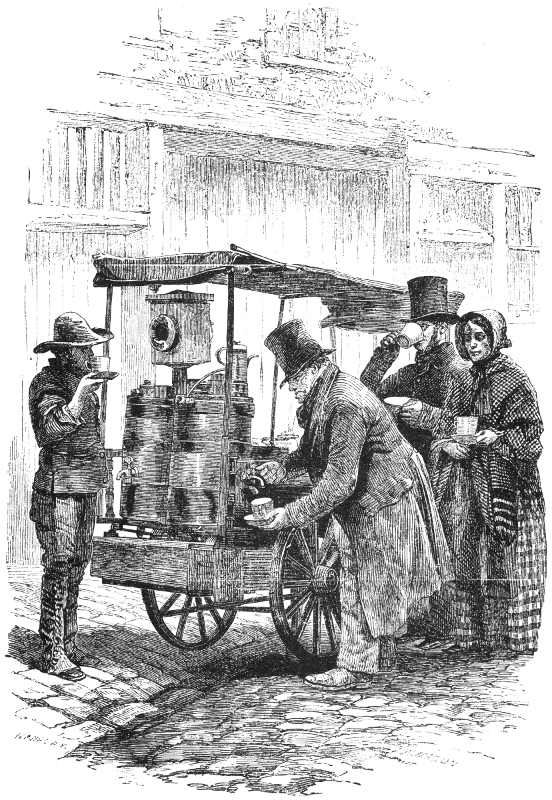
THE LONDON COFFEE-STALL.
[From a Daguerreotype by Beard.]
The class of persons usually belonging to the business have been either cab-men, policemen, labourers, or artisans. Many have been bred to dealing in the streets, and brought up to no other employment, but many have taken to the business owing to the difficulty of obtaining work at their own trade. The generality of them are opposed to one another. I asked one in a small way of business what was the average amount of his profits, and his answer was,—
“I usually buy 10 ounces of coffee a night. That costs, when good, 1s. 0½d. With this I should make five gallons of coffee, such as I sell in the street, which would require 3 quarts of milk, at 3d. per quart, and 1½ lb. of sugar, at 3½d. per lb., there is some at 3d. This would come to 2s. 2¾d.; and, allowing 1¼d. for a quarter of a peck of charcoal to keep the coffee hot, it would give 2s. 4d. for the cost of five gallons of coffee. This I should sell out at about 1½d. per pint; so that the five gallons would produce me 5s., or 2s. 8d. clear. I generally get rid of one quartern loaf and 6 oz. of butter with this quantity of coffee, and for this I pay 5d. the loaf and 3d. the butter, making 8d.; and these I make into twenty-eight slices at ½d. per slice; so the whole brings me in 1s. 2d., or about 6d. clear. Added to this, I sell a 4 lb. cake, which costs me 3½d. per lb. 1s. 2d. the entire cake; and this in twenty-eight slices, at 1d. per slice, would yield 2s. 4d., or 1s. 2d. clear; so that altogether my clear gains would be 4s. 4d. upon an expenditure of 2s. 2d.—say 200 per cent.”
This is said to be about the usual profit of the trade. Sometimes they give credit. One person assured me he trusted as much as 9½d. that morning, and out of that he was satisfied there was 4d., at least, he should never see. Most of the stalls are stationary, but some are locomotive. Some cans are carried about with yokes, like milk-cans, the mugs being kept in a basket. The best district for the night-trade is the City, and the approaches to the bridges. There are more men and women, I was told, walking along Cheapside, Aldersgate-street, Bishopsgate-street, and Fleet-street. In the latter place a good trade is frequently done between twelve at night and two in the morning. For the morning trade the best districts are the Strand, Oxford-street, City-road, New-road (from one end to the other), the markets, especially Covent Garden, Billingsgate, Newgate, and the Borough. There are no coffee-stalls in Smithfield. The reason is that the drovers, on arriving at the market, are generally tired and cold, and prefer sitting down to their coffee in a warm shop rather than drink it in the open street. The best days for coffee-stalls are market mornings, viz. Tuesday, Thursday, and Saturday. On these days the receipts are generally half as much again as those of the other mornings. The best time of the year for the business is the summer. This is, I am told, because the workpeople and costermongers have more money to spend. Some stall-keepers save sufficient to take a shop, but these are only such as have a “pitch” in the best thoroughfares. One who did a little business informed me that he usually cleared, including Sunday, 14s.—last week his gains were 15s.; the week before that he could not remember. He is very frequently out all night, and does not earn sixpence. This is on wet and cold nights, when there are few people about. His is generally the night-trade. The average weekly earnings of the trade, throughout the year, are said to be 1l. The trade, I am assured by all, is overstocked. They are half too many, they say. “Two of us,” to use their own words, “are eating one man’s bread.” “When coffee in the streets first came up, a man could go and earn,” I am told, “his 8s. a night at the very lowest; but now the same class of men cannot earn more than 3s.” Some men may earn comparatively a large sum, as much as 38s. or 2l., but the generality of the trade cannot make more than 1l. per week, if so much. The following is the statement of one of the class:—
“I was a mason’s labourer, a smith’s labourer, a plasterer’s labourer, or a bricklayer’s labourer. I was, indeed, a labouring man. I could not get employment. I was for six months without any employment. I did not know which way to support my wife and child (I have only one child). Being so long out of employment, I saw no other means of getting a living but out of the streets. I was almost starving before I took to it—that I certainly was. I’m not ashamed of telling anybody that, because it’s true, and I sought for a livelihood wherever I could. Many said they wouldn’t do such a thing as keep a coffee-stall, but I said I’d do anything to get a bit of bread honestly. Years ago, when I was a boy, I used to go out selling water-cresses, and apples, oranges, and radishes, with a barrow, for my landlord; so I thought, when I was thrown out of employment, I would take to selling coffee in the streets. I went to a tinman, and paid him 10s. 6d. (the last of my savings, after I’d been four or five months out of work) for a can, I didn’t care how I got my living so long as I could turn an honest penny. Well; I went on, and knocked about, and couldn’t get a pitch anywhere; but at last I heard that an old man, who had been in the habit of standing for many years at the entrance of one of the markets, had fell ill; so, what did I do, but I goes and pops into his pitch, and there I’ve done better than ever I did afore. I get 20s. now where I got 10s. one time; and if I only had such a thing as 5l. or 10l., I might get a good living for life. I cannot do half as much as the man that was there before me. He used to make his coffee down there, and had a can for hot water as well; but I have but one can to keep coffee and all in; and I have to borrow my barrow, and pay 1s. a week for it. If I sell my can out, I can’t do any more. The struggle to get a living is so great, that, what with one and another in the coffee-trade, it’s only those as can get good ‘pitches’ that can get a crust at it.”
As it appears that each coffee-stall keeper on an average, clears 1l. a week, and his takings may be said to be at least double that sum, the yearly street expenditure for tea, coffee, &c., amounts to 31,200l. The quantity of coffee sold annually in the streets, appears to be about 550,000 gallons.
To commence as a coffee-stall keeper in a moderate manner requires about 5l. capital. The truck costs 2l., and the other utensils and materials 3l. The expense of the cans is near upon 16s. each. The stock-money is a few shillings.
Of the Street Sale of Ginger-beer, Sherbet, Lemonade, &c.
The street-trade in ginger-beer—now a very considerable traffic—was not known to any extent until about thirty years ago. About that time (1822) a man, during a most sultry drought, sold extraordinary quantities of “cool ginger-beer” and of “soda-powders,” near the Royal Exchange, clearing, for the three or four weeks the heat continued, 30s. a day, or 9l. weekly. Soda-water he sold “in powders,” the acid and the alkali being mixed in the water of the glass held by the customer, and drunk whilst effervescing. His prices were 2d. and 3d. a glass for ginger-beer; and 3d. and 4d. for soda-water, “according to the quality;” though there was in reality no difference whatever in the quality—only in the price. From that time, the numbers pursuing this street avocation increased gradually; they have however fallen off of late years.
The street-sellers who “brew their own beer” generally prepare half a gross (six dozen) at a time. For a “good quality” or the “penny bottle” trade, the following are the ingredients and the mode of preparation:—3 gallons of water; 1 lb. of ginger, 6d.; lemon-acid, 2d.; essence of cloves, 2d.; yeast, 2d.; and 1 lb. of raw sugar, 7d. This admixture, the yeast being the last ingredient introduced, stands 24 hours, and is then ready for bottling. If the beverage be required in 12 hours, double the quantity of yeast is used. The bottles are filled only “to the ridge,” but the liquid and the froth more than fill a full-sized half-pint glass. “Only half froth,” I was told, “is reckoned very fair, and it’s just the same in the shops.” Thus, 72 bottles, each to be sold at 1d., cost—apart from any outlay in utensils, or any consideration of the value of labour—only 1s. 7d., and yield, at 1d. per bottle, 6s. For the cheaper beverage—called “playhouse ginger-beer” in the trade—instead of sugar, molasses from the “private distilleries” is made available. The “private” distilleries are the illicit ones: “‘Jiggers,’ we call them,” said one man; “and I could pass 100 in 10 minutes’ walk from where we’re talking.” Molasses, costing 3d. at a jigger’s, is sufficient for a half-gross of bottles of ginger-beer; and of the other ingredients only half the quantity is used, the cloves being altogether dispensed with, but the same amount of yeast is generally applied. This quality of “beer” is sold at ½d. the glass.
About five years ago “fountains” for the production of ginger-beer became common in the streets. The ginger-beer trade in the open air is only for a summer season, extending from four to seven months, according to the weather, the season last year having been over in about four months. There were then 200 fountains in the streets, all of which, excepting 20 or 30 of the best, were hired of the ginger-beer manufacturers, who drive a profitable trade in them. The average value of a street-fountain, with a handsome frame or stand, which is usually fixed on a wheeled and movable truck, so as one man’s strength may be sufficient to propel it, is 7l.; and, for the rent of such a fountain, 6s. a week is paid when the season is brisk, and 4s. when it is slack; but last summer, I am told, 4s. 6d. was an average. The largest and handsomest ginger-beer fountain in London was—I speak of last summer—in use at the East-end, usually standing in Petticoat-lane, and is the property of a dancing-master. It is made of mahogany, and presents somewhat the form of an upright piano on wheels. It has two pumps, and the brass of the pump-handles and the glass receivers is always kept bright and clean, so that the whole glitters handsomely to the light. Two persons “serve” at this fountain; and on a fine Sunday morning, from six to one, that being the best trading time, they take 7l. or 8l. in halfpennies—for “the beer” is ½d. a glass—and 2l. each other day of the week. This machine, as it may be called, is drawn by two ponies, said to be worth 10l. a-piece; and the whole cost is pronounced—perhaps with a sufficient exaggeration—to have been 150l. There were, in the same neighbourhood, two more fountains on a similar scale, but commoner, each drawn by only one pony instead of the aristocratic “pair.”
The ingredients required to feed the “ginger-beer” fountains are of a very cheap description. To supply 10 gallons, 2 quarts of lime-juice (as it is called, but it is, in reality, lemon-juice), costing 3s. 6d., are placed in the recess, sometimes with the addition of a pound of sugar (4d.); while some, I am assured, put in a smaller quantity of juice, and add two-pennyworth of oil of vitriol, which “brings out the sharpness of the lime-juice.” The rest is water. No process of brewing or fermentation is necessary, for the fixed air pumped into the liquid as it is drawn from the fountain, communicates a sufficient briskness or effervescence. “The harder you pumps,” said one man who had worked a fountain, “the frothier it comes; and though it seems to fill a big glass—and the glass an’t so big for holding as it looks—let it settle, and there’s only a quarter of a pint.” The hirer of a fountain is required to give security. This is not, as in some slop-trades, a deposit of money; but a householder must, by written agreement, make himself responsible for any damage the fountain may sustain, as well as for its return, or make good the loss: the street ginger-beer seller is alone responsible for the rent of the machine. It is however, only men that are known, who are trusted in this way. Of the fountains thus hired, 50 are usually to be found at the neighbouring fairs and races. As the ginger-beer men carry lime-juice, &c., with them, only water is required to complete the “brewing of the beer” and so conveyance is not difficult.
There is another kind of “ginger-beer,” or rather of “small acid tiff,” which is sold out of barrels at street-stalls at ½d. the glass. To make 2½ gallons of this, there is used 1/2lb. tartaric, or other acid, 1s.; ½ lb. alkali (soda), 10d.; ½ lb. lump sugar, bruised fine, 4d.; and yeast 1d. Of these “barrel-men” there are now about one hundred.
Another class of street-sellers obtain their stock of ginger-beer from the manufacturers. One of the largest manufacturers for the street-trade resides near Ratcliffe-highway, and another in the Commercial-road. The charge by the wholesale traders is 8d. the doz., while to a known man, or for ready money, 13 are given to the dozen. The beer, however, is often let out on credit—or in some cases security is given in the same way as for the fountains—and the empty bottles must be duly returned. It is not uncommon for two gross of beer to be let out in this way at a time. For the itinerant trade these are placed on a truck or barrow, fitted up with four shelves, on which are ranged the bottles. These barrows are hired in the same way as the costers’ barrows. Some sell their beer at stalls fitted up exclusively for the trade, a kind of tank being let into the centre of the board and filled with water, in which the glasses are rinsed or washed. Underneath the stall there is usually a reserve of the beer, and a keg containing water. Some of the best frequented stalls were in Whitechapel, Old-street-road, City-road, Tottenham-court-road, the New-cut, Elephant and Castle, the Commercial-road, Tower-hill, the Strand, and near Westminster-bridge.
The stationary beer business is, for the most part, carried on in the more public streets, such as Holborn and Oxford-street, and in the markets of Covent-garden, Smithfield, and Billingsgate; while the peripatetic trade, which is briskest on the Sundays—when, indeed, some of the stationary hands become itinerant—is more for the suburbs; Victoria-park, Battersea-fields, Hampstead-heath, Primrose-hill, Kennington-common, and Camberwell-green, being approved Sunday haunts.
The London street-sellers of ginger-beer, say the more experienced, may be computed at 3,000—of whom about one-third are women. I heard them frequently estimated at 5,000, and some urged that the number was at least as near 5,000 as 3,000. For my own part I am inclined to believe that half the smaller number would be nearer the truth. Judging by the number of miles of streets throughout the metropolis, and comparing the street-sellers of ginger-beer with the fruit-stall keepers, I am satisfied that in estimating the ginger-beer-sellers at 1,500 we are rather over than under the truth. This body of street-sellers were more numerous five years back by 15 or 20 per cent., but the introduction of the street fountains, and the trade being resorted to by the keepers of coal-sheds and the small shopkeepers—who have frequently a stand with ginger-beer in front of their shops—have reduced the amount of the street-sellers. In 1842, there were 1,200 ginger-beer sellers in the streets who had attached to their stalls or trucks labels, showing that they were members—or assumed to be members—of the Society of Odd Fellows. This was done in hopes of a greater amount of custom from the other members of the Society, but the expectation was not realised—and so the Odd Fellowship of the ginger-beer people disappeared. Of the street-traders 200 work fountains; and of the remaining portion the stationary and the itinerant are about equally divided. Of the whole number, however, not above an eighth confine themselves to the trade, but usually sell with their “pop” some other article of open-air traffic—fruit, sweet-stuff, or shell-fish. There are of the entire number about 350, who, whenever the weather permits, stay out all night with their stands or barrows, and are to be found especially in all the approaches to Covent-garden, and the other markets to which there is a resort during the night or at day-break. These men, I was told by one of their body, worked from eight in the evening to eight or ten next morning, then went to bed, rose at three, and “plenty of ’em then goes to the skittles or to get drunk.”
The character of the ginger-beer-sellers does not differ from what I have described as pertaining to the costermonger class, and to street-traders generally. There is the same admixture of the reduced mechanic, the broken-down gentleman’s servant, the man of any class in life who cannot brook the confinement and restraint of ordinary in-door labour, and of the man “brought up to the streets.” One experienced and trustworthy man told me that from his own knowledge he could count up twenty “classical men,” as he styled them, who were in the street ginger-beer-trade, and of these four had been, or were said to have been “parsons,” two being of the same name (Mr. S ——); but my informant did not know if they stood in any degree of consanguinity one to another. The women are the wives, daughters, or other connections of the men.
Some of the stalls at which ginger-beer is sold—and it is the same at the coal-sheds and the chandlers’ shops—are adorned pictorially. Erected at the end of a stall is often a painting, papered on a board, in which a gentleman, with the bluest of coats, the whitest of trousers, the yellowest of waistcoats, and the largest of guard-chains or eye-glasses, is handing a glass of ginger-beer, frothed up like a pot of stout, and containing, apparently, a pint and a half, to some lady in flowing white robes, or gorgeous in purple or orange.
To commence in this branch of the street business requires, in all 18s. 3d.: six glasses, 2s. 9d.; board, 5s.; tank, 1s.; keg, 1s.; gross of beer, 8s. (this is where the seller is not also the maker); and for towels, &c., 6d.; if however the street-seller brew his own beer, he will require half a gross of bottles, 5s. 6d.; and the ingredients I have enumerated, 1s. 7d.
In addition to the street-sale of ginger-beer is that of other summer-drinks. Of these, the principal is lemonade, the consumption of which is as much as that of all the others together. Indeed, the high-sounding names given to some of these beverages—such as “Nectar” and “Persian Sherbet”—are but other names for lemonade, in a slightly different colour or fashion.
Lemonade is made, by those vendors who deal in the best articles, after the following method: 1 lb. of carbonate of soda, 6d.; 1 lb. of tartaric acid, 1s. 4d. (“at least,” said an informant, “I pay 1s. 4d. at ’Pothecaries Hall, but it can be had at 1s.”); 1 lb. of loaf-sugar, 5½d.; essence of lemon, 3d. This admixture is kept, in the form of a powder, in a jar, and water is drawn from what the street-sellers call a “stone-barrel”—which is a stone jar, something like the common-shaped filters, with a tap—and a larger or smaller spoonful of the admixture in a glass of water supplies an effervescing draught for 1d. or ½d. “There’s sometimes shocking roguishness in the trade,” said one man, “and there is in a many trades—some uses vitriol!” Lemonade, made after the recipe I have given, is sometimes bottled by the street-sellers, and sold in the same way as ginger-beer. It is bought, also, for street sale of the ginger-beer manufacturers—the profit being the same—but so bought to less than a twentieth of the whole sale. The water in the stone barrel is spring-water, obtained from the nearest pump, and in hot weather obtained frequently, so as to be “served” in as cool a state as possible. Sometimes lemonade powders are used; they are bought at a chemist’s, at 1s. 6d. the pound. “Sherbet” is the same admixture, with cream of tartar instead of tartaric acid. “Raspberry” has, sometimes, the addition of a few crusted raspberries, and a colouring of cochineal, with, generally, a greater degree of sweetening than lemonade. “If cochineal is used for colouring,” said one man, “it sometimes turns brown in the sun, and the rasberry don’t sell. A little lake’s better.” “Lemon-juice” is again lemonade, with a slight infusion of saffron to give it a yellow or pale orange colour. “Nectar,” in imitation of Soyer’s, has more sugar and less acid than the lemonade; spices, such as cinnamon, is used to flavour it, and the colouring is from lake and saffron.
These “cooling drinks” are sold from the powder or the jar, as I have described, from fountains, and from bottles. The fountain sale is not above a tenth of the whole. All is sold in ½d. and 1d. glasses, except the nectar, which is never less than 1d. The customers are the same as those who buy ginger-beer; but one “lemonader” with whom I conversed, seemed inclined to insist that they were a “more respectabler class.” Boys are good customers—better, perhaps, than for the beer,—as “the colour and the fine names attracts them.”
The “cooling drink” season, like that of the ginger-beer, is determined by the weather, and last summer it was only four months. It was computed for me that there were 200 persons, chiefly men, selling solely lemonade, &c., and an additional 300 uniting the sale with that of ginger-beer. One man, whose statement was confirmed by others, told me that on fine days he took 3s. 6d., out of which he cleared 2s. to 2s. 6d.; and he concluded that his brother tradesmen cleared as much every fine day, and so, allowing for wet weather and diminished receipts, made 10s. a week. The receipts, then, for this street luxury—a receipt of 17s. 6d. affording a profit of 10s.—show a street expenditure in such a summer as the last, of 2,800l., by those who do not unite ginger-beer with the trade. Calculating that those who do unite ginger-beer with it sell only one-half as much as the others, we find a total outlay of 4,900l. One of the best trades is in the hands of a man who “works” Smithfield, and on the market days clears generally from 6s. to 9s.
The stalls, &c., are of the same character as those of the ginger-beer sellers. The capital required to start is:—stone barrel, with brass tap, 5s. 6d.; stand and trestle, 6s.; 6 tumbler glasses, 2s. 3d.; 2 towels, 6d.; stock money, 2s. 6d.; jar, 2s.; 12 bottles (when used), 3s. 6d.; in all, about a guinea.
In showing the money expended in the ginger-beer trade it must be borne in mind that a large portion of the profits accrues to persons who cannot be properly classed with the regular street-traders. Such is the proprietor of the great fountain of which I have spoken, who is to be classed as a speculative man, ready to embark capital in any way—whether connected with street-traffic or not—likely to be remunerative. The other and large participants in the profits are the wholesale ginger-beer manufacturers, who are also the letters-out of fountains, one of them having generally nine let out at a time. For a street trader to sell three gross of ginger-beer in bottle is now accounted a good week, and for that the receipts will be 36s. with a profit in the penny bottle trade, to the seller, if he buy of a manufacturer, of 12s.; if he be his own brewer—reckoning a fair compensation for labour, and for money invested in utensils, and in bottles, &c., of 20s. An ordinary week’s sale is two gross, costing the public 24s., with the same proportion of profit in the same trade to the seller. In a bad week, or “in a small way to help out other things,” not more than one gross is sold.
The fountain trade is the most profitable to the proprietors, whether they send out their machines on their own account, or let them out on hire; but perhaps there are only an eighth of the number not let out on hire. Calculating that a fountain be let out for three successive seasons of twenty weeks each, at only 4s. the week, the gross receipts are 12l. for what on the first day of hire was worth only 7l.; so that the returns from 200 machines let out for the same term, would be 2,400l., or a profit of 1,000l. over and above the worth of the fountain, which having been thus paid for is of course in a succeeding year the means of a clear profit of 4l. I am assured that the weekly average of “a fountain’s takings,” when in the hands of the regular street-dealers, is 18s.
The barrel traders may be taken as in the average receipt of 6s. a week.
The duration of the season was, last year, only sixteen weeks. Calculating from the best data I could acquire, it appears that for this period 200 street-sellers of ginger-beer in the bottle trade of the penny class take 30s. a week each (thus allowing for the inferior receipts in bad weather); 300 take 20s. each, selling for the most part at ½d. the bottle, and that the remaining 400 “in a small way” take 6s. each; hence we find 11,480l. expended in the bottled ginger-beer of the streets. Adding the receipts from the fountains and the barrels, the barrel season continuing only ten weeks, the total sum expended annually in street ginger-beer is altogether 14,660l. The bottles of ginger-beer sold yearly in the streets will number about 4,798,000, and the total street consumption of the same beverage may be said to be about 250,000 gallons per annum.
Of the Experience and Customers of a Ginger-beer Seller.
A slim, well-spoken man, with a half-military appearance, as he had a well trimmed moustache, and was very cleanlily dressed, gave me the following account: “I have known the ginger-beer trade for eight years, and every branch of it. Indeed I think I’ve tried all sorts of street business. I’ve been a costermonger, a lot-seller, a nut-seller, a secret-paper-seller (with straws, you know, sir), a cap-seller, a street-printer, a cakeman, a clown, an umbrella-maker, a toasting-fork maker, a sovereign seller, and a ginger-beer seller. I hardly know what I haven’t been. I made my own when last I worked beer. Sunday was my best day, or rather Sunday mornings when there’s no public-houses open. Drinking Saturday nights make dry Sunday mornings. Many a time men have said to me: ‘Let’s have a bottle to quench a spark in my throat,’ or ‘My mouth’s like an oven.’ I’ve had to help people to lift the glass to their lips, their hands trembled so. They couldn’t have written their names plain if there was a sovereign for it. But these was only chance customers; one or two in a morning, and five or six on a Sunday morning. I’ve been a teetotaller myself for fifteen years. No, sir, I didn’t turn one—but I never was a drinker—not from any great respect for the ginger-beer trade, but because I thought it gave one a better chance of getting on. I once had saved money, but it went in a long sickness. I used to be off early on Sunday mornings sometimes to Hackney Marsh, and sell my beer there to gentlemen—oldish gentlemen some of them—going a fishing. Others were going there to swim. One week I took 35s. at 1d. a bottle, by going out early in a morning; perhaps 20s. of it was profit, but my earnings in the trade in a good season wasn’t more than 12s. one week with another. All the trades in the streets are bad now, I think. Eight years back I could make half as much more in ginger-beer as could be made last summer. Working people and boys were my other customers. I stuck to ginger-beer in the season and then went into something else, for I can turn my hand to anything. I began a street life at eight years old by selling memorandum-books in the bull-ring at Birmingham. My parents were ill and hadn’t a farthing in the house. I began with 1d. stock-money, and I bought three memorandum-books for it at Cheap Jack’s thatched house. I’ve been in London seventeen or eighteen years. I’m a roulette-maker now; I mean the roulette boxes that gentlemen take with them to play with when travelling on a railway or such times. I make loaded dice, too, and supply gaming-houses. I think I know more gaming-houses than any man in London. I’ve sold them to gentlemen and to parsons, that is ministers of religion. I can prove that. I don’t sell those sort of things in the streets. I could do very well in the trade, but it’s so uncertain and so little’s wanted compared to what would keep a man going, and I have a mother that’s sixty to support. Altogether my present business is inferior to the ginger-beer; but the fountains will destroy all the fair ginger-beer trade.”
Of the Street-sellers of Hot Elder Wine.
The sale of hot elder wine in the streets is one of the trades which have been long established, but it is only within these eight or ten years that it has been carried on in its present form. It continues for about four months in the winter.
Elder wine is made from the berries of the elder-tree. Elder syrup—also made from the berries—was formerly famous in the north of England as a curative for colds, and was frequently taken, with a small admixture of rum, at bedtime. Some of the street-sellers make the wine themselves; the majority, however, buy it of the British wine makers. The berries must be gathered when fully ripe, and on a dry day. They are picked, measured, and put into a copper, two gallons of water being added to every gallon of berries. They are then boiled till the berries are quite soft, when the liquor is strained and pressed from them through a strong hair sieve. The liquor thus expressed is again put into the copper, boiled an hour, skimmed, and placed in a tub along with a bread toast, on which yeast is spread thickly; it then stands two days, and is afterwards put into a cask, a few cloves and crusted ginger being hung in a muslin bag from the bung-hole, so as to flavour the liquor. Sometimes this spicing is added afterwards, when the liquor is warmed. The berries are sold in the markets, principally in Covent-garden,—the price varying, according to the season, from 1s. 6d. to 3s. a gallon. Of all elder-wine makers the Jews are the best as regards the street commodity. The costermongers say they “have a secret;” a thing said frequently enough when superior skill is shown, and especially when, as in the case of the Jews’ elder wine, better pennyworths are given. The Jews, I am told, add a small quantity of raspberry vinegar to their “elder,” so as to give it a “sharp pleasant twang.” The heat and pungency of the elder wine sold in the streets is increased by some street-sellers by means of whole black pepper and capsicums.
The apparatus in which the wine is now kept for sale in the streets is of copper or brass, and is sometimes “handsome.” It is generally an urn of an oblong form, erected on a sort of pedestal, with the lid or top ornamented with brass mouldings, &c. Three plated taps give vent to the beverage. Orifices are contrived and are generally hidden, or partially hidden, with some ornament, which act as safety-valves, or, as one man would have it, “chimneys.” The interior of these urns holds three or four quarts of elder wine, which is surrounded with boiling water, and the water and wine are kept up to the boiling pitch by means of a charcoal fire at the foot of the vessel. Fruit of some kind is generally sold by the elder-wine men at their stand.
The elder wine urn is placed on a stand covered with an oil-cloth, six or eight glasses being ranged about it. It is sold at a halfpenny and a penny a glass; but there is “little difference in some elder wines,” I was told, “between the penn’orths and the ha’porths.” A wine glass of the “regular” size is a half-quartern, or the eighth of a pint.
Along with each glass of hot elder wine is given a small piece of toasted bread. Some buyers steep this bread in the wine, and so imbibe the flavour. “It ain’t no good as I know on,” said an elder-wine seller, “but it’s the fashion, and so people must have it.” The purchasers of elder wine are the working classes—but not the better order of them—and the boys of the street. Some of these lads, I was told, were very choice and critical in their elder wines. Some will say: “It ain’t such bad wine, but not the real spicy.”—“The helder I thinks,” said another, “is middlin’, but somehow there’s nothing but hotness for to taste.”
Of these traders there are now perhaps fifty in London. One man counted up thirty of his brethren whom he knew personally, or knew to be then “working elder,” and he thought that there might be as many more, but I am assured that fifty is about the mark. The sellers of elder wine have been for the most part mechanics who have adopted the calling for the reasons I have often given. None of them, in the course of my inquiry, depended entirely upon the sale of the wine, but sold fruit in addition to it. All complained of the bad state of trade. One man said, that four or five years back he had replenished the wine in a three quart urn twelve times a day, a jar of the wine being kept at the stall in readiness for that purpose. This amounted to 576 glasses sold in the course of the day, and a receipt—reckoning each glass at a penny—of 48s.; but probably not more than 40s. would be taken, as some would have halfpenny glasses. Now the same man rarely sells three quarts in a day, except perhaps on a Saturday, and on wet days he sells none at all. The elder wine can be bought at almost any price at the wine makers, from 4d. to 1s. 6d. the quart. The charge in the public-houses is twice as high as in the streets, but the inn wine, I was told by a person familiar with the trade, contains spirit, and is more highly spiced.
A decent-looking middle-aged man who had been in a gentleman’s service, but was disabled by an accident which crushed his hand, and who thereupon resorted to street-selling and had since continued in it, in different branches, from fifteen to twenty years, gave me an account of his customers. He had not been acquainted with the elder-wine trade above four or five years when he bought an elder can for about 15s. among a cheap miscellaneous “lot” in Smithfield one Friday afternoon, and so he commenced: