Volume 1 — OF THE STREET-SELLERS OF MANUFACTURED ARTICLES. (continued 9)
Reading edition
I may observe that the generality of the hawkers of indecent prints and cards are women.
There are about 35 persons selling snuff and tobacco-boxes—the greatest sale being of tobacco-boxes—and cigar-cases, generally with the other things I have mentioned. Of these 35, however, not one-half sell snuff-boxes constantly, but resort to any traffic of temporary interest in the public or street-public estimation. Some sell only in the evenings. Reckoning that 15 persons on snuff and tobacco and cigar boxes alone take 18s. weekly (clearing 7s. or 8s.), we find 702l. thus expended.
Of the Street-Sellers of Cigars.
Cigars, I am informed, have constituted a portion of the street-trade for upwards of 20 years, having been introduced not long after the removal of the prohibition on their importation from Cuba. It was not, however, until five or six years later that they were at all extensively sold in the streets; but the street-trade in cigars is no longer extensive, and in some respects has ceased to exist altogether.
I am told by experienced persons that the cigars first vended in the streets and public-houses were really smuggled. I say “really” smuggled, as many now vended under that pretence never came from the smuggler’s hands. “Well, now, sir,” said one man, “the last time I sold Pickwicks and Cubers a penny apiece with lights for nothing, was at Greenwich Fair, on the sly rather, and them as I could make believe was buying a smuggled thing, bought far freer. Everybody likes a smuggled thing.” [This remark is only in consonance with what I have heard from others of the same class.] “In my time I’ve sold what was smuggled, or made to appear as sich, but far more in the country than town, to all sorts—to gentlemen, and ladies, and shopkeepers, and parsons, and doctors, and lawyers. Why no, sir, I can’t say as how I ever sold anything in that way to an exciseman. But smuggling’ll always be liked; it’s sich a satisfaction to any man to think he’s done the tax-gatherer.”
The price of a cigar, in the earlier stages of the street-traffic, was 2d. and 3d. One of the boxes in which these wares are ordinarily packed was divided by a partition, the one side containing the higher, and the other the lower priced article. The division was often a mere trick of trade—in justification of which any street-seller would be sure to cite the precedent of shopkeepers’ practices—for the cigars might be the same price (wholesale) but the bigger and better-looking were selected as “threepennies,” the “werry choicest and realest Hawanners, as mild as milk, and as strong as gunpowder,” for such, I am told, was the cry of a then well-known street-trader. The great sale was of the “twopennies.” As the fuzees, now so common, were unknown, and lucifer matches were higher-priced, and much inferior to what they are at present, the cigar seller in most instances carried tow with him, a portion of which he kept ignited in a sort of tinder-box, and at this the smokers lighted their cigars; or the vender twisted together a little tow and handed it, ignited, to a customer, that if he were walking on he might renew his “light,” if the cigar “wouldn’t draw.”
A cheaper cigar soon found its way into street commerce, “only a penny apiece, prime cigars;” and on its first introduction, a straw was fitted into it, as a mouth-piece. “Cigar tubes” were also sold in the streets; they were generally of bone, and charged from 2d. to 1s. each. The cigar was fitted into the tube, and they were strongly recommended on the score of economy, as “by means of this tube, any gen’l’man can smoke his cigar to half a quarter of an inch, instead of being forced to throw it away with an inch and a half left.” These tubes have not for a long time been vended in the streets. I am told by a person, who himself was then engaged in the sale, that the greatest number of penny cigars ever sold in the streets in one day was on that of her Majesty’s coronation (June 28, 1838). Of this he was quite positive from what he had experienced, seen, and heard.
“In my opinion,” said another street-seller, “the greatest injury the street-trade in such things had was when the publicans took to selling cigars. They didn’t at first, at least not generally; I’ve sold cigars myself, at the bars of respectable houses, to gentlemen that was having their glass of ale with a friend, and one has said to another, ‘Come, we’ll have a smoke,’ and has bought a couple. O, no; I never was admitted to offer them in a parlour or tap-room; that would have interfered with the order for ‘screws’ (penny papers of tobacco), which is a rattling good profit, I can tell you. Indeed, I was looked shy at, from behind the bar; but if customers chose to buy, a landlord could hardly interfere. Now, it’s no go at all in such places.”
One common practice among the smarter street-seller, when “on cigars,” was, until of late years, and still is, occasionally at races and fairs, to possess themselves of a few really choice “weeds,” as like as they could procure them to their stock-in-trade, and to smoke one of them, as they urged their traffic.
The aroma was full and delicate, and this was appealed to if necessary, or, as one man worded it, the smell was “left to speak for itself.” The street-folk who prefer the sale of what is more or less a luxury, become, by the mere necessities of their calling, physiognomists and quick observers, and I have no reason to doubt the assertion of one cigar-vendor, when he declared that in the earlier stages of this traffic he could always, and most unerringly in the country, pick out the man on whose judgment others seemed to rely, and by selling him one of his choice reserve, procure a really impartial opinion as to its excellence, and so influence other purchasers. When the town trade “grew stale”—the usual term for its falling-off—the cigar-sellers had a remunerative field in many parts of the country.
In London, before railways became the sole means of locomotion to a distance, the cigar-sellers frequented the coaching-yards; and the “outsides” frequently “bought a cigar to warm their noses of a cold night,” and sometimes filled their cases, if the cigar-seller chanced to have the good word of the coachman or guard.
The cigar street-trade was started by two Jews, brothers, named Benasses, who were “licensed to deal in tobacco,” and vended good articles. When they relinquished the open-air business, they supplied the other street-sellers, whose numbers increased very rapidly. The itinerant cigar-vending was always principally in the hands of the Jews, but the general street-traders resorted to the traffic on all occasions of public resort,—“sich times,” observed one, “as fairs and races, and crownations, and Queen’s weddings; I wish they came a bit oftener for the sake of trade.” The manufacture of the cigars sold at the lowest rates, is now almost entirely in the hands of the Jews, and I am informed by a distinguished member of that ancient faith, that when I treat of the Hebrew children, employed in making cigars, there will be much to be detailed of which the public have little cognisance and little suspicion.
The cigars in question are bought (wholesale) in Petticoat-lane, Rosemary-lane, Ailie-street, Tenter-ground, in Goodman’s-fields, and similar localities. The kinds in chief demand are Pickwicks, 7s. and 8s. per lb.; Cubas, 8s. 6d.; common Havannahs and Bengal Cheroots, the same price; but the Bengal Cheroots are not uncommonly smuggled.
“The best places for cigar-selling,” one man stated, “I’ve always found to be out of town; about Greenwich and Shooter’s Hill, and to the gents going to Kensington Gardens, and such like places. About the Eagle Tavern was good, too, as well as the streets leading to the Surrey Zoological—one could whisper, ‘cheap cigar, sir, half what they’ll charge you inside.’ I’ve known young women treat their young men to cigars as they were going to Cremorne, or other public places; but there’s next to no trade that way now, and hasn’t been these five or six years. I don’t know what stopped it exactly. I’ve heard it was shop-keepers that had licences, complaining of street people as hadn’t, and so the police stopped the trade as much as they could.”
At all the neighbouring races and fairs, and at any great gathering of people in town, cigars are sold, more with the affectation than the reality of its being done, “quite on the sly.” The retail price is 1d. each, and three for 2d. Some of the cheap cigars are made to run 200, and even as high as 230 to the pound. A fuzee is often given into the bargain.
I am told that, on all favourable opportunities, there are still 100 persons who vend cigars in the streets of London, while a greater number of “London hands” carry on the trade at Epsom and Ascot races. At other periods the business is all but a nonentity. To clear 1l. a week is considered “good work.” At one period, on every fine Sunday, there were not, I am assured, fewer than 500 persons selling cigars in the open air in London and its suburbs.
Of the Street-Sellers of Sponge.
This is one of the street-trades which has been long in the hands of the Jews, and, unlike the traffic in pencils, sealing-wax, and other articles of which I have treated, it remains so principally still.
In perhaps no article which is a regular branch of the street-trade, is there a greater diversity in the price and quality than in sponge. The street-sellers buy it at 1s. (occasionally 6d.), and as high as 21s. the pound. At one time, I believe about 20 years back, when fine sponge in large pieces was scarce and dear, some street-sellers gave 28s. the pound, or, in buying a smaller quantity, 2s. an ounce.
“I have sold sponge of all sorts,” said an experienced street-seller, “both ‘fine toilet,’ fit for any lady or gentleman, and coarse stuff not fit to groom a ass with. That very common sponge is mostly 1s. the lb. wholesale, but it’s no manner of use, it’s so sandy and gritty. It weighs heavy, or there might be a better profit on it. It has to be trimmed up and damped for showing it, and then it always feels hask (harsh) to the hand. It rubs to bits in no time. There was a old gent what I served with sponges, and he was very perticler, and the best customer I ever had, for his housekeeper bought her leathers of me. Like a deal of old coves that has nothing to do and doesn’t often stir out, but hidles away time in reading or pottering about a garden, he was fond of a talk, and he’d give me a glass of something short, as if to make me listen to him, for I used to get fidgety, and he’d talk away stunning. He’s dead now. He’s told me, and more nor once, that sponges was more of a animal than a wegetable,” continued the incredulous street-seller, “I do believe people reads theirselves silly. Such —— nonsense! Does it look like a animal? Where’s its head and its nose? He’d better have said it was a fish. And it’s not a wegetable neither. But I’ll tell you what it is, sir, and from them as has seen it where its got with their own eyes. I have some relations as is sea-farin’-men, and I went a woyage once myself when a lad—one of my relations has seen it gathered by divers, I forget where, from the rocks at the bottom and shores of the sea, and he says it’s just sea-moss—stuff as grows there, as moss does to old walls in England. That’s what it is, sir. As it’s grown in the water, it holds water you see. I’ve made 15s. on sponge alone, in a good week, when I had a good stock; but oftener I’ve made only 10s., and sometimes not 5s. My best trade is at private houses a little ways out of town. I’ve heard gents say, ‘A good sponging’s as good as a bath,’ and when I could get good things cheap they’d be sure to sell. No, I never did much at the mews.”
Another man told me that he once bought a large quantity of sponge at 6d. the lb., trimmed it up as well as he could, and got a man to help him, and the two “worked it off” in barrows; there was six barrows full, and as one was emptied it was replenished. It was sold at 1d. and 2d. a lump; about twenty lumps, or pieces, going to a pound, so that there was 14d. profit on what cost 6d., even on the penny lumps. He had forgotten the exact amount he cleared, and he and his mate sold it all in one summer’s evening, but it was somewhere about 10s. This happened some years ago, when the common sponge, which I heard called also “honeycomb” sponge, was not so “blown upon,” as my informant expressed it, as it is now. On my asking this man as to the proportion of Jews in this trade, he answered: “Well, many a day I’m satisfied there’s 100 people selling sponge, and I should say that for every ten or twelve Jews is one Christian, and half of them, or more, has been in some sort of service, I mean the Christians has, most likely stable-helpers, and they supplies the mews and the job and livery stables, such of them as requires men to find their own sponges, but that’s only a few; sponges is mostly bought for such places at the saddlers’ and other shops. In my opinion, sir, Jews is better Christians than Christians themselves, for they help one another, and we don’t. I’ve been helped by a Jew myself, without any connection with them. They’re terrible keen hands at a bargain, though.”
The sponge in the street-trade is purchased, wholesale, chiefly in Houndsditch. The wholesale trade in sponge, I may add, is also in the hands of the Jews. The great mart is Smyrna, the best qualities being gathered in the islands of the Greek Archipelago. The sponge is carried by the street-traders in baskets, the bearer holding a specimen piece or two in his hand. Smaller pieces are sometimes carried in nets, and nets were more frequently in use for this purpose than at present. It is nearly all sold by itinerants, in the business parts as well as the suburbs, the purchasers being “shopkeepers, innkeepers, gentlemen, and gentlemen’s servants.” Sometimes low-priced sponge is offered in a street-market on a Saturday or Monday night, but very rarely, as it is a thing little used by the poor. A little is sold to the cabmen at their stands. The sponge-sellers, I may add, when going a regular round, offer their wares to any passer-by. A little is done by the Jews in bartering sponge for old clothes. There are five or six women in the trade.
I have reason to believe that the estimate of my informant, as to the number of sponge-sellers, is correct. But some sell sponge only occasionally, some make it only a portion of their business, and others vend it only when they “have it a bargain.” Calculating, then, that only fifty persons (so allowing for the irregularities in the trade) vend sponge daily, and that each takes 15s. weekly,—some taking 25s., and others but 5s.—with about half profit on the whole (the common sponge is often from 200 to 300 per cent. profit), we find the outlay to be 1,950l.
Of the Street-Sellers of Wash-Leathers.
The wash-leathers, sometimes called “shammys” (chamois), now sold extensively in the streets, are for the most part the half of a sheep-skin, or of a larger lamb-skin. The skin is “split” by machinery, and to a perfect nicety, into two portions. That known as the “grain” (the part to which the fleece of the animal is attached) is very thin, and is dressed into a “skiver,” a kind of leather used in the commoner requirements of book-binding, and for such purposes as the lining of hats. The other portion, the “flesh,” is dressed as wash-leather. These skins are bought at the leather-sellers and the leather-dressers, at from 2s. to 20s. the dozen. The higher priced, or those from 12s. are often entire, and not “split” skins. The great majority of the street-sellers of wash-leathers are women, and principally Irishwomen. They offer their wash-leathers in all parts of town, calling at shops and inns; and at private houses offering them through the area rails, or knocking at the door when it is accessible. Many of these street-sellers are the wives of Irish labourers, employed by bricklayers and others, who are either childless, or able to leave their younger children under the care of an older brother or sister, or when the poverty of the parents, or their culpable neglect, is extreme, allow them to run at large in the court or street, untended. The wives by this street-trade add to the husbands’ earnings. In the respects of honesty and chastity, these women bear good characters.
The wash-leathers are sold for the cleaning of windows, and of plate and metal goods. Sixpence is a common price for a leather, the higher priced being sold at the mews and at gentlemen’s houses. The “chamois” sold at the mews, however, are not often sold by the Irishwomen, but by the class I have described as selling scissors, &c., there. The leathers are also cut into pennyworths, and these pennyworths are sometimes sold on Saturday evenings in the street-markets.
There are, I am assured, 100 individuals selling little or nothing else but wash-leathers (for these traders are found in all the suburbs) in London, and that they take 10s. weekly, with a profit of from 4s. to 5s. There are, also, 100 other persons selling them occasionally, along with other goods, and as they vend the higher-priced articles, they probably receive nearly an equal amount. Hence it would appear that upwards of 5000l. is annually expended in the streets in this purchase.
Of the Street-Sellers of Spectacles and Eye-Glasses.
Twenty-five years ago the street-trade in spectacles was almost entirely in the hands of the Jews, who hawked them in their boxes of jewellery, and sold them in the streets and public-houses, carrying them in their hands, as is done still. The trade was then far more remunerative than it is at the present time to the street-folk carrying it on. “People had more money then,” one old spectacle-seller, now vending sponges, said, “and there wasn’t so many forced to take to the streets, Irish particularly, and opticians’ charges were higher than they are now, and those who wanted glasses thought they were a take-in if they wasn’t charged a fair price. O, times was very different then.”
The spectacles in the street-trade are bought at swag-shops in Houndsditch. The “common metal frames,” with or without slides, are 2s. 6d. to 3s. 6d. the dozen wholesale, and are retailed from 4d. to 1s. The “horn frames” are 6s. to 7s. 6d. the dozen, and are retailed from 9d. to 18d., and even 2s. The “thin steel” are from 10s. 6d. to 21s. the dozen, and are retailed from 1s. 6d. to 3s. There are higher and lower prices, but those I have cited are what are usually paid by the street-traders. The inequality of the retail prices is accounted for by there being some difference in the spectacles in a dozen, some being of a better-looking material in horn or metal; others better finished. Then there is the chance of which street-sellers are not slow to avail themselves—(“no more nor is shopkeepers,” one man said)—I mean, the chance of obtaining an enhanced price for an article, with whose precise value the buyer is unacquainted.
“The patter,” said the street-trader I have before quoted, “is nothing now, to what I’ve known it. You call it patter, but I don’t. I think it’s more in the way of persuasion, and is mostly said in public-houses, and not in the streets. Why, I’ve persuaded people, when I was in the trade and doing well at it—for that always gives you spirits—I’ve persuaded them in spite of their eyes that they wanted glasses. I knew a man who used to brag that he could talk people blind, and then they bought! It wasn’t old people I so much sold to as young and middle-aged. I think perhaps I sold as many because people thought they looked better, or more knowing in them, than to help their eyesight. I’ve known my customers try my glasses, one pair after another, in the chimney glass of a public-house parlour. ‘They’re real Scotch pebbles,’ I used to say sometimes—and I always had a fair article,—‘and was intended for a solid silver frame but the frame was made too small for them, and so I got them and put them into this frame myself, for I’m an optician, out of work, by trade. They’re worth 15s., but you may have them, framed and all, for 7s. 6d.’ I got 5s. for one pair once that way but they were a superior thing; I had them a particular bargain.” One man told me that not long ago he asked 10d. for a pair of spectacles, and a journeyman slop-tailor said to him, “Why I only gave 1s. for this pair I’m wearing a few years back, and they ought to be less than 10d. now, for the duty’s off glass.”
The eye-glasses sold in the streets are “framed” in horn. They are bought at the same places as the spectacles, and cost, wholesale, for “single eyes” 4s. 6d. to 7s. 6d. the dozen. The retail price is from 6d. to 1s. The “double eyes,” which are jointed in the middle so that the frame can be fitted to the bridge of the nose, are 10s. 6d. to 15s. the dozen, and are retailed by the street-folk from 1s. 3d. to 2s. each.
The spectacles are sold principally to working men, and are rarely hawked in the suburbs. The chief sale is in public-houses, but they are offered in all the busier thoroughfares and wherever a crowd is assembled. “The eye-glasses,” said a man who vended them, “is sold to what I calls counter-hoppers and black-legs. You’ll see most of the young swells that’s mixed up with gaming concerns at races—for there’s gaming still, though the booths is put down in many places—sport their eye-glasses; and so did them as used to be concerned in getting up Derby and St. Leger ‘sweeps’ at public-houses; least-ways I’ve sold to them, where sweeps was held, and they was busy about them, and offered me a chance, sometimes, for a handsome eye-glass. But they’re going out of fashion, is eye-glasses, I think. The other day I stood and offered them for nearly five hours at the foot of London-bridge, which used to be a tidy pitch for them, and I couldn’t sell one. All that day I didn’t take a halfpenny.”
There are sometimes 100 men, the half of whom are Jews and Irishmen in equal proportions, now selling spectacles and eye-glasses. Some of these traders are feeble from age, accident, continued sickness, or constitution, and represent that they must carry on a “light trade,” being incapable of hard work, even if they could get it. Two women sell spectacles along with Dutch drops. As in other “light trades,” the spectacle sellers do not, as a body, confine themselves to those wares, but resort, as one told me, “to anything that’s up at the time and promises better,” for a love of change is common among those who pursue a street life. It may be estimated, I am assured, that there are thirty-five men (so allowing for the breaks in regular spectacle selling) who vend them daily, taking 15s. a week (with a profit of 10s.), the yearly expenditure being thus 1365l.
Of the Street-Sellers of Dolls.
The making of dolls, like that of many a thing required for a mere recreation, a toy, a pastime, is often carried on amidst squalor, wretchedness, or privation, or—to use the word I have frequently heard among the poor—“pinching.” Of this matter, however, I shall have to treat when I proceed to consider the manufacture of and trade in dolls generally, not merely as respects street-sale.
Dolls are now so cheap, and so generally sold by open-air traders whose wares are of a miscellaneous character, as among the “swag-barrow” or “penny-a piece” men of whom I have treated separately, that the sale of what are among the most ancient of all toys, as a “business of itself,” is far smaller, numerically, than it was.
The dolls are most usually carried in baskets by street-sellers (who are not makers) and generally by women who are very poor. Here and there in the streets most frequented by the patrons of the open-air trade may be seen a handsome stall of dolls of all sizes and fashions, but these are generally the property of makers, although those makers may buy a portion of their stock. There are also smaller stalls which may present the stock of the mere seller.
The dolls for street traffic may be bought at the swag-shops or of the makers. For the little armless 1d. dolls the maker charges the street-seller 8s., and to the swag-shop keeper who may buy largely, 7s. 6d. the dozen. Some little stalls are composed entirely of penny dolls; on others the prices run from 1d. to 6d. The chief trade, however, among the class I now describe, is carried on by the display of dolls in baskets. If the vendor can only attract the notice of children—and more especially in a private suburban residence, where children are not used to the sight of dolls on stalls or barrows, or in shops—and can shower a few blessings and compliments, “God be wid your bhutiful faces thin—and yours too, my lady, ma’am (with a curtsey to mistress or maid). Buy one of these dolls of a poor woman: shure they’re bhutiful dolls and shuted for them angels o’ the worruld;” under such circumstances, I say, a sale is almost certain. I may add that the words I have given I myself heard a poor Irishwoman, whom I had seen before selling large pincushions in the same neighbourhood (that of the Regent’s Park), address to a lady who was walking round her garden accompanied by two children.
A vendor of dolls expresses an opinion that as long as ever there are children from two years old to ten, there will always be purchasers of dolls; “but for all that,” said he, “somehow or another ’t is nothing of a trade to what it used to be. I’ve seen the time when I could turn out in the morning and earn a pound afore night; but it’s different now there’s so many bazaars, and so many toy shops that the doll hawker hasn’t half the chance he used to have. Sartinly we gets a chance now and then—fine days is the best—and if we can get into the squares or where the children walks with their nurses, we can do tidy; but the police are so very particular there’s not much of a livelihood to be got. Spoiled children are our best customers. Whenever we sees a likely customer approaching—we, that is, those who know their business—always throw ourselves in the way, and spread out our dolls to the best advantage. If we hears young miss say she will have one, and cries for it, we are almost sure of a customer, and if we see her kick and fight a bit with the nuss-maid we are sure of a good price. If a child cries well we never baits our price. Most of the doll-sellers are the manufacturers of the dolls—that is, I mean, they puts ’em together. The heads are made in Hamburgh; the principal places for buying them in London are at Alfred Davis’s, in Houndsditch; White’s, in Houndsditch; and Joseph’s, in Leadenhall-street. They are sold as thus:—The heads that we sell for 3d. each, when made up, cost us 7s. 6d. per gross, or 7½d. per dozen; these are called 1—O’s. No. 2—O’s., are 8s. 6d. per gross, and No. 3—O’s. 10s. per gross. One yard and half of calico will make a dozen bodies, small size. These we get sewn for three halfpence, and we stuffs and finishes them ourselves.
“When our 3d. dolls are made up, they cost about 1s. per dozen—so there is 2d. profit on every doll, which I thinks is little enough; but we often sells ’em at 2d.; we lays ’em out to the best advantage in a deep basket, all standing up, as it were, or leaning against the sides of the basket. The legs and bodies is carefully wrapped in tissue paper, not exactly to preserve the lower part of the doll, for that isn’t so very valuable, but in reality to conceal the legs and body, which is rather the reverse of symmetrical; for, to tell the truth, every doll looks as if it were labouring under an attack of the gout. There are, however, some very neat articles exported from Germany, especially the jointed dolls, but they are too dear for the street-hawker, and would not show to such advantage. There is also the plaster dolls, with the match legs. I wonder how they keep their stand, for they are very old-fashioned; but they sell, for you never see a chandler’s shop window without seeing one of these sticking in it, and a falling down as if it was drunk. Then there’s the wax dolls. Some of ’em are made of wax, and others of ‘pappy mashy,’ and afterwards dipped in wax. The cheapest and best mart for these is in Barbican; it would astonish many if they knew exactly what was laid out in the course of a year in dolls. It would be impossible, I think, to ascertain exactly; but I think I could guess something near the mark. There are, at least, at this time of year, when the fairs are coming on, fifty doll-hawkers, who sell nothing else. Say each of these sells one dozen dolls per day, and that their average price is 4d. each. That is just 10l. a day, and 60l. per week. In the winter time so many are not sold; but I have no doubt that 50l.’s worth of dolls are sold each week throughout the year by London hawkers alone, or just upon 3000l. per annum. The shops sell as many as the hawkers, and the stalls attending fairs half the amount; and you may safely say that the sum taken for dolls in and around London in one year amounts to 7500l. A doll-merchant can begin business with a trifle,” continued my informant; “a shilling will obtain a dozen 3d. dolls. If you have no basket, carry them in your arms, although they don’t show off to such advantage there as they do when nicely basketed; however, if you’ve luck, you may soon raise a basket; for 3s. 6d. you can get a very nice one; and although the doll trade is not what it used to be, there are,” said my informant, “worse games than that yet, I know. One man, who is now in a very respectable way of business—‘a regular gentleman’—was a very few years ago only a doll-hawker. Another man, who had two hands and only one arm—poor fellow! he was born with one arm, and had two hands, one appended to his arm in the usual way, and the other attached to his shoulder—a freak of nature, I think, they called it. However, my one-armed friend keeps now a very respectable little swag-shop at North Shields, in Northumberland.”
I inquired of my informant whether he objected to relate a little of his history? He replied, “not the least,” and recounted as follows:—
“They call me Dick the Dollman. I was, I believe, the first as ever cried dolls three a shilling in the streets. Afore I began they al’ays stood still with ’em; but I cried ’em out same as they do mackrel; that is twenty years ago. I wasn’t originally a doll-seller. My father was a pensioner in Greenwich College. My mother used to hawk, and had a licence. I was put to school in St. Patrick’s-school, Lanark’s-passage, where I remained six years, but I didn’t learn much. At thirteen years of age I was apprenticed to a brush and broom maker’s, corner of C—— Street, Spitalfields. My master was not the honestest chap in the world, for he bought hair illegal, was found out, and got transported for seven years. A man who worked for my master took me to finish my apprenticeship; this man and his wife was very old people. I used to work four days in the week, two for them and two for myself; the other two days I went out hawking brooms and brushes, and very often would earn 7s. or 8s. on a Saturday, but times was better then than they are now. Arter that, for sake of gain, I left the old people, I was offered 20s. to make and hawk; and in course I took it. I remained with this master five months; he was afflicted with rheumatic fever—went into the hospital—and I was left to shift for myself. When my master went to the hospital I had 7s. 6d. in my pocket; I knew I must do something, and, to tell you the truth, I didn’t like the brush-making; I would rather have hawked something without the trouble of making it. I think now I was a little afflicted with laziness. I was passing London-bridge and saw a man selling Marshall’s pocket-books; I knowed him afore; I thought I should like to try the pocket-book selling, and communicated my wishes to the man; he told me they cost eight shillings a dozen, if I liked we would purchase a dozen a’twixt us; we did so; I received half a dozen, but I afterwards learned that my friend obtained seven for his share, as they were sold thirteen to the dozen. I went to Chancery-lane with my lot and was very lucky; I sold the six books to one gentleman for six shillings: in course I soon obtained another supply; that day I sold four dozen, and earned 20s. I was such a good seller that Marshall let me have 3l. or 4l.’s worth on credit—and I never paid him. I know that was wrong now; but I was such a foolish chap, and used to spend my money as fast as I got it. I would have given Marshall a shilling the other day if I had had one, for I see him selling penny books in the street. I thought it was hard lines, and had been such a gentleman too. Somerset-house corner was a capital stand for selling pocket-books. The way I took to the dolls was this; I met a girl with a doll basket one day as I was standing at Somerset-house corner; she and I got a talking. ‘Will you go to the ’Delphy to night?’ says I; she consented. They was a playing Tom and Jerry at this time, all the street-sellers went to see it, and other people; and nice and crabbed some on ’em was. Well, we goes to the ’Delphy—and I sees her often arter that, and at last gets married. She used to buy her dolls ready made; I soon finds out where to get the heads—and the profits when we made them ourselves was much greater. We began to serve hawkers and shops; went to Bristol—saved 47l.—comes to London and spends it all; walks back to Bristol, and by the time we got there we had cleared more than 20l. We were about a month on the journey, and visited Cheltenham and other towns. We used to spend our money very foolishly; we were too fond of what was called getting on the spree. You see we might have done well if we had liked, but we hadn’t the sense. My wife got very clever at the dolls and so did I. Then I tried my hand at the wax dolls, and got to make them very well. I paid a guinea to learn.
“I was selling wax-dolls one day in London, and a gentleman asked me if I could mend a wax figure whose face was broken. I replied yes, for I had made a few wax heads, large size, for some showmen. I had made some murderers who was hung; lately I made Rush and Mr. and Mrs. Manning; but the showmen can’t afford to get new heads now-a-days, so they generally makes one head do for all; sometimes they changes the dress. Well, as I was telling you, I went with this gentleman, and proposed that he should have a new head cast, for the face of the figure was so much broken. It was Androcles pulling the thorn out of the lion’s foot, and was to be exhibited. I got 20s. for making the new head. The gentleman asked me if I knew the story about Androcles. Now I had never heard on him afore, but I didn’t like to confess my ignorance, so I says ‘yes;’ then he offers me 30s. a week to describe it in the Flora Gardens, where it was to be exhibited. I at once accepted the engagement; but I was in a bit of a fix, for I didn’t know what to say. I inquired of a good many people, but none on ’em could tell me; at last I was advised to go to Mr. Charles Sloman—you know who I mean—him as makes a song and sings it directly; I was told he writes things for people. I went, and he wrote me out a patter. I asked him how much he charged; he said, ‘Nothing my man.’ Sartinly he wasn’t long a-doing it, but it was very kind of him. I got what Mr. Sloman wrote out for me printed, and this I stuck inside my hat; the people couldn’t see it, though I dare say they wondered what I was looking in my hat about. However, in a week or so, I got it by heart, and could speak it well enough. After exhibiting Androcles I got an engagement with another waxwork show—named Biancis—and afterwards at other shows. I was considered a very good doorsman in time, but there’s very little to be got by that now; so we keeps to the dolly business, and finds we can get a better living at that than anything else. Me and the old woman can earn 1l. a week, bad and all as things are; but we’re obliged to hawk.”
Of the “Swag-Barrowmen,” and “Lot-Sellers.”
The “swag” (miscellaneous) barrow is one of the objects in the streets which attracts, perhaps more readily than any other, the regards of the passer-by. There are so many articles and of such various uses; they are often so closely packed, so new and clean looking, and every here and there so tastefully arranged, that this street-trader’s barrow really repays an examination. Here are spread on the flat part of the barrow, pepper-cruets or boxes, tea-caddies, nutmeg-graters, vinegar-cruets, pen-cases, glass or china-handled pens, pot ornaments, beads, ear-rings, finger-rings (plain or with “stones”), cases of scent-bottles, dolls, needle-cases, pincushions, Exhibition medals and “frames” (framed pictures), watches, shawl-pins, extinguishers, trumpets and other toys, kaleidoscopes, seals, combs, lockets, thimbles, bone tooth-picks, small playing-cards, teetotums, shuttle-cocks, key-rings, shirt-studs or buttons, hooks and eyes, coat-studs, money-boxes, spoons, boxes of toys, earthenware-mugs, and glass articles, such as salt-cellars and smelling-bottles. On one barrow were 225 articles.
At the back and sides of the swag-barrow are generally articles which are best displayed in an erect position. These are children’s wooden swords, whips, climbing monkeys, and tumblers, jointed snakes twisting to the wind from the top of a stick, kites, and such things as tin egg-holders.
Perhaps on very few barrows or stalls are to be seen all the articles I have enumerated, but they are all “in the trade,” and, if not found in this man’s stock, may be found in his neighbour’s. Things which attain only a temporary sale, such as galvanic rings, the Lord’s Prayer in the compass of a sixpence, gutta-percha heads, &c., are also to be found, during the popular demand, in the miscellaneous trader’s stock.
Each of the articles enumerated is retailed at 1d. “Only a penny!” is the cry, “pick ’em out anywhere; wherever your taste lies; only a penny, a penny, a penny!” But on a few other barrows are goods, mixed with the “penny” wares, of a higher price; such as knives and forks, mustard pots, sham beer glasses (the glasses which appear to hold beer frothing to the brim), higher-priced articles of jewellery, skipping-ropes, drums, china ornaments, &c. At these barrows the prices run from 1d. to 1s.
The practice of selling by commission, the same as I have shown to prevail among the costers, exists among the miscellaneous dealers of whom I am treating, who are known among street-folk as “swag-barrowmen,” or, in the popular ellipsis, “penny swags;” the word “swag” meaning, as I before showed, a collection—a lot.
The “swag-men” are often confounded with the “lot-sellers”; so that I proceed to show the difference.
The Lot-Sellers proper, are those who vend a variety of small articles, or “a lot,” all for 1d. A “lot” frequently consists of a sheet of songs, a Chinese puzzle, a 5l. note (Bank of Elegance), an Exhibition snuff-box (containing 6 spoons), a half jack (half sovereign), a gold ring, a silver ring, and a chased keeper with rose, thistle, and shamrock on it. The lots are diversified with packs of a few cards, little pewter ornaments, boxes of small wooden toys, shirt-buttons, baby thimbles, beads, tiny scent bottles, and such like.
The “penny apiece” or “swag” trade, as contradistinguished from the “penny lots” vended by the lot-sellers, was originated by a man who, some 19 years ago, sold a variety of trifles from a tea-tray in Petticoat-lane. My informant had heard him say—for the original “penny apiece” died four years ago—that he did it to get rid of the odds and ends of his stock. The system, however, at once attracted popularity, and the fortunate street-seller prospered and “died worth money.” At that period penny goods (excepting such things as sweet-stuffs, pastry, &c.) were far less numerous in the streets, and yet I have never met with an old street-trader (a statement fully borne out by old and intelligent mechanics) who did not pronounce spare pennies to be far more abundant in those days among the poorer and even middle classes. There were, moreover, far fewer street chapmen, so that this novel mode of business had every chance to thrive.
The origin of “lot-selling,” or selling “penny lots” instead of penny articles, was more curious. It was commenced by an ingenious Swiss (?) (about a year after the “penny apiece” trade), known in the street circles as “Swede.” He was a refugee, a Roman Catholic, and a hot politician. He spoke and understood English well, but had no sympathy with the liberal parties in this country. “He was a republican,” he would say, “and the Chartists were only milk and water.” When he established his lot-selling he used to place to his mouth an instrument, which was described to me as “like a doubled card,” and play upon it very finely. This would attract a crowd, and he would then address them in good English, but with a slight foreign accent: “My frents; come to me, and I will show you my musical instruments, which will play Italian, Swiss, French, Scotch, Irish, or any tunes. And here you see beautiful cheap lots of useful tings, and elegant tings. A penny a lot, a penny a lot!” The arrangement of the “lots” was similar to what it is at present, but the components of the pennyworth were far less numerous. This man carried on a good trade in London for two or three years, and then applied his industry to a country more than a town career. He died about five or six years ago, at his abode in Fashion-street, Spitalfields, “worth money.” At the time of his decease he was the proprietor of two lodging-houses; one in Spitalfields, the other in Birmingham, both I am told, well conducted; the charge was 4d. a night. He did not reside in either, but employed “deputies.” I may observe that he sold his “musical instruments,” also, at 1d. each, but the sale was insignificant. “Only himself seemed master of ’em,” said one man; “with other people they were no better nor a Jew’s-harp.”
Of the “penny apiece” street-vendors, there are about 300 in London; 250 having barrows, and 50 stalls or pitches on the ground. Some even sell at “a halfpenny apiece,” but chiefly to get rid of inferior wares, or when “cracked up,” and unable to “spring” a better stock. The barrows are 7 feet by 3; are well built in general, and cost 50s. each. These barrows, when fully stocked, are very heavy (about 4 cwt.), so that it requires a strong man to propel one any distance, and though occasionally the man’s wife officiates as the saleswoman, there is always a man connected with the business. In my description of a stock of penny goods, I have mentioned that there were 225 articles; these were counted on a barrow in a street near the Brill—but probably on another occasion (when there appeared a better chance of selling) there might be 500 articles, such things as rings and the like admitting of being stowed by the hundred in very small compass. The great display, however, is only on the occasion of holidays, or “when a man starts and wants to stun you with a show.” At Maidstone Fair the other day, a London street-seller, rather well to do, sold his entire stock of penny articles to a shopkeeper of the town, and when counted there were exactly fifteen gross, or 2160 “pieces” as they are sometimes called. These, vended at 1d. each, would realize just 9l., and would cost, wholesale, about 6l., or for ready money, at the swag-shops, where they may be bought, from 10s. to 20s. less, according to the bargaining powers of the buyer. The man’s reason for selling was that the Fair was “no good;” that is to say, the farmers had no money, and their labourers received only 7s. a week, so there was no demand; the swag-seller, therefore, rather than incur the trouble and expense of having to carry his wares back to London, sold at a loss to a shopkeeper in Maidstone, who wanted a stock.
The swag-barrowmen selling on commission have 3s. in every 20s. worth of goods that they sell. The commission may average from 9s. to 12s. a week in tolerable weather, but as in bad, and especially in foggy weather, the trade cannot be prosecuted at all, 7s. 6d. may be the highest average, or 10s. the year through.
The character of the penny swag-men belongs more to that of the costermongers than to any other class of street-folk. Many of them drink as freely as their means will permit. I was told of a match between a teetotaller and a beer-drinker, about nine years ago. It was for 5s. a side, and the “Championship.” Each man started with an equal stock, alike in all respects, but my informant had forgotten the precise number of articles. They pattered, twenty-five yards apart one from another, three hours in James-street, Covent-garden; three hours in the Blackfriars-road; and three hours in Deptford. The teetotaller was “sold out” in seven-and-a-half hours; while his opponent—and the contest seems to have been carried on very good-humouredly—at the nine hours’ end, had four dozen articles left, and was rather exhausted, or, as it was described to me, “told out.” The result, albeit, was not looked upon, I was assured, as anything very decisive of the relative merits of beer or water, as the source of strength or inspiration of “patter.” The teetotaller was the smarter, though he did not appear the stronger, man; he abandoned the championship, and went into another trade four years ago. The patter of the swag-men has nothing of the humour of the paper-workers; it is merely declaratory that the extensive stock offered on such liberal terms to the public would furnish a wholesale shop; that such another opportunity for cheap pennyworths could never by any possibility occur again, and that it was a duty on all who heard the patterer to buy at once.
The men having their own barrows or stalls (but the stall-trade is small) buy their goods as they find their stock needs replenishment at the swag-shops. “It was a good trade at first, sir,” said one man, “and for its not being a good trade now, we may partly blame one another. There was a cutting down trade among us. Black earrings were bought at 14d. the dozen, and sold at a loss at 1d. each. So were children’s trap-bats, and monkeys up sticks, but they are now 9d. a dozen. Sometimes, sir, as I know, the master of a swag-barrow gets served out. You see, a man may once on a time have a good day, and take as much as 2l. Well, next day he’ll use part of that money, and go as a penny swag on his own account; or else he’ll buy things he is sold out of, and work them on his own account on his master’s barrow. All right, sir; his master makes him a convenience for his own pocket, and so his master may be made a convenience for the man’s. When he takes the barrow back at the week’s end, if he’s been doing a little on his own dodge, there’s the stock, and there’s the money. It’s all right between a rich man and a poor man that way; turn and turn about’s fair play.”
The lot-sellers are, when the whole body are in London, about 200 in number; but they are three times as itinerant into the country as are the traders in the heavier and little portable swag-barrows. The lot-sellers nearly all vend their goods from trays slung from their shoulders. The best localities for the lot-sellers are Ratcliffe-highway, Commercial-road, Whitechapel, Minories, Tower-hill, Tooley-street, Newington-causeway, Walworth, Blackfriars and Westminster-roads, Long-acre, Holborn, and Oxford-street. To this list may be added the Brill, Tottenham-court-road, and the other street-markets, on Saturday evenings, when some of these places are almost impassable. The best places for the swag-barrow trade are also those I have specified. Their customers, alike for the useful and fancy articles, are the working-classes, and the chief sale is on Saturdays and Mondays. One swag-man told me that he thought he could sell better if he had a less crowded barrow, but his master was so keen of money that he would make him try everything. It made selling more tiresome, too, he said, for a poor couple who had a penny or two to lay out would fix on half the things they saw, and change them for others, before they parted with their money.
Of the penny-a-piece sellers trading on their own account, the receipts may be smaller than those of the men who work the huge swag-barrows on commission, but their profits are greater. Calculating that 100 of these traders are, the year round, in London (some are absent all the summer at country fairs, and on any favourable opportunity, while a number of swag-barrowmen leave that employment for costermongering on their own account), and that each takes 2l. weekly, we find no less than 10,400l. thus expended in the streets of London in a year.
The lot-sellers also resort largely to the country, and frequently try other callings, such as the sale of fruit, medals, &c. Some also sell lots only on Saturday and Monday nights. Taking these deductions into consideration, it may be estimated that only fifty men (there is but one female lot-seller on her own account) carry on the trade, presuming it to be spread over the six days of the week. Each of them may take 13s. weekly (with a profit of 7s. 6d.), so showing the street outlay to be 1,690l. The “lots” are bought at the German and English swag-shops; the principal supply, however, is procured from Black Tom in Clerkenwell.
Of the Street-Sellers of Roulette Boxes.
In my account of the street-trade in “China ornaments” I had occasion to mention a use to which a roulette box, or portable roulette table, was put. I need only repeat in this place that the box (usually of mahogany) contains a board, with numbered partitions, which is set spinning, by means of a central knob, on a pivot; the lid is then placed on the box, a pea is slipped through a hole in the lid, and on the number of the partition in which the pea is found deposited, when the motion has ceased, depends the result. The table, or board, is thus adapted for the determination of that mode of raising money, popular among costermongers and other street-folk, who in their very charities crave some excitement; I mean a “raffle;” or it may be used for play, by one or more persons, the highest number “spun” determining the winner. These street-sold tables may still be put to another use: In the smaller sort, “going no higher than fourteen,” one division is blank. Thus any one may play against another, or several others spinning in turns, the “blank” being a chance in the “banker’s” favour. Some of the tables, however, are numbered as high as 36, or as a seller of them described it, “single and double zero, bang; a French game.”
This curious street-trade has been carried on for seven years, but with frequent interruptions, by one man, who, until within these few weeks, was the sole trader in the article. There are now but two selling roulette-boxes at all regularly. The long-established salesman wears mustachios, and has a good deal the look of a foreigner. During his seven years’ experience he has sold, he calculates, 12,000 roulette-boxes, at a profit of from 175l. to 200l. The prices (retail) are from 1s. to 2l., at which high amount my informant once disposed of “a roulette” in the street. He has sold, however, more at 1s. than at all other rates together. The “shilling roulette” is about three inches in diameter; the others proportionately larger. These wares are German made, bought at a swag-shop, and retailed at a profit of from 15 to 33 per cent. They are carried in a basket, one being held for public examination in the vendor’s hand.
“My best customers,” said the experienced man in the business, “are stock-brokers, travellers, and parsons; people that have spare time on their hands. O, I mean by ‘travellers,’ gentlemen going on a railway who pass the time away at roulette. Now and then a regular ‘leg,’ when he’s travelling to Chester, York, or Doncaster, to the races, may draw other passengers into play, and make a trifle, or not a trifle, by it; or he will play with other legs; but it’s generally for amusement, I’ve reason to believe. Friends travelling together play for a trifle to pass away time, or who shall pay for breakfasts for two, or such like. I supplied one gaming-house with a large roulette-table made of a substance that if you throw it into water—and there’s always a pail of ‘tepid’ ready—would dissolve very quickly. When it’s not used it’s hung against the wall and is so made that it looks to be an oil-painting framed. It cost them 10l. I suppose I have the ‘knock’ of almost every gaming-house in London. There’s plenty of them still. The police can drive such as me about in the streets or out of the streets to starve, but lords, and gentlemen, and some parsons, I know, go to the gaming-houses, and when one’s broke into by the officers—it’s really funny—John Smith, and Thomas Jones, and William Brown are pulled up, but as no gaming implements are found, there’s nothing against them. Some of these houses are never noticed for a long time. The ‘Great Nick’ hasn’t been, nor the ‘Little Nick.’ I don’t know why they’re called ‘Nicks,’ those two; but so they are. Perhaps after Old Nick. At the Great Nick I dare say there’s often 1000l. depending. But the Little Nick is what we call only ‘brown papermen,’ low gamblers—playing for pence, and 1s. being a great go. I wonder the police allow that.”
Of the Street-Sellers of Poison for Rats.
The number of Vermin-Destroyers and Rat-Catchers who ply their avocation in London has of late years become greatly diminished. One cause which I heard assigned for this was that many ruinous old buildings and old streets had been removed, and whole colonies of rats had been thereby extirpated. Another was that the race of rat-catchers had become distrusted, and had either sought some other mode of subsistence, or had resorted to other fields for the exercise of their professional labours.
The rat-catcher’s dress is usually a velveteen jacket, strong corduroy trowsers, and laced boots. Round his shoulder he wears an oil-skin belt, on which are painted the figures of huge rats, with fierce-looking eyes and formidable whiskers. His hat is usually glazed and sometimes painted after the manner of his belt. Occasionally—and in the country far more than in town—he carries in his hand an iron cage in which are ferrets, while two or three crop-eared rough terriers dog his footsteps. Sometimes a tamed rat runs about his shoulders and arms, or nestles in his bosom or in the large pockets of his coat. When a rat-catcher is thus accompanied, there is generally a strong aromatic odour about him, far from agreeable; this is owing to his clothes being rubbed with oil of thyme and oil of aniseed, mixed together. This composition is said to be so attractive to the sense of the rats (when used by a man who understands its due apportionment and proper application) that the vermin have left their holes and crawled to the master of the powerful spell. I heard of one man (not a rat-catcher professionally) who had in this way tamed a rat so effectually that the animal would eat out of his mouth, crawl upon his shoulder to be fed, and then “smuggle into his bosom” (the words of my informant) “and sleep there for hours.” The rat-catchers have many wonderful stories of the sagacity of the rat, and though in reciting their own feats, these men may not be the most trustworthy of narrators, any work on natural history will avouch that rats are sagacious, may be trained to be very docile, and are naturally animals of great resources in all straits and difficulties.
One great source of the rat-catcher’s employment and emolument thirty years ago, or even to a later period, is now comparatively a nonentity. At that time the rat-catcher or killer sometimes received a yearly or quarterly stipend to keep a London granary clear of rats. I was told by a man who has for twenty-eight years been employed about London granaries, that he had never known a rat-catcher employed in one except about twenty or twenty-two years ago, and that was in a granary by the river-side. The professional man, he told me, certainly poisoned many rats, “which stunk so,” continued my informant—but then all evil odours in old buildings are attributed to dead rats—“that it was enough to infect the corn. He poisoned two fine cats as well. But I believe he was a young hand and a bungler.” The rats, after these measures had been taken, seem to have deserted the place for three weeks or a month, when they returned in as great numbers as ever; nor were their ravages and annoyances checked until the drains were altered and rebuilt. It is in the better disposition of the drains of a corn-magazine, I am assured, that the great check upon the inroads of these “varmint” is attained—by strong mason work and by such a series and arrangement of grates, as defy even the perseverance of a rat. Otherwise the hordes which prey upon the garbage in the common sewers, are certain to find their way into the granary along the drains and channels communicating with those sewers, and will increase rapidly despite the measures of the rat-catcher.
The same man told me that he had been five or six times applied to by rat-catchers, and with liberal offers of beer, to allow them to try and capture the black rats in the granary. One of these traders declared that he wanted them “for a gent as vas curous in them there hinteresting warmint.” But from the representations of the other applicants, my informant was convinced that they were wanted for rat-hunts, the Dog Billy being backed for 100l. to kill so many rats in so many minutes. “You see, sir,” the corn merchant’s man continued, “ours is an old concern, and there’s black rats in it, great big fellows; some of ’em must be old, for they’re as white about the muzzle as is the Duke of Wellington, and they have the character of being very strong and very fierce. One of the catchers asked me if I knew what a stunning big black rat would weigh, as if I weighed rats! I always told them that I cared nothing about rat-hunts and that I knew our people wouldn’t like to be bothered; and they was gentlemen that didn’t admire sporting characters.”
The black rat, I may observe, or the English rat, is now comparatively scarce, while the brown, or Hanoverian, rat is abundant. This brown rat seems to have become largely domiciled in England about the period of the establishment of the Hanoverian dynasty; whence its name. “A Hanover rat” was a term of reproach applied by the Jacobites to the successful party.
The rat-catchers are also rat-killers. They destroy the animals sometimes by giving them what is called in the trade “an alluring poison.” Every professional destroyer, or capturer, of rats will pretend that as to poison he has his own particular method—his secret—his discovery. But there is no doubt that arsenic is the basis of all their poisons. Its being inodorous, and easily reducible to a soft fine powder, renders it the best adapted for mixing with anything of which rats are fond—toasted cheese, or bacon, or fried liver, or tallow, or oatmeal. Much as the poisoner may be able to tempt the animal’s appetite, he must, and does, proceed cautiously. If the bait be placed in an unwonted spot, it is often untouched. If it be placed where rats have been accustomed to find their food, it is often devoured. But even then it is frequently accounted best to leave the bait unpoisoned for the first night; so that a hungry animal may attack it greedily the second. With oatmeal it is usual to mix for the first and even second nights a portion of pounded white sugar. If this be eaten it accustoms the jealous pest to the degree of sweetness communicated by arsenic. The “oatmeal poison” is, I am told, the most effectual; but even when mixed only with sugar it is often refused; as “rats is often better up to a dodge nor Kirstians” (Christians).
Another mode of killing rats is for the professional destroyer to slip a ferret into the rats’ haunts wherever it is practicable. The ferret soon dislodges them, and as they emerge for safety they are seized by terriers, who, after watching the holes often a long time, and very patiently, and almost breathlessly, throttle them silently, excepting the short squeak, or half-squeak, of the rat, who, by a “good dog,” is seized unerringly by the part of the back where the terrier’s gripe and shake is speedy death; if the rat still move, or shows signs of life, the well-trained rat-killer’s dog cracks the vermin’s skull between his teeth.
If the rats have to be taken alive, they are either trapped, so as not to injure them for a rat-hunt (or the procedure in the pit would be accounted “foul”), or if driven out of their holes by ferrets, they can only run into some cask, or other contrivance, where they can be secured for the “sportsman’s” purposes. Although any visible injury to the body of the rat will prevent its reception into a pit, the creatures’ teeth are often drawn, and with all the cruelty of a rough awkwardness, by means of pinchers, so that they may be unable to bite the puppies being trained for the pit on the rats. If the vermin be not truly seized by the dog, the victim will twist round and inflict a tremendous bite on his worrier, generally on the lip. This often causes the terrier to drop his prey with a yell, and if a puppy he may not forget the lesson from the sharp nip of the rat. To prevent this it is that the rat-catchers play the dentist on their unfortunate captives.
I heard many accounts of the “dodges” practised by, or imputed to, the rat-catchers: that it was not a very unusual thing to deposit here and there a dead rat, when those vermin were to be poisoned on any premises; it is then concluded that the good poison has done its good work, and the dead animal supplies an ocular demonstration of professional skill. These men, also, I am informed, let loose live rats in buildings adapted for the purpose, and afterwards apply for employment to destroy them.
I am informed that the principal scene of the rat-catcher’s labours in London is at the mews, and in private stables, coach-houses, and out-buildings. It is probable that the gentlemen’s servants connected with such places like the excitement of rat-hunting, and so encourage the profession which supplies them with that gratification. In these places such labours are often necessary as well as popular; for I was informed by a coachman, then living with his family in a West End mews, and long acquainted with the mews in different parts of town, that the drainage was often very defective, and sanitary regulations—except, perhaps, as regarded the horses—little cared for. Hence rats abounded, and were with difficulty dislodged from their secure retreats in the ill-constructed drains and kennels.
The great sale of the rat-catchers is to the shops supplying “private parties” with rats for the amusement of seeing them killed by dogs. With some “fast” men, one of these shopkeepers told me, it was a favourite pastime in their own rooms on the Sunday mornings. It is, however, somewhat costly if carried on extensively, as the retail charge from the shops is 6d. per rat. The price from the catcher to the dealer is from 2s. 6d. to 7s. the dozen. Rats, it appears, are sometimes scarce, and then the shopkeeper must buy, “to keep up his connection,” at enhanced cost. One large bird-seller, who sold also plain and fancy rats, white mice, and live hedgehogs, told me that he had, last winter, been compelled to give 7s. a dozen for his vermin and sell them at 6d. each.
The grand consumption of rats, however, is in Bunhill-row, at a public-house kept by a pugilist. A rat-seller told me that from 200 to 500 rats were killed there weekly, the weekly average being, however, only the former number; while at Easter and other holidays, it is not uncommon to see bills posted announcing the destruction of 500 rats on the same day and in a given time, admittance 6d. Dogs are matched at these and similar places, as to which kills the greatest number of these animals in the shortest time. I am told that there are forty such places in London, but in some only the holiday times are celebrated in this small imitation of the beast combats of the ancients. There is, too, a frequent abandonment of the trade in consequence of its “not paying,” and perhaps it may be fair to estimate that the average consumption of this vermin-game does not exceed, in each of these places, 20 a week, or 1040 in a year; giving an aggregate—over and above those consumed in private sport—of 52,000 rats in a year, or 1000 a week in public amusement alone.
To show the nature of the sport of rat-catching, I print the following bill, of which I procured two copies. The words and type are precisely the same in each, but one bill is printed on good and the other on very indifferent paper, as if for distribution among distinct classes. The concluding announcement, as to the precise moment at which killing will commence, reads supremely business-like:—
RATTING FOR THE MILLION! A Sporting Gentleman, Who is a Staunch Supporter of the destruction of these Vermin WILL GIVE A GOLD REPEATER WATCH, TO BE KILLED FOR BY DOGS Under 13¾lbs. Wt. 15 RATS EACH! TO COME OFF AT JEMMY MASSEY’S, KING’S HEAD, COMPTON ST., SOHO, On Tuesday, May 20, 1851.
☞ To be Killed in a Large Wire Pit. A chalk Circle to be drawn in the centre for the Second.—Any Man touching Dog or Rats, or acting in any way unfair his dog will be disqualified.
To go to Scale at Half past 7 Killing to Commence At Half past 8 Precisely.
A dealer in live animals told me that there were several men who brought a few dozens of rats, or even a single dozen, from the country; men who were not professionally rat-catchers, but worked in gardens, or on farms, and at their leisure caught rats. Even some of the London professional rat-catchers work sometimes as country labourers, and their business is far greater, in merely rat-catching or killing, in the country than in town. From the best information I could command, there are not fewer than 2000 rats killed, for sport, in London weekly, or 104,000 a year, including private and public sport, for private sport in this pursuit goes on uninterruptedly; the public delectation therein is but periodical.
This calculation is of course exclusive of the number of rats killed by the profession, “on the premises,” when these men are employed to “clear the premises of vermin.”
There are, I am told, 100 rat-catchers resorting, at intervals, to London, but only a fourth of that number can be estimated as carrying on their labours regularly in town, and their average earnings, I am assured, do not exceed 15s. a week; being 975l. a year for London merely.
These men have about them much of the affected mystery of men who are engaged on the turf. They have their “secrets,” make or pretend to “make their books” on rat fights and other sporting events; are not averse to drinking, and lead in general irregular lives. They are usually on intimate terms with the street dog-sellers (who are much of the same class). Many of the rat-catchers have been brought up in stables, and there is little education among them. When in London, they are chiefly to be found in Whitechapel, Westminster, and Kent-street, Borough; the more established having their own rooms; the others living in the low lodging-houses. None of them remain in London the entire year.
These men also sell rat-poison (baked flour or oatmeal sometimes) in cakes, arsenic being the ingredient. The charge is from 2d. to 1s., “according to the circumstances of the customer.” In like manner the charge for “clearing a house of vermin” varies from 2s. to 1l.: a very frequent charge is 2s. 6d.
Of the Street-Sellers of Rhubarb and Spice.
From the street-seller whose portrait has already been given I received the following history. He appeared to be a very truthful and kindly-disposed old man:—
“I am one native of Mogadore in Morocco. I am an Arab. I left my countree when I was sixteen or eighteen year of age. I forget, sir. I don’t know which, about eighteen, I tink it was. My fader was like market man, make de people pay de toll—he rent de whole market, you see, from de governemen, and make de people pay so much for deir stands. I can’t tell you what dey call dem dere. I couldn’t recollect what my fader pay for de market; but I know some of de people pay him a penny, some a ha’penny, for de stands. Dere everyting sheap, not what dey are here in England. Dey may stop all day for de toll or go when de market is over. My fader was not very rish—not very poor—he keep a family. We have bread, meat, shicken, apples, grapes, all de good tings to eat, not like here—tis de sheapest countree in de world. My fader have two wifes, not at once you know, he bury de first and marry anoder. I was by second wife. He have seven shildren by her, four sons and tree daughters. By de first I tink dere was five, two sons and tree daughters. Bless you, by de time I was born dere was great many of ’em married and away in de world. I don’t know where dey are now. Only one broder I got live for what I know, wheder de oders are dead or where dey are I can’t tell. De one broder I speak of is in Algiers now; he is dealer dere. What led me to come away, you say? Like good many I was young and foolish; like all de rest of young people, I like to see foreign countries, but you see in my countree de governemen don’t like de people to come away, not widout you pay so mush, so Gibraltar was de only port I could go to, it was only one twenty miles across de water—close to us. You see you go to Gibraltar like smuggling—you smuggle yourself—you talk wid de Captain and he do it for you.
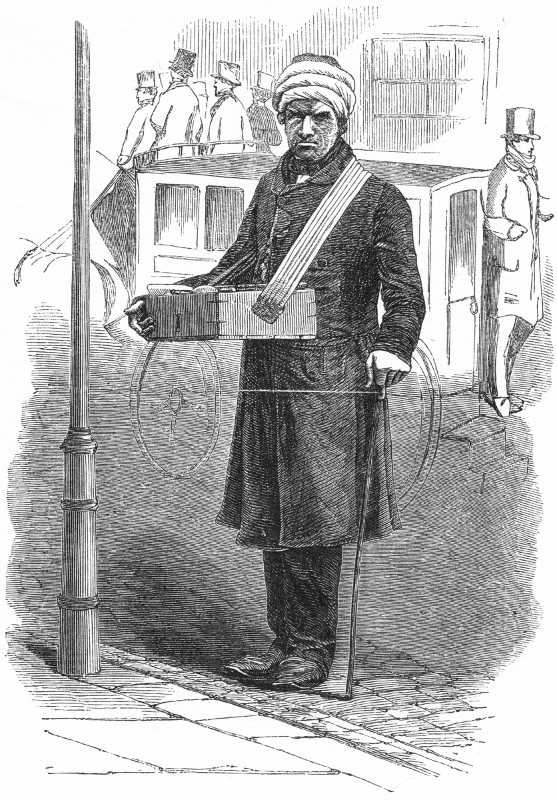
THE STREET RHUBARB AND SPICE SELLER.
[From a Daguerreotype by Beard.]
“My fader been dead years and years before I come away, I suppose I was about ten year old when he die. I had been at school till time I was grown up, and after dat I was shoemaker. I make de slippers. Oh yes! my moder was alive den—she was dead when I was here in England. I get about one penny a pair for de slippers in my countree; penny dere as good as shilling here amost. I could make tree, four, five pair in one day. I could live on my gains den better dan what I could do here wid twelve times as mush—dat time I could. I don’t know what it is now. Yes, my moder give me leave to go where I like. She never see me since” (sighing). “Oh yes, I love her very mush. I am old man now, but I never forgot her yet;” here the old man burst into tears and buried his face in his handkerchief for several minutes. “No, no! she don’t know when I come away dat she never see me again, nor me neider. I tell I go Gibraltar, and den I tell her I go to Lisbon to see my broder, who was spirit merchant dere. I didn’t say noting not at all about coming back to her, but I tought I should come back soon. If I had tought I never see no more, not all de gold in de world take me from her. She was good moder to me. I was de youngest but one. My broders kept my moder, you see. Where I came from it is not like here, if only one in de family well off, de oders never want for noting. In my country, you see, de law is you must maintain your fader and moder before you maintain your own family. You must keep dem in de house.” Here he repeated the law in Hebrew. “De people were Mahomedans in Mogadore, but we were Jews, just like here, you see. De first ting de Jews teesh de shildren is deir duty to deir faders and deir moders. And dey love one anoder more than de gold; but dey love de gold more dan most people, for you see gold is more to dem. In my countree de governemen treat de Jews very badly, so de money all de Jews have to help dem. Often de government in my country take all deir money from de Jews, and kill dem after, so de Jews all keep deir money in secret places, put de gold in jars and dig dem in de ground, and de men worths hundreds go about wid no better clothes dan mine.
“Well, you see I leave my poor moder, we kissed one anoder, and cry for half an hour, and come away to Gibraltar. When I get dere, my broder come away from Lisbon to Gibraltar; dat time it was war time, and de French was coming to Lisbon, so everybody run. When I come away from Mogadore, I have about one hundred dollars—some my moder give me, and some I had save. When I got to Gibraltar, I begin to have a little stand in de street wid silk handkershiefs, cotton handkershiefs, shop goods you know. I do very well wid dat, so after I get licence to hawk de town, and after dat I keep shop. Altogeder, I stop in Gibraltar about six year. I had den about five or six hundred dollars. I live very well all de time I dere. I was wid my broder all de time. After I am six year in Gibraltar, I begin to tink I do better in England. I tink, like good many people, if I go to anoder part dat is risher—’t is de rishest countree in de world—I do better still. So I start off, and get I here I tink in 1811, when de tree shilling pieces first come out. I have about one hundred and tirty pound at dat time. I stop in London a good bit, and eat my money; it was most done before I start to look for my living. I try to look what I could do, but I was quite stranger you see. I am about fourteen or fifteen month before I begin to do anyting. I go to de play house; I see never such tings as I see here before I come. When I come here, I tink I am in heaven altogether—God a’mighty forgive me—such sops (shops) and such beautiful tings. I live in Mary Axe Parish when I first come; same parish where I live now. Well, you see some of my countreemen den getting good living by selling de rhubarb and spices in de street. I get to know dem all; and dat time you see was de good time, money was plenty, like de dirt here. Dat time dere was about six or seven Arabians in de street selling rhubarb and spices, five of ’em was from Mogadore, and two from not far off; and dere is about five more going troo de country. Dey all sell de same tings, merely rhubarb and spice, dat time; before den was good for tem tings—after dat dey get de silks and tings beside. I can’t tell what first make dem sell de rhubarb and de spice; but I tink it is because people like to buy de Turkey rhubarb of de men in de turbans. When I was little shild, I hear talk in Mogadore of de people of my country sell de rhubarb in de streets of London, and make plenty money by it.
“Dere was one very old Arabian in de streets wen I first come; dey call him Sole; he been forty year at de same business. He wear de long beard and Turkish dress. He used to stand by Bow Shursh, Sheapside. Everybody in de street know him. He was de old establish one. He been dead now, let me see—how long he been dead—oh, dis six or seven and twenty year. He die in Gibraltar very poor and very old—most ninety year of age. All de rhubarb-sellers was Jews. Dere was anoder called Ben Aforiat, and two broders; and anoder, his name was Azuli. One of Aforiat’s broders use to stand in St. Paul’s Shurshyard. He was very well know; all de oders hawk about de town like I do myself. Now dey all gone dead, and dere only four of us now in England; dey all in London, and none in de country. Two of us live in Mary Axe, anoder live in, what dey call dat—Spitalfield, and de oder in Petticoat-lane. De one wat live in Spitalfield is old man, I dare say going for 70. De one in Petticoat-lane not mush above 30. I am little better dan 73, and de oder wat live in Mary Axe about 40. I been de longest of all in de streets, about tirty-eight or tirty-nine year. All dat was here when I first come, die in London, except dat old man Sole wat I was telling you of, dat die in Gibraltar. About tirteen or fourteen die since I come to England; some die in de Hospital of de Jews at Mile End; some die at home—not one of dem die worth no money. Six of dem was very old people, between 60 and 70; dere was some tirty, some forty. Some of dem die by inshes. Dere was one fine fellow, he was six foot two, and strong man, he take to his bed and fall away so; at last you see troo his hand; he was noting but de carcase; oders die of what you call de yellow jaundice; some have de fever, but deir time was come; de death we must be.
“When I first come to dis countree me make plenty of money by selling de rhubarb in de street. Five-and-twenty year ago I make a pound a day some time. Take one week wid another, I dare say I clear, after I pay all de cost of my living, tirty shillings; and now, God help me, I don’t make not twelve shilling a week, and all my food to pay out of dat. One week wid anoder, when I go out I clear about twelve shilling. Everyting is so sheep now, and dere is so many sops (shops), people has no money to buy tings with. I could do better when everyting was dear. I could live better, get more money, and have more for it. I have better food, better lodging, and better clothes. I don’t know wat is de cause, as you say. I only know dat I am worse, and everybody is worse; dat is all I know. Bread is sheeper, but when it was one and ninepence de loaf I could get plenty to buy it wid, but now it is five pence, I can’t no five pence to have it. If de cow is de penny in de market what is de use of dat, if you can’t get no penny to buy him? After I been selling my rhubarb for two years, when I fust come here, I save about a hundred and fifty pound, and den you see I agree wid tree oder of my countrymen to take a sop (shop) in Exeter. De oder tree was rhubarb-sellers, like myself, and have save good bit of money as well. One have seven hundred pound; but he have brought tree or four hundred pound wid him to dis countree. Anoder of de tree have about two hundred, and de oder about one hundred; dey have all save deir money out of de rhubarb. We keep our sop, you see, about five year, and den we fall in pieces altogeder. We take and trust, and lose all our money. T’oders never keep a sop before, and not one of us was English scholar; we was forced to keep a man, and dat way we lose all our money, so we was force to part, and every one go look for hisself. Den we all go selling rhubarb again about de country, and in London; and I never able to hold up my head since. When I come back to de rhubarb times is getting bad, and I not able to save no more money. All I am worth in de world is all I got in my box, and dat altogether is not more dan ten shilling. Last week I havn’t a pound of meat in de house, and I am obliged to pawn my waistcoat and handkerchief to get me some stock. It easy to put dem in, but very hard to get dem out.
“I had two wives. After two or tree year when I come I marry my first. I had two shildren by my first, but both of dem die very young; one was about five year old and de oder about tree. When I travel the countree, my first wife she go wid me everywhere. I been to all parts—to Scotland, to Wales, but not Ireland. I see enough of dem Irish in dis countree, I do no want no more of dem dere. Not one of my countree I tink ever been to Ireland, and only one beside myself been to Scotland; but dat no use, de Scotsh don’t know wat de spice is. All de time I am in Scotland I can’t get no bread, only barley and pea meal, and dat as sour as de winegar—and I can’t get no flour to make none too—so I begin to say, by God I come to wrong countree here. When I go across de countree of England I never live in no lodging-houses—always in de public—because you see I do business dere; de missus perhaps dere buy my spices of me. I lodge once in Taunton, at a house where a woman keep a lodging-house for de Jewish people wat go about wid de gold tings—de jewellery. At oder towns I stop at de public, for dere is de company, and I sell my tings.
“I buy my rhubarb and my spice of de large warehouse for de drugs; sometime I buy it of my countreemen. We all of us know de good spice from de bad. You look! I will show you how to tell de good nutmeg from de bad. Here is some in de shell: you see, I put de strong pin in one and de oil run out; dat is because dey has not been put in de spirit to take away de oil for to make de extract. Now, in de bad nutmeg all de oil been took out by de spirit, and den dere is no flavour, like dose you buy in de sheep sops (cheap shops). I sell de Rhubarb, East Indy and Turkey, de Cloves, Cinnamons, Mace, Cayenne Pepper, White Pepper—a little of all sorts when I get de money to buy it wid. I take my solemn oat I never sheat in scales nor weight; because de law is, ‘take weight and give weight,’ dat is judge and justice. Dere is no luck in de sort weight—no luck at all. Never in my life I put no tings wid my goods. I tell you de troot, I grind my white pepper wid my own hands, but I buy me ginger ground, and dat is mixed I know. I tink it is pea flour dey put wid it, dere is no smell in dat, but it is de same colour—two ounces of ginger will give de smell to one pound of pea flour. De public-houses will have de sheap ginger and dat I buy. I tell you de troot. How am I tell what will become of me. Dat is de Almighty’s work” (here he pointed to Heaven). “De Jews is very good to deir old people. If it was not for my old woman I be like a gentleman now in de hospital at Mile End; but you see, I marry de Christian woman, and dat is against our people—and I would never leave her—no not for all de good in de world to come to myself. If I am poor, I not de only one. In de holiday times I send a petition, and perhaps dere is five shillings for me from de hospital. In de Jews’ Hospital dere is only ten—what you call de Portuguese Jews. We have hospital to our ownselves. Dere de old people—dey are all above sixty—are all like noblemen, wid good clothes, plenty to eat, go where you like, and pipe of tobacco when you want. But I wont go in no hospital away from my old woman. I will get a bit of crust for her as long as I can stand—but I can hardly do that now. Every one got his feeling, and I will feel for her as long as I live. When dere is de weather I have de rheumatis—oh! very bad—sometime I can scarcely stand or walk. I am seventy-tree, and it is a sad time for me now. I am merry sometime tho’. Everyting wid de pocket. When de pocket is merry, den I am merry too. Sometime I go home wid one shilling, and den I tink all gets worse and worse, and what will become of me I say—but dat is de Almighty’s work, and I trust in him. Can I trust any better one? Sometime I say I wish I was back in my countree—and I tink of my poor moder wat is dead now, and den I am very sad. Oh yes, bless your heart, very sad indeed!”
The old man appears to sell excellent articles, and to be a very truthful, fair-dealing man.
Of the Hawking of Tea.
“Persons hawking tea without a licence” (see Chitty’s Edition of “Burn’s Justice,” vol. ii. p. 1113) “are liable to a penalty, under 50 Geo. III., cap. 41.; and, even though they had a licence, they would be liable to a penalty for selling tea in an unentered place.” The penalty under this act is 10l., but the prohibition in question has long been commonly, if not very directly, evaded.
The hawking of tea in London cannot be considered as immediately a street-trade, but it is in some respects blended with street callings and street traffic, so that a brief account is necessary.
I will first give a short history of what is, or was, more intimately a portion of the street-trade.
Until about eight or ten years ago, tea was extensively hawked—from house to house almost—“on tally.” The tally system is, that wherein “weekly payments” are taken in liquidation of the cost of the article purchased, and the trade is one embodying much of evil and much of trickery. At the present time the tallymen are very numerous in London, and in the tally trade there are now not less than 1000 hawkers of, or travellers in, tea; but they carry on their business principally in the suburbs. When I come to treat of the class whom I have called “distributors,” I shall devote an especial inquiry to the tally trade, including, of course, the tea trade. Mr. M’Culloch mentions that a Scotchman’s “tally-walk”—and the majority of the tallymen are Scotchmen—is worth 15 per cent. more than an Englishman’s.
The branch of the tea trade closely connected with the street business is that in tea-leaves. The exhausted leaves of the tea-pot are purchased of servants or of poor women, and they are made into “new” tea. One gentleman—to whose information, and to the care he took to test the accuracy of his every statement, I am bound to express my acknowledgments—told me that it would be fair to reckon that in London 1500 lbs. of tea-leaves were weekly converted into new tea, or 78,000 lbs. in the year! One house is known to be very extensively and profitably concerned in this trade, or rather manufacture, and on my asking the gentleman who gave me the information if the house in question (he told me the name) was accounted respectable by their fellow-citizens, the answer was at once, “Highly respectable.”
The old tea-leaves, to be converted into new, are placed by the manufacturers on hot plates, and are re-dried and re-dyed. To give the “green” hue, a preparation of copper is used. For the “black” no dye is necessary in the generality of cases. This tea-manufacture is sold to “cheap” or “slop” shopkeepers, both in town and country, and especially for hawking in the country, and is almost always sold ready mixed.
The admixture of sloe-leaves, &c., which used to be gathered for the adulteration of tea, is now unknown, and has been unknown since tea became cheaper, but the old tea-leaf trade, I am assured, carried on so quietly and cleverly, that the most vigilant excise-officers are completely in the dark; a smaller “tea-maker” was, however, fined for tea-leaf conversion last year.
Into this curious question, concerning the purposes for which the old tea-leaves are now purchased by parties in the street, I shall enter searchingly when I treat of the street-buyers. The information I have already received is of great curiosity and importance, nor shall I suppress the names of those dishonest traders who purchase the old dried tea-leaves, as a means of cheating their customers.
Into the statistics of this strange trade I will not now enter, but I am informed that great quantities of tea-leaves are sent from the country to London. Perhaps of the 1500 lbs. weekly manufactured, three quarters may be collected in the metropolis.
I may here add, that the great bulk of the tea now hawked throughout the metropolis is supplied from the handsome cars, or vans, of well-known grocers and tea-dealers. Of these—it was computed for me—there are, on no day, fewer than 100 in the streets of London, and of its contiguous and its more remote suburbs, such as Woolwich, and even Barnet. One tradesman has six such cars. The tea is put up in bags of 7, 14, and 21 lbs., duly apportioned in quarter, half, and whole pounds; a quarter of a pound being the smallest quantity vended in this manner. The van and its contents are then entrusted to a driver, who has his regular round, and very often his regular customers. The customers purchase the tea from their faith in the respectability of the firm—generally well known through extensive advertising. The teas are supplied by the house which is pronounced to supply them; for the tradesman is the capitalist in the matter, his carman is the labourer, and the house is responsible for the quality of the article. When a new connection has to be formed, or an “old connection” to be extended, circulars (bonâ fide) are sent round, and the carman afterwards calls: and, “in some genteel streets,” I was told, “calls, oft enough, at every house, and, in many districts, at every decent-looking house in every street.” So far, then, even this part of the traffic may be considered one of the streets. The remuneration of the street-traveller in, or hawker of, tea, is usually 1d. per lb. on the lower-priced kinds, 2d. on the higher (but more often 1d.) and, very rarely indeed, 3d. on the highest. The trade is one peculiar to great cities—and most peculiar, I am assured, to London—for the tradesman does not know so much as the name of his customer; nor, perhaps, does the carman, but merely as “Number such-an-one.” The supply is for ready money, or, if credit be given, it is at the risk of the carman, who has a weekly wage in addition to his perquisites. Every evening, when the vehicle is driven back to the premises of its owner, “stock is taken,” and the money taken by the carman—minus what may be called the “poundage”—is paid over to the proper party.