Volume 1 — OF THE STREET-SELLERS OF STATIONERY, LITERATURE, AND THE FINE ARTS. (continued 3)
Reading edition
‘The very kittens on the hearth They dare not even play.’
His breakfast embraces all the good things of the season. He divides his delicacies with a silver fork—where did he get it? The mode in which this man obtains a livelihood is at once a mixture and a mystery. His prevailing plan is to waylay gentlemen in the decline of life, and to extort money by threats of accusation and exposure, to which I can do no more than allude. His wife, a notorious shoplifter, is now for the third time ‘expiating her offences’ in Coldbath-fields.
“Next to Navy Jem may be perceived a little stunted woman, of pretended Scotch, but really Irish extraction, whose husband has died in the hospital for consumption at least as many times as the hero of Waterloo has seen engagements. At last the man did die, and his widow has been collecting money to bury him for eight years past, but has not yet secured the required sum. This woman, whose name I never knew, has a boy and a girl; to the former she is very kind, the latter she beats without mercy, always before breakfast, and with such (almost) unvaried punctuality that her brother will sometimes whisper (after saying grace), ‘Mother, has our Poll had her licks yet?’
“Among the records of mortality lately before the public, is the account of a notorious woman, who was found suffocated in a stagnant pool, whether from suicide or accident it was impossible to determine. She had been in every hospital in town and country, suffering from a disease, entirely self-procured. She applied strong acids to wounds previously punctured with a pin, and so caused her body to present one mass of sores. She was deemed incurable by the hospital doctors, and liberal collections were made for her among the benevolent in various places. The trick, however, was ultimately discovered, and the failure of her plan (added to the bad state of health to which her bodily injuries had gradually led) preyed upon her mind and hastened her death.
“This woman had been the paramour of ‘Peter the crossing-sweeper,’ a man who for years went about showing similar wounds, which he pretended had been inflicted while fighting in the Spanish Legion—though, truth to say, he had never been nearer Spain than Liverpool is to New York. He had followed the ‘monkry’ from a child, and chiefly, since manhood, as a ‘broken-down weaver from Leicester,’ and after singing through every one of the provinces ‘We’ve got no work to do,’ he scraped acquaintance with a ‘school of shallow coves;’ that is, men who go about half-naked, telling frightful tales about shipwrecks, hair-breadth escapes from houses on fire, and such like aqueous and igneous calamities. By these Peter was initiated into the ‘scaldrum dodge,’ or the art of burning the body with a mixture of acids and gunpowder, so as to suit the hues and complexions of the accident to be deplored. Such persons hold every morning a ‘committee of ways and means,’ according to whose decision the movements of the day are carried out. Sometimes when on their country rounds, they go singly up to the houses of the gentry and wealthy farmers, begging shirts, which they hide in hedges while they go to another house and beg a similar article. Sometimes they go in crowds, to the number of from twelve to twenty; they are most successful when the ‘swell’ is not at home; if they can meet with the ‘Burerk’ (Mistress), or the young ladies, they ‘put it on them for dunnage’ (beg a stock of general clothing), flattering their victims first and frightening them afterwards. A friend of mine was present in a lodging-house in Plymouth, when a school of the shallow coves returned from their day’s work with six suits of clothes, and twenty-seven shirts, besides children’s apparel and shoes, (all of which were sold to a broker in the same street), and, besides these, the donations in money received amounted to 4s. 4d. a man.
“At this enterprise ‘Peter’ continued several years, but—to use his own words—‘everything has but a time,’ the country got ‘dead’ to him, and people got ‘fly’ to the ‘shallow brigade;’ so Peter came up to London to ‘try his hand at something else.’ Housed in the domicile of ‘Sayer the barber,’ who has enriched himself by beer-shops and lodging-house-keeping, to the tune it is said of 20,000l., Peter amused the ‘travellers’ of Wentworth-street, Whitechapel, with recitals of what he had seen and done. Here a profligate, but rather intelligent man, who had really been in the service of the Queen of Spain, gave him an old red jacket, and with it such instructions as equipped him for the imposition. One sleeve of this jacket usually hung loosely by his side, while the arm it should have covered was exposed naked, and to all appearance withered. His rule was to keep silence till a crowd assembled around him, when he began to ‘patter’ to them to the following effect: ‘Ladies and gentlemen, it is with feelings of no common reluctance that I stand before you at this time; but although I am not without feelings, I am totally without friends, and frequently without food. This wound (showing his disfigured arm) I received in the service of the Queen of Spain, and I have many more on different parts of my person. I received a little praise for my brave conduct, but not a penny of pension, and here I am (there’s no deception you see) ill in health—poor in pocket, and exposed without proper nourishment to wind and weather—the cold is blowing through me till I am almost perished.’ His ‘Doxy’ stood by and received the ‘voluntary contributions’ of the audience in a soldier’s cap, which our hero emptied into his pocket, and after snivelling out his thanks, departed to renew the exhibition in the nearest available thoroughfare. Peter boasted that he could make on an average fifteen of these pitches a day, and as the proceeds were estimated at something considerable in each pitch (he has been known to take as much as half-a-crown in pence at one standing), he was able to sport his figure at Astley’s in the evening—to eat ‘spring lamb,’ and when reeling home under the influence of whiskey, to entertain the peaceful inhabitants with the music of—‘We won’t go home till morning——’
“Whether the game got stale, or Peter became honest, is beyond the purport of my communication to settle. If any reader, however, should make his purchases at the puffing fishmonger’s in Lombard-street, they may find Peter now pursuing the more honest occupation of sweeping the crossing, by the church of St. Gabriel, Fenchurch-street.
“Among the most famous of the ‘lurking patterers’ was ‘Captain Moody,’ the son of poor but honest parents in the county of Cornwall, who died during his boyhood, leaving him to the custody of a maiden aunt. This lady soon, and not without reason, got tired of her incorrigible charge. Young Moody was apprenticed successively to three trades, and wanted not ability to become expert in any of them, but having occasional interviews with some of the gipsey tribe, and hearing from themselves of their wonderful achievements, he left the sober walks of life and joined this vagrant fraternity.
“His new position, however, was attractive only while it was novel. Moody, who had received a fair education, soon became disgusted with the coarseness and vulgarity of his associates. At the solicitation of a neighbouring clergyman, he was restored to the friendship of his aunt, who had soon sad reason to regret that her compassion had got the better of her prudence; for one Sunday afternoon, while she was absent at church, young Moody who had pleaded indisposition and so obtained permission to stay at home, decamped (after dispatching the servant to the town, a mile distant, to fetch the doctor) in the meantime, emptying his aunt’s ‘safety cupboard’ of a couple of gold watches and £72 in cash and country notes.
“His roving disposition then induced him to try the sea, and the knowledge he obtained during several voyages fitted him for those maritime frauds which got him the name of ‘Captain Moody, the lurker.’ The frauds of this person are well known, and often recounted with great admiration among the pattering fraternity. On one occasion, the principal butcher in Gosport was summoned to meet a gentlemen at an hotel. The Louisa, a brig, had just arrived at Portsmouth, the captain’s name was Young, and this gentleman Moody personated for the time being. ‘I have occasion,’ said he to the butcher, ‘for an additional supply of beef for the Louisa; I have heard you spoken of by Captain Harrison’ (whom Moody knew to be an old friend of the butcher’s), ‘and I have thus given you the preference. I want a bullock, cut up in 12lb. pieces; it must be on board by three to-morrow.’ The price was agreed upon, and the captain threw down a few sovereigns in payment, but, of course, discovered that he had not gold enough to cover the whole amount, so he proposed to give him a cheque he had just received from Captain Harrison for £100, and the butcher could give him the difference. The tradesman was nothing loth, for a cheque upon ‘Vallance, Mills, and West,’ with Captain Harrison’s signature, was reckoned equal to money any day, and so the butcher considered the one he had received, until the next morning, when the draft and the order proved to be forgeries. The culprit was, of course, nowhere to be found, nor, indeed, heard of till two years after, when he had removed the scene of his depredations to Liverpool.
“In that port he had a colleague, a man whose manners and appearance were equally prepossessing. Moody sent his ‘pal’ into a jeweller’s shop, near the corner of Lord-street, who there purchased a small gold seal, paid for it, and took his leave. Immediately afterwards, Moody entered the shop under evident excitement, declaring that he had seen the person, who had just left the shop secrete two, if not three, seals up his coat-sleeve; adding, that the fellow had just gone through the Exchange, and that if the jeweller were quick he would be sure to catch him. The jeweller ran out without his hat, leaving his kind friend in charge of the shop, and soon returned with the supposed criminal in his custody. The ‘captain,’ however, in the mean time, had decamped, taking with him a tray from the window, containing precious materials to the value of 300l.
“At another time, the ‘captain’ prepared a document, setting forth ‘losses in the Baltic trade,’ and a dismal variety of disasters; and concluding with a melancholy shipwreck, which had really taken place just about that time in the German Ocean. With this he travelled over great part of Scotland, and with almost unprecedented success. Journeying near the Frith of Forth, he paid a visit to Lord Dalmeny—a nobleman of great benevolence—who had read the account of the shipwreck in the local journals, and wondered that the petition was not signed by influential persons on the spot; and, somewhat suspicious of the reality of the ‘captain’s’ identity, placed a terrestrial globe before him, and begged to be shown ‘in what latitude he was cast away.’ The awkwardness with which Moody handled the globe showed that he was ‘out of his latitude’ altogether. His lordship thereupon committed the document to the flames, but generously gave the ‘captain’ a sovereign and some good advice; the former he appropriated at the nearest public-house, of the latter he never made the least use.
“Old, and worn out by excesses and imprisonment, he subsists now by ‘sitting pad’ about the suburban pavements; and when, on a recent evening, he was recognised in a low public-house in Deptford, he was heard to say, with a sigh: ‘Ah! once I could “screeve a fakement” (write a petition) or “cooper a monekur” (forge a signature) with any man alive, and my heart’s game now; but I’m old and asthmatic, and got the rheumatis, so that I ain’t worth a d—n.’
“‘The Lady Lurker.’—Of this person very little is known, and that little, it is said, makes her an object of pity. Her father was a dissenting minister in Bedfordshire. She has been twice married; her first husband was a schoolmaster at Hackney, and nephew of a famous divine who wrote a Commentary on the Bible, and was chaplain to George III. She afterwards married a physician in Cambridgeshire (a Dr. S——), who is alleged to have treated her ill, and even to have attempted to poison her. She has no children; and, since the death of her husband, has passed through various grades, till she is now a cadger. She dresses becomingly in black, and sends in her card (Mrs. Dr. S——) to the houses whose occupants are known, or supposed, to be charitable. She talks with them for a certain time, and then draws forth a few boxes of lucifers, which, she says, she is compelled to sell for her living. These lucifers are merely excuses, of course, for begging; still, nothing is known to have ever transpired in her behaviour wholly unworthy of a distressed gentlewoman. She lives in private lodgings.”
I continue the account of these habitations, and of their wretched occupants, from the pen of the same gentleman whose vicissitudes (partly self-procured) led him to several years’ acquaintance with the subject.
“Padding-kens” (lodging-houses) in the country are certainly preferable abodes to those of St. Giles’s, Westminster, or Whitechapel; but in country as in town, their condition is extremely filthy and disgusting; many of them are scarcely ever washed, and as to sweeping, once a week is miraculous. In most cases they swarm with vermin, and, except where their position is very airy, the ventilation is imperfect, and frequent sickness the necessary result. It is a matter of surprise that the nobility, clergy, and gentry of the realm should permit the existence of such horrid dwellings.
“I think,” continues my informant, “that the majority of these poor wretches are without even the idea of respectability or ‘home comforts,’—many of them must be ranked among the worst of our population. Some, who could live elsewhere, prefer these wretched abodes, because they answer various evil purposes. With beggars, patterers, hawkers, tramps, and vendors of their own manufacture, are mingled thieves, women of easy virtue, and men of no virtue at all; a few, and by far the smallest portion, are persons who once filled posts of credit and affluence, but whom bankruptcy, want of employment, or sickness has driven to these dismal retreats. The vast majority of London vagrants take their summer vacation in the country, and the ‘dodges’ of both are interchanged, and every new ‘move’ circulates in almost no time.
“I will endeavour to sketch a few of the most renowned ‘performers’ on this theatre of action. By far the most illustrious is ‘Nicholas A——,’ an ame known to the whole cadging fraternity as a real descendant from Bamfylde Moore Carew, and the ‘prince of lurkers’ and patterers for thirty years past. This man owes much of his success to his confessedly imposing appearance, and many of his escapes to the known respectability of his connections. His father—yet alive—is a retired captain in the Royal Navy, a gentleman of good private property, and one of her Majesty’s justices of peace for the county of Devon—the southern extremity of which was the birth-place of Nicholas. But little is known of his early days. He went to school at Tavistock, where he received a good education, and began life by cheating his schoolfellows.
“The foolish fondness of an indulgent mother, and some want of firmness in paternal discipline, accelerated the growth of every weed of infamy in Nicholas, and baffled every experiment, by sea and land, to ‘set’ him up in life.
“Scarcely was he out of his teens, when he honoured the sister country with his visits and his depredations. About the centre of Sackville-street, Dublin, there lived a wealthy silversmith of the name of Wise. Into his shop (accompanied by one of his pals in livery) went Nicholas, whose gentlemanly exterior, as I have already hinted, would disarm suspicion in a stranger.
“‘Good morning sir, is your name Wise?—Yes, sir.—Well, that is my name.—Indeed, of the English family, I suppose?—Yes, sir, East Kent.—Oh, indeed! related to the ladies of Leeds Castle, I presume?—I have the honour to be their brother.—James, is your name James or John?—Neither, sir, it is Jacob.—Oh, indeed! a very ancient name.—Well, I have occasion to give a party at the Corn Exchange Tavern, and I want a little plate on hire, can you supply me?’—A very polite affirmative settled this part of the business. Plate to the amount of 150l. was selected and arranged, when Nicholas discovered that his pocket-book was at home (to complete the deception, his right arm was in a sling). ‘Will you, Mr. Wise (you see my infirmity), write me a few lines?—With the greatest pleasure,’ was the silversmith’s reply.—‘Well, let me see. “My dear, do not be surprised at this; I want 150l., or all the money you can send, per bearer; I will explain at dinner-time.
J. Wise.”
“‘Now, John, take this to your mistress, and be quick.’ As John was not very hasty in his return, Nicholas went to look for him, leaving a strict injunction that the plate should be sent to the Corn Exchange Tavern, as soon as the deposit was received. This happened at eleven in the forenoon—the clock struck five and no return of either the master or the man.
“The jeweller left a message with his apprentice, and went home to his dinner. He was met at the door of his suburban villa by his ‘better half,’ who wondered what made him so late, and wished to know the nature of the exigency which had caused him to send home for so much money? The good man’s perplexity was at an end when he saw his own handwriting on the note; and every means within the range of constabulary vigilance was taken to capture the offender, but Nicholas and his servant got clear off.
“This man’s ingenuity was then taxed as to the next move, so he thought it expedient to tax somebody else. He went with his ‘pal’ to a miscellaneous repository, where they bought a couple of old ledgers—useful only as waste paper, a bag to hold money, two ink-bottles, &c. Thus equipped, they waited on the farmers of the district, and exhibited a ‘fakement,’ setting forth parliamentary authority for imposing a tax upon the geese! They succeeded to admiration, and weeks elapsed before the hoax was discovered. The coolness of thus assuming legislatorial functions, and being, at the same time, the executive power, has rarely been equalled.
“There is an old proverb, that ‘It is an ill wind that blows nobody good.’ The gallant ‘captain’ was domiciled at a lodging-house in Gainsborough, Lincolnshire, where he found all the lodgers complaining of the badness of the times—most of them were makers of nets. He sallied forth to all the general shops, and left his (fictitious) ‘captain’ card at each, with an order for an unusual number of nets. This ‘dodge’ gave a week’s work to at least twenty poor people; but whether the shopkeepers were ‘caught in a net,’ or the articles were paid for and removed by the ‘captain,’ or whether it was a piece of pastime on his part, I did not stay long enough to ascertain.
“Nicholas A—— is now in his sixty-second year, a perfect hypochondriac. On his own authority—and it is, no doubt, too true—he has been ‘lurking’ on every conceivable system, from forging a bill of exchange down to ‘maundering on the fly,’ for the greater part of his life; and, excepting the ‘hundred and thirteen times’ he has been in provincial jails, society has endured the scourge of his deceptions for a quarter of a century at least. He now lives with a young prostitute in Portsmouth, and contributes to her wretched earnings an allowance of 5s. a week, paid to him by the attorney of a distant and disgusted relative.”
The writer of this account was himself two whole years on the “monkry,” before he saw a lodging-house for tramps; and the first he ever saw was one well-known to every patterer in Christendom, and whose fame he says is “gone out into all lands,” for its wayfaring inmates are very proud of its popularity.
“It may be as well,” writes the informant in question, “before submitting the following account, to state that there are other, and more elaborate marks—the hieroglyphics of tramping—than those already given. I will accordingly explain them.
“Two hawkers (pals) go together, but separate when they enter a village, one taking each side of the road, and selling different things; and, so as to inform each other as to the character of the people at whose houses they call, they chalk certain marks on their door-posts:
“ means ‘Go on. I have called here; don’t you call—it’s no go.’

“ means ‘Stop—you may call here; they want’ (for instance) ‘what you sell, though not what I sell;’ or else, ‘They had no change when I was there, but may have it now;’ or, ‘If they don’t buy, at least they’ll treat you civilly.’

“ on a corner-house, or a sign-post, means, ‘I went this way;’ or ‘Go on in this direction.’

“ on a corner-house, or sign-post, means ‘Stop—don’t go any further in this direction.’

“ as before explained, means ‘danger.’

“Like many other young men, I had lived above my income, and, too proud to crave parental forgiveness, had thrown off the bonds of authority for a life of adventure. I was now homeless upon the world. With a body capable of either exertion or fatigue, and a heart not easily terrified by danger, I endured rather than enjoyed my itinerant position. I sold small articles of Tunbridge ware, perfumery, &c., &c., and by ‘munging’ (begging) over them—sometimes in Latin—got a better living than I expected, or probably deserved. I was always of temperate and rather abstemious habits, but ignorant of the haunts of other wanderers, (whom I saw in dozens every day upon every road, and every conceivable pursuit) I took up my nightly quarters at a sort of third-rate public-houses, and supposed that my contemporaries did the same. How long my ignorance might have continued (if left to myself) I can hardly determine; an adventure at a road-side inn, however, removed the veil from my eyes, and I became gradually and speedily ‘awake’ to ‘every move on the board.’ It was a lovely evening in July, the air was serene and the scenery romantic; my own feelings were in unison with both, and enhanced perhaps by the fact that I had beguiled the last two miles of my deliberate walk with a page out of my pocket-companion, ‘Burke on the Sublime and Beautiful.’ I was now smoking my pipe and quaffing a pint of real ‘Yorkshire stingo’ in the ‘keeping room’ (a term which combines parlour and kitchen in one word) of a real ‘Yorkshire village,’ Dranfield, near Sheffield. A young person of the other sex was my only and accidental companion; she had been driven into the house by the over-officiousness of a vigilant village constable, who finding that she sold lace without a license, and—infinitely worse—refused to listen to his advances, had warned her to ‘make herself scarce’ at her ‘earliest possible convenience.’
“Having elicited what I did for a living, she popped the startling question to me, ‘Where do you “hang out” in Sheffield?’ I told her that I had never been in Sheffield, and did not ‘hang out’ my little wares, but used my persuasive art to induce the purchase of them. The lady said, ‘Well, you are “green.” I mean, where do you dos?’ This was no better, it seemed something like Greek,—‘delta, omicron, sigma,’ (I retain the “patterer’s” own words to show the education of the class)—but the etymology was no relief to the perplexity. ‘Where do you mean to sleep?’ she inquired. I referred to my usual practice of adjourning to an humble public-house. My companion at once threw off all manner of disguise, and said, ‘Well, sir, you are a young man that I have taken a liking to, and if you think you should like my company, I will take you to a lodging where there is plenty of travellers, and you will see “all sorts of life.”’ I liked the girl’s company, and our mutual acquiescence made us companions on the road. We had not got far before we met the aforesaid constable in company with an unmistakeable member of the Rural Police. They made some inquiries of me, which I thought exceeded their commission. I replied to them with a mutilated Ode of Horace, when they both determined that I was a Frenchman, and allowed us to ‘go on our way rejoicing.’
“The smoky, though well-built, town of Sheffield was now near at hand. The daylight was past, and the ‘shades of the evening were stretching out;’ we were therefore enabled to journey through the thoroughfares without impertinent remarks, or perhaps any observation, except from a toothless old woman, of John Wesley’s school, who was ‘sorry to see two such nice young people going about the country,’ and wondered if we ‘ever thought of eternity!’
“After a somewhat tedious ramble, we arrived at Water-lane;—at the ‘Bug-trap,’ which from time immemorial has been the name of the most renowned lodging-house in that or perhaps any locality. Water-lane is a dark narrow street, crowded with human beings of the most degraded sort—the chosen atmosphere of cholera, and the stronghold of theft and prostitution. In less than half an hour, my fair companion and myself were sipping our tea, and eating Yorkshire cake in this same lodging-house.
“‘God bless every happy couple!’ was echoed from a rude stentorian voice, while a still ruder hand bumped down upon our tea-table a red earthen dish of no small dimensions, into which was poured, from the mouth of a capacious bag, fragments of fish, flesh, and fowl, viands and vegetables of every sort, intermingled with bits of cheese and dollops of Yorkshire pudding. The man to whom this heterogeneous mass belonged, appeared anything but satisfied with his lot. ‘Well,’ said he, ‘I don’t know what this ’ere monkry will come to, after a bit. Three bob and a tanner, and that there dish o’ scran’ (enough to feed two families for a fortnight) ‘is all I got this blessed day since seven o’clock in the morning, and now it’s nine at night.’ I ventured to say something, but a remark, too base for repetition, ‘put the stunners on me,’ and I held my peace.
“I was here surprised, on conversing with my young female companion, to find that she went to church, said her prayers night and morning, and knew many of the collects, some of which she repeated, besides a pleasing variety of Dr. Watts’s hymns. At the death of her mother, her father had given up housekeeping; and, being too fond of a wandering life, had led his only child into habits like his own.
“As the night advanced, the party at the ‘Bug-trap’ more than doubled. High-flyers, shallow-coves, turnpike-sailors, and swells out of luck, made up an assembly of fourscore human beings, more than half of whom were doomed to sleep on a ‘make-shift’—in other words, on a platform, raised just ten inches above the floor of the garret, which it nearly equalled in dimensions. Here were to be huddled together, with very little covering, old men and women, young men and children, with no regard to age, sex, or propensities.
“The ‘mot’ of the ‘ken’ (nickname for ‘matron of the establishment’) had discovered that I was a ‘more bettermost’ sort of person, and hinted that, if I would ‘come down’ with twopence more (threepence was the regular nightly charge), I, ‘and the young gal as I was with,’ might have a little ‘crib’ to ourselves in a little room, along with another woman wot was married and had a ‘kid,’ and whose husband had got a month for ‘griddling in the main drag’ (singing in the high street), and being ‘cheekish’ (saucy) to the beadle.
“Next morning I bade adieu to the ‘Bug-trap,’ and I hope for ever.”
The same informant further stated that he was some time upon “tramp” before he even knew of the existence of a common lodging-house: “After I had ‘matriculated’ at Sheffield,” he says, “I continued some time going to public-houses to sleep, until my apparel having got shabby and my acquintance with misfortune more general, I submitted to be the associate of persons whom I never spoke to out of doors, and whose even slight acquaintance I have long renounced. My first introduction to a London paddin’ ken was in Whitechapel, the place was then called Cat and Wheel-alley (now Commercial-street). On the spot where St. Jude’s church now stands was a double lodging-house, kept by a man named Shirley—one side of it was for single men and women, the other married couples; as these ‘couples’ made frequent exchanges, it is scarcely probable that Mr. Shirley ever ‘asked to see their marriage lines.’ These changes were, indeed, as common as they were disgusting. I knew two brothers (Birmingham nailers) who each brought a young woman out of service from the country. After a while each became dissatisfied with his partner. The mistress of the house (an old procuress from Portsmouth) proposed that they should change their wives. They did so, to the amusement of nine other couples sleeping on the same floor, and some of whom followed the example, and more than once during the night.
“When Cat and Wheel-alley was pulled down, the crew removed to George-yard; the proprietor died, and his wife sold the concern to a wooden-legged Welshman named Hughes (commonly called ‘Taff’). I was there some time. ‘Taff’ was a notorious receiver of stolen goods. I knew two little boys, who brought home six pairs of new Wellington boots, which this miscreant bought at 1s. per pair; and, when they had no luck, he would take the strap off his wooden-leg, and beat them through the nakedness of their rags. He boarded and lodged about a dozen Chelsea and Greenwich pensioners. These he used to follow and watch closely till they got paid; then (after they had settled with him) he would make them drunk, and rob them of the few shillings they had left.
“One of these dens of infamy may be taken as a specimen of the whole class. They have generally a spacious, though often ill-ventilated, kitchen, the dirty dilapidated walls of which are hung with prints, while a shelf or two are generally, though barely, furnished with crockery and kitchen utensils. In some places knives and forks are not provided, unless a penny is left with the ‘deputy,’ or manager, till they are returned. A brush of any kind is a stranger, and a looking-glass would be a miracle. The average number of nightly lodgers is in winter 70, and in summer (when many visit the provinces) from 40 to 45. The general charge is, if two sleep together, 3d. per night, or 4d. for a single bed. In either case, it is by no means unusual to find 18 or 20 in one small room, the heat and horrid smell from which are insufferable; and, where there are young children, the staircases are the lodgment of every kind of filth and abomination. In some houses there are rooms for families, where, on a rickety machine, which they dignify by the name of a bedstead, may be found the man, his wife, and a son or daughter, perhaps 18 years of age; while the younger children, aged from 7 to 14, sleep on the floor. If they have linen, they take it off to escape vermin, and rise naked, one by one, or sometimes brother and sister together. This is no ideal picture; the subject is too capable of being authenticated to need that meaningless or dishonest assistance called ‘allowable exaggeration.’ The amiable and deservedly popular minister of a district church, built among lodging-houses, has stated that he has found 29 human beings in one apartment; and that having with difficulty knelt down between two beds to pray with a dying woman, his legs became so jammed that he could hardly get up again.
“Out of some fourscore such habitations,” continues my informant, “I have only found two which had any sort of garden; and, I am happy to add, that in neither of these two was there a single case of cholera. In the others, however, the pestilence raged with terrible fury.
“Of all the houses of this sort, the best I know is the one (previously referred to) in Orchard-street, Westminister, and another in Seven Dials, kept by a Mr. Mann (formerly a wealthy butcher). Cleanliness is inscribed on every wall of the house; utensils of every kind are in abundance, with a plentiful supply of water and gas. The beds do not exceed five in a room, and they are changed every week. There is not one disorderly lodger; and although the master has sustained heavy losses, ill health, and much domestic affliction, himself and his house may be regarded as patterns of what is wanted for the London poor.
“As there is a sad similarity between these abodes, so there is a sort of caste belonging in general to the inmates. Of them it may be averred that whatever their pursuits, they are more or less alike in their views of men and manners. They hate the aristocracy. Whenever there is a rumour or an announcement of an addition to the Royal Family, and the news reaches the padding-ken, the kitchen, for half-an-hour, becomes the scene of uproar—‘another expense coming on the b—y country!’ The ‘patterers’ are very fond of the Earl of Carlisle, whom, in their attachment, they still call Lord Morpeth; they have read many of his lordship’s speeches at soirées, &c., and they think he wishes well to a poor man. Sir James Graham had better not show face among them; they have an idea (whence derived we know not) that this nobleman invented fourpenny-pieces, and now, they say, the swells give a ‘joey’ where they used to give a ‘tanner.’ The hero of Waterloo is not much amiss ‘if he lets politics alone.’ The name of a bishop is but another name for a Beelzebub; but they are very fond of the inferior clergy. Lay-agents and tract-distributors they cannot bear; they think they are spies come to see how much ‘scran’ (food) they have got, and then go and ‘pyson’ the minds of the public against poor people.
“I was once (says our informant) in a house of this kind, in George-street, St. Giles’s,—the missionary who visited them on that occasion (Sunday afternoon) had the misfortune to be suspected as the author of some recent exposure in the newspapers.—They accused him, and he rebutted the accusation; they replied, and he rejoined; at last one of the men said, ‘What do you want poking your nose in here for?’ ‘The City Mission,’ was the answer, ‘had authorised ——.’ ‘Authorised be d—d! are you ordained?’ ‘No, not yet, friend.’ The women then tore the poor gentleman’s nether garments in a way I must not describe. The men carried him into the yard, filled his mouth with flour of mustard and then put him in a water-butt.
“It is, I am satisfied, quite a mistake to suppose that there is much real infidelity among these outcast beings. They almost all believe in a hereafter; most of them think that the wicked will be punished for a few years, and then the whole universe of people be embraced in the arms of one Great Forgiving Father. Some of them think that the wicked will not rise at all; the punishment of ‘losing Heaven’ being as they say ‘Hell enough for anybody.’ Points of doctrine they seldom meddle with.
“There are comparatively few Dissenters to be found in padding-kens, though many whose parents were Dissenters. My own opinion (writes my informant) is, that dissent seldom lasts long in one family. In eight years’ experience I have found two hundred apparently pious men and women, and at least two thousand who call themselves Protestants, but never go to any church or chapel.
“The politics of these classes are, perhaps, for the most part, ‘liberal Tory.’ In most lodging-houses they take one or two papers: the Weekly Dispatch, and Bell’s Weekly Messenger, are the two usually taken. I know of no exception to this rule. The beggars hate a Whig Ministry, and I know that many a tear was shed in the hovels and cellars of London when Sir Robert Peel died. I know a publican, in Westminster, whose daily receipts are enormous, and whose only customers are soldiers, thieves, and prostitutes, who closed his house the day of the funeral, and put himself, his family, and even his beer-machines and gas-pipes, into mourning for the departed statesman.
“The pattering fraternity, that I write of, are generally much given to intemperance. Their amusements are the theatre, the free-and-easy, the skittle-ground, and sometimes cards and dominoes. They read some light works, and some of them subscribe to libraries, and a few, very few, attend lectures. Eliza Cook is a favourite writer with them, and Capt. Marryatt, the ‘top-sawyer,’ as a novelist. Ainsworth is the idol of another class, when they can read. Mr. Dickens was a favourite, but he has gone down sadly in the scale since his Household Words ‘came it so strong’ against the begging letter department. These poor creatures seldom rise in society. They make no effort to extricate themselves, while by others they are unpitied because unknown. To this rule, however, there are some happy and honourable exceptions.
“Taken as a body, patterers, lurkers, &c. are by no means quick-sighted as to the sanctions of moral obligation. They would join the hue and cry against the persecutors of Jane Wilbred, but a promiscuous robbery, even accompanied by murder—if it was ‘got up clever’ and ‘done clean,’ so long as the parties escaped detection—might call forth a remark that ‘there was no great harm done,’ and perhaps some would applaud the perpetrators.”
Before quitting this part of my subject (viz. the character, habits, and opinions of all classes of patterers), I will give an account of the pretended missionary proceedings of a man, well-known to the vagrant fraternity as “Chelsea George.” I received the following narrative from the gentleman whose statements I have given previously. The scheme was concocted in a low lodging-house:
“After a career of incessant ‘lurking’ and deceit, Chelsea George left England, and remained abroad,” writes my informant, “four or five years. Exposure to the sun, and allowing his beard to grow a prodigious length, gave him the appearance of a foreigner. He had picked up enough French and Italian, with a little Dutch and German, and a smattering of Spanish, to enable him to ‘hail for any part of the globe,’ and from the designed inarticulateness with which he spoke (sometimes four languages in one sentence) added to his sun-burnt and grotesque appearance, it was difficult to pall him upon any racket (detect him in any pretence), so that the most incredulous,—though often previously imposed upon—gave credence to his story, relief to his supposed necessities, and sometimes letters of introduction to their friends and neighbours.
“Some time after his return to England, and while pursuing the course of a ‘high-flyer’ (genteel beggar), he met with an interruption to his pursuits which induced him to alter his plan without altering his behaviour. The newspapers of the district, where he was then located, had raised before the eye and mind of the public, what the ‘patterers’ of his class proverbially call a ‘stink,’—that is, had opened the eyes of the unwary to the movements of ‘Chelsea George;’ and although he ceased to renew his appeals from the moment he heard of the notice of him, his appearance was so accurately described that he was captured and committed to Winchester jail as a rogue and vagabond. The term of his imprisonment has escaped my recollection. As there was no definite charge against him, probably he was treated as an ordinary vagrant and suffered a calendar month in durance. The silent system was not then in vogue, consequently there existed no barrier to mutual intercourse between prisoners, with all its train of conscience-hardening tendencies. I do not say this to intimate unqualified approval of the solitary system, I merely state a fact which has an influence on my subject.
“George had by this time scraped acquaintance with two fellow-prisoners—Jew Jem and Russia Bob. The former in ‘quod’ for ‘pattering’ as a ‘converted Jew,’ the latter for obtaining money under equally false, though less theological, pretences.
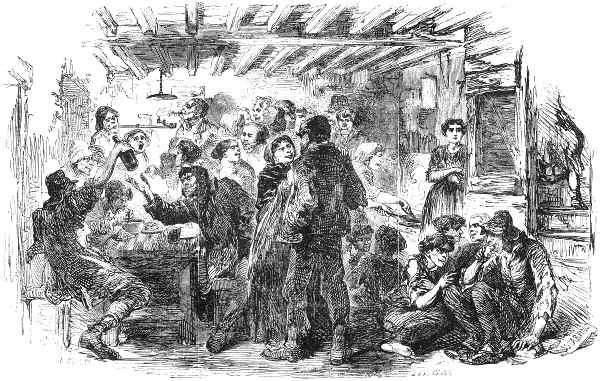
“THE KITCHEN,” FOX-COURT, GRAY’S-INN-LANE.
“Liberated about one time, this trio laid their heads together,—and the result was a plan to evangelize, or rather victimize, the inhabitants of the collier villages in Staffordshire and the adjoining counties. To accomplish this purpose, some novel and imposing representation must be made, both to lull suspicion and give the air of piety to the plan, and disinterestedness to the agents by whom it was carried out.
“George and his two fellow-labourers were ‘square-rigged’—that is, well dressed. Something, however, must be done to colour up the scene, and make the appeal for money touching, unsuspected, and successful. Just before the time to which I allude, a missionary from Sierra Leone had visited the larger towns of the district in question, while the inhabitants of the surrounding hamlets had been left in ignorance of the ‘progress of missions in Africa and the East.’ George and his comrades thought it would be no great harm at once to enlighten and fleece this scattered and anxious population. The plan was laid in a town of some size and facility. They ‘raised the wind’ to an extent adequate to some alteration of their appearances, and got bills printed to set forth the merits of the cause. The principal actor was Jew Jim, a converted Israelite, with ‘reverend’ before his name, and half the letters of the alphabet behind it. He had been in all the islands of the South Sea, on the coast of Africa, all over Hindostan, and half over the universe; and after assuring the villagers of Torryburn that he had carried the Gospel to various dark and uninhabited parts of the earth, he introduced Russia Bob (an Irishman who had, however, been in Russia) as his worthy and self-denying colleague, and Chelsea George as the first-fruits of their ministry—as one who had left houses and land, wife and children, and taken a long and hazardous voyage to show Christians in England that their sable brethren, children of one common Parent, were beginning to cast their idols to the moles and to the bats. Earnest was the gaze and breathless the expectation with which the poor deluded colliers of Torry-burn listened to this harangue; and as argument always gains by illustration, the orator pulled out a tremendous black doll, bought for a ‘flag’ (fourpence) of a retired rag-merchant, and dressed up in Oriental style. This, Jew Jim assured the audience, was an idol brought from Murat in Hindostan. He presented it to Chelsea George for his worship and embraces. The convert indignantly repelled the insinuation, pushed the idol from him, spat in its face, and cut as many capers as a dancing-bear. The trio at this stage of the performances began ‘puckering’ (talking privately) to each other in murdered French, dashed with a little Irish; after which, the missionaries said that their convert (who had only a few words of English) would now profess his faith. All was attention as Chelsea George came forward. He stroked his beard, put his hand in his breast to keep down his dickey, and turning his eyes upwards, said: ‘I believe in Desus Tist—dlory to ’is ’oly Name!’
“This elicited some loud ‘amens’ from an assemblage of nearly 1,000 persons, and catching the favourable opportunity, a ‘school of pals,’ appointed for the purpose, went round and made the collection. Out of the abundance of their credulity and piety the populace contributed sixteen pounds! The whole scene was enacted out of doors, and presented to a stranger very pleasing impressions. I was present on the occasion, but was not then aware of the dodge. One verse of a hymn, and the blessing pronounced, was the signal for separation. A little shaking of hands concluded the exhibition, and ‘every man went into his own house.’
“The missionary party and their ‘pals’ took the train to Manchester, and as none of them were teetotallers, the proceeds of their imposition did not last long. They were just putting on their considering caps, for the contrivance of another dodge, when a gentleman in blue clothes came into the tap-room, and informed Jew Jem that he was ‘wanted.’ It appears that ‘Jem’ had come out of prison a day or two before his comrades, and being ‘hard up,’ had ill-used a lady, taken her purse, and appropriated its contents. Inquiries, at first useless, had now proved successful—the ‘missionary’ stood his trial, and got an ‘appointment’ on Norfolk Island. Russia Bob took the cholera and died, and ‘George the convert’ was once more left alone to try his hand at something else.”
Of the Low Lodging-houses of London.
The patterers, as a class, usually frequent the low lodging-houses. I shall therefore now proceed to give some further information touching the abodes of these people—reminding the reader that I am treating of patterers in general, and not of any particular order, as the “paper workers.”
In applying the epithet “low” to these places, I do but adopt the word commonly applied, either in consequence of the small charge for lodging, or from the character of their frequenters. To some of these domiciles, however, as will be shown, the epithet, in an opprobrious sense, is unsuited.
An intelligent man, familiar for some years with some low lodging-house life, specified the quarters where those abodes are to be found, and divided them into the following districts, the correctness of which I caused to be ascertained.
Drury-lane District. Here the low lodging-houses are to be found principally in the Coal-yard, Charles-street, King-street, Parker-street, Short’s-gardens, Great and Little Wyld-streets, Wyld-court, Lincoln-court, Newton-street, Star-court.
Gray’s-inn Lane. Fox-court, Charlotte-buildings, Spread Eagle-court, Portpool-lane, Bell-court, Baldwin’s-gardens, Pheasant-court, Union-buildings, Laystall-street, Cromer-street, Fulwood’s-rents (High Holborn).
Chancery-lane. Church-passage, and the Liberty of the Rolls.
Bloomsbury. George-street, Church-lane, Queen-street, Seven-dials, Puckeridge-street (commonly called the Holy Land).
Saffron-hill and Clerkenwell. Peter-street, Cow-cross, Turnmill-street, Upper and Lower White-cross-street, St. Helen’s-place, Playhouse-yard, Chequer-alley, Field-lane, Great Saffron-hill.
Westminster. Old and New Pye-streets, Ann-street, Orchard-street, Perkins’s-rents, Rochester-row.
Lambeth. Lambeth-walk, New-cut.
Marylebone. York-court, East-street.
St. Pancras. Brooke-street.
Paddington. Chapel-street, Union-court.
Shoreditch. Baker’s-rents, Cooper’s-gardens.
Islington. Angel-yard.
Whitechapel, Spitalfields, &c. George-yard, Thrawl-street, Flower and Dean-street, Wentworth-street, Keate-street, Rosemary-lane, Glasshouse-yard, St. George’s-street, Lambeth-street, Whitechapel, High-street.
Borough. Mint-street, Old Kent-street, Long-lane, Bermondsey.
Stratford. High-street.
Limehouse. Hold (commonly called Hole).
Deptford. Mill-lane, Church-street, Gifford-street.
There are other localities, (as in Mile-end, Ratcliffe-highway, Shadwell, Wapping, and Lisson-grove,) where low lodging-houses are to be found; but the places I have specified may be considered the districts of these hotels for the poor. The worst places, both as regards filth and immorality, are in St. Giles’s and Wentworth-street, Whitechapel. The best are in Orchard-street, Westminster (the thieves having left it in consequence of the recent alterations and gone to New Pye-street), and in the Mint, Borough. In the last-mentioned district, indeed, some of the proprietors of the lodging-houses have provided considerable libraries for the use of the inmates. In the White Horse, Mint-street, for instance, there is a collection of 500 volumes, on all subjects, bought recently, and having been the contents of a circulating library, advertised for sale in the Weekly Dispatch.
Of lodging-houses for “travellers” the largest is known as the Farm House, in the Mint: it stands away from any thoroughfare, and lying low is not seen until the visitor stands in the yard. Tradition rumour states that the house was at one time Queen Anne’s, and was previously Cardinal Wolsey’s. It was probably some official residence. In this lodging-house are forty rooms, 200 beds (single and double), and accommodation for 200 persons. It contains three kitchens,—of which the largest, at once kitchen and sitting-room, holds 400 people, for whose uses in cooking there are two large fire-places. The other two kitchens are used only on Sundays; when one is a preaching-room, in which missionaries from Surrey Chapel (the Rev. James Sherman’s), or some minister or gentleman of the neighbourhood, officiates. The other is a reading-room, supplied with a few newspapers and other periodicals; and thus, I was told, the religious and irreligious need not clash. For the supply of these papers each person pays 1d. every Sunday morning; and as the sum so collected is more than is required for the expenses of the reading-room, the surplus is devoted to the help of the members in sickness, under the management of the proprietor of the lodging-house, who appears to possess the full confidence of his inmates. The larger kitchen is detached from the sleeping apartments, so that the lodgers are not annoyed with the odour of the cooking of fish and other food consumed by the poor; for in lodging-houses every sojourner is his own cook. The meal in most demand is tea, usually with a herring, or a piece of bacon.
The yard attached to the Farm House, in Mint-street, covers an acre and a half; in it is a washing-house, built recently, the yard itself being devoted to the drying of the clothes—washed by the customers of the establishment. At the entrance to this yard is a kind of porter’s lodge, in which reside the porter and his wife who act as the “deputies” of the lodging-house. This place has been commended in sanitary reports, for its cleanliness, good order, and care for decency, and for a proper division of the sexes. On Sundays there is no charge for lodging to known customers; but this is a general practice among the low lodging-houses of London.
In contrast to this house I could cite many instances, but I need do no more in this place than refer to the statements, which I shall proceed to give; some of these were collected in the course of a former inquiry, and are here given because the same state of things prevails now. I was told by a trustworthy man that not long ago he was compelled to sleep in one of the lowest (as regards cheapness) of the lodging-houses. All was dilapidation, filth, and noisomeness. In the morning he drew, for purposes of ablution, a basinfull of water from a pailfull kept in the room. In the water were floating alive, or apparently alive, bugs and lice, which my informant was convinced had fallen from the ceiling, shaken off by the tread of some one walking in the rickety apartments above!
“Ah, sir,” said another man with whom I conversed on the subject, “if you had lived in the lodging-houses, you would say what a vast difference a penny made,—it’s often all in all. It’s 4d. in the Mint House you’ve been asking me about; you’ve sleep and comfort there, and I’ve seen people kneel down and say their prayers afore they went to bed. Not so many, though. Two or three in a week at nights, perhaps. And it’s wholesome and sweet enough there, and large separate beds; but in other places there’s nothing to smell or feel but bugs. When daylight comes in the summer—and it’s often either as hot as hell or as cold as icicles in those places; but in summer, as soon as its light, if you turn down the coverlet, you’ll see them a-going it like Cheapside when it’s throngest.” The poor man seemed to shudder at the recollection.
One informant counted for me 180 of these low lodging-houses; and it is reasonable to say that there are, in London, at least 200 of them. The average number of beds in each was computed for me, by persons cognizant of such matters, from long and often woful experience, at 52 single or 24 double beds, where the house might be confined to single men or single women lodgers, or to married or pretendedly married couples, or to both classes. In either case, we may calculate the number that can be, and generally are, accommodated at 50 per house; for children usually sleep with their parents, and 50 may be the lowest computation. We have thus no fewer than 10,000 persons domiciled, more or less permanently, in the low lodging-houses of London—a number more than doubling the population of many a parliamentary borough.
The proprietors of these lodging-houses mostly have been, I am assured, vagrants, or, to use the civiller and commoner word, “travellers” themselves, and therefore sojourners, on all necessary occasions, in such places. In four cases out of five I believe this to be the case. The proprietors have raised capital sufficient to start with, sometimes by gambling at races, sometimes by what I have often, and very vaguely, heard described as a “run of luck;” and sometimes, I am assured, by the proceeds of direct robbery. A few of the proprietors may be classed as capitalists. One of them, who has a country house in Hampstead, has six lodging-houses in or about Thrawl-street, Whitechapel. He looks in at each house every Saturday, and calls his deputies—for he has a deputy in each house—to account; he often institutes a stringent check. He gives a poor fellow money to go and lodge in one of his houses, and report the number present. Sometimes the person so sent meets with the laconic repulse—“Full;” and woe to the deputy if his return do not evince this fulness. Perhaps one in every fifteen of the low lodging-houses in town is also a beer-shop. Very commonly so in the country.
To “start” a low lodging-house is not a very costly matter. Furniture which will not be saleable in the ordinary course of auction, or of any traffic, is bought by a lodging-house “starter.” A man possessed of some money, who took an interest in a bricklayer, purchased for 20l., when the Small Pox Hospital, by King’s-cross, was pulled down, a sufficiency of furniture for four lodging-houses, in which he “started” the man in question. None others would buy this furniture, from a dread of infection.
It was the same at Marlborough-house, Peckham, after the cholera had broken out there. The furniture was sold to a lodging-house keeper, at 9d. each article. “Big and little, sir,” I was told; “a penny pot and a bedstead—all the same; each 9d. Nobody else would buy.”
To about three-fourths of the low lodging-houses of London, are “deputies.” These are the conductors or managers of the establishment, and are men or women (and not unfrequently a married, or proclaimed a married couple), and about in equal proportion. These deputies are paid from 7s. to 15s. a week each, according to the extent of their supervision; their lodging always, and sometimes their board, being at the cost of “the master.” According to the character of the lodging-house, the deputies are civil and decent, or roguish and insolent. Their duty is not only that of general superintendence, but in some of the houses of a nocturnal inspection of the sleeping-rooms; the deputy’s business generally keeping him up all night. At the better-conducted houses strangers are not admitted after twelve at night; in others, there is no limitation as to hours.
The rent of the low lodging-houses varies, I am informed, from 8s. to 20s. a week, the payment being for the most part weekly; the taxes and rates being of course additional. It is rarely that the landlord, or his agent, can be induced to expend any money in repairs,—the wear and tear of the floors, &c., from the congregating together of so many human beings being excessive: this expenditure in consequence falls upon the tenant.
Some of the lodging-houses present no appearance differing from that of ordinary houses; except, perhaps, that their exterior is dirtier. Some of the older houses have long flat windows on the ground-floor, in which there is rather more paper, or other substitutes, than glass. “The windows there, sir,” remarked one man, “are not to let the light in, but to keep the cold out.”
In the abodes in question there seems to have become tacitly established an arrangement as to what character of lodgers shall resort thither; the thieves, the prostitutes, and the better class of street-sellers or traders, usually resorting to the houses where they will meet the same class of persons. The patterers reside chiefly in Westminster and Whitechapel.
Some of the lodging-houses are of the worst class of low brothels, and some may even be described as brothels for children.
On many of the houses is a rude sign, “Lodgings for Travellers, 3d. a night. Boiling water always ready,” or the same intimation may be painted on a window-shutter, where a shutter is in existence. A few of the better order of these housekeepers post up small bills, inviting the attention of “travellers,” by laudations of the cleanliness, good beds, abundant water, and “gas all night,” to be met with. The same parties also give address-cards to travellers, who can recommend one another.
The beds are of flock, and as regards the mere washing of the rug, sheet, and blanket, which constitute the bed-furniture, are in better order than they were a few years back; for the visitations of the cholera alarmed even the reckless class of vagrants, and those whose avocations relate to vagrants. In perhaps a tenth of the low lodging-houses of London, a family may have a room to themselves, with the use of the kitchen, at so much a week—generally 2s. 6d. for a couple without family, and 3s. 6d. where there are children. To let out “beds” by the night is however the general rule.
The illustration presented this week is of a place in Fox-court, Gray’s-inn-lane, long notorious as a “thieves’ house,” but now far less frequented. On the visit, a few months back, of an informant (who declined staying there), a number of boys were lying on the floor gambling with marbles and halfpennies, and indulging in savage or unmeaning blasphemy. One of the lads jumped up, and murmuring something that it wouldn’t do to be idle any longer, induced a woman to let him have a halfpenny for “a stall;” that is, as a pretext with which to enter a shop for the purpose of stealing, the display of the coin forming an excuse for his entrance. On the same occasion a man walked into “the kitchen,” and coolly pulled from underneath the back of his smock-frock a large flat piece of bacon, for which he wanted a customer. It would be sold at a fourth of its value.
I am assured that the average takings of lodging-house keepers may be estimated at 17s. 6d. a night, not to say 20s.; but I adopt the lower calculation. This gives a weekly payment by the struggling poor, the knavish, and the outcast, of 1,000 guineas weekly, or 52,000 guineas in the year. Besides the rent and taxes, the principal expenditure of the lodging-house proprietors is for coals and gas. In some of the better houses, blacking, brushes, and razors are supplied, without charge, to the lodgers: also pen and ink, soap, and, almost always, a newspaper. For the meals of the frequenters salt is supplied gratuitously, and sometimes, but far less frequently, pepper also; never vinegar or mustard. Sometimes a halfpenny is charged for the use of a razor and the necessary shaving apparatus. In one house in Kent-street, the following distich adorns the mantel-piece:
“To save a journey up the town, A razor lent here for a brown: But if you think the price too high, I beg you won’t the razor try.”
In some places a charge of a halfpenny is made for hot water, but that is very rarely the case. Strong drink is admitted at almost any hour in the majority of the houses, and the deputy is generally ready to bring it; but little is consumed in the houses, those addicted to the use or abuse of intoxicating liquors preferring the tap-room or the beer-shop.
Of the Filth, Dishonesty, and Immorality of Low Lodging-houses.
In my former and my present inquiries, I received many statements on this subject. Some details, given by coarse men and boys in the grossest language, are too gross to be more than alluded to, but the full truth must be manifested, if not detailed. It was remarked when my prior account appeared, that the records of gross profligacy on the part of some of the most licentious of the rich (such as the late Marquis of Hertford and other worthies of the same depraved habits) were equalled, or nearly equalled, by the account of the orgies of the lowest lodging-houses. Sin, in any rank of life, shows the same features.
And first, as to the want of cleanliness, comfort, and decency: “Why, sir,” said one man, who had filled a commercial situation of no little importance, but had, through intemperance, been reduced to utter want, “I myself have slept in the top room of a house not far from Drury-lane, and you could study the stars, if you were so minded, through the holes left by the slates having been blown off the roof. It was a fine summer’s night, and the openings in the roof were then rather an advantage, for they admitted air, and the room wasn’t so foul as it might have been without them. I never went there again, but you may judge what thoughts went through a man’s mind—a man who had seen prosperous days—as he lay in a place like that, without being able to sleep, watching the sky.”
The same man told me (and I received abundant corroboration of his statement, besides that incidental mention of the subject occurs elsewhere), that he had scraped together a handful of bugs from the bed-clothes, and crushed them under a candlestick, and had done that many a time, when he could only resort to the lowest places. He had slept in rooms so crammed with sleepers—he believed there were 30 where 12 would have been a proper number—that their breaths in the dead of night and in the unventilated chamber, rose (I use his own words) “in one foul, choking steam of stench.” This was the case most frequently a day or two prior to Greenwich Fair or Epsom Races, when the congregation of the wandering classes, who are the supporters of the low lodging-houses, was the thickest. It was not only that two or even three persons jammed themselves into a bed not too large for one full-sized man; but between the beds—and their partition one from another admitted little more than the passage of a lodger—were placed shakes-down, or temporary accommodation for nightly slumber. In the better lodging-houses the shake-downs are small palliasses or mattresses; in the worst, they are bundles of rags of any kind; but loose straw is used only in the country for shake-downs. One informant saw a traveller, who had arrived late, eye his shake-down in one of the worst houses with anything but a pleased expression of countenance; and a surly deputy, observing this, told the customer he had his choice, “which,” the deputy added, “it’s not all men as has, or I shouldn’t have been waiting here on you. But you has your choice, I tell you;—sleep there on that shake-down, or turn out and be d——; that’s fair.” At some of the busiest periods, numbers sleep on the kitchen floor, all huddled together, men and women (when indecencies are common enough), and without bedding or anything but their scanty clothes to soften the hardness of the stone or brick floor. A penny is saved to the lodger by this means. More than 200 have been accommodated in this way in a large house. The Irish, at harvest-time, very often resort to this mode of passing the night.
I heard from several parties, of the surprise, and even fear or horror, with which a decent mechanic—more especially if he were accompanied by his wife—regarded one of these foul dens, when destitution had driven him there for the first time in his life. Sometimes such a man was seen to leave the place abruptly, though perhaps he had pre-paid his last halfpenny for the refreshment of a night’s repose. Sometimes he was seized with sickness. I heard also from some educated persons who had “seen better days,” of the disgust with themselves and with the world, which they felt on first entering such places. “And I have some reason to believe,” said one man, “that a person, once well off, who has sunk into the very depths of poverty, often makes his first appearance in one of the worst of those places. Perhaps it is because he keeps away from them as long as he can, and then, in a sort of desperation fit, goes into the cheapest he meets with; or if he knows it’s a vile place, he very likely says to himself—I did—‘I may as well know the worst at once.’”
Another man who had moved in good society, said, when asked about his resorting to a low lodging-house: “When a man’s lost caste in society, he may as well go the whole hog, bristles and all, and a low lodging-house is the entire pig.”
Notwithstanding many abominations, I am assured that the lodgers, in even the worst of these habitations, for the most part sleep soundly. But they have, in all probability, been out in the open air the whole of the day, and all of them may go to their couches, after having walked, perhaps, many miles, exceedingly fatigued, and some of them half-drunk. “Why, in course, sir,” said a “traveller,” whom I spoke to on this subject, “if you is in a country town or village, where there’s only one lodging-house, perhaps, and that a bad one—an old hand can always suit his-self in London—you must get half-drunk, or your money for your bed is wasted. There’s so much rest owing to you, after a hard day; and bugs and bad air’ll prevent its being paid, if you don’t lay in some stock of beer, or liquor of some sort, to sleep on. It’s a duty you owes yourself; but, if you haven’t the browns, why, then, in course, you can’t pay it.” I have before remarked, and, indeed, have given instances, of the odd and sometimes original manner in which an intelligent patterer, for example, will express himself.
The information I obtained in the course of this inquiry into the condition of low lodging-houses, afforded a most ample corroboration of the truth of a remark I have more than once found it necessary to make before—that persons of the vagrant class will sacrifice almost anything for warmth, not to say heat. Otherwise, to sleep, or even sit, in some of the apartments of these establishments would be intolerable.
From the frequent state of weariness to which I have alluded, there is generally less conversation among the frequenters of the low lodging-houses than might be expected. Some are busy cooking, some (in the better houses) are reading, many are drowsy and nodding, and many are smoking. In perhaps a dozen places of the worst and filthiest class, indeed, smoking is permitted even in the sleeping-rooms; but it is far less common than it was even half-a-dozen years back, and becomes still less common yearly. Notwithstanding so dangerous a practice, fires are and have been very unfrequent in these places. There is always some one awake, which is one reason. The lack of conversation, I ought to add, and the weariness and drowsiness, are less observable in the lodging-houses patronised by thieves and women of abandoned character, whose lives are comparatively idle, and whose labour a mere nothing. In their houses, if the conversation be at all general, it is often of the most unclean character. At other times it is carried on in groups, with abundance of whispers, shrugs, and slang, by the members of the respective schools of thieves or lurkers.
I have now to speak of the habitual violation of all the injunctions of law, of all the obligations of morality, and of all the restraints of decency, seen continually in the vilest of the lodging-houses. I need but cite a few facts, for to detail minutely might be to disgust. In some of these lodging-houses, the proprietor—or, I am told, it might be more correct to say, the proprietress, as there are more women than men engaged in the nefarious traffic carried on in these houses—are “fences,” or receivers of stolen goods in a small way. Their “fencing,” unless as the very exception, does not extend to any plate, or jewellery, or articles of value, but is chiefly confined to provisions, and most of all to those which are of ready sale to the lodgers.
Of very ready sale are “fish got from the gate” (stolen from Billingsgate); “sawney” (thieved bacon), and “flesh found in Leadenhall” (butcher’s-meat stolen from that market). I was told by one of the most respectable tradesmen in Leadenhall-market, that it was infested—but not now to so great an extent as it was—with lads and young men, known there as “finders.” They carry bags round their necks, and pick up bones, or offal, or pieces of string, or bits of papers, or “anything, sir, please, that a poor lad, that has neither father nor mother, and is werry hungry, can make a ha’penny by to get him a bit of bread, please, sir.” This is often but a cover for stealing pieces of meat, and the finders, with their proximate market for disposal of their meat in the lowest lodging-houses in Whitechapel, go boldly about their work, for the butchers, if the “finder” be detected, “won’t,” I was told by a sharp youth who then was at a low lodging-house in Keate-street, “go bothering theirselves to a beak, but gives you a scruff of the neck and a kick and lets you go. But some of them kicks werry hard.” The tone and manner of this boy—and it is a common case enough with the “prigs”—showed that he regarded hard kicking merely as one of the inconveniences to which his business-pursuits were unavoidably subjected; just as a struggling housekeeper might complain of the unwelcome calls of the tax-gatherers. These depredations are more frequent in Leadenhall-market than in any of the others, on account of its vicinity to Whitechapel. Even the Whitechapel meat-market is less the scene of prey, for it is a series of shops, while Leadenhall presents many stalls, and the finders seem loath to enter shops without some plausible pretext.
Groceries, tea especially, stolen from the docks, warehouses, or shops, are things in excellent demand among the customers of a lodging-house fence. Tea, known or believed to have been stolen “genuine” from any dock, is bought and sold very readily; 1s. 6d., however, is a not unfrequent price for what is known as 5s. tea. Sugar, spices, and other descriptions of stolen grocery, are in much smaller request.
Wearing-apparel is rarely bought by the fences I am treating of; but the stealers of it can and do offer their wares to the lodgers, who will often, before buying, depreciate the garment, and say “It’s never been nothing better nor a Moses.”
“Hens and chickens” are a favourite theft, and “go at once to the pot,” but in no culinary sense. The hens and chickens of the roguish low lodging-houses are the publicans’ pewter measures; the bigger vessels are “hens;” the smaller are “chickens.” Facilities are provided for the melting of these stolen vessels, and the metal is sold by the thief—very rarely if ever, by the lodging-house keeper, who prefers dealing with the known customers of the establishment—to marine-store buyers.
A man who at one time was a frequenter of a thieves’ lodging-house, related to me a conversation which he chanced to overhear—he himself being then in what his class would consider a much superior line of business—between a sharp lad, apparently of twelve or thirteen years of age, and a lodging-house (female) fence. But it occurred some three or four years back. The lad had “found” a piece of Christmas beef, which he offered for sale to his landlady, averring that it weighed 6 lbs. The fence said and swore that it wouldn’t weigh 3 lbs., but she would give him 5d. for it. It probably weighed above 4 lbs. “Fip-pence!” exclaimed the lad, indignantly; “you haven’t no fairness. Vy, its sixpun’ and Christmas time. Fip-pence! A tanner and a flag (a sixpence and a four-penny piece) is the werry lowest terms.” There was then a rapid and interrupted colloquy, in which the most frequent words were: “Go to blazes!” with retorts of “You go to blazes!” and after strong and oathful imputations of dishonest endeavours on the part of each contracting party, to over-reach the other, the meat was sold to the woman for 6d.
Some of the “fences” board, lodge, and clothe, two or three boys or girls, and send them out regularly to thieve, the fence usually taking all the proceeds, and if it be the young thief has been successful, he is rewarded with a trifle of pocket-money, and is allowed plenty of beer and tobacco.
One man, who keeps three low lodging-houses (one of which is a beer-shop), not long ago received from a lodger a valuable great-coat, which the man said he had taken from a gig. The fence (who was in a larger way of business than others of his class, and is reputed rich,) gave 10s. for the garment, asking at the same time, “Who was minding the gig?” “A charity kid,” was the answer. “Give him a deuce” (2d.), “and stall him off” (send him an errand), said the fence, “and bring the horse and gig, and I’ll buy it.” It was done, and the property was traced in two hours, but only as regarded the gig, which had already had a new pair of wheels attached to it, and was so metamorphosed, that the owner, a medical gentleman, though he had no moral doubt on the subject, could not swear to his own vehicle. The thief received only 4l. for gig and horse; the horse was never traced.
The licentiousness of the frequenters, and more especially of the juvenile frequenters, of the low lodging-houses, must be even more briefly alluded to. In some of these establishments, men and women, boys and girls,—but perhaps in no case, or in very rare cases, unless they are themselves consenting parties, herd together promiscuously. The information which I have given from a reverend informant indicates the nature of the proceedings, when the sexes are herded indiscriminately, and it is impossible to present to the reader, in full particularity, the records of the vice practised.
Boys have boastfully carried on loud conversations, and from distant parts of the room, of their triumphs over the virtue of girls, and girls have laughed at and encouraged the recital. Three, four, five, six, and even more boys and girls have been packed, head and feet, into one small bed; some of them perhaps never met before. On such occasions any clothing seems often enough to be regarded as merely an incumbrance. Sometimes there are loud quarrels and revilings from the jealousy of boys and girls, and more especially of girls whose “chaps” have deserted or been inveigled from them. At others, there is an amicable interchange of partners, and next day a resumption of their former companionship. One girl, then fifteen or sixteen, who had been leading this vicious kind of life for nearly three years, and had been repeatedly in prison, and twice in hospitals—and who expressed a strong desire to “get out of the life” by emigration—said: “Whatever that’s bad and wicked, that any one can fancy could be done in such places among boys and girls that’s never been taught, or won’t be taught, better, is done, and night after night.” In these haunts of low iniquity, or rather in the room into which the children are put, there are seldom persons above twenty. The younger lodgers in such places live by thieving and pocket-picking, or by prostitution. The charge for a night’s lodging is generally 2d., but smaller children have often been admitted for 1d. If a boy or girl resort to one of these dens at night without the means of defraying the charge for accommodation, the “mot of the ken” (mistress of the house) will pack them off, telling them plainly that it will be no use their returning until they have stolen something worth 2d. If a boy or girl do not return in the evening, and have not been heard to express their intention of going elsewhere, the first conclusion arrived at by their mates is that they have “got into trouble” (prison).
The indiscriminate admixture of the sexes among adults, in many of these places, is another evil. Even in some houses considered of the better sort, men and women, husbands and wives, old and young, strangers and acquaintances, sleep in the same apartment, and if they choose, in the same bed. Any remonstrance at some act of gross depravity, or impropriety on the part of a woman not so utterly hardened as the others, is met with abuse and derision. One man who described these scenes to me, and had long witnessed them, said that almost the only women who ever hid their faces or manifested dislike of the proceedings they could not but notice (as far as he saw), were poor Irishwomen, generally those who live by begging: “But for all that,” the man added, “an Irishman or Irishwoman of that sort will sleep anywhere, in any mess, to save a halfpenny, though they may have often a few shillings, or a good many, hidden about them.”
There is no provision for purposes of decency in some of the places I have been describing, into which the sexes are herded indiscriminately; but to this matter I can only allude. A policeman, whose duty sometimes called him to enter one of those houses at night, told me that he never entered it without feeling sick.
There are now fewer of such filthy receptacles than there were. Some have been pulled down—especially for the building of Commercial-street, in Whitechapel, and of New Oxford-street—and some have fallen into fresh and improved management. Of those of the worst class, however, there may now be at least thirty in London; while the low lodgings of all descriptions, good or bad, are more frequented than they were a few years back. A few new lodging-houses, perhaps half a dozen, have been recently opened, in expectation of a great influx of “travellers” and vagrants at the opening of the Great Exhibition.
Of the Children in Low Lodging-houses.
The informant whose account of patterers and of vagrant life in its other manifestations I have already given, has written from personal knowledge and observation the following account of the children in low lodging-houses:
“Of the mass of the indigent and outcast,” he says, “of whom the busy world know nothing, except from an occasional paragraph in the newspaper, the rising generation, though most important, is perhaps least considered. Every Londoner must have seen numbers of ragged, sickly, and ill-fed children, squatting at the entrances of miserable courts, streets, and alleys, engaged in no occupation that is either creditable to themselves or useful to the community. These are, in many cases, those whose sole homes are in the low lodging-houses; and I will now exhibit a few features of the ‘juvenile performers’ among the ‘London Poor.’
“In many cases these poor children have lost one of their parents; in some, they are without either father or mother; but even when both parents are alive, the case is little mended, for if the parents be of the vagrant or dishonest class, their children are often neglected, and left to provide for the cost of their food and lodging as they best may. The following extract from the chaplain’s report of one of our provincial jails, gives a melancholy insight into the training of many of the families. It is not, I know, without exception; but, much as we could wish it to be otherwise, it is so general an occurrence, varied into its different forms, that it may be safely accounted as the rule of action.
“‘J. G. was born of poor parents. At five years old his father succeeded to a legacy of 500l. He was quiet, indolent, fond of drink, a good scholar, and had twelve children. He never sent any of them to school! “Telling lies,” said the child, “I learned from my mother; she did things unknown to father, and gave me a penny not to tell him!” The father (on leaving home) left, by request of the mother, some money to pay a man; she slipped up stairs, and told the children to say she was out.
“‘From ten to twelve years of age I used to go to the ale-house. I stole the money from my father, and got very drunk. My father never punished me for all this, as he ought to have done. In course of time I was apprenticed to a tanner; he ordered me to chapel, instead of which I used to play in the fields. When out of my time I got married, and still carried on the same way, starving my wife and children. I used to take my little boy, when only five years old, to the public-house, and make him drunk with whatever I drank myself. A younger one could act well a drunken man on the floor. My wife was a sober steady women; but, through coming to fetch me home she learned to drink too. One of our children used to say, “Mam, you are drunk, like daddy.”’
“It may be argued that this awful ‘family portrait’ is not the average character, but I have witnessed too many similar scenes to doubt the general application of the sad rule.
“Of those children of the poor, as has been before observed, the most have either no parents, or have been deserted by them, and have no regular means of living, nor moral superintendance on the part of relatives or neighbours; consequently, they grow up in habits of idleness, ignorance, vagrancy, or crime. In some cases they are countenanced and employed. Here and there may be seen a little urchin holding a few onions in a saucer, or a diminutive sickly girl standing with a few laces or a box or two of lucifers. But even these go with the persons who have ‘set them up’ daily to the public-house (and to the lodging-house at night); and after they have satisfied the cravings of hunger, frequently expend their remaining halfpence (if any) in gingerbread, and as frequently in gin. I have overheard a proposal for ‘half-a-quartern and a two-out’ (glass) between a couple of shoeless boys under nine years old. One little fellow of eleven, on being remonstrated with, said that it was the only pleasure in life that he had, and he weren’t a-going to give that up. Both sexes of this juvenile class frequent, when they can raise the means, the very cheap and ‘flash’ places of amusement, where the precocious delinquent acquires the most abandoned tastes, and are often allured by elder accomplices to commit petty frauds and thefts.
“Efforts have been made to redeem these young recruits in crime from their sad career, with its inevitable results. In some cases, I rejoice to believe that success has crowned the endeavour. There is that, however, in the cunning hardihood of the majority of these immature delinquents, which presents almost insuperable barriers to benevolence, and of this I will adduce an instance.
“A gentleman, living at Islington, who attends one of the city churches, is in the habit of crossing the piece of waste ground close to Saffron-hill. Here he often saw (close to the ragged school) a herd of boys, and as nearly as he could judge always the same boys. One of them always bowed to him as he passed. He thought—and thought right—that they were gambling, and after, on one occasion, talking to them very seriously, he gave each of them twopence and pursued his way. However, he found himself followed by the boy before alluded to, accompanied by a younger lad, who turned out to be his brother. Both in one breath begged to know if ‘his honour’ could please to give them any sort of a job. The gentleman gave them his card, inquired their place of residence (a low lodging-house) and the next morning, at nine o’clock, both youths were at his door. He gave them a substantial breakfast, and then took them into an outhouse where was a truss of straw, and having himself taken off the band, he desired them to convey the whole, one straw at a time, across the garden and deposit it in another out-house. The work was easy and the terms liberal, as each boy was to get dinner and tea, and one shilling per day as long as his services should be required. Their employer had to go to town, and left orders with one of his domestics to see that the youths wanted nothing, and to watch their proceedings; their occupation was certainly not laborious, but then it was work, and although that was the first of their requests, it was also the last of their wishes.
“Taking advantage of an adjoining closet, the servant perceived that the weight even of a straw had been too much for these hopeful boys. They were both seated on the truss, and glibly recounting some exploits of their own, and how they had been imposed upon by others. The eldest—about fourteen—was vowing vengeance upon ‘Taylor Tom’ for attempting to ‘walk the barber’ (seduce his ‘gal’); while the younger—who had scarcely seen eleven summers—averred that it was ‘wery good of the swell to give them summut to eat,’ but ‘precious bad to be shut up in that crib all day without a bit o’ backer’. Before the return of their patron they had transported all the straw to its appointed designation; as it was very discernible, however, that this had been effected by a wholesale process, the boys were admonished, paid, and dismissed. They are now performing more ponderous work in one of the penal settlements. Whether the test adopted by the gentleman in question was the best that might have been resorted to, I need not now inquire.
“It would be grateful to my feelings if in these disclosures I could omit the misdemeanors of the other sex of juveniles; but I am obliged to own, on the evidence of personal observation, that there are girls of ages varying from eleven to fifteen who pass the day with a ‘fakement’ before them (‘Pity a poor orphan’), and as soon as evening sets in, loiter at shop-windows and ogle gentlemen in public walks, making requests which might be expected only from long-hardened prostitution. Their nights are generally passed in a low lodging-house. They frequently introduce themselves with ‘Please, sir, can you tell me what time it is?’ If they get a kindly answer, some other casual observations prepare the way for hints which are as unmistakeable as they are unprincipled.”
Of the Low Lodging-houses throughout the Country.
Further to elucidate this subject, full of importance, as I have shown, I give an account of low lodging-houses (or “padding-kens”) at the “stages” (so to speak) observed by a patterer “travelling” from London to Birmingham.
I give the several towns which are the usual sleeping places of the travellers, with the character and extent of the accommodation provided for them, and with a mention of such incidental matters as seemed to me, in the account I received, to be curious or characteristic. Circuitous as is the route, it is the one generally followed. Time is not an object with a travelling patterer. “If I could do better in the way of tin,” said one of the fraternity to me, “in a country village than in London, why I’d stick to the village—if the better tin lasted—for six months; aye, sir, for six years. What’s places to a man like me, between grub and no grub?” It is probable that on a trial, such a man would soon be weary of the monotony of a village life; but into that question I need not now enter.
I give each stage without the repetition of stating that from “here to there” is so many miles; and the charge for a lodging is at such and such a rate. The distance most frequently “travelled” in a day varies from ten to twenty miles, according to the proximity of the towns, and the character and capabilities (for the patterer’s purposes) of the locality. The average charge for a lodging, in the better sort of country lodging-houses, is 4d. a night,—at others, 3d. In a slack time, a traveller, for 4d., has a bed to himself. In a busy time—as at fairs or races—he will account himself fortunate if he obtain any share of a bed for 4d. At some of the places characterised by my informant as “rackety,” “queer,” or “Life in London,” the charge is as often 3d. as 4d.
The first stage, then, most commonly attained on tramp, is—
Romford.—“It’s a good circuit, sir,” said my principal informant, “and if you want to see life between from London to Birmingham, why you can stretch it and see it for 200 miles.” The Romford “house of call” most frequented by the class of whom I treat, is the King’s Arms (a public-house.) There is a back-kitchen for the use of travellers, who pay something extra if they choose to resort, and are decent enough to be admitted, into the tap-room. “Very respectable, sir,” said an informant, “and a proper division of married and single, of men and women. Of course they don’t ask any couple to show their marriage lines; no more than they do any lord and lady, or one that ain’t a lady, if she’s with a lord, at any fash’nable hotel at Brighton. I’ve done tidy well on slums about ‘ladies in a Brighton hotel,’ just by the Steyne; werry tidy.” In this house they make up forty beds; some of them with curtains.
Chelmsford.—The Three Queens (a beer-shop.) “A rackety place, sir,” said the man, “one of the showfuls; a dicky one; a free-and-easy. You can get a pint of beer and a punch of the head, all for 2d. As for sleeping on a Saturday night there, ‘O, no, we never mention it.’ It mayn’t be so bad, indeed it ain’t, as some London lodging-houses, because there ain’t the chance, and there’s more known about it.” Fourteen beds.
Braintree.—The Castle (a beer-shop.) “Takes in all sorts and all sizes; all colours and all nations; similar to what’s expected of the Crystal Palace. I was a muck-snipe when I was there—why, a muck-snipe, sir, is a man regularly done up, coopered, and humped altogether—and it was a busyish time, and when the deputy paired off the single men, I didn’t much like my bed-mate. He was a shabby-genteel, buttoned up to the chin, and in the tract line. I thought of Old Scratch when I looked at him, though he weren’t a Scotchman, I think. I tipped the wink to an acquaintance there, and told him I thought my old complaint was coming on. That was, to kick and bite like a horse, in my sleep, a’cause my mother was terrified by a wicious horse not werry long afore I was born. So I dozed on the bed-side, and began to whinny; and my bed-mate jumped up frightened, and slept on the floor.” Twenty-two beds.
Thaxton.—“A poor place, but I stay two days, it’s so comfortable and so country, at the Rose and Crown. It’s a sort of rest. It’s decent and comfortable too, and it’s about 6d. a night to me for singing and patter in the tap-room. That’s my cokum (advantage).” Ten beds.
Saffron Walden.—The Castle. “Better now—was very queer. Slovenly as could be, and you had to pay for fire, though it was a house of call for curriers and other tradesmen, but they never mix with us. The landlord don’t care much whose admitted, or how they go on.” Twenty-four beds.
Cambridge.—“The grand town of all. London in miniature. It would be better but for the police. I don’t mean the college bull-dogs. They don’t interfere with us, only with women. The last time I was at Cambridge, sir, I hung the Mannings. It was the day, or two days, I’m not sure which, after their trial. We pattered at night, too late for the collegians to come out. We ‘worked’ about where we knew they lodged—I had a mate with me—and some of the windows of their rooms, in the colleges themselves, looks into the street. We pattered about later news of Mr. and Mrs. Manning. Up went the windows, and cords was let down to tie the papers to. But we always had the money first. We weren’t a-going to trust such out-and-out going young coves as them. One young gent. said: ‘I’m a sucking parson; won’t you trust me?’ ‘No,’ says I, ‘we’ll not trust Father Peter.’ So he threw down 6d. and let down his cord, and he says, ‘Send six up.’ We saw it was Victoria’s head all right, so we sends up three. ‘Where’s the others?’ says he. ‘O,’ says I, ‘they’re 1d. a piece, and 1d. a piece extra for hanging Mr. and Mrs. Manning, as we have, to a cord; so it’s all right.’ Some laughed, and some said, ‘D—n you, wait till I see you in the town.’ But they hadn’t that pleasure. Yorkshire Betty’s is the head quarters at Cambridge,—or in Barnwell, of course, there’s no such places in Cambridge. It’s known as ‘W— and Muck Fort.’ It’s the real college touch—the seat of learning, if you’re seeing life. The college lads used to look in there oftener than they do now. They’re getting shyer. Men won’t put up with black eyes for nothing. Old Yorkshire Betty’s a motherly body, but she’s no ways particular in her management. Higgledy-piggledy; men and women; altogether.” Thirty beds.
Newmarket.—“The Woolpack. A lively place; middling other ways. There’s generally money to be had at Newmarket. I don’t stay there so long as some, for I don’t care about racing; and the poorest snob there’s a sporting character.” Six beds.