Volume 1 — OF THE STREET-SELLERS OF STATIONERY, LITERATURE, AND THE FINE ARTS. (continued 5)
Reading edition
The license enjoyed by the court jesters, and, in some respects, by the minstrels of old, is certainly enjoyed, undiminished, by the street-writers and singers of ballads on a subject. They are unsparing satirists, who, with a rare impartiality, lash all classes and all creeds, as well as any individual. One man, upon whose information I can rely, told me that, eleven years ago, he himself had “worked,” in town and country, 23 different songs at the same period and on the same subject—the marriage of the Queen. They all “sold,”—but the most profitable was one “as sung by Prince Albert in character.” It was to the air of the “Dusty Miller;” and “it was good,” said the ballad-man, “because we could easily dress up to the character given to Albert.” I quote a verse:
“Here I am in rags From the land of All-dirt, To marry England’s Queen, And my name it is Prince Albert.”
“And what’s more, sir,” continued my informant, “not very long after the honeymoon, the Duchess of L—— drove up in her carriage to the printer’s, and bought all the songs in honour of Victoria’s wedding, and gave a sovereign for them and wouldn’t take the change. It was a duchess. Why I’m sure about it—though I can’t say whether it were the Duchess of L—— or S——; for didn’t the printer, like an honest man, when he’d stopped the price of the papers, hand over to us chaps the balance to drink, and didn’t we drink it! There can’t be a mistake about that.”
Of street ballads on political subjects, or upon themes which have interested the whole general public, I need not cite additional instances. There are, however, other subjects, which, though not regarded as of great interest by the whole body of the people are still eventful among certain classes, and for them the street author and ballad-singer cater.
I first give a specimen of a ballad on a Theatrical Subject. The best I find, in a large collection of these street effusions, is entitled “Jenny Lind and Poet B.” After describing how Mr. Bunn “flew to Sweden” and engaged Miss Lind, the poet proceeds,—the tune being “Lucy Long”:
“After Jenny sign’d the paper, She repented what she’d done, And said she must have been a cake, To be tempted by A. Bunn. The English tongue she must decline, It was such awkward stuff, And we find ’mongst our darling dames, That one tongue’s quite enough. CHORUS. So take your time Miss Jenny, Oh, take your time Miss Lind, You’re only to raise your voice, John Bull, will raise the wind. Says Alfred in the public eye, My name you shan’t degrade, So birds that can and won’t sing Why in course they must be made This put Miss Jenny’s pipe out, Says Bunn your tricks I see, Altho’ you are a Nightingale, You shan’t play larks with me. The Poet said he’d seek the law, No chance away he’d throw; Says Jenny if you think I’ll come, You’ll find it is no go! When a bird-catcher named ‘Lummy’ With independence big, Pounced down upon the Nightingale, And with her hopp’d the twig!”
I am inclined to think—though I know it to be an unusual case—that in this theatrical ballad the street poet was what is tenderly called a “plagiarist.” I was assured by a chaunter that it was written by a street author,—but probably the chaunter was himself in error or forgetfulness.
Next, there is the Ballad on a Civic Subject. In the old times the Lord Mayor had his laureate. This writer, known as “poet to the City of London,” eulogised all lord mayors, and glorified all civic pageants. That of the 9th November, especially, “lived in Settle’s numbers, one day more,”—but Elkanah Settle was the last of such scribes. After his death, the city eschewed a poet. The office has now descended to the street bard, who annually celebrates the great ceremony. I cite two stanzas and the chorus from the latest of these civic Odes:
“Now Farncombe’s out and Musgrove’s in, And grand is his position, Because he will be made a king, At the Hyde Park Exhibition; A feast he’ll order at Guildhall, For hypocrites and sinners, And he has sent Jack Forester to Rome, To invite the Pope to dinner! A day like this we never saw, The truth I am confessing, Batty’s astonishing menagerie, Is in the great procession; There’s lions, tigers, bears and wolves, To please each smiling feature, And elephants in harness drawing Drury Lane Theatre! CHORUS. “It is not as it used to be, Cut on so gay and thrifty, The funny Lord Mayor’s Show to see, In eighteen hundred and fifty.”
There is, beside the descriptions of ballads above cited, the Ballad Local. One of these is headed the “Queer Doings in Leather-lane,” and is on a subject concerning which street-sellers generally express themselves strongly—Sunday trading. The endeavour to stop street trading (generally) in Leather-lane, with its injurious results to the shopkeepers, has been already mentioned. The ballad on this local subject presents a personality now, happily, almost confined to the street writers:
“A rummy saintly lot is there, A domineering crew, A Butcher, and a Baker, And an Undertaker too, Besides a cove who deals in wood, And makes his bundles small, And looks as black on Sunday As the Undertaker’s pall. CHORUS. You must not buy, you must not sell, Oh! is it not a shame? It is a shocking place to dwell, About sweet Leather Lane. The Butcher does not like to hear His neighbours holloa, buy! Although he on the Sunday Sells a little on the sly; And the Coffin Maker struts along Just like the great Lord Mayor, To bury folks on Sundays, Instead of going to prayers.”
There are yet three themes of these street songs, of which, though they have been alluded to, no specimens have been given. I now supply them. The first is the election ballad. I quote two stanzas from “Middlesex and Victory! or, Grosvenor and Osborne for ever!”
“Now Osborne is the man To struggle for your rights, He will vote against the Bishops, You know, both day and night, He will strive to crush the Poor Law Bill, And that with all his might, And he will never give his vote To part a man from his wife. CHORUS. Then cheer Osborne and Lord Grosvenor, Cheer them with three times three, For they beat the soldier, Tommy Wood, And gained the victory. I have not forgot Lord Grosvenor, Who nobly stood the test, For the electors of great Middlesex I know he’ll do his best; He will pull old Nosey o’er the coals, And lay him on his back, And he swears that little Bob’s head He will shove into a rat trap.”
Then come the “elegies.” Of three of these I cite the opening stanza. That on the “Death of Queen Adelaide” has for an illustration a figure of Britannia leaning on her shield, with the “Muse of History,” (as I presume from her attributes,) at Britannia’s feet. In the distance is the setting sun:
“Old England may weep, her bright hopes are fled, The friend of the poor is no more; For Adelaide now is numbered with the dead, And her loss we shall sadly deplore. For though noble her birth, and high was her station The poor of this nation will miss her, For their wants she relieved without ostentation, But now she is gone, God bless her! God bless her! God bless her! But now she is gone, God bless her!”
The elegy on the “Death of the Right Honourable Sir Robert Peel, Bart. M.P.,” is set off with a very fair portrait of that statesman.
“Britannia! Britannia! what makes thee complain, O why so in sorrow relenting, Old England is lost, we are borne down in pain, And the nation in grief is lamenting, That excellent man—the pride of the land, Whom every virtue possessed him, Is gone to that Home, from whence no one returns, Our dear friend, Sir Robert, God rest him.”
The verses which bewail the “Death of H. R. H. the Duke of Cambridge,” and which are adorned with the same illustration as those upon Queen Adelaide, begin
“Oh! death, thou art severe, and never seems contented, Prince Adolphus Frederick is summoned away, The death of Royal Cambridge in sorrow lamented, Like the good Sir Robert Peel, he no longer could stay; His virtues were good, and noble was his actions, His presence at all places caused much attraction, Britannia for her loss is driven to distraction, Royal Cambridge, we’ll behold thee no more!”
The third class of street-ballads relates to “fires.” The one I quote, “On the Awful Fire at B. Caunt’s, in St. Martin’s-lane,” is preceded by an engraving of a lady and a cavalier, the lady pointing to a column surmounted by an urn. I again give the first stanza:
“I will unfold a tale of sorrow, List, you tender parents dear, It will thrill each breast with horror, When the dreadful tale you hear. Early on last Wednesday morning, A raging fire as we may see, Did occur, most sad and awful, Between the hours of two and three.”
In a subsequent stanza are four lines, not without some rough pathos, and adapted to move the feelings of a street audience. The writer is alluding to the grief of the parents who had lost two children by a terrible death:
“No more their smiles they’ll be beholding, No more their pretty faces see, No more to their bosoms will they fold them, Oh! what must their feelings be.”
I find no difference in style between the ballads on a subject of to-day, and the oldest which I could obtain a sight of, which were sung in the present generation—except that these poems now begin far less frequently with what at one time was as common as an invocation to the Muse—the invitation to good Christians to attend to the singer. One on the Sloanes, however, opens in the old fashion:
“Come all good Christians and give attention, Unto these lines I will unfold, With heartfelt feelings to you I’ll mention, I’m sure ’twill make your blood run cold.”
I now conclude this account of street-ballads on a subject with two verses from one on the subject of “The Glorious Fight for the Championship of England.” The celebration of these once-popular encounters is, as I have already stated, one of the points in which the modern ballad-man emulates his ancient brother minstrel:
“On the ninth day of September, Eighteen hundred and forty five, From London down to Nottingham The roads were all alive; Oh! such a sight was never seen, Believe me it is so, Tens of thousands went to see the fight, With Caunt and Bendigo. And near to Newport Pagnell, Those men did strip so fine, Ben Caunt stood six feet two and a half, And Bendigo five foot nine; Ben Caunt, a giant did appear, And made the claret flow, And he seemed fully determined Soon to conquer Bendigo. CHORUS. With their hit away and slash away, So manfully you see, Ben Caunt has lost and Bendigo Has gained the victory.”
Of the Street Poets and Authors.
Authorship, for street sale, is chiefly confined to the production of verse, which, whatever be its nature, is known through the trade as “ballads.” Two distinctions, indeed, are recognised—“Ballads” and “Ballads on a Subject.” The last-mentioned is, as I have said and shown, the publication which relates to any specific event; national or local, criminal or merely extraordinary, true or false. Under the head “Ballads,” the street-sellers class all that does not come under the description of “Ballads on a Subject.”
The same street authors—now six in number—compose indiscriminately any description of ballad, including the copy of verses I have shown to be required as a necessary part of all histories or trials of criminals. When the printer has determined upon a “Sorrowful Lamentation,” he sends to a poet for a copy of verses, which is promptly supplied. The payment I have already mentioned—1s.; but sometimes, if the printer (and publisher) like the verses, he “throws a penny or two over;” and sometimes also, in case of a great sale, there is the same over-sum.
Fewer ballads, I was assured, than was the case ten or twelve years ago, are now written expressly for street sale or street minstrelsy. “They come to the printer, for nothing, from the concert-room. He has only to buy a ‘Ross’ or a ‘Sharp’” [song-books] “for 1d., and there’s a lot of ’em; so, in course, a publisher ain’t a-going to give a bob, if he can be served for a farthing, just by buying a song-book.”
Another man, himself not a “regular poet,” but a little concerned in street productions, said to me, with great earnestness: “Now look at this, sir, and I hope you’ll just say, sir, as I tell you. You’ve given the public a deal of information about men like me, and some of our chaps abuses you for it like mad; but I say it’s all right, for it’s all true. Now you’ll have learned, sir, or, any way, you will learn, that there’s songs sung in the streets, and sometimes in some tap-rooms, that isn’t decent, and relates to nothing but wickedness. There wasn’t a few of those songs once written for the streets, straight away, and a great sale they had, I know—but far better at country fairs and races than in town. Since the singing-houses—I don’t mean where you pay to go to a concert, no! but such as your Cyder-cellars, and your night-houses, where there’s lords, and gentlemen, and city swells, and young men up from the colleges—since these places has been up so flourishing, there hasn’t, I do believe, been one such song written by one of our poets. They all come from the places where the lords, and genelmen, and collegians is capital customers; and they never was a worse sort of ballads than now. In course those houses is licensed, and perticler respectable, or it wouldn’t be allowed; and if I was to go to the foot of the bridge, sir (Westminster-bridge), and chaunt any such songs, and my mate should sell them, why we should very soon be taking reg’lar exercise on Colonel Chesterton’s everlasting staircase. We has a great respect for the law—O, certainly!”
Parodies on any very popular song, which used to be prepared expressly for street trade, are now, in like manner, derived from the night-house or the concert-room; but not entirely so. The parody “Cab, cab, cab!” which was heard in almost every street, was originated in a concert-room.
The ballads which have lately been written, and published expressly for the street sale, and have proved the most successful, are parodies or imitations of “The Gay Cavalier.” One street ballad, commencing in the following words, was, I am told, greatly admired, both in the streets and the public-houses.
“’Twas a dark foggy night, And the moon gave no light, And the stars were all put in the shade: When leary Joe Scott, Dealt in ‘Donovan’s hot’ Said he’d go to court his fair maid.”
I now give three stanzas of “The Way to Live Happy Together,”—a ballad said to have been written expressly for street sale. Its popularity is anything but discreditable to the street-buyers:
“From the time of this world’s first formation You will find it has been the plan, In every country and nation, That woman was formed to please man; And man for to love and protect them, And shield them from the frowns of the world, Through the smooth paths of life to direct them, And he who would do less is a churl. Then listen to me! If you would live happy together, As you steer through the troubles of life, Depend that this world’s greatest treasure, Is a kind and a good-tempered wife. Some men will ill-use a good woman, And say all they do turns out wrong, But as I mean to offend no one, You’ll find faults to both sides belong; But if both were to look at the bright side, And each other’s minds cease to pain, They would find they have looked at the right side, For all would be summer again. Then listen to me! If you would live happy together, &c. Married women, don’t gossip or tattle, Remember it oft stirs up strife, But attend to your soft children’s soft prattle, And the duties of mother and wife. And men, if you need recreation, With selfish companions don’t roam, Who might lead you to sad degradation, But think of your comforts at home. Then listen to me! If you would live happy together, &c.”
“It’s all as one, sir,” was the answer of a man whom I questioned on the subject; “it’s the same poet; and the same tip for any ballad. No more nor a bob for nothing.”
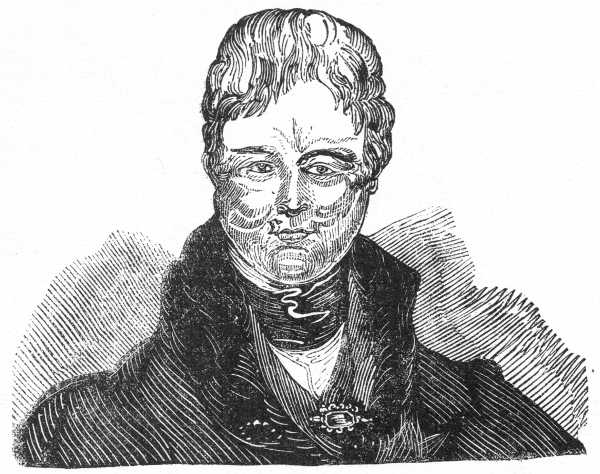
ILLUSTRATIONS OF STREET-ART—No. III.
Mr. PATRICK CONNOR. [13]
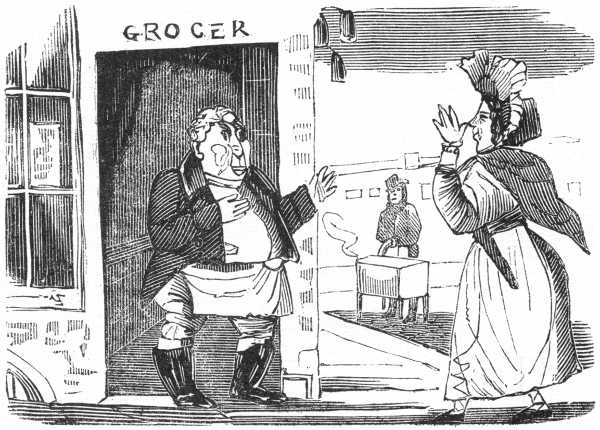
ILLUSTRATIONS TO STREET-BALLADS.
THE AMOROUS WATERMAN. Of St. JOhn’s Wood.
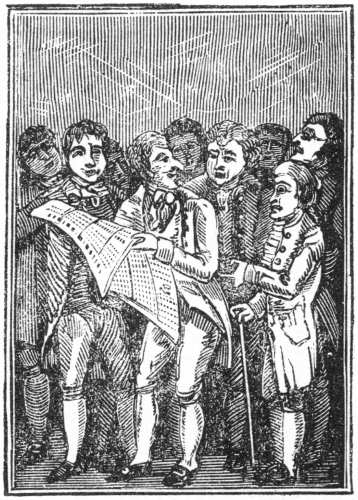
ILLUSTRATIONS OF STREET-ART—No. IV.
THE QUEEN’S GLORIOUS SPEECH.
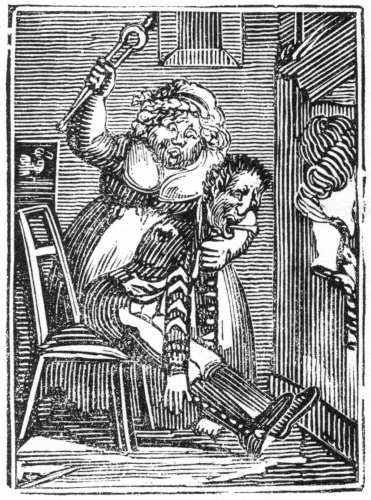
GENERAL HAYNAU. [14]
THE POACHERS.
The Miller’s Ditty.

The Heart that can feel for Another.

ROSIN THE BEAU.
Broken Hearted Gardener.
A large number of ballads which I procured, and all sold and sung in the street, though not written expressly for the purpose, presented a curious study enough. They were of every class. I specify a few, to show the nature of the collection (not including ballads on a subject): “Ye Banks and Braes o’ Bonnie Doun,” with (on the same sheet) “The Merry Fiddler,” (an indecent song)—“There’s a good Time coming, Boys,” “Nix, my Dolly,” “The Girls of ——shire,” (which of course is available for any county)—“Widow Mahoney,” “Remember the Glories of Brian the Brave,” “Clementina Clemmins,” “Lucy Long,” “Erin Go Bragh,” “Christmas in 1850,” “The Death of Nelson,” “The Life and Adventures of Jemmy Sweet,” “The Young May Moon,” “Hail to the Tyrol,” “He was sich a Lushy Cove,” &c. &c.
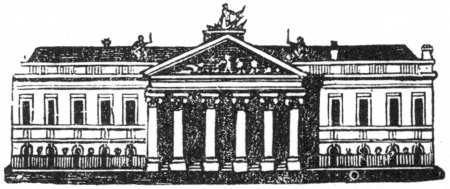
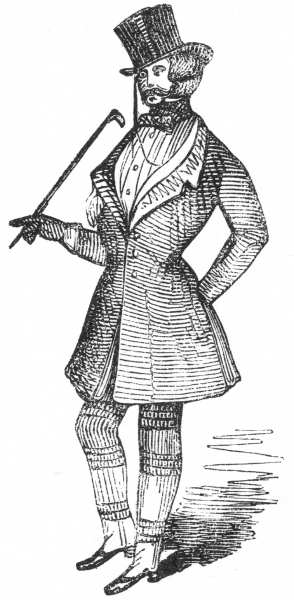
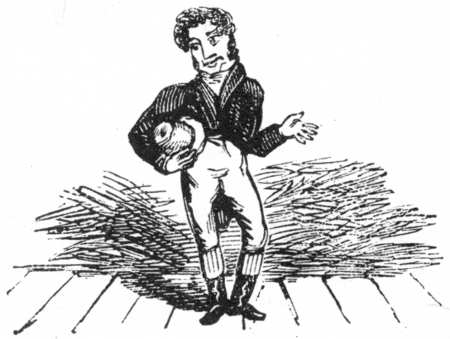
I may here mention—but a fuller notice may be necessary when I treat of street art—that some of these ballads have an “illustration” always at the top of the column. “The Heart that can Feel for Another” is illustrated by a gaunt and savage-looking lion. “The Amorous Waterman of St. John’s Wood,” presents a very short, obese, and bow-legged grocer, in top-boots, standing at his door, while a lady in a huge bonnet is “taking a sight at him,” to the evident satisfaction of a “baked ’tater” man. “Rosin the Beau” is heralded by the rising sun. “The Poachers” has a cut of the Royal Exchange above the title. “The Miller’s Ditty” is illustrated by a perfect dandy, of the slimmest and straightest fashion; and “When I was first Breeched,” by an engraving of a Highlander. Many of the ballads, however have engravings appropriate enough.
Of the Experience of a Street Author, or Poet.
I have already mentioned the present number of street authors, as I most frequently heard them styled, though they write only verses. I called upon one on the recommendation of a neighbouring tradesman, of whom I made some inquiries. He could not tell me the number of the house in the court where the man lived, but said I had only to inquire for the Tinker, or the Poet, and any one would tell me.
I found the poor poet, who bears a good character, on a sick bed; he was suffering, and had long been suffering, from abscesses. He was apparently about forty-five, with the sunken eyes, hollow cheeks, and, not pale but thick and rather sallow complexion, which indicate ill-health and scant food. He spoke quietly, and expressed resignation. His room was not very small, and was furnished in the way usual among the very poor, but there were a few old pictures over the mantel-piece. His eldest boy, a lad of thirteen or fourteen, was making dog-chains; at which he earned a shilling or two, sometimes 2s. 6d., by sale in the streets.
“I was born at Newcastle-under-Lyne,” the man said, “but was brought to London when, I believe, I was only three months old. I was very fond of reading poems, in my youth, as soon as I could read and understand almost. Yes, very likely, sir; perhaps it was that put it into my head to write them afterwards. I was taught wire-working, and jobbing, and was brought up to hawking wire-work in the streets, and all over England and Wales. It was never a very good trade—just a living. Many and many a weary mile we’ve travelled together,—I mean, my wife and I have: and we’ve sometimes been benighted, and had to wander or rest about until morning. It wasn’t that we hadn’t money to pay for a lodging, but we couldn’t get one. We lost count of the days sometimes in wild parts; but if we did lose count, or thought we had, I could always tell when it was Sunday morning by the look of nature; there was a mystery and a beauty about it as told me. I was very fond of Goldsmith’s poetry always. I can repeat ‘Edwin and Emma’ now. No, sir; I never read the ‘Vicar of Wakefield.’ I found ‘Edwin and Emma’ in a book called the ‘Speaker.’ I often thought of it in travelling through some parts of the country.
“Above fourteen years ago I tried to make a shilling or two by selling my verses. I’d written plenty before, but made nothing by them. Indeed I never tried. The first song I ever sold was to a concert-room manager. The next I sold had great success. It was called the ‘Demon of the Sea,’ and was to the tune of ‘The Brave Old Oak.’ Do I remember how it began? Yes, sir, I remember every word of it. It began:
Unfurl the sails, We’ve easy gales; And helmsman steer aright. Hoist the grim death’s head— The Pirate’s head— For a vessel heaves in sight!
That song was written for a concert-room, but it was soon in the streets, and ran a whole winter. I got only 1s. for it. Then I wrote the ‘Pirate of the Isles,’ and other ballads of that sort. The concert-rooms pay no better than the printers for the streets.
“Perhaps the best thing I ever wrote was the ‘Husband’s Dream.’ I’m very sorry indeed that I can’t offer you copies of some of my ballads, but I haven’t a single copy myself of any of them, not one, and I dare say I’ve written a thousand in my time, and most of them were printed. I believe 10,000 were sold of the ‘Husband’s Dream.’ It begins:
O Dermot, you look healthy now, Your dress is neat and clean; I never see you drunk about, Then tell me where you’ve been. Your wife and family—are they well? You once did use them strange: O, are you kinder to them grown, How came this happy change?
“Then Dermot tells how he dreamed of his wife’s sudden death, and his childrens’ misery as they cried about her dead body, while he was drunk in bed, and as he calls out in his misery, he wakes, and finds his wife by his side. The ballad ends:
‘I pressed her to my throbbing heart, Whilst joyous tears did stream; And ever since, I’ve heaven blest, For sending me that dream.’
“Dermot turned teetotaller. The teetotallers were very much pleased with that song. The printer once sent me 5s. on account of it.
“I have written all sorts of things—ballads on a subject, and copies of verses, and anything ordered of me, or on anything I thought would be accepted, but now I can’t get about. I’ve been asked to write indecent songs, but I refused. One man offered me 5s. for six such songs.—‘Why, that’s less than the common price,’ said I, ‘instead of something over to pay for the wickedness.’—All those sort of songs come now to the streets, I believe all do, from the concert-rooms. I can imitate any poetry. I don’t recollect any poet I’ve imitated. No, sir, not Scott or Moore, that I know of, but if they’ve written popular songs, then I dare say I have imitated them. Writing poetry is no comfort to me in my sickness. It might if I could write just what I please. The printers like hanging subjects best, and I don’t. But when any of them sends to order a copy of verses for a ‘Sorrowful Lamentation’ of course I must supply them. I don’t think much of what I’ve done that way. If I’d my own fancy, I’d keep writing acrostics, such as one I wrote on our rector.” “God bless him,” interrupted the wife, “he’s a good man.” “That he is,” said the poet, “but he’s never seen what I wrote about him, and perhaps never will.” He then desired his wife to reach him his big Bible, and out of it he handed me a piece of paper, with the following lines written on it, in a small neat hand enough:
“C elestial blessings hover round his head, H undreds of poor, by his kindness were fed, A nd precepts taught which he himself obeyed. M an, erring man, brought to the fold of God, P reaching pardon through a Saviour’s blood. N o lukewarm priest, but firm to Heaven’s cause; E xamples showed how much he loved its laws. Y outh and age, he to their wants attends, S teward of Christ—the poor man’s sterling friend.”
“There would be some comfort, sir,” he continued, “if one could go on writing at will like that. As it is, I sometimes write verses all over a slate, and rub them out again. Live hard! yes, indeed, we do live hard. I hardly know the taste of meat. We live on bread and butter, and tea; no, not any fish. As you see, sir, I work at tinning. I put new bottoms into old tin tea-pots, and such like. Here’s my sort of bench, by my poor bit of a bed. In the best weeks I earn 4s. by tinning, never higher. In bad weeks I earn only 1s. by it, and sometimes not that,—and there are more shilling than four shilling weeks by three to one. As to my poetry, a good week is 3s., and a poor week is 1s.—and sometimes I make nothing at all that way. So I leave you to judge, sir, whether we live hard; for the comings in, and what we have from the parish, must keep six of us—myself, my wife, and four children. It’s a long, hard struggle.” “Yes, indeed,” said the wife, “it’s just as you’ve heard my husband tell, sir. We’ve 2s. a week and four loaves of bread from the parish, and the rent’s 2s. 6d., and the landlord every week has 2s.,—and 6d. he has done for him in tinning work. Oh, we do live hard, indeed.”
As I was taking my leave, the poor man expressed a desire that I would take a copy of an epitaph which he had written for himself. “If ever,” he said, “I am rich enough to provide for a tomb-stone, or my family is rich enough to give me one, this shall be my epitaph” [I copied it from a blank page in his Bible:]
“Stranger, pause, a moment stay, Tread lightly o’er this mound of clay. Here lies J—— H——, in hopes to rise, And meet his Saviour in the skies. Christ his refuge, Heaven his home, Where pain and sorrow never come. His journey’s done, his trouble’s past, With God he sleeps in peace at last.”
Of the Street-sellers of Broad-Sheets.
The broad-sheet known in street-sale is an unfolded sheet, varying in size, and printed on one side. The word is frequently used to signify an account of a murder or execution, but it may contain an account of a fire, an “awful accident and great loss of life,” a series of conundrums, as in those called “Nuts to Crack,” a comic or intended comic engraving, with a speech or some verses, as recently in satire of the Pope and Cardinal Wiseman (these are sometimes called “comic exhibitions”), or a “bill of the play.” The “cocks” are more frequently a smaller size than the broad-sheet.
The sellers of these articles (play-bills excepted), are of the class I have described as patterers. The play-bill sellers are very rarely patterers on other “paper work.” Some of them are on the look-out during the day for a job in porterage or such like, but they are not mixed up with any pattering,—and a regular patterer looks down upon a play-bill seller as a poor creature, “fit for nothing but play-bills.” I now proceed to describe such of these classes as have not been previously given.
Of the “Gallows” Literature of the Streets.
Under this head I class all the street-sold publications which relate to the hanging of malefactors. That the question is not of any minor importance must be at once admitted, when it is seen how very extensive a portion of the reading of the poor is supplied by the “Sorrowful Lamentations” and “Last Dying Speech, Confession, and Execution” of criminals. One paper-worker told me, that in some small and obscure villages in Norfolk, which, he believed, were visited only by himself in his line, it was not very uncommon for two poor families to club for 1d. to purchase an execution broad-sheet! Not long after Rush was hung, he saw, one evening after dark, through the uncurtained cottage window, eleven persons, young and old, gathered round a scanty fire, which was made to blaze by being fed with a few sticks. An old man was reading, to an attentive audience, a broad-sheet of Rush’s execution, which my informant had sold to him; he read by the fire-light; for the very poor in those villages, I was told, rarely lighted a candle on a spring evening, saying that “a bit o’ fire was good enough to talk by.” The scene must have been impressive, for it had evidently somewhat impressed the perhaps not very susceptible mind of my informant.
The procedure on the occasion of a “good” murder, or of a murder expected to “turn out well,” is systematic. First appears a quarter-sheet (a hand-bill, 9½ in. by 7½ in.) containing the earliest report of the matter. Next come half-sheets (twice the size) of later particulars, or discoveries, or—if the supposed murderer be in custody—of further examinations. The sale of these bills is confined almost entirely to London, and in their production the newspapers are for the most part followed closely enough. Then are produced the whole, or broad-sheets (twice the size of the half-sheets), and, lastly, but only on great occasions, the double broad-sheet. [I have used the least technical terms that I might not puzzle the reader with accounts of “crowns,” “double-crowns,” &c.]
The most important of all the broad-sheets of executions, according to concurrent, and indeed unanimous, testimony is the case of Rush. I speak of the testimony of the street-folk concerned, who all represent the sale of the papers relative to Rush, both in town and country, as the best in their experience of late years.
The sheet bears the title of “The Sorrowful Lamentation and Last Farewell of J. B. Rush, who is ordered for Execution on Saturday next, at Norwich Castle.” There are three illustrations. The largest represents Rush, cloaked and masked, “shooting Mr. Jermy, Sen.” Another is of “Rush shooting Mrs. Jermy.” A prostrate body is at her feet, and the lady herself is depicted as having a very small waist and great amplitude of gown-skirts. The third is a portrait of Rush,—a correct copy, I was assured, and have no reason to question the assurance,—from one in the Norwich Mercury. The account of the trial and biography of Rush, his conduct in prison, &c., is a concise and clear enough condensation from the newspapers. Indeed, Rush’s Sorrowful Lamentation is the best, in all respects, of any execution broad-sheet I have seen; even the “copy of verses” which, according to the established custom, the criminal composes in the condemned cell—his being unable, in some instances, to read or write being no obstacle to the composition—seems, in a literary point of view, of a superior strain to the run of such things. The matters of fact, however, are introduced in the same peculiar manner. The worst part is the morbid sympathy and intended apology for the criminal. I give the verses entire:
“This vain world I soon shall leave, Dear friends in sorrow do not grieve; Mourn not my end, though ’tis severe, For death awaits the murderer. Now in a dismal cell I lie, For murder I’m condemn’d to die; Some may pity when they read, Oppression drove me to the deed. My friends and home to me were dear, The trees and flowers that blossom’d near; The sweet loved spot where youth began Is dear to every Englishman. I once was happy—that is past, Distress and crosses came at last; False friendship smiled on wealth and me, But shunned me in adversity. The scaffold is awaiting me, For Jermy I have murdered thee; Thy hope and joys—thy son I slew, Thy wife and servant wounded too. I think I hear the world to say— ‘Oh Rush, why didst thou Jermy slay? His dear loved son why didst thou kill, For he had done to thee no ill.’ If Jermy had but kindness shown, And not have trod misfortune down, I ne’er had fired the fatal ball That caus’d his son and him to fall. My cause I did defend alone, For learned counsel I had none; I pleaded hard and questions gave, In hopes my wretched life to save. The witness to confound did try, But God ordained that I should die; Eliza Chestney she was there,— I’m sorry I have injured her. Oh, Emily Sandford, was it due That I should meet my death through you? If you had wish’d me well indeed, How could you thus against me plead? I’ve used thee kind, though not my wife: Your evidence has cost my life; A child by me you have had born, Though hard against me you have sworn. The scaffold is, alas! my doom,— I soon shall wither in the tomb: God pardon me—no mercy’s here For Rush—the wretched murderer!”
Although the execution broad-sheet I have cited may be the best, taken altogether, which has fallen under my observation, nearly all I have seen have one characteristic—the facts can be plainly understood. The narrative, embracing trial, biography, &c., is usually prepared by the printer, being a condensation from the accounts in the newspapers, and is perhaps intelligible, simply because it is a condensation. It is so, moreover, in spite of bad grammar, and sometimes perhaps from an unskilful connection of the different eras of the trial.
When the circumstances of the case permit, or can be at all constrained to do so, the Last Sorrowful Lamentation contains a “Love Letter,” written—as one patterer told me he had occasionally expressed it, when he thought his audience suitable—“from the depths of the condemned cell, with the condemned pen, ink, and paper.” The style is stereotyped, and usually after this fashion:
“Dear ——,—Shrink not from receiving a letter from one who is condemned to die as a murderer. Here, in my miserable cell, I write to one whom I have from my first acquaintanceship, held in the highest esteem, and whom, I believe, has also had the same kindly feeling towards myself. Believe me, I forgive all my enemies and bear no malice. O, my dear ——, guard against giving way to evil passions, and a fondness for drink. Be warned by my sad and pitiful fate.”
If it be not feasible to have a love-letter—which can be addressed to either wife or sweetheart—in the foregoing style, a “last letter” is given, and this can be written to father, mother, son, daughter, or friend; and is usually to the following purport:
“Condemned Cell, ——
“My Dear ——,—By the time you receive this my hours, in this world, will indeed be short. It is an old and true saying, that murderers will one day meet their proper reward. No one can imagine the dreadful nights of anguish passed by me since the commital of the crime on poor ——. All my previous victims have appeared before me in a thousand different shapes and forms. My sufferings have been more than I can possibly describe. Let me entreat you to turn from your evil ways and lead a honest and sober life. I am suffering so much at the present moment both from mind and body that I can write no longer. Farewell! farewell!
“Your affectionate ——.”
I have hitherto spoken of the Last Sorrowful Lamentation sheets. The next broad-sheet is the “Life, Trial, Confession, and Execution.” This presents the same matter as the “Lamentation,” except that a part—perhaps the judge’s charge at the trial, or perhaps the biography—is removed to make room for the “Execution,” and occasionally for a portion of the “Condemned Sermon.” To judge by the productions I treat of, both subjects are marvelously similar on all occasions. I cite a specimen of the Condemned Sermon, as preached, according to the broad-sheet, before Hewson, condemned for the murder of a turnkey. It will be seen that it is of a character to fit any condemned sermon whatever:
“The rev. gent. then turned his discourse particularly to the unhappy prisoner doomed to die on the morrow, and told him to call on Him who alone had the power of forgiveness; who had said, ‘though his sins were red as scarlet,’ he would ‘make them white as snow,’ though he had been guilty of many heinous crimes, there was yet an opportunity of forgiveness.—During the delivery of this address, the prisoner was in a very desponding state, and at its conclusion was helped out of the chapel by the turnkeys.”
The “Execution” is detailed generally in this manner. I cite the “Life, Trial, Confession and Execution of Mary May, for the Murder of W. Constable, her Half-brother, by Poison, at Wix, near Manningtree:”
“At an early hour this morning the space before the prison was very much crowded by persons anxious to witness the execution of Mary May, for the murder of William Constable, her half-brother, by poison, at Wix, Manningtree, which gradually increased to such a degree, that a great number of persons suffered extremely from the pressure, and gladly gave up their places on the first opportunity to escape from the crowd. The sheriffs and their attendants arrived at the prison early this morning and proceeded to the condemn cell, were they found the reverend ordinary engaged in prayer with the miserable woman. After the usual formalities had been observed of demanding the body of the prisoner into their custody she was then conducted to the press-room. The executioner with his assistants then commenced pinioning her arms, which opperation they skillfully and quickly dispatched. During these awful preparations the unhappy woman appeared mently to suffer severely, but uttered not a word when the hour arrived and all the arrangements having been completed, the bell commenced tolling, and then a change was observed, to come over the face of the prisoner, who trembling violently, walked with the melancholy procession, proceeded by the reverend ordinary, who read aloud the funeral service for the dead. When the bell commenced tolling a moment was heard from without, and the words “Hats off,” and “Silence,” were distinctly heard, from which time nothing but a continual sobbing was heard. On arriving at the foot of the steps leading to the scaffold she thanked the sheriffs and the worthy governor of the prison, for their kind attentions to her during her confinement; & then the unfortunate woman was seen on the scaffold, there was a death like silence prevailed among the vast multitude of people assembled. In a few seconds the bolt was drawn, and, after a few convulsive struggles, the unhappy woman ceased to exist.”
I cannot refrain from calling the reader’s attention to the “copy of verses” touching Mary May. I give them entire, for they seem to me to contain all the elements which made the old ballads popular—the rushing at once into the subject—and the homely reflections, though crude to all educated persons, are, nevertheless, well adapted to enlist the sympathy and appreciation of the class of hearers to whom they are addressed:
COPY OF VERSES.
“The solemn bell for me doth toll, And I am doom’d to die (For murdering my brother dear,) Upon a tree so high. For gain I did premeditate My brother for to slay,— Oh, think upon the dreadful fate Of wretched Mary May. CHORUS. Behold the fate of Mary May, Who did for gain her brother slay. In Essex boundry I did dwell, My brother lived with me, In a little village called Wix, Not far from Manningtree. In a burial club I entered him, On purpose him to slay; And to obtain the burial fees I took his life away. One eve he to his home return’d, Not thinking he was doom’d, To be sent by a sister’s hand Unto the silent tomb. His tea for him I did prepare, And in it poison placed, To which I did administer,— How dreadful was his case. Before he long the poison took In agony he cried; Upon him I in scorn did look,— At length my brother died. Then to the grave I hurried him, And got him out of sight, But God ordain’d this cruel deed Should soon be brought to light. I strove the money to obtain, For which I did him slay, By which, also, suspicion fell On guilty Mary May. The poison was discovered, Which caused me to bewail, And I my trial to await Was sent to Chelmsford jail. And for this most atrocious deed I at the bar was placed, The Jury found me guilty,— How dreadful was my case. The Judge the dreadful sentence pass’d, And solemn said to me, ‘You must return from whence you came, And thence unto the tree.’ On earth I can no longer dwell, There’s nothing can me save; Hark! I hear the mournful knell Which calls me to the grave. Death appears in ghostly forms, To summon me below; See, the fatal bolt is drawn, And Mary May must go. Good people all, of each degree, Before it is too late, See me on the fatal tree, And pity my sad fate. My guilty heart stung with grief, With agony and pain,— My tender brother I did slay That fatal day for gain.”
This mode of procedure in “gallows” literature, and this style of composition, have prevailed for from twenty to thirty years. I find my usual impossibility to fix a date among these street-folk; but the Sorrowful Lamentation sheet was unknown until the law for prolonging the term of existence between the trial and death of the capitally-convicted, was passed. “Before that, sir,” I was told, “there wasn’t no time for a Lamentation; sentence o’ Friday, and scragging o’ Monday. So we had only the Life, Trial, and Execution.” Before the year 1820, the Execution broad-sheets, &c., were “got up” in about the same, though certainly in an inferior and more slovenly manner than at present; and one copy of verses often did service for the canticles of all criminals condemned to be hung. These verses were to sacred or psalm tunes, such as Job, or the Old Hundredth. I was told by an aged gentleman that he remembered, about the year 1812, hearing a song, or, as he called it, “stave,” of this description, not only given in the street with fiddle and nasal twang, to the tune of the Old Hundredth, but commencing in the very words of Sternhold and Hopkins—
“All people that on earth do dwell.”
These “death-verses,” as they were sometimes called, were very frequently sung by blind people, and in some parts of the country blind men and women still sing—generally to the accompaniment of a fiddle—the “copy of verses.” A London chaunter told me, that, a few years back, he heard a blind man at York announce the “verses” as from the “solitudes” of the condemned cell. At present the broad-sheet sellers usually sing, or chaunt, the copy of verses.
An intelligent man, now himself a street-trader, told me that one of the latest “execution songs” (as he called them) which he remembered to have heard in the old style—but “no doubt there were plenty after that, as like one another as peas in a boiling”—was on the murder of Weare, at Elstree, in Hertfordshire. He took great interest in such things when a boy, and had the song in question by heart, but could only depend upon his memory for the first and second verses:
“Come, all good Christians, praise the Lord, And trust to him in hope. God in his mercy Jack Thurtell sent To hang from Hertford gallows rope. Poor Weare’s murder the Lord disclosed— Be glory to his name: And Thurtell, Hunt, and Probert too, Were brought to grief and shame.”
Another street paper-worker whom I spoke to on the subject, and to whom I read these two verses, said: “That’s just the old thing, sir; and it’s quite in old Jemmy Catnach’s style, for he used to write werses—anyhow, he said he did, for I’ve heard him say so, and I’ve no doubt he did in reality—it was just his favourite style, I know, but the march of intellect put it out. It did so.”
In the most “popular” murders, the street “papers” are a mere recital from the newspapers, but somewhat more brief, when the suspected murderer is in custody; but when the murderer has not been apprehended, or is unknown, “then,” said one Death-hunter, “we has our fling, and I’ve hit the mark a few chances that way. We had, at the werry least, half-a-dozen coves pulled up in the slums that we printed for the murder of ‘The Beautiful Eliza Grimwood, in the Waterloo-road.’ I did best on Thomas Hopkins, being the guilty man—I think he was Thomas Hopkins—’cause a strong case was made out again him.”
I received similar accounts of the street-doings in the case of “mysterious murders,” as those perpetrations are called by the paper workers, when the criminal has escaped, or was unknown. Among those leaving considerable scope to the patterer’s powers of invention were the murders of Mr. Westwood, a watchmaker in Prince’s-street, Leicester-square; of Eliza Davis, a bar-maid, in Frederick-street, Hampstead-road; and of the policeman in Dagenham, Essex. One of the most successful “cocks,” relating to murders which actually occurred, was the “Confession to the Rev. Mr. Cox, Chaplain of Aylesbury Gaol, of John Tawell the Quaker.” I had some conversation with one of the authors of this “Confession,”—for it was got up by three patterers; and he assured me that “it did well, and the facts was soon in some of the newspapers—as what we ’riginates often is.” This sham confession was as follows:
“The Rev. Mr. Cox, the chaplain of Aylesbury Gaol, having been taken ill, and finding his end approaching, sent for his son, and said, ‘Take this confession; now I am as good as my word; I promised that unhappy man, John Tawell, that while I lived his confession should not be made public, owing to the excited state of the public mind. Tawell confessed to me, that besides the murder of Sarah Hart, at Salt-hill, for which he suffered the last penalty of the law at Aylesbury, he was guilty of two other barbarous murders while abroad as a transport in Van Dieman’s Land. One of these barbarous and horrid murders was on the body of one of the keepers. He knocked him down with the keys, which he wrenched from him, and then cut his throat with his own knife, leaving the body locked up in his cell; and before that, to have the better opportunity of having the turnkey single-handed, John Tawell feigned illness. He then locked the keeper, in the cell, and went to a young woman in the town, a beautiful innkeeper’s daughter, whom he had seduced as he worked for her father, as he had the privilege of doing in the day-times. He went to her, and she, seeing him in a flurried state, with blood upon his hand, questioned him. He told the unhappy young woman how he had killed the keeper for the love of her, and the best thing to be done was for her to get possession of all the money she could, and escape with him to this country, where he would marry her, and support her like a lady. The unhappy young woman felt so terrified, that at the moment she was unable to say yes or no. He became alarmed for his safety, and with the identical knife that he killed the keeper with, he left his unhappy victim a weltering in her gore. He then fled from the house unobserved, and went into the bush, where he met three men, who had escaped through his killing the keeper. He advised them to go down with him to an English vessel lying off the coast. When they reached the shore, they met a crew in search of fresh water; to them they made out a pitiful story, and were taken on board the ship. All being young men, and the captain being short of hands, and one of them having been really a seaman transported for mutiny, the captain, after putting questions which the seaman answered, engaged them to work their passage home. Tawell was the captain of the gang, and was most looked up to. They worked their passage home, behaving well during the voyage, so that the captain said he would make each of them a present, and never divulge. When they reached Liverpool, Tawell robbed the captain’s cabin of all the money contained in it, which was a very considerable sum. After that he left Liverpool, and adopted the garb of a Quaker, in which he could not easily be recognized, and then pursued the course of wickedness and crime which led him to a shameful death.’”
The “confession” of Rush to the chaplain of Norwich Castle, was another production which was remunerative to the patterers. “There was soon a bit of it in the newspapers,” said one man, “for us and them treads close on one another’s heels. The newspapers ‘screeved’ about Rush, and his mother, and his wife; but we, in our patter, made him confess to having murdered his old grandmother fourteen years back, and how he buried her under the apple-tree in the garden, and how he murdered his wife as well.”
These ulterior Confessions are very rarely introduced, in lieu of some matter displaced, into the broad-sheet, but form separate bills. It was necessary to mention them here, however, and so preserve the sequence of the whole of the traffic consequent upon a conviction for murder, in this curious trade.
Sometimes the trial, &c., form also separate bills, as well as being embodied afterwards in the Sorrowful Lamentation. This is only, however, in cases which are deemed important. One of the papers I obtained, for instance, is the “Trial of Mr. and Mrs. Manning for the Murder of Mr. Patrick O’Connor.” The trial alone occupies a broad-sheet; it is fairly “got up.” A portrait of Mr. Patrick O’Connor heads the middle column. From the presence of a fur collar to the coat or cloak, and of what is evidently an order with its insignia, round the neck, I have little doubt that the portrait of Mr. O’Connor was originally that of the sovereign in whose service O’Connor was once an excise-officer—King William IV.
The last publication to which the trade has recourse is “the book.” This is usually eight pages, but sometimes only four of a larger size. In authorship, matter, or compilation, it differs little from the narratives I have described. The majority of these books are prepared by one man. They are in a better form for being preserved as a record than is a broad-sheet, and are frequently sold, and almost always offered by the patterers when they cry a new case on a sheet, as “people that loves such reading likes to keep a good account of the best by them; and so, when I’ve sold Manning’s bills, I’ve often shoved off Rush’s books.” The books, like the bills, have generally the letters and the copy of verses.
Some of these books have the title-page set forth in full display,—for example: “Horrible Murder and Mutilation of Lucy Game, aged 15, by her Cruel Brother, William Game, aged 9, at Westmill, Hertfordshire. His Committal and Confession. With a Copy of Letter. Also, Full Particulars of the Poisonings in Essex.” Here, as there was no execution, the matter was extended, to include the poisonings in Essex. The title I have quoted is expanded into thirteen lines. Sometimes the title-page is adorned with a portrait. One, I was told, which was last employed as a portrait of Calcraft, had done severe service since Courvoisier’s time,—for my informant thought that Courvoisier was the original. It is the bust of an ill-looking man, with coat and waistcoat fitting with that unwrinkled closeness which characterises the figures in tailors’ “fashions.”
The above style of work is known in the trade as “the book;” but other publications, in the book or pamphlet form, are common enough. In some I have seen, the title-page is a history in little. I cite one of these:—“Founded on Facts. The Whitby Tragedy; or, the Gambler’s Fate. Containing the Lives of Joseph Carr, aged 21, and his sweetheart, Maria Leslie, aged 19, who were found Dead, lying by each other, on the morning of the 23rd of May. Maria was on her road to Town to buy some Ribbon, &c., for her Wedding Day, when her lover in a state of intoxication fired at her, and then run to rob his prey, but finding it to be his Sweetheart, reloaded his Gun, placed the Muzzle to his Mouth, and blew out his Brains, all through cursed Cards, Drink, &c. Also, an affectionate Copy of Verses.”
To show the extent of the trade in execution broad-sheets, I obtained returns of the number of copies relating to the principal executions of late, that had been sold:
OfRush2,500,000copies.
„the Mannings2,500,000„
„Courvoisier1,666,000„
„Good1,650,000„
„Corder1,650,000„
„Greenacre1,666,000„
Of Thurtell I could obtain no accounts—“it was so long ago;” but the sale, I was told, was enormous. Reckoning that each copy was sold for 1d. (the regular price in the country, where the great sale is,) the money expended for such things amounts to upwards of 48,500l. in the case of the six murderers above given. All this number was printed and got up in London; a few “broad-sheets” concerning Rush were printed also in Norwich.
Touching the issue of “cocks,” a person connected with the trade calculated for me, from data at his command, that 3,456 copies were struck off weekly, and sold in the streets, in the metropolis; and reckoning them at only a ½d. each, we have the sum of 7l. 4s. spent every week in this manner. At this rate, there must be 179,712 copies of “cocks” printed in a year, on which the public expend no less than 374l. 8s.
Of the style of illustrations usually accompanying this class of street literature the two large engravings here given are fac similes—while the smaller ones are faithful copies of the average embellishments to the halfpenny ballads. On another occasion I shall speak at length on “Street-Art.”
Of the Street-sellers of Conundrums.
Among the more modern street sales are “conundrums,” generally vended, both in the shops and the streets, as “Nuts to Crack,” when not in the form of books. This is another of the “broad-sheets,” and is sufficiently clever and curious in its way.
In the centre, at the top, is the “Wonderful Picture,” with the following description: “This Picture when looked at from a particular point of view, will not only appear perfect in all respects and free from distortion, but the figures will actually appear to stand out in relief from the paper.” The wonderful picture, which is a rude imitation of a similar toy picture sold in a box, “with eye-piece complete,” at the shops, presents a distorted view of a church-spire, a light-house, a donjon-keep, castellated buildings backed by mountains, a moat on which are two vessels, an arch surmounted by a Britannia, a palm-tree (I presume), and a rampart, or pier, or something that way, on which are depicted two figures, with the gestures of elocutionists. The buildings are elongated, like shadows at sunset or sunrise. What may be the “particular point of view” announced in the description of the Wonderful Picture, is not described in the “Nuts,” but the following explanation is given in a little book, published simultaneously, and entitled, “The Nutcrackers, a Key to Nuts to Crack, or Enigmatical Repository:”
“The Wonderful Picture.—Cut out a piece of cardboard 2½ inches long, make a round hole about the size of a pea in the top of it; place this level with the right-hand side of the Engraving and just 1½ inches distant from it, then apply your eye to the little hole and look at the picture, and you will find that a beautiful symmetry pervades the landscape, there is not the slightest appearance of distortion, and the different parts appear actually to stand up in relief on the paper.”
Below the “Wonderful Picture” are other illustrations; and the border of the broad-sheet presents a series of what may be called pictorial engravings. The first is,
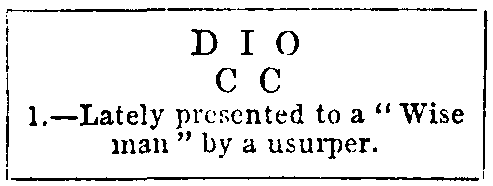
The answer being evidently “Diocese.” No. 26 is
“Pinafore” is the solution. Of the next “hieroglyphic”—for a second title to the “Nuts” tells of “200 Hieroglyphics, Enigmas, Conundrums, Curious Puzzles, and other Ingenious Devices,”—I cannot speak very highly. It consists of “AIMER,” (a figure of a hare at full speed,) and “EKA.” Answer.—“America.”
In the body of the broad-sheet are the Enigmas, &c., announced; of each of which I give a specimen, to show the nature of this street performance or entertainment. Enigma 107 is—
“I’ve got no wings, yet in the air I often rise and fall; I’ve got no feet, yet clogs I wear, And shoes, and boots, and all.”
As the answer is foot-ball, the two last lines should manifestly have been placed first.
The “Conundrums” are next in the arrangement, and I cite one of them:
“Why are there, strictly speaking, only 325 days in the year?”
“Because,” is the reply, “forty of them are lent and never returned.” The “Riddles” follow in this portion of the “Nuts to Crack.” Of these, one is not very difficult to be solved, though it is distinguished for the usual grammatical confusion of tenses:
“A man has three daughters, and each of these have a brother. How many children had he?”
The “Charades” complete the series. Of these I select one of the best:
“I am a word of letters seven, I’m sinful in the sight of heaven, To every virtue I’m opposed, Man’s weary life I’ve often closed. If to me you prefix two letters more, I mean exactly what I meant before.”
The other parts of the letter-press consist of “Anagrams,” “Transpositions,” &c.
When a clever patterer “works conundrums”—for the trade is in the hands of the pattering class—he selects what he may consider the best, and reads or repeats them in the street, sometimes with and sometimes without the answer. But he does not cripple the probable quickness of his sale by a slavish adherence to what is in type. He puts the matter, as it were, personally. “What gentleman is it,” one man told me he would ask, “in this street, that has—
‘Eyes like saucers, a back like a box, A nose like a pen-knife, and a voice like a fox?’
You can learn for a penny. Or sometimes I’ll go on with the patter, thus,” he continued, “What lady is it that we have all seen, and who can say truly—
‘I am brighter than day, I am swifter than light, And stronger than all the momentum of might?’
More than once people have sung out ‘the Queen,’ for they seem to think that the momentum of might couldn’t fit any one else. It’s ‘thought’ as is the answer, but it wouldn’t do to let people think it’s anything of the sort. It must seem to fit somebody. If I see a tailor’s name on a door, as soon as I’ve passed the corner of the street, and sometimes in the same street, I’ve asked—
‘Why is Mr. So-and-so, the busy tailor of this (or the next street) never at home?’
‘Because he’s always cutting out.’ I have the same questions for other tradesmen, and for gentlemen and ladies in this neighbourhood, and no gammon. All for a penny. Nuts to Crack, a penny. A pair of Nutcrackers to crack ’em, only one penny.”
Sometimes this man, who perhaps is the smartest in the trade, will take a bolder flight still, and when he knows the residence of any professional or public man, he will, if the allusion be complimentary, announce his name, or—if there be any satire—indicate by a motion of the head, or a gesture of the hand, the direction of his residence. My ingenuous, and certainly ingenious, informant obliged me with a few instances:—“In Whitechapel parish I’ve said—it ain’t in the print, it was only in the patter—‘Why won’t the Reverend Mr. Champneys lay up treasures on earth?’—‘Because he’d rather lay up treasures in heaven.’ That’s the reverend gentleman not far from this spot; but in this sheet—with nearly 100 engravings by the first artists, only a penny—I have other questions for other parsons, not so easy answered; nuts as is hard to crack. ‘Why is the Reverend Mr. Popjoy,’ or the Honourable Lawyer Bully, or Judge Wiggem,—and then I just jerks my thumb, sir, if it’s where I know or think such people live—‘Why is the Reverend Mr. Popjoy (or the others) like two balloons, one in the air to the east, and the ’tother in the air to the west, in this parish of St. George’s, Hanover-square?’ There’s no such question, and as it’s a sort of a ‘cock,’ of course there’s no answer. I don’t know one. But a gentleman’s servant once sung out: ‘’Cause he’s uppish.’ And a man in a leather apron once said: ‘He’s a raising the wind,’ which was nonsense. But I like that sort of interruption, and have said—‘You’ll not find that answer in the Nutcrackers,’ only a penny—and, Lord knows, I told the truth when I said so, and it helps the sale. No fear of any one’s finding out all what’s in the sheet before I’m out of the ‘drag.’ Not a bit. And you must admit that any way it’s a cheap pennorth.” That it is a cheap harmless pennyworth is undeniable.
The street-sale of conundrums is carried on most extensively during a week or two before Christmas; and on summer evenings, when the day’s work is, or ought to be, over even among the operatives of the slop employers. As the conundrum patterer requires an audience, he works the quieter streets, preferring such as have no horse-thoroughfare—as in some of the approaches from the direction of Golden-square to Regent-street. The trade is irregularly pursued, none following it all the year; and from the best information I could acquire, it appears that fifteen men may be computed as working conundrums for two months throughout the twelve, and clearing 10s. 6d. weekly, per individual. The cost of the “Nuts to Crack” (when new) is 5d. a doz. to the seller; but old “Nuts” often answer the purpose of the street-seller, and may be had for about half the price; the cost of the “Nut-crackers” 2s. to 2s. 6d. It may be calculated, then, that to realize the 10s. 6d., 15s. must be taken. This shows the street expenditure in “Nuts to Crack” and “Nut-crackers” to be 90l. yearly.
Of the Street-sellers of Comic Exhibitions, Magical Delusions, &c.
The street sale of “Comic Exhibitions” (properly so called) is, of course, as modern as the last autumn and winter; and it is somewhat curious that the sale of any humorous, or meant to be humorous sheet of engravings, is now becoming very generally known in the street sale as a “Comic Exhibition.” Among these—as I have before intimated—are many caricatures of the Pope, the Church of Rome, Cardinal Wiseman, the Church of England, the Bishop of London (or any bishop or dignitary), or of any characteristic of the conflicting creeds. In many of these, John Bull figures personally, and so does the devil.
The Comic Exhibition (proper) is certainly a very cheap pennyworth. No. 1 is entitled, “The Ceremonial of the Opening of the Great Exhibition, in 1851, with Illustrations of the Contributions of All Nations.” The “contributions,” however, are reserved for Nos. 2 and 3. Two larger “cuts,” at the head of the broad-sheet, may be considered geographical, as regards the first, and allegorical as regards the second. “Table Bay” presents a huge feeder (evidently), and the “Cape of Good Hope” is a spare man obsequiously bowing to the table and its guest in good hope of a dinner. Of the Sandwich Islands and of Hung(a)ry, the “exhibition” is of the same description. The second larger cut shows the Crystal Palace ascending by the agency of a balloon, a host of people of all countries looking on. Then comes the “Procession from Palace-yard to Hyde Park.” The first figure in this procession is described as “Beefeaters piping hot and well puffed out,” though there is but one beefeater, with head larger than his body and legs ridiculously small, (as have nearly all the sequent figures), smoking a pipe as if it were a trombone, duly followed by “Her Majesty’s Spiritual Body-guard” (five beefeaters, drunk), and by “Prince Albert blowing his own trumpet” (from the back of a very sorry steed), with “Mops and brooms,” and a “Cook-oo” (a housemaid and cook) as his supporters. Then follow figures, grotesque enough, of which the titles convey the character: “A famous Well-in-Town;” “Nae Peer-ye;” “Humorous Estimates” (Mr. Hume); “A Jew-d’ esprit” (Mr. D’Israeli); “An exemplification of Cupidity in Pummicestone” (Lord Palmerston); “Old Geese” and “Young Ducks” (old and angry-looking and young and pretty women); “Some gentlemen who patronise Moses in the Minories” (certainly no credit to the skill of a tailor); “A Jew Lion” (M. Jullien); “Fine high screams” (ice-creams) and “Capers” (chorister boys and ballet-girls); “Hey-day, you don’t take advantage here” (Joseph Ady); and “Something to give the milk a head” (a man with a horse’s head on a tray). These, however, are but a portion of the figures. The Comic Exhibition-sheet contains ninety such figures, independent of those in the two cuts mentioned as headings.
“Galleries of Comicalities,” or series of figures sometimes satirically, sometimes grotesquely given without any aim at satire, are also sold by the same parties, and are often announced as a “Threepenny gallery for a penny!—and dirt cheap at threepence. As big as a newspaper.”
Another broad-sheet sold this winter in the streets is entitled, “Optical and Magical Delusions,” and was announced as “Dedicated to and Prepared for his Royal Highness the Prince of Wales—the only original copy.” The engravings are six in number, and are in three rows, each accompanying engraving being reversed from its fellow: where the head is erect on one side, it is downward on the other. The first figure is a short length of a very plain woman, while on the opposite side is that of a very plain man, both pleased and smirking in accordance with a line below: “O what joy when our lips shall meet!” “Cat-a-gorical” is a spectacled and hooded cat. “Dog-matical” is a dog with the hat, wig, and cane once held proper to a physician. “Cross purposes” is an austere lady in a monster cap, while her opposite husband is pointing bitterly to a long bill. The purport of these figures is shown in the following
“DIRECTIONS—Paste all over the Back of the sheet, and put a piece of thick paper between, to stiffen it, then fold it down the centre, so that the marginal lines fall exactly at the back of each other, (which may be ascertained by holding it to the light)—press it quite flat—when cut separate they will make three cards—shave them close to the margin—then take a needlefull of double thread and pass it through the dot at each end of the card; cut the thread off about three inches long. By twisting the threads between your fore fingers and thumbs, so as to spin the card round backwards and forwards with a rapid motion, the figures will appear to connect and form a pleasing delusion.”
Then there are the “Magical Figures,” or rude street imitations of Dr. Paris’ ingenious toy, called the “Thaumascope.” Beside these are what at the first glance appear mere black, and very black, marks, defining no object; but a closer examination shows the outlines of a face, or of a face and figure. Of such there are sometimes four on a broad-sheet, but they are also sold separately, both in the streets and the small stationers’ shops. When the white or black portion of the paper is cut away (for both colours are so prepared), what remains, by a disposition of the light, throws a huge shadow of a grotesque figure on the wall, which may be increased or diminished according to the motions of the exhibitor. The shadow-figures sold this winter by one of my informants were of Mr. and Mrs. Manning, the Queen, Prince Albert, the Princess Royal, and the Prince of Wales; “but you see, sir,” observed the man, “the Queen and the Prince does for any father and mother—for she hasn’t her crown on—and the Queen’s kids for anybody’s kids.”
I mention these matters more particularly, as it certainly shows something of a change in the winter-evenings’ amusements of the children of the working-classes. The principal street customers for these penny papers were mechanics, who bought them on their way home for the amusement of their families. Boys, however, bought almost as many.
The sale of these papers is carried on by the same men as I have described working conundrums. A superior patterer, of course, shows that his magical delusions and magical figures combine all the wonders of the magic lantern and the dissolving views, “and all for one penny.” The trade is carried on only for a short time in the winter as regards the magical portion; and I am informed that, including the “Comic Exhibitions,” it extends to about half of the sum taken for conundrums, or to about 45l.
Of the Street-sellers of Play-Bills.
The sellers of play-bills carry on a trade which is exceedingly uncertain, and is little remunerative. There are now rather more than 200 people selling play-bills in London, but the number has sometimes been as high as 400. “Yes, indeed,” a theatrical gentleman said to me, “and if a dozen more theatres were opened to-morrow, why each would have more than its twenty bill-sellers the very first night. Where they come from, or what they are, I haven’t a notion.”
The majority of the play-bill sellers are either old or young, the sexes being about equally engaged in this traffic. Some of them have followed the business from their childhood. I met with very few indeed who knew anything of theatres beyond the names of the managers and of the principal performers, while some do not even enjoy that small modicum of knowledge, and some can neither read nor write. The boys often run recklessly alongside the cabs which are conveying persons to the theatre, and so offer their bills for sale. One of these youths said to me, when I spoke of the danger incurred, “The cabman knows how to do it, sir, when I runs and patters; and so does his hoss.” An intelligent cabman, however, who was in the habit of driving parties to the Lyceum, told me that these lads clung to his cab as he drove down to Wellington-street in such a way, for they seemed never to look before them, that he was in constant fear lest they should be run over. Ladies are often startled by a face appearing suddenly at the cab window, “and thro’ my glass,” said my informant, “a face would look dirtier than it really is.” And certainly a face gliding along with the cab, as it were, no accompanying body being visible, on a winter’s night, while the sound of the runner’s footsteps is lost in the noise of the cab, has much the effect of an apparition.
I did not hear of one person who had been in any way connected with the stage, even as a supernumerary, resorting to play-bill selling when he could not earn a shilling within the walls of a theatre. These bill-sellers, for the most part, confine themselves, as far as I could ascertain, to that particular trade. The youths say that they sometimes get a job in errand-going in the daytime, but the old men and women generally aver they can do nothing else. An officer, who, some years back, had been on duty at a large theatre, told me that at that time the women bill-sellers earned a trifle in running errands for the women of the town who attended the theatres; but, as they were not permitted to send any communication into the interior of the house, their earnings that way were insignificant, for they could only send in messages by any other “dress woman” entering the theatre subsequently.
In the course of my inquiries last year, I met with a lame woman of sixty-eight, who had been selling play-bills for the last twelve years. She had been, for six or eight months before she adopted that trade, the widow of a poor mechanic, a carpenter. She had first thought of resorting to that means of a livelihood owing to a neighbouring old woman having been obliged to relinquish her post from sickness, when my informant “succeeded her.” In this way, she said, many persons “succeeded” to the business, as the recognised old hands were jealous of and uncivil to any additional new comers, but did not object to a “successor.” These parties generally know each other; they murmur if the Haymarket hands, for instance, resort to the Lyceum for any cause, or vice versâ, thus over-stocking the business, but they offer no other opposition. The old woman further informed me that she commenced selling play-bills at Astley’s, and then realized a profit of 4s. per week. When the old Amphitheatre was burnt down, she went to the Victoria; but “business was not what it was,” and her earnings were from 6d. to 1s. a week less; and this, she said, although the Victoria was considered one of the most profitable stations for the play-bill seller, the box-keeper there seldom selling any bill in the theatre. “The boxes,” too, at this house, more frequently buy them outside. Another reason why “business” was better at the Victoria than elsewhere was represented to me, by a person familiar with the theatres, to be this: many go to the Victoria who cannot read, or who can read but imperfectly, and they love to “make-believe” they are “good scholards” by parading the consulting of a play-bill!
On my visit the bill-sellers at the Victoria were two old women (each a widow for many years), two young men, besides two or three, though there are sometimes as many as six or seven children. The old women “fell into the business” as successors by virtue of their predecessors’ leaving it on account of sickness. The children were generally connected with the older dealers. The young men had been in this business from boyhood; some sticking to the practice of their childhood unto manhood, or towards old age. The number at the Victoria is now, I am informed, two or three more, as the theatre is often crowded. The old woman told me that she had known two and even four visitors to the theatre club for the purchase of a bill, and then she had sometimes to get farthings for them.
A young fellow—who said he believed he was only eighteen, but certainly looked older—told me that he was in the habit of selling play-bills, but not regularly, as he sometimes had a job in carrying a board, or delivering bills at a corner, “or the likes o’ that;”—he favoured me with his opinion of the merits of the theatres he was practically acquainted with as regarded their construction for the purposes of the bill-seller. His mother, who had been dead a few years, had sold bills, and had put him into the business. His ambition seemed to be to become a general bill-sticker. He could not write but could read very imperfectly.
“Vy, you see, sir,” he said, “there’s sets off. At the Market (Haymarket), now, there’s this: there’s only one front, so you may look sharp about for there goes, boxes, pit, and gallery. The ’Delphis as good that way, and so is the Surrey, but them one’s crowded too much. The Lyceum’s built shocking orkered. Vy, the boxes is in one street, and the pit in another, and the gallery in another! It’s true, sir. The pit’s the best customer in most theatres, I think. Ashley’s and the Wick is both spoiled that way—Ashley’s perticler—as the gallery’s a good step from the pit and boxes; at the Wick it’s round the corner. But the shilling gallery aint so bad at Ashley’s. Sadler’s Wells I never tried, it’s out of the way, and I can’t tell you much about the ’Lympic or the Strand. The Lane is middling. I don’t know that either plays or actors makes much difference to me. Perhaps it’s rather vorser ven it’s anything werry prime, as everybody seems to know every think about it aforehand. No, sir, I can’t say, sir, that Mr. Macready did me much good. I sometimes runs along by a cab because I’ve got a sixpence from a swell for doing it stunnin’, but werry seldom, and I don’t much like it; though ven you’re at it you don’t think of no fear. I makes 3s. or rather more a week at bill-selling, and as much other vays. I never saw a play but once at the Wick. I’d rather be at a Free and Heasy. I don’t know as I knows any of the actors or actresses, either hes or shes.”
The sellers of play-bills purchase their stock of the printer, at 3s. 4d. the hundred, or in that proportion for half or quarter-hundreds. If a smaller quantity be purchased, the charge is usually thirteen for 6d.; though they used to be only twelve for 6d. These sellers are among the poorest of the poor; after they have had one meal, they do not know how to get another. They reside in the lowest localities, and some few are abandoned and profligate in character. They reckon it a good night to earn 1s. clear, but upon an average they clear but 3s. per week. They lose sometimes by not selling out their nightly stock. What they have left, they are obliged to sell for waste-paper at 2d. per lb. Christmas, Easter, and Whitsuntide are generally their best times—they will then make 9d. per night clear. The printer of the play-bills prints but a certain number, the demand being nearly ascertained week by week. These are all sold (by the printer or some person appointed) to the regular customers, in preference to others, but the “irregulars” can get supplied, though often not without trouble. The profit on all sold is rather more than cent. per cent. As I have intimated, when some theatres are closed, the bill-sellers are driven to others; and as the demand is necessarily limited, a superflux of sellers affects the profits, and then 2s. 6d. is considered a good week’s work. During the opera season, I am told, a few mechanics, out of work, will sell bills there and books of the opera, making about 6s. a week, and doing better than the regular hands, as they have a better address and are better clad.
Taking the profits at 3s. a week at cent. per cent. on the outlay, and reckoning 200 sellers, including those at the saloons, concert-rooms, &c., we find that 60l. is now expended weekly on play-bills purchased in the streets of London.
Of the Street-sellers of Periodicals, Pamphlets, Tracts, Books, etc.
These street-sellers are a numerous body, and the majority of them show a greater degree of industry and energy than is common to many classes of street-folk. They have been for the most part connected with the paper, newspaper, or publishing trade, and some of them have “known better days.” One intelligent man I met with, a dealer in “waste” (paper), had been brought up as a compositor, but late hours and glaring gas-lights in the printing-office affected his eyes, he told me; and as a half-blind compositor was about of as little value, he thought, as a “horse with a wooden leg,” he abandoned his calling for out-of-door labour. Another had been a gun-smith, and when out of his apprenticeship was considered a “don hand at hair triggers, for hair triggers were more wanted then,” but an injury to his right hand and arm had disabled him as a mechanic, and he had recourse to the streets. A third had been an ink-maker’s “young man,” and had got to like the streets by calling for orders, and delivering bottles of ink, at the shops of the small stationers and chandlers, and so he had taken to them for a living. Of the book-stall-keepers I heard of one man who had died a short time before, and who “once had been in the habit of buying better books for his own pleasure than he had afterwards to sell for his bread.” Of the book-stall proprietors, I have afterwards spoken more fully.
All the street-sellers in question are what street estimation pronounces to be educated men; they can all, as far as I could ascertain, read and write, and some of them were “keenish politicians, both free-traders, and against free-trade when they was a-talking of the better days when they was young.” Nearly all are married men with families.
The divisions into which these street traffickers may be formed are—Odd Number-sellers—Steamboat Newsvendors—Railway Newsvendors, (though the latter is now hardly a street traffic),—the Sellers of Second Editions (which I have already given as a portion of the patterers)—Board-workers (also previously described, and for the same reason)—Tract-sellers (of whom I have given the number, character, &c., and who are regarded by the other street-sellers as the idlers, beggars, and pretenders of the trade),—the Sellers of Childrens’ Books and Song Books—Book-auctioneers, and Book-stall-keepers.
Of the Street-sale of Back Numbers.
This trade is carried on by the same class of patterers as work race-cards, second editions, &c. The collectors of waste-paper frequently find back numbers of periodicals in “a lot” they may have purchased at a coffee-shop. These they sell to warehousemen who serve the street-sellers. The largest lot ever sold at one time was some six or seven years ago, of the Pictorial Times, at least a ton weight. A dealer states—
“I lost the use of this arm ever since I was three months old. My mother died when I was ten years of age, and after that my father took up with an Irishwoman, and turned me and my youngest sister (she was two years younger than me) out into the streets. My youngest sister got employment at my father’s trade, but I couldn’t get no work because of my crippled arm. I walked about, till I fell down in the streets for want. At last, a man, who had a sweetmeat-shop, took pity on me. His wife made the sweetmeats, and minded the shop while he went out a juggling in the streets, in the Ramo Samee line. He told me as how, if I would go round the country with him and sell a few prints while he was a juggling in the public-houses, he’d find me in wittles, and pay my lodging. I joined him, and stopped with him two or three year. After that I went to work for a werry large waste-paper dealer. He used to buy up all the old back numbers of the cheap periodicals and penny publications, and send me out with them to sell at a farden’ a piece. He used to give me 4d. out of every shilling, and I done very well with that, till the periodicals came so low, and so many on ’em, that they wouldn’t sell at all. Sometimes I could make 15s. on a Saturday night and a Sunday morning, a-selling the odd numbers of periodicals,—such as tales; ‘Tales of the Wars,’ ‘Lives of the Pirates,’ ‘Lives of the Highwaymen,’ &c. I’ve often sold as many as 2,000 numbers on a Saturday night in the New-cut, and the most of them was works about thieves, and highwaymen, and pirates. Besides me, there was three others at the same business. Altogether, I dare say my master alone used to get rid of 10,000 copies of such works on a Saturday night and a Sunday morning. Our principal customers was young men. My master made a good bit of money at it. He had been about eighteen years in the business, and had begun with 2s. 6d. I was with him fifteen year, on and off, and at the best time. I used to earn my 30s. a week full at that time. But then I was foolish, and didn’t take care of my money. When I was at the ‘odd number business,’ I bought a peep-show, and left the trade to go into that line.”
Of the Sale of Waste Newspapers at Billingsgate.
This trade is so far peculiar that it is confined to Billingsgate, as in that market alone the demand supplies a livelihood to the man who carries it on. His principal sale is of newspapers to the street-fishmongers, as a large surface of paper is required for the purposes of a fish-stall. The “waste” trade—for “waste” and not “waste-paper” is the word always applied—is not carried on with such facility as might be expected, for I was assured that “waste” is so scarce that only a very insufficient supply of paper can at present be obtained. “I hope things will change soon, sir,” said one collector, gravely to me, “or I shall hardly be able to keep myself and my family on my waste.”
This difficulty, however, does not affect such a street-seller as the man at Billingsgate, who buys of the collectors—“collecting,” however, a portion himself at the neighbouring coffee-shops, public houses, &c.; for the wants of a regular customer must, by some means or other, be supplied.
The Billingsgate paper-seller carries his paper round, offering it to his customers, or to those he wishes to make purchasers; some fishmongers, however, obtain their “waste” first-hand from the collectors, or buy it at a news-agent’s.
The retail price varies from 2d. to 3½d. the pound, but 3½d. is only given for “very clean and prime, and perhaps uncut,” newspapers; for when a newsvendor has, as it is called, “over-stocked” himself, he sells the uncut papers at last to the collector, or the “waste” consumer. This happens, I was told, twenty times as often with the “weeklys” as the “dailys;” for, said my informant, “suppose it’s a wet Sunday morning—and all newsvendors as does pray, prays for wet Sundays, because then people stays at home and buys a paper, or some number, to read and pass away the time. Well, sir, suppose it’s a soaker in the morning, the newsman buys a good lot, an extra nine, or two extra nines, or the like of that, and then may be, after all, it comes out a fine day, and so he’s over-stocked; in which case there’s some for the waste.”
When they consider it a favourable opportunity, the workers carry waste to offer to the Billingsgate salesmen; but the chief trade is in the hands of the regular frequenter of the market.
From the best information I could obtain, it appears that from 70 to 100 pounds weight of “waste”—about three-fourths being newspapers, of which some are foreign—is supplied to Billingsgate market and its visitants. Two numbers of the Times, with their supplements, one paper-buyer told me, “when cleverly damped, and they’re never particularly dry,” will weigh about a pound. The average price is not less than 2½d. a pound, or from that to 3d. A single paper is 1d. At 2½d. per pound, and 85 pounds a day, upwards of 275l. is spent yearly in waste paper at Billingsgate, in the street or open-air purchase alone.
Of the Sale of Periodicals on the Steam-boats and Steam-boat Piers.
In this traffic are engaged about 20 men, “when the days are light until eight o’clock;” from 10 to 15, if the winter be a hard winter; and if the river steamers are unable to run—none at all. This winter, however, there has been no cessation in the running of the “boats,” except on a few foggy days. The steam-boat paper-sellers are generally traders on their own account (all, I believe, have been connected with the newsvendors’ trade); some few are the servants of newsvendors, sent out to deal at the wharfs and on board the boats.
The trade is not so remunerative that any payment is made to the proprietors of the boats or wharfs for the privilege of selling papers there (as in the case of the railways), but it is necessary to “obtain leave,” from those who have authority to give it.
The steam-boat paper-seller steps on board a few minutes before the boat starts, when there are a sufficient number of voyagers assembled. He traverses the deck and dives into the cabins, offering his “papers,” the titles of which he announces: “Punch, penny Punch, real Punch, last number for 3d.—comic sheets, a penny—all the London periodicals—Guide to the Thames.”
From one of these frequenters of steam-boats for the purposes of his business, I had the following account:
“I was a news-agent’s boy, sir, near a pier, for three or four year, then I got a start for myself, and now I serve a pier. It’s not such a trade as you might think, still it’s bread and cheese and a drop of beer. I go on board to sell my papers. It’s seldom I sell a newspaper; there’s no call for it on the river, except at the foreign-going ships—a few as is sold to them—but I don’t serve none on ’em. People reads the news for nothing at the coffee-shops when they breakfasts, I s’pose, and goes on as if they took in the Times, Chron, and ’Tiser—pubs. we calls the ’Tiser—all to their own cheek. It’s penny works I sell the most of; indeed, it’s very seldom I offer anything else, ’cause it’s little use. Penny Punches is fair sale, and I calls it ‘Punch’—just Punch. It’s dead now, I believe, but there’s old numbers; still they’ll be done in time. The real Punch—I sell from six to twelve a week—I call that there as the reel Punch. Galleries of Comicalities is a middling sale; people take them home with them, I think. Guides to the Thames is good in summer. They’re illustrated; but people sometimes grumbles and calls them catchpennies. It ain’t my fault if they’re not all that’s expected, but people expects everything for 1d. Joe Millers and ’Stophelees” (Mephistopheles) “I’ve sold, and said they was oppositions to Punch; that’s a year or more back, but they was old, and to be had cheap. I sell Lloyd’s and Reynolds’s pennies—fairish, both of them; so’s the Family Herald and the London Journal—very fair. I don’t venture on any three-halfpenny books on anything like a spec., acause people says at once: ‘A penny—I’ll give you a penny.’ I sell seven out of eight of what I do sell to gents.; more than that, perhaps; for you’ll not often see a woman buy nothing wots intended to improve her mind. A young woman, like a maid of all work, buys sometimes and looks hard at the paper; but I sometimes thinks it’s to show she can read. A summer Sunday’s my best time, out and out. There’s new faces then, and one goes on bolder. I’ve known young gents. buy, just to offer to young women, I’m pretty well satisfied. It’s a introduction. I have met with real gentlemen. They’ve looked over all I offered for sale and then said: ‘Nothing I want, my good fellow, but here’s a penny for your trouble.’ I wish there was more of them. I do sincerely. Sometimes I’ve gone on board and not sold one paper. I buy in the regular way, 9d. for a dozen (sometimes thirteen to the dozen) of penny pubs. I don’t know what I make, for I keep no count; perhaps a sov. in a good week and a half in another.”
I am informed that the average earnings of these traders, altogether, may be taken at 15s. weekly; calculating that twelve carry on the trade the year through, we find that (assuming each man to sell at thirty-three per cent. profit—though in the case of old works it will be cent. per cent.) upwards of 1,500l. are expended annually in steam-boat papers.
Of the Sale of Newspapers, Books, &c., at the Railway Stations.
Although the sale of newspapers at the railway termini, &c., cannot strictly be classed as a street-sale, it is so far an open-air traffic as to require some brief notice, and it has now become a trade of no small importance.
The privilege of selling to railway-passengers, within the precincts of the terminus, is disposed of by tender. At present the newsvendor on the North-Western Line, I am informed, pays to the company, for the right of sale at the Euston-square terminus, and the provincial stations, as large a sum as 1,700l. per annum. The amount usually given is of course in proportion to the number of stations, and the traffic of the railway.
The purchaser of this exclusive privilege sends his own servants to sell the newspapers and books, which he supplies to them in the quantity required. The men thus engaged are paid from 20s. to 30s. a week, and the boys receive from 6s. to 10s. 6d. weekly, but rarely 10s. 6d.
All the morning and evening papers are sold at the Station, but of the weekly press, those are sent for sale which in the manager’s judgment are likely to sell, or which his agent informs him are “asked for.” It is the same with the weekly unstamped publications. The reason seems obvious; if there be more than can be sold, a dead loss is incurred, for the surplusage, as regards newspapers, is only saleable as waste paper.