Chapter VII · TOWNS, PAST AND PRESENT. (continued 2)
Reading edition
EDEN P. O.
Eden was located about eight miles northwest of Atchison, and Charles Servoss was appointed the first postmaster there in 1858. The postoffice was located on a farm adjoining the Johnson Wymore farm on the south. Servoss resigned as postmaster in 1863 and removed to Detroit, Mich. He was succeeded by H. C. Lee, who kept the office on a farm adjoining the Wymore farm on the west. Mr. Lee was a grandfather of Miss Kate Platt and Mrs. S. F. Harburger, formerly of Atchison, and the father of Mrs. Flora B. Hiatt. Mr. Lee held the office until 1872, when Francis Schletzbaum, Sr., was named as postmaster, and removed the office to his farm, which adjoined the old Wymore farm on the north. The postoffice remained there until it was discontinued upon the establishment of free rural delivery service in 1900.
123
POTTER.
Potter is pleasantly situated on a slight rise or knoll in the beautiful valley of Stranger creek, and near the southeast corner of Mt. Pleasant township. From the first it has been the principal station on the Santa Fe railroad, between Atchison and Leavenworth, being situated about midway between the two cities. It is an attractive little town, with well graded streets and good cement sidewalks, and a number of attractive residences. While it is one of the younger towns of the county, it has made strides that make it compare favorably with some of its older sisters, in volume of business at least, if not in population.
Potter, as the home of the white man, dates back further than any community in the county. Elsewhere in this history will be found an account of Paschal Pensoneau, the old French trader, who established himself on Stranger creek, near the present townsite, during the early forties.
The building of Potter is the third and the most successful attempt to establish a town in that vicinity. The first attempt was at Mount Pleasant. This was one of the first towns started in Kansas, and here was located the first postoffice in Atchison county. It prospered for a time and was a candidate for the county seat. It gradually declined, and since the establishment of Potter, has been little more than a memory. In the early days, some say before Mt. Pleasant was started, a town was laid out near the big Mercer spring, just northeast of the present site of Potter, and called Martinsburg. It was extensively boomed, but outside of a small store and a few huts, it never advanced beyond the paper stage.
Early in 1886 the Leavenworth, Northern & Southern railway, now a branch of the Santa Fe, and known as the “Pollywog,” was built and a station located where Potter now stands. A town was platted and called Bennett Springs, after James Gordon Bennett, the well known eastern journalist. The mineral springs on the Masterson farm near the townsite were attracting considerable attention at the time, and it was thought that a popular resort could be built up there. The medicinal properties of the water were discovered by Dr. Rice, a local physician, and subsequently analyzed by experts, who confirmed Dr. Rice’s conclusions, and a number of people claimed to have used the waters in liver, kidney and other complaints with good results. Henry C. Squires, afterwards a Potter banker, conceived the idea of establishing a health resort here, and named it in honor of James Gordon Bennett, who, it was thought, would use his influence towards getting 124eastern capital interested in the project. The expected financial backing was not forthcoming, however, and the proposed development of the springs was never made.
In the meantime the railroad people had christened the town Potter, in honor of Hon. Joseph Potter, owner of the quarter section on which the town was laid out, and, while the name of the town still appears on the tax rolls as Bennett Springs, the original name having never been legally changed, the town is now generally known as Potter. Joseph Potter was the original settler, having preëmpted the land on which the town stands, in 1854, and the first sales of lots in Potter were deeded to their purchaser thirty-two years later direct from the Government preëmption owner. The taking up of the land, filing, etc., cost Mr. Potter about $220 for 160 acres, and when it was divided up into town lots it brought him $200 an acre. Mr. Potter entered part of this land with a land warrant given him for services in the Mexican war.
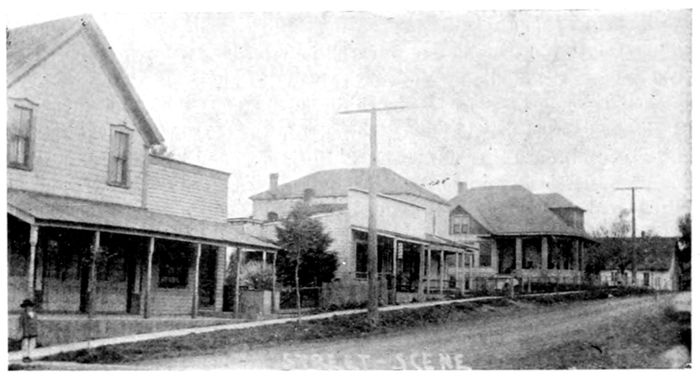
Street Scene, Potter, Kansas
The first lots in the town were sold to the late James Stalons, for many years a justice of the peace, preacher of the Gospel and prominent citizen of the county. The first house on the townsite was built by Thomas J. Potter in 1882, four years before the town was laid out. The house is still standing. The first business house in the town was erected by Charles Klein, who operated a store there until his death. A year or two after Potter was 125started the postoffice was removed from Mt. Pleasant to the place, and James B. Weir was the first postmaster. The first hotel was operated by Mrs. Elvira Pierce. Dr. Barnes had the first drug store, and was also the first physician; Frank Blodgett, the first hardware store, and B. F. Shaw & Company, the first furniture store. The first barber was Thomas Seever; the first blacksmith, Lou Chilson; the first butcher, John Yost; the first carpenter, P. H. Fleer; the first painters, George Brown and Grant Cass; the first stone masons, S. B. Morrow and Frank Maxwell; the first shoemaker, Patrick Murphy; the first stock buyer, Henry Show; the first school teacher, Albert Limbaugh; the first railroad agent, C. L. Cherrie; the first lumber dealer, David Hudson; the first harness maker, Harry Rickets; the first rural mail carrier, Frank White. Frank Mayfield operated the first livery stable; the first elevator was built by James Hawley; the first church building was that of the Methodists. The first Methodist preacher was Rev. John W. Faubian, and the first Christian preacher, Rev. T. W. Cottingham. The first telephone exchange was operated by Charles and George Sprong. The first lodge was Echo Lodge, No. 103, Independent Order of Odd Fellows. The first bank was the Potter State Bank. Potter has had three newspapers, the first, the Potter Press, was established by E. E. Campbell, in 1898. In 1900 Mr. and Mrs. Eppie Barber started the Potter Leaf. Three years later Charles B. Remsburg bought the Leaf’s circulation and launched the Potter Kansan, which is now owned and published by his father, J. E. Remsburg.
Potter is one of the most flourishing towns of its size in Kansas. Though its population is less than 200, it boasts of two banks, the aggregate resources of which amount to nearly a quarter million dollars. There probably is not another town of its size in the State that has two banks. The town has two good elevators which during the years 1912, 1913 and 1914 handled on an average of 140,000 bushels of grain a year. These elevators are operated by Fred Ode & Sons and James Robinson. The railroad station at Potter does a business that amounts to something like $40,000 annually. The shipping of live stock is an important industry here. The principal buyers are Tinsley, Potter, and Timple Bros. Much fruit is grown around Potter, and as high as $20,000 has been paid out for apples during one shipping season.
Potter has a rural high school, the first of its kind established in the State, and an $8,000 school building.
The town has two general stores, those of W. A. Hodge and P. P. Knoch; a hardware store, operated by B. F. Shaw; a grocery store, by Thomas J. Potter; a furniture store, by Frank Beard; a drug store, by G. E. 126Coulter; a hotel, by Mrs. G. F. Pope; two blacksmith shops, by R. E. Brown and G. F. Pope; a livery stable, by H. G. Hawley; two barber shops, by George Brown and Frank Blankenship; a cement tile factory, by Grisham & Maxwell; a millinery store, by Mrs. T. J. Maxwell; a telephone exchange, by E. C. Yoakum; a newspaper, The Potter Weekly Kansan, by J. E. Remsburg; two physicians, Dr. G. W. Redmon and Dr. S. M. Myers. Dr. A. E. Ricks, of Atchison, has a branch dental office here; the Lambert Lumber Company, of Leavenworth, has a commodious and well stocked yard here, with Samuel Parker as manager. There are two churches, Methodist and Christian, two public halls, and one lodge hall. L. M. Jewell conducts an insurance, real estate and loan business. There is also a garage, and other business enterprises in the town.
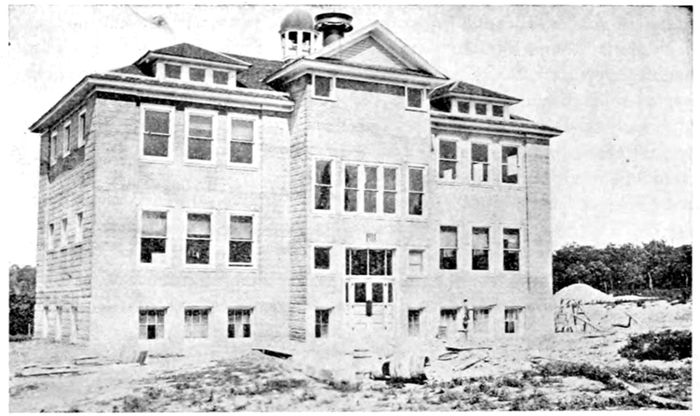
School House, Potter, Kansas
MOUNT PLEASANT.
In 1854 Thomas L. Fortune, Jr., a Virginian, settled on the “old Military road” and opened one of the very earliest stores in Atchison county, around this store springing up the village of Mount Pleasant. A postoffice was established here in 1855, and Mr. Fortune was appointed postmaster. Being an inventive genius, he finally gave up his store business and devoted his energies towards perfecting and building a road-wagon, to which reference has heretofore been made, and which he thought would revolutionize the freighting business across the plains.
127The townsite of Mount Pleasant was surveyed in 1857 by John P. Wheeler, agent for the Town Company.
Michael Wilkins and James Laird were the very first settlers in the township, being followed shortly afterwards by Levi Bowles, Jacob Grindstaff, Andrew J. Peebler, Martin Jones, Chris Horn, P. R. King, W. C. Findley, A. S. Speck and Amos Hamon.
The first hotel in the town was opened by Henry Payne, who operated it many years.
T. J. Payne and Philo W. Hull were the next parties to engage in business, Mr. Payne leaving when the new town of Sumner was started, and locating there.
The next to engage in business was P. R. King, who established a general store about 1858. He remained at Mount Pleasant until after the county seat question had been settled, when he removed to Atchison.
In the fall of 1858 a district school was opened. In 1860 the Cumberland Presbyterians erected a church building, having held religious services at the homes of the members prior to this time. Rev. A. A. Moore was their first pastor.
On May 1, 1862, the Church of Christ was organized by Elder W. S. Jackson, with seventeen members, services being held in the school house.
Mount Pleasant Lodge, No. 158, Ancient Free and Accepted Masons, of Mount Pleasant, was organized in the fall of 1868 by the following charter members: William J. Young, X. Klein, M. R. Benton, John Hawley. S. K. McCreary, Joseph Howell and Albert Hawley. Their first meeting was held October 20, 1868, with the following as first officers: William Young, worshipful master; X. Klein, senior warden; A. Hawley, junior warden; S. K. McCreary, secretary; M. R. Benton, treasurer.
In August, 1862, the name of the postoffice was changed to Locust Grove.
LEWIS’ POINT.
In pre-territorial times and in the steamboat days, Kansas had many geographical names that are not now to be found on the map. Some of them, where permanent settlements have sprung up, have been perpetuated, but the majority of them do not live even in the memory of the oldest inhabitants. One of the latter is “Lewis’ Point,” near the present site of Oak Mills. Old “Cap.” Lewis is long since dead, his name almost forgotten, and the rapacious Missouri river and “Mansell’s Slide” are now about to devour the “Point.” 128with which his name was coupled in our early geography. While “Lewis’ Point” was never a place of any prominence, and not even the site of a village or settlement, yet it was a geographical name that was known to every steamboat man running on this section of the river, and is worthy of preservation in our local history. “Lewis’ Point” was at the projection of land lying immediately above Oak Mills, on the Missouri river. It took its name from the fact that Calvin Lewis, an old riverman, settled at this point at an early day, and it became a frequent stopping place for steamboats to take on wood. In those days there was a splendid wood supply in that vicinity. Lewis’ house stood near the site of the old Champton, or William Moody, house, which was destroyed by fire about a year ago.
It is not generally known that a steamboat was ever built on Atchison county soil, much less that Oak Mills was ever the scene of the ship builder’s craft, outside of the construction of Indian canoes and the modern skiffs built by Dick King or some other later-day river man. Yet, it is a fact that Calvin Lewis once built and launched at “Lewis’ Point” a small stern-wheel steamboat, and operated it on the river for several years. In 1855 the first territorial legislature of Kansas passed an act authorizing Lewis to operate a ferry at “Lewis’ Point.”
FARLEY’S FERRY.
The same legislature that gave permission to Lewis to operate a ferry at “Lewis’ Point,” granted the same privilege to Nimrod Farley, to maintain a ferry across the Missouri river, opposite Iatan, Mo. Farley was a well known character in the Missouri bottoms in the vicinity of Iatan, Cow Island, and Oak Mills, in the early days. He lived near Iatan, but it seems that he owned land on the Kansas side, near Oak Mills, which offered a landing for his ferry. He was a brother of Josiah Farley, who laid out the town of Farley, in Platte county, in 1850. George McAdow later became proprietor of Farley’s Ferry and operated it until it was destroyed by Jayhawkers, shortly before the war.
129