Chapter XXV · BIOGRAPHICAL HISTORY (continued 4)
Reading edition
Bert Blair grew up on his father’s farm and in Atchison, and was educated in the district schools and the Atchison public schools. He lived at home until he was eighteen years of age when he engaged in railroading. It may have been the stories of his father about the travelers that prompted him to go into railroading. At any rate he found the adventurous work to his liking and he worked as a fireman on the Missouri Pacific railroad passenger train from Kansas City to Omaha, until he was promoted to the position of locomotive engineer. His run was from Hiawatha to Kansas City, which was a division of the Missouri Pacific then. In 1890 he rented his father’s farm, and at the death of the latter, he inherited eighty acres, and he has since increased his holdings to 160 acres. He has built a fine modern 456barn on his place, 50×54 feet in size, with a capacity of ninety-two tons of hay, and was designed and built by Mr. Blair himself.
In 1886 he married Sarah P. Jeffery, who was born February 20, 1869, in Missouri. She was a daughter of Ira P. and Mary (Farley) Jeffery, both of whom were born in Virginia. They came to Atchison county, Kansas, in the seventies, and are now deceased. To Mr. and Mrs. Blair have been born four children, as follows: Roberta, deceased; Claude, Effingham, Kan., married Vera Pittman, of Effingham, and has one son, Thomas Albert, who was born December 24, 1909; William C., who married Elsie Stickler, of Lancaster, and has two sons, Chester Eugene, born April 23, 1913, and Bert William, born October 20, 1914. A daughter, Sarah, died in infancy in Kansas City. Mrs. Blair died November 20, 1915, and her remains were interred in the cemetery at Lancaster. Mr. Blair is a Democrat. He attends the Methodist church, and is a member of the Eagles and Modern Woodmen of America.
GEORGE H. T. JOHNSON.
There is considerable distinction in being the oldest practicing physician in Atchison county, and this well merited honor properly belongs to Dr. George H. T. Johnson, of Atchison, Kan., who for nearly half a century has practiced his profession continuously in the city with ever increasing prestige and success which has never abated during the long period of his career. Dr. Johnson is one of the best loved and well respected professional men of the city who has won his place in the front rank of his profession by sheer merit and ability of a high order. Despite his seventy-three years of age he still continues to minister to the ailing and has kept abreast of the wonderful advances made in medical science.
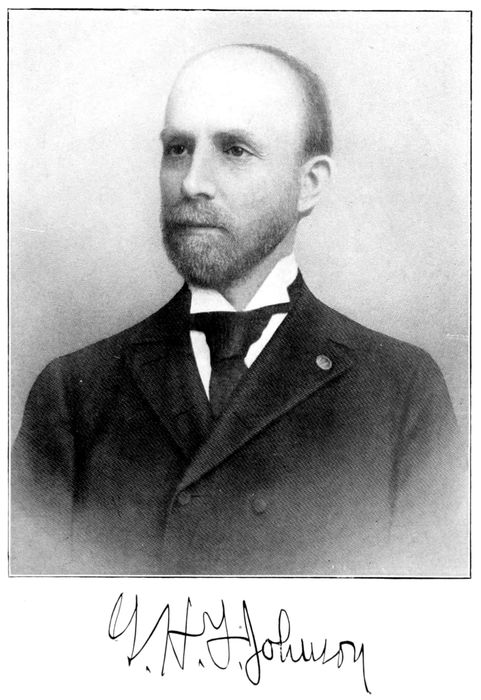
G. H. T. Johnson
457Dr. G. H. T. Johnson was born near Mt. Vernon, Jefferson county, Illinois, October 15, 1842, a son of James and Lydia (Cricle) Johnson, the former a native of Connecticut and the latter of Illinois. His paternal grandfather, George Johnson, was a soldier in the American army during the War of 1812. The father of Dr. Johnson died when he was an infant and his mother departed this life at the age of seventy-eight years. George H. T. was educated in the public schools of Jefferson county and Mount Vernon. He remained at home until the summer of 1862, when he enlisted in the Union army as a member of Company G, One Hundred and Tenth regiment, Illinois infantry. In September of the same year this regiment was assigned to the command of General Buell, then at Louisville, Ky., and first saw action at the battle of Perryville, Ky., October 8, 1862. Subsequently, the One Hundred and Tenth was transferred to General Rosecrans’ army and took part in the great battle of Stone River and the campaign which resulted in the capture of Chattanooga, and the great battle of Chickamauga. He was under General Thomas at the battles of Chattanooga, Lookout Mountain and Missionary Ridge. General Grant in person directed the maneuvers of Generals Thomas’ and Rosecrans’ combined forces during these famous engagements. Subsequently, his regiment was assigned to the command of General Sherman and served under Sherman until the close of the Civil war. He took part in the siege and capture of Atlanta and the famous March to the Sea, which culminated in the capture of Savannah, which city Sherman presented to President Lincoln as a Christmas gift. He also participated in the campaign of the Carolinas and was at the last battle fought by Sherman’s army at Bentonville, N. C., and at the surrender of the Confederate army under Gen. Joseph Johnston near Raleigh. From there the victorious army marched to Richmond, thence to Baltimore and on to Washington, where they participated in the Grand Review. Mr. Johnson was honorably discharged from the service and mustered out June 8, 1865. The doctor tells many anecdotes of his long and varied army experience which are all interesting and show that he proved himself not unworthy of the martial blood coursing through his veins and transmitted from his grandfather.
Upon his return home from the war Mr. Johnson taught one term of school and then decided to take up the study of medicine and make the science of healing his life vocation. Accordingly, he entered the Cleveland Homeopathic Medical College and subsequently attended the Homeopathic Medical College of St. Louis, Mo., where he was graduated February 26, 1869. While a student at college he heard of the city of Atchison and was impressed with the idea that it would be a good place to locate. After looking around for a few weeks he became convinced that Atchison was a desirable location for a young physician and he came here in April of 1869 and soon built up an excellent practice which grew in volume as the years went on. In 1885 Governor Martin appointed Dr. Johnson a member of the State board of health, and in April of that year he was elected president of the board and retained the position for eight years. He is president of the Atchison board of pension examiners for the United States Government and has acted in that capacity for several years, his service as pension examiner beginning during the term of President Arthur and continuing under the administrations of Presidents 458Harrison, McKinley, Roosevelt and Taft. He always takes an interest in the brothers who fought in the army under the stars and stripes for the preservation of the American Union and does everything in his power to aid the old soldiers. He is a charter member of the Homeopathic Medical Society of Kansas and served two terms as president of this society. He is also a member and has been a senior member of the American Institute of Homeopathy, the oldest medical institute in the United States. For many years he has been a member of the American Public Health Association, as well as the County, State, and American Medical Associations. Fraternally, he is affiliated with the Masonic order, the Independent Order of Odd Fellows, and the Ancient Order of United Workmen, and has been a surgeon of John A. Martin Post, No. 93, Grand Army of the Republic, since its organization, excepting two years when he served as the post commander. Dr. Johnson is a man of wide and thorough experience, broad and tolerant in his views, who has commanded the confidence and high esteem of the people of Atchison and the surrounding country during the many years in which he has been a resident of the city. He is one of the best known men in the county and holds high rank as a physician whose skill has not suffered abatement as the years have gone by.
CHARLES H. JOHNSON
Dr. Charles H. Johnson, his son, practices with his father. He is a graduate of the Kansas State University and completed a course in the medical department of Columbia University, N. Y., and also graduated from the College of Physicians and Surgeons of New York City. For two years he served as staff physician of the Roosevelt Hospital of New York City, where he gained a wide and varied experience in the practice of his profession that has proven to be invaluable to him in his later career. Since locating in Atchison with his father he has built up a fine practice and served for ten years as surgeon of the Orphans’ Home at Atchison.
THOMAS C. TREAT.
Thomas C. Treat, who is engaged in the investment brokerage business in Atchison, is one of the extensive land owners of Atchison county. Mr. Treat is a native of Atchison county, born March 26, 1865, and is a son of Levi S. and Mary D. (Cooper) Treat, the former a native of Connecticut and the latter of England. Mary D. Cooper was born in Exeter, Devonshire, England, and was a daughter of Thomas and Mary A. Cooper. The Cooper 459family immigrated to America when Mary D. was a child. The family consisted of the parents and three children. They made the trip across the Atlantic in a sailing vessel, the voyage taking six weeks. They located at Covington, Ky., where the parents spent their lives. Mary D. Cooper had friends living in Atchison, and came here in 1857, where she later met and married Levi S. Treat. Levi S. Treat was born in Connecticut in 1814, and was a son of Amos Treat, who removed with his family to the Western Reserve, which comprised twelve counties in northeastern Ohio. The Treat family located in that section in 1828, when Levi S. was fourteen years old, and there the parents spent the remainder of their lives.
When a young man, Levi S. Treat was in the employ of the Government, prospecting for copper in the Lake Superior region. He was thus engaged for eight or ten years, and in 1856 came to Atchison county, Kansas. Shortly after arriving here, he preëmpted 160 acres of land, part of which is now included within the city limits of Atchison. Here he followed farming and fruit growing in the early days and prospered and acquired considerable land. He dealt quite extensively in real estate and was one of the early promoters of Atchison, and built the first brick business house in that city. This building was located two doors east of the Byrum Hotel. Levi S. Treat was a successful business man and one of the substantial citizens of Atchison county. During the Civil war he was a colonel of the Twelfth regiment, Kansas militia. He died April 13, 1881, and his wife survived him for several years, passing away March 29, 1913. They were the parents of six children, as follows: Kate married Samuel K. Woodworth, and they reside in California; Frank resides in Arizona; Thomas C., the subject of this sketch; Alice married George Guerrier, of Atchison, Kan.; Grace married William Berry, of Atchison, Kan., and Ethel married Harry McDuff, of Omaha, Neb.
Thomas C. Treat was reared in Atchison and educated in the public schools, and later attended St. Benedict’s College. He then was engaged in fruit growing for a number of years, and in 1889 engaged in the investment and brokerage business in Atchison, and has continued in that business to the present time. Mr. Treat owns over 1,100 acres of land besides various other interests and investments. He is one of the pioneer fruit growers of Atchison county, and owns a fifty-acre fruit farm, which has few equals, if any, in the State of Kansas. The trees on this place are about fifteen years old, and, under normal conditions, are very productive. Mr. Treat has made an extensive study of the fruit business and has developed a scientific system 460of treating his trees. He was the first fruit man in Atchison county to use the spray method, and he has been very successful in the fruit business.
Mr. Treat was one of the organizers of the Union Trust Company, which was later merged into the Exchange State Bank, and has been a director, or other officer, in that institution since its organization. He is also a stockholder in the Exchange State Bank. He is a member of the Benevolent and Protective Order of Elks, and is one of the progressive and public spirited citizens of Atchison county.
CHARLES H. FUHRMAN.
Charles H. Fuhrman, farmer and stockman, of Lancaster township, Atchison county, Kansas, was born in Schleasien, Germany, December 13, 1852. He is a son of Ernst and Louise (Heine) Fuhrman, and is their only child. The father was married again, however, and to his second wife, Johanna Gerlach, twelve children were born, as follows: Ernst, Atchison, Kan.; Caroline (Dierking), Dodge City, Kan.; Louise (Repstein), Jefferson county, Kansas; William, St. Joseph, Mo.; Reinhold, farmer, Lancaster township, Atchison county, Kansas; Julius, Doniphan county, Kansas; Traugot, Center township, Atchison county; Herman, Lancaster township, Atchison county; Paul, Center township, Atchison county; Emma (Schwope), Center township. Two children died in infancy. The father was born in Germany July 8, 1826, and in 1872 came to America and settled in Atchison county, Kansas, where he bought 160 acres of land in section 16, Lancaster township. This was timber and prairie land and there was only a small, poorly built house on it at the time, but during the twenty years which he owned it he built several substantial buildings and made numerous improvements. He then sold the place to his son, Herman, and removed to Lancaster, where he lived in quiet, well-earned retirement for five years, when he went to live with his son, Paul, in Center township, where he died September 2, 1915. The mother, Louise (Heine) Fuhrman, died in Germany when a young woman in 1852. Charles Fuhrman’s stepmother, Joehanna (Gerlach) Fuhrman, was born in Germany, and is now living with her daughter, Emma, in Center township, Atchison county, in her eighty-fifth year.
Charles Fuhrman left Germany with his parents when he was nineteen years of age. He had received his education under the German system, and 461had been taught the carpenter’s trade, but never followed this occupation after he came to America. He remained with his parents, helping his father on the farm in Lancaster township until he was twenty-five years old, when he bought 160 acres of land in section 18, Lancaster township. When he took possession the farm had no improvements, and he first built a house and a barn, and added other improvements and conveniences. He acquired more land until he now owns 390 acres, including eight acres of fine timber land on his home place and ten acres of timber on the farm which he rents. He has stocked his farm with graded animals. Besides his real estate investments, Mr. Fuhrman is a shareholder in the Huron Telephone Company. He was married in 1878 to Louise Roerchen, who was born in Germany July 16, 1857. She left her native land with her uncle, Karl Schwope, in 1860. They came to Wathena, Doniphan county, Kansas. Her mother died on the ocean while coming to America and the little daughter was reared by her grandparents in Doniphan county and attended the grammar school at Wathena. Six children were born to Mr. and Mrs. Fuhrman: Ernst, farmer, Lancaster township, Atchison county; Ida (Tuley), deceased; William, Lancaster township; Selma (Lange), Grasshopper township, Atchison county; Edward, living at home; Mabel, also living with her parents. Mr. Fuhrman is a Republican, and has been road overseer of Lancaster township. He belongs to the Evangelical church, and is a member of the Modern Woodmen of America.
CHARLES LINLEY.
A true analysis of the growth and development of the manufacturing and commercial enterprises of a city invariably brings forth the fact that while the interested principals furnished capital, energy and ability, its financial institutions were also material factors. The city of Atchison is not an exception to the rule. The policy of her banks has been, since the first one was established, to extend assistance to merchants and manufacturers. Both executives and directors have been keenly alive to the fact that a liberal policy, in so far as was consistent with sound banking, was essential to commercial growth. Among those who have realized success in this field of activity is he whose name initiates this article. He first entered the banking life of the city in the early nineties, subsequently served Atchison county in an official capacity and re-entered financial circles as one of the organizers of the Union Trust Company in 1907, was later elected 462cashier of the Exchange State Bank, and in 1911 resigned to accept his present position, that of cashier of the First National Bank.
Charles Linley was born in the city of Atchison July 10, 1867, and is the only surviving member of the family of Dr. James M. Linley, a pioneer physician of the city and one of her most influential citizens. Dr. Linley was born in Salem, Ky., the son of a pioneer, and was of English descent. He was reared in his native State, received a good academic and classical education, and subsequently entered Miami Medical College at Cincinnati, Ohio, from which he was graduated with the Degree of Doctor of Medicine. During the closing years of the Civil war he entered the Union army as a regimental surgeon and served until the close of the conflict. Previous to entering the army he had married Mary A. Hubbard, a daughter of Charles Hubbard, of Hickman, Ky., a member of one of Kentucky’s most prominent families, an influential citizen and a widely known and successful physician.
Following his service in the Union army, he came to the conclusion that Kansas spelled opportunity for him, and bringing his family, located in the city of Atchison in 1865. From this time until his death, which occurred November 28, 1900, he continued in the active practice of his profession. He was recognized as one of the most successful physicians and surgeons in northeastern Kansas. He was a man of attractive personality, was intimately acquainted throughout the city and county and held in the highest esteem by all who knew him. His record for continuous years of practice has seldom been equaled in the State. He was a believer in the religion of deed, and his creed was to do good. He believed in the gospel of help and hope. For forty-five years he lived his creed and preached his gospel to the citizens of his adopted State. He was not only a successful physician but also realized a substantial success in a commercial way. He was directly or indirectly interested in many business enterprises. He was one of the active forces in the organization of the First National Bank, and from the establishment until his death was a member of its directorate. He and his wife were prominent in the social and religious life of the city, and the Linley residence was known for its gracious hospitality which was extended to their many friends with true Kentucky spirit. Dr. and Mrs. Linley were the parents of five children, all of whom, with the exception of our subject, are deceased. Hubbard Linley, the eldest, was graduated in medicine and became one of the most prominent surgeons in northeast Kansas. He was division surgeon of the Missouri Pacific railway, Atchison district. His death occurred in July, 1911. Thomas died in childhood; Victor, on November 20, 1915; and Maria died in childhood.
463Charles Linley was reared in the city of Atchison and received his early education in its public schools. Subsequently, he entered Kansas University, where he completed a course in English. He initiated his commercial career in 1887 when he entered the employ of the First National Bank of Atchison in the capacity of collector. In 1892 he was appointed deputy treasurer of Atchison county. That he filled this position satisfactorily is attested through his having been elected treasurer of the county in 1899 and re-elected to that office in 1902. His second term expired in 1905, but he held over until 1907, as the gentleman elected to the office in the fall of 1904 died before being sworn in. The administration of the affairs of this office under Mr. Linley was marked by efficiency, economy and courtesy. During the last two years of this service he was the junior member of the Antle-Linley Grain Company of Atchison. In 1907 he was actively concerned in organizing the Union Trust Company of Atchison, and was elected secretary and treasurer. He filled this position until 1909, when the Exchange State Bank was organized. This institution took over the Union Trust Company, and Mr. Linley was elected cashier. He remained with the Exchange State Bank until 1911, when he was elected cashier of the First National Bank, the institution in which he had received his first business experience some twenty years previous, and in the organization of which his father was an active factor. To the banking fraternity Mr. Linley is known as an energetic, able and progressive executive, one who has brought the administrative policy of his bank to a point of high efficiency. He has extensive commercial interests aside from the bank. He is a stockholder in the Globe Publishing Company, the Bailor Plow Company, and the Cain Milling Company. Since attaining his majority, he has been active in the political life of the county, and is one of the influential members of the Progressive party. Mr. Linley is a member and past exalted ruler of Atchison Lodge, No. 647, Benevolent and Protective Order of Elks. He is also a member of Atchison Lodge, No. 404, Loyal Order of Moose.
On June 26, 1890, in Atchison, Mr. Linley married Miss Roberta Wilson Riddell, a daughter of Mrs. Josephine E. Riddell. They have one child Robert Wilson Linley, born in Atchison, March 8, 1894. He was educated in the public schools of his native city and graduated from its high school. In 1911 he entered the law department of Kansas University, remaining until 1913, when he entered the University of Wisconsin, where he completed a course in English. In 1915 he entered the employ of the First National Bank of Atchison in the capacity of collector and remittance clerk.
464
WILLIAM H. BUSH.
William H. Bush, farmer and stockman, of Lancaster township, Atchison county, was born January 16, 1856, in Hanover, Pa. He is a son of Elias D. and Sarah (Keithline) Bush, and was one of six children, as follows: William, subject of this sketch; Samuel, deceased; John, deceased; Andrew, foreman of tailoring establishment in St. Louis, Mo.; Charles F., signal man for the Missouri Pacific railway in Colorado; Minnie, Atchison, Kan. Elias D. Bush, the father, was born December 16, 1834, in Pennsylvania. He was a stationary engineer and also followed farming for a time. During the eighties he came to Atchison county and took up farming in Shannon township. For a few years he rented his land, but later bought 160 acres in section 26, Lancaster township, which is now owned by Amel Markwalt. Elias D. Bush followed farming here until 1904, when he sold his place and removed to Atchison, where he is now living in retirement. William H. Bush’s mother was born February 27, 1834, in Hanover, Pa., and died in 1890, and is buried in Lancaster cemetery.
William H. Bush attended the common schools in Hanover, Pa., and later worked in the coal mines. In 1876 he left the East and came to Atchison county, Kansas, and for five years worked for his uncle, Andrew Keithline, and then rented land in Shannon township for eleven years. He was successful in this venture, and in 1890 bought the farm of 160 acres which he now farms, in Lancaster township. When he took the farm it had only the most meager improvements, consisting chiefly of a small house and an old barn, both in a dilapidated condition. Mr. Bush has built a fine eleven-room house and a large barn, 64×60 feet. This barn cost him $3,000, and he is willing to wager that it is one of the best, though perhaps not the largest, in Atchison county. He now owns 320 acres of land in Lancaster township and has a number of head of high grade stock, including Shorthorn cattle and Duroc Jersey hogs. Mr. Bush is a practical farmer, who, with practically no start, has, by hard work and diligent economy, become a man of comfortable circumstances. He holds a position of high esteem among the many acquaintances he has made in Atchison county.
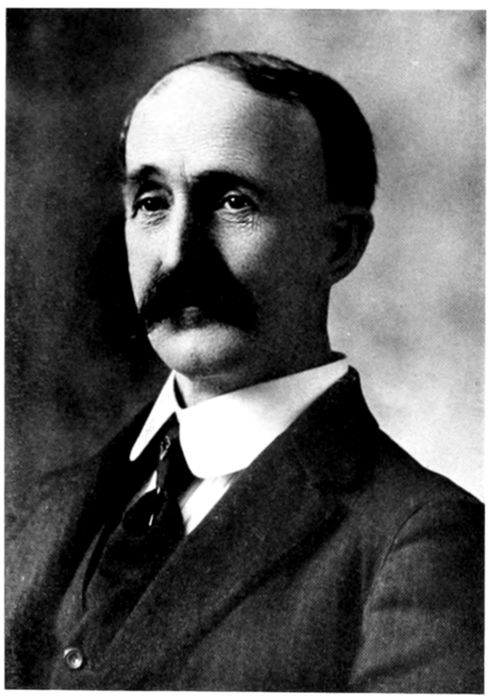
MICHAEL J. HINES
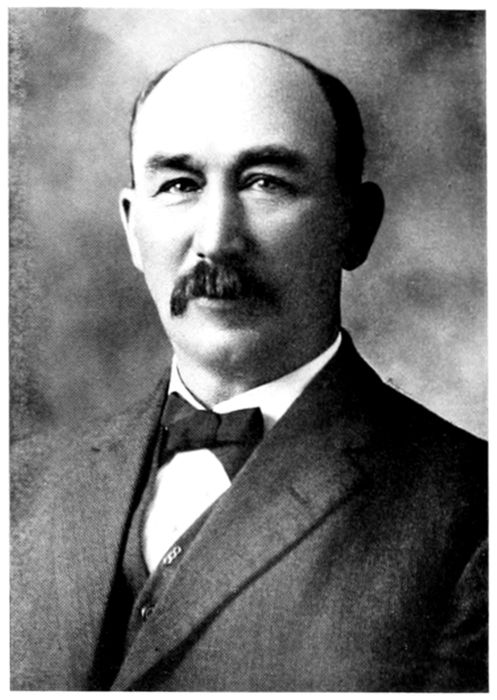
WILLIAM H. BUSH
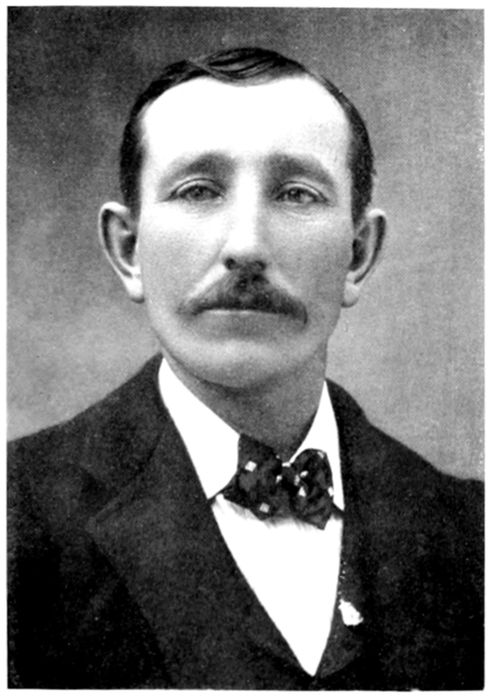
GEORGE DORSSOM
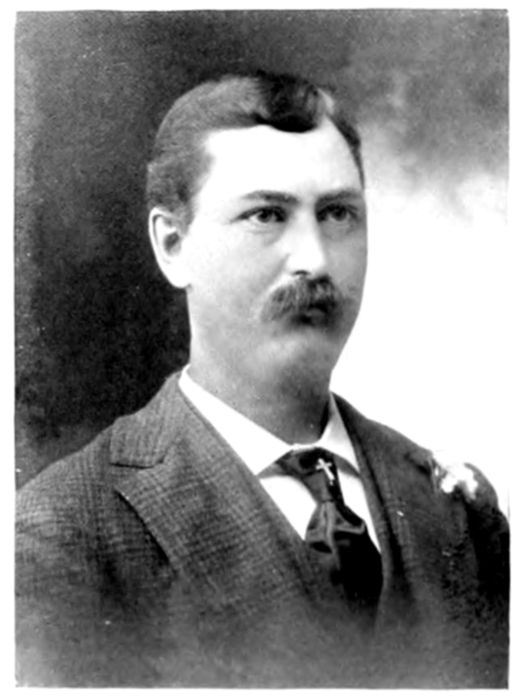
CHAS. H. FALK
465On March 30, 1881. Mr. Bush was united in marriage with Ellen J. Christian, a native of the Isle of Man, a small island in the Irish sea lying between Ireland and England. She was born January 24, 1857, a daughter of Charles and Mary (Kneale) Christian, both of whom were natives of the Isle of Man. Mrs. Bush died in February, 1911. They had six children, as follows: Cora, Atchison, Kan.; Harry, Atchison, Kan.; Mary Smithson, Lancaster, Kan.; Ina, deceased; Sarah, Atchison Kan.; Jessie, Atchison, Kan. On October 29, 1913, Mr. Bush married Mary E. Christian, a niece of his first wife, and a daughter of Charles and Ellen J. (Wade) Christian, natives of the Isle of Man. She was born near Pardee, Atchison county, March 21, 1869, and attended the Catholic parochial school of Atchison. They have no children. Mr. Bush is a Republican and attends the Methodist church. He is a member of the Independent Order of Odd Fellows and Modern Woodmen of America of Lancaster. He also is a member of the Atchison County Protective Association, of which he was one of the organizers, and served as president of the association for a number of years.
Mr. Bush is one of the most successful farmers in Kansas and is the owner of a highly productive tract of land. As an illustration of his success as a farmer, the records show that from a tract of twenty-one acres there was corn produced at an average of 108 bushels to the acre the first year, ninety-seven bushels to the acre the second year, and eighty-four bushels to the acre the third year, after which the land was sown to wheat in the natural order of crop rotation and the yield was thirty-eight bushels to the acre. Mr. Bush is a firm believer in crop rotation as a means of preserving the fertility of the soil.
MICHAEL J. HINES.
For an individual to come to Atchison county without funds and with practically no influential friends to assist him to achieve success, it is remarkable for him to accomplish in the rather brief period of twenty-six years as much as has been done by Michael J. Hines, of Lancaster township, Atchison county. It is apparent that Kansas presents unusual opportunities for a man to better his condition, if one man can accumulate 480 acres of land, become president of a flourishing banking concern and a stockholder in another important city bank. The main reason for Mr. Hines’ wonderful success must lie in the ability of the man himself, and the reviewer must of necessity conclude that the power to achieve was inherent in his mental and physical makeup, which, combined with industry, decided financial ability, honesty and uprightness has made him one of the leading citizens of his adopted county. Mr. Hines is a scion of old southern families, and comes of good old Virginia stock on his mother’s side, being descended from the well known Hunter family of Virginia, who were among the founders of the Baptist church in the southland. Mr. Hines is a large stockholder and director, and was 466formerly vice-president of the Antelope Peak copper mines of Arizona. He is the owner of a 320–acre irrigated ranch in the Valier valley of Montana, near Valier.
Michael J. Hines was born July 5, 1863, in Roanoke county, Virginia, and was one of the twelve children of Henry and Katherine (Jeter) Hines, six of whom are living. The father was born in Rockingham county, Virginia, in 1833. He was a Confederate soldier during the Civil war, having enlisted in Virginia but was not in any battles during the war. His life was spent in farming except for a time when he speculated in Confederate money. At the close of the war he had a sack full of Confederate scrip which could not be redeemed. He died at his home in Abington, Va., in 1898. His father, Richard Hines, was of Irish descent and was a plantation owner in Virginia. His mother was Sallie (Howmaker) Hines, and was of German descent. The mother of Michael Hines was also a Virginian, having been born in Bedford county, Virginia, in 1841. She died in 1890. She was a daughter of Allison Jeter. Her mother was a member of the Hunter family, who were among the first members of the Baptist church.
Michael Hines was reared and educated in Virginia and left that State in 1883 when he was twenty years of age, settling in Morgan county, Illinois, where he worked as a farm hand for six years. He then came to Atchison, Kan., and was engaged as foreman by the Greenleaf & Baker Grain Company. Six years later he bought his present farm of 160 acres. It was unimproved and none of the land was broken. Since buying the land he has made $10,000 worth of improvements on his place and has set out fifteen acres of orchard. This evidence speaks for the thrift and good judgment of Mr. Hines. He also has bought 480 acres of land in Lancaster township. He is a live, progressive farmer and stock raiser and keeps graded stock of all kinds on his farm. Mr. Hines is a shareholder and president of the Lancaster State Bank, and is also a stockholder in the German-American Bank of Atchison, Kan. In politics Mr. Hines is a Democrat, but votes independently in county and State affairs, and for the individual.
Mr. Hines was married in 1890 at Alexander, Ill., to Lillie Kaiser, who was born August 27, 1870, and six children have been born to this union, as follows: Samuel, who was graduated from the Atchison business college, and is now farming at home; Frank, Helen, Louise and Lillian, all living at home, and one died in infancy. Mr. Hines is a member of the Methodist church and is a trustee and steward in the Shannon Methodist Episcopal Church. He belongs to the Modern Woodmen of America and the Independent Order of Odd Fellows of Lancaster, Kan.
467
CHARLES H. FALK.
Charles H. Falk, of Shannon township, is the owner of the first tract of land which was filed upon in the Atchison county land office in 1854. This farm was preëmpted by Capt. William Jackson, who was a justice of the peace and a captain of home guards during the Civil war, and died at Ft. Worth, Tex., in 1911. The first house built on the place was made from material taken from the cabin of a river steamer sunk in the Missouri river. Henry Falk, father of Charles, and his son, have made so many excellent improvements on the dwelling that the dining room of the present residence is the only part of the old cabin now in use. This part of the home was built in 1857. The original owner set out a grove of cottonwoods in 1857 which was cut down in the fall of 1892 by the present proprietor, and erected a barn from the lumber sawed, which made over 112,000 feet of good merchantable lumber. Mr. Falk’s barn was built from this lumber, with the exception of the shingles. Captain Jackson sold the land to Frank Fisher, who died in 1877, six months after the purchase, and it was bought by Henry Falk, father of Charles H., in 1878. After Henry Falk’s death, Charles H. came into possession of the land by inheritance, and by purchase of the interests of the other heirs. He has made very extensive improvements since becoming the owner and despite that the soil has been in constant cultivation for more than sixty years the yield of crops is greater now than ever before, and the wheat crops in late years have exceeded twenty-two bushels an acre. The farm residence is attractively situated, in the center of the tract of 155 acres and is reached by a splendid driveway, kept in first class condition by Mr. Falk. In fact, the private road to the Falk residence is kept in far better condition than many of the country roads in Atchison county, and is in keeping with the general appearance of this fine farm.
Charles H. Falk was born May 23, 1864, in Watertown, Wis., a son of Henry, born in 1815, and died, 1894, and of Wilhelmina (Clout) Falk, born 1819, and died in 1901. Both parents were born on the River Rhine in Germany, and married in their native land. Henry Falk was a cabinet-maker and immigrated to Wisconsin in 1857, and worked at his trade until 1866, when he settled on a farm. He came to Atchison county with his family in 1879, and on February 2, of that year, moved on the farm which he had purchased the preceding year.
Charles H. Falk was married in 1885 to Elizabeth Wolters, a daughter of John Wolters, a native of Holland, who was one of the first brick-makers in Atchison and Doniphan counties. John Wolters emigrated from Holland 468to Doniphan county, Kansas, in 1857, and came to Atchison in 1858. During his long residence in Atchison he has been a manufacturer of brick, and the results of his handiwork are seen in the construction of many of the brick buildings in the city. Mr. Wolters was born in May, 1827, and is now over eighty-nine years of age and the oldest Atchison county resident at the present time. He lives a retired life on South Second street. Mr. and Mrs. Falk have children as follows: John H., a resident of Beattie, Marshall county, married Margaret Gressel, and they have two children, Karl and Pauline; Henry, in the employ of the Symns Grocer Company; Anna, a seamstress, living with her parents; Rose, wife of John McGrath, a traveling salesman for the Symns Grocer Company, and they have one child, Rosemary; Herbert, aged twenty years, and Irene, aged ten years, both of whom are at home with their parents.
Mr. Falk and his family are members of St. Benedict’s Catholic Church, and Mr. Falk is a member of the church committee of four councilors. He is a Democrat, but is inclined to be independent in his voting, having a decided leaning toward the support of those candidates that seem best fitted for the office. He has filled no civic office but that of township trustee, which he held for one year, having been appointed by the county commissioners to fill a vacancy in Shannon township. He is affiliated with the Catholic Mutual Benefit Association and the Central Protective Association and is a member of the St. Joseph society.
GEORGE DORSSOM.
George Dorssom, one of the oldest living pioneer settlers of Lancaster township in point of residence, now living retired at Lancaster, Atchison county, was born August 4, 1864, in Lancaster township, Atchison county. He is a son of George and Sophia (Storm) Dorssom, and was one of thirteen children, four boys and five girls of whom are still living. The subject of this sketch was the seventh child of the family. The father of George Dorssom, whose name also was George, was born in Germany January 8, 1820. He sailed to America and settled in New Orleans when a young man and worked as a tailor there. He then went to Wayne county, Ohio, where he worked as a tailor for a time, when he engaged in farming. In 1860 he came to Atchison county, Kansas, and bought forty acres of prairie land in section 21, Lancaster township, which he broke with oxen. He farmed on 469this place until his death in January, 1895. He came to America a stranger and without funds, but by hard work he accumulated considerable means and reared ten out of a family of thirteen children. His wife, Sophia, was a devoted helpmate, and when they were struggling to make their farm pay, she would load up a small hand wagon with vegetables and garden truck and pull it to Lancaster, where she would sell or exchange the produce for goods. This trip was two miles, and it was a great exertion for Mrs. Dorssom, but she was glad to be able to help her husband in whatever way she could. After the death of her first husband she was married again on February 19, 1896, to Jacob Merkel, a native of Germany. He died March 12, 1908. His wife is still active, despite her age, and lives in Lancaster with a maid. She is able to be about her work and takes a keen interest in life. Her children are: Mrs. Margaret Kleppe, a widow, residing in Brown county, Kansas; Mrs. Katherine Hinz, a widow, Lancaster, Kan.; John, farmer, Lancaster township; Mrs. Caroline Kloepper, deceased; Mrs. Sophia Myer, living in Soldier, Jackson county, Kansas; Adam, Lancaster township; Louisa Henrietta, dead; Mrs. Lizzie Myer, of Lancaster; Dora W., deceased; Adam, of Lancaster, Kan.; Mrs. Louisa Fridel, Brown county, Kansas; Henry, farmer, and three children who died in infancy. She has forty-five grandchildren and fifteen great-grandchildren and is very proud of them all. Her descendants all carry the idea of an industrious woman with them and the influence of the life of this woman will stay with them all through their lives.
George Dorssom, the subject of this sketch, was reared on the farm of his father. He attended school in the Bell district and worked on his father’s farm until he was twenty-five years of age. He then bought eighty acres of land from his father in section 21, Lancaster township, and followed farming for fifteen years. He has added forty acres to his farm and made extensive improvements to the extent of $7,000. He now owns 138 acres of land and a fine residence with about five acres of residence property in Lancaster, Kansas. Mr. Dorssom was a breeder of Berkshire hogs, to which he paid special attention. In 1909 he retired and moved to Lancaster, Kan. He is a Republican and was a member of the city council for four years. For a term of seven years he was road supervisor of Lancaster township. He has always taken an active interest in public affairs of his community. He has led a useful life and looks back on one of the longest careers of living citizens who were born in Atchison county. He has traveled in many parts of the United States, but is glad to have settled down in retirement in Atchison county, believing it to be the happiest country he has ever seen.
On December 31, 1890, Mr. Dorssom married Hulda Hinz, who was 470born in Germany October 1, 1860. She came to America when she was twenty years old. Her father, Edward Hinz, died in Germany in 1895, at the age of fifty-eight years. The mother, Caroline (Lutce) Hinz, came to Atchison county, Kansas, in 1896, and now resides at Leavenworth. Mrs. Dorssom attended school in Germany. She was one of nine children. A brother, Richard, is a florist at Leavenworth, Kan., and two brothers are in the same business, one, Rudolph, at St. Joseph, Mo., and the other, Amiel, at Leavenworth. Mr. and Mrs. Dorssom have no children, but they adopted a child, Gustave Hinz, a nephew of Mrs. Dorssom. They reared and educated him, and he is now farming on the home place. Both Mr. and Mrs. Dorssom are members of the English Lutheran church. He is a charter member of the Independent Order of Odd Fellows, and has been a member of the Lancaster Lodge of Odd Fellows, No. 355, since October, 1891, nearly twenty-five years. Mrs. Dorssom is a charter member of the Daughters of Rebekah Lodge, No. 431.
CYRUS E. DAVIS.
Cyrus E. Davis, founder and proprietor of the firm C. E. Davis & Sons, plumbing and heating contractors, at 509 Kansas avenue, is one of Atchison’s leading citizens, and a successful business man who has built up his business from a modest beginning in a few short years. He first started with a small shop on Commercial street, and in October, 1914, moved to his present location. A complete stock of plumbing, heating and steam fitting goods is carried in the shop, exceeding a value of $2,500. The excellence and thoroughness of the work done by the Davis establishment is marked, and the business is constantly on the increase.
Mr. Davis was born October 10, 1864, in Frederick county, Maryland, son of George W. and Belinda (Saunders) Davis. The Davis family is a very old one of Welsh extraction in America. The founders of this family were four brothers, who crossed the ocean and left their native land of Wales early in the seventeenth century. George W. Davis was also born in Frederick county, Maryland, and became a contractor and builder. He followed his trade in his native State until 1873, when he migrated to Nebraska with his family. Later he went to Texas, where he died in 1900. He was the father of nine sons, as follows: George W., a contractor and builder, of David City, Neb.; Harry W., a building contractor, of Houston, Texas; Theodore 471E., a contracting painter, of Columbus, Neb.; Mahlon, a tailor, located in Norwalk, Ohio; William M., deceased; Lewis A., a tinner and coppersmith, of San Bernardino, Cal., in the employ of the Santa Fe railroad; Cyrus E., with whom this review is directly concerned; Frank H., business agent for the Carpenters’ Union of Oklahoma City, Okla. The mother of these children was also born in Frederick county, Maryland, in 1825, a daughter of Mr. and Mrs. Walter Saunders, natives of England. Walter Saunders came of a good English family and studied in a boarding school of Southhampton, England, and became a school teacher in Maryland. He had the distinction of having taught for forty years in one school district in Frederick county, Maryland, and became well-to-do. Mrs. Davis died in 1889.
Cyrus E. Davis was educated in the public schools of Columbus, Neb., learned his father’s trade when a young man, and after taking a correspondence course in bridge engineering, he entered the employ of the Missouri Pacific Railway Company as bridge constructor. He remained with this road for five years and came to Atchison in 1886. He was employed by the Missouri Pacific Railway Company until 1905 and then entered the plumbing and heating department of the Farwell Heating Company for one and one-half years, and then became foreman for the Thayer Supply Company of Atchison. In the year 1912 he started a shop of his own on Commercial street and was successful from the start. It became necessary for him to seek larger quarters, and in October of 1914 he moved his business and shop to his present location.
Mr. Davis was united in marriage with Ida Mayhood in 1889, and to this union have been born seven children, as follows: Frank M., George E., Reynold, Fred, Norma, Charles, and Verner, deceased. All of Mr. Davis’ sons are associated with him in his business, and have learned to become expert plumbers and steamfitters under their father’s tutelage. The mother of these children was born November 9, 1869, in Leavenworth county, Kansas, a daughter of George and Mary (Carr) Mayhood, natives of Ireland, and Canada, respectively. George Mayhood emigrated from Ireland in an early day and settled in Leavenworth county about 1865, where he engaged in farming. He and his wife were married in Lowell, Mass.
Mr. Davis is a Republican, and has taken an active and influential part in the civic life of his adopted city, having served two terms as a member of the city council. He and his family are members of the Christian church, and he is fraternally connected with the Ancient Free and Accepted Masons, Active Lodge, No. 158, and the Modern Woodmen of America, in both of which lodges he is much interested.
472
HENRY BUTTRON.
The life story of Henry Buttron, late of Lancaster township, Atchison county, Kansas, reveals the accomplishments of a poor German emigrant, who began his career in Kansas with no money, and rose to become the practical leader of the German colony in the township, and to amass considerable wealth. His large farm of 960 acres which he owned at the time of his demise was left intact, to be held in trust for his children and heirs.
Henry Buttron was born in Hesse-Darmstadt, Germany, October 12, 1831, and he was one of the five sons of Jacob and Margaret (Zimmer) Buttron, two of whom came to America from their native land. Two brothers of the family, Frederick and Henry, came to America in 1852; Frederick settled in Pittsburgh, as did Henry, and he resided there until 1854, and then came to the West. In his native land, Henry Buttron had learned the trade of blacksmith; he worked at his trade in Pittsburgh, and after he came west, he was employed as a smith at Elgin, Ill., until 1857. He then came to Kansas and preëmpted a claim on section 22, Lancaster township, Atchison county. He brought a small amount of money with him, and was enabled to build a very small house, and then began to improve his farm. The crops failed in 1860, and he found it necessary to resort to the hammer and anvil in order to gain a livelihood for himself and his family. He, accordingly, removed to Atchison and was employed at his trade by Tom Ray, of the firm of Ostertag & Carmichael, and Anthony & Ostertag, consecutively for nine years. He then returned to his claim, redeemed the unpaid taxes, and entered upon a new era of progress and industry which led to his great success in the ensuing years. In 1882 he erected a large, handsome farm house, which at the time was one of the most conspicuous homes in the county. He added to his possessions as he was able, and accumulated a total of six quarter sections of good land, of 960 acres in all, all of which he left to his widow, who resides on the old home place.
Henry Buttron was married in Atchison, Kan., in 1866, to Rosa Scheu, whose father, Andrew Scheu, came from Wittenberg, Germany. The following children were born to this union: Rosa, wife of Louis Gerhardt, of Atchison; Emma, wife of Charles Kammer, of Lancaster township; Kate and Jacob, at home; Henry, who married Bertha Kemmer; Fred, married Louise Meek, lives near Nortonville, Kan.; Anna, wife of George Schulz, Lancaster township; Karl, married Anna Hegland, Lancaster township; William, George and Louis, at home. The mother of these children was born in Germany, in May, 1845, and came to America with her parents when nine years of age. She was a daughter of Andrew and Rosena (Baner) Scheu, both deceased.
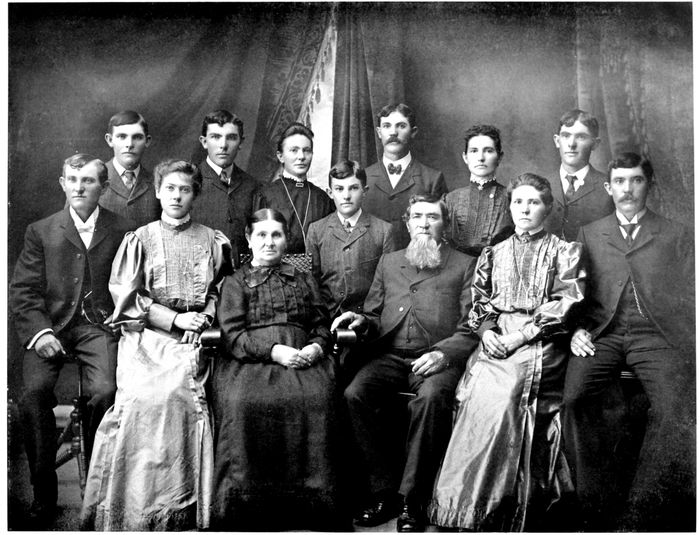
Mr. and Mrs. Henry Buttron and Family, of Lancaster Township
473Mrs. Buttron has grandchildren as follows: Kathrine, Rosa and Henrietta Kammer; Henry Buttron’s children, three, Clarence, Esther and Ruth; Fred Buttron has three children, Karl, Ralph, Mildred; Mrs. Anna Schulz has two children, Gilbert and Karl; Mrs. Rosa Gerhardt has one son, William; Karl Buttron has one child, Edward; Jacob Buttron has four children, Bertha, Emma, Alice and John.
Henry Buttron died February 8, 1913. During the Civil war he was a member of the Kansas State militia, and was in the engagement fought at Westport, and which resulted in the rout of the forces of the rebel general, Price. Mr. Buttron always took a keen interest in local and county affairs, and took a prominent part in affairs of importance to the well being of the people. He was always modest and unostentatious in his conduct, and was greatly respected by the people of his neighborhood for his cool judgment and patriotism at all times. Henry Buttron was a good citizen, and a kind parent who was highly esteemed by all who knew him.
W. H. SMITH.
Some men are natural organizers and blessed with such a deep love for the well being of their fellowmen that their activities are to a considerable extent devoted to spreading the gospel of good fellowship among mankind. The social and fraternal orders which are popular among men of any locality are simply the outgrowth of that desire, for the realization of a great dream for the “Brotherhood of Man,” which was predicted 2,000 years ago. A man who furthers the growth of organizations which have the welfare of the individual, singly and collectively, at heart is doing a considerable amount of definite good for the betterment of social conditions. Such a citizen is W. H. Smith, the widely known and efficient clerk of the district court of Atchison county, and a likeable and able personality, who figures prominently in the history of his county.
Mr. Smith was born February 3, 1855, at Knoxville, Ill. He is a son of John and Harriet (Gibbons) Smith, natives of England. John Smith, the father, was born in 1808, and died in the year 1863. He was a scion of an English family and was a graduate of Oxford University. He became a contractor and builder in his native land, but immigrated to America with his 474wife and three children in 1852, settling in Knoxville, Ill., where he died eleven years later. He was the father of the following children: Mrs. Sarah Ann Simpson, deceased; Mrs. Harriet Ann Webb, of Burlington Junction, Mo.; Charles E., of Sierra Blanca, Texas, employed as a stationary engineer by the Texas Pacific railway since 1880. The mother of these children departed this life February 2, 1890, aged seventy-eight years, at the home of her daughter, Mrs. Simpson.
W. H. Smith was reared in Knoxville, Ill. Being left an orphan at an early age, by the death of his father, it was necessary for him to start work when a boy and practically earn his own living and educate himself. By working on neighboring farms during the spring and summer he was enabled to attend school during the winter months, and succeeded in attending the Knoxville high school. He did farm work until 1865 and then learned the printing trade in Knoxville, being attached to the staff of the Knoxville Republican during the winter of 1866 and ’67, and remained until 1874 in that capacity. At the early age of twenty years he wedded Elmira Kistler, and then settled on a farm in Lehigh county, Pennsylvania, on which was located a tannery. He operated both farm and tannery until 1880, when he decided to cast his fortunes in the western country. March 2, 1880, he came to Atchison with his family and moved to a farm near Good Intent, five miles northwest of Atchison. The year before this he had made a trip to Atchison county and invested in eighty acres of land which was partly improved. He developed this tract into a very fine farm and sold it at a considerable advance over and above the purchase price in 1895. In the spring of 1890 Mr. Smith removed to Atchison and for three years served as night agent at the union station for the Wells, Fargo and American Express companies. He then bought an interest in the Home Show Printing Company, and was connected with this concern in active capacity for a period of twelve years, or until 1905. The printing company was then taken over by other parties and he continued working in the office until 1909.
During his residence in Atchison county previous to this time, Mr. Smith had become prominently identified with the Republican party and had become known as a “wheel horse” of the organization and universally esteemed by the rank and file of the party. He was elected to the office of clerk of the district court in the fall of 1908, and began the duties of his office in January of 1909. He was reëlected in 1912 and again in 1914. He was elected without opposition from any source in 1912, and overcame his opponent in 1914 by the immense plurality of 3,010 votes. For a period of three years he was secretary of the Republican central committee, 475and was for six years a member of the first Atchison county high school board, being one of the surviving members of the original board which erected the county high school at Effingham, and was likewise a member of the board which rebuilt the school house when it was destroyed by fire. Mr. Smith was a member of this board while still a resident of the county and took a prominent part in the inauguration of this worthy institution, which has been so much appreciated by the people of Atchison county.
In religious matters Mr. Smith is identified with the Episcopal church. Probably no man in Atchison county is identified with a greater number of fraternal organizations than is he. He became a member of the Odd Fellows August 2, 1882, and is also a member of the encampment. Since January 1, 1915, he has served as a secretary of Friendship Lodge, Independent Order of Odd Fellows, No. 5, and has been scribe of the encampment for the past fifteen years. For eighteen years he has been secretary of the board of trustees of the Odd Fellows lodge and is affiliated with the Rebekahs, and is a member of the canton. Since 1880 he has been a member of the Central Protective Association and was practically its originator, and has been the grand secretary of the order since 1886. The first of the annual outings and picnics held by this famous association was conducted in the grove on Mr. Smith’s farm. Visitors and guests to the number of 10,000 people have attended these picnics. Mr. Smith has been a member of the Ancient Order of United Workmen since 1895, and recorder of the order for thirteen years. He is a member of the Woodmen of the World and has been their banker for six years past. He is affiliated with the Knights and Ladies of Security; the Kansas Fraternal Citizens; a member of Atchison Aerie, Fraternal Order of Eagles, No. 173, and its secretary since 1904. Before removing to Atchison he was secretary of the Central Protective Association at Good Intent for five years. He is at present serving his second term as State secretary of the Kansas Eagles, and has held various offices in the State aerie, including the important post of State representative. Since 1895 Mr. Smith has been a member of the Modern Woodmen; is a member of the Fraternal Aid Union, and the Improved Order of Red Men, and is an honorary member of the Typographical Union.
Mr. Smith’s happy wedded life began July 4, 1874, when he married Elmira, daughter of Joel and Matilda Kistler, of Lehigh county, Pennsylvania, members of an old Pennsylvania family. Joel Kistler was a large land owner and tannery operator in Lehigh county. He and his brother, Stephen, operated a number of tanneries, and were extensive farmers, and were very wealthy. Joel Kistler came west, located in Knoxville, Ill., and invested 476heavily in Illinois land. He died at Stony Run, Berks county, Pennsylvania. Mrs. Kistler died at Schnecksville, Pa. To Mr. and Mrs. Smith have been born the following children: Estella, born July 14, 1875, deceased; Harriet Matilda, born June 6, 1876, wife of J. A. Wilkinson, of Hershey, Pa., and the mother of two children, John J., aged twelve years, and Michael aged eight years; Isabelle, born December 15, 1880, wife of Dr. J. E. Exter, of Atchison, and mother of one child, Eugene, aged five years; Pearl, born October 12, died April 25, 1890; Helen, born May 1, 1885, wife of R. H. Jones, chief train dispatcher for the Missouri Pacific railroad at Falls City, Neb., and mother of one child, Mary Elmira, aged six years; Frank Gibbons Smith, born August 8, 1891, and died February 23, 1901.
W. H. Smith is considered as one of the best officials who has ever filled a county office, and he is held in high esteem for his many excellent qualities. To his many friends and associates he is affectionately known as “Big Bill,” an appropriate name on account of his large stature, and an appellation which can well be applied to his heart and mind. While large of body, he is also big-hearted and blessed with a breadth of mind and good will which embraces all mankind.
JOSEPH W. ALLEN.
For over forty-five years Joseph W. Allen, veteran, merchant, and descendant of an old and distinguished colonial family, has been identified with the civic and mercantile life of the city of Atchison. He comes of rugged New England stock, noted for their integrity, honesty and proverbial industry throughout the United States, and has been one of the builders of Atchison’s largest wholesale grocery house. Mr. Allen has grown up with Atchison, and has come to be one of its best known and highly respected citizens, having risen from moderate circumstances at the outset of his career to a position of affluence and decided prestige among the commercial men of northeast Kansas.
Joseph W. Allen was born in Craftsbury, Orleans county, Vermont, March 2, 1841, a son of Hollis F. and Sophia (Root) Allen, natives of Massachusetts. The father was a merchant and when a young man removed from his native State to Craftsbury, Vt., where he was engaged in the mercantile business for a number of years, and in the latter part of his life he came to Atchison, Kan., dying in 1874. He had three sons who served in 477the Union army: Frank H., who later came to Atchison and was a member of the wholesale drug firm of McPike & Allen; George R. Allen, a retired manufacturer, living at Alton, Ill., and Joseph W., with whose career this review is directly concerned. A daughter, Anna H., wife of the late Frank Howard, founder of the Frank Howard Manufacturing Company of Atchison, died in 1915 at her home in this city. Another daughter, Nellie, makes her home with her brother, Joseph W., in Atchison, and is now in Honolulu. The Allen family is of Scotch origin, and Ethan Allen, of Revolutionary fame, was a member of the same family.
Mr. Allen was reared to manhood in Vermont and received a good common school education, attending the Craftsbury Academy. On October 2, 1861, in answer to the President’s call for volunteers to defend the Union, he enlisted for three years in Company I, First regiment, Vermont cavalry. He was mustered in with the regiment November 19, 1861, at Burlington, Vt., as bugler, and was mustered out of the service November 18, 1864. He left Burlington December 12, 1861, for Washington, D. C., and remained there with his regiment until February, 1863, at which time he was detailed at General De Forest’s headquarters as musician. Afterwards, he was detailed to General Kilpatrick’s headquarters as musician and remained there until General Wilson took command of the division in April, 1864. He was then detailed to General Sawyer’s headquarters until October, 1864, at which time he came to Burlington Vt., where he was mustered out of the service. Mr. Allen was in thirty-seven engagements during his three years of service, and was never wounded nor captured, nor was he absent from duty a single day on account of sickness. His regiment did notable service under Generals Sheridan and Custer, and he was engaged in the famous battle of Winchester. An incident of Mr. Allen’s army career is well worth recording. He effected, single handed, the capture of four Confederate soldiers, and the story of the capture is one of the historical incidents of the great conflict. The incident took place near Lightersville, Md., and it was after the regiment had taken part in the battle of Huntersville, Pa., July 2, 1863, and the battle of Gettysburg, July 3, 1863, the battle of Monterey on the Fourth of July, Lightersville on July 5, and on the sixth of July occurred the battle of Hagerstown. The men were all fatigued and had been deprived of both sleep and rest for several nights in succession, Joseph Allen among the rest. When they had ridden nearly all night to a point near Lightersville, they halted for rest in the small hours of the morning. Many were dismounted and fell asleep on the ground, Mr. Allen doing likewise. He slept so soundly, however, that when he awoke his comrades were gone. It was dark and he was 478uncertain in which direction the command had gone. He mounted his horse and let the animal pursue its own way without guidance. Dashing down the road, horse and rider came out into a main highway and unexpectedly came upon four men who were as much taken by surprise and fright as Allen himself. The rebels, supposing that there was a larger number of Union men following, made haste to surrender without waiting for an invitation. Allen promptly accepted their surrender and took them along to the main body which was some distance ahead. His prisoners proved to be a major, a captain and two lieutenants of the Eighth Georgia regiment.
Mr. Allen rode during the war a very sensible and intelligent cavalry horse, and thereby hangs a tale. In one of the cavalry engagements in which he participated he and his comrade were riding together under heavy fire. His riding partner was shot from the saddle and Mr. Allen felt his own horse sinking under him. Believing that the animal was mortally hurt he dismounted and jumped on the back of his dead comrade’s mount and rode away to safety. That night while lying in his blankets with the earth for his couch and the starlit sky for a canopy overhead he felt something soft and gentle nudging him. Startled, he arose hastily and was overjoyed to find that it was his favorite horse which had returned safely, but badly wounded, from the battlefield, and had hunted out his master from among the hundreds of recumbent and sleeping forms on the camping ground.
He returned to Craftsbury after his war service and engaged in mercantile business which he continued until 1870, when he came to Atchison at the solicitation of his brother, Frank H., who was at that time the junior member of the firm of McPike & Allen, wholesale druggists of Atchison. Mr. Allen entered the employ of the company as traveling salesman and was thus engaged for a period of three years. He then embarked in the grocery business in partnership with Colonel Quigg under the firm name of Quigg & Allen. Colonel Quigg commanded the Thirteenth Kansas infantry regiment during the Civil war. The firm of Quigg & Allen carried on a wholesale grocery business for about three years. Then Mr. Allen purchased his partner’s interest, and three years later consolidated with the A. B. Symns Grocer Company. A. B. Symns became the president of the company and Mr. Allen became vice-president. When Mr. Symns died in 1905 Mr. Allen became president and held the position until 1911 when he retired from active participation in the business, although he still retains a substantial interest in the company. Mr. Allen was one of the dominant individuals in the development of the Symns Grocer Company in the extensive concern which it is at the present time. When he joined forces with Mr. Symns their 479combined capital did not exceed $15,000, and during his period of association with this company their business developed into enormous proportions, and the capital of the Symns Grocer Company now amounts to $300,000. Mr. Allen was a natural salesman and had complete charge of the traveling sales department of the Symns Grocer Company, and, in fact, during the first few years was the entire traveling sales force himself. Later, as additional salesmen were added to the force he continued to direct the sales department of the business. Mr. Allen is a prominent factor in the business world of Atchison, and is vice-president of the Atchison Savings Bank. He is a member of the Benevolent and Protective Order of Elks, and in his political views is absolutely independent.
RALPH U. PFOUTS.
Ralph U. Pfouts, a leading young attorney of Atchison, is a native son of Atchison county. He was born at Monrovia December 4, 1890, and is a son of William A. and Ollie (Sharpless) Pfouts. William A. Pfouts, the father, is also a native Kansan, born in Nemaha county in 1861 and is a son of James and Caroline (Kellam) Pfouts, natives of Pennsylvania, where they were reared and married, and in 1860 came to Kansas, locating in Nemaha county. The father, James Pfouts, died a few months after coming to this State and his wife returned to Pennsylvania with her little family. A few years later, however, the Pfouts family returned to Kansas, locating at Lancaster, Atchison county, and here William A. Pfouts was educated and reared to manhood. He followed farming in early life and for eighteen years was a school teacher. In 1896 he engaged in the general mercantile business at Lancaster. To William A. and Ollie (Sharpless) Pfouts were born two children, as follows: Ralph, the subject of this sketch, and Mabel, deceased. The wife and mother died in 1901, and in 1905 William A. Pfouts married Miss Sadie M. Monnies.
Ralph U. Pfouts was educated in the public schools of Atchison county, and Kansas University, at Lawrence, Kan., graduating from the law department of the latter institution with the class of 1914. Shortly after graduating he passed the State bar examination and engaged in the practice of his profession at Atchison where he is meeting with well merited success. He has appeared in connection with important litigations in both the State and Federal courts and is enjoying a lucrative practice. He possesses the natural 480qualities of an able lawyer and is an untiring student, and those who know him best predict for him a successful career in his chosen profession. Politically, he is a Republican. Mr. Pfouts is a member of the Ancient Order of United Workmen, Independent Order of Odd Fellows, and Atchison Aerie No. 173, Fraternal Order of Eagles.
OLE G. GIGSTAD.
Ole G. Gigstad, farmer and stockman, Lancaster township, was born in Norway, October 25, 1856. He is a son of Gulick and Anna (Grannan) Gigstad. He was one of seven children, one of whom is now dead. Four sons and one daughter are now living in the United States. A brother, Knud G. Gigstad, is also a farmer and stockman in Lancaster township. The father was a native of Norway and spent his life there. Ole Gigstad left Norway in May, 1883, and came to Atchison county, Kansas, where he worked a year for his brother, Knud. Then for three years he rented a farm from his uncle in Brown county, Kansas, and in 1887 bought the farm in Lancaster township. It is an eighty acre farm and Mr. Gigstad has made improvements to the extent of $5,000, including a fine house and barn. He now owns 320 acres of well improved land, 160 acres of which are being farmed by his oldest son, Gustave, and it has a comfortable residence.
Ole Gigstad attended school in Norway, but when he sailed for America he could not speak the English language, and when he arrived here he was in debt to the extent of fifty dollars, which was an additional handicap. But his industry has brought him to the front rank of Atchison county farmers. He owns a fine herd of graded stock and is a successful farmer and stockman. He rented eighty acres additional in 1915 and he had 100 acres in corn last year.
Mr. Gigstad was married in 1888 to Severine Knudson, who was born in Norway, September 23, 1866. She left her native land in the spring of 1883 and settled at Everest, Kan., where her brothers were living at the time. In 1884 she removed to St. Joseph, Mo., where she worked four years. Her parents were Knud and Inger Sofie (Berntson) Knudson, natives of Norway. Her father was born in 1814, and immigrated to America in 1891, coming to Atchison county, Kansas, where he lived with his children until his death, in 1894. The mother was born in 1827, and died in her native country in 1887. Mr. and Mrs. Gigstad have eight children: Gustave A., farming the 160 acres 481west of his father’s farm; Ida, Charles, Albert, Emma, Edna, Alice, Benjamin, all living at home. Mr. Gigstad is a member of the Lutheran church and is a Republican.
JOHN H. BARRY.
John H. Barry, chairman of the board of directors of the First National Bank of Atchison, is one of the well known citizens of the city who has figured in the development of Kansas, especially the eastern portion of the State, for a period of many years. For fifty-seven years he has been a resident of the State, and has made his own way from comparative poverty in his youth, to a position of affluence which compares most favorably with that of the men of his day with whom he has been associated. He has seen the Sunflower State develop from a wilderness, unsettled and unpeopled, except by the wild animals and Indians, to become one of the fairest and greatest of the sub-divisions of the American Union. He is proud of Atchison and her prestige, and has played no small part in the task of advancing his adopted city to the forefront of western municipalities.
J. H. Barry is of Celtic origin, having been born in the city of Boston, of Irish parents, in 1849. His parents, Michael and Ellen (Roach) Barry, were natives of County Cork, Ireland, where they were reared and married, and crossed the Atlantic to seek their fortune in the new world. Settling in Boston in the early forties, Mr. Barry plied his trade of tailor with fair success and owned and conducted his own tailoring establishment. He died there when John H. was a small boy. His widow, accompanied by her son, then journeyed across the country to Leavenworth in 1858. Here the boy was brought up until he was fifteen years of age and in 1862 became a freighter in the employ of the Government. He was a “mule whacker,” or driver, who had charge of a team of six mules which he drove from Ft. Leavenworth across the Great Plains to New Mexican points. Saving his earnings, he embarked in the freighting business at Leavenworth for himself in 1866, driving his outfit over the route of the Ft. Scott & Gulf railroad, via Baxter Springs, Kan., through the Indian Territory to Indian agencies in the territory and Texas, carrying wagon loads of merchandise and trinkets on the outward bound trip, and bringing back a load of furs, hides and osage orange seed. The trinkets taken along were intended for the Indians who exchanged their furs for adornment. The osage orange seed was in great demand at 482this period inasmuch as the settlers were then girding their lands with osage hedges. Mr. Barry’s freighting venture proved profitable, and he made considerable money during the two years in which he made trips to the Southwest. In 1870 he engaged in railroad contracting, and was fairly successful until 1873. He graded and built many miles of railroad in southern Kansas and through Oklahoma, and in the building of the L. L. & G. R. R., he reaped excellent profits. He had his ups and downs, like other contractors, however, and one experience in particular very nearly proved his undoing. This was in the building of the M. K. & T. R. R., in which Mr. Barry had contracted to build a twenty foot embankment for a distance of one mile. It was understood with the railroad officials that the grading was to be completed by the first day of the following year, but he rushed the work so as to have it completed before the fall rains began. He succeeded in doing this early in the fall, but the head contractor, Stewart McCoy, would not accept the work as finally done before the time limit of the contract, unless he would deduct twenty per cent, from the contract price agreed upon. This arrangement meant the complete dissipation of his profits, and he finally came through with only his outfits. This experience ended Mr. Barry’s contracting career, as far as railroad building was concerned, and disposing of his outfits, he came to Atchison in 1873 with a small capital. Here on March 17, 1873, he entered the employ of the Missouri Pacific railroad as switchman and remained in the employ of this road until 1879, filling various positions, such as baggageman, trainman and yardmaster. While engaged in railroading he became interested in the civic and political life of Atchison, and possessing an engaging and candid personality, he made many warm friends, and was given political preferment. In the spring of 1879 he was elected constable and held the post and various others for three years. Following this office he was appointed chief of the Atchison city police in 1883 by Mayor C. C. Burns and served until 1885. In 1885 he served as superintendent of the Street Railway Company. Since then he has taken a more or less active part in political matters in the city and county, and is considered one of the political leaders of his party. While serving as city marshal he was a United States deputy marshal under United States Marshal Ben Simpson. In 1885 he established the Barry Coal and Wood Company, which he successfully conducted along with other commercial propositions until 1910. He became interested in the Atchison Paving Brick Company, and was active in the affairs of this manufacturing concern for over fifteen years, being still interested in the company. Upon the organization of the Commercial State Bank in November, 1906, he was elected president of the institution, and upon its 483consolidation with the First National Bank of Atchison he became chairman of the board of directors of the new organization.
Mr. Barry’s marriage with Kate Curtin occurred November 28, 1874, and to this marriage have been born the following children: John, engaged in business in New Mexico; Henry, Helen and C. W., deceased; Frances Barry Simmons, and one son, who died in infancy. The younger daughter is the wife of O. A. Simmons, whose biography appears in this volume. The mother of these children was born and reared in Leavenworth, Kan., a daughter of John and Helen Curtin, natives of Ohio, who came to Leavenworth in 1856. John Curtin was a landscape gardener by profession.
Mr. Barry has always been a Democrat. In 1885 he became a candidate for sheriff of the county, but was defeated by only four votes. In 1887 he was again a candidate for the office and was elected by the large majority of 1,150 votes. This, too, in the face of the fact that Atchison county has generally been considered a stronghold of Republicanism. So well did he perform the duties of his office, and so popular did he become that he experienced no difficulty in a second election to the sheriff’s office in 1889, with a majority of 850 to his credit. It is stated that his majority when elected sheriff of the county was the largest ever given a candidate for the place. He is a member of the Catholic church and is fraternally connected with the Ancient Order of United Workmen, the Knights of Columbus, and the Elks. Mr. Barry’s success has been due to a strong and winning personality, squareness in the conduct of his business transactions which have been proverbial, a genius and capacity for organization, which enabled him to plan and carry out his various undertakings to a successful issue, and the ability to make and retain friends.
WARREN W. GUTHRIE.
It is given to relatively few men to leave this world for the mysteries of the next, contented with what they have done here, and without regret for duties unfulfilled. At the end of a lingering illness, giving ample time for reflection, and as a last utterance, General Guthrie called closer to his bedside his faithful wife and companion and his six living children then gathered about him and whispered to them: “I know that I am about to leave you forever. I want you to know that I am going without regret except for our separation. I have raised a family in which I have had only pride. I have 484tried to prepare you to be good members of your own families and useful citizens. I have fought the fight and my work is done. I am ready to go. I want you to know that I leave you feeling that I have never done any man an intentional wrong, or left unfulfilled any duty I was capable of accomplishing, and that I go content.”
These last whispers give a fair index to the life and character of this sturdy pioneer Kansan. He was a type of a product of the early years of struggle in Kansas, now largely passing away. Diplomacy was a word of which he might never have known the meaning. He at least never practiced it to the prejudice of frankness. Whether as a friend who could be depended upon in any emergency and regardless of consequences to himself, or whether as a foe who could not be placated by excuses or offers of advantage personal to himself, and equally regardless of consequences his cards in the game were always upon the table face up. He despised sham and pretense in every form, and whether in business, politics or the judicial forum, he always fought his way double-fisted, straight for the goal.
Born June 9, 1834, on a flinty hillside farm on the banks of the Housatonic river in Connecticut, and ambitious for a broader field, W. W. Guthrie struck out for himself early in life. At seventeen he was providing for his further education by teaching a rural school in New Jersey, on the present site of Long Branch, where the chief qualification for the teacher was his ability to thrash the biggest young fisherman in the school. In his later years it was one of the delights of General Guthrie to tell of his experiences in instructing the youth of New Jersey with a clapboard.
In 1857 under the well known general advice of Horace Greeley, Mr. Guthrie, then admitted to the bar, came, seeking his fortune, to Kansas by way of steamboat up the Missouri river from St. Louis, landing at Whitecloud, thirty-one miles north of Atchison, then one of the cities upon the Missouri with small population but unlimited future possibilities. Shortly afterwards he moved again westward to Hiawatha, the county seat of Brown county, where he established himself in practice, his business radiating to the surrounding counties, which were reached principally on muleback. General Guthrie was over six feet in height, and he loved to tell how, as a lanky young lawyer with a small mule, it was difficult to keep his feet off the ground in traveling from county seat to county seat. At Hiawatha he and the late Gov. E. N. Morrill were close friends, kept “bach” together, and had the usual quarrels as to whose turn it was to scrape the skillet.
Elected to the Territorial legislature, his service attracted such attention that in his absence, and without his knowledge, he was given by the Republicans 485the first nomination under State organization for the office of attorney general; he was duly elected and served as the first attorney general of the newly created State. It was from his incumbency in that office that he became known as General Guthrie. He was not acceptable for military service and took no part in the Civil war except as a volunteer in the organization hastily effected to repel the invasion of Gen. Sterling Price, which was cut off by his defeat at the battle of Westport.
Some of General Guthrie’s friends have felt that he would not have been nominated for attorney general if he had been at the convention where he was nominated, or had known that he was to be suggested as a candidate. While General Guthrie subsequently served with credit in the Kansas State senate and was an influential factor in Kansas politics for many years in the interests of others, he was not a successful politician as a candidate in conventions not made up of a majority of men who personally knew him well. He was thrice a candidate for the Republican nomination for Congress, and once nominated by one of the two factions of a convention which split up in a row and nominated two different candidates. When it came to bodies made up of trading delegations dickering for local advantages, General Guthrie’s straightforwardness, his aversion to crooked deals and trades, and his unwillingness to offer personal reward for political assistance put him at a serious disadvantage. If he thought a man or thing was wrong he never hesitated to say so, even though he understood what the results would be. It is said that at the last congressional convention in which he was a candidate, and in which he was the favorite candidate, the balance of the power was held by a delegation amenable to the allurements of promise of office, or more direct substantial and immediate reward. His less scrupulous friends tried to “dope” the General with some medicine that would put him out of action while they used the necessary means to the end. But the General refused to be either doped or to retire and shut his eyes to the situation, preferring an honorable defeat.
General Guthrie had physical as well as moral courage. Contesting the candidacy of a former prominent citizen of Atchison who had come from another State under a cloud, General Guthrie collected the record of this candidate in his former home and announced that he would read it at a meeting to be held in old Turner Hall. This was in the early days when Atchison had her quota of “roughneck” citizens. General Guthrie was notified that they would attend and that he would read his documentary evidence at the peril of his life. He had never owned or carried a firearm except during the preparation to resist the Price raid, but on the night of the meeting 486he stepped out on the platform at Turner Hall, and laying upon the table a pair of old army revolvers, he looked down on the “roughnecks” in the front row and advised them that he was about to proceed with his speech, and that persons who didn’t like trouble had better leave before it began. He made the speech. The trouble did not start. The candidate he was opposing was defeated.
From the time Kansas became a State until his death, General Guthrie was a citizen of Atchison contemporary with that circle of brilliant and able men who in the early days made Atchison the mother of the political history of the State, such as Senator John J. Ingalls, Governor John A. Martin, Governor George W. Glick, United States District Judge Cassius G. Foster, Chief Justices Samuel A. Kingman and Albert H. Horton, and such early-day business men as David Auld, the Challiss brothers, Jacob Leu, and Samuel Hollister.
After his election as attorney general on December 21, 1863, General Guthrie, accompanied by his friend, Chief Justice Albert H. Horton, as best man, crossed the Missouri river to St. Joseph upon the ice, crawling upon their hands and knees, the ice being too treacherous to support a man walking upright, to be married to Julia, daughter of Capt. William Fowler, of St. Joseph, also a pioneer, the first county clerk in the territory of which St. Joseph is now the county seat. There were born of this marriage eight children, two of whom died in infancy, the others and the wife surviving General Guthrie. W. F. Guthrie, the eldest son, practiced law with his father until about the time of the death of the latter, when, with his wife and three children he removed to Kansas City and is still in practice. The second son, F. L. Guthrie, a retired banker, with wife, resides at Paola, Kan. Mary Louise Guthrie is the wife of A. E. White, head of the commissary department of the Burlington system, residing in Chicago, and the mother of four children. Warren W. Guthrie, Jr., practiced law in Atchison in association with his father and brother, and afterwards practiced alone until his death on August 17, 1914, being one of the most beloved men personally of all the people of Atchison. Theodore F. Guthrie, also the father of four children, is, as he has been since before his father’s decease, the manager of the Guthrie ranch in Chase county, Kansas. Gilbert L. Guthrie has been the wanderer of the family, a metallurgical engineer who has seen distinguished service on every continent of the globe, but has given up his work to be a companion to the widow, residing on the old Guthrie homestead adjoining Atchison.
From the first General Guthrie became and until ill health overtook him remained a notable figure at the bar, not only of Atchison, but of the State at 487large, and particularly northeast Kansas, where his early successes brought him in as a consultant in the territory he had formerly covered on muleback, long after that territory had developed many able lawyers of its own. His name appears frequently in the reports of the supreme court of Kansas, and in connection with the establishment of many new and novel precedents in the courts. General Guthrie was an original thinker along legal lines, and not over-tolerant of the law as he found it in the books. When it did not suit him his vigorous mind would discern logical modifications and novel applications of old doctrines to meet the new necessities of his litigation.
Every fight for the general good of the community found General Guthrie in the front of battle. No difficulty daunted him. All that was required for him was to decide as to what he thought right, and his hat was in the ring. Perhaps the greatest personal, direct service rendered by General Guthrie to the community was in connection with the failure of the Peoples Savings Bank. The Peoples Savings Bank was an auxiliary of the United States National Bank, the closing of which was brought about by the circulation of rumors affecting its solvency. It paid its liabilities in full before it closed, but the assets of the Peoples Savings Bank were invested chiefly in real estate mortgages and bonds not immediately payable, and as times were then, not readily convertible, so that its closure, following that of the United States National, left hundreds of citizens with their needed savings not immediately realizable. General Guthrie was a holder of one share of stock only in each of these banks, for the purpose of qualifying as a director as an accommodation to the operating officers, his friends. This double failure, at a time of general financial uneasiness, helped by stories circulated by enemies of the bank officials anxious to bring them into disgrace, filled Atchison with excitement. Nightly meetings, attended by hundreds of depositors, were held, and in their ignorance measures were initiated which would have resulted in a sacrifice of the assets and the realization to the depositors of but a small per cent. of their claims. General Guthrie undertook to stem this tide and save the depositors from themselves. He arranged with his co-directors to advance a sum to buy up at face value the deposits of the smaller and more needy depositors, and out of his own funds advanced the moneys necessary to protect the assets from sacrifice, and lent his own uncompensated efforts to their realization at their actual value, with the result that within a year every claim of the bank was paid in full.
Like many successful men who have been born and spent their early years upon a farm. General Guthrie was interested in farming and in farm development and in showing what could be done through proper cultivation 488and stock development. He left ample provision for his widow and younger children, chiefly in farm lands. He gave personal attention to the operation and improvement of his farms, and took particular delight in the management of his 6,000 acre ranch in Chase county, Kansas, and in the development of a grade of cattle originated by himself, the Polled Herefords, a strain of Herefords, from which he succeeded in breeding off the horns. Nothing gave him greater pleasure in the later years of his life than to explain his farming and cattle operations to his friends and intimates. He was ready to put aside the most intricate litigation at any time for a chat on this subject.
While General Guthrie’s open-handed warfare upon the things he thought wrong made him many enemies, his untiring energy, integrity and readiness to help anyone or anything he believed to be right, brought him a host of friends, not only among the young lawyers he raised and trained, but among the public at large, and he died an honored and respected member of this community on April 22, 1903, at the old home place adjoining the city of Atchison.
JOHN PETER ADAMS.
Faithfulness to duty is generally recognized and rewarded by the people of an average American community. Atchison county is singularly fortunate in having as its officials men of whom it can be said are above the average type of county officials. The office of probate judge of the county is no exception, and is ably filled by the present incumbent of whom this biography treats. John Peter Adams is an able member of the Atchison county bar and a painstaking and conscientious public official. In the performance of the duties of his high office he has won the esteem of the people of the county and showed such marked ability in his judicial capacity that he was elected to the office for the third time without opposition from any source.
Judge John Peter Adams was born in the town of Lock Berlin, Wayne county, New York, June 7, 1855. His parents were Peter and Martha (Eldridge) Adams, and Judge Adams was one of six children.
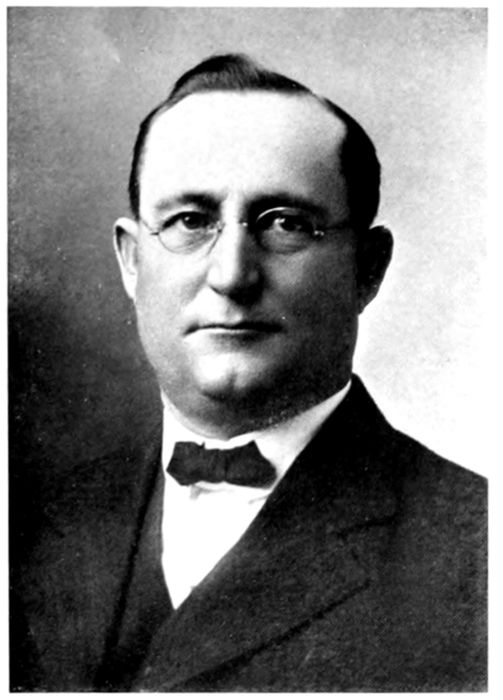
WILLIAM A. JACKSON, Judge District Court.
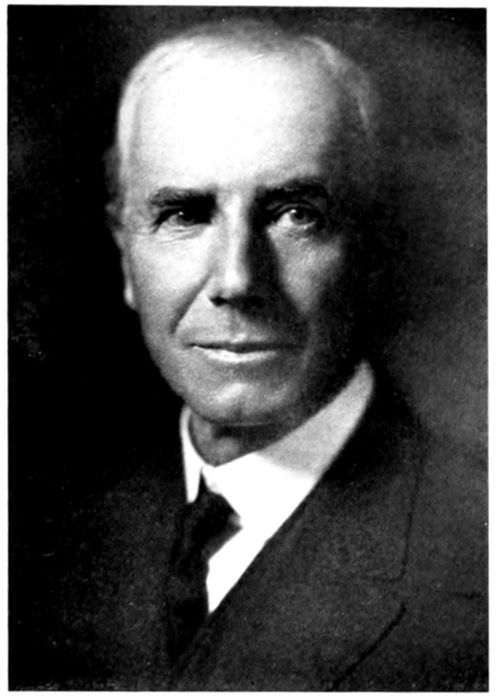
CHARLES J. CONLON, County Attorney.
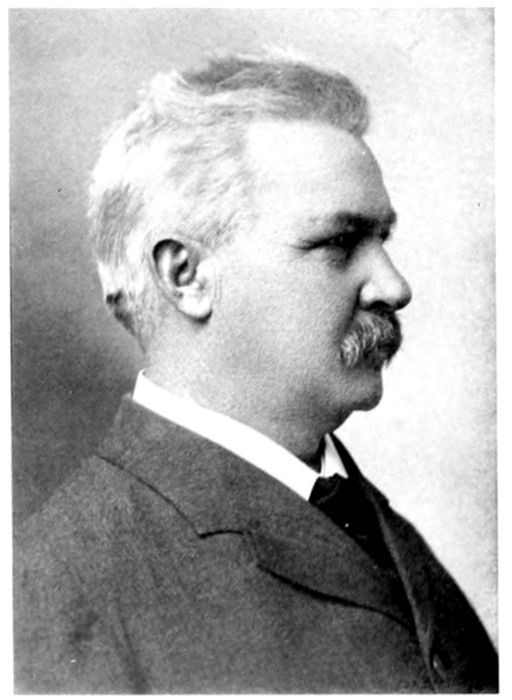
JOHN PETER ADAMS, Judge of Probate Court.
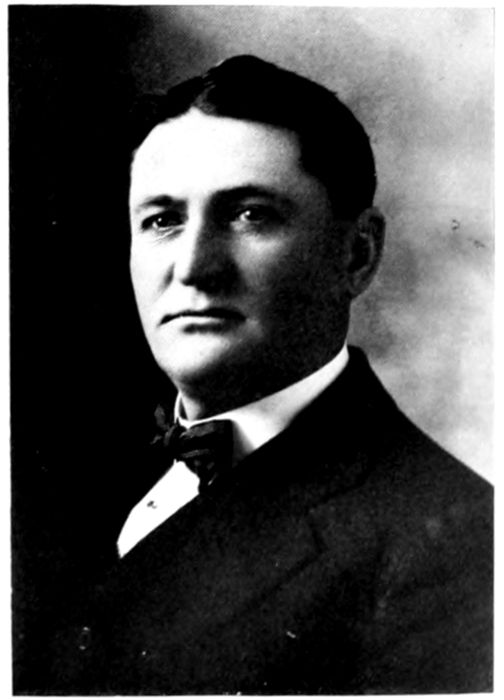
ROY C. TRIMBLE, Sheriff.
489Judge Adams received his early education in the schools of his native State and the Macedon Academy, following which he completed a business course at the Eastman Business College, Poughkeepsie, N. Y. He practically worked his way through school by teaching, becoming a teacher at the early age of eighteen. He came to Atchison in 1879 and entered the law office of Judge H. M. Jackson, as a law student, and was admitted to the practice of law in 1880. A short time following his admission to the bar he opened an office for himself, and later became a partner with Roy C. Crawford. A partnership with Charles J. Conlon was formed some time afterward, which continued until the election of Mr. Adams to the office of probate judge in 1910. Judge Adams was reëlected in 1912, and again in 1914, without opposition for the nomination or election. He is a Republican and a firm believer in a high protective tariff. Previous to his election to the probate judgeship, he served as judge of the Atchison city court, having been appointed by Governor Bailey in 1902, and reëlected three times following his appointment without opposition. Judge Adams has always earnestly advocated Republican principles and has been a faithful party worker.
Judge Adams was married in Albion, Mich., June 24, 1885, to Mary Stevens, a native of Lock Berlin, N. Y., and a daughter of Wells J. L. and Nancy Stevens. To Judge and Mrs. Adams have been born three children, who are the pride of their parents, as follows: Eldridge, born November 30, 1892. He received his classical education in Kansas University and graduated in medicine from Rush Medical College at Chicago in 1914, after a thorough course of study in the University of Chicago, now a practicing physician and surgeon in the Illinois State Hospital for eye, nose and throat, at Chicago. Dr. Adams is a rising young physician of marked ability and was an apt student, and is ambitious to succeed in his chosen profession. He graduated from the Atchison High School at the age of fifteen, from the Kansas University at the age of nineteen, and received his Doctor of Medicine degree from Rush College of Medicine when but twenty-three years of age. It is safe to predict a brilliant future for this Atchison boy. A daughter of Judge Adams, Eleanor, aged twenty, is a student of Knox College, Galesburg, Ill., class of 1916, where she is specializing in music—violin and voice. Genevra, the youngest child of Judge and Mrs. Adams, is eighteen years old, a graduate of the Atchison High School, and a student in Baker University. The Adams family has resided in the same house at Fourth and Laramie streets for thirty years, or since the marriage of Judge and Mrs. Adams. They believe in giving their children the advantages of a good education, as the best preparation possible for their future success.
Judge Adams was reared in the Episcopalian faith, which was the church of his fathers, but is an attendant with the members of his family at the Methodist Episcopal church. He became a member of the Masonic lodge in 1876.
490
WILLIAM ANTHONY JACKSON.
While we reverence the courts and look upon them as the final refuge of the citizenry in time of oppression or trouble, we realize that the tribunals of the people for safeguarding our inalienable rights as citizens are measured in their usefulness by the character of the men chosen to sit at the head of the judiciary. Society is protected from those criminally inclined, and we accept without criticism the decisions of the judges with whom we come into personal contact, because of the fact that the masses of the people have an abiding faith in the integrity of the courts. This confidence is more in evidence in a community where all have an opportunity of judging at close range the qualifications and personal integrity of those chosen by the people to administer the judicial affairs of the people. It is meet and necessary that the judges in whom we place implicit confidence be men of the highest calibre, broad-minded and sympathetic in dealing firmly with the many diverse cases which are brought before them for adjudication. The district court of Atchison county is presided over by a learned jurist who has the confidence and esteem of the people, and who enjoys the universal respect of the citizens of the county. Hon. William A. Jackson, judge of the district court of Atchison county, is such a man wisely chosen to fill the highest office within the gift of the people in his district. His career as presiding officer of the court has been marked by a display of ability, legal acumen, broad-minded and sympathetic discernment of right and wrong in handing down his decisions that have satisfied the most exacting. He was born in Versailles, Morgan county, Missouri, October 6, 1866. He is a son of Judge Horace M. and Lavanchia Isabelle (Valentine) Jackson, a review of whose life is given in this volume.